
Car Dealers vs. Consumers: Make Your Voice Heard

In June, the Federal Trade Commission proposed a new set of rules that would ban unscrupulous sales practices that are commonly employed at car dealerships. Among the notoriously anti-consumer practices targeted are the sale of products without benefit, bait-and-switch pricing, forced add-ons, and discriminatory practices for cash buyers.
There’s a reason the annual trustworthiness of profession poll from Gallup ranks car salespeople at the bottom; it’s not because every salesperson is bad, it’s because a few bad apples ruin the bunch. Over the years I have heard countless stories from our community of these aforementioned practices. Still, powerful dealer lobbies are combating the FTC proposal, and it’s become clear that they’re determined to defeat the proposal at all costs.
Fortunately, consumers have a real opportunity to have their voices heard. A public comment period is now open until September 2022, and we’re calling on you to share your opinion with the FTC. It’s clear that auto dealers are already amassing a unified position, and we need to do the same. If consumers show up in numbers, car buying may be transformed for the benefit of we, the people. Time is of the essence, as this narrow window leaves less than two months for the public to share their support.
FTC proposal Levels the Playing Field for Car Buyers
On June 27th, The Federal Trade Commission proposed a new set of rules that would ban specific auto sales tactics commonly used by car dealers to take advantage of consumers. In an FTC proposal titled Motor Vehicle Dealers Trade Regulation Rule No. P204800, the following auto dealer practices are targeted:
- Selling products with No Benefit to the Customer
- Advertising the Real Price of the Car Online
- Non-Discriminatory Practices for Cash Buyers
- Enhanced Consent for F&I products
FTC Bureau of Consumer protection Director Samuel Levine explained the reasoning behind the proposed rules. “As auto prices surge, the commission is taking comprehensive action to prohibit junk fees, bait-and-switch advertising and other practices that hit consumers’ pocketbooks. Our proposed rule would save consumers time and money and help ensure a level playing field for honest dealers.”
The average new car transaction is now $47,202, or 72% of the median household income in the United States. Bait-and-switch pricing, forced add-ons and dishonest financing tactics have all contributed to the average monthly car payment soaring to $730, 40% higher than the average payment just five years prior. With car prices at record highs, consumers are fed up with anti-consumer sales tactics that proliferate at many dealerships nationwide.
This is our chance as consumers to unite behind a proposed rule that could change car buying for the better unlike ever before. However, this battle is far from won.
Car Dealer Dissent Has Been Swift, Yet Flawed
The National Automobile Dealers Association, or NADA, is a nationally-recognized industry and political force that represents over 16,000 auto dealers nationwide. Every year, the NADA and its counterpart for independent dealers spend millions of dollars lobbying politicians to advance legislation that is pro-dealer, too often at the expense of the consumers the auto industry relies on. The power and influence of today’s car dealers can be traced directly to the NADA and NIADA.
Needless to say, the dealer lobby isn’t happy about the FTC’s proposed rules. In a letter to the FTC, the NADA characterized the proposal as unsupported, sloppy and inconsistent. How so? NADA senior vice president Paul Metrey dismissed the proposal as “woefully inadequate” because the regulation is unnecessary in his view, because it would address “things they can go after” already. It’s as if dealers and their powerful lobbies are fully aware of the anti-consumer sales tactics flourishing in the industry, but are content with pushing the limits of regulation until enforcement encroaches on their bottom lines.
Read the full NADA response here.
Another flawed argument promoted by the NADA is that complaints are few and far between. The FTC said it received more than 100,000 auto-related complaints in 2021. To counter that startling statistic, the NADA says there were 42 million new- and used-car sales last year. We all know that car buyers rarely have the time to seek out the procedures to submit a formal FTC complaint. Consumers have jobs, families, and other financial obligations on their minds. Imagine if one out of twenty dishonest car sales resulted in a formal complaint. In reality, reporting is likely even lower.
CarEdge’s Community Members Share Troubling Car Buying Experiences
There’s no way of knowing just how widespread this problem is, yet every day our community of CarEdge members shares tales of shady dealership practices, and dishonest, anti-consumer tactics that cost them time and money. Whether it be comments on YouTube, or essays we receive via email; our millions of monthly viewers are fed up with the status quo, and demand change.
Industry media outlets are picking sides, and some heavyweights are clearly siding with dealer lobbies. Industry news outlet Automotive News published an editorial promoting the talking points disseminated by the NADA and NIADA. They too are calling for interested parties to submit comments during the narrow public comment period.
The Time to Act Is NOW. Make Your Voice Heard By Submitting a Comment in Favor of the FTC’s proposal
The FTC’s open commenting period is now open, and it will remain open until September 12, 2022. Anyone can submit a comment to voice support or displeasure with the proposal. In a classic David versus Goliath scenario, dealer lobbyists are facing off against consumers like you and I. With massive auto dealer lobbies and even media outlets calling for dealers to submit comments opposing the proposed rules, it’s up to all of us to make our voices heard. Submit a comment today on Regulations.gov. This should be a priority for all Americans who are sick and tired of car buying being synonymous with deception and dishonesty. We’ll keep you posted on the latest developments.
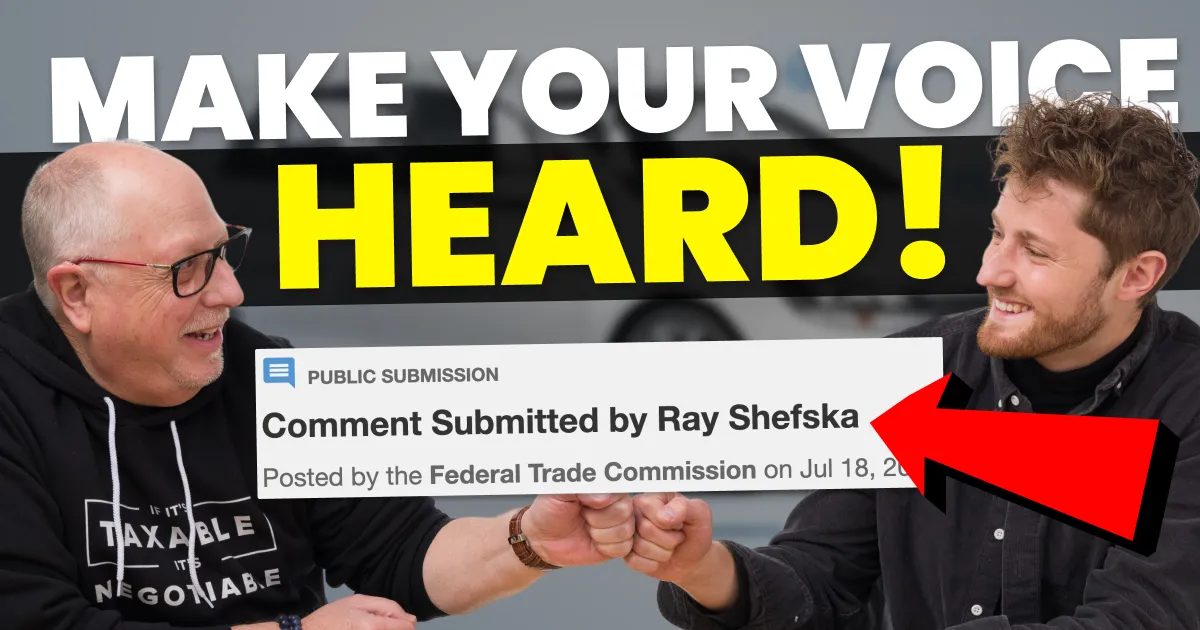
Read Ray’s comment to the FTC
View Ray’s comment here, or read it below:
As someone who spent 43 years managing automobile dealerships and advocating for better enforcement of rules and regulations regarding dealer advertising and F&I practices, I strongly support your efforts to finally rid America of the unethical practices that many dealerships employ. Business decisions are made by dealerships everyday as to how to advertise the price of a vehicle online. Should we include the destination charge that is part of the MSRP in the price or should we disclose that in the small print? Should we disclose any dealer installed accessories or packages that the customer is expected to pay for in the advertised price or should we only disclose that once they have come into the dealership? Should we disclose all dealer and state fees or again wait until the customer has agreed to buy the car? How should we disclose our F&I offerings, or our rate markups for placing indirect loans? These are all business decisions that truthfully should not have to be made, full disclosure and transparency is not only what consumers want, it is what they are entitled to. You can read many consumer complaints in regards to this issue on our YouTube channel: https://www.youtube.com/c/CarEdge/ videos, just click on just about any video and read what consumers are saying on a daily basis.
One must question what is wrong with a society as a whole when everyone knows that consumers are taken advantage of everyday when purchasing a car or truck and everyone turns a blind eye to it. Law enforcement, consumer protection agencies, State Attorney Generals, the Federal Trade Commission and many other “consumer” protection organizations all know what is going on yet do next to nothing to correct it. The essence of commerce should not be “who can we take advantage of today” but rather how can we operate in a consumer respectful and honest manner. I believe the enactment of these proposals would bring us closer to the later and finally rid our society of the former.
Sponsored by Insurify
Are you overpaying for car insurance?
Compare rates from top carriers in under 5 minutes. CarEdge users save an average of $996/year on auto insurance.
*Disclosure: CarEdge may earn a commission when you compare insurance quotes through our partner, Insurify. This does not influence our editorial content.*