
AI Is Poised To Change How We Buy Cars

Key Takeaways
- Agentic AI can handle vehicle research, lead filtering, and price negotiations, shifting the focus from quantity to quality in dealer-consumer interactions.
- Transparency will become the norm as AI shopping agents collect and share out-the-door pricing data, exposing hidden fees and rewarding honest dealers with more sales.
- Dealers and buyers both stand to benefit. By automating tedious tasks and reducing misaligned incentives, AI creates a faster, more efficient, and trust-driven retail automotive experience.
By Zach Shefska, Co-Founder & CEO of CarEdge
Retail Auto Status Quo: A Broken System
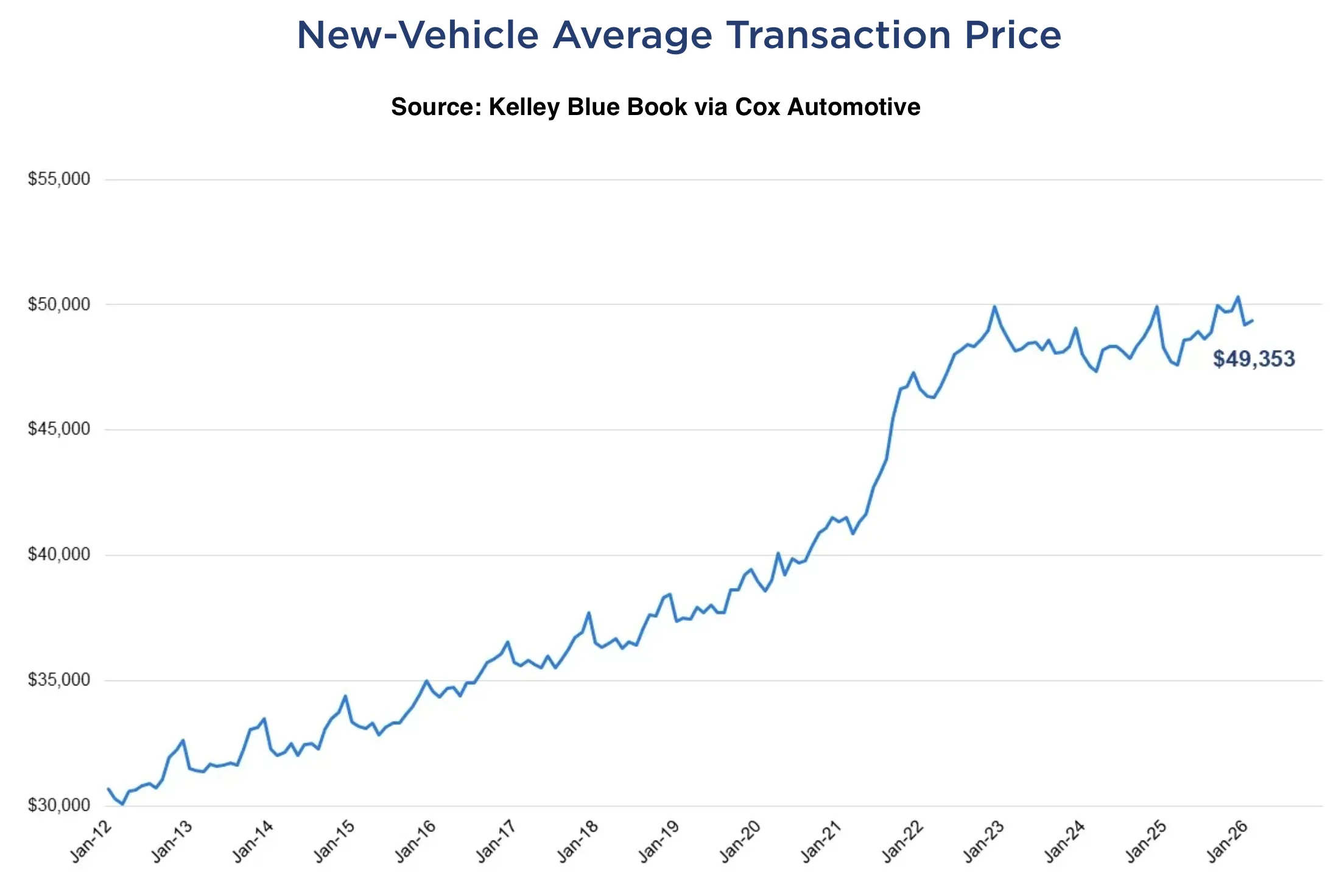
Spending $50,000 should be fun, exciting, and rewarding. Sadly, for both consumers and car dealers, the car buying process is typically the opposite. Riddled with inefficiencies and frustrations, the age of AI presents an opportunity to redefine retail automotive sales.
Trust between buyers and sellers is at an all-time low. In Gallup’s annual trustworthiness of profession survey, car salespeople consistently rank at the very bottom. In the most recent poll, only 7% of Americans reported that they trust car salespeople to have high honesty and ethics. It’s no surprise then that many shoppers dread stepping into a showroom. Lack of transparency on pricing, confusing add-ons, and high-pressure tactics have made the process feel adversarial.
Not only does this broken status quo tarnish dealers’ reputations, it also hurts their bottom line. Consider the fact that the turnover rate for dealership sales consultants is nearly 72% (double that of other roles at the dealership). Dealerships are unable to retain their sales staff. Why? The quality of life for a sales consultant in a dealership can be poor, and while the pay can make up for it for a while, it is untenable for many long-term.
Ask any dealership sales team about their pain points, and they’ll inevitably mention lead bloat – a flood of online leads and inquiries, most of which go nowhere. Third-party listing websites and lead generators grew quickly as retail auto sales transitioned online in the mid to late 2000s. These websites often blast the same customer inquiry out to multiple dealerships, creating a frenzy where five stores chase one lukewarm prospect.
The result is wasted time and money: the average dealership converts only about 2% of its third-party leads into sales, however third-party leads make up a significant amount of total lead volume. That means salespeople must sift through countless inquiries to sell just one car (or dealerships invest in expensive business development centers, adding to their already high cost infrastructure).
The incentives in today’s system are misaligned – many third-party platforms profit from quantity of leads, not quality of outcomes. Dealers and OEMs end up paying for lots of noise and very little signal. This traditional model leaves everyone dissatisfied. Consumers feel pestered and distrusted, and dealers waste resources chasing ghosts.
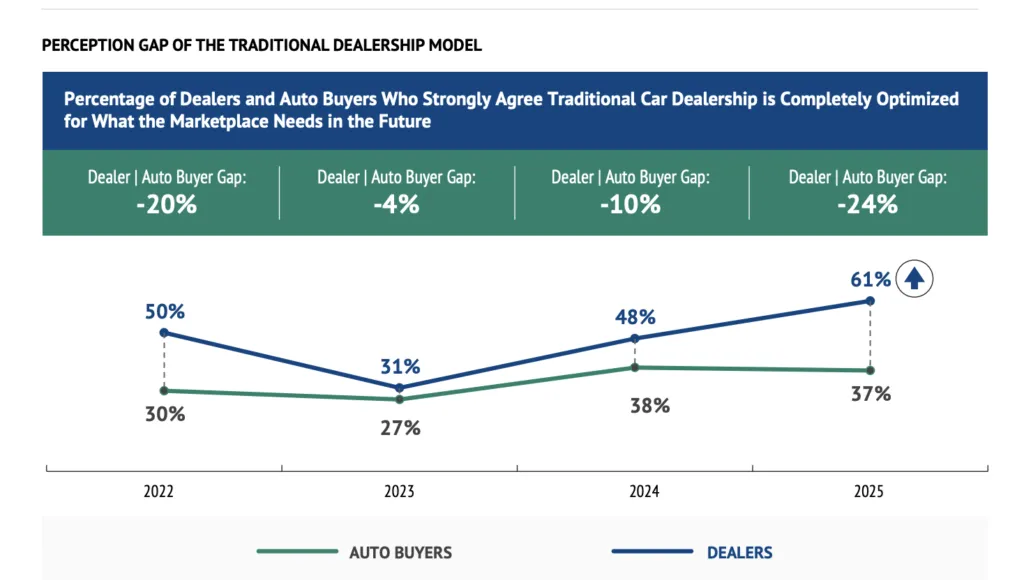
Source: Urban Science and The Harris Poll
It’s no wonder then that this paradigm has led to the largest gap between dealer and consumer expectations, ever. In 2025, 61% of dealers believe buying a car from a dealership is “completely optimized,” whereas only 37% of consumers agree. There is a lot of work to be done to close this gap, and improve the overall experience for the entire marketplace.
AI To the Rescue
Is there a better way? I believe so, and AI will usher in change at an unprecedented rate.
A recent survey found that 25% of consumers are already using tools like ChatGPT to assist them in purchasing a vehicle, and that 40% of consumers say they will use AI tools to support them in their future vehicle purchases. AI adoption at dealerships is significantly higher (albeit nascent in scope), with nearly 90% of dealerships reporting that they have already deployed AI at their store.
How will AI impact retail auto?
Let’s start with third-party shopping websites. These platforms are incentivized to keep users scrolling through thousands of listings, with dealers and OEMs paying fees for sponsored placements and advertisements. Their user experiences are optimized for form fills and lead submissions with dark UX patterns encouraging users to submit more and more leads – quantity over quality.
Think of your own search behavior for a moment. Before LLMs, you likely scrolled through the first page of results on Google to find the blue link you wanted to click on. How do you search now? You use AI Mode, or type a question into ChatGPT. There’s a reason why Google search traffic is falling for publishers, and it’s because there is a fundamental shift in how consumers access information.
The same is true for retail automotive. Third-party car shopping websites will evolve to look more like ChatGPT. Imagine an intuitive interface where you can ask questions, share input, and ultimately be presented with options that work for you. AI will change how consumers research and ultimately decide on the vehicle they want to purchase.
Dealerships will spend less time explaining features and capabilities – customers will have vetted that information with their AI shopping agent first. Sales consultants won’t waste time chasing leads that aren’t in the market to shop – instead they’ll get notifications from buyer’s AI shopping agents that the customer is ready to purchase. Because consumers will be more educated and empowered before contacting a dealership, we will see a fundamental shift in the leads business away from quantity and towards quality. This is good.
Agentic AI presents a compelling use case for consumers and dealers to hand off even more of the rudimentary grunt work of car buying as well. Why would I go to the dealership and haggle with the salesperson when my AI shopping agent can do it for me? As a dealership operator, why would I employ a sales consultant and sales manager to negotiate with an AI agent? I wouldn’t. For these customers, AI agents will handle it instead.
Agentic commerce means agentic commerce. Agents representing both consumers and dealers will engage with each other. Cost infrastructure will come down and time will be given back to the humans previously in the loop.
Buying a car is one of the few purchases consumers engage in that requires negotiation. Salespeople and sales managers negotiate every day, but customers do it once every three to five years. Negotiations are a dreaded (and time consuming) part of the buying process and a perfect example of where agentic AI can level the playing field, increase efficiency, and drive positive outcomes.
At CarEdge we’re already seeing the beneficial impacts of agentic AI for both sellers and buyers. Consider the story of Thomas. He came to CarEdge in June looking to purchase a Honda Accord. Thomas’ AI agent contacted numerous dealerships in his area that all had the vehicle he was interested in, right down to the specific trim and options.
While Thomas was at work, his AI agent engaged with the dealerships and ultimately, after 13 messages back and forth with one dealer in particular, achieved an out the door price of $36,900. The initial out the door price quote was $38,180.

Thomas went in that afternoon and purchased the vehicle. Thomas saved time, and $1,280 thanks to his AI agent. This is how agentic commerce is already influencing retail automotive.
How does the entire automotive ecosystem win with agentic AI? It’s simple. Data.
Car prices are notoriously opaque. The only way to really know what you are going to pay for a car is to contact a dealer and get an out the door price quote. The FTC and states’ attorney generals have gone after myriad dealerships over the years for bait and switch pricing and forced add-ons. However the practice is still prevalent, and in many cases, it’s a cost of doing business.
Take for example this Nissan Rogue for sale in Florida.

The online advertisement is hard to decipher, however it appears the price is $32,415.
Upon contacting the dealership, the price is actually:

$34,239 (plus tax/title/fees & payoff – whatever that is in this case). How and why did the price increase by nearly $2,000? Who knows. But this is all too common in retail automotive.
These practices obviously frustrate and confuse customers, however they also harm dealers who are reputable and don’t play games. Andrew Wright, Managing Partner at Vinart Dealerships shared his frustrations on X:
“I inquired about what this major 3rd party classified listings company was doing to police their platform for dealers engaging in deceptive pricing practices. The answer in short: NOTHING… All of the major classified listings platforms (Cars Commerce, Autotrader, CarGurus, Carfax, etc.) know that this is going on and they are doing NOTHING to stop it. In fact, they are REWARDING this behavior by affixing “great deal” badges on cars with deceptively low pricing.”
How do AI agents solve this problem? It’s simple. They collect, organize, and retain complete pricing data to bring unparalleled transparency. Currently, there is no third-party collecting accurate data on vehicle pricing (including dealer fees and add-ons). There have been some nascent attempts to flag bad actors (i.e. Markups.org and online review websites), however their scope and efficacy is limited, and we all know that consumers and dealers are equally capable of leaving bad reviews that stretch the truth. Pricing transparency isn’t just good for customers, it’s a competitive edge for honest dealers. AI helps surface trustworthy dealers in a crowded market and rewards them with more sales.
AI agents flip the script. Instead of relying on human beings to get out the door pricing and then manually enter that information into some sort of crowd-sourced database, AI agents are able to automate this process, removing any potential biases.
At CarEdge, our car shopping agents have been deployed 10,000 times since launch in late July, and we have collected data on thousands of dealerships. Want to know which dealer is adding “mandatory” nitrogen tire fill for $399 to all of their vehicles? We know it. Want to know which dealers are not playing games and leading with transparency? We have it.
AI agents level the playing field for consumers and dealers. Publishing and sharing this data will bring transparency unlike ever before, and will challenge the industry to operate more efficiently and fairly for everyone involved. Again, this is only possible thanks to agentic AI.
Artificial intelligence’s impact on retail auto will be profound (and it already is). From vehicle research and selection, to negotiation and pricing, agentic AI brings much needed transparency and efficiency to an industry that desperately needs it.
For consumers, the car buying experience is about to get radically easier. For dealers and OEMs, the ones who embrace this new model won’t just survive, they’ll lead. The age of agentic AI is here, and it’s time we start building with it.
Sponsored by Insurify
Are you overpaying for car insurance?
Compare rates from top carriers in under 5 minutes. CarEdge users save an average of $996/year on auto insurance.
*Disclosure: CarEdge may earn a commission when you compare insurance quotes through our partner, Insurify. This does not influence our editorial content.*