
CarEdge saved me over 4,500 dollars on a brand new Honda Pilot. I can't say thank you enough.
Price intelligence
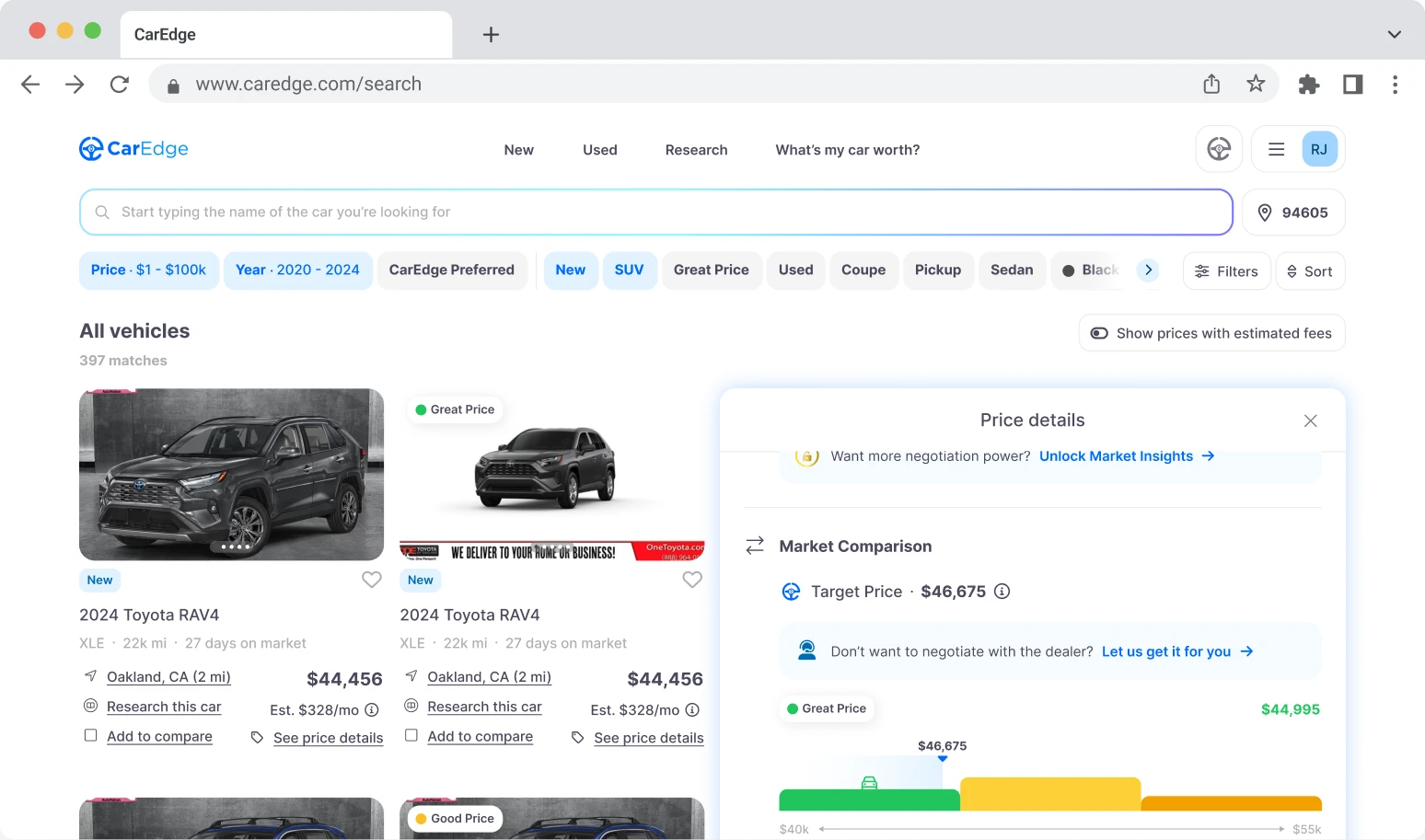
Find a wide range of vehicle listings with market insights on new and used listings near you.

What can I do with CarEdge?
 CarEdge Insights
What can I do with CarEdge?
Get access to exclusive information so you can make an informed car buying decision — all in one place.

Find a wide range of vehicle listings with market insights on new and used listings near you.
Track your vehicle’s value and cash in when the time is right to sell.

Access to our proprietary data to help you find the right car, at the right price. Find these unlocked on every listing after subscribing.

With our expert-led, tech-enabled car buying service, we will locate, negotiate, and deliver your vehicle so you can get a new car hassle free.


Help us personalize your CarEdge experience — it only takes a second.
Your answers help us personalize your CarEdge journey — we’ll follow up with tips and next steps that match your buying timeline.
It’s no surprise that working in the auto industry since the 70’s has yielded dozens of crazy stories. Zach asked me to gather together some of my craziest dealership stories in one place. You’ll hear some good ones, some bad ones, and they’re all a sneak peek into the life of working at a dealership.
Without further ado, let’s dive in.
Back in the late ’70s, we had a customer come to the Nissan dealership and go through the motions of buying a new car. When it came time to do a test drive, we took a photocopy of his ID, and he and the salesperson headed out. During the drive, the customer asked to make a stop at a 7/11 to pick something up.
It turns out what he wanted to “pick up” was all the cash out of the 7/11 cash registers. He planned to use our car as the getaway car for his robbery. The salesperson was an unwitting accomplice (don’t worry, the salesperson wasn’t charged), and the robber was arrested.
Back at the dealership, when the test drive had dragged on for longer than normal, we called the cops, and they were able to track down the robber and his unsuspecting accomplice. This is one of the many reasons why we take photocopies of driver’s licenses before test drives. In my 43 years of being in the car business, this experience might hold the top spot as one of the craziest dealership experiences I’ve ever had.
Much like the story above, I remember when I worked as a sales manager at singlepoint Pontiac dealership (yes those existed at one time), and a customer was going through the motions of looking to purchase a car. When it came time to test drive the car, he and the female sales associate disappeared. After being gone for 7 or 8 hours, there was cause for concern.
Let CarEdge help you buy your next car! It’s like Honey, but for buying cars, trucks, and SUVs. Sign Up For Free
Again, back at the dealership we called the cops (you’d be surprised how many 911 calls I had to make during the early days of my career), and fortunately the prospective customer (and kidnapper) came back with the car and our sales associate. When he arrived, the police were waiting, and he was charged with kidnapping. Thankfully, having a photocopy of the driver’s license helped the police bring a quick resolution to the kidnapping.
At our old Mini dealership, we carefully picked all of our test drive routes based on showing off how well the Minis handled. Many people buy Minis because of how fun they are to drive, so our job as a sales team was to expose prospective customers to that experience anytime they got behind the wheel. I was a sales manager at the dealership back in the early 2010’s, and I still remember the day I had to rush from my office to a backroad only a mile from the dealership to once again call 911.
A customer out on a test drive drove right into a tree. The car rolled and was totaled, and both the customer and the salesperson were rushed to the hospital. Fortunately, everyone survived, and miraculously the salesperson only missed a few days of work.
I remember the salesperson telling me that their last words right before the accident were, “You might wanna slow down here.” If only the customer had listened. I always hated it when prospective customers drove too aggressively on test drives. I didn’t like having my life put in jeopardy. This experience was a good example of why you need to be careful when test driving a new car.
Two mistakes were made in this next story: the salesperson said “yes,” and they didn’t take a photocopy of the customer’s ID.
This story took place at a Jaguar dealership, which is a car brand known for high-value cars. A customer came in one day and wanted to test drive a vehicle. He brought in a high-value vehicle to trade in. He said he wanted to take it home to show his wife, and he wanted to go alone.
This part is where our mistake happened. The salesperson agreed to it without even taking a copy of their license.
We never saw the customer again. It turns out the trade in vehicle was also stolen, and the Jaguar that was test-driven to “show his wife” was the next stolen vehicle.
Since there was no photocopy, there was nothing to give to the cops once the salesperson (and sales manager) realized what had happened.
Fortunately that experience didn’t happen to me, but the lesson was still learned: always get a copy of the ID every time.
This one didn’t happen at one of our dealerships, but it was a nearby dealership. There was a Mercedes-Benz dealership directly across from us when I worked at Acura North Scottsdale in Scottsdale, Arizona. All of the dealerships in the complex shared the same (or at least similar) test drive routes.
I still remember the day we saw a big smoke cloud on the not-too-distant horizon. It turns out; one of the driver’s test driving a new Mercedes-Benz AMG vehicle didn’t quite realize that the road had a sharp left coming up and kept driving straight directly into a storm drainage ditch. The car was totaled, but fortunately, nobody was injured.

How about a change of pace? Let’s talk about a positive experience from our time in the auto industry.
Back at the Mini dealership, we had an arrangement with a minor league baseball team (the York Revolution in York, PA) to showcase our cars. For about four years, we would caravan 50 or 60 Minis up to the stadium from Maryland every year. I negotiated with the Revolution that our caravan would drive around the field, and as a group we would enter from center field and drive around the warning track.
The crowd loved it, the sales staff loved it, the customers loved it.
It was one of the things we did that brought our staff and our customers together. It helped show them that we were people just like them, not con artists out to raid their bank accounts.
One thing that we loved about this experience was seeing people from all walks of life come together over one mutual interest: their love of their Mini.
Let’s finish up our craziest dealership stories with a few short positive stories.

Every year during Christmas at our Acura dealership, we would set up tables and all the necessary supplies to wrap gifts. We would invite sales staff, customers, and everyone’s families to come wrap presents for Toys for Tots. It was an excellent experience for us all, and it felt good to give back to the community.
When we were in Phoenix, we had regular BBQs for our customers. In reality, it ended up being for all the salespeople and their customers in the entire auto complex. We enjoyed providing a full spread of meats and sides for our fellow salespeople.
My last story is one of my favorites. One time, our dealership was selected as one of the top 30 best places to work in Phoenix. As they counted down and gave out awards to 30 small businesses around the Phoenix metro area, we wondered why they hadn’t gotten to us yet. As it turns out, they were saving us for last. We secured the number one spot as the best small business to work at in Phoenix, and the day of the announcement I was the one at the event representing Acura of North Scottsdale. I still remember getting up on stage to accept our award and not having a clue what to say. I was dumbfounded and proud at the same time!
Working in the auto industry for four decades has yielded plenty of stories. Much like any career, there are some excellent stories, some bad stories, and plenty that fell in between. I’m grateful for my time in the industry, especially now that I am able to help thousands of people from the other side of the desk.
Here at CarEdge, we get a lot of emails from car buyers like you looking for advice on how to get the best car deal possible. The question “should I pay cash for a car?” Comes into our inbox daily. If you’ve managed to save up enough cash to buy a car, kudos to you. Now, it’s time to be strategic about how you use it to get the best car deal possible.
Most people assume that telling a car dealer that you’re paying in cash is a negotiating tactic and will get you a better price. Here’s the truth: it doesn’t. Saying that you’re paying with cash kills your negotiating power.
If you’re wondering, “should I pay cash for a car?” The answer is complicated. Yes, pay the full amount as soon as possible. But don’t walk in with a briefcase of cash and slam it on the salesperson’s desk.
To understand how to answer this question, we need to begin by looking at how dealerships make their money.
Car dealerships make about a quarter of their profit off car sales, yet vehicle sales make up about half of their revenue. That’s because of the slim front-end margins on most car deals (especially for new cars, used cars are a bit of a different story.)
You’ve heard me say it before, and you’ll hear me say it again—selling cars is merely a means to sell other products like finance options, insurance products, service, and parts.
Car dealerships make most of their money in the service department, but when it comes to vehicle sales, dealerships make their money in the Finance and Insurance (F&I) office. The F&I office is referred to as the “back-end” of a car deal. The “front-end” is what you spend time negotiating with the salesperson. The irony is that dealers are incentivized to sell as many cars as possible (frequently at a loss) simply to make money on the back-end (and from manufacturer incentives).
If you’ve ever bought a car before, you’ve heard a salesperson ask you “do you plan to finance the vehicle?” This is because if they know you plan to finance (and especially if you intend to finance through the dealership) they know the dealership can make money on the back-end of the car deal. Every car dealership out there will ask you to fill out a credit application so they can secure financing options for you. When they do this, they bake profit into the numbers. This practice is a significant source of profit for a car dealership.
So, if you walk in and say you’re paying with cash, you’re telling the salesperson that you’re going to eliminate the dealership’s primary source of profit.
What do you do? You take out a loan.
Let’s say you have all this cash, and you want to buy your car at the best possible price. It should be as simple as buying a meal at a restaurant, right? Unfortunately, that’s not the case.
You’ll pay far more for your car if you ask to pay for it all upfront with cash. That’s because the dealership will not be willing to negotiate as much on the front-end of the car deal since you will not become a sales opportunity for the back-end of the deal (aka in the F&I office).
So what should you do? Take out a loan through the dealership and pay it off immediately (or refinance it). Doing this will get you a much lower price than paying with cash at the dealership.
Like we discuss in depth in Deal School, you want to negotiate the out the door price of the vehicle with the salesperson. By informing them of your interest in financing your purchase through the dealership, you’ll find that the salesperson will be more likely to negotiate on the front-end of the deal.
One rule of thumb is that if it’s taxable, it’s negotiable. If a fee is not taxed, you can’t negotiate it down or away. It’s important to know exactly what you can negotiate.
Here’s the essential part of the entire process: make sure the loan does not have a prepayment penalty. If it does, walk away or ask for a different lending option. Fortunately, most loans do not have a prepayment penalty. Typically only exclusive financing options from captive lenders (the manufacturer’s lending institution) have these clauses.
It’s advisable not to tell the dealer that you plan to pay off or refinance the loan immediately. Dealerships incur “chargebacks” when this happens, so let this strategy be our little secret, and not something you blurt out to the F&I manager.
When you’re in the F&I office, decide if you want any of the ancillary products like an extended warranty, and then go through with the rest of the paperwork with the F&I manager. Once you’re happy with all the numbers, pay your down payment, sign the paperwork, and drive away.
You’ve got a brand-new car and a brand-new loan. It typically takes a lender about a week to put a new loan on the books once they receive it from the dealership. Wait about two weeks, then call your lender and ask for the payoff amount. They’ll tell you exactly how much you have to pay to end your loan. Send them a check or wire transfer, and you’re done.
If you don’t have enough cash to pay off your loan immediately, look to refinance the existing loan. However, if you took advantage of a rare zero-APR financing incentive, don’t expect to find anything better out there.
Remember that credit checks within a 30 days period for an auto-loan are grouped into one “hit” on your credit, so you don’t have to be too concerned about getting your credit run once again to find refinance opportunities.
You may have done it by way of a loan, but this is the best way to use your cash to buy a car. If you skip the loan and pay for the car entirely in cash, you’ll end up paying far more than if you take out a loan and pay it off early.
Now that we’ve unveiled our master plan for how to use your cash most effectively to buy a car, we should take a step back and ask if it’s a good idea in the first place.
If you’re asking “should I pay cash for a car,” we’re assuming you have a hefty savings account and financial portfolio. However, if paying cash for a vehicle will drain your savings completely, it might make more sense to finance the loan and put a large amount down for your down payment.
It’s also worth shopping around for different financing offers. No matter what, we always recommend having a pre-approval from an outside financial institution before you go to the dealership so that you have leverage when you are in the F&I office. In some cases, captive lenders offer special financing offers (like 0% APR) that no outside lender can beat. In those cases, financing through the dealership is the only logical option.
Since you now know paying for a car with cash won’t get you a better deal, you might want to reconsider the entire idea. Is this the best use of your cash? If you still think it is, make sure you take out a loan and immediately pay it off instead.
It’s vital that you don’t tell the salesperson, sales manager, or F&I manager that you’re going to pay off the loan immediately. They really don’t want to incur the chargeback.
Instead, go through the motions of taking out a loan and simply pay it off a week later. With this strategy you’ll get the best car deal possible.
Infiniti is a brand known for quality and luxury, so how does their certified pre-owned program stack up to the rest? If you’re interested in buying an Infiniti certified pre-owned vehicle, you need to know the ins and outs of their program.
We are about to dive into the Infiniti certified pre-owned program and discuss their complicated warranty, inspection process, and go over their perks.
TLDR; The warranty policy is needlessly complicated. There’s also no additional powertrain warranty on top of the standard warranty, although the powertrain is covered within this warranty. Ultimately, we like this program, but it has some severe drawbacks that we didn’t expect from Infiniti.
To become an Infiniti certified pre-owned vehicle, the car must meet the following criteria:
The vehicle must undergo and pass the 167-point inspection. If a car doesn’t score 100% on the inspection, it will not become certified.
Only one warranty is offered by Infinity, and that is their Certified Pre-Owned Warranty. This warranty only covers mechanical breakdowns caused by parts not functioning as intended, which you could also call manufacturer defects. Their documentation explicitly states that the following are not covered:
All of these conditions are standard for a CPO warranty, and there’s nothing out of the ordinary.
The Infiniti Certified Pre-Owned warranty covers most components in your vehicle, including the powertrain. That’s why they don’t offer a separate powertrain warranty; they decided to cover both with the same warranty.
Get the information & insights dealers don’t want you to have! It’s like Honey, but for buying cars, trucks, and SUVs. Sign Up For Free
Infiniti does offer an extended protection warranty that can be purchased to enhance coverage and extend the warranty. This extended warranty adds coverage for 352 components, which you can view on their website.
It’s worth noting that their website does not make mention of any deductibles. They also don’t discuss the transferability of the warranty. Both of these pieces of information are vital when discussing a CPO warranty. Most automakers, such as Audi, explicitly state if there will be a deductible for covered repairs.
The Certified Pre-Owned Warranty has three different durations for the same warranty based on the age and mileage of the CPO vehicle that you’ve purchased:
Doesn’t that seem needlessly complicated? It’s almost as if they created this policy to confuse buyers. It looks like the best choice is option number 2, more than 15,000 miles but less than 48 months from being sold. With this warranty, you’ll have an additional four years of coverage with no mileage restrictions.
Ultimately, you’ll need to keep this complex coverage system in mind when making your purchase decision.
Every Infiniti must pass a 167-point inspection to be sold as an Infiniti certified pre-owned vehicle. Infiniti has made their complete checklist available on their website, but we’ll cover the main points below:
This inspection is precisely what we’d expect from Infiniti, a brand known for being luxurious and of the utmost quality. It seems like they do their best to ensure that every vehicle in their CPO program will last for decades.
Every automaker with a CPO program includes various perks to persuade people into buying from them. Infiniti has many perks in their CPO program as well:
These perks seem like the bare minimum for a brand like Infiniti. While these perks are more tempting than perks offered by some other automakers, Infiniti should certainly be doing more to entice people to buy one of their CPO vehicles.
We like Infiniti’s certified pre-owned program. However, we are not a fan of their complex warranty coverage policy based on mileage and the time since it was sold. It seems needlessly complicated. Plus, there’s no additional powertrain warranty, even though the powertrain is covered in the included warranty. Aside from these issues, the inspection appears to be thorough, which is arguably the most crucial part of a program. Still, make sure you have an independent mechanic perform a pre-purchase inspection to verify that you’re buying a quality vehicle.
To some, Porsche is the epitome of luxury and quality. While that’s an arguable perspective, we can’t deny that Porsches provide a certain level of luxury to their car owners. If you’re a Porsche fan, going for a certified pre-owned vehicle might be an ideal way to get into one. You won’t be paying nearly as much as you would be buying a brand-new Porsche.
However, you should carefully consider the Porsche certified pre-owned program. We’re about to take a look at their warranty, inspection process, and evaluate the perks the program offers.
TLDR; We are far from impressed by the Porsche CPO program. They need to add a powertrain warranty that lasts for at least seven years. They also need to provide more thorough inspections. While their expanded roadside assistance is nice, we think it’d be more beneficial to have a better warranty.
To become a Porsche certified pre-owned vehicle, the car must meet the following criteria:
We’re surprised that Porsche is certifying vehicles that are up to 13 years old. That’s almost double what most automakers will certify. We suppose that means they have confidence in their cars.
Porsche provides a limited warranty for all Porsche certified pre-owned vehicles that covers:
That’s pretty comprehensive. However, to be covered, the issue must stem from a manufacturer defect. If the problem stems from misuse, an accident, neglect, or normal wear and tear, the repairs will not be covered under the CPO warranty.
The complete lack of a powertrain warranty is alarming. While the powertrain is covered in their CPO warranty, we’d prefer to see a separate powertrain warranty that lasts longer than the CPO warranty. This is done by many other automakers, such as Acura.
That exclusion list is relatively standard for CPO warranties. This warranty is intended to protect you from the manufacturer’s defects and not cover you for every issue you have with your vehicle.
Porsche states explicitly that there is no deductible for warranty repairs, which we love to see. They also specify that specifically trained technicians will do all repairs, and they’ll only use genuine Porsche parts.
The warranty that comes with every Porsche certified pre-owned vehicle will last for two years and unlimited miles. This CPO warranty goes into effect when the new vehicle warranty expires or when the CPO vehicle is purchased if there is no existing new vehicle warranty.
The Porsche CPO warranty lasts for two years with unlimited mileage, but there is not a separate warranty for powertrain coverage that’s included in the two years. This is far below the industry standard for powertrain warranties, which is typically ten years.
Get the information & insights dealers don’t want you to have! It’s like Honey, but for buying cars, trucks, and SUVs. Sign Up For Free
Porsche does not explicitly state that the warranty is transferable, although other websites claim that it is transferable. This is something to clarify before buying a Porsche certified pre-owned vehicle since a transferable warranty will significantly increase your resale value.
Porsche has a modest 111-point inspection. The average for most CPO programs is around 150, so Porsche is well under the industry standard. You can view the complete CPO inspection checklist online, but we’ll cover the main points below:
We’re surprised to see such a light inspection for Porsche, a brand known for quality. Perhaps their inspection is more thorough than the number of inspection points leads us to believe? Or maybe they aren’t that invested in their certified pre-owned program? It seems like having more inspection points is a great way to ease a customer’s worries about buying a CPO vehicle.
Porsche provides 24-hour roadside assistance for two years after buying a Porsche certified pre-owned vehicle. Porsche provides more robust roadside assistance than most automakers. It includes:
Porsche also provides trip interruption benefits if your vehicle breaks down due to warrantied issues more than 100 miles from your home. This coverage includes reimbursement for meals, lodging, car rentals, and alternate transportation. They do not specify a dollar limitation with this coverage.
We’re surprised to see that these are the only perks offered by Porsche. Most manufacturers have an entire list of perks, while Porsche only offers two bonuses. One of the main perks we’d like to see them add is rental car coverage for warrantied issues. Having to cover your rental when the problem is due to a manufacturer’s defect does not sit well with us.
Overall, we’re not impressed by Porsche’s certified pre-owned program. The warranty is not nearly long enough. They should either extend it or create a separate warranty that covers the powertrain. Another concern is their inspection. They aren’t inspecting as many points as most other automakers. We recommend getting a pre-purchase inspection for any Porsche certified pre-owned vehicle.
If you’re set on getting a Porsche, going certified pre-owned is an excellent way to go. However, if you’re looking for a reliable CPO vehicle, there are other programs with a better offering.
Jaguar is the ultimate luxury brand in some people’s eyes. While that’s arguable, nobody can deny that they provide a smooth, comfortable ride. However, they have quite a hefty price tag. Fortunately, they have a certified pre-owned (CPO) program that makes getting into a Jaguar much more affordable.
We’re about to go over the Jaguar certified pre-owned program, including examining the warranty, inspection process, and offered perks. Let’s take a look at what the world’s premium luxury brand has to offer and see if it’s a good way for you to buy your next car.
TLDR; We expected more out of the Jaguar certified pre-owned program, but it’s still an acceptable program. The warranty is comprehensive, yet we’d like to see it extended. At first glance, it seems top of the line until you realize that the countdown started when the vehicle was first sold. We would also appreciate having the warranty split up and a separate powertrain warranty for an extended duration.
To be included in the Jaguar certified pre-owned program, a vehicle must meet the following criteria:
Once all of these conditions are met, the vehicle will be sold as a Jaguar certified pre-owned vehicle and will receive the Jaguar certified pre-owned warranty.
The Jaguar Approved Certified Limited Warranty covers all mechanical or electrical repairs related to the manufacturer’s defects, and the repairs are completed at a Jaguar dealership. There is no coverage for any issues that are believed to be a result of wear and tear.
Jaguar does not charge any deductible for covered repairs. This is a breath of fresh air since many automakers seem to be starting to charge deductibles for warrantied issues.
Get the information & insights dealers don’t want you to have! It’s like Honey, but for buying cars, trucks, and SUVs. Sign Up For Free
The Jaguar certified pre-owned warranty is fully transferable, with no fee disclosed. This dramatically increases your resale value should you decide to sell. All you’ll have to do in order to transfer the warranty is to call their customer support to initiate the process.
The Jaguar certified pre-owned warranty goes into effect after the new car warranty expires, if one is active on the CPO car.
Jaguar’s CPO warranty lasts for up to 7 years or 100,000 miles, whichever comes first. This warranty begins when the CPO car is first purchased, so most CPO vehicles will only add around two years or 40,000 miles to the warranty. However, if you buy a newer CPO vehicle, you’ll end up with more coverage. Starting the warranty on the original purchase date can be confusing, so make sure to clarify how long your warranty will last before making a purchase.
Every Jaguar certified pre-owned vehicle has undergone a 165-point inspection. This is about average for luxury brands, and we would expect nothing less from Jaguar. You can view their inspection checklist in their CPO brochure on their website, but we’ll cover the major points below:
This inspection looks standard to us, but that’s not a bad thing. Most automakers go the distance with their inspections, so it’s no surprise to see that Jaguar has done the same. Having 165 inspection points is slightly above the average, which is around 150.
Much like other car manufacturers, Jaguar offers a few bonuses to go along with their CPO cars:
These are all the benefits listed on their website and in their brochures, so it’s safe to say this is all that’s offered. This offering is relatively minimal compared to other automakers. However, it is all that you need. Roadside assistance is a must for any CPO vehicle, and providing you with a vehicle history report also provides you with peace of mind.
Overall, we expected more from Jaguar. Their warranty is reasonable, but at worst, you’ll only get an extra two years and 40,000 miles of coverage. That’s not much of a warranty if you compare it to other automakers. Their inspection seems sufficient, although we’d like to see the actual checklist the technicians used. All we could find online was the brochure with a prepared list for public use. Of course, you should make sure you get a pre-purchase inspection from an independent mechanic before buying any vehicle.
If you dream of getting a Jaguar, the Jaguar certified pre-owned program is an excellent way to make that happen. You’ll be driving a slightly used, but thoroughly inspected Jaguar for far less than buying a brand-new car. However, if you’re more interested in purchasing a general certified pre-owned vehicle for a reasonable price and don’t care if it’s a Jaguar, we’d suggest you look at other automakers.