
CarEdge saved me over 4,500 dollars on a brand new Honda Pilot. I can't say thank you enough.
Price intelligence
Find a wide range of vehicle listings with market insights on new and used listings near you.

What can I do with CarEdge?
 CarEdge Insights
What can I do with CarEdge?
Get access to exclusive information so you can make an informed car buying decision — all in one place.

Find a wide range of vehicle listings with market insights on new and used listings near you.
Track your vehicle’s value and cash in when the time is right to sell.

Access to our proprietary data to help you find the right car, at the right price. Find these unlocked on every listing after subscribing.

With our expert-led, tech-enabled car buying service, we will locate, negotiate, and deliver your vehicle so you can get a new car hassle free.


Help us personalize your CarEdge experience — it only takes a second.
Your answers help us personalize your CarEdge journey — we’ll follow up with tips and next steps that match your buying timeline.
(Updated for Summer 2022)
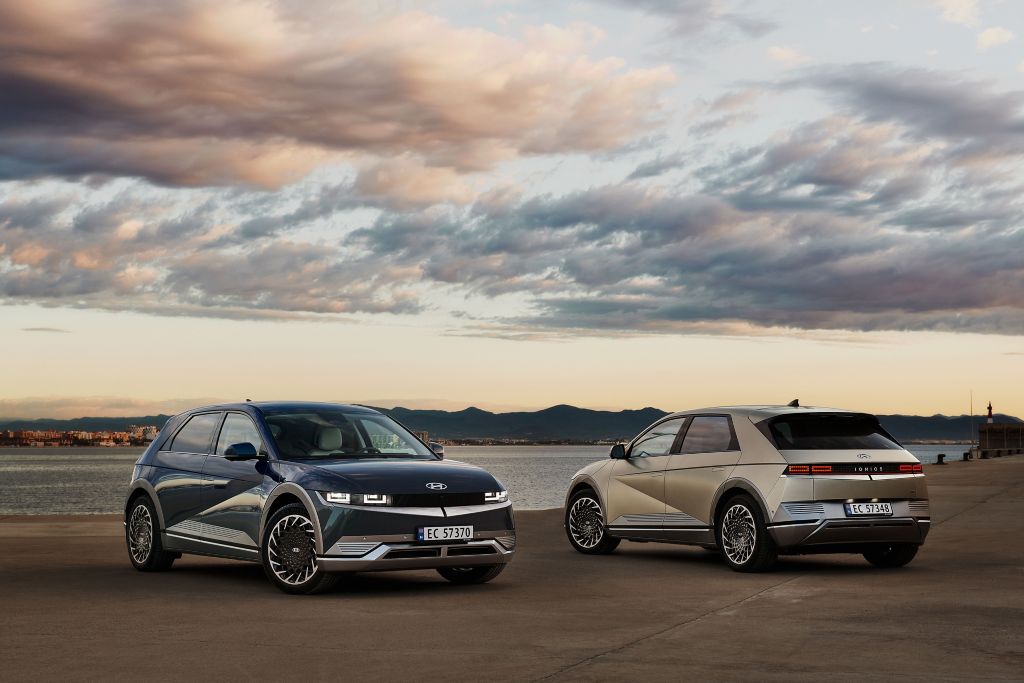
As anyone who’s fallen head over heels for one of the many 2022 electric vehicles and clicked that ‘Order’ button can attest, just because you can order an EV in 2022 doesn’t mean you can drive it home this year. This was a problem I faced myself, but I finally broke the code and got a Hyundai IONIQ 5 at MSRP (here’s how).
Soon after I began my online car search, it became clear that if I wanted a brand-new vehicle, my options were limited by availability. To make the most of the situation, I thought I’d share what I’ve learned about the availability and estimated delivery times for EVs on the market today. Here’s what we know as we kick off the new year.
Note: These are fully-electric models that can either be ordered now or purchased at a dealership today. Many more have been announced but are not yet officially available.
| Make | Model | Class | Starting MSRP | Estimated Delivery/Lot Availability* |
|---|---|---|---|---|
| Audi | e-tron | crossover SUV | $65,900 | Available Now |
| Audi | Q4 e-tron | crossover SUV | $43,900 | Available Now |
| Audi | RS e-tron GT | sedan | $103,445 | Available Now |
| BMW | iX | SUV | $88,050 | Mid-2022 |
| BMW | i4 | sedan | $55,400 | Mid-2022 |
| Cadillac | Lyriq | SUV | $62,990 | Late-2022 |
| Chevrolet | Bolt | hatchback | $31,000 | Available Now |
| Chevrolet | Bolt EUV | crossover SUV | $33,500 | Available Now |
| Fisker | Ocean | crossover SUV | $37,499 | 2023 |
| Ford | Mustang Mach-E | crossover SUV | $43,895 | Available Now |
| Ford | F-150 Lightning | truck | $39,974 | 2023-2024 |
| GMC | Hummer EV | truck | $99,995 | Mid-to-late 2022 |
| Hyundai | IONIQ | crossover SUV | $33,245 | Available Now (Discontinued) |
| Hyundai | IONIQ 5 | crossover SUV | $43,650 | Available Now |
| Hyundai | Kona | crossover SUV | $34,000 | Available Now |
| Jaguar | I-Pace | crossover SUV | $69,900 | Available Now |
| Kia | Niro | crossover SUV | $39,990 | Available Now |
| Kia | EV6 | crossover SUV | $42,115 | Available Now |
| Lucid | Air | sedan | $77,400 | Mid-2022 |
| Mazda | MX-30 | crossover SUV | $33,470 | 2022 - CA Only |
| Mercedes | EQS | sedan | $102,310 | Available Now |
| Mercedes | EQB | SUV | ~$55,000 | Late 2022 |
| Nissan | Leaf | hatchback | $27,400 | Available Now |
| Nissan | Ariya | crossover SUV | $47,125 | Late 2022 |
| Polestar | Polestar 2 | sedan | $45,900 | Available Now |
| Porsche | Taycan | sedan | $82,700 | Available Now |
| Rivian | R1T | truck | $67,500 | 2023 |
| Rivian | R1S | SUV | $70,000 | 2023 |
| Subaru | Solterra | crossover SUV | $46,220 | Mid-to-late 2022 |
| Tesla | Model S | sedan | $94,990 | Late 2022 - 2023 |
| Tesla | Model 3 | sedan | $46,990 | Mid-to-late 2022 |
| Tesla | Model X | SUV | $104,990 | 2023 |
| Tesla | Model Y | crossover SUV | $62,990 | Late 2022 - 2023 |
| Toyota | bZ4X | crossover SUV | $43,215 | Mid-to-late 2022 |
| Volkswagen | ID.4 | crossover SUV | $40,760 | Mid-2022 |
| Volvo | XC40 Recharge | crossover SUV | $55,300 | Available Now |
| *For a vehicle ordered in May 2022, unless there's existing dealership supply. |
A few things might stand out to you on this list. Not a lot of options are available if you need a new vehicle right now. VW Group’s new EVs are available at many dealerships, although there are reports of major dealer markups. It’s quite easy to find EVs of the previous generation on dealer lots. Think Kia eNiro, Hyundai Kona EV, Nissan Leaf and the like.
The vast majority of 2022 electric vehicles are crossovers. No surprise there given the sales trends over the past decade. Honda doesn’t have a single EV arriving in the North American market until the 2024 Prologue electric SUV. That is surprising considering the popularity and good reputation of the brand. What will it take for automakers to catch up to demand? An end to the chip shortage would be a great step in the right direction. There’s also the supply versus demand factor. Ford, Rivian, Tesla and VW are all swamped with orders well into 2022, and even into 2023. All except Tesla are EV newcomers who are facing the same production ramp-up struggles that Tesla just barely survived a few years ago. We’ll update this page regularly as more information becomes available, so save it to your bookmarks!
Did we miss anything? Let us know in the comments below, or shoot an email to [email protected].

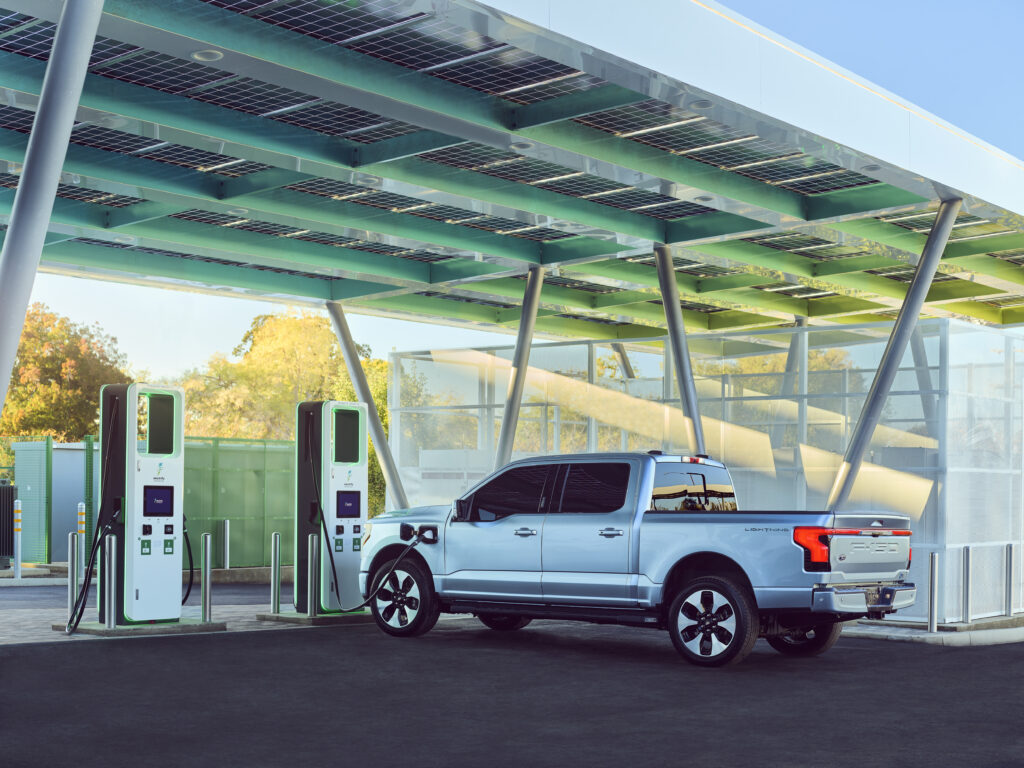
As if anyone needed one more reason to be anxious, some of today’s electric vehicles have inspired a new kind of dread: range anxiety. If you’re new to the world of EVs, you may be wondering why electric vehicle range figures are compared and analyzed meticulously. Maybe you’re even skeptical of EVs because of the sub-300 mile ranges touted as the latest and greatest. The largest automakers are committed to electrification, and American drivers are finding that shopping for an EV is a different experience. There’s no doubt it takes some getting used to. Is the instant acceleration and cheaper fuel worth the learning curve that comes with EV adoption?
Electric vehicle charging stations are still few and far between in most of America. Even charging technologies vary widely from one vehicle to the next. A few new EVs are behind the times when it comes to charging speed, most notably the Chevy Bolt. Others, like the Hyundai IONIQ 5 and Porsche Taycan, are progressing forward with the fastest top-up times in the industry. Thankfully, charging an EV in America is about to get a lot easier in 2022. Billions of dollars in both private and public funding is being funneled into growing the nation’s public charging infrastructure over the next two years. EV range figures will likely become less defining for each new EV that hits the market as charging becomes quicker and easier to find.
As we enter 2022, range is still top of mind for consumers. But estimating EV range is not an exact science. Some vehicles regularly exceed EPA mileage ratings, but many others fall short of the advertised figures. Here’s what consumers need to know about real-world range in today’s growing EV market.
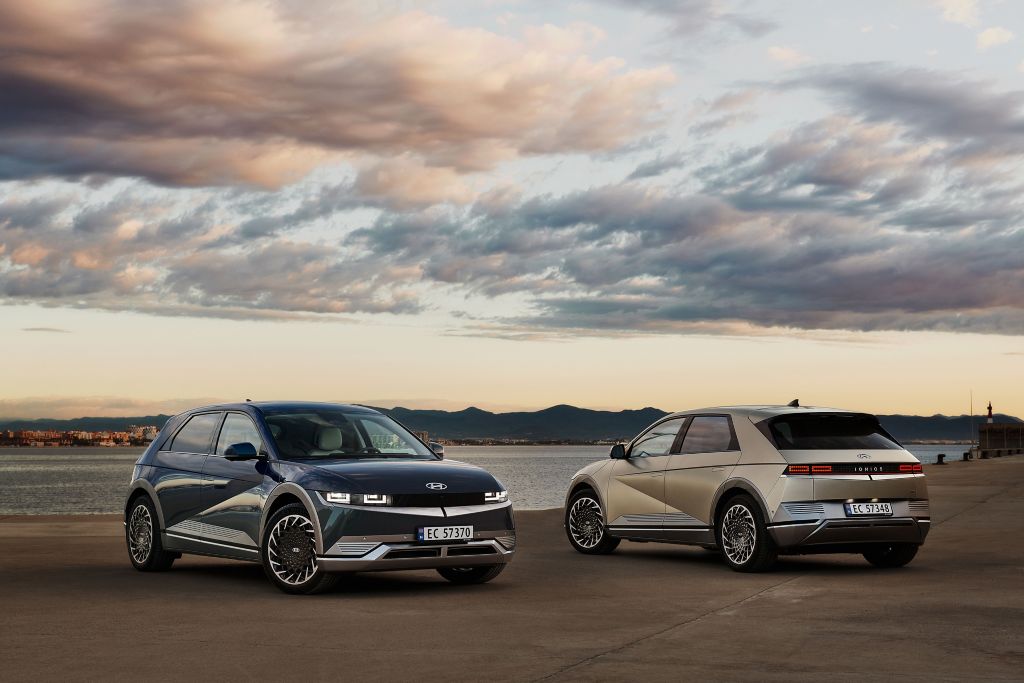
Speed is the number one factor that determines electric vehicle range. The relationship between city/highway driving and range is the opposite with an EV than you’ll find with a combustion-powered vehicle. With a traditional combustion vehicle, better gas mileage is achieved at highway speeds, usually between 50-70 miles per hour. That’s not so with EVs.
EVs are more efficient at lower speeds, even in stop-and-go traffic. Let’s consider the example of the best-selling Tesla Model Y. The 2022 Model Y’s combined range rating is 330 miles, or 125 mpg equivalent. A closer look at the city and highway figures tells an interesting story. On the highway, the US EPA calculates the Model Y’s fuel economy as 131 mpge. Real-world testing at 70 mph finds that the Model Y can make it about 275 miles on a charge. However, in city driving scenarios at lower speeds, the Model Y is good for an astounding 131 mpge, or over 350 miles of range. The story is the same for most other EVs: slower driving around town yields greater efficiency and more range.
Why is speed such an important factor for electric vehicle range? It all comes down to something engineers can’t control, only accommodate: physics. At higher speeds, a vehicle encounters higher friction as it pushes through the air. Friction causes drag, and drag can only be overcome by more force. In this case, the additional force is supplied by higher power output from the electric motors. This is why EV stats often include the ‘drag coefficient’ along with horsepower, torque, curb weight and the rest of the usual metrics for comparison.
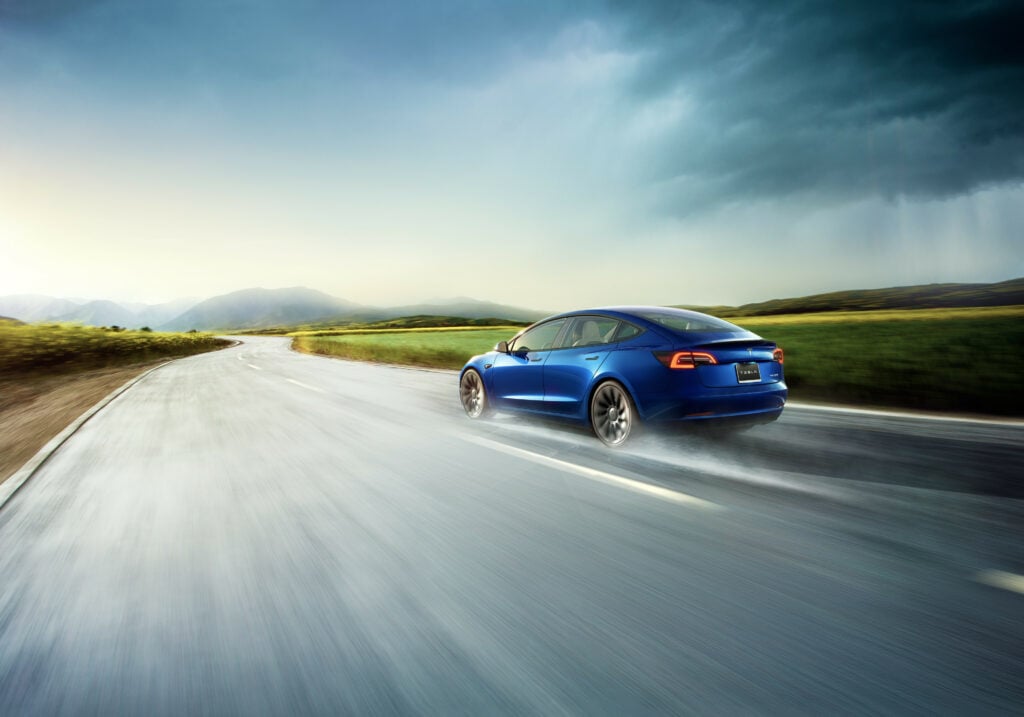
Temperature, wind and even precipitation can all affect electric vehicle range, especially at higher speeds. Every battery-electric motor platform has an ideal operating temperature. Usually, the ideal temperature is somewhere near 70 degrees Fahrenheit. At the ideal temperature, the vehicle can attain up to 115% of its official rated range. That means a Ford Mustang Mach-E rated for 270 miles may actually make it over 300 miles on a single charge in perfect conditions.
Summer heat eats into range somewhat, but winter cold is the real range killer. Effects vary from one model to another, but it’s not uncommon for an EV to lose 30% of its range in freezing temperatures. Why? The cold itself is responsible for about 10% of the range loss, but it’s actually running the heater that demands so much energy, and range takes an even bigger hit. Winter weather is so problematic for EVs that many OEMs are installing heat pumps in their latest models in an effort to reduce range loss in the cold.
As long-haul truck drivers know well, a headwind or severe crosswind kills range for all vehicles, regardless of fuel type. An EV normally rated for 250 highway miles might not even make it 200 with a strong headwind. On the other hand, a tailwind can extend range far beyond the usual performance. Once again, this is similar to what drivers of combustion vehicles will experience.
Rain and snow also reduce range by adding to drag. Think of it this way: any vehicle, electric or otherwise, uses more fuel to literally push through the air as precipitation falls onto it.
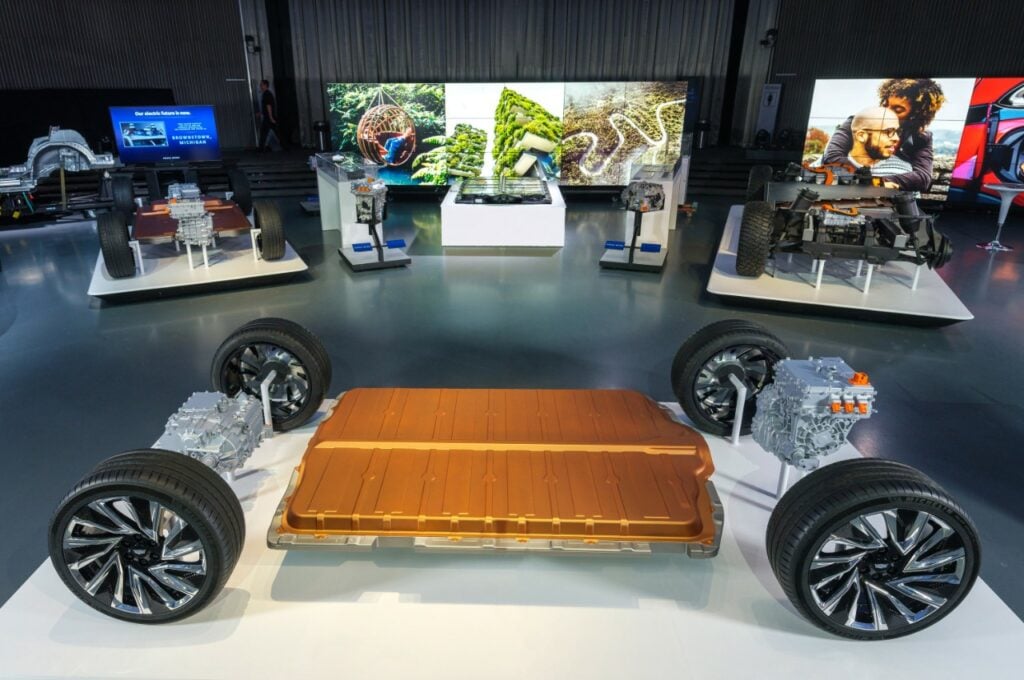
All EVs lose rated range as they accumulate miles on the odometer. It’s just a part of battery wear and tear. The range loss is greatest as the vehicle is ‘broken in’ so to speak. Tesla vehicles lose about 5% of their range within the first 30,000 miles of driving, but range loss slows down afterward. There are many examples of Teslas with 200,000 miles on the odometer that continue to carry 90% of the original range, and almost all retain at least 85% by this point. Other EVs show similar range loss over time.
Battery degradation is unavoidable, but there are measures that EV drivers can take to minimize it. Limiting level 3 fast charging to only when necessary (such as road trips) is the biggest effort anyone can make to preserve the health of their battery. Charging at home on a level 1 or 2 charger to 80% or 90% state of charge is recommended for most EVs. Only when the extra mileage is needed should EVs be fully charged to 100%. One notable exception is the 2022 Tesla Model 3. Tesla has decided to put lithium-iron-phosphate (LFP) batteries in the standard range variants of the Model 3, making this the first EV on the market to withstand regular charging to 100% without notable battery degradation. Perhaps this was a factor in Hertz’s recent decision to buy 100,000 Model 3’s.
With so many factors going into EV range, you might be wondering how one can reliably estimate the range of their EV in real time. Luckily, engineers saw the need for real-time range estimators and got ahead of this challenge. Today’s EVs include smart range estimators (that some affectionately call guess-o-meters) that factor in a number of variables to display the remaining range for the driver. Real-world range figures don’t necessarily make road trips challenging, but for the time being, it is something else for drivers to monitor while charging stations remain uncommon.
Curious as to how your favorite electric vehicles match up in real-world range? The EV experts over at InsideEVs have compiled a database of how every model they’ve tested firsthand performs in the real world. Some EV models far exceed their official EPA ratings, while others come up short. Below are a few of their more notable findings.
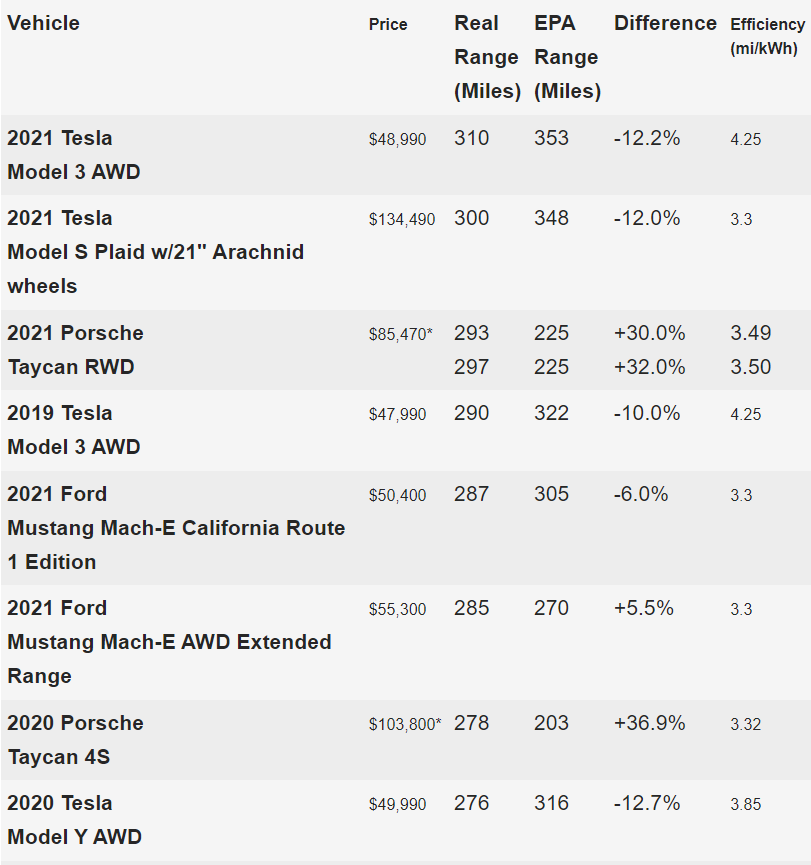
Source: InsideEVs

Today’s EVs are expected to retain 85-90% of their original range after 100,000 miles, and possibly even over 200,000 miles. This normal range loss is due to battery wear after repeated charging and discharging cycles. Real world range is something for EV shoppers to bear in mind when comparing models. Remember: If an EV is EPA rated for 250 miles, it will likely only achieve 225 miles on a full charge after 100,000 miles of driving.
The data from InsideEVs shows that some automakers consistently underperform their ratings, while others exceed expectations. Will range anxiety turn buyers away, or will tech and sporty handling compel more drivers to think about going electric? Let us know your thoughts in the comments below. We’ll continue to keep you informed as electrification overtakes the auto industry.