
CarEdge saved me over 4,500 dollars on a brand new Honda Pilot. I can't say thank you enough.
Price intelligence
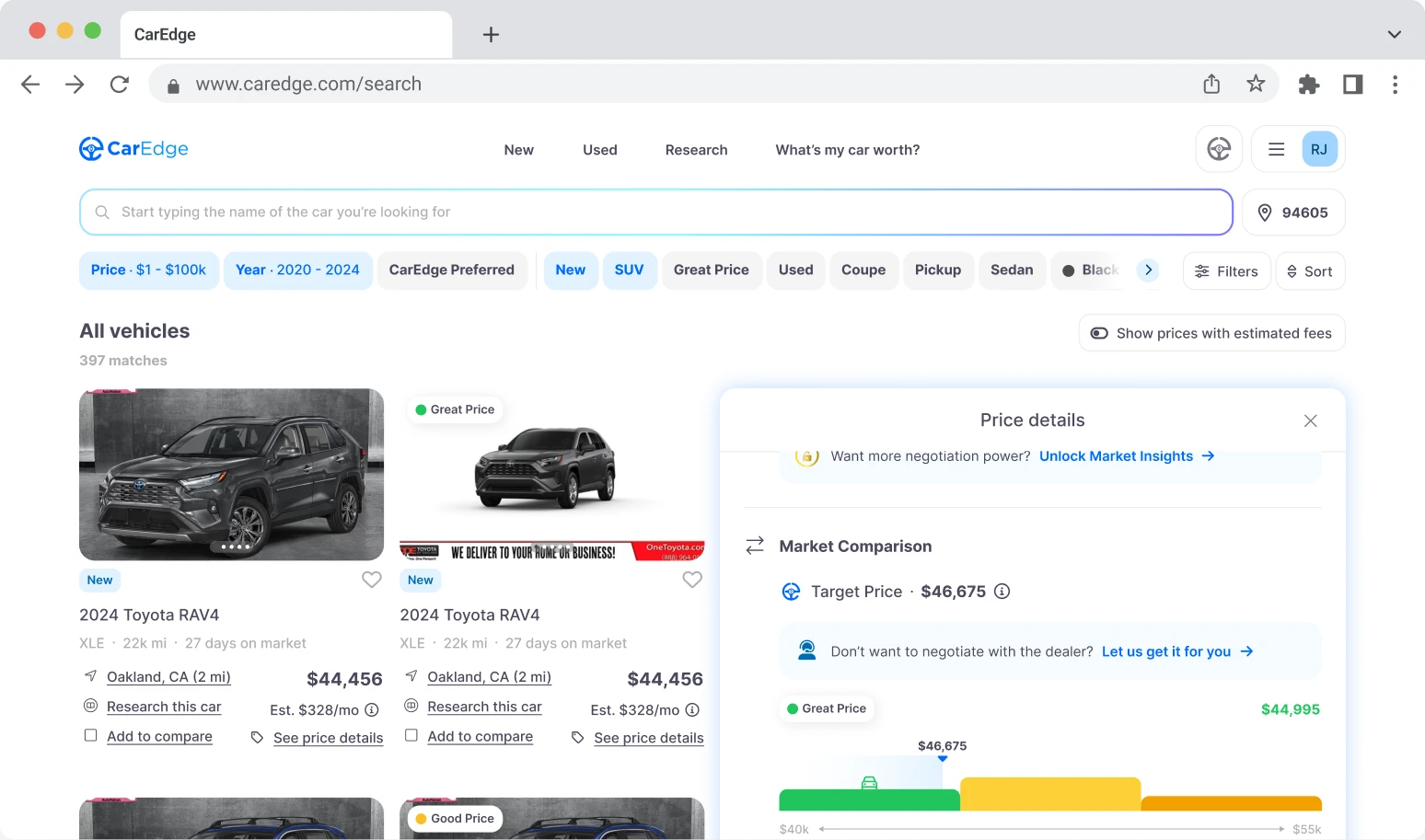
Find a wide range of vehicle listings with market insights on new and used listings near you.

What can I do with CarEdge?
 CarEdge Insights
What can I do with CarEdge?
Get access to exclusive information so you can make an informed car buying decision — all in one place.

Find a wide range of vehicle listings with market insights on new and used listings near you.
Track your vehicle’s value and cash in when the time is right to sell.

Access to our proprietary data to help you find the right car, at the right price. Find these unlocked on every listing after subscribing.

With our expert-led, tech-enabled car buying service, we will locate, negotiate, and deliver your vehicle so you can get a new car hassle free.


Help us personalize your CarEdge experience — it only takes a second.
Your answers help us personalize your CarEdge journey — we’ll follow up with tips and next steps that match your buying timeline.
Buick has a reputation for building solid, reliable vehicles. Even with that reputation, breakdowns still happen. Having an extended warranty helps to protect you from massive repair bills. If you’re thinking about a dealer warranty, take a look at our Buick extended warranty review first!
We’re about to cover everything you need to know about the Buick extended warranty, including service plans, coverage, and potential drawbacks.
Our Buick extended warranty review wouldn’t be complete if we didn’t talk about the coverage options. Buick offers two levels of coverage, Platinum and Silver. They each provide extensive coverage, but both plans only cover issues related to manufacturer defects. Anything related to abuse, misuse, negligence, or standard wear and tear will not be covered.
Let’s dive a little deeper into these plans:
A Buick vehicle service contract has several term length options:
Between the two levels of plans and four term lengths, you can customize the level of coverage that you’re after.
There are other perks as well, such as rental car coverage, towing, and road service. They even offer trip interruption coverage for situations in which your car breaks down when you’re more than 100 miles away from home.
We need to highlight that these warranties are administered by AMT Warranty Corp, as dictated in the service contract. This means that even though Buick is selling them as their own warranties, someone else administrates the plans. This gives us an uneasy feeling, especially because this is only disclosed in the fine print in the sample contract.
Overall, we think the Buick extended warranty is worth it if you’re located near a Buick dealership. Otherwise, you might be better off with a third-party extended warranty.
The core difference between a Buick extended protection plan, and a third-party extended warranty is flexibility in where your car is fixed. Even though the Buick vehicle service contract is technically administered by a third-party, they still require that you take your car to a Buick dealership for repairs.
The benefit of taking your car to a dealership is that all repairs will be done with genuine Buick parts, instead of the aftermarket parts that will likely be used at another repair shop.
However, if the nearest Buick dealership is quite far away, it might be better to go for a third-party warranty so that you can take your vehicle to your favorite mechanic.
We aren’t discussing prices in our Buick extended warranty review because, as we’ve mentioned before, when discussing vehicle service contracts, prices are highly customized. No two cars will receive the same quote, even with the same coverage from the same company.
Buick does not make any special mention of certified pre-owned Buicks when discussing their warranty. We’ve searched both the sample contract and their extended warranty information page, and there’s no mention of a certified pre-owned extended warranty.
What this likely means is that the same warranties are available for certified pre-owned vehicles with no added or reduced coverage.
We highly suggest that you clarify the type of coverage your CPO vehicle is eligible for when you’re at the dealership buying your car, since they don’t make a clear distinction in coverage.
We heavily dislike that the Buick extended protection plans are administered by a secondary company instead of directly through Buick. If this was clearly disclosed on their sales pages, it might not sting as much. Instead, we discovered this by examining the sample contract.
Other than this massive drawback, it seems like a perfectly fine extended warranty. The coverage comes in two tiers, and you have four term lengths to choose from. This makes their warranty offering flexible, which we appreciate.
So what’s the bottom line of our Buick extended warranty review? We cannot recommend the Buick extended warranty program in good conscience. We are put off by the fact that they secretly passed off their warranty administration to a third party and didn’t make this information obvious until you read the fine print in the contract.
If you’re looking for another option for a vehicle service contract, we offer VSCs through our reputable vendors. With our flat-rate markup and transparent pricing, we’d love to help you find the coverage you need. We even offer a free consultation to talk about options to create the right plan for you. Contact us today and we’ll find you a great extended warranty.
BMW is one of the top names that come to mind when people think about luxury vehicles. Their cars are designed to last and to deliver top-of-the-line performance. Still, manufacturer defects can happen, even in these premium cars. If you’re thinking about buying an extended warranty, take a look at our BMW extended warranty review first!
A BMW extended protection plan offers coverage from hefty repair bills that are related to manufacturer’s defects. BMW offers extended warranties that we believe are well worth the cost.
Buying a BMW extended warranty is worth it for anyone who plans to keep a vehicle for a longer time than the factory warranty covers. Because of the cost to make repairs on BMWs, having the added protection of an extended warranty will give you peace of mind.
We recommend that you don’t purchase this warranty from the dealership, though. Instead, add it to your car later. There’s no requirement that you must buy it at the time that you’re purchasing the vehicle.
BMW has a sleek warranty that is easy to understand. We love to see simplicity when it comes to warranties, as complex warranty plans often confuse consumers, leading them to make poor choices.
There are three types of BMW extended protection plans. The lower two levels are available for any new or used BMW vehicle. The highest level is also available for new and used BMWs, but it’s also the only option for a certified pre-owned BMW.
Each of the three plans has its own level of coverage:
Take note that only breakdowns that are related to manufacturers’ defects are covered. If repairs are needed because of misuse, abuse, or negligence, the repairs will not be covered.
We should highlight that you don’t need to buy an extended warranty when you’re buying your car. You can add it on later. Different automakers have stipulations on when such coverage can be added, so make sure to check with BMW on their specific limitations.
When it comes to the length of your warranty, BMW has surprisingly flexible options. You can purchase coverage for lengths ranging from four years to seven years. This is slightly more complicated for certified pre-owned vehicles, which we’ll discuss in detail later. You’ll also be able to choose your mileage limitation, either 75,000 or 100,000 miles.
Flexibility on where you can have repairs completed is the primary difference between a BMW extended warranty and a third-party extended warranty. All repairs covered by your BMW extended warranty must be completed at an authorized dealer. Meanwhile, third-party providers typically allow you to have repairs completed at any licensed repair shop.
Another key difference in coverage happens in the parts used for your repairs. BMW extended warranties call for using BMW genuine parts, whereas a repair shop will most likely use aftermarket parts. This is an important thing to consider when thinking about which option will be right for you.
We’ve previously discussed that extended warranty pricing varies from car to car, which is why we won’t talk about costs in our BMW extended warranty review. The pricing is based on your mileage and VIN. You’ll need to obtain several quotes and compare specific coverage to make an informed decision.
The certified pre-owned BMW extended warranty coverage is part of the Platinum plan discussed above. However, the term length varies based on the type of CPO that you’re purchasing.
This can be complicated, so let’s break it down based on the CPO offerings that BMW has:
That might be a lot to wrap your head around, which is why we wanted to make sure to mention it in our BMW extended warranty review! Essentially, just keep in mind that your term length options will vary based on the CPO type that you end up purchasing.
A BMW vehicle service contract will provide the coverage you need to give you peace of mind. We think that this makes extended warranties worthwhile for anyone who plans to keep their vehicle after the factory warranty expires.
As for the BMW vehicle service contract options, the coverage is quite thorough for the top two plans. The powertrain plan, which will be less expensive, doesn’t have extensive coverage, but it will still protect you from potentially expensive repairs.
So what’s the bottom line from our BMW extended warranty review? We recommend the BMW extended warranty program. They have three clear options with explicitly stated coverage. Repairs will be made using genuine BMW parts, which we greatly appreciate.
If you are looking for another option, contact us today. We offer vehicle service contracts through our partner vendors. We provide transparent pricing and an explicitly stated markup. We even offer free consultations to help you decide if our options are right for you.
Purchasing an Acura vehicle service contract provides a longer and more comprehensive warranty than what comes with your vehicle.
Opting for an extended warranty is typically a good idea, but you still need to purchase the correct plan for what you need. If you plan on only having the car for a few years, you probably don’t need an extended warranty at all. If you want to own it for decades, an extended warranty is almost required.
Today, we’re going to cover the Acura extended warranty. We’ll discuss if it’s worth it overall, compare it to other options, and make our ultimate recommendation.
TLDR:
We always suggest that any car buyer consider an extended warranty. While buying them at the dealership is not usually the best way to buy, buying one after the fact is often well worth it. An Acura vehicle service contract can help prevent a costly repair bill. But is this the right warranty for your circumstances? Let’s dive into our Acura extended warranty review.
Acura offers what they call Acura Care. It’s a group of four levels of warranties:
1. New Vehicle Coverage
2. Pre-Owned Vehicle Coverage
3. Certified Additional Coverage
4. Powertrain Coverage (Pre-owned vehicles only)
Should you go for a warranty directly from the manufacturer or opt for a third-party vehicle service contract?
You may notice that we aren’t going to talk about pricing in this Acura extended warranty review. If you’re concerned about pricing, you’ll have to obtain several quotes and compare the cost and coverage. Vehicle service contracts are priced individually based on the car (including the VIN and the mileage). This means that neither Acura nor third party companies will post a price on their website.
An Acura certified pre-owned extended warranty has much of the same coverage as their other warranties. The New Vehicle, Pre-Owned Vehicle, and Certified Additional Coverage cover many the same components:
The above is not an exhaustive list of what is covered. It’s what Acura lists as a sample of their coverage. Acura does not publicize an exhaustive list of what is covered under their Acura extended protection.
The Powertrain Coverage, which is only available to pre-owned vehicles, covers:
Acura Care also provides 24/7 roadside assistance and rental care reimbursement for the duration of the warranty. They provide trip interruption benefits as well, which provides $100 per day for up to 3 days if you have covered repairs, as long as you’re more than 100 miles away from home.
A third-party vehicle service contract is an extended warranty provided by any company other than Acura. There are dozens of reputable companies that you can choose from when shopping around for a third-party Acura warranty.
The coverage will vary based on the program you select. It might cover the same or more components as the Acura extended warranty, or it might cover fewer. It’s important to understand what is covered by the program you’re considering before you sign any contracts. Simply ask the salesperson, and they should provide you with a document that explains coverage and exclusions.
The primary benefit of going for a third-party warranty over a direct warranty is flexibility. Third-party warranty providers have a much wider network of repair shops that you can use for covered repairs. Acura, and most other automakers, require that repairs are completed at an authorized dealership.
If you compare a third-party warranty to Acura extended protection, you’ll notice two major differences:
1. Acura provides more perks, such as roadside assistance and trip interruption coverage
2. Third-party warranties have a wider network of covered repair shops
You’ll have to decide which factor is more important to you. We like having repairs done at the dealership when possible since they’ll use genuine parts, as aftermarket parts often have serious issues. That’s a strong positive to any Acura extended warranty.
On the other side of the coin, having more options for covered repair shops is worthwhile, especially if you aren’t near an Acura dealership.
So here the main point of our Acura extended warranty review: While we like the Acura extended warranty program, going for a third-party warranty might be better for your situation.
Audi is one of the top names in luxury vehicles, so it makes sense that you might want to protect your investment with an Audi extended warranty.
We’re about to cover everything you need to know about the extended warranty offer from Audi, including the different levels of service provided and a comparison to similar third-party options.
Our Audi extended warranty review wouldn’t be complete without checking out their coverage. The value of an Audi extended warranty will vary from person to person. If you plan on keeping your car for decades to come, then it might be worth it. However, if you like to trade in vehicles every few years, you should probably skip the Audi extended protection program.
Audi has three types of vehicle service contracts for you to choose from:
We need to highlight that two of these plans run concurrently with your factory warranty: Term protection and Audi Pure protection. That means that you’ll only use these warranties for the first few years if something breaks that is not covered by your factory warranty but is covered by the extended warranty.
So is the Audi vehicle service contract worth signing? The term protection option is likely worth it for everyone, assuming that you remember to use it when it comes time to replace the covered parts. The other two programs are only worth it if you’re going to be keeping your vehicle for quite a bit longer than the factory warranty covers.
There are plenty of third-party extended warranty providers to choose from, but they all have one distinct advantage over Audi extended protection plans: Flexibility.
Third-party vendors allow you to take your vehicle to almost any repair shop, provided that they are licensed by a reputable association. Conversely, an Audi extended warranty requires that all repairs be done at an authorized dealership.
If you live near an Audi dealership, this might not be a big deal. However, if the closest Audi dealership is on the other side of town or the other side of your state, it might be a deal breaker. You’ll need to consider what works best for you.
You may have noticed that we aren’t mentioning prices in this Audi extended warranty review. When it comes to pricing, we’ve previously broken down how the cost of a vehicle service contract varies based on the VIN and mileage of the car in question. You’ll need to obtain several quotes to compare coverage before deciding which warranty is best for you.
The certified pre-owned Audi extended warranty coverage is based on exclusions. Most breakdowns that are related to a manufacturer’s defect will be covered, except for:
Their website directs you to contact a dealership for a detailed list of covered components. They do not provide this list from their website.
Perhaps the biggest drawback of the Audi vehicle service contract is the lack of detailed information given to consumers upfront. The only information they make available on their website is a sale-focused page and legal statements to cover themselves for liability purposes. We’d like to see a document that dives deeply into what is covered on each of their warranty offerings.
So what is the outcome of our Audi extended warranty review? Overall, we are neutral toward the Audi extended protection plans. We cannot give them a confident recommendation based on the information they publicly provide.
If you’re looking for more options, we also offer vehicle service contracts through our partner. We offer transparent pricing and coverage options. Your costs are based upon your VIN and mileage, and we have a flat rate markup. We also offer a free consultation to discuss your options. Reach out to us today if you’re interested in the ways that we can help you stay protected on the roads.
Mitsubishi is known for being a smaller automaker with intriguing cars. They craft quality vehicles, but mistakes still happen. That’s why we suggest purchasing an extended warranty to protect you from hefty repair bills. But is it best to buy one from Mitsubishi? We’ll help you decide in our Mitsubishi extended warranty review.
We’re about to go over the Mitsubishi extended warranty, including discussing who administers the program, the different plan tiers, and our recommendation.
Before we can evaluate whether or not the Mitsubishi extended warranty is worth getting, we first need to examine what’s included in the warranty.
The Mitsubishi extended warranty is not actually administered by Mitsubishi. It’s administered by the same company that goes by four different names depending on which state you live in, mostly going by Automotive Warranty Services, Inc. We appreciate that this is disclosed in the sales brochure, but we don’t like the partnership with an unknown company.
There are four different plans offered by the Mitsubishi vehicle service contract. Only one of them is available for new cars; the rest are only available for used cars. The plans are:
It’s worth noting that these are the coverage terms discussed on the official sales material. However, we discovered that some dealerships have their own level of coverage. You’ll need to clarify with the dealership that you’re working with what coverage options they offer.
You’ll have your choice of term lengths and deductibles. These figures will also vary by dealership.
Based on the national sales brochure, all plan levels come with the following perks:
Notice how we aren’t discussing prices in our Mitsubishi extended warranty review? As we pointed out in a previous post about vehicle service contracts, prices vary based on VIN and mileage. That means that prices will be different for every Mitsubishi out there.
So, is the Mitsubishi extended warranty worth it? We don’t think so. Repairs must be completed at a Mitsubishi dealership, and there are only approximately 300 Mitsubishi dealerships in the country. There’s a good chance of issues occurring when you’re far from a dealership. Coverage seems thorough, but we don’t like how the coverage can change depending on the dealership. It’s probably worth skipping over the Mitsubishi extended protection program.
Most third-party extended warranty providers try to copy the coverage of automakers’ extended warranties. While there are certainly differences in coverage, they are typically minor.
The main difference between an automaker’s warrant and a third-party warranty is where you can have the vehicle repaired. Even though the Mitsubishi extended protection plan is technically administered by a third-party, it is treated as an automaker warranty. This fact means that you can only have your vehicle repaired at one of the few Mitsubishi dealerships around the country.
Third-party extended warranty companies typically allow you to have repairs completed at any auto shop that is licensed by ASE or AAA. This policy means that you will be covered anywhere, from your neighborhood mechanic to the mechanic in a small town that you pass through on your road trip.
We typically advise people to obtain several quotes and compare coverage. This time, we think you should skip the Mitsubishi extended warranty and only obtain quotes from third-party warranty providers. The amount of Mitsubishi dealerships is just far too low, along with having different coverage based on the dealership you buy your plan from.
There is no special mention in any of the information we’ve found about special coverage for Mitsubishi certified pre-owned vehicles. It appears as though they are lumped in with other used cars, which means they are eligible for all four tiers of coverage that we discussed above. If you’re planning on buying a CPO, make sure to get a pre-purchase inspection.
What’s our ultimate opinion from our Mitsubishi extended warranty review? We do not recommend the Mitsubishi vehicle service contract. There is likely a better program out there for your needs. Having different coverage criteria based on where you buy the warranty is a massive drawback. We also don’t like how it’s administered by a third-party, yet you still have the limitation of having the repairs completed at a dealership. Our advice is to skip this warranty.
If you’re looking for another option, we’ve partnered with a vehicle service contract vendor to offer you great plans. All of their plans have clear coverage and transparent pricing. We’ll even include a free consultation call to help you pick the best warranty for you, even if it’s not our option. Reach out to us today to see how we can help.