
CarEdge saved me over 4,500 dollars on a brand new Honda Pilot. I can't say thank you enough.
Price intelligence
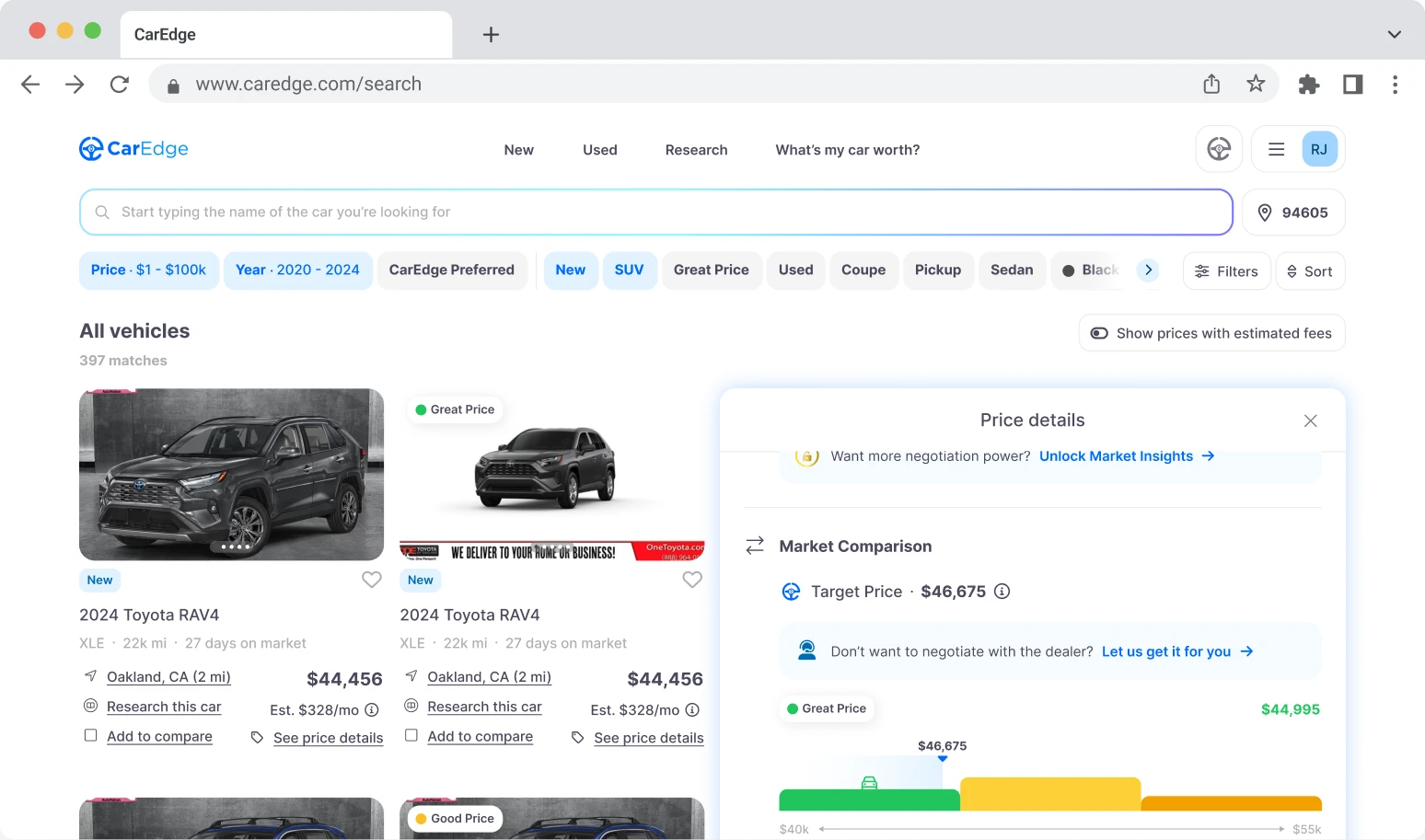
Find a wide range of vehicle listings with market insights on new and used listings near you.

What can I do with CarEdge?
 CarEdge Insights
What can I do with CarEdge?
Get access to exclusive information so you can make an informed car buying decision — all in one place.

Find a wide range of vehicle listings with market insights on new and used listings near you.
Track your vehicle’s value and cash in when the time is right to sell.

Access to our proprietary data to help you find the right car, at the right price. Find these unlocked on every listing after subscribing.

With our expert-led, tech-enabled car buying service, we will locate, negotiate, and deliver your vehicle so you can get a new car hassle free.


Help us personalize your CarEdge experience — it only takes a second.
Your answers help us personalize your CarEdge journey — we’ll follow up with tips and next steps that match your buying timeline.
Fiat crafts luxury vehicles with the level of precision we’ve come to expect. However, even in the best assembly lines, mistakes can happen and manufacturer’s defects can occur. That is when a Fiat extended warranty can help to protect you from expensive repairs. But is it worth buying? Find out in our Fiat extended warranty review!
We’ll be discussing the Fiat extended warranty program today. We’ll go over Fiat’s coverage, their perks, and what we think about their program.
We can’t talk about whether we think a Fiat vehicle service contract is worth it without talking about what’s in the plan in the first place.
Fiat warranties are offered by a company called Mopar. This is a partnership that is fully disclosed and not hidden, so we don’t hold that against Fiat.
There are four tiers of coverage to choose from:
If you want to dive deeper into the available plans, you can view Mopar’s sales brochure.
Mopar makes it clear that maintenance services and any wear-and-tear items are not covered by the Fiat extended protection plans. This would refer to oil changes and new brake pads, for example.
There are dozens of options for mileage and term length limits on the plans from Mopar. Combined with the four levels of coverage they offer, you can truly customize your plan.
Fiat and Mopar add a few perks to their programs to persuade you to buy:
We don’t think these perks should persuade you into becoming a customer. You need to compare coverage and prices to make your decision; let the perks be added bonuses.
Notice that we aren’t discussing price in our Fiat extended warranty review? That’s because, as mentioned in another post about extended warranties, all extended warranty prices are unique to the car in question. Prices will vary based on the VIN and mileage.
Even though Mopar is technically a third-party provider, the agreement between Fiat and Mopar is more of a partnership than anything else. There are other third-party vendors for extended warranties that you can consider instead.
The core difference between a Mopar warranty and a standard third-party warranty is where you can go to repair your vehicle. A third-party warranty will allow you to repair your vehicle at any licensed auto shop. Meanwhile, a Fiat vehicle service contract requires you to have your vehicle repaired at a Fiat dealership.
An exception can be made if your vehicle breaks down far from a Fiat dealership. Mopar will reimburse you for repairs. This requires prior authorization before repairs and then filing for reimbursement after you pay the repair shop.
A third-party warranty might be better if you are far from a Fiat dealership. Compare prices and coverage primarily, but keep this crucial difference in mind.
Every Fiat certified pre-owned vehicle is eligible for a Fiat extended warranty. Only the Added Care Plus and Maximum Care programs can be purchased for a CPO vehicle.
For those financing a CPO, you can also add GAP insurance to your vehicle through Mopar. Depending on how much equity you’ve put into the vehicle, this might be a worthwhile purchase.
What’s the ultimate conclusion of our Fiat extended warranty review? We recommend Fiat’s extended warranty program. Fiat is transparent about its partnership with Mopar, and we greatly appreciate that.
The main thing we love about Fiat’s program is the wide variety of coverage options. Between the four levels of coverage and a massive selection of term lengths, you can find something that will work for you. The only drawback is the limitation of options on where you can have your vehicle repaired.
If you’re looking for another extended warranty provider, we offer vehicle service contracts through our trusted vendors. We have clearly defined coverage and transparent pricing. We’ll even hop on the phone with you to discuss all your warranty options so that you can pick the one that fits you best. Contact us today to schedule your consultation call.
Dodge is known for building sturdy cars and trucks that stand the test of time. Even with that solid reputation, their cars can still have manufacturer’s defects. That’s why buying a Dodge vehicle service contract, also known as an extended warranty, can often be worthwhile…but is it right for you? Find out in our Dodge extended warranty review!
In this post, we’ll be going over the Dodge extended warranty program. We’ll discuss the coverage that comes with their different plans, explore any perks, and make our recommendation on whether this warranty is a good buy or not.
All Dodge extended warranties are sold and managed by Mopar. This is clearly displayed throughout their materials, so we don’t hold that fact against Dodge.
Mopar offers four tiers of coverage to select from:
Dodge makes a point of stating that their plans do not cover any maintenance services or any standard wear items, like brake pads and belts. We’d also like to highlight that all these plans only cover manufacturer’s defects. Abuse, neglect, and misuse issues are not covered.
For those looking to dive deeper into what’s covered, you can view the Mopar sales brochure. Coverage is discussed on page 5 of their materials.
When it comes to term lengths, there are multiple options available. You can even choose to have unlimited mileage covered. All these selections will play a role in the calculation of the final price for the warranty.
Mopar sweetens the deal with a selection of bonuses:
Bonuses are great, but we don’t think they should influence your decision to buy an extended warranty. Get quotes, compare coverage, and consider prices. Let any perks just be icing on the cake.
We aren’t talking about prices in our Dodge extended warranty review because, as we mentioned in another post about vehicle service contracts, prices vary from car to car. They are based on the VIN and mileage of the vehicle. You’ll need to ask for several quotes to compare prices and coverage.
It’s worth mentioning that coverage for all Dodge extended warranty plans begins when you buy the warranty. This means that there could very well be overlap with your existing manufacturer’s warranty.
Is the Dodge extended protection plan worth it? We think so. They have great coverage that is fully customizable, so it’ll fit most budgets. You’ll need to get a quote for your specific car to see if Mopar can give you a price that will win you over.
Mopar might administer the Dodge warranty, but it’s not considered a third-party warranty. It’s actually more of a partnership between Dodge and Mopar. This means that all repairs must still be done at a Dodge dealership.
Conversely, third-party extended warranties will cover you for repairs done at most auto repair shops, as long as they are licensed by ASE, AAA, or RepairPal. Most third-party vendors will pay for repairs directly; you won’t have to pay for the repairs yourself and then get reimbursed.
With the Mopar warranties, covered repairs are reimbursed to you if you must take your vehicle to a shop outside of the dealership network. For example, if you’re on a road trip and your car breaks down, there might not be a Dodge dealership nearby. For covered repairs, you’ll have to obtain prior authorization, pay the bill yourself, and then file for reimbursement.
Third-party warranties are sometimes a better choice, depending your distance from a Dodge dealership. Keep this in mind when shopping around.
All Dodge certified pre-owned vehicles are eligible for a Dodge extended protection plan, but not all of Mopar’s plans are available to choose from. Only the top two tiers can be selected: Added Care Plus and Maximum Care.
If you’re financing your CPO vehicle, it’s worth taking note that Mopar also offers GAP insurance. Depending on the amount of equity you’ve put into the car, it might be worth bundling this with your Dodge vehicle service contract.
What’s the bottom line of our Dodge extended warranty review? We recommend Dodge extended warranties. We appreciate that they’re upfront and honest about their partnership with Mopar, instead of tucking that fact away in a contract like other automakers often do.
Mopar offers plenty of customization to their plans. The main drawback to working with them is that you are limited on where you can take your vehicle when repairs are needed. If you don’t have a Dodge dealership nearby, a third-party warranty might be a better option.
If you’re looking for more choices, we offer vehicle service contracts through our reputable vendors. With transparent pricing and clear coverage, we make things easy. We’ll even provide a completely free consultation to help you decide on the best extended warranty for you, even if it’s not the one we’re offering. You can reach out to us today to schedule a consultation call.
An extended warranty is a great way to avoid costly repair bills. While it’s not usually worth buying at the dealership, we still suggest that you think about adding an extended warranty to your new or certified pre-owned car. Should you buy the one from Chrysler? Find out in our Chrysler extended warranty review!
Today, we’re going to review the Chrysler extended warranty program. We’ll discuss the level of coverage offered, compare it to third-party options, and make our ultimate recommendation.
Before we can say if the Chrysler extended protection plan is worth getting, we need to discuss what’s involved in the program.
Mopar has four levels of coverage to choose from:
None of the Chrysler extended warranty plans offer coverage for maintenance services, like oil changes or air filters. They also do not cover the body, paint, or any wear-and-tear items (brake pads, rotors, belts, and windshield wipers).
If you want to dive deeper into the features of any of these plans, you can view Mopar’s breakdown on page 5 of their extended warranty sales brochure.
As far as term lengths go, you can choose your mileage coverage in intervals. Plans are available for 12,000 miles, 15,000 miles, or even unlimited mileage. You can also pick the number of years that you want coverage for.
On top of their coverage, they offer a handful of useful perks:
We like perks as much as the next car owner, but we don’t think perks should be a substantial reason to choose an extended warranty.
Take note that we aren’t discussing pricing in our Chrysler extended warranty review. As we’ve discussed earlier, pricing for vehicle service contracts varies from car to car and is based on your VIN and mileage. You’ll need to obtain quotes from any warranty company that you’re interested in to compare prices.
Coverage begins when you buy the plan. Keep this in mind to avoid overlapping with your existing manufacturer’s warranty.
So is a Chrysler extended warranty worth it? We think that due to the highly customizable array of warranties that you can choose from, it’s well worth getting a quote. For the right price, the Chrysler vehicle service contract might be worth it.
Even though the warranty is offered and managed by Mopar, which is a third party, it’s not treated like a third-party warranty. It’s more of a partnership between Chrysler and Mopar. The primary thing to note is that all repairs must be done at a Chrysler dealership.
Mopar does say that your repairs might be covered if you have issues when you are far from a Chrysler dealership. The process looks a bit complex, as you or the shop will have to contact Mopar for authorization before repairs start. Once done, you’ll have to submit a request for reimbursement. This means that you will be paying out of pocket and that there’s a chance that your reimbursement request could be denied.
On the other hand, a true third-party extended warranty will allow you to have your repairs completed at any number of shops around the country. Most third-party warranties ask you to take your car to a repair shop that is licensed by a reputable association, such as ASE, AAA, or RepairPal. If the shop is licensed, you can have your work done there. In most cases, the warranty company will also pay for the repairs over the phone instead of paying by yourself and then waiting for reimbursement.
If you buy a Chrysler pre-owned vehicle, you have the option of covering it with a Chrysler extended protection plan through Mopar. However, you will only have the Maximum Care and Added Care Plus options available to you, which we discussed above.
Mopar also offers GAP insurance for certified pre-owned vehicles, which might be worth it depending on your situation. You’ll have to do some math to determine if you should purchase GAP insurance.
What’s the final verdict of our Chrysler extended warranty review? We do recommend the Chrysler extended warranty. They are upfront and honest about who is offering and managing the warranty, instead of hiding it in the fine print of the contract like other automakers we’ve seen.
Their levels of coverage and customization allow you to craft a plan that works for your financial situation. The only downside comes from the limitations on where you can take your car for repairs.
If you’re looking for another option, we offer vehicle service contracts through our third-party vendors. Our pricing is transparent, and coverage is clearly laid out. We even offer free consultations to help you decide which warranty to select. Contact us today to set up a time to talk about coverage!
Chevy is known for building reliable cars and trucks, but they certainly aren’t free from defects in the manufacturing process. With the many moving parts involved in any vehicle, every automaker has the potential to make mistakes. That’s why Chevy offers an extended warranty…to cover you in case there are defects that result in a mechanical breakdown. Before you buy it, though, check out our Chevrolet extended warranty review.
Choosing a Chevrolet vehicle service contract calls for a thorough examination of everything involved, and that’s what we’re going to do today. We’ll discuss the coverage, term length options, and who administrates the warranty before giving you our final recommendations.
Before deciding if the Chevrolet vehicle service contract is worth it, we need to discuss what it entails. When you’re buying a car, this is always an important step to keep in mind!
The Chevrolet extended warranty, managed by AMT Warranty Corp., offers two levels of coverage:
Neither of these plans provides any coverage for issues related to abuse, misuse, or neglect. The problem must stem from a manufacturer’s defect to be covered, much like the factory warranty that came with your car.
A Chevrolet extended warranty has a few different term lengths to select from:
With two tiers and four term lengths, you can really nail down the type of plan that you want.
There are other perks that come along with the Chevrolet extended warranty, such as lockout assistance and trip interruption coverage. These perks are excellent. However, we don’t think you should be swayed into making your decision based on perks.
The fact that the Chevrolet extended warranty is managed by AMT Warranty Corp. is concerning. We tried, and we can only find basic information about this company, such as their stock profile and Facebook page. They don’t even have a website (unless it’s hidden under another name). We don’t know why Chevy has partnered with them, and this partnership is only visible when examining the fine print of the contract.
Third-party extended warranties, legally known as vehicle service contracts, are a great alternative to warranties provided by a manufacturer. The primary benefit of a third-party warranty is that you can take your car to almost any repair shop that you’d like, provided they are licensed by the right association.
On the other hand, a Chevrolet extended warranty demands that you bring your car back to an authorized Chevy dealership to have repairs completed. While this does mean that you’ll have specifically trained technicians and Chevy genuine parts, it can be a hassle.
You may have noticed that we aren’t talking about price anywhere in our Chevrolet extended warranty review. That’s because the prices of extended warranties, both from Chevy and third parties, vary from car to car. We’ve discussed this in detail earlier, but essentially, the price quoted is based on your VIN and mileage. It’s advised that you obtain several different quotes before making your decision, since you won’t be able to quickly compare prices online.
Chevy does not mention certified pre-owned Chevrolets anywhere on their extended warranty documentation. This likely means that a Chevy CPO has the same options as any other Chevy, but you should clarify this with the dealership you’re working with.
You don’t want to miss out on added coverage or not have as much coverage as you’re expecting. You should always be aware of the coverage that you’re signing up for.
So what’s the final decision on our Chevrolet extended warranty review? We can’t recommend the Chevy extended protection plan solely because they are unclear about the entity that is managing the program. Their partnership with AMT Warranty Corp. caught us off guard when we were reviewing the contracts, and it left us with a bad impression of the entire vehicle service program.
Other than that, the Chevrolet extended protection plan seems worthwhile. They provide thorough coverage on their platinum plan and decent coverage on their silver plan. If they had only made their partnership with AMT Warranty Corp. clear on their website and highlighted it in the contract, we might give them a pass and recommend them.
If you’d like another choice, we offer vehicle service contracts through our reputable providers. Our vehicle service contracts have transparent pricing and clearly stated coverage. You’ll know exactly what you’re getting. We even offer free consultation calls to help you talk through your different options. Get in touch with us today, and we’ll help you find an excellent vehicle service contract.
Cadillac is the authority in providing a smooth, luxurious ride. However, even well-crafted cars can have issues. Opting for a vehicle service contract, otherwise known as an extended warranty, can help you to prevent a massive repair bill if something happens to your vehicle. If you’re thinking about buying a dealer warranty, read through our Cadillac extended warranty review first!
We’re about to review the Cadillac extended warranty program, including the term lengths, the levels of coverage, and the administration of the warranty.
There are two levels of coverage offered with a Cadillac extended warranty. Both plans provide extensive coverage. However, neither plan will cover any issues related to negligence, wear and tear, or abuse. For a repair to be covered under the Cadillac vehicle service contract, it must stem from a defect in manufacturing.
The two levels for plans are:
A Cadillac extended protection plan has several term lengths to choose from:
You have plenty of ways to customize your extended warranty between the two options and the four term lengths.
Cadillac also offers other perks to tempt you towards using with their services, such as roadside assistance and trip interruption coverage. While these perks are nice, we don’t think they should sway you one way or the other. You should choose your warranty based on the cost, what’s covered, and how many repair facilities you can use.
It’s imperative that we highlight that a company called AMT WARRANTY CORP provides the warranty. There is little publicly available information about this company. Cadillac has partnered with them for their extended warranty instead of administering the warranty themselves. We only discovered this by analyzing the sample contract; they don’t make this information clear on their website.
If you’re near a Cadillac dealership and want your car repaired with genuine Cadillac parts, we think their extended warranty is worth it. Otherwise, you might be better off going for a true third-party warranty.
The main difference between a Cadillac vehicle service contract and a third-party warranty is the number of options for where you can take your car for repairs. With a third-party warranty, you can repair your car almost anywhere. Each third-party vendor has its own requirements, but typically, if they’re licensed through a reputable association, you can take your car there.
Conversely, you need to take your car to a Cadillac dealership if you opt for a Cadillac extended warranty. The perk of doing this is that genuine Cadillac parts will always be used instead of aftermarket parts that will likely be used with other repair shops.
We should highlight why we aren’t talking about prices in our Cadillac extended warranty review. We’ve talked about extended warranties before and pointed out that quotes vary based on the individual car in question. Any extended warranty vendor will come up with a quote based on your VIN and mileage. That’s why you need to obtain several quotes from different providers and compare the costs and coverage.
Cadillac does not mention any special coverage for certified pre-owned vehicles anywhere on their website or within the sample contract. We assume this means that you have the same warranty options for a new or used car, but we don’t want to state that as fact.
You should talk to the dealership before buying a warranty for your certified pre-owned Cadillac to make sure that there isn’t any added or reduced coverage for used cars.
So what’s the ultimate finding from our Cadillac extended warranty review? It’s hard to recommend a service when they don’t explicitly state who is administering their warranty. The fact that they sneak in the administration in the fine print of their contract rubs us the wrong way.
While the extended warranty itself looks great, we can’t get over the sneaky warranty administration. If the company in charge of the administration had more publicly available information, we might give this a pass. However, it’s a company that we can’t find much information on, so we cannot recommend the Cadillac extended warranty.
If you’re looking for another option, we offer vehicle service contracts through our reputable vendors. We offer transparent pricing and coverage, so you’ll always know exactly what you’re getting. We even offer free consultation calls to help you on the right options for you. Contact us today to get set up with your warranty today!