
CarEdge saved me over 4,500 dollars on a brand new Honda Pilot. I can't say thank you enough.
Price intelligence
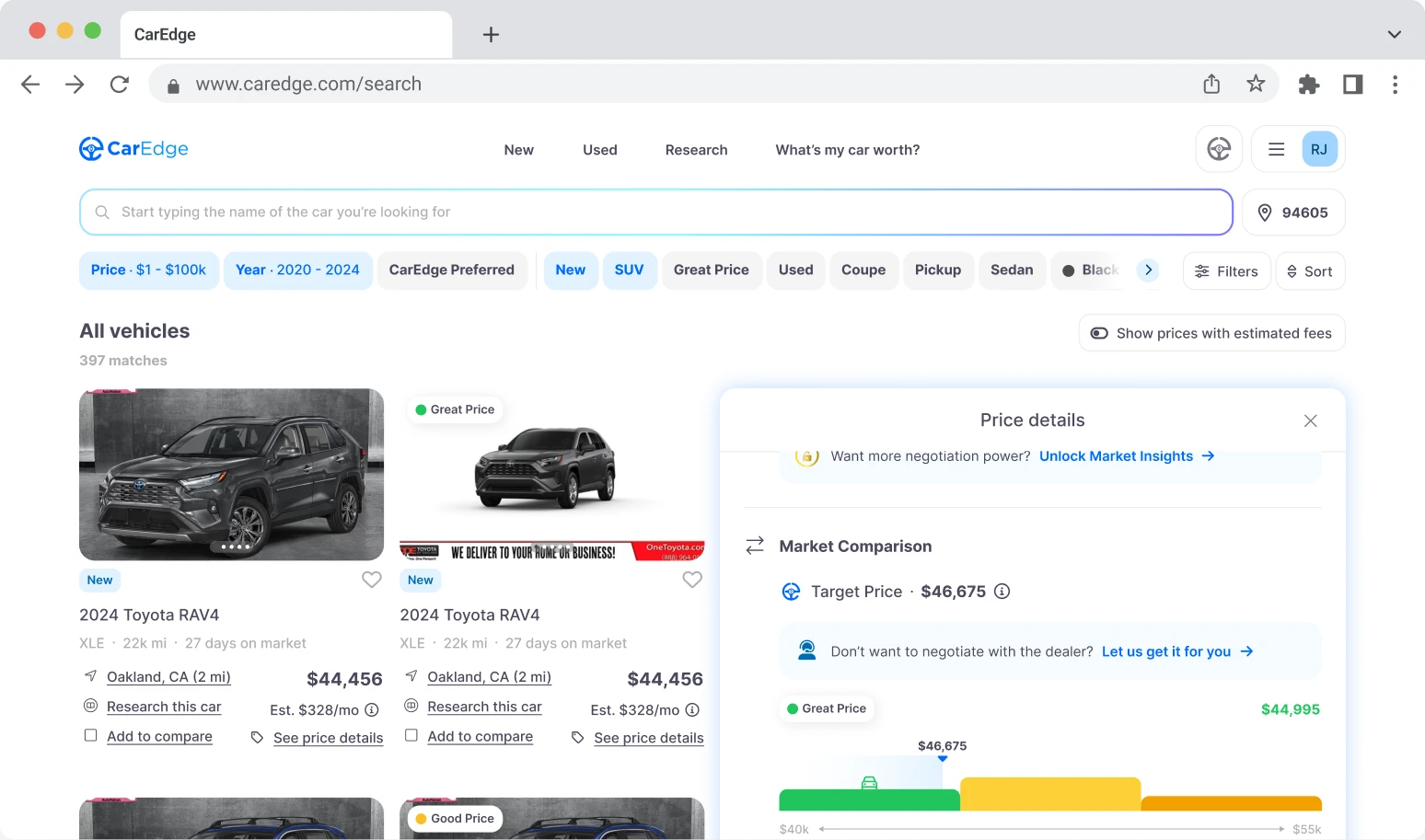
Find a wide range of vehicle listings with market insights on new and used listings near you.

What can I do with CarEdge?
 CarEdge Insights
What can I do with CarEdge?
Get access to exclusive information so you can make an informed car buying decision — all in one place.

Find a wide range of vehicle listings with market insights on new and used listings near you.
Track your vehicle’s value and cash in when the time is right to sell.

Access to our proprietary data to help you find the right car, at the right price. Find these unlocked on every listing after subscribing.

With our expert-led, tech-enabled car buying service, we will locate, negotiate, and deliver your vehicle so you can get a new car hassle free.


Help us personalize your CarEdge experience — it only takes a second.
Your answers help us personalize your CarEdge journey — we’ll follow up with tips and next steps that match your buying timeline.

Negative equity, or being “underwater” on a car loan, is becoming a growing issue for many drivers in today’s market. As vehicle prices soar and depreciation accelerates, more car owners are finding themselves owing more on their loans than their cars are worth. CarEdge, in partnership with Black Book, surveyed nearly 1,000 drivers to understand the extent of this problem in Q3 2024. Here are the key findings.
👉 Download the complete report

According to our survey, 31% of drivers who financed their vehicles are currently in negative equity. This number rises to 39% for vehicles purchased since 2022, indicating that newer car buyers are especially vulnerable. As vehicle prices increase and long loan terms become more common, the risk of being underwater is higher than ever.

A staggering 61% of surveyed drivers overestimate how much their cars are worth, with 17% believing their vehicle is worth at least $5,000 more than its true trade-in value. This disconnect can lead to unpleasant surprises when drivers try to trade in or sell their cars, often rolling over negative equity into their next auto loan and perpetuating the cycle.

Our data shows that loan terms directly impact vehicle equity. Car owners with 84-month loan terms are nearly $5,000 underwater on average, while those with 36-month loans typically have $12,340 in equity. Although longer loans reduce monthly payments, they also increase the likelihood of negative equity in the long term.

Electric vehicle owners are significantly more likely to be underwater. Of the EV owners we surveyed, 46% are currently in negative equity, with a median loan-to-value (LTV) ratio of 0.94—higher than the broader market’s 0.73. Luxury car brands like Tesla and BMW also see higher rates of negative equity compared to budget brands like Toyota and Honda.
As more drivers find themselves underwater on their car loans, the negative equity issue is poised to become a major challenge for car owners and the auto industry alike. While budget car buyers may fare better, EV and luxury car owners are disproportionately affected.
CarEdge remains committed to providing insights and tools to help consumers navigate today’s car market. To learn more about vehicle equity and stay informed on auto news and market trends, visit CarEdge for expert analysis and guidance. For more information about Black Book’s industry-leading data and analytics, visit BlackBook.com.