
CarEdge saved me over 4,500 dollars on a brand new Honda Pilot. I can't say thank you enough.
Price intelligence
Find a wide range of vehicle listings with market insights on new and used listings near you.
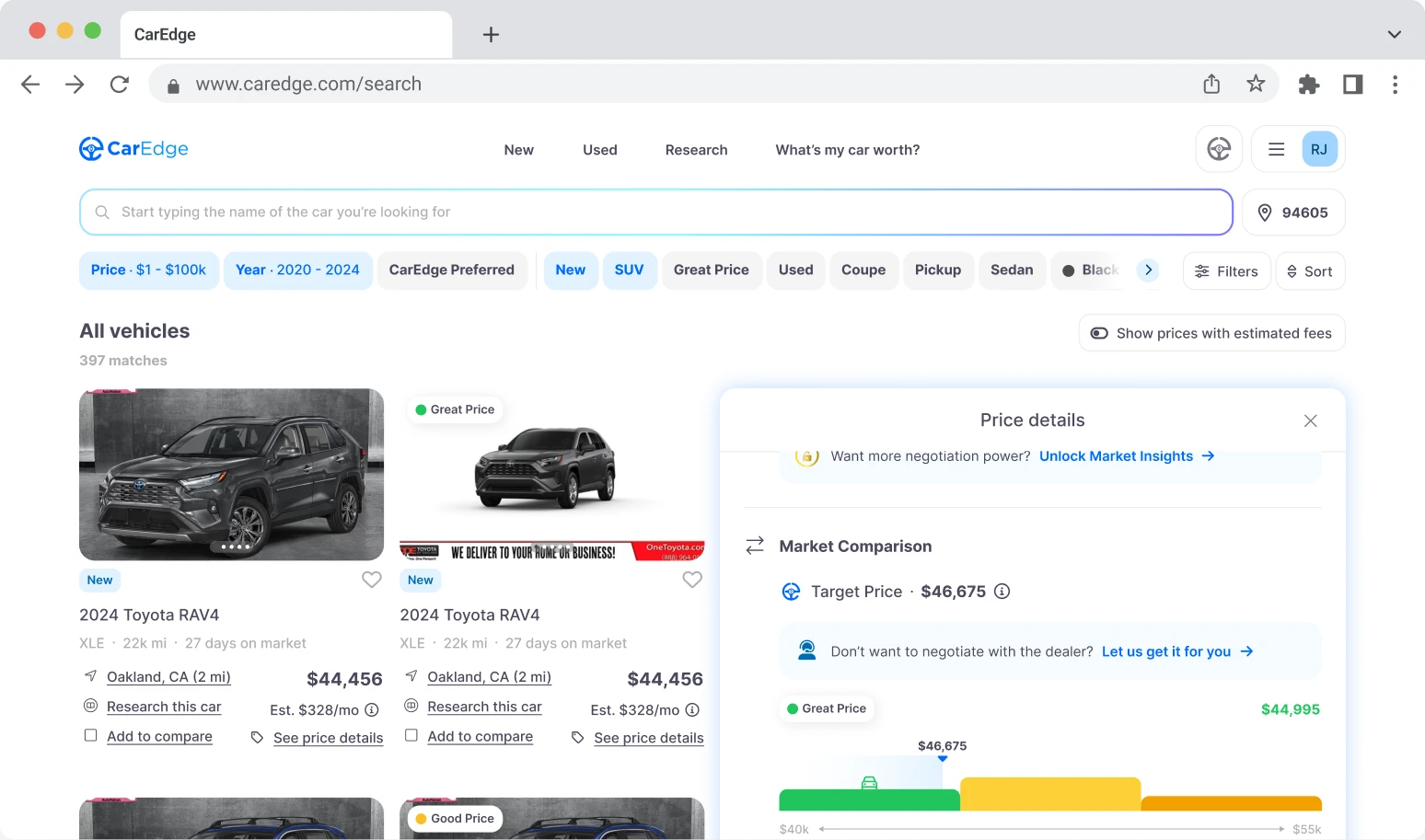

What can I do with CarEdge?
 CarEdge Insights
What can I do with CarEdge?
Get access to exclusive information so you can make an informed car buying decision — all in one place.

Find a wide range of vehicle listings with market insights on new and used listings near you.
Track your vehicle’s value and cash in when the time is right to sell.

Access to our proprietary data to help you find the right car, at the right price. Find these unlocked on every listing after subscribing.

With our expert-led, tech-enabled car buying service, we will locate, negotiate, and deliver your vehicle so you can get a new car hassle free.


Help us personalize your CarEdge experience — it only takes a second.
Your answers help us personalize your CarEdge journey — we’ll follow up with tips and next steps that match your buying timeline.

Just two automakers have announced plans for Super Bowl LX commercials that will air during the game on February 8, 2026. According to NBCUniversal, 30-second spots for the 2026 game are priced between $8 – $10 million. As of now, only Toyota and Cadillac have decided to write the big checks for primetime advertising. Fewer automakers than usual will be featured in the Super Bowl commercial breaks, with some big names already announcing they won’t participate.
Here’s a look at every automaker with Super Bowl commercials in 2026.
As the only true consumer-focused Super Bowl car commercial announced so far, Toyota is front and center for the big game. Toyota has revealed its commercial for Super Bowl LX, and it tells the story of a family and 30 years of RAV4. The RAV4 is completely redesigned for 2026 and now features a hybrid powertrain across the lineup.
The 2026 Toyota RAV4 starts at $33,350 for the base LE trim and is expected to cost over $50,000 for the sport-tuned GR Sport.
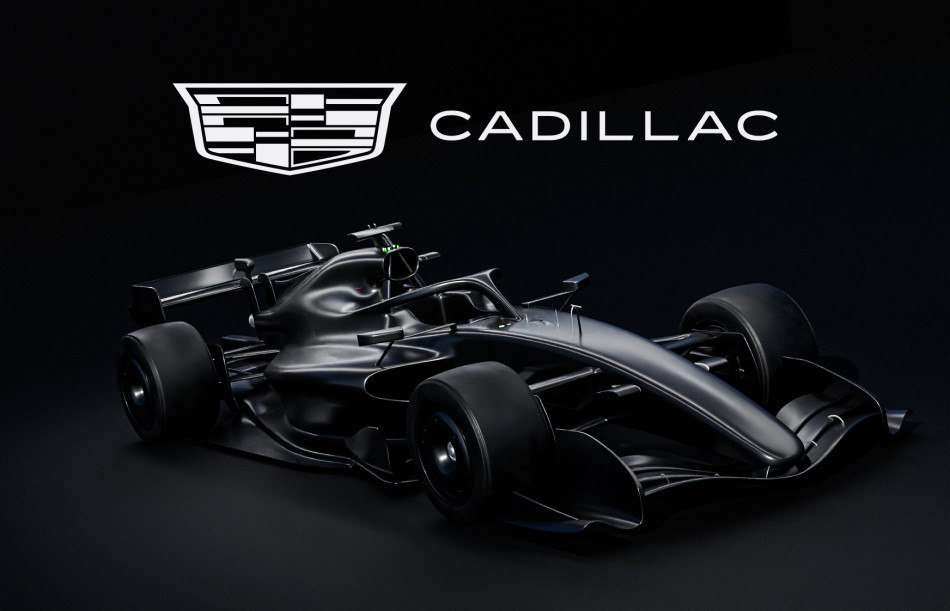
GM’s luxury brand is looking to transform its reputation from one that caters to older drivers to the backbone of a brand-new racing team. Rather than featuring the 2026 Cadillac lineup, the Super Bowl LX commercial will feature the Cadillac F1 team.
“The Super Bowl spot will take the team into millions of homes, while the Cadillac Countdown will give a front-row view in one of the busiest areas in the US,” said Dan Towriss, CEO of Cadillac Formula 1 Team Holdings.
Cadillac will become F1’s 11th team. Sergio Pérez and Valtteri Bottas will drive the Ferrari-powered Cadillac car in its debut season.
According to industry experts at AdAge, for most automakers, Super Bowl marketing is in the rearview mirror. The category, once a Big Game stalwart, is poised for another down year with only two brands—Toyota and Cadillac—confirming ad buys as of today. Instead of shelling out as much as $10 million for 30 seconds of airtime in the game, plus millions more for production costs, many automakers are seeking more value with their media buys.
Automakers are turning to more cost-effective options like streaming platforms, YouTube, and social media for their advertising budgets.
It would likely help if ad placement costs didn’t continually increase. Mike Marshall, head of global advertising for NBCUniversal, told Bloomberg that some ad slots for the Feb. 8 game on NBC have sold for $10 million. That’s a new record by a large margin.
The $10 million price tag is a 43% increase from 2022, when $7 million bought you 30 seconds of exposure. This year’s game is expected to attract an audience of up to 130 million viewers.
The typical cost for a 30-second commercial in the Super Bowl has risen 122% over the last decade. According to USA Today’s Ad Meter, here’s how much a Super Bowl commercial cost has risen over the last 25 years:
The car graveyard is growing faster than ever in 2026.
Every week, automakers announce another model getting the axe. In January alone, four models were dropped from the likes of Tesla, Dodge, Hyundai, and others. Some are old favorites that just couldn’t keep up. Others are failed experiments that never found a buyer. Either way, they’re all headed to the same place: automotive history.
The drumbeat of auto cancellations has grown so frequent that we decided to keep track of it all with a new resource: grimly named the Auto Obituaries. On this guide, we’ll be tracking every single cancellation as it happens in 2026. Check back often, because in today’s market, your favorite car could be next.

According to The Korea Herald, the Kia Niro EV has been discontinued. The first-generation Niro EV debuted in 2018, at a time when affordable electric cars were somewhat rare. The second generation debuted in 2021, bringing significant styling changes and a higher DC fast charging power input that made charging stops shorter.
All this being said, the Niro EV slowly went from lovable underdog to a hard-to-explain model in the Korean manufacturer’s U.S. lineup. With a starting price of roughly $40,000 and a 253-mile range, Kia’s cheapest EV stateside lost its shine in a market where the entry-level Tesla Model 3, which is a larger car that can go 321 miles on a full charge, starts from $36,990.
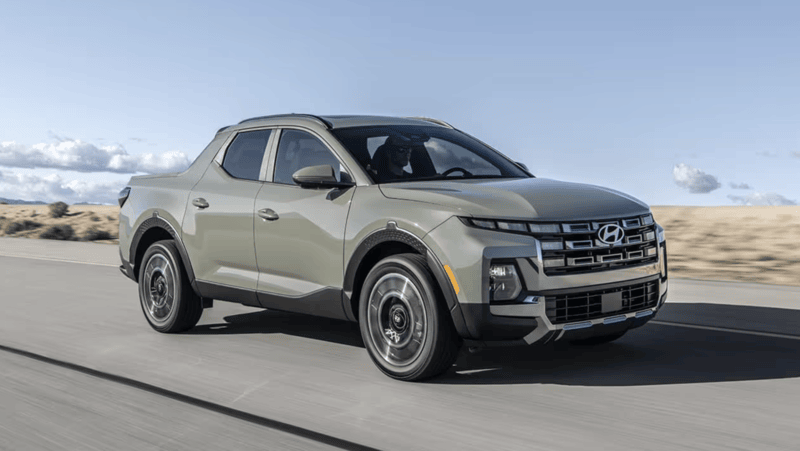
Hyundai is pulling the plug on the Santa Cruz compact pickup after just one generation, according to sources who spoke with Automotive News. Poor sales and bloated inventory are believed to be driving the decision. Ford’s Maverick outsold the Santa Cruz by a 6-to-1 margin in 2025, leaving Hyundai dealers sitting on nearly five months of unsold inventory by year’s end. Since their shared 2021 debut, the Maverick has racked up over 467,000 U.S. sales compared to just 140,000 for the Santa Cruz. The Maverick’s sub-$20,000 starting price significantly undercut the Santa Cruz’s $25,000 base MSRP. The Santa Cruz’s higher price, lack of a hybrid option, and polarizing design never caught on with buyers.
Hyundai isn’t abandoning trucks entirely. Hyundai plans to start building a midsize pickup in summer 2029, switching to traditional body-on-frame construction to compete with the Toyota Tacoma, Ford Ranger, and Chevrolet Colorado.
According to CarEdge, there were 226 days of supply for the Santa Cruz in late January, nearly triple the industry average.
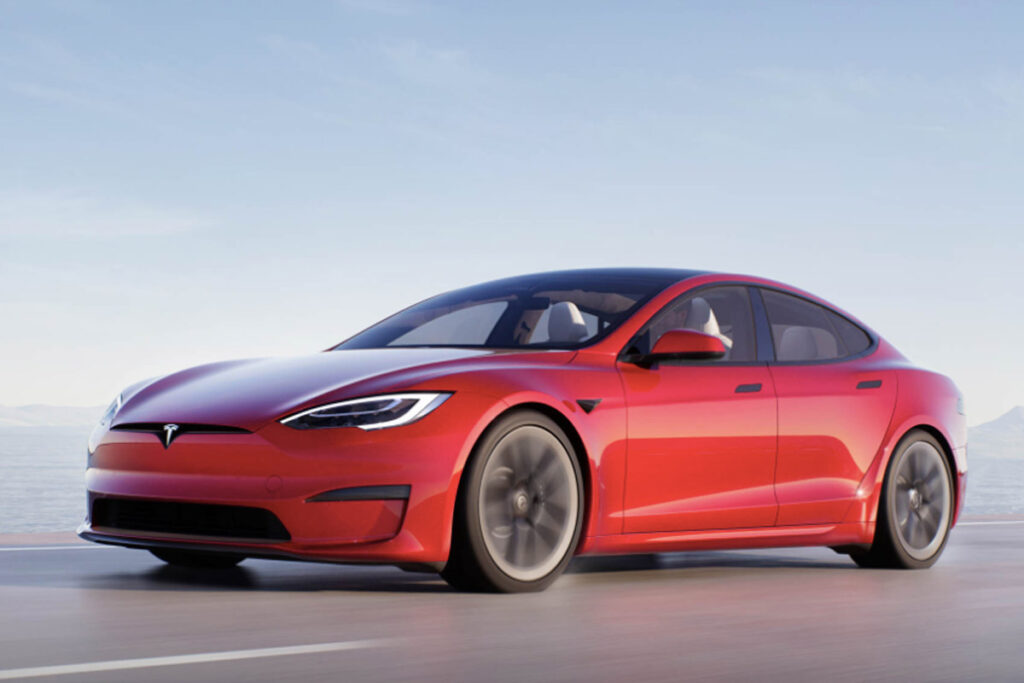
Tesla will end production of the Model S sedan and Model X crossover next quarter to make room for an Optimus robot assembly line at its California factory, CEO Elon Musk announced on January 28. Musk said discontinuing the models is part of Tesla’s shift from an automotive company to a “physical-AI provider” focused on autonomous vehicles, robotaxis, and humanoid robots.
Combined sales of the Model S, Model X, and Cybertruck plunged 40 percent in 2025 to just 50,850 units X, according to Automotive News.
The Model S launched in 2012 as Tesla’s first mass-market vehicle. Starting at $96,630 in 2026, the Model S has seen its fair share of price changes in recent years as demand peaked and then steadily fell.
The Model X followed in 2015 with signature falcon-wing doors and now starts at $101,630. Both models are being axed as Tesla doubles down on its higher-volume Model 3 and Model Y, which sold nearly 1.6 million units globally last year despite a 7 percent decline.

The Dodge Hornet has been discontinued after just a few years on the market, with Stellantis pointing to “shifts in the policy environment” as the reason for axing the Italy-built crossover. In reality, the Hornet has just always been a very poor seller.
Stellantis initially announced in July that the Hornet would be postponed for the 2026 model year while the company evaluated U.S. tariff impacts, but production has now officially ended.
Built alongside the Alfa Romeo Tonale, the Hornet launched in 2023 with both conventional gasoline and plug-in hybrid options, starting at $31,990 for the base GT model X. It joins a long list of short-lived Dodge small crossovers, including the Caliber, Nitro, and Journey.
These cars are sticking around for now, but were recently making headlines for similar reasons. Stay tuned, as this may be a sign of things to come.
In January, Volkswagen announced that the Tennessee-built ID.4 will soon be renamed the ID.Tiguan. Following the end of U.S. federal EV incentives, ID.4 sales fell off a cliff. With policy changes being cited by nearly every OEM in recent lineup announcements, we wouldn’t be surprised if we soon learn that the ID.4 is canceled. It’s a great EV if you can find one at the right price, so we hope a name change will brighten its future.
General Motors has indicated that the recently resurrected Chevrolet Bolt will only live to see 18 months of production before it is canceled yet again. The Bolt was always a popular EV, largely due to the attainable price point around $30,000. However, policy changes seem to have gotten the best of GM’s much-hyped affordable EV strategy. At least the Bolt will stick around for much of 2027.
Wondering which cars will be axed next? Check out the slowest-selling cars in America.
While everyone’s lining up for the same RAV4s, CR-Vs, and F-150s, there are plenty of excellent vehicles that offer similar value, without the markups or slim inventory. These 10 cars fly under the radar, and that’s actually good news for you. Less demand means better negotiating power, bigger discounts, and often, better manufacturer incentives.
We’ve focused this list on two things that matter most when playing it smart: reliability and affordability.
All vehicles start under $40,000. All offer legitimate value. If you disagree with any cars you see here, drop us a note on the CarEdge Community Forum. Maybe you’ll even change our minds!
Without further ado, these are the cars that we think are worth the test drive before you settle for the best-seller in your neighbor’s driveway.
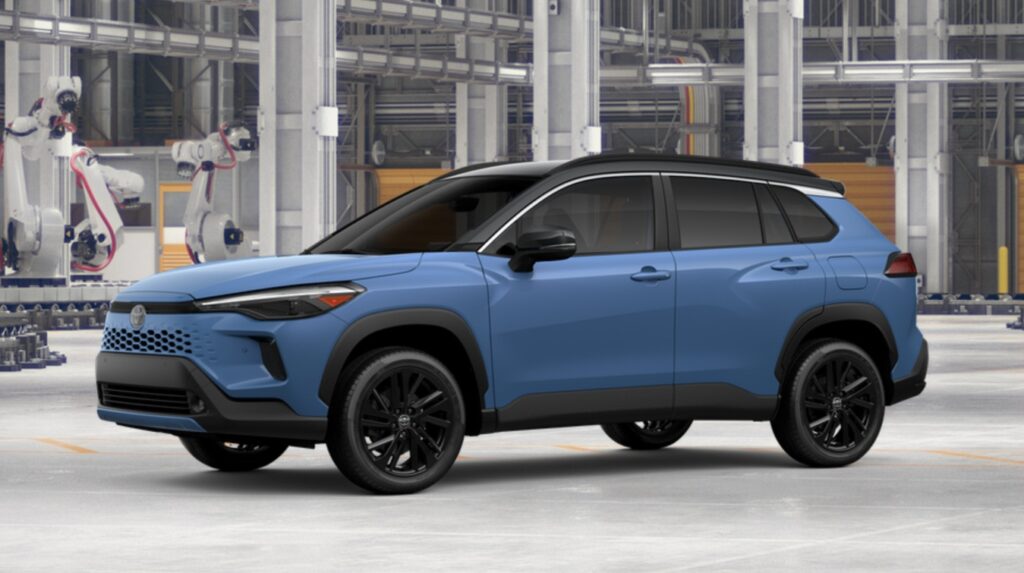
Starting Price: $30,745 MSRP with destination fees
Why It’s Underrated: Everyone wants the RAV4 Hybrid, so they overlook its smaller, cheaper sibling. Before you get in line for a 2026 RAV4, we think the less popular Corolla Cross Hybrid is worth a look.
The Corolla Cross Hybrid sits on Toyota’s proven platform, gets 42 mpg combined, and costs thousands less than a comparable RAV4 Hybrid. Consider this: the Corolla Cross XSE costs $8,000 less than the 2026 RAV4 XSE. It has nearly identical reliability credentials—because both models share Toyota’s 5th generation hybrid powertrain.
The interior is nicer than you’d expect at this price point, but it’s still a budget model. Plus, you can actually find these on dealer lots without a markup, unlike their RAV4 cousins.
Toyota sold just 100,000 copies of the Corolla Cross in 2025, despite tallying 478,000 sales for the very similar RAV4.

Starting Price: $28,445 MSRP with destination fees
Why It’s Underrated: People think it’s too small and too slow. They’re missing the point.
The Crosstrek is consistently in the top tier of Consumer Reports’ reliability rankings. It comes standard with all-wheel drive (most competitors charge $1,500-2,000 for that), gets excellent safety scores, and has one of the lowest cost-of-ownership figures in its class.
Yes, the base engine is underwhelming. But if you’re buying a Crosstrek for drag racing, you’ve already made a mistake. This is a get-to-work-in-a-snowstorm, haul-camping-gear type of compact crossover.
Subaru often brings low-APR incentives to the Crosstrek.

Starting Price: $31,485 MSRP with destination fees
Why It’s Underrated: The CX-5 has been around for over a decade with minimal issues. It has a borderline premium interior that rivals luxury brands, handles better than anything in its class, and has a low overall cost of ownership.
Better yet, Mazda routinely offers better manufacturer incentives than you’ll find for the RAV4 or CR-V. See the best offers of the month.
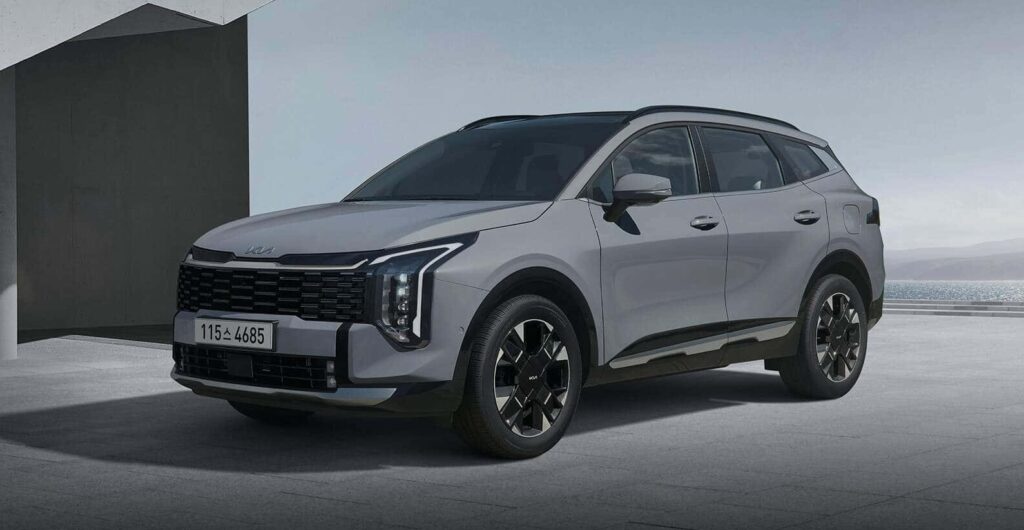
Starting Price: $31,985 MSRP with destination fees
Why It’s Underrated: To many, Kia’s reputation is stuck in 2005. That’s unfortunate, because their vehicles aren’t.
The Sportage Hybrid won U.S. News’ “Best Cars for the Money” award. It comes loaded with features that cost extra on Toyota and Honda. Worried about reliability? Kia is winning over skeptics with a 10-year/100,000-mile powertrain warranty.
Kia’s reliability has genuinely improved. They’re not Toyota-level yet, but they’re solid mid-tier, and that warranty gives you coverage longer than most people keep their vehicles anyway. The hybrid system delivers excellent fuel economy without the Toyota markup.
According to EPA testing, the 2026 Sportage Hybrid is good for 43 miles per gallon in combined city/highway driving. That’s a few MPGs better than most RAV4 trim options!
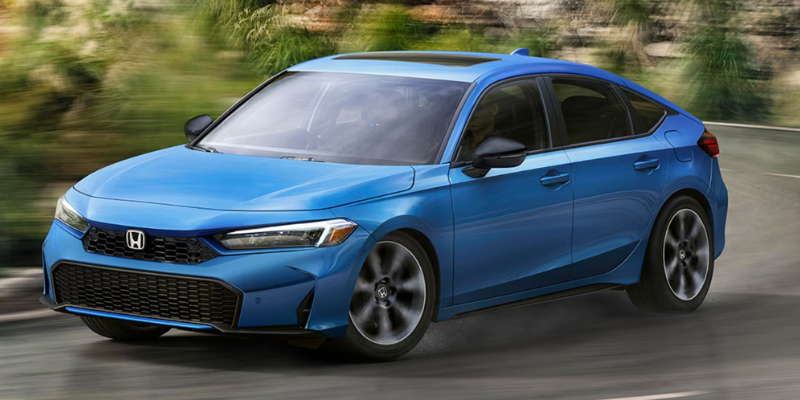
Starting Price: $25,890 MSRP with destination fees
Why It’s Underrated: Are you sure you want to join the compact crossover club? The Civic is a legendary car full of value and character. In fact, along with the Toyota Camry, it’s one of the only sedans that still ranks in the top 10 sellers by volume. Looking to keep your car budget in check? That’s another reason to love the Civic: it starts at $25,890.
Unless you regularly haul a big family or go off-road, SUV drivers are paying extra for ride height you don’t need. The Civic gets better gas mileage, costs less to insure, is easier to park, and will last just as long as any crossover.
After peaking at 377,000 sales back in 2017, Honda sold just 238,000 Civics in 2025.
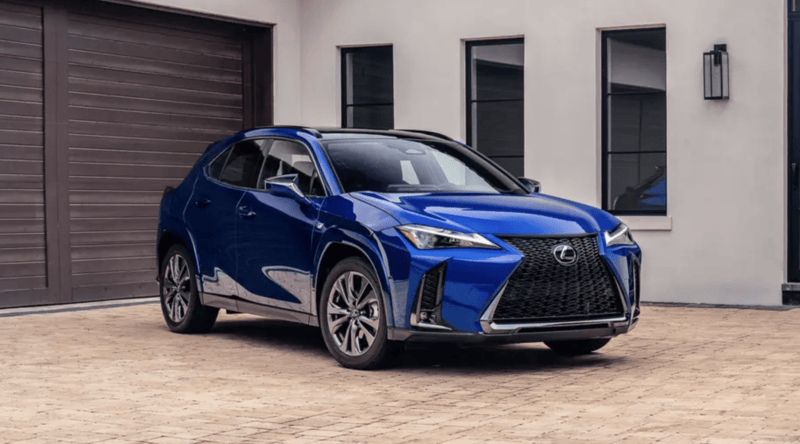
Starting Price: $38,250 MSRP with destination fees
Why It’s Underrated: People assume luxury means expensive repairs. With Lexus, that assumption is wrong.
The UX is the most reliable luxury subcompact SUV according to Consumer Reports. Lexus has topped J.D. Power’s dependability rankings three years running. What’s behind their success? To be frank, a Lexus is Toyota engineering with a nicer interior.
In 2026, the UX comes standard with a hybrid powertrain good for over 40 miles per gallon. This means hundreds of dollars in annual fuel savings for the average driver.
Yes, it’s smaller than German competitors. But it’s also more reliable than German competitors, cheaper to maintain, and will probably still feel premium in 10 years when others are nickel-and-diming you for sensors and software updates.
Browse Lexus UX listings near you

Starting Price: $27,950 MSRP with destination fees
Why It’s Underrated: People think bigger is always better. In urban environments, a large SUV can be a headache.
The HR-V brings Honda’s legendary reliability to the subcompact crossover segment. Consumer Reports gives it above-average reliability ratings, and Honda’s track record for affordable maintenance speaks for itself.
The real magic is the interior space. Honda’s engineers are wizards at maximizing every inch. The cargo area is impressive for a vehicle of this size, and the rear seat is more spacious than many midsize SUVs. Pair that with decent fuel economy (28 mpg combined) and Honda’s reputation for going 200,000+ miles on an engine, and you have a smart choice for anyone who doesn’t need to tow a boat.
Last year, Honda sold 148,000 copies of the HR-V. That’s one-third of the sales that the CR-V achieved.
Buying a car doesn’t have to be miserable. Here’s a wild thought: what if you could just have an expert handle it all for you, from finding the right fit to negotiating every aspect of your deal?
That’s exactly what we do at CarEdge.
Since launching our car buying service a few years back, we’ve negotiated over 3,000 deals for drivers around the nation. On average, CarEdge clients save $2,200 by letting us negotiate on their behalf. Say goodbye to the ‘traditional’ way to buy a car, and let’s get you the price, and experience, you deserve!

Stepping into a car dealership can feel like entering a high-stakes poker game, but with the right guidance, you can confidently call their bluff. CarEdge’s Ray Shefska lifts the veil on dealership tactics with secrets from his impressive 40+ year tenure in the industry. While maximizing profits is part of their playbook, you don’t have to be an unwitting participant. Here’s how you can outsmart the car dealership sales team
Correct answer: I have a total out-the-door price in mind. I’d like to stay focused on that.
Wrong answer: Yes, I don’t want my monthly payment to be more than $700 per month.
Why: Once the dealer knows what your monthly payment goal is, they immediately start thinking about how much wiggle room they have for add-on products, incentives and other odds and ends of the deal. Once you share your desired monthly payment, you’ll be negotiating that number for the rest of the deal. This makes it alarmingly easy to lose sight of how much you’re actually paying for the car.
Correct answer: I just want to know what the out-the-door number is, can we stay focused on that for now?
Wrong answer: I think I could put between $5,000 and $10,000 down. It depends on what the price of the car is, and how much you give me for the trade-in.
Why: This question is another tactic the salesperson uses to turn you into a ‘payment buyer’. Yes, you’ll eventually have to tell them what your down payment is, but do NOT volunteer that information too early in the negotiation! Car dealership salespeople are going to.
Note: Often, the salesperson will phrase this question as if it’s coming from the bank. For example, “The bank typically wants you to put 20% cash down or more. Were you planning on doing that?” You can still refuse to answer this question early on in the conversation. Remember, you’re still trying to get the out-the-door price from them. That’s the number that matters.
Correct answer: I haven’t decided yet. Once we’ve established an out-the-door number, we can discuss things like that.
Wrong answer: Yes of course, how much can you give me for it?
Why: You should always treat buying a car and trading in as TWO separate transactions, because they truly are. See what your car is worth with offers from multiple online buyers here.
These are the questions you’re most likely to encounter at the finance office. For even more tips, examples and advice, see our Finance Office Cheat Sheet. It’s one of our many free resources!
Correct answer: I have thought about this and I’ve even been pre-approved with competitive credit unions, so I do understand what my loan terms should be in order to keep my payment affordable.
Wrong answer: No, I haven’t thought about it yet. Can you help me lower my payment even further?
Why: When you express uncertainty about your desired loan term, finance managers spot an opportunity to manipulate the loan term to make a deal appear more attractive. By extending the loan term, they can “lower” your monthly payments, even if it ends up costing you more in the long run due to interest.
Correct answer: Yes, if you can beat the rate I have on my pre-approval from the credit union, I’d consider it. The rate and the payment would need to come down enough to justify it.
Wrong answer: Sure! That sounds easier.
Why: Be sure to mention that your payment would need to come down in addition to getting a lower interest rate. Why? All too often, the finance manager can offer you a slightly lower interest rate, only to trick you into add-on products later, meaning that your monthly payment ends up the same or even higher than it was originally.
Are you interested in our tire care package for just $6 per month? Or theft protection for just $10 per month?
Correct answer: Thanks, but for each of these products, I need to see the total cost of the product, not just the monthly payment.
Wrong answer: Awesome, wow I see that this theft protection only adds $10 per month!
Why: Expect them to show you the monthly payment, not the total price of the products on their menu. You’ll have to ask for them to point out the total price. Remember this: A product that adds ‘just’ $10 to your monthly car payment over a 60-month loan term will actually cost you $600.
Would you pay $600 for something like tire protection or theft protection? Or, could you buy these products elsewhere for half the price? This is how you should think about the menu products.
The finance office is not the time to lose sight of the number that matters: the out-the-door price!
Your Guide to Car Dealer Fees: What’s legit, and what’s not?
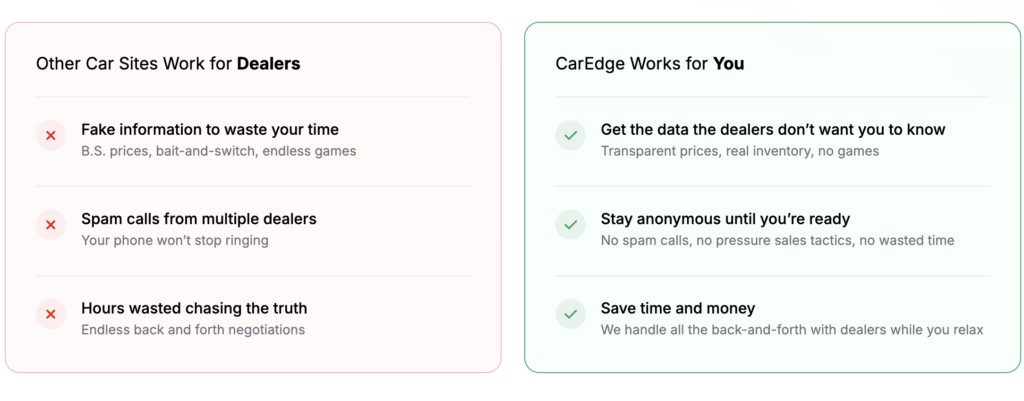
Ready to outsmart the dealerships? Our seasoned experts will 1) find the car you’re looking for, 2) negotiate your deal, from start to finish, 3) arrange the paperwork so you just sign on the dotted line. Want home delivery? We can do that too!
Here’s how CarEdge Concierge works.
Remember that when buying or leasing a car, knowledge is power!
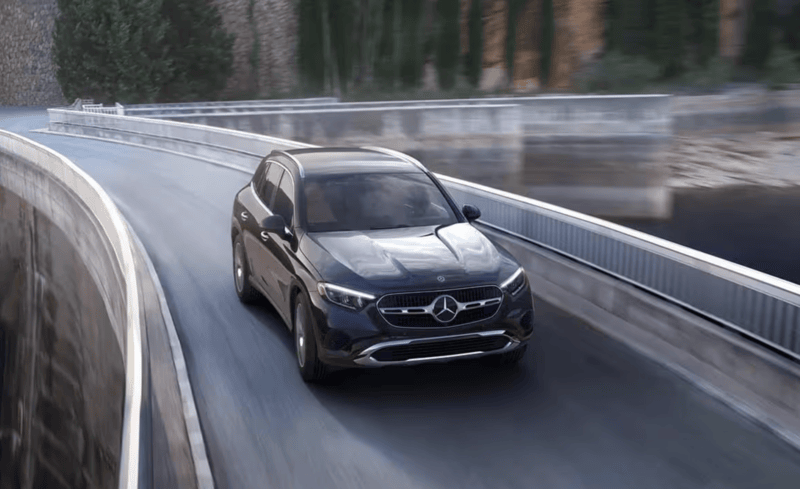
On January 17, U.S. President Donald Trump announced that a new 10% tariff will be imposed on the U.K., Denmark, Norway, Sweden, France, Germany, the Netherlands, and Finland as retaliation for their opposition to Trump’s initiative to control Greenland. Trump said the tariffs on goods from these countries will rise to 25% from June 1, 2026. Greenland has been a part of Denmark since 1814, and has been an autonomous territory since 1953.
Immediately, shares of Europe’s biggest automakers began to tumble. The renewed fears of a trade-war are seen as a threat to their bottom lines, and to their ability to keep prices competitive in the U.S. market.
As of the most recent data from 2024, roughly 800,000 passenger vehicles were imported into the U.S. from the EU, with German automakers like Mercedes-Benz, Audi, and Porsche making up 73% of that. Other key players in the trans-Atlantic auto trade are Land Rover, MINI, and Jaguar.
Italian brands like Alfa Romeo and Maserati, both under the Stellantis umbrella, are spared from the Greenland tariffs due to the neutral stance taken by Italy’s government. If the European Union forms a more united front against the U.S., more makes and models could be subject to Trump’s Greenland tariffs.
Whether or not Mercedes-Benz, Land Rover, and the Volkswagen Group raise prices in 2026 comes down to one thing: how long the tariffs stick around. If the Trump administration ends up raising the tariffs to 25% as indicated, these luxury OEMs will have a hard time keeping pricing where it sits today.
Here’s a look at where average selling prices sit for these brands as of late January 2026 according to CarEdge data:
If prices begin to creep higher, we could see more luxury buyers pivot to domestic or Japanese brands. In January, new car supply remains healthy for the most-affected European brands. By measure of market-day supply (how long it would take to sell all inventory at current daily sales rates), the four key players are sitting in a good spot.
BMW (82 days of supply), Mercedes-Benz (85 days of supply), Porsche (98 days of supply), and Audi (106 days of supply) are all experiencing relative stability in January, but that could soon change.
Don’t expect price hikes to come quickly. European luxury brands are in a constant fight for market share with the likes of Tesla, Cadillac, and even newcomers like Rivian and Lucid in the U.S. market.
At home in Europe, these same brands are already under pressure with Chinese brands like BYD and Xpeng winning over more buyers. Europe’s legacy automakers will hold off on price hikes for as long as possible to remain competitive.
However, if 25% tariffs do indeed arrive in June 2026, that wil be a hurdle too big to ignore, and price changes are likely to reflect that.
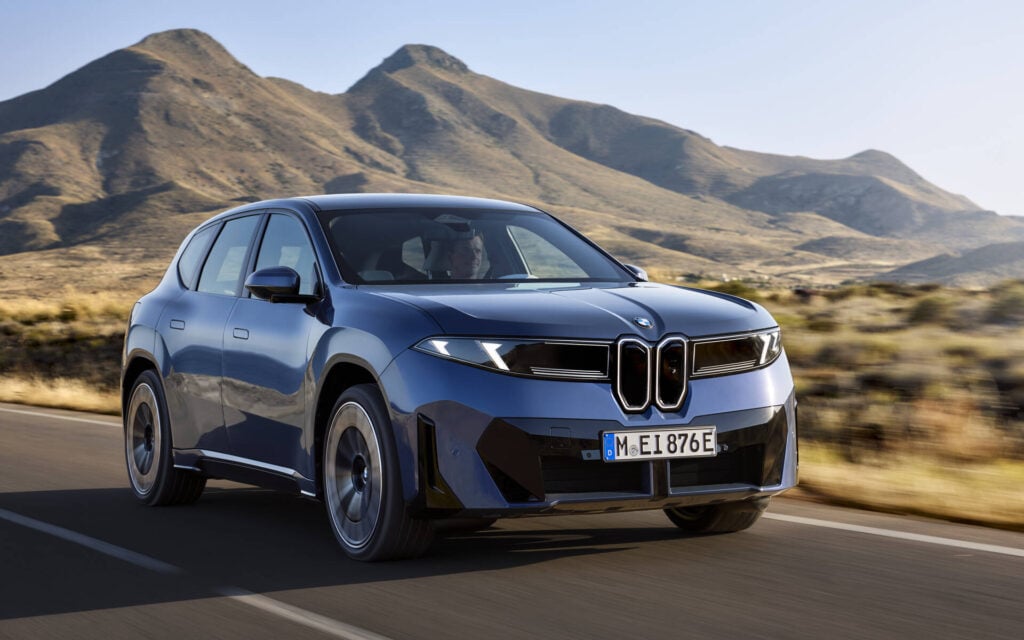
For one German luxury automaker, establishing a heavy presence stateside continues to pay off. The BMW plant in Spartanburg, South Carolina produces models like the X3, X4, X5, X6, X7, and XM. Roughly half of these vehicles are exported worldwide, making the U.S. the largest automotive exporter by value for BMW Group.
BMW’s domestic manufacturing strength in the U.S. is expected to largely shield it from auto tariffs in 2026. Luxury car buyers can expect greater price stability from BMW as a result.