
CarEdge saved me over 4,500 dollars on a brand new Honda Pilot. I can't say thank you enough.
Price intelligence
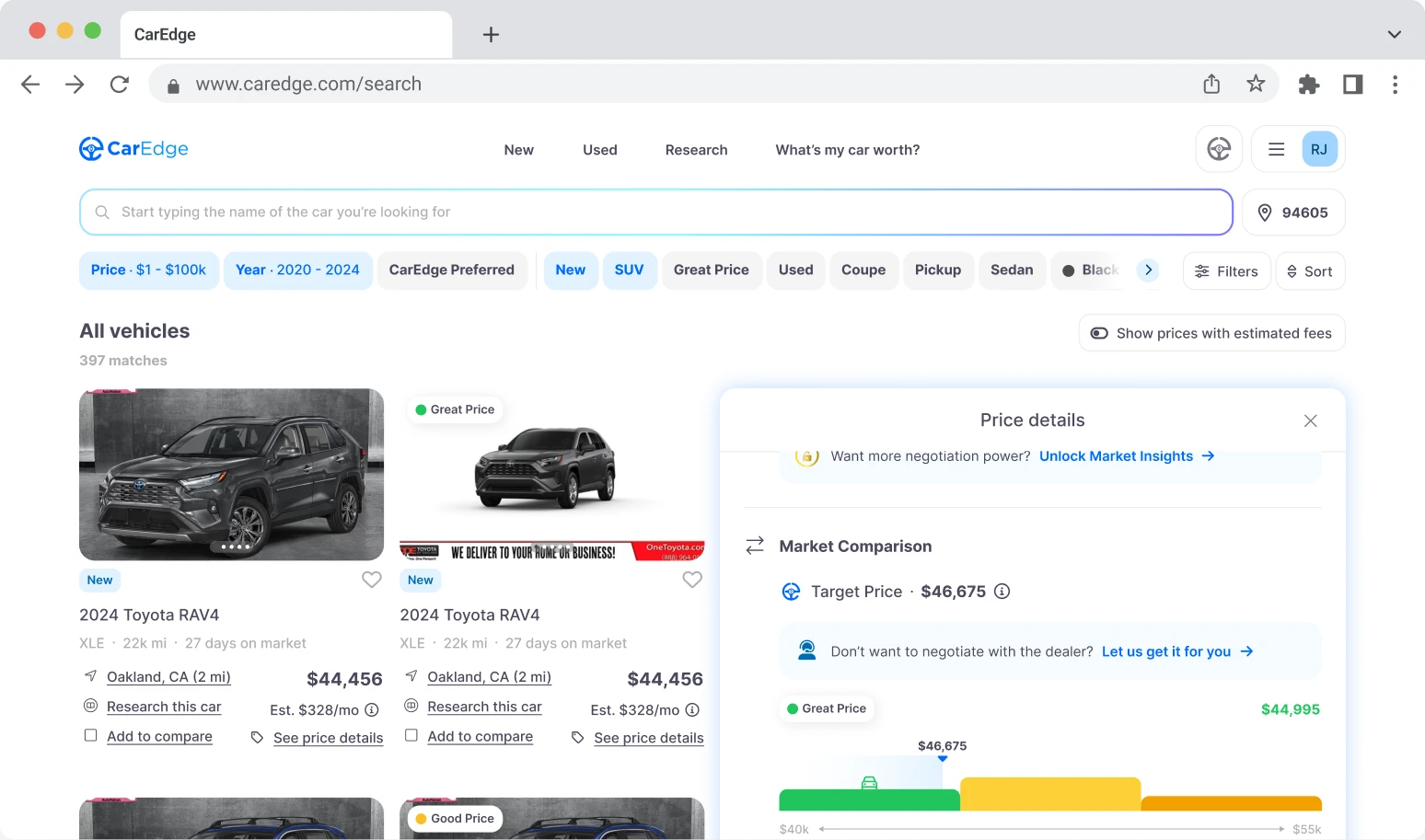
Find a wide range of vehicle listings with market insights on new and used listings near you.

What can I do with CarEdge?
 CarEdge Insights
What can I do with CarEdge?
Get access to exclusive information so you can make an informed car buying decision — all in one place.

Find a wide range of vehicle listings with market insights on new and used listings near you.
Track your vehicle’s value and cash in when the time is right to sell.

Access to our proprietary data to help you find the right car, at the right price. Find these unlocked on every listing after subscribing.

With our expert-led, tech-enabled car buying service, we will locate, negotiate, and deliver your vehicle so you can get a new car hassle free.


Help us personalize your CarEdge experience — it only takes a second.
Your answers help us personalize your CarEdge journey — we’ll follow up with tips and next steps that match your buying timeline.
Undoubtedly, buying a car is one of the most challenging purchases you’ll ever endure (the key word here is “endure,” because it really can be a test of wills to buy a car). For many, purchasing a car, truck, or SUV is the second largest expense they’ll ever have, second only to buying a home. You’d think that spending such a large amount of money would be a happy and joyous occasion … The reality of buying a car couldn’t be further from that aspiration.
Buying a car is certainly a lot different than when I first started in the car business in the 1970’s. We’ve seen a lot of changes that are for the better (and quite a few that are for the worse), but no matter how you look at it, buying a vehicle is still one of the most frustrating things we have to do every few years. I sold cars for 43 years, and even I think the buying process is annoyingly aggravating.
That being said, there is a difference between getting annoyed, and getting taken advantage of, and my goal today is to help you avoid the latter. There are a few telltale signs of a shady car deal, and my hope is that you never experience any of them. That being said, there’s a strong likelihood that you will, and in an effort to help you protect yourself, I’ve written this guide.
Without further ado, let’s dive into the three signs you should walk away from a car deal.
Regardless of if you’re purchasing from a private party or from a car dealership, if the seller of the vehicle won’t show you a CarFax report or the reconditioning repair work, that’s a sure sign that you should walk away from the car deal.
When car dealers buy used cars (either as trade-ins or from auction) they inspect them to make sure they are in good condition for sale. Typically this entails some “reconditioning” work. Reconditioning is the industry term used to describe the process of getting a vehicle “showroom ready”.
If a dealer won’t show you the repair order for the reconditioning work that’s a telling sign that you should walk away from the car deal. It begs the question “What is the dealer trying to hide?”
The same thing goes for when you buy from a private party. If they won’t share previous service records and an up to date CarFax, that’s a red flag and clear sign that you should walk away. Poorly maintained vehicles can be a seemingly endless money-pit, and you don’t want to be the one paying for a laundry list of future repairs simply because a seller didn’t maintain their car well or disclose to you issues it had that would be apparent on a CarFax.
This rule applies to purchasing vehicles from rental car companies as well. It’s well known throughout the automotive industry that the CarFax reports on rental cars can be lacking in detail. This is because CarFax collects information about every vehicle from their network of data providers. Rental car company owned repair shops are not a CarFax data provider, meaning CarFax is “in the dark” when it comes to a lot of the history of a rental car. That being said, it’s of the utmost importance that the rental car company shares with you the service records and reconditioning repair work done on a vehicle.
Another thing to recognize as a “red flag” is if the dealer adds an erroneous “reconditioning fee” to the selling price of the vehicle. The dealer’s cost to recondition the vehicle is already factored into the selling price, so an additional “reconditioning fee” is simply an attempt to make extra profit off of you. Again, this is a sign to walk away from the deal.
If the seller of the vehicle won’t let you get a pre-purchase inspection completed on the vehicle, this is a tell tale sign that you should walk away from the deal. Again, it begs the question “what is there to hide?”
Obviously if you are purchasing a new vehicle you will not get a pre-purchase inspection completed on a car, however for any used vehicle (even a certified pre-owned) you should consider a pre-purchase inspection, and if the dealer or seller won’t allow it, you should walk away.
Recognize that not every car dealership will allow you to drive a car to your mechanic’s shop to inspect the vehicle. This is different from them not allowing the inspection to take place at all.
Some dealerships have policies that restrict their willingness to move vehicles around to a mechanic’s shop for pre-purchase inspections. That being said, they should allow you to have the mechanic come on site, or be willing to take the vehicle to the mechanic’s shop if you put down a refundable deposit on the car. Some dealerships are nervous that if they take a car to a mechanic’s shop for a pre-purchase inspection they may miss a potential customer who is interested in buying the car while it is away.
During my 43 years in the business I never had an issue allowing a customer to get a pre-purchase inspection. I gladly endorsed it. Typically we would have one of our lot attendants drive the car to their mechanic’s shop to make it easier on the customer. If a dealer is unwilling to support your pre-purchase inspection desires, again, that is a sign to walk away.
This tactic, to offer two different prices that are dependent on you financing your vehicle with the dealership, is not only unethical, but counterproductive to being customer-centric. Advertising a price that requires a customer (you) to finance through the dealership so that the dealership can make extra profit is not illegal, but it’s certainly close to the line!
It’s well known that car dealerships make most of their money from the “back-end” of a car deal. This is where they sell insurance products (like an extended warranty), and originate loans. If the dealership where you are looking at buying a car wants to charge you more for the car if you have your own financing, to me, that’s a red flag.
This also applies to other insurance products (like extended warranties). Let’s say you’ve negotiated a price with your salesperson and you’re now in the F&I (finance and insurance) office. The F&I manager tells you that you can get an extra half of a point off of your interest rate on the loan if you buy their extended warranty. What do you do? You get up and walk away!
Tactics like these are simply signs of car dealerships that are looking to take advantage of their customers. Again, they’re not illegal, but they certainly toe the line.
Buying a car is the polar opposite of any other purchase we make. When you go to the grocery store and buy some cereal you pay the price of the cereal and sales tax, that’s it.
When you buy a car you pay for the price of the car, and then a laundry list of fees (some of which are legitimate, many of which are bogus). As a car buyer, how are you supposed to know what’s fair and legitimate, versus something that is purely dealer profit?
I’ve written about legitimate and illegitimate car dealer fees in the past, but it’s worth restating them here. Specifically stay away from dealers that try and charge you any of these fees:
When it comes to the end of a car lease, you have a few different options for what you can do. To make the best choice possible, it’s important to understand a few factors that go into the different lease-end options you have at your disposal.
Deciding what to do at the end of a car lease depends mostly on how you feel about the car. Of course, your financial situation and inclinations also come into play. We’re about to explore each of the options available to you as your lease ends.
Looking for help with leasing a car at the best price? Let our team of expert Car Coaches take the hassle out of car buying and leasing. Here’s how we can help.
When you return your leased car, it will be thoroughly inspected, this is called the “lease-end inspection,” and it’s important to understand that you may be charged fees for excessive wear and tear to the vehicle. When you take your vehicle to the dealership they’ll be looking for:
Before you head for the dealership, you should ensure you have everything that came with the car to avoid additional fees. This means you’ll want to bring both sets of keys, make sure the spare tire is in the trunk, have the original floor mats in the vehicle, etc, etc.
If you plan to simply return the vehicle, you should also be prepared to pay the lease disposition fee, which is often around $400 (although the exact amount is on your lease contract). This fee is to cover the costs of reselling your leased car, and if you plan to return your vehicle (and not lease another vehicle from the same manufacturer) you cannot get out of paying this fee. If you went over your mileage allotment expect to get a bill sent to you, and if you’re terminating your lease before it’s over, expect even more fees (as well as the reality that you’ll still need to make your remaining lease payments).
Let’s say you want to return your car and then get a new lease. That is of course also an option, and one the dealership will be excited to help with. It’s likely that the dealership has contacted you in the months leading up to your lease-end to try and get you into a new lease already, and so by the time you show up to return your vehicle you may have already put together your new lease deal.
When you return a vehicle and then lease another from the same manufacturer they will waive the lease disposition fee. The vehicle you are returning will still need to go through a lease-end inspection, and you’ll face fees if you don’t have the second set of keys, or went over the allotted mileage.
You may be able to roll any lease equity over into a new lease as well. Lease equity is the positive equity created when your car is worth more than the residual value stated in your lease terms. Lease equity typically only occurs when you have severely under-driven the mileage stated on your lease, or when you simply get lucky because of an increased demand for your specific car.
For example, let’s say you lease a Honda Accord, and the stated residual value at the end of the term is $15,000. You lease it and barely drive it during the 36 month lease. You head to the dealership to return your current lease and move into a new Accord. When you arrive the dealership lets you know that the vehicle’s “book value” (how much they’re willing to buy it for) is $16,000. Rather than return the vehicle, you work with the dealer to buy it, trade it in, and roll over the equity ($1,000) into the new lease.
When leasing a car, many people decide to move into a new lease with the same dealership. While reasonable, you should shop around before jumping into another lease. Like we always preach, you should negotiate the largest dealer discount from MSRP before committing to a car deal.
If you’ve enjoyed your leased car you always have the option of buying it outright at the end of your lease. You know exactly how much you’re going to pay for the car (the residual value set when you signed the lease contract), and you know everything about the vehicle (since you’ve been driving it for the past few years).
The residual price is in your leasing contract and was determined based on their estimation of what your car would be worth at the end of the lease. Comparing the residual value against the current market value is often the deciding factor for people considering buying their leased car.
For example, John leases a Toyota Prius, and at the time the contracts are drawn up, the manufacturer calculates that the Prius will be worth 58% (residual values are always represented as percentages) of its original MSRP. That means John can buy his Prius outright, at the end of the lease for $17,000 (remember, this is a hypothetical). Because of market conditions, and the fact that John only put 18,000 miles on the Prius, he knows the vehicle is worth $20,000 if he sold it to a private party, or $18,500 if he sold it to the dealer. These figures mean John should almost certainly buy the car since it’s $1,500 cheaper than the market rate.
However, if John’s lease comes to an end and the book value on his Prius is actually $15,000, John would be paying an extra $2,000 over his Prius’ market value if he bought it outright at the end of the lease. In this case John would be better off turning in the leased Prius and buying one elsewhere for $15,000.
One of the most challenging decisions people face when considering what to do at the end of a car lease is often the same decision that originally led them to their lease: should you lease it or buy it?
There are pros and cons to both options. Objectively considering both will ultimately help you decide what to do at the end of a car lease.
People decide to buy cars at the end of their leases all the time. There are many good reasons why. However, there are also a few notable drawbacks.
Pro:
Cons:
Buying a car usually makes more financial sense than leasing a car. One benefit of purchasing the vehicle that you’ve been leasing is that you know exactly how it’s been driven and maintained, as compared to buying a used car off the lot.
Our Car Coaches are ready to help you determine which option is best for you. Our community saves thousands of dollars every day. Check out these uplifting success stories!
In case you missed it: Check out this 100% FREE car buying negotiation cheat sheet.
Some people are serial car leasers. They’d never want to commit to owning the same car for longer than a lease. Let’s take a look at some reasons why.
Pro:
Cons:
You may notice that these pros and cons lists are quite similar to the lists you might make before you first got into a lease. That’s because deciding what to do at the end of a car lease is similar to deciding to start a lease in the first place: lease a new car or buy the one you’ve been driving.
Deciding between the three lease end options detailed above can often be tricky. It typically comes down to how you feel about the car. If you love the way it drives and you want to keep driving it, buying it is usually the best option, even if the numbers say you should turn it in. Conversely, if you dislike driving it and you’ve been counting down the days, it’s probably best to turn it in and walk away.
Now you know what to do at the end of a car lease, but you still have homework to do. You need to determine the car’s current market value and compare it against the residual price. The difference between these numbers will help you decide what to do at the end of a car lease.
You just negotiated and agreed to a car deal. Congratulations! Now isn’t the time to put down your guard … As one sales process ends, another is about to begin.
You see, the F&I (finance and insurance) office is where the real money is made in a car dealership. It’s where an F&I manager will offer you all sorts of additional products to go along with your new vehicle. In today’s modern F&I office there are dozens of products you can buy, and to convince you to buy them, savvy F&I managers use what is called menu selling.
What exactly is F&I menu selling? How should you handle it? And what should you know before you step foot in an F&I office?
Don’t worry, we’ve got you covered. CarEdge is dedicated to arming you with all of the information that you need to get the best deal possible (both on the front-end, and on the back-end of your car deal).
Let’s break down exactly what an F&I menu is, discuss why it’s in use, and teach you how to handle it. The next time you walk into the car dealership, you’ll be ready.
After you’ve negotiated your car deal, you’ll meet the F&I Manager. Sometimes you’ll meet the F&I Manager when you’re still completing your car deal with your salesperson, but nine times out of ten, you’ll meet them once you step foot in their office. You’ll exchange some pleasantries as you acclimate, then they’ll pull out the menu. That’s right, a menu. It will have four or five columns, each with different types of coverage and protection. At the bottom of each column is a display price for your projected monthly payment.
The menu can either be physical (like a menu you would see at a dinner), or digital (typically pulled up on either an iPad, or a giant screen on the F&I Managers desk).
The finance manager will go over each column, discussing the different levels of coverage available in each program, and give you the total monthly price for each package. Note that it’s the monthly price, but more on that later.
You’ll then be asked which level of protection is right for you. Nowhere on the menu is there an option to have no coverage; you’ll have to ask for that on your own.
This entire concept is known as menu selling. It’s a simplistic way to get you to buy an extended warranty, tire and wheel protection, dent and ding coverage, etc, etc. The entire concept is based on the notion that if you give people a list of options, they’ll feel compelled to pick at least one of them, and when you frame it as “this protection only increases your monthly payment by $15 per month,” it becomes increasingly difficult (as a customer) to say “no.”
Don’t fall for it. It’s fine if you want added coverage for your new car, but don’t let this psychological trick be the reason you purchase. F&I menu selling isn’t an unethical car dealer practice, but it’s certainly a tactic you’ll run into. Simply be prepared.
And, as always we do offer transparent pricing for CarEdge members on vehicle service contracts, so if you are interested in buying an “extended warranty” get a “cost plus” quote from us to price shop with. More on that here: https://caredge.com/extended-warranty/
Way back in the day it wasn’t uncommon for F&I products (like extended warranties) to get “slipped in” to a customer’s car deal, even if they weren’t disclosed. Those days are fortunately long gone (thanks to several lawsuits), and nowadays “disclosure” is a primary concern for the F&I Manager.
All F&I products need to be presented to every customer, and the customer must specifically decline the coverage being offered. If the customer declines, they’ll have to sign something that says they declined. This policy prevents finance managers from selling you something you don’t even know about, but at the same time, it opens up entirely new sales opportunities.

For a while, F&I Managers would simply tell you about the different levels of protection. Then, some revolutionaries came up with the idea of “The Menu”. It caught on like wildfire, and it’s now standard practice in car dealerships around the country. Our favorite implementation of the “menu” is the docuPAD, a giant tablet that sits on a F&I Managers desk. It looks a little silly, doesn’t it?
What do you do when you’re greeted with the F&I menu?
The first thing that any reputable F&I Manager will go over is your base payment, without any added coverage. They’ll also show you the APR and the term length of your loan (if you’re financing). You need to initial next to all three to indicate that you received those specific terms.
If you would like to decline all options, make that clear. Say that you’re ready to sign the disclosure and that you will not be buying any further coverage. Be firm and confident. Be prepared to walk out on the entire deal if they push you on trying to buy coverage that you don’t want. This is especially important if the F&I Manager says anything along the lines of “You know we can lower your interest rate by a point if you buy the extended warranty …” Not only is this illegal, it’s a sign that this is a dealership you shouldn’t do business with!
Of course, you might actually want some of the options on the menu, and this is where it gets tricky. You’ll need to understand the full price of the products, not just their impact on your monthly payment.
The way that they convey the price is in terms of how it will impact your monthly payment. They’ll say that you’re going to pay nothing today, it’s all bundled into the payment, and it’ll only increase by X amount. Those are all sales tactics.
Here’s what you do: ask for the total cost of the product you’re interested in. Don’t accept the standard “it’s only $15 per month” answer. You need a full dollar amount. Most F&I Managers won’t have an issue providing you the total figure, it may simply take some poking and prodding. Once you get the price, know that you can cross shop at other dealerships, online companies, and even here at CarEdge. Whatever you do, don’t fall prey to the idea that you can’t negotiate on F&I products. Just like your car deal, the products in the F&I office are negotiable.
F&I menu selling prays on payment buyers. A payment buyer is a term for anyone who buys their car based on their monthly payment. There’s nothing wrong with this, and it’s a perfectly reasonable way to think about car buying.
However, the issue with F&I menu selling is that it takes advantage of payment buyers by squeezing options into the monthly payment, then downplaying their cost.
The best way to protect yourself against F&I menu selling is to focus on the out-the-door (OTD) price. The OTD price is the total figure that includes everything you’ll be paying for, including extended warranties and other options. It’s really the best way to know how much you’re actually paying for a car. You will have negotiated the OTD price with your salesperson, and now you’ll do it again with the F&I Manager.
Conceptualizing your car buying experience as a single number, instead of a series of monthly payments, helps you understand the impact of menu selling. Sure, $15 per month seems reasonable. Stretched over a long enough term, that can be $2,000 added to the price of your car.
Here’s a general rule of thumb: if there’s a tax applied to it, you can negotiate it. Everything else cannot be negotiated. Guess what’s taxed? Every option on the menu, and every other service the F&I office presents you with.
If you do want something that’s being offered, get them to go lower on price. Finance Managers have a complex commission structures, but in the simplest terms, most are rewarded for moving a volume of products, even if they aren’t the most profitable. This means the F&I Manager is motivated to move their products so that they get paid more.
You can use this to your advantage by asking for a discount. Say that the payment option on the menu is too much, but you’re interested in the coverage. Be clear that you don’t want to extend your payment term, but you want a lower monthly payment.
You might be surprised by how flexible finance managers can be. The key is to use the same trick for declining coverage overall, projecting confidence and staying firm.
F&I menu selling is so prevalent that we can almost guarantee you’ll be seeing it the next time you buy a car. Ever since its creation, it’s been a massive profit generator for car dealerships. By packaging everything into options and just tacking it onto your monthly payment, more and more car buyers are susceptible to saying “yes,” when in reality they aren’t 100% sure what they’ve bought.
Menu selling isn’t “good or bad,” it’s simply a function of buying a car. Our hope is that when you experience it you’ll be more informed and confident as a result of taking the time to read this page.
Misdirection is the secret to every magic trick ever created. It’s also the secret to the smoothest tricks performed by car salespeople. One classic old-school dealer close is called the 4-square close. It’s a specific type of close that’s been used for decades and is still employed by salespeople in car dealerships around the country.
Here at CarEdge, our mission is to provide you with the quality education and information that you need to secure a reliable car at a fair price. Today, we’re going to dissect this old-school dealer close and show you how to make it work in your favor.
Let CarEdge help you buy your next car! It’s like Honey, but for buying cars, trucks, and SUVs. Sign Up For Free
If you prefer to watch instead of read, simply click on the video above.
Imagine you’re at the dealership to buy a new car, and the car salesperson comes back from the sales manager’s office to the cubicle she left you in. She’s holding a folded piece of paper and has a smile on her face. She says something about how the sales manager must be in a good mood, and she unfolds the paper as if it holds the secret to happiness.
What she shows you are four squares drawn on the paper. You’re about to experience the 4-square — a tried-and-true old school dealer close. Above the four squares you’ll see your name, the vehicle you’re interested in purchasing, and its MSRP. Below are four squares that are the foundation of this close. Those squares are:
She’ll break down each square, saying they’re giving you a great sale by reducing the MSRP. She’ll move on to the trade-in square and say you’re getting a great deal there, too. Then she goes over to the cash down, and say you “only” have to pay that amount. Finally, she then goes over to the payment ranges, there’s typically three of them, and she’ll tell you what they are.
After that, she closes: “Which payment range works best for you?” That’s the conclusion of this old school dealer close. She’s hoping that you simply pick a payment range and you proceed to the next step in the car buying process.
However, you’re probably not going to be happy with every number she presents to you (at least you shouldn’t be!) You’re going to go through the squares, one by one, and say you want better figures (a lower selling price, more for your trade, etc). She might discount the car a little more or up the trade-in value, but the two squares that she really manipulates are the cash down amount and payment ranges. She’ll say something like “it’s just math” as she changes numbers around to suit your requests.
The car salesperson might decrease what you put down, then increase your payment amount, then stretch the payment term. As you negotiate, she’ll keep moving numbers around (probably after multiple trips to the “manager’s office” to get approval) until you are satisfied with your payment amount, the term, and the money down. When that happens, she has successfully closed, and you move on to the next phase.
This entire process is misdirection. The car salesperson is focusing on cash down and payment terms while neglecting the other two boxes, trade-in value and sale price.
It’s a smooth old school dealer close. Unaware buyers fall for it time and time again, which is why it’s still in use. We’d love to see this old school dealer close fade away into obscurity, but that will take a well-educated public.
What can you do to counter this close? Can you avoid it altogether, or perhaps even put it to work for you?
Most car buyers are only interested in how much they are going to pay every month and how much they are going to have to put down. It makes sense since those are the numbers that have a direct impact on their bank account. You hear us talk about it all the time, we shouldn’t be payment shoppers, but naturally, most of us are. It’s okay, you simply need to be informed when you make your buying decisions.
However, focusing on those numbers writes a blank check for dealerships, as they can massage these two numbers to boost their profits. It’s why they use the 4-square close to keep you focused on money down and the payment amount.
Here’s what you do instead: you keep changing the focus to the other two boxes. You keep saying you want more off of MSRP, and you want more for your trade-in. Stand firm in your choice and say that you know they can do better.
Or, we can even take it further.
Take the pen from the car salesperson and add a new box, and label it OTD. That stands for out-the-door, and that’s the real figure you focus on. How much is that car going to cost you, total, to drive off the lot?
You want a grand total that factors in every expense (taxes, title, tags, fees, etc.) and is the absolute final number. You tell them they can keep reducing the sale price and boosting the trade-in value until you both agree on an OTD amount. These will be tough negotiations, but you’ll need to remain firm to secure the OTD price you’re after.
Once you have an agreeable OTD amount, then you can talk about the other boxes. You can discuss how much you need to put down and your monthly payment amount.
It’s vital to understand that these figures are secondary. Many people who focus solely on their monthly payments don’t even know how much the car ends up costing them. You don’t want to be in that situation; you want to walk away knowing you got a fair deal.
You should also make it clear that you want a specific monthly payment, and you only want to put a certain amount of money down. Don’t let them still manipulate these numbers, because they’ll try. Once you’ve agreed on an OTD price, you make sure they match what you want to put down and the payment terms you’re after, especially when you get back into the F&I office.
We’ll be honest; it will be difficult to enact the above plan. Car salespeople are trained to keep the focus on the two squares that make them money. Shifting focus back to the sale price and the trade-in value will be a challenge. Getting them to agree on an OTD amount will be even more difficult. You’ll have to employ every negotiation tactic in your toolbelt, but it’ll be worth it. You’ll avoid getting taken advantage of at the dealership, and like we always say, you can (and should) treat your trade-in as a separate transaction, that way you can focus on getting a fair OTD instead of getting confused between the sale of your vehicle and the purchase of a new one.
Something you must remember is that you are always in control when buying a car. If the salesperson and sales manager won’t work with you on an OTD amount, or you don’t like what they offer you, walk away. You can say something like, “these figures don’t work for me,” and excuse yourself. Anything other than a firm and confident “no” will open the door for overcoming more objections. That’s what they’re trained to do, and you can bet they’ll do it.
If they keep pushing, make it clear that the numbers aren’t what you have in mind, so you’re going to leave and find another dealership. You should always have the mindset that you have nothing to lose by walking away. This is why we always say the best time to buy a car is when you don’t need to, since it allows you the comfort of knowing you can walk away.
You might discover that the dealership is actually more willing to work with you if you’re about to leave. Or they won’t, and you’ll leave and move on to the next dealership. Either way, you need to stand up for yourself and don’t let dealers take advantage of you with this classic old-school dealer close.
Over the years I’ve heard (or used) every old-school dealer close in the book. “Closes” range from the salesperson putting “soft” pressure on you while acting as your “friend” to more advanced tactics like the 4 square. There is a certain art to it (as there is in all sales), but it’s not the type of art most people like (especially not when they’re at a car dealership).
Our job at CarEdge is to help you be a more informed and educated car buyer. Today we’ll cover one of the more common “close” tactics called the 3 “m” close. Although it is a bit old-school a lot of dealerships still employ it, and unfortunately new people to the industry are learning it.
The 3 “m” close attempts to overcome the common objections that someone might have when they’re close to signing the dotted line, but aren’t quite ready. Today, I’ll walk you through exactly what’s going on with this close, how to spot it, and what to do about it. As always, if you don’t feel like reading, simply click play on the video above.
Let CarEdge help you buy your next car! It’s like Honey, but for buying cars, trucks, and SUVs. Sign Up For Free
You need to be ready to walk into the dealership with confidence, and my hope is this article will help. Let’s dive in.
The three “M” close comes into play when a salesperson hears a customer’s first objection, which is often “I need to think about it.” At that point, salespeople are trained to go into a maneuver like the 3 “M” close. You’ll hear something like, “Do we have the right machine picked out for you?”
When you hear this (or some variant of it), recognize what the salesperson is doing, they’re beginning to get into the 3 “M” close, and you just heard the first “M”; is it a problem with the “machine.” You could bet money that the following two M’s are next. This is a dealer favorite old-school close.
The goal of this M is simply to get to you to say that you like the car that’s been picked out and that it’s the right car for you. After all, if you like the car, then there’s some other issue that needs to be addressed. That’s the essence of this old-school dealer close: break down the three common barriers and seal the deal.
If you say it’s not the right car, then they’ll start showing you other vehicle options. If it’s an issue with the machine, your salesperson will act fast to find another vehicle on their lot that meets your needs, wants, and desires.
A decent salesperson will set up this M by saying something like, “Nobody wants to do business with someone that they don’t like, so am I the problem?”
It’s human nature not to want to hurt someone else’s feelings, so it’s almost a guarantee that you’ll say something along the lines of “No, of course you’re not the problem.” People usually want to avoid conflict, so it’s highly unlikely you’re going to say you don’t like your salesperson, even if you can’t stand them.
The car salesperson might even rope in other people that you’ve met from the dealership and say that everyone here would do anything to make sure you got in the right car. Everything said at this step is meant to set themselves up as your best friend who’s just trying to help you get into the right car.
Once they verify that they aren’t the problem, they’ll move on to what probably is the actual problem: the money.
The final M is typically where the actual objection is taking place. You might like the car, you might like the salesperson, but if the numbers don’t add up, you’ll have an objection to signing your vehicle purchase agreement.
At this stage, everyone is on the same page, and the salesperson knows that the money is the issue. Don’t be surprised when they still ask if it is, it’s all part of how they were trained. Once you confirm that the money is the problem, they’ll break down how it’s a good deal or possibly waive some fee that should’ve already been waived.
One tactic that we saw when this topic was brought up on our YouTube channel was pushing to let the customer take the car on an “extended test drive.” This is a bit of a gray area, but can be legitimate. Some dealerships do actually let you bring the car back if you don’t like it after a few days, but you absolutely need to have it in writing. If you don’t get it in writing, then you’re just buying the car. Of course, if you get in a car accident during your extended test drive, you’re the one on the hook, so at the end of the day, I’m not a big fan or proponent of taking a dealer up on this offer.
Another option is that they switch to another closing tactic that’s more specific to the money issue. The purpose of this old-school dealer close is to have you admit where the problem is so that they apply more pressure in that specific place. If it were a game of chess, the 3 “M” close is getting you to move your pawns out of the way so they can strike where it matters.
Whatever their next step is, you can be sure it’ll involve overcoming your objection about the price. They might pull up vAuto and show you that they’ve got the best price around. They might also break down the financial figures one more time to show that the financing agreement being offered is incredible.
Either way, you don’t want to buy that car. So, what can you do against this close?
One of the things customers say that leads into the 3 “M” close is the classic, “I need to think about it.” Dealers hear that countless times in their careers and the 3 “M” close is used to overcome this objection. Car salespeople are well aware that “I need to think about it” is often an attempt to get out of the dealership, and salespeople are wired to think “How can I close this deal now?”
Unfortunately, your attempt to leave is their attempt to close you. Their job is to help convince you to sign the paperwork today, not tomorrow, not next week, not in a month. That’s where the 3 “M” close comes in. In theory, every objection is dismantled, and you’ll drive away in your new car.
Here’s what you do. Memorize this line because it’s your way to avoid the entire close: “I’m not ready to make that decision.” Short, simple, and conveys all the information they need.
It’s a similar concept to “I need to think about it,” but it leaves less room for pushy sales tactics. If the car salesperson keeps pushing, repeat it. You can always get up and walk away. It’s better to face a temporary awkward situation than sign up for a car payment that’s just a bit too high, and trust me, it won’t be the first time in that salesperson’s career they’ve heard “no!”
Your absolute best weapon against this close is saying “no” at any point. You’re always free to say “no” and walk out of the dealership. Every car salesperson has heard no before, and they’ll hear it again. Don’t be afraid to make them hear it one more time if you’re not ready to sign the dotted line.
We firmly believe that arming you with information is the best way to prepare for the sales tactics that car dealerships employ. Not every dealership is going to roll out this old-school dealer close, but many will. Now that you’re ready for it, you should also be ready to say “no” and walk out.