
CarEdge saved me over 4,500 dollars on a brand new Honda Pilot. I can't say thank you enough.
Price intelligence
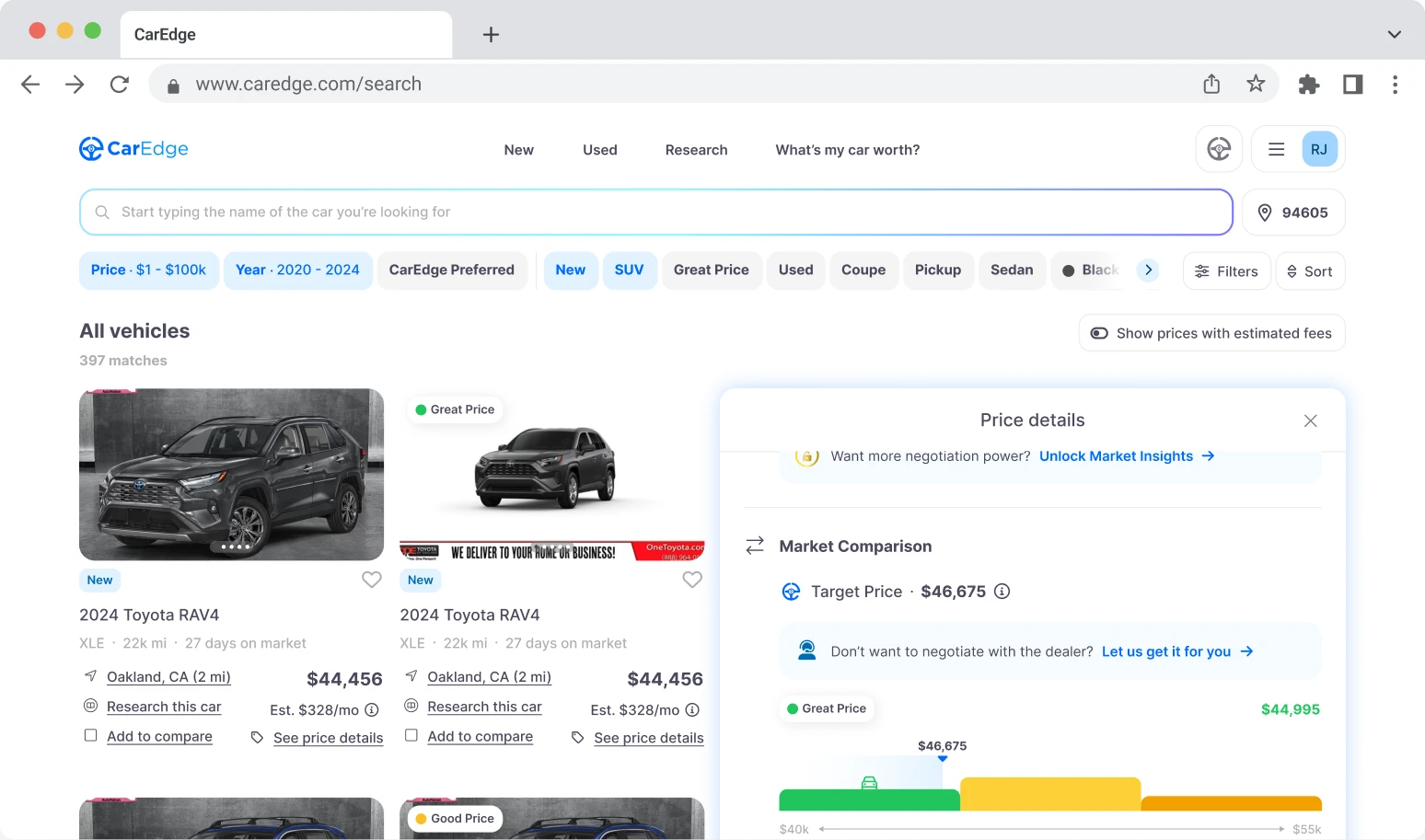
Find a wide range of vehicle listings with market insights on new and used listings near you.

What can I do with CarEdge?
 CarEdge Insights
What can I do with CarEdge?
Get access to exclusive information so you can make an informed car buying decision — all in one place.

Find a wide range of vehicle listings with market insights on new and used listings near you.
Track your vehicle’s value and cash in when the time is right to sell.

Access to our proprietary data to help you find the right car, at the right price. Find these unlocked on every listing after subscribing.

With our expert-led, tech-enabled car buying service, we will locate, negotiate, and deliver your vehicle so you can get a new car hassle free.


Help us personalize your CarEdge experience — it only takes a second.
Your answers help us personalize your CarEdge journey — we’ll follow up with tips and next steps that match your buying timeline.
New vehicle inventory levels have plummeted. The ongoing semiconductor shortage has caused automakers to cut production. Drive around town and you’ll see your local car dealership likely doesn’t have much inventory on their lot, and if they do, it’s likely used vehicles, not new.
More and more dealerships are turning towards “factory orders“. Generally speaking, this is a good thing, as it allows the customer to get exactly what they want. The issue is, as far as we can tell from our community of thousands of savvy shoppers, those people who placed orders are getting the runaround.
Learn more about the chip shortage. Read: The How We Ran out of Cars in the US
“Your car will be built next week and shipped to us soon,” is a common phrase we’re hearing, and then sadly weeks go by without an update. Automakers are simply struggling to do what they’re supposed to do best; make cars.
To put into perspective how dire the current new vehicle inventory situation is, we’re going to compare the current market days supply and inventory levels of a few of the major automakers to their prior levels in 2019. Let’s dive in.

Ford has made headlines for many reasons in 2021. Their current inventory levels are one of those reasons. In September of 2019, Ford had 621,000 new vehicles in inventory across the United States. At current sales rates, that represented an 82 day supply of inventory on their dealer lots. Today, as of September 2021, Ford has 210,800 units of inventory in the market.
See your local inventory levels
Toyota was initially hailed as one of the automakers who would be able to mitigate the effects of the chip shortage and retain their production capacity. That was until Toyota announced a 40% decrease in production in October as a result of supply-chain issues.
In 2019 Toyota had 444,000 units of inventory in the market, at a 50 days supply. Today, Toyota has 135,200 units of inventory in the market, at an 18 days supply. Staggering.
See your local inventory levels
Honda’s inventory levels in September of 2019 were healthy, with 351,700 units of inventory in the US market. Today they have less than 100,000 units of inventory for sale in the United States.
See your local inventory levels
Hyundai and Kia have also struggled during the chip shortage. In 2019 they had 210,400 new vehicles in dealer inventory. Today that number stands at 79,400, with a days supply of inventory of 17.
See your local inventory levelsIf you’re looking to buy a car in 2021 the price you are going to pay will be higher than in prior years. We recommend you do not buy a vehicle right now unless you absolutely need to. If you do need a new set of wheels we encourage you to consider leasing instead of financing. More on that here.
Because of the shortage of new vehicles, used cars have appreciated in value as well. If you are going to buy a used vehicle, be sure to get it pre-purchase inspected.
To learn how CarEdge members are securing fair deals in these tough market conditions, read some success stories here.
As a result of the global pandemic, we have seen changes across every industry. The automotive sector has experienced some of the most dramatic. It’s not unethical to say that we’re running out of new cars in the United States right now.
Earlier this year lumber prices skyrocketed (and then fell back down to reality), home prices soared in value (and continue to), and other industries undoubtedly evolved as a result of the pandemic. However cars (both new and used), have experienced unprecedented impacts as a result of Covid-19.
Take a drive down to your local “dealership row” and you’ll see empty lots. Where did all the cars go?


Chips are to blame. No, not those chips … We’re talking about microchips, the unimaginably small, paper-thin integrated circuits that store data, transmit code and allow software to carry out their magical properties. Vehicles today are full of computers, microchips, and software. The reason you don’t see any cars on your local dealers lot is because production of these chips has been outstripped by demand.
We began documenting the chip shortage at the beginning of 2021. Initial news reports suggested that there would be a significant, albeit short-lived supply chain disruption that would affect new vehicle production.
10 months later, it is clear as day that those initial reports were wrong. Very wrong. There will be lasting and widespread impacts from this shortage.
Today we’re going to explore how we ran out of cars, trucks, and SUVs, what impact that has on you if you need to buy a vehicle, and what this means for the “new normal” of buying a car.
Let’s dive in.
Frequently you’ll hear my father, Ray Shefska joke that Frito Lay needs to increase their production capabilities because of the chip shortage. If only the solution were that simple!
Global semiconductor production is derived primarily from three companies; TSMC, Samsung, and Intel. Those aren’t the three companies you need to know about though. The one company you need to know about is ASML.
ASML is a Dutch corporation that has cornered the market on the one thing that is more important than microchips — the machines that make them. ASML produces EUV machines. These are the machines that TSMC, Samsung, and Intel use to produce their computer chips.

Wired recently produced an awesome article on ASML, and we recommend you take a look if you’re interested in a deeper dive on them.
The long and short of it is that there is one company that produces these machines (ASML), the machines themselves are incredibly complex (100,000+ components), and they’re unfathomably expensive (hundreds of millions of dollars). When someone says “we should just make some more chips,” they don’t understand that ASML holds the keys to that kingdom, and they are producing as many EUV machines as they can. There isn’t a quick fix when it comes to producing microchips.
Our current microchip shortage is in part exacerbated by the fact that these integrated circuits are in literally every electronic device we interact with. ASML has some quality information on that here. Chips are the new gasoline in a sense — they’re everywhere.
So how badly is the chip shortage affecting the automotive sector? Badly.
Market Days Supply is an industry metric that automotive manufacturers and dealerships measure to track their inventory levels.
When we founded CarEdge we built software that tracks Market Days Supply for consumers so that they could be armed with the same information the OEMs and dealers have. If a vehicle has a high Market Days Supply it would indicate a greater likelihood that the dealer would negotiate and sell it at a better price. When Market Days Supply is low, a dealer (and the OEM) have little incentive to negotiate or discount their product.

How bad is the new car shortage? Subaru has a 6 day supply of inventory nationwide right now. Honda’s sales were off 18% year-over-year for the month of August, and Toyota recently announced a 40% decrease in production over the coming months.
The chip shortage, and subsequent new car shortage is very real, and very impactful.
With automakers unable to provide their dealerships with new vehicles, used cars have become increasingly popular. Black Book, an industry leader in vehicle valuations, and a CarEdge partner, produces a weekly market report on used vehicles.
For 10 months now we have tracked this report each week, and it is truly unfathomable what we’re seeing. Retail used car prices are up 25% from just the beginning of this year, while wholesale prices have risen more than 30%.

There is serious concern that this “bubble” in used car prices will have lasting negative effects on the market. Our primary fear is that consumers who finance a used vehicle today will be in severe debt positions once supply returns to some sort of pre-pandemic normalcy.
For used car owners (and lessees) who have a vehicle to sell (and don’t need to replace it), there couldn’t be a better time to be in the market. Traditionally used vehicles are depreciating assets, however over the past 12 months we’ve seen certain segments of used vehicles (we’re looking at you full-sized vans) appreciate over 100% in that timeframe.
In short, we think the answer is yes, and there are two primary considerations that give us confidence to say that:
It’s as simple as that. The shortage isn’t going to end overnight, and while OEMs and dealerships learn how to cope with that, they are finding innovative and new ways to increase their profits. Even if the shortage could be reconciled tomorrow, why would Ford go back to their old ways? Why would the new car dealership go back to stocking a 90 days supply of inventory? Why go back if profits are up?
For these two reasons, we anticipate there will be lasting and permanent changes to the retail automotive industry. Here are a few specific areas where we think the change will be felt.
The days of rebates and special interest rates are behind us. Why incentivize the sale of a vehicle when you don’t have enough vehicles to sell?
The average incentive outlay (how much the manufacturer spent to incentivize the sale of a vehicle) dropped 40% year-over-year in August from $3,969 to $2,432 (TrueCar), and this trend will surely continue.

Automakers have traditionally spent thousands of dollars to incentivize the sale of their vehicles. These are marketing expenses that are paid for by the manufacturer. To be crystal clear, these are programs like the $500 you get off for being a recent college graduate, or the limited time $1,000 rebate offer on the Chevrolet 1500. These incentives are diminishing rapidly, and in a world where there is less supply, it makes sense for automakers to cut back on their budget for incentives and programs.
Another lasting impact we see has to do with transaction prices (both for new and used vehicles). With less supply we anticipate that all vehicle prices will stay elevated.
Dealerships with limited supply are able to tack on accessories and “additional dealer markup” simply as a result of having ample demand and not enough supply. Traditionally gross profit on a new vehicle was near zero. Car dealers made their money on the “back-end” of the deal (selling loans and insurance products). Nowadays, dealers are making thousands on the sale of the vehicle, and even more on the back-end. This is a result of the limited supply and healthy demand.
We anticipate that this will be a lasting trend. Dealerships will not discount below MSRP on new vehicles, and they won’t negotiate on their used inventory. Instead, you’ll have to fight tooth and nail over the $900 “GPS tracking system” they installed (that really only costs $200), and the $5,000 additional dealer markup they added “just because.”
With prices inflated, and with limited leverage, consumers will need to be prepared to put more cash down than ever before in order to get approved for their loan. Unlike anytime before, GAP insurance will be a smart decision for most purchasers.
With limited inventory on dealership lots, we expect the trend to “factory order” vehicles to become the new normal. Ford and General Motors have both said that they like having less inventory on their dealerships lots, and that they’d prefer to move towards an order system.
This will in part change how consumers negotiate car deals, and it will also drastically change the way car dealerships look and feel. Do you really need a humongous lot when you have no vehicles on it? We expect to see the physical representation of dealerships change over the coming years as a result of more factory orders, and less inventory on dealership lots.
The automotive industry is experiencing a transformation right before our eyes. Buying a car is even more difficult today than it was a few years ago, and in part that’s because of how rapidly the industry is evolving.
Here at CarEdge we’re committed to helping you navigate this process. You should feel confident when you buy a car, and between our Auto Advocate live chat support, vibrant community forum, and consistent educational content, we promise to do the best we can to assist you through this process.
The idea of selling a leased car for a profit was once a foreign concept. Today —amidst an ongoing chip shortage and subsequent new vehicle shortage — selling a leased vehicle for a profit is more common than you think. How can you sell your leased car and make the most money? Which types of vehicles are worth the most compared to their residual value? What automakers are making it more difficult for you to make money selling your lease? We’ll answer these questions and more!
Let’s dive in.
The steps to sell your leased vehicle are not too terribly complex. Here they are from Ray Shefska:
1. You need to first buy the vehicle from the lease company.
2. Call the lease company and get your current payoff. Get a 10 day payoff to allow enough time for the funds to arrive at the bank.
3. Make arrangements to buy the vehicle out directly from the lease company if they allow you to do so. Not all leasing companies allow this, so you will need to ask your particular lender.
4. If you cannot pay cash for the vehicle, make arrangements to finance the balance. Some lease companies can assist you with this. If not, check with your credit union or local bank. We can even help you with that…
Finance with CarEdge. We work with trusted credit unions nationwide. Get pre-approved in minutes!
5. If buying the vehicle out with the assistance of the dealer, be aware that the dealer may charge you their doc fee, collect all taxes due, if any, and collect the title and registration fees. They can also assist you with financing if needed. A word of advice: they very well may attempt to mark up the interest rate on the loan and also attempt to sell you their normal F&I protection products.
Consider financing with us! We work with credit unions nationwide.
6. Once you have purchased the vehicle and had the title and registration issued in your name you can then sell it.
7. To sell your previously leased vehicle for the most money, compare quotes from online car buyers like Carvana and Vroom. We’ve made it even easier for you to get all your quotes in one spot! Simply enter your vehicle information below…
Learn the tricks to trade-in for the most money. Read the trade-in tactics for success!
8. If you decide to sell to a third party, you will need to provide them with your loan account number so they can contact the lender to get the current payoff. They will make the payoff and you will receive whatever balance is remaining. You will need to provide them with the title if you have it or you will have to sign a motor vehicle power of attorney instructing the bank to release the title to the buyer when the vehicle is paid off.
9. If you are selling to a private party, advertise the vehicle and always be sure to meet any potential buyer in a very public place and bring along someone to accompany you.
10. Never allow the potential buyer to test drive the vehicle by themself. Always accompany the potential buyer on the test drive and have your friend tag along as well.
11. Establish the test drive route prior to leaving and set the ground rules for how the vehicle is allowed to be driven. The driver must obey all traffic safety rules and stay within the posted speed limit at all times.
12. Once you have agreed to sell the vehicle, complete the transaction at your bank, credit union, motor vehicle agency or local police station to protect all parties from any issues. Be certain to make sure that buyer’s funds are indeed good prior to releasing any paperwork or keys to the vehicle.
13. Do not allow the buyer to drive off using your tags and registration.
Our friends over at iseecars.com did an incredible job analyzing millions of vehicles for sale to determine which cars, trucks, and SUVs are selling for the most profit over their residual values. As you’ll recall, residual values are set when you sign your lease. These values are the leasing company’s best guess as to what the vehicle will be worth at the end of the lease.
Because the current new car shortage was not foreseen in 2018, residual values are well below the actual value of nearly every leased car. This means that lessees are in positive equity positions; they can purchase their lease at the preset residual value, and it is worth more on the open market. Incredible!
What vehicles are selling for the most over their preset residual values? First, let’s establish that the average off-lease used vehicle is worth 31.5% more than its original residual value. That’s shocking, but compared to the top ten, it’s relatively reserved!
| Rank | Vehicle | $ Amount Over Residual | % Over Residual |
|---|---|---|---|
| 1 | Volkswagen Tiguan | $8,677 | 61.3% |
| 2 | Dodge Charger | $11,806 | 55.9% |
| 3 | Chevrolet Camaro | $12,346 | 52.9% |
| 4 | Nissan Altima | $6,228 | 49.4% |
| 5 | Volkswagen Passat | $6,400 | 49.3% |
| 6 | Chrysler 300 | $8,084 | 49.2% |
| 7 | Nissan LEAF | $6,167 | 48.3% |
| 8 | Chevrolet Malibu | $6,392 | 48.2% |
| 9 | Hyundai Elantra | $5,319 | 47.9% |
| 10 | Mazda MAZDA6 | $7,193 | 46.8% |
A host of captive finance companies (financing company’s owned by automakers) have taken steps to make it more difficult for consumers to sell a leased vehicle for profit. Toyota, GM, Honda, Acura, and Mazda are just a few automakers that are no longer allowing third parties to make the payoff payment on a lease. Ford has not allowed third parties to do this for years.


What does this mean?
This means that you have to go to a franchised dealership to buy your leased vehicle before you can sell it to a third party. In the past you could go to Carvana and they could payoff your lease for you. Now, you’ll need to go to the dealership, buy the vehicle, get the title, then sell it to Carvana (or another third party).
Why are Ford, GM, Toyota, Honda, and Mazda doing this? Because it increases the chance that the dealership will be able to get the off-lease vehicle from you. Dealers are short on supply (cars to sell), and by forcing lease customers to come back to the dealership they are increasing their chances of buying the car from you.
As a result of ongoing new vehicle production shortages, used cars, trucks, and SUVs are in high demand. This means that “rougher” and “edgier” used vehicles are making their way to dealership lots for sale to the public. One way to protect yourself from unknowingly purchasing a clunker is to look at a Carfax or AutoCheck vehicle history report.
Today we’re going to share a few stories from the CarEdge Community about AutoCheck and Carfax, and provide our recommendations for how you can protect yourself if you are buying a used car.
Let’s dive in.
Let’s start with the basics … How do these two companies work? AutoCheck and Carfax both operate in the same way; they source data from different places and compile that information into reports that are easy for a consumer to understand. With this in mind, it’s clear how the two companies compete. Who can get more (and better) data about a vehicle? That’s the challenge.
Become a FREE CarEdge MemberCarfax and AutoCheck both boast impressive lists of data partners on their websites. For example, Carfax says they have 112,000 data sources, while AutoCheck was developed by Experian and has access to all of their resources and relationships. Both companies provide compelling credentials as to why they are superior to the other. That being said, they both face the same issue: if data is not reported to them from one of their data partners, it will never show up on a report.
This brings us to the most important question of them all … Which is more reliable? Carfax or AutoCheck? We’ll answer this question by providing a few anecdotes from our experiences, as well as what we’ve heard from CarEdge Community members who have shared their stories with us in the community forum or via Live Chat with our Auto Advocates.
Sadly, this happens more frequently than we’d like. Take for example the case of Chris, a gentleman in Alaska who purchased a 2019 Ford Fusion from a local independent dealership.
Chris went to the dealership, took the Fusion for a test drive, reviewed the AutoCheck report that the dealer provided, and purchased his car. A few days later he took it to the local Ford dealership because a light came on in the dash. Within an hour, Chris had a sinking feeling in his stomach when a technician came to him and explained that his vehicle had been in a severe accident. Chris, unbeknownst to him, had bought a clunker.
How could that happen? The AutoCheck had been clean. In case it wasn’t obvious, this is why we always recommend getting a pre-purchase inspection completed on any used vehicle (even certified pre-owned). That being said, what was scary about Chris’ experience is that Carfax had different data than AutoCheck—they did report damage to the vehicle (but not an accident).
Let’s look at the two reports, and some photos of the vehicle before it was repaired.

As you can see on the AutoCheck report, the Fusion comes back “clean” and with an average AutoCheck score. Let’s look at the Carfax report.

As you can see on the Carfax report there are no accidents reported either, however there is a report of damage to the vehicle.

Right there on the Carfax report it says clearly “get the vehicle inspected before you buy.” Carfax knew about the damage, and AutoCheck didn’t. Chris obviously didn’t get the vehicle inspected, and he trusted the dealer who sold him the vehicle because they provided a “clean” AutoCheck.
Become a FREE CarEdge MemberDoes this mean AutoCheck is inferior to Carfax? We’ll let you be the judge …


We heard a similar story from a CarEdge Community member named Kristen.

Kristen had a nearly identical experience to Chris. She bought a vehicle (and even got the extended warranty), only to find out a few weeks later that it had previously been in not only one, but two accidents!
Does AutoCheck not collect as much information as Carfax? Based on some of our communities experiences, it appears that way.
I know we sound like a broken record, but getting a pre-purchase inspection is one of the best things you can do to protect yourself when buying a used vehicle. A pre-purchase inspection isn’t bullet-proof, but it certainly increases the likelihood of you avoiding a fate like Chris or Kristen.
Another trick you can use to get more information about a vehicle is to ask your insurance company to check the VIN in their systems. Insurance companies have databases similar to Carfax and AutoCheck that they can access on your behalf. Once you’ve found a vehicle you’re interested in, call your insurance company and ask them what info they have on the VIN. If it comes back clean on their end, then get the pre-purchase inspection.
In nearly every state, when you purchase a used vehicle you are purchasing it “as-is.” This means that no matter what condition the vehicle is, you are purchasing it as such. This doesn’t mean a dealership can sell you any clunker (vehicles have to pass state safety inspections to be sold), however it does mean that once they’ve sold you something it is entirely yours to deal with. The contract you signed stated it is being sold to you “as-is” and that the dealer cannot be held liable for the condition of the vehicle.
It is important that you understand the “as-is” concept, because your recourse post-purchase if something does go wrong is limited. If you’re like Chris or Kristen you have a few options to remediate the situation, however none are ideal. It is critically important that you understand you are purchasing the vehicle “as-is” and that you should be measured and pragmatic before signing the contract.
You don’t have to look far to see that there is currently something unprecedented going on in the automotive industry. From the empty dealership lots you drive by, to the news stories you’re hearing about a “chip shortage,” it’s clear something very serious is impacting manufacturers, dealers, and ultimately people like you and me; consumers.
We’ve documented in the past how the ongoing semiconductor (chip) shortage is wreaking havoc on manufacturer’s ability to produce new vehicles. Ford is storing F-150’s in country fields and race tracks, Jaguar Land Rover is informing their investors that they’re losing more money than anticipated because of the shortage, and dealers are making record profits because they can sell their limited inventory above sticker price (MSRP).
To suggest that what’s going on in the market right now is ridiculous would be an understatement. We’ve never seen anything like it.
Traditionally, buying a car can be pretty intimidating. You find something online, go into the dealership, sign the paperwork and then you’re left wondering, “did I get a good deal?” In today’s market the answer more and more frequently is “no.”
Become a FREE CarEdge MemberUninformed buyers are agreeing to pay for crazy add-ons, unheard of additional dealer markup, and ridiculous F&I products, simply because they don’t know better. That’s why today we want to share with you the simplest explanation for why you should be leasing a vehicle right now instead of buying it. If you know someone who is thinking about getting a car in this market, please consider sharing this with them.
Here we go …
To understand why leasing is the smarter option today, let’s start by explaining why financing (i.e. taking out a loan to purchase) a vehicle is not advisable right now. I wrote about this in depth a few weeks ago, but the long and short of it is this:
Vehicle prices are inflated, which means the loan you take out on the vehicle will be for the inflated purchase price. Let’s say you get a five year loan, well, over the next five years as vehicle prices normalize, you’ll still have your loan for the original amount (when prices were inflated). This means you’ll be in a major negative equity position (the vehicle will be worth considerably less than what you owe on the loan).
Enjoying this guide Check out The Car Buyer’s Glossary of Terms, Lingo, and Jargon
Why is this important? Because in normal times many people would find themselves in $2,000 to $3,000 “negative equity” positions, and that was without inflated vehicle prices at the time of purchase. In today’s market, those same people will find themselves in much more severe negative equity positions because they took out a loan on something that isn’t actually worth as much as it’s selling for right now.
So what options do you have?
This is where leasing comes into the picture. When you lease a vehicle you don’t own it, you rent it. Leases make a lot of sense in today’s market because they allow you to fulfill your need (having mobility), while also mitigating your risk of taking on debt that will burden you into the future.
Let’s look at a tangible example. Here’s a lease deal for a 2021 Toyota Camry:

You can see the MSRP is $26,701, and the dealership is selling the vehicle at that price. The residual value is down in the bottom left, and it is 52%. That means that at the end of the lease term (36 months and 36,000 miles) the leasing company (Toyota Financial Services) expects the vehicle to be worth 52% of its original value ($13,885).
Should you buy GAP Insurance? Read our guide to GAP Insurance!
The residual value is not negotiable. It is the best guess from Toyota as to what they think the vehicle will be worth at the end of the lease term. Since the pandemic we have not seen meaningful changes in residual values. This makes sense, because the residual value is an estimate as to what the vehicle will be worth in three or four years, not next week. Even with inflated vehicle values today, leasing companies expect their vehicles to return to a normal depreciation curve in the future.
Become a FREE CarEdge MemberBy leasing, you are effectively renting the vehicle for 48% of its depreciation.
Your other option is to finance the purchase of the vehicle. If you do that you will be financing the total purchase price, plus taxes, plus fees. On this Camry deal that likely comes out to $30,000. Typically Camry’s would sell with a dealer discount and significant manufacturer rebates. Obviously in today’s market that’s not what’s going on.
Once used vehicle prices return to normal and this Camry depreciates as expected, you’ll owe significantly more on the loan than what the vehicle is worth. Compare that to our leasing option, and after three years you can walk away from the lease and purchase a Camry then (likely with the dealer discount and the manufacturer incentives we’re accustomed to).
The real benefit of leasing right now is that it means you will not be in a severe negative equity position in three years, and by that time vehicle prices will have normalized as new car supply has returned to normal. At that point it would make much more sense to purchase a vehicle (new or used) since their prices will not be inflated.
In the meantime, if you do finance a vehicle, be prepared to face a sobering reality when you check the value of your vehicle in 24 months. It’s going to depreciate, and if your loan is for thousands of dollars more than what it’s actually worth, that’s going to be a tough pill to swallow.