CarEdge saved me over 4,500 dollars on a brand new Honda Pilot. I can't say thank you enough.
Price intelligence
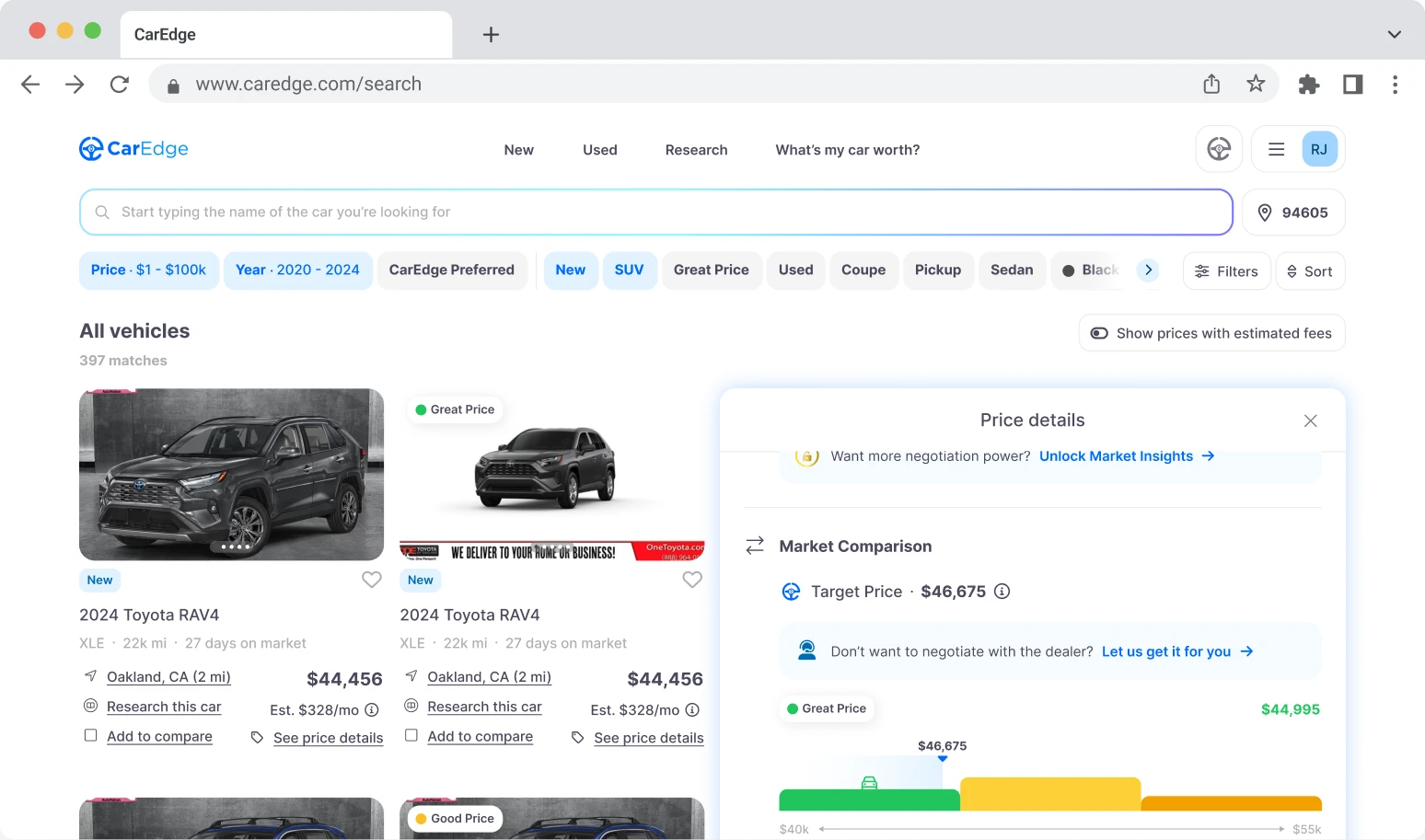
Find a wide range of vehicle listings with market insights on new and used listings near you.

What can I do with CarEdge?
 CarEdge Insights
What can I do with CarEdge?
Get access to exclusive information so you can make an informed car buying decision — all in one place.

Find a wide range of vehicle listings with market insights on new and used listings near you.
Track your vehicle’s value and cash in when the time is right to sell.

Access to our proprietary data to help you find the right car, at the right price. Find these unlocked on every listing after subscribing.

With our expert-led, tech-enabled car buying service, we will locate, negotiate, and deliver your vehicle so you can get a new car hassle free.


Help us personalize your CarEdge experience — it only takes a second.
Your answers help us personalize your CarEdge journey — we’ll follow up with tips and next steps that match your buying timeline.
Buying a used car is not easy. No two used cars are the same, and today Ray and Zach discuss the steps you can take to feel more confident on your used car buying journey. From certified pre-owned to private party, Ray and Zach breakdown what you need to know before you buy your next used car.
It’s unfortunate, but buying a new car is undoubtedly difficult. During this episode, Ray and Zach discuss the steps you should take before beginning your buying process. From doing your research, to knowing what to say to the dealer, Ray and Zach break down step by step what you can do to be more confident buying a new car.
9% of Americans trust car salesmen, a Gallup poll reported. Only 26% of consumers feel confident when shopping for a car a Capital One survey found. And, 87% of car shoppers dislike the dealership experience, says Rethink Retail.
Why is buying a car so damn difficult? Ray Shefska spent 43 years running car dealerships, and in today’s episode he, and his son, Zach, discuss how and why the car buying process is broken.
The car business has taught me a lot over the 40+ years that I’ve been a part of it. Today I wanted to share with you the five most important things I learned during that time:
Be who you are — warts and all. It took me a while, but over the years, I figured out that it was important for me to be a little silly, a little off kilter, and a little different at the dealerships I worked at. Why? Because that’s who I am.
I remember many, many years ago, watching a guest on an afternoon talk show say that you should “dare to be different.” I hate to say it, but it’s easy to be pretty much the same, but if you dare to be different, you’ll inevitably stand out from the crowd.
For me, that meant having fun with customers, being both informative, and entertaining at the same time. When I was selling, I was giving the customer a show. Fortunately for them, there was no cover and no two drink minimum, but damnit, they were entitled to a good time.
My motto was simple, “if you give them a good show, they will part with their dough!” (As you can see, I stuck with car sales instead of poetry for good reason). Don’t feel pressured to act a certain way in the dealership, whether you work there, or you’re coming in to buy a car. Not only is it perfectly fine to be you, it’s encouraged. Be the best you, you can be.
If you find yourself having to tell something other than the truth, you are not only letting your customer down, but more importantly you are letting yourself down! As I have been known to share with a customer, “if the truth is going to preclude us from making a deal, then so be it, I’m not going to lie to you in order to make it happen.”
Jack Nicholson famously shouted from the witness stand in the movie, A Few Good Men, “You want the truth? You can’t handle the truth!” Maybe in the military he was right, but when it comes to sales, he was dead wrong.
Let a professional car buyer help. We do the hard stuff for you.
[mautic type=”form” id=”4″]
In sales the truth shall set you free. Rather than wondering down a twisting road of lies, each requiring you to remember what the last lie was, you can instead simply tell the truth. As I like to say, “if it is right, do it or say it, if it is wrong, don’t do it or say it, and if you are not sure if it is right or wrong, do both you and your customer a favor, and don’t say it.”
Tell the truth, you’ll both be better off for it.
In my 40+ year career in the car business, this one took the longest time for me to understand. You never want to say “no” to a customer, instead, you are always searching for a way to say “yes” to them. One way to do this? Always focus your conversation around what you can do. This puts both you and the customer on the path towards “yes.”
For example, let’s say you’ve quoted a customer a payment of $498 a month for a 60 month loan. Like most customers do, they say, “make it $450 for 48 months and we’ve got a deal.”
For the longest time my response was almost instant and almost always the same, “What are you crazy, I can’t do that,” and the ultimate result was almost always the same: we didn’t make a deal because it was too confrontational.
Later in my career, I handled the same situation very differently. I would tell the customer a story (selling is storytelling), about when I attended company-wide sales training, and they taught us to never tell a customer what we can’t do. “I should only tell you what I can do, and folks if you pay close attention to what I can do, you’ll probably notice that I am really telling you in a nice way, what I can’t do.” This was my go to script.
“So what I can do is $498 a month for 60 months. Can we make this work for both of us?” I’d finally ask.
This wouldn’t always work, but the results were an awful lot better than simply telling the customer, “nope, we can’t do that.”
Always speak to your customer in terms of what can be done. For both of you, it’s a much more fun and positive path to travel.
This one is as old as the hills but incredibly important, under promise and over deliver. If you tell a customer that you are going to do something, whether it be big or small, do it. I don’t care how small or trivial it is, if you say you’re going to do it, do it. Did you tell a customer that you’d follow up later on today with more information? Call them later that day, even if you haven’t gotten the information yet. If you don’t keep your promise you’ll erode valuable trust with your customer.
I cannot tell you how much that means to a customer, seemingly small things like picking up the phone and giving them a call when you said you would, is truly a difference maker. Trust me, the salesperson down the street probably won’t keep that promise. All you need to do is under promise and over deliver to take the first step towards being their go to “car guy.”
Remember, never promise more than you can deliver. If you do, you’ll instantly become a “typical car guy” in the customer’s eyes. Remember, dare to be different. Part of that difference is always doing more than you said you would. No ifs, ands or buts. If you promise it, do it!
It costs a ton of money to acquire a new customer. Whether your marketing includes digital, TV, radio, direct mail, etc, it’s incredibly expensive to acquire new customers at your dealership.
Dealerships invest in all this marketing to attract customers to their showroom, with the hope that their sales staff can sell them when they come in. If your store is really good, you’ll close 20 to 25% of the people that walk in for the first time. That means 75 to 80% of people aren’t buying on their initial visit.
Would you like to improve your odds of closing a deal? Of course you would. How can you? By concentrating your efforts on your existing customers.
Existing customers will close at a higher rate because they have already done business with you (if you treated them right the first time around). One of the best things your dealership can do is to configure a rewards program that is designed to encourage your customers, both sales and service, to remain your customer.
Perhaps you can guarantee an extra $500 trade value if they have always serviced and maintained their current vehicle at your dealership, whether they purchased it from you or not. Take a cue from your local supermarket or grocery store, they all have rewards programs for shopping with them. Come up with something similar for your dealership.
Research shows that existing customers will pay a higher average gross profit than a fresh customer. Do the math and you’ll realize that it costs a whole lot less to keep your existing customers than it does to go find new ones.
Those are the five most important things that I have learned in my 40+ years in the car business.
As billions of people shelter in place, many household brand names are struggling to find their footing. Hertz Rental Car is one of them. With the drastic decline in travel (both business and personal), Hertz is faced with more uncertainty than ever before. As Hertz contemplates filing for bankruptcy, our team at CarEdge is considering what impact that would have on the used car market, and specifically used car prices and deals for consumer.
Should you buy a used car today, or wait a few weeks or months to get a better deal? That’s the money-saving question, and Hertz’ bankruptcy decision will certainly implicate what makes the most sense.
With a total fleet of over 856,800 vehicles globally (as of 2018), it’s safe to say that Hertz has a lot of vehicles under their ownership. What would happen if Hertz has to liquidate those assets to pay back their creditors? In the United States alone, the company has more than 500,000 vehicles under their ownership. If Hertz files for bankruptcy and has to sell all of these used cars, what would happen to used car prices?
Let’s explore.
It’s important to understand that car dealerships base their used car prices off of “market value.” Like I’ve written about in the past when discussing how much dealers mark up their used car inventory, dealerships use software like vAuto to constantly adjust their used car prices to reflect what people are paying for similar cars in their region.
That being said, if there was an influx of used cars that flood the wholesale market, we would anticipate that demand to purchase those cars would not keep up, ultimately lowering the price per vehicle. We’ve already seen a decrease in wholesale prices for used vehicles, with a historic 9.2% drop in whole prices recorded in April, according to data reported by Manheim Auto Auctions, the largest purveyor of used car auctions in the United States.
Let a professional car buyer help. We do the hard stuff for you.
[mautic type=”form” id=”4″]
Hertz, and their creditors desperately want to avoid having to liquidate their inventory of vehicles, because they know prices are already suppressed. According to Bloomberg, they’re looking for any option other than a “fire sale.”
But what would happen if hundreds of thousands of used cars immediately flooded the market? Because of the sheer scale of their liquidation, it’s not likely that Hertz will be able to liquidate many vehicles directly to consumers. That means car dealers will buy up their inventory at suppressed prices, and in return sell them at lower prices (of course with a margin still built in).
If the supply side of our equation increases by 500,000+ units, and the demand side stays the same, you ultimately have a decrease not only in wholesale prices, but also retail prices. Car dealers will need to sell their inventory to sustain their cash flow, and in theory, good deals should be for the taking. Ultimately a large increase in used car supply will trigger car dealership’s “dynamic pricing” tools to rapidly lower their selling price, while still maintaining some profit margin, at least that’s our supposition.
One of the questions I get asked frequently is if buying a rental car is a good value. The answer is, it depends.
With Hertz potentially liquidating hundreds of thousands of cars, I can assure you there are some vehicles they’ll be selling that you’ll want to avoid, and some you’ll certainly want to take a closer look at. How can you tell which rental cars make good used cars? Here’s my advice.
Take into consideration where the car was driven. To find this out you can look at the vehicles CarFax report. Although it won’t tell the full story of what a vehicle has been through, knowing where it spent most of its time is helpful.
For example, very recently we helped a client purchase a used car in Anchorage, Alaska. The vehicle was previously a rental car, and it only had 14,000 miles on it. Why? Because in Alaska they have an incredibly short summer rental season, and this car had been driven hard for three months, and then was ready for sale to a local resident. What did that mean for our client? They got a great car, at a great price, with relatively few miles, in driving conditions that focused entirely on highway roads, not city streets. In this example, buying a rental car is a great used car value.
On the other hand, if you’re looking to buy a rental car and it spent most of its days in a major city center, you may want to think twice. Scratches and dings are almost certainly going to be present. How many potholes can one car drive over before the tires need to be realigned? The brake pads may be worn, etc, etc.
If you do want to buy a rental car as a good used car value, you’ll want to get a pre-purchase inspection completed in advance, to confirm everything is in good working order.
Whether Hertz goes bankrupt or not, you can buy vehicles from them. Hertz Car Sales is a business unit within Hertz that comprises 75 retail store fronts nationwide. Hertz Car Sales would not be able to support the liquidation of all Hertz inventory in the event of bankruptcy, however it is likely they would see an increase in used car sales.
That being said, Hertz Car Sales takes a “one price” approach, which means you will not be able to negotiate the selling price of a vehicle. Time will tell, but you may end up getting a better deal if you buy a car through a dealer instead.
Keep in mind other car rental companies, like Avis, Budget, and Enterprise also offer similar programs which may be worth investigating at this time too.