
CarEdge saved me over 4,500 dollars on a brand new Honda Pilot. I can't say thank you enough.
Price intelligence
Find a wide range of vehicle listings with market insights on new and used listings near you.
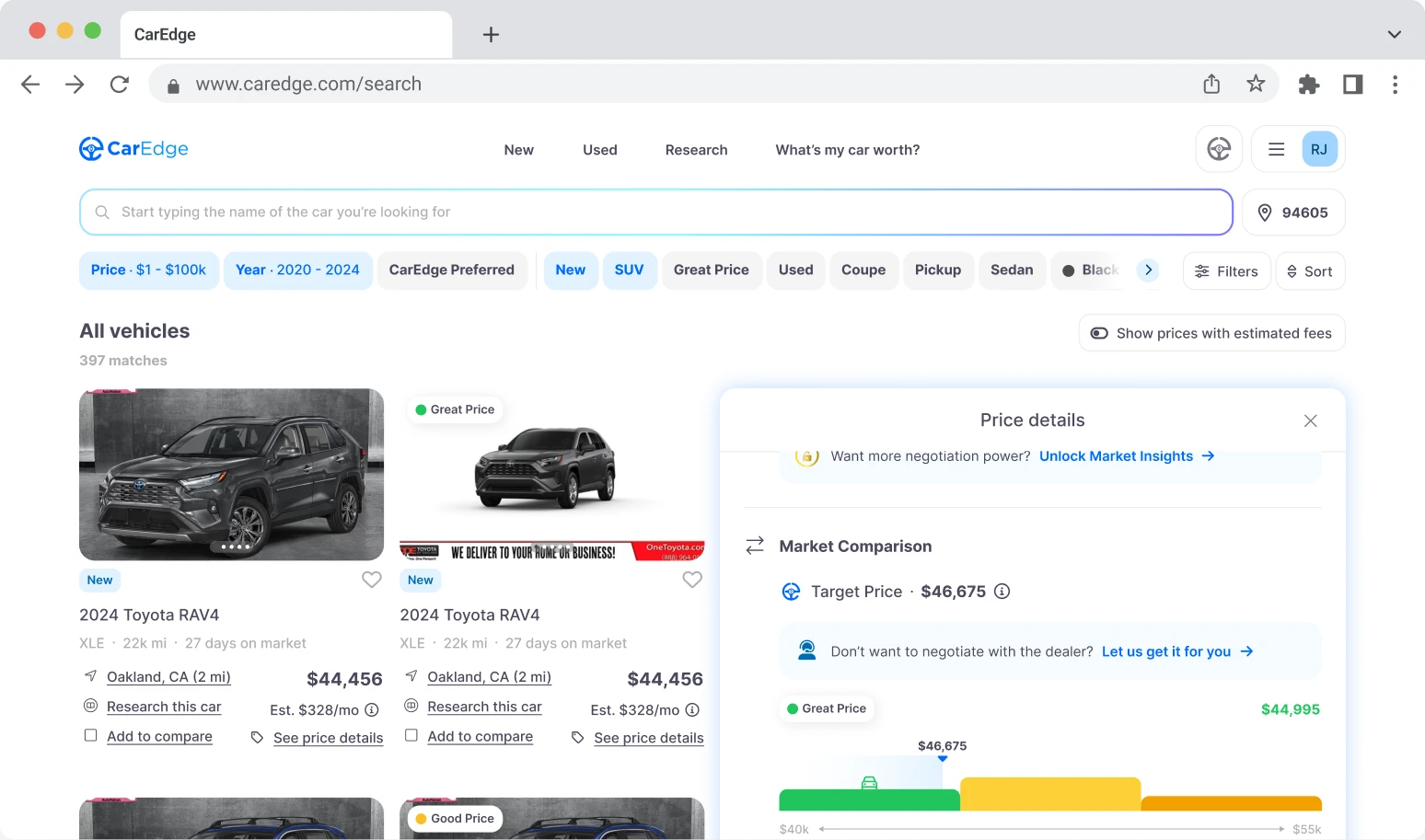

What can I do with CarEdge?
 CarEdge Insights
What can I do with CarEdge?
Get access to exclusive information so you can make an informed car buying decision — all in one place.

Find a wide range of vehicle listings with market insights on new and used listings near you.
Track your vehicle’s value and cash in when the time is right to sell.

Access to our proprietary data to help you find the right car, at the right price. Find these unlocked on every listing after subscribing.

With our expert-led, tech-enabled car buying service, we will locate, negotiate, and deliver your vehicle so you can get a new car hassle free.


Help us personalize your CarEdge experience — it only takes a second.
Your answers help us personalize your CarEdge journey — we’ll follow up with tips and next steps that match your buying timeline.

If you’re looking for a vehicle that offers fuel efficiency without the charging hassles of an EV, a hybrid might be your best match. This month, automakers are offering lease specials across a range of models, from the redesigned Prius to hybrid SUVs like the Corolla Cross. Let’s dive into the top hybrid lease deals available for November 2024.
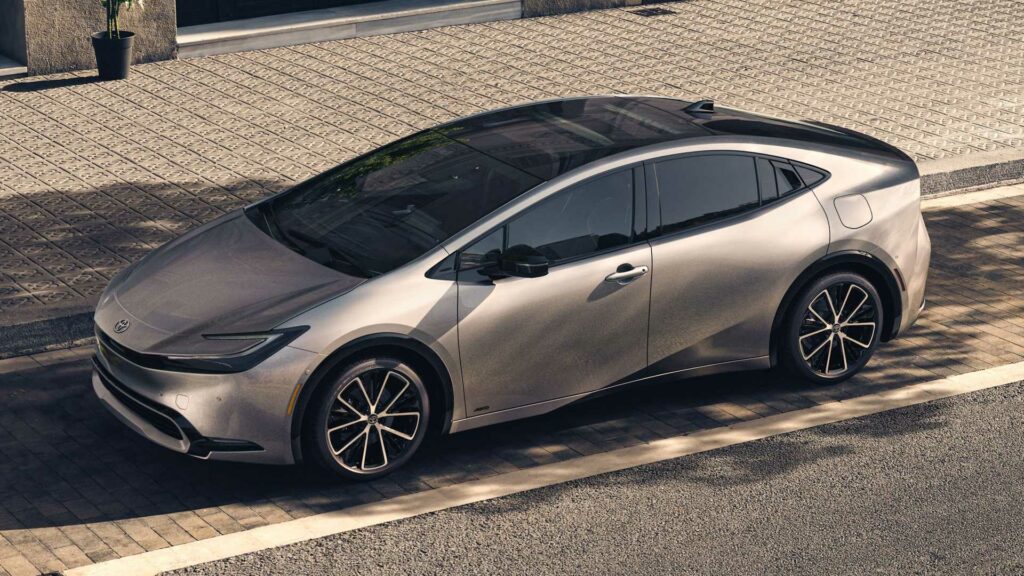
MSRP: $29,095+
Best Lease Offer: Lease the Prius LE for $289/month for 36 months with $3,999 due. See offer details.
Fuel Efficiency: 54 miles per gallon
Consumer Reports Overall Score: 90/100. See the full review.
Browse Toyota Prius listings with the power of local market data

MSRP: $27,400+
Best Lease Offer: Lease the Elantra Hybrid Blue for $279/month for 36 months with $3,499 due. See offer details.
Fuel Efficiency: 54 miles per gallon
Consumer Reports Overall Score: 77/100. See the full review.
Browse Hyundai Elantra Hybrid listings with the power of local market data

MSRP: $25,345+
Best Lease Offer: Lease the Civic Hybrid Sport Touring for $349/month for 36 months with $4,499 due. See offer details.
Fuel Efficiency: 49 miles per gallon
Consumer Reports Overall Score: 71/100. See the full review.
Browse Honda Civic Hybrid listings with the power of local market data

MSRP: $28,220+
Best Lease Offer: Lease the 2024 RAV4 Hybrid for $359/month for 36 months with $3,999 due. See offer details.
Fuel Efficiency: 39 miles per gallon
Consumer Reports Overall Score: 78/100. See the full review.
Browse Toyota Corolla Cross Hybrid listings with the power of local market data
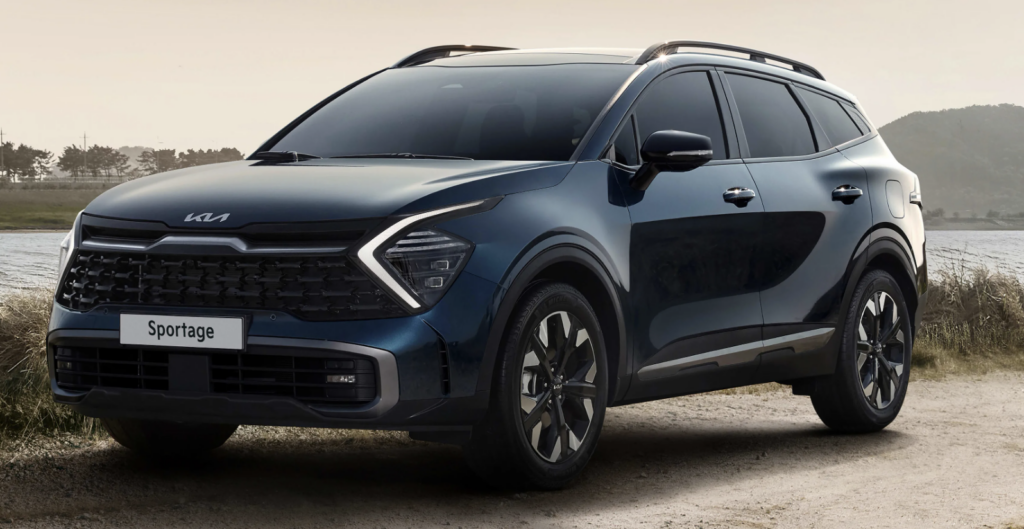
MSRP: $29,965+
Best Lease Offer: Lease the Sorento Hybrid EX for $359/month for 36 months with $3,499 due. See details at Kia.com
Fuel Efficiency: 43 miles per gallon
Consumer Reports Overall Score: 79/100. See the full review.
Browse Kia Sportage Hybrid listings with the power of local market data
Ready to find the perfect hybrid without dealership hassles? Let CarEdge help you navigate the leasing process. Our experts can find the best vehicle for your needs, negotiate the best price or lease terms, and handle all the details. Save time and money with CarEdge Concierge, the #1 car buying service in America.

If you’re in the market for a family SUV, December is hands down the best time to shop deals on three-row SUVs. Automakers are offering APRs as low as zero percent and lease specials for under $200/month to clear out 2025 inventory. Let’s dive into the top 3-row SUV deals available in December 2025.

MSRP: $38,045 – $55,245
Financing Offer: 1.99% APR for 48 months, plus $3,750 total cash savings. See details at HyundaiUSA.com
Lease Offer: Lease the 2025 Palisade SE for $369/month for 36 months with $3,999 due
Safety Rating: Top Safety Pick
Consumer Reports Overall Score: 79/100. See the full review.
Browse Palisade listings with the power of local market data

MSRP: $39,220 – $57,325
Financing Offer: 2.9% APR for 60 months for the 2025 CX-90. Learn more at MazdaUSA.com
Safety Rating: Top Safety Pick Plus
Consumer Reports Overall Score: 64/100. See the full review.
Browse Mazda CX-90 listings with the power of local market data

MSRP: $64,945 – $90,625
Financing Offer: No payments for 90 days when financing with Stellantis. No APR offers are advertised, so ask your local dealer.
Safety Rating: See the latest IIHS crash test results
Consumer Reports Overall Score: 54/100. See the full review.
Browse Jeep Wagoneer listings with the power of local market data

MSRP: $62,485 – $81,184
Financing Offer: 0% APR for 60 months for the 2025 Jeep Grand Cherokee.
Safety Rating: Top Safety Pick
Consumer Reports Overall Score: 45/100
See Jeep Grand Cherokee listings with the power of local market insights

MSRP: $39,420 – $54,515
Financing Offer: 0.9% APR for 60 months, or a $3,500 cash bonus. Learn more at VW.com
Lease Offer: Lease the 2025 Atlas SE Tech for $599/month for 36 months with $0 due at signing.
Safety Rating: Top Safety Pick
Consumer Reports Overall Score: 53/100. See the full review.
Browse VW Atlas listings with the power of local market data

MSRP: $37,585 – $54,780
Financing Offer: 0.9% APR for 60 months. See details at Kia.com
Lease Offer: Lease the 2025 Telluride S for $379/month for 36 months with $3,999 due
Safety Rating: Top Safety Pick Plus
Consumer Reports Overall Score: 76/100. See the full review.
Browse Telluride listings with the power of local market data
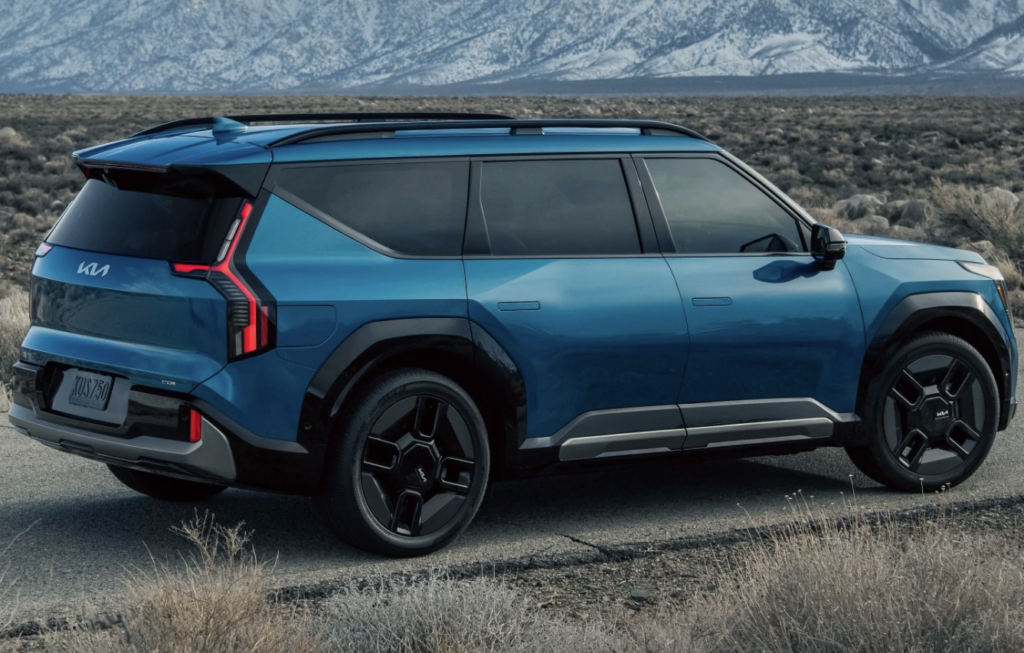
MSRP: $56,395 – $75,395
Financing Offer: 0% APR for 60 months. See details at Kia.com
Lease Offer: Lease the 2026 Kia EV9 for $449/month for 24 months with $3,999 due
Safety Rating: Top Safety Pick
Consumer Reports Overall Score: 73/100. See the full review.
Browse Kia EV9 listings with the power of local market data
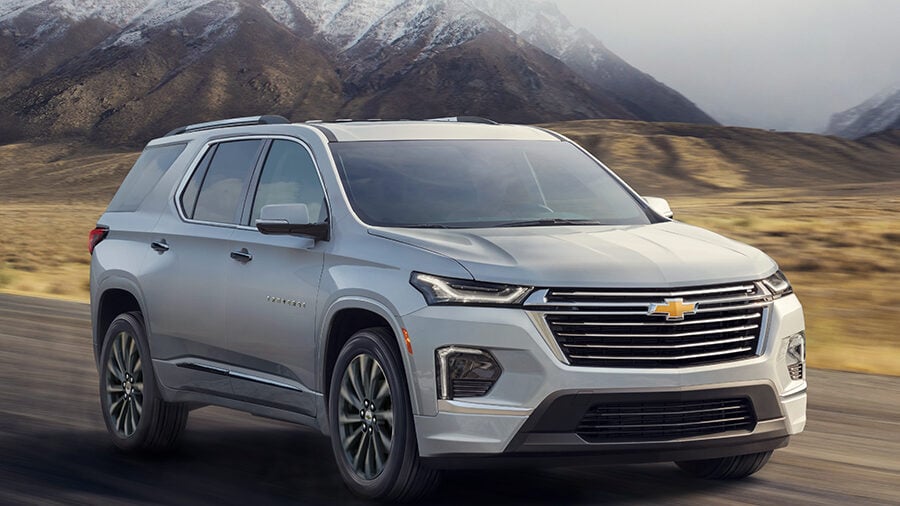
MSRP: $39,495 – $55,595
Lease Offer: Lease the Traverse LT from $499/month for 24 months with $5,199 due for eligible lessees.
Financing Offer: 1.9% APR for 36 months. See details at Chevrolet.com
Safety Rating: Top Safety Pick
Consumer Reports Overall Score: 74/100
Browse Traverse listings with the power of local market data
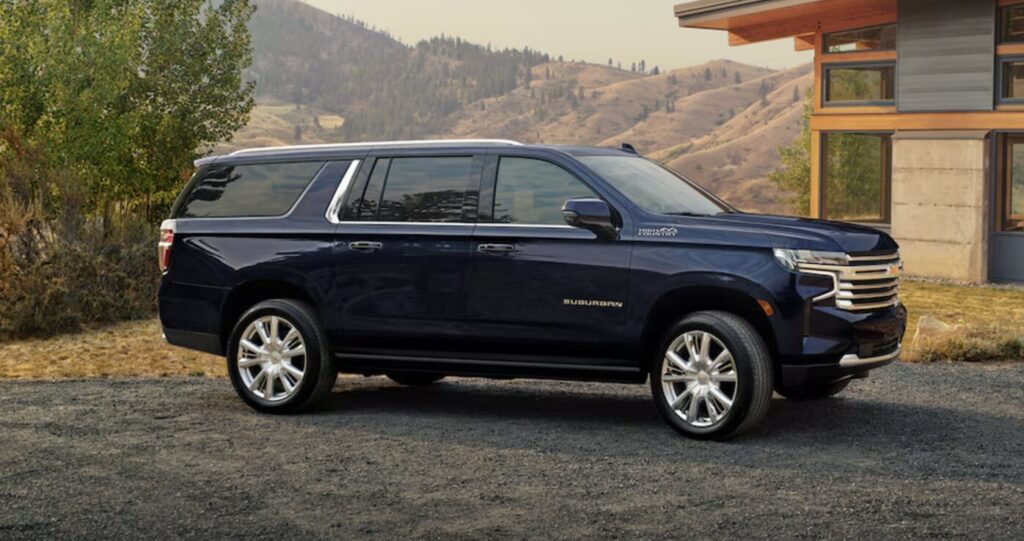
MSRP: $58,195 – $81,895
Financing Offer: Check with your local dealer. See details at Chevrolet.com
Lease Offer: No lease specials are advertised.
Safety Rating: 4-Stars
Consumer Reports Overall Score: 59/100. See the full review.
Browse Tahoe listings with the power of local market data
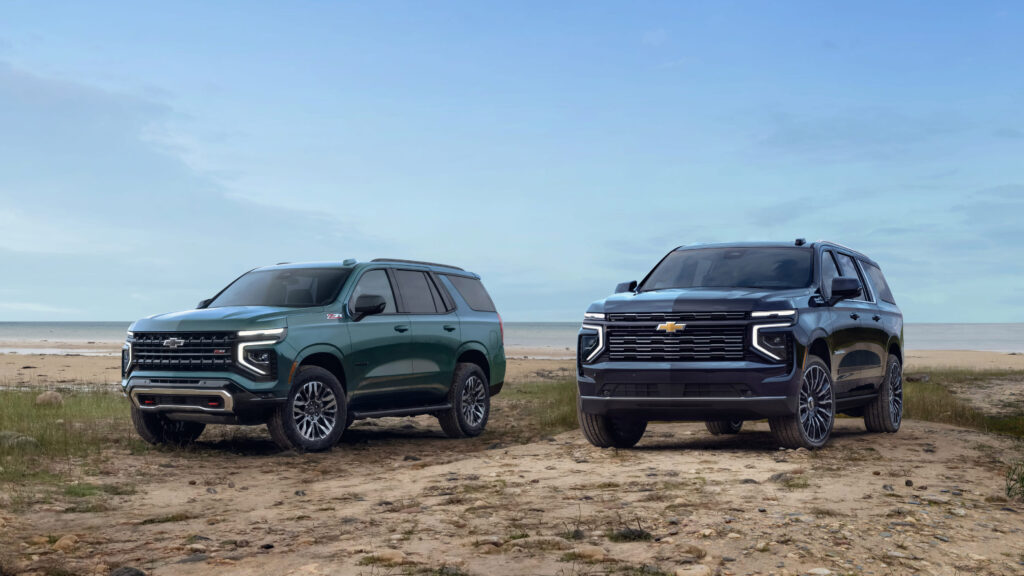
MSRP: $58,195 – $81,895
Financing Offer: Check with your local dealer. See details at Chevrolet.com
Lease Offer: $879/month for 36 months with $8,879 due at signing for the 2025 Tahoe.
Safety Rating: 4-Stars
Consumer Reports Overall Score: 53/100. See the full review.
Browse Tahoe listings with the power of local market data

MSRP: $57,625 – $85,795
Financing Offer: Ford is not currently advertising national APR incentives for the Expedition. See details at Ford.com
Lease Offer: Ford is not currently advertising nationwide lease offers for the Expedition.
Safety Rating: 5-Stars
Consumer Reports Overall Score: 60/100. See the full review.
Browse Expedition listings with the power of local market data

Kia loves to call the Carnival a multi-purpose vehicle (MPV), and it’s not a bad name for such a versatile and ‘cool’ minivan. the Carnival is a favorite of families who prefer to cruise in style, three rows and all.
MSRP: $37,895 – $51,995
Financing Offer: 3.9% APR for 48 months. See details at Kia.com
Lease Offer: Lease the 2025 Carnival MPV LX for $419/month for 24 to 36 months with $3,999 due.
Safety Rating: Not awarded. See safety test details.
Consumer Reports Overall Score: 79/100. See the full review.
Browse Kia Carnival listings with the power of local market data

MSRP: $41,340–$61,480
Financing and Cash Offer: Lease the 2025 Pacifica Plug-In Hybrid with 0% APR for 72 months or $7,500 cash allowance. See details at Chrysler.com
Lease Offer: Lease the Pacifica Touring Plug-In Hybrid for $499/month for 36 months with $4,499 due.
Safety Rating: Top Safety Pick
Consumer Reports Overall Score: 70/100. See the full review.
Browse Pacifica listings with the power of local market data
👉 Ready to find your perfect 3-row SUV? Let CarEdge help you navigate the car buying process. Your CarEdge Concierge can find the best vehicle for your needs, negotiate the best price, and handle all the details.
Or, have AI handle your negotiation for you. Yes, you read that right. CarEdge’s new AI Negotiator (recently featured in Fortune), makes getting a fair price easier than ever before. Here’s how it works.

Where are used car prices headed? How far have used car prices already fallen this year? Which cars have seen the greatest depreciation? We’re answering these questions and more with the latest used car market update for summer 2024. Want to see local price data and buying advice? Check out CarEdge Pro, now featuring Invoice Prices!
As of July 2024, there are 2.21 million used cars for sale in America, a number that has remained steady in recent months. Despite this stable inventory, used cars are sitting on dealership lots for longer. The days to turn, which indicates how long a car stays on the lot before being sold, has risen from 43 days in March to 53 days in July.
The average listing price for a used car is now $25,251, which is down 1.5% since early June and down 7% year-over-year. If we go back to 2022, at the peak of used car prices, we see a 12% decline. Here’s a surprising fact: retail used car prices are now on par with summer 2021 levels. Over the same three years, the cumulative rate of inflation has been 16%. Car prices are defying the inflationary trend seen in other parts of the U.S. economy. So, how much further will used car prices fall in 2024?
CarEdge Co-Founder and industry veteran Ray Shefska shared his thoughts on where used car prices are headed for the remainder of 2024. “The trend should continue downward, with some caveats. There will be a reduction in lease returns the second half of the year and all of next year, due to the market slowdown three years ago during the pandemic. I expect that the downward trend in used car prices will be about half of what we have seen through the first 6 months of the year. The younger 2 to 3 year-old cars with lower mileage will once again command premium pricing.”
We’ve compiled the used cars that are seeing the greatest depreciation in 2024, leading to more affordable prices for buyers today.
Minivan prices have fallen 7% since April, exceeded only by full-size vans, which have fallen 14% in the same period. Following the decline, here are the average selling prices for some of the most popular used vans today:

Average Selling Price: $32,474
Negotiability Score: Below average, 41 days of market supply

Average Selling Price: $39,779
Negotiability Score: Below average, 31 days of market supply

Average Selling Price: $33,197
Negotiability Score: Average, 47 days of market supply
According to iSeeCars, the average price of a used EV dropped by 29.5% from $40,783 in June 2023 to $28,767 in June 2024. Here are the latest prices for three of the most popular used EVs in America:

Average Selling Price: $28,844
Negotiability Score: Below average, 38 days of market supply

Average Selling Price: $24,096
Negotiability Score: Below average, 34 days of market supply

Average Selling Price: $32,681
Negotiability Score: Below average, 26 days of market supply
Another used car segment that has seen falling prices in 2024 is the luxury crossovers. Prices for these popular models have fallen by more than 40% in three years.

Average Selling Price: $33,105
Negotiability Score: Average, 48 days of market supply

Average Selling Price: $47,790
Negotiability Score: Above average, 64 days of market supply

Average Selling Price: $34,225
Negotiability Score: Above average, 66 days of market supply
The used car market is inching closer to normal following four years of disruption. Prices are falling, inventory levels are high, and cars are staying on lots longer. However, the market is complex, with each used car segment showing different trends. Minivans and full-size vans are seeing the steepest price declines, while used EVs and luxury crossovers also offer some serious opportunities for savings. As lease returns decrease, younger, low-mileage cars will likely become more valuable, slowing the overall price decline later in 2024.
👉 Tired of car shopping hassles? Let us handle it for you with our CarEdge Concierge service. Our experts will find the perfect vehicle, negotiate the best price, and take care of all the details, saving you time and money. Learn more about CarEdge Concierge, the #1 car buying service in America.

In 2023, nearly 6 million car crashes occurred in the U.S., with 40,000 resulting in fatalities. As accident rates rise, vehicle safety matters more than ever. The Insurance Institute for Highway Safety (IIHS) conducts crash tests on dozens of car and truck models annually. From front and side-impact crashes to simple headlight performance, every aspect of the vehicle is scrutinized with one thing in mind: safety. The most recent IIHS tests found these 5 models to be some of the safest cars on the road in 2024.
All of these cars are rated ‘Top Safety Pick Plus‘ by the IIHS in 2024. The Institute’s ratings are based on the most recent crash testing and available safety features.
Note that the IIHS tests models when a new generation arrives, so if you see that the most recent test was a few years ago, that simply means that 2024’s model is the same car structurally. From EVs to SUVs, there’s something for everyone.
In the overviews below, we’ve included links to IIHS testing. A green rating of ‘G‘ indicates the highest possible score of ‘Good‘, and a yellow ‘A‘ represents ‘Acceptable‘ ratings.
It’s the best-selling EV in America, and the safest too. Tesla VP of Vehicle Engineering Lars Moravy explained that absorbing as much energy as possible during a collision was a goal from the start of the vehicle’s design. The Model Y has one of the lowest probabilities of injury from an accident of any car on sale today.
Here are the key safety results from the Model Y IIHS testing:

Other available safety features
Consumer Reports rates the Model Y 72 out of 100 points. See their full review.
Learn more about the Model Y at Tesla.com, or see used Model Y listings with market data
If you’re in the market for a midsize SUV with all-wheel drive, the Subaru Ascent might be the perfect fit. It’s got space for up to eight passengers, which are well-protected considering the Ascent’s 5-star safety ratings.
Here are the key safety results from the Subaru Ascent IIHS testing:

Other available safety features
Consumer Reports rates the Ascent 79 out of 100. See the full review.
Browse Subaru Ascent listings with local market data
The Honda Accord is arguably the best sedan on sale today. It’s safe, fuel efficient, good looking, and handles better than the competition. Not to mention you get all of this and more for under $30K. The IIHS gave the Accord the coveted ‘Top Safety Pick Plus’ top honors after the latest crash tests.
Here are the key safety results from the Honda Accord IIHS testing:

Other available safety features
Consumer Reports gave the 2024 Accord 78 out of 100 points. See their full review.
Browse Honda Accord listings with local market data
The legendary Prius has come a long way from its humble, economical beginnings. In 2024, it’s a sharp-looking car that turns heads. Of course the Prius will save you on fuel with 57 miles per gallon, but it’s also the safest hybrid car in 2024.
Here are the key safety results from the Toyota Prius IIHS tests:

Other available safety features
Consumer Reports gave the redesigned Prius 80 out of 100 points. See their full review.
Browse Toyota Prius listings with local market data
How does peppy driving dynamics, high ground clearance, and room for the family for well under $35,000 sound? The 2024 Mazda CX-50 is winning over plenty of fans as Mazda’s U.S. market share climbs. On top of the all-weather capabilities and well-powered engine, the CX-50 is one of the safest cars on the market.
Here are the key safety results from the Mazda CX-50 IIHS tests:

Other available safety features
Consumer Reports rates the 2024 CX-50 77 out of 100 points. See their full review.
Browse Mazda CX-50 listings with local market data
Car buying is NOT fun. At least that’s been the case until now. As you consider these top safety picks for your next ride, remember this: you CAN skip the dealership hassles to save time, stress, and money.
With CarEdge Concierge, we do the heavy lifting for you. You tell us what you want, right down to the finest details. Your Car Concierge takes it from there, sourcing the perfect vehicle negotiated to the best price. With home delivery available, buying a car has never been easier.

Imagine cutting your fuel bill in half, without making the sacrifices that come with the EV lifestyle. Have you ever experienced the joy of owning a car that routinely gets 40, maybe even 50 miles per gallon? If not, we’re here to change that. In this guide, we’ll introduce you to the 5 best fuel-efficient cars for 2024.
We’ve selected five of the top new car models based on fuel efficiency, considering other important factors like reliability, comfort, and cost of ownership as tie-breakers. Fuel efficiency is measured in miles per gallon (mpg). We’ve included the annual fuel cost calculated for the average American driver traveling 15,000 miles per year, paying $3.50/gallon for gas. For comparison, the average American light-duty vehicle gets 25 miles per gallon, and costs $2,100 to fuel each year.
Without further adieu, let’s dive in.

For anyone familiar with fuel-efficient car brands, the winners should come as no surprise. Toyota and Honda have long been leaders in hybrid technology, consistently delivering cars that top the charts in fuel efficiency. Hyundai is also making a strong push in the hybrid market, proving that fuel economy doesn’t have to come at a premium price.

See Prius listings with local market data

See Camry Hybrid listings with local market data

See Elantra Hybrid listings with local market data

See Civic Hybrid listings with local market data

See Corolla Cross Hybrid listings with local market data
While fuel efficiency is undeniably important when selecting your next vehicle, it’s just one piece of the puzzle. You’ll want to take into account other critical factors like reliability, comfort, safety features, and the overall cost of ownership to make a well-rounded decision that aligns with your unique needs and preferences.
You don’t have to navigate car buying alone! Your CarEdge Concierge is here to listen to your needs, find the perfect car, and negotiate the price on your behalf. It’s the easiest way to buy a car in 2024, hands down!