
CarEdge saved me over 4,500 dollars on a brand new Honda Pilot. I can't say thank you enough.
Price intelligence
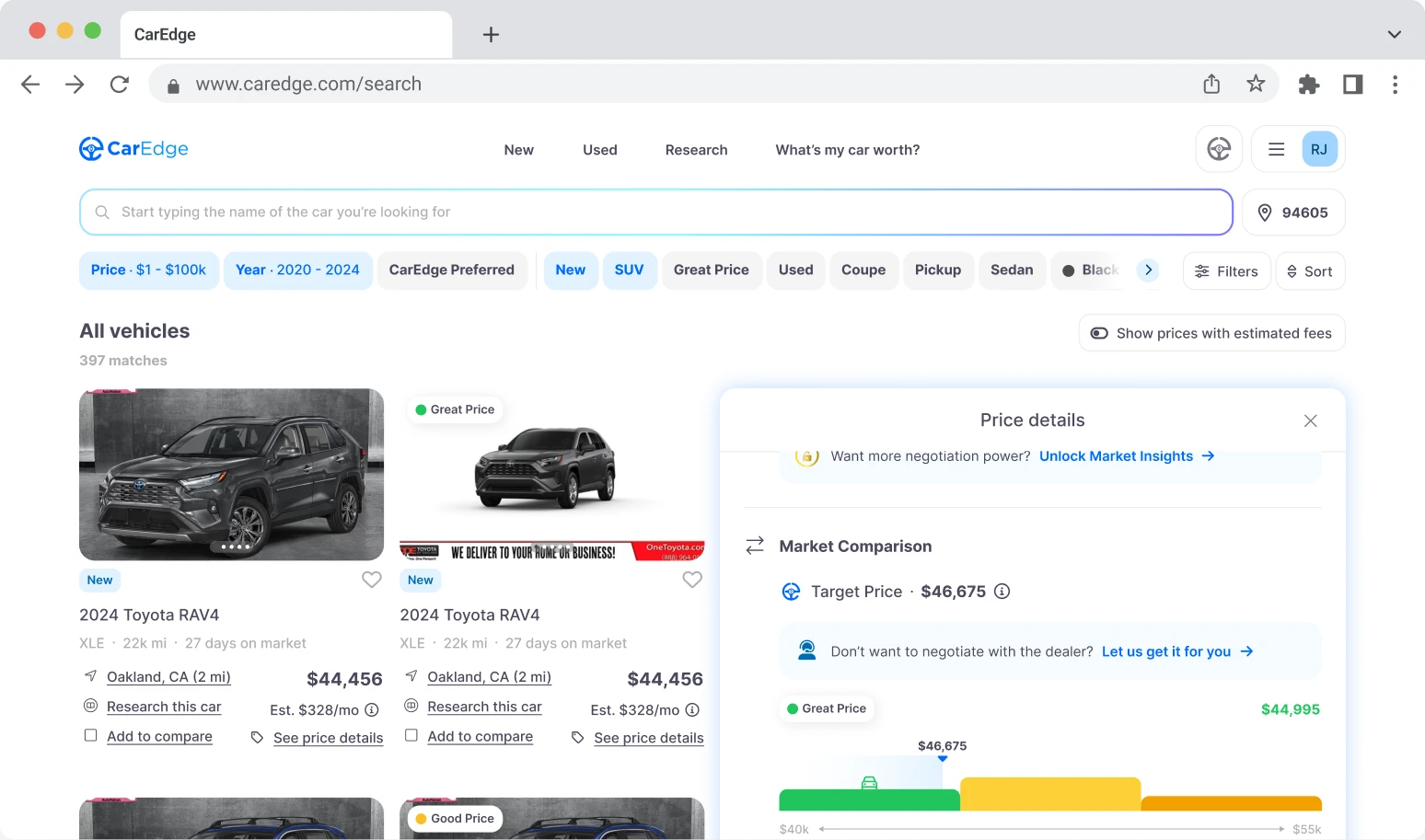
Find a wide range of vehicle listings with market insights on new and used listings near you.

What can I do with CarEdge?
 CarEdge Insights
What can I do with CarEdge?
Get access to exclusive information so you can make an informed car buying decision — all in one place.

Find a wide range of vehicle listings with market insights on new and used listings near you.
Track your vehicle’s value and cash in when the time is right to sell.

Access to our proprietary data to help you find the right car, at the right price. Find these unlocked on every listing after subscribing.

With our expert-led, tech-enabled car buying service, we will locate, negotiate, and deliver your vehicle so you can get a new car hassle free.


Help us personalize your CarEdge experience — it only takes a second.
Your answers help us personalize your CarEdge journey — we’ll follow up with tips and next steps that match your buying timeline.
Purchasing a vehicle often includes a critical, yet confusing step: signing the vehicle purchase agreement. This document outlines your purchase price, fees, financing details, trade-in terms, taxes, and more. Dealerships review these contracts daily, but most car buyers only encounter them once every few years. That’s why understanding every line item is essential.
In this guide, we’ll explain each section of the contract—from the Truth-in-Lending disclosures to your trade-in certification and warranty disclaimers—so you can sign with confidence and avoid surprises.
The first thing you will see on your new car purchase contract will be information required by the federal Truth-in-Lending Act – or “TILA” for short. This information will not be present on your contract if you are not financing your purchase.
There are four key pieces of information that must be included in the Truth-in-Lending Disclosure:
By law the dealership must review each of these four components of your purchase with you. Savvy finance managers will circle the boxes on the contract with the back of their pen so that it leaves a mark on the carbon copy of the contract as “proof” that they reviewed the document with the client.
Below this you will find details about your payment schedule. At this stage in the process, nothing should be foreign here; this should show the agreed-to loan financing option you selected.
Below that, you’ll notice a few disclaimers. One of importance is the prepayment notice. If you pay off your loan early you will not be subject to any penalty. Always keep this in mind when you are financing a vehicle purchase.
Next comes a list of all components of the contract broken out in an itemized fashion. This section of the contract is intended to make it clear to you what you are purchasing and how much you are financing to make the purchase. For many people this section of the contract gets confusing, but it doesn’t have to be. Let’s break it down line by line.
The first item you see in the itemized section of the contract is the cash price, also referred to as the selling price of the vehicle. This amount, plus the doc fee total the entire cash price or selling price of your purchase.
The down payment section refers to any money you put down on the purchase. If you are trading in a vehicle this will include (like the example above does) a trade in allowance, payoff, and net trade in. If you owe more than your current car is worth, you will see a negative value on line 2C. If you were to put cash down for your purchase that would show on line D, and if you have any incentives or rebates that go towards your down payment those would show on line E.
This is simply the cash price minus the down payment amount.
As it sounds, this section refers to any fees being paid to other parties on your behalf. In the example above you see “N/A” everywhere. That means the customer did not roll their taxes, title, and registration into the loan for their purchase. Instead, they paid those fees out of pocket when they went to register the car in their name. This section will typically be full of numbers that vary from state to state (since each state has different sales tax, title fees, and registration fees). If specific insurance coverages were purchased (which very few people purchase nowadays), and they were rolled into your loan, you would see those amounts in lines E, F, and G. The same goes for lines H through P.
The total amount financed is the sum of section 3 and section 4. The unpaid cash balance, plus the amount paid to others on your behalf.
Believe it or not, everything we’ve reviewed thus far is actually not the vehicle purchase agreement, it is the retail contract required for finance purchases. If you aren’t financing your vehicle purchase you won’t be reviewing a document like the one above. Instead you’ll see something similar to what we’re about to cover, the real purchase agreement.
The purchase agreement restates everything on the retail contract (just on slightly different parts of the page) and includes a few other important items, two worth calling out specifically:
This section of the vehicle purchase agreement only comes into play if you are trading a vehicle in during your purchase. When you sign the contract you certify that:
If any of these conditions are not met, or you do not disclose them to the dealer, they can void the transaction. As with all situations, honesty is the best policy, so be sure to tell the truth before signing the dotted line!
The final section to make you aware of on the vehicle purchase agreement is the warranty disclaimer and doc fee notice.
The warranty disclaimer makes it clear that the purchase is being made “as-is,” with no additional warranties (from the dealer). As the disclaimer states, any warranties from the manufacturer are not “party” to the dealer, and you can leverage them anywhere the manufacturer supports, not just the dealership where you are making your purchase.
Then, below that is the documentary fee notice. This states the reason why you see a “doc fee” on the purchase of your vehicle. Doc fees vary from state to state, and as we’ve written about before, you’ll never be able to get a dealer to remove a doc fee from their contract, but you can get them to discount a vehicle the amount of the fee.
Remember, always ask questions when you’re not sure about something. If there is something that you don’t understand, seek clarification. Never sign a document if you are not 100% sure what you are signing.
Q: What is included in the Truth-in-Lending disclosure?
A: The disclosure must detail the Annual Percentage Rate (APR), total finance charge, amount financed, and total of payments. By law, dealers must review these figures with you before you sign.
Q: Are doc fees negotiable?
A: Doc fees vary by state and are often non-negotiable. But you can negotiate the vehicle price down by the amount of the doc fee to keep overall cost neutral.
Q: What does “as-is” mean in the warranty disclaimer?
A: “As-is” indicates the dealer is not providing any additional warranty. Only manufacturer warranties apply. For added protection, you can purchase aftermarket warranties, but they’re not required.
Q: What should I check in the trade-in certification?
A: Verify statements about your trade-in’s title status (non-salvage), emissions system, airbag functionality, and odometer accuracy. Incorrect certifications can void the sale.
Ready to outsmart the dealerships? Download your 100% free car buying cheat sheets today. From negotiating a deal to leasing a car the smart way, it’s all available for instant download. Get your cheat sheets today!
CarEdge is a trusted resource for car buyers, offering data-backed insights, negotiation tools, and expert guidance to help consumers save time and money. Since 2019, CarEdge has helped hundreds of thousands of drivers navigate the car-buying process with confidence. Learn more at CarEdge.com.
The car business has taught me a lot over the 40+ years that I’ve been a part of it. Today I wanted to share with you the five most important things I learned during that time:
Be who you are — warts and all. It took me a while, but over the years, I figured out that it was important for me to be a little silly, a little off kilter, and a little different at the dealerships I worked at. Why? Because that’s who I am.
I remember many, many years ago, watching a guest on an afternoon talk show say that you should “dare to be different.” I hate to say it, but it’s easy to be pretty much the same, but if you dare to be different, you’ll inevitably stand out from the crowd.
For me, that meant having fun with customers, being both informative, and entertaining at the same time. When I was selling, I was giving the customer a show. Fortunately for them, there was no cover and no two drink minimum, but damnit, they were entitled to a good time.
My motto was simple, “if you give them a good show, they will part with their dough!” (As you can see, I stuck with car sales instead of poetry for good reason). Don’t feel pressured to act a certain way in the dealership, whether you work there, or you’re coming in to buy a car. Not only is it perfectly fine to be you, it’s encouraged. Be the best you, you can be.
If you find yourself having to tell something other than the truth, you are not only letting your customer down, but more importantly you are letting yourself down! As I have been known to share with a customer, “if the truth is going to preclude us from making a deal, then so be it, I’m not going to lie to you in order to make it happen.”
Jack Nicholson famously shouted from the witness stand in the movie, A Few Good Men, “You want the truth? You can’t handle the truth!” Maybe in the military he was right, but when it comes to sales, he was dead wrong.
Let a professional car buyer help. We do the hard stuff for you.
[mautic type=”form” id=”4″]
In sales the truth shall set you free. Rather than wondering down a twisting road of lies, each requiring you to remember what the last lie was, you can instead simply tell the truth. As I like to say, “if it is right, do it or say it, if it is wrong, don’t do it or say it, and if you are not sure if it is right or wrong, do both you and your customer a favor, and don’t say it.”
Tell the truth, you’ll both be better off for it.
In my 40+ year career in the car business, this one took the longest time for me to understand. You never want to say “no” to a customer, instead, you are always searching for a way to say “yes” to them. One way to do this? Always focus your conversation around what you can do. This puts both you and the customer on the path towards “yes.”
For example, let’s say you’ve quoted a customer a payment of $498 a month for a 60 month loan. Like most customers do, they say, “make it $450 for 48 months and we’ve got a deal.”
For the longest time my response was almost instant and almost always the same, “What are you crazy, I can’t do that,” and the ultimate result was almost always the same: we didn’t make a deal because it was too confrontational.
Later in my career, I handled the same situation very differently. I would tell the customer a story (selling is storytelling), about when I attended company-wide sales training, and they taught us to never tell a customer what we can’t do. “I should only tell you what I can do, and folks if you pay close attention to what I can do, you’ll probably notice that I am really telling you in a nice way, what I can’t do.” This was my go to script.
“So what I can do is $498 a month for 60 months. Can we make this work for both of us?” I’d finally ask.
This wouldn’t always work, but the results were an awful lot better than simply telling the customer, “nope, we can’t do that.”
Always speak to your customer in terms of what can be done. For both of you, it’s a much more fun and positive path to travel.
This one is as old as the hills but incredibly important, under promise and over deliver. If you tell a customer that you are going to do something, whether it be big or small, do it. I don’t care how small or trivial it is, if you say you’re going to do it, do it. Did you tell a customer that you’d follow up later on today with more information? Call them later that day, even if you haven’t gotten the information yet. If you don’t keep your promise you’ll erode valuable trust with your customer.
I cannot tell you how much that means to a customer, seemingly small things like picking up the phone and giving them a call when you said you would, is truly a difference maker. Trust me, the salesperson down the street probably won’t keep that promise. All you need to do is under promise and over deliver to take the first step towards being their go to “car guy.”
Remember, never promise more than you can deliver. If you do, you’ll instantly become a “typical car guy” in the customer’s eyes. Remember, dare to be different. Part of that difference is always doing more than you said you would. No ifs, ands or buts. If you promise it, do it!
It costs a ton of money to acquire a new customer. Whether your marketing includes digital, TV, radio, direct mail, etc, it’s incredibly expensive to acquire new customers at your dealership.
Dealerships invest in all this marketing to attract customers to their showroom, with the hope that their sales staff can sell them when they come in. If your store is really good, you’ll close 20 to 25% of the people that walk in for the first time. That means 75 to 80% of people aren’t buying on their initial visit.
Would you like to improve your odds of closing a deal? Of course you would. How can you? By concentrating your efforts on your existing customers.
Existing customers will close at a higher rate because they have already done business with you (if you treated them right the first time around). One of the best things your dealership can do is to configure a rewards program that is designed to encourage your customers, both sales and service, to remain your customer.
Perhaps you can guarantee an extra $500 trade value if they have always serviced and maintained their current vehicle at your dealership, whether they purchased it from you or not. Take a cue from your local supermarket or grocery store, they all have rewards programs for shopping with them. Come up with something similar for your dealership.
Research shows that existing customers will pay a higher average gross profit than a fresh customer. Do the math and you’ll realize that it costs a whole lot less to keep your existing customers than it does to go find new ones.
Those are the five most important things that I have learned in my 40+ years in the car business.
A car’s invoice price is the amount that a car dealership pays the manufacturer for a vehicle. By understanding how this price determines the overall sticker price of a vehicle, you can shop smart when hunting for deals. In this guide we’ll show you how to look up the dealer invoice price, no matter the car you’re interested in.
👉 Get a FREE dealer invoice price now (NEW!)
Did you know that car dealerships don’t own their inventory outright? Floorplanning costs are a little-known facet of the auto industry. At the center of the costs of being in the car business are invoice prices. The dealer invoice price refers to the amount a car dealership pays to the manufacturer for a vehicle. It’s important to know this price because it can serve as a valuable tool in negotiating the final cost of a car. By understanding the dealer invoice price, you can have a better idea of a fair price for the vehicle you’re thinking of buying.
Franchised car dealerships buy their inventory directly from their manufacturers. Similarly to you and I, dealers “floor plan” their purchases. Floor plan is industry jargon for “finance,” and it means that dealerships take out loans to pay for all of the vehicles you see on their lot, just like most consumers do when they finance the purchase of a new vehicle.
Dealerships receive an invoice directly from the factory telling them the price of the car (including the destination fee) that they owe. The dealer invoice is something you’ll want access to when negotiating the price of a new car.
When it comes to used cars, they are primarily bought and sold from the auctions or customer trade-ins, and in these cases looking at a dealer invoice price won’t be an option. You can always ask a dealer what they paid for a used car, but there typically won’t be a willingness to share that information.
On the new car side of things, dealers are much more likely to be open and transparent about the invoice cost they paid to purchase a vehicle. This has become a sales tactic that nearly all car dealerships use to convince customers that they are getting a fair deal.

👉 Get your FREE dealer invoice price from CarEdge (NEW!)
Looking for something else? Here’s how you can go about finding the dealer invoice price when buying a car…
At the end of the day, there is only one foolproof way to get the invoice price of any new car — ask the salesperson or sales manager at the dealership. This doesn’t have to be overly complicated. A quick email that says, “Hi, I am interested in this Ram 1500 pickup truck, and I want a fair deal. Can you please send me out-the-door pricing, a copy of the Monroney label, and the invoice you paid from the factory?” Will go a long way.
Referencing the out-the-door price is a great way to show a salesperson or sales manager that you know what you’re talking about, and you don’t want to spend hours discussing monthly payment goals. Asking for the Monroney label, or window sticker is also a great way to show you’re on top of your game. You want to know what options and features the vehicle has, and what better way than to look at the Monroney label? And finally, asking for the factory invoice makes it clear to the dealer that you want to make a fair deal.
The same thing applies to money factors when leasing a car. Do not be afraid to ask a dealer what the money factor is on a lease, and to follow that question up with, “Is this the buy rate, or are you marking it up?” If the dealer can’t give you a straight answer, that’s another sign it’s time to find someone new to work with.
Set a target price: Determine a target price based on the dealer invoice price and any applicable incentives or rebates. This will give you a starting point for negotiations.
Preparation is key: Bring printouts of your research, including the dealer invoice price and any incentives or rebates, to the dealership as evidence to support your negotiation. Don’t forget this negotiation cheat sheet!
Stay calm and confident: Negotiating can be stressful, but staying calm and confident during the process can help you secure the best deal possible.
Ready to outsmart the dealerships? Download your 100% free car buying cheat sheets today. From negotiating a deal to leasing a car the smart way, it’s all available for instant download. Get your cheat sheets today!
As billions of people shelter in place, many household brand names are struggling to find their footing. Hertz Rental Car is one of them. With the drastic decline in travel (both business and personal), Hertz is faced with more uncertainty than ever before. As Hertz contemplates filing for bankruptcy, our team at CarEdge is considering what impact that would have on the used car market, and specifically used car prices and deals for consumer.
Should you buy a used car today, or wait a few weeks or months to get a better deal? That’s the money-saving question, and Hertz’ bankruptcy decision will certainly implicate what makes the most sense.
With a total fleet of over 856,800 vehicles globally (as of 2018), it’s safe to say that Hertz has a lot of vehicles under their ownership. What would happen if Hertz has to liquidate those assets to pay back their creditors? In the United States alone, the company has more than 500,000 vehicles under their ownership. If Hertz files for bankruptcy and has to sell all of these used cars, what would happen to used car prices?
Let’s explore.
It’s important to understand that car dealerships base their used car prices off of “market value.” Like I’ve written about in the past when discussing how much dealers mark up their used car inventory, dealerships use software like vAuto to constantly adjust their used car prices to reflect what people are paying for similar cars in their region.
That being said, if there was an influx of used cars that flood the wholesale market, we would anticipate that demand to purchase those cars would not keep up, ultimately lowering the price per vehicle. We’ve already seen a decrease in wholesale prices for used vehicles, with a historic 9.2% drop in whole prices recorded in April, according to data reported by Manheim Auto Auctions, the largest purveyor of used car auctions in the United States.
Let a professional car buyer help. We do the hard stuff for you.
[mautic type=”form” id=”4″]
Hertz, and their creditors desperately want to avoid having to liquidate their inventory of vehicles, because they know prices are already suppressed. According to Bloomberg, they’re looking for any option other than a “fire sale.”
But what would happen if hundreds of thousands of used cars immediately flooded the market? Because of the sheer scale of their liquidation, it’s not likely that Hertz will be able to liquidate many vehicles directly to consumers. That means car dealers will buy up their inventory at suppressed prices, and in return sell them at lower prices (of course with a margin still built in).
If the supply side of our equation increases by 500,000+ units, and the demand side stays the same, you ultimately have a decrease not only in wholesale prices, but also retail prices. Car dealers will need to sell their inventory to sustain their cash flow, and in theory, good deals should be for the taking. Ultimately a large increase in used car supply will trigger car dealership’s “dynamic pricing” tools to rapidly lower their selling price, while still maintaining some profit margin, at least that’s our supposition.
One of the questions I get asked frequently is if buying a rental car is a good value. The answer is, it depends.
With Hertz potentially liquidating hundreds of thousands of cars, I can assure you there are some vehicles they’ll be selling that you’ll want to avoid, and some you’ll certainly want to take a closer look at. How can you tell which rental cars make good used cars? Here’s my advice.
Take into consideration where the car was driven. To find this out you can look at the vehicles CarFax report. Although it won’t tell the full story of what a vehicle has been through, knowing where it spent most of its time is helpful.
For example, very recently we helped a client purchase a used car in Anchorage, Alaska. The vehicle was previously a rental car, and it only had 14,000 miles on it. Why? Because in Alaska they have an incredibly short summer rental season, and this car had been driven hard for three months, and then was ready for sale to a local resident. What did that mean for our client? They got a great car, at a great price, with relatively few miles, in driving conditions that focused entirely on highway roads, not city streets. In this example, buying a rental car is a great used car value.
On the other hand, if you’re looking to buy a rental car and it spent most of its days in a major city center, you may want to think twice. Scratches and dings are almost certainly going to be present. How many potholes can one car drive over before the tires need to be realigned? The brake pads may be worn, etc, etc.
If you do want to buy a rental car as a good used car value, you’ll want to get a pre-purchase inspection completed in advance, to confirm everything is in good working order.
Whether Hertz goes bankrupt or not, you can buy vehicles from them. Hertz Car Sales is a business unit within Hertz that comprises 75 retail store fronts nationwide. Hertz Car Sales would not be able to support the liquidation of all Hertz inventory in the event of bankruptcy, however it is likely they would see an increase in used car sales.
That being said, Hertz Car Sales takes a “one price” approach, which means you will not be able to negotiate the selling price of a vehicle. Time will tell, but you may end up getting a better deal if you buy a car through a dealer instead.
Keep in mind other car rental companies, like Avis, Budget, and Enterprise also offer similar programs which may be worth investigating at this time too.
Used car buying can be stressful. Our Honda Certified Pre-Owned review is meant to help.
One of the perks of buying a certified pre-owned vehicle is knowing that it meets the manufacturer’s standards for quality and worthiness. That being said, every manufacturer has a slightly different certified pre-owned program, and Honda actually offers two variants.
HondaTrue Certified, and HondaTrue Certified+ are two levels of certified pre-owned offered by Honda on their vehicles. Below we’ll tell you what you need to know about both before you buy your next Accord, Civic, Odyssey, or CRV.
CarEdge score: 7/10
HondaTrue Certified+ is Honda’s premier CPO program. Vehicles that are less than one year old qualify for Certified+ distinction.
CarEdge score: 6/10
Honda’s “non-plus” variant of certified pre-owned is valuable for customers. Below we breakdown what we like and dislike about both CPO programs.
What’s to love about Honda’s CPO program?
What’s missing or lacking about the program?
If you’re interested in reading all the fine print, you can click here to access the entire CPO warranty booklet. Below we’ll go in depth into key aspects of the certified pre-owned program.
Expendable Parts
Maintenance procedures
Clutch, Brakes & Tires
Batteries & Bulbs
This limited warranty does not cover any emission-related repairs, including but not limited to the following:
This limited warranty does not cover any item concerning the vehicle’s general appearance including cleaning, polishing, normal wear and deterioration of any part.
Body Parts & Trim
Interior Parts, Upholstery & Trim
Glass & Mirrors
Wheels
As you can see, a lot of items are not covered by the CPO warranty. This is one of our biggest frustrations with Honda’s certified pre-owned program. Unfortunately for the customer, they will likely end up having to pay out of pocket for something on their CPO vehicle, even though they are paying for the privilege of it coming with this extra warranty.
Similar to Toyota’s certified pre-owned program, Honda also offers a 12 month roadside assistance program for CPO vehicles. This is a nice perk, and one that more and more manufacturers are offering.
The specific benefits that come from Roadside Assistance are:
For a vehicle to qualify for CPO status, it must pass a rigorous 182-point inspection by a Honda certified technician. The inspection includes confirming that no aftermarket parts have been added to the vehicle, that the entire interior, exterior, and underside of the vehicle are of high quality, and that the tires, brakes, and engine are in good working condition.
For a complete list of what is included in the inspection, you can click here.
We hope you found this Honda Certified Pre-Owned review helpful. Navigating the car buying journey can be challenging, and we’re here to help!