
CarEdge saved me over 4,500 dollars on a brand new Honda Pilot. I can't say thank you enough.
Price intelligence
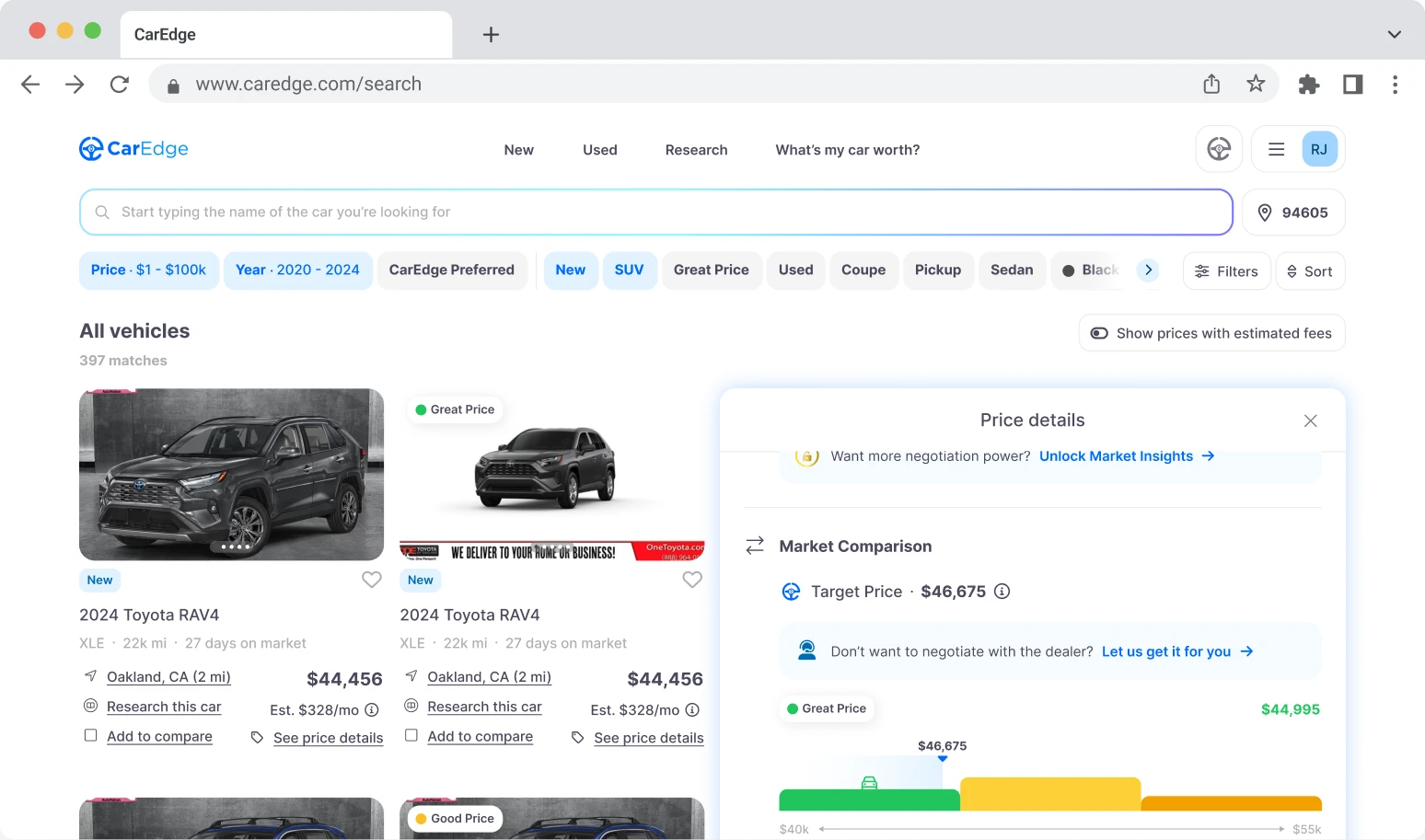
Find a wide range of vehicle listings with market insights on new and used listings near you.

What can I do with CarEdge?
 CarEdge Insights
What can I do with CarEdge?
Get access to exclusive information so you can make an informed car buying decision — all in one place.

Find a wide range of vehicle listings with market insights on new and used listings near you.
Track your vehicle’s value and cash in when the time is right to sell.

Access to our proprietary data to help you find the right car, at the right price. Find these unlocked on every listing after subscribing.

With our expert-led, tech-enabled car buying service, we will locate, negotiate, and deliver your vehicle so you can get a new car hassle free.


Help us personalize your CarEdge experience — it only takes a second.
Your answers help us personalize your CarEdge journey — we’ll follow up with tips and next steps that match your buying timeline.

Most people assume the savvy car buyer is the one who shows up knowing exactly what they want, from trim selection to paint color. They’ve done the research. They’ve made their decision. They’re ready to buy.
Here’s what the data actually shows: that buyer is often the easiest one for a dealer to work with. And not in a good way.
A new study from Cox Automotive found that only 29% of car buyers started the shopping process knowing exactly what vehicle they wanted, down from 37% in 2020. Meanwhile, buyer satisfaction with their vehicle selection hit 62%, up sharply from just 36% during the inventory crunch of 2022. Overall new-vehicle buyer satisfaction reached 76% in 2025, an all-time high.
Could ‘clueless’ car shoppers really be making better purchasing decisions in today’s car market? Let’s dig into the details.
After 43 years working in dealerships, I can tell you something most car buyers don’t realize: dealers can read a locked-in buyer from across the showroom floor.
When you walk in and announce you want a specific model in a specific trim in a specific color, you’ve handed the dealer a map to your wallet. They know you’re not going anywhere. They know the price pressure is low. And they’ll structure the deal accordingly.
The buyer who walks in open to a few different options? That buyer is harder to pin down. And that’s a good thing for your negotiation.
Flexibility signals that you have choices. Dealers respond to buyers who have choices.
The 71% of buyers who went into the process without a fixed vehicle in mind weren’t just wandering around hoping something caught their eye. They were shopping smarter.
They let needs drive the search, not brand loyalty.
Instead of starting with a model name, start with what you actually need. How many people are you hauling regularly? What’s your commute? Do you need cargo space, towing capacity, or just solid fuel economy? More and more car buyers are realizing that brand loyalty often doesn’t lead to better outcomes. CarGurus found that more than half of car shoppers consider three or more brands. Yes, reliability, safety ratings, and resale value are important, but in 2026, these attributes can be found across the market.
They cross-shopped new and used.
In 2025, 66% of buyers considered both new and used vehicles, up from 57% the year before. That matters because the used market has returned close to pre-pandemic norms — more inventory, more stable pricing — and there’s real value to be found if you’re not religiously committed to buying new.
They looked at leasing.
Among new-vehicle shoppers, 29% weighed leasing versus buying in 2025, an all-time high. Leases were typically saving buyers more than $100 per month compared to financing a purchase. If you’ve never seriously considered leasing because you “just don’t lease,” it might be worth running the numbers before you decide.
They checked the deals before falling in love with a vehicle.
Incentives shift every month. What’s well-discounted in March might be full price in June. A buyer anchored to one specific vehicle has to take whatever deal exists on that vehicle right now. A buyer open to a few options can follow the money — and find the model where the manufacturer is hungry to move inventory.
Use CarEdge’s Best Deal Hub to see what’s on sale this month. Before you shop, find dealerships known for transparent pricing and no-nonsense deals with our Car Dealer Ratings [NEW!].
None of this means you should walk into a dealership without doing your homework.
Know your budget before you know your vehicle. And know your budget as an out-the-door number, not a monthly payment. Dealers sell monthly payments because it obscures the total cost of the deal. When you know the OTD price you can afford, you can evaluate any vehicle clearly — regardless of how a dealer tries to frame it.
Use our invoice price lookup tool to understand what dealers are actually paying before you negotiate.
Once you have a few vehicles in mind, get competing quotes before you step foot on a lot. The buyer who has quotes from multiple dealers on multiple vehicles has all the leverage. The buyer committed to one car at one dealer has none.
Our Concierge team can help you run this process — getting real offers from dealers without the back-and-forth, so you can compare apples to apples and make the call that’s actually right for you.
The most satisfied car buyers are the ones who kept their options open. They consider more vehicles, compare more deals, and don’t let brand loyalty or a fixed idea of what they “should” buy get in the way of a good decision.
The market has more inventory and more incentives than it has in years. There are good deals out there right now, but they’re spread across segments and brands, and they change monthly. The buyer who’s willing to follow the data instead of a predetermined list is going to find them.Start with what you need. Set a real budget. Then use CarEdge to see what the market is offering before you decide what you want. Here’s how we can help.
New to car buying, or simply want to brush up your negotiating skills for the 2026 car market? Checkout our free guide to buying a car with confidence below:

The federal government just put nearly 100 dealership groups on notice.
On March 13, the Federal Trade Commission sent warning letters to 97 auto dealer groups across the country, telling them in plain terms: the price you advertise has to be the price customers actually pay. No hidden fees tacked on at signing. No mandatory add-ons buried in the paperwork. No prices that only apply if you use the dealer’s financing.
For anyone who has ever sat in a finance office watching a $32,000 car turn into a $38,000 car, this is not a surprise. It’s great to see the FTC finally doing something about it.
The agency’s letters flagged several specific practices it considers illegal under the FTC Act:
The FTC also pointed to active enforcement cases it already has underway against Lindsay Chevrolet, Leader Automotive Group, and Asbury Automotive Group as examples of what happens when dealers don’t clean up their act.
This is part of a broader FTC push on pricing transparency across multiple industries, but cars have long been one of the worst offenders. Anyone who has spent time at a dealership knows why.
Here’s what’s worth knowing: the behaviors the FTC is warning dealers about are exactly what CarEdge’s Dealer Transparency Index is built to measure.
Our AI agent contacts dealers on behalf of real car shoppers, collects itemized out-the-door quotes, and scores every dealer based on what they actually charge, not what they advertise. The scoring breaks down like this:
The result is a 0–100 score for every dealer in our database. Some dealerships score a perfect 100. Others are in the 20s and 30s.
The dealers at the bottom of our index aren’t just underperforming on a CarEdge metric. They’re doing the things the FTC is now formally warning the industry about.
A warning letter from the FTC doesn’t mean dealers will immediately change their behavior. Enforcement takes time, and habits baked into a dealership’s F&I process don’t disappear overnight. That’s why having independent, data-backed ratings matters.
Before you visit a dealership, you can check their Dealer Transparency score. This tool is 100% free. See their average doc fees. See how often they push mandatory add-ons. See how their out-the-door prices compare to what they advertise.
The FTC is telling dealers they need to be honest. CarEdge tells you which ones already are.
Check your dealership’s transparency score on the CarEdge Dealer Transparency Index.
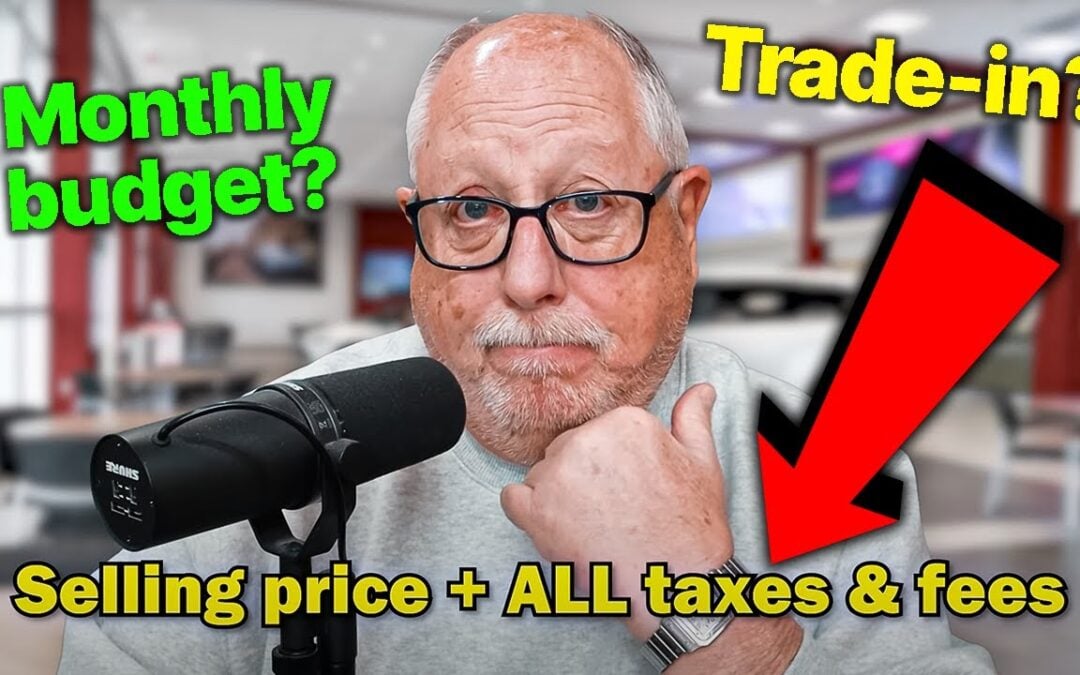
Walk into a dealership and tell a salesperson you need to keep your payment under $500 a month. Watch what happens next.
They’ll smile, nod, and say something like “let’s see what we can do.” Then they’ll disappear into the manager’s office, and just like that, your negotiating leverage just vanished.
I spent four decades on the dealer side of the table. I’ve watched this play out thousands of times. The buyer thinks they’ve communicated a firm boundary. What they’ve actually done is handed the dealer a roadmap.
A monthly payment is not a price. It’s a math problem with four variables: the price of the car, your trade-in value, your down payment, and your loan term. Change any one of those and you can hit almost any monthly number a buyer asks for.
That’s the point.
When you anchor to a monthly payment, the out-the-door price of the car stops being the focus of the negotiation. The dealer shifts into what the industry calls “selling in the box” — managing those four variables to protect their profit while giving you the number you asked for.
Here’s a simple example.
Say you’re looking at a car that should sell for $35,000. You say you need to stay at $550 a month. A dealer can hit $550 a month at a fair price on a 60-month loan, or they can hit $550 a month on an overpriced car by stretching the loan to 72 or 84 months, burying your trade-in value, or bumping your interest rate a point or two. You got your number. They kept their margin. You won’t realize what happened until it’s too late.
None of this is illegal. It’s just leverage, and payment-focused buyers give it away for free.
If you’ve ever sat at a desk and had a salesperson slide over a worksheet divided into four boxes — purchase price, trade-in value, down payment, and monthly payment — you’ve seen the four-square.
The four-square is not a transparency tool. It’s a negotiation tool. It’s designed to keep your eyes moving between boxes so that while you’re focused on getting the monthly payment down, the trade-in value quietly drops, or the purchase price quietly rises, or the down payment grows.
Most buyers only watch one box. Dealers watch all four.
A classic move: the salesperson offers to drop your monthly payment by $40. Feels like a win. But they got there by extending your loan term by 12 months. You’re now paying an extra year of interest on a depreciating asset. The monthly payment went down. The total cost of the car went up.
If you don’t know what’s happening in the other three boxes, you can’t know whether you’re getting a good deal or not. That’s the whole idea.
The out-the-door price is the only number that matters when you sit down to negotiate. Everything else — monthly payment, loan term, interest rate — flows from that number. Get it right, and the rest of the deal has a foundation. Ignore it, and you’re building on sand.
Here’s how to approach it:
Only after you’ve agreed on an OTD price should you discuss monthly payment, and at that point, it’s just arithmetic.

This isn’t a complete case against thinking about your monthly budget. Knowing what you can realistically afford each month is responsible. The mistake isn’t having a number in mind, it’s leading with it, or letting it substitute for OTD-price thinking.
If you’re leasing, the monthly payment is more central to the structure of the deal. But even then, the capitalized cost (the effective purchase price in a lease), the money factor, and the residual value all drive that payment. A lease payment can be manipulated just as easily as a purchase payment if you’re not watching the underlying numbers.
Know your budget ceiling. Just don’t tell the dealer what it is.
What is the four-square method? The four-square is a worksheet dealers use to manage four deal variables simultaneously: the vehicle price, trade-in value, down payment, and monthly payment. By keeping all four in play at once, dealers can shift numbers between boxes to protect their margin while appearing to negotiate.
What’s the difference between monthly payment and out-the-door price? The out-the-door price is the total amount you’re paying for the vehicle, including all taxes, fees, and dealer charges — before financing. The monthly payment is what you pay after the loan is structured. Two buyers can have the same monthly payment and wildly different OTD prices depending on their loan terms and rates.
Is it better to just pay cash for a car? It depends, and the answer might surprise you. Paying cash removes the financing variable entirely, which in many ways is an advantage — no interest, no loan term manipulation. But dealers actually make money on financing through rate markup, so a cash buyer sometimes gets less flexibility on the vehicle price itself. The better move is often to secure a pre-approval, negotiate the OTD price as if you’re financing, and then decide at signing whether to use the loan or pay cash. That way you get the best of both.Should I tell the dealer my budget? You can acknowledge that you have a budget without disclosing a specific monthly number. If pressed, redirect: “I’m focused on making sure the price of the car is fair. Once we agree on that, we can figure out the financing.”

Most people walk into a dealership assuming the dealer is trying to squeeze every dollar out of the deal. That’s fair. But here’s something most buyers never consider: sometimes a dealer is actively trying to lose money on your car (on purpose).
It sounds backwards. But once you understand why it happens, you’ll never negotiate the same way again. I spent 43 years as a car dealer, spending time in just about every major role throughout several dealerships. I want to share some insider tips that can help the average car buyer gain the upper hand when it comes to negotiating a car deal.
Let’s dive in.
Before we get into the volume game, it helps to understand how thin new car margins actually are.
On an economy car — your Kias, Hyundais, Nissans — a dealer might have 2 to 3% markup built into the sticker price. On a $22,000 car, that’s $440 to $660 in front-end profit before negotiations even start. Negotiate at all, and that number shrinks fast.
Luxury and truck margins are better, but even there, the car sale itself isn’t where dealerships make most of their money. The real profit centers are the Finance and Insurance office, the service department, and parts. Selling you a car is how they get you in the door for everything else.
Which means that from the dealer’s perspective, making a little less on the sale of the car isn’t necessarily a bad outcome. It depends on what else they stand to gain.
Here’s where it gets interesting.
Manufacturers set monthly, quarterly, and annual sales targets for every dealer in their network. Hit the target, and the manufacturer pays out a bonus — sometimes worth hundreds of thousands of dollars for a single month. Exceed the target, and the bonus gets even bigger.
The structure is typically tiered. To use a simplified example: sell 95 to 105% of your monthly goal and the factory pays $1,000 per car sold. Push it to 105 to 115% and that jumps to $1,250 per car. The incentive compounds the more you sell.
Now here’s the math that changes everything. If a dealer has sold 94 cars with two days left in the month, and their goal is 100, they need six more deals to hit the first bonus tier. At $1,000 per car across all 100 units sold, that’s a $100,000 payout. Suddenly, selling a car at a $500 loss isn’t losing money — it’s a $99,500 return on a $500 investment.
That’s why dealers take losing deals at the end of the month. The math works in their favor.
This dynamic creates real, predictable windows when dealers are motivated to deal in ways they simply aren’t at other times of the month.
The last week of the month is when pressure builds. The last Tuesday, Wednesday, or Thursday before month-end is the sweet spot — dealers are pushing hard, managers are flexible, and the urgency is real on both sides of the table.
The end of the quarter is even better. Quarterly targets stack on top of monthly ones, so the final days of March, June, September, and December carry double pressure. A dealer who’s behind on both a monthly and a quarterly goal has a lot of reasons to sharpen their pencil on your deal.
Model year changeovers are another opening. When new model year inventory starts arriving, typically late summer into fall, dealers need to move the outgoing models fast. A motivated dealer on aged inventory is a dealer you want to be talking to.
The same logic applies to slow-selling models in general. A vehicle that’s been sitting for 90 days is a liability. One that moves in a week is not. CarEdge tracks Market Days Supply for every vehicle — it’s one of the most useful numbers you can check before you negotiate, because it tells you exactly how much leverage you’re walking in with.
Knowing this is only useful if you act on it. Here’s how to put it to work.
Time your visit. End of month and end of quarter aren’t secrets, but most buyers still show up whenever it’s convenient. Being intentional about timing is one of the easiest advantages you can give yourself.
Know the invoice price before you go. MSRP is the dealer’s starting point, not yours. The invoice price — what the dealer paid the manufacturer for the car — is your baseline. CarEdge provides free invoice pricing data so you can walk in knowing the actual number, not a guess.
Check Market Days Supply. A car with 90+ days supply is sitting. A car with 20 days supply is moving. The more supply, the more room to negotiate. Find this on CarEdge Car Search before you set foot in a showroom.
Don’t be afraid to go below invoice. It happens more than most buyers realize. When a dealer needs a deal to hit a bonus tier, below invoice isn’t just possible — it’s logical for them.
Get competing offers. Contact multiple dealers on the same car. One of them may need your deal more than the others on a given day.
A few things worth being clear about.
Dealers aren’t desperate every day. If you show up the first week of the month, when quotas have just reset and the pressure is gone, you’re negotiating against a dealer who has no reason to give anything away. Timing matters.
Even when a dealer takes a thin deal on the car, they’ll look to make it up somewhere else — the financing, the trade-in, the add-ons in the F&I office. A good deal on the vehicle doesn’t automatically mean a good deal overall. Hold firm on extended warranties and other F&I products, and make sure your trade-in value is based on market data, not whatever number they write down.
If you’d rather not manage all of this yourself, CarEdge Concierge handles it all, from finding the car you want to negotiating the out-the-door price.
A buyer who walks in during the last week of the month, knows the invoice price, and understands the local market is in a stronger position than almost anyone else in that showroom. The manufacturer built this system to move cars. It can move money into your pocket too, if you know how it works.
Sometimes, the dealer needs your deal more than you need their car.
Walk into a dealership on a Saturday afternoon and you’ll immediately feel the energy. Salespeople are moving, managers are busy, and the finance office has a line. Now picture walking in on a Tuesday morning at 10 AM: quiet showroom, attentive staff, and a manager who picks up the phone on the first ring.
Both scenarios can work in your favor. They just require different strategies.
The truth is, timing matters enormously when buying a car. However, it’s not the one-size-fits-all advice you’re likely to see online. I was a car dealer for four decades before starting CarEdge with my son Zach. What I learned over the years can help you get a fair deal with the least stress.
Whether you’re shopping on a weekend or a weekday, knowing what’s happening on the dealer’s side of the table gives you leverage.
Weekends account for roughly 60-70% of dealership foot traffic. That creates real challenges for buyers: salespeople juggling multiple customers, managers buried in their offices, and F&I departments with hour-plus waits.
But here’s what most car buying guides won’t tell you.
It’s true that stores are busiest during the weekends, but deals can be had because the weekends are when stores are looking for sales volume. There are usually lots of appointments scheduled plus a lot of walk-in traffic. I would suggest that there is a greater emphasis placed on making deals especially on Saturday.
In other words, the same energy that makes weekends chaotic also makes dealers hungry. The floor is busy because they want it to be. And a prepared buyer can absolutely take advantage of that.
Go Early Saturday Morning
If you’re shopping on a weekend, get to the dealership by 9 AM. You’ll catch staff before the chaos builds, and you’ll be first in the finance queue. More importantly, you’ll have a salesperson’s full attention before they’re pulled in five directions.
Come Prepared — It’s Non-Negotiable
Weekend buyers who overpay are usually unprepared buyers. When the showroom is packed, pressure tactics thrive. Salespeople will suggest other customers are eyeing the same car. Managers will push for quick decisions. The antidote is doing your homework before you arrive.
Know the fair market value of the vehicle using tools like CarEdge’s Deal Finder. Have a pre-approval from your bank or credit union. Know your trade-in value. When you walk in with all of that, that pressure stops working.
Use the Dealer’s Motivation Against Them
Salespeople earn bonuses for closing deals on Saturdays — which means they have a personal financial reason to work with you. If you’re close on numbers, lean into that. A salesperson who earns an extra $200 for closing a deal today has more incentive to go back to the manager and push for a better number.
Don’t Let the Finance Office Drain You
The biggest weekend mistake isn’t the negotiation — it’s arriving at the F&I office mentally exhausted after a two-hour wait and saying yes to products you don’t need. If you’re going to shop on a weekend, plan for the wait. Eat beforehand. Know in advance what add-ons you’ll decline. Extended warranties, paint protection, and GAP insurance are all negotiable; GAP in particular can often be cut from $895 to under $400 if you push back.
None of this means weekdays have lost their advantage. If you have flexibility, Tuesday through Thursday mornings remain the lowest-pressure environment for buying a car. Manager wait times shrink, salespeople focus entirely on your deal, and there’s no manufactured scarcity in the room.
The best time of all? A Tuesday or Wednesday morning in the final week of the month — or better yet, the final week of a quarter (late March, late June, late September, late December). Monthly and quarterly quotas stack on top of each other, and dealers are sharpening pencils to hit numbers before the deadline.

Rainy days cut foot traffic 30-40%, even on weekends. Quotas don’t change with the weather. A rainy Saturday can give you the deal volume of a weekend with the calm of a weekday.
Holiday sale weekends (Memorial Day, Labor Day) are marketing events first, deals second. The pricing is often available any other time. The Tuesday after a holiday weekend can be a hidden gem — the promotions sometimes linger, but the crowds are gone.
Model year changeovers (August-October) are when dealers most need to clear outgoing inventory. Stack that timing with end-of-quarter pressure and you’ve got real leverage going in.
Is it better to buy a car on a weekend or a weekday? It depends on your situation. Weekdays offer a calmer environment and more manager availability. Weekends bring more pressure but also higher dealer motivation to close — especially on Saturdays when sales spiffs are common. A prepared buyer can do well on either day.
What is the best day of the week to buy a car? Tuesday through Thursday mornings offer the lowest pressure and most attentive service. But Saturday mornings before 10 AM can also be effective if you arrive prepared and understand how to use the dealer’s closing motivation to your advantage.
Is it better to buy a car at the end of the month? Yes. The last week of the month — particularly the final Tuesday, Wednesday, or Thursday — is when dealers are pushing hardest to hit quotas. End-of-quarter deadlines (March, June, September, December) add even more pressure in your favor.What should I bring to a dealership? At minimum: a pre-approval from your bank or credit union, documentation of your trade-in value, and research on fair market pricing for the vehicle you want. Tools like CarEdge’s Deal Finder can help you walk in knowing exactly what the car should cost.