
CarEdge saved me over 4,500 dollars on a brand new Honda Pilot. I can't say thank you enough.
Price intelligence
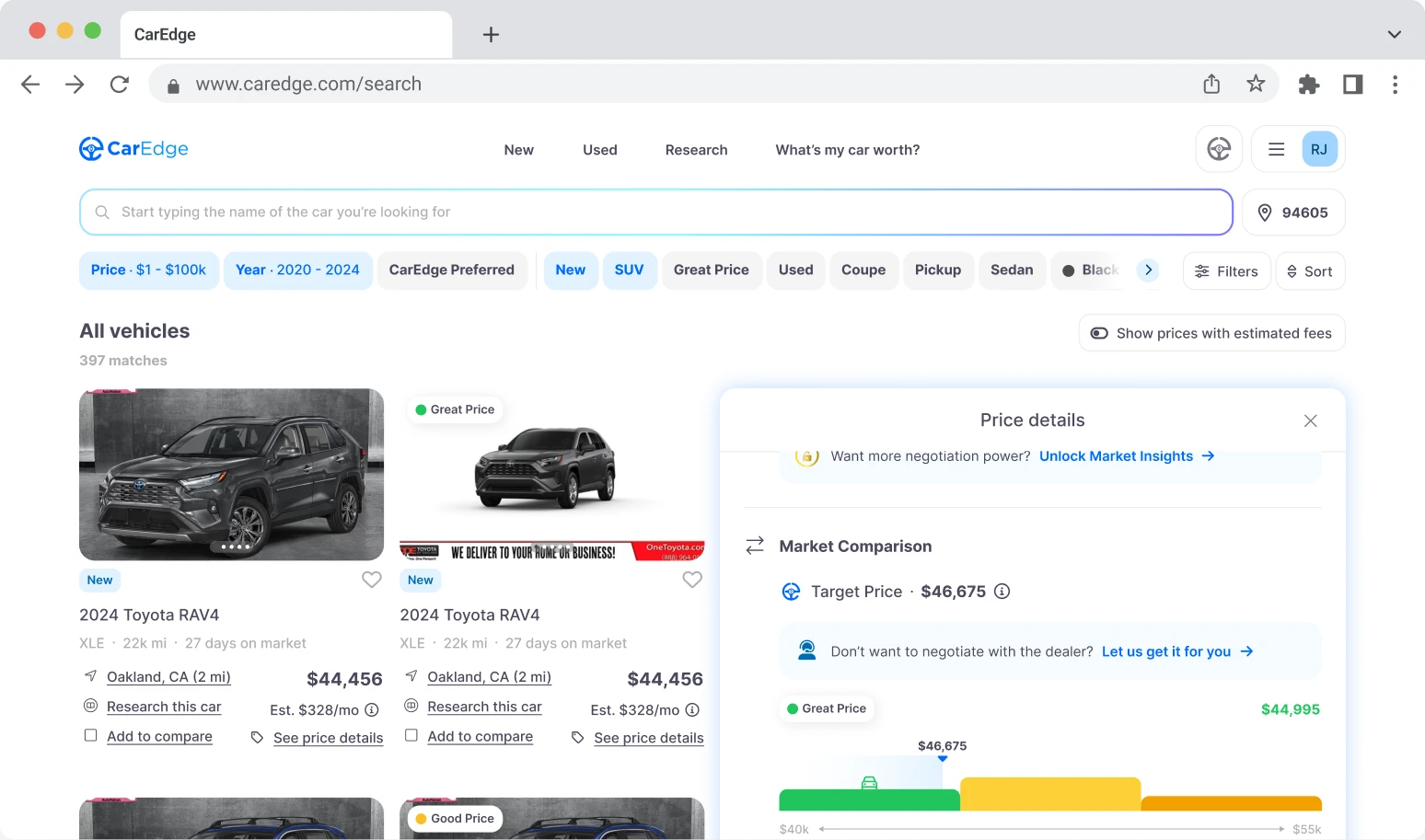
Find a wide range of vehicle listings with market insights on new and used listings near you.

What can I do with CarEdge?
 CarEdge Insights
What can I do with CarEdge?
Get access to exclusive information so you can make an informed car buying decision — all in one place.

Find a wide range of vehicle listings with market insights on new and used listings near you.
Track your vehicle’s value and cash in when the time is right to sell.

Access to our proprietary data to help you find the right car, at the right price. Find these unlocked on every listing after subscribing.

With our expert-led, tech-enabled car buying service, we will locate, negotiate, and deliver your vehicle so you can get a new car hassle free.


Help us personalize your CarEdge experience — it only takes a second.
Your answers help us personalize your CarEdge journey — we’ll follow up with tips and next steps that match your buying timeline.

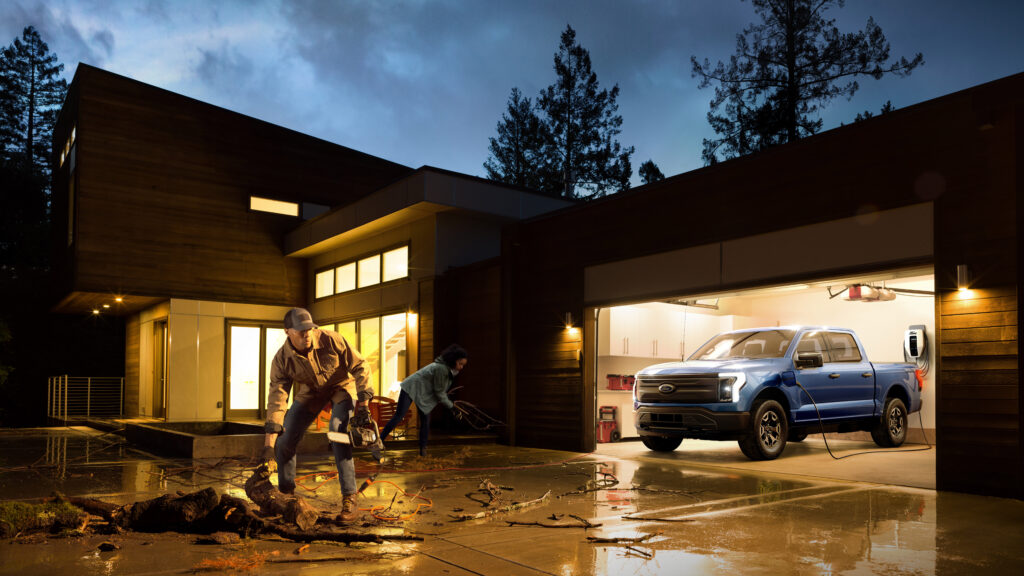
Imagine using your vehicle as a backup generator for your home, or even to help a stranded motorist reach their destination. Electric vehicles claim just 5% of new vehicle market share in America, however record gas prices are spurring renewed interest in the EV lifestyle. One of the most sought-after features of electric vehicles is bidirectional charging. Also known as vehicle-to-load, or V2L, tomorrow’s cars literally have the power to do so much more than drive us around. Here’s everything you need to know about bidirectional charging in electric vehicles.
During typical use, electric cars draw electricity from the grid, and then consume that energy to power their electric motors. What if you could reverse the flow of electricity back into the grid? Better yet, imagine making money doing it. The future of mobility is about to get weird. Cars are already becoming rolling computers, so it only makes sense that they are capable of revolutionizing the world beyond the driver’s seat.
Simply put, bidirectional charging is the ability for electrical current to flow in both directions: from the grid to the vehicle (to charge the battery pack), and also from the car to the grid, another car, or household appliances.
When an electric vehicle is charged, alternating current (AC) from the grid is converted to direct current (DC) using the car’s built-in converter. To send electricity out of the battery pack and back into the grid or into another electronic device, electricity must first convert back to AC. This is done using an inverter. Vehicles that are manufactured with an inverter are already equipped with the hardware needed for bidirectional charging.
The numbers are in: see average EV prices and the latest EV market share update.
Vehicle to grid (V2G) capability enables an electric car to return electricity to the grid. V2G can help supply energy at times of peak grid demand. In most of the world, electricity demand peaks during the afternoon and early evening. Peak demand causes demand charges, which are higher rates for usage.
Vehicle to grid capability offers a way around demand charges, to the benefit of consumers and grid operators alike. The vehicle’s owner avoids demand charges or even sells electricity to the grid, and the grid gains a new source of electricity when it’s needed the most.
Although V2G is still in its infancy, the technology opens up the possibility of future revenue streams for everyday EV drivers and even automakers. Imagine if your car could make you money while it’s parked in the garage. Rental and ride-hailing fleets could double the revenue from their autonomous vehicles by serving as power suppliers to the grid. It’s a game changing option that is coming to cars in the near future.
V2L allows an electric vehicle’s battery pack to power appliances such as power tools, a coffee machine, cooking equipment, laptops, or even a party. More importantly, vehicle-to-load capability serves as the ideal emergency power source during times of need, such as following a natural disaster or power outage. Some cars, such as the 2022 Hyundai IONIQ 5, can output 3.6 kilowatts via V2L functionality. That is a LOT of power, surely enough to power an entire campsite or family-sized outdoor event.
Naturally, one of the first uses of bidirectional charging that comes to mind is powering one’s home during a power outage. Indeed, vehicle-to-home (V2H) power supply is under development, and it’s even featured in a few of today’s production EVs. It’s important to note that accessories and professional installation of associated hardware are required before any EV can power an entire home. Still, it looks like V2H capability is a real option for EV shoppers to consider in 2022. More on today’s V2H EVs below.
The short answer is that it depends on the battery chemistry. One of the latest battery chemistry types to be employed in EVs is lithium-iron-phosphate batteries, or LFP. LFP batteries quickly rose to prominence due to their remarkable ability to withstand the stresses of repeated charging cycles without severe battery degradation.
Other battery chemistries lose range over time as the battery is charged and discharged (referred to as a charging cycle). Even charging to 100% too often can reduce the life of some battery types. LFP batteries are the perfect companion for bidirectional charging, especially vehicle-to-grid. They handle frequent charging and discharging like a champ.
Other battery types in development are engineered with bidirectional charging capability in mind. Ford’s partnership with SK Innovation resulted in a more environmentally-friendly battery chemistry suitable for the frequent charge cycles of bidirectional charging.
Our EV extended warranty provides peace of mind. Batteries and other electrical components are covered! Get a quote for your EV today.
| Max Power Output | Date Available | V2L Capable? | V2H Capable? | V2G Capable in 2022? | |
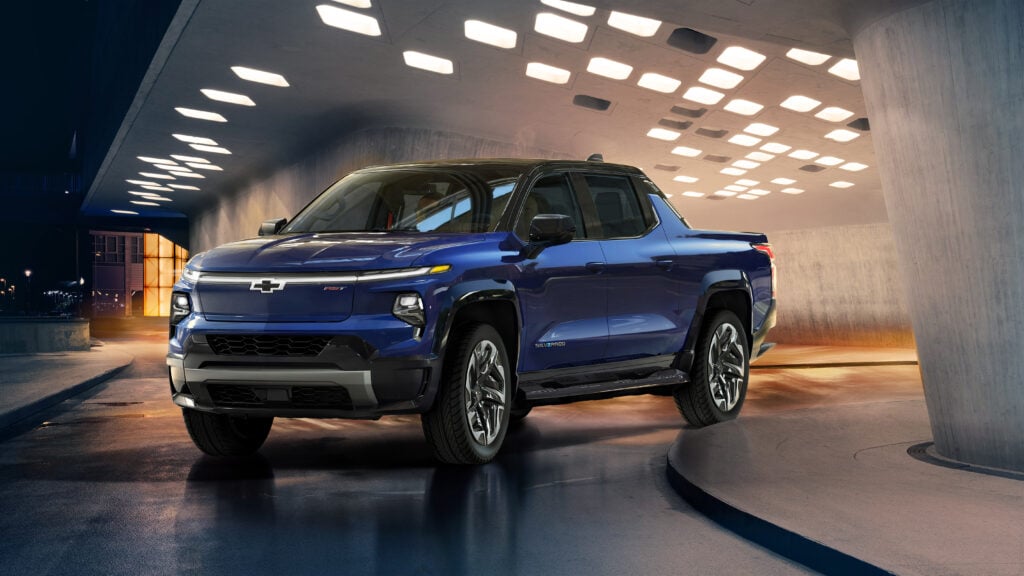
| Chevrolet Silverado EV | 10.2 kW | 2023 | Yes | Yes | No |
| Ford F-150 Lightning | 9.6 kW | Mid 2022 | Yes | Yes | No |
| Hyundai IONIQ 5 | 3.6 kW | Now | Yes | No | No |
| Genesis GV60 | 3.6 kW | Spring 2022 | Yes | No | No |
| Genesis G80 | 3.6 kW | 2022 | Yes | No | No |
| Kia EV6 | 1.9 kW | Now | Yes | No | No |
| Toyota bZ4X | TBD | Mid 2022 | Yes | No | No |
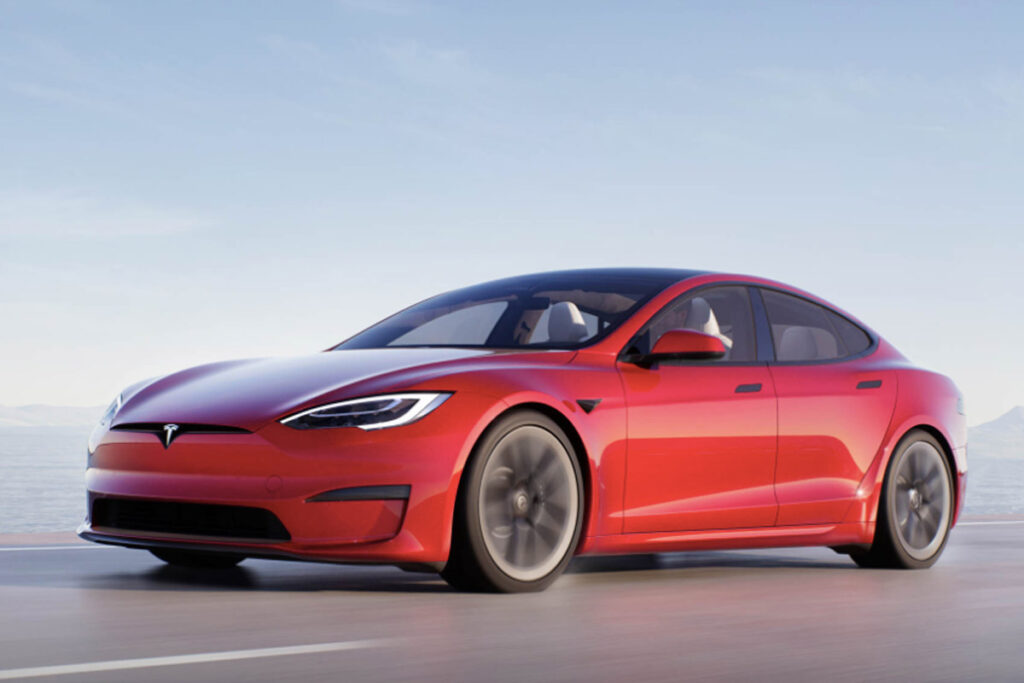
For the time being, no Tesla models are capable of bidirectional charging. It’s possible (even likely) that all 2022 Tesla models have the necessary hardware for V2G or V2L, or V2H. However, Tesla has alternative motives for delaying bidirectional charging rollout for as long as possible. If Tesla vehicles became V2H-capable, they would render the $10,500 Tesla Powerwall home battery obsolete!
A few curious Tesla owners have inquired about modifying their cars to become capable of bidirectional charging. The response from Tesla was a warning that doing so would void the vehicle’s battery warranty. So for now, don’t expect Tesla EVs to power your home or appliances.
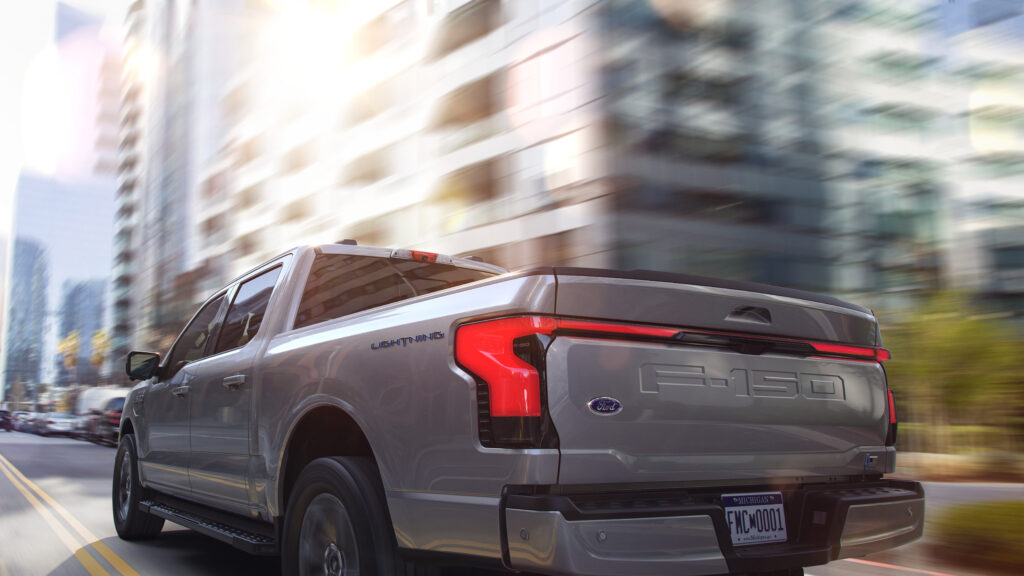
Ford’s F-150 Lightning is widely marketed as the answer to power grid anxieties. Ford Intelligent Backup Power is an available accessory to the popular F-150 Lightning electric truck. With 200,000 reservations in the books, the Lightning is already sold out through 2023.
The F-150 Lightning contains unique battery chemistry that strengthens charging cycle durability while also requiring fewer rare earth metals. Ford’s partner, SK Innovation, has developed a new battery cathode that uses 90% nickel, and 5% each of manganese and cobalt. The new battery chemistry also reduces the harmful environmental and ethical impacts of cobalt mining.
Ford’s engineers designed the new electric F-150 with V2H in mind. In the electric truck segment that’s rapidly gaining steam, automakers are looking for bold ways to make their truck a compelling buy.
“F-150 Lightning with available Ford Intelligent Backup Power can provide power and security during an electrical outage – the first electric truck in the U.S. to offer this capability; in the future, new features will offer additional ways to manage energy use and potentially save on energy costs.”
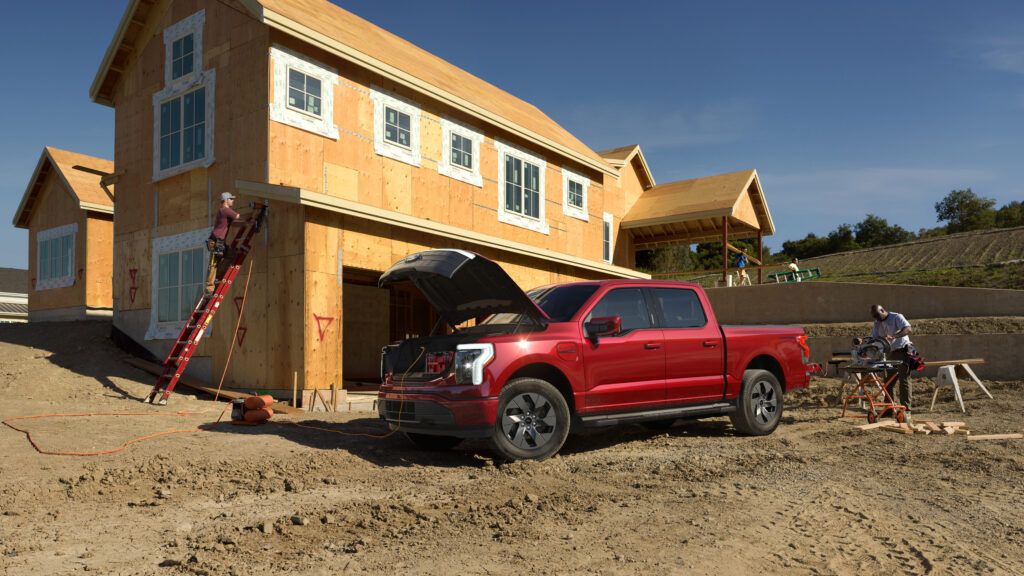
“The F-150 Lightning extended-range battery system can store 131 kilowatt-hours of energy and deliver up to 9.6 kilowatts of power in a cleaner, quieter, more efficient way versus gasoline-powered generators, and with greater capacity than many wall battery units. F-150 Lightning can also offer lower-cost energy storage in a product customers already own – their truck.”
How long should an electric truck be able to power an entire home? 12 hours? Three days? Ford says that depending on power demand, some homes could be powered for seven days with the F-150 Lightning’s extended range battery.
“With Ford Intelligent Backup Power and the Home Integration System, F-150 Lightning automatically kicks in to power your home if the grid goes down. Once power is restored, the system automatically reverts back to utility power. Based on an average U.S. home at 30 kilowatt-hours of use per day, F-150 Lightning with extended-range battery provides full home power for up to three days, or as long as 10 days when used in conjunction with solar power or rationing.”
Learn more about Ford Intelligent Backup Power in Ford’s official announcement.
The average
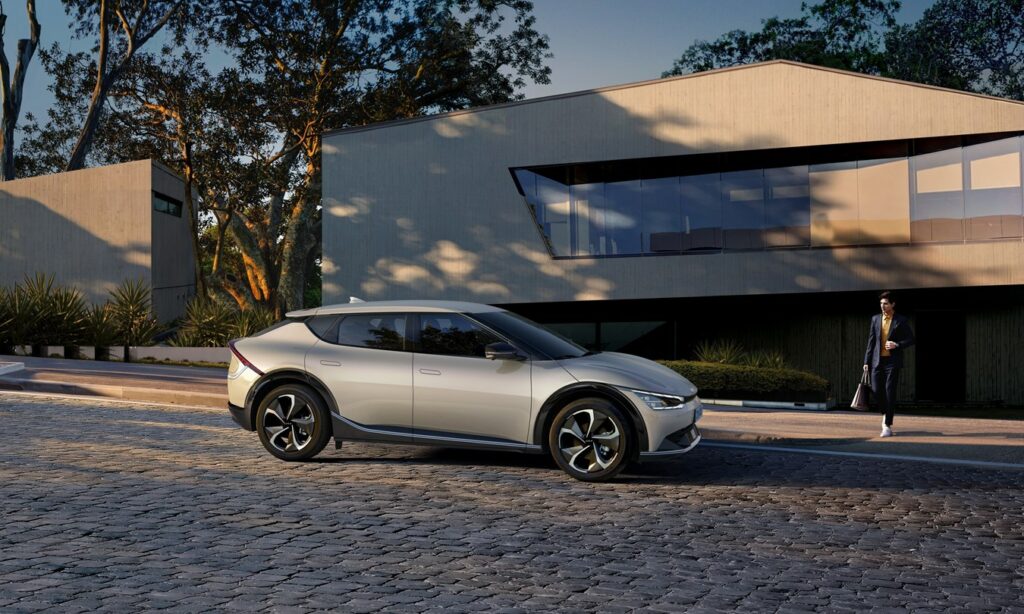
Bidirectional charging is yet another way that the electrification of the auto industry is transforming vehicle ownership. In five years (or less), trucks will be judged for how many days they can power your home, and crossovers will be expected to power household appliances with ease.
The fact that vehicle-to-home capability relies on the professional installation of accessories sold separately seems to fly under the radar for many. While vehicle-to-load may become a standard feature that we all take for granted in a decade’s time, retrofitting a home for V2H power will remain a lofty expense for the foreseeable future.
What do you think about bidirectional charging? Do you plan to power your home with your car in the future? Let us know what you think about automaker’s bold plans for EVs in the comments below, or share your thoughts with the CarEdge Community at caredge.kinsta.cloud.

Finally, the world knows why Ford has yet to name an electric vehicle the ‘Model e.’ On March 2, Ford announced the formation of a distinct unit for electric vehicle operations. The decision paves the way for the automaker to accelerate EV development while opening new avenues for direct-to-consumer sales. Ford says they are driven by the need to compete and win against both new EV competitors and established automakers.
3/3/22 Update: Ford CEO and President Jim Farley explained the move and how it affects dealers.
“This is only about creating incredible products that improve over time. To create a better customer experience than yesterday. And ultimately, to win as a company. The reality is, our legacy organization has been holding us back. We had to change.”
Ford wants a certain number of dealers to opt in to a new Model e sales model. Model e dealers would not hold inventory. Instead, they will facilitate the delivery of online orders, much as Tesla does for their customers. Electric vehicles will be sold at non-negotiable prices. That’s just one step away from direct-to-consumer sales.
“Our message to dealers is, we’re betting on you. Get ready to specialize,” Farley said.
Ford’s announcement outlines the establishment of two new operational divisions that will remain under the corporate umbrella of Ford Motor Company. Ford Model e will take on the future of electric vehicle development and sales. Ford Blue will become Ford’s combustion-powered division, encompassing everything from the F-150 to the Bronco.
The two new divisions within Ford will continue to collaborate and propel the greater Ford enterprise forward, according to the press release detailing the plans. Ford Model e and Ford Blue will join Ford Pro as the corporation continues to branch out its business model. In 2021, Ford Pro was launched as a one-stop shop for commercial and government customers.
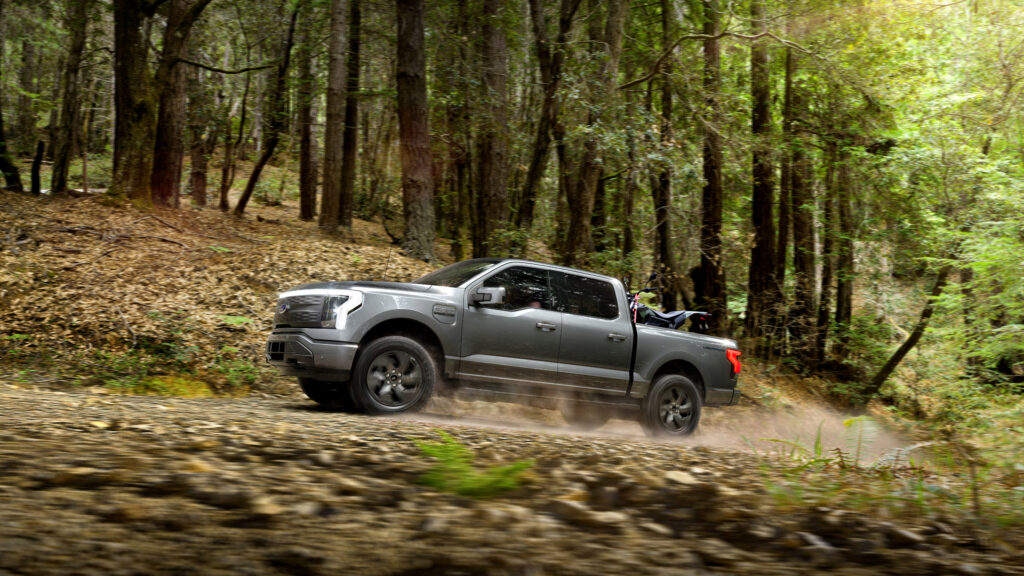
The creation of Ford Model e was driven by the success of the popular Ford Mustang Mach-e and the overflowing support for the upcoming F-150 Lightning. Interestingly, Ford cited the success of their dedicated EV division in China as another source of inspiration for the launch of Ford Model e.
Ford President and CEO Jim Farley will take on yet another role as President of Model e. Farley has long been an outspoken proponent of Ford’s ambitious electrification plans.
“Ford Model e will be Ford’s center of innovation and growth, a team of the world’s best software, electrical and automotive talent turned loose to create truly incredible electric vehicles and digital experiences for new generations of Ford customers,” Farley said.
Ford hopes that Model e will attract and retain the best engineers and software developers to Ford. As autonomous driving and wireless over-the-air updates become the norm, Ford wants to be a leader in the reimagined automotive industry that’s currently in the making. A lot more computers, and a lot less oil. They’re pushing full steam ahead with ground-up development of electric vehicles. EV platform design, battery research and development, electric motors and inverters and charging infrastructure will all fall under the umbrella of Ford Model e. There are also plans to advance recycling infrastructure in both cost-cutting and environmentally responsible ways.
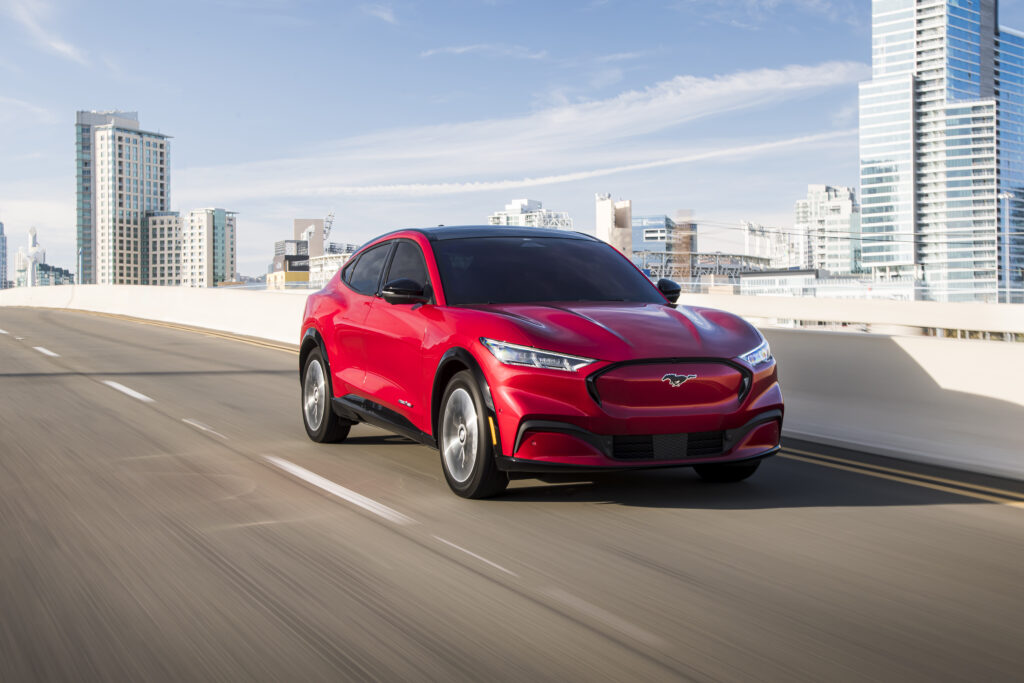
Ford not-so-subtly shared one of their larger ambitions for their new electric vehicle division: foregoing the dealership model. We’ve seen Ford’s corporate leadership speak out against outrageous dealer markups as the F-150 Lightning nears delivery. Ford’s announcement highlights the changes to their EV sales model:
“Ford Model e also will lead on creating an exciting new shopping, buying and ownership experience for its future electric vehicle customers that includes simple, intuitive e-commerce platforms, transparent pricing and personalized customer support from Ford ambassadors.”
Yeah, transparent pricing would be welcome. It’s great and almost shocking to see a legacy automaker making such a large pivot away from the status quo. Could the direct-to-consumer model win over new customers to the Ford brand?

CEO Jim Farley calls the Ford+ plan the company’s biggest opportunity for growth and value creation since Henry Ford scaled production of the Model T. Ford Blue will work to optimize Ford’s combustion-powered models and profitability through strengthened consumer relationships, quality improvements and greater operational efficiency.
“Ford Blue’s mission is to deliver a more profitable and vibrant ICE business, strengthen our successful and iconic vehicle families and earn greater loyalty by delivering incredible service and experiences. It’s about harnessing a century of hardware mastery to help build the future. This team will be hellbent on delivering leading quality, attacking waste in every corner of the business, maximizing cash flow and optimizing our industrial footprint.”
Ford CEO Jim Farley has long said that Tesla needs to be taken seriously. Tesla, Rivian, Lucid and newcomer Fisker are all having success with direct-to-consumer sales. However, these automakers and any others who go this route face a maze of state laws that present roadblocks for direct-to-consumer sales. The dealership lobby is strong in much of the United States. So much so that a recent West Virginia bill was introduced that would ban most over-the-air updates in the state, all so that dealerships can continue to rake in service center revenue.
Other automakers are in the weeds with the dealership model, too. Kia’s much-lauded EV6 electric crossover is facing opposition from Kia dealerships. They’re simply not adapting to the coming rush of electric vehicles. Jalopnik reported that EV6 buyers are reaching out to them with stories of dealers who are making buying an EV6 a lot harder than it should be.
Nationwide, 17 states currently have a ban on direct-to-consumer sales. Eleven more states have carved out specific exceptions for Tesla (and in some cases, other automakers that sell only EVs). That’s why Tesla technically can’t sell directly to consumers in states like Texas and Washington. It’s an antiquated system in need of change.
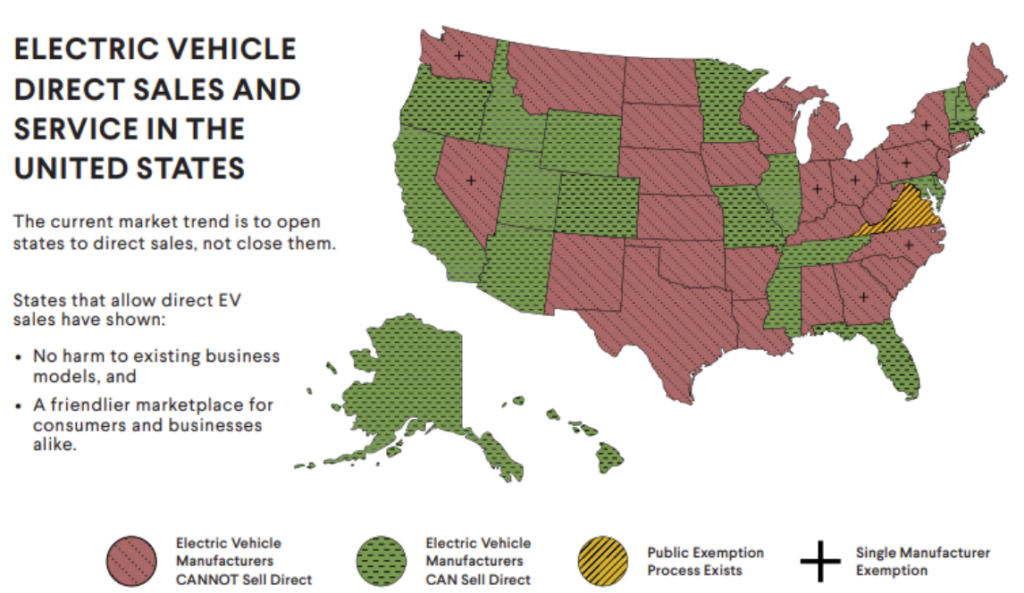
Ford recognizes the tides of change approaching automotive sales. Automotive News reported that efforts to permit direct-to-consumer sales have been introduced in 10 states. Several of the bills already failed. More are surely to come as electric vehicle market share surpasses 5% of new auto sales in America.
This is long overdue. Consumers are fed up with dealer markups, deceptive sales tactics and stressful experiences at the dealership. But this isn’t the end for dealerships. There will be a need for dealers for decades to come, even if sales shift away from their franchises.
Electric vehicles are coming, like it or not. Ford is aiming for annual production of more than 2 million EVs by 2026. They expect EVs to represent half of global volume by 2030. Automakers say that half a trillion dollars will go to electric vehicle development this decade. However, EVs currently can’t be serviced at the neighborhood repair shop, or in one’s home garage. Certified technicians certified in electric vehicle repair are quickly going to be in high demand at service centers everywhere. Dealership service centers aren’t going away. In fact, dealership service centers will likely see business grow as more consumers opt for electric vehicles.
Ford’s new Model e and Ford Blue divisions present a massive opportunity for new revenue streams and efficiency within Ford’s R&D and sales operations. Will other legacy automakers follow suit? Truthfully, they are very likely making plans as we speak. CarEdge will keep you up to date with consumer-focused automotive news. More change is surely to come.
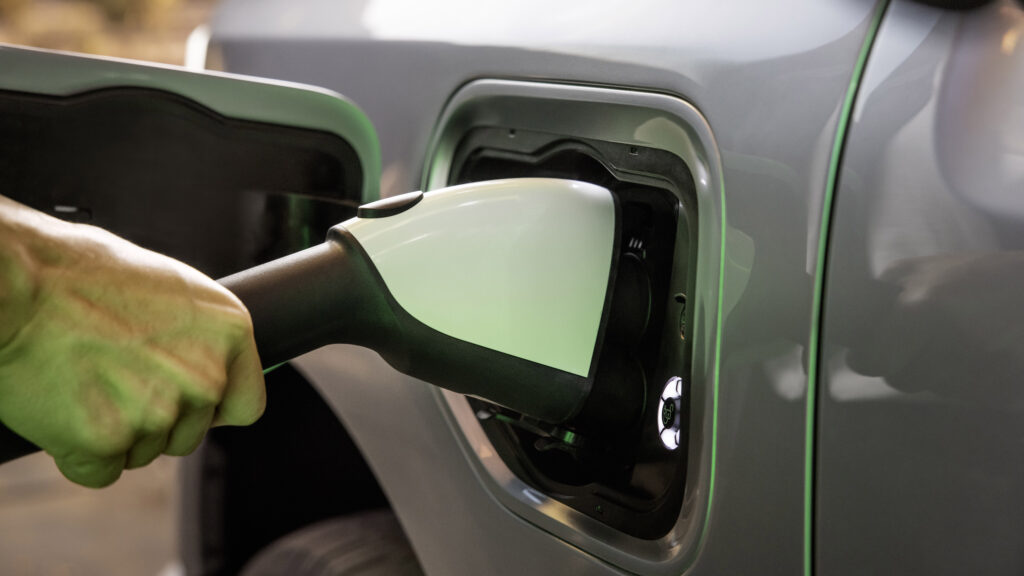
Electric vehicles now make up 9% of the global market, and 4.5% of American auto sales. Estimates vary, but many analysts expect electric vehicle sales to reach 40% market share in 2030. Will their crystal ball prove correct? It’s now looking possible. New data from the International Energy Agency beat previous forecasts by 26%. In 2020, Loren McDonald of EVAdoption predicted that electric vehicle sales would make up 3.55% of the US market in 2021. With the official tally now coming in a full percentage point higher, the electric momentum is accelerating. When the chip shortage finally ends, the production of EVs will likely be prioritized by automakers. Considering the massive half-trillion dollar investments OEMs have committed to electrifying their lineups, I’m sure they’re happy to see that there’s a growing market for their future products.
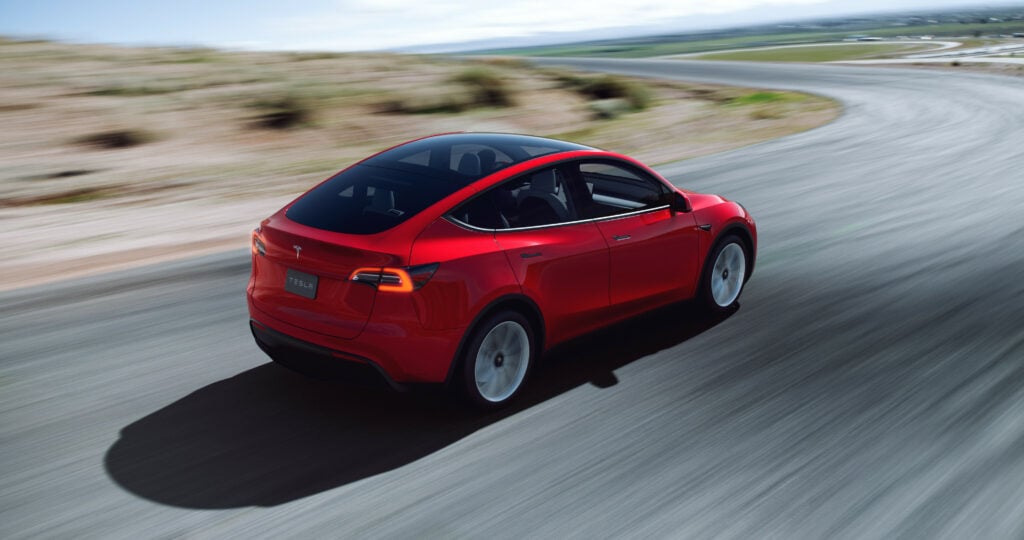
Tesla’s pioneering Supercharger network of DC fast chargers remains the industry standard for electric vehicle charging. With 3,476 locations, hassle-free plug-and-charge and consistent reliability, only Electrify America has come remotely close to what Tesla offers. For the past decade, Superchargers have been known for convenience and accessibility, but a few pending developments could change that. Here’s what we’re watching:
Tesla continues to dominate electric vehicle sales in America and abroad. In 2021, Tesla year-over-year sales grew 87% to 936,172 vehicles globally. In the United States, Cox Automotive estimates that Tesla delivered 352,472 vehicles to customers. Tesla’s 2021 sales were enough to (probably) unseat BMW as luxury sales leader in the US.
In 2021, Tesla installed 8,221 new Superchargers at 912 stations around the world. This represents 35% growth in just one year, a huge accomplishment for the EV leader. However, will it be enough? Sales have been outpacing Supercharger growth for years now. The vast majority of charging stations never see a crowd, but that could change soon as Tesla’s zero-hassle sales model and superior technology have drawn more buyers to the brand.
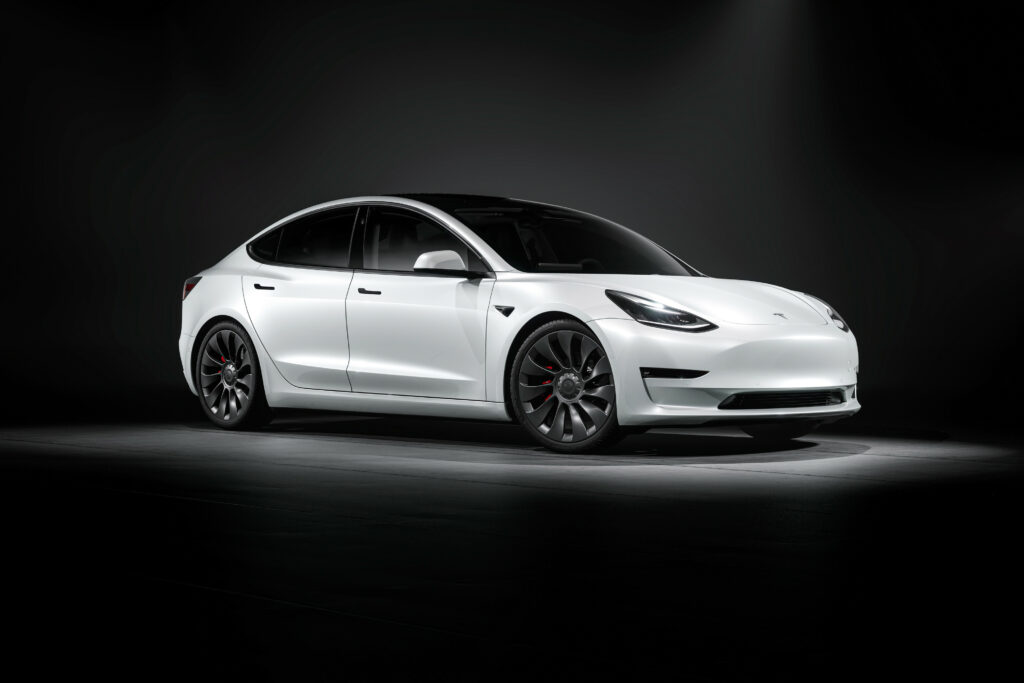
Tesla CEO Elon Musk confused Tesla owners and thrilled non-Tesla owners when he shared the company’s intentions to open up some Superchargers to non-Tesla cars. In early 2022, several Supercharger locations in France, Norway and the Netherlands are open to all. If open access spreads to North America, Superchargers will see a flood of traffic as Ford Mustang Mach-E’s, Volkswagen ID.4’s, Hyundai IONIQ 5’s and dozens of other models gain access to America’s largest fast charging network.
Something positive came out of Volkswagen’s dieselgate debacle. As part of a 2016 settlement with the United States Environmental protection Agency and the California Air Resources Board, VW was ordered to spend $2 billion on something that would clean up the air. The result was the birth of Electrify America.
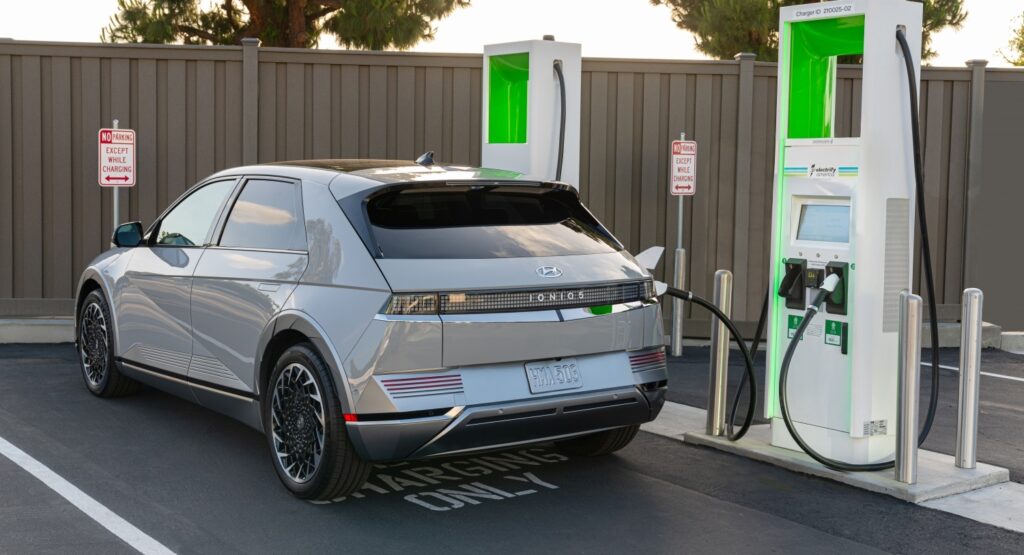
After installing their first chargers in 2018, Electrify America now has 3,500 charging stations at 800 locations around the US. The big difference between Electrify America and Tesla Superchargers is accessibility. Any electric vehicle can pull up to an EA station to charge. Only Tesla models are allowed to charge at Superchargers, except for select Superchargers in Europe that are open to all.
Electrify America has its faults though. Drivers often encounter out-of-order chargers, and most vehicles are not yet compatible with the convenient plug-and-charge capability that you’ll find at Tesla Superchargers. Reports indicate that reliability is improving at Electrify America, and several automakers say their new EVs will have seamless plug-and-charge capability.
Tesla’s record growth is great news for the automaker, but the picture is more complicated for Tesla owners. Tesla Superchargers in California and East Coast hotspots already fill up during peak travel. You could argue that gas stations do too, but waiting in line to plug in and then wait another 20 minutes to charge is not the same thing.
Fortunately, charging is about to get a lot easier in America. Public and private partnerships are currently designing a National Charging Network that will bring charging to remote locations and more American highways. The Supercharger network will continue to grow, as evidenced by the hundreds of ‘coming soon’ locations just added to the Tesla Supercharger map.
Some gas stations are getting into the charging game. Why don’t more add DC fast chargers to their parking lots? DC fast charger installation is expensive. We’re talking over $100,000 in most cases. Public-private partnerships appear set on helping businesses overcome the prohibitive costs of installing chargers. That would certainly benefit a rapidly electrifying nation of drivers.
Let us know what you think in the comments below. Better yet, connect with auto experts and fellow car enthusiasts at caredge.kinsta.cloud/community, where we work for YOU.
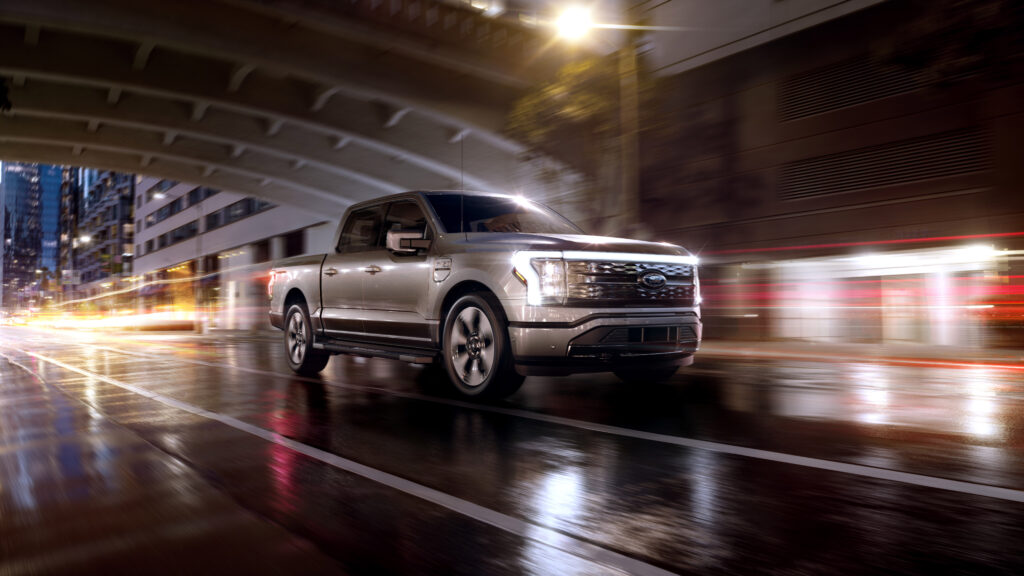
Over the past year, electric trucks have gone from nothing to the most-watched vehicle segment on the planet. Back in the pre-pandemic good ol’ days of 2019, electric trucks were relegated to the concepts of startup fantasies like Rivian, Nikola and Bollinger. Tesla’s Cybertruck was the first to be unveiled in November of 2019, however it’s still at least a year away from production. In 2022, buyers have two to choose from: The $100,000+ GMC Hummer EV, and the mid-size luxury-oriented Rivian R1T, which starts over $70,000. Electric trucks have remained out of reach for the average consumer.
This is where Ford has a chance to really make a splash in the market. With the best-selling F-150 being the unofficial symbol of working America, it’s only natural that the F-150 gets the honor of being the first electric truck for the masses. Even better, it’s going to offer features and utility that no truck has ever seen before. The anticipation is building.
The 2022 Ford F-150 Lightning may not turn heads like the Cybertruck, but the Lightning’s capabilities are astounding. What exactly makes the F-150 Lightning so innovative, and will it overtake Tesla as the face of electric trucks?
Here’s What Stands Out With the F-150 Lightning
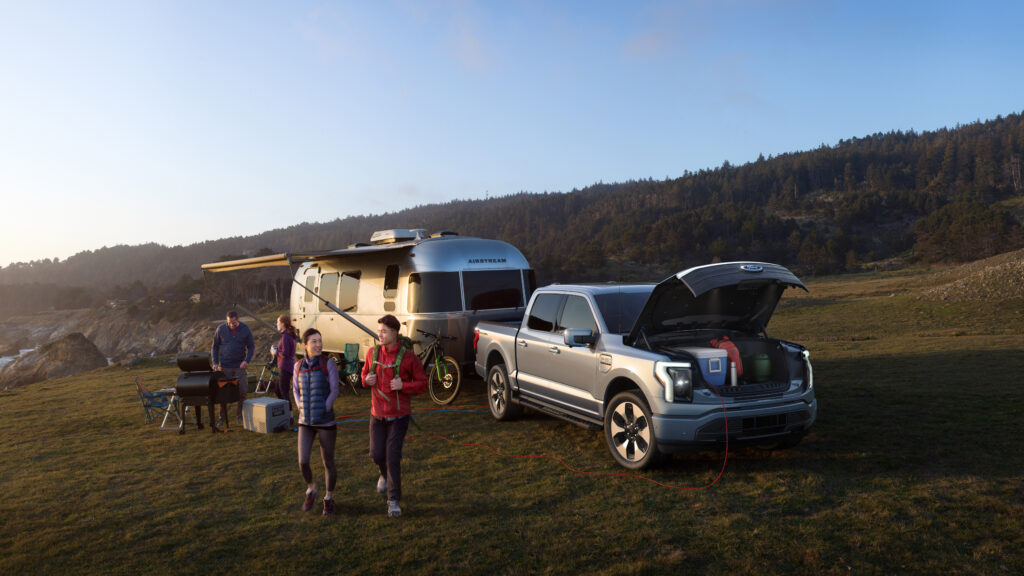
Look, I get it. Most traditional truck buyers don’t follow the latest and greatest in the EV space. What does matter, however, is the utility of the truck they drive. Can it get the job done reliably?
Ford’s most anticipated electric vehicle is not the Mustang Mach-E. It’s not an electric Explorer. It’s without a doubt the 2022 F-150 Lightning electric truck. For well over 30 years, the F-150 has been the best-selling vehicle in America. Now that Ford expects 40% to 50% of its global sales to be fully electric by 2030, how does the F-150 fit into the picture?
Ford has made it clear that they intend to entice traditional truck buyers into an electric F-150, while also attracting new consumers to the brand. So far, it seems to be working like a charm. As of January 2022, Ford has 200,000 reservations for the F-150 Lightning in the books. This truck hasn’t even entered series production yet and it’s already sold out until 2024.
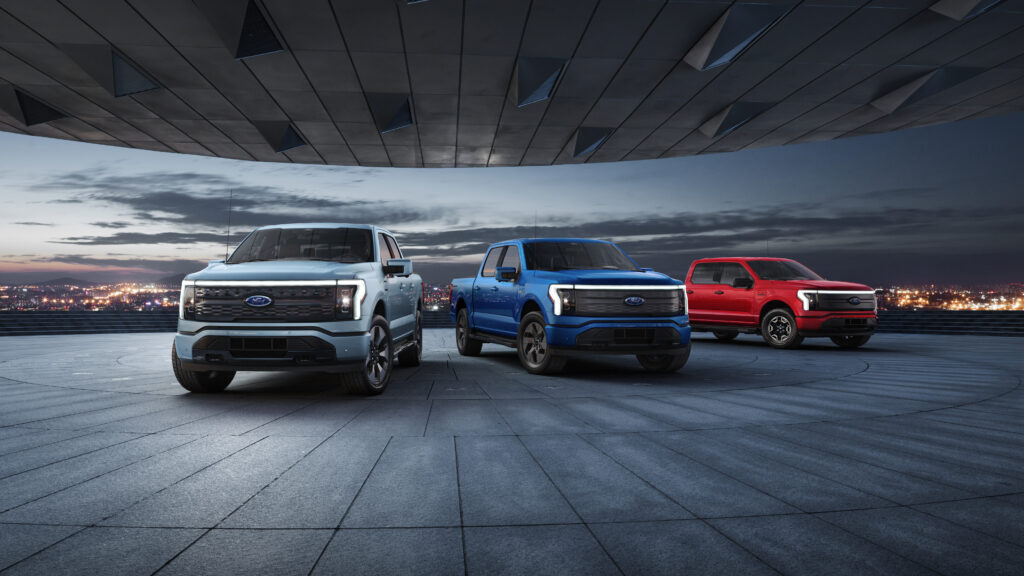
On the exterior, the Lightning looks a lot like a combustion-powered F-150. The distinguishing features are daytime-running light bars across the top of the front grille and across the tailgate in the back. The Lightning also has aero wheel options to improve efficiency for maximum range. They don’t look silly like some aero wheels do. Other than that, you really have to stare at it to notice the Lightning is any different. Three new faux grille options are there for looks. With an EV, the grille merely protects the spacious front trunk.
The charge port right in front of the driver’s door doubles as a name plate. Ford intentionally designed the exterior to appeal to traditional truck buyers. Not everyone wants a spaceship.
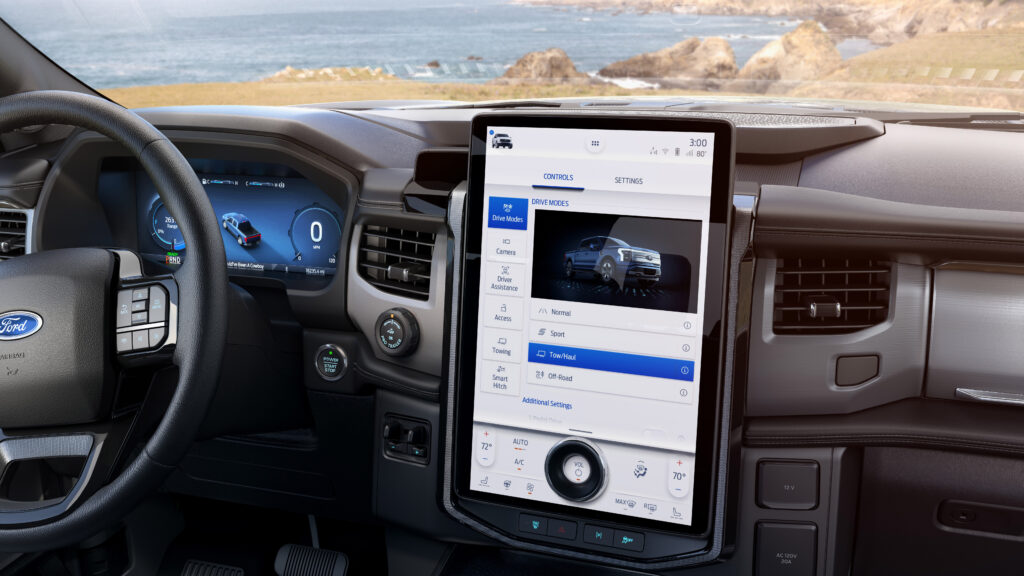
The F-150 Lightning is only offered in crew cab configurations. The interior dimensions are the same as the gas-powered F-150, but that’s a compliment. Plenty of space up front, and lots in the back. Up front, the biggest difference is the 15.5” infotainment screen. It’s only in the higher trims of the Lightning for now, but it’s probably a sign of what’s to come for the whole lineup. Everything from drive modes to towing configurations and entertainment is all accessed through the huge vertical screen. Climate controls are always fixed at the bottom of the display, although it’s still a touch-screen feature. Sorry physical button enthusiasts!
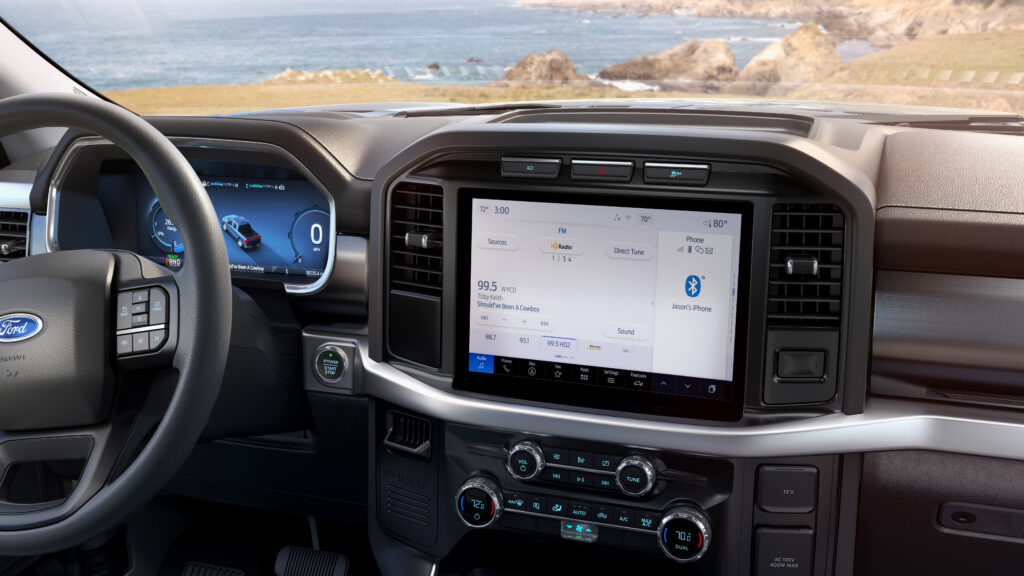
Utility reigns supreme in the F-150 Lightning electric truck. The center console folds down into a work desk, but that’s a feature that combustion-powered versions also have. The rear seats offer the same generous space that you’ll find in the gas equivalent, including under-seat storage. Available Max Recline Seats offer nearly 180 degrees of recline. Perhaps a charging nap is in your future?
The 2022 F-150 Lightning is powered by dual electric motors, each of which could fit inside a duffel bag. The electric motors are powered by large lithium-ion batteries produced through a joint venture with SK Innovation in Georgia. American-made batteries for American-made EVs! That’s not as common as you’d think.
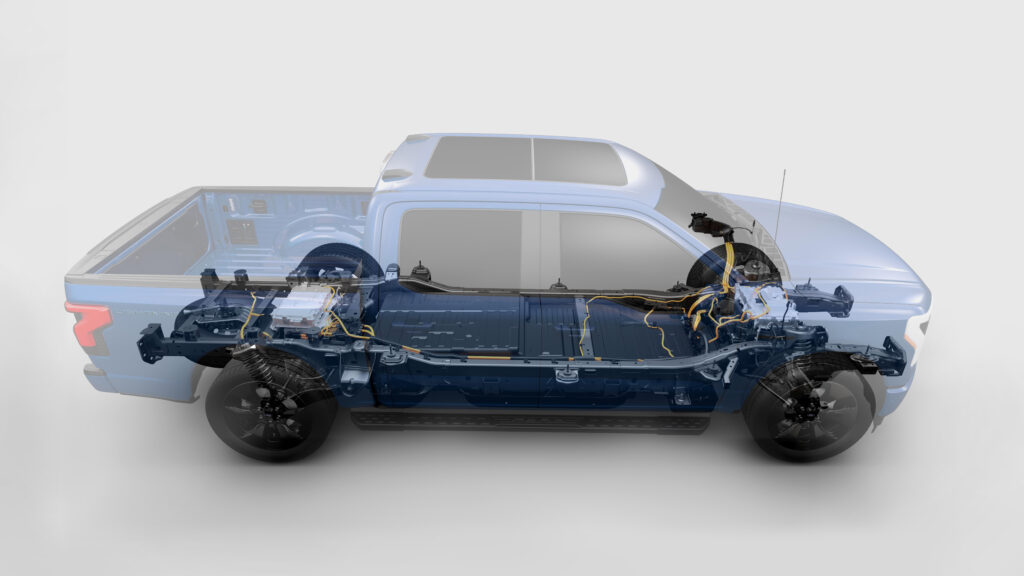
The F-150 Lightning’s battery lives under the floor of the truck, where it’s out of the way and secured in a waterproof casing surrounded by crash-absorption protection. Ford says the battery was designed with extreme weather and abuse in mind. It can handle off-road adventure like a champ. Innovative thermal management keeps the battery at optimum temperatures.
The base ‘standard range’ battery is a 98 kilowatt-hour (kWh) usable lithium-ion battery. Stepping up to the extended range configuration gets you a 131 kWh battery pack built from the same chemistry. This extended-range battery offers more towing, a lot more performance, but less payload. Why less payload? The bigger battery is much heavier. The F-150 Lightning weighs 6,500 pounds!
The base standard range battery supplies the two motors with 425 HP and 775 lb-ft of torque. The extended range battery opens up to 565 HP and the same 775 lb-ft of torque. Notably, four-wheel drive is standard across all trims. One motor is located at the front axle, and another is in the rear. Both the battery and motors get metal skid plates that shield the underbody from impacts, water and the elements for durability.
The official EPA numbers are out! The standard range battery is rated for 230 miles on a charge, and the available extended range battery is good for 320 miles. The final EPA numbers exceed what Ford had previously estimated. Ford engineers have fueled rumors that the Lightning’s range estimates are calculated with 1,000 pounds of payload included. With an empty bed, the F-150 Lightning may go even further on a single charge.
Ford offers four drive modes: normal, sport, off-road, and haul. Additional settings include one-pedal driving (a Tesla favorite) and the option to lock the differential with the touch of a button. Why would you want a sport mode on your F-150? The Lightning launches to 60 mph in just 4.4 seconds!
More than 80% of electric vehicle charging is done at home. Ford is the only automaker to offer an 80-amp charge station as standard equipment. At home, the F-150 Lightning adds an average range of 30 miles per charging hour, fully charging an extended-range truck from 15% to 100% percent in about eight hours. Keep in mind that the truck charges overnight while you’re sound asleep. EV owners typically wake up each morning with a full battery to start the day.
At a public DC fast charger like you’ll find at Electrify America, The 2022 F-150 Lightning can accept 150 kilowatt charging speeds. This is below what the upcoming Silverado EV offers, but it’s still decent. If the charging curve is above average, 150 kW won’t be a problem at all. At a DC fast charger, the extended-range F-150 Lightning is targeted to gain up to 54 miles of range in 10 minutes. In 41 minutes, Ford says it can charge from 15% to 80%.
Charging an electric truck is A LOT more affordable than fueling up at the gas station. Fuel savings just might justify the time it takes to charge. At Electrify America, a typical charge from 5% to 90% (adding 255 miles of range) will only cost about $35. The real savings are in your garage. At home, where most charging is done, the same charge to 90% would only cost $15 at average residential electric rates. Learn more about how much it costs to charge an electric vehicle here.
On the surface, the bed of the F-150 Lightning is pretty standard. It’s the usual 5’5” bed with a power tailgate. Sadly, it lacks the magical pass-through feature of the upcoming 2023 Chevrolet Silverado EV. Upon closer inspection, there are some very useful gadgets. The side of the bed includes several household 120-volt outlets and a more powerful 240-volt outlet. Ford says the Lightning can power worksite tools for days without having a big impact on the state of charge. This really highlights the immense energy capacity of the 98 to 131 kWh battery, and how comparatively little energy small appliances and tools consume.
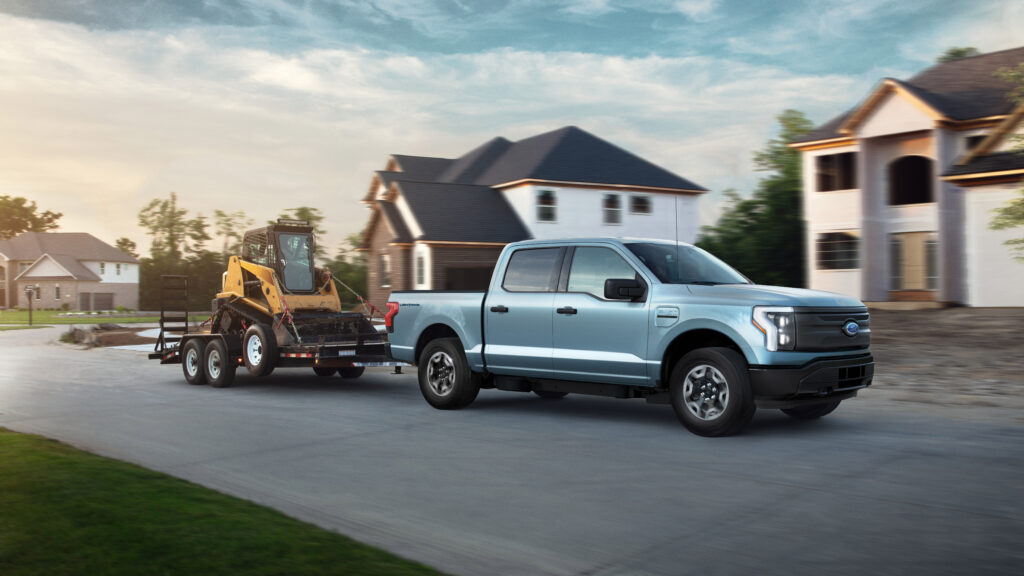
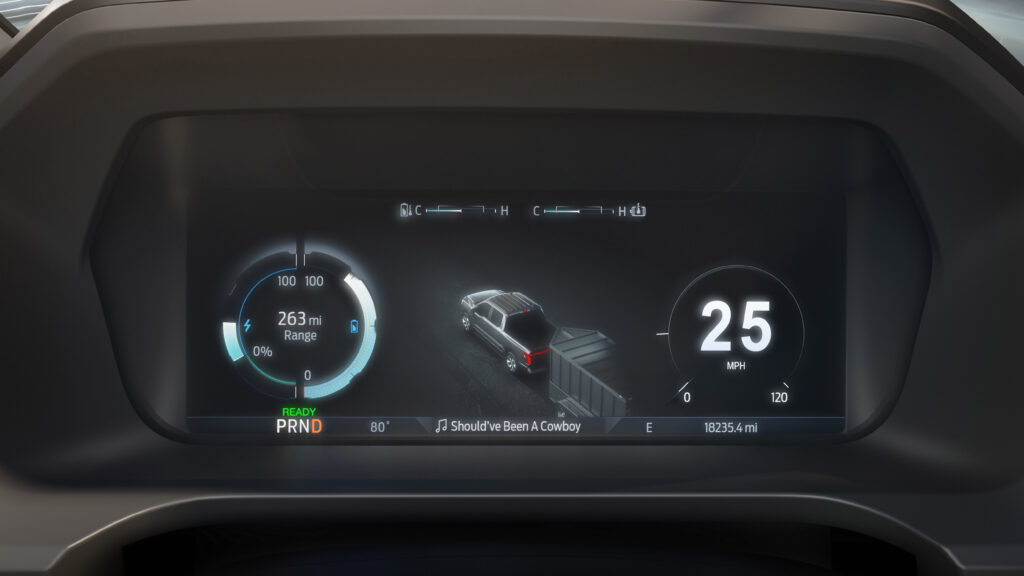
How does towing or hauling around a bed full of materials impact range? Just like with any gas or diesel-powered truck, fuel efficiency decreases with towing and higher payloads. Ford’s engineers thought of this, and they’ve used the Lightning’s electrical infrastructure to offer an impressive remedy. Using the scales built into the truck and a fancy computer, real-time range estimates are constantly calculated based on payload and towing demands. The gauge cluster displays an accurate estimate of how much range you have in any given scenario. No need to do calculations in your head.
With the 230-mile standard battery, payload capacity is 2,000, and towing is up to 7,700 pounds. The extended range battery opens up towing to 10,000 pounds, but the added weight of the battery lowers payload to 1,800 pounds. The Lightning weighs about 1,000 pounds more than regular F-150s.
The F-150 Lightning has a massive 14 cubic-foot front trunk. Finally, a truck with a trunk! There are four power outlets providing 2.4 kW of power and two USB ports, all within the front trunk. The floor has a drain too. You can even charge tools in the front trunk while driving the vehicle.
Pro Power Onboard is Ford’s vehicle-to-load system that produces . Power reserve functions allow the driver to automatically cut off power supply once the battery state of charge drops to a predetermined level.
An even bigger deal is Ford Intelligent Backup Power. With the proper setup and accessories, the F-150 Lightning automatically kicks in to power your house when the power goes out. Once power is restored, the truck automatically reverts to charging its battery. Ford says that based on 30kWh of electricity usage in the average American home, F-150 Lightning with extended-range battery can power an entire home for up to three days, or as long as 10 days with power rationing. THIS could be the feature that wins over the masses.
Wait, that’s not all. Ford has more tricks up its sleeve than a dealership F&I manager:
“In the future, Ford will introduce Ford Intelligent Power, which can use the truck to power homes during high-cost, peak-energy hours while taking advantage of low-cost overnight rates to charge the vehicle in time for your morning drive. This can help save money on electricity that powers your vehicle and home while also taking pressure off the grid in peak usage times.”
You heard here first, folks. You’ll soon have the ability to buy a truck that can lower your entire utility bill. Considering that this feature alone would save a ton on monthly bills, charging the F-150 Lightning will basically pay for itself! That could be HUGE savings for those accustomed to paying $60-$80 for every tank of gas.
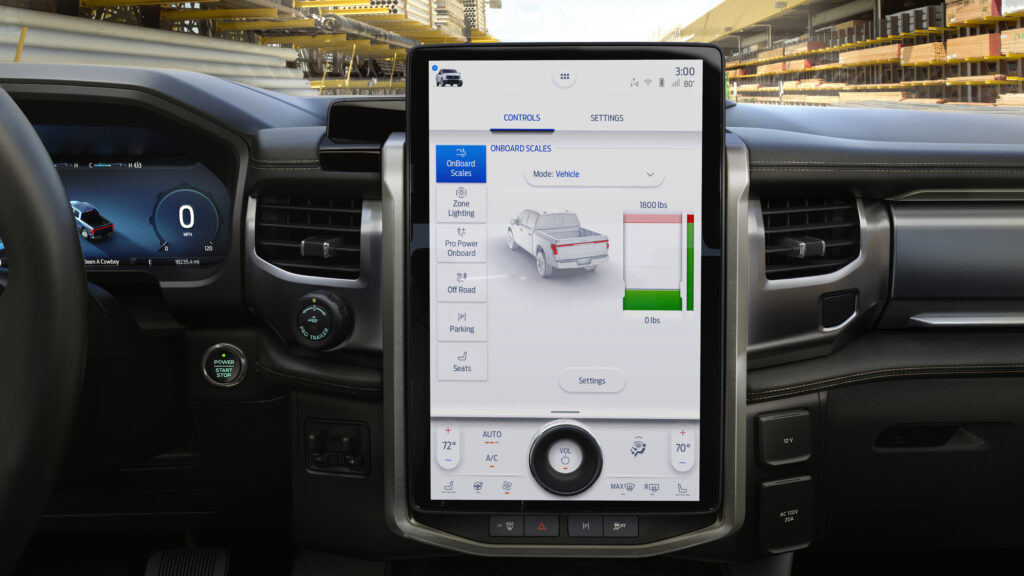
The Lightning can learn all about your hauling habits. The truck recognizes which trailer you’re hauling, combines that with info from the onboard scale, and provides immediate updates to driving range and power.
The F-150 Lightning has games! Tesla popularized in-cabin gaming, and now Ford has seen the appeal of a lighthearted, fun-yet-functional vehicle experience. Automakers are all about ‘experience’ these days.
The gauge cluster is conveniently located within the line of sight for the driver. It displays useful information about real-time battery conditions, motor performance and power distribution. In the Lightning, everything is customizable.
Does Ford want to spy on you? probably not. However, two driver-facing cameras are built into the dash. These are actually safety monitors for Blue Cruise, Ford’s advanced driver assistance technology. Blue Cruise enables hands-free driving on divided highways, as long as your eyes are on the road. This is wading into level 2 autonomy, but Ford has more ambitious driver assistance plans in the works.
There’s also a 360-degree camera for parking assistance. Exterior zone lighting lets you illuminate precisely what you need to see in the dark.
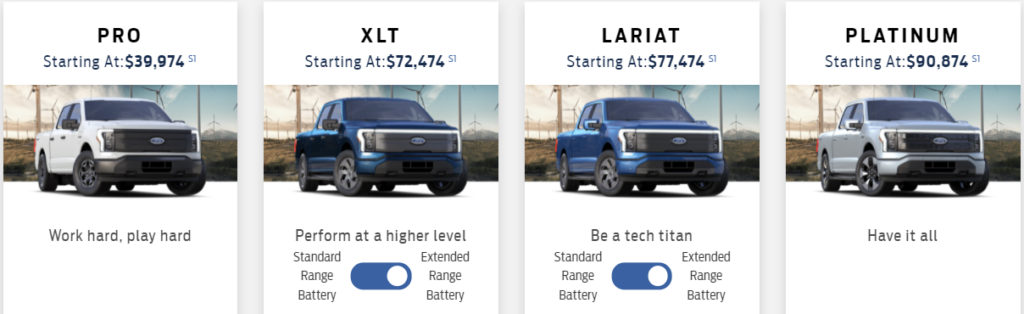
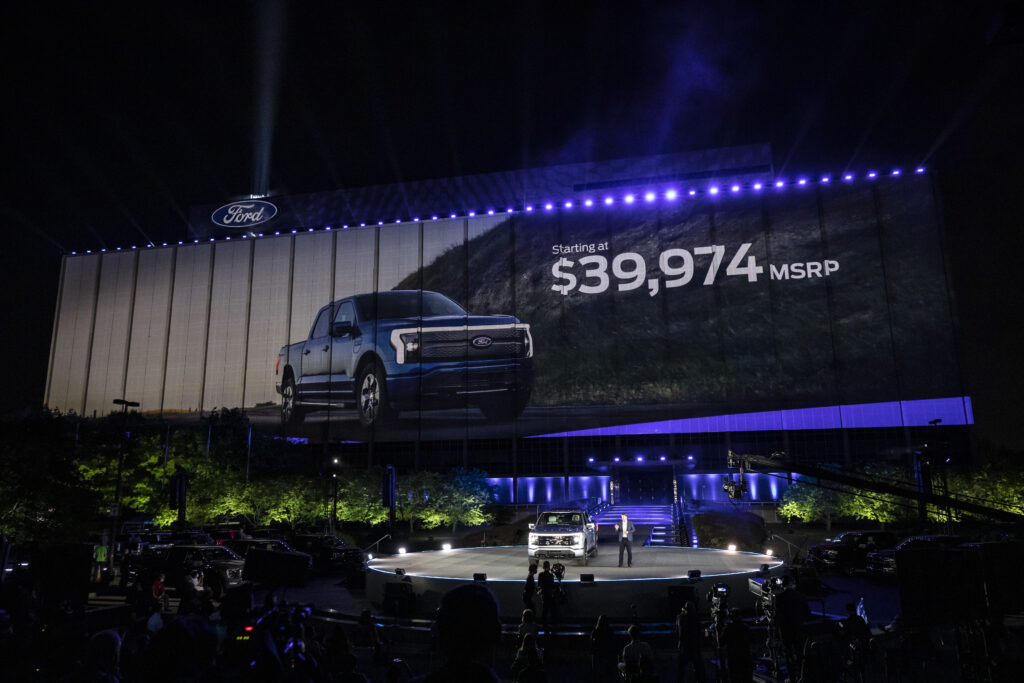
The work and fleet-oriented Pro edition starts at $39,974. The Pro includes bare-bones manual vinyl seats and no frills. Most consumers will start their shopping at the $52,974 XLT trim. This is where most of the desired features and comforts enter the scene. A step up will land you at the $67,474 Lariat. Both the XLT and Lariat come with the 230-mile standard range battery unless you opt for the extended range battery. On top of the spec sheet is the Platinum. For $90,874, you can get an extended range battery, 22-inch bright machined aluminum grille, the larger (15.5-inch) touchscreen, upgraded sound, and both heated and ventilated seats. Check out the major differences below:
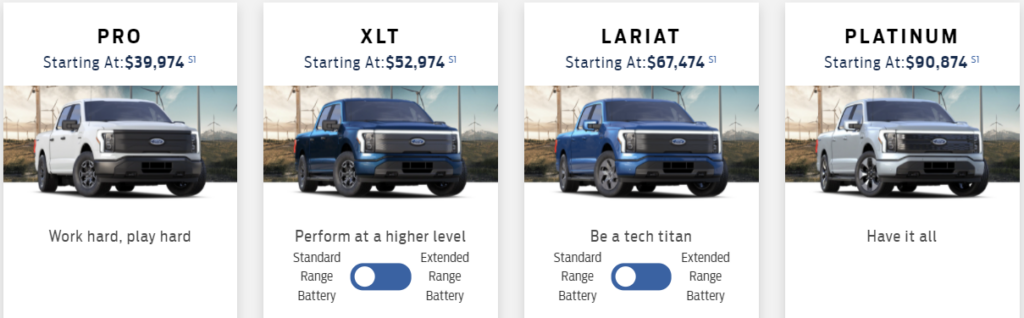
Notice that the soon-to-be-popular XLT trim listed at a starting MSRP of $52,974 is actually a $72,474 truck in disguise. If you want to step up from the 230 mile standard range battery to the bigger battery, going for the XLT just doesn’t make sense for most buyers. Ford clearly wants buyers to take the dive for the Lariat or Platinum trims. Kind of sneaky if you ask me.
Ford recently sent a memo regarding F-150 Lightning pricing to their dealers, and it was swiftly leaked online. It reveals that the automaker intends to preserve what little is left of positive dealership experiences. The memo cuts right to the chase. “It has come to our attention that a limited number of dealerships are interacting with customers in a manner that is negatively impacting customer satisfaction and damaging to the Ford Motor Company brand and Dealer Body reputation.” Wow, Ford actually wants their customers to have a pleasant dealership experience.
This memo brings up a key concern about F-150 Lightning pricing. Will dealers use unprecedented demand to try and justify outrageous additional dealer markups? Clearly, Ford corporate is intent on getting ahead of the problem before it snowballs out of control and tarnishes the brand for hundreds of thousands of new Ford customers. Find out more about this secret memo and what CarEdge advocates think about it here.
Does the Ford F-150 Lightning electric truck qualify for the EV tax credit? Yes! The federal EV tax credit slashes up to $7,500 off of the Ford F-150 Lightning pricing. Lawmakers are considering revisions to the EV tax credit that could possibly add to the discount. Right now, buyers receive the incentive when they file taxes. proposed changes to the law would make the discount effective at the point of sale.
Sadly, there’s no easy answer. If you were among the hundreds of thousands to place a pre-order back in early 2021, you just might receive your F-150 Lightning by the end of 2022. Most current reservation holders will receive theirs in 2023. Ford is doubling down on production capacity due to high demand, so if you get in line soon, maybe you’ll also get your truck before 2024. For the time being, reservations are closed so that existing deposit-holders can place their official orders. Soon, Ford says they will open reservations back up to the masses. Ford currently has about 200,000 reservations in the books. With the doubled production capacity, Ford will be making about 150,000 per year. Do the math, and that means most F-150 Lightning buyers will have to wait until 2024.
If you’re ready to buy an electric truck now, there are only two options with immediate availability. The popular Rivian R1T is an outdoorsy luxury mid-size truck. The R1T starts around $70,000 before incentives. The GMC Hummer EV is crab-walking its way into dealerships, but only at a hefty price tag. For $100,000, the reimagined electric hummer truck can be all yours. The Tesla Cybertruck was just delayed to 2023 at the earliest, so there’s not much to say about that concept for the time being.
Is it worth the wait for the Ford? F-150 Lightning pricing is attractive, and it’s sure to get truck buyers the most value for their money out of the few options we have today. Plus, who wouldn’t want to have a truck that also serves as a generator for backup power? Tesla has been stubbornly against adding vehicle-to-grid functionality to their models, probably because Tesla also sells home battery products.
The 2022 Ford F-150 Lightning electric truck is the pinnacle of utility. You can power a dozen tools, save hundreds to thousands on fuel, and even power your entire home with this truck. Unfortunately, Ford didn’t anticipate so much love for the Lightning. If this truck was at dealerships today, they’d be flying off the lot. F-150 Lightning pricing is what you’d expect from a truck in today’s market. It’s likely to set buyers back by at least $60,000 with options included. If only there was an electric Ford Maverick for those of us who prefer to spend less.
Do you think the F-150 Lightning will sell to traditional truck buyers? Or will Ford appeal to a different demographic altogether? We’d especially love to hear from you if you’re a reservation holder. The Lightning will have a lot to live up to after the long wait we’re in for.
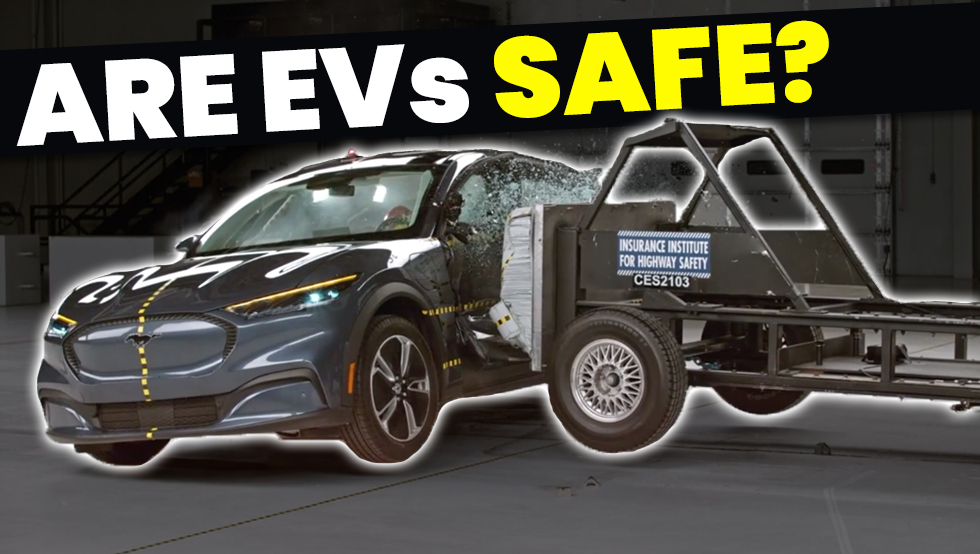
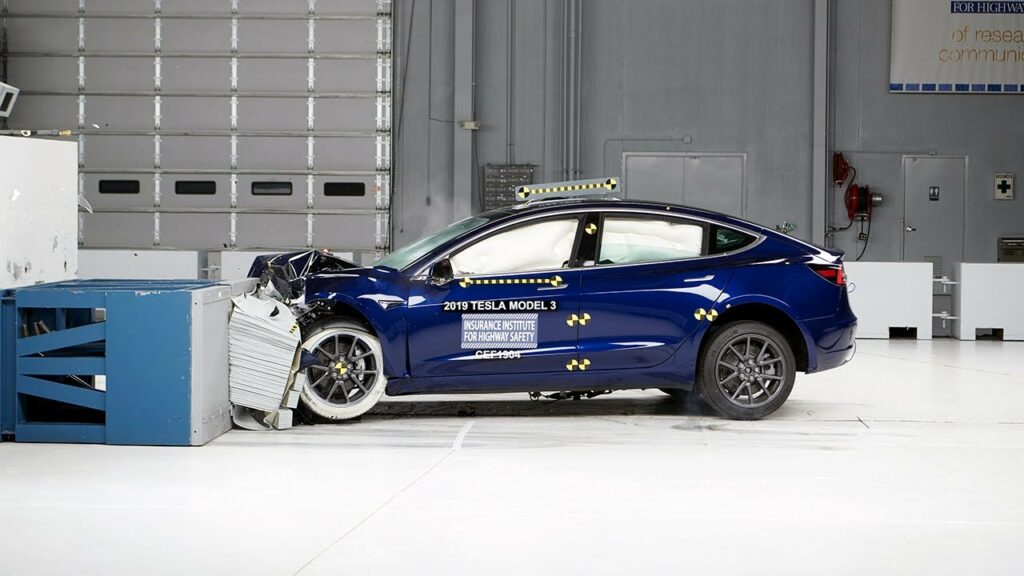
Your opinion of electric vehicles likely depends on which side of the news you’ve seen. If you know anything about the Chevy Bolt hazard, you might even scurry to the other side of the street when you encounter one. But does the data support EV skepticism, or is the big picture something different altogether? Do we even have enough data to draw firm conclusions? It’s important to get down to the facts, and that’s our goal today. Here’s what crash test ratings, vehicle fire statistics and real-world data can tell us about electric car safety in 2022.
The National Highway Traffic Safety Administration (NHTSA) and the Insurance Institute for Highway Safety (IIHS) conduct standardized crash testing for vehicles that possess the potential to become popular and sell in big numbers. If it’s popular, they’re going to crash it and collect data. These two crash testing programs don’t treat electric vehicles any differently than they would a traditional combustion-powered vehicle.
As a refresher, here are the crash tests conducted by the NHTSA and IIHS:
The following additional tests are conducted by the IIHS:
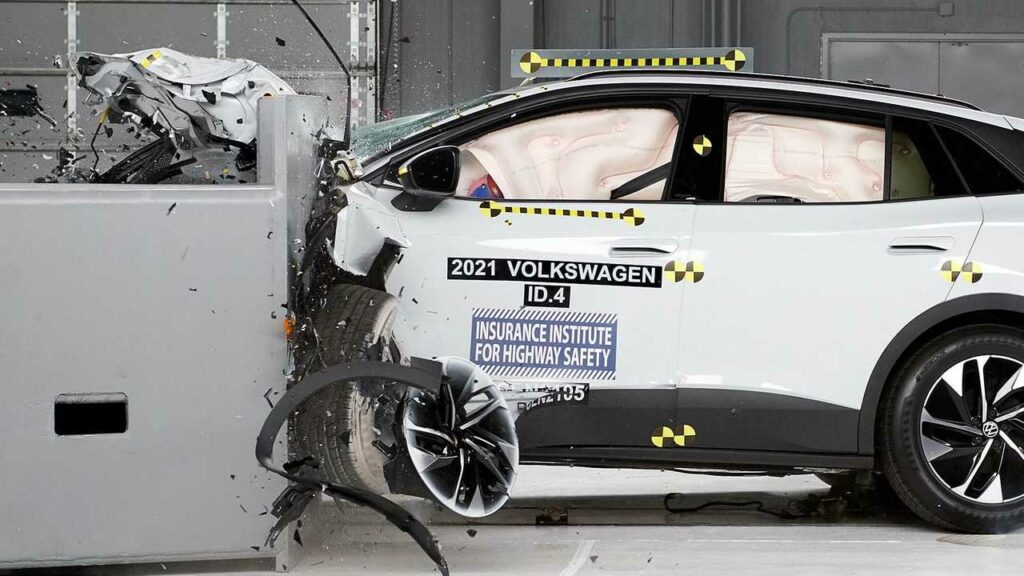
How do electric vehicles perform in these crash tests? Take a look at the limited data we have.
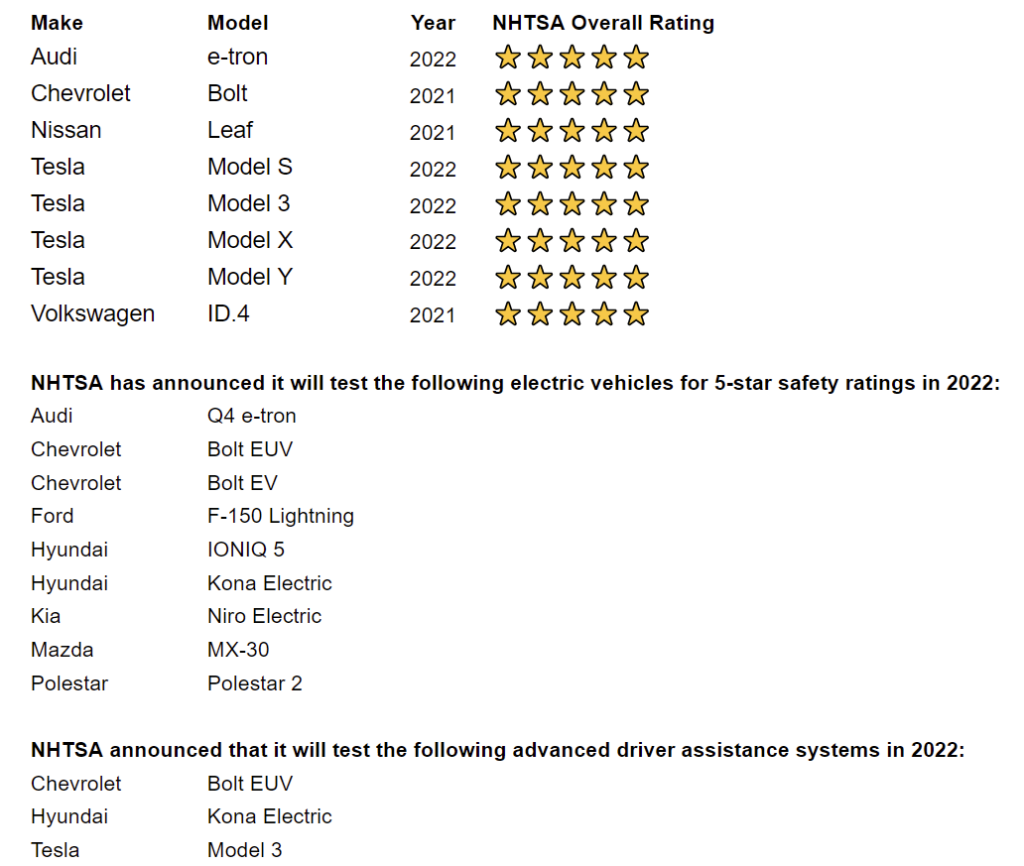
The Insurance Institute for Highway Safety (IIHS) does not provide overall ratings. They instead provide dozens of ratings for many different safety metrics. You can check out their ratings here.
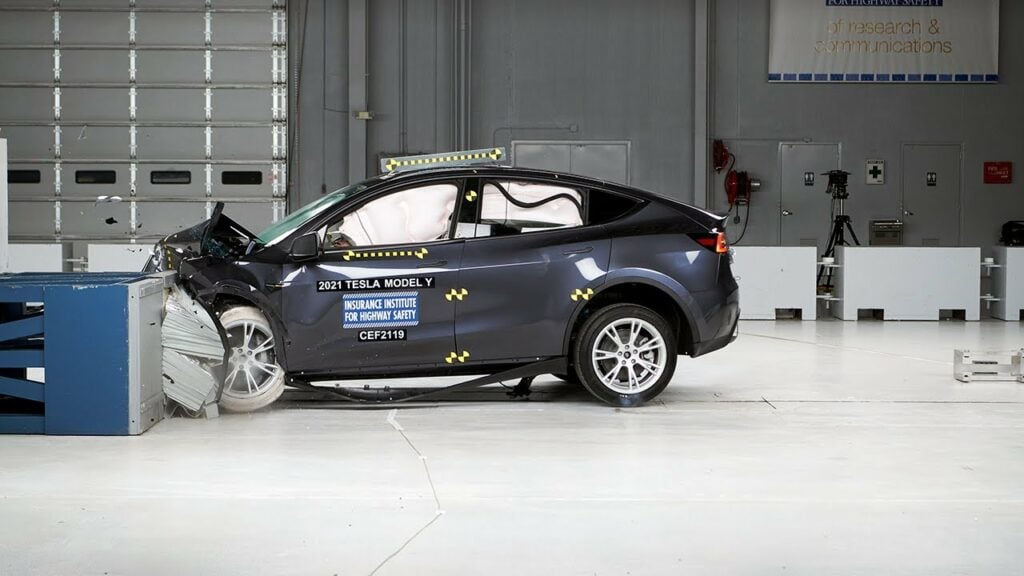
This data from the NHTSA and IIHS shows that while data is limited (but growing), all EVs tested so far have received excellent solid ratings. In fact, all eight electric models tested by the NHTSA in 2021-2022 earned five-star ratings. Considering that over 70% of EVs sold in the US are Tesla models, these ratings do represent the vast majority of EVs on American roads today. Still, far more testing is needed with so many electric models coming in 2022.
The IIHS sees the trends in their own data: EVs are actually making passenger vehicles safer than ever before. In a 2021 IIHS report on electric vehicle safety, they shared what they’ve learned so far.
“Evidence is growing that electric vehicles are at least as safe as conventional ones, with two more vehicles that run exclusively on battery power earning safety awards from the Insurance Institute for Highway Safety. In addition, an updated analysis of insurance data shows injury claims are substantially less frequent for such vehicles.”
Those are powerful words from an insurance-minded crash-tester. We definitely need more electric car safety testing. EV sales made up 6.5% of American auto sales in 2021, and that figure is expected to reach or exceed 40% by 2030. One useful safety test would be comparing how long it takes to extinguish a fire for each EV model. I’d love to see that testing implemented for the safety and preparedness of our first responders.
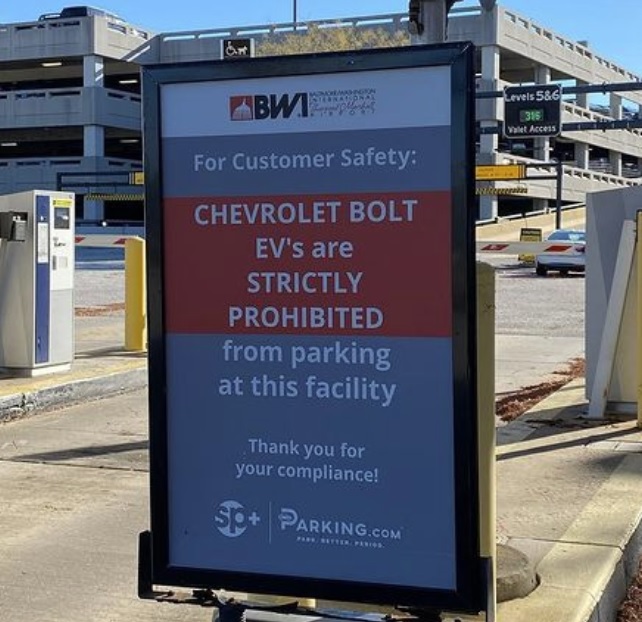
Whether you prefer a vehicle that requires gasoline, diesel or battery packs, all vehicles are built to haul around what are essentially concentrated energy sources. That’s how the vehicle converts potential energy in the form of combustible carbon or electrons into kinetic energy to get you from A to B. The latest and greatest battery chemistries pack more power than ever before into battery cells, but they also claim to be safer. However, any concentrated energy source is volatile under certain conditions. That’s why we don’t light matches at the gas pump. What about EV batteries? Are they a fire hazard worthy of extraordinary caution?
The CarEdge team recently dug deep into the latest EV battery fires that have made the news, and our findings certainly shed light on the facts. Here’s a summary of what the data and engineering investigations featured in our EV battery fire report reveal.
Data compiled by the National Fire protection Association (NFPA) and the US Department of Transportation shows that among all vehicle types, there’s an average of one vehicle fire per 19 million miles driven. Both the NFPA and the Center for Auto Safety say there is not yet a centralized database for electric vehicle fire statistics. In an effort to address the lack of information surrounding EV battery fires, Tesla decided to begin releasing statistics in their annual impact reports.
Tesla’s 2020 Impact Report says that from 2012-2020, there’s been one Tesla fire per 205 million miles traveled. The fact that Tesla models made up 79% of American EV sales in 2020 highlights the relevance of their data. Unfortunately, other automakers haven’t released comparable data (we’re looking at you GM!). We’re hopeful that will change soon.
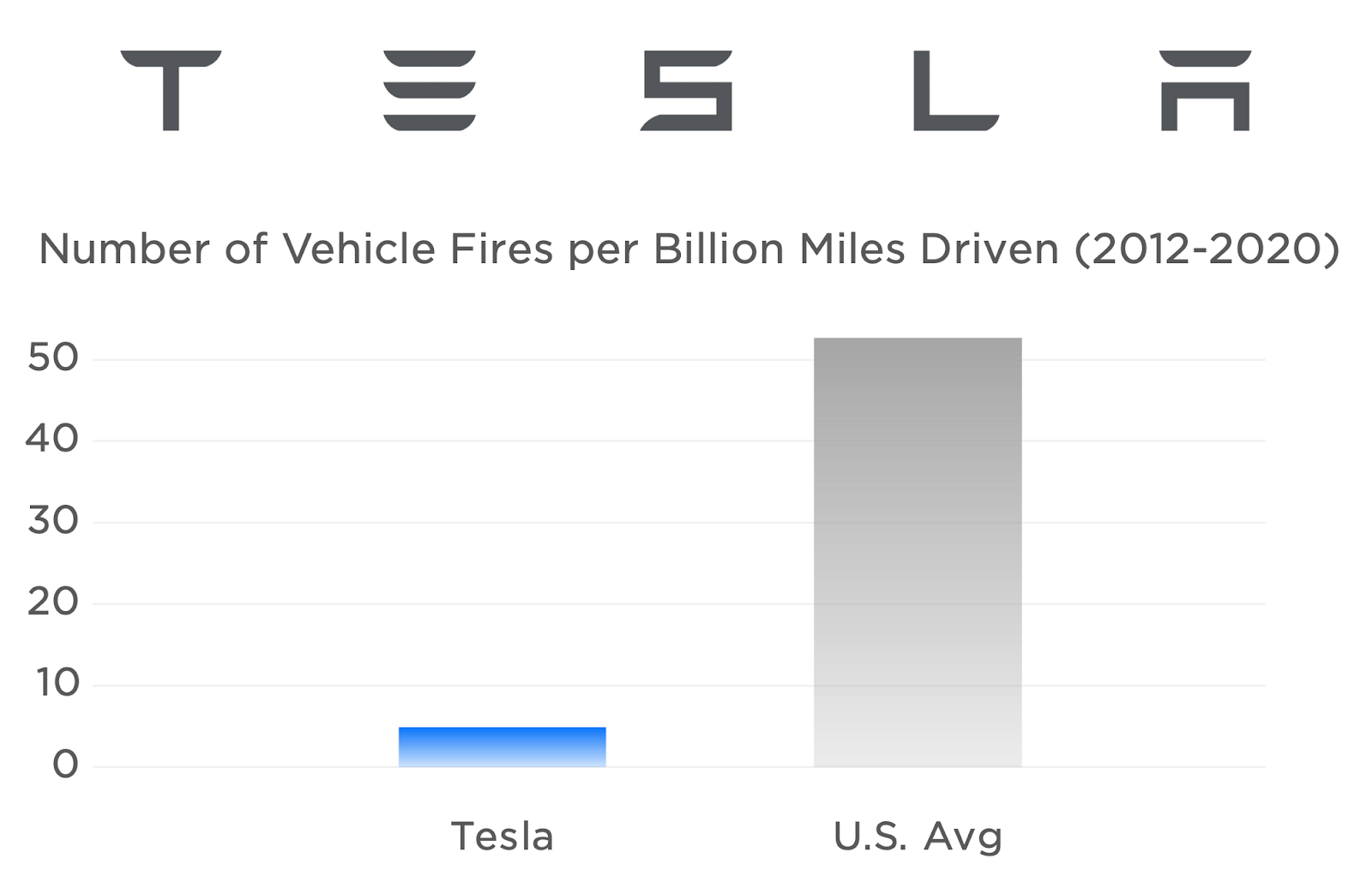
Source: Tesla
This comparison doesn’t hide the fact that one other EV model has had major problems. The ongoing Chevrolet Bolt recall is costing GM and battery supplier LG a few billion dollars to resolve. There have also been sporadic incidents with other EVs. The Hyundai Kona briefly made headlines with multiple fires, but a fix was quickly implemented. It seems like every Tesla fire makes it into the news, even though there are not many.
Despite the statistics showing just how rare and isolated the events are, EV fires are real, and every one is worthy of proper investigation. The same goes for any vehicle fire.
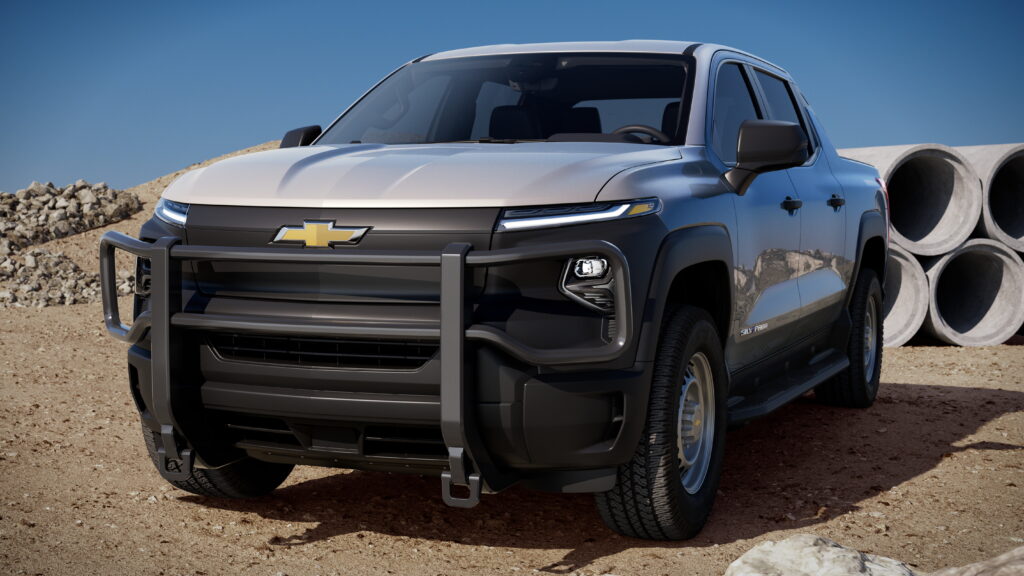
Although Tesla’s data suggests that EVs are less prone to car fires than combustion vehicles, there are major safety concerns for the firefighters who extinguish the flames when an EV fire does occur. Firefighters need special training to learn how to safely approach EV-related incidents, but only two-thirds of departments have had the opportunity due to funding constraints. Automakers need to come forward and support our first responders with training and resources to prepare for the electrification of the auto industry.
EV fires require A LOT more water to extinguish. Tesla’s First Responders Guide recommends 3,000 to 8,000 gallons of water on hand to put out a Tesla fire. Some fires have needed 30,000 gallons of water to extinguish. Basically, firefighters have to do whatever it takes to cool down the battery, and that’s really hard to do with so much energy densely packed into the pack. Once the fire appears fully extinguished, there’s a chance it could still flare up, even days later. Towing services and junkyards are advised to park damaged electric vehicles at least 50 feet from other vehicles in the yard. As EVs become more popular, that might not be feasible in just a few years.
When cars launch full-speed ahead without warning, we have a major problem. Fortunately, that has not been proven to have occurred following dozens of investigations over the years. A number of serious accidents involving EVs have resulted in drivers claiming that the car accelerated on its own. Tesla vehicles have faced these accusations for years, but investigations have never found evidence of unintended acceleration. Plus, Tesla EVs are computers on wheels, and they maintain very detailed logs of all driver inputs. These logs are thoroughly inspected in every investigation.
The Department of Transportation’s National Highway Traffic Safety Administration (NHTSA) determined that reports of sudden unintended acceleration involving four different Tesla models were due to user error. In other words, the driver mistakenly smashed the accelerator pedal. With so much torque and instant feedback, that’s enough to launch a Tesla like a rocket. Depending on where that rocket is aimed, it could go launching right into harm’s way. The lesson here? Powerful EVs demand more attention than some drivers are used to. Electric car safety features can only go so far if drivers are careless or over confident.
Hyundai recently recalled 2,700 2017-2019 Ioniq electric vehicles (the generation prior to the all-new Hyundai IONIQ 5) to correct a rare but scary defect that may cause the Ioniq to accelerate after the driver releases the accelerator pedal when in ‘limp mode.’ With no accidents reported, it appears as though Hyundai got ahead of this issue before anything tragic happened. As far as we (and the US government) know, no EVs have accelerated on their own without driver input.
This is another headline grabber for Tesla. Anytime there’s a crash involving a Tesla on autopilot, it’s sure to make the news. Tesla Autopilot certainly has its faults, notably ‘phantom braking’ and difficulties with poor visibility. However, Tesla keeps track of their accident data from all Tesla vehicles worldwide, and this is what they’ve found as of December 2021:
“In the 4th quarter, we recorded one crash for every 4.31 million miles driven in which drivers were using Autopilot technology (Autosteer and active safety features). For drivers who were not using Autopilot technology (no Autosteer and active safety features), we recorded one crash for every 1.59 million miles driven. By comparison, NHTSA’s most recent data shows that in the United States there is an automobile crash every 484,000 miles.”
Although this is not independently verified, it’s intriguing data to say the least. Could Tesla Autopilot really be safer than human drivers? Considering that 15% of motor vehicle accidents in the US are attributed to driver distraction, it may not be all that surprising. More automakers are offering level 2 autonomous driving features. As Autopilot-like technology increases, electric car safety will be under the microscope. Learn more about Tesla’s annual safety report here.
Our goal at CarEdge is to provide you with factual information that’s useful for your decision-making process as you consider your next vehicle purchase. Why do we cover EVs so intently? Because industry insights show that major automakers are dead set on electrifying their entire lineups by 2035 at the latest. From Ford to GM and everyone in between, the story is the same. With hundreds of billions of dollars going towards EV development, it’s important to hold automakers accountable with such a nascent technology.
Over 2 million EVs are already on American roads and global EV sales totaled 4.5 million in 2021 alone. This is just the beginning. Sales of electric vehicles are expected to rise 75% to more than 8 million in 2022. Electric car safety is more important than ever. Are EVs safe? So far, it looks like electric vehicles are at least as safe as combustion vehicles. But when things go awry, EV fires are far more difficult to extinguish than what we’ve seen in the past, and that’s a concern worth addressing promptly at all costs. If you’re thinking about going electric for your next vehicle purchase, rest assured that EVs from Tesla, Ford, Volkswagen, Hyundai-Kia and others are ranked up there with the very best in the entire industry.
We have thousands of EVs (and other vehicles) listed today. Each listing includes industry insights, empowering data and the true TotalPrice that will make buying a car the transparent process it should’ve always been. Check it out here!