
CarEdge saved me over 4,500 dollars on a brand new Honda Pilot. I can't say thank you enough.
Price intelligence
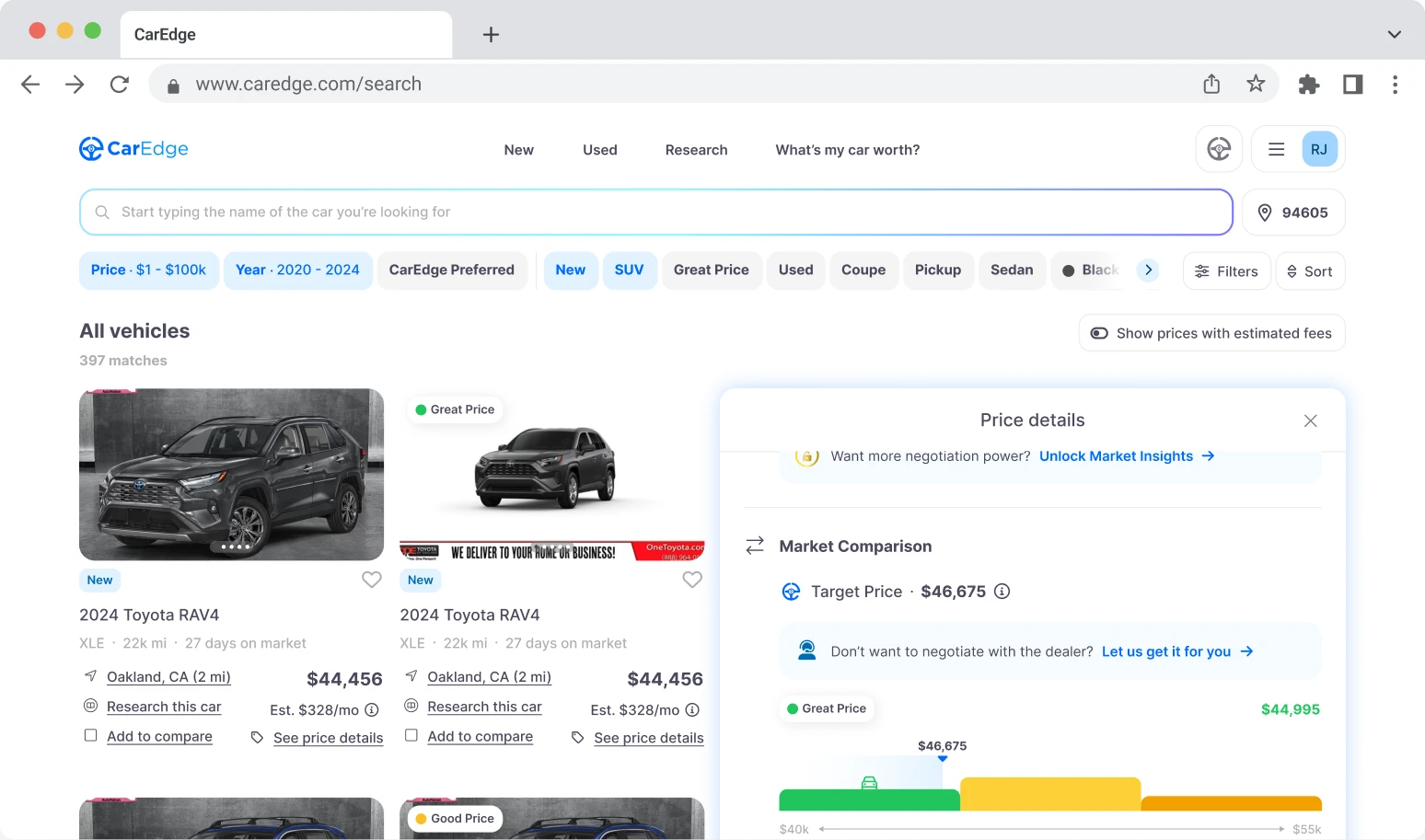
Find a wide range of vehicle listings with market insights on new and used listings near you.

What can I do with CarEdge?
 CarEdge Insights
What can I do with CarEdge?
Get access to exclusive information so you can make an informed car buying decision — all in one place.

Find a wide range of vehicle listings with market insights on new and used listings near you.
Track your vehicle’s value and cash in when the time is right to sell.

Access to our proprietary data to help you find the right car, at the right price. Find these unlocked on every listing after subscribing.

With our expert-led, tech-enabled car buying service, we will locate, negotiate, and deliver your vehicle so you can get a new car hassle free.


Help us personalize your CarEdge experience — it only takes a second.
Your answers help us personalize your CarEdge journey — we’ll follow up with tips and next steps that match your buying timeline.
Ram is known for crafting sturdy vehicles with immense power. Even with the best standards of manufacturing, though, mistakes can still happen. That’s why we suggest buying an extended warranty. A Ram extended warranty will protect you against manufacturer’s defects and save you from hefty repair bills if something stops working. You can learn more about this in our Ram extended warranty review below.
Today, we’re going to take a look at the Ram extended warranty. We’ll discuss the different tiers of coverage, compare the plans to third-party options, and discuss certified pre-owned coverage.
Let’s dive in.
Before we can talk about whether the Ram extended warranty is worth getting, we need to discuss what’s included in it.
The plan is managed by Mopar, but is offered in a partnership with Ram. Mopar has four tiers of coverage:
This plan is intended to cover the core systems of the vehicle. It includes the engine, driveline, and transmission.
This tier covers everything from the plan above, as well as coverage for some electrical systems, braking systems, and cooling systems.
This plan includes everything from the two tiers above, with the addition of greater coverage for electrical systems, instrumentation, luxury group systems, and the rear suspension.
This top-tier plan aims to cover almost every component in your car. It includes everything in the previous tiers and adds in body mechanisms, safety systems, and manual interior mechanisms.
You can learn more about each of the above plans through Mopar’s sales brochure (page five).
It’s worth mentioning that none of the Ram extended warranty plans offer any coverage for maintenance. That means air filters, oil changes, and belt replacements are not covered. None of the plans provide any coverage for body, paint, or components that wear by design, like rotors.
The term lengths for their coverage are highly flexible. You’ll have your choice of mileage intervals (all the way up to 15,000), with an option for unlimited miles if you’d like. You can select a term length that meets your needs, too.
Mopar also offers a number of perks that are worthwhile:
You may have noticed that we aren’t discussing any prices in our Ram extended warranty review. That’s because, as discussed in an earlier article, pricing for these plans is based on mileage and VIN. Because of this, you’ll need to obtain quotes from a number of different providers to better understand what a fair price might be for your vehicle.
Every Ram vehicle service contract begins when the plan is purchased. Keep this in mind so that you can avoid overlapping with the factory warranty; that would just be a waste of money. Fortunately, this means that you won’t have to buy the extended warranty at the time that you buy your car.
Do we think a Ram extended warranty is worth it? We do think so, largely because of the amount of customization available. You should at least get a quote to see what it will cost you. If you like the price, then the Ram vehicle service contract might be perfect for you.
Even though Mopar is technically a third-party, this warranty is just about the same as if it were offered by Ram directly. All repairs must be completed at a Ram dealership.
However, Mopar goes further and does provide some coverage for breakdowns that occur when you’re too far from a Ram dealership. They’ll reimburse you for these covered repairs. However, you need to first obtain prior authorization, pay the mechanic in full, and then file your claim.
On the other hand, most third-party warranties will directly pay the repair shop for your repairs, as long as the shop you use is licensed by ASE or AAA.
Ram certified pre-owned vehicles are eligible for an extended warranty through Mopar. You’ll only be able to buy the top two plans, however: Added Care Plus and Maximum Care.
If you’re financing your vehicle, you might want to consider adding GAP insurance through Mopar, depending on how much you’ve put into the car.
What’s the final outcome of our Ram extended warranty review? We do recommend the Ram vehicle service contract. Mopar provides an excellent selection of options for coverage. You’ll be able to customize your plan to suit your exact needs. The only major downside to their warranty is having to take your vehicle to a participating Ram dealership for your repairs.
If you’re looking for another option, we’ve partnered with a vendor of vehicle service contracts to help bring you a reliable VSC with transparent pricing. Our partner offers clearly stated coverage, and we’re proud to work with them. We even offer free consultation calls to help you decide which plan might be best for you (even if it’s not ours). Contact us today to request a quote.
Subaru is known for making rugged and reliable vehicles that stand the test of time. Even with this reputation, manufacturer’s defects can still occur. That’s why we always recommend buying a vehicle service contract to protect you from hefty repair bills down the line. Learn more about the Subaru extended warranty review on today’s post!
Today, we’re going to go over the Subaru extended warranty. We’ll discuss the different levels of coverage, compare it to third-party programs, and make our ultimate recommendation.
Before we can determine if a Subaru extended warranty is worth purchasing, we need to take a look at what’s included in their coverage.
Subaru calls their extended warranty programs “Added Security.” The Subaru extended protection plan has three tiers:
This base-level program provides coverage for the engine, transmission, and transaxle. It is intended to protect you from some of the more expensive repairs that can happen.
As the mid-tier plan, there is much more coverage in comparison to the Powertrain plan. Coverage is expanded to include the cooling and fuel systems, steering systems, front suspension, major electrical systems, and air conditioning.
The top-tier program is described as providing coverage for “virtually every part of your Subaru.” There is comprehensive coverage for most systems and components on your vehicle.
If you’d like to dive deeper into what’s covered with the Subaru Added Security plans, you can view their component coverage brochure.
Subaru says that they offer term lengths all the way up to 10 years and 100,000 miles, although they do not provide the increments that you can select from.
All repairs must be completed at a Subaru dealership, and all repairs will be done with genuine parts. While some may see this as a limitation, we view it as an upside. Genuine parts typically have a better construction than aftermarket parts.
You’ll be able to pick from a $0 or $100 deductible for covered repairs.
Surprisingly, the Subaru extended warranty programs specifically include wear-and-tear components. This is highly unusual from a vehicle service contract and something we like to see.
Every tier of protection can be transferred to a new party if you sell the vehicle while the warranty is active. Subaru does not discuss if there is a transfer fee applied when you use this benefit.
Subaru offers other perks to tempt you into buying their service contract, as well, which include:
Notice that we are not discussing prices in our Subaru extended warranty review? As we discussed in an earlier post about vehicle service contracts, prices are based on your VIN and mileage. This means that prices will vary from car to car. You’ll need to obtain several quotes to determine if Subaru is offering you a reasonable price for your extended warranty.
Is the Subaru extended warranty worth getting? We absolutely think so! The fact that it covers wear and tear alone puts it miles above most other service contracts. Beyond that, they include flexible plans and term lengths, so you can customize your coverage based on your needs.
Third-party extended warranties often mimic the coverage made available by automakers. They do this because they want to compete with the automakers. As such, most of the same components will be covered among different plans.
There are two vital differences between the Subaru extended warranty and third-party extended warranties:
Most plans from third-party companies and other automakers will not cover any components that are damaged from wear and tear. The issue must stem from a manufacturer’s defect; otherwise, it’s not covered.
With a Subaru extended warranty, all repairs must be completed at a Subaru dealership. Conversely, a third-party program will allow you to have repairs completed at almost any auto shop, provided they are licensed by ASE or AAA.
If you’re located close to a Subaru dealership, it’s worth getting a Subaru extended protection plan. However, if it would be difficult for you to get your car in at the dealership for repairs, a third-party program will likely be just as good.
Subaru’s FAQ section states that any Subaru that is still covered by the original factory warranty is eligible for an extended warranty. We take this to mean that this applies to Subaru certified pre-owned vehicles, as well. However, not all Subaru CPOs will still have a factory warranty. You’ll need to keep this in mind when shopping for your Subaru CPO vehicle.
What’s the final call on the Subaru extended warranty review? We do recommend getting a quote for a Subaru vehicle service contract. On their website, they say that they view extended warranties as a chance to provide great customer support, not as just another revenue stream. While this is certainly a statement intended to make a sale, their policy also seems to back that up. They cover wear-and-tear issues and have flexible coverage options, making their program worth investigating.
If you’re looking for another option, we offer vehicle service contracts through our third-party partners. They have clear coverage and transparent pricing, so you’ll know what you’re getting. We’ll even include a free consultation call to help you pick a warranty, even if you don’t pick our option. Contact us today to request a quote and schedule your consultation call.
Tesla has been steadily taking the automobile world by storm over the past few years. While there’s a lot to be excited about, manufacturer’s defects can still occur in Tesla cars. That’s why we always suggest covering your purchase with an extended warranty. But should you buy the one from Tesla? Find out more in our Tesla extended warranty review.
Today, we’re going to take a look at Tesla’s extended warranty. We’ll go over their plans, discuss what’s covered, and make our ultimate recommendation.
We cannot discuss if the Tesla extended warranty is worth getting without first examining what’s included in the warranty.
Tesla only offers their extended warranties — which they simply call an Extended Service Agreement — on the Model S and Model X. Other models do not have an available vehicle service contract.
Coverage for a Tesla extended warranty begins when the New Vehicle Limited Warranty expires. As such, you have two options for warranties. The only differentiator is the length of time and mileage that it extends your warranty:
Tesla does not provide a list of components that are covered or even a brief overview. They only say that the lithium-ion battery and drive unit are not covered, but leave it at that. Their website refers you to a Tesla Service Center or dealership for component coverage information.
In order for an issue to be covered, it must stem from defects in the materials or workmanship on the part in question. There is no coverage for wear and tear or issues related to neglect, misuse, or abuse. Any items that are “consumable” and related to regular maintenance are not covered.
Usually, we wouldn’t be able to cover costs in our Tesla extended warranty review. We’d tell you that prices for extended warranties are based on your VIN and mileage, so you need to request a quote to determine your price. However, Tesla breaks the mold by listing the prices of their warranties for each vehicle and time period, which are:
Keep in mind that these prices are current as of this writing and may change in the future. Refer to Tesla’s extended service agreement page to see current prices.
Any Tesla that is still under the New Vehicle Limited Warranty is eligible for a Tesla vehicle service contract. Warranties must be purchased by the owner at the nearest Tesla Service Center. Extended warranties must be purchased no later than 30 days or 1,000 miles past the expiration of the New Vehicle Limited Warranty.
Tesla states that there is a deductible, but doesn’t discuss how much it is. You’ll have to ask a sales specialist about this.
Warranties are fully transferable to a new owner. No fee is disclosed.
Do we think it’s worth getting a Tesla extended warranty? We are neutral towards their warranty. We would suggest obtaining quotes from other providers and comparing coverage and costs. There is nothing about the Tesla extended warranty program that’s special or unique, other than flat-rate pricing that they list on their website.
You don’t have many options when it comes to third-party extended warranties. CarShield provides a third-party warranty option, although you’ll need to request a quote to see coverage and cost. A lesser-known company called Xcelerate also offers an extended warranty that caters to electric vehicles.
With either of the above third-party options, you’ll be able to take your Tesla to any auto shop that is certified by ASE or AAA. Of course, due to the complexities of Tesla cars, you should call ahead and ask if they’ll even work on them.
You’ll be restricted to Tesla Service Centers to perform your repairs with a Tesla extended warranty. While this can be seen as a downside, considering how different and complex Tesla cars are, it might not be such a bad thing. All repairs will be done by Tesla-trained technicians and use genuine Tesla parts.
If you’re far from a Tesla Service Center, you might want to look into a third-party extended warranty. However, if you’re somewhat close, it’s probably worth sticking with the Tesla extended protection program.
Tesla does not have a certified pre-owned program. They simply refer to the cars they sell with prior owners as “used.” All used cars sold directly by Tesla come with a Used Vehicle Limited Warranty, which will provide some coverage. Tesla does not clearly state that their used inventory is eligible for Tesla’s extended protection plans. It’s possible that they qualify for the “over 180 days” price.
What’s our ultimate call from the Tesla extended warranty review? We do recommend a Tesla vehicle service contract. However, our recommendation is not because they have an amazing program or a great price. Instead, we recommend them because you should always have your Tesla worked on by a trained mechanic who is using genuine Tesla parts. Otherwise, you could end up shortening the life of your vehicle.
If you’re looking for another option, we work with a third-party vendor of vehicle service contracts that offers fair pricing and clear coverage. We’ll even hop on the phone with you and help you compare different warranties, even if you don’t select our option. Reach out to us today to obtain a quote for your car.
Toyota is known for producing extraordinarily reliable vehicles that will last a lifetime. Even with that reputation, if you’re especially risk averse, there can be good reason to purchase an extended warranty on a Toyota vehicle. A Toyota extended warranty will provide years of peace of mind beyond the original manufacturer’s new car warranty, and for that reason we think they are worth considering. Learn more in our Toyota extended warranty review.
We’re going to dive into the Toyota extended warranty program. We’ll be going over the different levels of coverage, certified pre-owned options, and make our ultimate recommendations.
Before we directly state whether or not it’s worth getting a Toyota extended warranty, we first need to examine what’s included in the warranty program.
There are three tiers of plans available to new and used Toyotas:
To see an extensive list of what’s covered by each plan, we recommend taking a look at the website Toyota put together to explain plan coverage.
New vehicles are eligible for a Toyota extended protection plan within the first three years and 36,000 miles, whichever comes first.
Used vehicles are eligible for a Toyota extended warranty as long as they are within nine prior model years and have fewer than 150,000 miles. Take note that the extended warranty for used cars must be purchased when the car is sold.
Toyota also offers a single plan for their certified pre-owned cars, which they call Toyota Certified Used Vehicles. The plan for CPO vehicles is:
● Toyota Certified protection. This single plan for CPO vehicles covers most components in your vehicle. In order to be eligible for this plan, the car must be within six model years and be under 85,000 miles. You can buy the certified pre-owned plan at any point within the first 12 months or 12,000 miles.
New and used vehicles have a $0 or $100 deductible, which you’ll select when you set up the plan. The $100 deductible is waived if you have repairs completed at the same facility that sold you the car.
Toyota also includes a few useful benefits:
All Toyota vehicle service contracts can be transferred to a new party at any time with no fee. We appreciate this policy as it increases your resale value.
We aren’t discussing the prices of any of these plans in our Toyota extended warranty review because prices are based on VIN and mileage, as we mentioned in an earlier post. You’ll need to obtain a quote to see what the extended warranty will cost you. To get a quote you can contact your local Toyota dealership. Please remember that dealerships typically markup these products 200-300%, and you can (and should) negotiate with them on the price.
Is the Toyota extended warranty worth it? It’s an extremely comprehensive program with flexible coverage that you can tailor to fit your needs. We think it’s worth asking for a quote and comparing it to other options (like what we have to offer here at CarEdge). If the price is right, it might be the way to go.
Most third-party extended warranty providers do their best to copy the coverage made available by car manufacturers. This is done to stay competitive. While there may be slight differences in component coverage, they will mostly be the same.
However, one thing will be dramatically different: your repair options. With a Toyota extended warranty, your car must be repaired at a Toyota dealership. With a third-party extended warranty, you have your choice of any auto shop that is licensed by ASE or AAA, which includes any and all Toyota dealerships.
After months of interviewing different administrators, we decided to partner with AUL corporation to sell their Toyota extended warranties. For CarEdge members only we are able to offer transparent pricing, and complimentary consultation calls to determine if buying a Toyota extended warranty makes sense for you.
If you are considering getting extended protection on your Toyota we highly recommend you get a free quote from CarEdge that you can use to negotiate with the dealership. And, if you do buy from CarEdge you can know that you purchased a third party Toyota extended warranty that has been vetted by us.
All Toyota certified pre-owned vehicles are eligible for a unique vehicle service contract, which we discussed above. The coverage under this program is similar to the warranty that comes with a certified pre-owned vehicle. We appreciate how there is no deductible for repairs.
What’s the final decision from our Toyota extended warranty review? We do recommend the Toyota vehicle service contract. There is a wide selection of programs made available, with specific coverage for used and certified pre-owned vehicles. We think it’s worth getting a quote from Toyota if your vehicle is still eligible for any of their warranties.
If you’d like another option, we offer vehicle service contracts through our third-party partner. They have clear coverage and upfront pricing for all of their VSCs. We’ll even get on the phone with you for a consultation call to help you pick the best warranty for you, even if it’s not ours. Get in touch with us today to request a quote and schedule your call.
Volvo has a reputation for manufacturing high quality, sporty vehicles. While they certainly produce great cars, mistakes in manufacturing can still happen. That’s why we always suggest purchasing an extended warranty so that you’re protected from an expensive repair bill if something happens. But should you get it from Volvo directly? Learn more in our in-depth Volvo extended warranty review.
Today, we’re going to go through the Volvo extended warranty program. We’ll discuss the levels of coverage they offer, the fine print details, and give you our ultimate recommendation.
Before we can talk about whether a Volvo extended warranty is worth purchasing, we first need to examine what’s included in the warranty itself.
The Volvo extended warranty has three levels of coverage:
As the lowest plan available, this plan covers the powertrain systems. That includes the engine, transmission, and drive axle. There is also limited additional coverage for hybrid and electric vehicles.
This plan builds upon the Powertrain Coverage Plan by adding a number of major systems. Coverage includes steering, brakes, cooling, electrical, suspension, and air conditioning systems.
This plan is an exclusionary coverage plan. That means that any component is covered unless it is specifically listed as an exclusion. You can view the complete exclusion list on their sales brochure.
You’ll have your pick of term lengths when purchasing your Volvo warranty, with the maximum option being an additional six years or 120,000 miles.
All repairs must be completed at a Volvo dealership. This is standard practice for automaker warranties. It can sometimes be a drawback, but it also means that your car will always be worked on by Volvo-trained technicians and repairs will be completed with genuine Volvo parts. These perks can be important, as aftermarket parts are not always as reliable as genuine parts.
Each of the three plans offered come with some excellent benefits, which include:
The Volvo extended protection plan is fully transferable, which improves your resale value if you decide to sell your car down the road. Volvo does not state whether there is a fee for transferring the warranty or not.
There is no coverage for any issues related to misuse, abuse, or neglect. Neglect is defined to include the failure to add necessary fluids to the vehicle, such as coolant or oil. Additionally, there is no coverage for something that is already covered by the manufacturer’s warranty. All of these “fine print” terms are standard practice.
Why aren’t we talking about prices in our Volvo extended warranty review? As mentioned in an earlier post about vehicle service contracts, prices will vary based on the VIN and mileage of the vehicle in question. As such, the quote you receive will be different from another customer’s quote, even if you have the same car.
So is a Volvo extended protection plan worth it? We believe that it is. There’s nothing particularly special about the Volvo extended warranty, but that’s not a bad thing. It means that they provide the level of coverage, term lengths, and benefits that we should expect from all automakers. It’s worth getting a quote from Volvo to see if the price they give you works with your budget.
Third-party extended warranty providers tend to copy the coverage that’s available with automakers’ extended warranties. As such, if you shop around, you’ll see that the coverage is pretty similar across direct and indirect extended warranties.
There is one vital difference, however…where you can have your car repaired. With a Volvo extended warranty, all repairs must be completed at a participating Volvo dealership. While this does mean that you’ll have genuine parts used in your repairs, getting a broken-down vehicle to a dealership might prove troublesome.
On the other hand, most third-party warranties will let you have your vehicle repaired at any repair shop that is licensed by ASE or AAA.
Unfortunately, Volvo does not make any special mention of Volvo CPO vehicles in any of their available information about extended warranties. This might mean that they are covered, but it could also mean that they’re ineligible. As such, you’ll need to contact a Volvo dealership to determine if your CPO is eligible for a Volvo warranty.
Where do we land on our Volvo extended warranty review? We do recommend a Volvo vehicle service contract. There is nothing special about their VSC offering, but that’s perfectly fine. Their coverage is excellent, and their term lengths are flexible. All of the other terms of the Volvo vehicle service contract are to be expected. We think that it’s worth getting a quote for a Volvo extended warranty.
If you’re looking for another option, we’ve partnered with a third-party provider of vehicle service contracts. Our partner provides excellent coverage with transparent pricing. We even include a consultation call to help you decide which option is right for you, even if you don’t pick our partner. Reach out to us today to schedule a call or request a quote.
GMC produces sturdy, reliable automobiles. That being said, even the best cars can still have manufacturer’s defects that occur from time to time. Having an extended warranty can help to provide additional coverage when these issues occur. While we never advise buying an extended warranty from a dealership when you’re buying your car, they are still worth having and can be purchased after you leave the dealership. But is the warranty from GMC worth it? Find out in our GMC extended warranty review!
Today, we’re going to analyze the GMC extended warranty. We’ll discuss what is included with the warranty, who provides administration services for the warranty, and compare the warranty from GMC to third-party options.
We couldn’t say if it was worth getting a GMC extended protection plan without first discussing what is covered under it. Known as the Platinum protection Plan, this GMC vehicle service contract has flexible term lengths and great coverage.
The GMC extended warranty program is actually administered by AMT Warranty Corp. This organization has little public information out there, so we can’t evaluate them fully. We only discovered this relationship by examining the fine print in the sample contract.
You may choose any of the below terms for your GMC vehicle service contract:
As far as what’s covered under the GMC vehicle service contract, they boast coverage for over 1,000 components in their Platinum protection Plan. Even though they don’t discuss it on their website, the sample contract that they make available also discusses a silver plan. The Platinum Plan will cover everything that is not on the exclusion portion of the sample contract, while the silver plan will only cover what is specifically listed.
Both plans provide coverage for:
While both plans provide coverage for all of the listed systems, the Platinum Plan covers more components within each system.
There is no coverage for any issues that are related to misuse, abuse, or neglect. The GMC vehicle service contract only provides coverage for manufacturer’s defects, which is standard for all vehicle service contracts.
GMC also provides a number of benefits that come with every extended warranty:
While we think the above perks are nice, we don’t think they should persuade you into buying a GMC extended warranty. The main factors you should consider are coverage and cost for the warranty.
As we’ve mentioned in a previous post about vehicle service contracts, the price of a VSC will always be unique from car to car, which is why we haven’t talked about prices in our GMC extended warranty review. The final price is based on your VIN and total mileage. That’s why you need to obtain several quotes to decide which provider is worth considering.
So is a GMC extended warranty worth it? We don’t like that the warranty is actually provided by AMT Warranty Corp., a company that has almost no information available. However, we think it’s worth getting a quote from GMC, since they do offer excellent coverage. If the price is right, it might be worth it.
There are a seemingly endless number of providers for third-party extended warranties out there. Speaking in generalities, these companies usually attempt to mimic the coverage provided by the automaker’s extended warranties.
However, there is one vital difference between the GMC warranty and a third-party warranty…where you can have the vehicle repaired. With a GMC extended warranty, you are required to have your repairs done at a participating GMC dealership. You might be reimbursed in special situations in which you can’t get the vehicle to a dealership, but you’ll have to file a claim in these cases.
With a third-party extended warranty, you can have the vehicle repaired almost anywhere. As long as a reputable association, such as the ASE or AAA, licenses the shop you can take your vehicle there.
We examined the sample contract, sales page, and FAQ and could not find any mention of special considerations for a certified pre-owned GMC. This means that you’ll need to contact GMC directly, either at their headquarters or any dealership, and ask if your CPO is covered. You might have special coverage available, or you might not be eligible at all.
What is the final opinion of our GMC extended warranty review? We cannot recommend the GMC extended protection program. We can’t move past the fact that the warranty is actually administered by a secretive third-party company through some barely-disclosed agreement. If we didn’t examine the sample contract, we wouldn’t have even known.
However, if this fact doesn’t bother you, it’s likely worth getting a quote from GMC. They have excellent coverage and flexible coverage terms. If you do go this route, keep in mind that you can only have your car repaired at a GMC dealership.
If you’re looking for another option, we offer vehicle service contracts through our reputable providers. We have transparent pricing and clear coverage standards. To make matters easier, we even offer free consultation calls to discuss all of your options (even if our option isn’t the best fit for you!). Contact us today to set up your free consultation or to request a quote.
Ford likes to market itself as a tough, durable automaker. While some Ford fans will back this up, Fords can still have problems. That’s where a Ford extended protection plan, also known as an extended warranty, comes into play. These types of plans provide added coverage for your vehicle. But are they worth it? Find out in our Ford extended warranty review!
We’re about to examine the Ford extended warranty program. We’ll discuss the different tiers of coverage that they offer, other conditions that apply to their warranty, and compare their plan to third-party options.
Before deciding whether a Ford extended warranty is worth your hard-earned cash, let’s examine what is included in their warranty.
A Ford extended warranty is technically managed by the Ford Motor Service Company, although they say the warranty is “100% backed by Ford.”
Ford offer four different types of plans to choose from:
Mileage coverage starts at 12,000 and goes up to 15,0000 miles or 25,000 miles. Term lengths range from three years to eight years. It’s all up to you what kind of coverage you’d like.
All of the plans discussed above carry a $100 deductible for covered repairs. This differs from policies offered by other automakers, which don’t tend to have deductibles.
All warranties are transferable with a $75 fee. While it might seem unpleasant to have to pay additional fees, it will likely boost the resale value of your vehicle if you can transfer over your warranty to the next owner when you go to sell the car.
Notice that we’re not discussing prices in our Ford extended warranty review. As we’ve covered in earlier posts, prices for extended warranties always vary from vehicle to vehicle. The price given will be based on your VIN and mileage. We always suggest that you obtain quotes from several companies before you make a purchase so that you can compare prices and coverage.
The Ford Motor Service Company offers a handful of perks to try to persuade you into becoming a customer, including:
While these things are nice, we don’t think that perks should sway you one way or another. Perks should be thought of as an added bonus, not a major factor in your decision.
Most third-party extended warranties try to mimic the automaker’s coverage. This means that you’ll likely find similar coverage available from other companies. The big difference between an automaker’s warranty and a true third-party warranty is where you can take the car for repairs.
With the Ford extended protection program, all repairs must be done at a Ford or Lincoln dealership. The benefit to this policy is that you’ll use technicians who trained to work on Ford vehicles and all repairs will be completed using genuine Ford parts.
On the other hand, third-party extended warranties will support repairs done through a much wider network of auto repair facilities. Many third-party warranties will allow you to have your car repaired at any shop that is licensed by a reputable association, such as ASE or AAA.
It comes down to your preferences. If you live near a Ford dealership, then it might not be an issue to take your car into the dealership for repairs. If the nearest Ford dealership is far away, it might be well worth having the option to take your car anywhere you’d like for repairs. You don’t have to buy the warranty when you’re buying a car, so take your time to compare your different options.
Ford does not make any special mention of a specific Ford certified pre-owned extended warranty. We scoured their sales pages, brochures, and sample contracts. We assume that this means that a certified pre-owned vehicle can be covered with a Ford vehicle service contract. However, we can’t say that with any certainty.
You’ll need to ask the dealership or the Ford Motor Service Company about coverage for a certified pre-owned vehicle before signing any contracts. Doing this makes sure that you don’t miss out on any additional coverage that might be available.
What’s our final verdict from our Ford extended warranty review? We recommend buying a Ford vehicle service contract. It’s managed by a company that we assume is a subsidiary of the Ford Motor Company, and the warranties are said to be “backed by Ford.” We like the coverage options that they offer and the flexibility in mileage and term lengths. Ultimately, depending on your financial situation and coverage needs, the Ford warranty program might be a great choice for you.
If you’re looking for some additional options, we offer vehicle service contracts through our reputable vendors. We have clearly stated coverage and transparent pricing. We can even jump on a consultation call with you to review all of your options for warranty coverage. Contact us today to schedule your free consultation.
Fiat crafts luxury vehicles with the level of precision we’ve come to expect. However, even in the best assembly lines, mistakes can happen and manufacturer’s defects can occur. That is when a Fiat extended warranty can help to protect you from expensive repairs. But is it worth buying? Find out in our Fiat extended warranty review!
We’ll be discussing the Fiat extended warranty program today. We’ll go over Fiat’s coverage, their perks, and what we think about their program.
We can’t talk about whether we think a Fiat vehicle service contract is worth it without talking about what’s in the plan in the first place.
Fiat warranties are offered by a company called Mopar. This is a partnership that is fully disclosed and not hidden, so we don’t hold that against Fiat.
There are four tiers of coverage to choose from:
If you want to dive deeper into the available plans, you can view Mopar’s sales brochure.
Mopar makes it clear that maintenance services and any wear-and-tear items are not covered by the Fiat extended protection plans. This would refer to oil changes and new brake pads, for example.
There are dozens of options for mileage and term length limits on the plans from Mopar. Combined with the four levels of coverage they offer, you can truly customize your plan.
Fiat and Mopar add a few perks to their programs to persuade you to buy:
We don’t think these perks should persuade you into becoming a customer. You need to compare coverage and prices to make your decision; let the perks be added bonuses.
Notice that we aren’t discussing price in our Fiat extended warranty review? That’s because, as mentioned in another post about extended warranties, all extended warranty prices are unique to the car in question. Prices will vary based on the VIN and mileage.
Even though Mopar is technically a third-party provider, the agreement between Fiat and Mopar is more of a partnership than anything else. There are other third-party vendors for extended warranties that you can consider instead.
The core difference between a Mopar warranty and a standard third-party warranty is where you can go to repair your vehicle. A third-party warranty will allow you to repair your vehicle at any licensed auto shop. Meanwhile, a Fiat vehicle service contract requires you to have your vehicle repaired at a Fiat dealership.
An exception can be made if your vehicle breaks down far from a Fiat dealership. Mopar will reimburse you for repairs. This requires prior authorization before repairs and then filing for reimbursement after you pay the repair shop.
A third-party warranty might be better if you are far from a Fiat dealership. Compare prices and coverage primarily, but keep this crucial difference in mind.
Every Fiat certified pre-owned vehicle is eligible for a Fiat extended warranty. Only the Added Care Plus and Maximum Care programs can be purchased for a CPO vehicle.
For those financing a CPO, you can also add GAP insurance to your vehicle through Mopar. Depending on how much equity you’ve put into the vehicle, this might be a worthwhile purchase.
What’s the ultimate conclusion of our Fiat extended warranty review? We recommend Fiat’s extended warranty program. Fiat is transparent about its partnership with Mopar, and we greatly appreciate that.
The main thing we love about Fiat’s program is the wide variety of coverage options. Between the four levels of coverage and a massive selection of term lengths, you can find something that will work for you. The only drawback is the limitation of options on where you can have your vehicle repaired.
If you’re looking for another extended warranty provider, we offer vehicle service contracts through our trusted vendors. We have clearly defined coverage and transparent pricing. We’ll even hop on the phone with you to discuss all your warranty options so that you can pick the one that fits you best. Contact us today to schedule your consultation call.
Dodge is known for building sturdy cars and trucks that stand the test of time. Even with that solid reputation, their cars can still have manufacturer’s defects. That’s why buying a Dodge vehicle service contract, also known as an extended warranty, can often be worthwhile…but is it right for you? Find out in our Dodge extended warranty review!
In this post, we’ll be going over the Dodge extended warranty program. We’ll discuss the coverage that comes with their different plans, explore any perks, and make our recommendation on whether this warranty is a good buy or not.
All Dodge extended warranties are sold and managed by Mopar. This is clearly displayed throughout their materials, so we don’t hold that fact against Dodge.
Mopar offers four tiers of coverage to select from:
Dodge makes a point of stating that their plans do not cover any maintenance services or any standard wear items, like brake pads and belts. We’d also like to highlight that all these plans only cover manufacturer’s defects. Abuse, neglect, and misuse issues are not covered.
For those looking to dive deeper into what’s covered, you can view the Mopar sales brochure. Coverage is discussed on page 5 of their materials.
When it comes to term lengths, there are multiple options available. You can even choose to have unlimited mileage covered. All these selections will play a role in the calculation of the final price for the warranty.
Mopar sweetens the deal with a selection of bonuses:
Bonuses are great, but we don’t think they should influence your decision to buy an extended warranty. Get quotes, compare coverage, and consider prices. Let any perks just be icing on the cake.
We aren’t talking about prices in our Dodge extended warranty review because, as we mentioned in another post about vehicle service contracts, prices vary from car to car. They are based on the VIN and mileage of the vehicle. You’ll need to ask for several quotes to compare prices and coverage.
It’s worth mentioning that coverage for all Dodge extended warranty plans begins when you buy the warranty. This means that there could very well be overlap with your existing manufacturer’s warranty.
Is the Dodge extended protection plan worth it? We think so. They have great coverage that is fully customizable, so it’ll fit most budgets. You’ll need to get a quote for your specific car to see if Mopar can give you a price that will win you over.
Mopar might administer the Dodge warranty, but it’s not considered a third-party warranty. It’s actually more of a partnership between Dodge and Mopar. This means that all repairs must still be done at a Dodge dealership.
Conversely, third-party extended warranties will cover you for repairs done at most auto repair shops, as long as they are licensed by ASE, AAA, or RepairPal. Most third-party vendors will pay for repairs directly; you won’t have to pay for the repairs yourself and then get reimbursed.
With the Mopar warranties, covered repairs are reimbursed to you if you must take your vehicle to a shop outside of the dealership network. For example, if you’re on a road trip and your car breaks down, there might not be a Dodge dealership nearby. For covered repairs, you’ll have to obtain prior authorization, pay the bill yourself, and then file for reimbursement.
Third-party warranties are sometimes a better choice, depending your distance from a Dodge dealership. Keep this in mind when shopping around.
All Dodge certified pre-owned vehicles are eligible for a Dodge extended protection plan, but not all of Mopar’s plans are available to choose from. Only the top two tiers can be selected: Added Care Plus and Maximum Care.
If you’re financing your CPO vehicle, it’s worth taking note that Mopar also offers GAP insurance. Depending on the amount of equity you’ve put into the car, it might be worth bundling this with your Dodge vehicle service contract.
What’s the bottom line of our Dodge extended warranty review? We recommend Dodge extended warranties. We appreciate that they’re upfront and honest about their partnership with Mopar, instead of tucking that fact away in a contract like other automakers often do.
Mopar offers plenty of customization to their plans. The main drawback to working with them is that you are limited on where you can take your vehicle when repairs are needed. If you don’t have a Dodge dealership nearby, a third-party warranty might be a better option.
If you’re looking for more choices, we offer vehicle service contracts through our reputable vendors. With transparent pricing and clear coverage, we make things easy. We’ll even provide a completely free consultation to help you decide on the best extended warranty for you, even if it’s not the one we’re offering. You can reach out to us today to schedule a consultation call.
An extended warranty is a great way to avoid costly repair bills. While it’s not usually worth buying at the dealership, we still suggest that you think about adding an extended warranty to your new or certified pre-owned car. Should you buy the one from Chrysler? Find out in our Chrysler extended warranty review!
Today, we’re going to review the Chrysler extended warranty program. We’ll discuss the level of coverage offered, compare it to third-party options, and make our ultimate recommendation.
Before we can say if the Chrysler extended protection plan is worth getting, we need to discuss what’s involved in the program.
Mopar has four levels of coverage to choose from:
None of the Chrysler extended warranty plans offer coverage for maintenance services, like oil changes or air filters. They also do not cover the body, paint, or any wear-and-tear items (brake pads, rotors, belts, and windshield wipers).
If you want to dive deeper into the features of any of these plans, you can view Mopar’s breakdown on page 5 of their extended warranty sales brochure.
As far as term lengths go, you can choose your mileage coverage in intervals. Plans are available for 12,000 miles, 15,000 miles, or even unlimited mileage. You can also pick the number of years that you want coverage for.
On top of their coverage, they offer a handful of useful perks:
We like perks as much as the next car owner, but we don’t think perks should be a substantial reason to choose an extended warranty.
Take note that we aren’t discussing pricing in our Chrysler extended warranty review. As we’ve discussed earlier, pricing for vehicle service contracts varies from car to car and is based on your VIN and mileage. You’ll need to obtain quotes from any warranty company that you’re interested in to compare prices.
Coverage begins when you buy the plan. Keep this in mind to avoid overlapping with your existing manufacturer’s warranty.
So is a Chrysler extended warranty worth it? We think that due to the highly customizable array of warranties that you can choose from, it’s well worth getting a quote. For the right price, the Chrysler vehicle service contract might be worth it.
Even though the warranty is offered and managed by Mopar, which is a third party, it’s not treated like a third-party warranty. It’s more of a partnership between Chrysler and Mopar. The primary thing to note is that all repairs must be done at a Chrysler dealership.
Mopar does say that your repairs might be covered if you have issues when you are far from a Chrysler dealership. The process looks a bit complex, as you or the shop will have to contact Mopar for authorization before repairs start. Once done, you’ll have to submit a request for reimbursement. This means that you will be paying out of pocket and that there’s a chance that your reimbursement request could be denied.
On the other hand, a true third-party extended warranty will allow you to have your repairs completed at any number of shops around the country. Most third-party warranties ask you to take your car to a repair shop that is licensed by a reputable association, such as ASE, AAA, or RepairPal. If the shop is licensed, you can have your work done there. In most cases, the warranty company will also pay for the repairs over the phone instead of paying by yourself and then waiting for reimbursement.
If you buy a Chrysler pre-owned vehicle, you have the option of covering it with a Chrysler extended protection plan through Mopar. However, you will only have the Maximum Care and Added Care Plus options available to you, which we discussed above.
Mopar also offers GAP insurance for certified pre-owned vehicles, which might be worth it depending on your situation. You’ll have to do some math to determine if you should purchase GAP insurance.
What’s the final verdict of our Chrysler extended warranty review? We do recommend the Chrysler extended warranty. They are upfront and honest about who is offering and managing the warranty, instead of hiding it in the fine print of the contract like other automakers we’ve seen.
Their levels of coverage and customization allow you to craft a plan that works for your financial situation. The only downside comes from the limitations on where you can take your car for repairs.
If you’re looking for another option, we offer vehicle service contracts through our third-party vendors. Our pricing is transparent, and coverage is clearly laid out. We even offer free consultations to help you decide which warranty to select. Contact us today to set up a time to talk about coverage!