
CarEdge saved me over 4,500 dollars on a brand new Honda Pilot. I can't say thank you enough.
Price intelligence
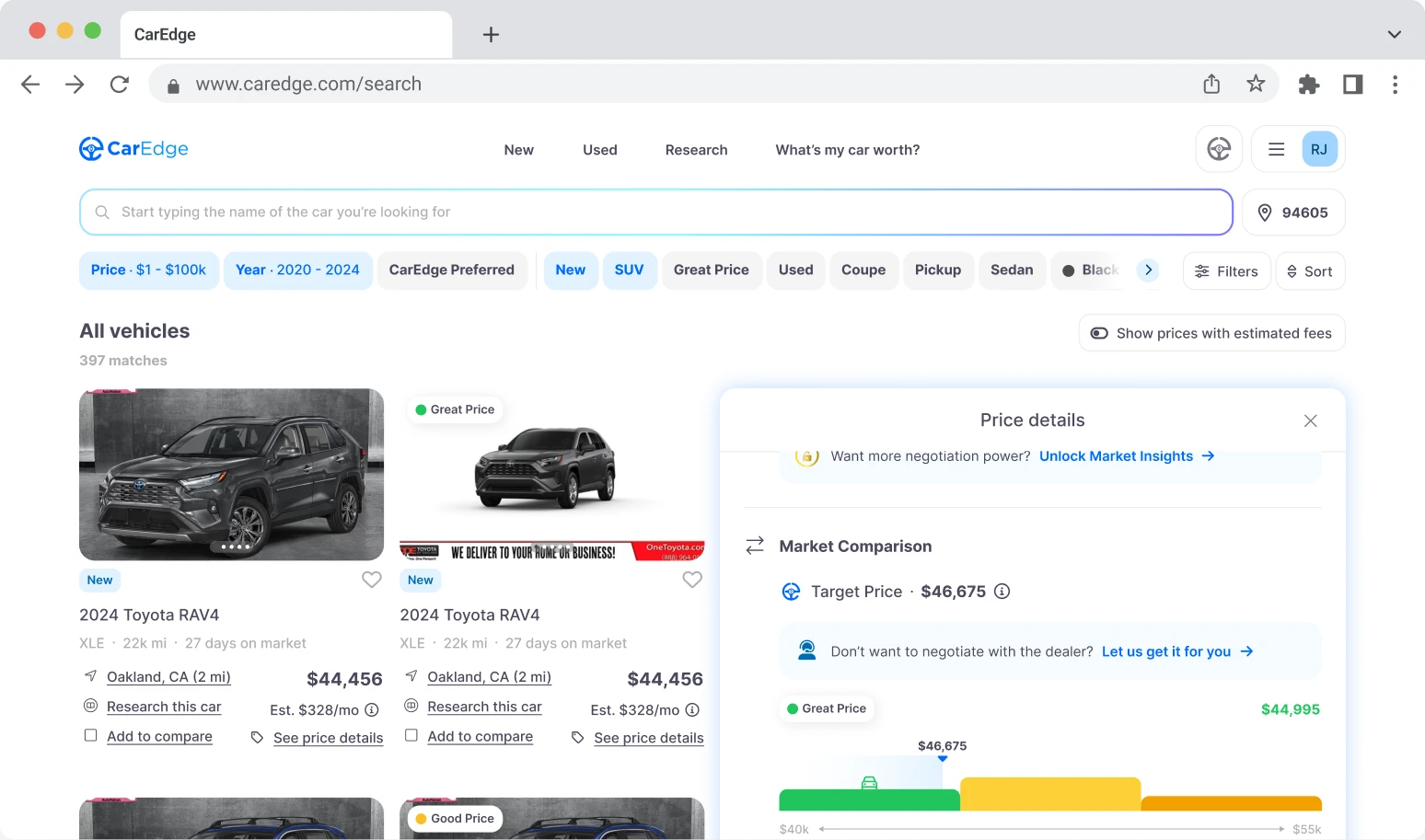
Find a wide range of vehicle listings with market insights on new and used listings near you.

What can I do with CarEdge?
 CarEdge Insights
What can I do with CarEdge?
Get access to exclusive information so you can make an informed car buying decision — all in one place.

Find a wide range of vehicle listings with market insights on new and used listings near you.
Track your vehicle’s value and cash in when the time is right to sell.

Access to our proprietary data to help you find the right car, at the right price. Find these unlocked on every listing after subscribing.

With our expert-led, tech-enabled car buying service, we will locate, negotiate, and deliver your vehicle so you can get a new car hassle free.


Help us personalize your CarEdge experience — it only takes a second.
Your answers help us personalize your CarEdge journey — we’ll follow up with tips and next steps that match your buying timeline.
All around the world, BMW has a specific reputation for providing quality, luxurious cars. However, buying a brand-new BMW is quite costly. That’s why we recommend going for the BMW certified pre-owned vehicle program. You can get into a BMW that’s been inspected and has a warranty without paying new car prices.
TLDR; We like the BMW certified pre-owned program. Although, the lack of a separate powertrain warranty does bring down the entire program. Most other programs include a powertrain warranty. We do appreciate that they add the CPO warranty to the end of the New Vehicle warranty. Their inspection process is thorough, and they offer great perks. The BMW CPO program is a great way to get into a BMW.
BMW says their CPO program is “selective from the start.” While that’s an excellent sales pitch, what does it mean? Here’s what we’ve gathered:
The lack of a specific age range is a bit concerning, but with a 60,000-mile maximum, most vehicles will only be a few years old. We love the program criteria because they require an up-to-date maintenance history for the car, which is not standard for other CPO programs.
Every BMW certified pre-owned vehicle includes comprehensive coverage that kicks in after the New Vehicle warranty expires. We love to see automakers add a new warranty to the end of the New Vehicle warranty instead of replacing it.
The CPO warranty has the same coverage as the New Vehicle warranty, described as “specific defects in materials and workmanship.” They also include a complete breakdown of what is not covered:
While this might seem like a long list of what they don’t cover, it’s all relatively standard for CPO programs. Most CPO programs are a little more specific about what they will cover. Based on our interpretation, BMW will cover repairs if they are related to a manufacturer defect.
The warranty may be transferred to a new party, which significantly increases your resale value.
Every BMW certified pre-owned vehicle comes with whatever is remaining on the New Vehicle Warranty, if anything, which lasts for four years and 50,000 miles. After that warranty expires, the CPO warranty kicks in, which provides one year of coverage with unlimited mileage.
Since one of the requirements to be in the BMW certified pre-owned program is to have less than 60,000 miles, it is possible to buy a CPO vehicle with a New Vehicle warranty that has already expired. Fortunately, you’ll still be covered by the new warranty. Although, this does mean you would benefit from buying a newer CPO vehicle, if possible.
You may purchase extended protection at any point during the warranty to extend your coverage. BMW offers a few different types of extended warranties that you can view on their website.
BMW performs a thorough inspection of every vehicle before it’s certified. Unlike almost every other automaker, they don’t talk about how many inspection points they have. Instead, they call it a “360-degree vehicle inspection.” Even on their inspection checklist, they don’t number the inspection points. So, what are they inspecting? Let’s take a look:
Something that jumps out about their inspection process is that their checklist has a section for “comments.” Most automakers have a simple “pass” or “fail” checklist. BMW may include this section for many possible reasons, but we like to think it was so they could more accurately describe the component’s condition.
Most automakers provide perks with every CPO vehicle they sell, and BMW is no different. Here are the bonuses you can expect if you buy a BMW certified pre-owned vehicle:
Some of these perks are standard, while others go above and beyond what is par for the course. Providing loaner cars directly from the dealership is a unique benefit and prevents the hassle of having to deal with a rental car business or going through the reimbursement process. We also appreciate the trip interruption perk.
We recommend the BMW certified pre-owned program. They provide a thorough vehicle inspection, although they don’t use the point-based system other automakers use. We do wish they offered a specific extended powertrain warranty. They make up for this lack of warranty with their other offerings, but overall the absence of a powertrain warranty does bring the program down. Ultimately, it’s an excellent program for someone looking to get into a BMW who doesn’t want to go for a brand-new car.
Buying a Ford certified pre-owned vehicle is a fantastic way to own a relatively new Ford that comes with a warranty and has been inspected. You don’t need to pay new car prices to have a car with a warranty. We often advise people to go for a CPO vehicle over a Craigslist used car since you know the vehicle you’re buying has been inspected and comes warrantied.
We’re about to dive deep into the Ford CPO program, where we’ll discuss the warranty, inspection process, and go over the perks they offer.
TLDR; Ford’s warranty is unimpressive, but it’s also not disappointing. They are offering an industry-standard warranty. Their inspection process, while thorough, is also industry standard. There’s nothing that jumps out as unique or exciting about the Ford CPO program. If you’re a fan of Ford, it’s still worth buying a Ford CPO over a generic used Ford off the side of the road.
The Ford certified pre-owned program includes two warranties that are on par with the industry standard. They don’t rise above the average, but they also don’t fall below it. To be eligible for the Ford CPO program, a car must meet the following criteria:
The mileage requirement is slightly higher than other automakers, who generally set the bar at 50,000 miles.
When you buy a Ford certified pre-owned vehicle, you’ll receive two warranties that cover different parts of your car.
Comprehensive Limited Warranty which covers over 1,000 components including:
Ford also provides a Powertrain Limited Warranty, which covers:
Both of these warranties are offering industry standard coverage. This can be considered a good thing since they aren’t dipping below the industry standard. However, we would like to see more components covered in the Comprehensive Limited Warranty.
The Ford certified pre-owned program provides two warranties of different lengths:
Both of these warranties are fully transferable to new owners with no transfer fee, enhancing your resale value.
Ford also offers Extended Service Plans, which cover more areas of the vehicle and have varying durations. These plans are available at a Ford dealer, and they do not post any information about them on their website.
It’s important to note that Ford does not explicitly mention what happens when you buy a CPO car that still has the New Vehicle Warranty. They should state whether or not that warranty will carry over, and if the CPO warranty kicks in after it expires. Perhaps it means you won’t be receiving a CPO warranty. This policy needs to be stated directly.
Both of their warranty durations are relatively standard for the auto industry. The Comprehensive Limited Warranty duration is the same as most other competitors, while the Powertrain Limited Warranty is slightly lower than others, as some offer ten years.
Every Ford certified pre-owned vehicle has been through a rigorous 172-point inspection. You can view the complete inspection checklist on their website, but we’ll go over the significant points:
Providing a 172-point inspection is more thorough than some competitors, but not by much. It is an average amount of inspection points. We’re unimpressed by their inspection process, but still, we aren’t disappointed in it.
We should highlight that this is Ford’s internal inspection. You should still have your own pre-purchase inspection done.
Every Ford certified pre-owned vehicle comes with many perks. Ford provides these perks both as a ‘thank you’ and to persuade you to buy a Ford CPO vehicle. The perks are:
This perk offering is pretty small as compared to other automakers. We’re a little surprised since Ford is such a big name in the auto world. Perhaps it’s for this reason that they don’t feel the need to offer too many perks?
Overall, the Ford certified pre-owned program is average in every way. They only fall below average with their perk offering, but that’s not as important. The critical aspects of a CPO vehicle are the warranty and inspection, and they’re perfectly average in those regards. Being average is certainly better than being subpar. We recommend this program for fans of Ford. If you are looking for a reliable certified pre-owned vehicle, Ford is an acceptable way to go, but there are other automakers with better programs.
Buying a Kia certified pre-owned car means your new vehicle has been thoroughly inspected and comes with a comprehensive warranty. Nine times out of ten suggest going for a certified pre-owned vehicle over a Craigslist used car, as long as the financials make sense.
We’re about to review everything you need to know about the Kia certified pre-owned program, including warranty information, the inspection, and the bonuses.
TLDR; Kia has a standard CPO program, which is a good thing. The platinum warranty is transferable for a $40 fee, which increases your resale value. We need to highlight that the powertrain warranty begins on the date that the car was initially sold, or as Kia put it, when the odometer was at 0.
There are no surprises in the Kia certified pre-owned warranty. We expected that the powertrain warranty would begin on the initial sale date, but that’s something we always like to highlight to avoid confusion.
Not every Kia is eligible to become a certified pre-owned car. To qualify for the Kia certified pre-owned warranty, a vehicle must meet the following criteria:
Comprehensive Platinum Coverage
Limited Powertrain Warranty:
The official Kia website says that exact coverages, exclusions, and limitations apply, but you’ll have to review your contract or see a dealer for details. This lack of transparency is a mark against them since they don’t make these conditions publicly available on their website.
It’s worth noting that Kia’s program has a $50 deductible per visit for warrantied repairs. This fee is unusual for the industry and something we definitely don’t like. However, some other automakers charge deductibles on their CPO extended warranty, so this isn’t unique to Kia.
The warranty is mostly what makes buying a pre-owned vehicle worthwhile. Kia provides two warranties with different lengths with all of its CPO vehicles:
Any Kia certified pre-owned vehicle that still has the initial manufacturer powertrain warranty, which is 10 years or 100,000 miles, will be transferred to the new owner. Since the minimum requirements to qualify for the program are 5 years or newer and less than 60,000 miles, every Kia CPO car will come with the powertrain warranty. The difference will be how much longer you have left on it, based on the car’s age and mileage.
Both warranties are fully transferable to a new owner. Thanks to this transferability, your resale value on your Kia certified pre-owned vehicle is boosted, although there is a $40 fee.
The Kia certified pre-owned program includes a 164-point inspection. You can view the entire inspection check sheet at the manufacturer’s website. Any inspected vehicle must score 100% to be certified. We’ll go over the main points with you:
Kia makes special mention that they use manufacturer-authorized parts for any repairs made during the inspection process. This policy is ideal because many aftermarket parts are known for failing much faster than manufacturer-approved parts.
We should note that Kia inspects more about each car than many other automakers. This extra level of care gives us confidence that their program is only offering the best cars available.
Every car manufacturer likes to add in some bonuses to tempt you into buying a CPO car. Here’s what Kia offers:
Ultimately, these perks alone don’t do much to make a CPO car worth it. We think the inspection and warranty are what make a CPO vehicle worthwhile. These perks are just a nice add on.
The Kia certified pre-owned program is well-rounded and undoubtedly in line with the industry standard. There are no surprises. The warranties they offer will give you some peace of mind for the beginning of your car’s life. Buying a certified pre-owned vehicle is exponentially better than going for a random used car that hasn’t been inspected by anyone.
Whether you’re going through eBay, Craigslist, or Facebook Marketplace, you need to know how to buy a car from a private seller. We’re here to arm you with information you can use to secure a reliable car and avoid scams (which are all too prevalent on these peer to peer websites).
You’re about to learn a few easy-to-remember things about how to buy a car from a private seller that will guarantee you are purchasing a roadworthy vehicle. Our hope is that you don’t end up like Riley, or John.
You should ask if the seller has the title to the car before you even agree to meet them. In your first or second message to them on your chosen platform, ask if they have the title. If they say yes, you should inquire if the title is in their name.
That last part is vital – the title must be in their name. Something you should know about buying a car from a private seller is that some people “jump” the title. This term means they’ve purchased the vehicle from another seller and are now trying to sell it to you without putting the car in their name first. While legal, jumping the title is extremely risky.
You want to avoid someone who is attempting to jump the title because it may indicate they have stolen the car. Surprisingly, some car owners store their title in their glove box (please, never do this!). If someone steals that car that has the title in the glove box, not only do they have a car, but they also have the title. All they have to do is sign the back of the title, and they can sell the car to you.
If you end up buying a stolen vehicle, you’ll end up losing the car. It will likely happen when you go to transfer the title to your name. If you’re lucky, they’ll only take the vehicle and bring you in for questioning. If you’re unlucky, well, it could get much worse.
Of course, purchasing a stolen vehicle is a worst-case scenario. The point is that the person whose name is on the title should be the person that you’re dealing with. Even if the person selling the car claims the title is in their spouse’s name, don’t buy that car.
It’s simple; you need to know the history of the vehicle you want to buy. While an honest seller will tell you everything they know, they might leave something out or not know the entire story.
Grab the VIN from them before you meet up and buy a Carfax report (are those reports trustworthy?). The cost of a Carfax report is well worth it to know everything about the vehicle.
The main things you’re looking for on the report are:
Another alternative to a Carfax report is to contact your insurance company. They have a wealth of information at their disposal that goes beyond what you could find by Googling the VIN.
However you go about it, be sure you have all of the information you can find about this vehicle. You need to be positive that you aren’t buying a salvage title (unless you want to) and that you are aware of every accident the car has been in.
We always suggest getting a pre-purchase inspection before buying a car, whether you’re buying from a private seller or a dealership.
A pre-purchase inspection is a specific type of vehicle inspection that a mechanic performs in which they look over the car for any apparent issues. They inspect it for any signs of damage, leaks, and any parts that will need to be replaced soon.
The goal of a pre-purchase inspection is to get a well-rounded picture of the vehicle that you’re looking to buy. Depending on the mechanic, they’ll likely give you an overall opinion: “yes, buy this,” or “no, avoid it.”
Combined with the Carfax report, the pre-purchase inspection paints an image of the car’s history and gives you a glimpse into the future. You might discover that the lower control arms are going out or that the alternator is failing. This information can be used to negotiate with the seller or help you decide to avoid buying the vehicle altogether.
Something you should know about how to buy a car from a private seller is that if the seller refuses to let you have the vehicle inspected, just walk away. They could be hiding something intentionally, or they may just be a pain to work with. If they’re worried about handing you the keys to take it to the mechanic, have them go with you.
Due to the price tag and people’s naivety, the private car selling world is filled with various scams. You can avoid most of them by following one piece of advice: if it sounds too good to be true, then it is.
The most common types of scams that we see have to do with how you pay for the car, such as:
You should only pay for the car with traditional forms of payment. Of course, you should only buy a car you’ve seen in person. That’s right; some scammers try to get people to pay for vehicles they don’t even have.
Information is your greatest tool when it comes to buying a car from a private seller. You should know everything about the vehicle that you possibly can. You should also know simple tips, such as making sure the seller is listed on the title and not paying for the car with strange forms of payment. By arming yourself with information, you’ll be ready to buy a car from a private seller.
Buying a Chrysler certified pre-owned vehicle is a great way to buy a quality car without having to pay brand new sticker prices. A CPO vehicle has been thoroughly inspected and comes with a warranty to give you peace of mind. We will always suggest buying a CPO car over a generic used car if for nothing other than the peace of mind that comes with a certified pre-owned vehicle.
We’re about to dive deep into the Chrysler CPO program and discuss the warranty, inspection process, and the added perks. You’ll see why we suggest buying a CPO car over a “side of the road” used car whenever we can.
TLDR; The basic warranty is far too short. This short warranty brings down the entire CPO program. However, the powertrain warranty is thorough and will almost make up for the poor basic warranty. The add-on perks are standard but still a great addition to the program. The inspection points are a bit lower than competing automakers. Overall, this is a substandard program, but it still beats a standard used car.
Chrysler’s warranty has a short basic warranty but an extended powertrain warranty. We consider their program to be below average overall, largely because the basic warranty is quite substandard.
To qualify to be in the Chrysler CPO program, a vehicle must meet several conditions:
Chrysler certified pre-owned vehicles come with two warranties:
Basic Warranty:
Powertrain Warranty
All covered repairs also have a $100 deductible. While this may not seem like much, it can add up quite quickly if there are frequent repairs.
Both warranties are fully transferable to a new party for a $150 fee. Being able to transfer the warranty dramatically increases your vehicle’s resale value, although that depends on where you sell your car.
The Chrysler certified pre-owned program offers two warranties with different durations:
The issue that stands out the most, is the length of their basic warranty. Three months and 3,000 miles is far too short. Think about the frequency of oil changes in your current car; that’s how long the basic warranty is. We don’t think that’s long enough for manufacturer defects to appear.
Chrysler offers Certified Upgrade Plans if you wish to extend your basic warranty. Each plan will begin on the date of purchase and will also have a deductible for covered repairs. Chrysler does not provide specific details about these upgrade plans, and their website directs you to contact your dealer.
Chrysler does not inspect as many components as other manufacturers, such as Kia, Mazda, or Honda. However, the inspection is still quite thorough and is much better than an uninspected used car. The Chrysler certified pre-owned program inspects 125 points. You can view the exact Chrysler certified pre-owned checklist here, but we’ll cover the significant inspection areas below:
While other manufacturers’ inspections have more inspection points, we believe that the Chrysler inspection is thorough and covers all the crucial points.
It’s worth noting that every car must pass the inspection with a score of 100%; otherwise, it is not certified.
All automakers like to include a few perks as part of their CPO plan, and the Chrysler certified pre-owned plan is no different. Each CPO vehicle purchase includes:
Overall, the Chrysler perk offering is relatively standard in the auto industry. These perks shouldn’t persuade you to buy a Chrysler CPO, but they serve as a nice bonus.
We think the Chrysler certified pre-owned program is slightly below average based on industry standards. Their inspection points are lower than many other automakers, and their basic warranty is far too short.That being said, we still advise buying a Chrysler pre-owned vehicle over a generic used car thanks to their inspection and warranty. Make sure you always get a pre-purchase inspection from an unbiased third party, though. We want to make sure that you buy a car in excellent condition.
There are a multitude of factors that affect the value of a used car. The vehicle’s condition, any remaining manufacturer warranties, etc, etc. One way you can take the guesswork out of the used car buying process is by choosing a used vehicle that’s been certified pre-owned by the manufacturer. We put together this Subaru certified pre-owned review to help simplify the buying process so you can choose your next used Subaru with confidence.
Choosing a certified pre-owned vehicle offers the assurance that the car or truck you’re considering meets the specifications set by the manufacturer. With Subaru, used cars that meet these company specifications have passed a 152-point inspection and are covered by the Subaru Certified Pre-Owned Warranty.
Subaru vehicles have a reputation for quality, with 97% of the models sold over the past 10 years still on the road today. In addition to a solid reputation for quality, Subaru Certified Pre-Owned Vehicles offer you a number of assurances about what you can expect when you buy one of these pre-inspected vehicles.
Technicians who have been trained by Subaru inspect and recondition these used vehicles to like-new condition. If the technicians find anything that doesn’t meet safety specifications during the inspection, it either gets repaired or replaced before hitting the showroom floor.
For a full list of items checked in the 152-point inspection, you can click here.
The CPO warranty extends the original 36,000 mile/3-year warranty. When you choose a Subaru that’s backed by the company’s certified pre-owned warranty, you’re provided with a CARFAX vehicle history report, full documentation for the vehicle, and two sets of keys and remotes.
This coverage includes:
Powertrain Components That Are Covered
Transaxle, Transmission and Differential Parts That Are Covered
Hybrid System Subaru Warranty
For hybrid Subaru vehicles, hybrid system parts that are covered include:
The certified pre-owned warranty from Subaru protects your investment in your vehicle with coverage for up to seven years and 100,000 miles on the powertrain, beginning at the date the vehicle was purchased new. It additionally comes with a $0 deductible on all-wheel-drive components, the engine, and the transmission when repairs are performed by a covered Subaru dealership.
We hope this Subaru Certified Pre-Owned information helps simplify your car-buying experience. We know there’s a lot of information to process when you’re buying a car, and we’re here to help with plenty of details!
Choosing a vehicle from the Subaru CPO inventory offers buyers some extra perks. Special finance rates as low as 0.99% for well-qualified buyers and no down payment is the first of these perks. The company also offers additional coverage for buyers who choose a vehicle from the Subaru certified pre-owned selection.
The additional coverage is available in two package plans, the CPO Classic Plan and the CPO Gold Plus plan, both of which include roadside assistance.
The CPO Classic plan covers towing and rental reimbursement plus approximately 1,000 parts in the major component areas of a vehicle, including:
The CPO Gold Plus plan covers towing and rental reimbursement plus hundreds of parts that aren’t covered by the CPO Classic plan. This plan reimburses for meals and lodging if your Subaru breaks down when you’re traveling out of town. Travel assistance, such as trip routing and a retailer location service are also included with this plan.
Under these warranty plans, you aren’t charged for covered repairs, including parts and labor. That protects you from the cost of repairing or replacing defective parts. Your Subaru dealer will choose between remanufactured and new Subaru parts when performing repairs under the CPO warranty.
If you need to file a claim under your Subaru CPO warranty, it’s important to file it as soon as you discover a defect, and before the warranty period ends. Subaru of America recommends that you take your car to the dealer who sold it to you for repairs, but if that isn’t an option, you can take it to any authorized Subaru dealer.
If you are unable to drive your vehicle to the dealership for repairs, Subaru of America pays the towing cost under the terms of the CPO warranty. In some cases, Subaru will cover the cost of emergency repairs at non-dealer facilities, and the terms regarding this are found in the warranty information that’s linked above.
Buying a Ram certified pre-owned vehicle is an excellent option for anyone who wants to get into a quality vehicle without paying new car prices. They offer a thorough 125-point inspection to ensure that any car they certify won’t break down on you any time soon.
We’re about to cover everything you need to know about the Ram certified pre-owned program, including the warranty, what’s inspected, and other add-ons. Of course, make sure you research your ideal car well before you visit the dealership.
TLDR; The Ram certified pre-owned program is average, which is a good thing. The 125-point inspection has a few points less than other manufacturers, but it’s still comprehensive. We don’t like the $100 deductible for covered repairs, as that could add up over a vehicle’s life. The short bumper-to-bumper warranty is also unfavorable.
Ram has a decent warranty for their certified pre-owned vehicles. It’s nothing spectacular, but it’s not terrible. We consider this warranty average for the industry.
The most common questions people ask regarding a certified pre-owned program are about the warranty. Any Ram certified pre-owned vehicle comes with two warranties covering different parts of the car.
Maximum Care Warranty:
Powertrain Limited Warranty:
One of the significant downsides of the Ram certified pre-owned warranty is the deductible. This deductible is unusual for CPO warranties, and we hope someday Ram reconsiders this fee.
These warranties are transferable if you sell your car while it’s still covered. However, there is a $150 fee to transfer the warranties. This fee seems unnecessary and makes the Ram CPO warranty worse in our eyes.
The Powertrain Limited Warranty lasts for seven years or 100,000 miles, whichever comes first. It’s worth noting that both numbers began when the vehicle was sold as new, not from when you buy it.
The Maximum Care Warranty is good for three months or 3,000 miles, whichever comes first. We think this is absurdly low, considering 3,000 miles is an average oil change interval. This coverage interval is also short by industry standards.
Ram certified pre-owned warranties also come with three different Certified Upgrade Plans. Each of these plans begins on the date of purchase. They also require a deductible. The official Ram website does not provide additional details on these upgraded plans and directs you to visit a dealer.
Ram is quite proud of their inspection checklist. Every vehicle that earns the title of certified pre-owned will undergo this inspection.
Before being inspected, every vehicle must meet the following criteria:
Once a car meets those criteria, it moves on to the inspection. You can view the complete checklist on the Ram official website:
Any Ram certified pre-owned has gone through intensely thorough testing. The rigorous testing is why we also suggest going for a CPO vehicle over a ‘side of the road’ used car. A CPO has been tested and is proven to be a safe buy.
While the inspection and the warranty are the main selling points of buying a CPO vehicle, automakers like to add some bonuses. Purchasing a Ram certified pre-owned car comes with some of these perks:
We like the perks, we like the powertrain warranty, and we appreciate the thorough inspection. Ultimately, the Ram certified pre-owned program is par for the course. They compete with other car manufacturers but fall short in some areas, such as the Maximum Care Warranty (3,000 miles is too low!). However, buying a pre-owned vehicle is always better than buying a standard used car and making some mistakes. Depending on the numbers, we always suggest going for a CPO vehicle.
You’ll feel confident with your purchase when buying a Mazda certified pre-owned vehicle. Their 160-point inspection carefully scrutinizes and tests every major and minor component in each car before it earns the ‘certified pre-owned’ designation.
We’re about to go over the warranty that comes along with buying a Mazda CPO, along with talking about what that warranty covers, and then looking at the inspection process itself. We’ll also take a look at what else comes with a Mazda certified pre-owned vehicle. If this is your first time buying a car, we also suggest learning a few car buying tips to help you out.
TLDR; Mazda’s certified pre-owned program is pretty standard, which is a good thing. There are no surprises. Each car receives a thorough inspection and is then covered by a good warranty. The only part we don’t like is that the powertrain warranty begins when the vehicle is first sold, not when you buy it. Other than that, we like the Mazda certified pre-owned program.
After a vehicle has completed the inspection process and passed with flying colors, it is then sold with a Mazda certified pre-owned warranty. That warranty will cover any manufacturer defects that arise, with no deductible on repairs (provided you go to a Mazda dealership).
Mazda has a somewhat average, yet still useful, certified pre-owned warranty. Their CPO warranty comes in two parts and covers:
CPO Vehicle Limited Warranty
Limited Powertrain Warranty
Please be aware that these warranties don’t mean that every issue you encounter will be covered. For one, they won’t cover accidents. For two, there are numerous caveats in the fine print:
That might seem like a ton of fine print. Essentially, do all your maintenance and services at Mazda dealerships, be a responsible owner when it comes to usage and modifications, and your warranty will remain intact. While we’re on the topic of fine print, it pays to learn some auto industry jargon before you visit the dealership.
The limited vehicle warranty, which you could also call a bumper-to-bumper warranty, lasts for 12 months or 12,000 miles. The powertrain warranty lasts for seven years or 100,000 miles; however, those numbers start when the car was initially sold.
One nice aspect of the Mazda warranty is that if the CPO vehicle is still covered by the New Vehicle Limited Warranty (3-years, 36,000 miles), that warranty remains in effect. Once that warranty expires, then the CPO Limited Vehicle Warranty kicks in. Keep this in mind when shopping for a Mazda certified pre-owned vehicle; the newer, the better.
Both of the warranties they offer on CPO cars are transferable to the new party if you decide to sell your car, too. The warranties increase your resale value should you decide to sell within the warranty’s timeframe.
Mazda certified pre-owned vehicles undergo a 160-point inspection before being certified and receiving the warranties discussed above. You can view more about their assessment in the official CPO brochure, but we’ll go over some of the main points:
They’ll also perform any required maintenance, such as giving it an oil change before leaving the inspection facility.
Please note that this is different from a pre-purchase inspection, which you should definitely also have done.
Mazda has included quite a few perks to tempt people into buying a Mazda certified pre-owned car.
One great perk that Mazda provides is 24/7 emergency roadside assistance for the duration of the seven-year / 100,000 powertrain warranty. Their roadside assistance covers:
Every Mazda certified pre-owned car also comes with a complete AutoCheck vehicle history report and three-year buyback protection provided by Experian.
Mazda provides all CPO customers with a 3-month subscription to SiriusXM, too. Not necessary, but something you might appreciate.
It’s worth noting that Mazda does not provide any allowance for a rental car if your vehicle is in for warrantied repairs, unlike some other manufacturers. This is where a third party vehicle service contract could provide additional value to you.
We believe that Mazda certified pre-owned vehicles are thoroughly inspected, fairly warrantied, and the right car can be a great buy (depending on the financial numbers). Buying a certified pre-owned has many advantages over buying a standard used car and should always be a priority.
Buying a certified pre-owned vehicle is a great way to have the sticker price of a used car but with all of the same confidence you have when purchasing a new car. You’re guaranteed to receive a car that has undergone a comprehensive inspection to ensure that everything is as it should be and the vehicle is ready to sell.
Compared to buying a used car off of the street, it instills a lot of confidence in the vehicle that you’re buying. We’re about to go into the Dodge certified pre-owned warranty, their inspection process, and other perks you get when you buy a Dodge CPO.
TLDR; We love the length of the powertrain warranty. It’s one of the best in the industry. They also provide some useful perks that every automobile owner will appreciate. We dislike the short bumper-to-bumper warranty, though. The $100 deductible for repairs under warranty is also unreasonable, as many manufacturers do not charge a deductible.
To qualify for the inspection process and become a Dodge certified pre-owned vehicle, the automobile must be less than 5 model years old. It also must have less than 75,000 miles.
If a vehicle meets the criteria, then it can be part of the program. After inspection, they are sold with the Dodge certified pre-owned warranty. This warranty covers a variety of issues that stem from manufacturer defects (accidents are not covered).
Dodge has an interesting philosophy when it comes to their CPO warranty. They want to cover the powertrain for quite some time, but the bumper-to-bumper coverage is extremely short. Let’s take a look:
Bumper-To-Bumper Warranty:
Powertrain Warranty
One major downside to both warranties is that there is a $100 deductible for covered repairs. Such a deductible is unusual in the industry; most manufacturer warranties have no deductible. Over the life of a vehicle, those $100 deductibles can undoubtedly add up. There’s a lot to know about why warranties are so often sold, and the fees are part of it.
The Dodge certified pre-owned bumper-to-bumper warranty lasts either 3,000 miles or three years, while the powertrain warranty lasts 100,000 miles or seven years.
Our most significant critique of the Dodge certified pre-owned warranty is easily the short length of the bumper-to-bumper warranty. We think 3,000 miles is absurdly low, and someone who drives a relatively average amount could rack that up in just a few months. Think about how often you get an oil change – that’s how long the warranty lasts.
The powertrain warranty even beats the new Dodge vehicles’ warranty by two years (they include a 5-year warranty).
It’s interesting how there’s such a stark contrast between the two Dodge warranties offered in the CPO program. While we’re uncertain about their motivations or philosophy, we do appreciate the extended powertrain warranty. Purchasing a third-party vehicle service contract to “extend” the bumper-to-bumper warranty is not a bad idea when it comes to Dodge CPO vehicles.
Dodge has a 125-point inspection that certifies that the vehicle is in roadworthy condition. They’ll lose money if they approve a car that breaks down a few miles down the road since every CPO vehicle comes with a warranty.
What’s on the inspection list? You can read the full list on their official website, but we’ll go over a few highlights:
As you can see, it’s quite a thorough list. However, it’s on par with the inspections performed by other vehicle manufacturers in their certified pre-owned programs. All of the manufacturers try to one-up each other with their inspection list, and over the years, this practice has resulted in most of them being quite similar.
Before you visit the car dealership, make sure you know our tips for first-time car buyers.
Many car manufacturers like to throw in extra bonuses with their CPO vehicles, and Dodge isn’t any different. Buying a Dodge with a CPO warranty provides the following perks:
We don’t think the Dodge certified pre-owned warranty is industry-leading by any stretch of the imagination, but the transferability and extended powertrain warranty are certainly highlights. As long as you’re getting a good out-the-door price on it, a pre-owned Dodge is a decent way to go. The inspection alone is why we always suggest going for a certified pre-owned vehicle over a random used car, when at all possible.
Knowing when dealers are highly motivated to sell can help you plan your car purchase around the best deals. Our team of Car Coaches has decades of combined experience, and always keeps a pulse on the auto market. There was no debating the best times to buy a car. Let’s dive in.
There are plenty of myths and claims about when you can get the best prices on cars. Many of these include specific holidays as well as certain days of the month, specific days of the year, and even exact times of the day. Some of these myths are based on observable trends in the auto industry, so let’s dig into those that hold the most merit.
For starters, it’s commonly understood that Mondays are the slowest day of the week at dealerships. So, if you’re in the market for a car and want to gain the rapt attention of a salesperson looking to make a deal or to meet a quota, consider visiting a dealership at midday on a Monday.
Another quirky fact is that shopping during poor weather can be an excellent way to get a better deal. This is because poor weather conditions generally deter customers from walking around car lots, and employees are anxious to make a sale for the day or to meet their quotas.
The key word in all of this, though…is quotas.
Dealers are assigned sales goals for each month. That means both management and sales staff at dealerships are inclined to offer better deals as their deadline approaches. So, if you visit the dealership on the last business day of the month, it gives you a bit more leverage in the negotiations.
Traditionally, January and February are difficult months for dealers, depending, of course, on other aspects of the economy. This makes it even more likely that a dealer may offer better deals for buyers during this time span. It seems too simple to be true but imagine shopping on Monday at midday during a snowstorm at the end of February. Now, you could be hitting the sweet spot!
Dealers aren’t the only individuals setting targets. Automotive manufacturers establish end of quarter goals for dealers which means the end of each quarter presents buyers with an opportunity to save some money. As you might expect, these quarters typically end in March, June, September, and December.
The last few days of December represent the absolute best time to buy a car because automotive manufacturers, dealers, and sales staff are highly motivated to achieve year-end sales goals. This motivation to negotiate comes from the fact that dealers get year-end bonuses from manufacturers when annual sales quotas are met.
Factory-to-dealer incentives can add up to a significant amount of income for dealers, so it’s common practice to offer enticements such as discounted prices, significant rebates, and special financing terms to customers as a financial benefit to both the buyer and the dealership.
Using a savings of at least 5% as a worthwhile objective for a customer (which can amount to a savings of over $1,100), research shows that the following holidays have been identified as some of the best days to buy a car.
It’s worth noting that the whole week from Christmas to New Year’s is the peak week for deals. In addition to being the holiday season, these days fall during the end-of-month, end-of-quarter, and end-of-year sales quota period for dealers, all of which can add up to great deals for car buyers.
Obviously, the best time to purchase a vehicle is when you don’t need one, but remember that your finest negotiating strategy, other than choosing the right day and best time to buy a car, is your willingness to walk away without one.
Print this 100% free car buying cheat sheet and strategy card!
Furthermore, it’s ok to mention that you know about sales quotas set by manufacturers. It’s alright to ask how much closer the dealership wants to get to its monthly, quarterly, or annual sales goals. Tell the manager that for the right price you’re willing to help the dealership get closer to hitting those targets.
Looking for car buying help? The CarEdge Team is ready to help you save thousands, and also to avoid the stress of car buying hassles.
CarEdge Coach is your path to 1:1, personalized help with your car deal.
Prefer a DIY route? Learn more about CarEdge Data‘s unparalleled insights.
Simply want to chat with an expert? Try a CarEdge Consult anytime.
We’re here to help. Remember, learning how to negotiate will save big time!