
CarEdge saved me over 4,500 dollars on a brand new Honda Pilot. I can't say thank you enough.
Price intelligence
Find a wide range of vehicle listings with market insights on new and used listings near you.
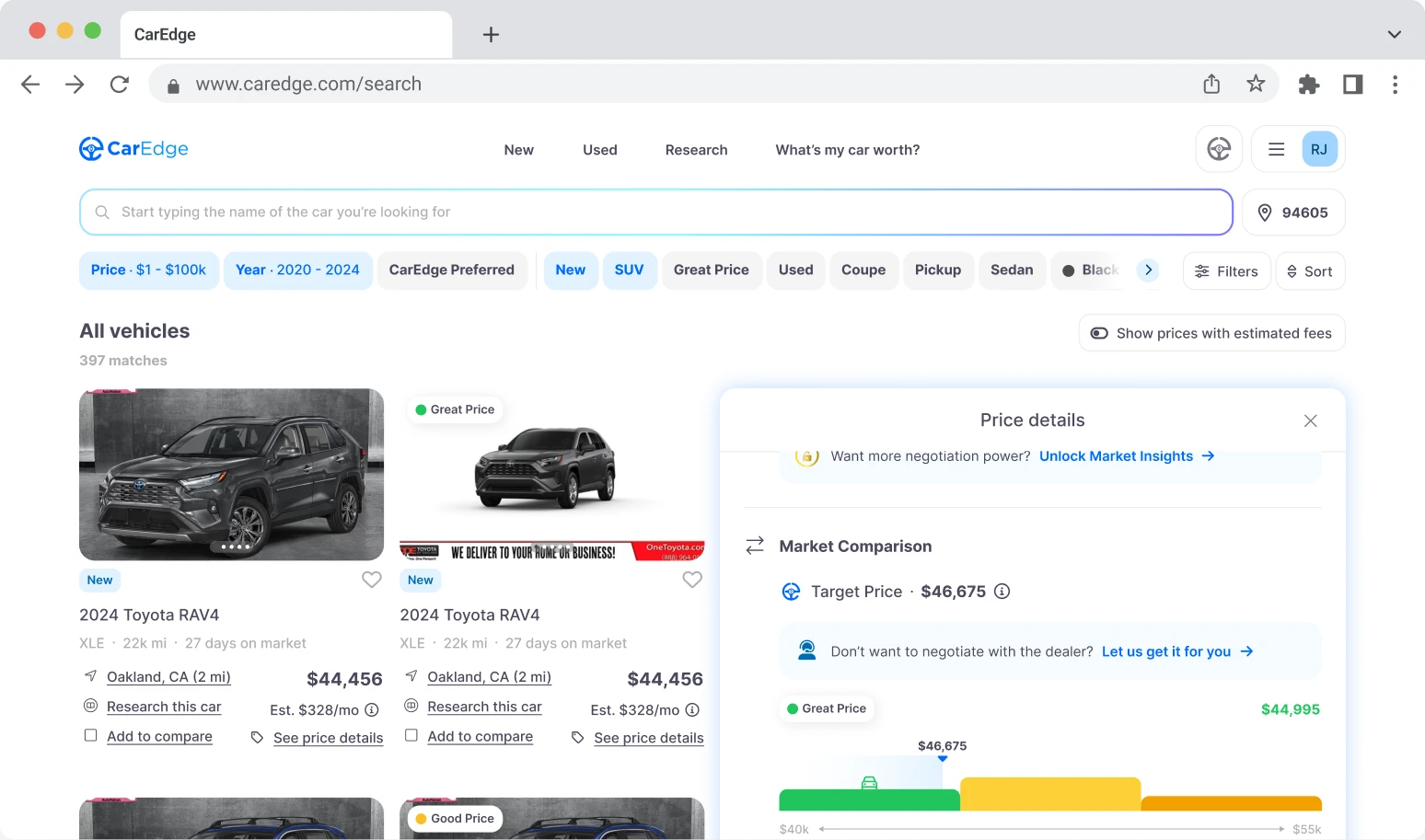

What can I do with CarEdge?
 CarEdge Insights
What can I do with CarEdge?
Get access to exclusive information so you can make an informed car buying decision — all in one place.

Find a wide range of vehicle listings with market insights on new and used listings near you.
Track your vehicle’s value and cash in when the time is right to sell.

Access to our proprietary data to help you find the right car, at the right price. Find these unlocked on every listing after subscribing.

With our expert-led, tech-enabled car buying service, we will locate, negotiate, and deliver your vehicle so you can get a new car hassle free.


Help us personalize your CarEdge experience — it only takes a second.
Your answers help us personalize your CarEdge journey — we’ll follow up with tips and next steps that match your buying timeline.
Cadillac has a long-held reputation for providing a luxurious ride. Depending on who you ask, they’re also the epitome of class. Anyone looking to drive a Cadillac should consider the Cadillac certified pre-owned (CPO) program. It’s a way to buy a slightly used, inspected, and warrantied Cadillac, which is better than buying used and cheaper than buying new.
We’re about to go through the Cadillac CPO program, including the warranty, inspection process, and any provided perks.
TLDR; We’re displeased by the Cadillac CPO program. The warranty they offer for their CPO vehicle isn’t long enough. While their inspection is thorough, we would like Cadillac to extend their warranty and bring back the powertrain warranty that came with all Cadillacs for five years.
Cadillac won’t allow any used car to become a CPO vehicle. To become a Cadillac certified pre-owned vehicle, the following criteria must be met:
Once these conditions are met, the car will be warrantied and sold as a Cadillac CPO vehicle.
Every Cadillac certified pre-owned vehicle includes a Limited Warranty, which is an extension of the Bumper-to-Bumper warranty that’s sold with every new car. This warranty covers most components of the vehicle. However, Cadillac does not include a specific exclusions list, unlike other automakers (Audi has a public exclusion list).
To be covered by this warranty, the issue must stem from a manufacturer’s defect. If the problem is related to misuse, neglect, abuse, or modification, the repairs will not be covered.
Get the information & insights dealers don’t want you to have! It’s like Honey, but for buying cars, trucks, and SUVs. Sign Up For Free
All repairs must be completed at a Cadillac dealer. This policy is standard for all CPO programs. There is no deductible for warrantied repairs, which is something that we greatly appreciate.
Third-party sources say that the warranty is transferable, but we’re unable to find any information on the warranty transferability on the official Cadillac certified pre-owned website. You’ll need to ask the dealer about transferability.
Every Cadillac certified pre-owned vehicle comes with a one-year Limited Warranty with no mileage cap. This warranty is active either after the expiration of the new vehicle Bumper-to-Bumper warranty or when you buy the CPO vehicle.
The original Bumper-to-Bumper warranty is good for four years or 50,000 miles. Compared to the requirements to participate in the CPO program, it’s entirely possible that you buy a car that doesn’t have a new vehicle Bumper-to-Bumper warranty. Fortunately, you’ll still be covered for one year with the CPO warranty.
It’s worth mentioning that model years 2012-2017 included a six-year and 100,000 miles powertrain warranty. If you purchase a vehicle within these years, you’ll retain the remainder of the powertrain warranty.
We don’t think a one-year warranty is sufficient for a CPO vehicle. Cadillac should lengthen the warranty and bring back their powertrain warranty. Offering a one-year warranty means that you have the equivalent of a few oil changes to discover any of the manufacturer’s defects. Considering it can take years for issues to show up, even when related to a defect, you could end up with repairs that would otherwise be covered.
General Motors offers a one-year warranty as well, but they also include a powertrain warranty to make up for it. Cadillac should follow suit.
Before being sold as a Cadillac certified pre-owned vehicle, the car must pass a 172-point inspection. You can view the entire checklist online, but we’ll cover the major sections below:
Cadillac’s inspection seems thorough and touches on all the crucial parts of a vehicle. Their inspection process boasts 172 points, which is slightly above the average amount of inspection points.
Every automaker provides some perks to go with your new certified pre-owned vehicle. Cadillac offers the following bonuses:
The above rewards are standard for a CPO program. Providing a courtesy vehicle if you need warrantied repairs is a nice perk, but many automakers include a similar bonus. While we’ve seen some CPO programs with fewer perks, we’ve also seen plenty of programs that offer more perks. Either way, we don’t think bonuses should play an essential role in helping you make a car purchasing decision.
Overall, we are not impressed by the Cadillac certified pre-owned program. The main reason is that they offer a CPO warranty that is far too short. One year is not long enough. Although other automakers offer similar warranties, we think this is too short to discover the manufacturer’s defects.
If you buy a Cadillac certified pre-owned vehicle, make sure to have a third-party mechanic perform a pre-purchase inspection before signing any paperwork. They’ll double-check the inspection and make sure it’s in prime condition.
Anyone who dreams of driving a Cadillac should consider their CPO program. However, if you’re only looking for a reliable CPO vehicle with a good warranty, there are other programs out there to explore.
Some car dealers do everything they can to be honest and showcase their integrity. Others do whatever they can to make an extra buck. While we’d love to tell you about all the great car dealers out there, we’re here to be your advocate in the car buying process. A big part of advocating for you is arming you with information.
Today, we’re going to take a look at unethical car dealer practices that you absolutely should be made aware of before you buy a new car. Even if a friend recommends your car dealer, even if you have a friend who works there, you should know about these practices.
We’re about to cover unethical car dealer practices that occur at every stage in the car buying process, from advertising a price you’ll never get, to packing your loan payments, to getting kickbacks from lenders.
We recently received an email from a reader in which they linked us to a dealership that was advertising two different prices: one if you financed with them and one of you didn’t. Guess which price was higher?
If you decided to finance with them, they gave you the price advertised in big, bold letters. Otherwise, you paid $1,000 more to use your financing option. Essentially, you must finance at the dealership and agree to whatever rates and terms they set up for you, or you’ll pay more.
This practice is not exactly common, but it does tie into more common practices. Car dealers often advertise prices that aren’t even available to most customers. The advertised price includes every available rebate, such as a first responder or recent graduate rebate. Then, when you show up to buy the car, they tell you that you don’t qualify.
Another prevalent practice is not including the price of tags, title fees, and other related expenses that they could easily add to the advertised price.
Essentially, one of the primary unethical car dealer practices that you absolutely must know is that the advertised price is not always what you’ll end up getting. You should research the market price of any potential car before you even visit the dealership so that you know what you should be paying. In other words, do your homework.
Let’s play out a scenario: you walk into a shady car dealership, and a salesperson starts asking you questions. One of the earliest questions they’ll ask is, “how much can you pay per month?”
If you say $350, you can be confident they’ll do mathematical gymnastics to make sure that you pay $350. The financing managers do this by tweaking the loan amount and the APR until it works out that you’re paying either the exact amount, or more, than what you said you could afford.
So, if the loan should’ve been $300 but they inch it up to $350, then you’ll end up paying an extra $2,400 over a four-year loan. That’s not a small amount of money that could otherwise be in your pocket.
This practice is called packing or loading payments, and it’s a hard practice to detect.
If you do end up agreeing to the packed loan, you better believe they’ll pull out any other tricks they have to squeeze you out of every dime. It’s better to push back and be firm on how much you will pay, and please, don’t be afraid to walk away from the dealer. You always have the option of walking away from a situation where it feels like they’re taking advantage of you.
Your best defense against having packed payments is to secure your financing from your bank or credit union. Other than that, you can also do plenty of research before you visit the dealership so that you know what your payments should be.
Leases are an essential revenue stream for most car dealerships. Always selling new cars is their primary revenue source, but the margins are tight, so they often opt to urge people to lease instead.
Sometimes, a dealership will attempt to coerce you into leasing instead of buying through dishonest practices. Typically, a car dealership will quote you high prices on purchasing a new car and then give you the much lower lease price that seems like a steal. The salesperson will make it seem like leasing is the best way to get the car you’re after. They might even make false promises about the lease, which can veer into illegal scam territory.
We have nothing against leases, but if you’re going to a car dealership to buy a car and the salesperson tries to push a lease on you, leave that dealership.
If you owned a car dealership and had no moral compass, how would you make a quick profit without doing anything? Add a fee to every vehicle you sell. Just like that, you’re making an extra $500 to $1,000 per vehicle without any added effort.
That’s what prep fees are. Even above-the-board car dealerships have been known to do this. They’ll disclose the fee and say that it’s part of preparing your vehicle for you. Doing this almost seems fair at first glance.
What does a prep fee cover?
Some things it might cover include: peeling off plastic covering, vacuuming the interior, and adding fluids to the car. It’s about 2 hours of work, but they want you to pay $500 (and they’re probably paying the person that’s doing the prepping minimum wage).
Prep fees are entirely legal. The only thing you can do is ask that they credit you back the prep fee. That’s right; refuse to pay it. Get up and walk out if you need to. An extra $500 fee for adding oil to your engine just isn’t worth it!
Let’s say you finance through the dealership, and the lender approves you at a 7% APR. However, you don’t know the exact number; it’s all done behind closed doors. After some waiting, the salesperson comes back and says they got you a 10% APR.
It’s a little higher than you had hoped, but you go for it. You sign with the lender for a 10% APR. Guess who gets that extra 3%? The dealership, through a payment from the lender.
This practice is known as an auto loan kickback. It’s one of the worst unethical car dealer practices because it can boost your monthly payments beyond what you had planned.
How do you protect against it? Get pre-approved for a loan through your bank or credit union. Doing so wholly avoids this unethical practice. If that isn’t an option, do plenty of research about what kind of an APR someone with your credit history should be getting. If they come back with a number higher than what you expected, say no.
Not everything unethical is illegal. However, we can safely say that everything illegal is also unethical. As such, we absolutely must inform you about illegal fraud that some dealerships try to get away with:
If you catch a dealership doing any of the above, they may be violating various consumer protection laws. We are not qualified to give legal advice, but we do believe you should seek a lawyer if you’ve been involved with any of these practices.
You can do two things to protect yourself against unethical car dealer practices: arm yourself with information and be open to different vehicles.
The first one is this article’s purpose; to inform you about specific practices that car dealers try to get away with. The second is up to you. If you are less committed to one particular vehicle, especially a specific VIN, then it’ll be easier to walk away if you believe there is something unethical happening.
Unfortunately, you have to keep your head on a swivel to avoid being taken advantage of. Research loans and car values before you visit a dealership, and you’ll be in an excellent position to prevent these practices.
Anyone who has ever held a job can tell you a few things that were annoying about it, even if it was their absolute dream job. Selling cars is no different; there are several things customers do that simply annoy car salespeople. It’s almost as if some people are trying to learn how to piss off a car salesperson!
If you want a smooth, pleasant car buying experience, it pays to know what customers do that gets under a car salesperson’s skin. If you want to know how to piss off a car salesperson so you can avoid doing those things, you’re in the right place. It’s time to take a look at five things customers do that frustrate car salespeople.
If you’ve ever held a job that interacts with the public, having a customer come in right before you close is likely pretty high on your list of annoyances. Car salespeople are the same.
Your average car dealership is open from 9 AM to 9 PM, otherwise known as half a day. Most salespeople are scheduled to work for a fair amount of these hours.
So when you come in looking to buy a car at 8:45 PM, the salesperson greeting you will be at least a little annoyed, even if they hide it under a smile. That salesperson was about to leave the dealership and enjoy their free time, but now they might be staying until midnight to sell you a car.
Don’t get us wrong, coming in right before closing and saying you want to buy a car will make a car salesperson and sales manager happy; they’re there to sell cars. They just won’t be as happy about the lack of sleep before the next workday.
If you want to know how to piss off a car salesperson, coming in right before closing is probably the easiest way to do it. If you can, try to go into a car dealership three to four hours before the dealership closes. That gives you time to go through the sales process without making a salesperson stay at work later than they’d prefer.
The car salesperson is there to work with you to sell you a car you love at a great price. They aren’t there to babysit your kids, and they certainly aren’t there to remind you to keep your kids under control.
All too often, parents bring their kids with them into a car dealership to buy cars. There is nothing wrong with that inherently, but once the kids start climbing through showroom cars, honking horns, and spilling drinks in vehicles, it’s time for the parents to step up. Yet, parents often act like there’s nothing wrong with what’s happening.
As a reminder, most car dealerships will have cars ranging from $15,000 to well over $100,000. It’s inconsiderate for parents to let kids use these expensive vehicles for their kid’s entertainment.
Get the information & insights dealers don’t want you to have! It’s like Honey, but for buying cars, trucks, and SUVs. Sign Up For Free
Do you want to know how to piss off a car salesperson? Bring your kids in and let them run wild. In which case, you’ll be forcing the car salesperson to remind you to parent your kids. This could lead to an awkward conversation with you about needing to come back without your kids to continue the deal. Nobody wants that.
If you want to bring your kids with you to buy a car, that’s fine. Just be prepared to parent your children when they get bored.
This annoyance isn’t as prevalent as it used to be, but it still happens.
You see, back in the ’70s and ’80s, people weren’t able to walk into a dealership and drive off the lot with a new car on the same day. Instead, they’d do all their negotiations and then fill out a credit application. The salesperson would call the bank and give them all of the buyer’s information, and then they’d reach a decision about a loan.
To hold the car, the buyer would leave a small deposit, usually around $100.
After the salesperson painstakingly went line by line with the bank rep to get them approved, people simply wouldn’t show up the next day to finalize the sale. That means that the salesperson missed out on a commission, and they wasted their valuable time processing a credit application.
Back then, if the buyer didn’t need a credit application and were going to pay by check, they’d often come back the next day with a check that was $50 cheaper. It seems, they figured they could save a little bit of money right at the end.
Looking to find out how to piss off a car salesperson? Put down a deposit on a vehicle and then never come back. When you put down the deposit, that salesperson cannot sell that car to anyone else. If it’s an expensive car or an in-demand car, they could miss out on other sales while your deposit is holding the vehicle. If you don’t come back to finish the deal, you better believe you’ll have a pissed off car salesperson.
This one is easy to avoid; come back to finish the deal.
This one is simple: you need a driver’s license to test drive a car. The number of people who show up to a car dealership and ask to test drive a car without bringing their driver’s license would astound you. It seems like common sense, yet it still happens all the time.
Wanting to know how to piss off a car salesperson? Get to the point where it’s time for a test drive and then say you don’t have your license with you.
Avoid this annoyance by bringing your driver’s license with you when you go to the dealership.
Honesty is always the best policy, even when dealing with car sales. Being honest with the car salesperson is respectful and persuades them to continue being honest with you.
If you don’t like a car or an offer, confidently say no. Don’t start talking about needing to talk it over with your spouse. Just look the salesperson in the eye and say that the car isn’t the right fit for you or that you don’t like the deal.
Don’t be worried about hurting the car salesperson’s feelings. They hear no all the time. They heard it before you arrived, and they’ll hear it again when you leave. Just be confident and honest with your “no.”
Every car salesperson wants to make a sale, but an annoyed salesperson is less willing to work with you. Learning how to avoid frustrating them will go far in creating a pleasant, straightforward transaction. Plus, it shows you respect the car salesperson even when you’re on opposite sides of the negotiating table.
Now that you know how to piss off a car salesperson, you’re in a good position to start things off on the right foot. Show up well before closing, parent your children if they act up, bring your ID, complete your deals, and be confident if you say no.
Buying a car in 2020 is a bit surreal. As a car buyer, you have many (and varied) options for where you can go to purchase a vehicle. Your options range from digital dealerships with “car vending machines” to traditional dealerships that still fill out credit applications by hand. It’s crazy to think that you could go to two car dealerships in one day and have two completely different experiences.
That being said, regardless of where you go to buy your next car, the odds are you’ll be negotiating the price of it. Even as more upstart digital car dealerships make their way into the market (Carvana, Vroom, Shift, et al), the majority of cars are still sold either via private party (on Craigslist, eBay, Facebook Marketplace, etc.) or at a dealership (franchised new car dealerships and independent local car dealerships). For you, as a car buyer, that most likely means you’ll be negotiating the price of the vehicle you’re interested in.
Many car buyers experience an awkward and uncomfortable situation when a car dealer is unwilling to negotiate. What do you do in this circumstance? After spending 43 years in the retail automotive industry, I’ve seen nearly every “sales” technique used on any unsuspecting customer, and I can assure you that even a car dealer who won’t negotiate on price, will bend even a bit to make a car deal.
What do you need to know when a car dealer won’t negotiate? Let’s dive in.
After 43 years of selling cars for a living, I now coach, counsel, and provide recommendations to car buyers for how they should navigate their car deals. The first piece of advice I give every single person who wants to buy a car is to check their local market conditions before contacting any dealership.
What does it mean to “know the current market conditions?” It’s simple; it means you know how many vehicles in your area would satisfy your needs. My son and I built the free Market Price Report back at CarEdge to help with this.

Car dealers use a piece of software called vAuto to track local market conditions. What vAuto provides a dealership with is a snapshot in time of all comparable inventory within a 100-mile radius of them. Dealers look at this snapshot to determine what price they should list their inventory for sale. Feel free to ask a dealer to see their vAuto report, most will oblige and share it with you.
What does this mean for you as the car buyer? It means you need to have your equivalent report in hand before you contact any dealership. The Market Price Report from CarEdge shows you all of the comparable year, make, model, trim (YMMT) options within a 100-mile radius of your location. Best of all it shows you the negotiability score of each vehicle in that area as well.

If you run a Market Price Report and you find there are no similar vehicles in your area, that’s a good sign that you won’t have much (if any) leverage during your negotiations. However, if you run a Market Price Report and find that there are 100+ similar vehicles in your area then you know now you can walk away from any deal and go find another one. The best part is, the car dealer knows that too, since they’re looking at their vAuto report.
Knowing your local market conditions puts you on a level playing field with the dealer, and that’s of the utmost importance when it comes to negotiations. It’s one of your best tools to make a car dealer budge when a car dealer won’t negotiate with you.

Once you have confirmed the local market conditions, I highly recommend you get a sense for how long each dealer has had their inventory in stock. You’ll hear me call this the “time on lot,” and it’s of the utmost importance.
Why? Because car dealers do not buy their inventory in cash, instead they finance their purchase (just like you or I would). This means that for every day a piece of inventory is sitting on their lot they are paying interest on that loan. You’ll hear this referred to as “floor plan” from dealers.
If you know how long a dealer has held a vehicle on their lot, you can begin to get a sense for what their floor plan cost is on that unit. With that information, you can then negotiate more effectively. You can also pair this knowledge with the local market conditions to target your negotiation efforts on the vehicle that has been sitting on a dealer’s lot longest.
If a car dealer won’t negotiate, one of the first things you should bring up is that you know how long the car has been on their lot. This gives you tremendous leverage in the negotiation.
It’s worth noting that the Negotiability Score we provide in the CarEdge dashboard reflects this (i.e., higher scores are for vehicles that have been on dealer’s lots longer than lower scores).
With your research out of the way, you’re now ready to engage with a dealership about the particular vehicle you’re interested in. I recommend you use one of our tried and tested email templates for your initial outreach to a dealer.
If you come across a situation in which a car dealer won’t negotiate, my recommendation would be to bring up the vehicle’s time on lot and remind the dealer (politely) that it is costing them money to have the vehicle sit there, when you would gladly take it off of their hands for the right price.
If this tactic does not work, my recommendation would be to show them the similar vehicles you have identified in the area, along with their time on the lot, and let the dealer know you have many options for where you can go to purchase your next car. If this doesn’t persuade them to negotiate and make a car deal, then it’s time to send your email introduction to the next dealer on the list.
Obviously, this strategy will not work if there are no similar vehicles in your area. If that’s the case, then I’d suggest you read this guide on how to buy a car long distance from a dealer.
When it comes to negotiating tactics, whoever is in command of the conversation has the leverage during the negotiation. Car salespeople are trained to always be in control of the conversation. You need to keep them on their toes by using the above tips to gain control of the conversation.
Ultimately, the power the customer has is that they can simply say “no” and walk away. The salesperson can say no, but then they lose out on commission and a chance to make a car deal. When you say no, all you’ve lost is a little bit of time. This is the ultimate upper hand that you have when a car dealer won’t negotiate.
By following the advice in this article (and in our free cheat sheet), you’ll know how to negotiate car prices like a pro. Don’t be afraid to say no and walk away if a salesperson refuses to work with you on the price.
Would a car buying coach make this whole process easier for you? What about exclusive savings on financing, insurance, maintenance and more? Consider joining CarEdge+! We’ve got plans to suit your needs! From free basic membership, 1:1 consultations, or the whole CarEdge+ experience, let us know how we can help YOU buy your next car with confidence.
Audi certified pre-owned vehicles are an excellent choice for someone who wants luxury and reliability without paying brand new car prices. It’s a great alternative to buying a questionable Audi off Craigslist. We’re about to go over the Audi CPO program’s intricacies and provide our insights along the way.
TLDR; The Audi certified pre-owned program only features one warranty: either the New Vehicle Limited Warranty that’s still active or a new CPO warranty. However, you don’t receive both. If the new car warranty is still active, there is no additional warranty. There’s also no separate powertrain warranty. However, the incredibly in-depth inspection process almost makes up for having unique warranty policies.
Audi has a unique warranty program since there are no mileage restrictions. They also do not separate their warranties based on what they cover, which many other automakers do. Instead, they have a warranty that covers almost every component on the vehicle.
The following criteria must be met to be eligible for the Audi certified pre-owned program:
If it meets the above criteria, then it moves on to the inspection. We’ll cover the inspection in detail later on.
Your Audi certified pre-owned vehicle will come with either the New Vehicle Limited Warranty or the Certified Pre-owned Limited Warranty. You can review more about these warranties in the publicly available warranty manual. If there is no remaining Audi New Vehicle Limited Warranty coverage at the time of purchase, the Audi Certified preowned Limited Warranty coverage period begins immediately and continues for 12 months, regardless of miles. Both provide the same coverage:
As for which components and systems are covered, the warranty is quite comprehensive. Please note that the below list is not all-inclusive:
Audi also makes special mention of areas that are not covered under warranty. This list is also not all-inclusive:
The exclusion list is standard, and nothing strikes us as out of place. The only aspect of the Audi warranty that’s odd is the lack of a more extended powertrain warranty.
All newly sold Audi’s come with a New Vehicle Limited Warranty, which lasts for four years and 50,000 miles. If this warranty is still active at the time of the CPO vehicle purchase, the warranty carries over.
Get the information & insights dealers don’t want you to have! It’s like Honey, but for buying cars, trucks, and SUVs. Sign Up For Free
If the New Vehicle Limited Warranty has expired at the time of the CPO car purchase, then the CPO Limited Warranty begins and will last for 12 months with no mileage limitation.
The lack of a mileage restriction on their warranties is outstanding and speaks to Audi’s overall brand since this is always the case.
We have to note that the way this is phrased, it is explicitly stated that you don’t receive the CPO Limited Warranty at all if you purchase a CPO vehicle that still has time left on the New Vehicle Limited Warranty. Keep this in mind when shopping to guarantee that you have an extended warranty left on your CPO vehicle.
Whichever warranty covers your vehicle, it is fully transferable if you decide to sell your car while the warranty is still active. There is no fee for transferring your CPO or New Car warranty.
Audi goes above and beyond with their inspections. They call it a “300+” point inspection, which is miles above what other automakers offer. It’s almost double the number of inspection points as many other manufacturers. You can view the complete checklist on their website, but we’ll cover some highlights:
Please note that the above is just a sample; the inspection checklist is quite thorough.
Every Audi certified pre-owned vehicle includes several perks. Below are the extras you’ll receive with your CPO vehicle:
Audi doesn’t seem to care about giving a ton of perks along with their CPO vehicles. Other manufacturers seem to think adding perks will sway people. However, we always say that the inspection and warranty should be what matters most.
We are impressed by the Audi certified pre-owned program. While the lack of a more extended powertrain warranty is concerning, the warranty they provide covers the powertrain. We appreciate the comprehensive inspection, which is an essential part of any CPO program. We recommend buying an Audi certified pre-owned vehicle; make sure you obtain a third-party pre-purchase inspection as well.
We always recommend buying a certified pre-owned (CPO) vehicle instead of a ‘side of the road’ used car. With a CPO vehicle, you have the peace of mind knowing that it was thoroughly inspected and comes with a warranty.
We’re about to take a look at the Hyundai CPO program and see how it stacks up. We’ll look over their warranty offering, their inspection process, and the perks that come with buying a Hyundai CPO vehicle.
TLDR; Hyundai does not offer an additional bumper-to-bumper warranty to replace the existing New Vehicle Limited Warranty that comes with every new car. This lack of a new warranty is unique in the worst possible way. Almost every other automaker adds a new warranty to the new car warranty. Other than this omission, the Hyundai CPO program is relatively standard. We would only suggest it if you’re a fan of Hyundai cars.
We’re surprised to see that Hyundai only provides the warranties that the vehicle already had. Almost every other automaker adds a new bumper-to-bumper warranty on top of the existing new car warranty, but Hyundai has decided against that.
To be certified as a pre-owned vehicle, a car must meet the below criteria:
Once met, the inspection begins to see if the vehicle will be certified.
The Hyundai certified pre-owned program includes the remainder of the five years / 60,000-mile New Vehicle Limited Warranty but does not add a warranty beyond that. The New Vehicle Limited Warranty covers most vehicle components, as long as the issue is a result of a manufacturer defect.
A powertrain warranty is also included. It’s worth noting that the warranty began when the vehicle was initially sold, not when you buy it. The powertrain warranty covers:
The lack of a new warranty being added to the end of their New Vehicle Limited Warranty is unfortunate and lowers the stature of their CPO program, in our eyes. Their powertrain warranty is industry standard, even though it starts when the vehicle is initially sold.
Hyundai also offers an additional 10-year/100,000-mile warranty on hybrid batteries for vehicles that contain one.
The powertrain warranty is in effect for ten years or 100,000 miles, whichever comes first. As we said above, the clock starts ticking when the vehicle is initially sold.
Unfortunately, the lack of an additional bumper-to-bumper warranty means that every vehicle sold in the Hyundai certified pre-owned program will have a different duration left on their existing warranty. Considering the requirements to participate in the CPO program are the same metrics as the New Vehicle Limited Warranty, it’s entirely possible that you can buy a CPO vehicle with one month left on its warranty.
This strange warranty policy means that if you’re going to buy a Hyundai certified pre-owned car, you need to ask how much time is left on the warranty. You don’t want to end up two months into your ownership without a warranty.
The 10-year/100,000-mile warranty on hybrid batteries is a nice touch, but it doesn’t quite make up for not offering an additional warranty on CPO vehicles.
We love the inspection aspect of buying a Hyundai certified pre-owned vehicle. The inspection results tell you that you’re buying a car without any apparent issues. Combined with the warranty, you can feel confident about your purchase.
Hyundai conducts a 173-point inspection of any car before it is certified. You can review the entire checklist on their website, but we’ll address the major areas below:
Having a 173-point inspection boosts our opinion of the Hyundai certified pre-owned program. They are thorough before they certify any vehicle to participate in their program.
Everyone likes bonuses, and automakers know that. Every Hyundai certified pre-owned vehicle comes with several perks:
Many of these perks are standard, such as roadside assistance and SiriusXM, but the travel interruption reimbursement is generous. Some other automakers provide this same benefit, but we wouldn’t say it’s an industry standard.
We do not think highly of the Hyundai certified pre-owned program. The lack of an additional bumper-to-bumper warranty is unique in the worst possible way. Almost every other CPO program includes a warranty to replace the new car warranty. Other than the lack of a new warranty, the rest of the program is relatively standard. We always think you should go for a CPO car over a generic used vehicle, but unless you’re a big fan of Hyundai, there are better CPO programs out there to explore.
Buying a General Motors certified pre-owned vehicle allows you to get a stable, warrantied car for a fraction of the price of a new car. We always steer people towards a CPO vehicle over a used car whenever we can.
We’re about to go over the General Motors certified pre-owned warranty, the inspection process, and other bonuses. We’ll give you our thoughts along the way so that you can evaluate whether their program is worth your money.
TLDR; General Motors provides an average warranty with their certified pre-owned cars. The bumper-to-bumper warranty is longer than some competitors, while the powertrain warranty is shorter than most competitors. However, their inspection process is quite thorough, and we like that they investigate vehicle history as part of it. While the perks they give you are nice, we don’t think they should persuade you to buy a General Motors certified pre-owned vehicle.
Warranties are half of the reason we always recommend a certified pre-owned vehicle over an ‘off the street’ used car. The other half is due to the inspection. Between the warranty and the inspection, you know that you’re getting a reliable vehicle and that the manufacturer has you covered if any issues should occur.
Every General Motors certified pre-owned vehicle includes two warranties:
Bumper-to-Bumper Limited Warranty:
Powertrain Limited Warranty:
The General Motors certified pre-owned warranties are average compared to industry standards. The bumper-to-bumper warranty is longer than some competitors, but the powertrain limited warranty is also shorter than some competitors.
We appreciate that there isn’t a deductible for covered repairs. Other automakers have deductibles, so it’s nice to see that General Motors is not taking part in this trend.
General Motors certified pre-owned vehicles come with two warranties that have different durations:
Bumper-to-Bumper Limited Warranty:
Powertrain Limited Warranty:
Being able to transfer the warranty is a nice feature. Imagine being able to sell a used car with a warranty; the new owner will love that. Not having to pay a transfer fee is also excellent, as some automakers do have a transfer fee.
We aren’t pleased with the warranty durations, although their bumper-to-bumper warranty is four times longer than Dodge. A longer powertrain warranty would put General Motors on par with other car manufacturers.
The inspection is an essential part of any CPO program. It’s how you know the vehicle will be reliable, and the warranty provides some peace of mind. General Motors conducts a thorough 172-point inspection of all cars before they are certified. You can view the complete checklist on their website, but we’ll cover the main points below:
Again, we appreciate their inspection because a vehicle history investigation is included. While we can assume other manufacturers do this, too, we like seeing it on the checklist.
Automakers like to include perks with their CPO programs, and General Motors is no different. Every General Motors certified pre-owned vehicle comes with a handful of bonuses:
These perks are pretty average. However, one that stands out is the two complimentary scheduled maintenance visits. Some other competitors provide one visit, while most give no free maintenance visits. The OnStar trial is also an excellent perk, and may come in handy in the event of an accident.
We aren’t particularly impressed by the General Motors certified pre-owned program, but we aren’t disappointed in it either. It’s quite an average program, which isn’t a bad thing. They would impress us a bit more by extending their powertrain warranty. We do like how many inspection points are checked during their inspection process, though. Overall, we’re neutral towards this program.
Anyone looking to buy a brand-new Volkswagen should first consider going for a certified pre-owned vehicle. A Volkswagen certified pre-owned car comes with a warranty, inspection, and includes a few perks.
We’re about to dive into the Volkswagen CPO program, examine their inspection process, warranty coverage, warranty duration, and explore their added perks.
TLDR; We do not recommend the Volkswagen certified pre-owned program. They do not offer a powertrain warranty at all. To make matters worse, they have a convoluted model-based warranty offering that seems to be in place to encourage people to buy older cars. The inspection process is also incredibly minimal, only inspecting 112 points. Which is far below the industry average.
The Volkswagen certified pre-owned program has a somewhat confusing year-based warranty offering. To qualify for the Volkswagen CPO program, the vehicle must meet the below criteria:
These criteria are pretty par for the course, although most automakers make the cutoff point five years and 50,000 miles. Volkswagen decided to extend its standards a little more than most manufacturers.
Every CPO vehicle comes with a Comprehensive Limited warranty that begins on the date that you buy the car. This warranty covers most major components in your car.
Unfortunately, Volkswagen says that inclusions and exclusions are available in the CPO manual, which they do not make available on their website. We have no way of verifying what exactly is and is not covered with this warranty. Refusing to make the manual available online is rare for CPO programs, as most automakers have the manual available directly on their website.
Repairs covered by this warranty still carry a $50 deductible per visit. Although this is better than paying for the repairs yourself, having this deductible is unpleasant. While it may not seem like much, it adds up over the lifetime of your warranty.
The absence of a specific powertrain warranty is alarming. Most automakers include a powertrain warranty that lasts up to 100,000 miles and ten years. Volkswagen does not offer any powertrain warranty. The lack of a powertrain warranty means that you could end up three years down the road and have powertrain problems that could potentially lead to scrapping your car.
Volkswagen created a strange model-based method for offering warranties on their CPO vehicles. They talk about it like it’s a selling point, but we think it’s needlessly complicated. Either way, here are the warranty durations they offer:
We should highlight that they offer the same warranty in every case: their Comprehensive Limited Warranty.
It’s unclear why the Volkswagen certified pre-owned program has this unique process for deciding on warranty coverage. It almost seems like their mentality is “our older cars need more coverage,” which does not instill confidence in their vehicles. This warranty offering also makes it seem like it’s worth buying 2017 over 2018 since you’ll get double the duration.
Although there’s not much information available on the plans, you can opt to add up to 100,000 miles to the included warranty. There are five different plans that you can pick from. You can talk to the Volkswagen dealership near you for more information about their added warranties.
Volkswagen does not directly state if their warranties are transferable, which directly impacts your resale value if you decide to sell your car.
Every vehicle in the Volkswagen certified pre-owned program has a 112-point inspection. This number of inspection points is relatively low for the industry standard. We’d say the average of inspection points is around 150-175 (Mazda inspects 160 points). Volkswagen also does not make its checklist publicly available on its website, which is unusual. They do give an overview of the process:
All of these descriptions are standard for a CPO inspection. It’s discouraging to see that they didn’t make their entire checklist available. It also doesn’t give us confidence in their cars that they are only inspecting 112 points. We’d like to see them enhance their program to catch up to other automakers.
Volkswagen has decided to offer several perks with their CPO vehicles, much like other manufacturers. Every Volkswagen certified pre-owned vehicle includes these perks:
This perk offering is the bare minimum that we’ve seen from auto manufacturers. We’re wondering why the Volkswagen certified pre-owned program didn’t decide to provide more perks that might set them apart from other automakers.
We do not recommend the Volkswagen certified pre-owned program. They have a convoluted warranty offering, perform a minimum amount of inspection, and do not make vital information available to the public. Unless you particularly like Volkswagens, we suggest looking at other certified pre-owned programs that include more extended warranties, a powertrain warranty, and a more thorough inspection.
Acura is known as a luxury brand, and the Acura certified pre-owned program irrefutably defends that reputation. The program provides an impressive warranty, thorough inspection, and goes above and beyond with more perks than most CPO programs. Thanks to the included warranty and inspection, we will always recommend a CPO vehicle over a generic used car.
Here we’ll cover everything you need to know about the Acura certified pre-owned program, including warranty coverage, insight into their thorough inspections, and what comes with your purchase.
TLDR; An Acura certified pre-owned vehicle comes with impressive warranties. Their limited warranty is far beyond the industry standard, while their powertrain warranty is about average. Acura inspects more on their cars than most other automakers and undoubtedly provides more perks than most.
Acura provides an impressive warranty with all of their CPO vehicles. For a deep dive into the Acura warranty, they’ve provided the full manual on their website. It’s 41 pages long, so we’ll cover the main points for you below.
To become certified as an Acura certified pre-owned vehicle, the car must be:
When you buy an Acura certified pre-owned vehicle, it comes with two warranties. Each warranty covers different parts of your vehicle.
Limited Warranty covers:
Powertrain Warranty covers:
There is an exhaustive list of precisely what is covered, and perhaps more importantly, what is not covered, at the manual on their website.
Both warranties will replace original parts that are directly stated as covered, provided that the issue stems from the part that is defective. Repairs must be completed in an authorized Acura facility and the parts used must be original equipment manufacturer (OEM) parts.
In the event of emergency repairs, meaning a repair that’s completed outside of an approved facility, Acura offers to provide reimbursement based on a few of the following conditions:
That’s pretty generous of them; most automakers wouldn’t provide this level of care or reimbursement. This reimbursement raises them quite a bit in our eyes.
Acura provides two warranties under their CPO program with different durations:
Limited Warranty
Powertrain Warranty
All new Acuras come with a New Vehicle Limited Warranty that is good for four years or 50,000 miles. If a certified pre-owned vehicle is purchased that still has this warranty active, the CPO warranty begins after the New Vehicle Limited Warranty expires.
All new vehicles come with a New Vehicle Powertrain Warranty that is valid for six years or 70,000 miles. This coverage overlaps with the Certified Pre-Owned Powertrain Warranty, so you’ll receive an extra year and 30,000 miles.
Both warranties are fully transferable if the vehicle is sold within the timeframe. No fee is required, and all that’s needed is a call to their client care services department. This transferability can be a great selling point if you’re looking to sell your vehicle.
We’re quite impressed by the length of their limited warranty. It’s way above industry standard, both in duration and allotted mileage. Their powertrain warranty is average.
All Acuras that meet the minimum requirements of the program must undergo a 182-point inspection. You can review the entire inspection checklist at this website, but we’ve provided the major points below:
All CPO programs include a thorough inspection, but Acura raises the bar with its 182-point inspection once again exceeding industry standards
All Acura certified pre-owned vehicles come with many included bonuses:
Acura has gone above and beyond with their included perks. While many auto manufacturers offer a few of these perks, Acura sought to provide their customers with unparalleled services.
We’re impressed by Acura’s CPO program. They provide an excellent warranty, plenty of perks, and a thorough inspection. Make sure that you still get your pre-inspection completed and you should be in good shape with your new car.
Anyone looking at buying a used car should first consider purchasing a certified pre-owned vehicle from a dealer. A CPO vehicle has many benefits over a Craigslist used car, primarily that it has been thoroughly inspected and comes with a warranty.
We’re about to dive into the Nissan certified pre-owned program, including discussing the warranty, inspection, and bonuses.
TLDR; Nissan provides a lackluster CPO program that we do not recommend. The lack of a bumper-to-bumper warranty on their CPO vehicles is a massive downside of their program. While their inspection process looks excellent, the absence of this warranty sticks out. You should only buy a Nissan CPO if you are a fan of Nissan. Otherwise, there are better CPO programs out there.
To be eligible for the Nissan certified pre-owned program, a vehicle must meet the below criteria:
We should highlight that they’ve phrased the age requirement interestingly. They don’t clarify if the ‘date in service’ is the date the car was made or the date the vehicle was sold. That’s something to clarify if you visit a Nissan dealership, as we could not find any clarification on their website.
Nissan only offers one warranty with their CPO vehicles: a powertrain warranty.
The powertrain warranty covers:
It needs to be mentioned that there is also a $100 deductible for covered repairs. While that may not seem like much, it can add up during the life of a vehicle.
While the powertrain warranty will protect you from significant damage that could total your car, the lack of a bumper-to-bumper warranty is detrimental to the entire program. Almost every automaker offers a specific bumper-to-bumper warranty with their CPO program.
The Nissan certified pre-owned program only has one warranty. It lasts for:
This powertrain warranty duration is about average for the industry. Some automakers boost the year range to ten, but 100,000 miles is standard.
We should compare the CPO eligibility against the powertrain warranty. Notice how you could potentially buy a vehicle with only one year left on the warranty or perhaps you only have 20,000 miles left? Since the powertrain warranty duration started counting down when the car was first sold, you should try to buy a newer Nissan certified pre-owned vehicle, if at all possible, to get the most out of the extended warranty.
Should you decide to sell your Nissan while the warranty is still active, it is fully transferable. This bonus can add some excellent resale value to your car. Although, Nissan does not make it clear if there is a fee to transfer the warranty.
Every Nissan certified pre-owned vehicle has been through a 167-point inspection. This amount of inspection points is about average for the auto industry. You can view the complete inspection checklist on Nissan’s website, but we’ll cover the main points below:
As you can see, their 167-point inspection covers every part of your vehicle. We are impressed by the attention to detail shown in their checklist, even if the overall inspection point number is average. The inspection process is the most substantial part of the Nissan certified pre-owned program.
Be aware that the dealer performs this inspection. You should also obtain a pre-purchase inspection before you make your decision.
Every automaker likes to include a few perks with their CPO program. Here’s what Nissan has:
Each of these perks is standard for the auto industry and they should not persuade you to buy a Nissan CPO car.
Overall, we are not impressed by the Nissan certified pre-owned program. The complete lack of a bumper-to-bumper warranty for their CPO vehicles means that there are thousands of components in the car that are not covered, even if it’s due to a manufacturer defect.
We do not suggest buying a Nissan CPO vehicle unless you’re a specific fan of Nissan. If you’re looking for a CPO vehicle that comes with a great warranty and nice perks, there are other automakers to research.