
CarEdge saved me over 4,500 dollars on a brand new Honda Pilot. I can't say thank you enough.
Price intelligence
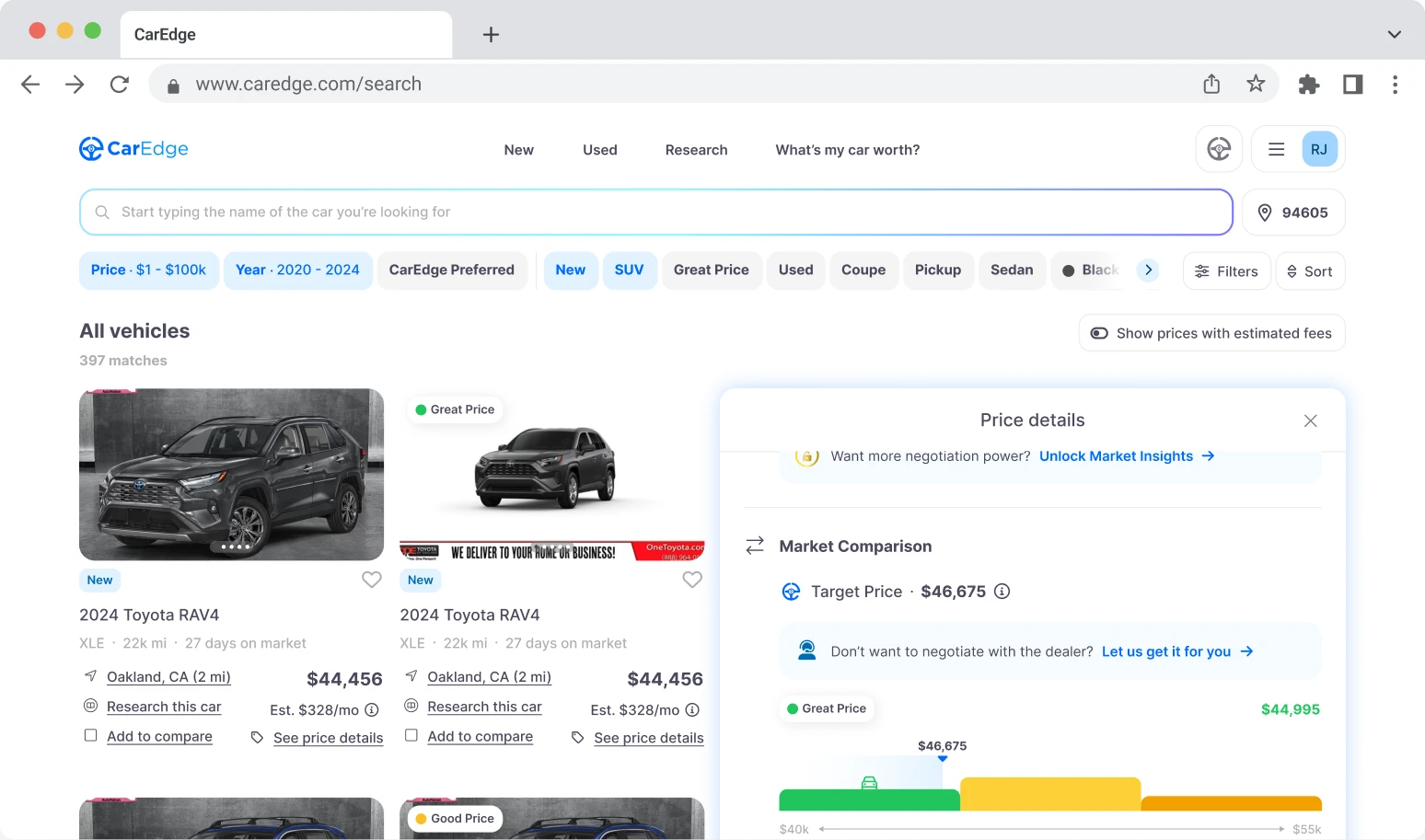
Find a wide range of vehicle listings with market insights on new and used listings near you.

What can I do with CarEdge?
 CarEdge Insights
What can I do with CarEdge?
Get access to exclusive information so you can make an informed car buying decision — all in one place.

Find a wide range of vehicle listings with market insights on new and used listings near you.
Track your vehicle’s value and cash in when the time is right to sell.

Access to our proprietary data to help you find the right car, at the right price. Find these unlocked on every listing after subscribing.

With our expert-led, tech-enabled car buying service, we will locate, negotiate, and deliver your vehicle so you can get a new car hassle free.


Help us personalize your CarEdge experience — it only takes a second.
Your answers help us personalize your CarEdge journey — we’ll follow up with tips and next steps that match your buying timeline.
How much is the car dealership going to offer you for your vehicle? You can bet that they’ll come in with a low offer, so you should be prepared with plenty of information to allow you to counter that offer.
Consumers have access to a number of services that can allow them to understand the value of their cars, including Kelley Blue Book, NADA Guides, and Edmunds. All of these sources can be used by consumers when they are deciding how to price their vehicle.
However, car dealerships have access to different sources of information that help them to determine how much to offer you for your car. One of these sources is called the Manheim Market Report, otherwise known as MMR. MMR values are designed to allow car dealerships to assess how much should be offered for any potential trade-ins.
Today, we’re going to take a look at MMR values, including what they are, how MMR reaches its prices, and how these values will affect your car buying experience.
MMR, which is short for the Manheim Market Report, is a specific report that’s available to auto wholesalers. Manheim is a brand of wholesale auction house that has auctions in every state (and most major cities). As such, there are millions of sales transactions being tracked every month through their services.
Manheim put together the MMR to help car buyers and sellers understand how much they should be paying for a vehicle. MMR values are a specialized tool that’s only available to people who buy cars at wholesale prices, which typically means that it’s used by car dealerships.
MMR provides data about the wholesale prices of vehicles for the past 13 months. All of this data is generated by real vehicle sales at the Manheim auction houses found throughout the country.
While their method for gathering data is straightforward, the way that they present it is quite helpful to anyone that is looking to buy or sell a vehicle at a wholesale auction.
MMR values will show prices in wholesale and retail markets, with three different tiers of prices that are based on the condition of the vehicle. Additionally, the report shows prices going back one year, six months, and two months. Then, predictions are made for how the price will change in one month and one year.
Since MMR gathers data based on its own sales, it can be considered to be quite accurate. Every sale made at an auction house in the Manheim network is tracked, analyzed, and used when someone generates a report for the same vehicle.
Car dealerships use MMR values in conjunction with other vehicle evaluators to help them determine how much to offer a customer for their trade-in. An MMR readout will give a car dealership a general idea of how much they could sell your trade-in for at an auction, which guides how much they’ll be willing to offer you.
Something that’s unique to MMR is that the prices are updated and refreshed every night. Since Manheim auctions are operating all the time, this allows Manheim to integrate new sales data into their pricing evaluations regularly. Other similar evaluators will only update data every week or every month.
Like a few other auto evaluation services, you won’t be interacting with the MMR directly. However, it will impact the offers that you receive from car dealerships on your trade-in. Dealerships will often use the MMR, Black Book, and vAuto to reach an offer price for your vehicle.
When you trade in your vehicle, your job is to have plenty of data available to counter the car dealership’s offer. Before visiting the target dealership, you should use a CarEdge trade-in valuation provided by Black Book, Kelley Blue Book printout, and perhaps a NADA Guide evaluation. On top of these evaluations, having a real offer from sites like Carvana and Vroom will encourage a dealer to offer more for your trade-in.
Remember to negotiate the price of your trade-in and the price of your new car in two separate negotiations. If you end up negotiating both at the same time, the car salesperson has the opportunity to manipulate the numbers to make it seem like you’re getting a better deal than you are. Start by negotiating the price of the new car, then mention that you have a car that you might trade-in for the right price.
Interested in learning how people come up with car values? You can learn more about other evaluation books here.
Understanding the value of your car is vital when you’re thinking about trading it in or selling it privately. This can help you to know that you’re not asking for an overinflated price, but also need to be aware when someone is offering you too little. That where things like Galves values can be helpful.
While there are many price books out there, today, we’re going to take a look at Galves. Dealers and financial institutions use Galves to determine how much to offer you for your vehicle. While you won’t be likely to use Galves directly, it’s worth learning about the tools that the dealerships are using.
Galves began in the 1920s as an automotive wholesale company that sold hundreds of cars per month. In the 1950s, they saw that there was a gap in the market for an auto evaluation tool that would assist dealers in streamlining their operations. They filled this gap by publishing the first edition of a printed book designed to address vehicle pricing.
Today, Galves operates a service that helps dealerships in the same ways that their physical books used to. Galves calculates the price of any given vehicle. This price is often used to justify quotes that are lower than the customer might be expecting.
Galves does not publicly discuss exactly how it reaches its values, but we know that a vehicle’s sales history is a primary factor in the way that they perform their calculations. Other factors include the make, model, miles, and condition of a given vehicle. All of this data is processed by their proprietary algorithms to determine the value of the car.
Galves uses their data to power a platform called Accu-Trade. This platform uses vehicle-specific information and historical sales data to generate an estimate of much should be offered for trade-ins. Dealers consider this data to be accurate and have confidence in basing their offers on Accu-Trade’s valuations.
Galves is believed to give lower estimates than other auto evaluators. The theory is that they “lowball” customers by using Galves’ evaluations to guide their quotes. Some dealerships do use multiple price books and use the lowest value out of all of the books to craft their offer to the customer.
However, dealerships believe that Galves gives them accurate information. This is why it’s become one of the standard price books for thousands of dealerships around the country. It’s a trusted resource, has been used for decades, and helps car dealers to make as much money as possible.
Galves does not make their data available to the general public for free. Instead, dealerships, auctioneers, financial institutions, and sales managers have access to their platform. A consumer could subscribe to Galves, but it’s not usually worth the price when you only want to buy a car once every few years.
Instead of relying on Galves values, we recommend using the CarEdge trade-in valuation tool. We partnered with Black Book (another book valuation company that dealers use) to allow our members to access trade-in, private party, and retail estimates for any VIN they enter.
Be aware that many dealerships will use Galves values as their justification for quoting you a low price. At the same time, most online price evaluators will quote a value that’s more than your car is worth to a dealer.
Car dealerships have to factor in the price of performing any maintenance or repairs on your car before it can be sold (oftentimes referred to as reconditioning). With many cars, dealerships have to consider that it will cost up to $2,000 to make an average trade-in vehicle retail-ready.
It’s wise to secure quotes from other dealerships that you can leverage in your favor. Carvana, Vroom, and CarMax all offer easy-to-obtain quotes for your car. Since the dealerships know you already have these quotes, they’ll be more likely to offer you a fair value in order to make the sale. That way, you’ll know you’re getting a good deal.
While you may not use Galves, you can trust that it’s a source that dealerships will use to get some of their information. Other price books that dealerships often use are vAuto and the Black Book. They’ll often use all three to determine the price to give you for your trade-in.
Interested in learning how people come up with car values? You can learn more about other evaluation books here.
You need to know the value of your car before you start to think about trading it in or selling it privately. With either option, you’ll need to know how to set your price accurately. Otherwise, you run the risk of selling it for too little or asking too much. That’s where Edmunds values can be helpful.
There are several prominent companies out there that are designed to help sellers to evaluate the price of any given vehicle. But the question remains: Which ones should you be using?
Today, we’re going to take a look at Edmunds, a source of car information that also provides an evaluation tool. We’ll discuss who they are, how they find their prices, and how accurate their estimates tend to be.
Edmunds began as Edmunds Publications in 1966. It was a printed booklet that aimed at helping shoppers to make informed buying decisions. In the 1990s, Edmunds made a series of maneuvers to become a digital source of auto information. Consumers trusted them for advice about car buying and understanding the value of a car.
These days, they are known for their True Market Value tool. This tool analyzes a number of factors to determine the correct price for a vehicle. Due to their existing reputation as a trusted source from which to buy vehicles, their True Market Value tool was quickly accepted as a great way to understand the value of the car.
In addition to their True Market Value tool, Edmunds is known for providing useful information about cars, along with their tools that allow buyers to search the inventory of a network of dealerships. The True Cost-to-Own feature, which compares maintenance costs for vehicles, has drawn the attention of car buyers for years, as well.
Edmunds uses a car’s make, model, mileage, condition, and styling to determine the worth of a vehicle. From this information, it provides a valuation both for trading it in or selling it to a private buyer. They collect and analyze car sales from an unknown number of sales across the country. Overall, it’s a worthwhile tool when you want to determine how much your car is worth.
Their search tool could be improved by showing consumers how many car sales are used to generate an evaluation. It would make their tool more trustworthy and help customers to gain an idea of how accurate their values are.
Edmunds True Market Value tool is fairly accurate for new cars. However, most dealerships do not use this tool as a reference point. It may be worth bringing up an estimate in private sales, though, as many consumers are aware of the authority behind the Edmunds brand.
In the True Market Value tool, predictions are available for all models. New predictions are published regularly and they can help you to decide when it might be the best time to buy that exact model. It’s another good tool to help you secure a great deal on your next car.
Edmunds has plenty of great information and tools available for car buyers. Keep in mind that once you share your personal information with Edmunds it’s likely you’ll be getting phone calls from dealers, so we really don’t like that this is a requirement (especially when the dealers don’t use Edmunds Values when quoting a trade-in).
Understand that the Edmunds Value will likely be higher than what a dealer offers you. It’s good to have a variety of information before negotiating the sale of your vehicle, and it’s also important to have realistic expectations. That’s why we recommend looking at other car values, such as the offer comparison tool here.
Edmunds provides a number of tools that we believe are helpful for consumers to understand how much to pay for a car. However, don’t expect dealers or private buyers to pay you exactly what is estimated. Instead, use the information as a negotiation point to help you nail down the exact price of the car.
If you’re buying a car at a dealership, make sure to negotiate the trade-in value of your old car and the price of the new car separately. If you try to negotiate them together, it’s easier for dealerships to move numbers around to make you feel like you’re getting a better deal than you really are.
We suggest that you start by negotiating the price that you’ll be paying for the new car in the beginning. Focus on the out-the-door price. Once you’ve agreed on that price, then say that you might want to trade in your current vehicle. Next, it’s time to negotiate the value of your trade-in. You can use Edmunds to make your case for its value, along with other tools, such as CarEdge’s integration with Black Book evaluations so that you know what a dealer will offer you.
It’s free, and takes just a minute. See what online car buyers will pay for your car!

Knowing the value of your vehicle is vital to ensuring that you receive a fair price for it, whether you seek out a private sale or a trade-in. Whichever way you plan to sell your car, you need to know what it’s worth. That’s why Red Book values were created: To evaluate your car.
Even though our services cater to the market in the United States, today, we’re going to examine Australia’s main source for auto evaluations. Understanding how services that are similar to the Kelley Blue Book function in another country can help to form a well-rounded perception of the auto industry.
In today’s post, we’ll go over what Red Book is, how they reach their values, and whether those values are accurate.
Red Book serves Australia. It allows residents to evaluate their current vehicles or evaluate vehicles they’d like to buy. It functions in a similar way to Kelley Blue Book and other tools that are available in the United States. However, it will cost money to evaluate a vehicle using their services.
A Red Book Valuation Report, which costs $33, will provide an evaluation of the target car, including reports that will help with selling, trading-in, or buying. Even though it may feel strange to pay a fee for this service, if it saves you more than $33 on the value of your car, then it’s worth doing.
Red Book does provide a number of free tools that help Australians browse different cars so that they can make informed buying decisions. Red Book can also evaluate bikes, boats, and some commercial products. They’ll even help you to arrange to secure a pre-purchase inspection of any new car.
One of the main features marketed on the Red Book website is its “News & Advice” section. They have over 390 articles published that cover a wide range of topics. It’s clear that the goal of this section is to be a source of news and knowledge to Red Book customers.
Operating under the same name but on a different website, Red Book also serves the Asian Pacific. All of the same services that they provide to Australians carry directly over to their Asian Pacific website. Coverage includes countries such as Thailand, Singapore, China, Hong Kong, and New Zealand.
Red Book uses many of the same criteria as other similar services: Kilometers traveled, condition of the car, options and features included, and aftermarket features. They gather their data through a number of sources, including auction house sales data, car dealership, field research, and analysis of the major auto classified websites that serve Australia.
Red Book’s data is gathered and analyzed constantly, with their official numbers being updated and made available each month. Red Book does not publicly discuss their method for analyzing and parsing all of the data that they gather, so we’re assuming that they have a proprietary algorithm that does much of the heavy lifting.
Government departments and car dealerships throughout Australia recognize Red Book’s accuracy. The company has a reputation for providing quality price valuation services in both of these areas. Car dealerships and consumers often use Red Book evaluations in negotiations to determine the final price of a vehicle.
Australian car buyers should use Red Book before heading into any auto transaction. The data is invaluable for the Australian market and having a Red Book Valuation Report will help you to understand what you should be paying for a new car, as well as what you should receive for your old car. While it is upsetting that they charge for their valuation report, when compared to the potential savings, it’s worth the price.
Ultimately, Red Book values are accurate and they provide a great service to Australian consumers. The company constantly gathers data, analyzes it, and makes sure that they provide the most up-to-date information possible.
On top of their auto valuations, they provide plenty of useful tools, services, and information to anyone that is looking to learn more about cars. Even if you’re not sure what kind of car you want, Red Book can help you to weigh your options and pick out your next vehicle.
Interested in learning how people come up with car values? You can learn more about other evaluation books here.
The value of your car plays an important role in getting you into your next car. You might decide to use your old car as a trade-in, or perhaps you’d like to sell it privately and use that cash as a down payment. Either way that you’d like to go, you need to understand what your car is worth. That’s where vAuto comes in.
There are plenty of auto evaluation tools out there, commonly called “books” because of the way in which they used to circulate. These days, most of the evaluation tools are online and can provide an instant value of any car.
Today, we’re going to take a look at vAuto. We’ll go over what vAuto is, how it reaches its value, and examine how accurate their values are.
Founded in 2006, vAuto is a company that was formed by “automotive industry veterans” that aims to give car dealerships a new way to manage their inventory of used cars. Their inventory management tools changed in 2010 when vAuto was bought out by the AutoTrader Group, which gave them access to all of the data from two of the nation’s biggest wholesale markets: Manheim and Autotrader.
All of this data serves to provide car dealerships with more information about their used car inventory. The goal is to help dealerships make the most of their used car inventory and ultimately make the most money possible.
In 2014, vAuto finally grew beyond its original purpose as inventory management software and launched Conquest, a tool for new cars and pricing services. These days, dealerships around the country use vAuto to manage their inventory, evaluate cars, and even guide the reconditioning process of trade-ins.
Have you noticed that all of their services are for car dealers? That’s because vAuto is not a consumer-facing company. The car dealerships are their customers, not car buyers. As such, they restrict access to their services to those who pay a subscription fee.
As discussed, vAuto has access to two valuable marketplaces for wholesale cars: Autotrader and Manheim. Using this data, vAuto calculates how much a dealership should pay for a car. Not only that, but they estimate how long it will take to sell the car in question.
Unfortunately, vAuto does not disclose any part of the algorithm used to calculate car values. We can assume that it takes into account all of the usual data, such as make, model, mileage, and condition. All of this information can be used to determine how much you should be offered for your trade-in.
Dealerships have been using vAuto for over a decade. It’s designed to help them manage multiple aspects of their business. Evaluating used and new cars is only one of the services made available by vAuto. As such, car dealers are quite confident in the services that they receive from vAuto.
Most car dealerships consider vAuto to be an important part of their auto valuation process. They’ll run your car through vAuto to gain a better understanding of how much to offer you, how long it’ll take them to sell it, and how in-demand your particular car might be. With all of this information in hand, they’ll make you an offer with the goal of making a profit on your car.
You won’t be using vAuto, as they are a subscription-based service that caters directly to car dealerships. However, you can use our Market Price Report, Kelley Blue Book, and NADA Guides to determine the value of your vehicle. You can even make use of CarEdge’s new integration with Black Book to help you understand what you’ll be offered for your trade-in.
Most car dealers will use vAuto in conjunction with the Black Book to determine what to offer a customer for their trade-in. You should understand that they’re likely going to show you the lowest valuation they can find, so don’t be afraid to push back. Highlight the valuations from other services to show that your car is worth more than what they’re offering.
One great strategy is to obtain quotes for your car from other dealerships or sites, such as Carvana and Vroom. Take these real quotes to the target car dealership to show them that you already have offers on the table. If they want your business, they’ll likely offer you more for your car.
Interested in learning how people come up with car values? You can learn more about other evaluation books here.
Whether you’re selling your car privately or trading it in to a dealership, you absolutely need to understand the value of your vehicle. The last thing that you want to do is get taken advantage of because you don’t understand your vehicle’s worth. That’s where NADA Guides values become important.
However, there are quite a few different car evaluation tools out there. These are known colloquially as “books,” since they began as physical books. With so many options, which bok value should you use?
Today, we’re going to take a look at NADA Guides, one of the most popular car value estimators out there. We’ll take a brief look at their history, discuss how they reach their values, and examine when you should use their evaluation tool.
Short for the National Automobile Dealers Association, NADA has been around since 1917. Not long after their formation, they started releasing NADA Guides, which is an evaluator tool used to determine how much a used car is worth.
Back in 1933, it was released as a periodical publication that has grown into a fully-featured website that helps consumers to understand as much as possible about a car’s value.
NADA Guides values are trusted by countless car dealers and consumers when it comes to understanding the worth of any given vehicle. They are widely considered to be an equivalent to the popular Kelley Blue Book. There is much debate about which one of the two is more accurate, but the truth is that they are both worth using.
Since NADA Guides was created out of a car dealers’ association, NADA Guides use real sales data from car dealerships to reach their values. NADA Guides use three primary criteria to determine the value of any given car:
NADA Guides put heavy emphasis on the car’s wholesale price, as opposed to focusing on mileage and conditions, as other value estimators do. The downside to this, however, is that NADA assumes that all vehicles are in great condition. This practice results in overinflated prices in situations in which the vehicle does have mechanical or cosmetic issues.
You should use NADA Guides values in conjunction with other value estimators to paint a picture of your car’s worth. Dealerships will use NADA Guides to establish a loan value for when they look for financing offers, then they’ll typically use the Black Book to reach their offer amount. This means that you should use everything at your disposal to counter their offer and ask for more. You deserve to get the most out of your trade-in.
NADA Guide values are considered by many to be overinflated, due to the fact that they don’t factor in the condition of the vehicle. However, many dealerships and consumers still use these guides to get an idea about what their car is worth.
Dealerships typically use the Black Book and NADA Guides in addition to their own appraisal to determine the value of your trade-in. They want to make money off of your trade-in, so they’ll generally offer you a much lower value than what you’re expecting.
You should use NADA Guides whenever you are planning to trade in or sell your car. Don’t rely solely on Kelley Blue Book — use NADA Guides, as well. Both are free, so you might as well put them to work for you! The more information that you can bring to the dealership with you, the better your negotiation will be. There is no single source that dictates your value; you’ll need to use multiple sources to understand the worth of your vehicle.
NADA Guides are largely used by financing companies, too.
Ultimately, NADA Guides are a great resource for anyone that wants to gain an understanding of the value of their car. Just like with Kelley Blue Book, don’t expect a car salesman to suddenly accept your value from NADA Guides. You will need to secure several other quotes from sites like Carvana, Vroom, and Carmax, and leverage these offers during your negotiations. You should do everything that you can to get a great deal on your new car.
If you’re selling your car privately, NADA Guides and the Kelley Blue Book can work together to justify your asking price. You can use both in your negotiations with the other party to help you get the best price for your car.
Interested in learning how people come up with car values? You can learn more about other evaluation books here.
Understanding how much your car is worth is vital when you want to sell it privately or trade it in at a dealership. Without knowing your car’s value, you risk expecting too much or selling it for far too little. That’s where Black Book values matter.
There are quite a few different evaluation resources out there, usually known as “books.” Each one of these books has its own unique method for evaluating how much a car is worth.
Today, we’re going to take a look at one of the gold standards for car dealerships: Black Book. While consumers are often familiar with a book of a different color (yes, we’re talking about you Blue Book), Black Book is often the one that dealers trust and use.
Founded in 1955, Black Book has grown and evolved every decade, but their mission has remained the same: To provide the most accurate car valuations out there.
Something that is unique about Black Book is that they charge a subscription fee, which means that their book values are typically only available to car dealerships and lenders. Why would you pay a fee to evaluate your car one time? That is a big reason why most consumers aren’t aware of Black Book (until they get to the dealership).
Black Book valuations are provided through many different mediums, most notably a weekly magazine that is circulated among approved sources, and in other formats, including their website and app. Car dealership solutions such as DealerTrack and Eleads integrate with Black Book to provide their sales staff with real-time Black Book values.
CarEdge is the first non-dealer, non-financial institution to provide Black Book values directly to consumers. Join to gain access to Black Book values and much more.
Black Book’s main method to evaluate cars is to visit over 60 auctions throughout the country every week to acquire information about used cars. Take note that these are wholesale auctions, which means that they are for dealers only.
Black Book’s data collectors physically visit auctions to obtain sales data, although they also seek data online. Their goal is to have information about every car sold at an auction in the entire country.
Just like other evaluation tools, Black Book has a proprietary algorithm for the way that they reach their total number for a car’s value. On Black Book’s website, they say that they have precise data that comes from “combining advanced capabilities of data scientists with the industry expertise of automotive analysts.” We like the way that sounds.
Black Book gives different values for wholesale, trade-in, private party, and retail transactions. Additionally, they have subsections based on the reported condition of the car. Just like other evaluators, they use as much data as possible about the target car to reach a value. This data is available for CarEdge members.
Since Black Book valuations are largely based on the selling price of used cars at a wholesale auction, Black Book tends to be accurate in its evaluations. Dealerships will undoubtedly use Black Book to determine how much your trade-in is worth. Black Book is typically more conservative than other book values. This is another reason why dealers typically rely on their values — it allows them to make more money when they sell the vehicle.
Black Book values were once only available for dealerships who paid the membership fee. However, we’ve integrated Black Book evaluations with our CarEdge member solutions. Now, you’ll be prepared for what a car dealership is likely going to offer you for your trade-in.
However, you should absolutely know about Black Book. Dealerships will run a report on your trade-in and use it to make you an offer on your car. Since Black Book is based largely on real sales, car dealers tend to think of their suggestion of value as the guaranteed sale price for your vehicle. That doesn’t mean that the negotiations need to end there. Instead, you should come back with your own information to get them to raise their offer price.
Before visiting the dealership, obtain estimates from other tools. Your most important negotiating tools will be actual offers from other dealerships. You can easily get a quote from Carvana, Vroom, and Carmax. Using these quotes to guide your negotiation process is a good way to secure a great deal. Additionally, CarEdge members now have access to Black Book valuations so that they know what to expect when they visit a car dealership.
Interested in learning how people come up with car values? You can learn more about other evaluation books here.
Determining the value of your used car requires more just than a rough estimate. When it comes to trading in your vehicle or selling it to a third party, accurate pricing is important. Without it, you run the risk of asking too much (and not finding a buyer) or selling it for too little. That’s where Kelley Blue Book values come in.
However, there are many different evaluation resources that you can use. These are known as “books.” Dealerships and car owners can use these books to evaluate their car’s value. Which one should you be using?
Today, we’re going to go over the most popular book, Kelley Blue Book. We’re going to take a look at what it is, discuss the values they give, and go over when to use a Kelley Blue Book estimate.
Kelley Blue Book began in 1926 and has become the standard for used car prices. Part of its popularity came from the fact that they used to publish a physical book that was blue, and it became widely used.
These days, the Blue Book lives at KBB.com, where it provides real-time evaluations of your vehicle. When you input all of the car’s information and details about its condition, you are given both the trade-in value estimate and the private party estimate. You’ll also receive a fair purchase price and pre-owned price (in case you’re the one looking to buy the car).
While they no longer distribute a physical book, the Kelley Blue Book remains the gold standard among consumers that want to learn how much their car is worth.
Kelley Blue Book is vague on their website when it comes to the ways that they evaluate vehicles. Their exact algorithm is proprietary, which means that we can’t pick it apart. All we know is that it depends on data intelligence and uses predictive analytics and field analysis to come up with an estimate of your car’s price. According to their website, they use over 250 data sources to come up with their estimates.
We do know that Kelley Blue Book uses the make, model, mileage, and condition of various systems to come up with its value estimate. They also take into account the type of transmission, engine size, and any custom options that might increase the vehicle’s value. Of course, we can bet that they calculate depreciation, too.
Generally speaking, Kelley Blue Book values can give people an over-inflated idea of what their car is worth. If you visit a dealership, the used car manager is not likely to agree to your Kelley Blue Book estimate.
Why is this? It’s largely because people overestimate the condition of their car when they’re using Kelley Blue Book’s tool. A small dent might not be worth mentioning to you, but an appraiser will certainly take note of it. Car dealerships primarily have to consider how much work will go into fixing the vehicle up so that it’s ready to sell, which is usually around $2,000.
Kelley Blue Book is a trusted tool for consumers, but dealerships don’t care what it says. They’ll use other tools, such as the Black Book and vAuto to determine what to offer you for your trade-in.
So if we’re strictly talking about dealerships, Kelley Blue Book values are not considered to be accurate. When it comes to private sales, though, Kelley Blue Book evaluations can be quite valuable. Private sellers and buyers both tend to use them when they’re navigating a deal.
You should use Kelley Blue Book when you’re looking to sell your car to a private party. Since the person you’re selling it to has likely already run a report, as well, you can use these estimates as a starting point for your negotiations.
Ultimately, Kelley Blue Book is a lead generation tool for car dealerships. They do their best to evaluate their cars, but their income generator comes from selling your information to car dealerships or directing your traffic to a car dealership’s website.
Even though you may have been raised to think of Kelley Blue Book as the ultimate decision-maker when it comes to a car’s value, if you’re dealing with the dealership, you’re better off looking at the Black Book or vAuto. Save Kelley Blue Book for the times in which you’re selling or buying a car privately.
Keep in mind that CarEdge members have access to Black Book estimates so that you can be prepared for what a car dealer might offer you.
Keep in mind that CarEdge members have access to Black Book estimates so that you can be prepared for what a car dealer might offer you.
Interested in learning how people come up with car values? You can learn more about other evaluation books here.
We love hearing about the successful car purchases that our members are able to make. Their stories perfectly illustrate that anyone can use CarEdge to save time buying a car while also getting a fair deal. Even better, our members often share that they’ve become expert negotiators, thanks to our tips and their hard work!
Today, we’re going to take a look at a recent success story from one of our members, Dana, to see how she used everything that she’s learned to find a great car at a great price.
Dana was in the market for a Honda CRV in the Touring trim level. She found a nearby dealership that had a large used inventory with five or six 2020 Touring models that were essentially identical; each of them had less than 1,000 miles and a fair price.
One of the vehicles had more miles and was, therefore, cheaper, so that’s the car that Dana picked. She ran our Market Price Report on the vehicle and discovered that it had been on the lot for over 200 days. Our Market Price Report also showed an excellent negotiation score, along with a recommended offer price that was well within her range.
The dealership provided a free Carfax report that corroborated the information we provided, so she moved forward. Dana visited her credit union — which we always suggest — and obtained pre-approved financing. As a graduate of our Deal School, Dana felt prepared to head to the dealership.
When Dana arrived at the dealership, she was immediately approached by a salesperson. The vehicle she was interested in was found on the dealer’s lot (and was actually buried behind two other vehicles). Much to Dana’s surprise, all three cars had to be jump-started before they were ready to drive.
The test drive proceeded without issue, so it was time to talk numbers. Dana made it clear that she wouldn’t go over a certain price.
The salesperson returned with a quote that shocked Dana. Dana broke down each line for us:
“I did allow him to review each line item with me. The first line was the list price of the vehicle. The second line was $1.00 for a ‘free Lifetime Warranty.’ The third line was $1,299, which was the service inspection and reconditioning for the ‘free Lifetime Warranty.’ The fourth line item was $1,700, which was a package that included dents/dings/paint, roadside assistance, key fob replacement, and sanitization. So before they even added their $995.00 dealer fee, tax, title, and tag, the vehicle was now $3,000 more than listed.“
After they discussed each item in detail, Dana said she would absolutely not be paying that price. The salesperson removed some of the add-ons, but said they couldn’t remove the inspection and reconditioning fee, which was part of the “free” warranty. She refused to pay this fee.
Know what fees you should & shouldn’t pay: Car Dealer Fees: What You Should Never Pay When Buying a Car
The salesperson left and returned with the sales manager. They both talked to Dana, who felt like this was an intimidation tactic.
After discussing the numbers and having the dealer deny how long the car had been on the lot, Dana felt strongly that the salesperson and sales manager were only interested in negotiating up, not down. As such, she threw out an offer that she described as “ridiculous,” just to see what they would say. The sales manager said they couldn’t do that, and Dana left the dealership.
She still wanted a new Honda, so she headed home and kept shopping around. Her story shows that sometimes you have to say “no” and walk away. The best price might not always be at the first dealership you visit.
The day after the false start, Dana found an excellent used vehicle on a dealer’s website that was located two-and-a-half hours away. She reviewed the Carfax report, along with every picture and video available. She decided that it listed for a reasonable price.
Dana contacted the dealership and explained to the sales manager that she lived over two hours away, but that she’d be willing to make the drive. She told him that she already had her own financing and that the sales manager needed to come up with their best out-the-door price.
Fifteen minutes later, Dana had an offer in hand. The offer was actually $500 less than what we suggested in our Market Price Report. It looked great, so Dana headed off to the dealership.
When she arrived, a salesperson had already set the car aside for them, and they began running through the textbook sales tactics. Dana reported that the salesperson used some of the same word tracks she had learned about in Deal School, almost word for word.
Dana and her husband agreed that the car was a great purchase for an ideal price. It was a certified pre-owned Honda CRV EX-L. Even though it was a different year and trim than the Touring she had looked at when she visited the first dealership, she ended up saving $10,000 by leaving the first dealership and deciding on another car.
Dana reports that this car purchase was by far the easiest and least stressful purchase of her life. We love to hear it!
We’re thrilled to hear that Dana had a much better experience at the second dealership. It sounds like it was worth taking a step back, visiting another dealership, and even buying a different car. Dana’s story shows us that it’s worth saying “no” when needed and that being flexible in your car choice can save you money. Thank you for sharing your story with us, Dana!

We regularly receive comments and emails from CarEdge members in which they share how they use our solutions to help secure an excellent car deal. We like to highlight these stories to inspire other members like yourself!
Today, let’s take a look at the experience of our member, Dave Lott. We’ll talk about the deal he received, how he managed to make it happen, and his unique experience in the F&I office.
Dave’s email shows that he has been thoroughly paying attention to everything that we have to share! He was after a 2021 Honda Pilot EX-L, which isn’t a rare vehicle (even amidst the ongoing chip shortage), so he secured quotes from two competing dealerships.
With both quotes in hand, he began negotiations. Let’s see what happened when he went to the dealership that offered him the best deal.
Once he arrived at the dealership, he wasted no time negotiating. Dave was well aware of the microchip shortage and was concerned that it might impact his ability to get a steep discount.
Thanks to his insider knowledge from CarEdge, Dave was able to secure a selling price that was 14% below MSRP, with the final out-the-door price 6.5% below MSRP. We’re quite thrilled to hear that Dave was able to secure such an excellent discount especially amidst these market conditions. It’s worth calling out the reason why Dave was able to get this dealer to come down on price as much as they did: he had a second dealer’s quote. We highly recommend (especially for new vehicles) getting two quotes from two dealerships and having them compete for your business. That’s what Dave did.
We’re also impressed that Dave got the dealership to include a complimentary three-year maintenance plan, with four of the oil changes upgraded to fully synthetic oil.
Dave told us that because he got such a great deal, he was worried that once he got to the F&I office, he would be hard-sold. Let’s see what actually ended up happening.
When a typical customer gets to the F&I office, it’s simply another round of negotiations and sales attempts from the F&I Manager. For Dave, the F&I Manager pulled out “the menu” filled with add-ons and simply asked, “Do I need to go over any of this with you?” Dave replied with a simple “No,” and they proceeded to the actual financing.
That is a testament to how knowledgeable the dealership staff knew Dave was!
When all is said and done, Dave walked out of the dealership with an out-the-door price that was 6.5% below MSRP with a 0% APR for 60 months financing — well done, Dave! We love to see CarEdge members getting great deals with the knowledge they’ve learned from our team! Thank you for sharing your story with us, Dave!