
CarEdge saved me over 4,500 dollars on a brand new Honda Pilot. I can't say thank you enough.
Price intelligence
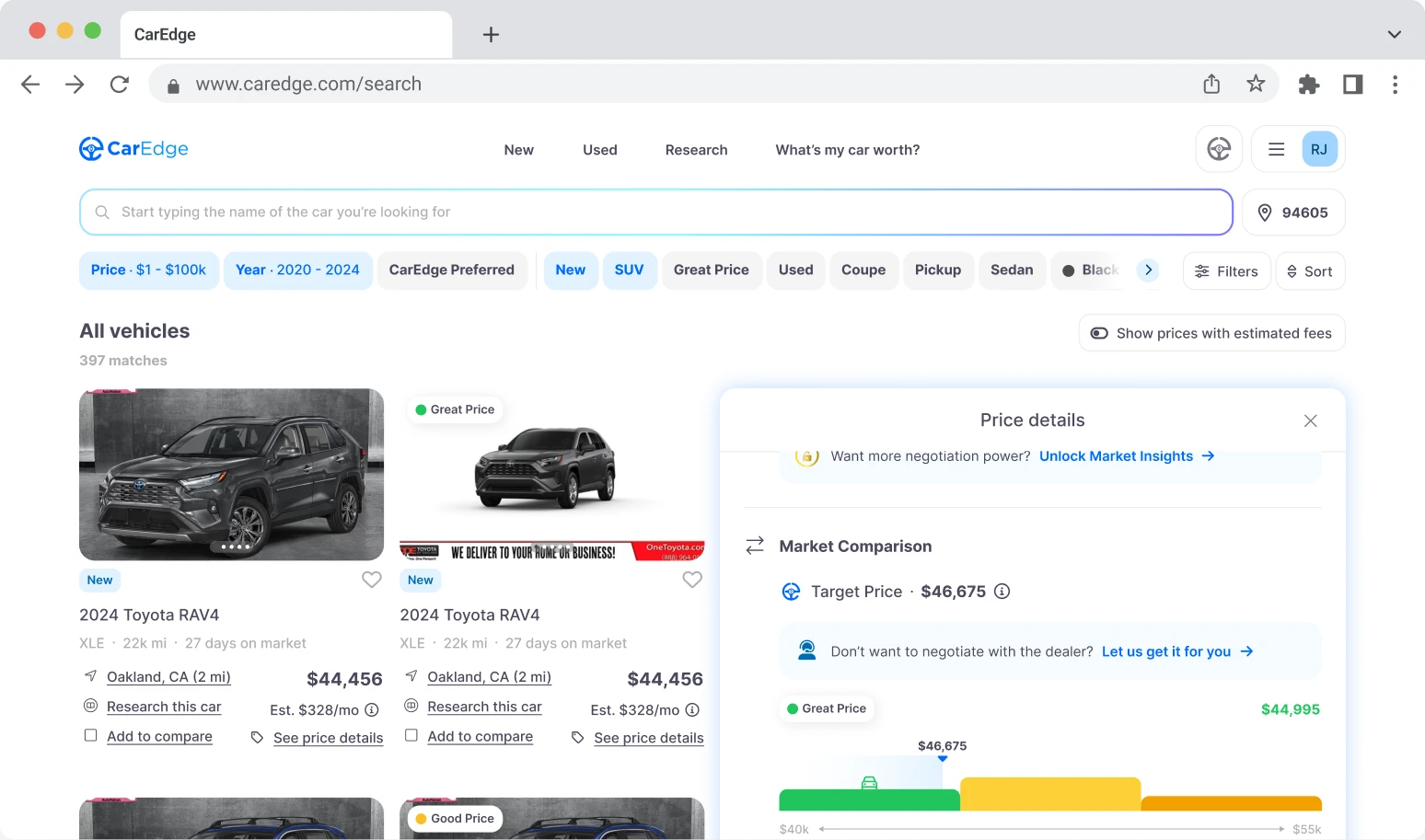
Find a wide range of vehicle listings with market insights on new and used listings near you.

What can I do with CarEdge?
 CarEdge Insights
What can I do with CarEdge?
Get access to exclusive information so you can make an informed car buying decision — all in one place.

Find a wide range of vehicle listings with market insights on new and used listings near you.
Track your vehicle’s value and cash in when the time is right to sell.

Access to our proprietary data to help you find the right car, at the right price. Find these unlocked on every listing after subscribing.

With our expert-led, tech-enabled car buying service, we will locate, negotiate, and deliver your vehicle so you can get a new car hassle free.


Help us personalize your CarEdge experience — it only takes a second.
Your answers help us personalize your CarEdge journey — we’ll follow up with tips and next steps that match your buying timeline.
We love hearing from our CarEdge members about their recent car deals. It’s always wonderful to see the ways they’ve used our solutions to negotiate and secure an excellent deal on their next car.
Today, we’ll take a look at a story from Mike C. about his recent car purchase. He used our solutions to expertly land a deal that he was extremely happy with. That’s what it’s all about. Let’s dive in!
Mike had a 2017 Buick Envision with a warranty that was about to expire. Not wanting to drive a car without a warranty, he started researching his options for buying a new car 8 months before he stepped foot on the lot at a dealership.
He discovered CarEdge on YouTube while researching car reviews. He was “instantly impressed” and began watching videos and taking notes. He even went through our Deal School.
After researching different options, Mike decided to pursue a new 2021 Hyundai Santa Fe Limited. Mike’s initial plan was to wait until the end of March (per Ray’s advice), but after noticing that his bid from Carvana for his Buick increased, he decided it was time to act.
Due to the chip shortage, used vehicle prices are rising fast. Become a member to get the latest prices on used cars powered by Black Book. Black Book is the guide many dealers use when valuing a trade-in.
Using our email templates, Mike reached out to eight dealerships in the area. Seven dealerships replied with out-the-door (OTD) prices. He then used the lowest of the eight OTD prices to negotiate with the other dealerships. Although he received a few excuses about why they couldn’t lower their price, he eventually heard back from one of the dealerships with a price that Mike considered to be fair.
According to Mike, “Your email templates were invaluable. They quickly identified the motivated dealers in the area.”
He printed off all of the documentation from us, along with his Carvana quote, and headed into the dealership.
Mike had already negotiated the OTD price over email. When he arrived at the dealership, he verified all the numbers with the sales manager, and “Deal 1,” as Mike puts it, was done in minutes.
“Deal 2” was trading in Mike’s current vehicle, his Buick. Initially, the sales manager said he couldn’t even get close to the trade-in value that Mike wanted. Then, Mike showed them the Black Book numbers that we provided him in the Market Price Report, along with Carvana’s offer. With all of this evidence presented, the sales manager agreed to come up to $20,600, which was acceptable.
The “friendly but assertive” F&I manager struck out when he started to offer Mike different protection packages and vehicle service contracts. Mike simply said no.
You don’t have to purchase a vehicle service contract at the dealership. See if a vehicle service contract is right for you.
He also verified that there was no early payment penalty on financing. The F&I manager said there was not a penalty, but that if he didn’t wait 90 days to pay off the loan, then it would result in a chargeback to the dealership.
Two hours after arriving, Mike and his wife drove away with a brand-new Hyundai Santa Fe.
Let’s evaluate Mike’s deal. He graciously provided us with all of the figures, which are:
Mike admits that there was probably room for improvement (and there always is), but he’s happy with the deal he received. He tells us that the deal he landed was as good as he could’ve hoped. Considering that the 2021 Santa Fe Limited had only been out for 2 months, Mike says he thinks that he got the best price possible.
We agree with Mike. It looks like he got a great deal. He used our tools to expertly find out all of the background information that he needed to negotiate. We especially like the way he utilized our email templates to get dealerships to negotiate against each other.
As Mike put it when reflecting on his transaction, “The power of knowledge cannot be denied. CarEdge access to days on lot, price history, and Black Book values are info sources of immense importance. Your deal school is an awesome body of work and will help just about every auto consumer. Some of the content I already knew, but I learned so much more. Your email templates were invaluable. They quickly identified the motivated dealers in the area.”
“All considered, my wife and I are really, really happy. Thank you for the time and effort you saved us. The time spent watching your videos was well worth it, given the info and entertainment value. Thank you for the money saved. Thank you for making the whole buying process just about stress-free.”
Well done and congratulations, Mike! We hope you enjoy your brand-new Santa Fe Limited.
Have you learned something new about buying, selling, or trading in a car as a CarEdge member? Share your story with us!
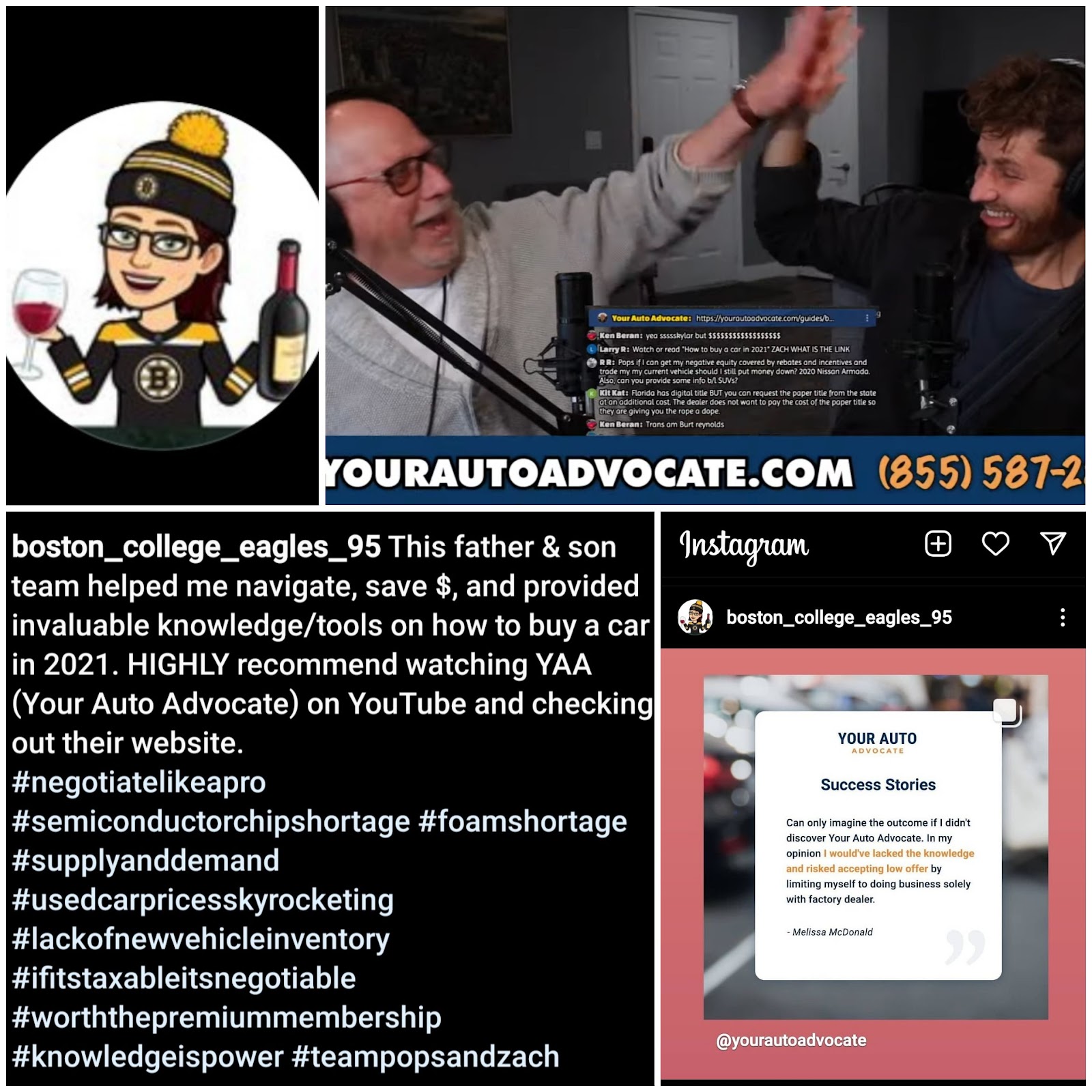
We love to hear success stories from the members at CarEdge. It’s great to see how people are putting our tools and information to use and securing excellent deals on their new purchases, sales, and trade-ins.
Today, we’re going to share a success story from Melissa. She doesn’t quite have her car in-hand due to the chip shortage, but she’s already secured a great price for her trade-in.
We’ll go over how she researched her negotiation, pushed when the dealership wouldn’t budge, and how she feels about the entire transaction. Let’s take a look at how Melissa negotiated the process and what she learned along the way.
Melissa tells us that she started researching which car to buy in 2020, but that she only recently found CarEdge in early 2021.
One of the first things that she remembers learning from us was that she needed to negotiate her trade-in and new car purchase as two separate transactions. Prior to that, she never thought it would be important to separate the two, and since she was about to trade-in her car, she was happy to learn a new trick.
Do you have a vehicle to trade in? Read the full guide to trading in your car.
After she signed up for CarEdge and became familiar with our dashboard, Melissa began to use our “trade in valuation” tool powered by Black Book, the same valuation book dealers use.. She tells us that she immediately put that into good use, since she was working with several dealerships at the same time.
On one of our live streams, Melissa had her deal picked to go through an examination with our trade-in analyzer. This is a segment in our live streams where we pick a member’s deal and analyze it live.
During this stream, she learned about some pre-trade negotiation strategies. Melissa also benefited from another CarEdge member, Larry R, who shared some insights into what the tax benefit would be if she traded her vehicle in versus selling it to Carvana or Vroom.
With all of these facts and figures in place, Melissa was ready to head to the dealership to complete some final negotiations on her trade-in.
Although she had done a lot of the legwork upfront via email, Melissa made an appointment to visit a car dealership to finalize selling her trade-in. She decided to try to get more value out of her trade-in.
The salesperson was visibly upset, since they had already prepared the paperwork. As such, they were dismissive of her attempt to negotiate. They tried to push her to sign the documents and move along with the sale that had been negotiated via email.
She didn’t give in, however. Melissa made it clear that she knew used vehicle prices were skyrocketing due to the microchip shortage and that this wouldn’t stop anytime soon. She told them that she knew that car dealerships tend to make more money on used cars than new cars and it would be worthwhile for them to pay more for the trade-in.
Her point was further cemented when she let them know that she had already received multiple quotes from online price books and other dealerships for her vehicle, so she knew what her trade-in was worth.
Having the trade-in value that was provided by Black Book, the same value the dealer was using, helped Melissa to understand the value she should be receiving for her trade-in. Her persistence paid off and the dealership ultimately caved in and gave her another $200 for her trade-in.
Melissa reported that on the same evening she traded her vehicle in, it showed up on the dealer’s website. The car dealership was asking for $3,690 more than what she received for it. Considering that a good part of that difference usually comes from reconditioning costs to prepare the vehicle for a new buyer, she was happy with the amount that she received from the deal.
Melissa is still waiting for her new car to be manufactured and shipped out. Unfortunately, the chip shortage has customers all around the world waiting for their cars to arrive. Melissa did not mention the make and model of the car that she’s buying, but we hope that she likes her new car when it comes in.
Melissa was very pleased with the value that she received for her trade-in. She’s grateful that she found our tools and was prepared to bring up the effect of the chip shortages at the dealership.
In her opinion, she’s saved over $4,000 compared to what she would have paid without CarEdge. We’re glad you negotiated a great price on your trade-in, Melissa!
Trading in your car can help you to buy a new car without having to put a large amount of money down. However, you need to keep in mind that dealerships will want to sell you a new car for as much as they can, while paying you as little as possible on your trade-in.
Today, we’re going to cover how you can use your trade-in to your advantage. We’ll discuss the best ways to boost your car’s trade-in value and give you tips on how you should negotiate while you’re at the dealership.
You’ve decided to trade in your car. What should you do next? Learning how to trade in a car is vital to getting the most bang for your buck. Here are your next steps.
Understanding how much a dealership should be offering is essential to successfully negotiating your trade-in value. You can use CarEdge Pro to gain an understanding of what similar cars are going for. It’s smart to bring printouts of your car’s fair value with you to the dealership to show that you’ve done your research.
There’s no need to give the car a new paint job, but fixing any cosmetic issues will go far in getting the most for your trade-in. It’s also worth cleaning the interior and exterior before you take the car to a dealership. Break out the shampoo for the carpets, go through a car wash, and fix any dents. You might be surprised how big of a deal this can be.
There are plenty of reasons to shop around at different dealerships. Every dealership will offer you a different amount for your car, and some will be more open to negotiating than others.
Make sure to obtain quotes from these dealerships for your trade-in and take them with you to the next dealership. Don’t lose them! These quotes — along with your used car values from CarEdge — will help you when it’s time to negotiate.
Once you have a firm understanding of your car’s value, have fixed any minor issues, and you’re prepared to shop around at multiple dealerships, it’s time to negotiate.

Avoid the temptation of negotiating your car trade-in value when you’re negotiating the price of a new car. You should negotiate both numbers separately. When you mix the negotiations, there’s too much potential for the salesperson to tweak the numbers so that it seems like you’re getting a better deal than you really are.
Your first order of business is to negotiate the price that you’ll pay for your new car. Once that is nailed down, then you can start talking about how much you’ll receive for your trade-in.
Use quotes from other dealerships and the Kelley Blue Book estimate to illustrate that you know what a fair offer looks like. Since many car dealerships will directly resell your trade-in on their used car lot, there’s an incentive for them to be competitive.
Stay firm in what you’ll accept. If they won’t give you a good price, then it’s time to leave that dealership. It’s worth taking your time to trade in a car the right way.
Timing matters when it comes to trading in your car. Being patient can often pay off. Factors such as weather, the type of car that you have, and other socioeconomic factors can come into play with the trade-in value that you receive.
For example, trading in an SUV that is in great condition right before winter can often result in a better trade-in value, as winter weather tends to drum up extra business from people that are looking for something that can handle snowy conditions. Think about the time of the year as it relates to what you’re offering.
Other factors can impact the sales process, too. It’s always better to try to buy a car at the end of the month or at the end of the year. That’s when car dealerships are trying to boost their numbers at the end of their sale periods. You’re likely to get a great price on your new car and a high trade-in value at these times.
Do your research to make sure that you know what your car is worth when you want to trade in a car. Stay firm on the amount that you’ll accept for your trade-in. Be aware that some dealerships may try to manipulate the numbers. Sometimes, what looks like a good deal on your trade-in is made up for with a bad deal in another area.
Remember, you can always say “no” and walk out of the dealership. It’s your car and you deserve to get a great deal.
Most people don’t look forward to buying a car. While the act of owning a new car is enjoyable enough that some people can power through it, it’s just not worth it to everyone. That’s where car brokers come in.
Car brokers can help you to navigate the automotive world on a personal level to help you buy your dream car. They can even help you to find a rare or specific vehicle.
Today, we’re going to examine what a car broker is, when you should use one, and how you can find a quality one.

What is a car broker? A car broker, also known as a car buying service, is basically a professional car buyer. The goal of a car broker is to level the playing field between you and the car dealership.
An auto broker is familiar with car dealership’s sales tactics, strategies for negotiating, and profit margins. They know how and where to save money throughout the entire process. They won’t fall for some of the numbers manipulations or specific strategies that might work on other customers. Instead, they’ll see these tactics coming and have a rebuttal already prepared.
Some auto brokers work for themselves or a small company, while others are part of a concierge service at a bank or credit union. An auto broker will often work for dealers and customers, helping to connect the two.
There are two ways that car brokers make their money: As a flat rate or as a percentage. An auto broker might charge everyone a flat rate, ranging from $200-$1,000. Other brokers opt to charge a percentage of the money that they saved you on your purchase. Expect to pay a retainer of approximately $100 once you decide to use an auto broker.
Car brokers can help to negotiate deals for new and used cars with dealerships.
Now that we’ve answered the question “what is a car broker,” we need to discuss the reasons that you should use one. People typically decide to use a car buying service to save time and money. Car brokers know exactly how to navigate the sales process to find any opportunities to save you money. You also won’t have to waste your time negotiating and spending hours at a dealership.
Other car buying services might be used when you’re looking for a rare or vintage car. Specialists hunt down these cars and buy them for their clients. This is a much more high-end service than the kind offered by the average car broker.
Using a car broker is similar to using a real estate agent. They help you to minimize mistakes and maximize your savings. For those looking to skip the whole car buying process altogether, this is a great way to go.
There are several things that you need to do when you want to hire a car buying service. You should begin by asking about options available through your favorite warehouse club store or the credit union that you bank with. Many types of brokers that offer car buying services may even have their fees included with your memberships.
If you don’t have a free option, it’s time to head online and look for a well-reviewed auto broker. Some attributes to look for are:
You will need to make sure that the auto broker is licensed to sell cars in your state and that they are able to abide by any other regulations that may apply to your specific transaction. Research any potential auto brokers on review-based sites to see how other customers have felt about working with them.
Want to get a better deal by yourself? Join CarEdge to get access to a suite of tools and information to help you get the best deal buying a car.
Deciding to work with an auto broker might well be worth your time. If you don’t care to learn the ins and outs of car buying in order to score a great deal, auto brokers are an excellent alternative. Keep in mind the requirements that we’ve outlined above and do plenty of research before deciding which one to work with.
Of course, if you want to learn how to negotiate and handle the work yourself, we’ve got a deal school that’s designed just for you.
If you’re looking for a new car, you might be tempted to investigate a new or used electric vehicle (EV). An EV is powered entirely by electricity that charges your battery at charging stations. There are a number of unique factors that must be considered as a result, such as the lifespan of the battery and the location of charging stations.
There are many aspects to consider when you’re looking into buying, selling, and trading EVs. Today, we’ll take a look at everything that you’ll encounter as you start shopping around for electric vehicles.
Buying an electric car might be the right purchase for you, but it’s also not for everyone. Instead of simply heading off to the nearest Tesla dealership to check out the latest models, it’s important to take some time to consider a few unique factors that will bring entirely new variables to the car buying equation.
Just like buying a traditional car, buying an EV requires plenty of time and research before you head to the dealership. In this electric car buying guide, we’re going to go over some of the prime factors that you need to consider before you buy this type of car. We’ll cover home charging, the importance of range, and whether an electric vehicle really saves you that much money.
One of the biggest perks of an EV is also its biggest downside: No gas. While this does mean that it will have a cheaper cost-to-own, it also means that you can’t fill up on your way to work in the morning when you need a boost. You will need to be able to charge your car either at home or somewhere that’s conveniently close to your home.
If you are on a standard 120V electric circuit, it would literally take days to charge your vehicle. These breakers aren’t even rated for the number of hours it would take to charge your car fully. Instead, they are most commonly used to run your standard appliances and electronics in your home.
The other option is a 240V electric circuit. On these breakers, you can have a Level 2 charging station installed that will most likely fill you up — or at least get you close to full — every single night. Your electric oven, dryer, and central AC run on 240V.
Either option comes with a home charging setup that can be purchased and installed by a number of companies. Exact prices will vary, but as a general rule for this electric car buying guide, set aside about $1,000 to $2,000 to install a home charging station.
How long do EVs take to charge? The exact answer will vary based on the vehicle, charger, and amount that needs to be charged. On average, most vehicles take about eight hours to charge fully.
The latest and greatest charging stations put out enough power to easily stop a heart. Keep in mind that your car has an inherent charging capacity that will restrict how much power can flow between the charging station and your car. This can matter greatly when you’re buying an electric car.
You need to keep electricity rates in mind for your home, as well. Electric vehicles are measured in kilowatt-hours per 100 miles, notated as kWh/100 miles. In order to figure out how much it’ll cost to have a given car charge at your home, multiply your vehicle’s kWh/100 miles rating by the rate you’re charged for electricity at the times that you’re most likely going to be charging.
In reference to EVs, range is used to describe how far a car can go on one charge. For quite some time, the lack of a comprehensive charging network was a large deterrent to the adoption of EVs. While it will certainly depend on your area, this problem has been resolved for much of the country.
You’ll need to consider where you usually drive if you plan to charge at home. You will also want to consider how often you take road trips to decide if the range limitation is even an issue for you.
For anyone looking for a nice easy daily-driver, the range might not be that big of a deal. Even people who take regular road trips should look up the network of charging stations before being deterred, since the network has grown substantially in recent years.
Some people are drawn to EVs for their environmental friendliness. You won’t be chugging gas every time you head to the grocery store, so many people also assume that this will directly translate into saving money. However, with other maintenance purchases taken into consideration, does this assumption hold true?
Consumer Reports recently found that the average EV owner saves over $800 to $1,000 per year on fuel costs over an equivalent gas-powered car. We assumed there’d be some savings in this arena!
Maintenance and repair were also found to be about half of the amount necessary for gas-powered vehicles, with an average savings of approximately $4,600 over the life of the car.
Depreciation has traditionally hit EVs harder than gas-powered cars, but newer reports are indicating that the new lines of EVs are on par with gas-powered cars for depreciation. Teslas also tend to hold their value well, making a strong case for buying a Tesla.
Ultimately, the true cost of ownership will be different for everyone. There will be variance in how quickly your car depreciates, what you can expect costs for repairs and maintenance to be, and fuel costs.
Based on Consumer Reports, the cost to own an electric car is generally lower than a gas-powered car; however, that isn’t necessarily true of all-electric vehicles. You’ll need to research your exact cost and be satisfied with those prices before you buy an EV.
Our electric car buying guide wouldn’t be complete without mentioning that insurance rates for electric vehicles are often higher than their gas-powered equivalents. This means you need to remember to get insurance quotes while you’re shopping around.
Deciding between a new or used EV is a tough choice to make. Much of the traditional advice applies here, such as obtaining a pre-purchase inspection and considering a CPO if possible.
One of the main unique aspects to consider is the life of the electric battery that powers your entire car. Replacing this battery is akin to replacing an engine in a gas-powered car. This means that when you buy a used EV, you will often have fewer miles on your electric battery.
EV cars also have the potential to make you eligible for a $7,500 tax credit. Assuming that you are eligible for this credit, this can significantly offset the cost of a new EV. Only 200,000 credits were given out to each manufacturer to provide as an incentive for buying a new EV. However, many of these credits have already been awarded, and the number of credits available will need to be increased at the federal level.
Depreciation is also a factor to consider. The value of new cars depreciates once they trade owners. If you buy a new car, you’re guaranteed to lose money on depreciation, but the trade-off is that you’ll get a brand-new electric battery and the latest technology in your vehicle.
There’s a great opportunity for a flexible buyer in the used electric vehicle market. After three years or so, many electric vehicles are traded in or sold out of the desire to buy something new. Many EV owners want the latest and greatest cars out there, especially when they know they’ve been piling up mileage on their batteries. As such, there is an excellent market of used EVs available.
We can’t talk about buying EVs without bringing up leases, too. There are two main points that need to be addressed when you’re considering leasing or buying an electric car.
EV batteries can cost about the same as a new engine when they need to be replaced. As such, never having to replace them can be quite advantageous. This is a major benefit of leasing a vehicle over owning an electric car. Once your lease is over, simply trade it in for a car with fresher batteries.
This point is technically true for any lease, but the technological differences that EVs have between model years are more significant. A few years of EV evolutions could greatly increase charge speed, expected distance of travel on a single charge, and battery life. Leasing to constantly have the best technology in each of these categories is well worth considering.
Tesla didn’t invent electric vehicles, but its impact on the marketplace cannot be understated. Their success launched EVs into the spotlight, and now, there are EV options from many major automakers.
Let’s take a quick look into the ways that major automakers are adapting and evolving with their EVs:
With plenty of money being invested into EVs and a large amount of these vehicles currently in operation, we expect to see EV sales soaring throughout the next decade.
While Tesla is more like buying an iPhone, other manufacturers sales are similar to their gas-powered counterparts. See our guide to buying a car in 2021.
Is buying an electric car the right move for you? As with many questions that relate to the car buying experience, the answer is: It depends.
As you’ve seen in our electric car buying guide, there are unique factors to consider at every step of the way. While many aspects of buying an electric car are the same as buying a gas-powered car, there are some unique points to consider. Put in plenty of time into researching charge locations and electricity prices, along to your standard car research if you plan to buy an EV.
It’s time to buy a new car. What should you do with your current car? You have two primary options: Trade it in at a dealership or sell it privately. Deciding whether you should trade or sell a car requires careful consideration.
Today, we’re going to discuss some of the pros and cons of each option so that you can get the most out of the sale of your car, whichever option you may choose.
Presumably, everyone has the same goal: To get the most out of their existing car. When you’re asking whether you should trade in or sell a car, the decision will likely depend on your situation and your priorities.
If you’re looking for a streamlined, simple experience, consider trading in your car. You can trade in your car at any dealership, and it’s much simpler than selling it to a private party. When it comes to ease, nothing can beat trading in a car.
Another benefit of trading in your car is that your total taxable price for your new car will be lower. Depending on the numbers, this has the potential to make trading it in much more lucrative. Of course, this benefit only applies to places that charge sales tax.
The biggest con in the battle of trade in vs. private sale is that a trade-in will have a dramatically lower price. You’ll get more direct cash with a private sale almost every time. However, you may need to spend a lot of time to get this higher dollar amount. You’ll spend time on marketing your vehicle, meeting up with people who may not end up buying it, and may have to haggle over terms for a while.
Should I trade in my car or sell it? That depends on the time you’re willing to wait. You might discover that it’s nice to have an instant payment when you trade in your old car. However, for most people, as they consider the difference between a trade-in and a resale value, they decide that it’s worth the extra time to sell the vehicle privately.
Whether you trade in or sell a car, you’re going to want to make sure you get as much value out of your car as you possibly can. Here are a few things that can help.
Nobody will buy a car when the check engine light is on. Having audible sounds when the engine is starting or idling is also a bad sign.
Since there’s a high probability that someone will want to take a test drive before they buy it, you should make sure that the vehicle is able to accelerate smoothly.
Repair any basic issues that your car might have. You should also consider fixing cosmetic issues. When you’re weighing the options to trade in vs. sell, this will matter.
Follow the maintenance schedule and keep records of everything done to the car as you own it. Anything from new tires to a new engine should be documented. This will boost your value, whether you sell it or you trade it in.
When you’re pricing your vehicle, research is key. Pricing it too high will mean that you’ll likely be stuck waiting for a buyer, while pricing it too low can mean that you’ll miss out on potential income. Use the Kelley Blue Book and our Market Price Report to gain a thorough understanding of how much you deserve for your car.
You’re probably going to have to negotiate, whether you sell your vehicle privately or use it as a trade-in.
Think about the buyer’s perspective. A private seller is most likely buying the car for personal use. They’ll want a reliable car that still has plenty of years left on it.
In contrast, a dealership will be looking to sell your car to another customer or sell it at an auction. Either way, they’re looking to turn a profit.
Keep these perspectives in mind when it comes time to negotiate.
Should I trade in or sell a car? It depends. Do you want to spend the time to show your car to various private parties and go on a dozen test drives with them? Is it worth it to have an easy transition directly from your old car to your new car? Whatever you decide, make sure to get a good deal by fixing issues upfront, keeping the car maintained, and researching the right price.
Car-buying myths seem to be just as common as urban legends. Nobody knows how these myths get started. We’re willing to bet they get started when someone misunderstands the terms of a deal or when they misunderstand car buying in general. First-time car buyers can start their experience off right when they don’t let these common myths get in your way!
We’ve gathered five common car-buying myths that you may have heard at some point in your life. We’ll take a look at each myth and pull it apart to find out why it’s incorrect. Let’s get started.
For some reason, buying a car in the rain has become a rock-solid piece of car-buying advice for some people. Every first-time car buyer beware: The rain has no impact on car sales! This idea is based entirely on the belief that car dealerships will be slow on rainy days, so they’ll be desperate for sales.
In truth, this myth has been around for so long that some car dealerships have reported being busy on rainy days. Let’s put this myth to rest and stop flocking to car dealerships when it rains.
We’ve all heard that “cash is king,” and while that’s true in some areas, car buying is not one of them. This myth implies that you’ll receive a better price if you walk with a briefcase full of $100 bills and offer to buy your dream car using cash.
It might seem like a car salesperson would be all over that, but in actuality, you may get a worse deal than the next customer who is financing their purchase.
When you finance a car, the car dealership is able to bake in some profit into your loan. Financing is one of a dealership’s main profit streams. As such, dealerships are more motivated to make a deal with someone who is going to finance their car than someone who is going to pay in cash.
Learn the dealer lingo. Check out our F&I office glossary of terms.
If you want to pay for a car using cash, finance it at the dealership and make sure there is no prepayment penalty. Then, pay it off in full a few weeks later. It’ll work in the same way as it would if you had bought the car with cash, but you’ll receive a better deal.
One of the main pieces of car-buying advice that we always tell first-time car buyers is to walk away if you don’t feel comfortable with a deal. As strange as it may seem, buyers can get stuck in the mentality that walking away means they’ll lose out on the car. That’s why this car-buying myth has been around for so long!
Yes, walking away from a deal will mean that you won’t get that specific deal. But next week or next month, chances are that you can get an extremely similar deal. That’s why we always recommend talking to multiple car dealerships.
The only exception to this myth comes when you’re after a limited make and model. If there’s a chance that the dealerships will run out of the car you’re after, then this myth may actually be true for you.
[good spot for the MPR widget]
One of the most popular car-buying myths is that used cars are the best way to buy. The idea comes from the fact that the value of the car has already depreciated, so you’ll be buying a car that’s closer to its true value.
While there is some truth here, you shouldn’t rule out buying a new car in total. You also need to consider the cost of maintenance and upkeep that comes with a used car.
Most importantly, you’ll have far more lending options if you go for a new car. Because dealers are incentivized to reduce the time on the lot for new cars, they may be more willing to negotiate on the price of a new vehicle.
Some first-time car buyers think that negotiation is a matter of knowing specific key phrases that will turn the tide in their favor. While knowing what to say and when to say it does help, knowing the value of the car that you’re buying and being confident and firm is actually the thing that is the most important.
There’s no knowledge threshold to keep you from being a skilled negotiator. Use our member solutions to determine how much you should be paying for a new or used car and confidently remain within the realms of the deal that you’d like to land.
Unraveling common car-buying myths can help you to win in negotiations. While some of the myths have nuggets of truth in them, others are legitimately bad advice. Stick with the sources that you can trust for quality advice about how to score a great deal.
At CarEdge, we love to hear from our members about a great deal they’ve scored. It’s fun to see the ways that people are putting our solutions and knowledge to practical use to save some money!
Today, we’re going to highlight a story from Rich about the easy sale he was able to do because he reached out ahead of time to the dealership and did his research. Let’s see how he managed to secure a great deal on a brand-new lease.
The story begins when Rich took his leased van into the dealership for a service appointment. As he was leaving, one of the salespeople approached and asked if Rich wanted to get into a new car and out of their lease.
Rich knew that he was approaching his mileage limit on his lease and didn’t want to pay for exceeding it. He was also aware of the semiconductor shortage and wanted to get into a new car before that shortage had a greater impact on the market.
Rich and the salesperson traded numbers. From his home, Rich started texting the salesperson about different vans after he ran them through the Market Price Report. Rich received several quotes before deciding on a 2021 Honda Odyssey Touring.
Before he went to the dealership, Rich secured several quotes for his car’s trade-in value from Carvana and Vroom. Securing these quotes helped Rich to point out to the salesperson what he would be able to get for his car at other locations. He knew that the dealership wanted his trade-in, so this was a perfect move to help him get the most value out of it.
You can get a trade-in value for your vehicle from within our app. Join CarEdge to gain access. Powered by Black Book, this value is used by dealers.
Once he had finalized the numbers with the salesperson, he was ready to head into the dealership to finalize the transaction and begin his next lease.
Unfortunately, Rich discovered that the color of Odyssey that he wanted would need to be brought in from another dealership, which had the potential to change some of the numbers. However, Rich noticed a burgundy Odyssey on their lot that had been there for over 100 days.
When Rich asked about the burgundy van, they said it would cost $300 more. Rich pushed back gently, and the salesperson returned from the sales manager with a $1,000 discount on the van. Pointing out the days on the lot seemed to have helped.
The rest of the transaction went smoothly. Honda had the highest offer for the old van, so Rich did the trade in there, instead of through Carvana or Vroom. Having those quotes in hand did help Rich to secure a higher trade-in value. Rich left with a 2021 Honda Odyssey Touring on a 36-month lease and he’s happy with the great deal he got.
Rich didn’t mention anything that happened in the F&I office, so we’re assuming that the negotiations went so well that it wasn’t worth mentioning.
As Rich said, “This was the first auto transaction where I felt I knew how to approach everything and what exactly to expect in the process.” He didn’t have to get into hardball negotiating and he still got a great deal, which is something we love to see.
Are you thinking about buying a car in 2021? Understanding how to buy a car goes beyond just a few simple tips. To be successful (and get a fair deal), you’ll need to be aware of current market conditions, know how to find the right car, and understand what to expect during negotiations and at the end of the sale.
Today, we’re going to dive into the details of how to buy a car in 2021. We’ll examine what makes buying a car in 2021 unique, and we’ll teach you exactly how to navigate the entire used and new car buying process. We’ll take you from searching for a vehicle to signing all the paperwork so you can buy a vehicle with confidence unlike ever before. Let’s get moving!
There are a few notable trends taking shape in 2021. Each of them will impact your car buying experience, whether you’re buying a used car or buying a new vehicle. Let’s take a look at two distinct trends that you need to be aware of.
Right now, there is a shortage of semiconductors and it’s impacting every industry that manufactures electronics, including the auto industry. Manufacturers are not currently able to keep with demand, which is creating supply chain problems for nearly every automaker. Brands are having to choose which models to build and which ones to put on the back burner.
The Semiconductor shortage is impacting prices. Learn more from our Chip Shortage guide.
Forecasts from AutoForecast Solutions project the anticipated loss in production for 2021 to be between 1.5 and 2 million units. Considering that the average number of new units built each year is 16 million, we’re talking about a significant impact to the supply of new vehicles. Semiconductor manufacturers are doing everything that they can to increase production, but there isn’t a “flip of the switch” solution at their disposal — they simply can’t ramp up semiconductor production as quickly as needed.
What does all of this mean for you? It means that people who are buying a new car will have fewer options to choose from. Dealers will have decreased inventory, but the same amount of demand. This will greatly impact your car buying experience, as the relationship between supply and demand has shifted.
What affects the new car market often affects the used car market, and that’s definitely true today. With more people looking at used cars as new cars are becoming harder to find, used car prices are going up. While this makes it a perfect sellers’ market, anyone looking to buy a used car will need to know how to navigate an under-supplied market.
The chip shortage has impacted used cars as well. Check out our trade-in guide to get the best deal.
Instead of heading into the dealership expecting them to bow to your requests, you’ll need to be aware that they have plenty of customers to work with. Still, tips for buying a car still apply and you should research, prepare, and practice before heading to the dealer. Understanding how to buy a car in 2021 means that you may just need to adjust your expectations for the experience.
The used market has been highly impacted by the semiconductor shortage on the new market. Surprisingly, we’re seeing some used cars go for similar or even higher prices than the MSRP would be if the cars were brand-new.
What about certified pre-owned (CPO) vehicles? As they are the perfect middle ground between used and new, CPO vehicles will become increasingly in demand. The more thorough inspection process is exactly what many people will want if they can’t buy a new car.
Thinking of buying a certified pre-owned car? Read about each manufacturer’s certified pre-owned program.
Overall, the semiconductor shortage is the biggest thing that’s affecting the new and used car buying markets this year. It’s a great time to sell your car, but if you’re looking to buy a new one, you need to know how to navigate this unique situation.
While this trend has been in motion for a few years, we anticipate that we’ll see “no haggle” and “one-price” dealerships continue to become more popular. These dealerships won’t haggle with you (even if you wanted them to), since they do what’s called market-based pricing. This pricing model doesn’t leave any room for haggling. Instead, you pay the requested price or move on. Simple as that.
Examples of one-price marketplaces are Carvana, Vroom, CarMax, and AutoNation. Each of these dealerships sells used cars that are worth investigating, but you won’t be able to haggle whatsoever with them, at least on the front end. You may still be able to negotiate with them on the back end, referring to finance and insurance.
One of our best car buying tips is that if you’re trading your old car in to a dealership when you buy your used car, obtain quotes for the trade-in. Most “no haggle” marketplaces will provide binding quotes that you can leverage when you’re at your chosen car dealership. It’s a great way to secure more money for your trade-in. For many people, this is an early lesson in learning how to buy a car.
Whether you’re buying a new car or a used one, every car buyer needs to reset their expectations for the types of large discounts that they may have heard about before. You should still expect a discount and you still deserve a fair price; it’ll just be harder to secure both this year.
You’ll need to put in plenty of research on the true value of the used car that you’re hoping to buy in order to understand what a fair price might be right now. Many of the price books out there, such as NADA Guides and Edmunds, use historical data to help predict prices. While that’s usually fine, you may see dealerships asking for more than usual due to the unpredictable shortage of semiconductors.
All of this is also true for specialized models that are coming out, such as the new Mustang Mach E. The more specialized the car is, the more people there will be to line up to buy it. If you’re buying an in-demand car this year, it’ll take even more work than usual to land a good deal on the vehicle.
Odds are if you’re reading this you know (or at least have a sense of) what vehicle you want to purchase. Scouring CarGurus, Autotrader, or manufacturer websites for hours can be a thankless task. How can you find what you’re looking for at a car dealership? Whether you’re buying new or used, locating the car you want to pursue purchasing can be quite the challenge.
There are other tools that you can use when buying a used car, but we suggest using our Market Price Report to locate inventory at dealerships that are near you. Not only will you find out what they have cars listed for, but you’ll also find out how many days those cars have been on their lot and their “negotiability score.” The “Market Summary” will show you the breakdown of vehicles to examine.
Due to the increased demand for both new and used cars, you may need to expand your search parameters or consider other makes and models. If you’re set on one specific car, you may need to be willing to drive further in order to get it.
Take note that since there is a shortage of used cars, fraud may be on the rise. Make sure to get a pre-purchase inspection, look at every car’s vehicle history, and carefully look over the vehicle’s service records. If you’re looking at CPO options, make sure to check the repair sheet to understand what has been fixed on the vehicle.
Negotiating is one of the first things you need to learn when you want to know how to buy a car in 2021. While negotiating a used car purchase is always going to be a little challenging, negotiating in a seller’s market will likely be much harder than usual.
You can start off on the right foot by contacting dealerships with our email templates. Within the Market Price Report, after you run a car, you’ll see a section called “Email Templates.” These templates are hand-crafted to help you negotiate the price of the car before you even step foot in the dealership. They’ll help you to come off as someone who knows what they’re doing and set you up for success.
Use our email templates with multiple dealerships. While there is no such thing as two used cars that are exactly the same, obtaining quotes from multiple dealerships will allow you to start a bidding war between these dealerships. Look for comparable cars and request quotes for them.
You will be negotiating what is called an out-the-door price, also known as OTD. Your OTD price is the exact amount that will be financed or paid in cash for the car that you desire. It’s a final figure and should be the only focus of your negotiations.
Once you’ve started things off the right way with our email templates, had multiple car dealerships sending you quotes, and decided that one of them is the clear winner, it’s time to head into the dealership.
You only get to buy a car once every decade or so, whereas the car salesperson gets to sell a car several times per day. This puts them on an uneven playing field with you. You can level the playing field by practicing what you’re going to say while you’re at the dealership. You should also practice how you’ll say it. Stand in front of a mirror and talk to yourself. Rehearse your negotiation skills and you’ll be well-rewarded with a better deal on the car.
Once you’re satisfied, head to the dealership and put that practice to work. Show them that you know exactly how to buy a car. Let the car salesperson know that you’re aware of the semiconductor shortage and its impact on the auto industry. Tell them that you know they are in a position to make a profit and that you’ll gladly pay them the profit that they’re due. You just don’t want to be the one paying them the most profit.
After you’ve finished negotiating with the salesperson, you’ll be whisked away to the F&I office. This office is intended to be the place where you finish the paperwork, but it’ll also be the setting of another round of negotiations.
There will be three specific areas of negotiations:
Negotiating your rate is going to be the most important part. You’re going to want to ask them a series of rate-related questions, which include:
Let’s break this down. The first question is clear-cut and the manager will answer the rate that is being offered to you.
The buy rate is the rate at which your loan was offered to the dealership. Dealerships have special agreements with lenders that mean that they’ll be able to buy your loan for a “buy rate” and then mark it up to offer it to you. For example, your buy rate might be 2%, but it might be marked up to 4% when they present it to you.
As such, the second question might be a surprise to the F&I manager. Some managers will not disclose your buy rate and they don’t have to. If they refuse to disclose the buy rate, it might be time to walk. One of our best car buying tips is to walk away from people who are being dishonest when they’re trying to sell you a car.
For the last question, you’ll acknowledge that they need to make a profit and ask if the rate they’ve offered is the best they can do. Remember, you can say no and walk away at any point.
One of the best things that you can do for yourself is to get pre-approved for a loan from your financial institution. Having this pre-approval will mean that you’ll be able to hand the pre-approval offer over to the F&I manager and ask them to beat the offer. The worst-case scenario is that you go with the pre-approval offer.
After the financing is discussed, the dealership will likely go over a suite of product offers. Some of these products include:
It’s completely fine if you want to buy any of these types of products. In many cases, they’re worth having. However, you should negotiate each individual product one at a time. If you want GAP insurance, ask how much it costs specifically and understand that the price is negotiable (which is true for all of their products).
Be aware that some F&I managers will say that you have to buy the offered products today. This is only true if you are going to be rolling the cost of the product into your financing. If you’re fine with buying them later, you can. You can even obtain quotes for specific products, like vehicle service contracts, and take those in with you.
A great car deal is usually the result of planning ahead, preparation, and negotiation. Put in the time to reach out to multiple dealers about the used cars that strike your interest. Request quotes and then use those quotes against other dealerships to secure a better price.
Understand what you’re going to say when it comes time to negotiate and practice beforehand. Stand in front of your mirror and negotiate with yourself. This is one of the best ways to learn how to buy a car: Practice negotiating.
After you’ve prepared, you’ll be ready to head into the dealership and put everything into play. Acknowledge that you’re aware of the current market conditions that put you at a disadvantage and say that you’re simply looking for a fair deal.
Next, you’ll head into the F&I office. This is where you’ll really put all of our car buying tips to work. You’ll nail down the details on your used car and negotiate the price of any products that you’re purchasing. You’ll drive away knowing that you got a good deal. How can you know that you got a good deal? If you and the car dealership were both able to leave the transaction feeling good, that’s a win!
You need to know how much your vehicle is worth, plain and simple. However, there are seemingly countless books for car valuations out there. Which ones are worth your time and which ones should you ignore?
Today, we’ll go over the different value books, examining how they get their values and when they should be used.
You need to understand the worth of your car before you start selling it. Where do you start?
What’s my car worth? Well, the first step is understanding how you’ll be selling it. The vast majority of the time, your car will be worth far more when you sell it privately as opposed to trading it in.
Why doesn’t everyone just sell privately? In order for you to land that higher selling price, you’ll need to list it on a classifieds site, talk to multiple would-be buyers, have plenty of people come look at it, and eventually you’ll find the right buyer.
Compare that process to simply handing the keys over when you buy your new car. Trading-in is much easier. You’ll be sacrificing some profits for the ease of trading the car in.
If you’re looking at trading the car in, most price books will tell you that your car is worth less when being traded in. This begs the question, why are trade in values so low? The short answer is that the dealership has to recondition your car before it can be sold, which costs money. Alternatively, they may simply sell it as-is at a wholesale auction, which means less money than selling it to another car buyer. Oh, and not to mention, the dealer needs to buy the car cheap enough to be able to turn around and make a profit.
In order to determine your car’s true worth, you need to look at a few different book values in addition to understanding that it will vary based on how you sell it, who you sell it to, and your negotiation skills.
Why are there so many vehicle value books? Why can’t someone just tell me what my car is worth?
Some books are intended for car dealership usage. This means that they’ll be focused on overall profitability and will often suggest lower prices than other books.
Some books are used primarily by financial institutions for setting loan to value ratios, and other books are intended for consumer usage. Different book values serve different purposes, and as a savvy car seller, it’s important you understand the distinction between each.
Another difference between the different book values is how they gather data, along with how they analyze it. Every book has its own data sources and evaluation algorithm, which is why the price is always different.
You should use multiple books and tools to understand the value of your vehicle, since there’s no definitive source. You should also understand that just because a vehicle valuation book says that your car is worth X, that doesn’t mean you’ll receive X. These values are data to use in negotiations.
Kelley Blue Book is perhaps the first name that comes to mind when most people think of a car evaluation tool. KBB has been around since 1926 and has grown by leaps and bounds since the first booklet was published.
Kelley Blue Book is known for providing different values based on whether you are trading a vehicle in or selling it privately. There are also different price estimates for vehicles based on the condition that they’re in. This actually harms the accuracy of Kelley Blue Book, since people often overestimate the condition of their vehicle.
You should use Kelley Blue Book with every car transaction that you make. However, be aware that this book is known for giving values that are higher than what a car dealer will offer you for your vehicle. Kelley Blue Book is better for evaluating the price of a car sold privately.
Read the full Kelley Blue Book guide.
Founded in 1955, Black Book has been on a mission to provide accurate car valuations since its inception. Black Book charges a subscription fee, which means it’s typically only used by dealerships and financial institutions that will use it enough to justify the cost. Black Book is heavily used by car dealers to determine how much you should be offered for your trade-in.
Black Book reaches its values by evaluating the sales data generated by over 60 auction companies around the country. Some of this data is even obtained by physically visiting auction houses and viewing their books.
Black Book values are typically not available to individual consumers, since they focus on serving car dealerships. However, here at CarEdge we partnered with Black Book to get their data into your hands. CarEdge members can now see Black Book trade-in, private party, and retail valuations in their dashboard. This means you’ll have the exact same information the dealer is using when you visit them.
Read the full Black Book guide.
CarEdge is the first non-dealer, non-financial institution to provide Black Book values directly to consumers. Become a CarEdge member and access Black Book data.
Short for the National Automobile Dealers Association, NADA has been in operation since 1917. Shortly after forming, they released NADA Guides to help determine the value of any given vehicle. These guides were published as books for quite some time. These days, NADA Guides are trusted by millions of consumers that want to understand the value of their vehicles.
NADA Guides uses local market demand, wholesale prices, and retail market prices to determine the valuation of any given vehicle. One downside of this approach is that they do not factor in condition or mileage, which creates estimates that are usually higher than what might be realistic.
You can use NADA Guides whenever you might otherwise use Kelley Blue Book. In fact, combining multiple books is a great way to help paint a picture of what your car is worth. Use NADA Guides in conjunction with other valuation tools and you’ll be ready to negotiate with the dealership. Take note that car dealerships and lending institutions often use NADA Guides to come up with financing offers, since they tend to overvalue vehicles (this helps with loan to value ratios).
NADA Guides are often used by financial institutions when they’re deciding how large of a loan they can approve for you.
Edmunds began publishing a car-buying guide in 1966. Over time, it evolved into becoming one of the most frequently referenced sources for car buying information. In the 1990s, Edmunds pivoted into the digital space and started to help consumers evaluate car prices.
These days, Edmunds is known for two impressive tools:
This car evaluator helps consumers to decide what they should be paying for a new car and how much they should sell their current car for. While some have criticized the aging design of this tool, it’s still well worth using when you want to gain more insight into your car’s value.
Ever wanted to know how much it would cost to own a BMW? This tool can help you to compare cars by presenting facts about the ongoing costs of ownership. It’s based largely on reported maintenance costs, along with gas mileage information.
Edmunds also publishes plenty of videos, guides, and walkthroughs on a variety of auto topics. They’ve earned their place as an authority in the auto industry.
You should use Edmunds whenever you’d like to know the value of a car. Since it’s free to use the tool, you should use it to evaluate your new car, along with the car you’ll be selling. Combined with other value books, this information can help you to negotiate with the dealership or a private buyer.
Galves began in the 1920s as a wholesale car dealership that sold hundreds of cars per month. As the company evolved, they saw a need for a tool that could evaluate the price of vehicles. Since nothing else existed, they created it. It was a printed book that aimed at helping car dealers to understand which prices they should use for buying and selling vehicles.
Much like their old books, modern Galves is a tool that helps car dealerships to price their cars. They also use the same data to power a platform called Accu-Trade, which is specifically geared toward advising car dealerships about the amount to offer a client on a trade-in vehicle.
Unless you get a job at a car dealership, you likely will not be using Galves. Instead, use tools like Edmunds, NADA Guides, and the Kelley Blue Book to evaluate your car.
Galves exists to serve car dealerships, though, which means that you should be aware of it. Galves often provides lower valuations than other services, which is one reason why dealerships like to use it.
Red Book is a unique entry on this list, since this service doesn’t actually operate in the United States (or even in North America). Instead, this service is for Australia and the Asian Pacific. It’s similar to Kelley Blue Book in that it uses the make, model, mileage, and condition to reach the value of a given vehicle. Red Book is well-respected throughout Australia and used by car buyers and car dealers alike.
Australian and Asian Pacific consumers should use the Red Book for any auto transaction that they’re making. It’s always worth understanding the value of your vehicle when you’re about to buy or sell a vehicle
Dealerships around the country use vAuto to manage their inventory and evaluate car prices. This subscription-based service is only available for people who are willing to pay an expensive fee, which means that this tool is often used exclusively by car dealerships. vAuto has access to data from two different sources: Manheim and Autotrader. All of their data is parsed and analyzed to determine how much a vehicle is worth.
As a car buyer, you won’t be likely to use vAuto. Instead, you’d be better served to use sites like Kelley Blue Book and the NADA Guides to evaluate your car’s worth.
Manheim Market Report, otherwise known as MMR, is a service that provides wholesale car buyers with valuable insights into car values. Manheim is an auction house that has branches all around the country, so they have millions of auto sales that they can analyze.
When analysis is done, MMR provides its users with precise reports that include the retail and wholesale value of a given car, along with predictions and insights into how much the car will be worth in the future.
As a consumer, you won’t have access to the MMR unless you decide to pay their expensive membership fees. It’s not worth it for someone who just wants to know the value of their trade-in or new car. Instead, use services like our Market Price Report, NADA Guides, Edmunds, and the Kelley Blue Book.
In addition to referencing book values we recommend you get quotes from “digital car dealers” that are desperate to buy your used car. We’ve gathered some useful online tools that you can use to generate quotes for your trade-in. These quotes will be massively helpful when you are at the dealership.
Carvana. Known as the “Cardian Angel,” this easy to use tool provides a customized trade-in quote that you can either accept or use in negotiations.
CarMax. Simply input your VIN and receive an online quote for a trade-in. Most cars will receive a quote, while other car owners will be asked to come in to receive a quote.
Vroom. Get a quote based on your VIN and mileage instantly. You’ll receive a redeemable quote that you can use as a negotiation tool.
There’s no rule that says that you can only use one value book. Combine our Market Price Report with NADA Guides and CarEdge’s Black Book evaluation to showcase that you know the value of your car when you’re at the dealership or selling your care to a private party.
Every piece of data that you bring with you will become an important tool when you’re looking to trade in a car or sell it privately. You can even secure quotes from sites like Carvana and Vroom when you want to effectively negotiate for a higher trade-in value.