
CarEdge saved me over 4,500 dollars on a brand new Honda Pilot. I can't say thank you enough.
Price intelligence
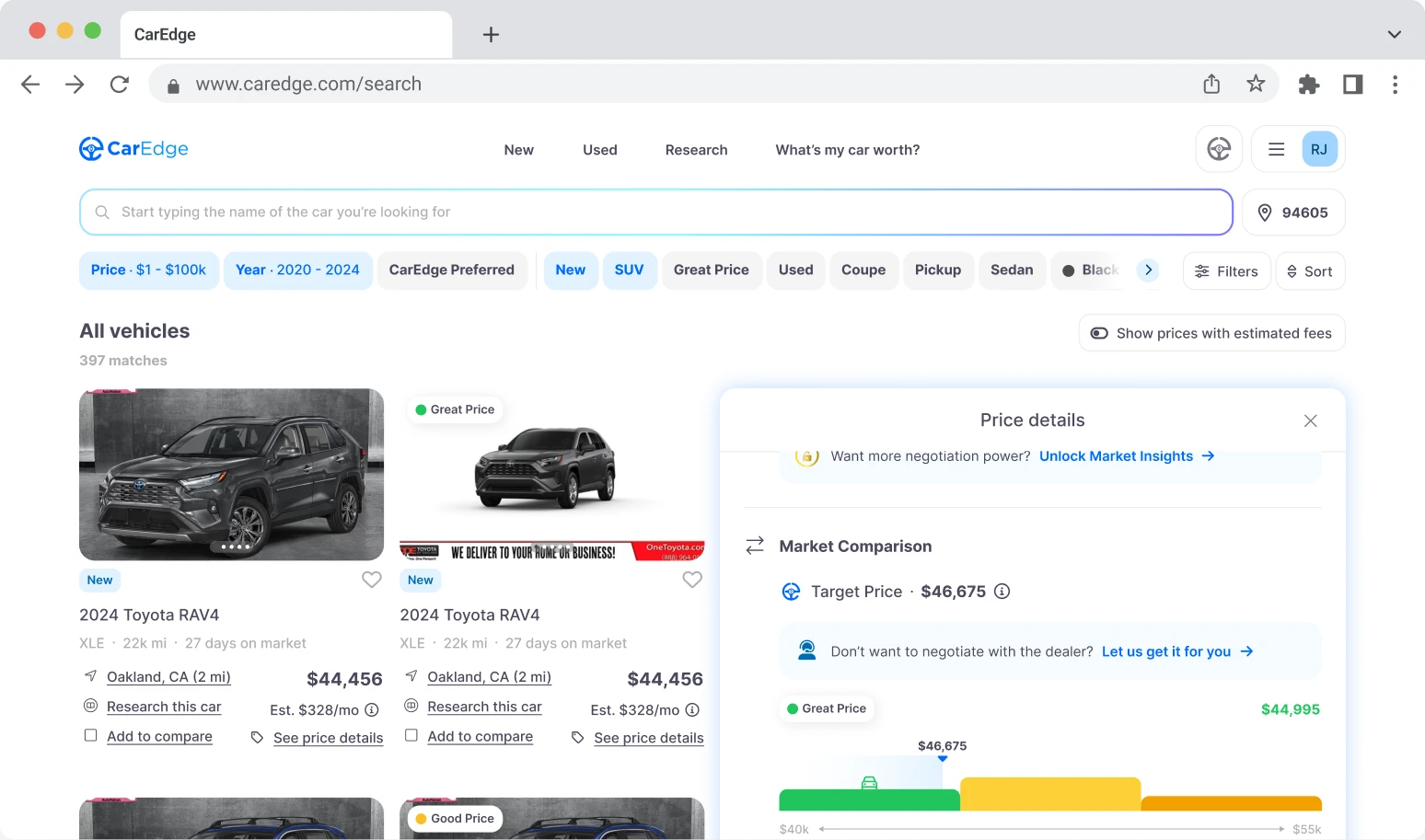
Find a wide range of vehicle listings with market insights on new and used listings near you.

What can I do with CarEdge?
 CarEdge Insights
What can I do with CarEdge?
Get access to exclusive information so you can make an informed car buying decision — all in one place.

Find a wide range of vehicle listings with market insights on new and used listings near you.
Track your vehicle’s value and cash in when the time is right to sell.

Access to our proprietary data to help you find the right car, at the right price. Find these unlocked on every listing after subscribing.

With our expert-led, tech-enabled car buying service, we will locate, negotiate, and deliver your vehicle so you can get a new car hassle free.


Help us personalize your CarEdge experience — it only takes a second.
Your answers help us personalize your CarEdge journey — we’ll follow up with tips and next steps that match your buying timeline.
We love hearing from our CarEdge members about their recent car deals. It’s always wonderful to see the ways they’ve used our solutions to negotiate and secure an excellent deal on their next car.
Today, we’ll take a look at a story from Mike C. about his recent car purchase. He used our solutions to expertly land a deal that he was extremely happy with. That’s what it’s all about. Let’s dive in!
Mike had a 2017 Buick Envision with a warranty that was about to expire. Not wanting to drive a car without a warranty, he started researching his options for buying a new car 8 months before he stepped foot on the lot at a dealership.
He discovered CarEdge on YouTube while researching car reviews. He was “instantly impressed” and began watching videos and taking notes. He even went through our Deal School.
After researching different options, Mike decided to pursue a new 2021 Hyundai Santa Fe Limited. Mike’s initial plan was to wait until the end of March (per Ray’s advice), but after noticing that his bid from Carvana for his Buick increased, he decided it was time to act.
Due to the chip shortage, used vehicle prices are rising fast. Become a member to get the latest prices on used cars powered by Black Book. Black Book is the guide many dealers use when valuing a trade-in.
Using our email templates, Mike reached out to eight dealerships in the area. Seven dealerships replied with out-the-door (OTD) prices. He then used the lowest of the eight OTD prices to negotiate with the other dealerships. Although he received a few excuses about why they couldn’t lower their price, he eventually heard back from one of the dealerships with a price that Mike considered to be fair.
According to Mike, “Your email templates were invaluable. They quickly identified the motivated dealers in the area.”
He printed off all of the documentation from us, along with his Carvana quote, and headed into the dealership.
Mike had already negotiated the OTD price over email. When he arrived at the dealership, he verified all the numbers with the sales manager, and “Deal 1,” as Mike puts it, was done in minutes.
“Deal 2” was trading in Mike’s current vehicle, his Buick. Initially, the sales manager said he couldn’t even get close to the trade-in value that Mike wanted. Then, Mike showed them the Black Book numbers that we provided him in the Market Price Report, along with Carvana’s offer. With all of this evidence presented, the sales manager agreed to come up to $20,600, which was acceptable.
The “friendly but assertive” F&I manager struck out when he started to offer Mike different protection packages and vehicle service contracts. Mike simply said no.
You don’t have to purchase a vehicle service contract at the dealership. See if a vehicle service contract is right for you.
He also verified that there was no early payment penalty on financing. The F&I manager said there was not a penalty, but that if he didn’t wait 90 days to pay off the loan, then it would result in a chargeback to the dealership.
Two hours after arriving, Mike and his wife drove away with a brand-new Hyundai Santa Fe.
Let’s evaluate Mike’s deal. He graciously provided us with all of the figures, which are:
Mike admits that there was probably room for improvement (and there always is), but he’s happy with the deal he received. He tells us that the deal he landed was as good as he could’ve hoped. Considering that the 2021 Santa Fe Limited had only been out for 2 months, Mike says he thinks that he got the best price possible.
We agree with Mike. It looks like he got a great deal. He used our tools to expertly find out all of the background information that he needed to negotiate. We especially like the way he utilized our email templates to get dealerships to negotiate against each other.
As Mike put it when reflecting on his transaction, “The power of knowledge cannot be denied. CarEdge access to days on lot, price history, and Black Book values are info sources of immense importance. Your deal school is an awesome body of work and will help just about every auto consumer. Some of the content I already knew, but I learned so much more. Your email templates were invaluable. They quickly identified the motivated dealers in the area.”
“All considered, my wife and I are really, really happy. Thank you for the time and effort you saved us. The time spent watching your videos was well worth it, given the info and entertainment value. Thank you for the money saved. Thank you for making the whole buying process just about stress-free.”
Well done and congratulations, Mike! We hope you enjoy your brand-new Santa Fe Limited.
Have you learned something new about buying, selling, or trading in a car as a CarEdge member? Share your story with us!

We love to hear success stories from the members at CarEdge. It’s great to see how people are putting our tools and information to use and securing excellent deals on their new purchases, sales, and trade-ins.
Today, we’re going to share a success story from Melissa. She doesn’t quite have her car in-hand due to the chip shortage, but she’s already secured a great price for her trade-in.
We’ll go over how she researched her negotiation, pushed when the dealership wouldn’t budge, and how she feels about the entire transaction. Let’s take a look at how Melissa negotiated the process and what she learned along the way.
Melissa tells us that she started researching which car to buy in 2020, but that she only recently found CarEdge in early 2021.
One of the first things that she remembers learning from us was that she needed to negotiate her trade-in and new car purchase as two separate transactions. Prior to that, she never thought it would be important to separate the two, and since she was about to trade-in her car, she was happy to learn a new trick.
Do you have a vehicle to trade in? Read the full guide to trading in your car.
After she signed up for CarEdge and became familiar with our dashboard, Melissa began to use our “trade in valuation” tool powered by Black Book, the same valuation book dealers use.. She tells us that she immediately put that into good use, since she was working with several dealerships at the same time.
On one of our live streams, Melissa had her deal picked to go through an examination with our trade-in analyzer. This is a segment in our live streams where we pick a member’s deal and analyze it live.
During this stream, she learned about some pre-trade negotiation strategies. Melissa also benefited from another CarEdge member, Larry R, who shared some insights into what the tax benefit would be if she traded her vehicle in versus selling it to Carvana or Vroom.
With all of these facts and figures in place, Melissa was ready to head to the dealership to complete some final negotiations on her trade-in.
Although she had done a lot of the legwork upfront via email, Melissa made an appointment to visit a car dealership to finalize selling her trade-in. She decided to try to get more value out of her trade-in.
The salesperson was visibly upset, since they had already prepared the paperwork. As such, they were dismissive of her attempt to negotiate. They tried to push her to sign the documents and move along with the sale that had been negotiated via email.
She didn’t give in, however. Melissa made it clear that she knew used vehicle prices were skyrocketing due to the microchip shortage and that this wouldn’t stop anytime soon. She told them that she knew that car dealerships tend to make more money on used cars than new cars and it would be worthwhile for them to pay more for the trade-in.
Her point was further cemented when she let them know that she had already received multiple quotes from online price books and other dealerships for her vehicle, so she knew what her trade-in was worth.
Having the trade-in value that was provided by Black Book, the same value the dealer was using, helped Melissa to understand the value she should be receiving for her trade-in. Her persistence paid off and the dealership ultimately caved in and gave her another $200 for her trade-in.
Melissa reported that on the same evening she traded her vehicle in, it showed up on the dealer’s website. The car dealership was asking for $3,690 more than what she received for it. Considering that a good part of that difference usually comes from reconditioning costs to prepare the vehicle for a new buyer, she was happy with the amount that she received from the deal.
Melissa is still waiting for her new car to be manufactured and shipped out. Unfortunately, the chip shortage has customers all around the world waiting for their cars to arrive. Melissa did not mention the make and model of the car that she’s buying, but we hope that she likes her new car when it comes in.
Melissa was very pleased with the value that she received for her trade-in. She’s grateful that she found our tools and was prepared to bring up the effect of the chip shortages at the dealership.
In her opinion, she’s saved over $4,000 compared to what she would have paid without CarEdge. We’re glad you negotiated a great price on your trade-in, Melissa!

Trading in your car can help you to buy a new car without having to put a large amount of money down. However, you need to keep in mind that dealerships will want to sell you a new car for as much as they can, while paying you as little as possible on your trade-in.
Today, we’re going to cover how you can use your trade-in to your advantage. We’ll discuss the best ways to boost your car’s trade-in value and give you tips on how you should negotiate while you’re at the dealership.
You’ve decided to trade in your car. What should you do next? Learning how to trade in a car is vital to getting the most bang for your buck. Here are your next steps.
Understanding how much a dealership should be offering is essential to successfully negotiating your trade-in value. You can use CarEdge Pro to gain an understanding of what similar cars are going for. It’s smart to bring printouts of your car’s fair value with you to the dealership to show that you’ve done your research.
There’s no need to give the car a new paint job, but fixing any cosmetic issues will go far in getting the most for your trade-in. It’s also worth cleaning the interior and exterior before you take the car to a dealership. Break out the shampoo for the carpets, go through a car wash, and fix any dents. You might be surprised how big of a deal this can be.
There are plenty of reasons to shop around at different dealerships. Every dealership will offer you a different amount for your car, and some will be more open to negotiating than others.
Make sure to obtain quotes from these dealerships for your trade-in and take them with you to the next dealership. Don’t lose them! These quotes — along with your used car values from CarEdge — will help you when it’s time to negotiate.
Once you have a firm understanding of your car’s value, have fixed any minor issues, and you’re prepared to shop around at multiple dealerships, it’s time to negotiate.

Avoid the temptation of negotiating your car trade-in value when you’re negotiating the price of a new car. You should negotiate both numbers separately. When you mix the negotiations, there’s too much potential for the salesperson to tweak the numbers so that it seems like you’re getting a better deal than you really are.
Your first order of business is to negotiate the price that you’ll pay for your new car. Once that is nailed down, then you can start talking about how much you’ll receive for your trade-in.
Use quotes from other dealerships and the Kelley Blue Book estimate to illustrate that you know what a fair offer looks like. Since many car dealerships will directly resell your trade-in on their used car lot, there’s an incentive for them to be competitive.
Stay firm in what you’ll accept. If they won’t give you a good price, then it’s time to leave that dealership. It’s worth taking your time to trade in a car the right way.
Timing matters when it comes to trading in your car. Being patient can often pay off. Factors such as weather, the type of car that you have, and other socioeconomic factors can come into play with the trade-in value that you receive.
For example, trading in an SUV that is in great condition right before winter can often result in a better trade-in value, as winter weather tends to drum up extra business from people that are looking for something that can handle snowy conditions. Think about the time of the year as it relates to what you’re offering.
Other factors can impact the sales process, too. It’s always better to try to buy a car at the end of the month or at the end of the year. That’s when car dealerships are trying to boost their numbers at the end of their sale periods. You’re likely to get a great price on your new car and a high trade-in value at these times.
Do your research to make sure that you know what your car is worth when you want to trade in a car. Stay firm on the amount that you’ll accept for your trade-in. Be aware that some dealerships may try to manipulate the numbers. Sometimes, what looks like a good deal on your trade-in is made up for with a bad deal in another area.
Remember, you can always say “no” and walk out of the dealership. It’s your car and you deserve to get a great deal.
Most people don’t look forward to buying a car. While the act of owning a new car is enjoyable enough that some people can power through it, it’s just not worth it to everyone. That’s where car brokers come in.
Car brokers can help you to navigate the automotive world on a personal level to help you buy your dream car. They can even help you to find a rare or specific vehicle.
Today, we’re going to examine what a car broker is, when you should use one, and how you can find a quality one.

What is a car broker? A car broker, also known as a car buying service, is basically a professional car buyer. The goal of a car broker is to level the playing field between you and the car dealership.
An auto broker is familiar with car dealership’s sales tactics, strategies for negotiating, and profit margins. They know how and where to save money throughout the entire process. They won’t fall for some of the numbers manipulations or specific strategies that might work on other customers. Instead, they’ll see these tactics coming and have a rebuttal already prepared.
Some auto brokers work for themselves or a small company, while others are part of a concierge service at a bank or credit union. An auto broker will often work for dealers and customers, helping to connect the two.
There are two ways that car brokers make their money: As a flat rate or as a percentage. An auto broker might charge everyone a flat rate, ranging from $200-$1,000. Other brokers opt to charge a percentage of the money that they saved you on your purchase. Expect to pay a retainer of approximately $100 once you decide to use an auto broker.
Car brokers can help to negotiate deals for new and used cars with dealerships.
Now that we’ve answered the question “what is a car broker,” we need to discuss the reasons that you should use one. People typically decide to use a car buying service to save time and money. Car brokers know exactly how to navigate the sales process to find any opportunities to save you money. You also won’t have to waste your time negotiating and spending hours at a dealership.
Other car buying services might be used when you’re looking for a rare or vintage car. Specialists hunt down these cars and buy them for their clients. This is a much more high-end service than the kind offered by the average car broker.
Using a car broker is similar to using a real estate agent. They help you to minimize mistakes and maximize your savings. For those looking to skip the whole car buying process altogether, this is a great way to go.
There are several things that you need to do when you want to hire a car buying service. You should begin by asking about options available through your favorite warehouse club store or the credit union that you bank with. Many types of brokers that offer car buying services may even have their fees included with your memberships.
If you don’t have a free option, it’s time to head online and look for a well-reviewed auto broker. Some attributes to look for are:
You will need to make sure that the auto broker is licensed to sell cars in your state and that they are able to abide by any other regulations that may apply to your specific transaction. Research any potential auto brokers on review-based sites to see how other customers have felt about working with them.
Want to get a better deal by yourself? Join CarEdge to get access to a suite of tools and information to help you get the best deal buying a car.
Deciding to work with an auto broker might well be worth your time. If you don’t care to learn the ins and outs of car buying in order to score a great deal, auto brokers are an excellent alternative. Keep in mind the requirements that we’ve outlined above and do plenty of research before deciding which one to work with.
Of course, if you want to learn how to negotiate and handle the work yourself, we’ve got a deal school that’s designed just for you.
If you’re looking for a new car, you might be tempted to investigate a new or used electric vehicle (EV). An EV is powered entirely by electricity that charges your battery at charging stations. There are a number of unique factors that must be considered as a result, such as the lifespan of the battery and the location of charging stations.
There are many aspects to consider when you’re looking into buying, selling, and trading EVs. Today, we’ll take a look at everything that you’ll encounter as you start shopping around for electric vehicles.
Buying an electric car might be the right purchase for you, but it’s also not for everyone. Instead of simply heading off to the nearest Tesla dealership to check out the latest models, it’s important to take some time to consider a few unique factors that will bring entirely new variables to the car buying equation.
Just like buying a traditional car, buying an EV requires plenty of time and research before you head to the dealership. In this electric car buying guide, we’re going to go over some of the prime factors that you need to consider before you buy this type of car. We’ll cover home charging, the importance of range, and whether an electric vehicle really saves you that much money.
One of the biggest perks of an EV is also its biggest downside: No gas. While this does mean that it will have a cheaper cost-to-own, it also means that you can’t fill up on your way to work in the morning when you need a boost. You will need to be able to charge your car either at home or somewhere that’s conveniently close to your home.
If you are on a standard 120V electric circuit, it would literally take days to charge your vehicle. These breakers aren’t even rated for the number of hours it would take to charge your car fully. Instead, they are most commonly used to run your standard appliances and electronics in your home.
The other option is a 240V electric circuit. On these breakers, you can have a Level 2 charging station installed that will most likely fill you up — or at least get you close to full — every single night. Your electric oven, dryer, and central AC run on 240V.
Either option comes with a home charging setup that can be purchased and installed by a number of companies. Exact prices will vary, but as a general rule for this electric car buying guide, set aside about $1,000 to $2,000 to install a home charging station.
How long do EVs take to charge? The exact answer will vary based on the vehicle, charger, and amount that needs to be charged. On average, most vehicles take about eight hours to charge fully.
The latest and greatest charging stations put out enough power to easily stop a heart. Keep in mind that your car has an inherent charging capacity that will restrict how much power can flow between the charging station and your car. This can matter greatly when you’re buying an electric car.
You need to keep electricity rates in mind for your home, as well. Electric vehicles are measured in kilowatt-hours per 100 miles, notated as kWh/100 miles. In order to figure out how much it’ll cost to have a given car charge at your home, multiply your vehicle’s kWh/100 miles rating by the rate you’re charged for electricity at the times that you’re most likely going to be charging.
In reference to EVs, range is used to describe how far a car can go on one charge. For quite some time, the lack of a comprehensive charging network was a large deterrent to the adoption of EVs. While it will certainly depend on your area, this problem has been resolved for much of the country.
You’ll need to consider where you usually drive if you plan to charge at home. You will also want to consider how often you take road trips to decide if the range limitation is even an issue for you.
For anyone looking for a nice easy daily-driver, the range might not be that big of a deal. Even people who take regular road trips should look up the network of charging stations before being deterred, since the network has grown substantially in recent years.
Some people are drawn to EVs for their environmental friendliness. You won’t be chugging gas every time you head to the grocery store, so many people also assume that this will directly translate into saving money. However, with other maintenance purchases taken into consideration, does this assumption hold true?
Consumer Reports recently found that the average EV owner saves over $800 to $1,000 per year on fuel costs over an equivalent gas-powered car. We assumed there’d be some savings in this arena!
Maintenance and repair were also found to be about half of the amount necessary for gas-powered vehicles, with an average savings of approximately $4,600 over the life of the car.
Depreciation has traditionally hit EVs harder than gas-powered cars, but newer reports are indicating that the new lines of EVs are on par with gas-powered cars for depreciation. Teslas also tend to hold their value well, making a strong case for buying a Tesla.
Ultimately, the true cost of ownership will be different for everyone. There will be variance in how quickly your car depreciates, what you can expect costs for repairs and maintenance to be, and fuel costs.
Based on Consumer Reports, the cost to own an electric car is generally lower than a gas-powered car; however, that isn’t necessarily true of all-electric vehicles. You’ll need to research your exact cost and be satisfied with those prices before you buy an EV.
Our electric car buying guide wouldn’t be complete without mentioning that insurance rates for electric vehicles are often higher than their gas-powered equivalents. This means you need to remember to get insurance quotes while you’re shopping around.
Deciding between a new or used EV is a tough choice to make. Much of the traditional advice applies here, such as obtaining a pre-purchase inspection and considering a CPO if possible.
One of the main unique aspects to consider is the life of the electric battery that powers your entire car. Replacing this battery is akin to replacing an engine in a gas-powered car. This means that when you buy a used EV, you will often have fewer miles on your electric battery.
EV cars also have the potential to make you eligible for a $7,500 tax credit. Assuming that you are eligible for this credit, this can significantly offset the cost of a new EV. Only 200,000 credits were given out to each manufacturer to provide as an incentive for buying a new EV. However, many of these credits have already been awarded, and the number of credits available will need to be increased at the federal level.
Depreciation is also a factor to consider. The value of new cars depreciates once they trade owners. If you buy a new car, you’re guaranteed to lose money on depreciation, but the trade-off is that you’ll get a brand-new electric battery and the latest technology in your vehicle.
There’s a great opportunity for a flexible buyer in the used electric vehicle market. After three years or so, many electric vehicles are traded in or sold out of the desire to buy something new. Many EV owners want the latest and greatest cars out there, especially when they know they’ve been piling up mileage on their batteries. As such, there is an excellent market of used EVs available.
We can’t talk about buying EVs without bringing up leases, too. There are two main points that need to be addressed when you’re considering leasing or buying an electric car.
EV batteries can cost about the same as a new engine when they need to be replaced. As such, never having to replace them can be quite advantageous. This is a major benefit of leasing a vehicle over owning an electric car. Once your lease is over, simply trade it in for a car with fresher batteries.
This point is technically true for any lease, but the technological differences that EVs have between model years are more significant. A few years of EV evolutions could greatly increase charge speed, expected distance of travel on a single charge, and battery life. Leasing to constantly have the best technology in each of these categories is well worth considering.
Tesla didn’t invent electric vehicles, but its impact on the marketplace cannot be understated. Their success launched EVs into the spotlight, and now, there are EV options from many major automakers.
Let’s take a quick look into the ways that major automakers are adapting and evolving with their EVs:
With plenty of money being invested into EVs and a large amount of these vehicles currently in operation, we expect to see EV sales soaring throughout the next decade.
While Tesla is more like buying an iPhone, other manufacturers sales are similar to their gas-powered counterparts. See our guide to buying a car in 2021.
Is buying an electric car the right move for you? As with many questions that relate to the car buying experience, the answer is: It depends.
As you’ve seen in our electric car buying guide, there are unique factors to consider at every step of the way. While many aspects of buying an electric car are the same as buying a gas-powered car, there are some unique points to consider. Put in plenty of time into researching charge locations and electricity prices, along to your standard car research if you plan to buy an EV.