
CarEdge saved me over 4,500 dollars on a brand new Honda Pilot. I can't say thank you enough.
Price intelligence
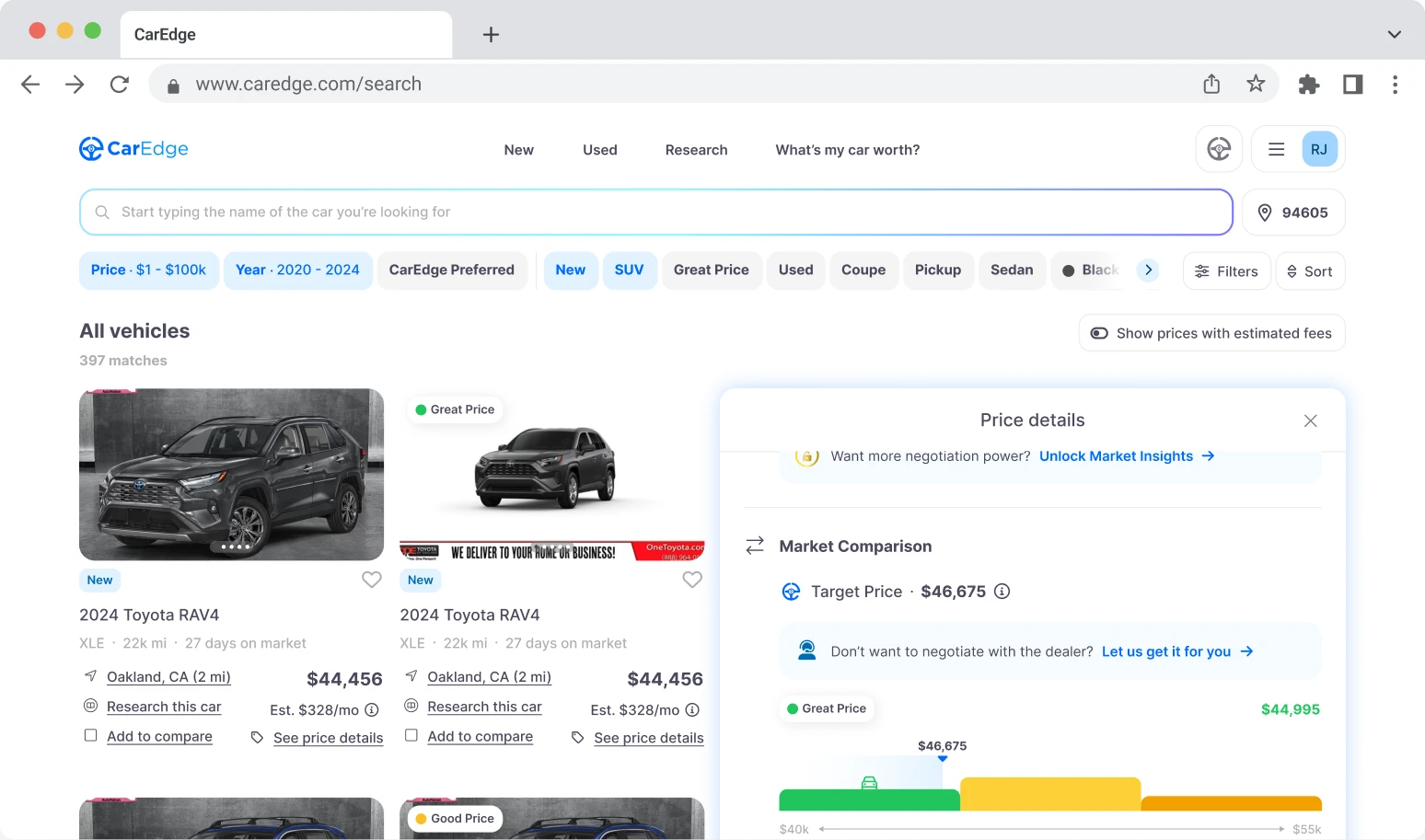
Find a wide range of vehicle listings with market insights on new and used listings near you.

What can I do with CarEdge?
 CarEdge Insights
What can I do with CarEdge?
Get access to exclusive information so you can make an informed car buying decision — all in one place.

Find a wide range of vehicle listings with market insights on new and used listings near you.
Track your vehicle’s value and cash in when the time is right to sell.

Access to our proprietary data to help you find the right car, at the right price. Find these unlocked on every listing after subscribing.

With our expert-led, tech-enabled car buying service, we will locate, negotiate, and deliver your vehicle so you can get a new car hassle free.


Help us personalize your CarEdge experience — it only takes a second.
Your answers help us personalize your CarEdge journey — we’ll follow up with tips and next steps that match your buying timeline.

Here at CarEdge, we’re focused on one thing: making car buying more transparent, more fair, and less of a hassle. As most drivers know from experience, buying a car is already a complex process, and purchasing a vehicle in another state can make it even more overwhelming. With inventory levels fluctuating, many car buyers are expanding their search beyond to find the right vehicle at the best price. We’ll walk you through the entire process, from understanding the steps involved to figuring out tax requirements and transportation logistics.
Buying a vehicle in another state is eerily similar to buying a car at your local dealership with a few exceptions. The steps to the sale are:
At a high level, that’s how you buy a car in another state. Let’s break each step down a bit further.
As with any car deal, the first step is to negotiate the OTD price with the salesperson or sales manager. Never be a monthly payment shopper. That’s a recipe for severely overpaying. When buying a vehicle in another state you’ll likely be unfamiliar with their taxes and fees.
It is incredibly important that you tell the dealership what your zip code is so that they can calculate your taxes and fees based on your location. We’ll touch on this more below, but taxes are paid where you register your vehicle, not where you purchase it. If the dealership doesn’t know your zip code, they won’t be able to provide you with an accurate out the door price quote.
We strongly recommend that you reference the CarEdge OTD Price Calculator to verify that the dealership’s OTD price matches up with the correct tax, title, and registration rates in your state.
Do you know what happens if you arrive at the dealership without a competitive financing pre-approval in hand? The finance office will be THRILLED because to the dealership, they instantly realize they have the upper hand.
Dealers routinely mark up finance offers before presenting them to customers. It’s one way they make money. Be sure to bring a competitive financing offer from a credit union!
Ideally, get offers from more than one credit union or small bank. Why not the “giant monster mega banks”, as money guru Clark Howard puts it? They don’t usually offer the best rates. They have name recognition, so perhaps they don’t feel that they need to be competitive.
Note: It’s ok to finance with the dealership, but only if they can beat your best offer from a credit union. Sometimes, this will make the sales manager more likely to ‘work with you’ on the out-the-door price of the car, since they receive compensation from the banks they work with when you finance with them. As long as it’s the best deal for you, there’s nothing wrong with it.
If you’re purchasing a used vehicle from another state, there are a few extra considerations you should be aware of. First, you should absolutely consider arranging for a pre-purchase inspection to make sure the vehicle is in good working condition. Second, you’ll need to ensure the vehicle can pass your state’s inspection and emissions testing. By conducting a pre-purchase inspection (PPI) you’ll likely become aware of any issues that would preclude the vehicle you’re thinking of buying from passing your state’s inspection.
To arrange for a pre-purchase inspection from out of state, you have a few options:
Check out our complete guide to PPIs for more information.
Before you sign anything, review the written out-the-door price and official buyer’s order to insure that there are NO dealer markups, and no unwanted add-ons. Nitrogen-inflated tires, ‘theft protection’, VIN etching, and even pinstripes are common add-ons. Just because the dealer pre-installed it, does NOT mean you have to pay for it.
👉 Remember: If it’s taxable, it’s negotiable.
After an inspection report has been received and you’ve agreed to an OTD price that you’ve carefully reviewed, you’ll want to place a deposit down on the vehicle. When buying a vehicle in another state, the last thing you want to do is fly there, or arrange shipping, only to see the price change at the eleventh hour. To protect yourself from last minute changes, place a deposit on the vehicle, and also request to sign a copy of the buyer’s order. Request that the sales manager at the dealership does the same too.
The final step in the out of state purchase process is to take delivery of the vehicle. This is when you will meet with the Finance and Insurance Manager to review loan options and insurance products. As with buying a vehicle locally, you can (and should) come in pre-approved with outside financing and extended warranty coverage quotes.
Depending on what state you are purchasing the vehicle from, you may be able to “take delivery” remotely (sign all the paperwork electronically) and have the vehicle shipped to you. More on that below.

Yes, if you buy a car in another state you can drive it back home to where you live. Unless of course you decide to buy a car in the state of Massachusetts …
In every state except Massachusetts you will receive a temporary license plate from the state where you purchased the vehicle. This temporary tag (also referred to as “drive off tags”) will allow you to legally operate the vehicle after purchasing it.
When you arrive back in your home state you will then go to your local department of motor vehicle and register the vehicle. This is when you will receive your permanent plates for the vehicle.
Why is Massachusetts different from all the other states? That’s a great question. Their laws around vehicle registration are infuriatingly complex and cumbersome. Auto Influence wrote a great article on the Massachusetts Problem.
When you purchase a vehicle out of state, you pay taxes in the state where you register the vehicle, not where you purchased it. The actual process of calculating the correct tax amount and remitting it to your home state can be handled differently.
For example, if it’s a neighboring state, the dealership where you purchase the vehicle will collect and remit the taxes and fees for you. You’ll then receive your permanent plates and registration in the mail. Many dealerships have software that allows them to calculate the proper sales tax and registration fees for different states, and in neighboring states they may feel comfortable handling that for you.
If you’re buying from a further away state, or if the dealership doesn’t offer to handle tax and registration for you, you should contact the dealership’s title department to see if they can walk you through the steps you’ll need to take back in your home state. At this point it is also helpful to consider contacting a local dealership and asking them for assistance too. You can of course also refer to your state and local tax laws and remit payment on your own.
Let’s say you purchase out of state and you pay for sales tax, but it is the wrong amount. What happens then? When you go to register your vehicle at your local department of motor vehicle you will either receive a credit from them, or you will owe them additional money.
Yes, absolutely. This is a very common practice and could financially make a lot of sense for you. The dealership where you purchase the vehicle may recommend a particular shipping company and you should see what their quote is. You should also shop the quote and get bids from other providers as well.
Shipping options will range from open air freight to closed container shipping.
When you buy with CarEdge, we can ship your vehicle to you. Learn more about the benefits of buying with CarEdge.
Yes. The registration process is different in each state, however you can buy a vehicle in one state and register it in your home state. You’ll need to make sure the vehicle can pass your state’s emissions test and road worthiness inspection.
You’ll also need to confirm that the vehicle title is clear of any liens.
If you’re buying a vehicle in another state and you have a trade-in, you should always treat your trade-in as a separate transaction from your purchase. When negotiating the out-the-door price, don’t let the dealership tie your trade-in offer to your purchase. If you do, you will get a low-ball offer.
👉 Take this trade-in checklist with you to play it smart.
Yes, you can lease a vehicle from another state, however some dealership’s will not allow you to. The complexity of out-of state leases is high, and some dealerships do not want the burden of mistakenly calculating the wrong taxes and fees on a lease.
Before negotiating an OTD price with an out of state dealership, we would encourage you to ask them if they’re willing to lease you the vehicle with you being from another state. Be prepared to give them your zip code since each state treats leases differently.

In conclusion, buying a vehicle in another state can seem like a daunting task, but with the right knowledge and guidance, it can actually be a smart move that saves you money. By taking the time to research the laws and regulations in the state you plan to buy from, and working with a reputable dealer or private seller, you can find the car of your dreams without breaking the bank.
Ready to outsmart the dealerships? Download your 100% free car buying cheat sheets today. From negotiating a deal to leasing a car the smart way, it’s all available for instant download.
These days, more drivers are opting to “factory order” a vehicle instead of buying one off the lot. This trend began during the new car shortages of the pandemic, and has stuck around ever since. For many car buyers, factory ordering is an unfamiliar purchase process and can be intimidating. We’re here to help you make sense of it all.
Everyday on the CarEdge Community Forum we field questions such as:
We’ll address these questions (and more) below.
Let’s dive in.
The steps to factory order a car isn’t too terribly complicated, however, for many, it’s an entirely unfamiliar process. Here’s the roadmap for factory ordering a car in 2026:
The simple “10 steps to factory order a car” … Simple, eh? Let’s break things down a bit more.
Can you negotiate on a factory order car? Yes. You can, and you should negotiate the price of your factory ordered vehicle.
There is a common misconception that because you are “custom ordering” a vehicle you cannot negotiate with the dealer, simply because it is “custom”. That couldn’t be further from the truth. From the dealership’s perspective a factory order is just like any other car deal. It’s a piece of inventory that they’ll make front-end and back-end profit on. As a customer, you should treat it the same way too.
So when do you negotiate on a factory order? At the time of placing the order. Not when you take delivery of the vehicle!
This is another common misconception when it comes to factory ordering a car. You need to negotiate when you first place the order, not when you take delivery. Why? Because the dealership treats the ordered vehicle similarly to any other sales.
When your salesperson/sales manager is putting together the “deal jacket” (industry lingo for all the paperwork associated with your car deal), they will have an out-the-door (OTD) price associated with the deal. That OTD price shouldn’t be MSRP + fees + taxes + tags/registration. Instead, if you negotiate with them it should be MSRP – dealer discount + fees + taxes + tags/registration.
Enjoying this guide Check out The Car Buyer’s Glossary of Terms, Lingo, and Jargon
If you don’t negotiate with them then, the assumption is that the deal is at MSRP, and your leverage (once the vehicle is on the dealer’s lot) is lesser. Especially in the current market where inventory is so scarce.
It’s also important to negotiate the price upfront, because you want to “lock-in” the price so that there are no surprises when you finally take delivery. More on that below.
What can you negotiate when you factory order a vehicle? It’s simple, all the same things you would negotiate when you purchase a car off the lot. Remember, if it’s taxable, it’s negotiable!
Negotiate on taxable fees (doc fees, processing fees, etc.), and on the vehicle’s selling price. After you negotiate, you should ask for a signed copy of the itemized out-the-door price.
Manufacturers incentives are applied at the time you take delivery of the vehicle, not at the time of placing the order. For example, if you order a truck today you will negotiate the OTD price with the salesperson and sales manager today. You will then take delivery of the truck several weeks later. At that time, you will be eligible for any applicable manufacturer incentives that are currently active. You will not be able to retroactively receive the incentives that were in place when you ordered the vehicle.
Negotiating a factory ordered vehicle is very similar to negotiating a vehicle that is on the dealer’s lot. If you are unfamiliar with that process, please consider going to CarEdge’s free Deal School, or if you’d rather have experienced pros handle your deal, consider signing up for our Car Buying Service.
That being said, there is one distinct difference between negotiating a vehicle on a dealer’s lot and one that is ordered. That distinction is floor-plan assistance.
What the heck is floor-plan assistance you wonder?
You may be more familiar with “holdback” which is a form of “under the line” profit that dealerships collect from the manufacturer. In addition to holdback, dealerships also receive floor-plan assistance and advertising assistance from their manufacturer.
Floor-plan assistance is a set aside amount of money for each vehicle (it appears on most dealer invoice prices) that the manufacturer gives to the dealership to offset the interest expense associated with “floor-planning” the vehicle. You may not have known this, but car dealerships do not pay cash for their inventory. They finance it, just like you or I would. That means they have an interest expense on each vehicle that is on their lot.
Floor-plan assistance helps offset this cost for the dealership.
Why is this important? Because since you are factory ordering your vehicle and will likely take delivery within a few days of it arriving at the dealership, the dealer will not incur any meaningful interest expense. That means the floor-plan assistance from the manufacturer is pure profit for them.
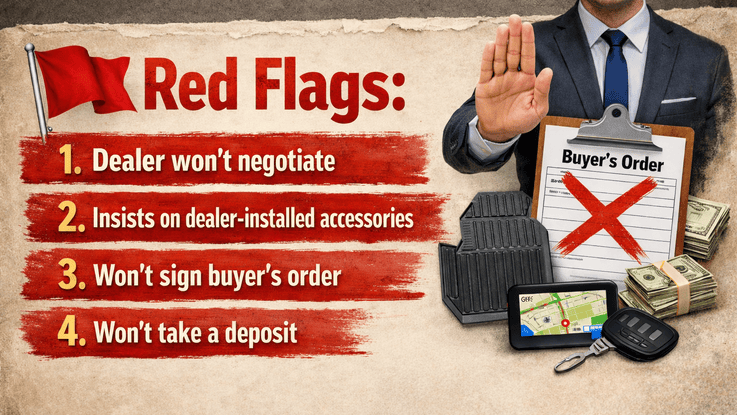
As you can tell by now, factory ordering a car is very similar to purchasing a vehicle straight off the dealer’s lot. It isn’t too terribly different, however there are some distinct changes in the process. That being said, are there any particular “red flags” you should watch out for when placing a factory order? The answer is “yes”. Here’s what you should watch out for.
This is a major red flag. If the dealership isn’t willing to negotiate on the price when you place the order you can guarantee that two things will happen when the vehicle does arrive:
We’ve heard too many stories of people “ordering” a vehicle and not negotiating the price in advance, only to have a nasty surprise when it finally does arrive at the dealership.
Dealer-installed accessories are added by the dealer when they receive a vehicle. You’ve likely seen these on an OTD price worksheet in the past. Things like wheel locks, or LoJack are common dealer-installed accessories.
A common line you’ll hear from a salesperson or sales manager is “we can’t take that off, we put it on every car.” Well, the great thing about factory ordering a vehicle is that the dealership doesn’t have to install any of their accessories, because you’ll take delivery as soon as the vehicle arrives.
If the dealership is persistent about not removing them, that’s a red flag, because it’s a truly illogical argument.
You’ve negotiated your OTD price and you’re ready to put down a deposit to hold the vehicle. Woohoo! The only way to really make the agreed upon OTD price legitimate is to have a mutually signed buyer’s order. That, plus the deposit and the signed build sheet, make it clear that the price is the negotiated price.
If a dealership won’t sign a buyer’s order, that’s a red flag. You don’t want to arrive the day your vehicle is ready only to find out that the negotiated selling price you had is no longer agreeable to the dealership, and the only way to protect yourself from that is to have the signed agreement.
If they won’t do it, take your business elsewhere.
When you factory order a car you will need to put down a deposit on the vehicle. This is typically $500 to $1,000. If the dealership does not request a deposit, or if they won’t accept your deposit, that means the vehicle you’re “ordering” isn’t really your vehicle. Just like the signed buyer’s order, if you can’t get a deposit down, you’re in for a rude surprise when the vehicle finally does arrive.
To “lock-in” your build and the OTD price, have both the dealership and yourself sign a buyer’s order, and put down the requisite deposit amount that they require.
This is an unfortunate, albeit common occurrence. If you’ve followed our steps and placed an order and then the dealership has gone silent, be sure to go up the chain of command at the dealership to contact someone in a leadership position to get information about your order. This is all about being your own advocate. We encourage you to use our email templates when contacting the dealership.
Have other questions about factory ordering? Please post them on the CarEdge Community here: https://community.caredge.com/home
We hope this helps. Please consider sharing it with anyone you know who might find it valuable.
Everyone loves a good success story. At CarEdge, we take great pride in giving our customers the knowledge and confidence they need when they’re buying a car.
Today, we’re going to meet Michael. Michael was in the market for a specific make and model of vehicle, but the only dealer in town wasn’t offering him a fair deal. Thankfully, Michael was a member of CarEdge, and the knowledge he gained enabled him to get his dream car without facing a nightmare at the dealership.
In the past, Michael had found it easier to lease his vehicles, which gave him the flexibility of a new car every few years. But one day, Michael fell in love with a vehicle model that was no longer available in new condition. So he decided to make the switch from leasing to buying a used vehicle.
Michael faced just one small problem: The vehicle of his dreams was only available at a particular dealership. But Michael was confident that he had the tools and know-how to get the best deal. Michael knew that the dealership had a $699 non-negotiable delivery fee, but he was willing to pay that price because he knew the dealer had a “no-haggle” policy.
Michael deliberately began his car-buying process by evaluating his trade-in. Michael had done his homework. He had shopped his trade-in around, getting online quotes from some of the major providers like we recommend, and eventually received one offer that was $2,000 more than the competition. Unfortunately, this dealer wasn’t so generous. They made an offer, but it was lower than almost any online offer Michael had received. What could he do?
Thankfully, Michael came prepared. As a member of CarEdge, Michael had been reviewing our materials and watching our videos to learn the vocabulary and tools to get his best deal. After becoming a member, he was able to perform his own analysis by running market reports, looking at reviews, and gaining the knowledge he would need before ever contacting a dealership.
Before he became a member of CarEdge, Michael felt confident in his knowledge of cars. But after investing time studying and reviewing our resources, Michael was amazed at the new depth of his knowledge.
Michael’s new knowledge came in handy now that he had entered the car-buying process.
First, he told the dealership that one of their competitors had provided an offer on his trade-in that was $2,000 more than what they were offering.
The dealer agreed to match this quote if Michael could provide a scanned copy of the quote. Michael assured the salesperson that if they could match the price, he’d be willing to purchase the car that same day.
As a premium member you get access to our Valuations tool that is powered by Black Book. Become a member to get access. You can print the value of your vehicle to show the dealer.
True to their word, the dealer offered Michael a trade-in value that was even better than before, offering $2200 more than their initial quote. Michael had won his first battle, but the sales war was far from over!
Michael and the dealer worked out all the details of the trade and the car he wanted to buy. Michael knew that he had excellent credit, which would allow him to qualify for around 3% financing from his local bank. The dealer, on the other hand, offered a rate of 4.4%.
When Michael challenged this figure and asked for the buy rate, he noticed a change in the conversation. The dealer knew that Michael was not their average customer. They promised to “see what we can do.” Within an hour, Michael received a phone call from the dealer—this time offering him a rate of 2.4%. Michael wasn’t merely excited; he felt satisfied that his research had paid off!
That’s when the dealer offered a $40 discount on a Vehicle Service Contract (VSC) package. This, they assured him, would “only” raise his monthly payment by the slightest amount. Michael, however, saw through their sales tactic. When Michael requested the actual price of the service contract (and not just the monthly rate), he discovered that the dealer was trying to add on $6,000 worth of services and products.
Michael politely declined. Thanks to his membership at CarEdge, he had a quote for a VSC in the amount of $2,400.
Perhaps Michael said it best: “The true success and value of CarEdge is shown here. Completed the deal without an extra 2% interest and without $6,000 of add-ons because I was prepared. Got an extra $200 over the highest offer on my trade (and over $2k more than their original offer) because I asked them to beat it to get my business. I was comfortable enough to push back. I was ready so that I could get my Ray Shefska Stamp of Approval, I think that even working with a no-haggle dealer, I can get one here.”
Ultimately, Michael got his dream car, thanks to the knowledge he gained through CarEdge. Our online resources gave Michael the knowledge and confidence he needed to push back and get the best deal possible.
Michael’s story can be your story! No one likes feeling like they’re being taken for a ride at the car dealership. Before you contact a dealer, check out some of our resources. Consider becoming a member, like Michael, so that you can have the confidence to get your next vehicle at the price you deserve.
Updated September 22, 2021
One of the oldest pieces of wisdom that people have passed around about buying a car is that it’s always better to buy a used car. In fact, nearly 70% of Americans say they would consider buying a used car, according to Cision. Is this age-old wisdom always true when it comes to used vs. new cars? What about in a strange year like 2021?
Today, we’re going to take a look at several factors that influence the new vs. used car buying decision, including factors that are unique to 2021.
When we compare used vs. new car values, we’re comparing equivalent vehicles that vary primarily based on model year. We all know that a 10 year old car will cost less than a brand-new car, so we need to compare equivalents (the same make, model, and trim) to honestly address the question, “Should I buy a new or used car?”
We all know that 2020 and 2021 have presented the world with unique problems. One of these problems is a semiconductor shortage. Semiconductors, also referred to as integrated circuits, ICs, and “chips,” are used in nearly every electronic device, which means there is a generally constant (and increasing) demand for them.
When the pandemic hit in 2020, semiconductor manufacturers had to shut down and then re-open with new safety restrictions. Doing so hurt productivity, along with the productivity of the entire supply chain.
Since it takes so much time to produce a semiconductor, it has been a slow struggle to catch up to the demand that multiple industries are placing on chipmakers.
You may be interested in this deep dive on How We Ran out of Cars in the US.
The second issue is related to other inputs that are required to manufacture vehicles.
Earlier in 2021 there was a severe winter storm that hit Texas and knocked their power grid offline. This storm resulted in oil refineries halting production, including the production of byproducts. One of these byproducts is used in foam seats in cars. Because of this, many automakers were struggling to secure foam so that they can continue to produce new cars.
There was also a rubber shortage that effected automakers.
More recently, we’ve seen automaker struggle securing other raw materials, such as resins and steel.
All of these factors have made 2021 a unique year in which to purchase a car. Keep these factors in mind as we proceed to examine which is better value; new or used cars.
Let’s begin with the most important attribute: Value. What is the current value of the car that you’d like to buy? You must understand the current value to decide whether to buy new or used.
We recommend using our Market Price Report to help determine the value of the car that you’re after. Our report will compare actual sales prices from various dealerships in your area to determine what a fair price might be for the car.
Run a Market Price Report for the target car that you have in mind. The price that we suggest as a fair price isn’t the entire story. To understand the full price that you can expect to pay, you’ll need to click through to the website of the dealership selling the car. Read through their listing and look for any manufacturer or dealership incentives.
You may discover that there is a $3,500 rebate on your car or some sort of dealer incentive for financing that will impact the purchase price. There may even be credits or rebates that apply to certain people, such as first responders and members of the military.
Deduct the dealer incentives from the price that we’re telling you is fair and you’ll have a great idea about the current value of the car.
You’re not done yet! To truly compare apples to apples for a used vs. new car, run another Market Price Report for a used car variant of the same make and model. For example, if your new car was a 2021 Honda Accord, you might run a new report for a 2019 Honda Accord.
Do the same thing and click through to the dealership website. Notice how there are no added discounts, incentives, or credits? Used cars generally do not have any added discounts.
Also use the Valuation Report in the app to get a sense of what a dealer would charge for the used car. Check out our guide to the Black Book value, which is used by many dealers.
Now, you have an excellent idea about the true value of both new and used cars for the make and model you’re interested in. Even though you can now answer the question about which one is a better value, there’s much more to consider before you make your purchase.
The price that someone is asking for a car is hardly ever going to be the actual price that someone else pays, something that’s true for both new and used cars. As such, to truly answer the question at hand, you need to consider how much you can negotiate with the seller.
When you run a Market Price Report, you’ll see a negotiability score towards the top. This score is calculated based on how long the car has been on the lot as compared to the average in the region. If a car has been on the lot for 70 days and the average in the area is 20 days, you’ll likely have some great luck negotiating for that car.
As such, when you’re comparing new vs. used car values, you need to keep in mind how much you can potentially negotiate off of the vehicle. There’s always plenty of room to negotiate with a new car, but the attitude with used cars is often “the price is the price.” Keep this in mind as you determine whether to buy a new or used car.
Negotiating doesn’t just happen when you’re haggling down the MSRP, it also happens when you’re seeking financing. Speaking in generalities, you’ll receive better financing offers when you’re buying a new car, along with having more room to negotiate on those offers. Used cars are usually a bit more cut and dry.
What difference does a warranty make in the used vs. new car battle? Your new car is going to come with some type of warranty to protect you from manufacturer’s defects. It may even have another warranty for powertrain components. Additionally, the car will be in factory-perfect condition, so you won’t need to worry about a pre-purchase inspection.
On the other hand, a used car is going to have whatever may be left on the warranty from when the car was initially bought. In many situations, that means there will be no warranty or that you only have a year or two left. Plus, you’ll absolutely need a pre-purchased inspection to make sure that you have a solid understanding of its condition.
Should you buy new or used? How important is the warranty to you? If it’s vital, then new cars are the way to go.
You should do the leg work to determine whether a new or used car is better in your exact situation. Our tools will do most of the hard work for you, but you still need to use them to determine whether a new car is better than a used car for the make and model you’re investigating.
When it comes to 2021, our conclusion is that buying a new car is generally the way to go, due to the material shortages that are impacting the industry. These shortages have raised the prices for used cars, which are more in demand, although this may change as the year goes on. While you may not have as much room to negotiate with a new car, you’ll still find more value with a new car than with a used car that has a temporarily inflated price.
Anyone looking to buy a car, whether it’s used or new, will benefit from using our Market Price Report. You can run three searches for free, which allows you to compare cars and make your ultimate decision. Head on over to the Market Price Report and run one today!
Understanding the history of a used car before you buy it is vital, but it can sometimes be difficult to get a full and accurate picture. Some sellers may lie about the condition of a vehicle or simply not remember everything that’s happened to it. This is where a CarFax report comes in.
We always recommend getting a pre-purchase inspection on any used vehicle you are considering purchasing, however at a bare minimum you need to get your hands on the vehicle’s history report.
What is a CarFax report? It’s a simple document that sheds light on the entire history of a given vehicle, starting from the time that it was manufactured. Understanding all of this information can help you to decide whether you want to buy the car, assist in negotiations, and let you understand what to expect from the car in the future.
Let’s take a look at what else you can learn from these important reports.
CarFax was founded in 1984 as a method to use data center tools to track and prevent odometer fraud. These days, CarFax maintains a database of over 6 billion vehicles in the United States and Canada.
An individual consumer or dealership can pay a fee to CarFax, along with the VIN for the car in question, and CarFax will present a detailed report about that vehicle.
So what’s on a CarFax report? There’s usually plenty of data to help consumers make an informed purchase decision. The data from CarFax comes from over 100,000 different sources. Much of the data on a CarFax report comes from police departments, since they are the first responders that handle major and minor car accidents. Other sources of data include insurance companies and auto body shops.
CarFax reports are broken down into several important sections. The section that’s particularly important for private sales is labeled “Title.” This is where the Department of Motor Vehicles’ information is listed.
Ensuring that the owner shown on the title matches the name of the person you’re buying from (if you’re not buying from a dealership, that is) will go far in keeping you out of trouble. This section will also inform you if the car has a salvaged title. It can even tell you if the car has been reported as stolen (run the other direction if it is).
Salvaged titles are not necessarily a lost cause. A salvage title means that the vehicle was in an accident and was declared to be totaled by an insurance company. After it was declared to be totaled, someone else took it upon themselves to repair the vehicle and put it back on the road. Salvaged vehicles might not have anything wrong with them, but you should still be wary of getting into a salvaged vehicle, since there are likely to be a lot of unknown factors.
The next section on the CarFax vehicle history report will simply list the mileage of the vehicle. It’s okay if there are some differences here, but they should be minor. Any major difference in the mileage is a red flag and could indicate odometer fraud. Typically speaking, though, differences in the mileage report only mean that the record hasn’t been updated as further miles were driven.
A CarFax report will also list how many owners the car has had. In an ideal world, you would want to buy a car with as few owners as possible. Generally, this means that the car hasn’t been passed around too frequently. A car with too many owners is a mild red flag, as this can be associated with certain types of fraud. Take note that CarFax does not collect nor report the names and addresses of previous owners.
On top of understanding how many people have owned the car, you’ll also learn whether the vehicle was used commercially, in a lease, or as a ride-sharing vehicle. This information can help you to understand what you’re getting into, since commercially owned vehicles will generally have more miles and may have been treated a bit rougher in the past. A ride-sharing vehicle can have its own problems, too, including a more worn interior and rougher suspension.
On a CarFax vehicle history report, you’ll learn if there are any active recalls that pertain to the vehicle. If you see a major recall affecting the target vehicle, ask whether it’s been addressed. If not, ask for a discount, since you’ll have to deal with the recall.
Most recalls are for a specific component. If a component has been recalled, it means that the car needs to be taken into a dealership for service. If you buy a used car and immediately have to address a recall, it can be a significant inconvenience (which often means it’s a good idea to ask for a discount).
Most importantly, a CarFax vehicle history report will tell you the accident history of the target vehicle. Details about the accident should be provided as well. Understanding whether a vehicle has been in an accident can help you to make your purchase decision. If you do proceed with the purchase, you can use the accident as leverage during the negotiations.
CarFax will let you know whether any car accidents resulted in airbag deployments or severe structural damage. If you see either of these types of damage listed, you should proceed with extreme caution. But even if you see a severe collision listed on a CarFax report, you should ask questions about the accident and ask for documentation about the repairs.
While collisions are certainly the main source of damage to cars, they are not the only one. A CarFax report can also show if there was any significant damage from fire, hail, or floods. Hail damage can be repaired without much issue, but stay away from cars that have been in a fire or a flood. Both of these types of damage can compromise the safety of the vehicle and result in costly repairs down the road, even if the initial damage was already repaired.
You’ll often hear people say that a certain car has a “clean” CarFax report. This means that there was no information found that was concerning.
It’s worth noting that a clean CarFax report doesn’t mean that the vehicle is perfect and worthy of being purchased. Sometimes, information can be misreported or otherwise mishandled so that it doesn’t show up on a CarFax report. For example, this might happen if someone failed to report a fender bender.
Other times, data may not show up because it didn’t come from the right sources. For example, an auto body shop might report that they worked on a car and replaced the rear fender, but if their report didn’t contain any information about the accident that caused the damage in the first place, it may not show up on the CarFax report as an accident.
It’s a good idea for anyone that is buying a used car to purchase a CarFax report before they sign on the dotted line. Many car dealerships are happy to provide a copy of the CarFax report for the vehicles that they sell.
You need to do everything you can to make sure that you’re buying a worthy vehicle, not a lemon that’ll break down on you next week. Test drives are one way to do that, and pre-purchase inspections are another way. Consider CarFax reports to be yet another tool in your toolbox when you want to make sure that you’re getting a good deal.
If you see any red flags appear on a CarFax report, it’s up to you to bring it up to the seller. Ask them whether there is a reasonable explanation for the things that came up on the report. You may end up hearing a string of excuses, but in some cases, you may get information that can alleviate your concerns.
As of 2021, one CarFax report costs $39.99, with discounts for volume as you increase the number of reports. Considering how much you’re likely to spend on the car, this is a minor expense that’s usually well worth the cost, especially if you end up using the information to negotiate the purchase price for your vehicle.
If you’re working with a used car dealer, ask them to supply a CarFax report for the vehicle that you’re interested in. It’s in their best interests to show that they have confidence in their cars and they usually don’t mind paying the small fee. If they won’t provide you with a report, it might be time to move on to the next dealership.
If you’re working with a private seller, on the other hand, don’t expect them to provide you with a CarFax report — you’ll most likely have to purchase your own as part of your due diligence on the vehicle.
Remember to buy a pre-purchase inspection alongside your CarFax report, which can help you to have all of the information you need to make an informed purchase decision.