
CarEdge saved me over 4,500 dollars on a brand new Honda Pilot. I can't say thank you enough.
Price intelligence
Find a wide range of vehicle listings with market insights on new and used listings near you.

What can I do with CarEdge?
 CarEdge Insights
What can I do with CarEdge?
Get access to exclusive information so you can make an informed car buying decision — all in one place.

Find a wide range of vehicle listings with market insights on new and used listings near you.
Track your vehicle’s value and cash in when the time is right to sell.

Access to our proprietary data to help you find the right car, at the right price. Find these unlocked on every listing after subscribing.

With our expert-led, tech-enabled car buying service, we will locate, negotiate, and deliver your vehicle so you can get a new car hassle free.


Help us personalize your CarEdge experience — it only takes a second.
Your answers help us personalize your CarEdge journey — we’ll follow up with tips and next steps that match your buying timeline.

If America is to go electric as the automakers claim, access to EV charging stations will have to grow exponentially in just the next few years. As it stands today, there are 63,000 public charging stations, but only 17,460 are fast chargers. That works out to just 37 charging ports per 100,000 Americans. Industry experts estimate the US will need more than 100,000 public fast chargers for the 22 million EVs that are expected to hit American roads by 2030.
Most charging is done at home, but public chargers are an important piece of the puzzle. They are essential for interstate travel and road trips. Will hitting the road in an EV ever be as simple and hassle-free as it is in a combustion vehicle? Here are the latest developments in the world of EV charging access.
President Biden, the US Department of Transportation, and the US Department of Energy announced the allocation of $5 billion over five years for the establishment of a National EV Charging Network. The funding is made possible by the Bipartisan Infrastructure Law, which was signed into law in November of 2021.
The chief goal of the charging funds is to create a network of EV charging stations along the Interstate Highway System. The total amount available to states in 2022 is $615 million, but states must submit an EV Infrastructure Deployment Plan before they can access these funds. A second, competitive grant program designed to further increase EV charging access in locations throughout the country, including in rural and underserved communities, will be announced later this year.
Learn more about how much each state is receiving to build electric car charging stations here.
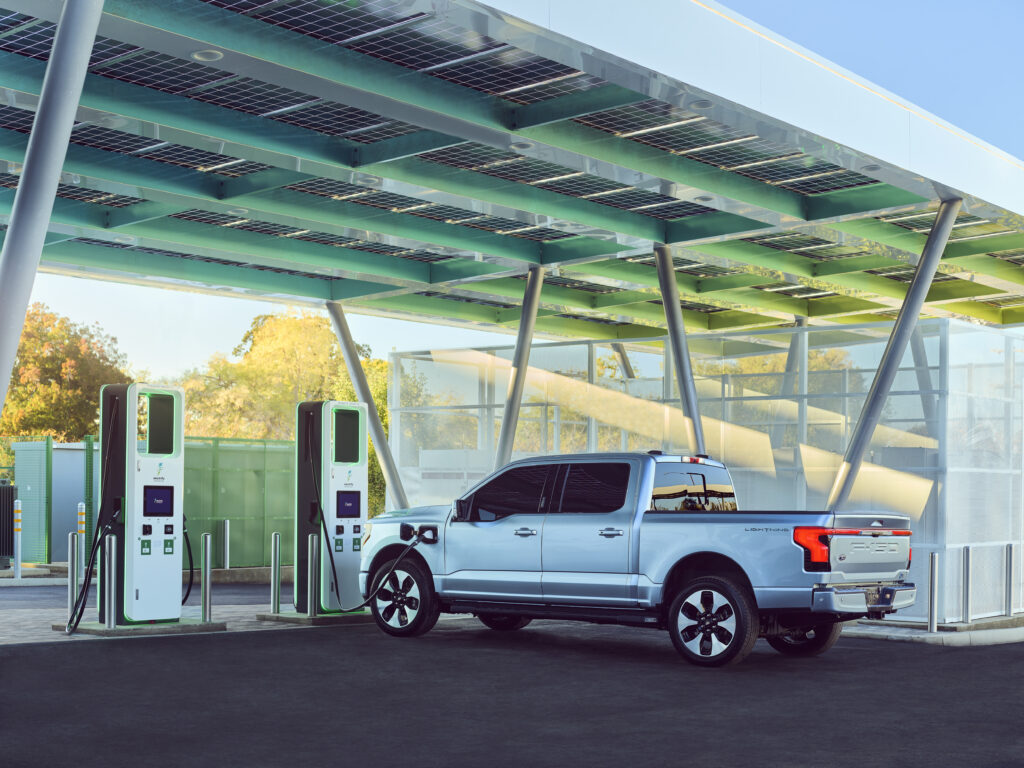
Although EVs only made up 5% of US passenger vehicle sales through mid-2021, a recent survey found that 39% of Americans say they are likely to purchase an EV for their next vehicle. On top of that, OEM executives expect half of all sales to be electric in 2030, just eight years ahead. Taken together, this points towards a future where EVs are no longer fringe models with limited audiences; EVs are going mainstream.
Over 80% of charging is done at home at very affordable residential rates. The remainder is at public charging stations that vary widely in pricing. In the states that lead in EV ownership, existing charging stations often have long wait times during periods of busy travel. The need for more public charging presents a business opportunity just waiting to be taken advantage of, and now the big utilities are taking notice.
Just this month, the Edison Electric Institute (EEI), an association representing US utilities, announced a monumental initiative to combine the forces of 51 investor-owned electric companies, one electric cooperative, and the Tennessee Valley Authority. This new coalition is a coordinated effort to install thousands of fast charging ports along major U.S. travel corridors by the end of 2023. The coalition members are committing $3 billion of their own money to bring fast chargers online over the next two years.
The 2021 bipartisan infrastructure package passed by congress allocates $7.5 billion for the expansion of charging to 500,000 charging plugs nationwide. The administration announced plans to designate highways as “corridor-ready” for electric vehicles, meaning charging stations are located no more than 50 miles apart and no more than five miles off the highway.
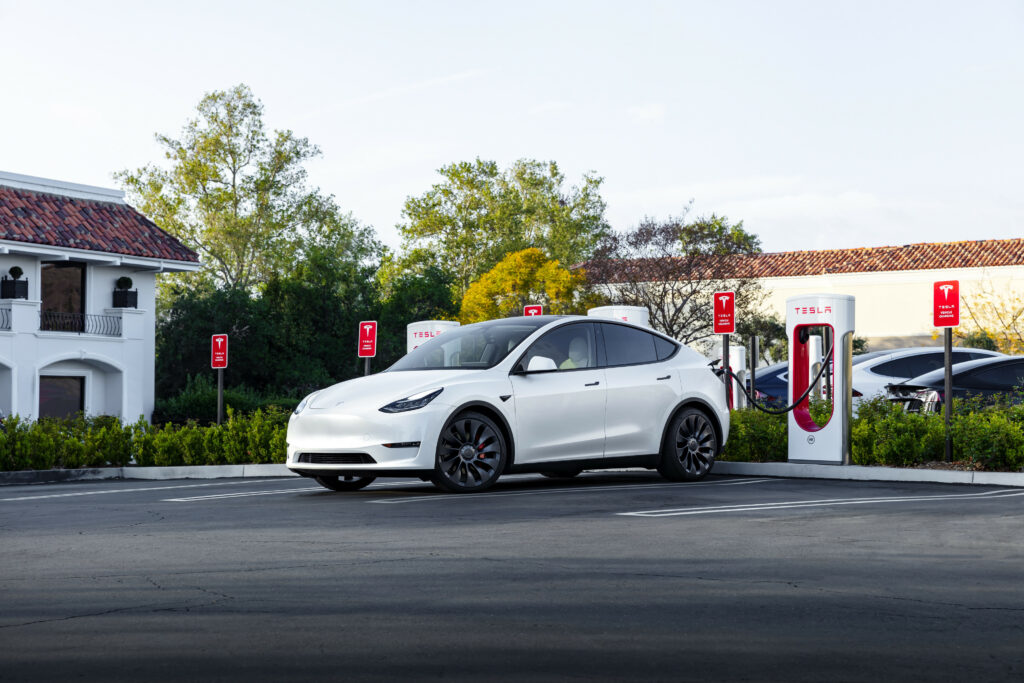
For most of the last decade, Tesla’s Supercharger network was the only nationwide fast-charging network for EV owners. It was long rumored that Tesla was on the verge of opening select Supercharger locations to all EV owners, but it appears that North American Tesla Superchargers will remain a walled garden for now. Tesla has already opened Supercharger access to all in France, The Netherlands, and Norway. Non-Teslas pay a higher price for charging, and Tesla says that will fund the continued growth of the network.
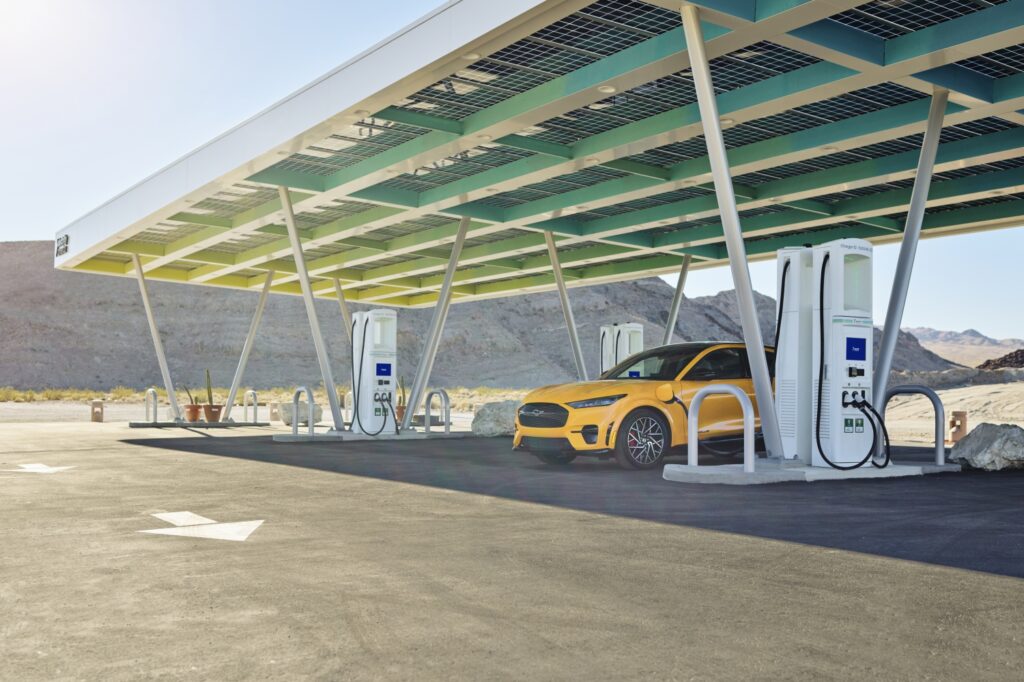
One outcome of the Volkswagen dieselgate debacle was the creation of Electrify America, a VW-funded nationwide charging network in the US. After a rocky start plagued by unreliability and low use, things are looking up for EA. This past summer, EA announced their “Boost Plan” to more than double their current EV charging infrastructure in the United States and Canada. At the end of 2021, EA has completed nearly 800 charging stations with a total of 3,500 charge ports. By the end of 2025, EA plans to have more than 1,800 fast charging stations and 10,000 individual chargers installed.
The all-new Volkswagen ID.4 electric crossover comes with three years of free fast charging at Electrify America stations. Hyundai and Ford are also offering limited free charging incentives for their EVs. As the networks expand, the value of these free charging incentives will grow.
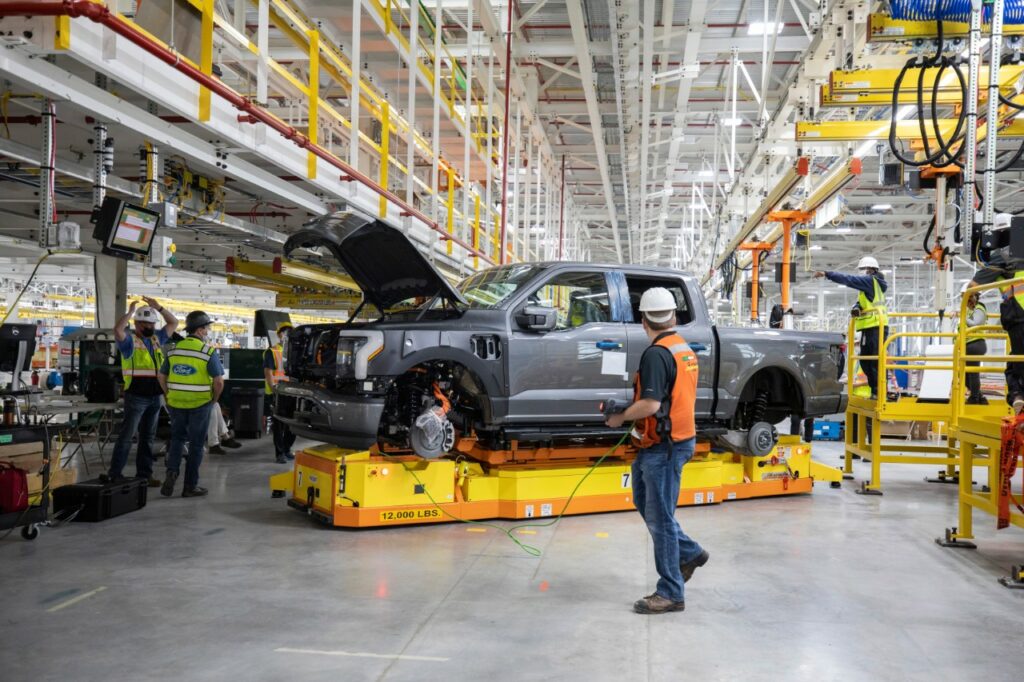
Legacy automakers and EV startups have plans to make public charging easier for their customers. GM announced Ultium Charge 360, a plan that will integrate charging networks for seamless use with all GM vehicles. They’ve established partnerships with EVgo, Blink, ChargePoint and other big names in North America. Furthermore, GM’s new Dealer Community Charging Pro will see dealerships playing an active role in bringing 40,000 level 2 chargers to underserved communities, including rural and urban locations.
Ford’s BlueOval charging network makes plug-and-charge possible for the Mustang Mach-E and future EV models, a nod to Tesla’s plug-and-charge popularity. Ford says that they want charging an EV to be as simple as stopping at a gas station.
By the end of 2023, Rivian’s Adventure Network of chargers will have 3,500 fast chargers installed at 600 sites in North America. Rivian’s brand targets outdoor enthusiasts and overlanding types, so the new network will cater to EV owners who venture off the beaten path. At first, the Rivian Adventure Network will be exclusive to Rivian owners, but the company says they will open it up to other EV brands shortly after. This is a big deal for EV owners looking for zero-emissions wilderness adventures, especially considering that the much-hyped Subaru Solterra all-wheel drive EV barely makes it 220 miles on a charge.
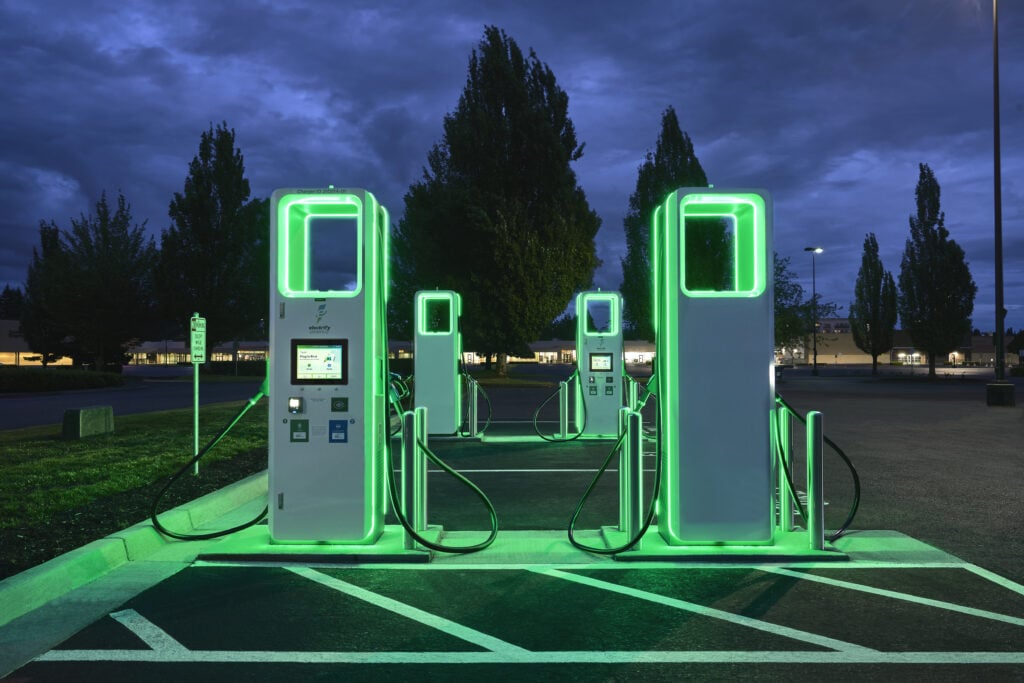
The short answer is no, not for decades, if ever. However, more and more gas stations are adding fast chargers to their parking lots. Sheetz, a popular gas station chain in the East, has been the site of many Tesla Superchargers. In Maryland, one gas station ditched gas entirely for EV charging stations. The new infrastructure bill’s $7.5 billion for EV charging will bring chargers to more gas stations, truck stops and interstate rest areas. The Department of Energy already keeps track of every fast charging station in the nation, and even has a neat map of stations to explore.
Retailers are seeing the benefits of hosting EV charging. Most Electrify America stations are located in Walmart or Target parking lots in close proximity to dining and shopping. Movie theaters and shopping malls often offer free charging for customers. This is a trend we expect to continue, bringing convenience and the occasional free charge to EV owners.
EV charging stations are great for highway adventures, but it’s important to remember that EV owners who rely on public charging will spend far more on charging than those who charge mostly at home. EV drivers who pay for public charging will see a much higher total cost of ownership, possibly even approaching that of a combustion vehicle.
More EV models are making their debut in 2022, and almost all of them charge at over 150 kW. This is great for those wanting to go electric yet dreading long waits at a charger. The next two years will transform the experience of EV ownership in America. With so many new fast chargers coming online and even better models to choose from, EV technology just might be maturing right as American infrastructure catches up with demand.
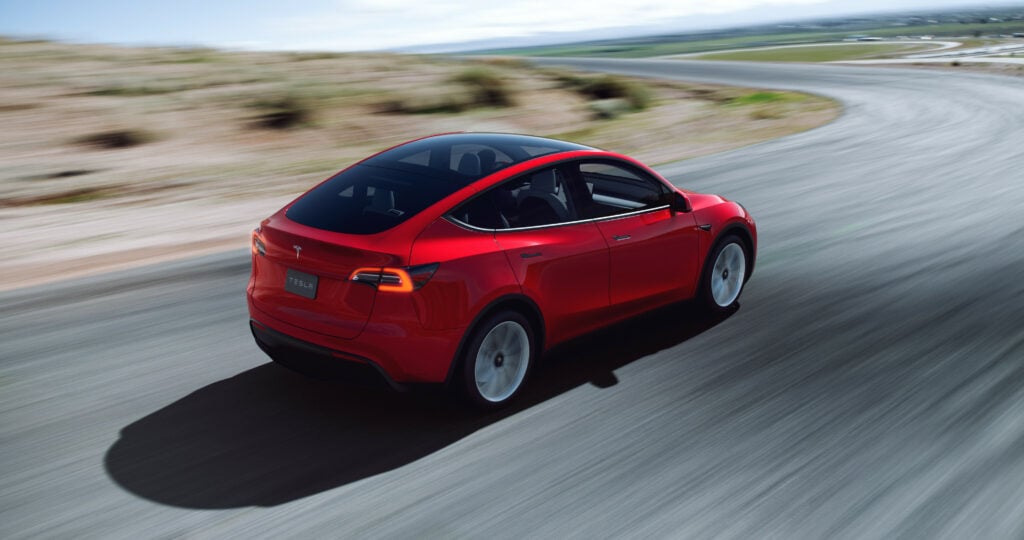
In 2021, Tesla’s one-size-fits-all crossover took the top spot in EV sales with over 132,000 sold in the US through November. The 2022 Tesla Model Y represents the electric giant’s staying power as a force to be reckoned with, and legacy OEMs are late to the game. Tesla recently shared important updates to the Model Y, along with a series of significant price increases. Here’s what you need to know about the 2022 Tesla Model Y.
Tesla’s Model 3 sedan recently became the first electric vehicle to surpass 1 million cumulative deliveries. The car also has some of the highest customer satisfaction ratings, despite low reliability scores. However, there was always one thing in particular that Model 3 owners wanted more of: space. When the Model Y crossover launched in 2019, Tesla offered a solution for those who desired an electric crossover.
Need a family-sized cabin? Want a sporty drive and all-weather confidence? How about class-leading charging speeds and EPA-rated range? The Model Y has these features and a LOT more. If you’re ready to buy a 2022 Tesla Model Y, get in line. Demand has been through the roof. The current backlog of orders shows an estimated delivery window in April-July 2023 for orders placed in July 2022. Upcoming 2022 updates, high customer satisfaction, and the fact that this vehicle is good at almost everything are all reasons for the runaway demand.
Tesla recently announced a small range increase for the Model Y. The updated figures have the Long Range all-wheel drive base version at 330 miles of combined city and highway driving with the 19” gemini wheels, up from 326 miles. This continues to be the all-electric crossover with the longest range on the market.
The Long Range base trim is listed for $67,190 ($65,990 + $1,200 doc fee). Upgrading to the 20” induction wheels (+$2,000) lowers range to 318 miles. The Performance variant ($71,190) gets 303 miles of range.
All new Model Ys can charge at up to 250 kW, which translates to adding 200 miles of range in just 15 minutes at a Tesla Supercharger. There’s now one more free paint option. Both pearl white multicoat and midnight silver metallic are available at no additional cost. Tesla’s controversial and unfinished Full Self-Driving is unlocked for $10,000 (all Tesla’s are equipped with the necessary hardware for FSD). All in all, a fully-loaded red Model Y Performance with FSD will cost a grand total of $87,190 before taxes.
To date, Model Ys have been built in Fremont, California for the North American market and in China for Europe and Asia. That will soon change with the opening of Giga Texas, Tesla’s brand-new factory and headquarters just outside of Austin.
The first Austin-built Model Y’s are rolling off the production line with a surprise in store. These first Texas-made Model Y’s are all-wheel drive ‘standard range’ Model Y’s with Tesla’s new 4680 tabless battery cells. Tesla is reportedly offering the first batch of this new Model Y variant to customers awaiting orders nearby.
The Model Y Standard Range AWD will cost a few thousand less than the long-range AWD (rumored to be $59,990), but range will be an EPA-rated 279 miles instead of 330. The battery pack has less capacity, with 68 kilowatt-hours instead of the larger 82 kWh pack. Zipping to 60 mph will take 5.0 seconds or so, which is just a hair slower than the long-range variant.
What’s so special about Tesla’s new 4680 batteries? This larger form factor features a streamlined design that is more energy dense and lightweight per unit of energy stored. In fact, Tesla’s 4680 cells are challenging the promise of solid state batteries, an emerging technology that legacy OEMs are betting on.
2022 Model Ys built at Giga Texas will start with a world-first: single castings for the front and rear portions of the frame. Following the introduction of Tesla’s megacasting, 2021 Model Ys are already produced with a single rear casting, which is one huge metal cast that replaces what was previously made of 70 individual parts. Mega-castings bring three important benefits for Tesla and their customers. Improved structural rigidity translates to better crash test performance.
Castings greatly simplify production. The new castings also make sense for the incorporation of an all-new structural battery pack for Tesla’s new 4680 batteries. Tesla is moving away from the ‘skateboard design’ that most automakers use for their battery packs, and is transitioning to battery integration into the frame of the car itself.
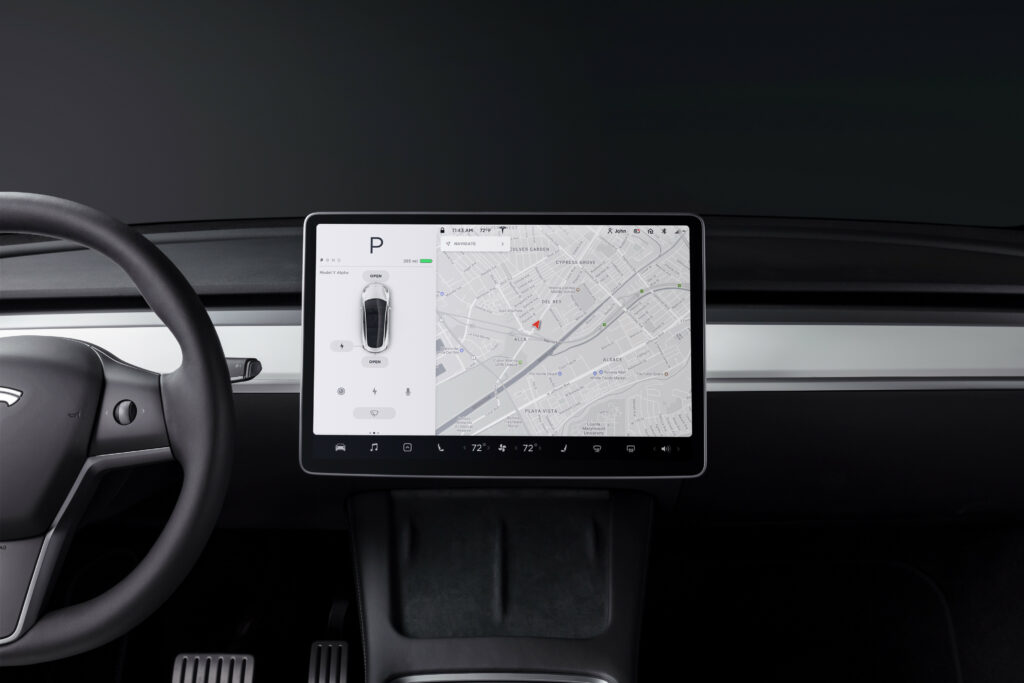
New for 2022, the Model Y is gaining an in-cabin radar that will monitor driver awareness, detect vehicle intrusions, and possibly even alert authorities if a child is left behind in a hot car. It also looks like all new Tesla models will now have the refreshed user interface that the luxurious Mode S and X received in 2021. This new UI enables the driver to customize the infotainment display as desired. Model X, Model S and made-in-China Model Ys have transitioned to a new AMD Ryzen chip for the media computer. The result has been quicker performance for the many apps that are accessible through the infotainment interface. It’s not a guarantee, but the 2022 Model Y built at Giga Texas may include the new AMD chip.
All Tesla’s receive over-the-air updates periodically, a game-changing strategy that’s now spreading through the auto industry. Even years down the road, the Model Y is likely to gain new features and better performance through OTA updates. All you need is a wifi connection.
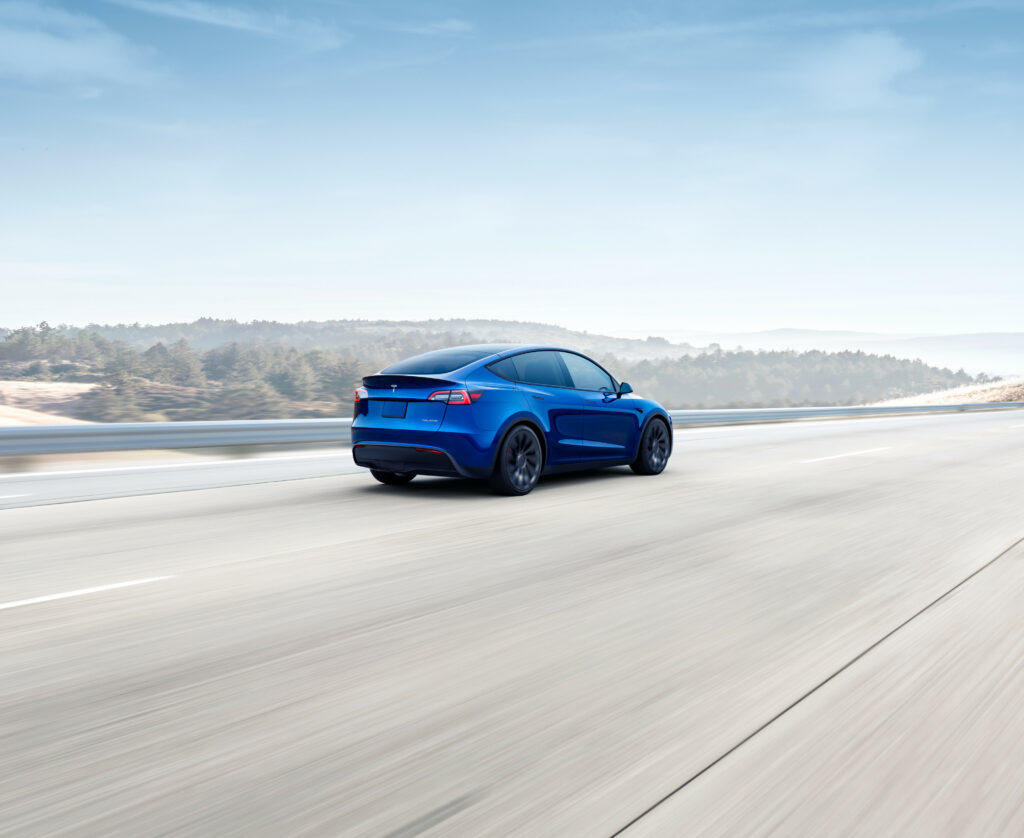
Rarely does a compact SUV perform like a track car. That’s exactly what you get with the 456 hp Model Y Performance. The Performance is the top-tier trim, cranking out 497 lb-ft of torque and propelling to 60 mph in just 3.5 seconds. It also comes with a lowered suspension and 21” uberturbine wheels. All that power comes with a range penalty, dropping it down to a still-respectable 303 miles.
Even the Model Y Long Range base variant is really fun to drive. With 384 hp and 376 lb-ft of torque, the most affordable Model Y still rockets to 60 mph in just 4.8 seconds. A test drive reveals that the power just keeps building beyond 60 mph. The Long Range has a top speed of 135 mph, and the Performance tops out at 155 mph. It’s easy to get a speeding ticket in this family car. Ground clearance is 6.6”, so off-roading capabilities are limited without modifications.
Some critics claim that Tesla’s are a bunch of one-trick ponies. They go fast in a straight line, but that’s about it. My experience test driving the Model Y has shown otherwise. It’s fun on a curvy road, and it feels well-planted on a variety of road surfaces and weather conditions. It weighs in at 4,416 pounds, so that’s what we’d expect. All Model Ys now include double-paned glass, so road noise is greatly reduced compared to the early Model 3’s, although it’s not as quiet as any of the German luxury cars.
When Tesla unveiled the Model Y, it was met with mixed reactions. Some thought it looked like a bloated Model 3, others saw it as the automaker’s key to world domination. Now that the dust has settled, the Model Y has garnered a devoted fan base of families, track enthusiasts and everything in between.
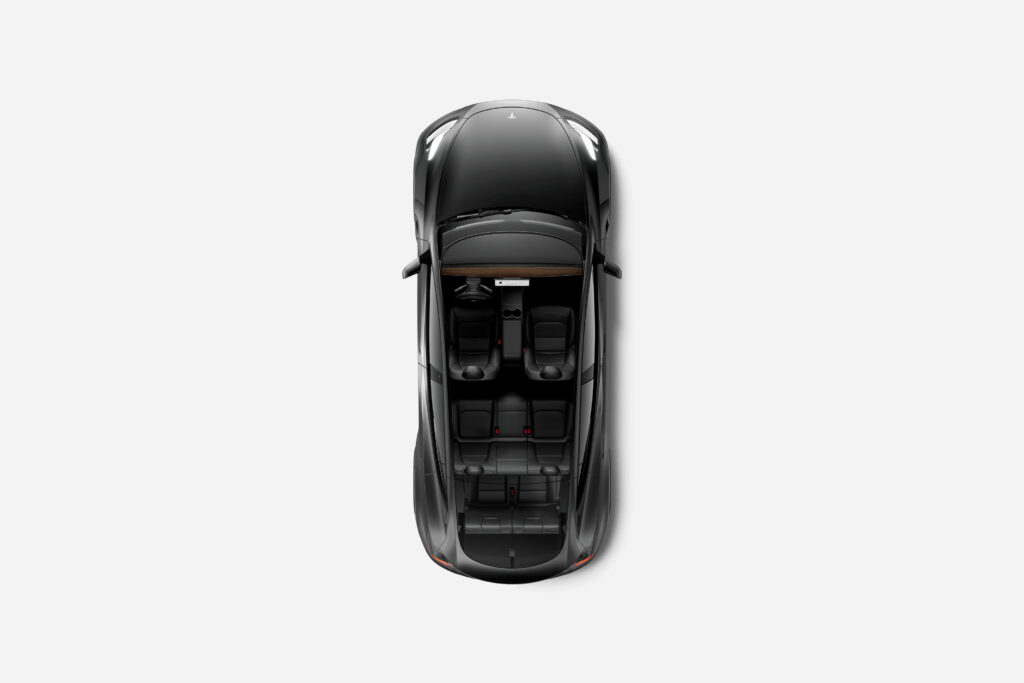
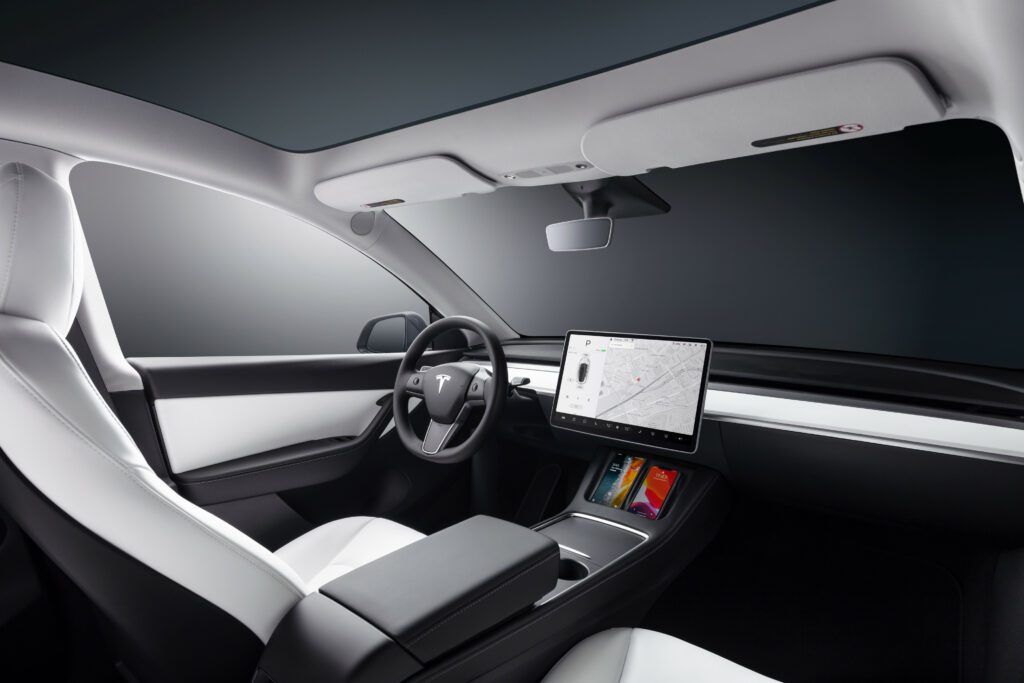
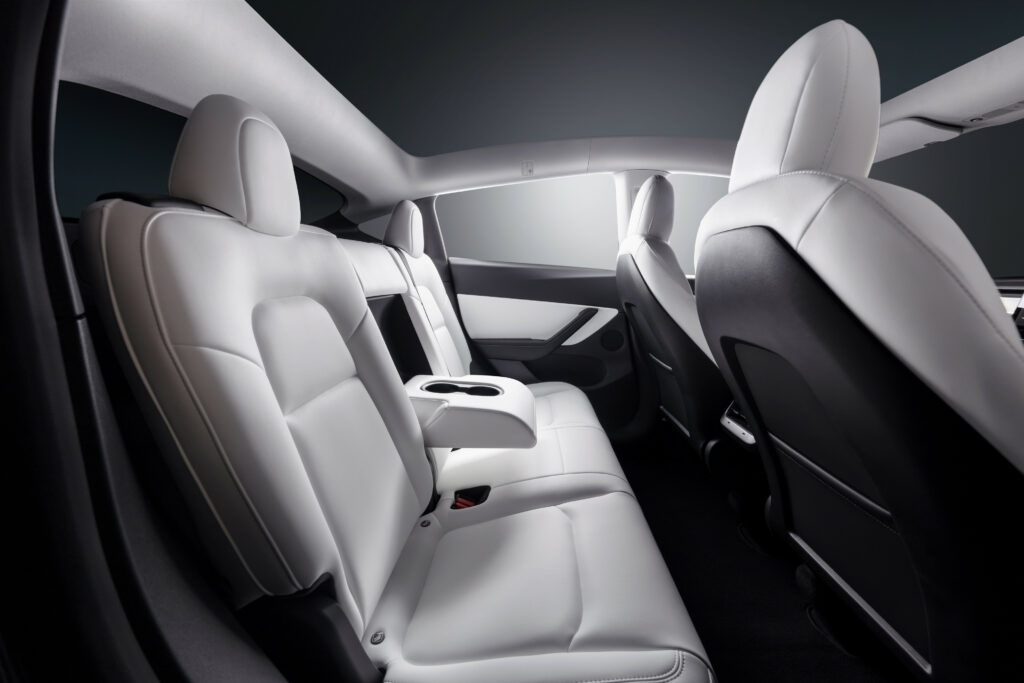
The Model Y’s broad popularity is attributed to its multifunctionality. It’s a family crossover, but it’s also a performance car. Inside, passengers are quite comfortable. There’s exceptional second-row leg and shoulder room. Thanks to a standard glass panoramic roof (without a sunshade), head room is more than enough, even for tall passengers. The rear seats recline slightly in case anyone wants to doze off while gazing up at the sky. An optional third row of seats can be tucked into the cargo area for an extra $3,000. It’s such a tight fit that you might as well go for a Model X if you really need a three-row SUV.
The rear cargo area is accessed through a power liftgate that opens up to 30 cubic feet with the second row in use. With those seats flat, there’s a whopping 68 cubic feet of cargo space. And unlike the class-competing Volkswagen ID.4, there is a large, deep front trunk (frunk!) that is excellent for storing charging cables, smelly shoes or pungent takeout food.
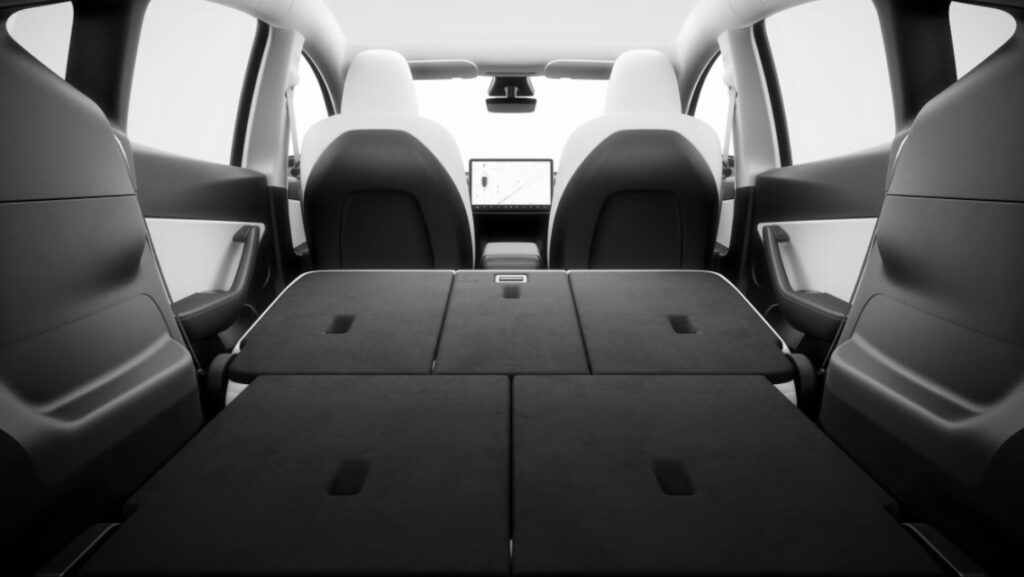
All Teslas include vegan leather at all trim levels. Black comes standard, but white is available for $1,000. Ownership experience shows that the white seats can stain, particularly due to excessive wearing of blue jeans. Yes, Tesla can send a Roadster into orbit, but can’t stain-proof their luxury seats.
The speedometer, navigation, climate controls, audio controls and most other features are accessed through the 15.5” touchscreen centrally mounted on the Model Y’s dash. Speaking of audio, there’s a 14-speaker premium sound system with two amps and a subwoofer. The immersive sound is a winner for audiophiles. There’s no gauge cluster like you’ll find in the Model S and X, but most drivers say they get used to it quickly. Infotainment and navigation are accessed through Tesla’s Premium Connectivity subscription, which costs $10 per month after the trial period.
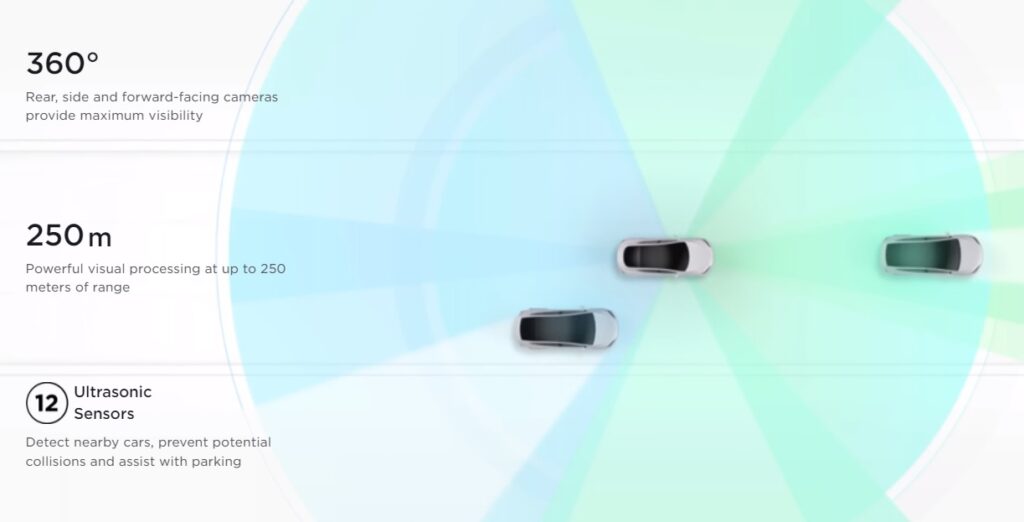
All Tesla cars come equipped with Autopilot, Tesla’s basic driver assist software. Standard autopilot is a combination of lane centering and adaptive cruise control, and it’s one of the best in the industry. If you’re expecting to hop in your car, take a snooze and be whisked away to work, you’ll be disappointed.
Tesla’s ‘Full Self Driving’ (FSD) costs an additional $12,000, but not all who pay for it even have access to it. Presumably fearing liability and regulatory challenges, Tesla requires all drivers who want FSD early access to pass a driving test. The test is conducted over about a week, during which the car carefully monitors patterns of acceleration, braking, following distance and more. Suffice to say, thousands of Tesla owners are angry about this surprise requirement, and many are locked out of their $12,000 purchase for the time being.
For those who do have access to the Beta version of FSD, it’s still not a fully-autonomous system. Even Tesla itself admits it is level 2 autonomy, which means that the driver must be prepared to take control of the vehicle at all times. Musk and his team promise that full autonomy (level 3 and above) is right around the corner, but they’ve been saying that for almost five years now.
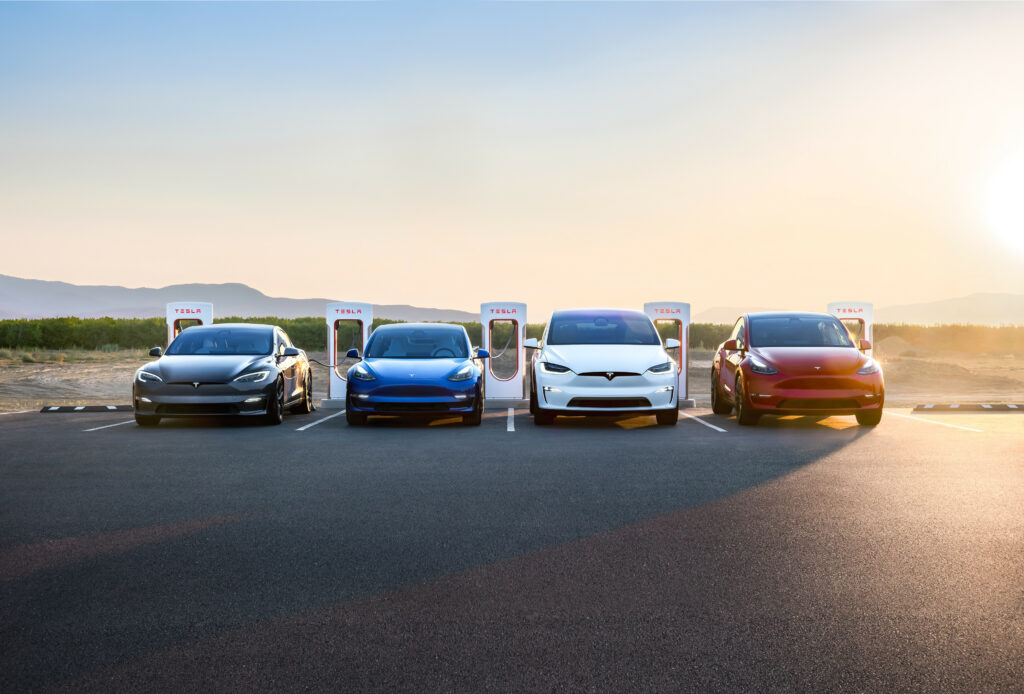
The Model Y is the most popular EV in America, and it has the specs and performance to back it up. With up to 330 miles of range, some of the fastest charging in the industry and software that just keeps getting better, there’s plenty to love. It’s not a cheap car, and whether or not EV incentives will once again apply to Tesla’s is yet to be determined. Tesla keeps raising prices, as do nearly all automakers. How the Model Y’s value compares to other 2022 EVs will depend on how competitors like the Ford Mustang Mach-E and Volkswagen ID.4 set their pricing for the upcoming model year.
If you’re ready to take the dive, you can reserve a Model Y with a $250 nonrefundable deposit. For the Long Range Model Y with the base Gemini wheels, expect to wait 11 months for delivery. If you add any upgrades, delivery is ‘only’ 7 months away. On top of that, Tesla is constantly upgrading their vehicles both in production and through OTA updates. If you order now, the car you get in several months time may very well have an even better range and further updated tech. Tesla’s mastery of the latest and greatest is something to consider when shopping for an electric crossover. This segment is getting crowded fast, but the 2022 Tesla Model Y remains one of the best.