
CarEdge saved me over 4,500 dollars on a brand new Honda Pilot. I can't say thank you enough.
Price intelligence
Find a wide range of vehicle listings with market insights on new and used listings near you.
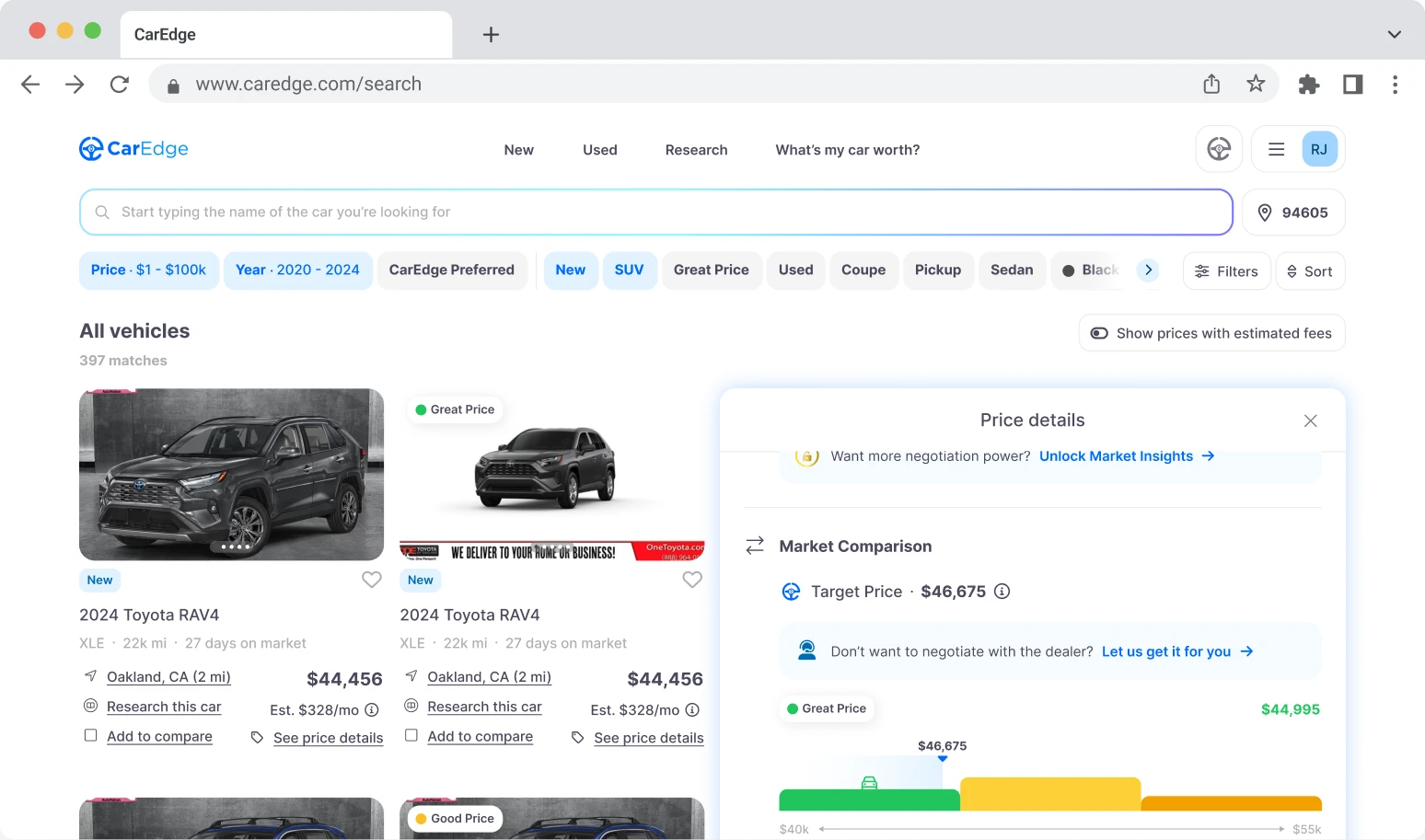

What can I do with CarEdge?
 CarEdge Insights
What can I do with CarEdge?
Get access to exclusive information so you can make an informed car buying decision — all in one place.

Find a wide range of vehicle listings with market insights on new and used listings near you.
Track your vehicle’s value and cash in when the time is right to sell.

Access to our proprietary data to help you find the right car, at the right price. Find these unlocked on every listing after subscribing.

With our expert-led, tech-enabled car buying service, we will locate, negotiate, and deliver your vehicle so you can get a new car hassle free.


Help us personalize your CarEdge experience — it only takes a second.
Your answers help us personalize your CarEdge journey — we’ll follow up with tips and next steps that match your buying timeline.
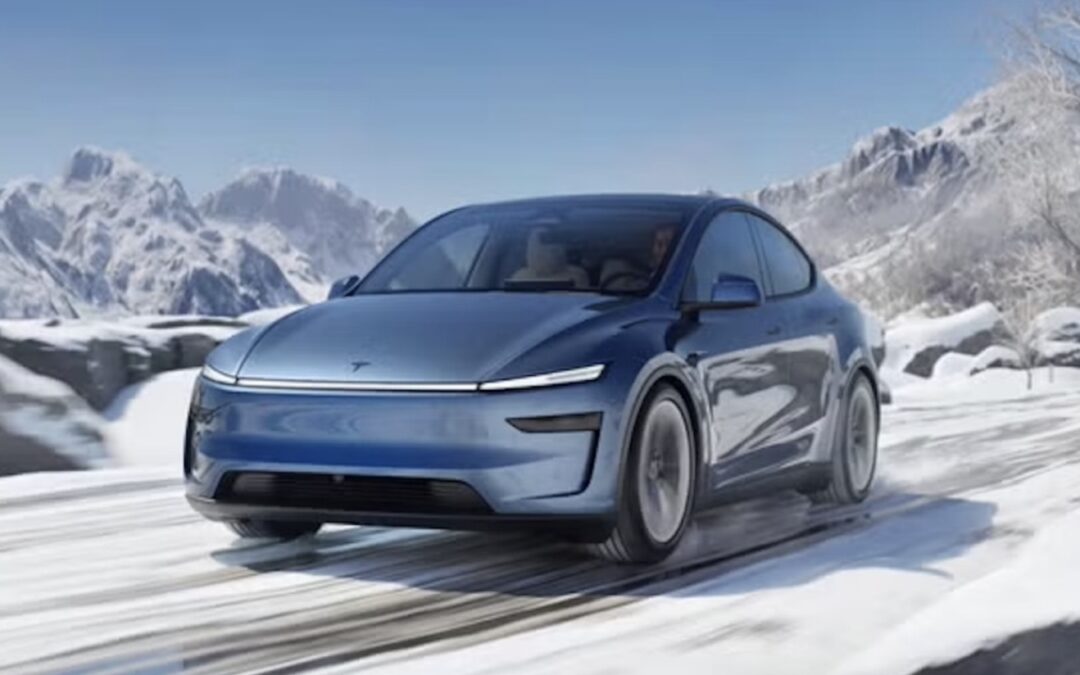

For those who are not interested in a massive, all-wheel drive truck, finding a car or crossover SUV that’s safe in the snow can be a challenge. We’re here to simplify your Car Search with this list of the best vehicles for winter driving, from snow to slush and beyond. Better yet, these all-wheel drive models offer the best value for your wallet as we head into the cool season.

Base Price (with all-wheel drive): $27,890 with destination fees
Fuel Economy: 27 mpg city and 35 mpg highway
Ground clearance: 5.9 inches
Reliability Rating: 3/5 according to Consumer Reports
Satisfaction Rating: 3/5 according to Consumer Reports
Why It’s Great For Winter: This is the go-to all-wheel drive sedan for under $30,000. That’s why it’s a shame that the 2025 model year will be the last. Subaru is discontinuing the Legacy after more than 30 years in the market. With excellent fuel economy, decent clearance for a sedan, and Subaru’s standard all-wheel drive, all shoppers in the market for a car with AWD should consider the Legacy while it can still be found on dealer lots. The good news is that there will be plenty of used Legacy’s on dealership lots for years to come.
See Subaru Legacy listings with local market data.

Base Price (with all-wheel drive): $30,595
Fuel Economy: 25 mpg city and 33 mpg highway
Ground clearance: 5.5 inches
Reliability Rating: 3/5 according to Consumer Reports
Satisfaction Rating: 3/5 according to Consumer Reports
Why It’s Great For Winter: The Mazda3 sedan offers something that’s increasingly rare: standard all-wheel drive on a sedan at a good price. From the Carbon Edition trim level and up, all-wheel drive is included, providing drivers with greatly improved traction in the snow.
See Mazda3 sedan listings with local market data.

Base Price (with all-wheel drive): $29,195
Fuel Economy: 25 mpg city and 33 mpg highway
Ground clearance: 5.3 inches
Reliability Rating: 4/5 according to Consumer Reports
Satisfaction Rating: 3/5 according to Consumer Reports
Why It’s Great For Winter: The Kia’s of today hardly resemble those of yesterday. On top of great looks, the K5 sedan has optional all-wheel drive starting at under $30,000. According to Consumer Reports, the Kia K5 has excellent reliability ratings too. Equipped with winter tires, the K5 would do excellent in the snow, as long as higher ground clearance isn’t a must.
See Kia K5 listings with local market data.

Base Price (with all-wheel drive): $44,370
Range: 363 miles
Ground clearance: 5.5 inches
Reliability Rating: 3/5 according to Consumer Reports
Satisfaction Rating: 4/5 according to Consumer Reports
Why It’s Great For Winter: ICE-powered cars are no competition for electric all-wheel drive. Reaction times and traction control capabilities are noticeably quicker in an AWD EV.
Despite slim ground clearance, the considerably more expensive Tesla Model 3 is an unbeatable value. For those who can claim the $7,500 federal EV tax credit before it expires on September 30, the Model 3 starts to look like more of a bargain.
Configure your Model 3 at Tesla.com, or see used Tesla listings with fair price data.

Base Price: $31,115
Fuel Economy: 26 mpg city and 33 mpg highway
Ground clearance: 8.7 inches
Reliability Rating: 4/5 according to Consumer Reports
Satisfaction Rating: 4/5 according to Consumer Reports
Why It’s Great For Winter: The Forester gets an upgrade for the 2025 model year. In addition to the added room and features, buyers will see a higher pricetag. On the bright side, Subaru is known for largely avoiding dealer markups, making it easier to get the Subaru you want at a fair price.
Why not the Crosstrek? You simply get more for your money with the Forester. Most will appreciate more cargo volume, and more room for passengers with the Forester.
Browse Subaru Forester listings with local market data.

Base Price: $41,415
Fuel Economy: 20 mpg city and 26 mpg highway
Ground clearance: 8.7 inches
Reliability Rating: 3/5 according to Consumer Reports
Satisfaction Rating: 3/5 according to Consumer Reports
Why It’s Great For Winter: The Ascent is perfect for those who need a larger SUV with standard all-wheel drive. The 2025 Ascent has three rows of flexible seating for 8 passengers, something that other models on this list can’t match.
Ground clearance is excellent, meaning that you’ll have no trouble pushing through snow (with proper tires, of course). Fuel economy is less than desired, but that’s what you get with a large SUV.
Browse Subaru Ascent listings with local market data.

Base Price: $31,720
Fuel Economy: 24 mpg city and 30 mpg highway
Ground clearance: 8.3 – 8.6 inches
Reliability Rating: 4/5 according to Consumer Reports
Satisfaction Rating: 3/5 according to Consumer Reports
Why It’s Great For Winter: The CX-50 features standard all-wheel drive and 8.3 to 8.6 inches of ground clearance, making this a great choice for budget-conscious buyers who don’t want a Subaru. Mazda reliability ratings are rising as the brand continues to transition towards a more premium reputation. Hoping for better MPGs? For 2025, a hybrid CX-50 is joining the lineup.
There’s a CX-50 for everyone. Mazda’s lineup offers a range of well-equipped trims, from the base 2.5 S Select for just $30,300 to the premium-natured 2.5 Turbo Premium starting at $41,300.
Browse Mazda CX-50 listings with local market data.
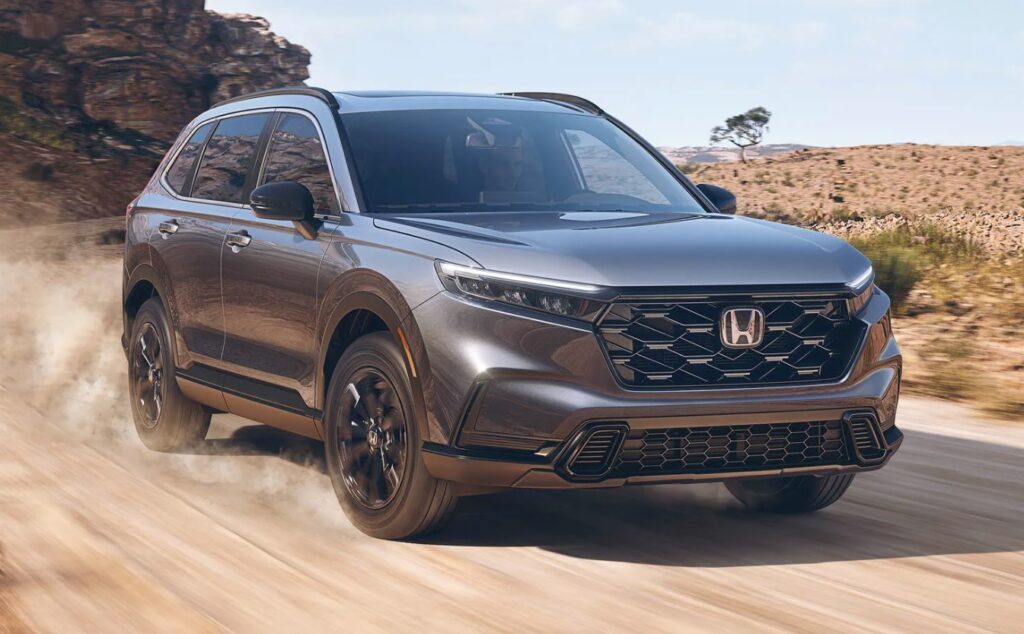
Base Price (with all-wheel drive): $31,450
Fuel Economy: 27 mpg city and 32 mpg highway
Ground clearance: 8.2 inches
Reliability Rating: 4/5 according to Consumer Reports
Satisfaction Rating: 4/5 according to Consumer Reports
Why It’s Great For Winter: It’s #2 in America in terms of SUV sales, but the CR-V is a clear winner for SUVs under $40,000. With all-wheel drive, the CR-V LX starts at a base price of $31,000.
The CR-V AWD is ideal for those who are okay with all-wheel drive that is only engaged when it’s needed. The rest of the time, the CR-V is front-wheel drive.
See Honda CR-V listings with local market data

Base Price (with all-wheel drive): $48,315
Fuel Economy: 35 miles per gallon combined
Ground clearance: 8.0 inches
Reliability Rating: 4/5 according to Consumer Reports
Satisfaction Rating: 4/5 according to Consumer Reports
Why It’s Great For Winter: There’s a lot to love about the Highlander Hybrid AWD: eight inches of ground clearance, 35 miles per gallon, and all-wheel drive on top of excellent reliability at a reasonable price.
Smaller hybrid SUVs like the Hyundai Tucson or Honda CR-V are excellent for winter when equipped with AWD, but serious winter drivers know that ground clearance matters in a snowstorm.
The only downside is limited inventory. See our latest inventory update.
Browse Highlander Hybrid listings with local market data.
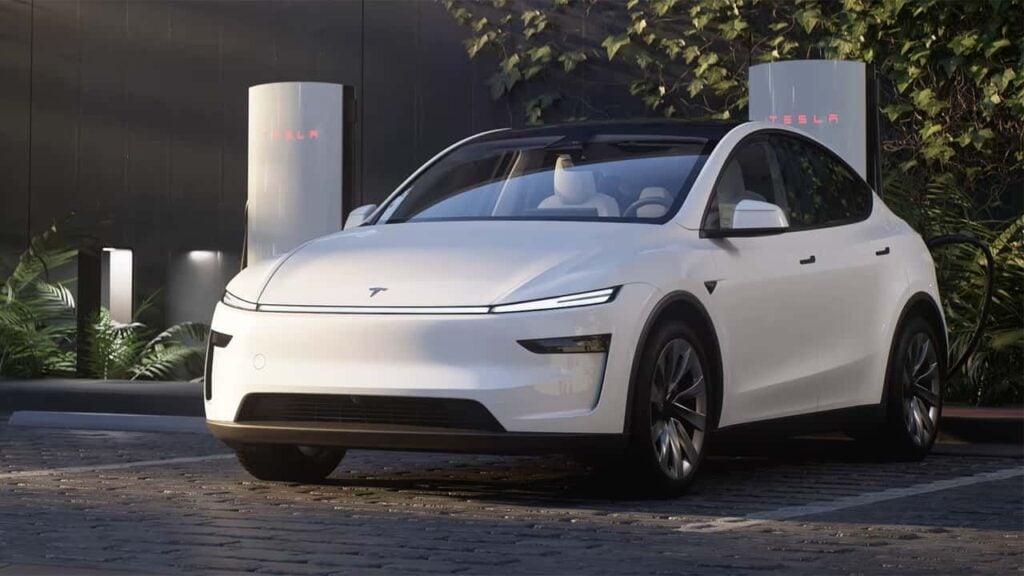
Base Price (with all-wheel drive): $49,370
Range: 308 miles (expect 20% less range in the winter)
Ground Clearance: 6.6 inches
Reliability Rating: 41/100 according to Consumer Reports
Satisfaction Rating: 4/5 according to Consumer Reports
Why It’s Great For Winter: Owning an electric vehicle is full of perks, but winter driving is not one of them. How so? EVs lose driving range in cold weather. It’s a matter of battery chemistry. On top of that, charging speeds can be slower in extreme cold without battery preconditioning capabilities.
Tesla, being the EV originators that they are, took these challenges into consideration as they built their brand. The Model Y has access to the largest and most reliable EV charging network in North America, the Tesla Supercharger network. That’s a huge help considering that the highway range in winter weather can drop below 250 miles on a full charge. With Superchargers being the easiest fast chargers to find (and use), that’s a major plus for the Model Y in winter.
Better yet, Tesla models have battery preconditioning built into route planning. This means that when you navigate to a charging station, the car will automatically warm the battery to the ideal temperature for faster charging. Battery preconditioning is an essential for EV ownership in cold climates.
When it comes to all-wheel drive, electric vehicles, including but not limited to the Model Y, have a big advantage over ICE vehicles: near-instantaneous reaction times. Everything is computer-based in an EV. Torque and traction control features are adjusted to maintain control far quicker than is possible in a traditional gas-powered vehicle. So range and charging can be tough in the winter, but EV traction is superior.

Sliding on flurries in your all-wheel drive vehicle? Before you blame the car, check your tires. Too many drivers forget the importance of winter-ready tires before venturing out in the snow. Unlike their summer counterparts, winter tires are specially designed with a different rubber compound that stays pliable in colder temperatures. This flexibility provides better grip on icy surfaces and shorter braking distances. The tread patterns on winter tires are also tailored to dig into snow and slush, channeling it away from the tire’s contact patch and enhancing traction.
Simply put, having winter tires is like equipping your vehicle with the right gear to conquer winter’s toughest terrain. All-wheel drive alone will NOT be enough to stay safe. Be sure you have tires that are suitable for winter before the first snowflakes fly.
Looking for help with your next vehicle purchase? The CarEdge Team is changing car buying for the better. From DIY options that equip you with powerful market insights to the best car buying Concierge service out there, we’re bringing pre-negotiated car deals to the masses.

Dependability matters, especially as auto repair costs soar. Have you ever experienced the delight of owning an SUV that goes above and beyond in terms of reliability? If not, we’re out to change that. In this guide, we’ll introduce you to the most reliable SUVs for 2025, courtesy of the consumer advocates at Consumer Reports.
We’ve ranked today’s new SUV models by popular segment. SUVs are ranked first by reliability, then with driver satisfaction and road test scores as the tie breakers. Consumer Reports rates satisfaction on a scale of 1 to 5, and both reliability and road test scores range from zero to 100.
Looking for the most reliable car brands overall? Check it out here.
For anyone familiar with the most reliable car brands, the winners should come as no surprise. Toyota and Lexus frequent the top of the list for automotive reliability. Honda and Subaru are also known for making the most dependable SUVs, and also win top honors here.
| Make | Model | Year | Reliability Score | Satisfaction Score | Road Test | Base MSRP |
|---|---|---|---|---|---|---|
| Subaru | Forester | 2025 | 98 / 100 | 4 / 5 | 92 / 100 | $29,995 - $41,695 |
| Toyota | RAV4 | 2025 | 86 / 100 | 3 / 5 | 73 / 100 | $29,250 - $40,605 |
| Toyota | RAV4 Plug-In Hybrid | 2025 | 84 / 100 | 5 / 5 | 88 / 100 | $44,265 - $48,135 |
| Toyota | RAV4 Hybrid | 2025 | 83 / 100 | 3 / 5 | 80 / 100 | $28,850 - $40,205 |
| Lexus | UX | 2025 | 77 / 100 | 4 / 5 | 75 / 100 | $36,540 - $46,575 |
| Lexus | NX Hybrid | 2025 | 76 / 100 | 4 / 5 | 84 / 100 | $41,955 - $57,805 |
| Subaru | Crosstrek | 2025 | 75 / 100 | 4 / 5 | 82 / 100 | $25,810 - $32,610 |
| Mazda | CX-5 | 2025 | 74 / 100 | 3 / 5 | 77 / 100 | $28,570 - $40,600 |
| Honda | HR-V | 2025 | 71 / 100 | 2 / 5 | 70 / 100 | $25,400 - $31,000 |
| Chevrolet | Trailblazer | 2025 | 68 / 100 | 2 / 5 | 68 / 100 | $23,100 - $29,300 |
| Ford | Escape | 2025 | 68 / 100 | 2 / 5 | 71 / 100 | $29,850 - $38,400 |
| Acura | RDX | 2025 | 64 / 100 | 3 / 5 | 80 / 100 | $44,700 - $54,400 |
| Honda | CR-V | 2025 | 61 / 100 | 3 / 5 | 88 / 100 | $30,100 - $50,000 |
| Toyota | Corolla Cross Hybrid | 2025 | 61 / 100 | 3 / 5 | 82 / 100 | $28,395 - $31,580 |
| Nissan | Rogue | 2025 | 61 / 100 | 2 / 5 | 81 / 100 | $29,230 - $40,920 |
The surprises on the list? Most would not expect to see the Chevrolet Trailblazer and Ford Escape alongside the big names in reliability.
Toyota and Lexus combined occupy five spots on the list of most reliable midsize SUVs.
| Make | Model | Year | Reliability Score | Satisfaction Score | Road Test | Base MSRP |
|---|---|---|---|---|---|---|
| Ford | Edge | 2024 | 74 / 100 | 3 / 5 | 81 / 100 | $38,465 - $47,205 |
| Toyota | Venza | 2024 | 71 / 100 | 3 / 5 | 79 / 100 | $35,070 - $43,215 |
| Kia | Sorento Hybrid | 2025 | 68 / 100 | 2 / 5 | 84 / 100 | $31,990 - $53,090 |
| Lexus | RX Hybrid | 2025 | 67 / 100 | 4 / 5 | 86 / 100 | $52,235 - $57,045 |
| Toyota | Highlander | 2025 | 65 / 100 | 3 / 5 | 82 / 100 | $39,820 - $53,975 |
| Toyota | Land Cruiser | 2025 | 65 / 100 | 4 / 5 | 57 / 100 | $56,700 - $61,470 |
| Toyota | Highlander Hybrid | 2025 | 64 / 100 | 4 / 5 | 86 / 100 | $39,520 - $53,675 |
| BMW | X5 | 2025 | 61 / 100 | 5 / 5 | 94 / 100 | $66,300 - $127,200 |
| Subaru | Outback | 2025 | 61 / 100 | 3 / 5 | 89 / 100 | $29,010 - $42,910 |
The Ford Edge and BMW X5 were least expected, but earned their place on the rankings.

It’s a lot tougher to find a reliable large SUV. There’s quite a bit of OEM representation on this list, however. Large SUV models from Toyota, Lexus, BMW, and Audi all earned above-average ratings in dependability according to Consumer Reports testing.
| Make | Model | Year | Reliability Score | Satisfaction Score | Road Test | Base MSRP |
|---|---|---|---|---|---|---|
| Lexus | TX Hybrid | 2025 | 64 / 100 | 3 / 5 | 92 / 100 | $68,000 - $76,700 |
| Audi | Q7 | 2025 | 63 / 100 | 2 / 5 | 87 / 100 | $60,500 - $65,800 |
| Toyota | Sequoia | 2025 | 63 / 100 | 2 / 5 | 57 / 100 | $62,425 - $83,915 |
| BMW | X7 | 2025 | 61 / 100 | 3 / 5 | 90 / 100 | $84,300 - $152,400 |
| Lexus | GX | 2025 | 65 / 100 | 4 / 5 | 62 / 100 | $63,935 - $80,400 |
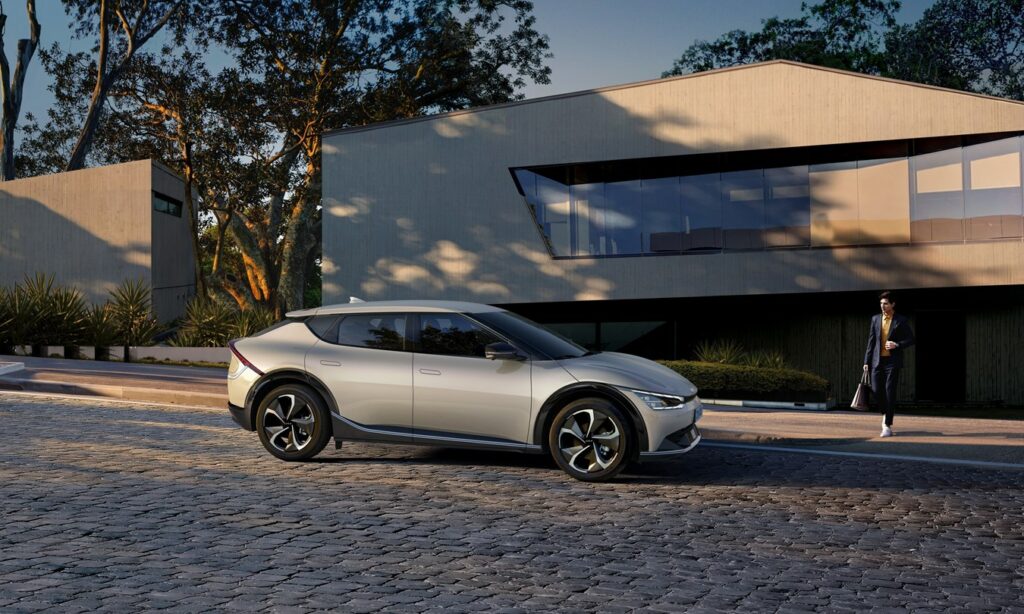
If you’re ready to make the switch, electric SUVs are the way to go for drivers determined to spend less on fuel while eliminating tailpipe emissions. Here are some of the most reliable electric SUVs. Note that Consumer Reports has not completed testing for a number of other popular electric crossovers.
| Make | Model | Year | Reliability Score | Satisfaction Score | Road Test | Base MSRP |
|---|---|---|---|---|---|---|
| Nissan | Ariya | 2025 | 58 / 100 | 3 / 5 | 70 / 100 | $39,770 - $54,370 |
| Lexus | RZ | 2025 | 57 / 100 | 1 / 5 | 70 / 100 | $42,800 - $57,430 |
| Audi | Q4 e-tron | 2023 | 54 / 100 | 1 / 5 | 79 / 100 | $49,800 - $58,200 |
| Genesis | GV60 | 2025 | 47 / 100 | 3 / 5 | 86 / 100 | $52,350 - $69,990 |
| Ford | Mustang Mach-E | 2025 | 43 / 100 | 4 / 5 | 74 / 100 | $41,450 - $56,500 |
| Kia | EV9 | 2025 | 42 / 100 | 4 / 5 | 88 / 100 | $54,900 - $73,900 |
| Tesla | Model Y | 2025 | 41 / 100 | 4 / 5 | 88 / 100 | $44,990 - $51,490 |
Electric SUVs from Lexus, Nissan, and Audi rank highest in terms of predicted reliability. However, they score lower in overall satisfaction. In most cases, this is due to slow charging. That’s true of the Audi Q4 and Lexus RZ, among others. It’s a shame that the fastest-charging electric SUVs, like those from Hyundai and Kia, have lower reliability scores.

While the reliability of an SUV is undeniably important when selecting your next vehicle, it’s just one piece of the puzzle. You’ll want to take into account other critical factors like fuel efficiency, comfort, safety features, and the overall cost of ownership to make a well-rounded decision that aligns with your unique needs and preferences.
Discover CarEdge’s cost of ownership rankings
You don’t have to navigate car buying alone! Our dedicated team of CarEdge Concierges will guide you through the entire process. With their expert insights and personalized advice, you can rest assured that you’ll not only find a reliable SUV but also one that perfectly suits your lifestyle and brings joy to every drive.
Some EVs are hot, and some are not. To provide you with real-time insights, we’ve gathered EV inventory data from CarEdge Data and Car Search to reveal which electric models are flying off the shelves, and which ones are taking their time.
We haven’t included direct-to-consumer brands like Tesla, Rivian, Lucid, VinFast, Fisker, and Polestar in our analysis. They don’t share their inventory data, but you can see their most recent sales totals here.

As the EV market continues to evolve, some models are in higher demand than others. Usually, it’s a combination of charging speeds, range, and price that bring swarms of buyers. Here, we highlight the fastest-selling electric vehicles in 2023’s market. These are the models with the lowest market-day supply (MDS), which is a reflection of inventory and daily selling rates over the past 45 days.
| Make | Model | Market Day Supply | Total For Sale (US) | Starting Price | Average Price Paid |
|---|---|---|---|---|---|
| Chevrolet | Bolt EV | 57 | 4,288 | $27,495 | $31,320 |
| Chevrolet | Bolt EUV | 60 | 1,240 | $28,795 | $33,116 |
| BMW | i4 | 60 | 2,268 | $53,195 | $63,185 |
| Kia | Kona EV | 60 | 303 | $33,550 | $39,462 |
| Audi | e-tron GT | 62 | 503 | $107,995 | $116,816 |
| Hyundai | IONIQ 6 | 73 | 3,127 | $42,715 | $49,498 |
| GMC | Hummer EV | 80 | 1,032 | $79,995 | $118,576 |
| BMW | iX | 81 | 3,645 | $88,095 | $102,447 |
| Mercedes-Benz | EQB | 88 | 3,012 | $52,750 | $62,258 |
| Subaru | Solterra | 96 | 2,270 | $44,995 | $49,913 |
The Chevy Bolt EV and larger Bolt EUV have been popular choices for budget-minded EV buyers. The i4 is a top-selling luxury sedan this month. EVs now make up 15% of BMW’s US sales, with Mercedes-Benz and Audi close behind.
The average starting price (MSRP + destination charge) of the fastest selling EVs is $50,206. On the other hand, the average selling price is $66,659, or 19% higher than the starting price for these same models. This is mostly due to the popularity of higher-trim cars, but dealer markups are also to blame. We have proof that EVs are negotiable. We don’t recommend paying any dealer markups on electric cars, trucks or SUVs.
Hyundai and Kia electric models are selling much faster right now than in recent months. Hyundai is second in EV market share in the US market, but remains far behind Tesla. Here’s the latest EV market share and sales update.

While some EVs race off dealership lots, others linger in showrooms, waiting for their new home. Technically, the all-new BMW i5 has the highest market day supply right now, but there’s a catch. The i5 is arriving on dealer lots for the first time, leading to an unrealistic inventory of 868 days. Therefore, selling rates are skewed and will remain inaccurate until the i5 has been on sale for at least 45 days. Here are the true electric models with the highest inventory and slowest selling rates:
| Make | Model | Market Day Supply | Total For Sale (US) | Starting Price (MSRP+destination) | Average Price Paid |
|---|---|---|---|---|---|
| Jaguar | I-PACE | 647 | 388 | $86,895 | $80,033 |
| Porsche | Taycan | 239 | 2,613 | $92,550 | $131,159 |
| Mercedes-Benz | EQS | 221 | 2,841 | $105,650 | $125,376 |
| Mercedes-Benz | EQS SUV | 221 | 123 | $105,550 | $130,156 |
| Ford | Mustang Mach-E | 204 | 24,874 | $44,796 | $57,807 |
| Genesis | GV60 | 190 | 1,747 | $53,195 | $65,746 |
| Ford | F-150 Lightning | 182 | 8,913 | $51,990 | $78,934 |
| Nissan | LEAF | 161 | 2,626 | $29,255 | $32,856 |
| Cadillac | Lyriq | 151 | 2,681 | $58,590 | $65,015 |
| Mercedes-Benz | EQE | 144 | 1,072 | $76,050 | $91,830 |
Among the slow-sellers, the average starting price (MSRP+destination) is $70,452. What about how much buyers are actually paying? CarEdge Data reveals that the average price paid averages out to $85,531 for these same models.
Interestingly, the average price paid for the ten slowest-selling EVs is 22% higher than the starting price, versus 19% higher for the fastest-selling EVs. This shows that luxury buyers don’t mind spending well above the base price, making $100,000+ EVs common.
Notably, the slowest-selling EVs tend to be luxury models, such as the Jaguar I-PACE and Porsche Taycan. However, the I-PACE is getting a refresh for the 2024 model year, making it a potential contender for luxury EV buyers.
Despite these slow sellers, the overall EV market continues to grow, with automakers producing more EVs than ever before. 2023 will be the first year with 1,000,000+ electric vehicles sold in America. Analysts expect the milestone to be reached in November.
If you’re as fascinated by evolving EV market data as we are, you’ll love these other market updates:
Which electric vehicles are you interested in? Which do you love, and which do you hate? Let us know in the comments below, or hop on over to the CarEdge Electric Vehicle Forum.
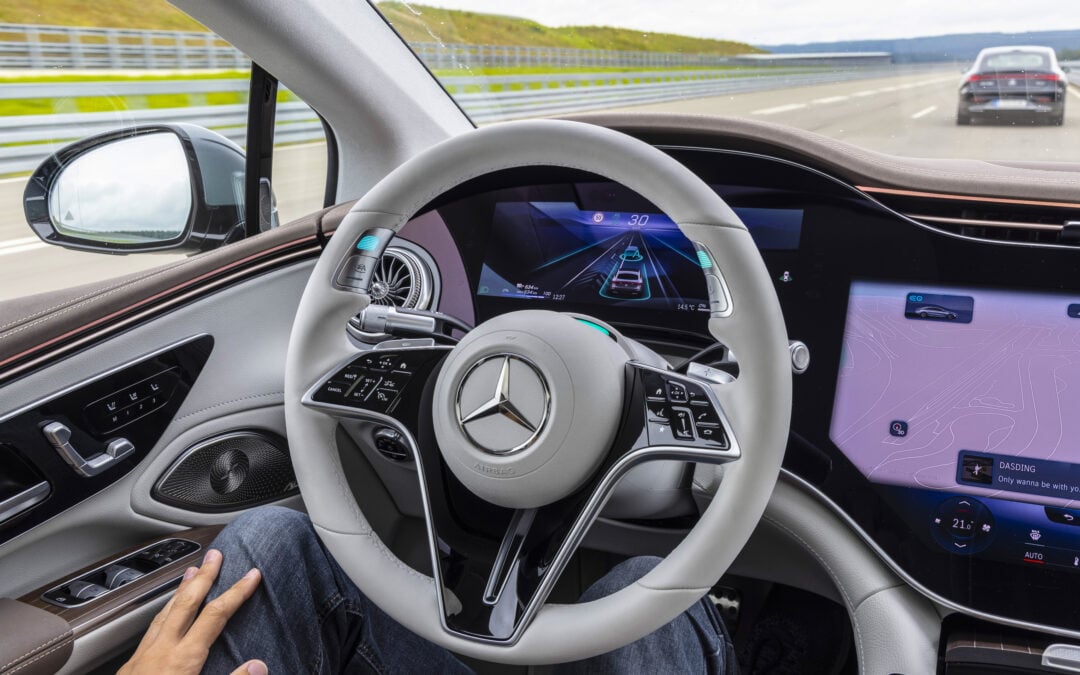
As we head into autumn, compelling luxury lease offers abound if you know where to look. We’ve sifted through the latest manufacturer offers to bring you the best 2024 and 2025 luxury lease deals available today. From Acura to Tesla, here’s your guide to some of the best luxury lease offers currently on the market.
Automakers release new lease deals early in the month, so check back for updates.

2024 Acura Integra Lease: Lease for $369 per month for 36 months with $4,999 due at signing.
2024 Acura RDX Lease: Lease for $429 per month for 24 months with $4,999 due at signing.
See all Acura lease deals at Acura.com

2024 BMW i4 Lease: Lease the eDrive35 for $449 per month for 36 months with $4,849 due.
2024 BMW X3 Lease: Lease sDrive30i for $579 per month for 36 months with $4,999 due.
2025 BMW X5 Lease: Lease the sDrive40i for $899 per month for 36 months with $6,599 due.
See all BMW lease offers at BMWUSA.com

2024 Cadillac Lyriq Lease: Lease for $349 per month for 36 months with $4,789 due.
2024 Cadillac XT5 Lease: Lease the FWD Luxury for $419 per month for 39 months with $4,459 due.
See all Cadillac lease offers at Cadillac.com

2024 Genesis G70 Lease: Lease from $399 per month for 36 months with $3,999 due at signing.
2024 Genesis G80 Lease: Lease from $559 per month for 36 months with $4,999 due at signing.
See all Genesis lease offers at Genesis.com

2024 Infiniti QX50 Lease: Lease the Pure AWD for $429 per month for 36 months with $5,574 due.
2024 Infiniti QX55 Lease: Lease the Luxe AWD for $489 per month for 36 months with $4,969 due.
See all Infiniti lease offers at InfinitiUSA.com

2024 Lexus RX 350 Lease: Lease for $539 per month for 36 months with $4,999 due.
2024 Lexus NX 350 Lease: Lease for $509 per month for 36 months with $3,999 due.
See all Lexus lease offers at Lexus.com

2024 GLE 350 4MATIC SUV: Lease for $849 per month for 36 months with $6,363 due.
2024 GLS 450 4MATIC SUV: Lease for $1,149 per month for 36 months with $8,443 due.
See all Mercedes-Benz lease offers at MBUSA.com
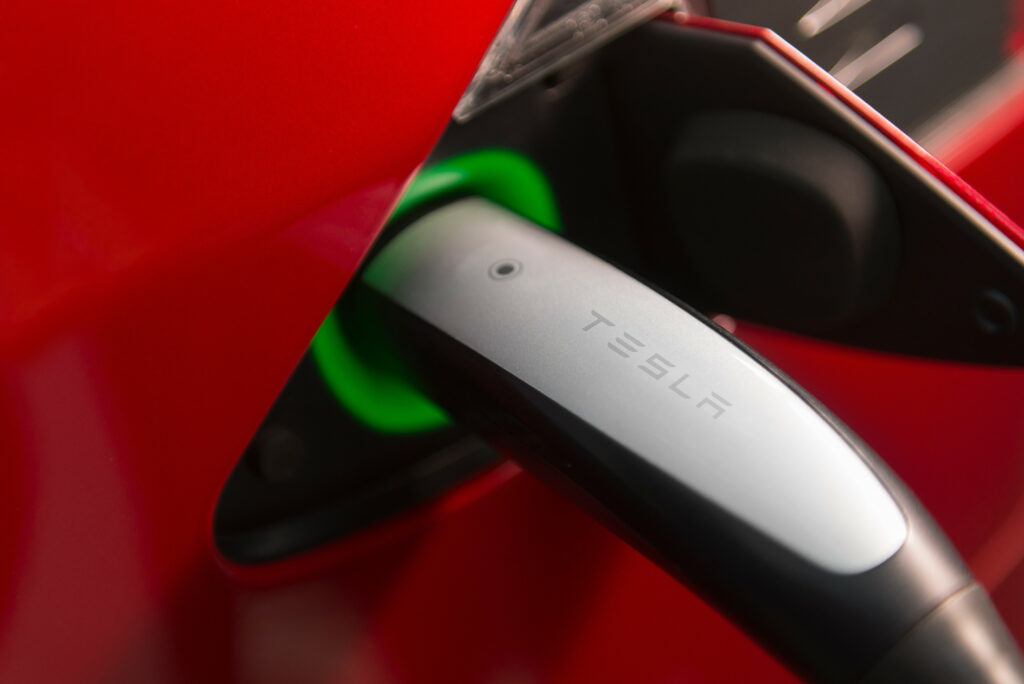
Model Y Long Range RWD: Lease for $339 per month for 36 months with $2,999 due.
Model 3 Long Range RWD: Lease for $309 per month for 36 months with $2,999 due.
Leasing a luxury car or SUV has never made more sense. When opting to buy instead, drivers are faced with interest rates at 20-year highs, and near-record car prices. With enticing luxury lease offers available, it makes sense to do what is essentially a long-term rental for the perfect car.

Ready to outsmart the dealerships? Download your 100% free car buying cheat sheets today. From negotiating a deal to leasing a car the smart way, it’s all available for instant download. Get your cheat sheets today!
Check out this other reader-favorite (100% free):

For those considering taking the plunge into the world of electric vehicles in 2025, there’s exciting news. The U.S. government has now clarified how car dealers can transfer tax credits for new and used EVs directly at the point of sale, ensuring you can benefit instantly from these incentives. But there’s a catch: dealers need to be registered. It’s an encouraging that more than 7,000 dealers have signed up, but thousands of others have yet to do the necessary work. Let’s delve into what this means for you.
Car dealerships across the country now have definitive guidelines on how tax credits for EVs can be handed over to the consumer at the point of sale. Previously, there were doubts about how swiftly dealers would be reimbursed by the federal government after passing the EV tax credit on to the buyer at the point of sale. The latest guidance is good news for EV buyers, but there’s a new item for your car buying checklist.
First, a quick reminder of how we got here.

In late 2022, the Inflation Reduction Act was passed into law here in the United States. The IRA brought back the federal EV tax credit for automakers like Tesla and General Motors, but took it away from Hyundai, Kia, Audi, and many others.
Why did the EV tax credit get taken away? The new rules are complex, but in summary, an electric vehicle must be made in North America, and fall under new price caps, in order to qualify. There are also battery sourcing requirements.
See exactly which EVs qualify, and the IRS income and eligibility guidance.
For all of 2023, the EV tax credit was just that, a non-refundable tax credit. Starting January 1, 2024, the EV tax credit became redeemable at the point of sale. In other words, you can take your federal incentive as a cash discount when you buy your car at the dealership.
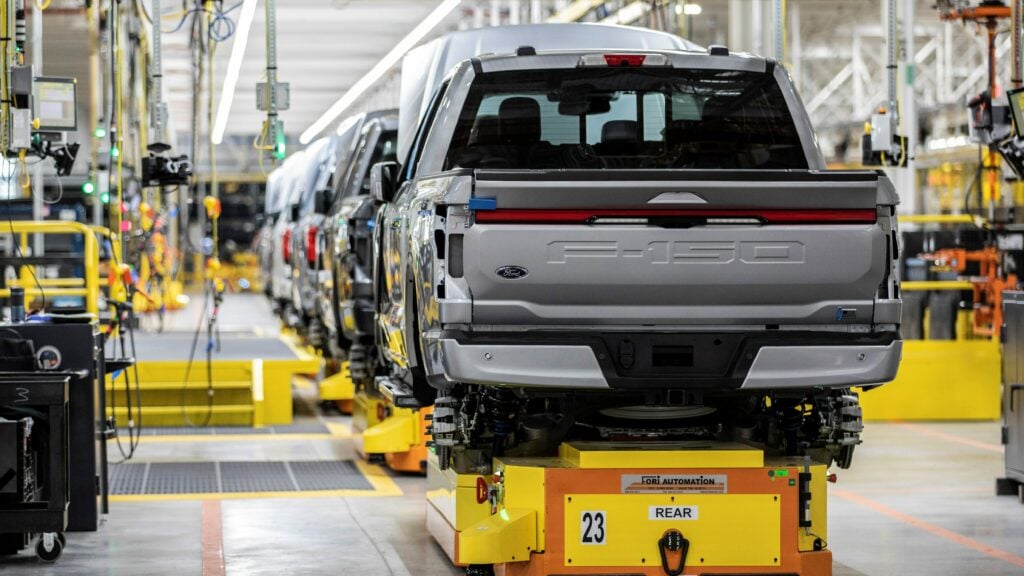
Previously, car dealers were nervous about how this EV incentive could play out. They remember the mess caused by poor planning during the Cash For Clunkers initiative years ago, and feared a repeat. That’s why dealers welcomed the news that the IRS will reimburse them within 72 hours.
For dealers, this is a game-changer. As Juan Alarcon, president of Car Pro Automotive Group, jubilantly told Automotive News, “Three days is great news.” But, he quickly adds a note of caution, “if they can pull it off.”
For these instant credits to materialize for buyers, dealers have a role to play. Your dealer must be registered on a new platform, IRS Energy Credits Online, in order for you to receive a point-of-sale EV tax credit.
This platform is the hub where dealers not only register but also electronically relay EV sales data to the IRS, receive payments for transferred credits, and file time-of-sale reports.
Once a credit is transferred at the point of sale, dealers have the option to slash the purchase price or hand cash over to the buyer. But remember, the amount has to be the full value of the available credit for the qualifying EV. Buyers will have to sign a statement under penalty of perjury that they understand the eligibility requirements for the EV tax credit, and will have to pay it back if they exceed the EV tax credit’s income limits for the year.
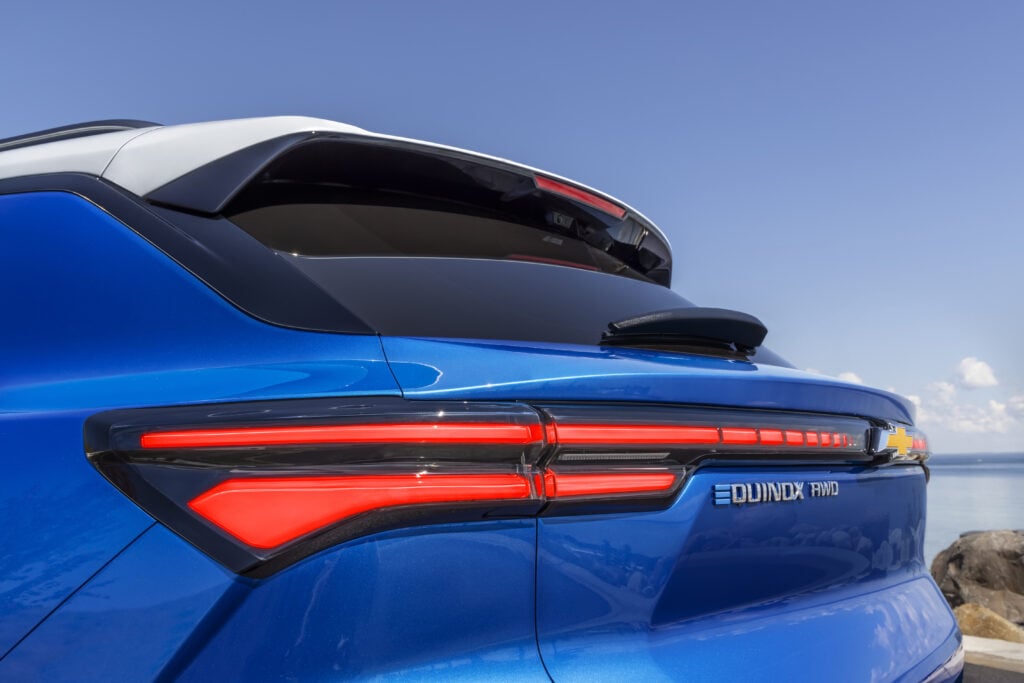
Finally, after a decade of asking for a point-of-sale tax credit, it’s finally here. However, if you’re buying from a car dealership, you need to check if they’ve registered with the new ‘IRS Credits Online’ system once it’s available.
If you sense any confusion or uncertainty, you can email them this article for further information. Remember, your car dealer must be registered before you can receive the EV tax credit at the point of sale.
Learn more about our car buying services. We’re simply here to help!