
CarEdge saved me over 4,500 dollars on a brand new Honda Pilot. I can't say thank you enough.
Price intelligence
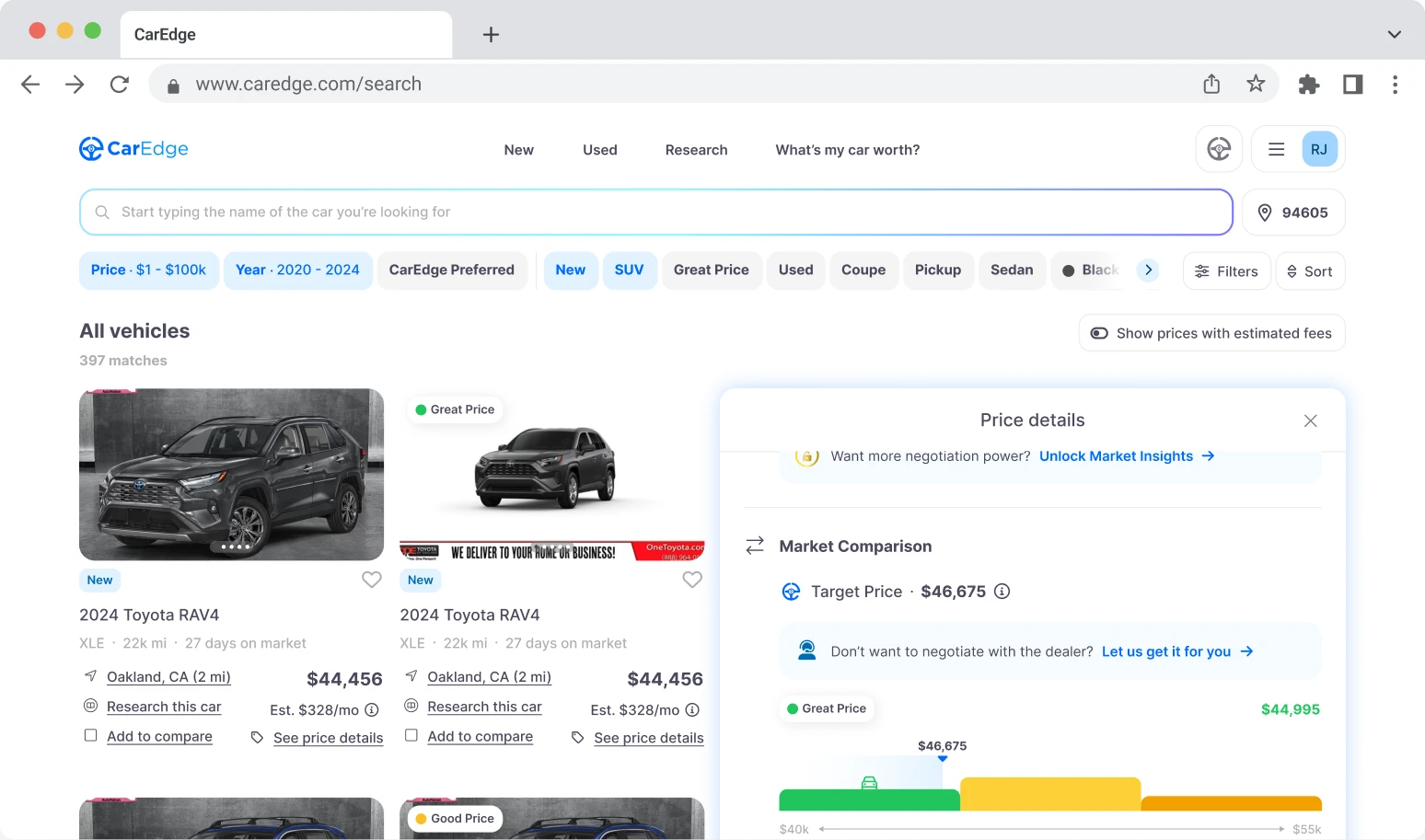
Find a wide range of vehicle listings with market insights on new and used listings near you.

What can I do with CarEdge?
 CarEdge Insights
What can I do with CarEdge?
Get access to exclusive information so you can make an informed car buying decision — all in one place.

Find a wide range of vehicle listings with market insights on new and used listings near you.
Track your vehicle’s value and cash in when the time is right to sell.

Access to our proprietary data to help you find the right car, at the right price. Find these unlocked on every listing after subscribing.

With our expert-led, tech-enabled car buying service, we will locate, negotiate, and deliver your vehicle so you can get a new car hassle free.


Help us personalize your CarEdge experience — it only takes a second.
Your answers help us personalize your CarEdge journey — we’ll follow up with tips and next steps that match your buying timeline.
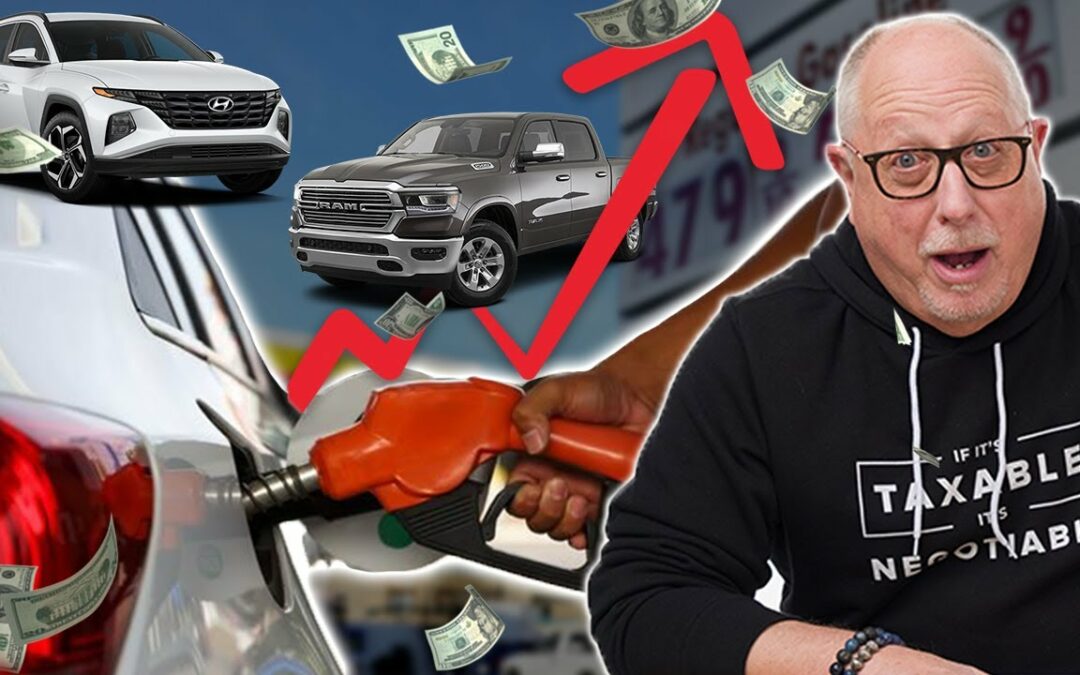
According to data from GasBuddy, the national average cost of one gallon of gasoline surpassed the 2008 record on Monday, March 7, 2022. The average price per gallon now stands at $4.10. AAA’s average is now $4.07, however several states are already over $4.50. How high will gas prices go, and what will it take to bring prices back down?
Energy experts predict gasoline prices to reach $4.50 at a minimum, with $5.00 not out of the question nationally. In California, the price of a gallon of gas is already $5.34. GasBuddy Head of Petroleum Analysis Patrick De Haan shared his predictions given the current state of affairs. “Most of the areas east of the Rockies are at low risk for some of the apocalyptic numbers like $5 and $6 per gallon…This is something that could change very quickly, but I don’t see that in most areas of the country just yet.”
Diesel prices average $4.63 per gallon, but are headed for $5.00 per gallon. GasBuddy petroleum analysts expect the record of $4.84 to be broken within two weeks.
Energy analysts point to the Russian invasion of Ukraine as the overwhelming cause of spiking prices. Russia is responsible for about 7% of global oil supply. Talk of cutting off Russian oil exports to Europe and America is raising oil prices to $130 per barrel on fears of further instability. In 2008, the price per barrel of oil hit a record $147. That record may be within reach, especially as warmer weather brings higher demand for fuel.
Analysts say that prices will rise and remain elevated until global instability calms and subsides. In other words, once Russia’s invasion of Ukraine ends. However, we’re entering spring, and warmer weather historically heralds higher gas prices. On average, gas prices in America rise about fifty cents per gallon in March and April.
On Monday, anonymous sources familiar with ongoing discussions told Reuters that the United States is seriously considering a ban on Russian oil imports as yet another sanction. The move has bipartisan support from lawmakers. In a Monday meeting, US officials tried to get European nations to join the Russian oil ban, but apparently none of them were willing to make the move.
The U.S. only gets about 3.5% of its oil from Russia, so Rabobank energy analyst Ryan Fitzmaurice told CNN that a U.S. ban would have symbolic significance. However, the European Union relies on Russia for over one quarter of its crude oil. A ban in the EU would have far greater effects. In Germany, gasoline sold for an average of $7.72 USD per gallon ($2.04 per liter) at the end of February. Shutting off Russian pipelines would send prices even higher.
A lot can change in two years. Back in April of 2020, quarantine shutdowns sent gas prices sinking to an average of $1.74 nationally. Many of us saw gas for under one dollar per gallon. Who knows where prices will be two years into the future.

One of the most common questions we get asked at CarEdge is, “What’s better right now, buying vs. leasing a car?” In 2022, with car prices going crazy, this question has become even more important to answer. In this article we’ll answer a few of the most common questions when it comes to buying vs. leasing a car. You’ll learn things like:
Let’s dive in.
Depending on who you talk to, leasing is either the best thing since sliced bread, or a foolish financial mistake. Many people misunderstand what leasing is; it’s simply a contract between you and a third party company that allows you to rent an asset for a set period of time with pre-negotiated terms and conditions. It’s nothing more and nothing lease less.
When you lease a vehicle there are four important factors that make up your monthly payment:
Let’s break each of these down.
When you lease a vehicle you do not purchase it, instead you are renting it. Instead of negotiating an out-the-door price (which is the price of the vehicle plus all taxes and fees), you negotiate the capitalized cost (also referred to as the “cap cost”) of the lease. The cap cost is the amount that is being financed with a lease. This will include:
👉 Be sure to read this guide on which fees are legit and which you should fight back against.
The cap cost plays a major role in your monthly lease payment. As a rule of thumb, for every $1,000 in additional cap cost, that will roughly translate to $20 a month in payment on a 36 month lease. So if the salesperson won’t budge on their $2,000 paint and fabric protection package, that will end up costing you about $40 a month for three years. Ouch. With a lease you always negotiate the cap cost.
The residual value is the pre-set value that the leasing company says a vehicle will be worth at the end of the lease term. Residual values are represented as percentages of a vehicle’s MSRP, not the negotiated capitalized cost.
For example, in this car deal you can see that the dealer provided Maurice with three different residual values for three different lease term lengths.
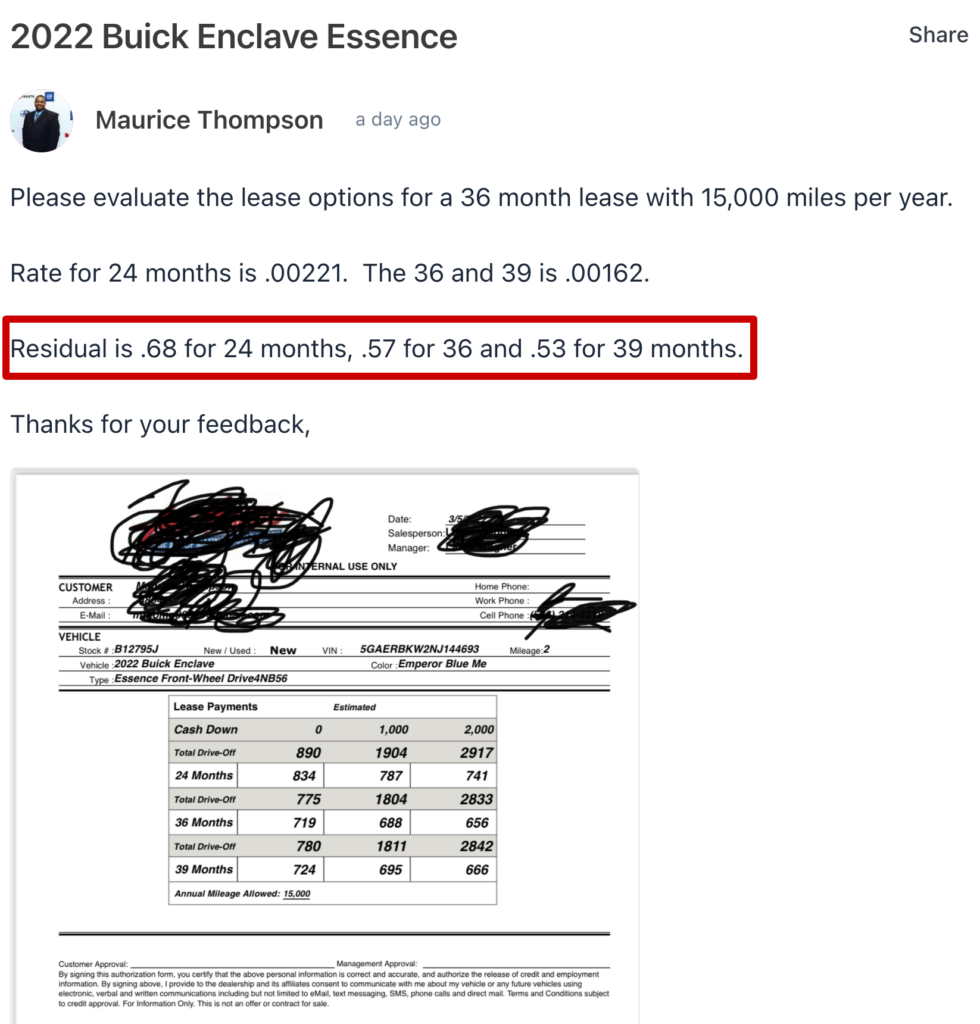
When you lease, you pay for the amount of depreciation that will occur over the course of the lease term. In Maurice’s case if he leased for 24 months the residual value is 68%, which means he will have paid for 32% of the vehicle’s depreciation from MSRP.
👉 Residual values are not negotiable and they are set by the leasing company. Dealer’s cannot modify residual values.
The money factor is the interest rate on a lease. Instead of paying an APR on a loan, you pay a money factor on the lease. Money factors are typically expressed in decimals which can be confusing. Don’t fret. Ask the salesperson for the money factor and then multiply it by 2400, that’s the interest rate you are paying on the lease.
Why do you pay interest on the lease? Because the leasing company is financing the purchase of the vehicle from the dealer. They then turn around and lease the vehicle they just bought to you. To make money they charge the dealer an interest rate (the money factor) to cover their cost of financing the purchase of the vehicle. That then gets passed on to you, the customer.
Money factors can and will be marked up. That means the leasing company may charge the dealer .00125 (3%) for the lease, and the dealer will turn around and tell you the money factor is actually .00175 (4.2%). That’s a sizable difference in rate, and represents a large profit center for dealers on a lease.
👉 You can and should negotiate the money factor on a lease.
Most states charge sales tax on each lease payment, some states do not. NY, NJ, MN, OH, GA for example charge sales tax upfront on the total amount of the lease payments. VA, MD, TX charge sales tax on the total selling price of the vehicle (the cap cost). In all other states, sales tax is simply factored into your monthly payment.
Sales tax is not negotiable.
Okay, so those are the mechanics of leasing, but that doesn’t answer the question, “What’s better right now, buying vs. leasing a car?” We’ll answer that below.
As we discussed above, there are four factors that impact how “good” a lease deal is. So far in 2022 we’ve seen two phenomena that make leasing less attractive than in prior years:
Since you can’t negotiate the residual value, there are some vehicles that are truly “unleasable” right now. Imagine leasing a Hyundai Kona EV for 36 months and paying for 50% of the vehicle’s depreciation. No thank you!
In most cases right now it is cheaper to buy instead of lease. That being said, there are still some advantages to leasing.
Proponents of leasing love to tout the benefits of not owning a car. When you lease there are three primary benefits:
Since a lease is simply a rental, you’ll have no negative equity at the end of the term. Plus, with a lease you are committed for 3 years and then you can switch into something new. And, if you do chose to buy your lease car you know the vehicle history and shouldn’t have any concerns.
These are benefits of leasing no matter how good or bad the lease deal was.
So what cars actually lease well right now in 2022? If you’re seriously weighing buying vs. leasing a car, you should consider these vehicle’s as lease options:
| Term | Year | Make | Model | MSRP | Average Payment (12,000 miles) |
| 36 | 2021 | BMW | i3 | $48,970.00 | $425.80 |
| 36 | 2022 | KIA | NIRO EV | $43,495.00 | $395.91 |
| 36 | 2022 | CHEVROLET | BOLT EV | $33,595.00 | $312.82 |
| 36 | 2022 | CHEVROLET | BOLT EUV | $36,245.00 | $341.01 |
| 36 | 2021 | CHEVROLET | BOLT EV | $38,567.00 | $367.63 |
| 36 | 2021 | HONDA | CIVIC TYPE R | $41,940.00 | $409.78 |
| 36 | 2022 | TOYOTA | TACOMA | $36,323.33 | $361.42 |
| 36 | 2022 | TOYOTA | TUNDRA 4WD | $51,455.00 | $524.43 |
| 36 | 2022 | HYUNDAI | KONA EV | $39,435.00 | $401.39 |
| 36 | 2022 | MITSUBISHI | OUTLANDER PHEV | $40,356.67 | $412.84 |
| 36 | 2021 | POLESTAR | POLESTAR 2 | $61,200.00 | $623.95 |
| 36 | 2022 | KIA | NIRO PLUG-IN HYBRID | $34,331.67 | $350.88 |
| 36 | 2022 | JEEP | WRANGLER UNLIMITED | $47,838.86 | $502.42 |
| 36 | 2021 | TOYOTA | TACOMA | $35,835.61 | $378.09 |
| 36 | 2022 | TOYOTA | TUNDRA 2WD | $48,478.57 | $527.23 |
Do you still have questions on buying vs. leasing a car? Get help from CarEdge’s team of car buying coaches. Click here to join CarEdge and get connected with a car lease expert who can help you navigate your deal. Here are some additional resources on car leases as well:

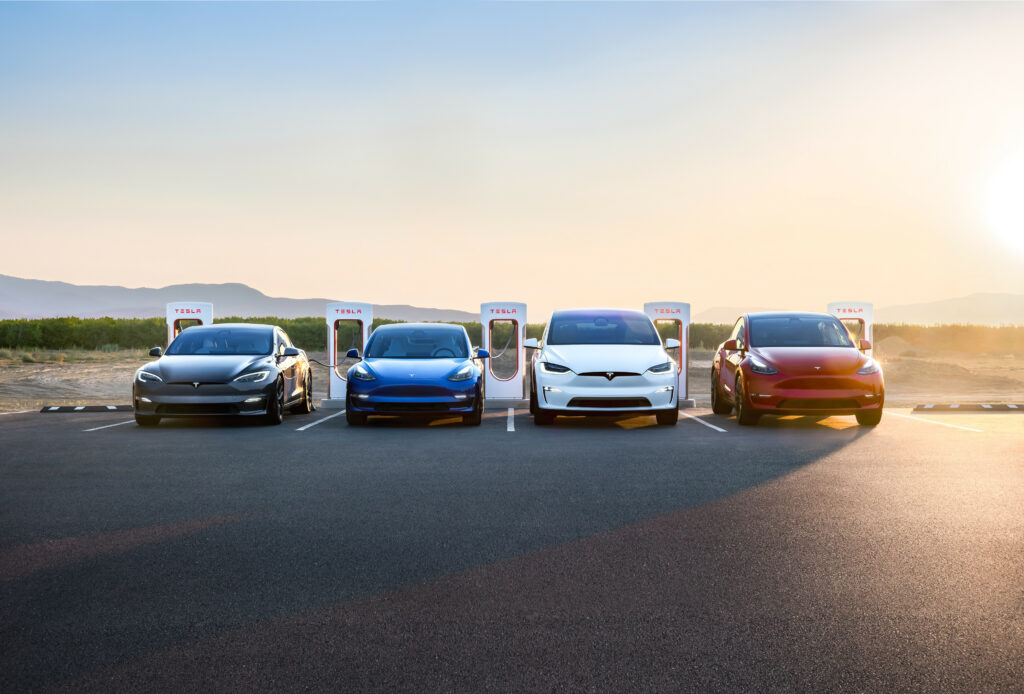
DC chargers, EVSEs, kilowatts and kilowatt-hours, a whole dictionary of new words, units and ownership experiences awaits first-time electric vehicle adopters. There’s a real learning curve that comes along with owning and operating an electric vehicle. Even if you plan to get every last mile out of your favorite combustion engine, the electric floodgates are open, and every automaker is making the switch.
There’s a lot to cover. You could read this valuable resource like a book, or better yet make use of the table of contents to skip around. These are the electric car terms you’ll be hearing a lot more of in tomorrow’s auto market. Did we miss any? Let us know!
This is the preferred planner used for road trips in electric vehicles. A Better Route Planner is fully-customizable, making charging stops much easier to plan.
AC stands for alternating current. Electricity supplied by the power grid is AC, yet electric vehicles need direct current (DC) to charge the battery. The “onboard charger” built into the vehicle converts power from AC to DC and then feeds it into the car’s battery. Charging at home will convert AC from the power outlet into DC in the car.
Amperes, or amps, are the base unit of electric current. Current is the speed or rate at which the electrons flow through a conductor, such as copper wire in a charging cable. Charging an EV from a basic level one 110 volt wall outlet provides around 12 amps of electricity current. Stepping up to a level two home charger (240 volt dryer outlet) sends around 32 amps to the car. Level three DC fast chargers supply over 100 amps.
This allows the vehicle to come to remain at a complete stop with the foot off of the brake. Auto hold is an essential part of one-pedal driving.
Some EVs are powered by asynchronous motors, which are cheaper to produce than permanent magnet motors. Most modern electric vehicles are powered by permanent magnet motors due to their higher efficiency and improved power generation.
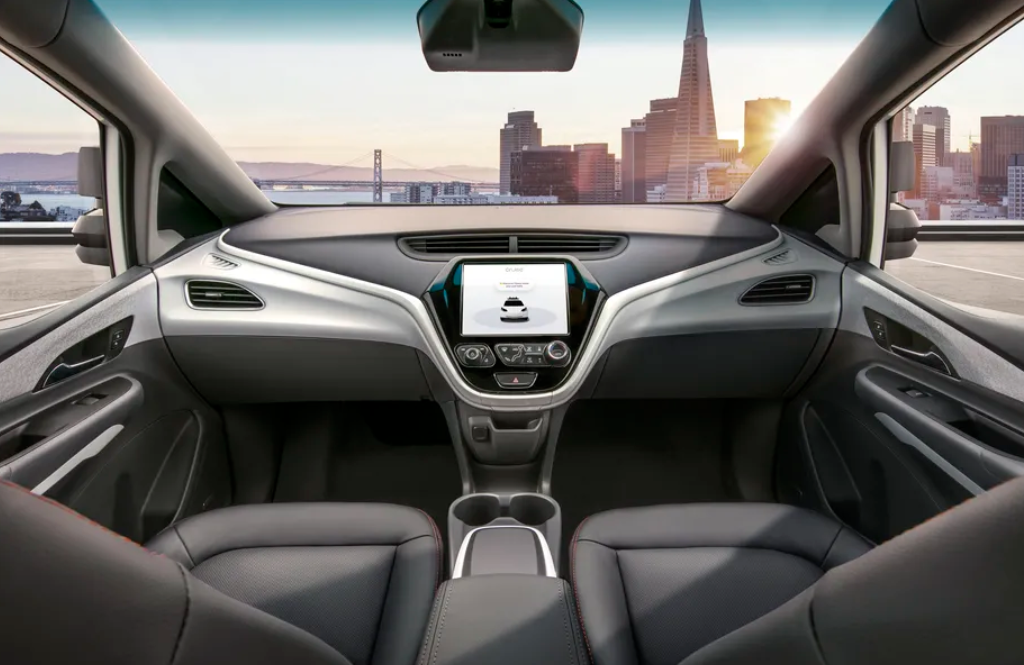
Great news! CarEdge published an entire guide to autonomous vehicles. There are different levels of autonomous driving. The lower levels are basically cruise control and lane centering. Advanced autonomy permits the driver to take hands off of the steering wheel. Fully autonomous cars don’t require the driver to pay attention at all, and can travel anywhere at a moment’s notice.
EV batteries don’t drain all the way to their true 0% state of charge. Doing so often would permanently damage the battery. Instead, all batteries are engineered to have a buffer. For example, a 82 kWh battery may only have 77 kWh of usable battery. The rest is the buffer. Some automakers send over-the-air updates to electric vehicles that can increase driving range by reducing the battery buffer.
You know the AA or AAA batteries in household electronics? Those are battery cells. Modern EV battery packs are made of several modules (sealed encasings) containing thousands of individual battery cells. Different battery form factors are used, depending on the engineering of the battery technology. The form factor is basically the shape and size of the battery cell.
All batteries lose the capacity to hold power over time due to wear and tear. For the time being, it’s an unavoidable characteristic of battery chemistry. However, battery chemists and engineers are always looking for ways to extend battery life and improve durability. Modern EVs are known to retain over 90% of the original battery capacity and range after 100,000 miles. Many Teslas on the road today have gone well over 200,000 miles on the same battery pack.
Think of the BMS as the ’brain’ of the car’s battery. The EV battery management system ensures the optimized and safe operation of the battery, carefully monitoring and adjusting the temperature, power output and charging intake at all times.
An EV battery module is made of several battery cells arranged and secured into a frame so that it becomes one unit. Battery packs contain several battery modules, which contain thousands of individual battery cells. For example, the Tesla Model 3’s 7,920 battery cells are arranged into five battery modules within the battery pack.
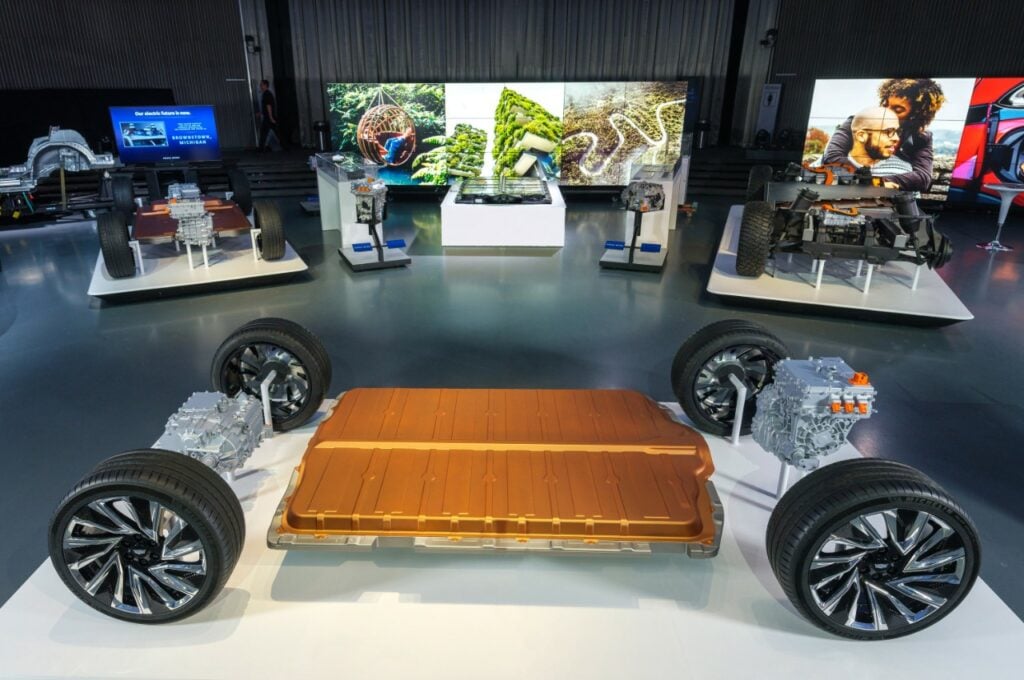
In an electric vehicle, the battery pack contains the individual battery cells and components. In modern EVs, the battery pack lies under the floor of the car, encased in a reinforced, waterproof case that is designed to withstand severe abuse from road debris, off-roading or accidents.
Battery preconditioning prepares an electric vehicle’s battery for fast charging. DC fast chargers supply more power to the battery when the battery is functioning at ideal temperatures. If a battery is still relatively cool, battery preconditioning may automatically warm up the battery to the optimum temperature when the car’s navigation system is navigating to a charger. Preconditioning capability can save drivers time at the charging station.
Some refer to fully-electric vehicles as ‘battery electric vehicles’, or BEVs. The term is used to separate plug-in hybrid vehicles (PHEVs) from fully electric vehicles.
The CCS connector is now the most common charging connector in North America. It’s the closest thing to a ‘standard’. It uses the J1772 charging inlet, and adds two more pins below to make faster charging possible. General Motors (all divisions), Ford, Chrysler, Dodge, Jeep, BMW, Mercedes, Volkswagen, Audi, Porsche, Honda, Kia, Fiat, Hyundai, Volvo, smart, MINI, Jaguar Land Rover, Bentley, Rolls Royce and others use the CCS plug.
Japanese brands continue to use the CHAdeMO connector, despite all other automakers abandoning this charging connector type. In North America, the only manufacturers currently selling electric vehicles that use the CHAdeMO connector are Nissan and Mitsubishi. The Nissan Leaf and the Mitsubishi Outlander plug-in hybrid are the only EVs that use the CHAdeMO charging connector type. Electrify America stations typically have one CHAdeMO plug.
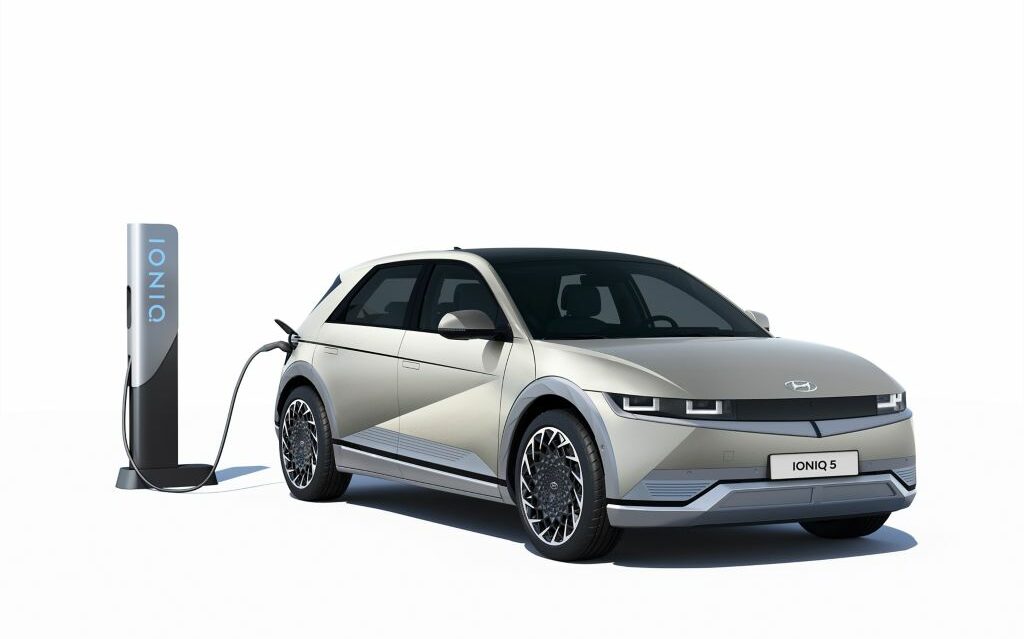
This is where the EV charger is plugged into the car. In some models, the charge port is located where the gas cap is located on traditional cars, but it may be located on the front grille or above the front wheels on some EVs.
ChargePoint is a popular charging station provider. Many ChargePoint stations are located in parking lots at shopping centers.
Adapters make it possible to charge a vehicle with an incompatible charge port. For example, Tesla vehicles all come with a Tesla plug, which is different from the common CCS plug that Volkswagen, Ford, GM and others use. A charging adapter can be purchased and attached to solve this plug mismatch. It’s wise to keep an adapter in the vehicle when traveling.
This is where EV drivers charge up their batteries on road trips, or if they don’t have the ability to charge at home. Charging speeds determine the amount of time drivers spend at a charging station. Older DC fast chargers peaked at 150 kilowatts, but newer charging stations are capable of charging cars at 350 kilowatts. Most charging stations are located in grocery store or gas station parking lots. In the US, a new national charging network is under development to bring charging stations to every corner of America.
DC stands for direct current. A DC charger converts alternating current (AC) from the power grid into direct current inside the charger itself. DC chargers are often called ‘fast chargers’ because this makes it possible to feed much more electricity to the battery much faster. Charging in America is about to get a lot easier.
In electric vehicles, a dual-motor setup enables all-wheel drive. Electric motors are only a tad larger than a basketball, so they can easily be placed on each axle. In fact, high-end EVs often have three motors (tri-motor) or even four motors (quad-motor). Often, dual-motor EVs operate with just the rear motor until additional acceleration or traction is needed.
Most electric vehicles include an eco mode, which activates efficiency measures to reduce battery consumption and prolong driving range.
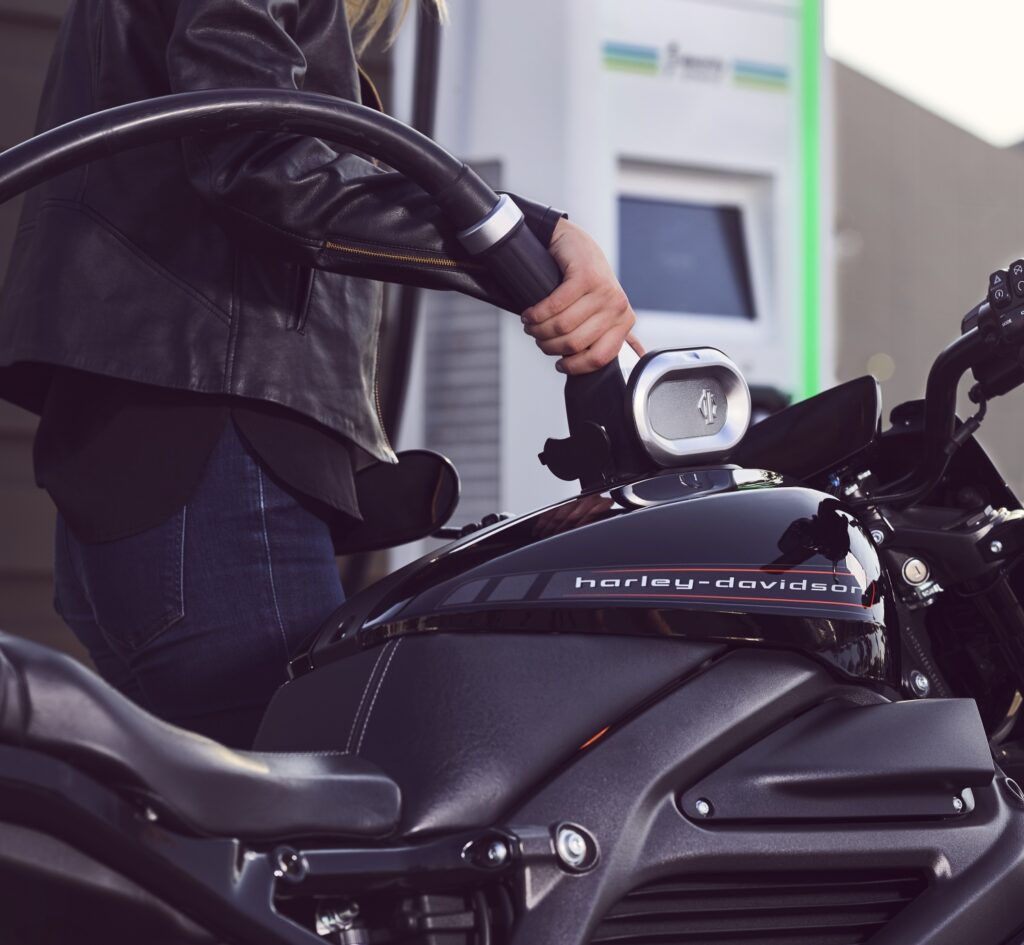
Electrify America is a large and rapidly growing operator of charging stations in the United States. It was established as a result of Volkswagen’s dieselgate emissions scandal. An average of four EA stations were opened every week since the official debut of Electrify America in May of 2018. Now, EA is embarking on the next stage of growth.
The current electric vehicle federal tax credit saves EV buyers $7,500 on their tax bill, so long as they owe at least that much in federal tax liability. In 2022, US lawmakers are considering an expansion to the EV tax credit, possibly up to $12,500 for some models. As of 2022, all automakers except Tesla and GM still qualify for the credit, which phases out after sales surpass 200,000. Learn more here.
Electric Vehicle Supply Equipment (EVSE) supplies charge to the vehicle and controls communication between the car’s battery management system and the charger. EVSE includes the charging cable, connector type, and communication infrastructure between the vehicle and the charger.
What do you call a front trunk? A frunk, of course! Not all EVs have a frunk, but Tesla models are known for their generous frunk sized. Electric trucks have massive frunks.
In the automotive world, ICE stands for internal combustion engine. In other words, old-fashioned, fossil fuel-burning vehicles.
When you pull up to a charging station only to find that it is blocked by an ICE car, you’ve been ICE’d. It’s a real problem when there are no other chargers available, and just annoying in general.
Every electric vehicle sold in North America can use any charging station that comes with the standard J1772 connector. Every non-Tesla level 1 or level 2 charging station sold in North America utilizes the J1772 connector. CCS chargers are a modified version of the J1772 connector.
One kilowatt equals 1,000 Watts. A Watt is a unit used to quantify the rate of energy transfer. Your home microwave uses 1,000 Watts, and an electric motor uses 100 to 300 kilowatts (100,000 to 300,000 Watts). EVs consume a lot of power, so power usage and charging rates are measured in kilowatts. DC fast chargers use 150 to 350 kilowatts.
The kilowatt-hour is a unit of energy equal to one kilowatt of power used or supplied for one hour. The kWh unit is most often used with regards to battery capacity. Modern electric vehicle batteries typically have a capacity between 58 kWh and 125 kWh.
This is the preferred unit of measuring EV efficiency in Europe. In the United States, miles per kilowatt-hour is the most common unit of measuring efficiency.
Level one charging is simply plugging into a standard wall outlet that supplies 110 volts. This is the most affordable charging option, as no installation or accessories are required. However, it is very slow. Often called ‘trickle charge’, level one charging is best for plugging in overnight. It may take 12 to 24 hours to fully charge, depending on the state of charge when plugging in. Here are five common myths about charging at home.
Level two EV chargers use a 240-volt dryer outlet to draw more power, and therefore to charge the car more quickly. Installation of a level two charger costs on average $700 – $1,500, but local, utility and state incentives can reduce the total cost. A level two charger can fill most EV batteries from empty in under 8 hours, adding between 18 and 30 miles of range per hour. Here are five common myths about charging at home.
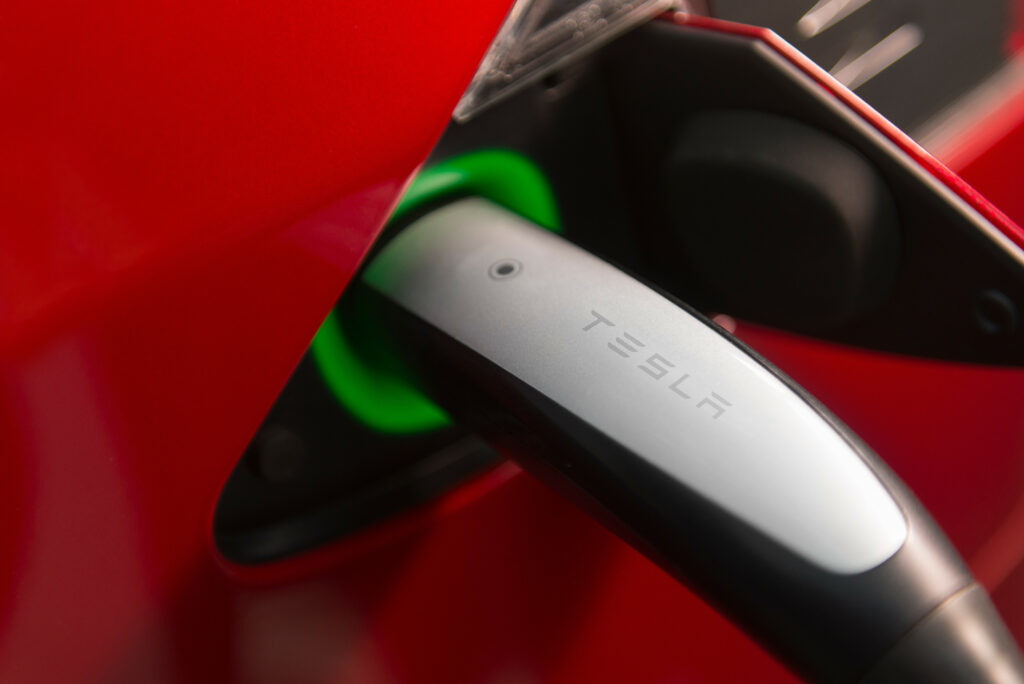
Level 3 chargers are known as DC (direct current) fast chargers. These are the quickest, most powerful chargers. In the United States, Electrify America and Tesla Superchargers are the most widespread level three charging networks. Depending on the vehicle model, a level three charger can fill an electric vehicle battery in 20 to 50 minutes from a low state of charge. Here’s how much it costs to charge at a level 3 charger.
For the time being, all electric vehicle batteries are made of lithium, a rare earth mineral known for high energy density, durability and rechargeability. Other rare minerals and chemicals are also included in the composition of EV batteries, such as nickel, cobalt, iron and phosphate. Lithium is mined from rock deposits.
In the United States, miles per kilowatt-hour is the most common unit of measuring efficiency. It serves the same purpose as ‘miles per gallon’ with combustion vehicles.
Miles per gallon equivalent (MPGe) is one of the units used to characterize the efficiency of an electric vehicle’s battery and electric motor powertrain. One kilowatt-hour (kWh) of electricity contains the same amount of energy as one gallon of gasoline. MPGe is how many miles the electric vehicle can drive on 33.7 kWh of electricity. It is primarily used in the United States. Most electric vehicles get between 90 MPGe and 125 MPGe.
Electric vehicles contain a built-in ‘onboard’ charger that converts AC power from the grid into a DC voltage that is used to charge the battery pack in the vehicle. Level one and level two charging at home is supplied by alternating current (AC) from the grid, however direct current (DC) fast chargers at Electrify America, Tesla Superchargers and others supply direct current directly to the vehicle.
What is one pedal driving? One pedal driving is when an electric vehicle combines regenerative braking and auto hold capabilities to make driving with just the accelerator pedal possible in most situations. With one-pedal driving, the brake pedal is only applied when the need arises to quickly slow down. When ‘creep mode’ is engaged (or the default setting), the car will creep forward when the foot is not on the brake, much as ICE cars do.
With OTA capability, vehicles can receive enhanced performance and safety improvements via a simple wireless internet connection. Some EVs, such as Tesla vehicles, have received OTA updates that actually increase their driving range or charging speed. CarEdge’s guide to OTA updates covers everything you need to know about this feature.
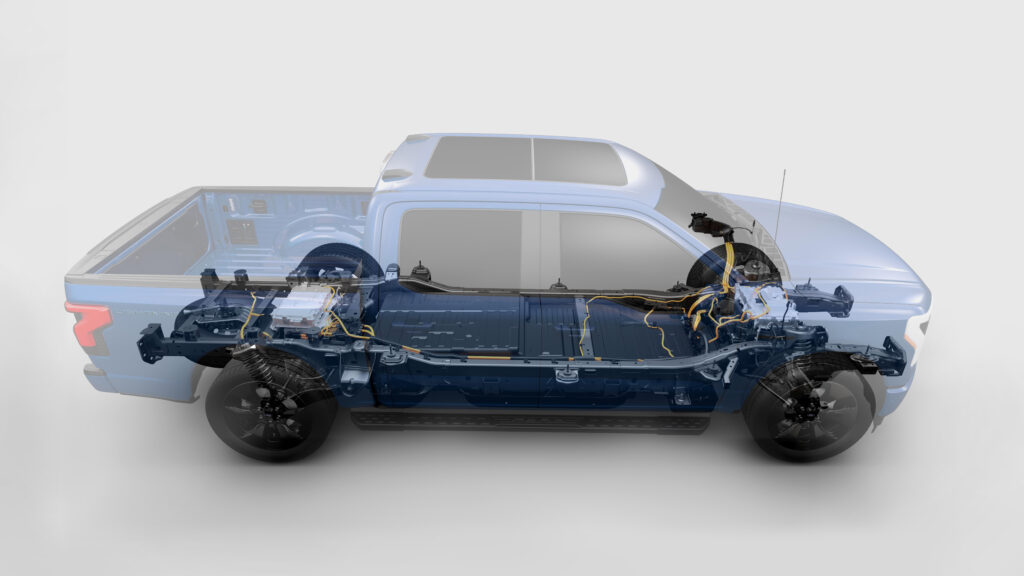
Most modern EVs are powered by highly-efficient, compact permanent magnet motors. Previously, the rare earth minerals needed to make permanent magnet motors were too expensive, but significant improvements in affordability and engineering have made this the gold standard for EV motors.
Plug-in hybrid vehicles (PHEVs) contain an electric motor and a gasoline-powered combustion engine. Most PHEVs can travel 20 to 30 miles on pure electricity before they begin to use the hybrid combustion engine for the remainder of the journey. PHEVs can be charged at a charging station, but they don’t require charging. However, PHEVs do contain far more mechanical components than a true EV, and therefore may eventually require more maintenance.
The PlugShare app is the go-to resource for electric vehicle owners when traveling. PlugShare’s map displays over 440,000 EV charging stations worldwide. The Trip Planning feature makes it quick and easy to plan out charging stops along any journey, and it’s fully customizable. This resource is especially useful when driving an EV into a rural area.
EV range is how many miles a vehicle can travel on a single charge, or remaining charge. Most electric vehicles are rated for somewhere between 250 and 350 miles of range on a full charge. In the United States, the EPA rates the official range based on a standardized driving course. Unlike internal combustion vehicles, EVs get better range in urban driving. For example, a Volkswagen ID.4 may get 230 miles on the highway at 70 mph, but nearly 300 miles of range when driving around town.
Electric vehicle range is always emphasized, but not at the fault of the car itself. Infrastructure is slow to catch up, and many parts of America remain charging deserts. Fortunately, public-private partnerships are coordinating the installation of a national charging network that will reach every corner of the United States by mid-decade. Charging in America will soon become much easier.
This is one of the superpowers of electric cars. Rather than letting all of the force applied by the brakes go to waste, EVs recapture some of the power through regenerative braking. How does regenerative braking work? When decelerating to slow down, the wheels drive the electric motor and convert kinetic energy from movement into potential energy to be stored in the battery pack. This is why EVs can actually gain significant driving range when cruising down a steep mountain. If a Tesla Model Y has 50% state of charge at the top of the mountain, it may have 55% by the time it reaches the valley below.
Solid-state batteries replace the liquid electrolyte found in other batteries with a solid electrolyte. The electrolyte is the part of the battery that is commonly known as battery acid. It conducts electricity between the cathode (negative terminal) and anode (positive terminal).
In essence, most of today’s batteries are ‘wet batteries.’ Solid-state batteries are ‘dry’, and with that comes many benefits, but also some new challenges. Affordability and the ability to withstand thousands of charging cycles remain the engineering challenges of solid state battery development. Several automakers are currently working on solid state development with hopes of producing EVs with much greater ranges and faster charging. Learn more about this technology at the CarEdge guide to solid state batteries.
How much charge is left in the battery? That’s the state of charge, usually displayed as a percentage. Some EV models display miles remaining by default, but most have the option for viewing the actual remaining battery percentage.

The Tesla Supercharger network is the largest charging network in the world, with over 30,000 chargers around the world. Version three (V3) superchargers supply up to 350 kilowatts of electricity to EVs, making it possible to charge up in as little as 20 minutes. The Tesla Supercharger network is only available to Tesla vehicles. Costs average around $0.28 per kilowatt-hour of electricity. Therefore, most Tesla cars will spend around $10 – $15 charging to full, gaining around 250 – 300 miles of range. Learn more about how much it costs to charge an electric car with our CarEdge guide to charging.
Tesla vehicles have a proprietary Tesla connector that accepts all voltage, so there’s no need to have a different connector specifically for DC fast charge. Only Tesla vehicles can use their DC fast chargers, called Superchargers. Be sure to check out the other plug types in the electric vehicle dictionary.
When an electric vehicle’s battery gets to a very low state of charge (often under 3%), the EV will have limited acceleration and even a limited top speed if the state of charge drops below 1%. It is important to avoid letting the battery drain this low often, as it can affect the long-term health of the battery.
All electric vehicle batteries contain a buffer, or unusable portion of the battery capacity. This is meant to preserve the longevity and health of the battery. Draining a battery entirely damages the internal components. Usable battery is the portion of the overall battery capacity that is accessible during normal operation. For example, the Ford Mustang Mach-E has a 98.8 kWh battery pack, but 91 kWh usable capacity. The rest serves as the buffer.
The latest generation of electric vehicles are capable of powering home electronics, charging other cars, and even powering an entire home. This feature is known as vehicle-to-load, or V2L. The Hyundai IONIQ 5 and Kia EV6 are both capable of vehicle-to-load transmission. It’s a great feature for avoiding the disruptions caused by utility power outages. You can even power an outdoor party (or campsite).
Think of voltage as the pressure from an electrical circuit’s power source that pushes electrical current through a wire, such as an EV charging cable. Amps multiplied by volts equals watts, which is the measurement used to determine the amount of energy. Most existing EV models are built with 400 V charging infrastructure, however newer models like the Hyundai IONIQ 5, Kia EV6 and Porsche Taycan use next generation 800 V architecture. The result is much faster charging.
There is a close relationship between watts, amps and volts. Amps multiplied by volts equals watts, which is the measurement used to determine the amount of energy. In the United States, the energy consumption of an electric vehicle is most often measured in watt-hours per mile, which is how much energy would need to be sustained for one hour for the vehicle to travel one mile. Highly efficient EVs average under 350 watt-hours per mile (Wh/mi).
Did we miss anything in our electric vehicle dictionary? Let us know in the comments!
Don’t forget to check out the new CarEdge Car Search, where you can find new and used vehicles listed for sale with unique industry insights that dealers don’t want you to see! You can even filter for electric vehicles. See the CarEdge electric car listings here.

Finally, the world knows why Ford has yet to name an electric vehicle the ‘Model e.’ On March 2, Ford announced the formation of a distinct unit for electric vehicle operations. The decision paves the way for the automaker to accelerate EV development while opening new avenues for direct-to-consumer sales. Ford says they are driven by the need to compete and win against both new EV competitors and established automakers.
3/3/22 Update: Ford CEO and President Jim Farley explained the move and how it affects dealers.
“This is only about creating incredible products that improve over time. To create a better customer experience than yesterday. And ultimately, to win as a company. The reality is, our legacy organization has been holding us back. We had to change.”
Ford wants a certain number of dealers to opt in to a new Model e sales model. Model e dealers would not hold inventory. Instead, they will facilitate the delivery of online orders, much as Tesla does for their customers. Electric vehicles will be sold at non-negotiable prices. That’s just one step away from direct-to-consumer sales.
“Our message to dealers is, we’re betting on you. Get ready to specialize,” Farley said.
Ford’s announcement outlines the establishment of two new operational divisions that will remain under the corporate umbrella of Ford Motor Company. Ford Model e will take on the future of electric vehicle development and sales. Ford Blue will become Ford’s combustion-powered division, encompassing everything from the F-150 to the Bronco.
The two new divisions within Ford will continue to collaborate and propel the greater Ford enterprise forward, according to the press release detailing the plans. Ford Model e and Ford Blue will join Ford Pro as the corporation continues to branch out its business model. In 2021, Ford Pro was launched as a one-stop shop for commercial and government customers.
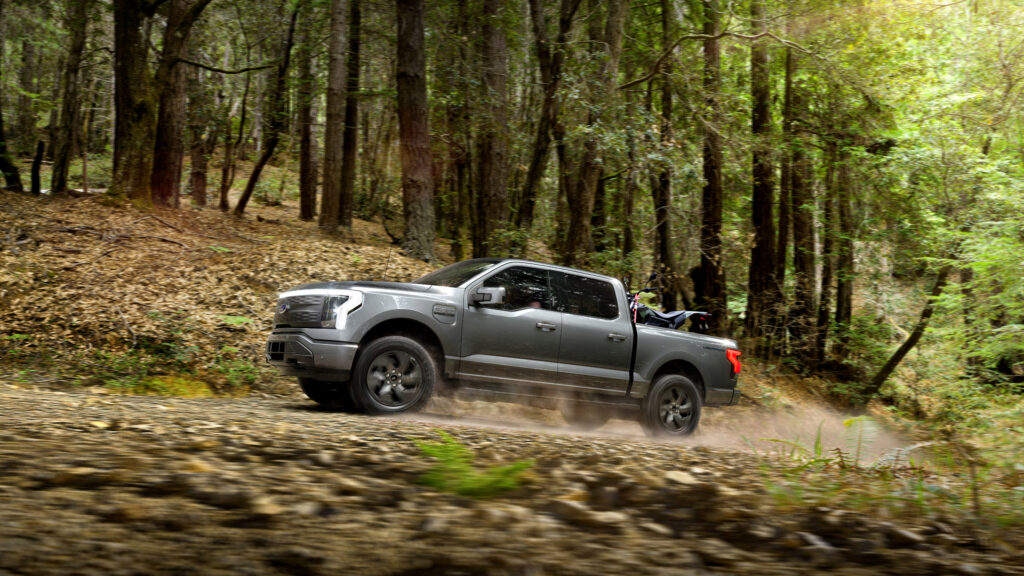
The creation of Ford Model e was driven by the success of the popular Ford Mustang Mach-e and the overflowing support for the upcoming F-150 Lightning. Interestingly, Ford cited the success of their dedicated EV division in China as another source of inspiration for the launch of Ford Model e.
Ford President and CEO Jim Farley will take on yet another role as President of Model e. Farley has long been an outspoken proponent of Ford’s ambitious electrification plans.
“Ford Model e will be Ford’s center of innovation and growth, a team of the world’s best software, electrical and automotive talent turned loose to create truly incredible electric vehicles and digital experiences for new generations of Ford customers,” Farley said.
Ford hopes that Model e will attract and retain the best engineers and software developers to Ford. As autonomous driving and wireless over-the-air updates become the norm, Ford wants to be a leader in the reimagined automotive industry that’s currently in the making. A lot more computers, and a lot less oil. They’re pushing full steam ahead with ground-up development of electric vehicles. EV platform design, battery research and development, electric motors and inverters and charging infrastructure will all fall under the umbrella of Ford Model e. There are also plans to advance recycling infrastructure in both cost-cutting and environmentally responsible ways.
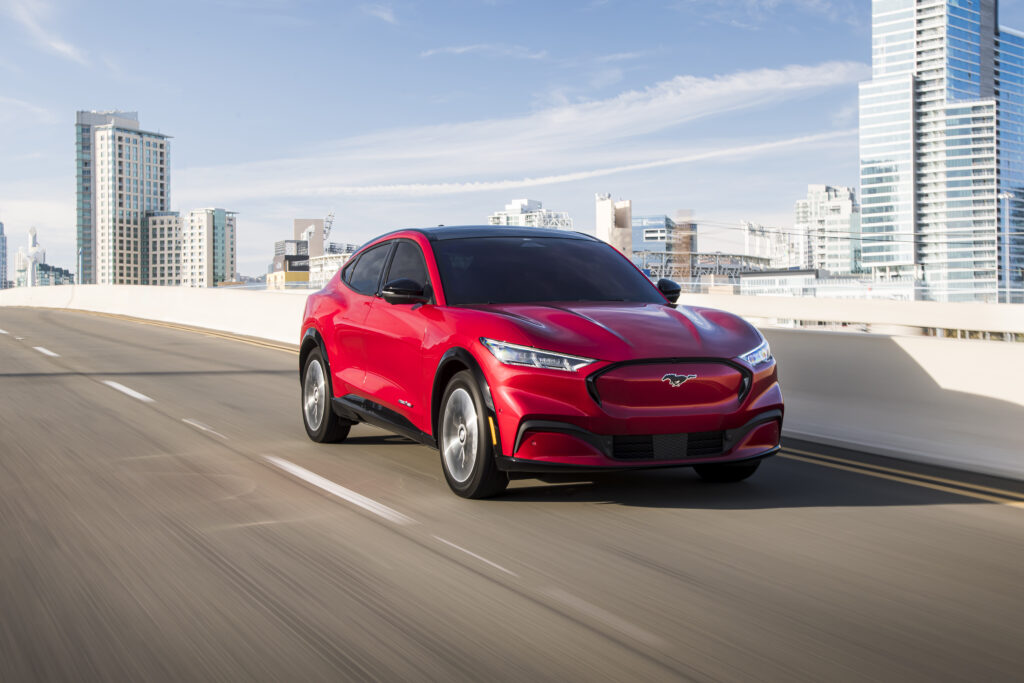
Ford not-so-subtly shared one of their larger ambitions for their new electric vehicle division: foregoing the dealership model. We’ve seen Ford’s corporate leadership speak out against outrageous dealer markups as the F-150 Lightning nears delivery. Ford’s announcement highlights the changes to their EV sales model:
“Ford Model e also will lead on creating an exciting new shopping, buying and ownership experience for its future electric vehicle customers that includes simple, intuitive e-commerce platforms, transparent pricing and personalized customer support from Ford ambassadors.”
Yeah, transparent pricing would be welcome. It’s great and almost shocking to see a legacy automaker making such a large pivot away from the status quo. Could the direct-to-consumer model win over new customers to the Ford brand?

CEO Jim Farley calls the Ford+ plan the company’s biggest opportunity for growth and value creation since Henry Ford scaled production of the Model T. Ford Blue will work to optimize Ford’s combustion-powered models and profitability through strengthened consumer relationships, quality improvements and greater operational efficiency.
“Ford Blue’s mission is to deliver a more profitable and vibrant ICE business, strengthen our successful and iconic vehicle families and earn greater loyalty by delivering incredible service and experiences. It’s about harnessing a century of hardware mastery to help build the future. This team will be hellbent on delivering leading quality, attacking waste in every corner of the business, maximizing cash flow and optimizing our industrial footprint.”
Ford CEO Jim Farley has long said that Tesla needs to be taken seriously. Tesla, Rivian, Lucid and newcomer Fisker are all having success with direct-to-consumer sales. However, these automakers and any others who go this route face a maze of state laws that present roadblocks for direct-to-consumer sales. The dealership lobby is strong in much of the United States. So much so that a recent West Virginia bill was introduced that would ban most over-the-air updates in the state, all so that dealerships can continue to rake in service center revenue.
Other automakers are in the weeds with the dealership model, too. Kia’s much-lauded EV6 electric crossover is facing opposition from Kia dealerships. They’re simply not adapting to the coming rush of electric vehicles. Jalopnik reported that EV6 buyers are reaching out to them with stories of dealers who are making buying an EV6 a lot harder than it should be.
Nationwide, 17 states currently have a ban on direct-to-consumer sales. Eleven more states have carved out specific exceptions for Tesla (and in some cases, other automakers that sell only EVs). That’s why Tesla technically can’t sell directly to consumers in states like Texas and Washington. It’s an antiquated system in need of change.
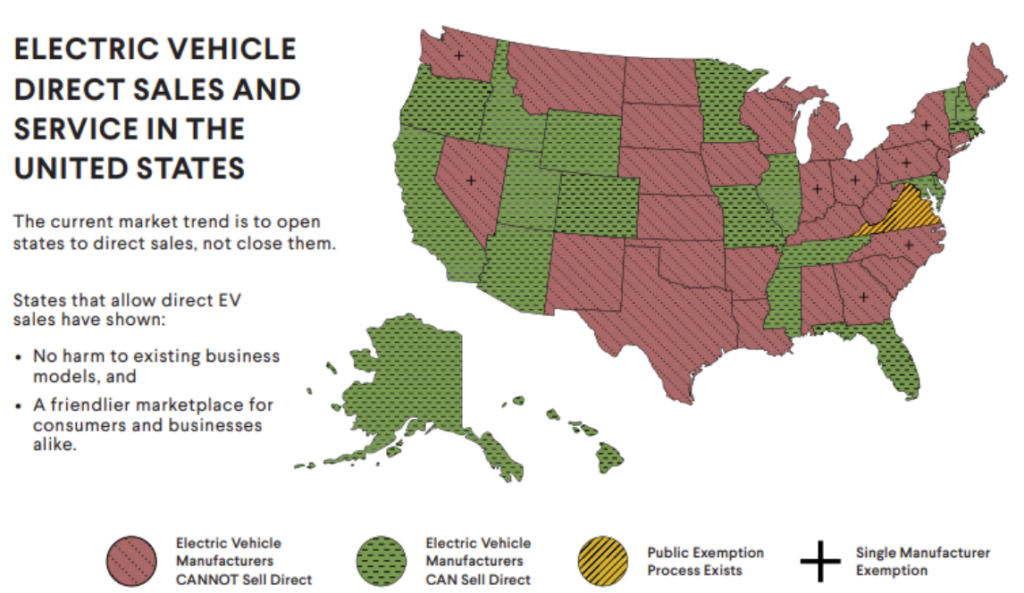
Ford recognizes the tides of change approaching automotive sales. Automotive News reported that efforts to permit direct-to-consumer sales have been introduced in 10 states. Several of the bills already failed. More are surely to come as electric vehicle market share surpasses 5% of new auto sales in America.
This is long overdue. Consumers are fed up with dealer markups, deceptive sales tactics and stressful experiences at the dealership. But this isn’t the end for dealerships. There will be a need for dealers for decades to come, even if sales shift away from their franchises.
Electric vehicles are coming, like it or not. Ford is aiming for annual production of more than 2 million EVs by 2026. They expect EVs to represent half of global volume by 2030. Automakers say that half a trillion dollars will go to electric vehicle development this decade. However, EVs currently can’t be serviced at the neighborhood repair shop, or in one’s home garage. Certified technicians certified in electric vehicle repair are quickly going to be in high demand at service centers everywhere. Dealership service centers aren’t going away. In fact, dealership service centers will likely see business grow as more consumers opt for electric vehicles.
Ford’s new Model e and Ford Blue divisions present a massive opportunity for new revenue streams and efficiency within Ford’s R&D and sales operations. Will other legacy automakers follow suit? Truthfully, they are very likely making plans as we speak. CarEdge will keep you up to date with consumer-focused automotive news. More change is surely to come.
Update 3/8/22: As the Ukraine crisis continues, automakers continue to see impacts. The possibility of a looming raw material shortages is beginning to weigh on semiconductor chip production forecasts, with the real possibility of an even worse chip shortage on the horizon. Metals used in everything from vehicle frames to catalytic converters are soaring to record prices due to the importance of Russia in the global supply. More on the latest developments below.
The ongoing crisis in Eastern Europe is affecting global automakers more than expected. As the conflict drags on into March, automotive suppliers in Russia and Ukraine are experiencing severe disruptions. Logistical nightmares are tumbling out of control as airspace restrictions are enforced. Now, cyberattacks are adding insult to injury. Here’s every automaker impacted by the conflict in Ukraine.
Transport between Europe and countries home to Asian auto manufacturers is facing unprecedented disruption as air space restrictions over Eastern Europe halt 20% of the world’s air cargo. In retaliation to bans imposed on Russia, Russia has reciprocated by banning European carriers from entering Russian airspace, which stretches 5,600 miles from Europe to East Asia. There have also been reports of Russian-based cargo ships being refused refueling at various ports in protest to the invasion of Ukraine.
Furthermore, automotive parts manufacturers located in Ukraine are shuttered, and those in Russia are subject to the effects of sanctions.
Raw materials used in the manufacturing of vehicle frames and electric vehicle batteries are soaring to record highs. Aluminum, palladium, platinum and nickel are most immediately impacted by the Ukraine-Russia conflict. About 40% of the world’s palladium is sourced from Russia. Palladium is used in catalytic converter production. Automotive News reports that auto industry suppliers are well aware of the impending impacts on manufacturing.
“When it comes to metals, Russia companies are major suppliers to Germany. In 2020, they accounted for 44 percent of Germany’s nickel imports, 41 percent of its titanium, a third of its iron, and 18 percent of its palladium.
With production of 108 million tons last year, Russia is the world’s fifth-largest producer of iron ore, according to Credit Suisse, supplying European steelmakers who now face higher prices and possible difficulties procuring the metal.”
Palladium now sits at $3,440 an ounce, 60% above where it was two months ago. Automotive-grade aluminum also hit a record high on March 7. Nickel is at a 15-year high.
Neptune Global chief executive Chris Blasi said that someone will bear the brunt of the record prices and shortage. “There is no other option beyond palladium and platinum for catalytic converters, and you cannot build a car without a catalytic converter,” Blasi said.
Around 70% of the neon used by automotive industry suppliers is sourced from raw materials in Ukraine. Neon is used in the lasers that are critical to the production of semiconductor chips. The ongoing chip shortage may become even worse if the Russia conflict extends beyond a few months. For now, chip makers are relying on existing supplies. Automotive News detailed the neon supply concerns to keep an eye on here.
Although many policy and conflict experts expected worse by now, cyberattacks have disrupted automakers in the past week, causing some plants to briefly close. The automakers themselves are not the only ones at risk. Suppliers critical to the vast automotive supply chain have been hit with cyberattacks, and the result has been felt in recent days.
Volkswagen Group, the parent company of Audi, sources a large portion of its wire harnesses from a Ukrainian supplier. Audi announced production cuts that result from these supply chain difficulties. VW Group brands are among the many who have stopped exports to the Russian market.
The critical wire harnesses that BMW uses for its vehicle production are sourced from suppliers in Western Ukraine. The closure of the suppliers and the associated supply chain bottlenecks have now caused production cuts at BMW’s German plants. BMW also halted production at a factory in Kaliningrad, a Russian exclave situated between Poland and Lithuania. BMW has also suspended vehicle exports to the country.
On March 2, Ford announced a production stop at the Ford Sollers production facility, in which it maintains a 50% stake in partnership with Russian automaker Sollers.
Ford has a 50% stake in three Russian automotive plants. Ford Sollers is the Russian joint venture between Sollers of Russia and Ford. Most of the production at Ford Sollers is for the Ford Transit and similar commercial vehicles. A company spokesperson said that employee safety is their priority, and that effects of sanctions and supply chain disruptions are being assessed.
GM says they are fortunate to have limited supply chain risks as a result of the Ukraine conflict. Still, they are stopping exports to Russia. The move is unlikely to have major impacts for GM, as they sell less than 3,000 vehicles in Russia annually. GM ended production in Russia seven years ago.
On March 2, Honda joined other automakers in pausing sales and exports to Russia. Volvo was the first to make the move.
Interfax News reported that a Russian Hyundai official announced the suspension of output at its plant in St. Petersburg. On March 4, the automaker cited supply issues in its decision to prolong the plant closure. Hyundai is a major force in Russia, selling over 10,000 vehicles per month on average (12% market share).
The UK automaker announced that it is ceasing shipments of vehicles to Russia, effective immediately. Last year, Jaguar Land Rover sold 6,900 vehicles in Russia. A spokesperson said Jaguar Land Rover’s priority was “the wellbeing of our entire workforce and their families, as well as those within our extended network”. The statement went on to cite global supply chains and sanctions. “The current global context also presents us with trading challenges, so we are pausing the delivery of vehicles into the Russian market and continually monitoring the situation on behalf of our global customer base.”
Global auto manufacturer Magna announced the closure of its six Russian plants on March 7, citing “the unfortunate situation in Ukraine.” Magna Spokeswoman Tracy Fuerst shared the company’s support for the Ukrainian people. “Although we don’t have facilities in Ukraine, we have the privilege of working with thousands of Ukrainian colleagues in our Magna operations around the world as well as those from Russia who share the same values of human rights, diversity and inclusion,” Fuerst said. The Canada-based automotive supplier builds parts and entire vehicles for brands ranging from Toyota to Mercedes-Benz.
Mercedes-Benz sources multiple components from suppliers in Ukraine. Mercedes-Benz will reduce production at some European plants this week due to supply shortages. Mercedes sources many components from suppliers in Ukraine. Production shifts will see cuts, but the automaker does not expect to fully stop production outside of Russia. Mercedes is halting production at its Russian plant and pausing the export of passenger cars and vans to the country. They cite sanctions as the cause of the move.
Following Volvo’s lead, Mitsubishi announced that it will halt production and sales of their vehicles in Russia, effective March 1st. Mitsubishi has 2.2% market share in Russia.
Stellantis established a task force to identify disruptions from the ongoing conflict. Stellantis CEO Carlos Tavares said that the automaker has 71 employees in Ukraine. They are ensuring compliance with the rapidly-evolving sanctions in place.
Stellantis, the result of a merger between Fiat Chrysler and Peugeot, produces and sells the Peugeot, Citroёn, Opel, Jeep, Fiat brands in Russia. In January, Stellantis announced that they will begin exporting Russian-made commercial vehicles to Western Europe. The latest developments will likely put a hold on their plans. In 2021, Stellantis brands had just 1% market share in Russia.
On March 2, Toyota announced an indefinite pause in production at its Russian factory. Toyota produces about 80,000 vehicles at its St. Petersburg plant. They are also pausing imports into Russia.
All 14 domestic factories were closed on February 28 after critical supplier Kojima was taken down by a cyberattack that included a threatening message. The supplier was hit with a virus soon after Japan’s government announced support for Ukraine.
Toyota announced that it would resume production at all facilities in Japan the following day. Kojima was unable to operate, and Toyota said they do not stockpile the parts made by the supplier. Toyota relies on 60,000 suppliers, an immense vulnerability that Toyota is surely rethinking.
Volkswagen Group, which includes Audi, Bentley, Cupra, Porsche, Lamborghini, Skoda, SEAT and Volkswagen, continues to face supply chain constraints. VW branded vehicles are produced using wire harnesses sourced in Ukraine. As reserve supplies run low, more production cuts are possible. Production of Volkswagen’s electric vehicles is halted because of supply chain disruptions. The Volkswagen ID.4, ID.3 and new ID.5 electric vehicles are especially affected.
On Thursday March 3, Volkswagen said it is suspending its Russian business until further notice. No cars from VW Group brands will be exported to Russia. VW delivered 216,000 cars in Russia in 2021, about 2.4% of Volkswagen Group’s global vehicle sales.
As supply chain vulnerabilities surface, VW says it will idle the massive Wolfsburg plant. The VW Zwickau and Dresden plants are also closed for the week. Prior to the Ukraine-Russia disruptions, there was already a 6-12 month wait for buyers ordering a Volkswagen ID.4 in North America.
On February 28, Volvo became the first automaker to cease shipments of new vehicles to Russia. The Swedish automaker (owned by Geeley of China) cited their desire to avoid possible conflicts with the rapidly changing sanctions being imposed on Russia by the European Union, United States, and allies. Volvo sold 9,000 cars in Russia in 2021.
The Russia-Ukraine conflict adds a new dimension to the production delays and supply chain disruptions that have been dragging on for well over a year. The latest chip shortage forecasts show a delayed recovery, despite earlier optimism. So far in 2022, AutoForecast Solutions has increased their projection of vehicles lost in production due to the chip shortage by 63%, from 767,700 to 1,253,100.
Severe sanctions on Russia and instability in Ukraine may persist far longer than originally expected. Now that cyber security vulnerabilities are being targeted, sporadic production halts are becoming the new normal. Automakers impacted by the Ukraine conflict are in for prolonged uncertainty. Automakers may be entering a period of disruption being the new normal, even as the chip shortage will eventually wind down.

The last thing you want is to buy a vehicle, drive it off the lot, and then be faced with thousands of dollars in repairs. Mechanical breakdown insurance is a way to budget future vehicle repair needs into your financial picture. It’s not all that different from how health insurance works. When your vehicle is healthy, your wallet is happy.
CarEdge will soon offer mechanical breakdown insurance in California. Why then, are CarEdge products called extended warranties, or vehicle service contracts in other states? When it comes to the law, words matter. In California state law, an extended warranty may only refer to manufacturer warranties, and a vehicle service contract may only be sold by a registered car dealership. As an online company that leaves only one option; mechanical breakdown insurance. When it comes time to get coverage for a used vehicle outside of the manufacturer’s warranty, California law says that we nor any other provider can label our coverage an ‘extended warranty.’
This frequently leads to a lot of confusion, and an opportunity for car dealers to jack up prices on extended warranties. In this article we’ll address the similarities and differences of what you can get at a car dealer, and what you get with CarEdge mechanical breakdown insurance (MBI).
Let’s dive in.
CarEdge’s California mechanical breakdown insurance will provide drivers with the same exact coverage that our extended warranty products offer in the other states. We know it’s confusing, but it’s the law!
However, not every mechanical breakdown insurance product is the same. Some have very limited coverage at high prices. Just like with a traditional extended warranty, it is critically important that you know what to expect before you buy.
Annoyed by the dealership finance manager who is pushing last-minute add-ons as you try to buy a car?
Dealership finance managers make A LOT of money from commissions when you buy their extended warranty or vehicle service contracts. That’s precisely why they are so distraught when you turn them down. It’s important for consumers to know that they have options outside of the dealer finance office, and we encourage everyone to get a quote from CarEdge to use as negotiating leverage with the dealer — whether you buy from us or not!
When shopping around, it’s important to fully understand the benefits of mechanical breakdown insurance products.
Exclusionary mechanical breakdown insurance lists the components of the vehicle that are not covered or excluded. This means that the vast majority of vehicle components ARE covered. CarEdge’s mechanical breakdown insurance is exclusionary, great news for you!
Named component mechanical breakdown insurance policies ONLY cover the vehicle components that are listed. Everything else isn’t covered. Chances are, you won’t get the coverage you need and expect if you go with a named component policy.
How much you’ll pay for an extended warranty depends on where you shop. Ray and Zach Shefska of CarEdge compared a quote from Endurance with CarEdge’s extended warranty offer, and the difference was stark. For the exact same vehicle, Endurance quoted $3,600, while CarEdge offered coverage for $1,600 in the apples-to-apples comparison. Don’t settle for just anything, get a free quote from CarEdge!
We believe transparency is key to building positive relationships with consumers. We’ve all been through the pain of buying a car before. That’s why we guarantee honest, no-hassle coverage for your vehicle. Here’s what CarEdge’s mechanical breakdown insurance covers.
For most vehicles we offer exclusionary coverage. This means your vehicle is covered from “bumper-to-bumper” for everything but normal wear and tear, routine maintenance and anything that is explicitly listed in Section 8 of the contract.
Global positioning system (GPS), instrument cluster, infrared systems, cruise control servo, proximity pass key and sensor, power antenna motor, 4WD encoder motor. Alternator, starter motor, front and rear wiper motors, voltage regulator, distributor, solenoids, manually operated switches, electronic level control compressor including its sensor and limiter valve, electronic fuel injection sensors and injectors, electronic ignition module, ignition coils, power window motors/regulators, rear window heating elements, power mirror motors, power seat motors, and power lock actuators.
Drive shaft/U joint, torque converter, and transmission mounts.
Factory installed turbocharger or supercharger, including housing, and all internal parts.
Crankshaft and bearings, oil pump, fuel pump, diesel injection pump, internal timing gears or chain/belt, camshaft, camshaft bearings, valve lifters, rocker arm assemblies and push rods, valve guides, pistons and rings, wrist pins, connecting rods, motor mounts, and distributor drive gear.
Pinion bearings, side carrier bearings, ring and pinion gears, carrier assembly, thrust washers, axles, axle bearings, constant velocity joints, internal transaxle seal, and drive axle housing
Coverage is provided in the event of a failure to the Hybrid Drive Battery, Electric Drive Battery, or High Voltage Battery. Replacement may be made with a battery of like kind and quality with an energy capacity (kWh storage) level at or above that of the original battery prior to the failure. The amount of energy that these batteries can store will decrease with time and miles driven.
Upper and lower control arms, control arm shafts and bearings or bushings, upper and lower ball joints, radius arm and bushings, torsion bars and mounts or bushings, stabilizer bars, links and bushings, struts, strut bearing plates, shock absorbers, spindle and spindle support, wheel bearings, and the following variable dampening suspension parts: compressor, control module, actuator, solenoid, height sensor, and mode selector switch.
In the event of a failure of the vehicle’s professionally Installed Charging Station, coverage will apply to the internal components of the professionally Installed Charging Station. This benefit will cover up to a maximum of twenty‐five hundred dollars ($2,500.00) towards the repair of a covered professionally Installed Charging Station.
Master cylinder, power brake cylinder, vacuum assist booster, hydro boost, disc brake caliper, wheel cylinders and compensating valve. The following ABS Components are covered: Hydraulic control unit, electronic control processor, wheel speed sensors, hydraulic pump/motor assembly, pressure modulator valve, isolation dump valve, and accumulator.
Engine cooling fan and motor, fan clutch, serpentine belt tensioner, radiator, heater core, water pump, and thermostat.
Compressor, condenser, evaporator, a/c clutch & coil, expansion valve, receiver drier, blower motor, and heater control valve.
Seals and gaskets coverage is included for covered components on Vehicles with less than one hundred twenty‐five thousand (125,000) miles at the contract purchase date.
Steering gear box, pump assembly, rack and pinion, pitman arm, idler arm, tie rod, control valves, and intermediate shafts.
If you’d prefer to look over the CarEdge mechanical breakdown insurance contract, check it out here.

Every year, Consumer Reports sends dozens of car models through half a million miles of track testing and data collection. The non-profit organization buys all of its test cars anonymously from dealers and does not accept free samples from automakers. The Consumer Reports testing regimen includes more than 50 scientific tests on every vehicle it evaluates.
The respected organization combines their findings with survey data from their 6 million subscribers to publish their annual Consumer Reports brand rankings. The pinnacle of the Consumer Reports’ annual rankings is the overall scores tallied for each brand.
In 2022, Consumer Reports scored 32 automotive brands based on their overall scores in reliability, consumer satisfaction, road testing and safety. This year’s rankings bring surprising changes and a new leader.
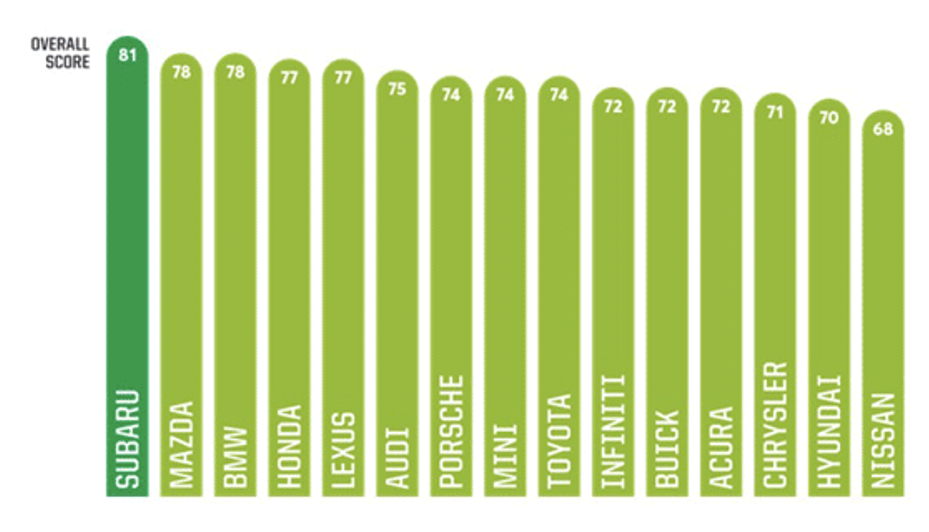
Subaru climbed two spots to number one in the 2022 Consumer Reports brand rankings. The Japanese automaker known for standard all-wheel drive dethroned Mazda with an overall score of 81. The 2022 Subaru Forester has ranked among Consumer Reports’ top picks for the 9th consecutive year. Fascinatingly, six of the top 10 brands in 2022 are Japanese automakers: Subaru, Mazda, Honda, Lexus, Toyota and Infiniti.
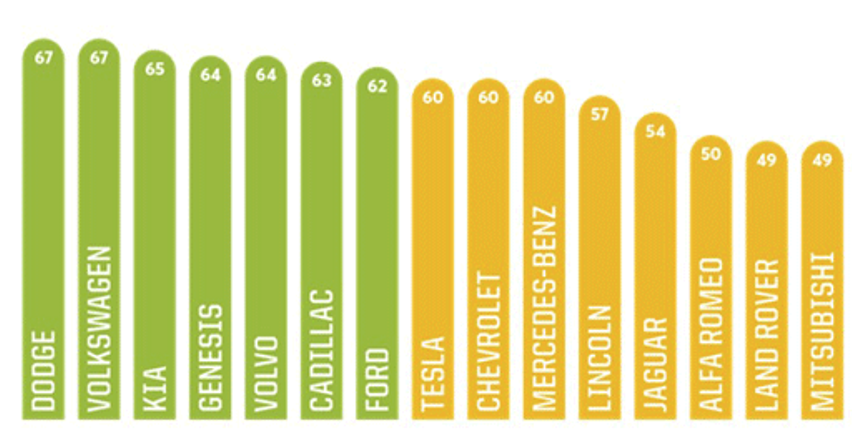
The highest ranking American automakers in 2022 are Buick (72), Chrysler (71), and Dodge (67). Cadillac and Ford just barely passed the test, scoring 63 and 62 overall. Chrysler and Dodge have been known for reliability issues in the past, so it’s great to see them improving. Likewise, BMW’s luxury vehicles have long been known for their maintenance expenses, so to achieve #3 overall is a notable feat.
As more automakers make advanced safety features standard on their models, the weight of Consumer Reports’ safety scoring is separating the winners from the losers.
With Subaru now number one overall, Mazda falls to second place, followed by BMW, Honda, Lexus, Audi, Porsche, Mini, Toyota, and Infiniti. Here are the overall brand scores from Consumer Reports.
Tesla fell seven spots to #23 in Consumer Reports’ overall brand rankings. In a press release, Consumer Reports cited the so-called ‘yoke’ steering wheel in the refreshed Tesla Model X and Model S as causes for concern and consumer dissatisfaction. Jake Fisher of Consumer Reports told Automotive News that Tesla’s tendency to push the limits is partly to blame. “It dropped more than any other automaker, kind of due to their own decisions,” he said.
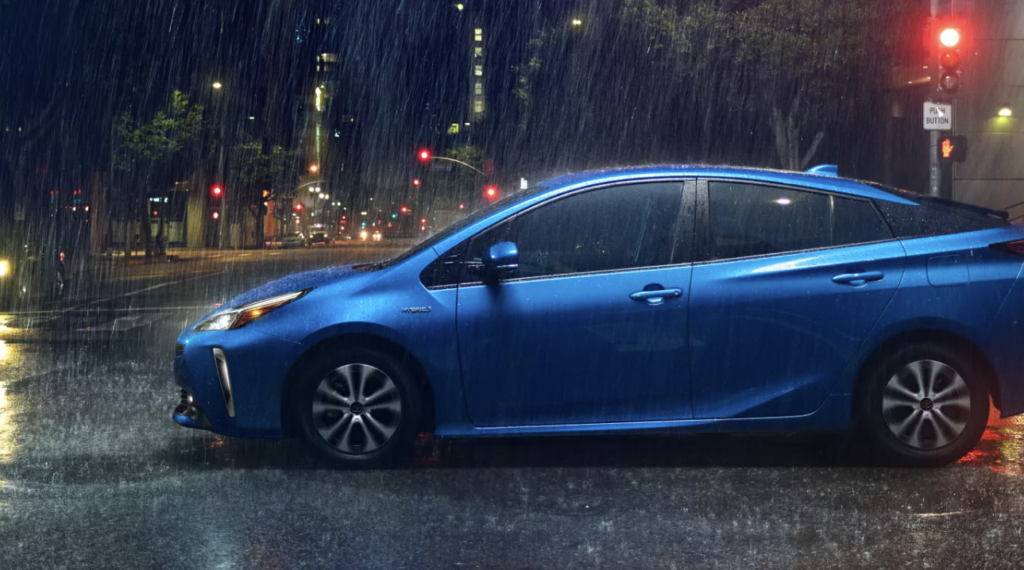
Everyone’s talking EVs, however Toyota’s hybrid powertrains remain the top-rated low-emissions choice at Consumer Reports. As part of their focus on low-emissions transportation, CR included the Green Choice designation for the second year. Toyota (9th overall) leads the Green Choice awards with 11 hybrid and plug-in hybrid models on the list.
What’s particularly interesting about this is the fact that Toyota has yet to release a single fully-electric vehicle. Their first, the 2023 Toyota bZ4X, is due to arrive later this year.
You can access the detailed 2022 Consumer Reports brand rankings with a membership to the non-profit.


Electric car maintenance is just one of many “new” experiences you’ll encounter when you buy your first EV. Instead of spending $50 at a gas station in a five-minute fill up, EV drivers plug in at home for an overnight charge. On the other hand, road trips require more planning and flexibility with an EV.
Another adjustment for drivers making the switch concerns maintenance and routine care. Electric car maintenance is not the kind of project you can do in your home garage using tutorial videos. It’s important to start by addressing a common EV ownership myth: electric cars are not maintenance-free. Of course, no mode of transportation is maintenance-free. Even riding a bicycle requires routine and unexpected work to keep the tires in motion and in good working condition. Fortunately, fewer moving parts should mean less maintenance overall. Is that always the case?
In this electric car maintenance guide, we’ll explain routine EV maintenance, and how often you should expect to make a service center visit.
The takeaway is that although electric cars require less maintenance, they do still need attention every once in a while. Just like a traditional internal combustion engine vehicle, EVs need:
Here’s the honest truth about EV maintenance needs:
The past decade of electric vehicle sales has shown that the vast majority of fully-electric models require less maintenance than combustion counterparts. So much so that automakers promote maintenance cost savings in their marketing campaigns for the dozens of EVs coming out in 2022.
EVs have a higher upfront cost, so it’s important to find ways of making up for the difference with fuel savings and today’s focus: electric car maintenance.
Here’s what you can expect when transitioning to a fully-electric vehicle.
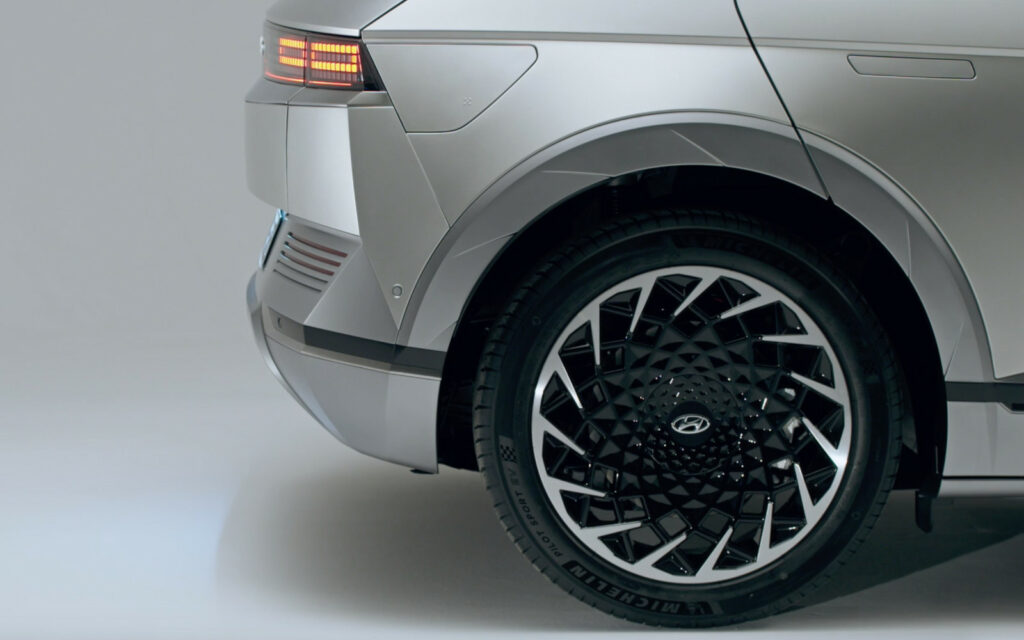
Electric vehicles are very heavy. Popular electric crossovers like the Volkswagen ID.4 and Tesla Model Y weigh as much as a heavy-duty pickup truck. Tires undergo greater wear and tear on an electric vehicle everytime the car accelerates or slows to a stop. Many EV owners report needing new tires every 20,000 miles or so.
Some EV owners choose to spend extra on tires that are rated as energy efficient. It’s not required, but EV-friendly tires can extend range by up to 5%. Regular tire pressure should be checked and adjusted often (at least once a month) to ensure proper inflation.
Believe it or not, today’s electric vehicles still require the same kind of 12 volt battery that you’ll find under the hood of most combustion vehicles. Why? The massive battery pack under the floor of the car is engineered to be optimized for delivering power to the electric motors. The electronics and comfort features in the cabin and lights around the vehicle are all powered by a separate, smaller 12 volt battery. So yes, your state-of-the-art electric vehicle may need a new bulky battery in a few years.
In case you’re wondering, the massive battery pack that is sealed under the floor of the vehicle is meant to last for hundreds of thousands of miles without issue. Automaker vehicle warranties cover the battery for up to 10 years and 100,000 miles.
Perhaps the worst thing that could go wrong with an electric vehicle is needing a new lithium-ion battery pack outside of warranty coverage. A full battery replacement costs anywhere from $5,000 to $15,000, depending on the model.
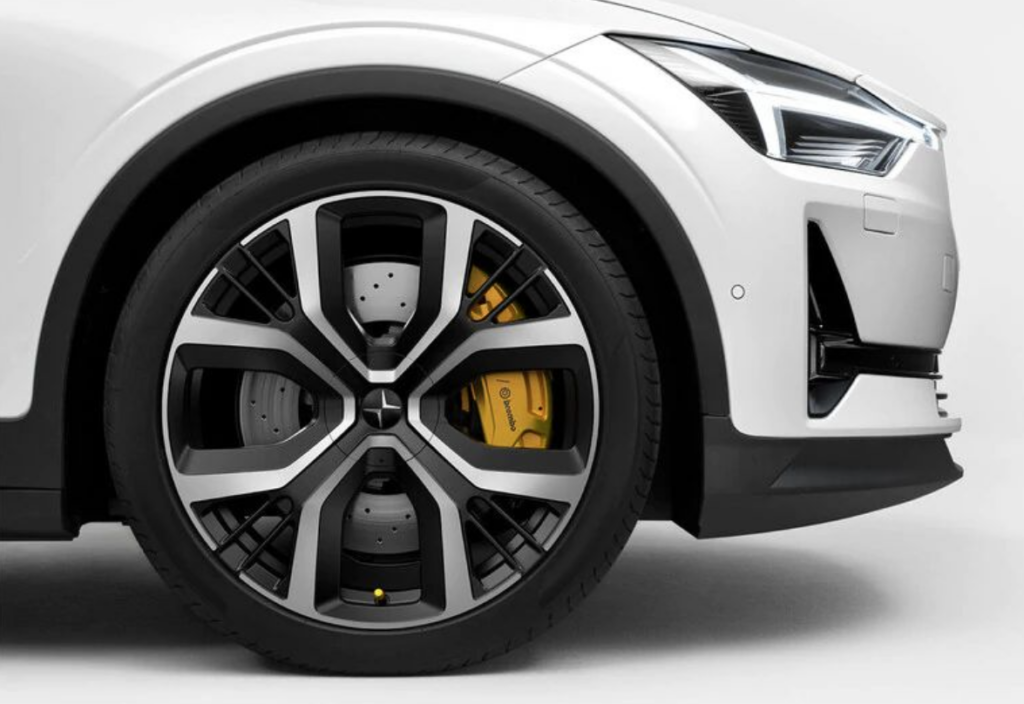
Most modern electric vehicles have regenerative braking, which harnesses the electric motor to slow the vehicle while adding charge to the battery pack. Regenerative braking not only extends range, it greatly reduces wear and tear on the brakes. Tesla’s have been known to go many years without any brake maintenance because of regenerative braking. A few EVs, such as the Volkswagen ID.4, even use old-fashioned drum brakes in the rear due to the greatly reduced use of electric vehicles brakes. Still, brakes will need to be checked during scheduled maintenance. Safety first!
As explained above, brakes on an electric vehicle typically avoid the usual wear and tear of combustion cars due to the help of regenerative braking. Still, brake fluid should be checked during scheduled maintenance. Some EV models require battery coolant fluid exchanges at some point, albeit quite infrequently. HVAC refrigerants also need checking and top-offs as needed. Don’t forget about the windshield wiper fluid.
I’ve been a passenger in more than one smelly Tesla. I repeat, electric cars are NOT maintenance-free! They have cabin filters just like every other car. Failing to change the cabin filter at regular intervals also irritates allergies and permits air pollution into the cabin. Smelly electric car? It’s likely a cabin filter in need of changing.
It’s easy to forget that electric vehicles have now been on roads for over a decade. With billions of miles driven, we’re finally starting to get some idea of the reliability of electric vehicles.
There are many examples of electric vehicles that have gone hundreds of thousands of miles while following maintenance schedules. EV skepticism is understandable; it’s a whole new vehicle ownership experience. However, frugal car buyers would be mistaken to overlook the maintenance and fuel savings that electric vehicles offer for most consumers.
In the end, owners spend about the same amount of money in five years of Tesla Model 3 ownership as they would owning a cheaper Toyota Camry for the same period. How so? Fuel and maintenance savings add up quicker the more you drive and the longer you own the car.
How will dealership service center revenue streams adapt to the decreased maintenance needs of electric vehicles? Will dealers be getting in on the software-by-subscription game? Or will dealers put up a fight to preserve their wallets?
There remain many unknowns and this time of rapid change in the automotive industry. Your consumer advocates here at CarEdge are helping thousands of car buyers navigate the auto market to save more, and stress. Learn how you can save thousands without lifting a finger with CarEdge’s AI Negotiator.

The ongoing chip shortage has tightened new vehicles supply to the extent that many dealers are adding enormous markups to their inventory. CarEdge previously reported that both General Motors and Ford have sent sternly-worded memos to their dealerships warning against the anti-consumer practices that automakers are hearing about from frustrated car buyers. Now, Hyundai and Genesis are getting serious about dealers tarnishing their brands with outrageous markups.
Automotive News reports that North American branches of Hyundai and Genesis are fed up with overly aggressive pricing strategies. The letter obtained by Automotive News warns U.S. dealers against damaging the brand’s reputation with markups that mislead buyers and balloon transaction prices.
While Hyundai Motor Group acknowledges that the MSRP is just that, the suggested retail price, they have tools they are not afraid to use if U.S. dealers don’t change their pricing practices. The letter reportedly floats reductions in future allocations, advertising benefits and the loss of other incentives as possible repercussions.
The letter to American Hyundai dealers specifically calls out the trickery of advertising one price online, and then surprising customers with a higher price once it’s time to start paperwork.
Sales executives from the North American divisions of Hyundai and Genesis noted that angry consumers brought this to their attention.
“We are writing now because with great regularity our customers around the country are voicing displeasure with certain pricing practices which, if left unchecked, will have a negative impact on the health of our brand,” the executives said in the letter.
Finding a new vehicle at MSRP is a challenge no matter what brand you’re in the market for, however Hyundai has seen some of the most outrageous dealership markups of all. One buyer in Massachusetts had worked out a deal over the phone for a new, all-electric Hyundai IONIQ 5. The salesperson he worked with committed to selling the EV at MSRP. The customer then drove three hours to the dealership, only to be met by a different sales manager who demanded a $5,000 markup for the same car.
Fortunately, this customer was able to find a better deal elsewhere, but many first-time Hyundai customers are not willing to give the brand second chances. Kia and Hyundai markups are among the largest in 2022, according to Edmunds. Hyundai transaction prices average $1,498 above sticker price; and for Genesis it was $1,603 higher. Hyundai markups are among the largest out there, and corporate leadership knows that is a bad look for the brand.
It’s refreshing to see an automaker playing the long game with customer relations. The letter warns dealers that once inventory stabilizes, customers will remember how they were treated.
“Once supply and demand come into greater equilibrium, customers will feel that they were overcharged for their vehicle and thus look to other brands the next time they are shopping. We believe that the risk of losing customers and potential future customers far overweighs any short-term gains to be had from what customers describe as unfair pricing.”
Hyundai and Genesis aren’t the first automakers to threaten their dealers with strongly worded memos. Earlier this year, GM and Ford dealers received letters from their leadership telling them to treat customers more fairly and equitably. The industry-wide push to electric vehicles brings higher production costs and lower margins, so higher prices may become the norm. Still, consumers expect a fair deal, and the automaker’s MSRP typically sets expectations.
Could these warnings be signs of dealer’s weakening grip on car sales in America? It’s a real possibility. You know which automaker actually increased sales in 2021? Tesla, the brand that dares to go without the dealership model. Rivian, Lucid and Fisker are promising to follow Tesla’s lead into the direct-to-consumer sales model.
If dealers won’t respect consumers or automaker guidance, automakers will be thinking a lot harder about alternative sales avenues that benefit consumers and their brands alike. When there’s an inefficiency as big as this, the free market tends to find a solution rather quickly. We’ll be following the developing situation closely.
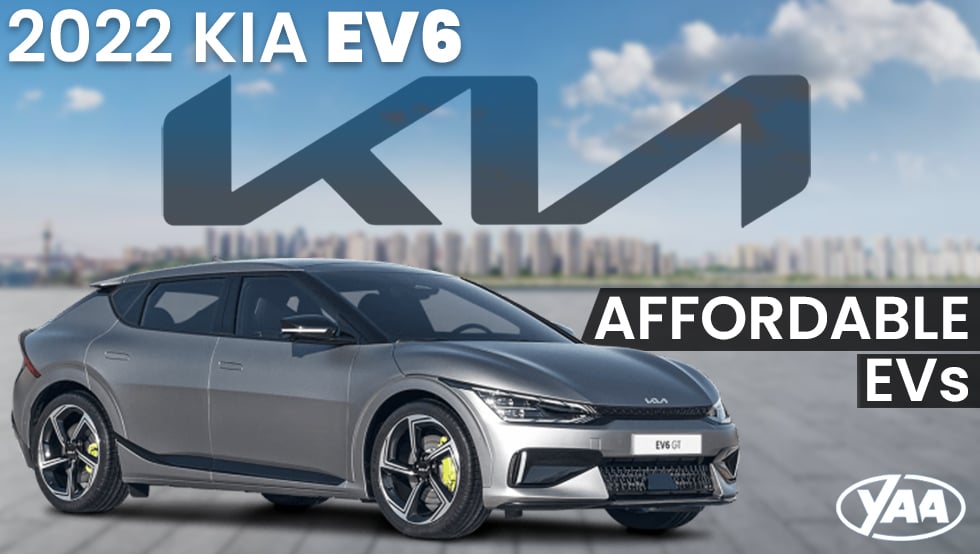
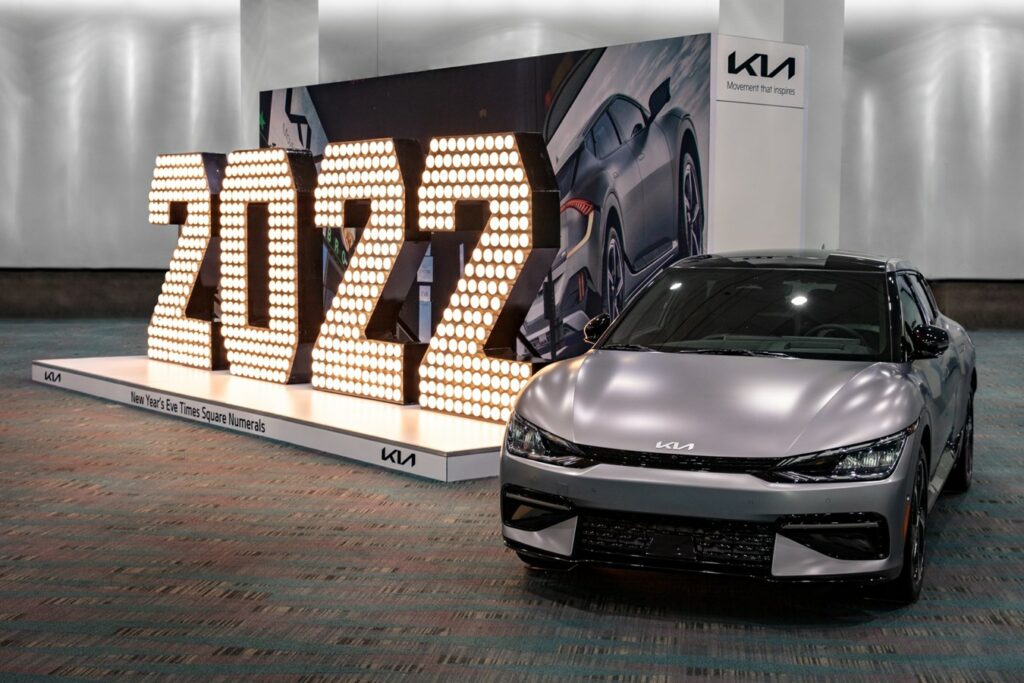
The average new vehicle sells for nearly $50,000, but not every vehicle costs the same to maintain and operate. Fuel economy, reliability, insurance, and maintenance needs are just some of the factors that determine the total cost of ownership for any vehicle. Automakers have made it clear that they’re bringing EVs to the masses, however cheap electric cars remain elusive.
Consumers in the market for an affordable vehicle in 2022 are presented with diverse options, including a larger selection of electric vehicles than ever before. EV‘s are no longer just for tech nerds. People who had never imagined themselves in an electric vehicle are making the switch simply for fuel savings.
However, it remains true that the majority of electric vehicles carry luxury price tags. It’s unlikely you’ll hear anyone say there are “cheap electric cars,” however there are affordable EVs. Here are five affordable electric vehicles that drivers love in 2022.
Starting at $40,760
240 – 260 miles of range
Learn more: CarEdge Review of the Volkswagen ID.4
Pro:
Cons:
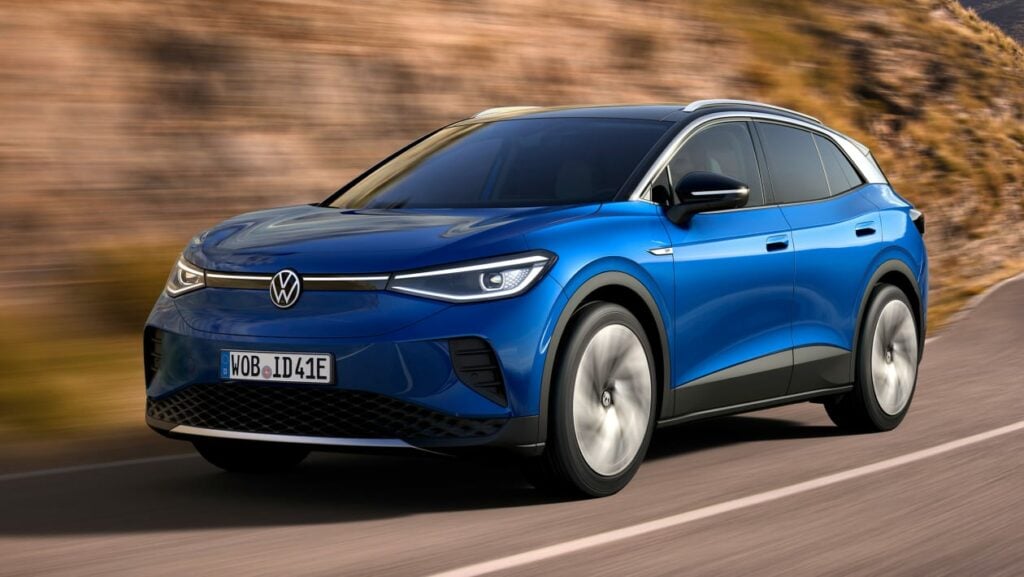
If you’re in the market for a great electric vehicle that will get you from A to B in comfort and confidence, the 2022 Volkswagen ID.4 should be on your short list. Capable performance, great safety ratings and a spacious cabin make the ID.4 a great place to be for the price point.
The 2022 ID.4 can go the distance, leaving range anxiety behind for the most part. Dozens of real-world range tests show that even on the highway at 70 mph, the ID.4 gets well over 200 miles on a charge. In city driving, closer to 300 miles is likely.
2022 updates are bringing bidirectional charging, plug-and-charge, increased range, quicker charging and major over-the-air updates to the ID.4. Even 2021 models will get new features via OTA updates this summer. Learn more about the game-changing capabilities of OTA updates here.
When it comes time to charge, you can either juice up at home overnight, or take advantage of 3 years of free Electrify America charging with unlimited miles. For frequent travelers, the Electrify America incentive can be worth a few thousand dollars. At a fast charger, charging to 80% takes about 30 minutes.
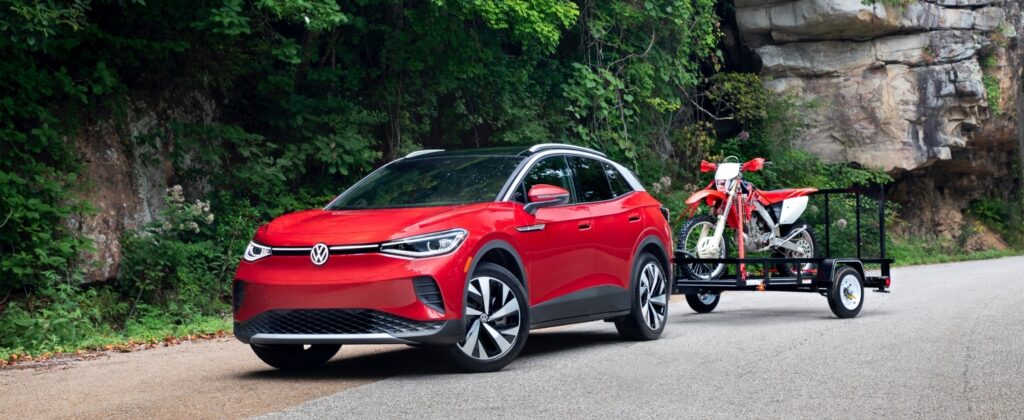
The all-wheel drive version of the ID.4 is where this crossover really shines. Adding another motor to the front axle increases horsepower to 295 with 339 lb-ft of torque and a very satisfying 0-60 time of just 5.4 seconds. However, it’s not quite a car you’d take to the track. The handling is well-tuned for attacking winding roads in inclement weather, although it maintains a more family-oriented demeanor.
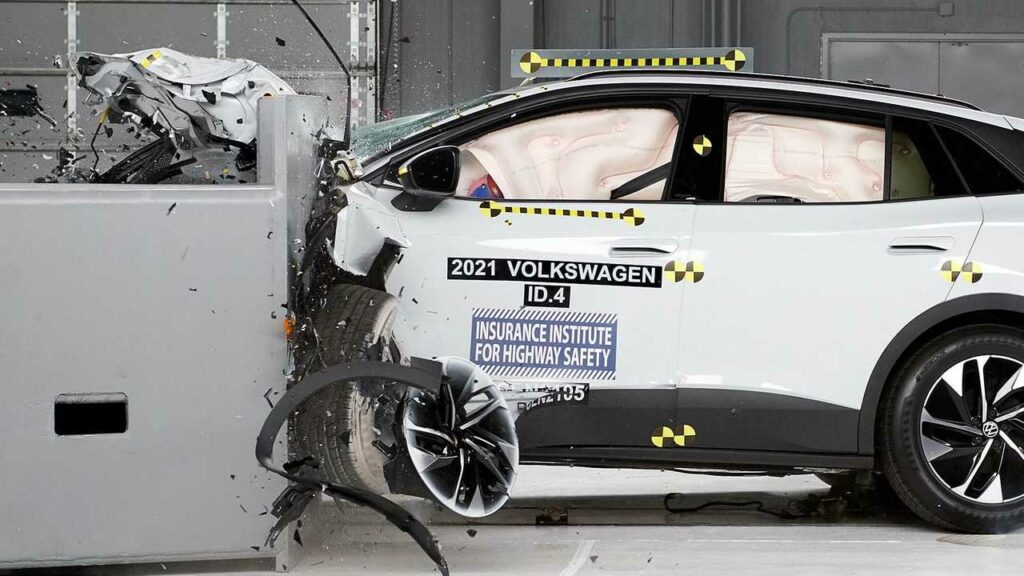
The 2021 ID.4 earned a Top Safety Pick+ rating from the Insurance Institute for Highway Safety, and a five-star rating from the National Highway Traffic Safety Administration’s rigorous crash testing. CarEdge recently detailed all electric vehicle safety ratings in 2022.
The Volkswagen ID.4 is about as good as it gets for its use case. For the frugal-minded, It’s a particularly compelling car in the base Pro trim with rear-wheel drive (MSRP $40,760). Volkswagen’s EVs still qualify for the $7,500 federal EV tax credit in the US, which can turn the entry-level ID.4 into a $34,000 purchase. That’s an amazing value in today’s market.
Starting at $40,900
232 – 310 miles of range
Learn more: CarEdge Review of the Kia EV6
Pro:
Cons:
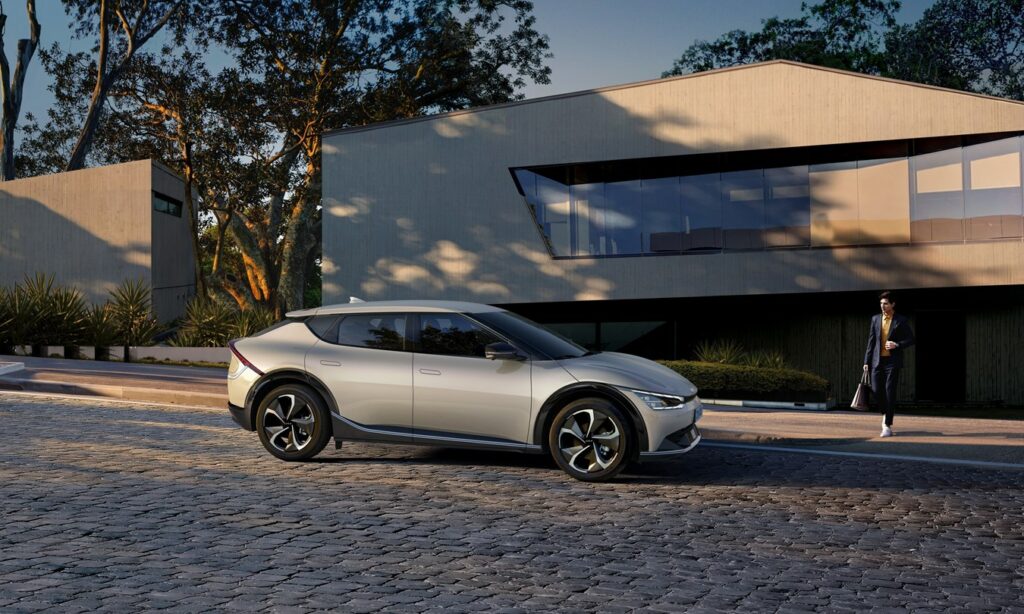
If you’re a techie who demands the latest and greatest that automakers have to offer, but don’t have the budget to buy an extravagant Lucid Air or Mercedes EQS, the Kia EV6 and its platform sibling the Hyundai IONIQ 5 just might be what you’re looking for.
Kia and Hyundai partnered up to engineer the new E-GMP battery and powertrain platform. The first two models to feature this advanced architecture are the Hyundai IONIQ 5 and the all-new Kia EV6. Both of these crossovers offer ultra-fast charging, impressive range, and over-the-air update capability for just over $40,000.
The 2022 Kia EV6 has a premium feel to it, and that’s something we’re still learning to expect from Kia. Aggressive looks on the outside are met with a welcoming, spacious interior. The cabin is open and airy.
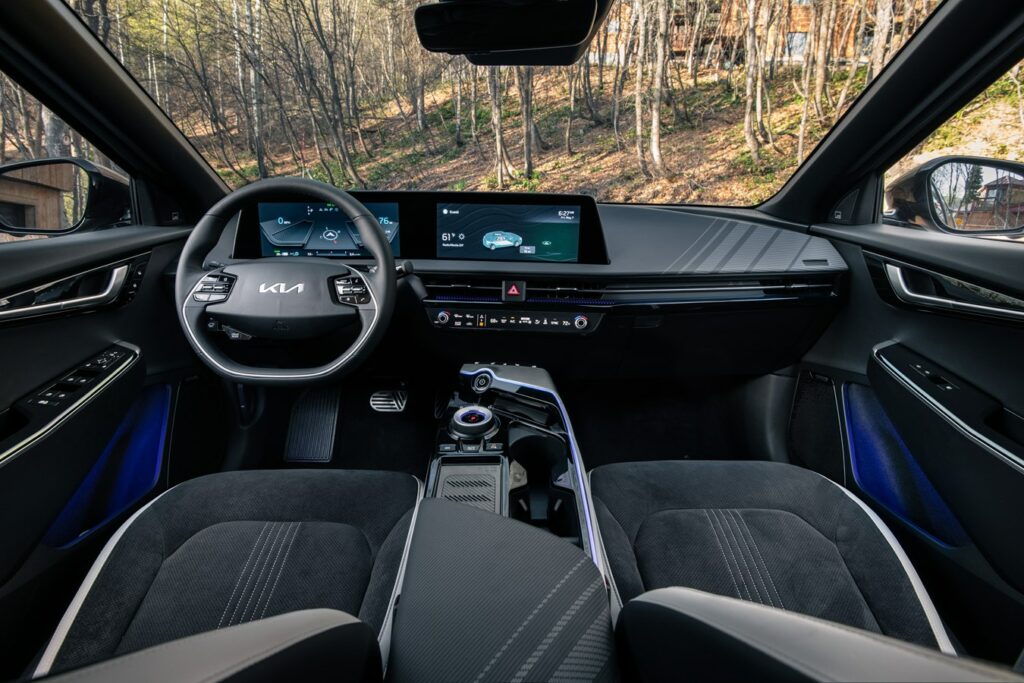
The EV6’s front dash consists of dual 12.3” screens, one for infotainment and another for the instrument cluster. Higher trims also include an augmented reality heads-up display that projects driving directions and basic info onto the windshield within the driver’s line of sight.
The Kia EV6 is no slouch; it can hustle with a heavy foot. All-wheel drive variants produce 313 hp and a 0-60 time of 5.1 seconds, but range drops to 274 miles on a charge. Longer range rear-wheel drive trims still reach 60 mph in just 7.3 seconds. For perspective, that’s about two seconds quicker than the popular Subaru Forester.
With a starting MSRP around $42,000 with destination, the 2022 EV6 represents incredible value for leading-edge tech. It even has faster charging and longer range than similarly priced Tesla models.
The greatest advantage the Kia EV6 has over any Tesla model is that the EV6 qualifies for the federal electric vehicle tax credit. Buyers can save up to $7,500 on their federal taxes if they purchase a Kia EV. Tesla and GM brands are no longer eligible since they’ve already sold greater than 200,000 electric cars.
If you’re a fan of the specs but not the aggressive looks, the Hyundai IONIQ 5 may be the perfect compromise.
Starting at $40,925
220 – 303 miles of range
Learn more: CarEdge Review of the Hyundai IONIQ 5
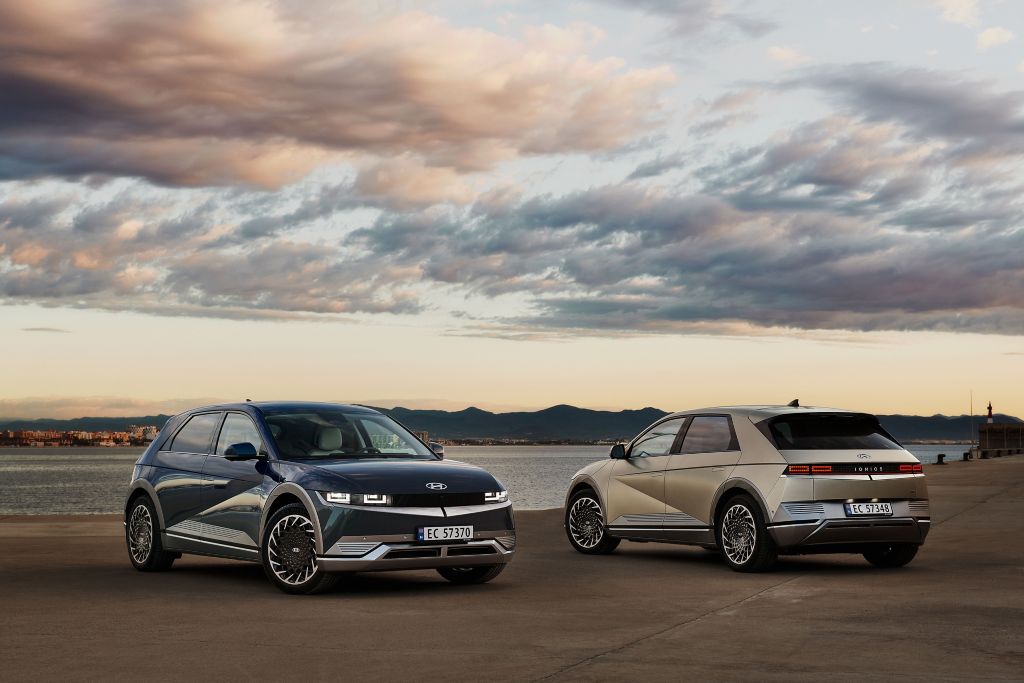
The IONIQ 5 made our CarEdge list of the 5 best cars to buy in 2022!
Pro:
Cons:
The all-new 2022 Hyundai IONIQ 5 is a uniquely retro electric crossover. You’re sure to get plenty of thumbs-ups at stoplights in this head-turner. It’s under $50,000, and surprisingly available at dealerships today. Hyundai says that the pixelated design draws inspiration from the first car they brought to America, the Hyundai Pony.
Also built on the new E-GMP platform, the Kia EV6’s sibling is as comfortable slamming into curves as it is cruising the interstate. The all-wheel drive variant is adequately powered with 320 horsepower and 446 lb-ft of torque. The AWD IONIQ 5 can get up and go with a 0-60 time of 5.2 seconds. That’s just a hair above the current electric crossover sales champion, the Tesla Model Y.
Range varies from 220 miles up to 303 miles depending on battery size and drivetrain. That’s slightly above average for a 2022 model. It’s important to note that some real-world highway range tests have struggled to get the IONIQ 5 past 200 miles on a charge.
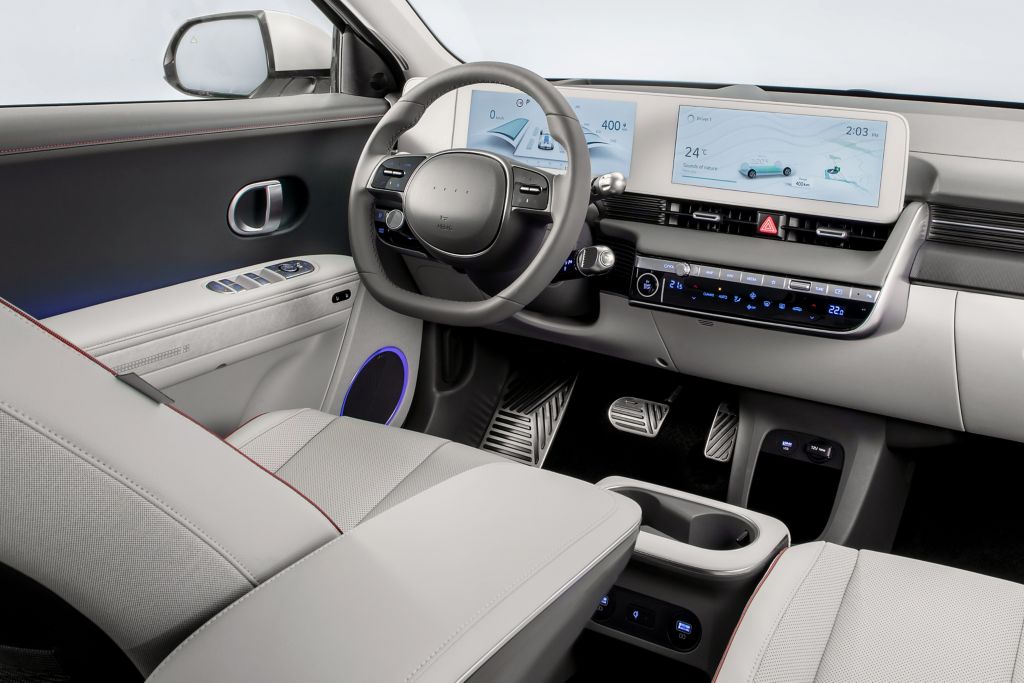
The IONIQ 5 does have one massive advantage over its competitors: charging speed. When you plug in at any Electrify America charging station, the IONIQ 5 can handle up to 230 kW charging speeds. Charging from 10% to 80% (adding 212 miles of range) takes just 18 minutes. The only other vehicle on the market capable of charging that fast is the $75,000+ Lucid Air luxury sedan. The IONIQ 5 has a major charging advantage over the ID.4 and Mustang Mach-E.
The IONIQ 5 is part crossover, part oversized hatchback. That’s not a bad thing. Somehow, Hyundai pulls off this delicate balance in all the right ways. The Ioniq 5’s interior volume (passenger and cargo combined) is 133.7 cubic feet, which is larger than the VW ID.4 and Ford Mustang Mach-E. The roominess has more in common with a Hyundai Santa Fe than a Kona.
Starting at just $40,925 for the 58 kWh smaller battery base model, the IONIQ 5 is available for thousands less than was expected. Most buyers will opt for the larger battery pack (77.4 kWh), which is comparable to other class competitors. With standard rear-wheel drive, the IONIQ 5 SE with the long range battery starts at $44,875. All-wheel drive is available for $3,500-3,900 more. The Limited trim starts at $51,825 and maxes out over $56,000 with all options included.
Starting at $44,990
272 miles of range
Learn more: CarEdge Review of the Tesla Model 3
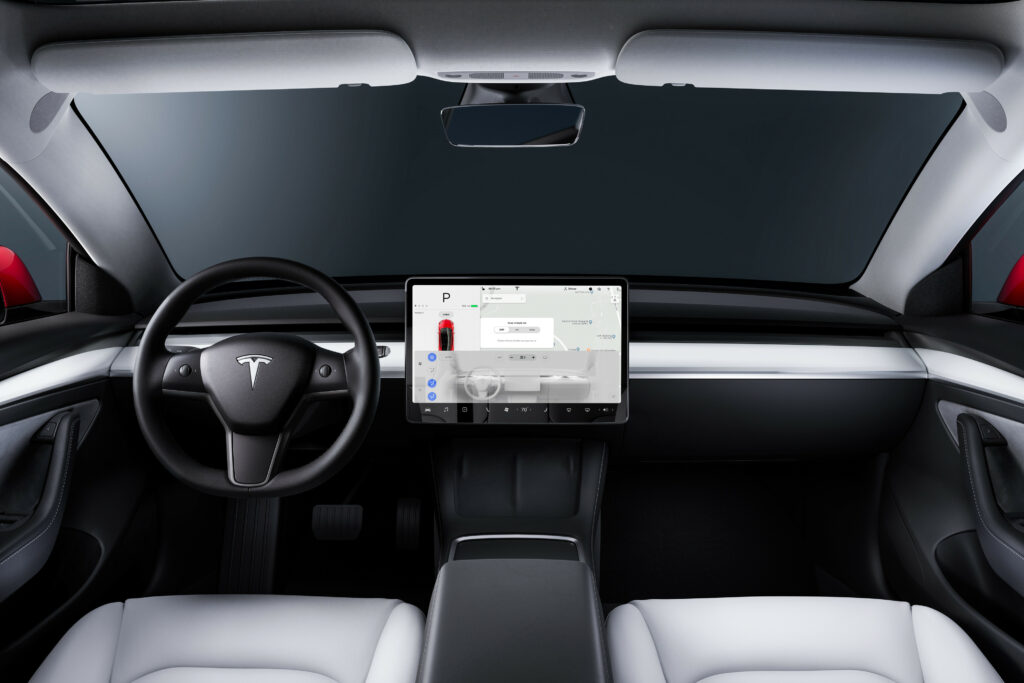
Pro:
Cons:
Say hello to the only Tesla available for less than $50,000. In reality, the 2022 Rear-Wheel Drive Model 3 is the same car as the ‘Standard Range Plus’ variant that the American automaker sold until 2021. Perhaps calling something ‘standard’ just wasn’t on-brand for the luxury automaker.
Don’t get your hopes up if you’re thinking you can get access to Tesla’s Full Self-Driving for under 50 grand. Tesla now charges $12,000 for FSD, which would bring the 2022 Rear-Wheel Drive Model 3 closer to $60,000 after taxes and fees.
Find out everything you need to know about self-driving cars in our CarEdge guide to autonomous vehicles.
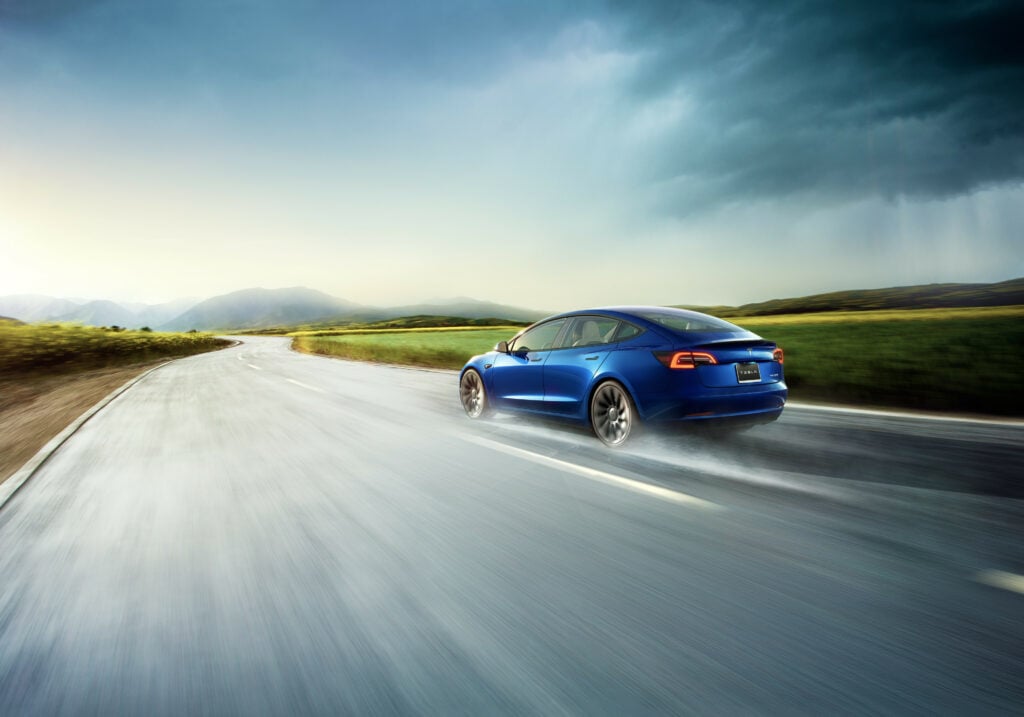
This base trim has received some 2022 upgrades, most notably an increase in range from 262 miles to 272 miles on a charge with the included 18” aero wheels. The 2022 Rear-Wheel Drive Model 3 features new lithium iron phosphate (LFP) batteries which will allow the car to repeatedly charge to 100% without risking as much harm to the life of the battery.
The Rear-Wheel Drive Model 3 is powered by a single electric motor that produces 296 hp and 277 pound-feet of torque. This sedan powers to 60 mph in just 5.8 seconds, not bad for a base trim.
At a Tesla Supercharger, its 60 kWh battery pack can accept up to 170 kW when nearly empty. In the real world, that means charging from 10-80% (adding 190 miles of range) takes about 26 minutes.
The 2022 Tesla Model 3 Rear-Wheel Drive now sells for a notoriously non-negotiable $44,990, plus the $1,200 destination and doc fee. So the cheapest Tesla is now $46,190. Just a year ago, it was $38,190.
Starting at $34,000
258 miles of range
Search hundreds of Hyundai Kona EVs for sale today at CarEdge Car Search!
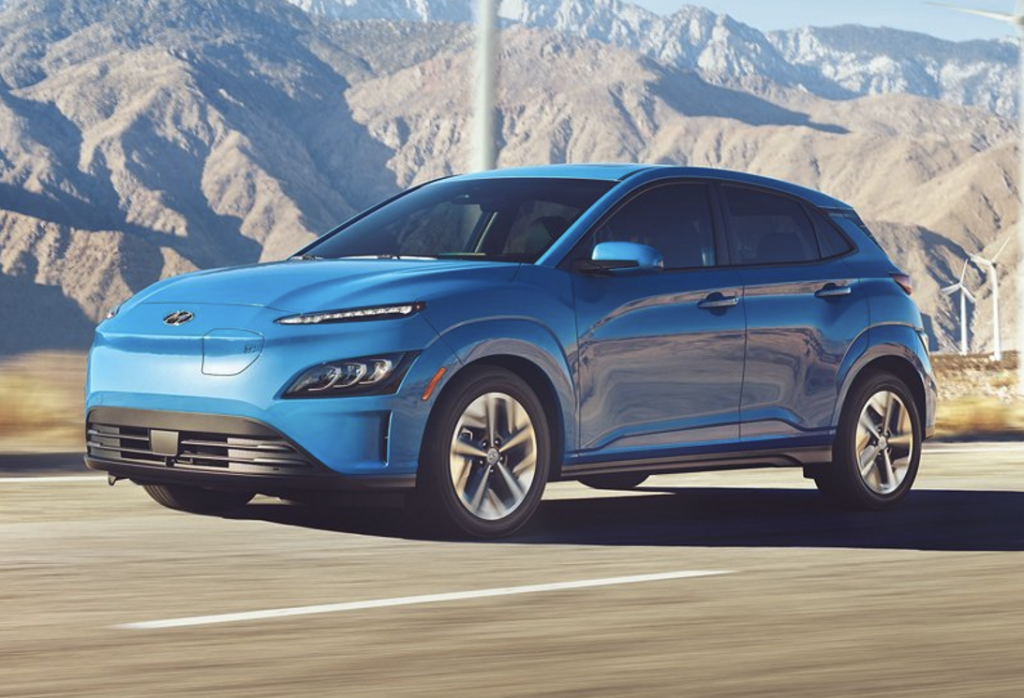
Pro:
Cons:
Hyundai’s forgotten electric vehicle should not be overlooked by those in search of a very affordable entry into electric mobility. The 2022 Hyundai Kona EV may not look all that attractive, but it has decent range and room to fit most lifestyles.
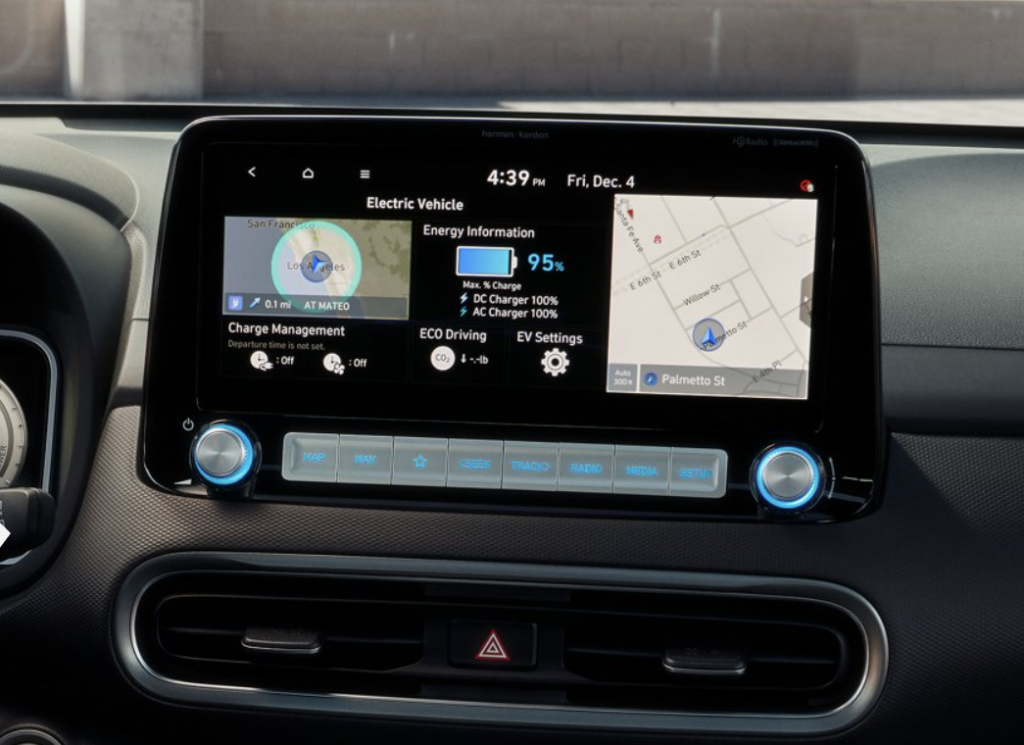
For just $34,000 before incentives, you can become the owner of the original Hyundai EV. This front-wheel drive subcompact crossover gets 258 miles on the charge, exceptional range for a budget EV. Some owners get over 275 miles on a single charge. The Limited trim, top-of-the-line option comes in at $42,500.
If you plug in at home, charging to 100% from a 240-volt dryer outlet will only take you about 9 hours from 10% state of charge. That will get you a full battery overnight while you’re sleeping. At a DC fast charger, the Kona is behind the competition. In 47 minutes, the Kona Electric charges from 10% to 80% capacity.
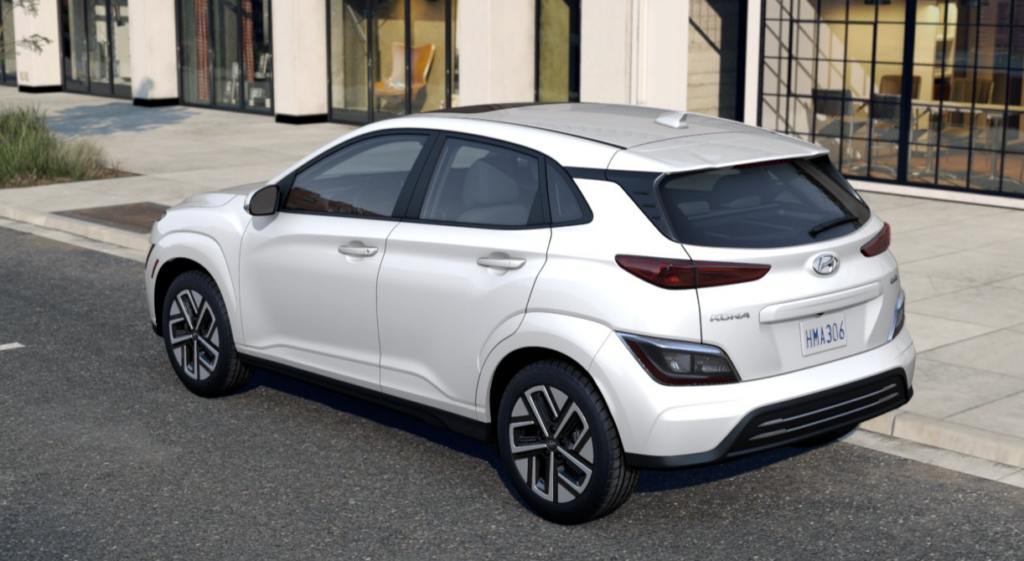
If you’re more of a Kia lover, we have great news. The Kia e-Niro is basically the Kona Electric with a Kia face.
Due to the Kona Electric’s charging faults, this would not be a great road-tripping vehicle. But if you’re looking for cheap electric cars perfect for zipping around town, this is a great deal not to be overlooked.
Available in 2023, but you can reserve one now.
Learn More: CarEdge review of the Fisker Ocean
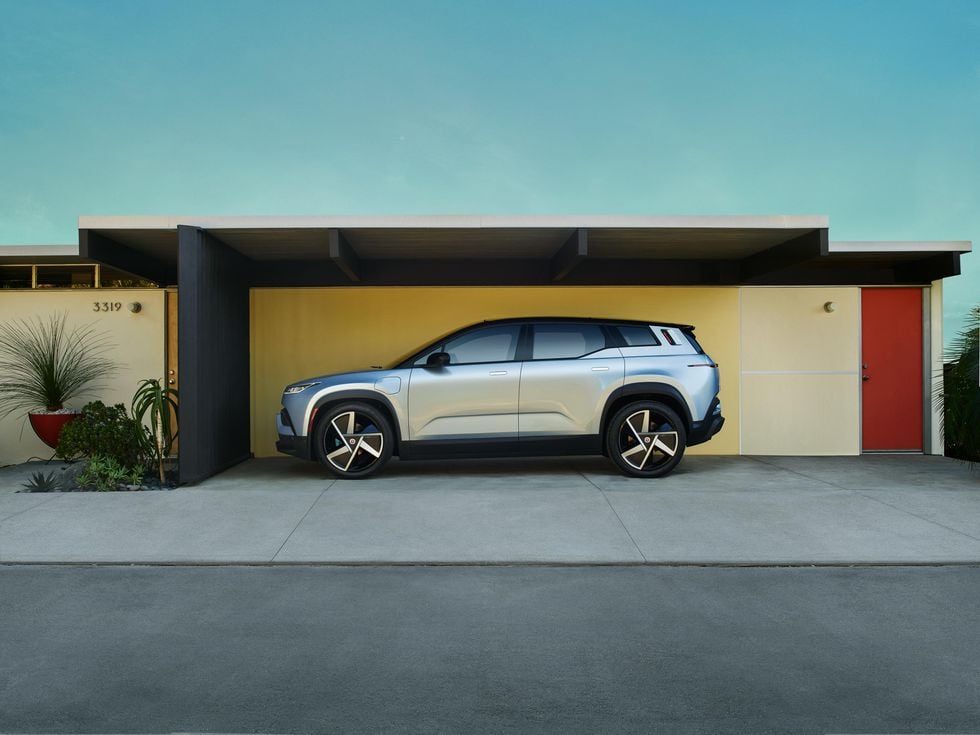
The Fisker Ocean sure does promise a lot. Will it deliver? At just $37,000, Fisker’s all-electric brand quotes 250 miles of range for the entry-level Fisker Ocean crossover. The 2023 Fisker Ocean didn’t make our official list for a few reasons. It hasn’t been produced yet, and delays have pushed the start of production back to November 2022. Fisker says they have 32,000 reservations in the books, so if you’re looking to buy one, it may not be possible until mid-2023. Furthermore, the more capable and sporty Fisker Ocean trims start at $50,000.
You may be wondering where the Chevrolet Bolt and Nissan Leaf are on this list of cheap electric cars. The Leaf is one of the originators of the EV segment, having started it all back in 2011. However, Nissan has regrettably not invested in range or battery performance upgrades over the years. It’s failing to keep up with the growing competition.
The 2022 Nissan Leaf S gets just 149 miles of range and charges quite slowly at between 50 and 100 kilowatts at a fast charger. It is the MOST affordable electric vehicle, with prices ranging from $27,400 to $37,400, however we can’t recommend an EV that leaves the lot at a disadvantage. As electric vehicles come to market with 250 to 400 mile ranges, how will the Leaf retain any resale value?
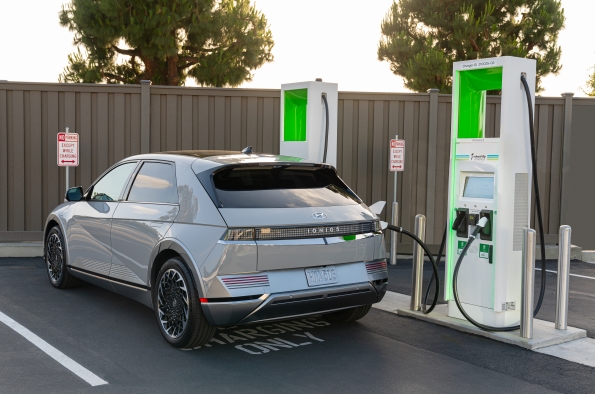
And then there’s the Chevrolet Bolt. It’s affordable and even looks okay with the recent facelift. While it’s true that the recall fix is giving Bolts brand-new, modernized battery packs, the reliability of the Bolt has taken such a hit that it’s too great of a financial risk for today’s consumers to get behind the wheel worry-free. You don’t want your $31,000 purchase to be a symbol of unprecedented fire risk. What would it take to change my mind? At this point, a few years of problem-free driving. Until then stay away from the Chevrolet Bolt. As you can see, there are plenty of other affordable electric vehicles out there in 2022.
Follow the money. Automakers are going all-in on electric vehicles in 2022 and beyond. The consumer benefits as competition rises, so perhaps affordable EVs are here to stay. If you’re looking to go electric in 2022, you don’t have to buy a Tesla, Nissan Leaf or Chevy Bolt. Every automaker is racing to become the next big thing in the world of EVs.
Some parting advice: consider all options, and test drive as many electric vehicles as you can. You’ll be amazed at what’s out there, and even more amazed at what’s to come.