
CarEdge saved me over 4,500 dollars on a brand new Honda Pilot. I can't say thank you enough.
Price intelligence
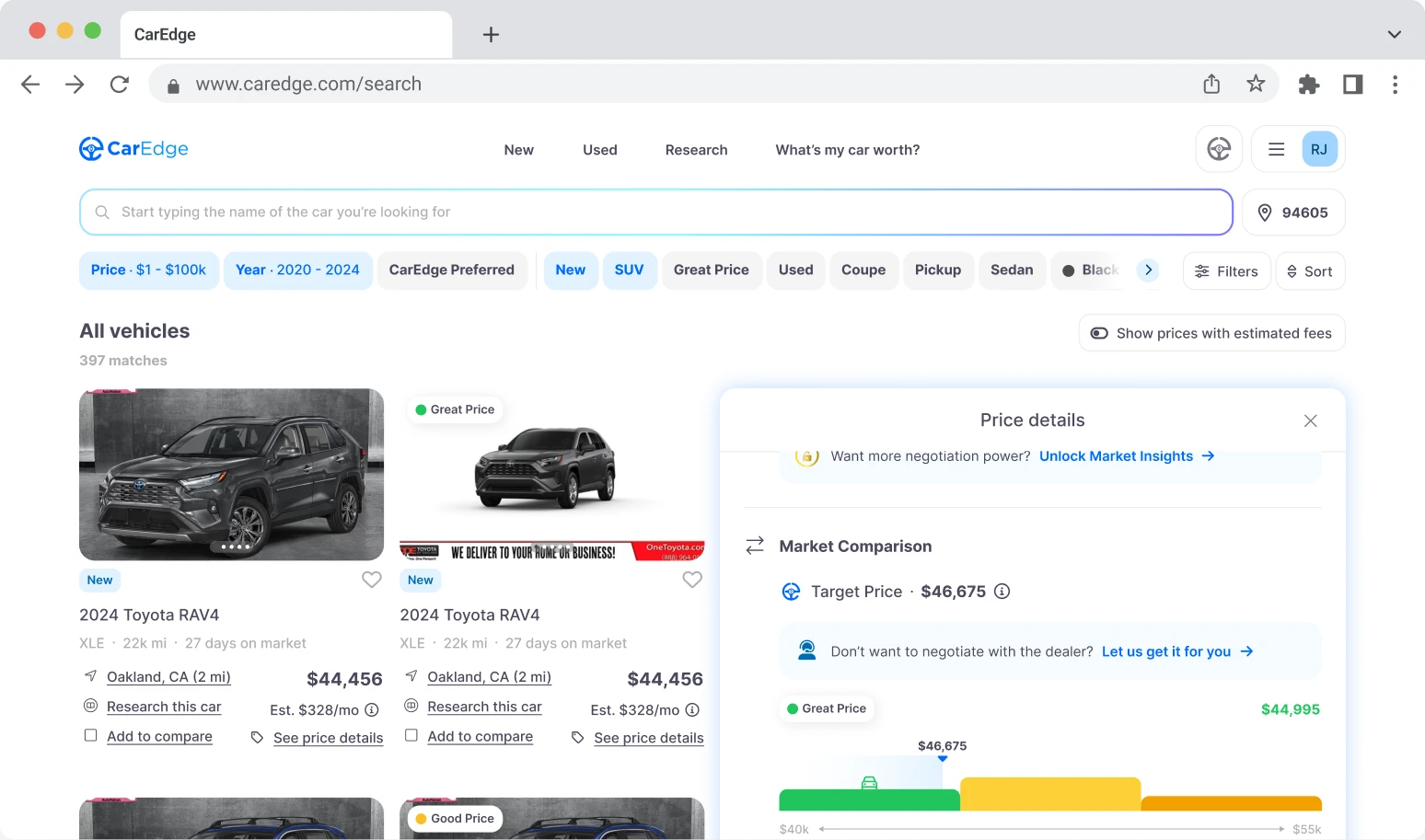
Find a wide range of vehicle listings with market insights on new and used listings near you.

What can I do with CarEdge?
 CarEdge Insights
What can I do with CarEdge?
Get access to exclusive information so you can make an informed car buying decision — all in one place.

Find a wide range of vehicle listings with market insights on new and used listings near you.
Track your vehicle’s value and cash in when the time is right to sell.

Access to our proprietary data to help you find the right car, at the right price. Find these unlocked on every listing after subscribing.

With our expert-led, tech-enabled car buying service, we will locate, negotiate, and deliver your vehicle so you can get a new car hassle free.


Help us personalize your CarEdge experience — it only takes a second.
Your answers help us personalize your CarEdge journey — we’ll follow up with tips and next steps that match your buying timeline.

Carvana (allegedly) sold someone a stolen truck. Yes, you read that correctly. A viral video on TikTok from a woman named Erin Stitt depicts the saga her and her boyfriend went through buying a 2018 Chevy Silverado Midnight Edition from Carvana, only to be stopped by six police cars and have the truck they just bought towed away.
Here’s what we know, and what you need to be aware of before you buy a car from Carvana, Vrooom, or any car dealer.
Let’s dive in.
Erin’s story is an unfortunate case of VIN cloning. This is where thieves steal a car (or in this case a truck) and cover up the vehicle’s VIN plates with a different VIN number. Criminals do this to obfuscate the true identity of the vehicle.
The procedure involves replacing the serial plate of a stolen or salvage repaired vehicle with a plate containing the number of a validly registered vehicle of similar make, model and year from another state, province or country.
VIN cloning is more rampant than you would have thought. For example, there was one case from Tampa, Florida, where the FBI found more than 1,000 cloned cars were sold across 20 different states. The most unfortunate aspect of this is that the purchaser is still be responsible for any outstanding loans, even though they didn’t realize they purchased a “cloned” car.
Erin posed this question in her TikTok video, “How did a stolen truck pass state inspection?” That’s a great question, however it’s not too difficult to understand once you dig into the state inspection requirements for many of the 50 states. Most don’t require a VIN inspection, and heck, even if they do, there’s a good chance the inspector will not notice the fake VIN plates.
More on state inspection requirements can be found here: https://insurify.com/blog/car-insurance/state-vehicle-inspection/
What steps can you take as a car buyer to avoid being in Erin’s situation? There are a few things you can do:
VIN cloning is common (sadly), and another form of deception that criminals use from time to time is called title washing. We have an entire article on title washing that I encourage you to read here: https://caredge.com/guides/title-washing/
Used and new car prices are climbing through the roof, and the rapidly increasing “destination charge” could be the culprit. The increase in destination charges, also known as “shipping” or “freight” charges has increased so rapidly that three class action lawsuits are currently being litigated.
Here’s how much major automakers have increased their destination charges since 2017.
| 2021 Model year avg. | Change from 2017 model year | |
| BMW | $973 | –17% |
| Ford | $1,393 | 29% |
| GM | $1,242 | 21% |
| Honda | $1,204 | 23% |
| Hyundai/Kia | $1,104 | 23% |
| Mercedes-Benz | $1,097 | 18% |
| Nissan | $1,236 | 24% |
| Porsche | $1,350 | 29% |
| Stellantis | $1,573 | 16% |
| Subaru | $996 | 18% |
| Tata | $1,195 | 20% |
| Tesla | $1,200 | 5.9% |
| Toyota | $1,127 | 15% |
| Volkswagen | $1,207 | –0.3% |
| Industry average | $1,220 | 12% |
The destination charge, also sometimes portrayed online as a shipping fee, are hidden from online advertised prices, however every buyer pays for them. Heck, even the dealership where you buy the car pays a destination fee, they simply pass that along to the end buyer.
The destination charge is a line item on the manufacturer’s invoice for a vehicle. It is a fee that the automaker sets. There is a retail price for it, and a wholesale price for it. The dealer pays a wholesale price, the consumer pays a retail price. In many cases the price is actually the same.
Destination charges are set by the manufacturer and are non-negotiable, since they are part of the vehicle’s MSRP. The manufacturer’s suggested retail price is non-negotiable (it is set by the manufacturer), however you can (and should!) negotiate your total out-the-door price (which includes a hopefully discounted selling price).
It is well known in the automotive industry that manufactures make a profit on their destination charges. Currently there are 3 active class action lawsuits against GM, Ford, and Stellantis for “deceptive” delivery fees.
From the GM lawsuit:
The lawsuit, filed in the Southern District of California, involves two plaintiffs who allege they were not aware that GM made a profit off of the destination fees it charges customers. According to Car Complaints, the plaintiffs are California resident Robert Romoff, who recently purchased a new 2021 Chevrolet Equinox with a $1,195 destination charge, and New Jersey resident Joe Siciliano, who purchased a new 2019 Cadillac Escalade with a $995 destination charge.
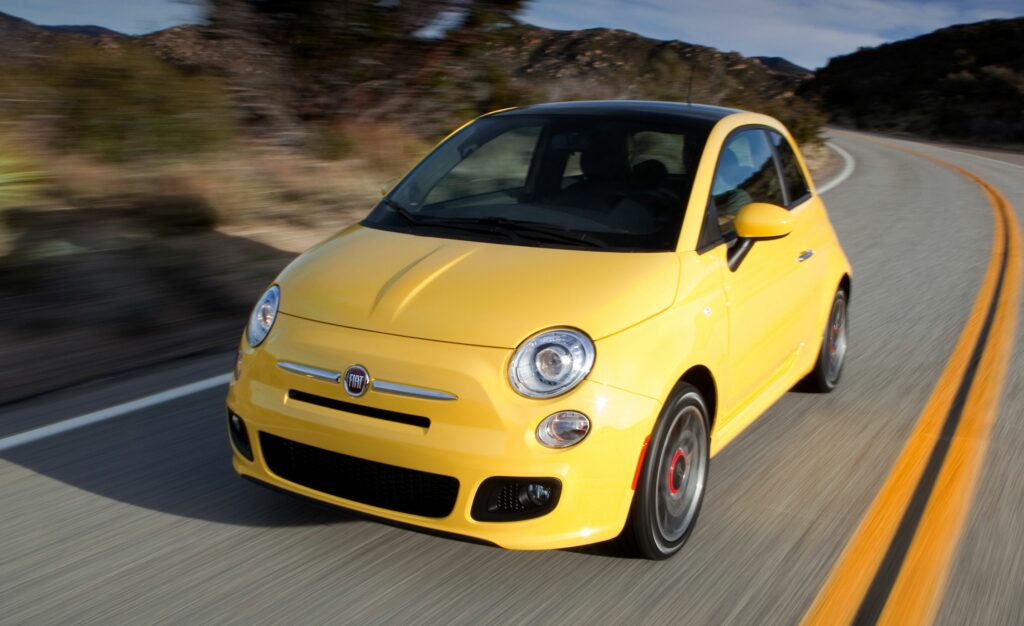
Stellantis, formerly Fiat Chrysler has increased their destination charges the most. Consumer Reports found Stellantis’ destination charges increased an average of 90 percent for Chrysler, Dodge and Jeep from 2011 to 2020, and 74 percent for Ram over the same period. And, even though no one buys them, Stellantis increased Fiat’s destination charge by 114 percent since 2012.
Surprising to many is the fact that domestically produced vehicles are also getting hit with VERY high destination charges. Take for example the new Jeep Grand Wagoneer which is built in Michigan. It comes with a $2,000+ destination charge.
What’s frustrating about the increase in destination fees is that it is yet another “black box” in the car buying process. Not only do we (consumers) have to deal with BS and bogus fees from the dealership, we also have to simply “accept” theses hidden profit fees from the manufacturers.

Updated April 2022
Automakers are in a pickle: delay production of cars because of a lack of chips, or produce cars, trucks, and SUVs missing some features customers have come to expect? It’s fascinating to see how different automakers are handling this once in a lifetime supply chain conundrum!
Ford, for example, just announced that they will ship and sell vehicles without chips controlling non-safety critical features. Yes, you read that right. It’s 2022, and Ford is getting even more desperate for semiconductors. It’s doubtful that there are any optimists left with regards to the auto industry supply shortage.
Ford isn’t the only manufacturer that is struggling to produce vehicles with all of their standard equipment. Let’s break down who is doing what, and which features consumers should and shouldn’t expect in their new car.
In March 2022, Ford told dealers that the chip shortage is getting worse, and that they’re going to need dealer’s help to sort things out. Automotive News reports that Ford executives told dealers that the automaker will have to enact a worst-case scenario plan that was floated last summer. Ford’s plan is to ship new vehicles to dealers without many of the semiconductor chips that are essential for features like auto stop-start, heated seats, and certain infotainment functions.
Ford spokesman Said Deep told Automotive News Ford would build Explorers without rear seat heat controls that could be added later. Ford already offers customers the option to order F-150s without the auto stop-start feature. Deep told Automotive News that in the case of the Explorers, buyers will receive a price reduction for the change, and Ford will restore rear seat passenger control of heating and air conditioning for free at a later date.
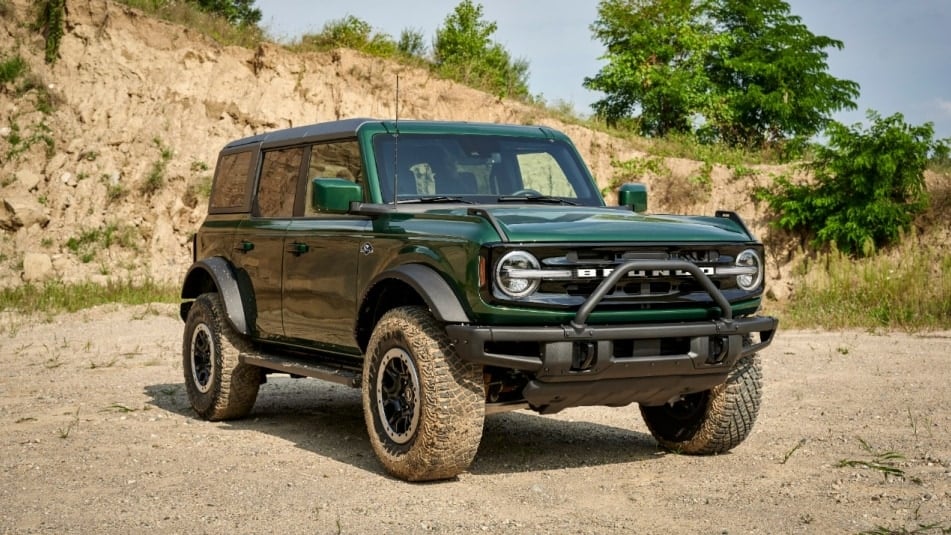
On the hunt for the elusive Ford Bronco? Thousands were recently seen waiting for parts outside of a production plant in Michigan. Patience and compromise will go a long way for car shoppers in 2022.
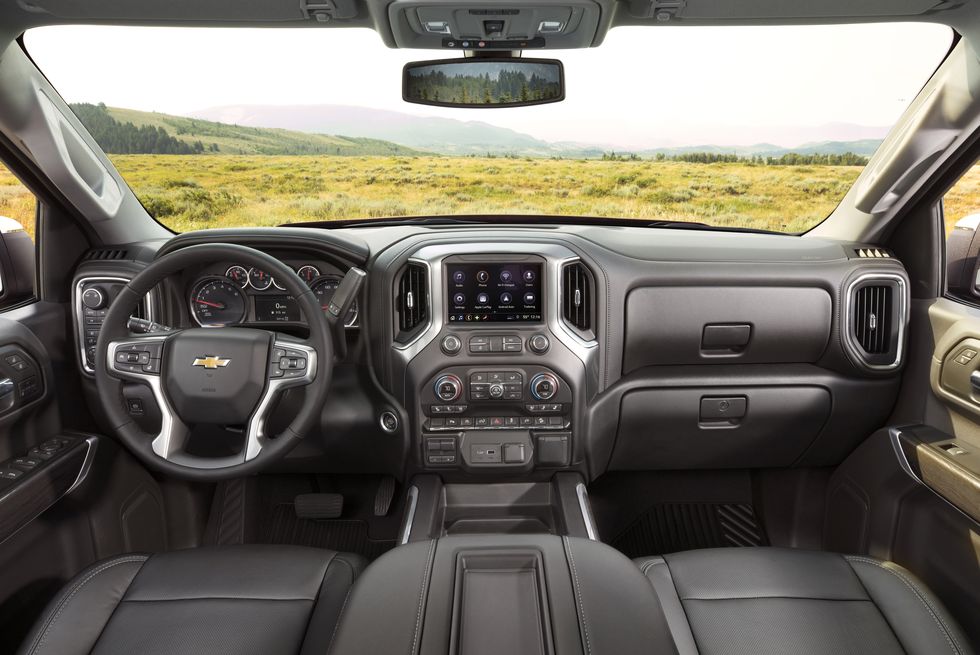
General Motors has seemingly been hit the hardest by the ongoing chip shortage. While the company tries to move forward, many core features and functionalities have been removed from their lineup.
General Motors made headlines late on Friday, November 12th when they announced that beginning on Monday, November 15th they would stop production of most of their vehicles with heated and ventilated seats, as well as heated steering wheels.
The effected vehicles include:
General Motors has not signaled when the vehicles would be produced with their previously expected equipment. GM has said that effected customers will be eligible for a $150 to $500 credit.
Earlier this year, GM removed climate control digital temperature displays, side blind zone alert and Super Cruise driver-assist technology on certain 2022 vehicles. Fortunately, now those features are available.
Update 11/22/21
On Friday November 19th, in a memo to their dealers, GM announced that they will reduce the credit given to customers who do not receive vehicles with heated seats. Instead of a credit up to $500, GM will credit customers up to $50. Correct, $50 for losing heated seats in their car. That’s crazy.
GM also instructed dealers that they think they will be able to retrofit vehicles with heated and ventilated seats by mid-2022. GM told dealers that heated steering wheels cannot be retrofitted, so vehicles missing that feature will still be discounted by $150.
Earlier in 2021, GM said it would eliminate the HD radio option because of a lack of semiconductors. Both 2021 Chevrolet Silverado 1500s and GMC Sierra 1500s, as well as 2022 model year 2500 and 3500 heavy-duty pickups were impacted. All trim levels were affected, and GM is offering buyers of a $50 credit.
Also earlier this year, GM announced that wireless charging pads would not make it into many of its vehicles. The 2021 Chevy Tahoe, Suburban, and GMC Yukon SUVs as well as the 2022 Buick Enclave, Chevy Traverse, and Cadillac XT5 and XT6 were all impacted by this decision.
Vehicles for sale without the charging pad will get a $75 credit.
Two core features that help make GM trucks more fuel efficient have gone missing: auto stop-start, and cylinder deactivation. In June, GM said the 2021 Silverado 1500 and the GMC Sierra 1500 would not come with stop-start technology. Customers who miss out on this feature are entitled to another $50 credit.
Even earlier this year, GM announced that some 2021 Chevy Silverado and GMC Sierra models would use more gas because they would not have their cylinder-deactivation systems. The impact? The trucks would increase their fuel usage by one mile per gallon.
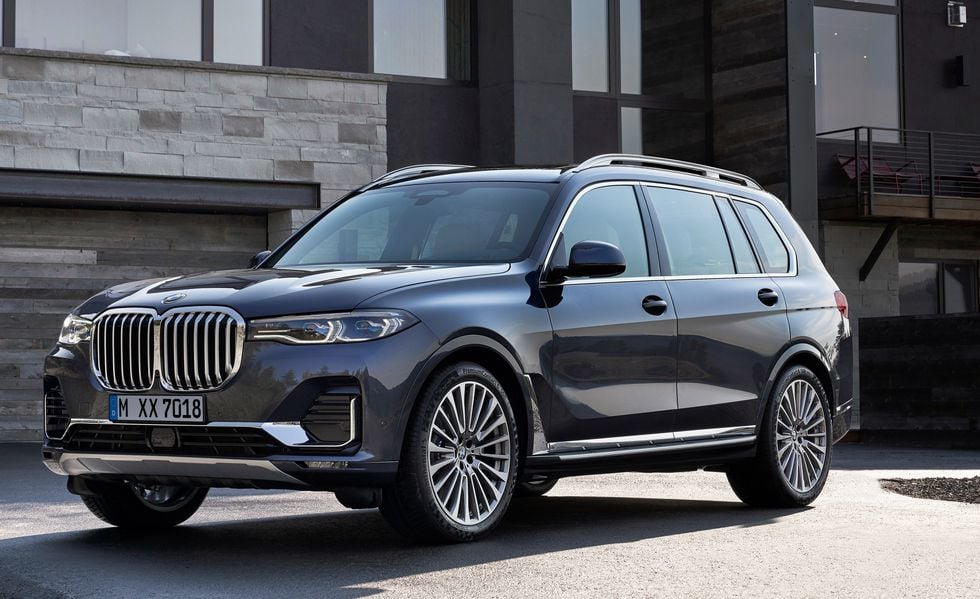
A brand new BMW X7 SUV has an MSRP of upwards of $100,000. At that price, you’d expect to get any feature or option you could possibly imagine. Buy a new car in 2021 and you’ll notice a piece of equipment nearly as ubiquitous as the seatbelt, however in your new $100,000 X7 you won’t have it; a touchscreen.
The effected vehicles include:
BMWs that were also ordered with the Parking Assistant package will now lose BMW’s Backup Assistant technology.
Earlier this Spring, Porsche told its U.S. dealers that their 18-way adjustable seat option (part of a $2,090 upgrade) would not be available. It appears that today the option is back for the Macan.
Another feature temporarily missing from some new Porsches is the electric steering column adjustment. Earlier this month, Porsche spokesperson Christian Weiss said that Porsche has been in communication with customers who have ordered cars with this feature, and said it will deliver vehicles with a manual steering column adjustment for the time being. Once available, the electric version will be retrofitted.
Even thought hey have raised their MSRP by 20%+ in 2021, Tesla has not been immune from chip shortage challenges. Earlier this year in May, Tesla removed lumbar support from the front passenger seat in the Model 3 and Model Y EVs.
Recently, another feature was silently deleted, USB-C ports in the rear of the center console of the Model 3 and Model Y.
Used car prices have ben skyrocketing for the past year. With new car production unable to keep up with demand, we have seen wholesale and retail used car prices set all-time highs. Frequently we are seeing used cars sell for more than their original MSRP.
Interestingly, with new vehicles being sold without all of their standard features, we wouldn’t be surprised if there is even more upward pressure on newer model year used vehicles. Would a consumer pay a premium for a used 2020 or 2021 that has all of the functionality they’ve come to expect, or wait for a factory order that may or may not have the features they expect? We think consumer demand for new user vehicles will continue to drive used car prices up.
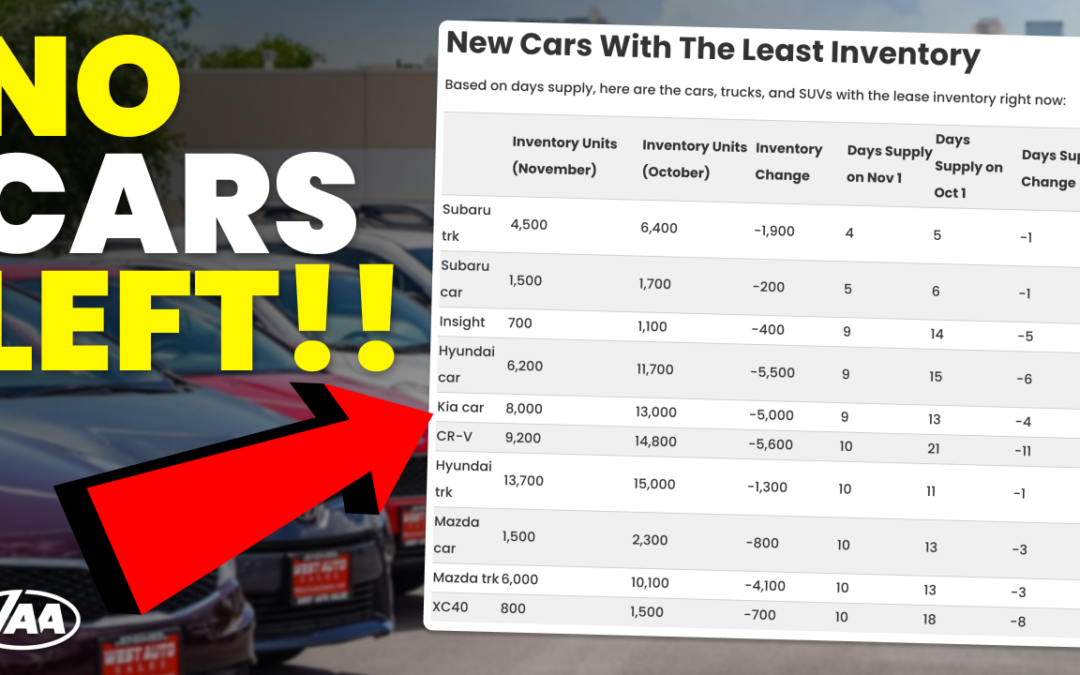
If you’re looking to buy a new car anytime soon, you’re in for a rude awakening … Finding a new car for sale right now in the United States is borderline impossible. Typically, manufacturers stock their dealers with a nearly 100 day supply of inventory. Right now, the industry is running at an 18 days supply. That being said, the total number of new cars in inventory ticked up 1.3% this month as compared to last.
To view last month’s new car inventory data, click here.
Each month we capture new data on industry-wide new car inventory levels. We have compiled the most up-to-date information here for you. Click below to jump to a particular manufacturer. Please note that we are not able to get vehicle specific inventory data for many of the manufacturers. This is something we hope to be able to provide in the near future.
You can access all of the data here: https://docs.google.com/spreadsheets/d/1sDB4ybm8F6VQotMS-HyjWv9n5IdQjTF6mbw8RwbbYXo/edit?usp=sharing
Days supply: Number of days needed to sell all vehicles in inventory, based on the previous month’s daily selling rate
Inventory: Unit count of vehicles on hand at dealerships, factory lots, ports of entry and in transit on a specific date
Based on days supply, here are the top ten vehicles with the most inventory:
| Inventory Units (November) | Inventory Units (October) | Inventory Change | Days Supply on Nov 1 | Days Supply on Oct 1 | Days Supply Change | |
| EcoSport | 6,900 | 6,500 | 400 | 133 | 90 | 43 |
| Fusion | 100 | 100 | 0 | 82 | 60 | 22 |
| Mustang Mach-E | 5,600 | 5,000 | 600 | 53 | 79 | -26 |
| Mustang | 5,900 | 6,000 | -100 | 52 | 55 | -3 |
| Edge | 16,900 | 12,800 | 4,100 | 49 | 47 | 2 |
| Genesis car | 3,500 | 4,100 | -600 | 49 | 68 | -19 |
| E-series van | 7,300 | 7,400 | -100 | 48 | 57 | -9 |
| ILX | 400 | 100 | 300 | 46 | 5 | 41 |
| Bronco Sport | 15,400 | 12,600 | 2,800 | 45 | 27 | 18 |
| Nautilus/MKX | 4,100 | 3,500 | 600 | 45 | 33 | 12 |
Based on solely the number of units available, here are the top ten vehicles with the most inventory:
| Inventory Units (November) | Inventory Units (October) | Inventory Change | Days Supply on Nov 1 | Days Supply on Oct 1 | Days Supply Change | |
| F series | 95,000 | 94,200 | 800 | 38 | 37 | 1 |
| Toyota trk | 73,100 | 66,600 | 6,500 | 21 | 18 | 3 |
| Explorer | 24,700 | 23,400 | 1,300 | 32 | 29 | 3 |
| Toyota car | 22,200 | 16,600 | 5,600 | 20 | 11 | 9 |
| Edge | 16,900 | 12,800 | 4,100 | 49 | 47 | 2 |
| Bronco Sport | 15,400 | 12,600 | 2,800 | 45 | 27 | 18 |
| Kia trk | 15,000 | 19,000 | -4,000 | 15 | 17 | -2 |
| Escape | 14,800 | 14,500 | 300 | 30 | 32 | -2 |
| Hyundai trk | 13,700 | 15,000 | -1,300 | 10 | 11 | -1 |
| HR-V | 13,400 | 13,900 | -500 | 31 | 28 | 3 |
You can check the current inventory levels of a particular vehicle in your market by running a free market price report in your CarEdge account.
See your local inventory levelsBased on days supply, here are the cars, trucks, and SUVs with the lease inventory right now:
| Inventory Units (November) | Inventory Units (October) | Inventory Change | Days Supply on Nov 1 | Days Supply on Oct 1 | Days Supply Change | |
| Subaru trk | 4,500 | 6,400 | -1,900 | 4 | 5 | -1 |
| Subaru car | 1,500 | 1,700 | -200 | 5 | 6 | -1 |
| Insight | 700 | 1,100 | -400 | 9 | 14 | -5 |
| Hyundai car | 6,200 | 11,700 | -5,500 | 9 | 15 | -6 |
| Kia car | 8,000 | 13,000 | -5,000 | 9 | 13 | -4 |
| CR-V | 9,200 | 14,800 | -5,600 | 10 | 21 | -11 |
| Hyundai trk | 13,700 | 15,000 | -1,300 | 10 | 11 | -1 |
| Mazda car | 1,500 | 2,300 | -800 | 10 | 13 | -3 |
| Mazda trk | 6,000 | 10,100 | -4,100 | 10 | 13 | -3 |
| XC40 | 800 | 1,500 | -700 | 10 | 18 | -8 |
Based on the total number of available units, here are the cars with the least inventory:
| Inventory Units (November) | Inventory Units (October) | Inventory Change | Days Supply on Nov 1 | Days Supply on Oct 1 | Days Supply Change | |
| Fusion | 100 | 100 | 0 | 82 | 60 | 22 |
| Clarity | 100 | 200 | -100 | 35 | 49 | -14 |
| 90 series | 100 | 100 | 0 | 42 | 34 | 8 |
| ILX | 400 | 100 | 300 | 46 | 5 | 41 |
| Insight | 700 | 1,100 | -400 | 9 | 14 | -5 |
| XC40 | 800 | 1,500 | -700 | 10 | 18 | -8 |
| Navigator | 1,300 | 1,400 | -100 | 29 | 29 | 0 |
| Odyssey | 1,300 | 2,400 | -1,100 | 13 | 11 | 2 |
| TLX | 1,400 | 2,000 | -600 | 27 | 26 | 1 |
| Mazda car | 1,500 | 2,300 | -800 | 10 | 13 | -3 |
These are the vehicles with the lowest days supply of inventory right now. Don’t expect to get a “deal” on any of these vehicles, because the dealership knows they have very little inventory.
Learn more about the chip shortage. Read: The How We Ran out of Cars in the US
| Inventory Units (November) | Inventory Units (October) | Inventory Change | Days Supply on Nov 1 | Days Supply on Oct 1 | Days Supply Change | |
| Fusion | 100 | 100 | 0 | 82 | 60 | 22 |
| Mustang | 5,900 | 6,000 | -100 | 52 | 55 | -3 |
| Bronco | 6,200 | 5,000 | 1,200 | 23 | 37 | -14 |
| Bronco Sport | 15,400 | 12,600 | 2,800 | 45 | 27 | 18 |
| E-series van | 7,300 | 7,400 | -100 | 48 | 57 | -9 |
| EcoSport | 6,900 | 6,500 | 400 | 133 | 90 | 43 |
| Edge | 16,900 | 12,800 | 4,100 | 49 | 47 | 2 |
| Escape | 14,800 | 14,500 | 300 | 30 | 32 | -2 |
| Expedition | 6,900 | 7,900 | -1,000 | 33 | 34 | -1 |
| Explorer | 24,700 | 23,400 | 1,300 | 32 | 29 | 3 |
| F series | 95,000 | 94,200 | 800 | 38 | 37 | 1 |
| Maverick | 2,700 | 3,900 | -1,200 | 18 | 193 | -175 |
| Mustang Mach-E | 5,600 | 5,000 | 600 | 53 | 79 | -26 |
| Ranger | 10,500 | 10,100 | 400 | 39 | 49 | -10 |
| Transit | 9,300 | 11,900 | -2,600 | 32 | 30 | 2 |
| Transit Connect | 2,200 | 1,500 | 700 | 41 | 98 | -57 |
| Continental | – | 100 | 179 | -179 | ||
| Aviator | 1,800 | 1,800 | 0 | 23 | 26 | -3 |
| Corsair/MKC | 2,200 | 2,500 | -300 | 23 | 31 | -8 |
| Nautilus/MKX | 4,100 | 3,500 | 600 | 45 | 33 | 12 |
| Navigator | 1,300 | 1,400 | -100 | 29 | 29 | 0 |
| FORD MOTOR CO | 239,800 | 232,100 | 7,700 | 37 | 37 | 0 |
Ford invoice pricing can be found here: https://caredge.com/guides/ford-invoice-price/
| Inventory Units (November) | Inventory Units (October) | Inventory Change | Days Supply on Nov 1 | Days Supply on Oct 1 | Days Supply Change | |
| ILX | 400 | 100 | 300 | 46 | 5 | 41 |
| NSX | – | 16 | 10 | 6 | ||
| RLX | – | 45 | 67 | -22 | ||
| TLX | 1,400 | 2,000 | -600 | 27 | 26 | 1 |
| MDX | 1,900 | 1,100 | 800 | 16 | 13 | 3 |
| RDX | 3,600 | 4,000 | -400 | 18 | 21 | -3 |
| Total Acura | 7,300 | 7,200 | 100 | 19 | 19 | 0 |
| Inventory Units (November) | Inventory Units (October) | Inventory Change | Days Supply on Nov 1 | Days Supply on Oct 1 | Days Supply Change | |
| Accord | 9,500 | 6,900 | 2,600 | 17 | 14 | 3 |
| Total Civic | 6,800 | 8,200 | -1,400 | 14 | 13 | 1 |
| Clarity | 100 | 200 | -100 | 35 | 49 | -14 |
| Fit | – | – | ||||
| Insight | 700 | 1,100 | -400 | 9 | 14 | -5 |
| CR-V | 9,200 | 14,800 | -5,600 | 10 | 21 | -11 |
| HR-V | 13,400 | 13,900 | -500 | 31 | 28 | 3 |
| Odyssey | 1,300 | 2,400 | -1,100 | 13 | 11 | 2 |
| Passport | 2,400 | 4,500 | -2,100 | 17 | 19 | -2 |
| Pilot | 6,900 | 11,100 | -4,200 | 20 | 23 | -3 |
| Ridgeline | 3,300 | 2,700 | 600 | 27 | 25 | 2 |
| Total Honda | 60,900 | 65,800 | -4,900 | 17 | 19 | -2 |
| Inventory Units (November) | Inventory Units (October) | Inventory Change | Days Supply on Nov 1 | Days Supply on Oct 1 | Days Supply Change | |
| Genesis car | 3,500 | 4,100 | -600 | 49 | 68 | -19 |
| Genesis trk | 3,000 | 3,700 | -700 | 24 | 28 | -4 |
| Total Genesis | 6,500 | 7,800 | -1,300 | 33 | 40 | -7 |
| Inventory Units (November) | Inventory Units (October) | Inventory Change | Days Supply on Nov 1 | Days Supply on Oct 1 | Days Supply Change | |
| Hyundai car | 6,200 | 11,700 | -5,500 | 9 | 15 | -6 |
| Hyundai trk | 13,700 | 15,000 | -1,300 | 10 | 11 | -1 |
| Total Hyundai | 19,900 | 26,700 | -6,800 | 11 | 12 | -1 |
| Inventory Units (November) | Inventory Units (October) | Inventory Change | Days Supply on Nov 1 | Days Supply on Oct 1 | Days Supply Change | |
| Kia car | 8,000 | 13,000 | -5,000 | 9 | 13 | -4 |
| Kia trk | 15,000 | 19,000 | -4,000 | 15 | 17 | -2 |
| Total Kia Motors | 23,000 | 32,000 | -9,000 | 12 | 15 | -3 |
| Inventory Units (November) | Inventory Units (October) | Inventory Change | Days Supply on Nov 1 | Days Supply on Oct 1 | Days Supply Change | |
| Mazda car | 1,500 | 2,300 | -800 | 10 | 13 | -3 |
| Mazda trk | 6,000 | 10,100 | -4,100 | 10 | 13 | -3 |
| MAZDA NA | 7,500 | 12,400 | -4,900 | 10 | 13 | -3 |
| Inventory Units (November) | Inventory Units (October) | Inventory Change | Days Supply on Nov 1 | Days Supply on Oct 1 | Days Supply Change | |
| Subaru car | 1,500 | 1,700 | -200 | 5 | 6 | -1 |
| Subaru trk | 4,500 | 6,400 | -1,900 | 4 | 5 | -1 |
| SUBARU OF AMERICA | 6,000 | 8,100 | -2,100 | 4 | 5 | -1 |
| Inventory Units (November) | Inventory Units (October) | Inventory Change | Days Supply on Nov 1 | Days Supply on Oct 1 | Days Supply Change | |
| Lexus car | 4,700 | 5,900 | -1,200 | 29 | 29 | 0 |
| Lexus trk | 12,800 | 19,000 | -6,200 | 19 | 27 | -8 |
| Total Lexus | 17,500 | 24,900 | -7,400 | 21 | 27 | -6 |
| Inventory Units (November) | Inventory Units (October) | Inventory Change | Days Supply on Nov 1 | Days Supply on Oct 1 | Days Supply Change | |
| Toyota car | 22,200 | 16,600 | 5,600 | 20 | 11 | 9 |
| Toyota trk | 73,100 | 66,600 | 6,500 | 21 | 18 | 3 |
| Total Toyota | 112,800 | 83,200 | 29,600 | 21 | 18 | 3 |
| Inventory Units (November) | Inventory Units (October) | Inventory Change | Days Supply on Nov 1 | Days Supply on Oct 1 | Days Supply Change | |
| 60 series | 1,700 | 1,600 | 100 | 44 | 37 | 7 |
| 90 series | 100 | 100 | 0 | 42 | 34 | 8 |
| XC40 | 800 | 1,500 | -700 | 10 | 18 | -8 |
| XC60 | 4,100 | 4,200 | -100 | 37 | 33 | 4 |
| XC90 | 2,000 | 2,700 | -700 | 21 | 23 | -2 |
| VOLVO CAR USA | 8,700 | 10,100 | -1,400 | 27 | 27 | 0 |
| Inventory Units (November) | Inventory Units (October) | Inventory Change | Days Supply on Nov 1 | Days Supply on Oct 1 | Days Supply Change | |
| Fusion | 100 | 100 | 0 | 82 | 60 | 22 |
| Mustang | 5,900 | 6,000 | -100 | 52 | 55 | -3 |
| Bronco | 6,200 | 5,000 | 1,200 | 23 | 37 | -14 |
| Bronco Sport | 15,400 | 12,600 | 2,800 | 45 | 27 | 18 |
| E-series van | 7,300 | 7,400 | -100 | 48 | 57 | -9 |
| EcoSport | 6,900 | 6,500 | 400 | 133 | 90 | 43 |
| Edge | 16,900 | 12,800 | 4,100 | 49 | 47 | 2 |
| Escape | 14,800 | 14,500 | 300 | 30 | 32 | -2 |
| Expedition | 6,900 | 7,900 | -1,000 | 33 | 34 | -1 |
| Explorer | 24,700 | 23,400 | 1,300 | 32 | 29 | 3 |
| F series | 95,000 | 94,200 | 800 | 38 | 37 | 1 |
| Maverick | 2,700 | 3,900 | -1,200 | 18 | 193 | -175 |
| Mustang Mach-E | 5,600 | 5,000 | 600 | 53 | 79 | -26 |
| Ranger | 10,500 | 10,100 | 400 | 39 | 49 | -10 |
| Transit | 9,300 | 11,900 | -2,600 | 32 | 30 | 2 |
| Transit Connect | 2,200 | 1,500 | 700 | 41 | 98 | -57 |
| Continental | – | 100 | 179 | -179 | ||
| Aviator | 1,800 | 1,800 | 0 | 23 | 26 | -3 |
| Corsair/MKC | 2,200 | 2,500 | -300 | 23 | 31 | -8 |
| Nautilus/MKX | 4,100 | 3,500 | 600 | 45 | 33 | 12 |
| Navigator | 1,300 | 1,400 | -100 | 29 | 29 | 0 |
| FORD MOTOR CO | 239,800 | 232,100 | 7,700 | 37 | 37 | 0 |
| ILX | 400 | 100 | 300 | 46 | 5 | 41 |
| NSX | – | 16 | 10 | 6 | ||
| RLX | – | 45 | 67 | -22 | ||
| TLX | 1,400 | 2,000 | -600 | 27 | 26 | 1 |
| MDX | 1,900 | 1,100 | 800 | 16 | 13 | 3 |
| RDX | 3,600 | 4,000 | -400 | 18 | 21 | -3 |
| Total Acura | 7300 | 7,200 | 100 | 19 | 19 | 0 |
| Accord | 9,500 | 6,900 | 2,600 | 17 | 14 | 3 |
| Total Civic | 6,800 | 8,200 | -1,400 | 14 | 13 | 1 |
| Clarity | 100 | 200 | -100 | 35 | 49 | -14 |
| Fit | – | – | ||||
| Insight | 700 | 1,100 | -400 | 9 | 14 | -5 |
| CR-V | 9,200 | 14,800 | -5,600 | 10 | 21 | -11 |
| HR-V | 13,400 | 13,900 | -500 | 31 | 28 | 3 |
| Odyssey | 1,300 | 2,400 | -1,100 | 13 | 11 | 2 |
| Passport | 2,400 | 4,500 | -2,100 | 17 | 19 | -2 |
| Pilot | 6,900 | 11,100 | -4,200 | 20 | 23 | -3 |
| Ridgeline | 3,300 | 2,700 | 600 | 27 | 25 | 2 |
| Total Honda | 60,900 | 65,800 | -4,900 | 17 | 19 | -2 |
| Genesis car | 3,500 | 4,100 | -600 | 49 | 68 | -19 |
| Genesis trk | 3,000 | 3,700 | -700 | 24 | 28 | -4 |
| Total Genesis | 6,500 | 7,800 | -1,300 | 33 | 40 | -7 |
| Hyundai car | 6,200 | 11,700 | -5,500 | 9 | 15 | -6 |
| Hyundai trk | 13,700 | 15,000 | -1,300 | 10 | 11 | -1 |
| Total Hyundai | 19,900 | 26,700 | -6,800 | 11 | 12 | -1 |
| Kia car | 8,000 | 13,000 | -5,000 | 9 | 13 | -4 |
| Kia trk | 15,000 | 19,000 | -4,000 | 15 | 17 | -2 |
| Total Kia Motors | 23,000 | 32,000 | -9,000 | 12 | 15 | -3 |
| Mazda car | 1,500 | 2,300 | -800 | 10 | 13 | -3 |
| Mazda trk | 6,000 | 10,100 | -4,100 | 10 | 13 | -3 |
| MAZDA NA | 7,500 | 12,400 | -4,900 | 10 | 13 | -3 |
| Subaru car | 1,500 | 1,700 | -200 | 5 | 6 | -1 |
| Subaru trk | 4,500 | 6,400 | -1,900 | 4 | 5 | -1 |
| SUBARU OF AMERICA | 6,000 | 8,100 | -2,100 | 4 | 5 | -1 |
| Lexus car | 4,700 | 5,900 | -1,200 | 29 | 29 | 0 |
| Lexus trk | 12,800 | 19,000 | -6,200 | 19 | 27 | -8 |
| Total Lexus | 17,500 | 24,900 | -7,400 | 21 | 27 | -6 |
| Toyota car | 22,200 | 16,600 | 5,600 | 20 | 11 | 9 |
| Toyota trk | 73,100 | 66,600 | 6,500 | 21 | 18 | 3 |
| Total Toyota | 112,800 | 83,200 | 29,600 | 21 | 18 | 3 |
| 60 series | 1,700 | 1,600 | 100 | 44 | 37 | 7 |
| 90 series | 100 | 100 | 0 | 42 | 34 | 8 |
| XC40 | 800 | 1,500 | -700 | 10 | 18 | -8 |
| XC60 | 4,100 | 4,200 | -100 | 37 | 33 | 4 |
| XC90 | 2,000 | 2,700 | -700 | 21 | 23 | -2 |
| VOLVO CAR USA | 8,700 | 10,100 | -1,400 | 27 | 27 | 0 |
| TOTAL | 490,000 | 483,600 | 6,400 | 18 | 20 | -2 |

Toyota Tundra prices are going up, up, up. Each model year automakers increase their base MSRP, however this year the percentage increase is especially impressive. Amidst the ongoing chip shortage, and quarterly earnings that show significant declines in manufacturer profits, we aren’t too surprised to see automakers drastically increase their prices year-over-year. Toyota Tundra prices are a bit surprising though. With their redesign for the 2022 model year, Toyota has drastically increased their MSRP prices for the 2022 Toyota Tundra.
Let’s breakdown the new pricing from Toyota for 2022.
New for 2022, Toyota has finally redesigned the Tundra. Exciting! What’s not so exciting is the year-over-year increase in MSRP for the truck.
| Trim | 2021 | 2022 | Percent Change |
| Tundra SR (RWD/Double Cab/6.5-ft bed) | $34,125 | $37,645 | 10.32% |
| Tundra SR (4WD/CrewMax/5.5-ft bed) | $37,705 | $42,695 | 13.23% |
| Tundra SR5 (RWD/Double Cab/6.5-ft bed) | $36,145 | $42,450 | 17.44% |
| Tundra SR5 (4WD/CrewMax/6.5-ft bed) | $41,470 | $48,810 | 17.70% |
| Tundra Limited (RWD/CrewMax/5.5-ft bed) | $44,705 | $50,595 | 13.18% |
| Tundra Limited (4WD/CrewMax/6.5-ft bed) | $45,890 | $53,925 | 17.51% |
| Tundra Platinum (RWD/CrewMax/5.5-ft bed) | $49,345 | $58,685 | 18.93% |
| Tundra Platinum (4WD/CrewMax/6.5-ft bed) | $52,395 | $62,015 | 18.36% |
| Tundra 1794 Edition (RWD/CrewMax/5.5-ft bed) | $49,345 | $59,385 | 20.35% |
| Tundra 1794 Edition (4WD/CrewMax/6.5-ft bed) | $52,395 | $62,715 | 19.70% |
On average the 2022 Tundra will cost 15% more than the prior model year. This is a HUGE increase year-over-year.
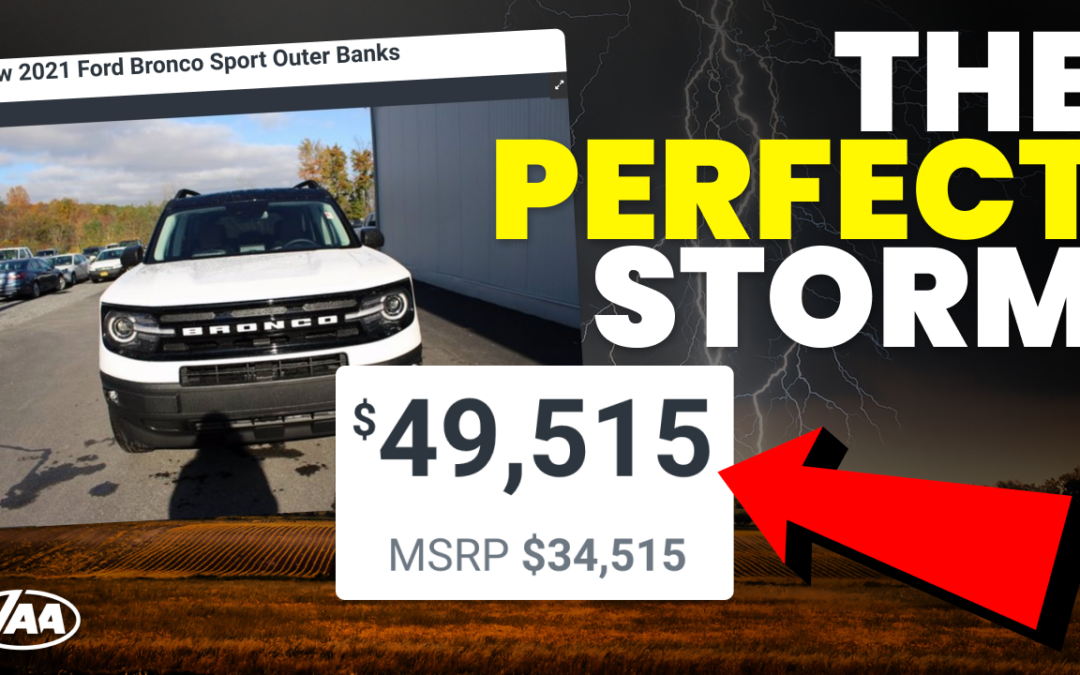
Chip shortage? Check. Magnesium shortage? Check. Labor strikes? Check.
If you could wave a magic wand and imagine what a “perfect storm” scenario would look like to drastically reduce automakers production capabilities, you’d probably describe something like what we’ve seen in 2021. Whether it’s supply chain constrains, virus outbreaks, or workers who are simply quitting, automakers are facing a series of setbacks that are unprecedented in scope and scale.
This “perfect storm” has had meaningful and material impacts on the everyday consumer. Everything is more expensive. Not just cars, trucks, and SUVs (did we mention that wholesale used car prices have increased 40%+ in 2021 alone?), but in other categories such as household goods, food, and more. We’re in the perfect storm, and for better or worse, that’s going to have major impacts on our pocketbooks next year, in 2022.
How big will the impact be in 2022? What changes do we expect automakers to make heading into the new year? And most importantly, when will things “go back to normal” (or will they?)? We’ll answer these questions and more. Let’s dive in.

Automakers, like all major manufacturers, operate on just-in-time (JIT) manufacturing practices. Just-in-time manufacturing is a business operating model where finished goods are created to meet demand. That’s it. Plain and simple. Finished goods are not created in surplus or in advance of any need. The benefit of JIT production is that the manufacturer can (in theory) avoid the waste associated with overproduction, the carrying costs of holding and storing inventory, and the burden of housing input materials that are necessary to create the finished good.
Henry Ford, in his 1923 book, My Life and Work describes just-in-time manufacturing:
We have found in buying materials that it is not worthwhile to buy for other than immediate needs. We buy only enough to fit into the plan of production, taking into consideration the state of transportation at the time. If transportation were perfect and an even flow of materials could be assured, it would not be necessary to carry any stock whatsoever. The carloads of raw materials would arrive on schedule and in the planned order and amounts, and go from the railway cars into production. That would save a great deal of money, for it would give a very rapid turnover and thus decrease the amount of money tied up in materials.
For all the benefits that JIT brings, it also has some downsides; mainly, when one piece of the intricate global system that delivers input goods to manufacturing plants on-time goes down, the whole system can be effected. What does this mean? It means that if one component of a vehicle doesn’t make it just in time to a production facility, then the whole process can come to a standstill.
That’s exactly what happened towards the end of 2020 when automakers slashed their orders of many input components. With the uncertainty of what was going to happen as a result of the coronavirus pandemic, automakers did not want to hold onto excess inputs at their production facilities (remember, JIT requires you to only have what you need). What no automakers expected was for new vehicle demand to stay steady in 2021. The expectation was that consumer demand would decrease because of the pandemic, that never panned out.
For months major original equipment manufacturers (OEMs) struggled to get their hands on the materials they needed to produce vehicles. The component that became the most challenging to source was (and still is) integrated circuits (also called semiconductors, or chips). These circuits are everywhere in our cars. From turning on the air conditioning to changing your turn signal, ICs play a major role in how your vehicle operates.

We’ve documented the chip shortage at great length. Suffice it to say the auto industry’s commitment to JIT manufacturing has completely backfired. With demand for semiconductors through the roof, price gauging has become rampant. It’s a classic case of the golden rule: she who has the gold, rules. Whomever has the chips right now, they rule.
In addition to input costs rising, OEMs have been faced with other pandemic induced challenges. Manufacturing plant shutdowns because of the virus have been rampant in 2021.
Automakers have collectively lost over 3,000 production days in assembly plants so far in 2021. That data comes from Bill Rinna, LMC Automotive’s director of vehicle forecasts for the Americas.
Used cars typically depreciate. Actually, let me rephrase that. Used cars depreciate. Never in history have we seen used vehicles appreciate in value like we are seeing so far in 2021.

Did you buy a brand new Toyota Camry three years ago and put a couple thousand miles on it? Guess what, you can sell it back to the dealer right now for likely exactly what you paid for it back then (or potentially more!). Seriously.
Because automakers have not been able to produce new vehicles at levels they expected to, used car prices have gone through the roof. New car prices have too. If a car does make it to a dealers lot, it is being sold with additional dealer markup (ADM) and all sorts of “accessories” or “add-ons” to boost dealer profit.
Know which fees you should and shouldn’t expect to pay. Read the full guide here!
The days of buying a car, truck, or SUV at invoice price are long gone. And the premise of buying a used car that has depreciated a bit, because it represents a “better deal” is entirely dead. In a market where new cars sell for significantly over MSRP, and used cars sell for more than their original MSRP, us consumers are at a loss. If you’ve tried to search for a car recently and said to yourself, “WTF!!!” you are not alone.
From the thousands of CarEdge members we help each month, we’ve seen most new car deals include at least $1,500 in additional “stuff”. This “stuff” can come in the form of dealer markup (market adjustments, additional dealer markup, etc.), accessories (appearance packages, protection packages, etc.), or general add-ons (window tint, nitrogen in the tires, etc.). If you’re able to buy a new car at MSRP without this additional markup/fees, that represents an incredible value right now.
MSRP stands for “manufacturers suggested retail price”. Over the past few months we’ve seen first-hand how important the word “suggested” is. Dealers have marked up their vehicles well above MSRP, and consumers are paying. With such limited supply, dealers are able to make ridiculous amounts of profit. Every publicly traded auto dealer made record profit in Q3 of 2021 as a result of this.
Next year we don’t think dealers will be able to make quite as much money. Why? Because the OEMs are going to get in on the fun — they’re going to drastically increase the MSRP. This won’t inherently stop car dealers from marking up even further past the MSRP, however we expect and anticipate very significant increases in MSRP for all new vehicles for the next model year.
We’ve already begun to see this. Tesla recently increased the price of its model S and Y by $2,000, followed by a $5,000 hike on for the model X and S.
Other automakers are already doing the same thing. The MSRP on a base Ram 2500 has increased 5% from 2021 to 2022 for example. We expect, and wouldn’t be surprised if more automakers increase their MSRP by double-digits in 2022.
Many of the major automakers have already signaled that they like their dealers having less inventory. The United States is the only major market where car dealerships have massive lots full of inventory. In many markets the dealership is simply a showroom with customers placing orders for the vehicles they want.
As more and more manufactures aspire to provide a “Tesla” like experience, we would not be surprised to see less inventory on dealer’s lots, and more factory orders.
Factory orders will also become more of the norm. Consumers may go to a dealership to test drive and “experience” a new car, but instead of buying it right there on the spot, they’ll place an order. This is a common practice in Europe and other major markets, however in the US it has never caught on. That’s likely going to change.

The latest on used car prices:
Used car prices typically follow seasonal patterns. Winter, and the fourth quarter are traditionally when the used car market experiences most of its yearly depreciation. So far, in this fourth quarter of 2021 used car prices have appreciated 5%.
We all know that used car prices have been increasing this year, and the latest data from Black Book suggests we’re going to continue to see used car values appreciate through the end of this year. That being said, we are starting to see some mixed signals from other data providers. Cox Automotive recently shared data that used car inventory levels have increased in November. Although used car prices have continued to increase, we could potentially be seeing a softening in the market if inventory levels continue to rise.
In this post we’ll run through the latest data on used vehicle values. We will update this page weekly as we get new data and information to share. If you have specific questions about used car prices please ask them on the CarEdge Community Forum.
To get the Black Book value of your vehicle you can do that here: https://app.CarEdgemember.com/trade-in
Let’s dive in.
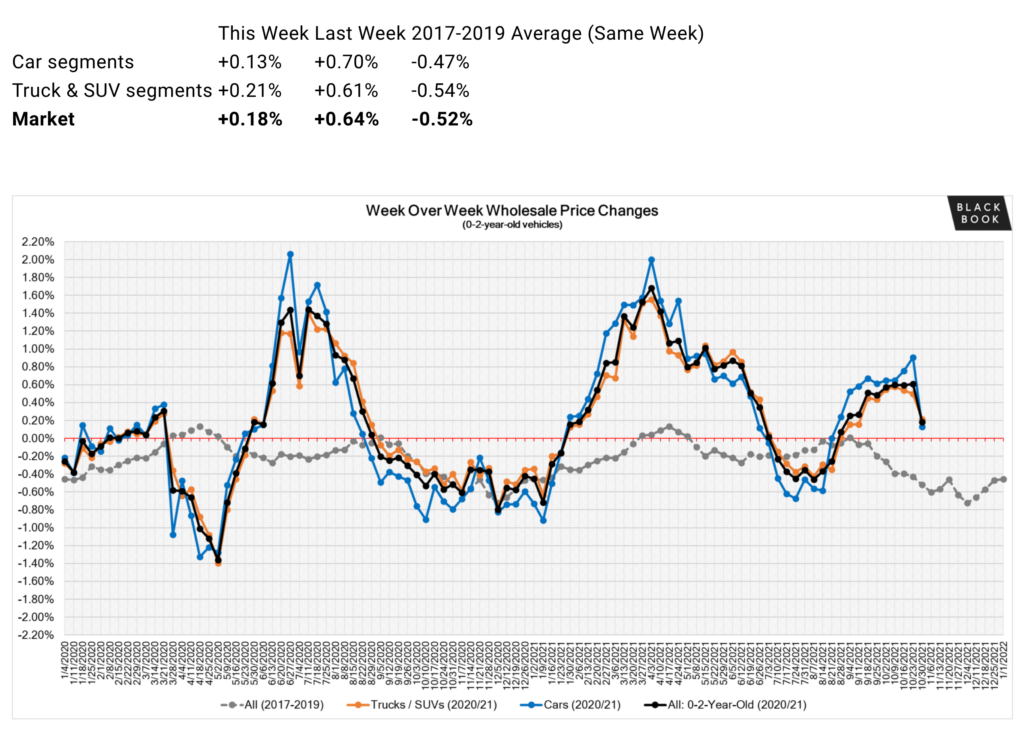
Wholesale used car prices have continued to increase. Data from Black Book shows that wholesale used vehicle prices have appreciated 48% in 2021 alone. The purple line represents 2021 wholesale weekly price changes. The blue line represents 2019 (the last “normal” year) of data we have. You can see drastic differences between the two lines.
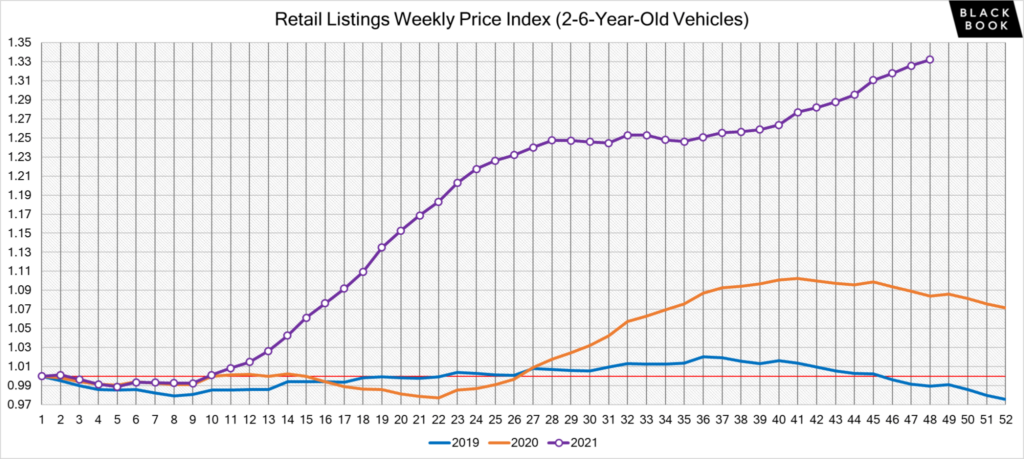
As wholesale prices have continued their ascent, retail used car prices have followed suit. Retail used car prices are up more than 33% since the beginning of this year. Again, look at the purple (this year) and blue (2019) lines in the graph below. It’s incredible to see the stark difference between the two.
As you are likely well aware, used car prices have skyrocketed because of the ongoing chip shortage and lack of new vehicles. We have updated data on new car inventory levels for the month of November, and they are not pretty.
That being said, wholesale used car inventory levels have ticked up so far in November. Data from Cox Automotive showed positive signs in terms of inventory with October inventory levels up 200,000 units from September. September ended with 2.28 million used vehicles in inventory, while October ended with 2.30 million. October’s supply was still about 8% lower than 2020.
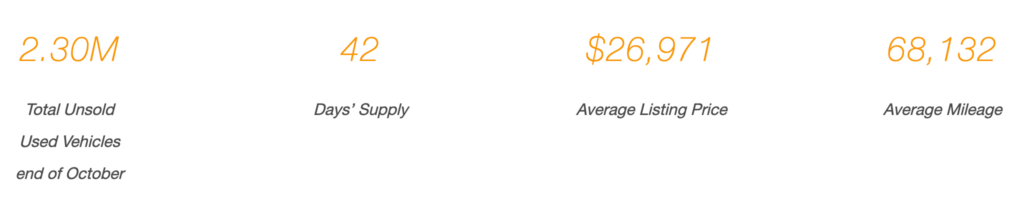
Cox also estimates the days supply of used car inventory. It is at 42 for the month of October, the same as September. Their data suggests that about 1.65 million used vehicles were sold in October 2021, up 400,000 units from the 1.61 million sold in September. October sales ran about 7% below the same year-ago period.
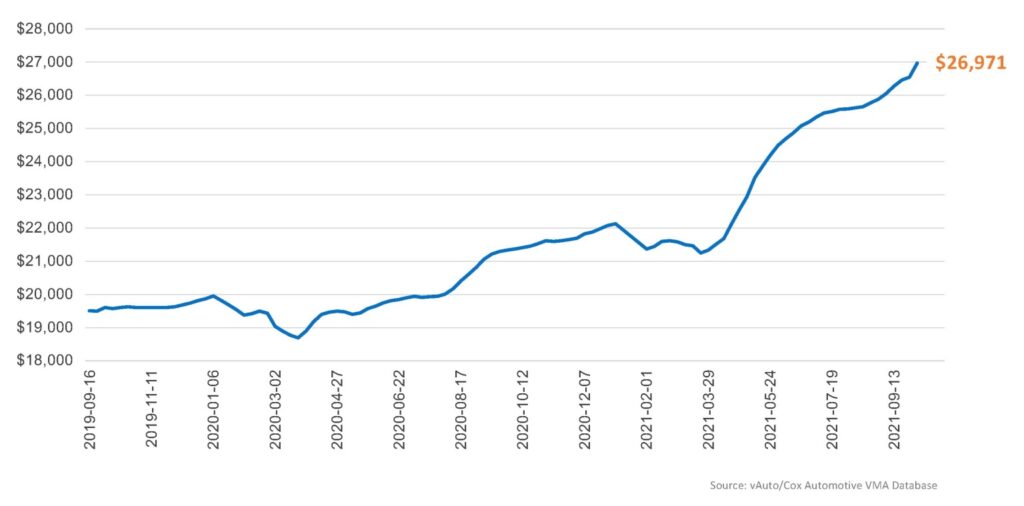
Both Cox and Black Book show retail used car prices hitting all-time highs. Cox has the average listing price for used vehicles at a new record of $26,971. That’s a $400 increase from September ($26,548).
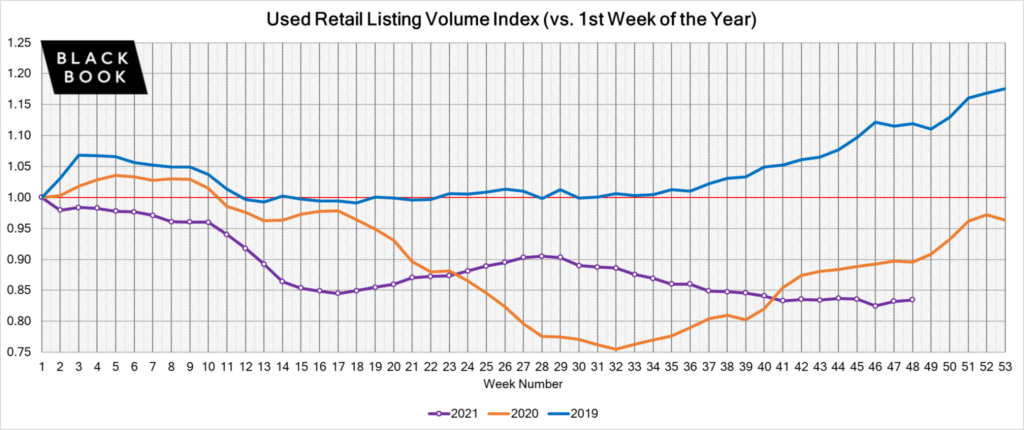
One of the most interesting data points Black Book tracks is used vehicle retail listings volume. This means how many used vehicles are listed for sale in the United States each week. Data from Cox suggests inventory levels are edging higher, and Black Books data shows the same thing. We see a slight week-over-week increase in retail listing volume.
Again, the purple line represents this year, and the blue line shows 2019. Typically we would see an increase in retail listing volume at this time of year, however right now the volume is still low and not increasing. This simply means there are less used vehicles for sale than earlier in the year, and the lowest level we’ve seen so far this year.
That being said, we did see another week of wholesale price increases, our 13th straight week of appreciation. Last week cars appreciated .70%. This week that sunk down to .13%. Trucks and SUVs increased .61% last week, and increased modestly by .21% this week. The used car market as a whole was up .18%, considerably lower than last week.
Toyota’s new car sales volume was down 29% in October. Toyota’s biggest sellers posted double digit declines in sales volume in October: Camry down 40 percent; RAV4 down 39 percent; Tacoma sales declined 38 percent; Highlander off 19 percent and Corolla sales off a staggering 61 percent.
It wasn’t just Toyota. Honda sales volume dropped 24% in the month too.
Used car prices will continue to appreciate as long as automakers are struggling to produce enough new vehicles. These recent earnings reports highlight how much the major manufacturers are struggling to stock their dealer’s lots.
Black Book supplies us with compelling data on the change in used car prices broken down by segment of vehicle. This past week compact cars appreciated in value the most. These are your Subaru Imprezas, Ford Fiestas, Nissan Versas, Mazda Mazda3s, Ford Focus, etc.
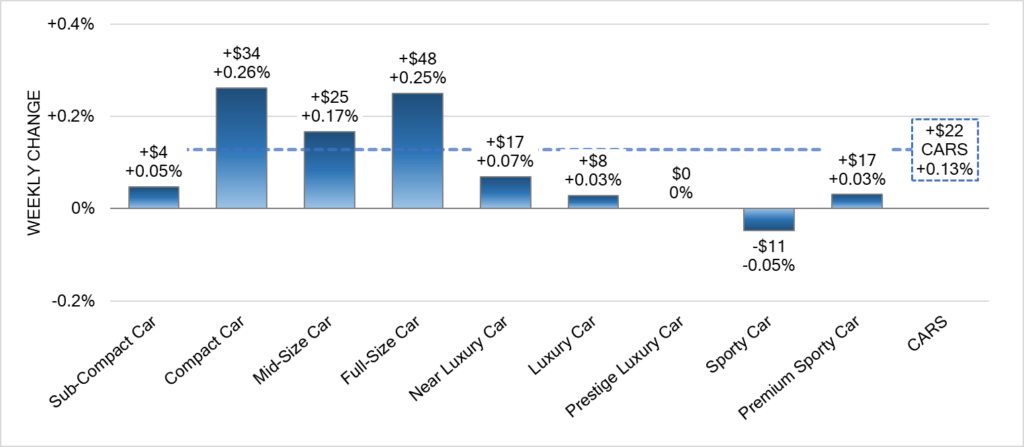
Sporty cars are finally depreciating! This time of year is seasonally when sports cars depreciate the most.
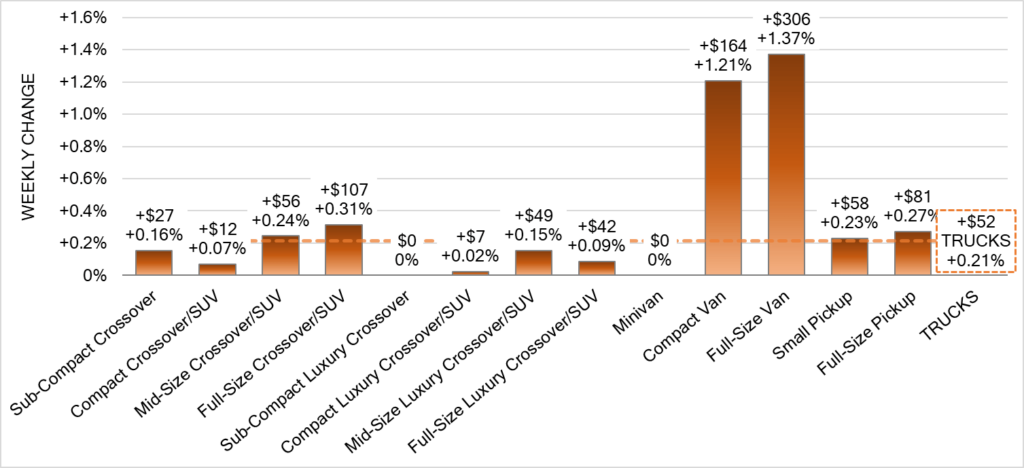
Compact vans and full-size vans continue to increase in value rapidly. Their value increased well over 1% week-over-week. Full-size vans have increased in price 42 out of the past 43 weeks.
We recently published data on which brands have seen their new and used prices increase the most (and least) year-over-year: https://caredge.com/guides/which-brands-prices-have-increased-the-most-least-in-2021/
Black Book provides “sales rate” data from the wholesale used car auctions.
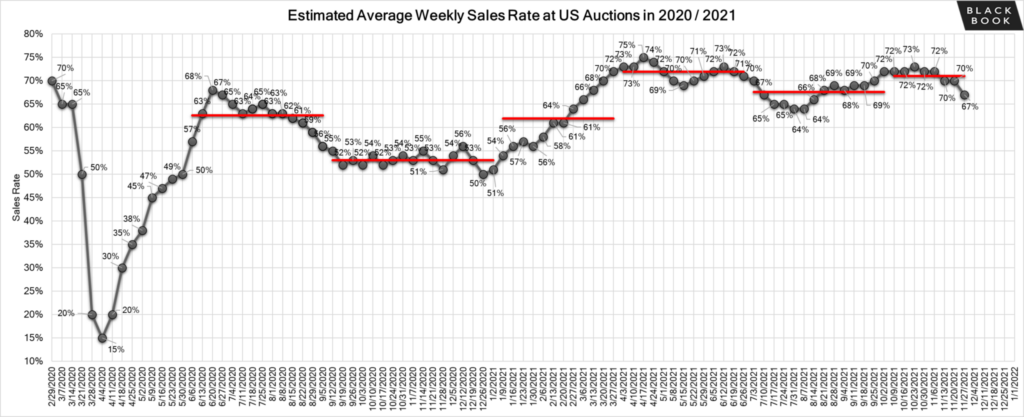
Directly from Black Book:
The weekly estimated average sales rate has remained stable at the 70% mark for the 2nd week in a row. This time last year, the estimated average weekly sales rate was around 51%, so while floor prices continue to rise, buyers continue to purchase vehicles at auction at a higher rate.
Typically the holiday season signals an increase in newer used vehicles. This is because of lease returns and rental vehicles coming to the auction. This year that is not happening to previously expected levels. While there was a slight uptick in newer model year vehicles rolling across the lane this past week, a significant portion of vehicles are arriving damaged.
Franchise car dealers are grounding lease returns and not sending them to auction. Fierce competition at the auctions can be mostly attributed to large independent dealerships and rental companies. Because of inventory scarcity, we have seen bidding wars across the country. Wholesale values and floors continue to increase and give no indication of slowing down.
We’ve heard stories from our community of similar experiences at the auction, and it appears that rougher and rougher vehicles are crossing the auction block at this time.
No. From all of the data we’ve been able to get our hands on, it looks like there isn’t a single style of vehicle or particular nameplate that is not increasing in value right now. We know that certain vehicles are appreciating less than others, however all vehicles are increasing in value right now.
Luxury vehicles, and in particular luxury SUVs are appreciating much less rapidly than other vehicles. Take for example the Mercedes-Benz GLC, it has only appreciated 8% year over year. This further reinforces the theory for why the Mirage has increased in value nearly 50%; consumers need affordable and attainable used cars, not expensive and luxurious ones.
Although our crystal ball has been notoriously cloudy here at CarEdge, we feel confident in saying that used car prices will continue to increase well into 2022. Even when automakers get production back up to speed for new vehicles, there will be lingering effects from this period of time where they have not been able to produce at expected capacity.
Also, the price to produce new vehicles has gone up. As a result of the chip shortage (and other supply chain issues), we expect MSRP on new vehicles to be considerably higher than before. Why? Because the manufacturers costs are increasing, and they will likely pass that along to the consumer. As a result, the demand for used cars will continue to be high because used cars (especially vehicles like the Mitsubishi Mirage) will be the only “attainable” price point vehicles for many people.
For these reasons, we think week over week, and month over month used car price increases will continue for at least another 12 months.
If used car prices are likely going to continue to appreciate, it would make sense to hold onto your used vehicle and wait to sell it. That being said, our best recommendation is to track the value of your used vehicle weekly. To do this we encourage you to use the “value my vehicle” section of your CarEdge account. You should also get quotes from Carvana, Vroom, CarMax, etc.
There may be small fluctuations in price from week to week, but we expect the price of your vehicle to gradually increase overtime. The indicator for when to sell will be when you see week over week declines in the value of your vehicle.
Our recommendation has been, and will continue to be to stop buying cars! We’re so passionate about this that we even made a website: http://stopbuyingcars.com/
However, if you need to buy a used car right now, here’s what you need to remember.
The only way to know if you’re getting a fair deal is to get the out-the-door price from the seller and then compare that to the vehicle’s value. To get the out-the-door price follow this guide:
To know if the vehicle’s price is fair, we encourage you to run the VIN through the CarEdge vehicle valuation page and to also get a quote from Carvana to see what they would pay to buy the car right now. If the Carvana quote is close to what you are paying for the vehicle, then it’s likely a pretty fair deal.
In today’s market, with “rougher” used cars for sale it is critically important that you get a pre-purchase inspection done on the vehicle you are thinking of purchasing. We have heard too many horror stories of people buying used cars “as-is” and then getting stuck with a piece of junk. Avoid that, and get a PPI!
Last but not least, consider getting an extended warranty on your used vehicle. CarEdge partnered with AUL Corporation to sell extended warranties with a flat markup, transparent pricing, and free consultations with an Auto Advocate. If we can help you protect your use car, we want to. More on that here: https://caredge.com/extended-warranty/ and request a free quote here: https://app.CarEdgemember.com/service-contract
Access the full cost to maintain data set here: https://docs.google.com/spreadsheets/d/1U1UYB3IxMzx2TdPTdHizbwL0T6MwRJRhzxDXoNlrGK8/edit?usp=sharing
Here at CarEdge we’re all about having the right information at the right time to make informed and educated decision. Whether it’s understanding current market conditions, spending within the 10% rule, or having access to the dealer’s invoice price to know you’re getting a fair deal, at CarEdge, we’re 100% on your side to make an empowered decision.
A lot of people spend days and weeks trying to get the best car deal and completely overlook another major expense: service and repairs. Fortunately we’ve gotten our hands on some really compelling data that breaks down how much it will cost (in maintenance, unplanned repairs, service campaigns, diagnostics, software updates and warranty and recall fixes) for your vehicle.
These are estimates, but they come from more than 16 million vehicles across 356 models and more than $2 billion in service costs. Costs such as gasoline, collisions, insurance and local and state inspections are not included in any of the figures.
Let’s dive in!
| Average 12-month in-service U.S. repair costs per vehicle | 2020 |
| Mitsubishi Mirage | $51.00 |
| Mitsubishi Eclipse Cross | $59.00 |
| Mitsubishi Mirage G4 | $63.00 |
| Chevrolet Sonic | $71.00 |
| Chevrolet Spark | $72.00 |
| Nissan NV | $74.00 |
| Buick Encore | $82.00 |
| Kia Sportage | $84.00 |
| Kia Elantra GT | $85.00 |
| Mazda CX-3 | $87.00 |
| Kia Sorento | $88.00 |
| Honda Fit | $89.00 |
| Honda CR-V | $90.00 |
| Kia Sedona | $93.00 |
| Mitsubishi Outlander Sport | $94.00 |
| Hyundai Santa Fe | $95.00 |
| Chevrolet Trax | $96.00 |
| Mazda MX-5 | $98.00 |
| Hyundai Tucson | $99.00 |
| Kia Optima | $99.00 |
Again, you can access the full cost to maintain data set, which includes prior model years here: https://docs.google.com/spreadsheets/d/1U1UYB3IxMzx2TdPTdHizbwL0T6MwRJRhzxDXoNlrGK8/edit?usp=sharing
It should come as no surprise that Mitsubishi takes the top spot on the list of cheapest cars to maintain. A 2020 Mitsubishi Mirage costs only $51 per year to maintain. That’s insane!
Each of the vehicles on this list are expected to cost less than $100 per year in maintenance, unplanned repairs, service campaigns, diagnostics, software updates and warranty and recall fixes. That means they are VERY cheap to own.
| Average 12-month in-service U.S. repair costs per vehicle | 2020 |
| Porsche Taycan | $3,190.00 |
| BMW M5 | $1,362.00 |
| Porsche 911 | $1,329.00 |
| Jaguar I-Pace | $1,286.00 |
| Mercedes-Benz AMG GT | $1,253.00 |
| BMW M8 | $1,035.00 |
| Audi R8 | $976.00 |
| Mercedes-Benz G-Class | $897.00 |
| BMW8 Series | $865.00 |
| Ram 4500 | $845.00 |
| Chevrolet Corvette | $802.00 |
| Ram 3500 | $798.00 |
| Land Rover Defender | $787.00 |
| Audi S5 | $756.00 |
| Mercedes-Benz GLS | $748.00 |
| BMW M4 | $727.00 |
| Land Rover Discovery | $712.00 |
| Porsche Cayenne | $707.00 |
| Audi A6 | $698.00 |
| BMW X6 | $675.00 |
| BMW X7 | $675.00 |
| Audi Q8 | $669.00 |
| Porsche 718 | $665.00 |
| Mercedes-Benz GLB | $653.00 |
| Jaguar F-Type | $651.00 |
| Mercedes-Benz GLE | $647.00 |
| BMW 7 Series | $646.00 |
| Ram 5500 | $628.00 |
| Lincoln Aviator | $626.00 |
| BMW M2 | $618.00 |
| Porsche Panamera | $611.00 |
| Land Rover Range Rover Evoque | $596.00 |
| Mercedes-Benz CLA | $596.00 |
| Audi A7 | $581.00 |
| Land Rover Range Rover | $578.00 |
| Mercedes-Benz CLS | $568.00 |
| Mercedes-Benz S-Class | $566.00 |
| Genesis G90 | $563.00 |
| Audi A5 | $561.00 |
| Mercedes-Benz A-Class | $549.00 |
| BMW X4 | $538.00 |
| Land Rover Range Rover Sport | $533.00 |
| Cadillac CT5 | $526.00 |
| BMW X5 | $517.00 |
| Audi Q7 | $516.00 |
| GMC Sierra 3500HD | $502.00 |
| Infiniti Q60 | $502.00 |
| Ram 2500 | $501.00 |
On the opposite end of the spectrum, these are the vehicles which have the highest annual cost to maintan. Every vehicle on this list is expected to cost more than $500 annually in maintenance, unplanned repairs, service campaigns, diagnostics, software updates and warranty and recall fixes.
These vehicles make great lease options because during the term of the lease they’ll be under the manufacturers warranty. The 2020 Porsche Taycan is expected to cost $3,190.00 per year in maintenance, unplanned repairs, service campaigns, diagnostics, software updates and warranty and recall fixes. That’s nuts!
The BMW M5 is the next closest vehicle and it’s not even in the same ballpark as the Taycan. The 2020 M5 will only cost you $1,300 and some change.
After looking at the data for the cheapest and most expensive cars to maintain, we thought it would be fun to see how much an extended warranty (which would cover most of these annual costs) would be.
To do this we manually received quotes from our extended warranty administrator, AUL for a 10 year, 100,000 mile extended warranty.
| Vehicle | Annual Service Costs | 10 yr/100k mile Warranty Cost |
| Mitsubishi Mirage | $51.00 | $1,662 |
| Mitsubishi Eclipse Cross | $59.00 | $1,762 |
| Mitsubishi Mirage G4 | $63.00 | $1,662 |
| Chevrolet Sonic | $71.00 | $1,320 |
| Chevrolet Spark | $72.00 | $1,220 |
| Nissan NV | $74.00 | $2,314 |
| Buick Encore | $82.00 | $1,492 |
| Kia Sportage | $84.00 | $1,320 |
| Kia Elantra GT | $85.00 | $1,320 |
| Mazda CX-3 | $87.00 | $1,392 |
| Kia Sorento | $88.00 | $1,220 |
| Honda Fit | $89.00 | $1,220 |
| Honda CR-V | $90.00 | $1,320 |
| Kia Sedona | $93.00 | $1,220 |
| Mitsubishi Outlander Sport | $94.00 | $1,662 |
| Hyundai Santa Fe | $95.00 | $1,320 |
| Chevrolet Trax | $96.00 | $1,320 |
| Mazda MX-5 | $98.00 | $1,392 |
| Hyundai Tucson | $99.00 | $1,220 |
| Kia Optima | $99.00 | $1,320 |
Keep in mind that each of these quotes includes CarEdge’s $500 profit margin, so the wholesale cost is actually the number you see minus $500. It’s interesting to see the variability between vehicles. The Nissan NV Van is inexpensive to own, however the extended warranty company charges significantly more than the other vehicles. Fascinating.
| Vehicle | Annual costs | 10 yr/100k mile Warranty Cost |
| Porsche Taycan | $3,190.00 | N/A |
| BMW M5 | $1,362.00 | $6,470 |
| Porsche 911 | $1,329.00 | N/A |
| Jaguar I-Pace | $1,286.00 | N/A |
| Mercedes-Benz AMG GT | $1,253.00 | N/A |
| BMW M8 | $1,035.00 | N/A |
| Audi R8 | $976.00 | N/A |
| Mercedes-Benz G-Class | $897.00 | $6,470 |
| BMW8 Series | $865.00 | N/A |
| Ram 4500 | $845.00 | N/A |
| Chevrolet Corvette | $802.00 | $2,650 |
| Ram 3500 | $798.00 | $2,108 |
| Land Rover Defender | $787.00 | N/A |
| Audi S5 | $756.00 | $6,620 |
| Mercedes-Benz GLS | $748.00 | $6,570 |
| BMW M4 | $727.00 | $4,074 |
| Land Rover Discovery | $712.00 | N/A |
| Porsche Cayenne | $707.00 | N/A |
| Audi A6 | $698.00 | $5,174 |
| BMW X6 | $675.00 | $5,174 |
| BMW X7 | $675.00 | $5,174 |
| Audi Q8 | $669.00 | $5,174 |
When it comes to the most expensive vehicles to maintain we weren’t able to get extended warranty quotes for many of the options. This is because AUL simply doesn’t allow us to sell warranties on these expensive vehicles. That being said, it seems like there might be some actual bargains in this group. Again, each price reflects CarEdge’s $500 profit margin. The Corvette and Ram 3500 10 year, 100,000 mile extended warranties seem like a bargain. Even the BMW M5 does too.
These are just estimates, and to get a full quote you do need to enter a VIN and current odometer reading, but it is interesting to see how the cost to maintain a vehicle plays into the extended warranty company’s price quote.

Do you remember when new cars cost less than $20,000? Well, those days are officially behind us. As of November 1st, 2021, there are only seven new cars that you can purchase for under $20,000. And, with used cars appreciating in value, there are even fewer used options below the “magic” $20,000 threshold.
The average new car price now tops $45,000. Finding a new car that is (dare we say) “affordable” is pretty much impossible. During the ongoing chip shortage, automakers cut their production of less expensive and lower margin vehicles. Instead, they allocated supplies towards their higher profit, more expensive vehicles.
As a result we have seen dramatic price increases among sub-compact and compact sedans and SUVs on the used car market. Finding a sub $20,000 new car that is actually in stock is borderline impossible. What under $20,000 cars are there? Let’s break it down.
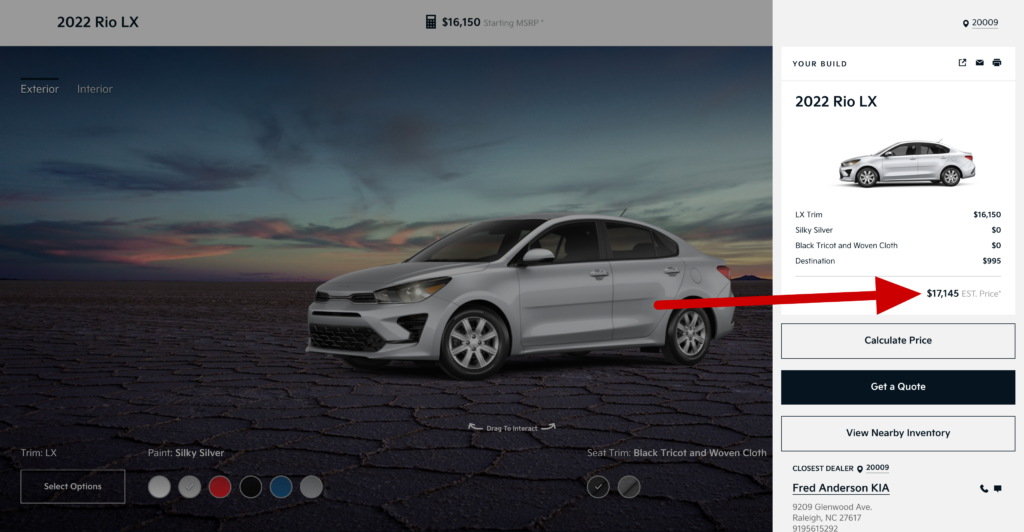
A base 2022 Kia Rio LX has an MSRP of $17,145. Depending on sales tax and dealer fees, you might be able to get “out the door” for less than $20,000 on a Kia Rio. The challenge will be finding one that’s available and on a dealer’s lot.
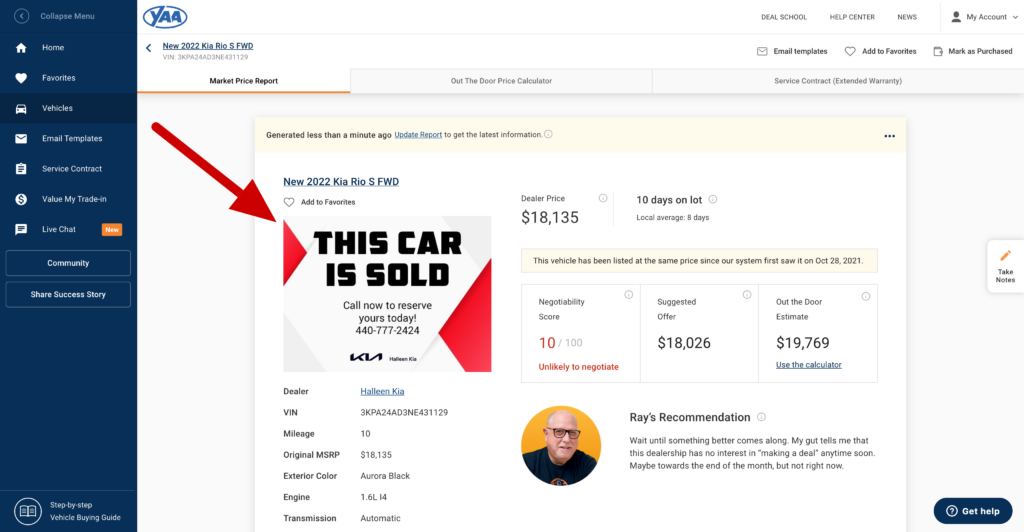
I found less than 10 Kia Rios in inventory and for sale in the United States under $20,000. This one for example was listed as available on Kia’s website, but when you ran a CarEdge analysis report on it it was obviously already sold.
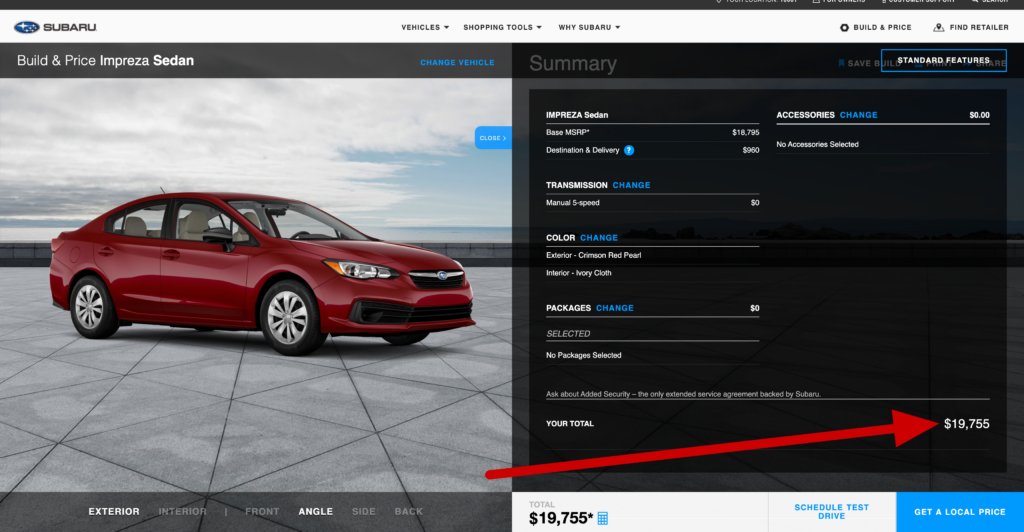
As surprise to some, the Subaru Impreza can be had for less than $20,000! All-in the total price (including dealer fees and taxes) will certainly be above the $20,000 threshold, however the base MSRP is just shy of $20,000.
Thinking about buying an extended warranty? Get a free quote from CarEdge first!
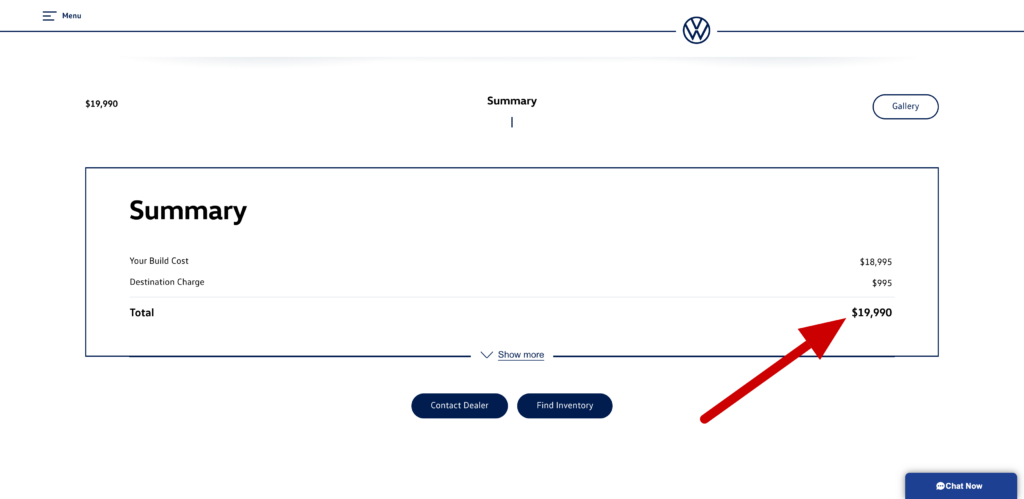
Another surprise entry in the under $20,000 car category is the base Volkswagen Jetta. The cheapest configuration of the Jetta comes in at $19,990. Good luck finding a Jetta for less than $20,000 in inventory nationwide. During my research I was unable to find a single Jetta in inventory with an MSRP below $20,000.
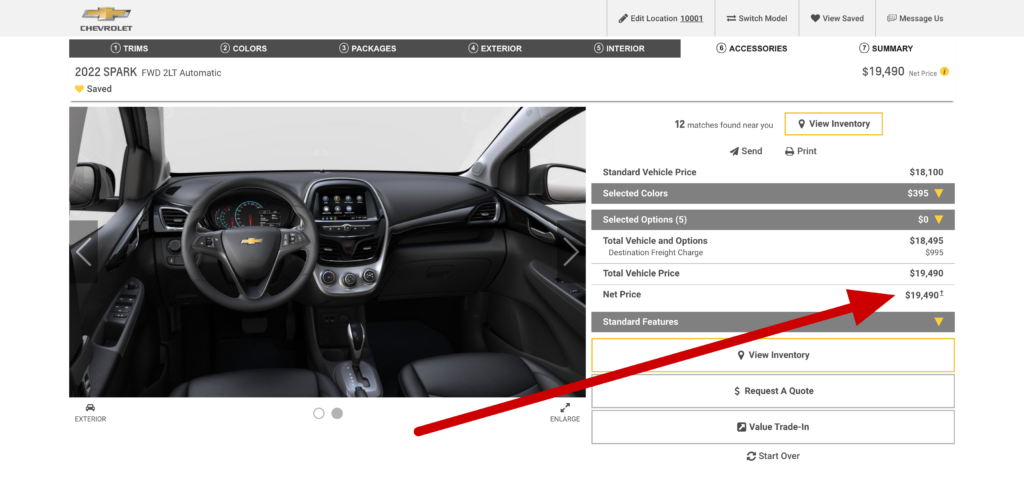
The Chevrolet Spark sneaks into the under $20,000 car club. During my research, I was able to find two Chevy Sparks for sale under $20,000 that are actually in inventory right now in the entire United States.

If you’re looking for an under $20,000 option, the Chevy Spark is a legitimate option in today’s market.
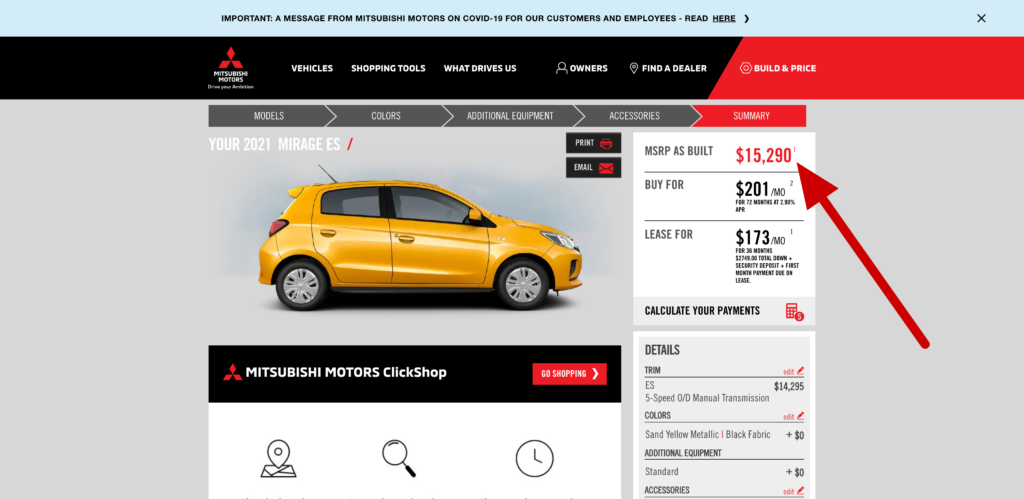
I was able to find hundreds of Mitsubishi Mirages for sale in the United States for less than $20,000. Crazy enough, used Mirages are actually selling for close to what you can purchase a new one for.

The Mitsubishi Mirage is the used car that has appreciated in value the most so far in 2021 as a used vehicle. Up more than 50% in value.
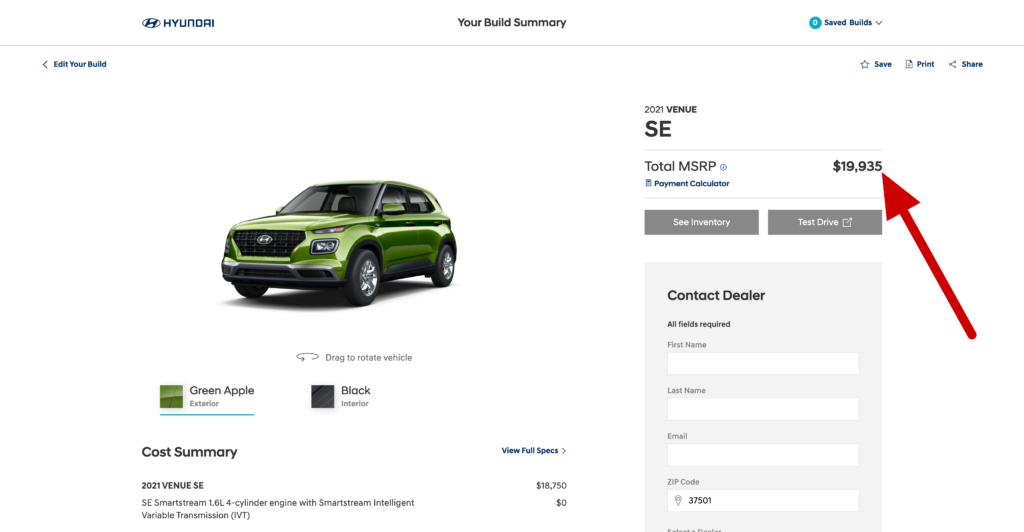
The Hyundai Venue, which came to market for the 2020 model year, is another under $20,000 options for SUV shoppers. At $19,935, the Venue is an affordable option for consumers.
Sadly, I could not locate a single Hyundai Venue in inventory that was listed for less than $20,000.
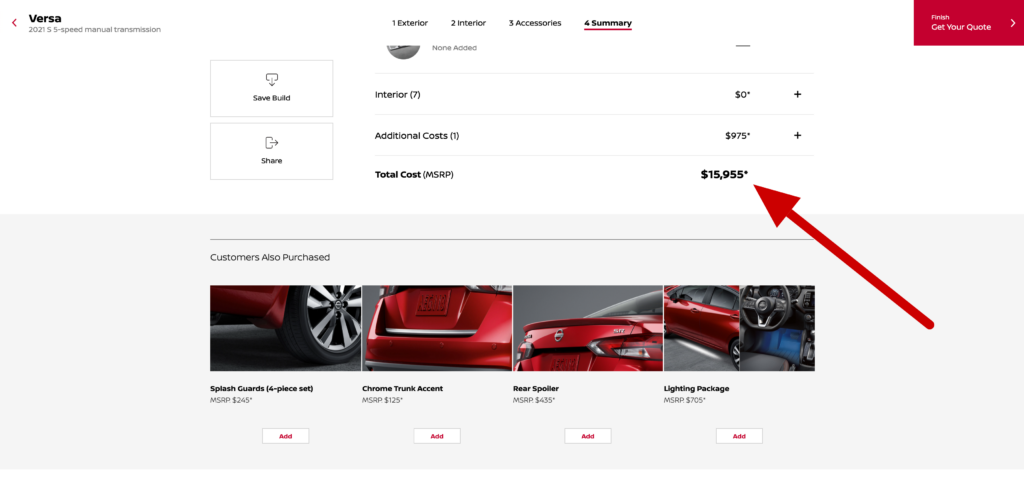
Last but not least on the list of under $20,000 you can buy in 2021 … The Nissan Versa. This subcompact is comparable to the Mitsubishi Mirage, and it’s in inventory too!
If you’re thinking about buying a car in today’s challenging market, let CarEdge help you. Whether it’s our professional car buying coaches, email templates you can use to negotiate with the dealer, or community forum with support and suggestions, we’re here to help you.

Buying a car is tricky. After negotiating a fair selling price, you need to be ready to go to battle for round two; negotiating a fair auto loan rate. Many car buyers think, “I’ll negotiate the selling price of the vehicle, and then I am all set!” This couldn’t be further from the truth.
Most don’t realize that they can negotiate the interest rate on a car loan. You DON’T have to take the financing offer from the dealership. Consumer Reports recently published an in depth investigative piece on auto loans and how they take advantage of consumers.
Today we’re going to walk you through how you can get a lower auto loan rate. No gimmicks, no ads, no BS, just the information you need to be informed the next time you finance a car purchase.
Looking for the best auto loan offers right now? Check out our list, updated every month.
When you buy a car you have many options for how you pay for it. Some people (if they have the means for it) like to pay in cash. Others (on new vehicles) like to lease. Most of us will end up financing the purchase of a vehicle.
This means we take out an auto loan. The bank pays the seller, and we then pay the bank for a set period of time. The bank makes money by charging you (the customer) an interest rate. On each of your monthly payments for the loan you are paying down the principal (the total loan amount) and interest (the money the bank makes).
Thinking about buying an extended warranty? Get a free quote from CarEdge first!
That’s a super simplified view of financing a car. Let’s focus our attention on what options you have to secure the BEST auto loan rate.
One option is to take the financing offer a dealership provides you with. This may not be your best option. If you’ve bought a car before you know at a certain point the salesperson is going to ask you to fill out a credit application. By filling out their credit application you’re giving the dealership the opportunity to contact multiple financial institutions to see what loans they can get you approved for.
This practice of sending your information out to many banks is sometimes referred to as “shotgunning”.

The dealership’s finance manager will see what you got approved for and then likely “mark up” the interest rate. Remember, the interest rate is the profit the bank makes for having made the loan. Well, the dealership can make money too by increasing the interest rate above what the bank approved you for.
This is sometimes referred to as “holding points”. If you get a financing offer from a car dealership, and it is not a special rate from the manufacturer (i.e. zero percent financing), then it likely is a marked up interest rate. Remember, this is likely NOT the best auto loan rate you can secure.
Coming into a car dealership with a pre-approval from a bank or credit union for your car loan is a smart decision. In advance of purchasing your vehicle you can contact your local bank or credit union to see what financing offers they can provide you with.
Credit unions are known for having very competitive used card loan interest rates. You should get a quote from an outside financial institution before going to the dealership.
You can even get a quote from a credit union through us. Check it out!
More and more frequently, especially as the chip shortage has drastically reduced new car inventories, we have heard from CarEdge Community members that dealerships are saying “You have to finance through us if you want to buy this car.” While this isn’t illegal, it certainly is unethical. That being said, as consumers we have a way to combat it.
To get the lowest auto loan rate possible, it may make sense to take the dealership’s finance offer and then immediately pay off, or refinance the car loan.
If you are going to do this, do not tell the dealership. The dealership will receive a chargeback on the loan they placed (aka it will cost them money), however you are well within your right to refinance your loan as quickly as you’d like.
The steps to refinance a car loan are quite simple. There are more and more companies that have entered the refinance space. It’s important that you understand how refinancing companies make money so that you can be informed as you go through the process.
Refinance companies do not make money by placing you in a loan. Instead, refinance companies make money by selling their customers ancillary products (think extended warranties, insurance policies, etc.)
If you’re going to refinance your car loan, then be aware that the refinance company will try to sell you their insurance products. As always, be sure to negotiate the price of those products if they interest you, and get a quote from CarEdge for the extended warranty so that you have leverage.
You can get a refinance quote with us. No strings attached, and no markups!
That’s a great question! We have an entire resource dedicated to helping those that have subprime (or no) credit. Take a look at that here: https://caredge.com/guides/how-to-buy-a-car-with-no-credit/
If you have questions, please post them on the forum. We’re here to help!