
CarEdge saved me over 4,500 dollars on a brand new Honda Pilot. I can't say thank you enough.
Price intelligence
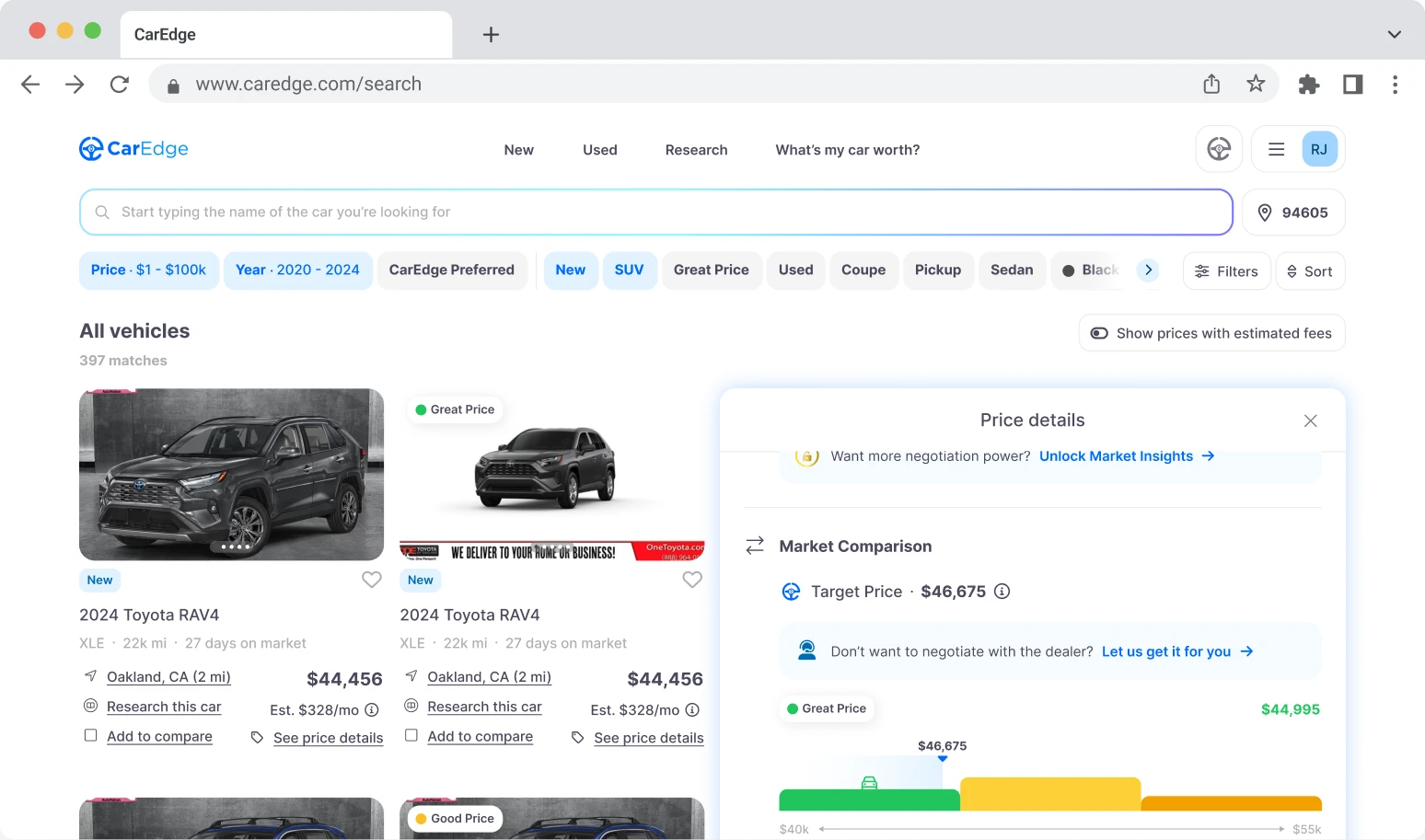
Find a wide range of vehicle listings with market insights on new and used listings near you.

What can I do with CarEdge?
 CarEdge Insights
What can I do with CarEdge?
Get access to exclusive information so you can make an informed car buying decision — all in one place.

Find a wide range of vehicle listings with market insights on new and used listings near you.
Track your vehicle’s value and cash in when the time is right to sell.

Access to our proprietary data to help you find the right car, at the right price. Find these unlocked on every listing after subscribing.

With our expert-led, tech-enabled car buying service, we will locate, negotiate, and deliver your vehicle so you can get a new car hassle free.


Help us personalize your CarEdge experience — it only takes a second.
Your answers help us personalize your CarEdge journey — we’ll follow up with tips and next steps that match your buying timeline.
Buying a car is no easy task. Buying a car long distance from a dealer can prove even more challenging. For the average person, what to know when buying a car long distance from a dealer can be confusing and complex. Fortunately it doesn’t have to be.
Let’s discuss why you might find yourself buying a car from a dealer in a different region, what information you need to know, and what steps you should take.
Let’s address the elephant in the room; why would you even want to buy a car from a dealer that’s not in your area? It’s likely that there’s a car dealership within a few miles of where you are right now. Why would you buy a car from someone on the other side of the country?
The simple answer is that the only car you could find that matches all your criteria is somewhere far away. The more complex answer could be that the non-local dealer offered a better price than the one nearby. Or, perhaps the non-local dealer has a car that has been converted into a certified pre-owned vehicle that actually offers a longer warranty than a brand new car (at a lower price).
If you’re thinking about buying a car, you might enjoy this article if you haven’t read it already: How Much Do Dealers Markup Used Cars?
For example, I remember one time when I purchased a 6,000 mile retired service loaner MDX that had been CPO’d. I ended up with a 5 year 60,000 mile bumper to bumper warranty, as opposed to the 4 year 50,000 mile warranty that came with it brand new from the manufacturer. Sometimes looking for cars like this can help you save money while still getting what you want (or more).
There are any number of legitimate reasons to buy a car from a dealer that is far away from you, and these are just a few of the most common.
I can’t say it enough, get any used car that you are buying from a distance inspected by an independent mechanic. Most franchised dealerships do a great job of inspecting and reconditioning their used cars, and you can (and should) ask them for the vehicles inspection and repair records. However, even with this information, it doesn’t hurt to get a pre-purchase inspection completed.
This is especially true if you are purchasing a car from a smaller used car lot. They may also be less willing to share repair orders with you.
How should you go about orchestrating a pre-purchase inspection when you live in California, and you just found your dream car in Idaho? It’s a lot simpler (and dealers are a lot more willing to help) than you might think.
Google is a wonderful tool when it comes to gathering information. This is undoubtedly true when it comes to finding a mechanic to inspect a potential used car purchase. Since you’ve found your car in a different region, it’s unlikely you know a mechanic that you trust to go over to the dealership and inspect it.
My recommendation would be to Google search to locate a qualified mechanic near the dealership to handle your pre-purchase inspection. Call them and let them know your situation (I live in California, and am looking to buy this car that’s near you, can you please inspect it, etc.)
Once you have a mechanic, and a car you would consider buying, make arrangements with the dealer to take the car to your independent mechanic for the pre-purchase inspection for you. Most dealerships will be willing to assist in moving a car from their lot to a mechanic’s shop to conduct the pre-purchase inspection. Don’t be afraid to ask them to do this.
I do have one note of caution with pre-purchase inspections. Your mechanic will find something wrong with the car. At the end of their day, it’s their job to find something. It could be something minor, it could be a little nit picky, it could be something that you need to take care of ASAP before you buy the car, just keep in mind that they will find something.
Do you go and pick it up? Do you get the car shipped to you? How the heck do you actually get the car you want to buy from a long distance dealer into your garage at home?
This is a matter of personal preference, and how much time (and money) you can set aside for such an endeavor.
If you’re thinking about buying a car, you might enjoy this article if you haven’t read it already: Monroney Sticker & Window Sticker Explained by a Former Car Dealer
During my 42 year career in the business, I had customers who travelled great distances by train and plane in order to pick up their new car to simply have the joy of driving it home. By great distances, we’re talking about several hundred, even up to a 1000 miles.
I also had customers who purchased a car from afar and made arrangements to have it shipped to them. For them, the “thrill” of driving hundreds of miles back home wasn’t worth the time it would take to get to the dealership and back. Many of my customer’s worked with Ship a Car Direct to get their cars delivered to them.
Those are your two options. If you’re unsure how to navigate this process consider letting us help. At CarEdge we’ll help you navigate the car buying process.
More and more dealerships are making it easier for you to purchase a car online. As the industry transitions from physical sales to ecommerce, there are bound to be changes in how people buy their cars.
One of the most popular tools that dealerships are using today to help with online sales comes from a company called Roadster. Roadster allows customers to seamlessly complete the entire purchase online. From inquiring about a particular car, to starting and completing the paperwork process, to making arrangements for shipping so that you never have to step foot into the dealership, Roadster provides the software to make it happen.
You could live in Seattle, purchase a specific Lexus that you found at a dealer in Pennsylvania, and do it all from the comfort of your home or office. The business model for how cars are being sold is changing dramatically. As someone once said, “it’s a small world, but I wouldn’t want to have to paint it.”
Keep in mind what we discussed above. What you need to know when buying a car long distance from a dealer isn’t as complex or challenging as you may have thought. Yes, there are a few more considerations, but they certainly aren’t insurmountable.
When it comes to cars, there’s a lot of jargon. So much so, that the already confusing process of buying a car, can get even more challenging for someone who isn’t well versed in automotive lingo. Throw in terms like monroney sticker, window sticker, and more on top of an already confusing subject matter, and you’re bound for frustration.
Fortunately, as with most things in life, these words and phrases aren’t actually as complex as they seem. Feeling confident when you buy a car is a must, and knowing the key words, phrases, and jargon that the dealer may throw around is a necessary step in that process.
Let’s explain the two terms above, the Monroney label, and the window sticker. Fortunately for you (as you’ll see in a moment), the two phrases refer to the same thing!
This is a loaded question, but we have to ask it… Do you trust your average car salesperson?
Odds are, you don’t. When asked, “Rate the honesty and ethical standards of people in these different fields — very high, high, average, low or very low?” Gallup found that only 9% of Americans identify car salesmen as having a “high” or “very high” level of ethical standards. This was by far the lowest rating of all professions (even below “Members of Congress”). Ouch.
If you’re thinking about buying a car, you might enjoy this article if you haven’t read it already: How Much Do Dealers Markup Used Cars?
Why is this important? Because it is the entire reason Monroney stickers exist. A car’s Monroney sticker presents all of the features, options, and charges associated with every single new car in the United States. Before the Monroney sticker existed, customers had to trust the salesperson at the dealership to provide them with information about what a car included, and how much it cost. The Monroney sticker made that information accessible (and mandatory) for all new cars.
The Monroney sticker applies to all new cars sold in the United States. You’ll frequently also hear it referred to as a car’s window sticker. The two terms are synonymous.
Included on the Monroney sticker are key pieces of information. They include:
As you can see, there is a lot of relevant information packed on the Monroney sticker, and again, with good reason!
I remember the days before Monroney stickers existed… There was a time when Monroney stickers were only mandated for cars and not trucks. It really was like the wild west.
Who, or what is Monroney, and why is their name associated with all new cars sold in the United States? Oklahoma Senator Almer Stillwell “Mike” Monroney sponsored a bill called the Automobile Information Disclosure Act of 1958. This bill would lead to the creation of the Monroney sticker once it was signed into law by then president Dwight Eisenhower.
Monroney was a pioneer for consumer safety. He also sponsored the bill that would eventually create the Federal Aviation Administration.
More in depth information on the legislation Monroney pursued can be found here: https://www.justice.gov/civil/consumer-protection-branch-32
As mentioned above, Monroney, or window stickers are required to have the following information:
Dealers are not permitted to remove, modify or alter these stickers in advance of selling a car.
Now that you know that a window sticker is required by law on all new cars in the United States, you’ll certainly be looking for it during your next dealership visit. Edmunds.com provides a great overview of where to look for each piece of information on the window sticker. Click here to view that article.

Ready to outsmart the dealerships? Download your 100% free car buying cheat sheets today. From negotiating a deal to leasing a car the smart way, it’s all available for instant download. Get your cheat sheets today!

When you go to buy a car, don’t be surprised if the dealer you’re purchasing it from bought the car at an auction. The “ins and outs” of used car auctions remain unknown to many, however they aren’t too terribly complex. Many people have asked me “why do cars go to auction?”
The short answer for why cars go to auction is to improve dealership profitability.
Let’s explore how car dealerships work, and how you can make an informed decision armed with this knowledge.
Car dealers are in the business of making money. When they can’t sell a car to a consumer quickly, it’s more profitable for them to sell that car to another dealer via an auction. Generally speaking, dealerships make most all their decisions based off of how it will impact their profitability.
As pre-owned inventory ages, dealers will often take those vehicles to the auction. Their goal is to turn that “dead” inventory into cash that can be used to buy other cars that they expect to sell faster. But why do dealers do this in the first place? What incentive do they have to get rid of “dead” inventory?
Most dealerships have strict pre-owned aging policies. This means that internal policies dictate how long a used car can stay on a dealership’s lot before it gets sent to the auction. A common practice in the industry is the 60 or 90 day rule.
If a used car isn’t sold within 60 or 90 days (this varies from dealer to dealer) management staff must get rid of the car. They have two options; either wholesale the car directly to another dealer, or more likely sell it at an auction.
Sometimes dealerships will even send new cars that have not sold quickly enough to the auction. This doesn’t occur often, but it happens. The rationale is for dealerships to relieve themselves of excess new car inventory or aging new cars, and instead replace them with fresh merchandise that they think will sell more quickly to a consumer. The whole reason cars go to the auction is to ensure inventory balance at the dealership.
Cars go to used car auctions because dealers simply can’t sell them quickly enough to a customer at their storefront. Dealers are incentivized to sell cars sooner rather than later because of carrying-costs that diminish a cars profitability, and pressure from shareholders to show that they’re moving inventory quickly.
If a dealership isn’t turning their inventory it is a sign to shareholders that they aren’t as efficient or profitable as their peers. With inventory sitting on a lot, the dealer has a significant amount of capital tied up in cars that aren’t selling. That means their money isn’t making them as much profit as it could.
Dealership staff accumulate knowledge and experience over time. With that experience comes the ability to know which makes and models will or won’t sell at their dealership. Prior experience with certain makes and models may have shown that certain cars simply aren’t popular on their lot. Off to the auction they go.
This varies from dealer to dealer. Location can play a major role in determining which cars stay and which cars go. For example, a sports car that gets traded in to a rural dealership will likely get sent to auction.
Sometimes a dealership will trade a luxury car that is simply too expensive for their taste. Those cars will be sent to an auction that specializes in those types of vehicles.
Another reason why cars go to auction is that after inspecting a vehicle for road worthiness and determining how much it would cost to recondition the vehicle, the dealer may simply deem it too expensive. When that’s the case, off to the auction it goes.
Often times dealerships trade cars that are too old, or have too many miles. When this is the case, a dealer may have no real intention of keeping the car. Instead they simply ship the car off to the auction as soon as possible.
As you can see, there are no shortage of reasons why cars go to auction. Dealerships send cars to the auction to get rid of aging inventory, because they just want cash to buy something different, or merely to balance their inventories for maximum return of investment. The reasons are as valid as they are varied, and the auctions remain a valuable tool for dealerships to use.
NEW from CarEdge: Get your FREE Dealer Invoice Price in minutes!
Knowing what to bring with you when buying a car can be one of the most intimidating aspects of the process. You know you’re serious about buying a new car, but you aren’t 100% sure what documents you need to have with you when you step foot in a dealership. That’s a-okay. We’ve all been there before.
What to bring with you when buying a car depends on your situation. Are you trading a car in? Financing your car? Do you have a co-signer? There are certain things you’ll want to have with you when you go to the dealer.
Let’s dive into each of the items you should bring with you when buying a car.

If you have a car to trade in, bring the title (if you have it), and make sure the car is titled in your name. A lot of people don’t realize that you can’t trade in a car that isn’t titled in your name. That means if you’re married you can’t trade in a car titled in your wife’s name without your wife being there. The name on the title and registration must match, if they don’t you can’t trade it in.
Also, don’t forget all sets of keys! Most cars have two sets of keys, unless one was lost.
If the vehicle is paid off, bring all the documents to confirm that the loan has been paid, and bring the current registration and valid insurance card. Oh, and don’t forget your driver’s license.
These are your “must haves” for trading in a car.
If you plan on putting money down on your new car, bring your checkbook or debit or credit card.
If you’re going to use your debit card for the down payment, make arrangements with your bank beforehand to allow you to access the amount of money you plan to put down. Most checking accounts have daily spending or withdrawal limits. The last thing you want to do is hand your debit card to the dealer for it to only get rejected when they swipe it. Make arrangements with your bank prior to getting to the dealership to ensure the smoothest process possible.
If you plan to use your credit card for your down payment, find out from the dealership the amount that they will accept that way. Since merchants pay a bank fee to process credit cards (2% or more of the amount charged), dealerships will limit the amount they accept from a credit card. In my 42 year career I saw dealerships that only accepted $1,000 from a credit card to go towards a down payment, to a max of $5,000 at some dealerships.

👉 Finance your car like a PRO with this free cheat sheet!
If you will be financing or leasing your new car, bring the information you’ll need to complete your credit application. This includes:
You might also enjoy this article if you haven’t read it already: What Credit Score Do Car Dealers Use?
The more complete the credit application, the quicker it is for the bank to make their determination as far as your credit worthiness is concerned. What does that mean for you? If you want to get in and out of the dealership as quickly and painlessly as possible, bring this information with you and have it handy.
Here is an added bonus that you should bring with you when buying a car. Bring a good attitude.
I know it might sound cliche, and hell, it is cliche, but after doing what I did for 42 years, I can assure you it goes a long way.
When you arrive at the dealership, let the salesperson know what you hope to accomplish together during your visit. For example, if you’re just there for information gathering, tell them that. If you’re only going for a test drive today, that’s a-okay, let them know. You simply want info on incentives and programs? Great, thanks for letting me know!
Don’t be adversarial, buying a car is truly a collaborative effort. Finding the right car and the right terms is a team effort, and the better you work as a team, the easier and more pleasant it will be.
So there you go. It isn’t as daunting as it may have seemed at first. If you bring these few items with you when you go to buy a new car, you’ll have a more pleasant experience. I guarantee it!

“I got a great deal.”
“How do you know?” I asked?
“Well, I negotiated over $2,000 off the original price, so I’m pretty sure I made out well. Didn’t I?”
After doing this for as long as I have, it doesn’t take long to burst someone’s bubble.
“Maybe you did… I know when I was managing dealerships I told my salespeople that they needed to be ready to lower the price three time during a negotiation — the customer always likes to win three times, then they’ll buy the car.”
I don’t take pride in bursting their bubble, it just comes with the territory at times.
“So, in your case, that $2,000 you shaved off the price is certainly some hefty savings, but I’d venture it was baked into the price they initially quoted you.”
The look on my son’s friend’s face was starting to sour.
“Don’t fret though, I’m sure they only made a couple hundred or maybe a thousand dollars off your deal, it’s just there may have been more room to negotiate.”
In today’s internet era, you may feel like you know how much wiggle room there is to negotiate on a new car, but at the end of the day, as a consumer, it’s hard to really know. Sure, tools like Kelly Blue Book can help you understand what a car is worth, but KBB and others miss out on vital pieces of information (such as manufacturer incentives, how long a car has been on the lot, and more).
When it comes to knowing how much you can negotiate on a car purchase there are 3 vital pieces of information that I always look for, and if I were you, I’d do the same.
Let’s explore each one of these.
You might also enjoy this article if you haven’t read it already: How Much Do Dealers Markup Used Cars?

The window sticker is the Manufacturers Suggested Retail Price, hence MSRP. What you need to find out is the percent of margin built into that MSRP. For example, for many less expensive cars (Toyota, Hyundai, etc.) the percent of margin (markup) might be very little, as little as only 2 or 3% of the MSRP.
It’s important to understand that the dealer buys the car from the manufacturer at the invoice price, and then lists the car for sale at or near the MSRP price. This is the retail price.
That means a car with an MSRP of $18,000 might only have $360 of profit built into it.
👉 Get the window sticker for free (don’t let others charge you for this!)
Generally speaking, and as a rule of thumb, the more expensive and luxurious the car, the more margin is built into the retail price. Where an $18,000 car may only have $360 of profit built into it, a $100,000 car may have as much as $10,000 in margin.
How can you determine what the dealers mark up on a car is? Unfortunately, it isn’t an exact science because it changes from car to car and dealer to dealer. However, you can use the guideline of 2 or 3% on less expensive brands, and 5 to 10% on luxury brands as a rule of thumb.
Regardless of if you’re buying a Kia or a Mercedes, the reality is there isn’t too much room to work with when just looking at the mark up. This is where factory incentives come into play.
Dealer incentives (also commonly referred to as factory incentives) are put in place by the manufacturer and allow for greater price flexibility because they artificially inflate the margin on any given car. The percent of margin in new cars can range from a low of 2% to as high as 15%, including all incentives.
The internet is a wonderful tool for finding information on incentives for particular cars. Bear in mind that there can be two types of incentives; customer incentives and dealer incentives.

Customer incentives range from rebates to special loan interest rates. Rebates can be as little as $500, or as much as $10,000 depending on the brand and the model. Other customer incentives can take the form of recent college graduate programs or active military or retired military and first responder programs.
There can also be hidden incentives based on who you work for or where you graduated college. Always ask the dealer about these types of programs and incentives, because it doesn’t cost them a dime! These programs and offers are usually through the manufacturer, so the dealer has no reason not to assist you here.
Customer incentives are relatively easy to learn about. Manufacturers actively market their recent college graduate programs, and websites like Edmunds.com keep track of constantly changing rebates and incentives.
Dealer incentives on the other hand are much harder to know about, and they can greatly affect how much you can negotiate on a new car. Manufacturers have monthly, quarterly, and even annual sales incentives for their dealers.
You need to understand that manufacturers have one objective, and that is to sell as many cars as possible. Many manufacturers are public companies. That means that each quarter they need to share their finance metrics with shareholders. Shareholders want to see that manufacturers are growing and selling more cars.
With that understanding, it’s easy to see why manufacturers put sales incentives in place for their dealers. Manufacturers need dealers to move as many cars as possible so that the manufacturer’s shareholders are excited about the brand’s growth.
Dealer incentives are quite significant. For example, a BMW dealership that hits their monthly sales incentive could receive $50,000 to $200,000 from the factory depending on their sales volume.
Obviously this means the dealer will be happy to lower the price on a car so that they get the kickback from the manufacturer. Use this to your advantage! Always ask the dealer how close they are to hitting their goal, if they need one or two more sales to get there, guess who just picked up some leverage? Yep, you!
The third criteria to know how much you can negotiate on a new car is how long the vehicle has been sitting on the dealers lot. The age of a car, and specifically how long it has been at a dealership can drastically affect a dealers willingness to discount a car.
If you’re looking for the car with the most “wiggle room,” then ask the dealer for the oldest inventory.
You might also enjoy this article if you haven’t read it already: What Happens to Unsold New Cars?
The reason for this is quite simple, the longer a car sits on a dealer’s lot the more it costs them (we talk about carrying costs in this post). This increases the dealers incentive to sell the car, and ultimately to save you more money.
By showing your interest in their oldest car, you’ll immediately get their attention. Make it clear you’re willing to entertain the “old” car if they make the price less than a younger (a similar car that has spent very little time in inventory). I can assure you from my 42 years of experience, they’ll be happy to do this for you.
Cars, unlike fine wines, don’t necessarily get better with age. Dealers want “old” cars gone! That gives you leverage, and getting a good deal is all about leverage.
So, now that you have some inside information you should feel more comfortable negotiating your next car deal. However, if you are like the majority of people that just hate to have to deal with this type of negotiation, there is help for you. Learn more about buying with CarEdge. We do the negotiating for you, and have your car delivered to your door.
👉 Check out this month’s best new car incentives (0% APRs, lease deals, and more!)

It’s always upsetting to learn that someone’s overcharged you for something. When I was asked “What can you do if you’re scammed by a car dealership?”, I knew I had to answer it.
Legitimately, if you’ve signed all the documents, completed your purchase, and driven your new car home, legally, in most jurisdictions, there isn’t much of anything you can do. In the eyes of the law, you’re the owner of that car. That doesn’t mean there aren’t practical steps you can take to try and resolve the issue, however.
If you feel that may have been taken advantage of, overcharged, or outright scammed, here’s the steps I would recommend you take.
Once you’ve realized something fishy happened, you may want to immediately call your salesperson. I wouldn’t recommend doing that. The salesperson isn’t going to be able to do anything to help resolve this issue, and they probably won’t want to if they did something nefarious.
You’ll want to talk to the sales manager, or better yet, the general manager (GM). When you do get through to a manager, the first thing you should try and do is appeal to them to “do the right thing.”
Don’t threaten or yell at the GM. In my 42 years in the car business, rarely did I see this tactic pay off. Car people are real people, just like you and me. They have families, and friends, and they can be swayed to help people in need.
Start out by approaching them as a human being and appeal to them on a human level. Ask them to do what is morally right. You might frame it exactly like that by saying something along the lines of, “Rarely in life can we make a wrong right, but now is one of those opportunities.” If you were legitimately scammed by a dealer, this tactic should work.
Be prepared to explain what the issue is and provide what you think would be a fair solution. The last part is critical. Come prepared with what you think would be a fair resolution to the problem.
By providing a solution, you are showing the GM good faith. This will encourage the necessary conversation that will ultimately lead to an acceptable resolution for everyone involved.
My experience has shown that this type of approach usually leads to a reasonable resolution. Personally, and during my 42+ year career in the car business, I am (and always was) more inclined to help a friendly person solve a problem than a screaming, threatening person.
Do you ever wonder how much car dealers mark up used cars? You might enjoy this article if you haven’t read it already: How Much Do Dealers Markup Used Cars?
If presenting your issue to the general manager doesn’t resolve the problem, your next best bet would be to contact the managing partner, dealer principal, area vice president or the owner of the dealership.
I can tell you from experience that if I couldn’t resolve a customer issue at my level, and it made it up the ladder to someone of greater authority, they were going to do whatever they had to do to make the problem go away. The dealer principal, vice president, or owner is too busy with other things to really want to deal with you. Use that to your advantage!
When I worked for the Penske organization, we had a regional VP that always reminded us that if a customer issue ever reached him, he would do whatever he had to do to make the customer happy. His advice to us (his managers) was to simply handle the issue at our level so he wouldn’t have to.
With that being said, if you weren’t able to resolve the issue with the general manager, do your best to talk to the next level of authority. They’re likely to do whatever it takes to “make the problem go away,” and considering you want a fair resolution, this is one way to get it. At most dealerships you can identify this person on their website. If you can’t, call the receptionist and ask.
What if “talking it out” doesn’t work? Do you still have options if you were scammed, overcharged, or taken-advantage of by a car dealership? The answer is yes.
You can contact the Better Business Bureau, your state’s Consumer protection Office, or even the Attorney General’s office. These three options could be time consuming. However, the Better Business Bureau would try to broker a resolution in a more timely manner than the other two would.
The Office of Consumer protection and the Attorney General’s office generally want to see a pattern of abuse by a dealership before taking action. You may need to wait years for enough complaints to be filed before they will do anything. This is frustrating, but it’s the reality of the situation.
The court of last resort, so to speak, is social media. There are any number of sites where you can post a review of the dealership and share your experience. Once again, do it in a respectful manner, no name calling, no shouting, no threats, as Sergeant Joe Friday from the old TV show Dragnet would say, “just the facts ma’am, just the facts.”

Although it may feel “good” to write out a diatribe, do your best to be succinct and factual in your online review. This will more than likely elicit a positive response from the dealer management. Dealers want to protect their online reputation. This means they’ll usually want to make amends for their wrongdoing to encourage a more positive review from you.
So what should you do if you’re scammed by a car dealership? Whether be an overcharge, a bait and switch, or something in between, realize that you might not have legal standing for your issue, but you do have options as to how to address it. From my experience, these are the avenues I suggest you travel if you ever find yourself feeling taken advantage of at a car dealership.

Ready to achieve more than simply avoiding scams, and outsmart the dealerships altogether? Enroll in Deal School now—CarEdge’s online, completely free car-buying course. Gain the insider knowledge to take charge of your purchase. Start mastering your deal today! It’s FREE HELP!
America runs on credit. Odds are, when you step foot in a car dealership you’ll need to be prepared to fill out a form or two that let the dealer check your credit score. However, many people don’t know what credit score car dealers actually use.
Unlike your traditional FICO score, car dealers — more accurately lending institutions that sell auto loans to dealerships — refer to another, less known score, called The FICO® 8 Auto Score, or its competitor CreditVision. To answer the question “What credit score do car dealers use?” We need to learn more about both of these products.
Fair Isaac Corporation (FICO) is a publicly traded data analytics company. You’re most likely familiar with their FICO score.
FICO offers specific products and solutions for car dealers and auto loans. Their product is called Auto Score 8. As you can see here from FICO’s promotional materials, Auto Score 8 is meant to help dealers assess credit risk and make approval decisions for auto loans. To answer the question ‘What credit score do car dealers use?” We need to dig into Auto Score 8, as it is in the industry standard credit score for auto loans.
Similar to your normal FICO score, you can request a copy of your current Auto Score from FICO for a fee.
What you really need to understand is that your Auto Score is calculated similarly, but differently than your traditional FICO score. The score range for the Auto Score is 250-900 (instead of the traditional 300-850). FICO promotes that Auto Score will help dealerships and lending institutions in five distinct ways:
FICO does not have a monopoly on the credit score market. There are other data analytics companies out there that want a slice of the pie.
TransUnion offers a product called CreditVision, which competes directly with FICO. Although CreditVision is not specific to car dealers or auto loans, it is important to mention here. When it comes to understanding what credit score car dealers use, CreditVision is important to be aware of.
TransUnion does offer dealer specific solutions that you should be aware of. This 2018 marketing video helps you get an understanding of what they provide dealerships with.
The main draw of CreditVision is the products ability to look at alternative credit data when calculating your score. Alternative credit data can include:
Regardless of if a dealership is using FICO® 8 Auto Score or CreditVision, my experience has taught me that there are three things that the banks and credit unions look at to determine your creditworthiness. They are, ability, stability and willingness.
Ability is defined by how much you earn and how much you payout on a monthly basis. In other words, do you have the ability based on your income to direct a certain percentage of that towards things like housing costs (mortgage or rent payments), car loans, and credit card payments?
Banks usually don’t want your debt payments to exceed more than 35 to 40% of your gross income. Say you earn $5,000 gross a month before taxes and deductions. The maximum amount of money banks would want to see you spending on debt is $2,000 per month.
This includes housing, cars and credit cards.
When you go to the dealer, ask yourself, “Do I have the ability, based off of what I earn and my current obligations, to take on additional debt?” That’s the question the dealer is asking themselves!
Stability is how long you have lived where you live, how long you have worked where you work, how long you’ve been employed in your line of work, and many other things of that nature.
Have you had three different addresses and four different jobs in the last three years? If you have, that would not show a bank stability. If you’re constantly moving and you’re having difficulty keeping a job for an extended period of time that could be a “red flag.”
Stability for the bank is someone who has resided at the same address for three years or longer, has been employed by the same employer for three years or longer, or has been employed in the same field for an even longer period of time.
Perhaps you’re a real estate agent and you’ve been in that line of work for 10 years. You’ve been with your present employer for three years, and you’ve lived at your current address for five years. That to a tee is stability.
You don’t move a lot, and you’ve been working in your industry for 10 years. To a car dealer or a bank, you don’t represent a big risk. If you have stability, you’re potentially the type of customer they are looking for, but that all depends on the last factor; willingness.
Willingness, is how you have handled your past debt obligations; mortgages, car loans, credit cards, phone bills and the like.
Have you paid them on time all the time or just some of the time? Have you paid them off ahead of schedule or did you fall behind schedule? If you fell behind schedule, how often did that happen? Did it happen once in three years or did it happen a dozen times in those three years?
Willingness signals to the bank exactly what kind of risk your loan poses to them.
If all of your accounts have always been paid on time or early, you are more than likely to get a loan quickly and easily because you pose little risk to the bank. If however you have a track record of paying your obligations off late, you immediately become riskier for the bank.
This generally translates into paying a higher interest rate. If the dealer or the bank is going to take the risk, they want to make money off of it. The greater the risk (less willing you’ve been in the past) the higher your rate of interest.
Now that we’ve answered the question “What credit score do car dealers use?” And we’ve addressed the three factors that influence your credit score, let’s discuss what credit score you actually need to buy or lease a new car.
In order to lease a car, you need to convince the leasing company that you’ll be able to make your monthly payments for the full time period of the lease. Unlike when you buy a car, leasing entails no ownership responsibility. In that regard, leasing is similar to renting an apartment. Each month the landlord expects payment. The same goes for your car lease.
620 is a minimum score you need to secure a lease. Below that, when you reach subprime credit, your chances of convincing a leasing company to “rent” you a vehicle become very challenging. This isn’t to say it’s impossible, however it certainly won’t be at an attractive price point.
A credit score in the Prime range will yield more favorable terms.
Unlike leasing, when you buy a car you become the individual holding the title. It’s relatively rare that someone comes into a dealership with cash and pays for a car upfront. With interest rates as low as they are, it really makes no sense why anyone would do that.
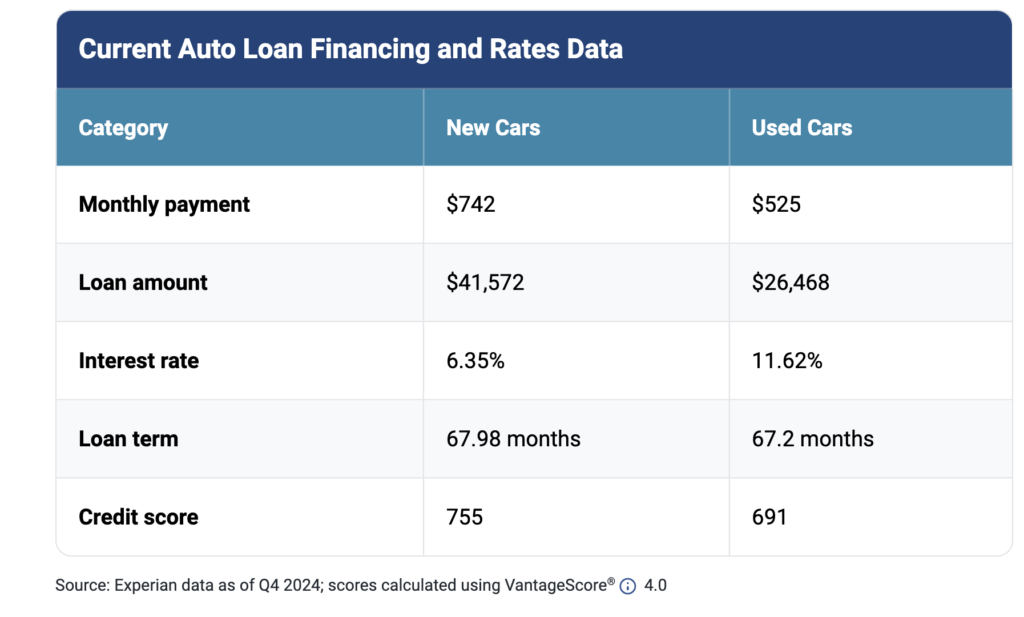
That means you’ll be financing your car. Nearly anyone can receive a loan on a car. The challenge will be getting the best rate possible. As your credit score decreases, the loan interest rate increases. In 2024, it’s common for borrows with ‘sub-prime’ or ‘deep-subprime’ credit to only qualify for rates over 15% APR. The worst auto loan rates are over 20% APR. How do you avoid these VERY costly interest rates? Work on raising your credit score, and having a sufficient income-to-debt ratio.
What is the moral of the story? If you want to get a car loan with little to no hassle, you need to always pay your loans, utility bills and credit cards on time. By doing this you will assure yourself the continued availability of credit at the best and least expensive rates and terms.
So always remember that banks are looking for your ability to repay your loan, the stability you have shown in your career and how often you have moved and how willingly you have paid back your past credit obligations. Ability, stability and willingness. These are the keys to good credit.

Do you ever wonder why car dealers are always trying to buy your car? It has something to do with how much dealers markup used cars. There is a lot of money to be made in used cars.
In my career, I’ve seen many different ideas about what the markup should be for a used car. There are many factors to consider. Let’s breakdown how dealers determine their price for used cars, and how much markup they apply to come up with the selling price.

Where to start? With a quick history lesson.
In the old days (you have to remember, I spent 42 years in the car business),pricing in the good old days was simple, easy, and best of all, it worked.
When a customer would walk in we knew how much profit was in the list price. We’d negotiate, and end up selling the customer their used car with a profit of $1,000 or $2,000. The best part was, the customer felt like a winner because they negotiated us off of our original price, and we made money.
Today it’s completely different. Today’s car buyers have access to more information before they walk in.
On the other side of the deal, car dealers today have software that helps them determine how much a car is worth. These software programs are complex. They tell dealers what they should price each used car at in relation to similar cars in the market so that they’ll sell. They can even take into account geographic and seasonal differences between dealerships.
Pricing for profit isn’t the primary concern for most car dealers. Even more important than profit nowadays is how quickly a dealership can turn its inventory. Turn is the term used to describe the amount of time a car sits on a dealers lot before it’s purchased by someone.
For many dealers (especially the big ones), the idea is to sell or turn your inventory within 60 days of acquiring it.
Many stores have strict aging policies for their used cars. If a used car doesn’t sell within 60 days (or at the max 90), off to the auction it goes. The dealer will sell a used car at auction and replace it with a different car that they think will sell within the 60 to 90 day timeframe. For most dealers, it’s important to turn your inventory as fast as possible. As a car sits on the lot, its actual value is declining. From the dealer perspective, what was worth $10,000 when you traded it is now worth $9,000 90 days later.
The longer a car sits on the lot, the lower the selling price becomes.
Most dealerships work on a strict 60 to 90 day policy for their used cars. This means they’re adjusting a used cars price downward every 10 days to try and sell the car.
There is even software that tracks how much interest a used car gets and changes the list price in realtime. Dynamic pricing decisions occur on an almost daily basis.

As much as the market will bear for that model. With that advent of sophisticated software platforms and “big data,” we’re seeing more and more dealers allowing algorithms to set prices, rather than human beings.
Last year, one iSeeCars survey showed that 31% of car buyers are paying over MSRP for new cars. At the used car level, it’s harder to collect similar data, but just imagine the markups running rampant.
That being said, the average used car markup today is probably about $2,500. Hard to find specialty cars (Ferrari, Lamborghini, McClaren and others), or models in short supply could (and should) be much higher. But, for your run of the mill used car, expect the dealer to have a $2,500 markup in the price. Remember, to get the best deal, you’ll want to find one of the older cars on the lot!
Ready to outsmart the dealerships? Download your 100% free car buying cheat sheets today. From negotiating a deal to leasing a car the smart way, it’s all available for instant download. Get your cheat sheets today!
At the end of the day, what’s most important to nearly everyone on this planet (after health, family, etc.), is money. Maslow’s hierarchy of needs tells use that after our psychological needs are met (food, water, shelter, etc.) we move on to our safety needs (personal security, employment, resources). Without a doubt, that means earning an income is a top priority. That begs the question, how much can a car salesman make?
In any given year, I managed salespeople that have well out-earned me (earning multiple hundreds of thousands of dollars). I’ve also managed salespeople that barely made a living at all.
In sales, it’s pay for performance, and for the car salesman, it’s no different.
Here’s how much a car salesman can make.

A car salesman’s income is tied directly to their effort and their skill level. For example, someone new to the business who is just starting to learn their craft might find themselves on a salary based pay plan for the first 90 days. This fixed pay plans would guarantee monthly earnings of $3,000 or so for the first three months on the job. After 90 days, pay plans for car salespeople generally go to commission only, although more and more dealerships today are developing hybrid compensation plans that include a salary plus commission, with the hope of encouraging more college educated people to consider a career in the retail automobile business.
How hard the salesperson works on developing their skills (either through available training or through practice talking with customers) will directly correlate to how much they make. Sales professionals are like athletes (bear with me here), in that they have to practice to continually improve. There’s a saying that amateurs practice to get it right, while professionals practice so that they’ll never get it wrong. Top car sales professionals always practice and rehearse so that they can make sure they “never get it wrong.”
You might enjoy this article if you haven’t read it already: What to Do If You’re Scammed by Car Dealership

Those who don’t practice or work on their skills (or those who sit aimlessly at their desk waiting for a customer to come in — the sad reality is that this represents the work ethic of a lot of car salespeople nowadays) as opposed to proactively seeking out customers, will usually find themselves at the very low end of the pay scale. This means they could be earning between $2,000 to $3,000 a month. I hate to categorize them as “bad” salespeople, rather they’re unmotivated salespeople, but the fact still remains, they’ll only be earning a few thousand dollars each month. Any aspiration of earning six figures or more each year is hard to come by for this group of salespeople, they’re lucky to make more than $40,000 annually.

An average salesperson, and by average I mean someone who sells around 8 cars a month, will make between $3,000 to $4,000 a month. Above average sales people, those selling between 10 to 12 cars a month, will earn somewhere between $4,000 to $6,000 a month. Selling 8 to 12 cars a month certainly isn’t going to make you rich, but it can provide a steady income stream. Plus, the jump from “above average” salesperson to “superstar” can represent a huge increase in earnings, one that almost certainly will cross the six figure threshold.

Top producers (of which there are very few), who are capable of selling between 25 to 50 cars a month will generally find themselves earning $150,000 to upwards of $500,000 or more annually. As someone once said, “that’s not chicken feed, that is some heavy duty money.”
Oh, and you don’t need a college degree in order to earn it, you just need to work on your craft (take advantage of training, never believe that there is nothing left to learn, utilize social media to create your own brand, and always practice and rehearse your sales techniques), and put forth the correct effort. The “correct” effort is staying in contact with your existing customer base and always remembering that all of your contacts with them are about them and not about you.
The most successful automobile sales people I know understand that nothing happens without first connecting on a human level with your customer and always maintaining that type of connection into the future. Building relationships (ie trust) takes time, and in sales it’s easy to lose sight of this. A lot of new salespeople like to focus their energy on the next sale. The salespeople I worked with that earned over $500,000 per year liked to focus on building lasting relationships (and getting referrals from) their existing customers. If you want to make more than six figures as a car salesman, this is one path to do it.
So there you have it, car salespeople’s earnings can range from not much, all the way to “you’ve got to shitting me, I didn’t know that you could make that type of money.” That is what makes the car business so great!

Over my 42+ years in the retail car business, I’ve seen too many different types of salesperson compensation plans. At each stop in my career, each pay plan had one thing in common — they were structured to keep the total salesperson’s compensation within the industry benchmark of 18 to 22% of expenses (more on that here).
Most comp plans (98%) fall within those industry benchmarks. So whether a salesman earned 35% of gross profit or 15% of gross profit on a deal, because of other factors involved, the compensation never really exceeded the 18 to 22% benchmark.
How could that be? Easy, every comp plan has things baked into it that lower what part of a sale’s gross profit is commissionable. For instance, most pay plans have a thing called “pack.”
Pack is a predetermined dollar amount that will be subtracted from the deal’s gross profit before the commission is calculated. Pack is utilized to cover such dealership expenses as advertising, inventory management software, utilities and non-revenue producing employees, such as administrative and accounting staff.
The greater the stores expenses are, the larger the pack will be.
As an example, in a store where the salesperson’s commission is set at 35%, the pack might be $1,500. That means that $1,500 is subtracted from the gross profit every time the salesperson closes a deal before the commission is calculated.
In a store where the commission is set at 20%, the pack might only be $500, but when everything is all said and done, each of those store’s sales comp would end up falling within the industry benchmarks of 18 to 22%.
What is truly interesting is that when everything is calculated into a salesperson’s commission (percentage of gross profit, unit bonuses, bonuses from the manufacturer for selling certain models, or hitting individual goals), the average commission for selling a car usually ends up being between $400 to $500. I don’t know why that is, I just know that over 42 years that’s what it would end up being for most of my salespeople.

The other interesting kicker is that most luxury brands tend to produce slightly higher commissions. This is simply because the gross profits tend to be higher as compared to volume brands like, Chevy or Toyota and say, Honda.
I remember working in a Pontiac store (yes, Pontiac was a brand) in the mid 1990’s, where I had two salesmen who each earned in excess of $150,000 a year (selling Pontiacs), while I, as their Sales Manager, was earning considerably less! I have also worked with sales people who represented high end luxury brands like BMW and Porsche who consistently were earning $400,000 to $500,000 annually. Those salespeople would even hire their own 1099 “staff” to help them with all the customer follow up, and relationship building.
If your goal is to make more than six figures selling cars, then getting into a luxury store may be beneficial for you. However, the barrier to entry at a luxury store may also be higher (ie they won’t hire just anybody).
Regardless, as you can see, there is a lot of money to be made in the retail automobile industry.
What if I told you there was no such thing as an unsold new car? Every new car, no matter how expensive, ugly, or unpopular, gets sold to someone at some point. In my 42 years in the car business, I’ve never met a car that didn’t end up with a buyer.
What happens to cars that end up sitting on a dealership’s lot? When you phrase the question that way, there are a few winding roads that new vehicles can end up journeying. Most cars are sold to a consumer. Good dealerships try and “turn” their inventory every 90 days. That is to say, if they can sell a car within 90 days of it arriving at their dealership, they do.
When I was a new car sales manager I would incentivize my sales staff to sell the oldest cars on our lot. Why? Because our dealership has a carrying cost for the vehicle. It’s important you understand what a carrying cost is, because it’s the primary driver for why there is no such thing as an unsold new car.

You may not know it, but car dealerships are just like you and me, they don’t buy each of the cars on their lot outright. Odds are, you wouldn’t go to a dealership and buy a $40,000 car in cash (some people can, but most people don’t), and dealerships are the same, they don’t go to the manufacturer and purchase millions of dollars in vehicles in cash. Instead, they, just like you, finance the cars.
You’re most likely well aware that new cars are depreciating assets, they’re constantly losing value. Just because a dealership is buying a car from a manufacturer doesn’t change this equation. From the dealership perspective, each day that they don’t sell a car is a day they are cutting into their potential profit (they have to keep paying interest on their loan).
Dealers pay both the interest on their loan for the vehicle, and the opportunity cost of keeping that car longer. There’s finite space on their lot, so each one that sits and takes up space costs them money.
In an ideal world (for the dealership) each car they have on the lot would sell within days of its arrival, but you and I both know this doesn’t happen.
Some dealerships I’ve worked for have had cars that celebrate birthdays (sit on the lot for more than 365 days without being sold). Why? I think it has something to do with ego, because most of the time it certainly doesn’t make business sense.
Most dealers are concerned with carrying cost (what we discussed above), and the largest dealers (the publicly traded ones) are measured by how quickly they can “turn” a car (move it from being on the lot to being in a customers hands).
Some dealers (in particular the old school ones) are steadfast that their staff should not discount a car to turn it more quickly. One dealer I worked for operated in this way, and we had many cars that would sit on the lot for well over a year.
Generally speaking, a car that sits on a dealer’s lot for 365+ days isn’t going to make the dealership any profit. However, in some cases the dealer can still find a way to make money.
Usually the cars that sit on a dealer’s lot for that long are relatively rare. What I mean by that, is that there aren’t many other cars with the exact trim level, or equipment, or color available. In my career, there were “new” cars I sold that were over a year old, and our dealership made a healthy profit on them simply because they were the only car in the country that included certain features.
In most dealerships cars really can’t go “unsold,” because that would upset shareholders (remember, the big public dealerships need to “turn” cars to keep their investors happy). However, in smaller, more “mom and pop” dealerships, “unsold” cars are more of a frequent occurrence.

Selling a relatively rare car to a consumer is the first “path” an unsold new car can go down. If you’re looking to buy a car, consider letting me help. There are of course many other paths unsold new cars can travel down as well.
At some dealerships older new cars are added to the service loaner fleet (the vehicles the dealership loans out to their service customers to drive while the car they own is being worked on) or as staff demos (cars the dealership staff can drive as a perk for working there). These cars are then converted to pre-owned inventory and marked down for sale.
If you’re looking to get a good deal on a new car, your best bet is to not buy a brand-new car at all. The truth is that a service loaner or demo are well-maintained cars and are lightly driven. This makes them great options for budget conscious car buyers who still want something “new.”
What happens if the car still doesn’t sell after being moved to “pre-owned?” This is where we enter the world of auctions. Automobile auctions are a foreign world to most, and with good reason, they’re restricted to registered dealers only, however they represent a multi-billion dollar industry with thousands of transactions occurring each day.
Dealers will frequently send cars to auction that they haven’t been able to sell them at their dealership. This is about as close to “unsold” as a car can get. Sending a car to auction typically means taking a loss, but it’s more valuable for the dealer to take a small loss at the auction than it is to keep the carrying cost of the car on their lot. It’s a trade off, and one that a lot of dealers make.
Generally speaking, manufacturers (frequently referred to as the original equipment manufacturer, OEM) work diligently to stock their dealerships with the right mix of vehicles. By stocking the dealership with the right mix of cars, OEMs are able to support their dealer partners in turning vehicles quickly. But, when that mix goes awry, and dealers truly can’t get a car off their lot, they’ll send it to the auction.
There are two types of auctions, open auctions and closed auctions. An open auction is open to any authorized dealer personnel, regardless of brand represented or whether being a new or used car dealership. A closed auction is restricted to dealerships that are franchised to represent that particular brand.
As an example, Honda may hold several auctions each month that are closed to Honda dealers only. This is done for the express purpose of selling off Honda lease returns and factory executive demos while maintaining a higher per car value because Honda dealers are willing to pay a higher price for nice pre-owned Hondas for their lot.
Cars traded into a dealership that the dealer doesn’t want for their lot are sold at open auctions. At open auctions, any dealer is invited to buy as many cars as they may like. These types of auctions are where many used car dealerships buy the inventory for their lots, and where many “unsold” cars eventually end up.
There are a few primary marketplaces for cars, the largest being Manheim, owned by Cox Automotive. If a car is “unsold”, odds are high it ends up at a regional Manheim auction. Most likely, some dealership will buy it.
If you’re interested in learning more about why there is no such thing as an unsold car, let us know in the comment section below. I’d be more than happy to explain how dealerships make money by buying cars at the auction.

So there you have it, no car actually ever goes unsold. Whether it be a dealer who holds onto a car until the right buyer comes along (even if that takes over a year), or a new car that gets converted into a used car, or if a car goes to the auction, every car eventually finds a home.
In my 42 years in the car business I never once saw a car, no matter how ugly, poor performing, or otherwise, not end up with a buyer. Something tells me that trend will continue for the next 42 years too!