
CarEdge saved me over 4,500 dollars on a brand new Honda Pilot. I can't say thank you enough.
Price intelligence
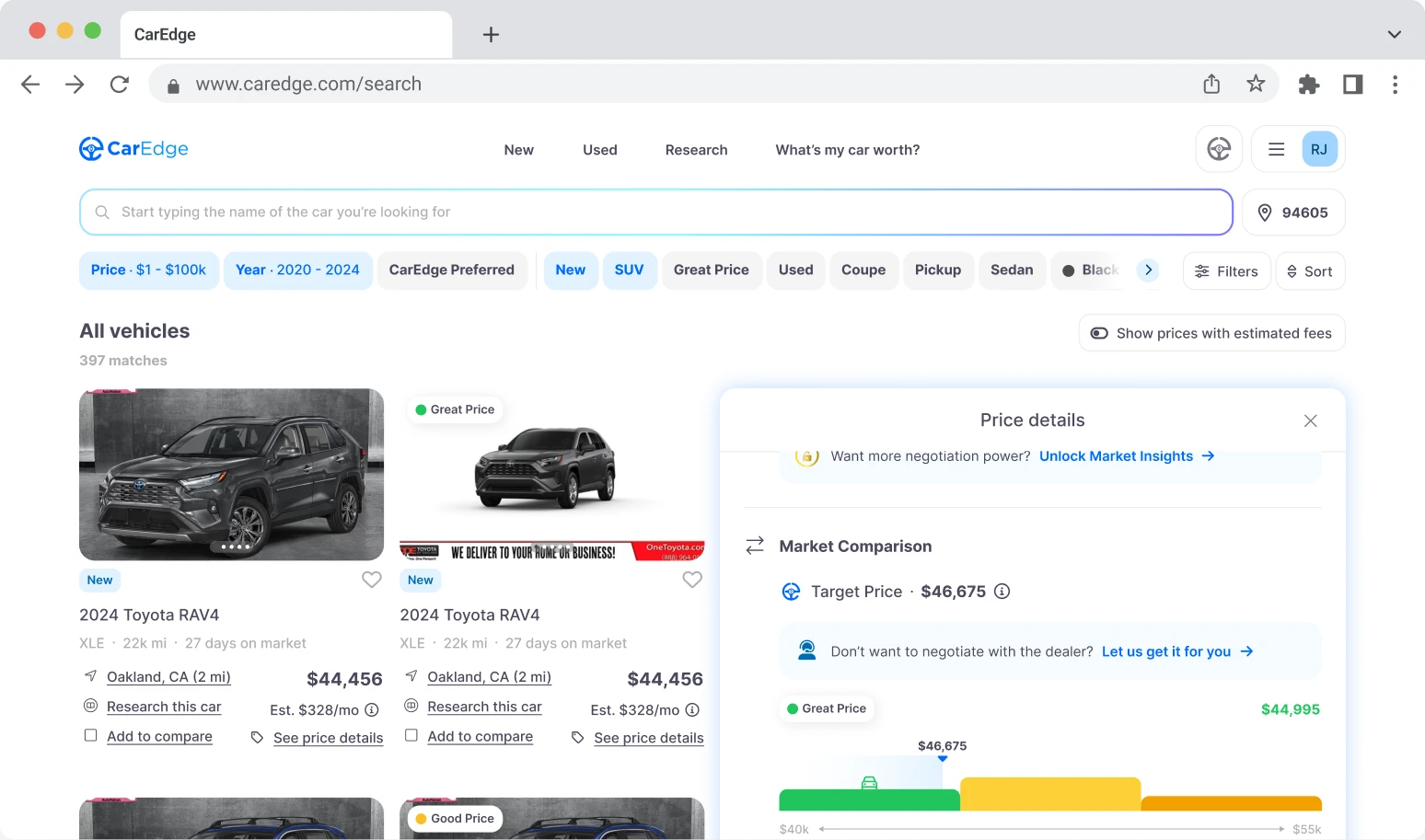
Find a wide range of vehicle listings with market insights on new and used listings near you.

What can I do with CarEdge?
 CarEdge Insights
What can I do with CarEdge?
Get access to exclusive information so you can make an informed car buying decision — all in one place.

Find a wide range of vehicle listings with market insights on new and used listings near you.
Track your vehicle’s value and cash in when the time is right to sell.

Access to our proprietary data to help you find the right car, at the right price. Find these unlocked on every listing after subscribing.

With our expert-led, tech-enabled car buying service, we will locate, negotiate, and deliver your vehicle so you can get a new car hassle free.


Help us personalize your CarEdge experience — it only takes a second.
Your answers help us personalize your CarEdge journey — we’ll follow up with tips and next steps that match your buying timeline.
The car business has taught me a lot over the 40+ years that I’ve been a part of it. Today I wanted to share with you the five most important things I learned during that time:
Be who you are — warts and all. It took me a while, but over the years, I figured out that it was important for me to be a little silly, a little off kilter, and a little different at the dealerships I worked at. Why? Because that’s who I am.
I remember many, many years ago, watching a guest on an afternoon talk show say that you should “dare to be different.” I hate to say it, but it’s easy to be pretty much the same, but if you dare to be different, you’ll inevitably stand out from the crowd.
For me, that meant having fun with customers, being both informative, and entertaining at the same time. When I was selling, I was giving the customer a show. Fortunately for them, there was no cover and no two drink minimum, but damnit, they were entitled to a good time.
My motto was simple, “if you give them a good show, they will part with their dough!” (As you can see, I stuck with car sales instead of poetry for good reason). Don’t feel pressured to act a certain way in the dealership, whether you work there, or you’re coming in to buy a car. Not only is it perfectly fine to be you, it’s encouraged. Be the best you, you can be.
If you find yourself having to tell something other than the truth, you are not only letting your customer down, but more importantly you are letting yourself down! As I have been known to share with a customer, “if the truth is going to preclude us from making a deal, then so be it, I’m not going to lie to you in order to make it happen.”
Jack Nicholson famously shouted from the witness stand in the movie, A Few Good Men, “You want the truth? You can’t handle the truth!” Maybe in the military he was right, but when it comes to sales, he was dead wrong.
Let a professional car buyer help. We do the hard stuff for you.
[mautic type=”form” id=”4″]
In sales the truth shall set you free. Rather than wondering down a twisting road of lies, each requiring you to remember what the last lie was, you can instead simply tell the truth. As I like to say, “if it is right, do it or say it, if it is wrong, don’t do it or say it, and if you are not sure if it is right or wrong, do both you and your customer a favor, and don’t say it.”
Tell the truth, you’ll both be better off for it.
In my 40+ year career in the car business, this one took the longest time for me to understand. You never want to say “no” to a customer, instead, you are always searching for a way to say “yes” to them. One way to do this? Always focus your conversation around what you can do. This puts both you and the customer on the path towards “yes.”
For example, let’s say you’ve quoted a customer a payment of $498 a month for a 60 month loan. Like most customers do, they say, “make it $450 for 48 months and we’ve got a deal.”
For the longest time my response was almost instant and almost always the same, “What are you crazy, I can’t do that,” and the ultimate result was almost always the same: we didn’t make a deal because it was too confrontational.
Later in my career, I handled the same situation very differently. I would tell the customer a story (selling is storytelling), about when I attended company-wide sales training, and they taught us to never tell a customer what we can’t do. “I should only tell you what I can do, and folks if you pay close attention to what I can do, you’ll probably notice that I am really telling you in a nice way, what I can’t do.” This was my go to script.
“So what I can do is $498 a month for 60 months. Can we make this work for both of us?” I’d finally ask.
This wouldn’t always work, but the results were an awful lot better than simply telling the customer, “nope, we can’t do that.”
Always speak to your customer in terms of what can be done. For both of you, it’s a much more fun and positive path to travel.
This one is as old as the hills but incredibly important, under promise and over deliver. If you tell a customer that you are going to do something, whether it be big or small, do it. I don’t care how small or trivial it is, if you say you’re going to do it, do it. Did you tell a customer that you’d follow up later on today with more information? Call them later that day, even if you haven’t gotten the information yet. If you don’t keep your promise you’ll erode valuable trust with your customer.
I cannot tell you how much that means to a customer, seemingly small things like picking up the phone and giving them a call when you said you would, is truly a difference maker. Trust me, the salesperson down the street probably won’t keep that promise. All you need to do is under promise and over deliver to take the first step towards being their go to “car guy.”
Remember, never promise more than you can deliver. If you do, you’ll instantly become a “typical car guy” in the customer’s eyes. Remember, dare to be different. Part of that difference is always doing more than you said you would. No ifs, ands or buts. If you promise it, do it!
It costs a ton of money to acquire a new customer. Whether your marketing includes digital, TV, radio, direct mail, etc, it’s incredibly expensive to acquire new customers at your dealership.
Dealerships invest in all this marketing to attract customers to their showroom, with the hope that their sales staff can sell them when they come in. If your store is really good, you’ll close 20 to 25% of the people that walk in for the first time. That means 75 to 80% of people aren’t buying on their initial visit.
Would you like to improve your odds of closing a deal? Of course you would. How can you? By concentrating your efforts on your existing customers.
Existing customers will close at a higher rate because they have already done business with you (if you treated them right the first time around). One of the best things your dealership can do is to configure a rewards program that is designed to encourage your customers, both sales and service, to remain your customer.
Perhaps you can guarantee an extra $500 trade value if they have always serviced and maintained their current vehicle at your dealership, whether they purchased it from you or not. Take a cue from your local supermarket or grocery store, they all have rewards programs for shopping with them. Come up with something similar for your dealership.
Research shows that existing customers will pay a higher average gross profit than a fresh customer. Do the math and you’ll realize that it costs a whole lot less to keep your existing customers than it does to go find new ones.
Those are the five most important things that I have learned in my 40+ years in the car business.
A car’s invoice price is the amount that a car dealership pays the manufacturer for a vehicle. By understanding how this price determines the overall sticker price of a vehicle, you can shop smart when hunting for deals. In this guide we’ll show you how to look up the dealer invoice price, no matter the car you’re interested in.
👉 Get a FREE dealer invoice price now (NEW!)
Did you know that car dealerships don’t own their inventory outright? Floorplanning costs are a little-known facet of the auto industry. At the center of the costs of being in the car business are invoice prices. The dealer invoice price refers to the amount a car dealership pays to the manufacturer for a vehicle. It’s important to know this price because it can serve as a valuable tool in negotiating the final cost of a car. By understanding the dealer invoice price, you can have a better idea of a fair price for the vehicle you’re thinking of buying.
Franchised car dealerships buy their inventory directly from their manufacturers. Similarly to you and I, dealers “floor plan” their purchases. Floor plan is industry jargon for “finance,” and it means that dealerships take out loans to pay for all of the vehicles you see on their lot, just like most consumers do when they finance the purchase of a new vehicle.
Dealerships receive an invoice directly from the factory telling them the price of the car (including the destination fee) that they owe. The dealer invoice is something you’ll want access to when negotiating the price of a new car.
When it comes to used cars, they are primarily bought and sold from the auctions or customer trade-ins, and in these cases looking at a dealer invoice price won’t be an option. You can always ask a dealer what they paid for a used car, but there typically won’t be a willingness to share that information.
On the new car side of things, dealers are much more likely to be open and transparent about the invoice cost they paid to purchase a vehicle. This has become a sales tactic that nearly all car dealerships use to convince customers that they are getting a fair deal.

👉 Get your FREE dealer invoice price from CarEdge (NEW!)
Looking for something else? Here’s how you can go about finding the dealer invoice price when buying a car…
At the end of the day, there is only one foolproof way to get the invoice price of any new car — ask the salesperson or sales manager at the dealership. This doesn’t have to be overly complicated. A quick email that says, “Hi, I am interested in this Ram 1500 pickup truck, and I want a fair deal. Can you please send me out-the-door pricing, a copy of the Monroney label, and the invoice you paid from the factory?” Will go a long way.
Referencing the out-the-door price is a great way to show a salesperson or sales manager that you know what you’re talking about, and you don’t want to spend hours discussing monthly payment goals. Asking for the Monroney label, or window sticker is also a great way to show you’re on top of your game. You want to know what options and features the vehicle has, and what better way than to look at the Monroney label? And finally, asking for the factory invoice makes it clear to the dealer that you want to make a fair deal.
The same thing applies to money factors when leasing a car. Do not be afraid to ask a dealer what the money factor is on a lease, and to follow that question up with, “Is this the buy rate, or are you marking it up?” If the dealer can’t give you a straight answer, that’s another sign it’s time to find someone new to work with.
Set a target price: Determine a target price based on the dealer invoice price and any applicable incentives or rebates. This will give you a starting point for negotiations.
Preparation is key: Bring printouts of your research, including the dealer invoice price and any incentives or rebates, to the dealership as evidence to support your negotiation. Don’t forget this negotiation cheat sheet!
Stay calm and confident: Negotiating can be stressful, but staying calm and confident during the process can help you secure the best deal possible.

Ready to outsmart the dealerships? Download your 100% free car buying cheat sheets today. From negotiating a deal to leasing a car the smart way, it’s all available for instant download. Get your cheat sheets today!
As billions of people shelter in place, many household brand names are struggling to find their footing. Hertz Rental Car is one of them. With the drastic decline in travel (both business and personal), Hertz is faced with more uncertainty than ever before. As Hertz contemplates filing for bankruptcy, our team at CarEdge is considering what impact that would have on the used car market, and specifically used car prices and deals for consumer.
Should you buy a used car today, or wait a few weeks or months to get a better deal? That’s the money-saving question, and Hertz’ bankruptcy decision will certainly implicate what makes the most sense.
With a total fleet of over 856,800 vehicles globally (as of 2018), it’s safe to say that Hertz has a lot of vehicles under their ownership. What would happen if Hertz has to liquidate those assets to pay back their creditors? In the United States alone, the company has more than 500,000 vehicles under their ownership. If Hertz files for bankruptcy and has to sell all of these used cars, what would happen to used car prices?
Let’s explore.
It’s important to understand that car dealerships base their used car prices off of “market value.” Like I’ve written about in the past when discussing how much dealers mark up their used car inventory, dealerships use software like vAuto to constantly adjust their used car prices to reflect what people are paying for similar cars in their region.
That being said, if there was an influx of used cars that flood the wholesale market, we would anticipate that demand to purchase those cars would not keep up, ultimately lowering the price per vehicle. We’ve already seen a decrease in wholesale prices for used vehicles, with a historic 9.2% drop in whole prices recorded in April, according to data reported by Manheim Auto Auctions, the largest purveyor of used car auctions in the United States.
Let a professional car buyer help. We do the hard stuff for you.
[mautic type=”form” id=”4″]
Hertz, and their creditors desperately want to avoid having to liquidate their inventory of vehicles, because they know prices are already suppressed. According to Bloomberg, they’re looking for any option other than a “fire sale.”
But what would happen if hundreds of thousands of used cars immediately flooded the market? Because of the sheer scale of their liquidation, it’s not likely that Hertz will be able to liquidate many vehicles directly to consumers. That means car dealers will buy up their inventory at suppressed prices, and in return sell them at lower prices (of course with a margin still built in).
If the supply side of our equation increases by 500,000+ units, and the demand side stays the same, you ultimately have a decrease not only in wholesale prices, but also retail prices. Car dealers will need to sell their inventory to sustain their cash flow, and in theory, good deals should be for the taking. Ultimately a large increase in used car supply will trigger car dealership’s “dynamic pricing” tools to rapidly lower their selling price, while still maintaining some profit margin, at least that’s our supposition.
One of the questions I get asked frequently is if buying a rental car is a good value. The answer is, it depends.
With Hertz potentially liquidating hundreds of thousands of cars, I can assure you there are some vehicles they’ll be selling that you’ll want to avoid, and some you’ll certainly want to take a closer look at. How can you tell which rental cars make good used cars? Here’s my advice.
Take into consideration where the car was driven. To find this out you can look at the vehicles CarFax report. Although it won’t tell the full story of what a vehicle has been through, knowing where it spent most of its time is helpful.
For example, very recently we helped a client purchase a used car in Anchorage, Alaska. The vehicle was previously a rental car, and it only had 14,000 miles on it. Why? Because in Alaska they have an incredibly short summer rental season, and this car had been driven hard for three months, and then was ready for sale to a local resident. What did that mean for our client? They got a great car, at a great price, with relatively few miles, in driving conditions that focused entirely on highway roads, not city streets. In this example, buying a rental car is a great used car value.
On the other hand, if you’re looking to buy a rental car and it spent most of its days in a major city center, you may want to think twice. Scratches and dings are almost certainly going to be present. How many potholes can one car drive over before the tires need to be realigned? The brake pads may be worn, etc, etc.
If you do want to buy a rental car as a good used car value, you’ll want to get a pre-purchase inspection completed in advance, to confirm everything is in good working order.
Whether Hertz goes bankrupt or not, you can buy vehicles from them. Hertz Car Sales is a business unit within Hertz that comprises 75 retail store fronts nationwide. Hertz Car Sales would not be able to support the liquidation of all Hertz inventory in the event of bankruptcy, however it is likely they would see an increase in used car sales.
That being said, Hertz Car Sales takes a “one price” approach, which means you will not be able to negotiate the selling price of a vehicle. Time will tell, but you may end up getting a better deal if you buy a car through a dealer instead.
Keep in mind other car rental companies, like Avis, Budget, and Enterprise also offer similar programs which may be worth investigating at this time too.
Used car buying can be stressful. Our Honda Certified Pre-Owned review is meant to help.
One of the perks of buying a certified pre-owned vehicle is knowing that it meets the manufacturer’s standards for quality and worthiness. That being said, every manufacturer has a slightly different certified pre-owned program, and Honda actually offers two variants.
HondaTrue Certified, and HondaTrue Certified+ are two levels of certified pre-owned offered by Honda on their vehicles. Below we’ll tell you what you need to know about both before you buy your next Accord, Civic, Odyssey, or CRV.
CarEdge score: 7/10
HondaTrue Certified+ is Honda’s premier CPO program. Vehicles that are less than one year old qualify for Certified+ distinction.
CarEdge score: 6/10
Honda’s “non-plus” variant of certified pre-owned is valuable for customers. Below we breakdown what we like and dislike about both CPO programs.
What’s to love about Honda’s CPO program?
What’s missing or lacking about the program?
If you’re interested in reading all the fine print, you can click here to access the entire CPO warranty booklet. Below we’ll go in depth into key aspects of the certified pre-owned program.
Expendable Parts
Maintenance procedures
Clutch, Brakes & Tires
Batteries & Bulbs
This limited warranty does not cover any emission-related repairs, including but not limited to the following:
This limited warranty does not cover any item concerning the vehicle’s general appearance including cleaning, polishing, normal wear and deterioration of any part.
Body Parts & Trim
Interior Parts, Upholstery & Trim
Glass & Mirrors
Wheels
As you can see, a lot of items are not covered by the CPO warranty. This is one of our biggest frustrations with Honda’s certified pre-owned program. Unfortunately for the customer, they will likely end up having to pay out of pocket for something on their CPO vehicle, even though they are paying for the privilege of it coming with this extra warranty.
Similar to Toyota’s certified pre-owned program, Honda also offers a 12 month roadside assistance program for CPO vehicles. This is a nice perk, and one that more and more manufacturers are offering.
The specific benefits that come from Roadside Assistance are:
For a vehicle to qualify for CPO status, it must pass a rigorous 182-point inspection by a Honda certified technician. The inspection includes confirming that no aftermarket parts have been added to the vehicle, that the entire interior, exterior, and underside of the vehicle are of high quality, and that the tires, brakes, and engine are in good working condition.
For a complete list of what is included in the inspection, you can click here.
We hope you found this Honda Certified Pre-Owned review helpful. Navigating the car buying journey can be challenging, and we’re here to help!
Buying a new car is no simple task. Stepping foot into a dealership can sometimes feel like you’re entering a new world. The lingo, the slang, the terminology. It’s all intimidating. Not to mention the fact that engaging with many car dealers is like pulling teeth to begin with. Throw in foreign words, phrases, and jargon, and it can be even more challenging to feel comfortable and confident when buying a car. This is why we created The Car Buyer’s Glossary of Terms.
We took the time to compile a glossary of terms, acronyms, and jargon you should know before going into a dealership. Click on any of the links below to jump to a specific section in The Car Buyer’s Glossary of Terms. If you think we missed a word, phrase, or acronym that belongs on this list, please let us know in the comments below.
Without further ado, here is The Car Buyer’s Glossary of Terms.
An acquisition fee, also commonly referred to as a bank fee, only comes into play when you lease a car. This fee is charged by the leasing company to initiate the customers lease and is required on all leases. The lease acquisition fee usually includes GAP insurance to protect both the lessor and the lessee in case of vehicle damage resulting in a total loss. The acquisition fee can range from a few hundred dollars, to more than a thousand dollars. This depends on the leasing company and the car being leased.
Additional dealer markup, or market adjusted pricing, is a tool that dealerships use to increase the asking price for a particular vehicle. This is typically listed on the addendum sticker that is placed next to the Monroney sticker to reflect any dealer installed items and adjustments. This usually occurs on vehicles that are in high demand and short supply.
Annual percentage rate is as common a term in a car dealership as it is at your local bank. Commonly referred to as APR, the annual percentage rate represents the annualized interest rate on a loan (or credit) of any sort. Instead of getting an auto loan at 0.0000110 per day interest, you get a loan at 4% APR. The annualized interest rate is simply easier to understand and reference.
Car auctions represent the underpinnings of the retail car market. Registered car dealers can sell and buy cars at used car auctions across the world. Manheim is the largest used car auctioneer. Dealers have access to manufacturer sponsored auctions where dealers franchised to sell those brands can buy retired company cars and captive lender lease returns.
Blue book value refers to the often referenced price sourced by Kelley Blue Book (kbb.com). Kelley Blue Book is well regarded in the automotive industry, having their used-car pricing guide in publication since 1926.
Most car leases are of the “closed-end” variety. A closed end lease means that the customer is not obligated to purchase the vehicle, or guarantee the lease end residual value of the vehicle at the end of the term. This means the customer does not have to buy out the car at the end of the lease. With an open end lease the customer is obligated to guarantee the lease end residual value of the vehicle.
Dealer incentives and factory incentives are one and the same. They are the incentives that the manufacturer pays to the dealership, and dealership personnel in order to encourage the sale of certain vehicles. These incentives can also take the form of monthly and quarterly sales goals as determined by the manufacturer.
Customer incentives, such as rebates, special financing options, and discounted lease rates are what the manufacturer will advertise and underwrite. These are put in place to encourage the sale of certain cars.
A car’s Monroney sticker provides an overview of relevant information about a new vehicle. Not included on this window sticker are any dealer added accessories. For example, dealers may add aftermarket wheels, undercoating and other features that can raise the asking price above the MSRP. These modifications will appear on a secondary window sticker known as the dealer addendum sticker. This ensures that you, the buyer, have full clarity into what the car includes, and what came from the manufacturer as well as what the dealer added.
A dealership markup may refer to the difference between the price a dealer pays to acquire a vehicle (often the wholesale or invoice price) and the price at which they sell it to the end consumer. In some contexts, it can also refer to the markup added to MSRP by the dealership. See Market Adjustment.
The destination charge is part and parcel of a car’s MSRP, and is listed on the window sticker as a separate line item that makes up the total manufacturer’s suggested retail price. The destination charge is not something that dealers pass on to the customer. It is a charge that the manufacturer imposes.
The disposition fee is non-negotiable, and only charged to a customer when they return their lease car and do not lease or finance another car through that lender or leasing company. This fee is charged in addition to any excess wear and tear items that might be discovered at lease end. The disposition fee helps to mitigate the lenders cost to recondition, transport and register the car for sale at the auction.
This is a fee that the dealerships charge to help offset the costs of non-revenue producing dealership personnel such as accounting staff, title clerks etc. Most states cap the dealers as to how much they can charge for the documentation fee, and this amount varies from state to state.
As with any loan, the down payment represents the cash paid upfront to reduce the total size of a loan.
Another charge only applicable to leases, an early-termination fee is exactly what it sounds like, it is an additional charge for cancelling your lease before the term is over.
Yet another lease specific charge, excess wear charges are incurred on leased vehicles that (upon their return) contain dings, dents, scratches, tears, etc. At the lease-end inspection (click here to jump to lease-end inspection), you will be notified if there are any excess wear charges. This also includes if you exceed your allotted mileage for the term.
An additional product sold by the dealership, that is sometimes referred to as a service contract. It covers service and repair costs that may be incurred beyond the vehicle’s factory warranty.
One of three revenue generating sections of a car dealership, the finance and insurance department is where you’ll sign your paperwork for your new car. The F&I manager will walk you through all of the documentation of your purchase, as well as give you the opportunity to purchase additional products (extended warranties, tire and wheel protection, etc.)
The cost incurred by a dealer to purchase inventory in their dealership. More on dealership floorplanning can be found here, on the NADA website.
Exactly as it sounds, gap insurance provides supplemental coverage for the difference between the cash value of your car and the amount you owe your lender or leasing company at the time of a claim. For vehicles with steep depreciation, gap insurance can be an attractive option.
The proportion of a loan that you are charged for the privilege of being lent money.
The price a dealership pays the manufacturer for a vehicle they have purchased.
This is dealer slang for a customer who accepts the first offer during negotiations, or chooses to not negotiate at all.
Manufacturers offer limited (in terms of scope and term) warranties on their new cars. Terms can be as few as a year or two, and scope frequently does not include general wear and tear items like tires and wiper blades.
The lease end inspection is mandated by the leasing company. The inspection includes recording the miles on the odometer, inspecting the vehicle for excess wear and tear, including such items as tire wear, scratches, dents, dings and windshield damage, and confirming that no aftermarket accessories were added to the vehicle. Oftentimes the lease end inspection is done by dealership personnel on the lender’s behalf, or if a customer prefers, a third party inspection can be requested.
A car dealership market adjustment refers to an additional charge or discount applied to the manufacturer’s suggested retail price (MSRP) of a new vehicle. This adjustment is determined by the dealership and is based on various factors, primarily local demand and availability of a particular vehicle model. The market adjustment is always negotiable.
Market Day Supply (MDS) in the auto industry represents the number of days it would take to sell current vehicle inventory at the existing sales rate. It helps dealerships and manufacturers gauge demand and adjust production and pricing strategies. A lower MDS often indicates high demand, potentially leading to higher prices, while a higher MDS may result in discounts and promotions to accelerate sales. In a healthy market, you can expect MDS for mainstream models to be between 45 and 65 days of supply.
The money factor is utilized by the leasing company to establish the interest portion of a lease payment.
Also commonly referred to as a window sticker, the Monroney sticker is a federally mandated label on all new cars in the United States. Named for Almer Stillwell “Mike” Monroney, a U.S. senator from Oklahoma who sponsored the legislation in 1958, the Monroney sticker contains information on the MSRP, fuel mileage, country of origin and more. Ray wrote this guide to understand how to read a Monroney sticker.
The Manufacturer’s Suggested Retail Price is the factory’s recommended selling price for a vehicle. Nine times out of ten, a dealership does not sell a car for it’s MSRP. Most are negotiated below that amount, since the dealer can still make money.
The total cost to purchase a vehicle. Also sometimes referred to as the “on-the-road” price. This includes all taxes, fees, and the selling price of the vehicle.
A rebate is cash that is advanced to the customer by the manufacturer as an inducement for the customer to buy the car. In the vast majority of cases the customer opts to use the rebate amount as additional cash down on the purchase. The other option for the customer is to request that the manufacturer actually mail them a check for the rebate amount after the sale. This probably happens less than one percent of the time.
The residual value represents the expected value of a vehicle at the end of a lease term. Cars depreciate, and lease rates are determined based off of the expected residual value of a vehicle at the end of a term. Residual values differ for every car.
Generally synonymous with extended warranty (click here to go to extended warranty), a service contract is a dealer sold product that covers repairs or service beyond the manufacturer’s warranty.
Loans granted to individuals who have less than stellar credit scores. Typical subprime credit scores fall below 600. More on the credit scores car dealers use can be found here.
The duration of a loan or lease as agreed to in your contract. Typically anywhere from 24 to 84 months.
Issued by the Department of Motor Vehicle in each state, a title represents a vehicles proof of ownership. Note that if you finance your car the bank will hold the title (known as a lien) until the loan is paid off. Similarly, if you lease a vehicle, the leasing company will hold the title.
When you sell your vehicle to a dealership during the process of purchasing another car. The “traded-in” car’s value is put towards the sale price of the next vehicle.
Cars, trucks, and SUVs come with a dizzying array of options. Trim levels are manufacturer created tiers of standard equipment and options. For example a BMW 3 series comes in four trim levels; 330i, 330i xDrive, M340i, and M340i xDrive. The model is a 3 series, the manufacturer is BMW, and the trim level is the 330i, 330i xDrive, M340i, and M340i xDrive.
Also referred to as “being under water,” or “negative equity,” this term refers to when you owe the bank more money than the vehicle’s current value. A high percentage of people find themselves in this position when they go to trade their existing car in towards a new one, especially if they took out a lengthy loan.
A 17 digit identification number that is unique to each vehicle. A vehicle’s identification number will include codes for year, make, body style and engine. VINs are typically found under the windshield or along the door jambs of a vehicle.
Ready to outsmart the dealerships? Download your 100% free car buying cheat sheets today. From negotiating a deal to leasing a car the smart way, it’s all available for instant download. Get your cheat sheets today!
When it comes to buying a used car, the process can be intimidating. One way to make it “easier” is to buy a certified pre-owned car. Toyota offers a certified used program, and below we’ll discuss its pros and cons. If you’re thinking about buying a certified pre-owned RAV4, Highlander, Camry, or Corolla, you’ll want to read this brief guide before you sign on the dotted line. Here is CarEdge’s Toyota certified pre-owned review.
CarEdge score: 7/10
We rate Toyota’s certified-pre owned program a 7 out of 10. There is a lot to like about Toyota’s used car certification, and a few things to be left longing for.
What’s to love about Toyota’s CPO program?
A complete breakdown of Toyota’s certified pre-owned program can be found here: https://www.toyotacertified.com, and I strongly recommend you become familiar with that website if you are considering purchasing a Camry, Corolla, RAV4, etc, etc. Below we breakdown the key features of each primary component of the CPO program.
If you’re thinking about buying a car, you might enjoy this article if you haven’t read it already: How Much Do Dealers Markup Used Cars?
Certified pre-owned Toyotas come with two warranties; a comprehensive bumper-to-bumper warranty, and a powertrain warranty. As with all warranties, there are a few disclaimers that you need to be familiar with. For example, on the 12-month/12,000-mile comprehensive warranty there is a laundry list of items that are not covered.
All interior and exterior cloth, leather, and stitching including convertible tops and/or vinyl tops including but not limited to: any vibration, deterioration, discoloration, disfigurement, warping, fading, staining, stretching, ripping, punctures, tearing, and/or scratches.
What does this mean for you? If something breaks in your certified pre-owned Toyota vehicle, the odds are it might not be covered by your one year warranty. On the plus, the powertrain warranty is much more comprehensive, and Toyota stands by that warranty for 7-years or 100,000 miles (from the date of first purchase), whichever occurs first.
All certified used Toyota vehicles come with one year of roadside assistance. This is a nice perk and covers a variety of “oh no” moments like:
To become a certified used Toyota, a vehicle must pass a rigorous 160 point inspection (165 for fuel cell vehicles, and 174 for Hybrids). One thing we love about the Toyota certified pre-owned inspection is that it covers both mechanical and cosmetic aspects of the vehicle, and it must be completed by a factory trained technician.
The complete list of what is inspected can be found here: https://www.toyotacertified.com/160-point-inspection
Overall, our review of the Toyota certified pre-owned program is positive. We wish there were more items covered by the comprehensive warranty, and that the warranty lasted longer. We appreciate the powertrain warranty, 160 point inspection, and roadside assistance programs.
If you’re in the market for a Toyota vehicle and you’re torn between new, used, or certified pre-owned, you wouldn’t be making a mistake to consider a CPO vehicle.
One thing you learn as you get older is that there’s no such things as an “easy way out.” Although, when it comes to ending your car lease early you may have a few options. Depending on your circumstances, there are a few creative ways you can end your car lease early without hurting your bank account.
Car dealers, and their manufacturers are always looking for two things;
If your lease isn’t due for another few months, but you really want to get into a new car, the odds are that a dealer is going to put their best foot forward to help you make that a reality. Why? Because they’ll make money selling the new lease, and they’ll sell another car. Both of those things benefit the dealer.
Although, this positive attitude needs to be taken with a grain of salt. Your current lease agreement is a legally binding document. It says you will make a certain amount of payments over a certain term, and that if you don’t, there will be specific consequences.
Buying a car (and getting a good deal) is all about leverage. If your lease isn’t due for 3 months, and you have a legally binding contract that says you’ll make the remaining payments, you don’t have too much leverage. Don’t fret though, because remember, the dealer and the manufacturer do want to help you get into a new car, but they also don’t want to give up the money they could be making if you completed the full term of your lease.
With all this being said, there are some creative ways you can approach this situation. Let’s get into the weeds of how you can end your car lease early.
The short answer is “no.” The long answer is “probably.” Why do I say that? Because a lot of factors are in play.
First, how many monthly payments do you have left on your current lease? One, two, twelve? If you have less than three, the odds are high that the dealer and the leasing company will work with you to forgive your remaining lease obligations in exchange for getting into a new car (although there are caveats to this that we’ll cover below). On the other end of the spectrum, if you have six, eight, or twelve payments left on your lease, there is less likelihood that the dealer or the leasing company will have any interest in helping you out. Why would they? You’ve got a whole year’s worth of payments to continue making, and with each check you write, they make money.
Take a look at your original lease agreement and locate the termination date of the lease (the date you would return the car if you completed the lease). You can typically also find this information in your online payment portal, if you have access to that. This date is the most important thing for you to keep in mind, and it’s the date that the dealership and the leasing company will be referring to when they consider how “friendly” they’ll be in forgiving your remaining lease payments.
To end your car lease early without penalty, you’ll want to research lease pull ahead programs. Car lease pull ahead programs are specific incentive programs that leasing companies create to entice prospective customers to lease a new vehicle.
Leasing companies generally do not provide this information in a publicly available way. Instead, each month the captive finance company (BMW Financial Services, for example) will send it’s dealerships (BMW dealerships) a list of new and ongoing incentive programs for customers.
These lists are humongous, complex, and not particularly easy to understand. Within these monthly guidelines dealers may find pull ahead programs (among other things) that are intended to incentivize customers to buy new cars. Keep in mind that incentive programs are different for each region within the United States. Two dealerships may have two very different incentive programs in any given month. This is partly why you don’t see lease pull ahead programs advertised nationwide.
You can try and find this information online, although your best bet is to call your local dealership, or the leasing company itself.

If you want to research online for lease offers, my recommendation would be to search for a specific manufacturer, for example “Chrysler lease offers” and go directly to the manufacturer website (like the example above).
Or, another option that is worth your time is a website called LeaseHackr, where individuals share lease deals they are aware of. Be warned that the offers you see on this website may not be available in your specific area.
It’s important to understand that dealers and leasing companies typically have more incentives in place if you lease the same vehicle, or with the same manufacturer again. Generally speaking, there are fewer programs if you end your lease early with Audi and then get a BMW, other than a conquest program to encourage a current Audi owner to move to a BMW, for example. That isn’t to say that programs don’t exist (they do), it simply means that incentives and offers are greater when you stay with the same brand from one lease to the next, especially when you want to end your current car lease early.
To this point we’ve talked about how you can end your lease early, but we haven’t spent any time discussing when it makes sense to actually do so. If you’re reading this near the time of its publication (April of 2020), then you know we are in the midst of the global coronavirus pandemic. It may be surprising to read this, but now (this month) is a good time to end your car lease early and get into a new car.
There are two reasons why.
At the end of the day, if you’re looking to end your car lease early you need to recognize that you have a legal obligation to fulfill the contract you signed. With that being said, you know that dealers and leasing companies want to lease you a new car, and you can use that to your advantage to ask for incentives and programs to help offset the remaining payments you have on your current lease.
Since the beginning of time, one aspect of business has always held true: cash is king. Without cash on hand, no business can survive for too long. Car dealerships are no exception to this rule, and as Coronavirus disrupts the lives of every person across the globe, consumers are faced with the question, “Is now a good time to buy a car?” We call this the Coronavirus car buying conundrum.
For many, the thought of buying a car right now is unfathomable (why leave the house?), but for others, there is good reason to wonder if now is the right time to buy a car. Regardless of whether your lease is up, your car broke down, or you simply want to take advantage of good deals, the question remains, “Is now a good time to buy a car?”
Buying a car during Coronavirus is unlike any other time in history. This isn’t a repeat of the Great Recession, and car dealerships weren’t around during the Spanish Flu. There’s no “playbook” for how this will turn out. What we do know however, is that there are some really compelling reasons to buy a car right now. Below we’ll discuss what they are, how you can take advantage of them, and what it means for you if you’re interesting in buying a car during Coronavirus.
One of the most challenging aspects of buying a car during the Coronavirus pandemic may simply be finding a dealer who will work with you to sell a car. In a few instances, for our customers, we’ve found it difficult to actually consummate a car deal. Stay at home orders, dealerships laying off sales staff, and myriad other reasons have made it harder than ever to actually go through the car buying process.
Let a professional car buyer help. We’re former dealership employees that locate, and negotiate on your behalf.
[mautic type=”form” id=”4″]
That being said, car dealerships are considered essential businesses by the federal government. Cybersecurity and Infrastructure Security Agency (CISA) Director, Christopher C. Krebs sent out a memo outlining which workers were deemed essential.
Workers critical to rental and leasing of vehicles and equipment that facilitate continuity of operations for essential workforces and other essential travel. And, Employees who repair and maintain vehicles, aircraft, rail equipment…
The memo is not explicit that car dealerships are to remain open, however it does make it clear that service departments should be accessible to the public.
Service and parts departments (at most dealerships) are open like normal (many with limited hours however). Sales departments in many locations are operating on an appointment only basis.
Federal guidelines can be superseded by an individual state. For example, in Michigan their initial “shelter in place” order deemed sales departments at car dealerships to be non-essential, however a revision was put in place that determined that sales departments are essential, which has enabled remote transactions to take place.
Before you try and buy a car, you need to research your state’s guidelines to determine if sales departments are open. From our research we have found that in most states the sales departments of a car dealership are open, but only on an appointment only basis. That means you need to call the dealership and arrange an appointment to come in and meet with them. Or, if you prefer, nearly every dealer is now offering to bring vehicles to you for test drives and delivery as an option.
Currently there are a slew of programs in place from manufacturers to try and sell more cars. Like we discussed in “How do car dealers make money?”, manufacturers desperately want to sell more cars so that they can impress their investors. As a result, from time to time, they will offer incentives to try and sell more cars.
Coronavirus car buying has led to manufacturers offering incentives that we haven’t seen since the Great Recession, in an attempt to sell more cars. For example there are currently programs that:
For a complete (and updated!) list of manufacturer incentives and programs, read our Coronavirus car deals coverage here.
Since manufacturers are offering incentives, does that mean you should buy a car right now? Not so fast… It depends where you live.
In most parts of the country, where there have been substantial limits placed on car dealerships, you should take advantage of current deals. Remember that dealerships incur carrying costs for each vehicle that sits on their lot. Everyday a car sits on their lot, they’re paying interest, and paying interest on a car they can’t sell gets very expensive very quickly.
With that in mind, dealers could go bankrupt in the near future, and the threat of running out of cash means dealers will grow more and more desperate to sell cars. If you’re in an area where restrictions have been severe, the odds are that now is as good a time as ever to buy a new car.
In other parts of the country, where restrictions are less severe (ie central and midwest USA), you may want to wait. In those areas of the country a lot of dealers are still operating like normal (or at least more closely to “normal”). With that being said, they aren’t “feeling the pinch” quite as bad as dealers in other parts of the country. If you’re in one of these locations you may want to wait a few weeks before buying a car.
For example, in North Dakota and Iowa there are currently no restrictions on car dealerships, whereas in Pennsylvania and Vermont dealers have seen virtually no sales over the past few weeks.
Most car dealerships, just like most small businesses, don’t have an emergency fund of cash that they can depend on when sales go south. As you’ve probably heard on the news, businesses of all shapes and sizes are looking for loans from the government to stay solvent. For car dealers that are in this precarious situation, they’ll be more than willing to make a deal with you to sell a car.
Remember, if you’re going to buy a new car, here are the documents you need to take with you. Oh, and always have a positive attitude!
Among the many offers from manufacturers aimed at selling more cars, most are offering some sort of special financing option. Many are offering 0 percent financing for up to 84 months on the purchase of a new or certified pre-owned vehicle that is financed through their captive lender.
For example, if you were thinking about financing the purchase of a new Jeep Gladiator you could get a loan from your local credit union, a big bank, or through Chrysler Capital (Jeep’s captive lending company). The “0 percent financing” offers you keep hearing about? Those are only available if you finance through the captive lender. And, before you get your hopes up too high, know that not all vehicles are offered for this special financing. Chrysler Capital actually isn’t offering 0 percent financing for the Jeep Gladiator, for example.
Another consideration to qualify for 0 percent financing is that you need to have a certain credit score. Car dealers use special credit scores to determine your creditworthiness. In order to qualify for 0 percent financing you’ll need to have a credit score at least above 700, and in some circumstances that won’t even be enough. Although manufacturers are advertising these “great” financing options, the reality is you won’t know if you truly qualify for them until the dealer runs your credit application.
That being said, even the “second tier” offers, like .9 percent financing, are still available for those that don’t qualify.
Don’t be tempted by 84 and 72 month loan offers. It’s wise to limit the length of the term you take on your loan, or else you’ll be buried in negative equity if/when you go to trade in your car. Even with 0 percent financing, you’d be wise to take a 5 year loan or shorter.
Buying a car during Coronavirus may seem like a daunting task, and it certainly is a lot different than it would have been just a few shorts weeks ago, but don’t let that stop you from taking advantage of good deals. And remember, if you want a professional to negotiate your car deal, get in touch, our team is here and happy to help!
What's happening across the globe right now is unprecedented. Coronavirus and COVID-19 are drastically changing the way human beings live their lives. Yet, having said that, car manufacturers are still determined to sell cars. Whether you're in the market for a new car or not, there are officially "Coronavirus car deals" for the taking.
As we continue to negotiate car deals for our customers, we are coming across more and more special offers from manufacturers. For example, Hyundai has recently brought a slew of special Coronavirus & COVID-19 specific offers to the table.

If you had been thinking about getting a new vehicle, but hadn't made your final decision yet, now may be as good a time as ever to make your purchase. Manufacturers have put into place very aggressive offers to try and sell cars during the Coronavirus pandemic, and we thought we could compile all of those offers in once place for you.
Let a professional car buyer help. Let us do the hard stuff.
[mautic type="form" id="4"]
We've compiled the incentives and offers currently available as a result of Coronavirus from each car manufacturer. This page will be updated frequently to reflect the most up to date information. Note that each section of this page has a link back to the relevant source. Please refer to the source for more information about a particular offer.
Without further ado, here are the current Coronavirus car deals out there for the taking.
| Brand | Model | Incentive | Eligibility | Good Thru | Source |
|---|---|---|---|---|---|
| Acura | ILX, MDX, RDX, RLX, and TLX models | No payments for 90 days if you finance the purchase of a new car through Acura Financial Services. | Anyone | 04/30/20 | https://www.acura.com/covid-19 |
| Acura | Anything but the NSX | $750 toward Cap Cost Reduction or Down Payment Assistance on any 2020 or newer Acura vehicle when financed or leased through Acura Financial Services | Law enforcement, firefighters, EMT/EMS, 911 dispatcher, healthcare professional (All Medical Doctors, Nurses, Physician Assistants, Medical Technicians, and Nurse’s Aides) | April 1, 2020 through July 6, 2020 | https://www.acura.com/covid-19/modals/first-responders |
| BMW | All models | No payments for 90 days if you finance the purchase of a new or used car through BMW Financial Services. | Not available to customers in PA or ME | June 30, 2020 | https://www.bmwusa.com/90-day-finance-offer.html?event=sav&modal=important-information |
| FCA | All models | No payments for 90 days if you finance the purchase of a new car through Chrysler Capital | Anyone | 04/30/20 | https://media.fcanorthamerica.com/newsrelease.do?id=21673&mid=23 |
| FCA | All models | 0% APR for 84 Months | Anyone | 04/30/20 | https://media.fcanorthamerica.com/newsrelease.do?id=21673&mid=23 |
| Ford | Anything but 2020 Super Duty trucks | Six months of payment relief for eligible new-car customers who finance their purchases through Ford Credit | Anyone | https://corporate.ford.com/articles/products/ford-offers-assistance-customers-communities-during-covid-19.html | |
| General Motors | Most models | 0% APR for 84 Months | Anyone | 4/30/20 | |
| General Motors | Most models | 120 days of payment deferment | Anyone | 4/30/20 | https://www.gmfirstresponderdiscount.com/offers/ |
| Genesis | 2019 G70 | 0% APR for 84 Months | Anyone | 4/30/2020 | https://www.genesis.com/us/en/promotions.html |
| Honda | All models | $750 toward Cap Cost Reduction or Down Payment Assistance on any 2020 or newer Honda vehicle when financed or leased through Honda Financial Services | Law enforcement, firefighters, EMT/EMS, 911 dispatcher, healthcare professional (All Medical Doctors, Nurses, Physician Assistants, Medical Technicians, and Nurse’s Aides) | 7/6/20 | https://automobiles.honda.com/tools/current-offers?zipcode=20817&offer=090111c081dbec21-CV1F1LEW |
| Honda | All models | Deferred first payment for 90 days | Anyone | 6/1/20 | |
| Hyundai | All models | 4 months deferred payments if you finance through Hyundai Motor Finance | Anyone | 5/4/20 | https://www.hyundaiusa.com/us/en/special-programs/hyundai-assurance |
| Hyundai | Tucson and Elantra | 0% APR for 84 Months | Anyone | ||
| Hyundai | All models | Up to six months of payments for Hyundai owners who purchased or leased a Hyundai vehicle between March 14 and April 30, 2020 if they lose their job due to COVID-19 this year | https://www.hyundaiusa.com/us/en/special-programs/hyundai-assurance | ||
| Hyundai | All models | $500 bonus towards purchase or lease | Law enforcement, firefighters, EMT/EMS, 911 dispatcher, healthcare professional (All Medical Doctors, Nurses, Physician Assistants, Medical Technicians, and Nurse’s Aides) | 1/4/21 | https://www.hyundaiusa.com/us/en/special-programs/first-responders |
| Jaguar & Land Rover | All models | 0% financing for 72 Months | Anyone | https://media.jaguarlandrover.com/en-us/news/2020/04/jaguar-land-rover-announces-steps-support-customers-response-covid-19 | |
| Jaguar & Land Rover | All models | 90-day first payment deferral financed through Jaguar Financial Group or Land Rover Financial Group | Anyone | https://media.jaguarlandrover.com/en-us/news/2020/04/jaguar-land-rover-announces-steps-support-customers-response-covid-19 | |
| Kia | All models | 120-day payment deferral on 0% APR Kia Motors Finance (KMF) contracts for up to 75 months | https://www.kiamedia.com/us/en/media/pressreleases/16025/kia-us-operations-respond-to-coronavirus-covid-19-pandemic | ||
| Lexus | All models | 90-day payment deferral on the purchase of a new Lexus financed through Lexus Financial Services (45 days in PA). | Anyone | May 4, 2020 | https://www.lexusfinancial.com/us/en/covid-19.html |
| Lincoln | All models (not leases) | 0% APR financing and the ability to defer their first payment up to 120 days when purchasing a new Lincoln. | Anyone | 4/30/20 | https://www.lincoln.com/here-for-you/ |
| Mazda | All models | 0.9% APR for 60 months | Anyone | https://www.mazdausa.com/covid-19-news | |
| Mazda | All models | 90-day payment deferral | Anyone | https://www.mazdausa.com/covid-19-news | |
| Mazda | All models | Increased loyalty for current Mazda owners from $750 to $1,500 | Current Mazda owners | https://www.mazdausa.com/covid-19-news | |
| Mercedes-Benz | Most models | 0% APR for 36 months on most models | Anyone | April 30, 2020 | https://www.mbusa.com/en/home |
| Mercedes-Benz | All models | 90-day first payment deferral | Anyone | April 30, 2020 | https://www.mbusa.com/en/home |
| Mini | All models | No payments for 90 days if you finance the purchase of a new or used car through Mini Financial Services. | |||
| Nissan | All models | No payments for 90 days if you finance the purchase of a new or used car through NMAC. | https://www.nissanusa.com/coronavirus.html | ||
| Porsche | N/A | ||||
| Subaru | Most models | No payments for 90 days if you finance the purchase of a new or used car through Subaru Financial Services. | https://www.subaru.com/covid-19 | ||
| Toyota | All models | 90-day payment deferral on the purchase of a new and certified used Toyota financed through Toyota Financial Services (45 days in PA). | May 4, 2020 | https://www.toyota.com/toyota-covid-19-response/ | |
| Volkswagen | All models | 180 day payment deferral on the purchase of a new Volkswagen financed through VCI. | April 30, 2020 | https://media.vw.com/releases/1280 | |
| Volkswagen | Most models | 0% financing for 72 Months | April 30, 2020 | https://media.vw.com/releases/1280 | |
| Volvo | N/A |
If you are aware of other special Coronavirus car deals and offers, please let us know. We will update this page accordingly. Also, if you found this post valuable, you might also enjoy this blog post on how car dealerships make money.
Have you ever wondered how car dealerships actually make money? You’re not alone. Many car buyers worry they’ll get taken advantage of. No one wants to be the customer who unknowingly hands a dealer thousands in profit.
👉 The truth is, dealerships make money in three main ways: vehicle sales, service and parts, and the Finance & Insurance (F&I) department.
Whether you’re shopping for a car, curious about the business side of dealerships, or just stumbled across this post, you’re in the right place. After spending 43 years in the car business, I’ve seen it all—and I’m here to break down exactly how dealers turn a profit.
Let’s take a closer look at where the money really comes from.
It seems counter-intuitive to suggest that car dealerships don’t make money selling cars. Why be in the car business if you don’t make money from selling cars?
This is a valid question, and unless you really understand how car dealerships operate, its answer is shrouded in secrecy. The reality is, most car dealerships don’t make much profit from selling cars. Some do (and we’ll discuss how), but for most, car sales don’t make up the majority of profit generated at a dealership. Let’s explore why.
Regardless of selling a new car or a used car, there are two separate parts of a car deal where the dealer can make money. They are referred to as the “front-end” and the “back-end” of the deal.
The front-end of the deal is everything that happens when you are working with the salesperson. The back-end of the deal is everything that happens after the salesperson is out of the picture, and the Finance Manager steps into the picture.
In theory, you can have a used car sale with no frontend profit and a lot of backend profit. Or you could have a new car deal with a lot of frontend profit and no backend profit. Or, vice versa.
If you hear a dealer say, “we are taking a huge loss on the front-end, you better make up for it on the back-end of the deal,” you know that means they aren’t making much (or any) money on the sale of the car. Their goal is now to make money in the F&I part of the sale.
First, we’re going to focus on front-end profit. Back-end profit is covered below in the F&I section. As you’re about to learn, selling cars is simply a means to sell other things.
The manufacturer’s suggested retail price (MSRP) of a car, as well as any applicable charges and fees (i.e. destination charges) are listed on every new vehicle’s Monroney sticker. The Monroney sticker provides you with a line-by-line overview of what is included on every new car sold in the United States. You may also see an addendum placed on the car if the dealer has added additional accessories or charges. Luckily, we made it possible to see the window sticker for any car by VIN.
The price you see on the window sticker has some built in profit for the dealer. Why then am I suggesting that dealers don’t really make money from selling new and used cars? It’s because most dealers don’t sell their cars at its list price. Most car deals are negotiated to a lower sale price.
As a general rule of thumb, the mark up on a new car can range from as little as 2 or 3% for your economy brands (Kia, Hyundai, etc.), to more than 10% for luxury vehicles (Mercedes-Benz, BMW, etc.). Trucks are also known as high-margin sellers. The more luxurious and expensive the car, the more margin built into the MSRP price.
That means if you’re looking to buy a new Kia, and the total price listed on the window sticker is $18,000, there may only be $360 in profit built into the sale of that car. However, on the other end of the spectrum, a $150,000 Mercedes-Benz could have upwards of $15,000+ profit built into its list price.
Used cars follow this pattern as well. The cheaper the car, the less margin built into its list price. The more expensive the car, the more potential for markup. With used cars, dealers have to base their pricing on what the market is willing to pay.
On average, there is typically somewhere between $1,500 and $3,000 of margin built into used cars prices.
So do dealers make a killing selling new and used cars? 99% of the time the answer is no. Do some people overpay for a car, and the dealer makes a lot of front-end profit? Yes, but it doesn’t happen often.
During my career, I sold cars where we lost thousands of dollars on the front-end. Why did I let the customer get such a good deal? We did it in order to hit our monthly volume sales objectives from the manufacturer. Remember what I said before? Car dealerships are a lot like grocery stores, they depend on volume. That reality couldn’t be more true when dealers are incentivized to sell more cars with less profit built into each sale by the manufacturer.
Manufacturers also incentivize dealers to sell more cars by setting lofty monthly, quarterly, and annual sales volume goals. If these sales goals are attained (and surpassed), result in hundreds of thousands, if not millions of dollars for the dealership.
It is in attaining these monthly, quarterly, and annual sales objectives that car dealers can make money from selling cars.
Why do manufacturers wave millions of dollars in front of dealerships to get them to take losing deals to hit their volume objectives? As with all “goals” or incentive plans, there is a psychological answer and a practical answer.
Manufacturers, many of which are publicly traded companies that have shareholders to please, need to show growth. How do you show growth? You sell more cars. How do you sell more cars? You incentivize your dealer network to sell more cars by losing money on the sale of each car.
Why does this work? Because investors and shareholders are more excited by growth (selling more cars), than by profits (actually making money on each car sold). In my estimation, these practices won’t last forever. But, for now, that’s the way the car business works.
Many dealerships will take losses on deals (especially towards the end of a month) in order to hit their factory incentive threshold. If a dealership doesn’t hit their goal set from the factory, they risk not making any money that month.
In my career, I’ve seen manufacturer incentives that pay dealerships based on what percentage of goal they attain. For example, let’s say a dealership has a goal of selling 100 new cars in June. If they attain 95 percent to 105 percent of that goal (95 to 105 cars sold), the factory will pay them $1,000 per car sold. But, if the dealership is able to attain between 105 and 115 percent of their goal the factory will pay $1,250 per car. It can go up from there.
Even with all this money being thrown around, car sales still represent a small profit generator for the dealership. At the end of the day, car sales exist to facilitate the other revenue generating areas of the dealership: the F&I office (aka the back-end), and the Service department.
A growing area of importance for car dealerships is in the Finance and Insurance office. F&I, as it’s affectionately referred to, has always been an important revenue generator for car dealers, but now more than ever it’s becoming a major driver of profit.
If you’ve ever bought a car before, you’re very aware of the paperwork you need to sign before the car is officially yours. It’s a lot, and it can be quite intimidating. The process you went through was probably something like this:
Yea, I know, buying a car is a real pain.
Once you are “handed off” to the Finance Manager, you begin the second sales process. You thought that now that the salesperson was gone the sales process was over? No way!
Car dealerships make money in F&I in a few different ways.
It’s important to understand that if you finance your purchase through a dealership they will make money on the loan. Don’t get too upset about this.
Car dealerships offer something to lending institutions that you and I can’t; volume. Generally speaking, car dealerships get access to loans at rates that individual consumers can’t. Dealers then mark up these loans and resell them to customers.
Keep in mind that you don’t have to get your car financed through a dealership. The next time you buy a car, you should consider getting a pre-approval on a loan from another lender. Use this as a comparison for what the dealer is able to quote you.
If you lease a car, dealers have a way to make some profit there too. Dealers make money by marking up the money factor on a lease. The lender charges the dealer a money factor of say, .00125, and the dealer marks it up 50, 75 or even 100 basis points. The difference between the buy rate (what the lender charges the dealer) and the marked up rate (what you’re quoted) is backend profit on the lease for the dealer.
In addition to profit generated from financing or leasing a car, dealers make money from selling different insurance packages or warranties: extended warranties, tire and wheel protection, so on and so forth. With each sale of an additional item, the dealer is making some profit.
Good finance managers are like gold in the car business, and dealerships like to keep them around. Dealerships are also keen to invest in technology and software that increase their F&I margins.
These days, many dealers are investing in third party vendors to make the F&I process more pleasant for the customer. Solutions like docuPAD have been able to make the F&I process easier for the customer while simultaneously increasing the gross profit dealers receive. By empowering the customer to self select which warranties, protections, and plans they want, dealerships are realizing that they are able to sell even more products during the F&I process than ever before.
As a rule of thumb, dealerships can traditionally make much more profit on the backend of a car deal than on the frontend. Depending on the dealership, a “healthy” deal for the car dealer will result in $2,500 to $3,500 in frontend and backend gross profit combined. Remember very little of that will come from the actual sale of the vehicle.
By now you are starting to see how car dealerships truly make their money. Selling cars is simply a means to sell other products and services, and it’s through those other products and services that dealers make their money.
As far as products and services a car dealership has to offer, look no further than their parts and service department for a plethora of options. For all car dealerships, their primary revenue generator (and profit center) is the Parts and Service department.
Let’s start with the Parts department. The parts department at any car dealership keeps in stock a variety of relevant items that go towards fixing, maintaining, or upgrading a vehicle. From tires to shocks, a dealership’s parts department will have hundreds, if not thousands of unique items stocked at any given moment.
The Parts department sells these parts to three customers:
Customer #1 is easy to understand. Let’s say you blow a tire in your Mazda and you show up at the local dealer to get it fixed. The parts department will happily sell you a replacement tire. In this instance, the dealership makes money off of selling you the marked up tire.
Customer #2 is also easy to understand. Let’s use the same example as above. This time, when you get to the dealership, they tell you they don’t have the tire you need. You ask the dealership to call another local dealer and buy the tire from them. In this case, the dealership that sold the tire made some money by selling it to another dealer.
Customer #3 is less obvious to someone who isn’t in the business, but it represents the most common customer of the Parts department; the dealership’s Service department. To keep using our example, instead of buying the tire outright from the dealer, and then going to an independent tire shop, you decide to simply let the dealership mount the new tire for you. In this case, on your invoice you’ll see charges for parts (the tire) and labor (mounting the tire). Yes, you, the customer are still paying for the tire. However, the dealer was able to bundle together the parts and service into one transaction. In these instances, the Service department is “buying” the part from the Parts department, and then charging you, the customer for both the parts and the labor.
The Service department is where car dealerships make most all of their money. In the business there is a concept called “service absorption.” Service absorption is the percentage that the Parts, Service and Body Shop operating gross covers of the total of its own entire combined department operating expenses PLUS the total of fixed expenses and dealer salary.
Car dealers aspire for 100% (or higher) service absorption, although most reach 70%. If a dealer attains 100% service absorption, that means that their Parts, Service, and Body Shop make enough profit to pay for all dealership expenses. Let that sink in for a moment…
How do dealers make money in the Service department then? By beating the book time associated with every vehicle that comes through the service lane.
For a Service department, it doesn’t matter if a vehicle is under warranty or not. Dealers will happily send invoices to manufacturer’s for cars under warranty. What is most important is that their mechanics can beat the book times stipulated for each job.
Auto repairs are charged based on how long a job should take, multiplied by a shop’s hourly rate. If a certain job should take four hours, and a mechanic can get it done in two, guess what the dealer is going to charge you for? Four hours of work. And, they’ll bill you at their hourly rate (which is generally going to be quite high).
This is how car dealerships make their money, by processing repairs, maintenance, and more through their service drive efficiently.
Up to now we’ve covered the traditional ways car dealers make money. There are a few nontraditional ways dealers (and more appropriately, their owners), can make money.
Savvy dealers make money from their dealership by owning the real estate that the dealership sits on. This is another way dealers can make a lot of money. Many dealers own the land they build their dealerships on, and then the dealership pays them rent each month to operate there. In my 42 years in the car business, I’ve seen dealers of all sizes make money from paying themselves rent.
I’m even aware of dealers who have repurposed an existing facility and rented it out to a competitor to sell a different brand. You can’t underestimate the value of the real estate that a dealership sits upon, that land is a veritable gold mine.
So there you have it, those are the myriad ways car dealerships make money.
Q: How do car dealerships make most of their money?
A: Most dealerships make the bulk of their profits from the Finance and Insurance (F&I) department and service and parts operations — not just car sales. While new car sales bring in revenue, the margins are often thin. Extended warranties, loan markups, and service contracts are where profits grow.
Q: Why do dealers mark up interest rates on car loans?
A: Dealers often partner with lenders and are allowed to mark up the buy rate (what the lender offers) to a higher rate for the buyer. The dealer keeps the difference, which can amount to hundreds or thousands of dollars over the life of the loan.
Q: Do dealerships make money on trade-ins?
A: Yes. Sometimes, dealerships appraise trade-ins at wholesale value and resell them at retail value. In other cases, the dealership sells the trade-in at a wholesale auction. The spread between what they pay and what they sell for is a key profit center.
Q: Are add-ons like extended warranties and gap insurance negotiable?
A: Absolutely. Many F&I products are marked up significantly, and dealers often have room to negotiate. You don’t have to buy these products on the spot — you can often find better deals from third-party providers like CarEdge.
Q: What’s the most profitable part of a dealership?
Typically, it’s the service and parts department, followed by F&I. Fixed operations (maintenance, repairs, and warranty work) provide recurring revenue long after the initial sale.
Ready to outsmart the dealerships? Download your 100% free car buying cheat sheets today. From negotiating a deal to leasing a car the smart way, it’s all available for instant download. Get your cheat sheets today!
CarEdge is a trusted resource for car buyers, offering data-backed insights, negotiation tools, and expert guidance to help consumers save time and money. Since 2019, CarEdge has helped hundreds of thousands of drivers navigate the car-buying process with confidence. Learn more at CarEdge.com.