
CarEdge saved me over 4,500 dollars on a brand new Honda Pilot. I can't say thank you enough.
Price intelligence
Find a wide range of vehicle listings with market insights on new and used listings near you.

What can I do with CarEdge?
 CarEdge Insights
What can I do with CarEdge?
Get access to exclusive information so you can make an informed car buying decision — all in one place.

Find a wide range of vehicle listings with market insights on new and used listings near you.
Track your vehicle’s value and cash in when the time is right to sell.

Access to our proprietary data to help you find the right car, at the right price. Find these unlocked on every listing after subscribing.

With our expert-led, tech-enabled car buying service, we will locate, negotiate, and deliver your vehicle so you can get a new car hassle free.


Help us personalize your CarEdge experience — it only takes a second.
Your answers help us personalize your CarEdge journey — we’ll follow up with tips and next steps that match your buying timeline.

Another month, another new record for car prices. In July, new car prices climbed 0.3% higher, and the average monthly payment increased by 0.9%. Used car prices have decreased at the wholesale level for eight weeks, but new car prices remain at record highs as dealer inventory stays slim. Here’s the latest new car price data from Cox Automotive, what it means for new car prices in August, and our best guess as to when new car prices may finally start to come down.
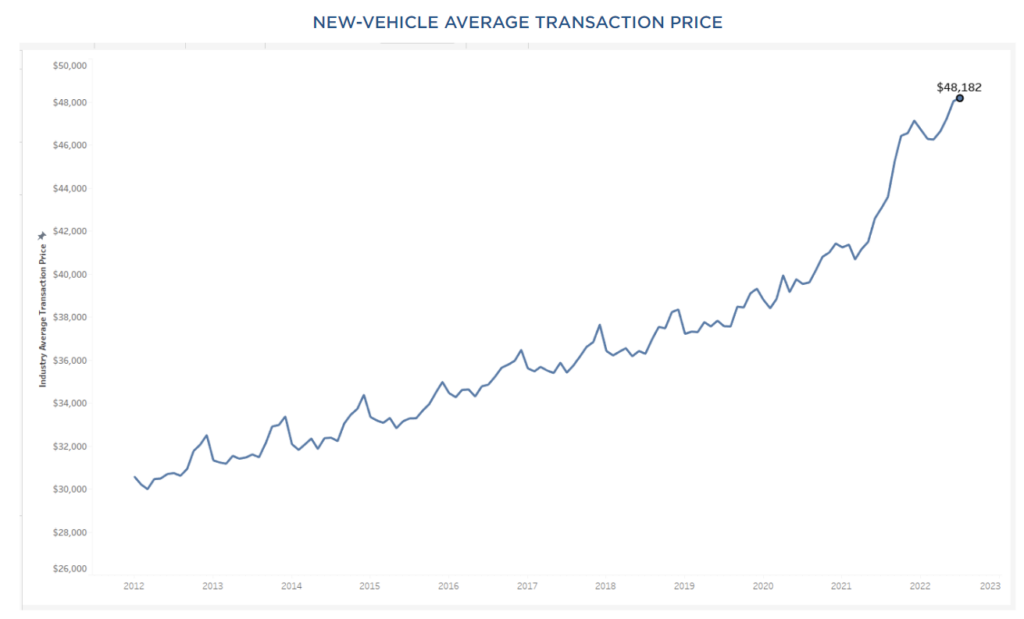
The average transaction price (ATP) for a new vehicle increased by 0.3% in July to a new record of $48,182, according to the latest Kelley Blue Book transaction price report. Year-over-year vehicle price increases are astounding. Since July 2021, the average new vehicle transaction has increased 11.9%, or $5,126. Looking back two years to the heart of the pandemic slump, the average new car transaction price is up 21.5% since July 2020. Worse yet, the ATP is up 58% over a decade. In 2012, the average transaction price was near $30,000.
Why are new car prices still going up? Rather than the prices themselves increasing substantially in July, other factors are largely responsible for the new record. The average interest rate increased another 19 basis points last month. The average auto loan interest rates across all credit profiles are 3.86% for new cars and 8.21% for used cars, according to data from MarketWatch. Gone are the days of zero percent interest rates, and the Federal Reserve will likely hike rates higher to get a handle on inflation.
Another factor contributing to record high average transaction prices is the popularity of luxury vehicles. Luxury vehicle share remains historically high, pushing the average ATP higher. The post-pandemic ‘K-shaped recovery’ has resulted in divergent economic situations from one household to the next. One family might be struggling to make ends meet, while the other is more well off than ever before. This trend has contributed to a surprisingly healthy luxury vehicle market, and more consumers willing to pay a premium for a new car in 2022.
The average monthly payment for a new car is now $733/month. That’s a new record, and it’s just a hair above June’s previous record of $730. Nationally, median one-bedroom rent is now $1,450, which is 11% higher than a year prior. In several Midwestern and Southern states, the average car payment is now on par with rent. We’ve never seen this before.
Cox Automotive’s Vehicle Affordability Index really puts this in perspective. The Vehicle Affordability Index is driven by the consumer’s vehicle transaction prices, the income of the consumer, amount financed by the consumer, and the interest rate provided by the lender. The result is a value that represents the number of weeks of the median household income in America that would be needed to buy the average new vehicle.
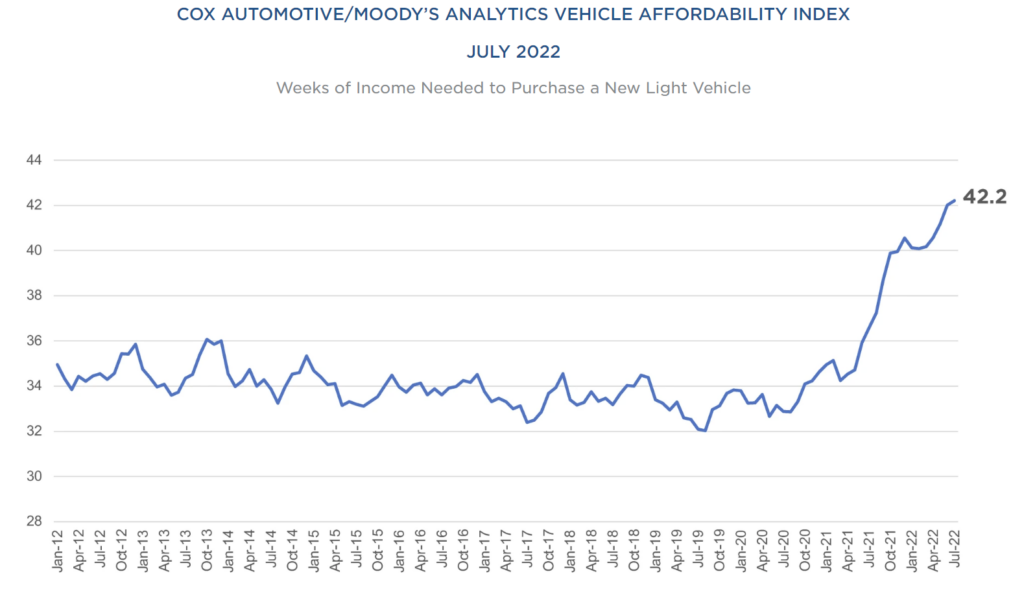
The number of median weeks of income needed to purchase the average new vehicle in July increased to 42.2 weeks from a downwardly revised 42.0 weeks in June. In other words, the average new vehicle purchase costs as much as 42 weeks of median income in America. Financial advisors generally recommend keeping total car expenses below 20% of monthly income, but very few Americans are able to do that today. With an average monthly car payment of $733, monthly income would need to be AT LEAST $3,665 to achieve this.
New-vehicle affordability in July was much worse than a year ago when prices were lower, incentives were higher, and rates were much lower. The estimated number of weeks of median income needed to purchase the average new vehicle in July was up 15% from last year. One year ago, auto interest rates were near record lows, incentives still existed, and prices were 11.9% lower.
In July, some automakers had improved inventory. Some, such as Ford and Toyota, had the greatest increases in inventory in several months. Still, with order backlogs and demand far exceeding supply, dealer lots remained nearly empty, and car prices remained high.
See the latest new car inventory numbers here.
New car prices will fall once automakers are able to produce more vehicles. What needs to happen for vehicle production to increase? Supply chain disruptions must come to an end once and for all. We’ve been watching automakers ration their supplies of semiconductor chips, wire harnesses, and even electric vehicle batteries as the pandemic and the war in Ukraine continue to disrupt supply chains.
There is now a question as to whether automakers will ever go back to their old ways of over producing vehicles and discounting them well below MSRP. They now see that consumers are willing to pay higher prices for cars, and that’s good for their bottom lines. As long as people agree to pay marked up prices, there will be no incentive to bring prices back down to historical norms. Many in the industry see this as the only path forward, given today’s market conditions.
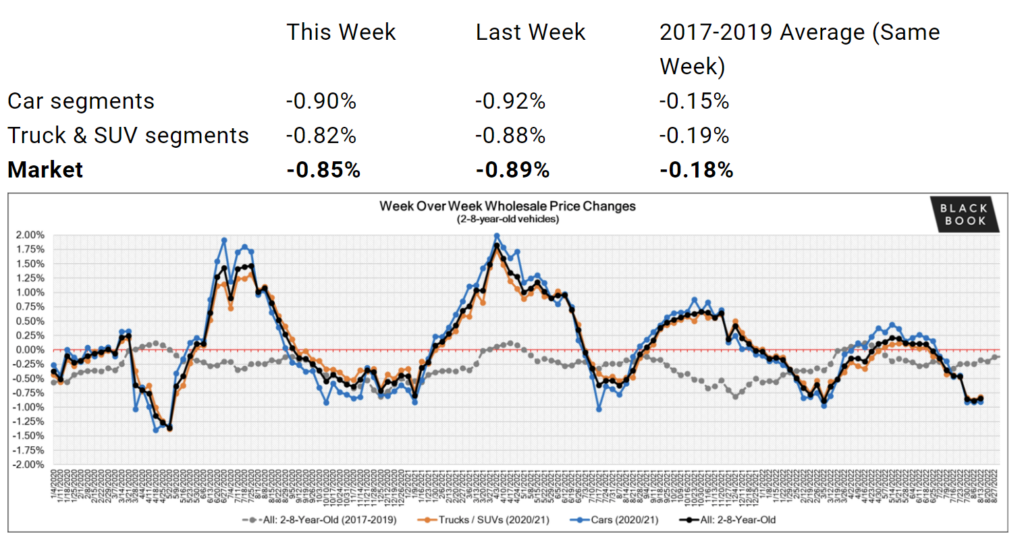
There is a bit of a silver lining. For eight weeks in a row, we’ve been tracking steepening declines in wholesale used car prices. We can confidently say that a trend has emerged. At auction, used car prices have dropped about 4% in two months. We expect these declines to soon translate to retail used car prices, and at the very least, dealers will be willing to negotiate a deal. Based on past trends, we expect retail used car prices to begin to decline in September. Don’t hold your breath, a used car might be the better value in 2022.
After years of asking for a used electric vehicle tax credit, we finally have it. Unfortunately, it’s not all that we had hoped it would be. Income limits are strict, and vehicle price caps are even tighter. We analyzed price data to find every EV and plug-in hybrid that may qualify for the used EV tax credit. One takeaway: It’s hard to find a sub-$25,000 electric vehicle!
As far as we can tell from the language of the Inflation Reduction Act, the strict Made-in-America and battery sourcing requirements that apply to new EVs and PHEVs do not apply to used EVs. However, the bill allows for the Treasury Secretary to finalize rules by the end of 2022, so it’s not set in stone just yet.
Beginning on January 1, 2023, car buyers can claim a $4,000 tax credit when purchasing a used electric vehicle for under $25,000. For buyers purchasing an EV under $13,300, this incentive is capped at 30% of the vehicle’s price. The seller must be a qualified dealer, and the buyer must have an adjusted gross income (AGI) of under $75,000 (individual), $112,500 (head of household) or $150,000 (joint filers).
Just how many used EVs can be easily found for under $25,000? A quick look at used EV prices is a reality check. If you’re open to settling for an electric vehicle model with lower range, slower charging and more miles on the odometer, you might find a deal that qualifies.

Range:
2011-2015 models – 73 to 84 miles
2016-2017 models – 84 to 107 miles
2018-2022 models – 150 to 226 miles
Max charging speed:
50 to 100 kW (charge to 80% in 45 minutes)
See used Nissan Leaf listings.

Range: 238 miles
Max charging speed:
55 kW (charging to 80% in just under an hour)
See used Chevrolet Bolt listings.

Range: 82 miles
Max charging speed:
50 kW
See used Chevrolet Spark EV listings.

Range: 81 miles to 188 miles, depending on model year and trim
Max charging speed: 40 kW (charge to 80% in 20 minutes)

Range: 258 miles
Max charging speed: 75 kW (charge to 80% in 50 minutes)
See used Hyundai Kona EV listings.

Range: 258 miles
Max charging speed: 75 kW (charge to 80% in 50 minutes)
See used Kia Niro EV listings.

Range: 111 miles
Max charging speed: 75 kW (charge to 80% in 50 minutes)
See used Kia Soul EV listings.

Range: 84 miles
Max charging speed: 85 kW

Range: 83 miles
Max charging speed: 7.2 kW
See used Volkswagen e-Golf listings.
The used (and new) EV tax credit does make plug-in hybrids (PHEVs) eligible, as long as they have a battery capacity of at least 7 kilowatt-hours. CarEdge’s auto expert Mario Rodriguez analyzed used PHEV prices, and these are the PHEV models that have a shot at qualifying under the $25,000 price cap.
The latest data shows wholesale used car prices dropping, but that has yet to translate to lower retail prices. Electric vehicles and plug-in hybrids are likely to be the last to see price declines, as they remain in high demand. We’ll keep you updated with the latest info.
Keep track of EV market share as more Americans go electric.
The Inflation Reduction Act of 2022 has thrown a wrench in the EV buying plans of many. Just three weeks after we first heard word of this deal between two Senators, it has been signed into law. Time is of the essence if you’re on the fence about an EV purchase! But don’t run out to buy that shiny new Tesla Model Y just yet. The language of the Inflation Reduction Act’s ‘Clean Vehicle Credit’ details requirements and important dates that you need to know about before signing a contract to purchase.
If buying an EV in America is in your future, here’s what you need to know today.
These are the big changes to the EV tax credit:
These new EV tax credit eligibility requirements eliminate several of the most popular electric vehicles on sale today. Here’s our list of the winners and losers, including those that will qualify for at least half of the new credit.
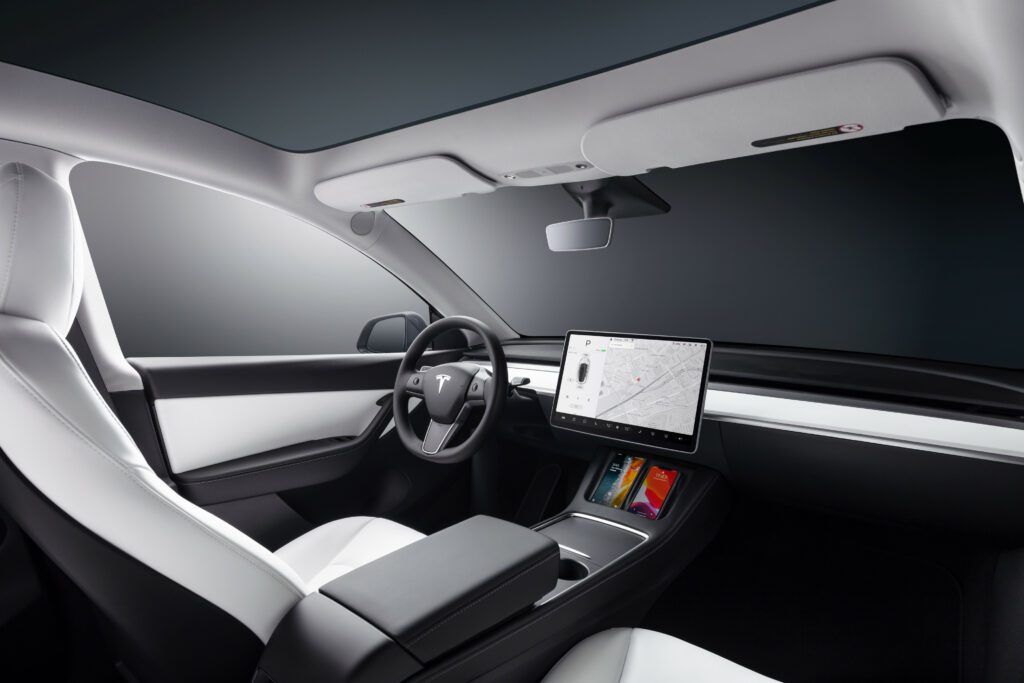
If you’re considering buying a Tesla Model Y, Cadillac Lyriq or Chevrolet Bolt, wait until January 1, 2023 to make the purchase. The revised EV tax credit removes the 200,000 sale cap for automakers on January 1, 2023. The 200,000 sale cap had previously disqualified Tesla and GM EV models from the original $7,500 EV tax credit.
Why only the Model Y? The Model Y is the only Tesla that will qualify for the new tax credit because of the price caps. The revised EV tax credit caps SUV and truck prices at $80,000, and sedans at $55,000. The only Model 3 under the price cap is the rear-wheel drive Model 3, but it sources batteries from CATL in China, so it is disqualified. The Model S and Model X are far too expensive. The Model Y is the most popular EV in America, so this is still good news for Tesla.
Ford makes the Mustang Mach-E in Mexico, and that’s not an issue as the new bill requires final assembly to be in the U.S., Canada or Mexico. However, Ford has battery sourcing agreements with numerous battery suppliers, and that’s where it gets complicated.
Ford currently makes the Mustang Mach-E in Mexico with batteries from LG Chem (now LG Energy Solutions). LG manufactures these battery cells in Poland, but the battery pack assembly is in North America. It’s unclear if Ford’s battery assembly meets the 40% battery component requirement. Unfortunately, Ford just signed an agreement with Chinese battery manufacturers CATL to supply batteries for upcoming Ford Mustang Mach-E’s. This may disqualify the automaker briefly, but not for the time being. Ford has already announced plans for two battery plants in Kentucky and Tennessee.
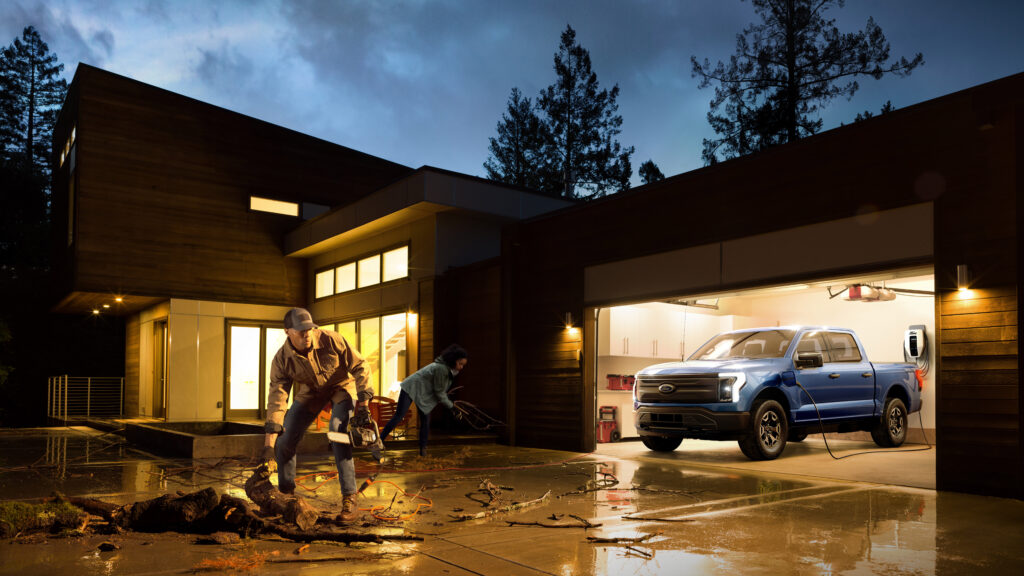
Does the F-150 Lightning qualify for the new EV tax credit? Yes, but it depends on where exactly the batteries are sourced from. Ford has said that is sources many F-150 Lightning battery packs from SK Innovation’s factory in Georgia, USA. That’s great for eligibility. However, Ford recently shared that they are sourcing more batteries for the Lightning from Chinese automaker CATL. That could complicate eligibility.
Most F-150 Lightning trim options that include the Extended Range battery (for 320 miles of EPA-rated range) are near or over the $80,000 price cap for trucks. Check your vehicle build specs and pricing to see if your total MSRP is under the $80,000 limit.
If you secured a written binding contract to purchase before the bill was signed, you could claim the original $7,500 tax credit when you file 2022 taxes.
In summary, most Ford electric vehicles will likely qualify for at least half of the new EV tax credit, which would be $3,750. Of course, this depends on battery sourcing. It’s possible that Ford EVs could eventually qualify for the full $7,500 once we know more about where Ford’s battery suppliers source their minerals.
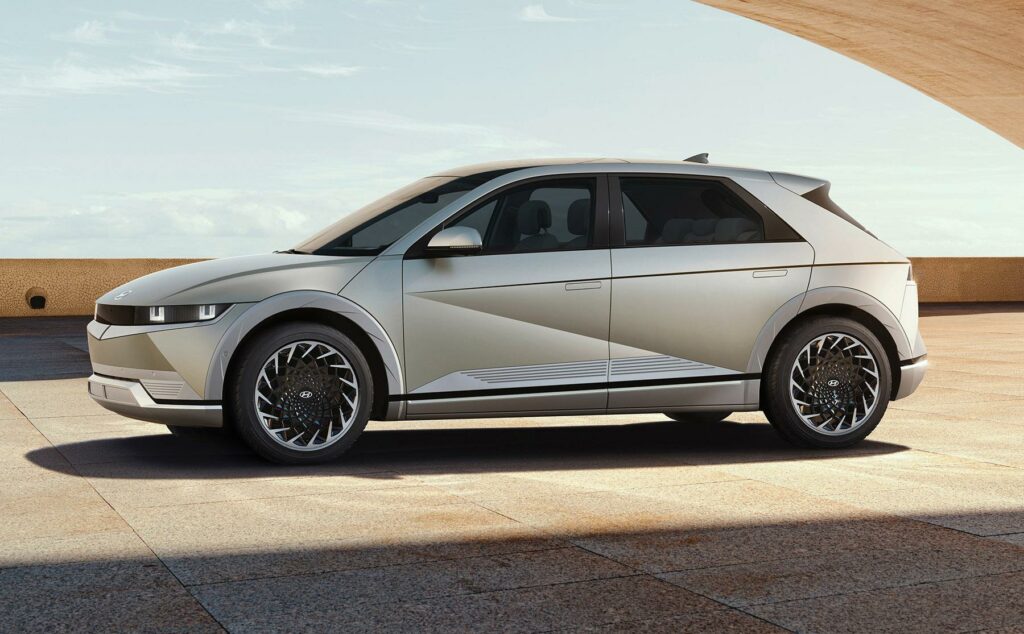
Many of today’s best electric vehicles are made overseas for now. The Kia EV6, Audi etron, Polestar 2, and my own Hyundai IONIQ 5 are all disqualified due to the Made-in-America requirement.
The language of the bill states that as soon as it is signed into law, EVs that do not have final assembly in the United States, Canada or Mexico will lose eligibility. The bill was signed on August 16, 2022.
See our full list of EVs that will lose eligibility, and those that will qualify.
The ‘Transition Rule’ in the new EV tax credit allows buyers to claim the original $7,500 EV tax credit if the buyer has signed a “written binding contract” BEFORE the Inflation Reduction Act of 2022 was signed into law.
Love legalese? Read the Senate’s Inflation Reduction Act’s text here.
The new bill states that the new used EV tax credit will take effect January 1, 2023 as a tax credit, and it will become refundable at the point of sale starting on January 1, 2024. There are STRICT limitations, however.
To qualify for the used EV tax credit, the vehicle must meet the following qualifications: cost less than $25,000; be at least 2 years old; and sold by a qualified dealer. Buyer income limits are an adjusted gross income of $75,000 for individual tax filers, $112,000 for head of household, and $150,000 for joint filers. Taxpayers are allowed one used EV credit every 3 years.
It’s a wild time to be in the market for an EV. Did we miss something? Let us know in the comments, or better yet chat with our EV and general car buying experts at the CarEdge Community Forum. You can also email me at [email protected]. This is an evolving situation!
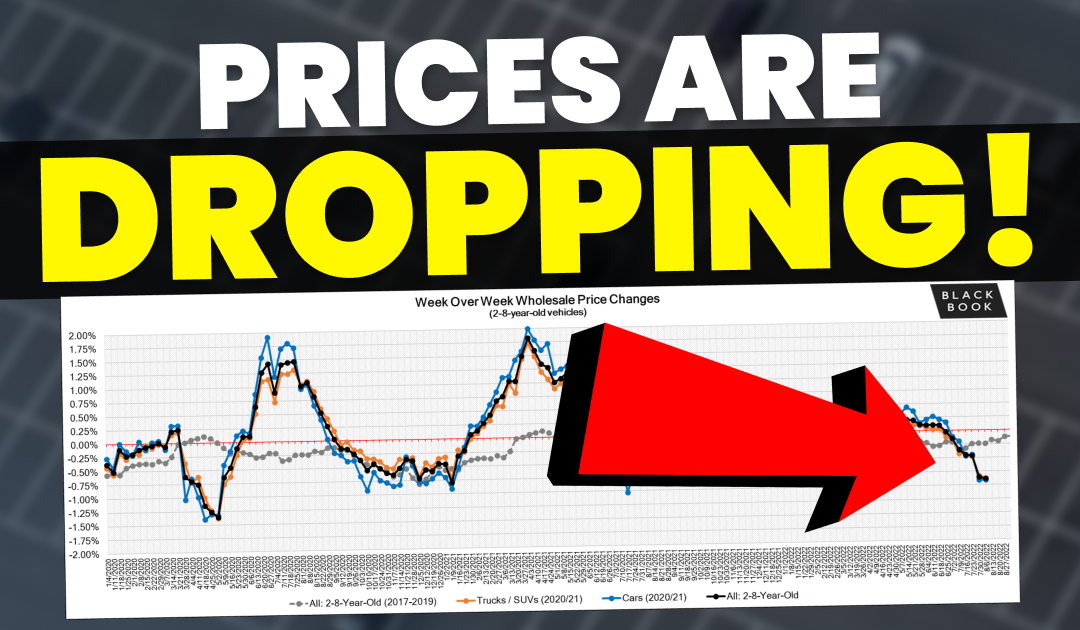
Each day we get asked, “When will car prices drop?” Fortunately, today we have good news to share; used car prices are starting to fall as you’re reading this.
At wholesale auctions, used car prices have dropped for seven weeks in a row. This week’s wholesale declines were so steep that the analysts at Black Book said it was reminiscent of declines seen at the start of the pandemic. If wholesale used car prices are dropping so much, why haven’t we seen an equally steep decline in retail prices? Well, we are just starting to.
In today’s turbulent world, there’s only so much we can confidently assume when drawing connections between the automotive market of the past and present. But the data is still useful. By taking a look at similar trends from years past, we can start to understand when retail car prices are likely to drop, which vehicles are likely to drop the most, by how much, and how you can approach negotiations.
Let’s dive in.
Historically, retail used car prices lag 4 to 6 weeks behind wholesale prices. We started to see significant wholesale price declines in the last week of June, and more so by mid-July. Take a look at the last 8 weeks of wholesale car prices:
+0.10% the week of June 20
-0.02% the week of June 27
-0.15% the week of July 4
-0.35% the week of July 11
-0.45% the week of July 18
-0.47% the week of July 25
-0.86% the week of August 1
-0.89% the week of August 8
Since early July, wholesale used car prices have dropped -3.19%, and some vehicle segments are down more than 5%. You may be asking why retail prices haven’t started dropping if wholesale prices started their downward trend seven weeks ago. Until the week of July 18, the wholesale declines were slight. Basically, they were within the ‘margin of error’, and the change wasn’t yet large enough to draw any big conclusions. When we started to see declines of -0.45% to -0.89% in a single week, that was the surefire indication that the price drop is real, and the bubble may even be bursting.
If used car prices are on track to follow a trajectory similar to what was seen when prices dropped in 2008 and 2020, we’d expect to see real declines 4 to 6 weeks after the start of significant declines. So when did the clock start? Conservatively, the first week of August was the first week of major declines. Wholesale used car prices dropped -0.86% last week alone. Looking ahead, we can expect retail used car prices to drop meaningfully starting in early- to mid-September. This coincides with a likely increase in repo cars that will also drive used car prices lower too.
While advertised retail prices may not be lower (why would a dealer drop their advertised price if they can find a customer willing to pay an inflated price?), we have heard more and more stories from our community of successful negotiations taking thousands of dollars off of used car deals. Negotiating on a used car is possible, and you should be encouraged to do it.
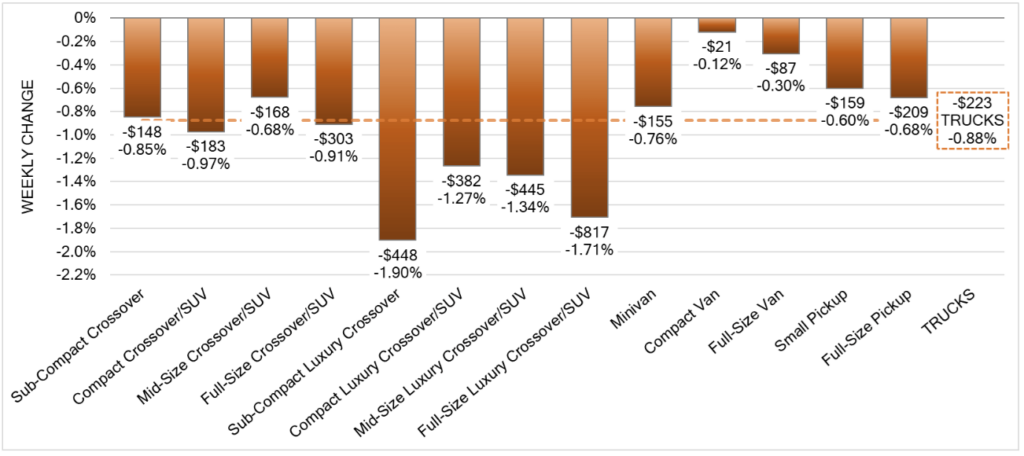
The past month of wholesale data shows that luxury vehicle and larger SUV segments are on track to see the steepest price declines. Why? Their prices have been the most inflated over the past 18 months, and consumer demand for high price vehicles is decreasing rapidly. The week of August 8, every luxury segment dropped by at least -1.24% week over week. Sub-compact and full-size luxury crossovers dropped nearly 2% in just one week. Since July 11, luxury segments have seen wholesale prices drop by -5.32%, while the overall used vehicle market dropped -3.19%.
Our very own market researcher Mario notes that some vehicle segments are softening, but mass-market sedans and trucks are holding firm. “I’m starting to see increased negotiability with late model mid-size SUVs like the Mazda CX-9 and the luxury segment (Lexus RX, Audi Q5, Acura RDX). These segments have been softening and represent some good deals. Trucks continue holding value. I haven’t seen much change on the lower end and small sedans.”
CarEdge Auto Expert Justise also emphasized more consumer negotiating power as the first sign of a softening auto market. “ Luxury and non-hybrid vehicles are already a lot more negotiable than they were last month. I am also seeing a lot more deals across the board without as many shenanigans like nitrogen tires, and fewer markups over MSRP. Even many Toyota & Hondas that are 2020-2021 model years are coming back down to Earth.”
Think about what we’ve all collectively been through over the last few years. We know better than to assume anything in this market is guaranteed! Today’s car market is unlike anything we’ve ever seen before. New car inventory remains very low, and prices are sky-high while interest rates complicate matters even more. And we haven’t even discussed inflation. So no, nothing is guaranteed, but it’s undeniable that overall market pressure is building that will most likely push dealer sales managers to adjust pricing downwards.
Another factor to take into account is that dealer sales managers are going to try their hardest to cover their losses. Those who bought severely overvalued used vehicles at auction two to six months ago are going to either stand defiantly and demand high prices, or they’ll ‘be smart about it’ and cut their losses by negotiating with prepared, knowledgeable car buyers.
See the latest NEW vehicle inventory, including days supply!
CarEdge’s own Ray Shefska said it best. “The smart dealers will take their losses, and sell what they can now. Wholesale price trends are indicating that they bought overpriced used vehicles for the past several months, and they’re losing money every day they don’t sell their inventory. This could drive prices downward sooner rather than later. Smart sales managers look at pricing weekly. If cars aren’t selling quickly like they have been, that’s a sign that the market is changing.”

Update: On August 16, 2022, President Biden signed the Inflation Reduction Act of 2022 into law. Within the 755 page bill is a massive, and controversial, revision of the electric vehicle tax credit (more on that here). Frankly, it’s a mix of good and bad news. The new incentives are sure to accelerate the growth of domestic production in the United States, however many models are losing the credit due to strict limits on eligibility.
Important Note: The IRS and Department of Energy have issued guidance, which can be found here and here. The vehicle price caps do not begin until January 1, 2023, which means that luxury EVs like the Lucid Air and Rivian R1T will qualify UNTIL the new year. These models are not on this list, as their inclusion is only for the rest of 2022.
The original 200,000 sale cap that took the previous tax credit away from Tesla and GM will be removed on January 1, 2023. EVs from these two automakers will not be eligible until after 1/1/2023.
We recommend checking out these official notices from the government for more information.
Although the Inflation Reduction Act’s language dictates that the Treasury Secretary will finalize several aspects of the new EV tax credit, many provisions and eligibility requirements are now final.
The revised EV tax credit adds the following requirements for eligibility:
Plug-in hybrids (PHEVs) will qualify, as long as they meet the requirements listed above. More on that below.
For additional information on the many changes in this new EV tax credit, see our resource here.
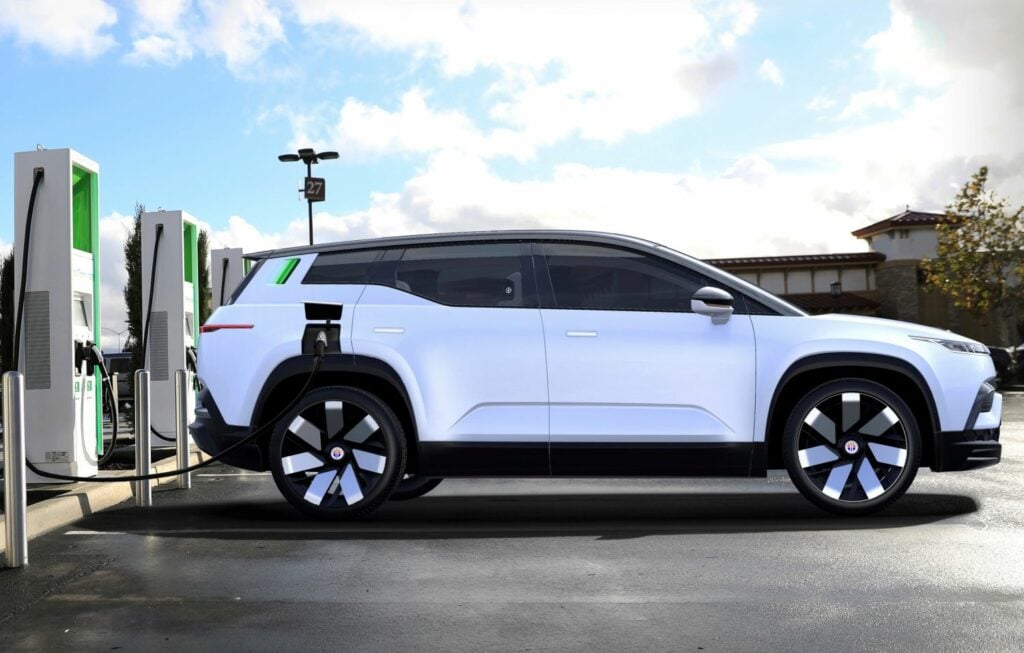
These are the electric vehicles that will NOT qualify for the new EV tax credit, and why.
(final assembly overseas). Audi is considering building EVs in America soon.
(final assembly overseas)
(final assembly overseas). Magna, who produces the Fisker Ocean, is considering building the EV in the United States.
(final assembly overseas; A new factory will open in Georgia in a few years, and a senator is trying to return eligibility sooner.)
(final assembly overseas)
(final assembly overseas)
(final assembly overseas)
(final assembly overseas)
(too expensive)
(final assembly overseas)
(final assembly overseas; the Polestar 3 EV will be assembled in the U.S.)
(too expensive… by a lot)
(too expensive)
(final assembly overseas)
(too expensive, RWD batteries produced overseas)
(too expensive)
(final assembly overseas)
(final assembly overseas)
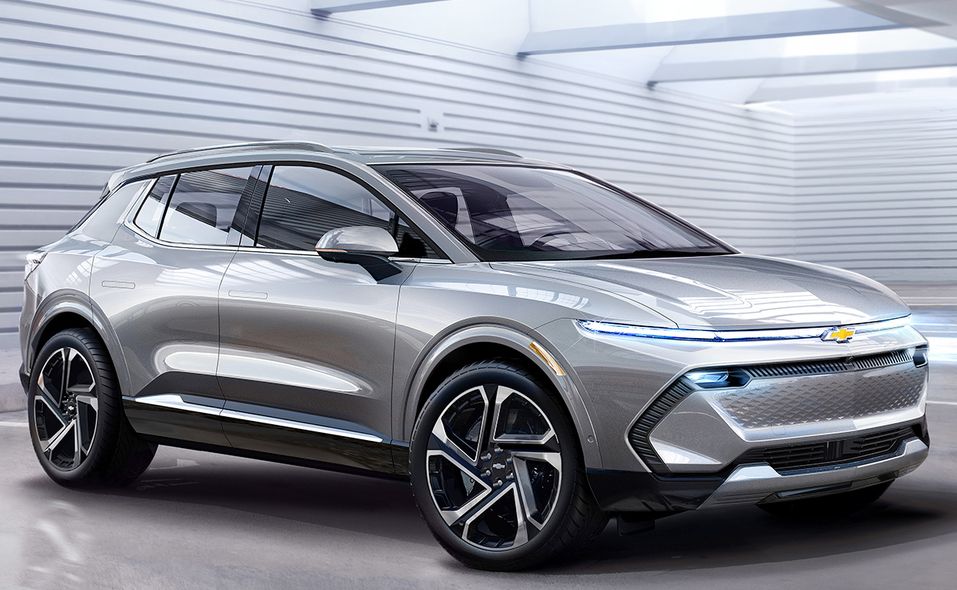
This EV will be built in America, and powered by GM’s Ultium batteries. It is likely to qualify for at least $3,750, of the full $7,500.
Currently the most affordable EV in America, it’s built in America with batteries manufactured in Michigan. It is likely to qualify for at least $3,750 of the full $7,500, depending on battery mineral sourcing.
Recently revealed, this EV will be built in America, and is powered by GM’s Ultium batteries. It is likely to qualify for at least $3,750, and possibly the full $7,500. We don’t know where GM intends to source battery minerals.
This EV will be built in America, and powered by GM’s Ultium batteries. It is likely to qualify for at least $3,750, and possibly the full $7,500. As with all other GM EVs, we don’t yet know where GM intends to source battery minerals.
GM will manufacture this EV in America, with GM’s own Ultium batteries. It is likely to qualify for at least $3,750, and possibly the full $7,500, depending on battery mineral sourcing. We do know that the battery components will have assembly in America.
General Motors will make the Prologue for Honda in the United States using U.S.-made Ultium batteries. It is likely to qualify for at least $3,750, and possibly the full $7,500.
Nissan builds the Leaf in Smyra, Tennessee. The AESC-supplied batteries are also assembled there, but it’s not clear where minerals are sourced from. The Leaf should qualify for at least $3,750, and perhaps the full $7,500. Nissan has plans for the impending retirement of the Leaf, so it’s not clear if one of America’s only affordable EVs will even be on sale next year.
This is the top-selling EV in America. Final assembly is in Texas and California. Battery components sourcing is from Tesla and Panasonic in Texas and California. Battery mineral sourcing is unknown. It is likely to qualify for at least $3,750, and possibly the full $7,500.
Final assembly is in Chattanooga, TN (for select VIN numbers, check with your dealer representative). SK Innovation makes the battery components in Georgia. Battery mineral sourcing is unknown. It is likely to qualify for at least $3,750, and possibly the full $7,500.
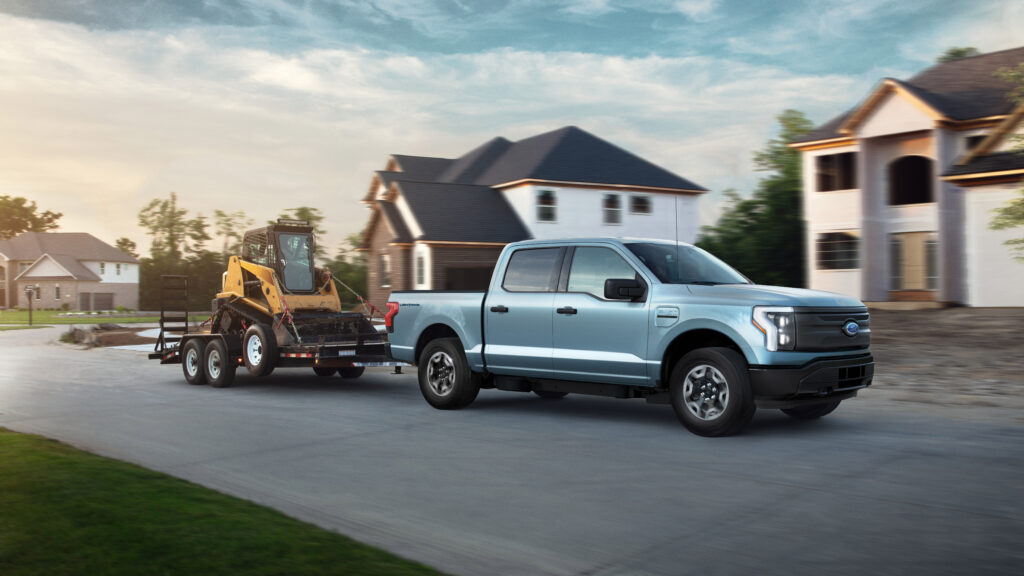
Ford currently makes the Mustang Mach-E in Mexico with batteries from LG Chem. LG Chem manufactures these battery cells in Poland, but the battery pack assembly is in North America. It’s unclear if Ford’s battery assembly meets the 40% battery component requirement. Unfortunately, Ford just signed an agreement with Chinese battery manufacturers CATL to supply batteries for upcoming Ford Mustang Mach-E’s. This may disqualify the automaker briefly. Ford has already announced plans for two battery plants in Kentucky and Tennessee.
Plug-in hybrids (PHEVs) WILL be eligible, but they must meet the same requirements listed above, and have a minimum battery capacity of 7 kilowatt-hours.
With the Made-in-America requirement beginning as soon as the bill as signed, most plug-in hybrids won’t be eligible. This includes the RAV4 Prime, Prius Prime, Hyundai Santa Fe PHEV, Hyundai Tucson PHEV and some BMW PHEVs, such as the 330e made in Germany. The popular X5 and X3 PHEVs are among those that will qualify, as long as the MSRP stays under $80,000.
The Chrysler Pacifica Hybrid should qualify for at least half of the new credit. It is manufactured in Ontario with batteries assembled in Michigan.
Jeep PHEVs, such as the Wrangler 4xe and Grand Cherokee PHEV, should qualify for at least half of the new credit. The Wrangler 4xe is made in Toledo, Ohio, however it’s unclear where the Samsung SDI batteries are sourced from.
Beginning on January 1, 2023, America’s first used electric vehicle tax credit begins. Eligibility requirements are strict:
The Inflation Reduction Act has been signed into law, so the ‘Made in North America’ requirement has begun. The Treasury Secretary will set the final rules for other portions of the EV tax credit, and that must happen before the end of this year. We’ll update this page as more information becomes available.
Next: U.S. EV Market Share Increased in Q2 2022

How can you determine the fair market value of a car? Over the last three years, used car prices plummeted during pandemic shutdowns, only to climb a record 40% in 2021. In 2023, there are strong signals that the car price bubble is bursting.
With such volatile changes in car prices, it has never been more difficult to know the true fair market value of a car. That being said, there are ways to answer this question!
In the old days, it was impossible to know what the real fair value of a car was. Kelly Blue Book was just that, a book. Books don’t update from week to week like used car prices do, and websites like KBB are really just meant to gather leads for dealers; their valuations aren’t a true indication of “fair market value.” How we share information has changed, but so has how we buy and sell cars. Online car dealers now account for 30% of new car sales in America, and the used car market is catching up.
With sites like CarEdge, Carvana, Vroom, CarGurus, and others, you can see in real-time what a car dealer would pay to buy a car. This is VERY valuable information for car owners, regardless of whether or not you intend to sell. More on that below.
If you’re buying a used car, the 10% rule is a great way to see if you’re paying a fair price. We all know car dealers make money when they sell cars, but how much do dealers make? In 2023, the average total profit per vehicle is up to $5,138. That’s double what it was five years prior.
With dealer profits climbing all the time, how can you make sure they’re not paying too much for a used car? We like to think about the 10% rule. If a dealer has a used car for sale and you’re going to buy it, the price should be no more than 10% over what online car dealers would pay to buy the car. We consider that to be a fair price. If it’s more, try and negotiate.
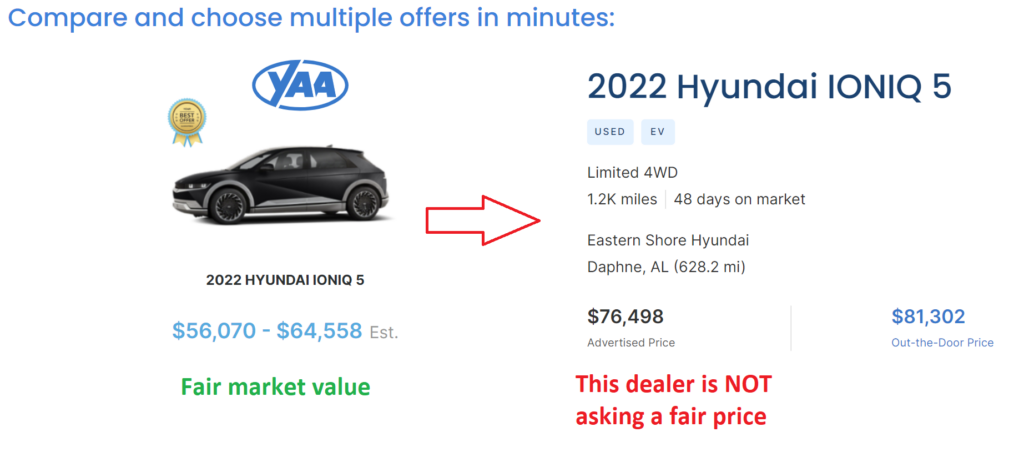
How could you apply the 10% rule? Both new and used car listings provide the vehicle’s VIN number, mileage, trim options and condition. Using that information, you could go through the tedious process of requesting a quote from Carvana, Vroom and CarGurus. Better yet, get all the quotes in one place with CarEdge’s Valuation. Once you have an estimated value or offer, simply calculate if the value is within 10% of the dealer’s quoted price. If it is, you’re looking at a fair price. If not, it’s time to look elsewhere or put your negotiating hat on.
We created a new kind of online vehicle valuation tool with the goal of giving consumers a realistic, regularly updated valuation without the fluff. Our CarEdge community members tell us time and time again; drivers just want real data without gimmicks or gotchas. How does it work? CarEdge’s Vehicle Valuation takes information you share about your vehicle or a vehicle you’re shopping for, and gives you real offers from online car buyers. Using either the vehicle’s VIN number or license plate, location and your answers to simple questions about the vehicle’s condition, you get multiple offers in less time than it takes to brew a pot of coffee.

Anyone who’s traded in a vehicle knows well that dealers lowball trade-in offers so that they can turn around and sell your car for more. CarEdge’s in-house auto experts leveraged decades of dealership experience to give consumers a better way to understand what their car is worth, and how its value changes over time.
Have questions about your car’s fair market value, or perhaps you’re wondering whether a dealer is giving you a fair price? Our auto experts are ready to help you at the CarEdge Community forum. Check it out today!

Who would have ever thought we’d have a Toyota emissions scandal to cover. When Volkswagen was caught red-handed in 2015, its entire leadership structure was turned on its head. Seven years later, Volkswagen is still fighting to improve its image, and the automaker is turning to electric vehicles in hopes of winning forgiveness. Now we’ve learned about a different emissions scandal dating back nearly 20 years to 2003. This time, it’s from a Toyota owned brand; Hino Motors.
Will the Hino emissions scandal spill over to Toyota’s corporate leadership? In an investigation that keeps growing, new revelations suggest this is far from over.
Today’s news is not the first Toyota “emissions scandal”. At the beginning of 2021, Toyota paid $180 million over Clean Air Act violations and settled with the United States federal government after a decade-long period (2005 to 2015) of misreporting emissions data.
From Car and Driver:
“Under the Clean Air Act, automakers are required to notify the EPA when there are 25 or more vehicles or engines in a model year with the same defect in an emission-control component, according to the government’s court filing against Toyota, which said Toyota was late in filing as many as 78 emission defect reports.”
The United States lawsuit claims that Toyota employees in Japan knew of the issue and did not rectify it. Interestingly, the same pattern of behavior was identified today in the Hino Motors scandal.

Hino Motors represents the Toyota Group in the global market for medium- and heavy-duty trucks and buses. Unlike the emissions scandal that Toyota settled last year, in this case, Hino Motors cheated emissions testing for 20 years.
Although most American drivers are not familiar with Hino, they do have a rapidly growing presence in the United States. Hino Motors is the fastest growing medium-duty truck brand in the U.S., and Hino dealerships can be found throughout the nation. Thousands of Americans are employed in Hino’s two American manufacturing plants, and dozens of sales and delivery centers.
In North America, Hino builds trucks in West Virginia, North Carolina and Canada. However production was halted for the first 10 months of 2021 as Hino had issues getting its engine certified in the U.S.
How could a foreign, little-known brand dominate so much of the commercial truck market that much of America’s supply chains rely on? Toyota owns 51% of Hino Motors. Considering that Toyota is the #2 automaker by sales in the American market, saying that Hino has a head start is an understatement.
Used car prices are dropping FAST. See the latest weekly data.
Earlier this year, Hino executives issued a public acknowledgement and apology for cheating emissions testing for nearly 20 years, and possibly longer. President Satoshi Ogiso bowed and apologized to customers and other stakeholders.
“I am so deeply sorry,” President Ogiso said. “Unfortunately, misconduct had been carried out for a widespread variety of models.”
Six months later, the investigative committee tasked by Hino Motors blamed the scandal on an environment where engineers feared challenging superiors in a toxic, high-stakes workplace. The committee’s report details an inflexible atmosphere that was constantly expected to live up to past achievements.
Investigative committee chairperson Kazuo Sakakibara, who is also a former prosecutor, told reporters that engineers and executives lost sight of values.
“The magnitude of their past successes has made them unable to change or look at themselves objectively, and they have been unaware of changes in the external environment and values,” he said in a press briefing.
So far, it is known that Hino cheated emissions testing on four engines used in medium- and heavy-duty trucks sold globally. Hino has recalled 47,000 trucks made between April 2017 and March this year, and Hino said an additional 20,900 would be recalled. With the latest revelation that emissions troubles date to at least 2003, the recall could be expanded to older model years.
Japan’s transportation ministry, which revoked the truck maker’s certification of the affected engines in March, said it would conduct an on-site investigation of the company.
Hino is essentially Toyota’s truck unit. Could the corporate problems spill over to Toyota as a whole? There are no indications that they will at this point. The stakes have always been higher for Toyota, whose sales dwarf those of its Hino unit.
Emissions scandals have touched other Japanese automakers in recent years. In 2017, Subaru and Nissan were investigated by the Japanese government. In 2018, the government said Mazda, Suzuki and Yamaha had improperly tested vehicles for fuel economy and emissions.
Proecutors, whistleblowers and executives all point to notoriously rigorous corporate culture as the main culprit. Something has to change before Japan’s massive automotive industry, which accounts for nearly 3% of the nation’s gross domestic product and supports an even larger manufacturing industry, suffers larger repercussions.
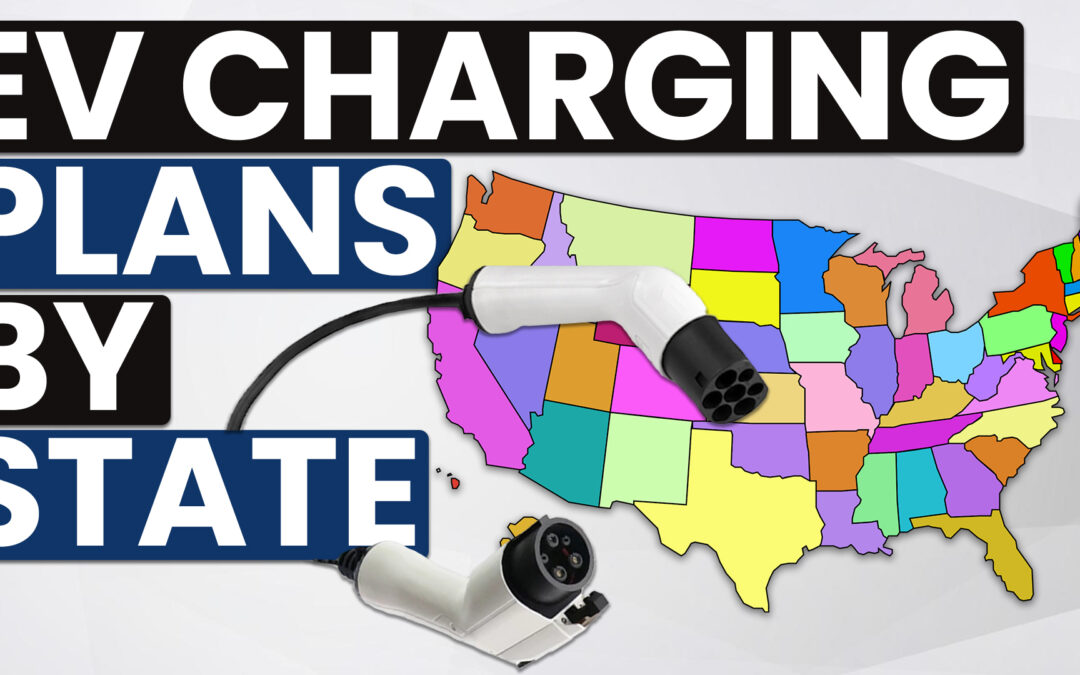
When the Bipartisan Infrastructure Investment and Jobs Act was signed into law in 2021, $1.2 trillion in federal funding was earmarked for dozens of projects ranging from bridge repair to internet access. Included in the massive package is $7.5 billion for National Electric Vehicle Infrastructure (NEVI), also known as the national charging network. States were tasked with submitting a plan for how they would spend NEVI funding, with a submission deadline of August 1, 2022. Now that states have turned in their EV charging proposals, we decided to create this resource with every state’s plans for how they’ll spend NEVI funding.
There’s a lot to unpack here. Phase one of this five-year initiative will prioritize DC fast chargers every 50 miles along Alternative Fuel Corridors, which are usually interstate highways. Once state NEVI plans are approved by the Federal Highway Administration, the contract bid process and construction will kick off in early 2023.
Fiscal year 2022 (FY2022) funding is based on the state’s population, size, and number of major highways. We’d love to hear what you think about how your state is planning to build out their portion of the national charging network.
With electric vehicle market share recently rising above 5%, it’s not too late to get the ball rolling on a national charging network. But time is of the essence. Sales data from Europe saw accelerated adoption once the 5% market share threshold was surpassed, and half of American drivers are interested in EVs.
Of greater concern is the many ways in which the build out of a national charging network could fall short, and this is what’s on my mind. Anyone who’s ever frequented Electrify America charging stations is well aware that malfunctioning charging stations are a lot more common than they should be. In my experience with my Hyundai IONIQ 5, it seems like one out of five chargers has issues.
Can states, the U.S. Department of Transportation and private partners install 500,000 chargers that are more reliable and less confusing than the status quo? Perhaps they could learn a thing or two from Tesla, whose Supercharger network is the gold standard. In many ways, the success of electric vehicles in America will rely on the success of the state plans shared here. I’d be lying if I told you I wasn’t feeling a bit of anxiety about how this could go!
Drop us a comment below. What’s your take on these state plans for the national charging network?

With tariffs, stubborn inflation, and stock market-selloffs, there are many factors that are dampening consumer sentiment in the United States. An economic slowdown impacts everyone, car buyers included. How will a recession impact car sales? How will car buyers be affected by a recession in 2025? Will it be the same as 2008, or are things different this time around? Let’s take a look at what history can teach us.
For most, the mere mention of a recession is cause for cutting back, saving money and spending less. Discretionary spending, essentially spending by choice rather than by need, always plummets in a recession. For some households, discretionary spending includes that shiny new car you’ve had your eye on. For others, a car is essential for work, etc. In a recession, auto sales decline significantly as many buyers back out of the market. However, a recession in 2025 is not going to be the same for car buying as it was in 2008 and 2020.
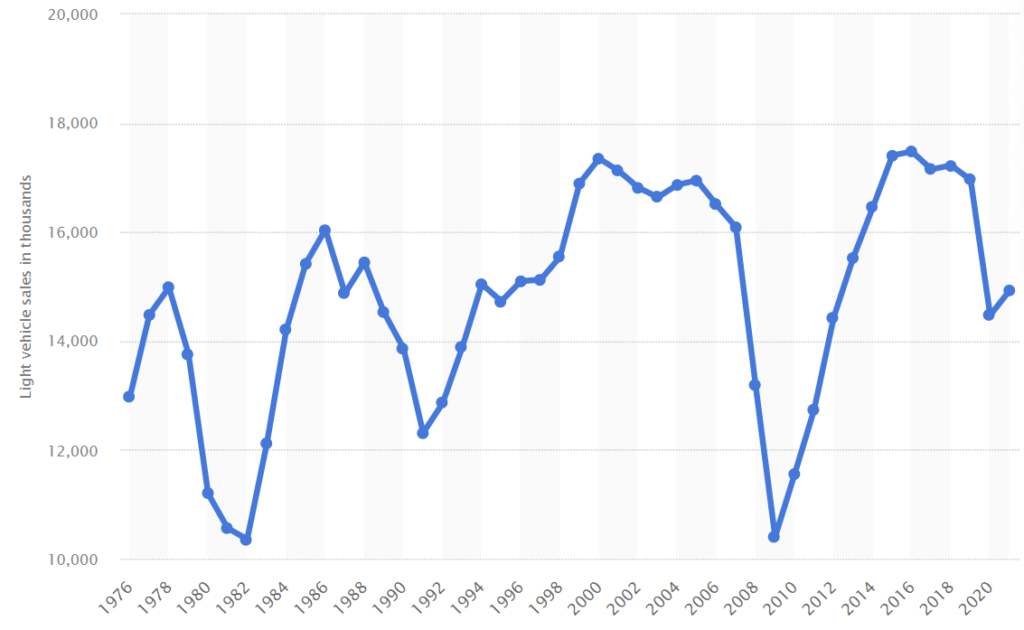
New vehicle sales in the U.S. fell nearly 40 percent during the ‘Great Recession’ of 2008. Gas-guzzlers were hit the worst, and hybrid powertrains made their big break. 2020’s pandemic-driven recession was the shortest in history, lasting just two months. Even then, auto sales were down 15 percent compared to 2019.
What’s different now? Car prices have climbed for three years straight at a pace never seen before. The result? Reluctant car buyers who are more likely to patiently seek out deals. If an economic recession begins, new car prices will be forced downward by a drop in demand. With high interest rates, car dealers lose money the longer a car sits on the lot due to floorplanning costs. Not selling is never an option, meaning that incentives will mount until buyers see value.
If you’re thinking about selling, you should decide sooner rather than later. We track used car prices weekly, and we’ve seen months of declines in both retail sales and the wholesale markets that determine trade-in values. Used car values are falling, and will continue to decline if a recession is in the cards for 2025.
The average used car listing price has fallen from an all-time high of around $28,000 in 2022 to $25,128 in March 2025. With economic worries lingering, we expect retail used car prices to fall another 3-5% through the end of the year. Those considering selling a vehicle in 2025 should assume that selling sooner will bring a high price versus waiting.

Have you ever heard of a car buying service? These ‘car concierge’ services are growing in popularity as drivers get fed up with the car dealership hassles. CarEdge Concierge is the best way to buy a car today. We’re independent from dealerships and automotive industry groups, meaning that we’re exclusively here to serve you.
After four months of electric vehicle ownership, my perspectives about the mass transition to electric vehicles have evolved. I no longer think that everyone should run out and buy an EV right now (besides, that’s not possible). I have a greater understanding of the skepticism that accompanies the push to EVs. All-in-all, I feel that I now understand the arguments from both sides: electric vehicles are amazing, better for the planet (in the long run) and fun to drive, however EVs are not even close to being ready for mass adoption.
Automakers have committed well over half a trillion dollars to electric vehicle research and development, marketing and most importantly, charging infrastructure buildout. But the grid isn’t ready, charging providers aren’t ready, and the American public has a LOT to learn before making the switch. EVs could still fail, and bring down the automotive industry with them. We’d hate to see that. These are 5 things that must happen in this decade to prepare the world for electric mobility.
The average price paid for an EV surpassed $66,000, on par with the overall luxury segment.
For years and years, I touted the coming cost parity that would finally make EVs just as affordable as any other car. Industry experts always told us that EV price parity would come when battery costs dropped below $100 per kilowatt-hour. Just as that milestone arrived, the world was turned upside down by the COVID-19 pandemic.
Global factory shutdowns disrupted the supply chains that all automakers rely on, and most notably those related to semiconductor chip production. Without the parts to make the cars, electric vehicle growth was held back just as the public warmed up to them. Raw materials used in both vehicle and battery manufacturing increased in cost by over 100%, and many automakers have passed the premiums on to consumers.
Today, electric vehicles cost more, and inventory is slim. Kelley Blue Book’s June 2022 car price data shows that the average EV transaction was $66,000, $18,000 over the overall car market average of $48,000. One year ago, the average EV transaction was $52,486, or 10.8% less than it was in June of 2020. In short, EV prices are headed in the wrong direction just as automakers are getting serious about making them.
In the age of record smashing, here’s one that will give pause: In June, the estimated average monthly payment increased to $730, which is a new record high. A new car monthly payment now costs as much as rent in many parts of the country. We’re seeing more and more car payments over $1,000 a month. The insane records don’t end there.
More cars are being repossessed as more auto payments are going past-due. With the way things stand today, either EVs will have to become more affordable, or their luxury pricing will soon risk worsening the auto loan crisis.
Earlier this year, Rivian CEO and Founder RJ Scaringe predicted that battery shortages would be the next disruption that the automotive industry would face. In fact, automakers are already rationing the batteries they have, and those they have lined up. Ever wondered why there are so few electric full-sized SUVs? Building those at scale would require a lot more batteries.
The average EV contains $8,255 of raw materials according to CNBC. That’s more than double the amount in combustion-powered counterparts. President Biden has even authorized use of the Defense Production Act to aid the situation by increasing domestic EV production and related supply chains.
For the most part, automakers don’t make their own batteries. They rely on contracts with battery manufacturers like Panasonic, LG Chem, and CATL to supply what their lofty plans for electric vehicles will need. That’s changing little by little. Tesla has started to produce small quantities of its new 4680 battery cells next to Giga Austin.
General Motors just received a $2.5 BILLION dollar loan from the U.S. Department of Energy for manufacturing the Ultium battery in Tennessee. Slowly but surely, some OEMs are taking control of their own battery supply chains. This will be key to avoiding battery shortages.
EV market share SOARS in America. See the latest numbers.
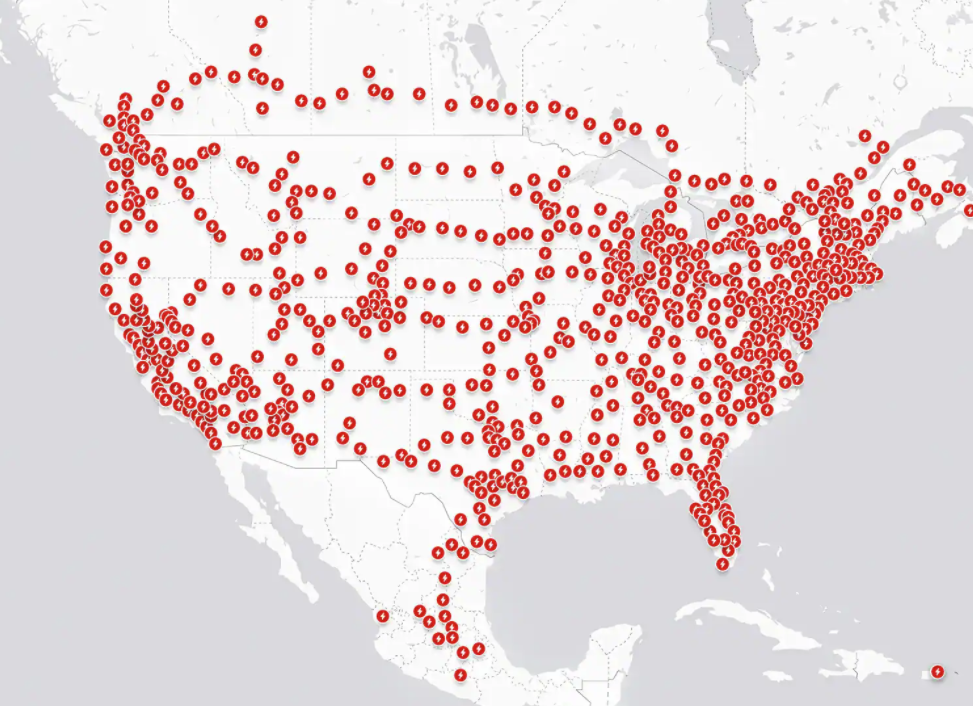
Over 62% of Americans support building out a nationwide charging network, and 39% of American drivers are considering buying an electric vehicle next time they’re in the market for a car. Frugal drivers are welcoming the fuel savings, albeit at a higher upfront cost. At current residential electricity rates, charging up is equivalent to spending about $1.00 per gallon of gas. The most expensive public chargers may approach $2.50 per gallon equivalent.
However, many Americans live in a charging desert. What good is the EV revolution if there’s nowhere to charge? Most EV drivers plug in at home, but not everyone can do that. From apartment dwellers to rural residents, owning an EV simply isn’t viable if there aren’t chargers for road trips, family visits and work transportation needs. When it makes sense for consumers, electric vehicles offer plenty of benefits. Cheaper fuel, less maintenance, sporty performance and no tailpipe emissions to name a few. But EVs risk remaining a symbol of luxury and impracticality if it doesn’t get a lot easier to charge up in America.
2021’s Bipartisan Infrastructure Act included $7.5 billion for the build-out of a national charging network. In summary, federal funding is supposed to get the ball rolling, and the private sector will take it from there. EV charging stations, particularly DC fast chargers, are really expensive to install. On top of upfront costs, America’s electrical grid is not ready for the demand that would be generated by mass adoption of EVs.
The deadline is nearing for states to submit their plans for how they will spend their allocated funding for EV charging. Will they use the funding to install reliable, standardized fast charging stations along major transportation corridors and rural areas alike? We’ll soon find out.
The following are all things I’ve encountered at Electrify America charging stations:
We need to do better to educate EV buyers and prospective EV buyers about how to drive electric without the hassles. We can’t blame the consumer, EVs bring a very different ownership experience. But whose responsibility is it to educate drivers? The dealership? The automaker? The driver themself? Guys like me?
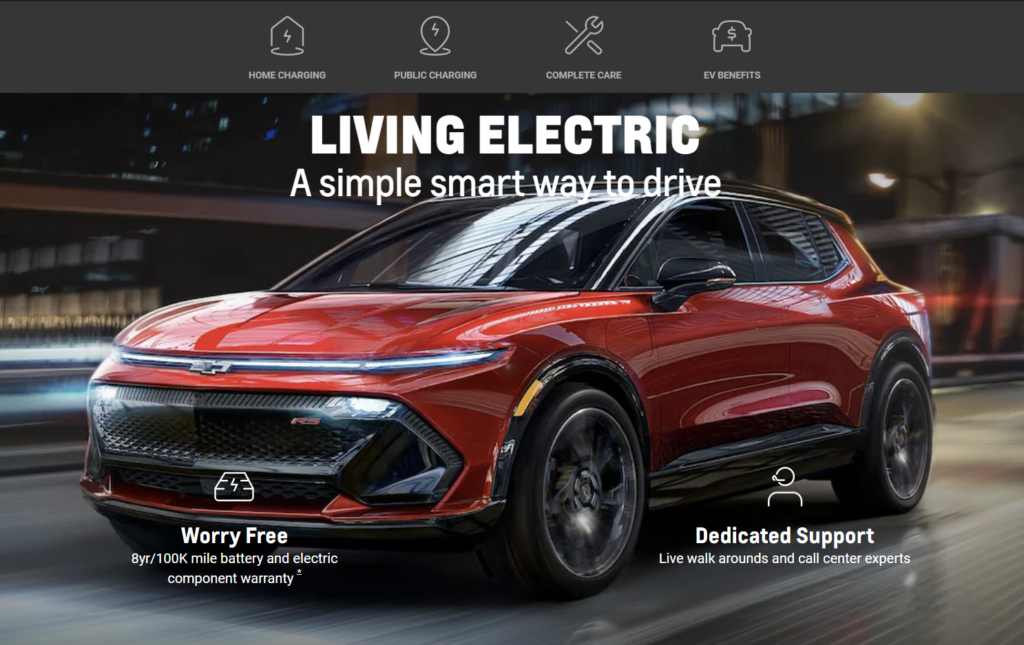
In reality, it will need to be all of the above. General Motors is leaning heavily on the success of what they call affordable EVs to dominate sales by the end of this decade. In the first real sign that OEMs might be taking their newfound responsibility seriously, Chevrolet just launched a great live chat and immersive experience on their website that is entirely devoted to educating the public about their EVs, with an emphasis on the ownership experience. We need more of that, and soon.
The woman I met who arrived at a charging station with 0% state of charge and no A/C should, in my opinion, be upset with her Kia dealer. She loved the car, but no one had explained to her how to plan for interstate travel in an EV. Dealers sell most vehicles in America, but the dealership sales model is under serious threat from the rising popularity of direct-to-consumer sales. Everyone wants to be Tesla. If legacy automakers are to stand a chance in the EV race, more OEMs need to prepare their dealer networks for the public education that comes along with selling EVs.
Does the lack of affordability, charging infrastructure and public awareness mean the electrification of the auto industry is doomed for failure? No, not at all. That’s because there’s still time to right wrongs, and to build out the nation’s charging infrastructure the right way. EVs are still under 6% market share in the U.S. (See the latest EV market share numbers here.) If these same problems persist when we exceed 15%, that will be real cause for concern.
It’s true that the electrical grid isn’t ready for mass adoption of EVs, but it’s getting there. Grid-scale battery megapacks (also pioneered by Tesla) are already being deployed to provide grid stability in times when the supply of electricity is not keeping up with demand. The sun only shines in the day, the wind is intermittent, but grid-scale batteries store and supply power from these renewable sources whenever they are most needed. Now, it’s like the sun is shining at night. These changes take time. Plus, the push for grid-scale battery storage could throw a wrench in EV battery supply chains. Nothing is certain, but things are moving in the right direction.

These are some innovations that have the potential to make electric vehicles more affordable with longer ranges, faster charging and improved safety. These innovations also make EV supply chains less damaging to the environment and less harmful to vulnerable communities worldwide.
How can the nation as a whole get to where it needs to be by, say, 2025? I’ll leave you with my own suggestion for legacy automakers and policymakers: don’t be afraid to learn from Tesla. A seamless, almost hassle-free EV ownership experience already exists in America, from plug-and-charge, reliable fast charging to the peace of mind that comes with the vast Supercharger network. I encourage all policymakers and engineers to learn from Tesla’s successful growth strategies. Will automakers and politicians have the courage to consult Elon Musk’s Tesla, or will they try to figure it all out on their own? What do you think?