
CarEdge saved me over 4,500 dollars on a brand new Honda Pilot. I can't say thank you enough.
Price intelligence
Find a wide range of vehicle listings with market insights on new and used listings near you.
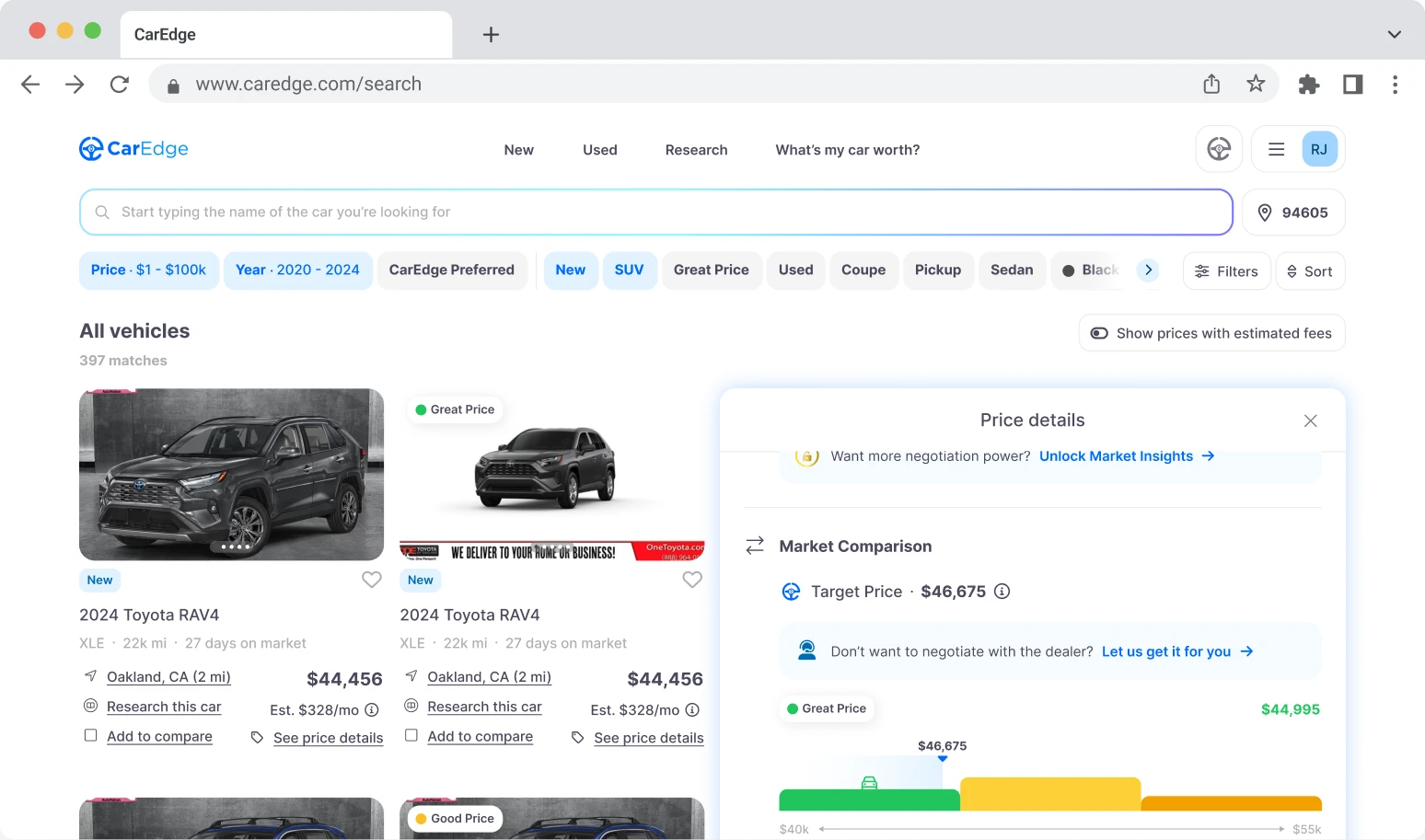

What can I do with CarEdge?
 CarEdge Insights
What can I do with CarEdge?
Get access to exclusive information so you can make an informed car buying decision — all in one place.

Find a wide range of vehicle listings with market insights on new and used listings near you.
Track your vehicle’s value and cash in when the time is right to sell.

Access to our proprietary data to help you find the right car, at the right price. Find these unlocked on every listing after subscribing.

With our expert-led, tech-enabled car buying service, we will locate, negotiate, and deliver your vehicle so you can get a new car hassle free.


Help us personalize your CarEdge experience — it only takes a second.
Your answers help us personalize your CarEdge journey — we’ll follow up with tips and next steps that match your buying timeline.
New vehicle inventory levels have plummeted. The ongoing semiconductor shortage has caused automakers to cut production. Drive around town and you’ll see your local car dealership likely doesn’t have much inventory on their lot, and if they do, it’s likely used vehicles, not new.
More and more dealerships are turning towards “factory orders“. Generally speaking, this is a good thing, as it allows the customer to get exactly what they want. The issue is, as far as we can tell from our community of thousands of savvy shoppers, those people who placed orders are getting the runaround.
Learn more about the chip shortage. Read: The How We Ran out of Cars in the US
“Your car will be built next week and shipped to us soon,” is a common phrase we’re hearing, and then sadly weeks go by without an update. Automakers are simply struggling to do what they’re supposed to do best; make cars.
To put into perspective how dire the current new vehicle inventory situation is, we’re going to compare the current market days supply and inventory levels of a few of the major automakers to their prior levels in 2019. Let’s dive in.

Ford has made headlines for many reasons in 2021. Their current inventory levels are one of those reasons. In September of 2019, Ford had 621,000 new vehicles in inventory across the United States. At current sales rates, that represented an 82 day supply of inventory on their dealer lots. Today, as of September 2021, Ford has 210,800 units of inventory in the market.
See your local inventory levels
Toyota was initially hailed as one of the automakers who would be able to mitigate the effects of the chip shortage and retain their production capacity. That was until Toyota announced a 40% decrease in production in October as a result of supply-chain issues.
In 2019 Toyota had 444,000 units of inventory in the market, at a 50 days supply. Today, Toyota has 135,200 units of inventory in the market, at an 18 days supply. Staggering.
See your local inventory levels
Honda’s inventory levels in September of 2019 were healthy, with 351,700 units of inventory in the US market. Today they have less than 100,000 units of inventory for sale in the United States.
See your local inventory levels
Hyundai and Kia have also struggled during the chip shortage. In 2019 they had 210,400 new vehicles in dealer inventory. Today that number stands at 79,400, with a days supply of inventory of 17.
See your local inventory levelsIf you’re looking to buy a car in 2021 the price you are going to pay will be higher than in prior years. We recommend you do not buy a vehicle right now unless you absolutely need to. If you do need a new set of wheels we encourage you to consider leasing instead of financing. More on that here.
Because of the shortage of new vehicles, used cars have appreciated in value as well. If you are going to buy a used vehicle, be sure to get it pre-purchase inspected.
To learn how CarEdge members are securing fair deals in these tough market conditions, read some success stories here.


Here at CarEdge, we’re focused on one thing: making car buying more transparent, more fair, and less of a hassle. As most drivers know from experience, buying a car is already a complex process, and purchasing a vehicle in another state can make it even more overwhelming. With inventory levels fluctuating, many car buyers are expanding their search beyond to find the right vehicle at the best price. We’ll walk you through the entire process, from understanding the steps involved to figuring out tax requirements and transportation logistics.
Buying a vehicle in another state is eerily similar to buying a car at your local dealership with a few exceptions. The steps to the sale are:
At a high level, that’s how you buy a car in another state. Let’s break each step down a bit further.
As with any car deal, the first step is to negotiate the OTD price with the salesperson or sales manager. Never be a monthly payment shopper. That’s a recipe for severely overpaying. When buying a vehicle in another state you’ll likely be unfamiliar with their taxes and fees.
It is incredibly important that you tell the dealership what your zip code is so that they can calculate your taxes and fees based on your location. We’ll touch on this more below, but taxes are paid where you register your vehicle, not where you purchase it. If the dealership doesn’t know your zip code, they won’t be able to provide you with an accurate out the door price quote.
We strongly recommend that you reference the CarEdge OTD Price Calculator to verify that the dealership’s OTD price matches up with the correct tax, title, and registration rates in your state.
Do you know what happens if you arrive at the dealership without a competitive financing pre-approval in hand? The finance office will be THRILLED because to the dealership, they instantly realize they have the upper hand.
Dealers routinely mark up finance offers before presenting them to customers. It’s one way they make money. Be sure to bring a competitive financing offer from a credit union!
Ideally, get offers from more than one credit union or small bank. Why not the “giant monster mega banks”, as money guru Clark Howard puts it? They don’t usually offer the best rates. They have name recognition, so perhaps they don’t feel that they need to be competitive.
Note: It’s ok to finance with the dealership, but only if they can beat your best offer from a credit union. Sometimes, this will make the sales manager more likely to ‘work with you’ on the out-the-door price of the car, since they receive compensation from the banks they work with when you finance with them. As long as it’s the best deal for you, there’s nothing wrong with it.
If you’re purchasing a used vehicle from another state, there are a few extra considerations you should be aware of. First, you should absolutely consider arranging for a pre-purchase inspection to make sure the vehicle is in good working condition. Second, you’ll need to ensure the vehicle can pass your state’s inspection and emissions testing. By conducting a pre-purchase inspection (PPI) you’ll likely become aware of any issues that would preclude the vehicle you’re thinking of buying from passing your state’s inspection.
To arrange for a pre-purchase inspection from out of state, you have a few options:
Check out our complete guide to PPIs for more information.
Before you sign anything, review the written out-the-door price and official buyer’s order to insure that there are NO dealer markups, and no unwanted add-ons. Nitrogen-inflated tires, ‘theft protection’, VIN etching, and even pinstripes are common add-ons. Just because the dealer pre-installed it, does NOT mean you have to pay for it.
👉 Remember: If it’s taxable, it’s negotiable.
After an inspection report has been received and you’ve agreed to an OTD price that you’ve carefully reviewed, you’ll want to place a deposit down on the vehicle. When buying a vehicle in another state, the last thing you want to do is fly there, or arrange shipping, only to see the price change at the eleventh hour. To protect yourself from last minute changes, place a deposit on the vehicle, and also request to sign a copy of the buyer’s order. Request that the sales manager at the dealership does the same too.
The final step in the out of state purchase process is to take delivery of the vehicle. This is when you will meet with the Finance and Insurance Manager to review loan options and insurance products. As with buying a vehicle locally, you can (and should) come in pre-approved with outside financing and extended warranty coverage quotes.
Depending on what state you are purchasing the vehicle from, you may be able to “take delivery” remotely (sign all the paperwork electronically) and have the vehicle shipped to you. More on that below.

Yes, if you buy a car in another state you can drive it back home to where you live. Unless of course you decide to buy a car in the state of Massachusetts …
In every state except Massachusetts you will receive a temporary license plate from the state where you purchased the vehicle. This temporary tag (also referred to as “drive off tags”) will allow you to legally operate the vehicle after purchasing it.
When you arrive back in your home state you will then go to your local department of motor vehicle and register the vehicle. This is when you will receive your permanent plates for the vehicle.
Why is Massachusetts different from all the other states? That’s a great question. Their laws around vehicle registration are infuriatingly complex and cumbersome. Auto Influence wrote a great article on the Massachusetts Problem.
When you purchase a vehicle out of state, you pay taxes in the state where you register the vehicle, not where you purchased it. The actual process of calculating the correct tax amount and remitting it to your home state can be handled differently.
For example, if it’s a neighboring state, the dealership where you purchase the vehicle will collect and remit the taxes and fees for you. You’ll then receive your permanent plates and registration in the mail. Many dealerships have software that allows them to calculate the proper sales tax and registration fees for different states, and in neighboring states they may feel comfortable handling that for you.
If you’re buying from a further away state, or if the dealership doesn’t offer to handle tax and registration for you, you should contact the dealership’s title department to see if they can walk you through the steps you’ll need to take back in your home state. At this point it is also helpful to consider contacting a local dealership and asking them for assistance too. You can of course also refer to your state and local tax laws and remit payment on your own.
Let’s say you purchase out of state and you pay for sales tax, but it is the wrong amount. What happens then? When you go to register your vehicle at your local department of motor vehicle you will either receive a credit from them, or you will owe them additional money.
Yes, absolutely. This is a very common practice and could financially make a lot of sense for you. The dealership where you purchase the vehicle may recommend a particular shipping company and you should see what their quote is. You should also shop the quote and get bids from other providers as well.
Shipping options will range from open air freight to closed container shipping.
When you buy with CarEdge, we can ship your vehicle to you. Learn more about the benefits of buying with CarEdge.
Yes. The registration process is different in each state, however you can buy a vehicle in one state and register it in your home state. You’ll need to make sure the vehicle can pass your state’s emissions test and road worthiness inspection.
You’ll also need to confirm that the vehicle title is clear of any liens.
If you’re buying a vehicle in another state and you have a trade-in, you should always treat your trade-in as a separate transaction from your purchase. When negotiating the out-the-door price, don’t let the dealership tie your trade-in offer to your purchase. If you do, you will get a low-ball offer.
👉 Take this trade-in checklist with you to play it smart.
Yes, you can lease a vehicle from another state, however some dealership’s will not allow you to. The complexity of out-of state leases is high, and some dealerships do not want the burden of mistakenly calculating the wrong taxes and fees on a lease.
Before negotiating an OTD price with an out of state dealership, we would encourage you to ask them if they’re willing to lease you the vehicle with you being from another state. Be prepared to give them your zip code since each state treats leases differently.

In conclusion, buying a vehicle in another state can seem like a daunting task, but with the right knowledge and guidance, it can actually be a smart move that saves you money. By taking the time to research the laws and regulations in the state you plan to buy from, and working with a reputable dealer or private seller, you can find the car of your dreams without breaking the bank.
Ready to outsmart the dealerships? Download your 100% free car buying cheat sheets today. From negotiating a deal to leasing a car the smart way, it’s all available for instant download.
As a result of the global pandemic, we have seen changes across every industry. The automotive sector has experienced some of the most dramatic. It’s not unethical to say that we’re running out of new cars in the United States right now.
Earlier this year lumber prices skyrocketed (and then fell back down to reality), home prices soared in value (and continue to), and other industries undoubtedly evolved as a result of the pandemic. However cars (both new and used), have experienced unprecedented impacts as a result of Covid-19.
Take a drive down to your local “dealership row” and you’ll see empty lots. Where did all the cars go?


Chips are to blame. No, not those chips … We’re talking about microchips, the unimaginably small, paper-thin integrated circuits that store data, transmit code and allow software to carry out their magical properties. Vehicles today are full of computers, microchips, and software. The reason you don’t see any cars on your local dealers lot is because production of these chips has been outstripped by demand.
We began documenting the chip shortage at the beginning of 2021. Initial news reports suggested that there would be a significant, albeit short-lived supply chain disruption that would affect new vehicle production.
10 months later, it is clear as day that those initial reports were wrong. Very wrong. There will be lasting and widespread impacts from this shortage.
Today we’re going to explore how we ran out of cars, trucks, and SUVs, what impact that has on you if you need to buy a vehicle, and what this means for the “new normal” of buying a car.
Let’s dive in.
Frequently you’ll hear my father, Ray Shefska joke that Frito Lay needs to increase their production capabilities because of the chip shortage. If only the solution were that simple!
Global semiconductor production is derived primarily from three companies; TSMC, Samsung, and Intel. Those aren’t the three companies you need to know about though. The one company you need to know about is ASML.
ASML is a Dutch corporation that has cornered the market on the one thing that is more important than microchips — the machines that make them. ASML produces EUV machines. These are the machines that TSMC, Samsung, and Intel use to produce their computer chips.

Wired recently produced an awesome article on ASML, and we recommend you take a look if you’re interested in a deeper dive on them.
The long and short of it is that there is one company that produces these machines (ASML), the machines themselves are incredibly complex (100,000+ components), and they’re unfathomably expensive (hundreds of millions of dollars). When someone says “we should just make some more chips,” they don’t understand that ASML holds the keys to that kingdom, and they are producing as many EUV machines as they can. There isn’t a quick fix when it comes to producing microchips.
Our current microchip shortage is in part exacerbated by the fact that these integrated circuits are in literally every electronic device we interact with. ASML has some quality information on that here. Chips are the new gasoline in a sense — they’re everywhere.
So how badly is the chip shortage affecting the automotive sector? Badly.
Market Days Supply is an industry metric that automotive manufacturers and dealerships measure to track their inventory levels.
When we founded CarEdge we built software that tracks Market Days Supply for consumers so that they could be armed with the same information the OEMs and dealers have. If a vehicle has a high Market Days Supply it would indicate a greater likelihood that the dealer would negotiate and sell it at a better price. When Market Days Supply is low, a dealer (and the OEM) have little incentive to negotiate or discount their product.

How bad is the new car shortage? Subaru has a 6 day supply of inventory nationwide right now. Honda’s sales were off 18% year-over-year for the month of August, and Toyota recently announced a 40% decrease in production over the coming months.
The chip shortage, and subsequent new car shortage is very real, and very impactful.
With automakers unable to provide their dealerships with new vehicles, used cars have become increasingly popular. Black Book, an industry leader in vehicle valuations, and a CarEdge partner, produces a weekly market report on used vehicles.
For 10 months now we have tracked this report each week, and it is truly unfathomable what we’re seeing. Retail used car prices are up 25% from just the beginning of this year, while wholesale prices have risen more than 30%.

There is serious concern that this “bubble” in used car prices will have lasting negative effects on the market. Our primary fear is that consumers who finance a used vehicle today will be in severe debt positions once supply returns to some sort of pre-pandemic normalcy.
For used car owners (and lessees) who have a vehicle to sell (and don’t need to replace it), there couldn’t be a better time to be in the market. Traditionally used vehicles are depreciating assets, however over the past 12 months we’ve seen certain segments of used vehicles (we’re looking at you full-sized vans) appreciate over 100% in that timeframe.
In short, we think the answer is yes, and there are two primary considerations that give us confidence to say that:
It’s as simple as that. The shortage isn’t going to end overnight, and while OEMs and dealerships learn how to cope with that, they are finding innovative and new ways to increase their profits. Even if the shortage could be reconciled tomorrow, why would Ford go back to their old ways? Why would the new car dealership go back to stocking a 90 days supply of inventory? Why go back if profits are up?
For these two reasons, we anticipate there will be lasting and permanent changes to the retail automotive industry. Here are a few specific areas where we think the change will be felt.
The days of rebates and special interest rates are behind us. Why incentivize the sale of a vehicle when you don’t have enough vehicles to sell?
The average incentive outlay (how much the manufacturer spent to incentivize the sale of a vehicle) dropped 40% year-over-year in August from $3,969 to $2,432 (TrueCar), and this trend will surely continue.

Automakers have traditionally spent thousands of dollars to incentivize the sale of their vehicles. These are marketing expenses that are paid for by the manufacturer. To be crystal clear, these are programs like the $500 you get off for being a recent college graduate, or the limited time $1,000 rebate offer on the Chevrolet 1500. These incentives are diminishing rapidly, and in a world where there is less supply, it makes sense for automakers to cut back on their budget for incentives and programs.
Another lasting impact we see has to do with transaction prices (both for new and used vehicles). With less supply we anticipate that all vehicle prices will stay elevated.
Dealerships with limited supply are able to tack on accessories and “additional dealer markup” simply as a result of having ample demand and not enough supply. Traditionally gross profit on a new vehicle was near zero. Car dealers made their money on the “back-end” of the deal (selling loans and insurance products). Nowadays, dealers are making thousands on the sale of the vehicle, and even more on the back-end. This is a result of the limited supply and healthy demand.
We anticipate that this will be a lasting trend. Dealerships will not discount below MSRP on new vehicles, and they won’t negotiate on their used inventory. Instead, you’ll have to fight tooth and nail over the $900 “GPS tracking system” they installed (that really only costs $200), and the $5,000 additional dealer markup they added “just because.”
With prices inflated, and with limited leverage, consumers will need to be prepared to put more cash down than ever before in order to get approved for their loan. Unlike anytime before, GAP insurance will be a smart decision for most purchasers.
With limited inventory on dealership lots, we expect the trend to “factory order” vehicles to become the new normal. Ford and General Motors have both said that they like having less inventory on their dealerships lots, and that they’d prefer to move towards an order system.
This will in part change how consumers negotiate car deals, and it will also drastically change the way car dealerships look and feel. Do you really need a humongous lot when you have no vehicles on it? We expect to see the physical representation of dealerships change over the coming years as a result of more factory orders, and less inventory on dealership lots.
The automotive industry is experiencing a transformation right before our eyes. Buying a car is even more difficult today than it was a few years ago, and in part that’s because of how rapidly the industry is evolving.
Here at CarEdge we’re committed to helping you navigate this process. You should feel confident when you buy a car, and between our Auto Advocate live chat support, vibrant community forum, and consistent educational content, we promise to do the best we can to assist you through this process.
The idea of selling a leased car for a profit was once a foreign concept. Today —amidst an ongoing chip shortage and subsequent new vehicle shortage — selling a leased vehicle for a profit is more common than you think. How can you sell your leased car and make the most money? Which types of vehicles are worth the most compared to their residual value? What automakers are making it more difficult for you to make money selling your lease? We’ll answer these questions and more!
Let’s dive in.
The steps to sell your leased vehicle are not too terribly complex. Here they are from Ray Shefska:
1. You need to first buy the vehicle from the lease company.
2. Call the lease company and get your current payoff. Get a 10 day payoff to allow enough time for the funds to arrive at the bank.
3. Make arrangements to buy the vehicle out directly from the lease company if they allow you to do so. Not all leasing companies allow this, so you will need to ask your particular lender.
4. If you cannot pay cash for the vehicle, make arrangements to finance the balance. Some lease companies can assist you with this. If not, check with your credit union or local bank. We can even help you with that…
Finance with CarEdge. We work with trusted credit unions nationwide. Get pre-approved in minutes!
5. If buying the vehicle out with the assistance of the dealer, be aware that the dealer may charge you their doc fee, collect all taxes due, if any, and collect the title and registration fees. They can also assist you with financing if needed. A word of advice: they very well may attempt to mark up the interest rate on the loan and also attempt to sell you their normal F&I protection products.
Consider financing with us! We work with credit unions nationwide.
6. Once you have purchased the vehicle and had the title and registration issued in your name you can then sell it.
7. To sell your previously leased vehicle for the most money, compare quotes from online car buyers like Carvana and Vroom. We’ve made it even easier for you to get all your quotes in one spot! Simply enter your vehicle information below…
Learn the tricks to trade-in for the most money. Read the trade-in tactics for success!
8. If you decide to sell to a third party, you will need to provide them with your loan account number so they can contact the lender to get the current payoff. They will make the payoff and you will receive whatever balance is remaining. You will need to provide them with the title if you have it or you will have to sign a motor vehicle power of attorney instructing the bank to release the title to the buyer when the vehicle is paid off.
9. If you are selling to a private party, advertise the vehicle and always be sure to meet any potential buyer in a very public place and bring along someone to accompany you.
10. Never allow the potential buyer to test drive the vehicle by themself. Always accompany the potential buyer on the test drive and have your friend tag along as well.
11. Establish the test drive route prior to leaving and set the ground rules for how the vehicle is allowed to be driven. The driver must obey all traffic safety rules and stay within the posted speed limit at all times.
12. Once you have agreed to sell the vehicle, complete the transaction at your bank, credit union, motor vehicle agency or local police station to protect all parties from any issues. Be certain to make sure that buyer’s funds are indeed good prior to releasing any paperwork or keys to the vehicle.
13. Do not allow the buyer to drive off using your tags and registration.
Our friends over at iseecars.com did an incredible job analyzing millions of vehicles for sale to determine which cars, trucks, and SUVs are selling for the most profit over their residual values. As you’ll recall, residual values are set when you sign your lease. These values are the leasing company’s best guess as to what the vehicle will be worth at the end of the lease.
Because the current new car shortage was not foreseen in 2018, residual values are well below the actual value of nearly every leased car. This means that lessees are in positive equity positions; they can purchase their lease at the preset residual value, and it is worth more on the open market. Incredible!
What vehicles are selling for the most over their preset residual values? First, let’s establish that the average off-lease used vehicle is worth 31.5% more than its original residual value. That’s shocking, but compared to the top ten, it’s relatively reserved!
| Rank | Vehicle | $ Amount Over Residual | % Over Residual |
|---|---|---|---|
| 1 | Volkswagen Tiguan | $8,677 | 61.3% |
| 2 | Dodge Charger | $11,806 | 55.9% |
| 3 | Chevrolet Camaro | $12,346 | 52.9% |
| 4 | Nissan Altima | $6,228 | 49.4% |
| 5 | Volkswagen Passat | $6,400 | 49.3% |
| 6 | Chrysler 300 | $8,084 | 49.2% |
| 7 | Nissan LEAF | $6,167 | 48.3% |
| 8 | Chevrolet Malibu | $6,392 | 48.2% |
| 9 | Hyundai Elantra | $5,319 | 47.9% |
| 10 | Mazda MAZDA6 | $7,193 | 46.8% |
A host of captive finance companies (financing company’s owned by automakers) have taken steps to make it more difficult for consumers to sell a leased vehicle for profit. Toyota, GM, Honda, Acura, and Mazda are just a few automakers that are no longer allowing third parties to make the payoff payment on a lease. Ford has not allowed third parties to do this for years.


What does this mean?
This means that you have to go to a franchised dealership to buy your leased vehicle before you can sell it to a third party. In the past you could go to Carvana and they could payoff your lease for you. Now, you’ll need to go to the dealership, buy the vehicle, get the title, then sell it to Carvana (or another third party).
Why are Ford, GM, Toyota, Honda, and Mazda doing this? Because it increases the chance that the dealership will be able to get the off-lease vehicle from you. Dealers are short on supply (cars to sell), and by forcing lease customers to come back to the dealership they are increasing their chances of buying the car from you.
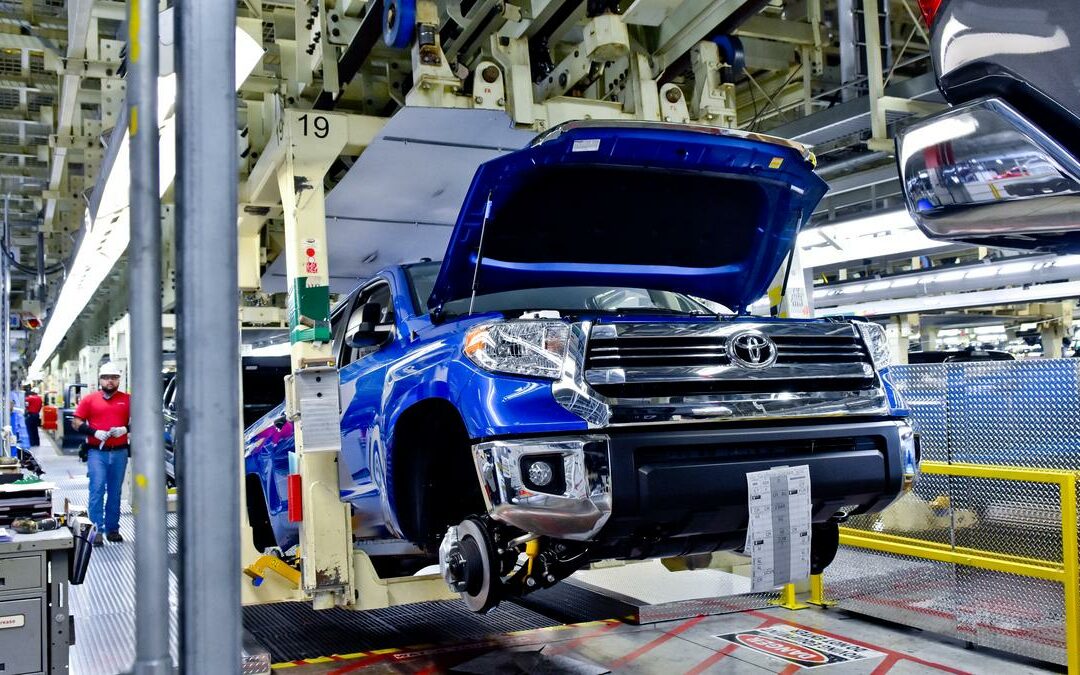
These days, more drivers are opting to “factory order” a vehicle instead of buying one off the lot. This trend began during the new car shortages of the pandemic, and has stuck around ever since. For many car buyers, factory ordering is an unfamiliar purchase process and can be intimidating. We’re here to help you make sense of it all.
Everyday on the CarEdge Community Forum we field questions such as:
We’ll address these questions (and more) below.
Let’s dive in.
The steps to factory order a car isn’t too terribly complicated, however, for many, it’s an entirely unfamiliar process. Here’s the roadmap for factory ordering a car in 2026:
The simple “10 steps to factory order a car” … Simple, eh? Let’s break things down a bit more.
Can you negotiate on a factory order car? Yes. You can, and you should negotiate the price of your factory ordered vehicle.
There is a common misconception that because you are “custom ordering” a vehicle you cannot negotiate with the dealer, simply because it is “custom”. That couldn’t be further from the truth. From the dealership’s perspective a factory order is just like any other car deal. It’s a piece of inventory that they’ll make front-end and back-end profit on. As a customer, you should treat it the same way too.
So when do you negotiate on a factory order? At the time of placing the order. Not when you take delivery of the vehicle!
This is another common misconception when it comes to factory ordering a car. You need to negotiate when you first place the order, not when you take delivery. Why? Because the dealership treats the ordered vehicle similarly to any other sales.
When your salesperson/sales manager is putting together the “deal jacket” (industry lingo for all the paperwork associated with your car deal), they will have an out-the-door (OTD) price associated with the deal. That OTD price shouldn’t be MSRP + fees + taxes + tags/registration. Instead, if you negotiate with them it should be MSRP – dealer discount + fees + taxes + tags/registration.
Enjoying this guide Check out The Car Buyer’s Glossary of Terms, Lingo, and Jargon
If you don’t negotiate with them then, the assumption is that the deal is at MSRP, and your leverage (once the vehicle is on the dealer’s lot) is lesser. Especially in the current market where inventory is so scarce.
It’s also important to negotiate the price upfront, because you want to “lock-in” the price so that there are no surprises when you finally take delivery. More on that below.
What can you negotiate when you factory order a vehicle? It’s simple, all the same things you would negotiate when you purchase a car off the lot. Remember, if it’s taxable, it’s negotiable!
Negotiate on taxable fees (doc fees, processing fees, etc.), and on the vehicle’s selling price. After you negotiate, you should ask for a signed copy of the itemized out-the-door price.
Manufacturers incentives are applied at the time you take delivery of the vehicle, not at the time of placing the order. For example, if you order a truck today you will negotiate the OTD price with the salesperson and sales manager today. You will then take delivery of the truck several weeks later. At that time, you will be eligible for any applicable manufacturer incentives that are currently active. You will not be able to retroactively receive the incentives that were in place when you ordered the vehicle.
Negotiating a factory ordered vehicle is very similar to negotiating a vehicle that is on the dealer’s lot. If you are unfamiliar with that process, please consider going to CarEdge’s free Deal School, or if you’d rather have experienced pros handle your deal, consider signing up for our Car Buying Service.
That being said, there is one distinct difference between negotiating a vehicle on a dealer’s lot and one that is ordered. That distinction is floor-plan assistance.
What the heck is floor-plan assistance you wonder?
You may be more familiar with “holdback” which is a form of “under the line” profit that dealerships collect from the manufacturer. In addition to holdback, dealerships also receive floor-plan assistance and advertising assistance from their manufacturer.
Floor-plan assistance is a set aside amount of money for each vehicle (it appears on most dealer invoice prices) that the manufacturer gives to the dealership to offset the interest expense associated with “floor-planning” the vehicle. You may not have known this, but car dealerships do not pay cash for their inventory. They finance it, just like you or I would. That means they have an interest expense on each vehicle that is on their lot.
Floor-plan assistance helps offset this cost for the dealership.
Why is this important? Because since you are factory ordering your vehicle and will likely take delivery within a few days of it arriving at the dealership, the dealer will not incur any meaningful interest expense. That means the floor-plan assistance from the manufacturer is pure profit for them.
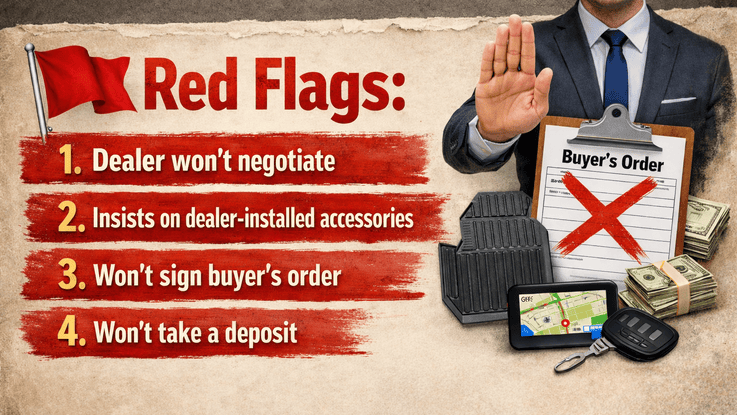
As you can tell by now, factory ordering a car is very similar to purchasing a vehicle straight off the dealer’s lot. It isn’t too terribly different, however there are some distinct changes in the process. That being said, are there any particular “red flags” you should watch out for when placing a factory order? The answer is “yes”. Here’s what you should watch out for.
This is a major red flag. If the dealership isn’t willing to negotiate on the price when you place the order you can guarantee that two things will happen when the vehicle does arrive:
We’ve heard too many stories of people “ordering” a vehicle and not negotiating the price in advance, only to have a nasty surprise when it finally does arrive at the dealership.
Dealer-installed accessories are added by the dealer when they receive a vehicle. You’ve likely seen these on an OTD price worksheet in the past. Things like wheel locks, or LoJack are common dealer-installed accessories.
A common line you’ll hear from a salesperson or sales manager is “we can’t take that off, we put it on every car.” Well, the great thing about factory ordering a vehicle is that the dealership doesn’t have to install any of their accessories, because you’ll take delivery as soon as the vehicle arrives.
If the dealership is persistent about not removing them, that’s a red flag, because it’s a truly illogical argument.
You’ve negotiated your OTD price and you’re ready to put down a deposit to hold the vehicle. Woohoo! The only way to really make the agreed upon OTD price legitimate is to have a mutually signed buyer’s order. That, plus the deposit and the signed build sheet, make it clear that the price is the negotiated price.
If a dealership won’t sign a buyer’s order, that’s a red flag. You don’t want to arrive the day your vehicle is ready only to find out that the negotiated selling price you had is no longer agreeable to the dealership, and the only way to protect yourself from that is to have the signed agreement.
If they won’t do it, take your business elsewhere.
When you factory order a car you will need to put down a deposit on the vehicle. This is typically $500 to $1,000. If the dealership does not request a deposit, or if they won’t accept your deposit, that means the vehicle you’re “ordering” isn’t really your vehicle. Just like the signed buyer’s order, if you can’t get a deposit down, you’re in for a rude surprise when the vehicle finally does arrive.
To “lock-in” your build and the OTD price, have both the dealership and yourself sign a buyer’s order, and put down the requisite deposit amount that they require.
This is an unfortunate, albeit common occurrence. If you’ve followed our steps and placed an order and then the dealership has gone silent, be sure to go up the chain of command at the dealership to contact someone in a leadership position to get information about your order. This is all about being your own advocate. We encourage you to use our email templates when contacting the dealership.
Have other questions about factory ordering? Please post them on the CarEdge Community here: https://community.caredge.com/home
We hope this helps. Please consider sharing it with anyone you know who might find it valuable.
You’ve finally settled on a new car. Test drives, negotiating and all the going back and forth has you feeling a little worn down but you’re almost done! All you have to do is sign a few papers and you’re out. So you thought.
Here are five things you might not have known about car dealership finance offices, and how they could be beneficial to you the next time you buy a new car.
When you sit down across from the Finance Manager he or she will present you with a document called a Menu. On it you’ll see columns filled with additional products and payments shown at the bottom of each of these columns.
Want to learn more about the “Menu?” Read the complete guide on F&I Menu Selling.
Your brain tries to put this all together when the Finance Manager begins to explain each item. Things like a Vehicle Service Contract (aka extended warranty), GAP, Maintenance Plan, Tire/Wheel, Paint/Interior and Key Care.
Here’s the thing … These additional products might seem great, and one or two of them might even make sense for your driving habits and lifestyle, but that doesn’t mean you have to pay retail price for them! Ask the Finance Manager what the actual price is and negotiate it down. You can do that! It’s not written in stone that you have to pay the full sticker for ancillary products that are presented to you on the Menu.
Note: Don’t ever let a Finance Manager tell you he/she will lower your interest rate IF you buy a product. In most cases, it’s not legal and is non-compliant.
You have an idea of how long you want to finance your new car. Five years seems pretty good, and since there’s not a prepayment penalty on the loan, you know you can pay it off faster if you want to.
Even though the numbers are all correct, and you’re about to sign your paperwork, that 60 month payment feels a little “snug” all of the sudden in your budget. What can you do?
Did you know that many banks will stretch that term out to 63 months with the same interest rate? That gives you a little more wiggle room, so that you won’t be stuck when the holiday season rolls around!
Also, ask the Finance Manager to show you a “two term menu” so that you can see what your payments look like in two different terms like, 66 months and 72 months!
Always be sure the Finance Manager shows you your Base Payment. That’s your payment without any additional products added on (aka what they’re showing you on the menu.)
When you’re finished negotiating the price of the vehicle with the sales person, and you’re ready to buy, the sales manager will then “push” that information into a computer program and assign it a deal number. The Finance Manager pulls that deal number up and begins firming up the fees. What the heck does that mean?
It’s the Finance Manager’s job to make sure that all state taxes and fees are accurate. The bottom line you agreed to at the sales person’s desk might not exactly match the number you’re presented with in the finance office.
If it’s a little lower – good for you! But, if it comes in higher and the Finance Manager tries to explain it’s because of fees, then let him or her know they’ll have to take it off the purchase price. Typically, it might be off by a few dollars but sometimes it could be as much as $20. Every penny counts!
Nowadays, many car deals are done for out of state customers because it is so tough to find the exact vehicle you’re looking for in your area. Don’t be surprised when the Finance Manager “firms up the fees,” and be prepared to ask questions and push back when appropriate.
You’ve been working hard to improve your credit and you know exactly what’s on it.
Now you’re a little nervous about getting a loan through the dealership because you’ve heard your application gets “shotgunned” to different lenders and that could hurt your score.
While your credit will bounce back after car shopping it does take time, and too many inquiries can look bad on your report. But there’s a way to lessen the blow.
Before you sign your credit application, tell the Sales Manager and the Finance Manager that you only want your loan to go to 2 or 3 banks at the most. And if you have a 750 to 800 score you can even tell them to bypass pulling your credit all together and just send it to 1 or 2 banks for the best approval.
You’ve done everything ahead of time so far. You’ve used CarEdge’s car buying email templates, negotiated an out the door price, and now you’re at the dealership ready to sign your paperwork and head home in your much awaited new car.
Your credit application is signed and the Finance Manager is getting your special APR incentive financing ready for you. And then everything comes to a screeching halt.
The Finance Manager says “I’m sorry Mr. and Mrs. Doe, it seems your credit is locked and we cannot get an approval for you at this time. Can you please call and have all 3 bureaus unlocked so we can move forward?”
Depending on how busy a Finance Manager is, getting your credit unlocked and finalizing your car deal could end up taking hours if there are other customers that now get to finish their deal before you.
If you have a lock or a freeze on your credit for protection, don’t forget to unlock it before you go to the dealership to complete your paperwork!
We hope these 5 little nuggets of information help you during your car buying process.
As a result of ongoing new vehicle production shortages, used cars, trucks, and SUVs are in high demand. This means that “rougher” and “edgier” used vehicles are making their way to dealership lots for sale to the public. One way to protect yourself from unknowingly purchasing a clunker is to look at a Carfax or AutoCheck vehicle history report.
Today we’re going to share a few stories from the CarEdge Community about AutoCheck and Carfax, and provide our recommendations for how you can protect yourself if you are buying a used car.
Let’s dive in.
Let’s start with the basics … How do these two companies work? AutoCheck and Carfax both operate in the same way; they source data from different places and compile that information into reports that are easy for a consumer to understand. With this in mind, it’s clear how the two companies compete. Who can get more (and better) data about a vehicle? That’s the challenge.
Become a FREE CarEdge MemberCarfax and AutoCheck both boast impressive lists of data partners on their websites. For example, Carfax says they have 112,000 data sources, while AutoCheck was developed by Experian and has access to all of their resources and relationships. Both companies provide compelling credentials as to why they are superior to the other. That being said, they both face the same issue: if data is not reported to them from one of their data partners, it will never show up on a report.
This brings us to the most important question of them all … Which is more reliable? Carfax or AutoCheck? We’ll answer this question by providing a few anecdotes from our experiences, as well as what we’ve heard from CarEdge Community members who have shared their stories with us in the community forum or via Live Chat with our Auto Advocates.
Sadly, this happens more frequently than we’d like. Take for example the case of Chris, a gentleman in Alaska who purchased a 2019 Ford Fusion from a local independent dealership.
Chris went to the dealership, took the Fusion for a test drive, reviewed the AutoCheck report that the dealer provided, and purchased his car. A few days later he took it to the local Ford dealership because a light came on in the dash. Within an hour, Chris had a sinking feeling in his stomach when a technician came to him and explained that his vehicle had been in a severe accident. Chris, unbeknownst to him, had bought a clunker.
How could that happen? The AutoCheck had been clean. In case it wasn’t obvious, this is why we always recommend getting a pre-purchase inspection completed on any used vehicle (even certified pre-owned). That being said, what was scary about Chris’ experience is that Carfax had different data than AutoCheck—they did report damage to the vehicle (but not an accident).
Let’s look at the two reports, and some photos of the vehicle before it was repaired.

As you can see on the AutoCheck report, the Fusion comes back “clean” and with an average AutoCheck score. Let’s look at the Carfax report.

As you can see on the Carfax report there are no accidents reported either, however there is a report of damage to the vehicle.

Right there on the Carfax report it says clearly “get the vehicle inspected before you buy.” Carfax knew about the damage, and AutoCheck didn’t. Chris obviously didn’t get the vehicle inspected, and he trusted the dealer who sold him the vehicle because they provided a “clean” AutoCheck.
Become a FREE CarEdge MemberDoes this mean AutoCheck is inferior to Carfax? We’ll let you be the judge …


We heard a similar story from a CarEdge Community member named Kristen.

Kristen had a nearly identical experience to Chris. She bought a vehicle (and even got the extended warranty), only to find out a few weeks later that it had previously been in not only one, but two accidents!
Does AutoCheck not collect as much information as Carfax? Based on some of our communities experiences, it appears that way.
I know we sound like a broken record, but getting a pre-purchase inspection is one of the best things you can do to protect yourself when buying a used vehicle. A pre-purchase inspection isn’t bullet-proof, but it certainly increases the likelihood of you avoiding a fate like Chris or Kristen.
Another trick you can use to get more information about a vehicle is to ask your insurance company to check the VIN in their systems. Insurance companies have databases similar to Carfax and AutoCheck that they can access on your behalf. Once you’ve found a vehicle you’re interested in, call your insurance company and ask them what info they have on the VIN. If it comes back clean on their end, then get the pre-purchase inspection.
In nearly every state, when you purchase a used vehicle you are purchasing it “as-is.” This means that no matter what condition the vehicle is, you are purchasing it as such. This doesn’t mean a dealership can sell you any clunker (vehicles have to pass state safety inspections to be sold), however it does mean that once they’ve sold you something it is entirely yours to deal with. The contract you signed stated it is being sold to you “as-is” and that the dealer cannot be held liable for the condition of the vehicle.
It is important that you understand the “as-is” concept, because your recourse post-purchase if something does go wrong is limited. If you’re like Chris or Kristen you have a few options to remediate the situation, however none are ideal. It is critically important that you understand you are purchasing the vehicle “as-is” and that you should be measured and pragmatic before signing the contract.
You don’t have to look far to see that there is currently something unprecedented going on in the automotive industry. From the empty dealership lots you drive by, to the news stories you’re hearing about a “chip shortage,” it’s clear something very serious is impacting manufacturers, dealers, and ultimately people like you and me; consumers.
We’ve documented in the past how the ongoing semiconductor (chip) shortage is wreaking havoc on manufacturer’s ability to produce new vehicles. Ford is storing F-150’s in country fields and race tracks, Jaguar Land Rover is informing their investors that they’re losing more money than anticipated because of the shortage, and dealers are making record profits because they can sell their limited inventory above sticker price (MSRP).
To suggest that what’s going on in the market right now is ridiculous would be an understatement. We’ve never seen anything like it.
Traditionally, buying a car can be pretty intimidating. You find something online, go into the dealership, sign the paperwork and then you’re left wondering, “did I get a good deal?” In today’s market the answer more and more frequently is “no.”
Become a FREE CarEdge MemberUninformed buyers are agreeing to pay for crazy add-ons, unheard of additional dealer markup, and ridiculous F&I products, simply because they don’t know better. That’s why today we want to share with you the simplest explanation for why you should be leasing a vehicle right now instead of buying it. If you know someone who is thinking about getting a car in this market, please consider sharing this with them.
Here we go …
To understand why leasing is the smarter option today, let’s start by explaining why financing (i.e. taking out a loan to purchase) a vehicle is not advisable right now. I wrote about this in depth a few weeks ago, but the long and short of it is this:
Vehicle prices are inflated, which means the loan you take out on the vehicle will be for the inflated purchase price. Let’s say you get a five year loan, well, over the next five years as vehicle prices normalize, you’ll still have your loan for the original amount (when prices were inflated). This means you’ll be in a major negative equity position (the vehicle will be worth considerably less than what you owe on the loan).
Enjoying this guide Check out The Car Buyer’s Glossary of Terms, Lingo, and Jargon
Why is this important? Because in normal times many people would find themselves in $2,000 to $3,000 “negative equity” positions, and that was without inflated vehicle prices at the time of purchase. In today’s market, those same people will find themselves in much more severe negative equity positions because they took out a loan on something that isn’t actually worth as much as it’s selling for right now.
So what options do you have?
This is where leasing comes into the picture. When you lease a vehicle you don’t own it, you rent it. Leases make a lot of sense in today’s market because they allow you to fulfill your need (having mobility), while also mitigating your risk of taking on debt that will burden you into the future.
Let’s look at a tangible example. Here’s a lease deal for a 2021 Toyota Camry:

You can see the MSRP is $26,701, and the dealership is selling the vehicle at that price. The residual value is down in the bottom left, and it is 52%. That means that at the end of the lease term (36 months and 36,000 miles) the leasing company (Toyota Financial Services) expects the vehicle to be worth 52% of its original value ($13,885).
Should you buy GAP Insurance? Read our guide to GAP Insurance!
The residual value is not negotiable. It is the best guess from Toyota as to what they think the vehicle will be worth at the end of the lease term. Since the pandemic we have not seen meaningful changes in residual values. This makes sense, because the residual value is an estimate as to what the vehicle will be worth in three or four years, not next week. Even with inflated vehicle values today, leasing companies expect their vehicles to return to a normal depreciation curve in the future.
Become a FREE CarEdge MemberBy leasing, you are effectively renting the vehicle for 48% of its depreciation.
Your other option is to finance the purchase of the vehicle. If you do that you will be financing the total purchase price, plus taxes, plus fees. On this Camry deal that likely comes out to $30,000. Typically Camry’s would sell with a dealer discount and significant manufacturer rebates. Obviously in today’s market that’s not what’s going on.
Once used vehicle prices return to normal and this Camry depreciates as expected, you’ll owe significantly more on the loan than what the vehicle is worth. Compare that to our leasing option, and after three years you can walk away from the lease and purchase a Camry then (likely with the dealer discount and the manufacturer incentives we’re accustomed to).
The real benefit of leasing right now is that it means you will not be in a severe negative equity position in three years, and by that time vehicle prices will have normalized as new car supply has returned to normal. At that point it would make much more sense to purchase a vehicle (new or used) since their prices will not be inflated.
In the meantime, if you do finance a vehicle, be prepared to face a sobering reality when you check the value of your vehicle in 24 months. It’s going to depreciate, and if your loan is for thousands of dollars more than what it’s actually worth, that’s going to be a tough pill to swallow.
Currently, there is a global shortage of new cars, trucks, and SUVs. Manufacturers like Ford, GM, and many others have been struggling for months to supply their dealerships with enough new inventory to keep up with demand.
Market days supply, a metric that sales managers and industry executives track religiously, is at historic lows. Dealerships typically carry a 60 to 90 days supply of inventory. This means that if a dealership did not receive another vehicle, they would have enough inventory to meet demand for 60 to 90 days. To paint a picture of how dire the situation is, Subaru currently has an 8 day supply of inventory. 8 days.
Get market days supply data for your area for FREE. Run a Market Price Report NOW!
Why is there a lack of supply? Because of an ongoing semiconductor shortage that has plagued the automotive industry for all of 2021, and likely into 2022.
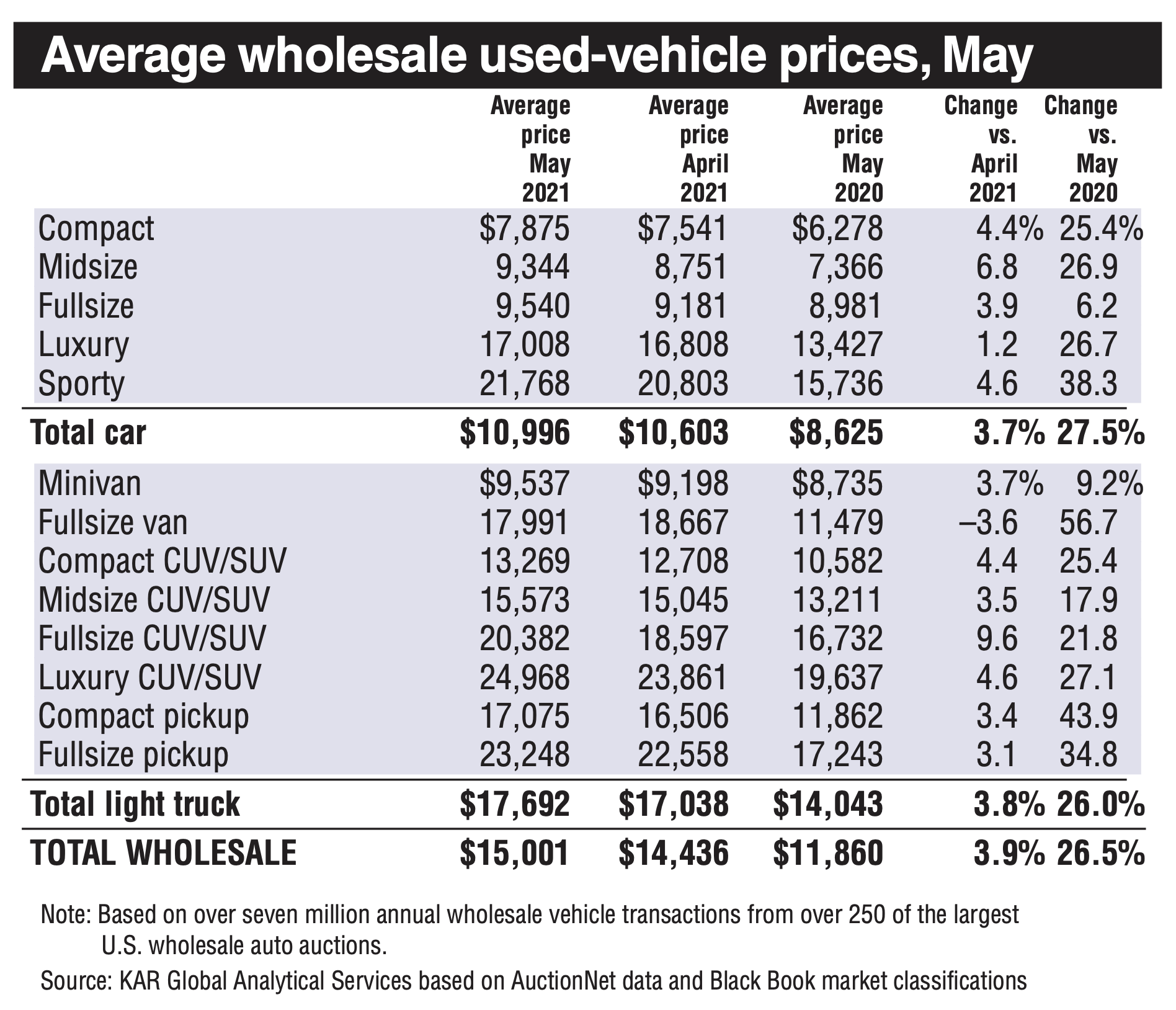
The “chip shortage” as many are referring to it, and the subsequent new vehicle shortage have had ripple effects across the entire automotive industry. With fewer new vehicles available for sale, used car prices have skyrocketed. Used vehicles are worth 25% more right now than they were at this exact same time last year. Considering a car is a depreciating asset, that’s not supposed to happen.
It’s fair to say that we’re currently experiencing a seller’s market of unprecedented magnitude. That being said, many people find themselves in a position where they need to buy a vehicle. In that case, there are a few things to be aware of in advance of signing on the dotted line of your buyer’s order.
As we’ve learned from CarEdge Community members who work in dealerships and financial institutions, lenders are still financing vehicle purchases, even as loan to value ratios are severely out of whack. What impact will consumers face once the bubble bursts? Let’s unpack exactly that.
Become a FREE CarEdge MemberWhen you buy a car it depreciates. The exception to this rule has been 2021, however we expect that once new vehicle production returns to normal, all vehicles will depreciate as per usual.
Before the chip shortage, a car buyer could expect their new vehicle to depreciate about 20% in their first year of ownership. For many owners who financed their purchase, this meant that they likely owed more on their loan than what the vehicle’s market value is after one year.
How so? Consider this scenario.
If you bought a $40,000 car and it depreciates 20%, it’s worth $32,000 after one year. Even though the vehicle selling price was $40,000, you likely financed more than $40,000. This is because the selling price of a vehicle isn’t the actual, or total price you pay. The total price is what we refer to as the out the door (OTD) price. The OTD price includes all fees, taxes, and accessories. When you finance a vehicle you finance the OTD price, PLUS any ancillary products you purchase in the finance office (unless you purchase them in full upfront).
Now the OTD price before you go to the dealership. Use the FREE OTD Calculator NOW!
That means your loan amount will be more than the $40,000 selling price (unless of course you plan to pay taxes and fees in cash, or make a substantial down payment). Every state and locale has different tax codes (we calculate those for you in our free OTD Price Calculator!), and dealer fees vary from state to state (we’re looking at you Florida), but a general rule of thumb is that your OTD price will be 10% higher than the selling price of the vehicle.
That $40,000 purchase is actually a $44,000 purchase, and unless you’re putting some serious cash down, you can quickly see how you’ll be in a negative equity position the moment you drive off the dealership’s lot. Your loan is for $44,000 (with zero down), and the value of the vehicle you are purchasing (new) is $40,000. You’re already in a $4,000 negative equity position.
What we described above is a typical negative equity situation consumers would face last year (pre-pandemic). Our concern is what will inevitably happen to consumers in 12, 24, or 36 months from now. Their negative equity position will be magnitudes greater than the example we just shared.
New vehicles are frequently selling for thousands of dollars over MSRP. Consumers are buying and financing thousands of dollars of “additional dealer markup” simply because of the supply shortage. In 2021, on a new Kia Telluride with $8,000 in additional dealer markup, you may have financed $54,000 on a $40,000 MSRP vehicle. That’s a serious negative equity position!

That being said, many lenders are not approving loans without significant cash down payments. Lenders need to abide by loan to value ratios that make sense based on your credit score and history. However, from everyone we’ve met with, lenders are still lending, and somehow consumers are manufacturing a large enough down payment to justify getting a loan approved.
Right now, at this very moment, the new Kia Telluride you just bought brand new might actually be worth MORE now that it’s a used vehicle (what a crazy time we are living in), however that is exactly the “bubble” we are talking about. Everyone knows that the Kia Telluride you just bought with $8,000 in additional dealer markup isn’t actually worth more used than it was new. That’s the craziness of our current supply/demand imbalance.
Become a FREE CarEdge MemberSo what happens in 24 months when that Kia Telluride price has normalized and it has deprecated the way we all expect it to? The owner who financed that purchase is going to be looking at a sobering reality, their Telluride will be worth considerably less than what they owe on their current loan. If they want to move into a different vehicle they’ll have a tough pill to swallow.
The same reality is playing out in the used car market. With used vehicle prices highly inflated, consumers are financing purchases on used cars and trucks that aren’t worth as much as they appear to be right now. The negative equity position they’ll be in will be staggering. The first impact of the “bubble bursting” will be the reality that millions of Americans will owe thousands of dollars more on their auto loans than what their vehicle is actually worth. This will have some interesting effects on vehicle sales in the near future.
Understanding GAP Insurance right now is very important! Read our FREE guide to GAP Insurance.
By now you are likely familiar with massive “online” car dealers like Carvana, Vroom, and Shift. Each of these companies has gone public over the past few years, and with valuations north of $50B, each has a lot of money to invest in growing their business.
What’s interesting about their business model (and Carmax’s too) is that they make most of their money not selling cars, but on selling loans, and ancillary products (extended warranties) tied to the purchase of a vehicle. To sell a loan or an extended warranty, you have to sell a car. Selling a car is actually really expensive. You have to find a vehicle to buy, recondition it so that it’s “showroom” ready, and then market it for sale.
Even with all that overhead, there is enough money in loans and extended warranties (and occasionally in the actual sale of the vehicle) that they make money (or at least make enough money to justify raising more capital from investors).
As used car prices have skyrocketed, we’ve seen an intensified bidding war amongst the deep pocketed publicly traded used car dealers. We’ve documented for months how Carvana, Carmax, Vroom, and Shift are paying incredibly high prices for used vehicles. Remember, if they don’t have inventory, they can’t make money, and if they can’t make money, their investors won’t be happy. It’s a vicious cycle.
What happens when the bubble bursts and used vehicle prices fall? Each of these dealers will be looking at their portfolio of hundreds of thousands of VERY expensive cars they paid for that are NOT worth what they paid for them. Depending on how quickly prices fall, each of these companies could be looking at hundreds of millions of dollars in inventory that is worth less than what they paid for it.
In a “post bubble burst” world we’ll be looking at quarterly reports from each of these companies that discuss how they’ll need to offload inventory at a loss to free up cash to be able to purchase new inventory at a lower price. This practice is called cost averaging, and it’s inevitable it will happen. The companies that don’t handle this well will certainly suffer, and as consumers we may be able to benefit from some sort of “fire sale” if/when it happens.
The third impact we see when the bubble bursts, is that there will likely be fewer in-market auto buyers. Like we discussed above, with expected negative equity positions to be very large, there will likely be a substantial number of buyers who take themselves out of the market when they realize that they owe thousands (if not tens of thousands) more on their current vehicle than what it is worth. We expect that many people will decide it makes more sense to hold onto their existing vehicle than “roll the negative equity” into a new loan and try to purchase another vehicle in 12, 24, or 36 months.
If you need to buy a car in this market, there are a few things you can do to protect yourself.
Become educated about the market situation. Reading this article will help you, and we also suggest you watch a few of our recent YouTube videos to get up to speed.
Be aware of your local market conditions. Although the supply shortage is global in scope, be sure to understand your local market conditions by running a Market Price Report.

Get support negotiating with the dealer/seller. Post your OTD worksheet to the CarEdge Community Forum, or live chat with our Auto Advocates On Demand. No matter what, get a second set of eyes to review your deal before you sign the dotted line.
Get pre-approved for financing instead of relying on the dealer!
Be patient! We’ve heard from dozens of community members that they’re still able to get fair deals right now. It takes patience and persistence. You’ve got this.
CarEdge was founded in 2020. We specialize in providing a number of solutions to our members to help them secure a great deal on a new car. As a part of our comprehensive tools for car buyers, we also offer vehicle service contracts (“extended warranties”) through our partner company, AUL.
We interviewed many different extended warranty administrators in advance of deciding to work with AUL Corporation. There are a lot of “fly by night” companies out there, and AUL is not one of them.
AUL Corporation has been in business for 31 years. They are fully accredited with the BBB and have an A+ rating. Their BBB rating is 4 out of 5 based on 54 customer reviews, with corporate headquarters in Napa, California.
The reason we chose to work with AUL Corporation is because of their track record in the industry, commitment to customer service, and quality products.
There are two big factors that need to be considered when you’re deciding which VSC (“extended warranty”) to purchase: Cost and coverage.
As we went over in our guide to vehicle service contracts, the cost of a VSC (“extended warranty”) is based on your VIN and the mileage of your vehicle. As such, your cost and quote may be quite different from the quotes that other consumers receive for their vehicle.
We’ve made it easy for you to see what a VSC (“extended warranty”) would cost: https://caredge.com/extended-warranty/
CarEdge promises to always be transparent in our pricing. Currently, we make a flat $500 on every VSC (“extended warranty”) we sell. That means the wholesale cost of the contract is the price you see when you self-quote minus $500. If we are required to change our pricing in the future, we will always provide a reason for the change. Our priority is transparency, so we encourage potential customers to reach out if they have any questions.
CarEdge’s VSCs are administered by AUL Corporation and are insured by American Bankers Insurance Company of Florida. We interviewed many different VSC administrators in advance of deciding to work with AUL Corporation.
AUL offers a comprehensive selection of coverage options under the umbrella of 15 different plans. These plans range from exclusionary coverage that will cover almost everything on your vehicle to stated coverages that are more hyper specific, along with some customizable levels of coverage.
Here at CarEdge we sell AUL’s Sentinel brand of products. There are four coverage options we are able to provide:
Supreme Plus is the highest level of coverage that most closely mimics a manufacturer’s new car warranty. Supreme, Premier, and Powertrain are all stated coverages that are more limited in scope. In the spirit of transparency, you can view a sample contract as well as a breakdown of specifically what is and isn’t covered by each level of coverage by logging into your CarEdge account.
Take note that there is no coverage for issues that relate to abuse, misuse, or neglect. VSCs (“extended warranties”) are intended to protect you from manufacturer defects, not other forms of breakdowns, like forgetting to change your oil or getting into a car accident.
All of the plans from AUL come with a few notable perks, including:
Please note that our VSCs (“extended warranties”) are not currently available to customers in Massachusetts.
Customers will be able to choose any repair shop that has been certified by ASE or AAA. This includes any local dealerships. Covered repairs will be paid directly to the repair shop. However, repairs must have prior authorization before they begin, and because AUL has long standing relationships with dealers, a service advisor will handle this on your behalf.
A deductible may be applied, depending on the type of plan you choose. As with any VSC (“extended warranty”), you should be fully aware of the deductible before you sign the contract.
Customers will be able to choose any repair shop that has been certified by ASE or AAA. This includes any local dealerships.
If a light comes on in your dash, or you hear a clunking in the engine, you should go to a local dealership or an ASE certified repair shop. When you pull into the service lane, have your policy number handy, and provide it to the service advisor. The service advisor will conduct a diagnostic assessment of your vehicle to determine what the issue is and present that information to both you and AUL. If the repair is a covered repair you will pay your deductible and be on your way. If it is not a covered repair you may have an out of pocket expense.
If your vehicle is outside of it’s factory bumper to bumper warranty you will need to have a pre purchase inspection (PPI) performed. A local mechanic should be able to conduct a PPI for ~$100. There are national services as well, such as LemonSquad. We simply need a copy of your PPI report on file.
Yes, you can cancel the vehicle service contract and receive a prorated amount of your money back (based on either time or miles, whichever is greater). If you cancel your vehicle service contract within 60 days and there have been no claims made you will receive a full refund. There is a $50 “administration fee” at the time of the refund.
You can cancel the vehicle service contract and receive a prorated amount of your money back OR it makes a great incentive to a new owner! There’s a $50 transfer fee and the new owner will have the remainder of the coverage.
Yes, if you purchase a vehicle service contract for a brand new vehicle you will have overlapping coverage during the period of your manufacturer warranty (typically 36 months and 36,000 miles).
When you purchase a vehicle service contract on a brand new vehicle you’ll have more term options and cheaper prices available. For example, you may be able to purchase a 10yr/100,000 mile term on a brand new car whereas you might only be able to get a 5 or 6 year term with fewer miles later. Please check out the video here that explains things to consider while buying extended warranty on a new vehicle.
Yes, you are purchasing the same type of product sold at a dealership. We cut out the middleman (insurance brokers), and make a few hundred dollars per vehicle service contract. The dealership marks up their vehicle service contract thousands of dollars, not hundreds, but thousands!
CarEdge’s vehicle service contracts are administered by AUL Corporation and are insured by American Bankers Insurance Company of Florida. We interviewed many different VSC (“extended warranty”) administrators in advance of deciding to work with AUL Corporation. AUL Corporation has been in business for 31 years. They are fully accredited with the BBB and have an A+ rating. Their BBB rating is 4 out of 5 based on 54 customer reviews, with corporate headquarters in Napa, California.
Believe it or not, many “manufacturer” vehicle service contracts are actually administered by third parties. Some manufacturers simply choose to “brand” a vehicle service contract with their name and it looks very enticing. We encourage you to do your research and check the coverage and price before making any buying decision. We reviewed manufacturer extended warranties here.
No. The price is the price and is a one time payment.
There are two surcharges that may apply.
A “Business Use” surcharge and a “Lift” surcharge.
If you use your vehicle for business such as Uber, Lyft, delivery services or if your vehicle is in a business name there is a surcharge.
If you have a lift kit (professionally installed before you purchase the vehicle service contract) there is a surcharge.
There is a standard $100 deductible per repair order. You may have the option of a $50 or $250 deductible.
No. If you perform your own maintenance on your vehicle it must be according to your owners manual and you must keep records of the maintenance. This means keeping track of what maintenance was performed, and receipts of materials used. You don’t want to be in need of repair because proper maintenance was not performed!
Our partnership with AUL Corporation allows us to provide a top-quality VSC to our members. We chose to work with AUL due to their excellent plans, affordable cost, and great customer reviews. To purchase a VSC (“extended warranty”) from us, please create a free CarEdge account and self-quote your VSC. If you’re not sure you want to purchase from us, please schedule a 15-minute consultation call with us. We’ll be happy to walk you through VSC options, even if you don’t choose ours. You can do that from within your account as well.