CarEdge saved me over 4,500 dollars on a brand new Honda Pilot. I can't say thank you enough.
Price intelligence
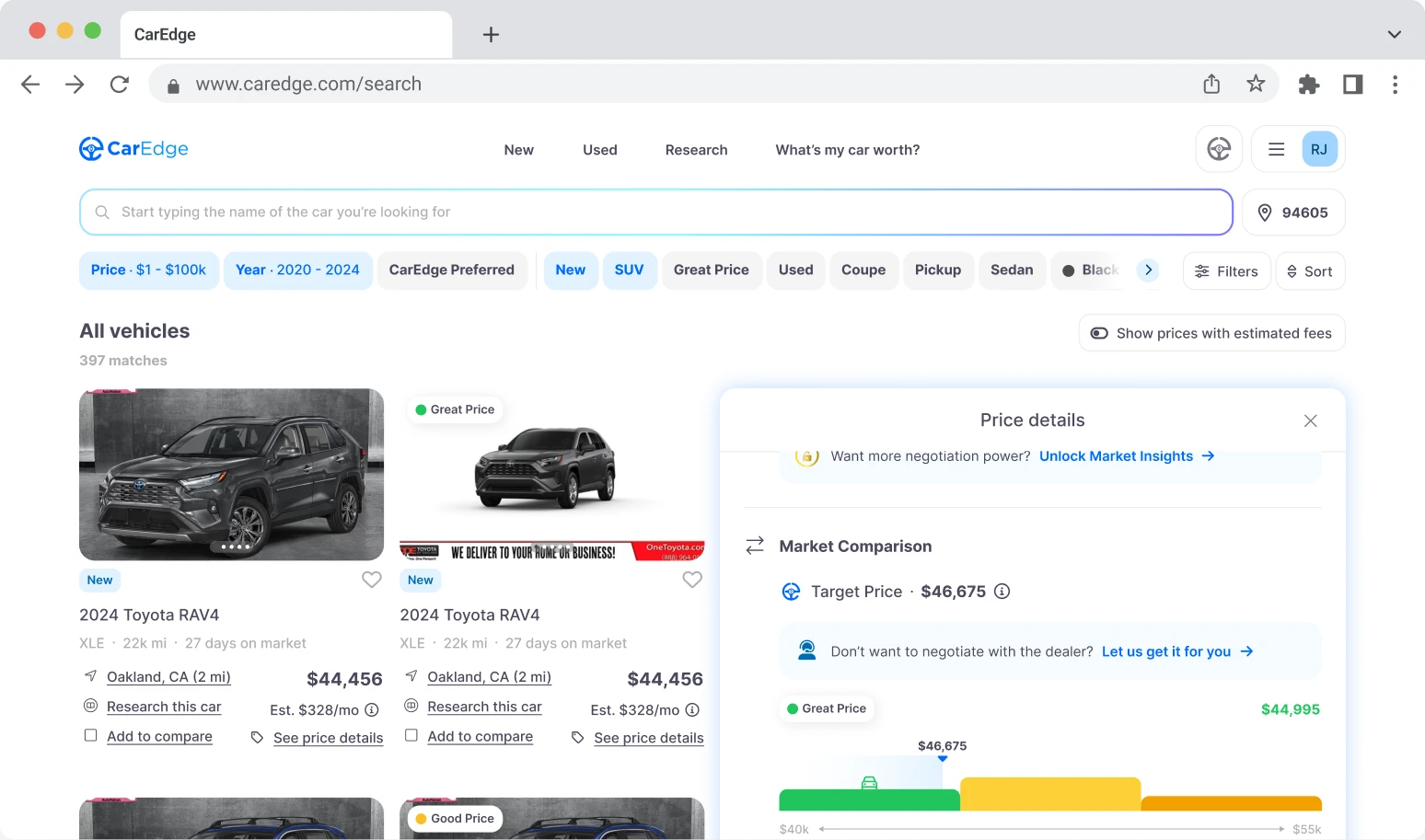
Find a wide range of vehicle listings with market insights on new and used listings near you.

What can I do with CarEdge?
 CarEdge Insights
What can I do with CarEdge?
Get access to exclusive information so you can make an informed car buying decision — all in one place.

Find a wide range of vehicle listings with market insights on new and used listings near you.
Track your vehicle’s value and cash in when the time is right to sell.

Access to our proprietary data to help you find the right car, at the right price. Find these unlocked on every listing after subscribing.

With our expert-led, tech-enabled car buying service, we will locate, negotiate, and deliver your vehicle so you can get a new car hassle free.


Help us personalize your CarEdge experience — it only takes a second.
Your answers help us personalize your CarEdge journey — we’ll follow up with tips and next steps that match your buying timeline.
Updated for 2026
When it comes time to say goodbye to your current set of wheels, you have plenty of options. You could sell to Carvana, sell to CarMax, sell to a private party, or perhaps trade in at the dealership. The list goes on and on.
Recently, I went through the process of selling my 2017 Volvo S90 to Carvana, and the process was unlike any other car dealership experience I have ever had before. Selling to Carvana was simple, smooth, and financially, the right choice for me.
We documented the process on our YouTube channel (the video above), and I wanted to go in more detail about the process. Here’s what went well, how it works, and more.
Carvana pays top dollar for their used cars. Why? Because they’re a HUGE publicly traded company that needs to impress investors with constant growth. The only way they can grow is to sell more cars, and the only way they can sell more cars is to buy more inventory. Because of this, Carvana is willing to pay top dollar for used cars.
Obviously Carvana (and all the other digital retailers) buy inventory from wholesale used car auctions, however, when you buy a car from the auction there are a lot of associated fees (buyers fees, transportation, and more). Because of this, companies like Carvana are happy to pay a premium to people like you and me because they don’t have to worry about all of the other costs associated with buying an auction car.
If you’re thinking “should I sell my car to Carvana to get the most amount of money,” the answer may be yes.
Before you do, make sure you compare multiple offers from the growing number of online car buyers. CarEdge has made it easy for you to get all of your offers in one spot, with no annoying phone calls, and no hassle. Check it out below!
Carvana dominated online car buying last year, but the market is quickly changing (check out the video above). There could be better offers out there, and that’s why we recommend comparing offers first.
I recommend you get offers from Carvana, EchoPark, and CarMax before deciding where to sell your car. After we posted our video on YouTube, we received comments from people that told us they received higher offers for their cars from CarMax, EchoPark, and others.
Some commenters even shared stories about selling their cars privately and getting thousands of dollars more than what Carvana offered.
What does all this mean?
If you’re looking for the highest offer possible, you’ll need to do some work to get quotes from each of the various companies (Carvana, CarMax, EchoPark, and others), as well as test the waters of selling privately. Keep in mind that selling privately requires a lot more work, and part of the benefit of selling to Carvana (or a similar company) is to avoid all that hassle and headache.
No! It’s important to understand that your Carvana offer is good for seven days and one thousand miles. I took advantage of both of those parameters when I sold my car to Carvana. I actually sold my car to Carvana five days after my offer “expired,” but this was okay because their online scheduling tool only had availability at that time. That was one of the surprising aspects of my sell to Carvana experience, they were so incredibly flexible.
You communicate via text message with your rep and they’re very accommodating to any changes you need to make. For example, I was originally scheduled to have my car picked up by Carvana in New Jersey, I then realized it would be advantageous for me to drive the car back to Maryland (to move some things), and when I asked Carvana if the offer would change if I drove back to Maryland their answer was simple, “as long as the odometer is within 1,000 miles of the photo you took, you’ll be fine.”
Not only did Carvana not change their offer, they were very accommodating to all of the changes I made during the process.
When you sell to Carvana your offer is good for 7 days or 1,000 miles. This is the most generous policy that I am aware of. CarMax offers a 7 day, 500 mile policy, while Vroom offers a 2 day and 250 mile policy.
Selling a car to Carvana takes less than an hour (and that includes the work you need to do online before you drop your car off, or they pick it up from you). Filling out the online form is quick and easy. Dropping the vehicle off at Carvana takes no more than 20 minutes. Carvana even pays for your Uber/Lyft ride back to a location of your choice.
Sort of, but not really. I was surprised at the fact that Carvana did not inspect my car when I dropped it off. I thought they would do a slightly more in depth inspection upon my arrival, but the reality was they didn’t.
Their staff person walked around my car with an iPad and took some photos, and that was about it.
Text messages you receive from Carvana repeatedly remind you that your car needs to be in running and driving condition, specifically the battery can’t be dead, nor can the tires be in non working condition. Aside from that, there’s no real inspection or requirements for what condition the vehicle needs to be in.
If you owe more on your car than it is worth, you’ll be asked to get a bank check for the amount of the difference between their offer price and the amount remaining on your loan. You’ll upload an image of this check to Carvana and bring it with you when you ultimately sell the vehicle.
So there you have it. If you’re thinking about selling your car, this is what you need to know about the sell to Carvana experience. Let us know in the comments below where you prefer to sell your vehicles.
If you want the simplest selling experience, I would recommend you consider selling your car to either CarMax, Carvana, or EchoPark. Although Carvana pays a fair amount to sellers, they’re not the only online car buyer these days. Make sure to get online offers from top buyers before making your decision.
Looking for help buying or selling a car? Our team of Car Coaches is changing car buying for the better! From free guides and cheat sheets to premium, personalized car buying help, we’ve got options to suit your needs.
Let us know how we can help!
Connect with us on Facebook: https://www.facebook.com/yourautoadvocates
Access Deal School FOR FREE: https://caredge.com/deal-school
Stay connected with Ray, Zach, and CarEdge here: https://www.instagram.com/shefska/ & https://www.instagram.com/yourautoadvocate/ & https://www.instagram.com/rasisjaz/
Today on the Auto Insider podcast, Ray and Zach discuss the latest trends in the used car market. Wholesale prices have seemingly hit the “peak” and are on their way back down. We’ve seen back to back weeks of decreased wholesale used car prices.
Black Book, one of the industry authorities on used vehicles has reported that the quality of inventory for sale at the auction has deteriorated. Wholesale used car supply is running so low that dealer’s are unable to keep their lots full enough to sell to retail customers.
The New York Times recently published an article titled, “Want to buy a used car? So does everyone else.” Ray and Zach discuss this as well.



Some things in life are worth checking twice. For example, when you leave your home it isn’t a bad idea to double check that you locked the door. Checking twice can save you a lot of headache, right? The same principle applies when purchasing a used car, and it’s exactly why you need to consider getting a pre-purchase inspection (PPI) on any used car you’re thinking of buying.
We’ve recorded countless videos for our YouTube channel talking about pre-purchase inspections and their importance. The long and short of it is that pre-purchase car inspections are 100% necessary for used car purchases. If you’re buying a used car, you need to get a pre-purchase inspection on it first, no ifs, ands, buts, or maybes.
Let’s dive into the details of what a PPI includes.
Simply put, a pre-purchase inspection is a vehicle inspection that occurs in advance of a vehicle sale. There are no set parameters for what constitutes a pre-purchase inspection (that is to say there isn’t a universally accepted “checklist” of things that a mechanic needs to review to complete the inspection).
Pre-purchase inspections (commonly referred to as PPIs) are simply a mechanical review of a vehicle in advance of a sale.
As the name suggests, you should get a PPI conducted in advance of purchasing a vehicle. Specifically you should have a PPI conducted the same day, or within a few days of taking delivery of a vehicle.
The last thing you want to do is have a pre-purchase inspection conducted only to have an issue crop up a few days later unexpectedly. Taking ownership as quickly as possible after your PPI is conducted is a best practice.
Our auto experts are ready to help you buy a car confidently. Join CarEdge+ for full access to everything we offer!

There are a few options for where you can get a pre-purchase inspection completed. First and foremost, if you have family or friends who are auto mechanics, ask them to help. If not, fallback to your trusted local mechanic. If you don’t have a local mechanic who can help (or if you’re buying the vehicle from out of state), consider using a national service like Lemon Squad.
We recommend Lemon Squad because they have been in business for a decade and have an “A” rating with the Better Business Bureau. We don’t get compensated for saying that, we simply think they’re a viable option if you don’t have a trusted family member, friend, or local mechanic.
It’s important to keep in mind that there is no universally accepted “checklist” for what is inspected during a PPI. That being said, there are a few things your mechanic will absolutely pay attention to. Specifically they’ll inspect:
At the end of the day each mechanic will have a slightly different pre-purchase inspection process. Bear in mind that most mechanics will find at least one thing that should be done on the car. Remember, it’s their job to find things and make you aware of them!
A PPI is similar to a home inspection on a house. You want your mechanic to be thorough (just like you want the home inspector to be thorough), and so you’d almost be disappointed if there wasn’t anything wrong with the car (or the house). Keep this in mind when you receive the pre-purchase inspection report. Your mechanic will make you aware of what is really important, and what is lower priority.

If your mechanic charges you more than a couple hundred dollars for the pre-purchase inspection, you may want to ask them a few questions. Depending on the vehicle, a PPI should range anywhere from $100 to $300.
Considering the vehicle you’re thinking of purchasing is most likely worth tens of thousands of dollars, the investment upfront in a PPI is well worth it. The headache you save, and the peace of mind you gain makes a pre-purchase inspection a worthy investment.
Do you have other questions about pre-purchase car inspections? If so, let us know in the comments down below.
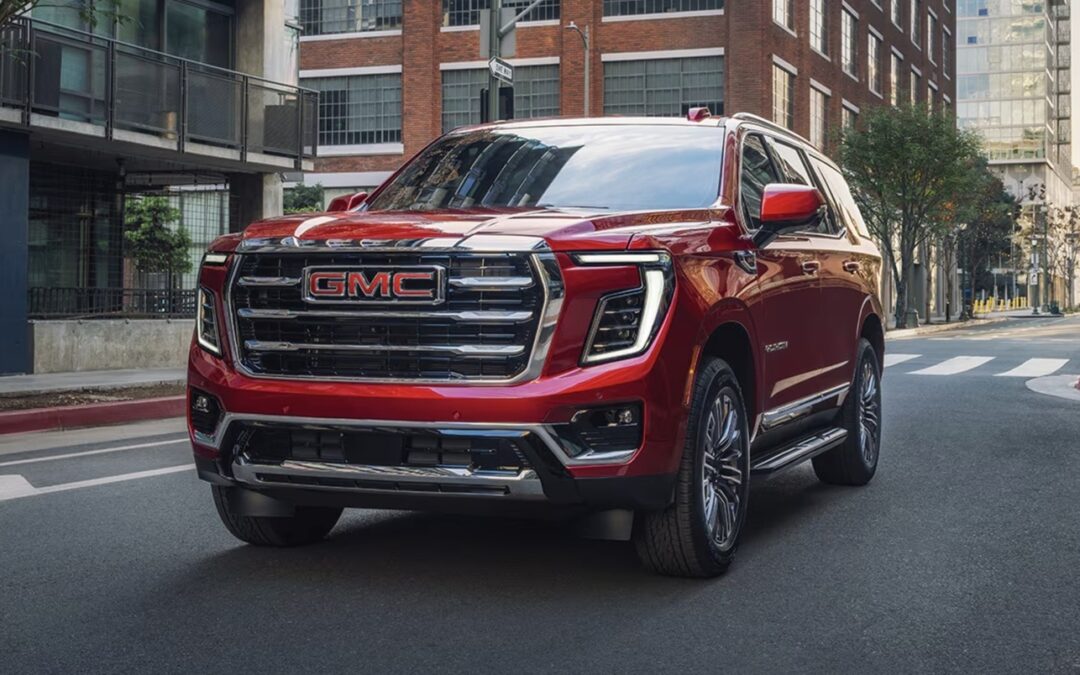
Buying a used car in today’s market is like trying to ride a unicycle in grass — difficult. If you’re uninformed, you could easily overpay, fall victim to predatory fees, or even end up with a clunker. There are common car-buying mistakes you can (and should) avoid, and this is especially true when buying a used car, since in most states there are fewer legal protections once you buy a used car “as-is.”
Here at CarEdge we want to make sure you’re an informed car buyer that gets a good car at a fair price, and that’s why we decided to list out our top four tips you can refer to during your car buying process. No one wants to get taken advantage of, and with these four simple tips you can make sure you don’t fall prey to common car-buying mistakes.
Without further ado, let’s jump in!
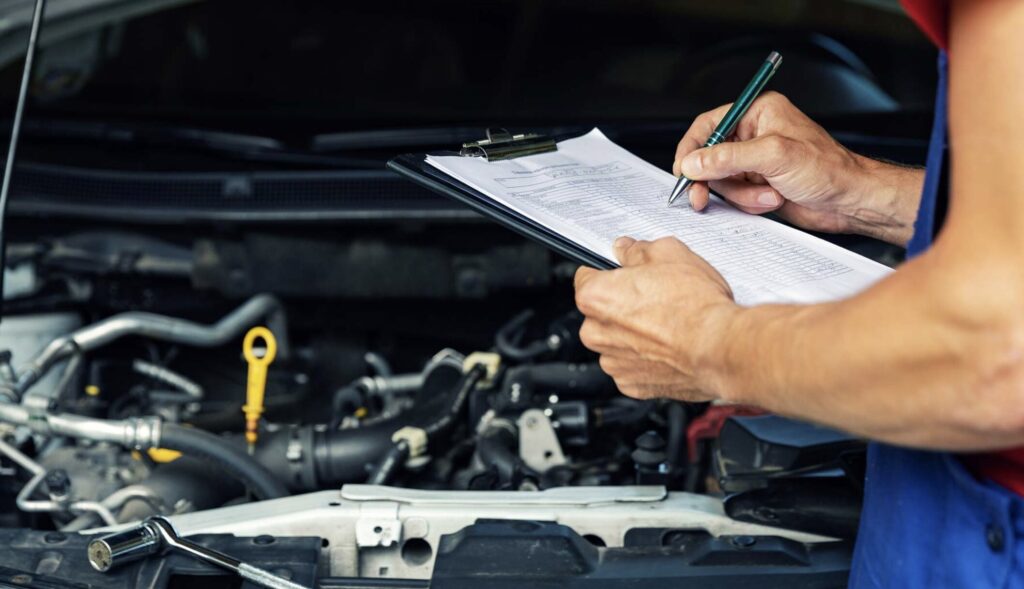
One of the most common car-buying mistakes you can make is not getting a pre-purchase inspection on a used vehicle. A pre-purchase inspection is a must, even if you’re buying the car out of state.
Some car buyers aren’t aware that you can request a pre-purchase inspection, others don’t think it’s worth spending a few hundred dollars to get one done. Our rule of thumb? Always get a pre-purchase inspection on any used car. This includes certified pre-owned vehicles. Why? Because the peace of mind is worth it.
Every state is different, but generally speaking, the laws protecting used car buyers are pretty unforgiving. In most states the laws surrounding “as-is” purchases don’t provide any recourse for buyers who end up with a clunker. The purchase was made “as-is,” and the seller is in the clear.
With that in mind, it should be obvious that getting a pre-purchase inspection is priority number one when purchasing your next used car. Skipping a pre-purchase inspection can be a costly car-buying mistake that could have been avoided. Plus, you can even leverage the results of the pre-purchase inspection when negotiating the purchase price of the vehicle.
For example, if your mechanic says that the car needs new brake pads and an oil change, then you can negotiate the cost of those repairs into the selling price of the vehicle. If you didn’t conduct the pre-purchase inspection, you would have been stuck footing the bill for those repairs yourself.
How should you go about getting a pre-purchase inspection? I am glad you asked! First and foremost, if you have a trusted mechanic, have them do the inspection. If you don’t have someone on standby (which is most of us), then we recommend a service called Lemon Squad. Lemon Squad is a national network of mechanics, and the reason we recommend their service is because they have been in business for a decade, and they have an “A” rating with the Better Business Bureau.
If the seller of the vehicle won’t let you get a pre-purchase inspection, that’s a sign that this isn’t the right car for you to purchase. If you were selling a car in good faith, wouldn’t you let someone get an inspection done? If they won’t, walk away. It’s not worth making this car-buying mistake only to get stuck with a clunker.
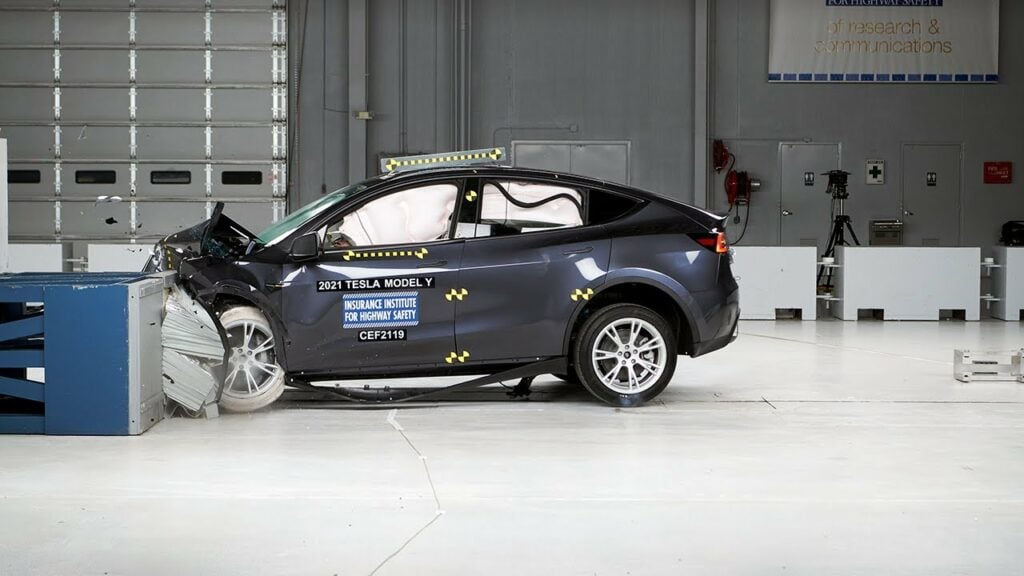
All too often we hear from car shoppers that they purchased a car that had a clean CarFax, only to find out after the fact that the vehicle had been in a minor accident, or had undisclosed repair work done. How and why does this happen so often? It’s simple, CarFax is only as good as the data they receive, and the reality is, CarFax and Autocheck don’t get ALL the information about a vehicle, and when they do, it might not always be that timely.
How can you protect yourself from this reality? Fortunately, there’s a simple workaround!
Make sure to google the VIN of the vehicle you’re interested in before purchasing. I can’t tell you the number of times a quick Google search has brought up accident photos, auction listings, and more that paint a very different picture than the CarFax or Autocheck did. Also, call your insurance company and tell them you’re thinking about purchasing a vehicle. Give them the VIN, and ask them to run a report on their end (insurance companies have access to more information than CarFax and Autocheck do). By simply calling your insurer, you can get a more clear picture of the history of any vehicle. Neat, eh?
Doing a quick (but through) VIN check before you buy a used car can save you countless headaches down the road.
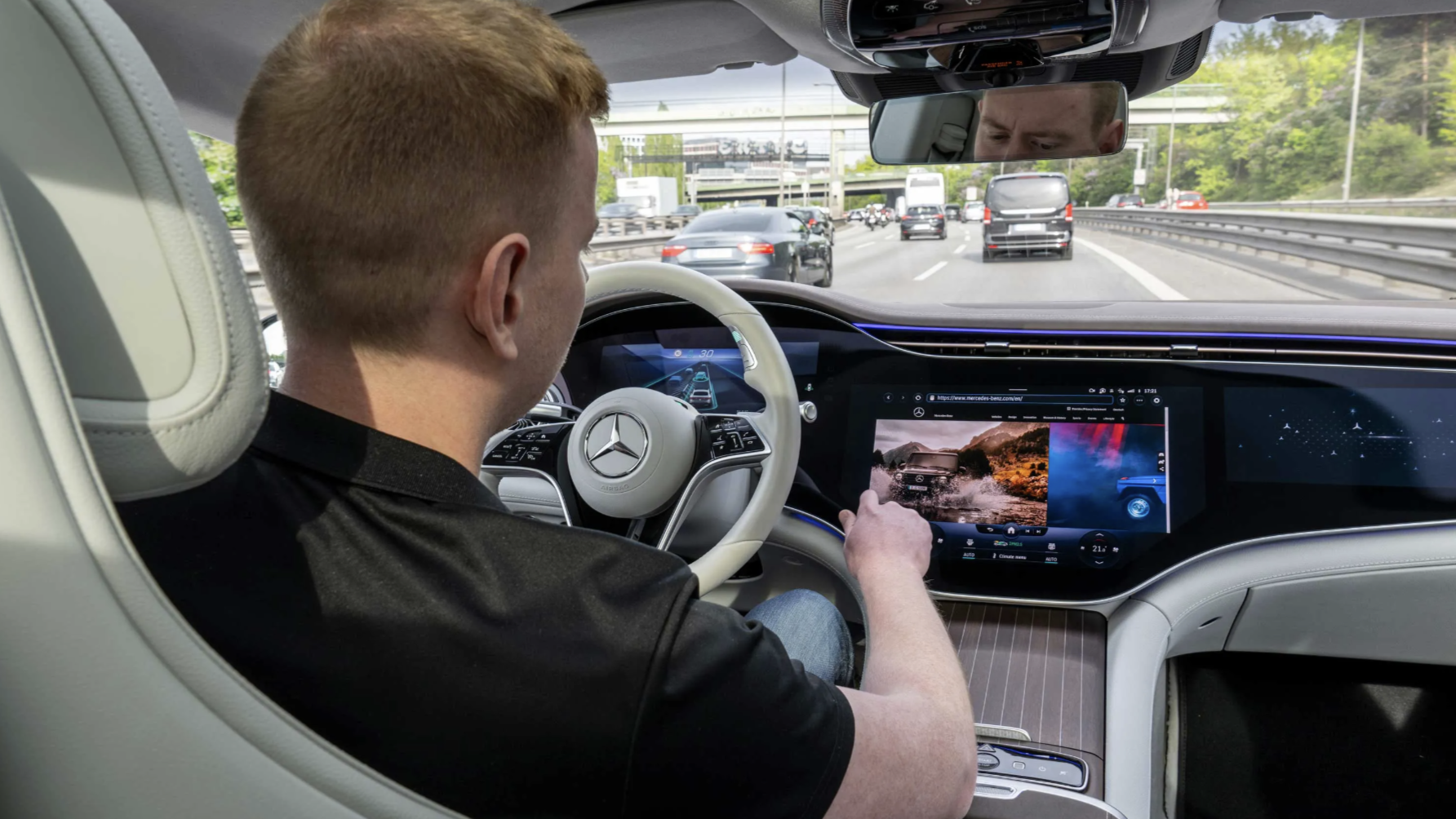
As a car shopper, you should have no fear of test driving one (or many) vehicles. Taking a car (whether it be new or used) for a test drive is something you absolutely should do.
Although not as effective as a pre-purchase inspection, test driving a car will also shed light on if it is in good working order, and more importantly, it will also help you determine if it’s the right car for you. As my dad used to say to me, “the feel of the wheel can seal the deal,” and I think he is 100% right. It’s hard to commit to such a large purchase without at least first test driving a car.
Even if you’re getting the same car you already have (or have previously owned), it’s still important to take it for a test drive. No two used cars are exactly the same, and for that reason alone, it’s worth taking a test drive.
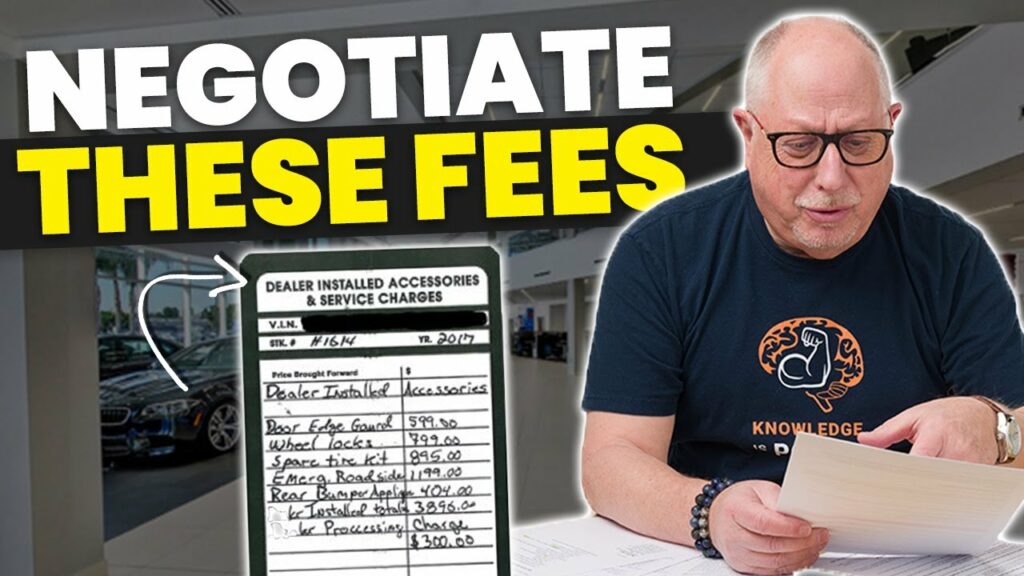
We’ve written extensively about the fees you should and shouldn’t have to pay when purchasing a vehicle. The number of horror stories we’ve heard from shoppers who were charged for nitrogen tires, or a duplicative destination charge is unnerving. However one fee you should never have to pay on a used vehicle is an additional reconditioning fee.
If you are ever asked to pay a reconditioning fee that adds to the price of the car, refuse it! It is absolutely bogus.
Reconditioning is an industry term for the work a used car needs to get it “showroom ready.” This is simply a cost of purchasing inventory and preparing it for sale to a retail customer. With that in mind, if you ever see an additional “recon fee,” recognize that it is B.S., and remind the seller that the reconditioning should already be factored into the selling price of the vehicle.
Dealers have been known to tack on this fee, and it’s a car-buying mistake we’ve seen too many times before. Don’t pay for additional reconditioning!
Car dealership fees: Which are fake, and which are legit?
Don’t overpay.
This may seem obvious, but do your best to not overpay. Cars are a commodity, which means there are A LOT of them.
Be diligent about checking market conditions for the car you’re considering purchasing. Make sure that the dealer you’re working with is not selling the car at a ridiculous markup. With our Market Price Report you can quickly see how negotiable other dealer’s similar vehicles are. Definitely take the time to do that before making your final purchase.
At the end of the day, it’s incredibly important that you get a fair deal. The best way to ensure that happens is to do a bit of research in advance of agreeing to an out-the-door price.
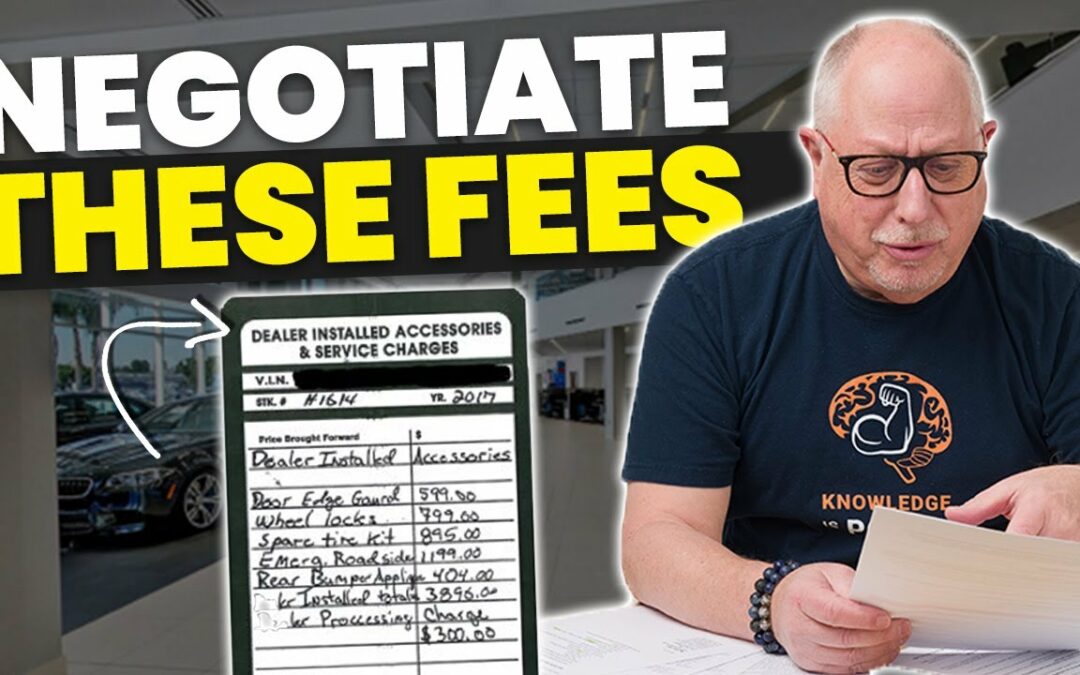
Dealership fees and add-ons can add up to hundreds and even thousands of dollars, but that doesn’t mean you have to pay them. It’s no secret that dealer markups are ruining car buying. This guide to car dealer fees will help you understand common fees, spot hidden or fake charges, and learn how to avoid them.
When purchasing a vehicle, it’s essential to be aware of the legitimate fees and taxes that make up the out-the-door price. These fees are typically imposed by the government and vary by state or local jurisdiction.
Find out how much your next car will REALLY cost with this free out-the-door price calculator.
Here’s a closer look at some of the most common legitimate fees and taxes associated with buying a car.
Buying a car comes with a whole host of taxes. These include city, state, and county sales tax, personal property tax, and often a vehicle license tax, which has to be paid annually. These all vary from state to state, and in the case of sales tax, in even smaller jurisdictions.
In addition to taxes, there are a handful of other legitimate fees that are imposed by your local government. Title, tags, and registration fees are all par for the course when purchasing a vehicle.
The title fee is charged as a cost for the documents required to transfer the title, the cost for this fee can range from $4 up to $150 depending on the state.
Registration fees, charged to cover the cost of registering the vehicle under the buyer’s name, can vary wildly. Some states charge a flat fee, some charge based on weight, while others charge based on how old the car is. Our out-the-door price estimator will help you get a sense for how much your state’s registration fees will be.
Tag fees relate to the physical plates you need to carry on the vehicle. Again, this varies from state to state, but know it is another fee you should be prepared to pay.
Doc fees straddle the line of legitimate and illegitimate. Know that you can and should negotiate the doc fee with a car dealer. Also know that the dealer will never actually remove the fee from your buyer’s order, instead they will reduce the selling price of the vehicle by the same amount as the doc fee.
Doc fees change from state to state and from dealer to dealer. Many states cap doc fees to prevent dealers from exploiting them. For example you’ll never see a doc fee of more than $85 in California, whereas in Florida you’ll frequently find dealers charging upwards of $1,000 for a doc fee. In some states it’s the wild west.
Be Prepared: Car Dealer Doc Fees by State
Read the contract carefully: Make sure to review the sales contract thoroughly and ask the dealer to explain any unfamiliar fees or charges.
Look for inconsistencies: Compare the fees listed in the contract to the fees mentioned during negotiations or in advertising materials. If there are discrepancies, ask the dealer to clarify or remove them.
Research online: Check out resources like CarEdge to get an idea of what fees are typical for your area and vehicle type. This calculator and this guide to doc fees are great places to start.
Need some help? Our Car Coaches are ready to assist today! Learn more about how to get started.
These are the most common hidden fees you shouldn’t feel pressured to pay:
Some dealership fees add no value to your car and should be included with every new and used car at no additional cost. These are essentially fake fees that solely exist to make the dealership more money. Always avoid these fees:
It’s very important to remember that these fees add no value at all to your car, whether new or used. All of these so-called services should be included in the selling price of the vehicle, no ifs, ands or buts. Having trouble negotiating fake fees? Our CarEdge Car Coaches are always here to assist.
These car dealer fees add little value despite potentially costing hundreds or thousands of dollars. If you don’t want the product, these fees or ‘add-ons’ are always negotiable:
👉 Know before you buy! Estimate your future insurance costs with our free car insurance calculator
All of these add-ons and dealership fees are negotiable. Not a single one of them is required, no matter what a salesperson tells you. They’re not like the taxes, title and registration fees that you should expect to pay.
| Fee or Add-on | Category |
|---|---|
| Wheel Locks | Accessory |
| Spash Guards | Accessory |
| Mud Guards | Accessory |
| Exhaust Tip | Accessory |
| Pinstripes | Accessory |
| Sun Shade | Accessory |
| Floor Mats | Accessory |
| Connectivity Kit | Accessory |
| SAVY Driver | Accessory |
| Trunk Tray | Accessory |
| Pro Pack | Accessory Packages |
| KARR Security System | Car Alarm Products |
| Fusion Security System | Car Alarm Products |
| Diamond Ceramic | Paint Protection |
| Zaktek Ultimate | Paint Protection |
| Zurich Shield | Paint Protection |
| Nano Protection | Paint Protection |
| Cilajet | Paint Protection |
| Clearshield | Paint Protection |
| Premium Exterior Finish | Paint Protection |
| Advanced Ceramic Tech | Paint Protection |
| Enviromental Protection Package | Paint Protection |
| Carefree Paint Protection | Paint Protection |
| Ziebart Diamond Gloss | Paint Protection |
| Door Edge Guard | Paint Protection |
| Clear Door Protection | Paint Protection |
| Clear Shield Package | Paint Protection |
| 3M Protection Package | Paint Protection |
| Clear Bra | Paint Protection |
| Paint Pro Film | Paint Protection |
| Invisa Shield | Paint Protection |
| Key Care/Key Replacement | Lost/Stolen Key replacement |
| Vehicle Prep | Dealer Fee |
| Dealer Prep for Delivery | Dealer Fee |
| Pre-Delivery Service | Dealer Fee |
| Pre-Delivery Inspection | Dealer Fee |
| Reconditioning Fee | Dealer Fee |
| VIN Etch | Etch Theft Deterrent |
| VTR | Etch Theft Deterrent |
| Theft Code Protection | Etch Theft Deterrent |
| Courtesy Guard | Etch Theft Deterrent |
| Express Code | Etch Theft Deterrent |
| Phantom Footprint | Etch Theft Deterrent |
| Dent Protection | Exterior Protection |
| Ding Defender | Exterior Protection |
| Appearance Protection | Exterior Protection |
| ELO-GPS | GPS Theft Deterrent |
| Spartan GPS | GPS Theft Deterrent |
| SWAT GPS | GPS Theft Deterrent |
| LoJack | GPS Theft Deterrent |
| Theft Patrol | GPS Theft Deterrent |
| Fabric Defense | Interior Protection Products |
| Interior All Weather Protect | Interior Protection Products |
| NuVinAir | Interior Protection Products |
| Caltex Reistall | Interior/Exterior Protection Products |
| LuxCare | Interior/Exterior Protection Products |
| Autobond Sealant | Interior/Exterior Protection Products |
| Xzilon Paint and Fabric | Interior/Exterior Protection Products |
| PermaPlate | Interior/Exterior Protection Products |
| Paint and Fabric Defense | Interior/Exterior Protection Products |
| Allstate Paint and Fabric | Interior/Exterior Protection Products |
| Nitrogen Fill | Tire Care |
| Solar Guard Tint | Window Tint |
| Tinted Glass | Window Tint |
| Nano-Ceramic Film | Window Tint |
| Smart Auto Windshield | Windshield Protection Coverage |
| Windshield Repair | Windshield Protection Coverage |
| Crystal Fusion | Windshield Protection Coverage |
| Dupont | Paint & Interior protection |
| Simoniz | Paint & Interior protection |
| Diamond Coat | Paint & Interior protection |
| Safe-Guard/Theft | Theft Deterrent |
| US TheftGuard | Theft Deterrent |
| Data Dots/Nano Dots | Theft Deterrent |
| Theft Prevent | Theft Deterrent |
Our CarEdge Car Coaches help thousands of drivers negotiate better deals on their car purchases every month. We’ve seen it all! Here are three examples of ridiculous dealer add-ons and B.S. fees that we’ve helped to negotiate off of the out-the-door price.

Who on Earth would agree to pay $3,000 for a protection package when you could apply those same products for a few hundred dollars elsewhere? Overpriced paint and protection fees are always negotiable.

Some dealers seem to think that if you can afford a new truck, you won’t mind paying a thousand dollars extra for unwanted dealer add-ons. Always negotiate these fees.

Two grand for a safety and security package? Nope, nope and nope.
And then you have this… a whole slew of dealership fees and add-ons that are VERY hard to justify.

You should never feel pressured to pay for something that doesn’t add value. Our #1 tip for negotiating car dealer fees is to enter the deal prepared and empowered with knowledge. By being prepared, thoroughly examining contracts, and negotiating wisely, you can minimize surprise fees and secure the best deal possible.
100% FREE Car Buying Help Is Here!
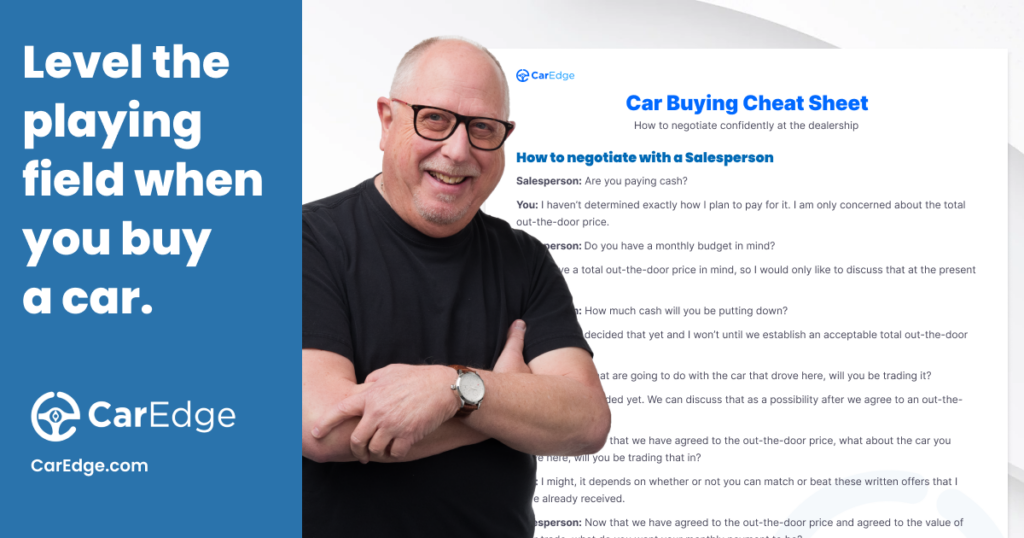
Ready to outsmart the dealerships? Download your 100% free car buying cheat sheets today. From negotiating a deal to leasing a car the smart way, it’s all available for instant download. Get your cheat sheets today!
Connect with us on Facebook: https://www.facebook.com/yourautoadvocates
BECOME A BETA TESTER, PLEASE! https://caredge.com/
Stay connected with Ray and Zach here: https://www.instagram.com/shefska/ & https://www.instagram.com/rasisjaz/
You don’t need to look far to realize that used car prices have been incredibly volatile over the past few months. Amidst the ongoing global COVID-19 pandemic, many aspects of life have changed, and the automotive industry has been no exception. Over the past few months we’ve seen supply shortages, once in a lifetime manufacturer incentive deals, and used car prices that defy reality.
It goes without saying that 2020 will certainly be a year we never forget for myriad reasons.
To better understand the true impacts the past few months have had on used car prices, the team over at iSeeCars.com, led by Julie Blackley, conducted a research study on used car price changes. Their findings? Both surprising and telling. A lot of vehicles have seen their values increase, while a select few have actually gone down in price (who would have guessed).
We highly recommend you take a look at the full report here, but in the meantime, we’ve distilled some of our favorite insights for you. Without further ado, let’s dive in.
Connect with us on Facebook: https://www.facebook.com/yourautoadvocates
BECOME A BETA TESTER, PLEASE! https://caredge.com/
Stay connected with Ray and Zach here: https://www.instagram.com/shefska/ & https://www.instagram.com/rasisjaz/
Today Ray and Zach discuss the state of the used and new car market. What effects will the end of government subsidies have on car prices? When should you buy your next new or used car? Is now the right time to buy? Ray and Zach answer these questions and more in today’s episode.
Axios Navigator: https://www.axios.com/newsletters/axios-navigate
Deal School is an entirely free online curriculum that is intended to teach you the bare minimum of what you should know before you buy a car. Taught by Ray and Zach Shefska, Deal School is two and half hours of video content, plus six quizzes to test your knowledge along the way. The goal of Deal School is to help you better understand the car buying process, and how car dealerships operate.
Deal School was born out of frustration. Frustration that buying a car is so challenging. As the CarEdge YouTube channel began to grow, we realized that we could help a lot of people by simply organizing our content into a logical progression. With over 100 videos on YouTube, it can be hard to find the exact topic you are looking for. With Deal School, you can simply glance at the curriculum, find the topic you’re interested in, and jump right there. We created Deal School so that when people ask us “How can I negotiate a car deal?” We can simply link them to Deal School, and know that they are getting a good answer. We hope that if a friend or family member ever asks you about how you bought your car, you’ll tell them about Deal School as well.
There’s no such thing as a free lunch, right? So what’s the catch? If there is a “catch” it’s that you have to sign up with an email address to access Deal School. Otherwise, there is no “catch.” We’ve disabled advertisements on Deal School videos, so you won’t be interrupted by those. Instead, you should be able to click through video to video and focus on learning.
Why do we want your email address? Because in the not too distant future we are going to have products that we are going to sell. Those products will help you navigate the car buying process, and we’ll try to make money from selling them. If you sign up for Deal School with your email address, then we have a way to contact you in the future when we have products to sell (and other free resources too).
How long will Deal School be available?
There is no “expiration date” on Deal School. My dad and I will most likely need to update the course materials in a year or so (as dealership practices change), but aside from that, what you see is what you get, and it will be that way into the future.
Deal School is broken into six core lessons:
Each lesson has a varied number of topics within them. Topics have associated videos and course materials (blog posts, other video, other resources, etc.).
In total there are 50 videos that are a part of the course.
As of right now, Deal School is the only course we have available. We’re very interested in producing more, so if you feel strongly about another topic (for example an entire course dedicated to financing a purchase), then please let us know. How should you let us know? Take a look down below!
Your feedback is invaluable. CarEdge has become what it is today thanks to you. To share feedback with us about Deal School, please complete this short survey: https://caredge.com/deal-school/survey/
Connect with us on Facebook: https://www.facebook.com/yourautoadvocates
BECOME A BETA TESTER, PLEASE! https://caredge.com/
Stay connected with Ray and Zach here: https://www.instagram.com/shefska/ & https://www.instagram.com/rasisjaz/
Today Ray and Zach discuss the current state of the used car market. If you’re thinking about buying or selling your used car, you’ll definitely want to watch this first. New data from Black Book and Manheim provide insights into the current and future state of the used car market.
Black Book report: https://www.blackbook.com/covid-19-market-insights-8-19-20/
Manheim report: https://publish.manheim.com/en/services/consulting/used-vehicle-value-index.html
You want to sell your car, but you’re not going to let go of it easily. It’s always worth the effort to sell your car for the most money possible. Once you’ve made the decision to sell, another question comes to mind: “where should I sell my car to get the most money?”
If your goal is to get the most money when selling your car, then be prepared to do a bit of work. If you’re more interested in convenience, then have no fear, there are plenty of people out there who want to make it easy to buy your car from you.
Let’s run through the three different categories of car buyers, get into the specifics of what work you will need to do to sell your car to each of them, and cover the pros and cons of your varied options. Let’s dive in!
There is nothing wrong with selling your car to a local dealership. Will you get the most money possible? No. Will you have the most convenient experience possible? probably not. Will you get the worst possible price for your car? Definitely not. Will it be the least convenient experience for you? Most likely not.
Selling your car to a local dealership is the ultimate middle ground of car sales. It’s an option, it’ll always be there, and it isn’t great, but it isn’t bad either.
Thinking of buying a used car? You might enjoy this guide: Buying a Car on Craigslist? Here Are 4 Things You Need to Do First.
What work is involved in selling your car to a local dealership? Not much. Don’t spend hundreds of dollars getting the vehicle cleaned, detailed, or looking “showroom ready.” The used car manager that appraises your vehicle won’t be swayed by how good the car looks, and they’ll still be thinking about the reconditioning work they’ll need to do to make the vehicle “merchandisable” (sales ready).
Selling to your local car dealer is convenient in this sense. Simply call them, make an appointment to get your vehicle appraised, and have the necessary documentation with you to complete the transaction (more on that below).
Understand that the offer you get from your local dealer will most likely not be top dollar for your car. Quite frankly, it could be the lowest offer you get. Local dealerships typically never offer what the national used car dealers do (more on them next), and although there is less work involved, offers from local dealers are typically much less than what you would get if you sold your vehicle to a private party (stay tuned).
If you’re still asking yourself, “Should I sell my car to a local dealer?” I’d caution that you shouldn’t. I think you’ll find one of the other two options more attractive for obvious reasons.
National used car dealers have invested millions of dollars to create “seamless” and “technology-driven” ways to buy your car. CarMax pioneered the marketing of “we’d like to buy your car, please sell it to us” many years ago, and since then, upstart companies like Carvana and Vroom have doubled-down on purchasing used cars directly from consumers.
What work is involved in selling your car to one of these national retailers? Not much. Similarly to when you sell your car to a local dealership, you shouldn’t invest time or money in cleaning up your vehicle. Carvana, CarMax, and Vroom are all prepared to recondition your vehicle, and a detail will not change the appraisal value.
What are the pros and cons of selling to a Carvana, CarMax, or Vroom? There are plenty. To start with, the best “pro” on the list is the offer price. Carvana and Vroom are notorious for offering very competitive prices to buy used vehicles. We recently sat down with Nicholas Hinrichsen, the former Senior Director of Sell to Carvana, on the Auto Insider podcast. It was fascinating to learn how Carvana determines pricing for their used car purchases.
Carvana and Vroom will also both come to you to purchase your car. Instead of driving to your local dealership, or to a physical CarMax storefront, Carvana and Vroom will send a flatbed truck to you and take delivery of your vehicle right there.
And finally, on the list of “pros” is the fact that all three major players offer seamless, simple, and intuitive online platforms you can use to sell your car directly to them.
What are the cons you may be asking? There aren’t many. The only downside to selling your car to Carvana, CarMax, or Vroom is that there is a chance you may not get top dollar for your vehicle as compared to selling it to a private party. That being said, the amount of time saved by selling to one of these big three national brands can more than make up for the price difference.
If you’re truly invested in getting the highest offer on your vehicle, then you should strongly consider selling your car to a private party. Selling your car to another individual generally requires a lot more work than any of the other options we’ve already discussed.
When selling to a local car dealer or a national used car brand, you don’t need to worry about cleaning up or detailing your vehicle. That couldn’t be further from the truth when it comes to selling your car to another individual. You want your car to be looking immaculate!
If you’re thinking about buying or selling your car, you might enjoy this article if you haven’t read it already: The Car Buyer’s Glossary of Terms, Lingo, and Jargon
If you can get your car looking great, take professional photos, and get it listed on many different websites, odds are you’ll get top dollar for your vehicle. The cons however consist of investing your time into preparing the vehicle, coordinating appointments with strangers, and letting someone you don’t know test drive your car.
If you can look past these cons, then selling your car to a private party may make sense for you.
No matter who you sell your car to, there are a few items you’ll want to have handy to facilitate the transaction:
As a final note, remember to take your belongings out of the vehicle before you sell it. There’s nothing worse than seeing your EZ-Pass get billed six months after you sold your car.