
CarEdge saved me over 4,500 dollars on a brand new Honda Pilot. I can't say thank you enough.
Price intelligence
Find a wide range of vehicle listings with market insights on new and used listings near you.
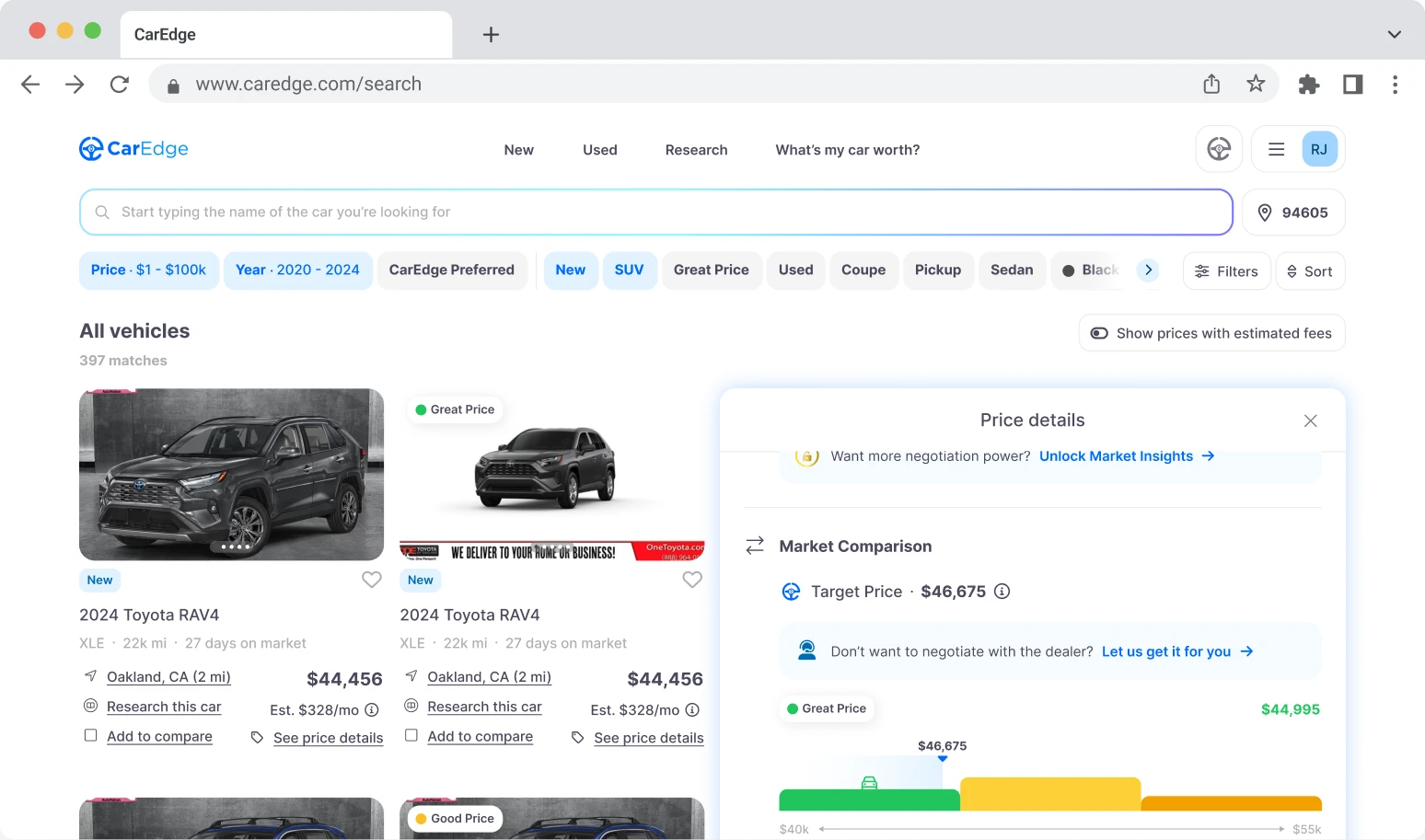

What can I do with CarEdge?
 CarEdge Insights
What can I do with CarEdge?
Get access to exclusive information so you can make an informed car buying decision — all in one place.

Find a wide range of vehicle listings with market insights on new and used listings near you.
Track your vehicle’s value and cash in when the time is right to sell.

Access to our proprietary data to help you find the right car, at the right price. Find these unlocked on every listing after subscribing.

With our expert-led, tech-enabled car buying service, we will locate, negotiate, and deliver your vehicle so you can get a new car hassle free.


Help us personalize your CarEdge experience — it only takes a second.
Your answers help us personalize your CarEdge journey — we’ll follow up with tips and next steps that match your buying timeline.
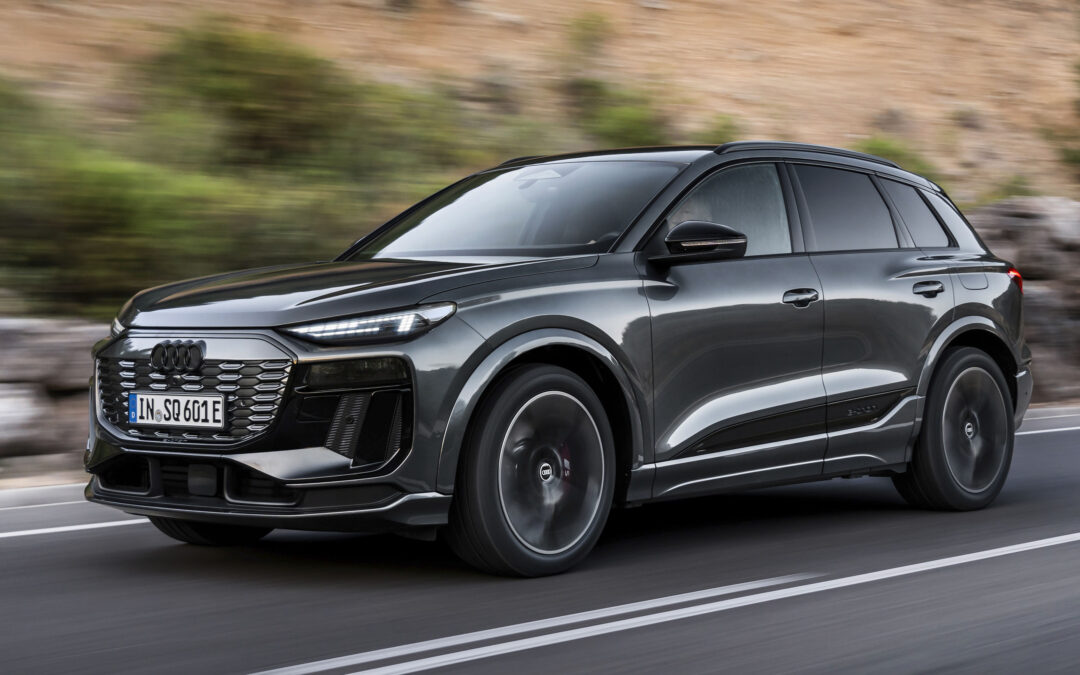
Last month, EVs were flying off dealer lots in the last days of the federal tax credit. Now, in October, the market is adapting to a new reality without incentives. Knowing which models are moving quickly, and which are stagnant, can give you the upper hand.
We analyzed October 2025 car market data to find the EVs with the lowest and highest market day supply (MDS). MDS measures how many days it would take to sell through current inventory at the current sales pace. Here are the standouts in today’s EV market.
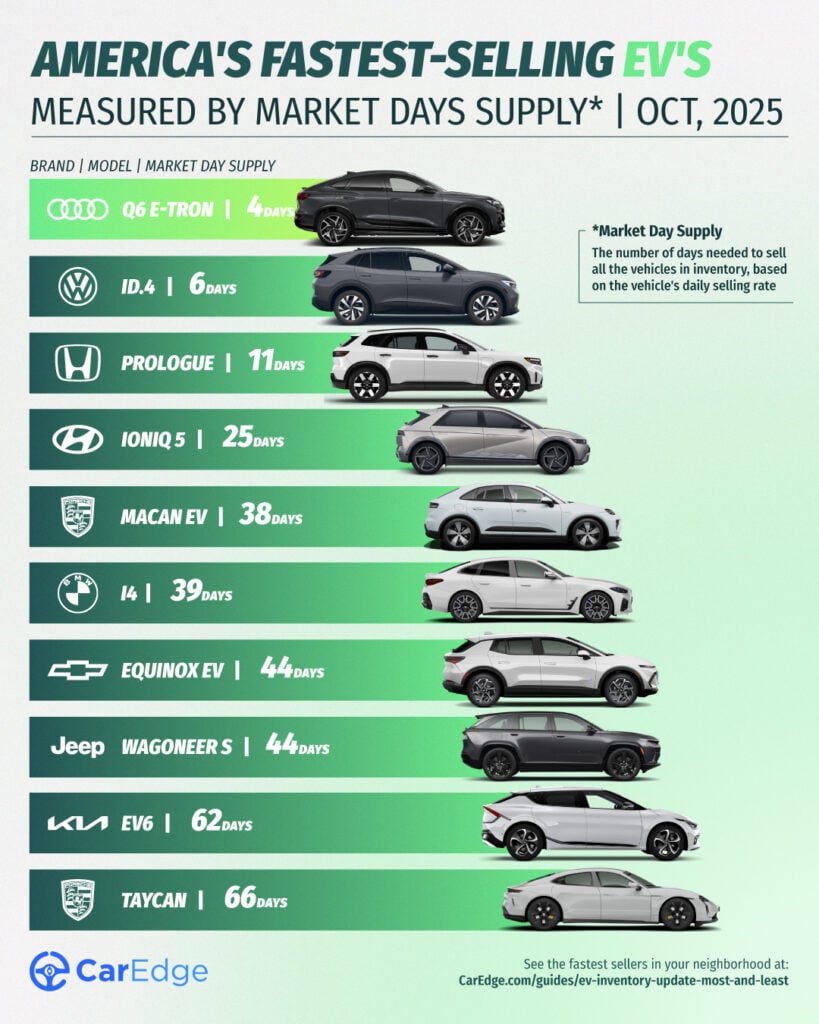
These are the EVs with the lowest market day supply as of October 2025. That means they’re in high demand right now, and likely harder to negotiate on due to limited availability.
| Make | Model | Market Day Supply | Total For Sale | 45-Day Sales | Average Selling Price |
|---|---|---|---|---|---|
| Audi | Q6 e-tron | 4 | 371 | 4,644 | $67,518 |
| Volkswagen | ID.4 | 6 | 756 | 5,351 | $47,481 |
| Honda | Prologue | 11 | 1,974 | 8,514 | $54,017 |
| Hyundai | IONIQ 5 | 25 | 5,604 | 9,967 | $51,650 |
| Porsche | Macan EV | 38 | 856 | 1,152 | $87,805 |
| BMW | i4 | 39 | 1,639 | 1,889 | $66,479 |
| Chevrolet | Equinox EV | 44 | 9,215 | 9,911 | $40,041 |
| Jeep | Wagoneer S | 44 | 1,444 | 1,554 | $59,543 |
| Kia | EV6 | 62 | 3,156 | 2,277 | $49,353 |
| Porsche | Taycan | 66 | 1,094 | 742 | $141,455 |
Source: CarEdge Pro
For the first time ever, the Audi Q6 e-tron is the fastest-selling EV in America. The Volkswagen ID.4 is in second place as the September rush lifted sales rates. VW Group has three models in the top 10 right now, which is far from usual. The Macan EV has been a hot seller for Porsche.
Mercedes-Benz, Chevrolet, and Hyundai also have models in the top 10. The Chevy Equinox EV and Hyundai IONIQ 5 are the best-selling electric cars outside of Tesla right now, at least in terms of total sold.
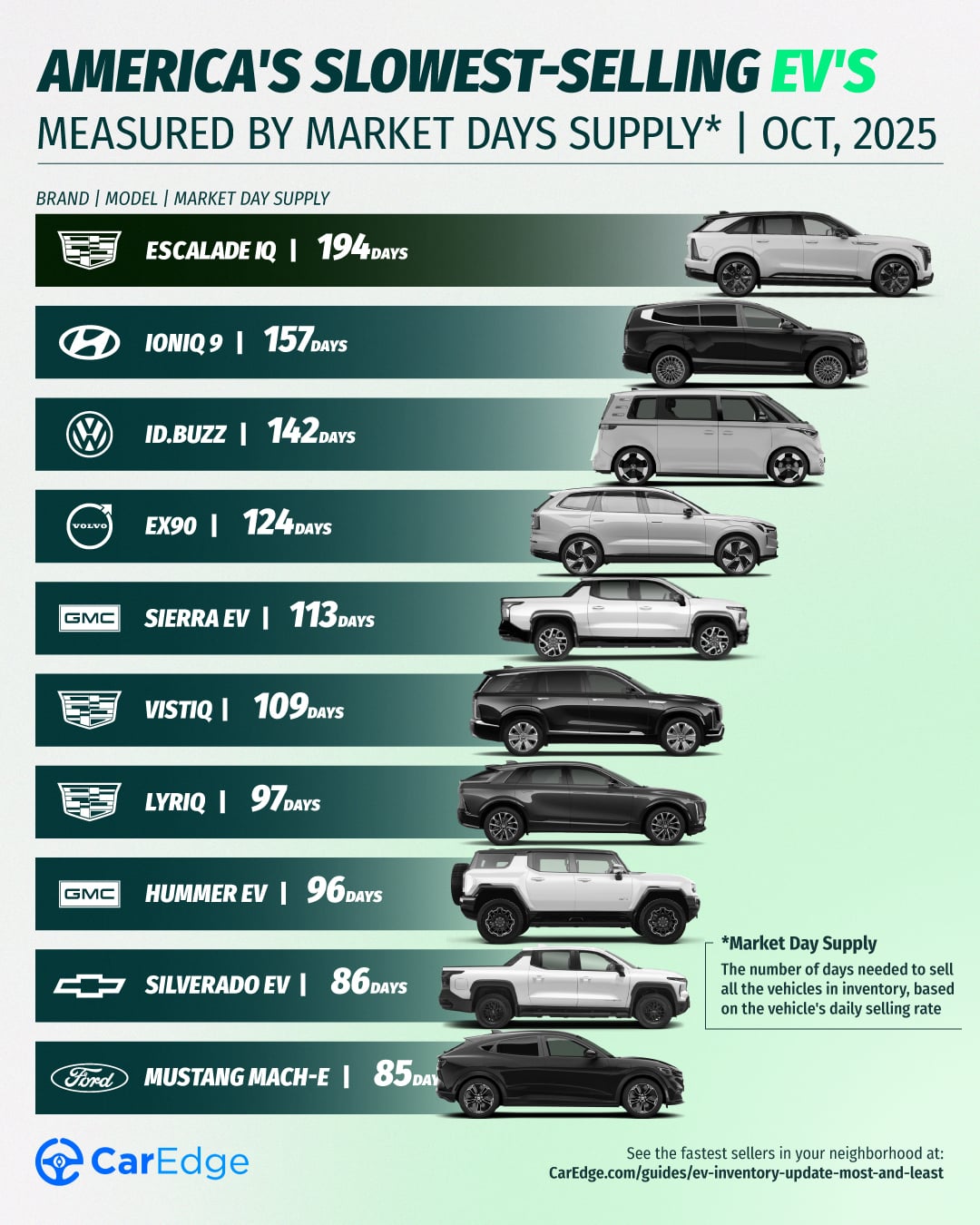
These EVs have the highest MDS, meaning they’re sitting unsold for far longer than average. Buyers may be able to score bigger discounts on these models — especially with CarEdge’s AI Negotiator doing the legwork for you.
| Make | Model | Market Day Supply | Total For Sale | 45-Day Sales | Average Selling Price |
|---|---|---|---|---|---|
| Cadillac | Escalade IQ | 194 | 3,639 | 844 | $142,724 |
| Hyundai | IONIQ 9 | 157 | 4,380 | 1,256 | $70,060 |
| Volkswagen | ID.BUZZ | 142 | 3,058 | 967 | $67,503 |
| Volvo | EX90 | 124 | 1,435 | 521 | $88,031 |
| Cadillac | Vistiq | 109 | 4,636 | 1,917 | $81,766 |
| Cadillac | Lyriq | 97 | 7,013 | 3,239 | $66,145 |
| GMC | Sierra EV | 113 | 3,914 | 1,555 | $87,106 |
| GMC | Hummer EV | 96 | 4,784 | 2,239 | $98,791 |
| Chevrolet | Silverado EV | 86 | 3,224 | 1,688 | $74,597 |
| Ford | Mustang Mach-E | 85 | 16,645 | 8,791 | $47,979 |
Source: CarEdge Pro
Cadillac’s Escalade IQ is the slowest-selling EV in America right now, with an eye-popping 194 days of supply. Luxury EVs dominate the slowest sellers, including the Volvo EX90 and Cadillac Vistiq.
Volkswagen’s ID.BUZZ has never been the hot seller that was once expected. Industry insiders suspect this is because of two things: high prices and slow charging compared to the competition.
The Ford Mustang Mach-E also finds itself here again, although sales have been picking up quickly. For buyers, these EVs are the most negotiable in October, but only if you know how to negotiate. Or, let AI negotiate for you.
If you’re chasing a deal, start your search with the slowest sellers. High inventory levels give you leverage, and dealers will be more motivated to talk price. Federal incentives are gone, so traditional car market dynamics will shape negotiability moving forward. Where supply far exceeds supply, you’ll always have more leverage.
Thinking about leasing? It’s worth considering. EVs tend to depreciate faster than gas-powered cars, and leasing can protect you from steep resale losses down the road. See depreciation forecasts for free with CarEdge’s Research Hub.

With CarEdge Concierge, our experts handle everything from finding available inventory to negotiating with dealers. Already know the exact EV you want? Use our first-ever AI Negotiator and let CarEdge AI negotiate with dealers anonymously on your behalf. It’s our most affordable car buying help ever!
You can also explore free tools like cost of ownership comparisons, car market updates, and our most popular free resource, downloadable negotiation cheat sheets. There’s no reason to shop unprepared in 2025.
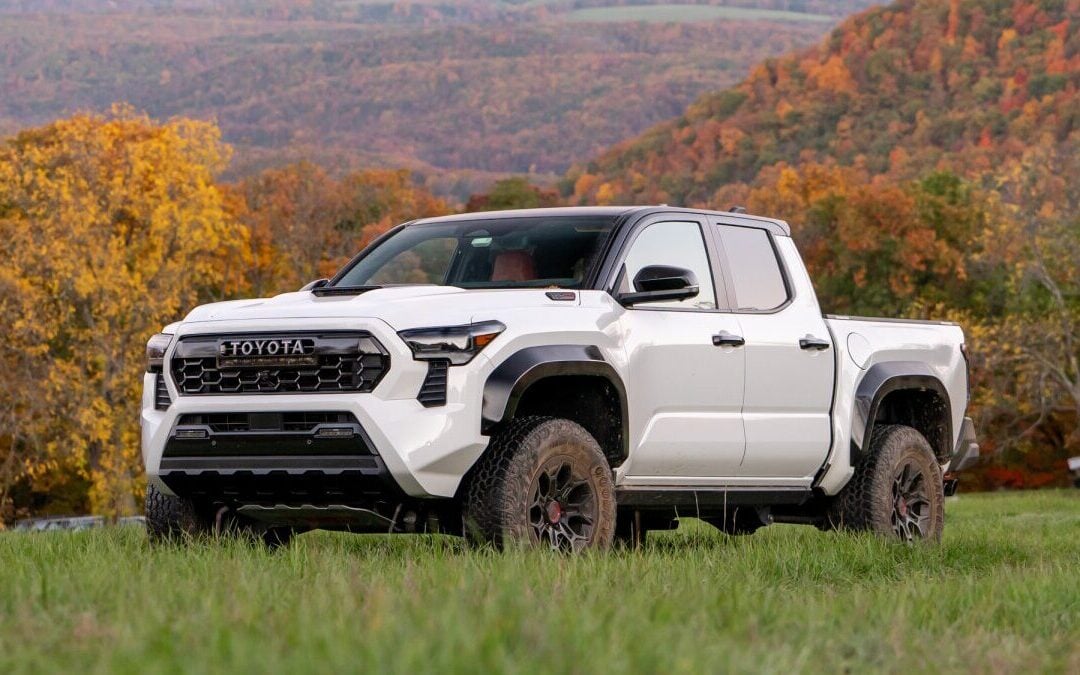
The gap between the fastest and slowest-selling pickups is wider than ever in 2025. With some trucks selling in just over a month, and others sitting unsold for over six months, knowing what’s hot (and what’s not) can make or break your next deal.
That’s why understanding Market Day Supply (MDS) is more important than ever for anyone buying or selling a truck in 2025. At CarEdge, we used real-time inventory and sales data to identify the fastest- and slowest-selling trucks in November.
MDS tells us how long it would take to sell all the current inventory of a particular model at the current sales pace, assuming no new units are added. A low MDS means a truck is selling quickly. A high MDS, on the other hand, signals oversupply, and that can mean buyers have more leverage at the dealership.
Whether you’re buying new or considering a trade-in, here’s what the latest market data from CarEdge Pro reveals about the best-selling and worst-selling trucks in America.
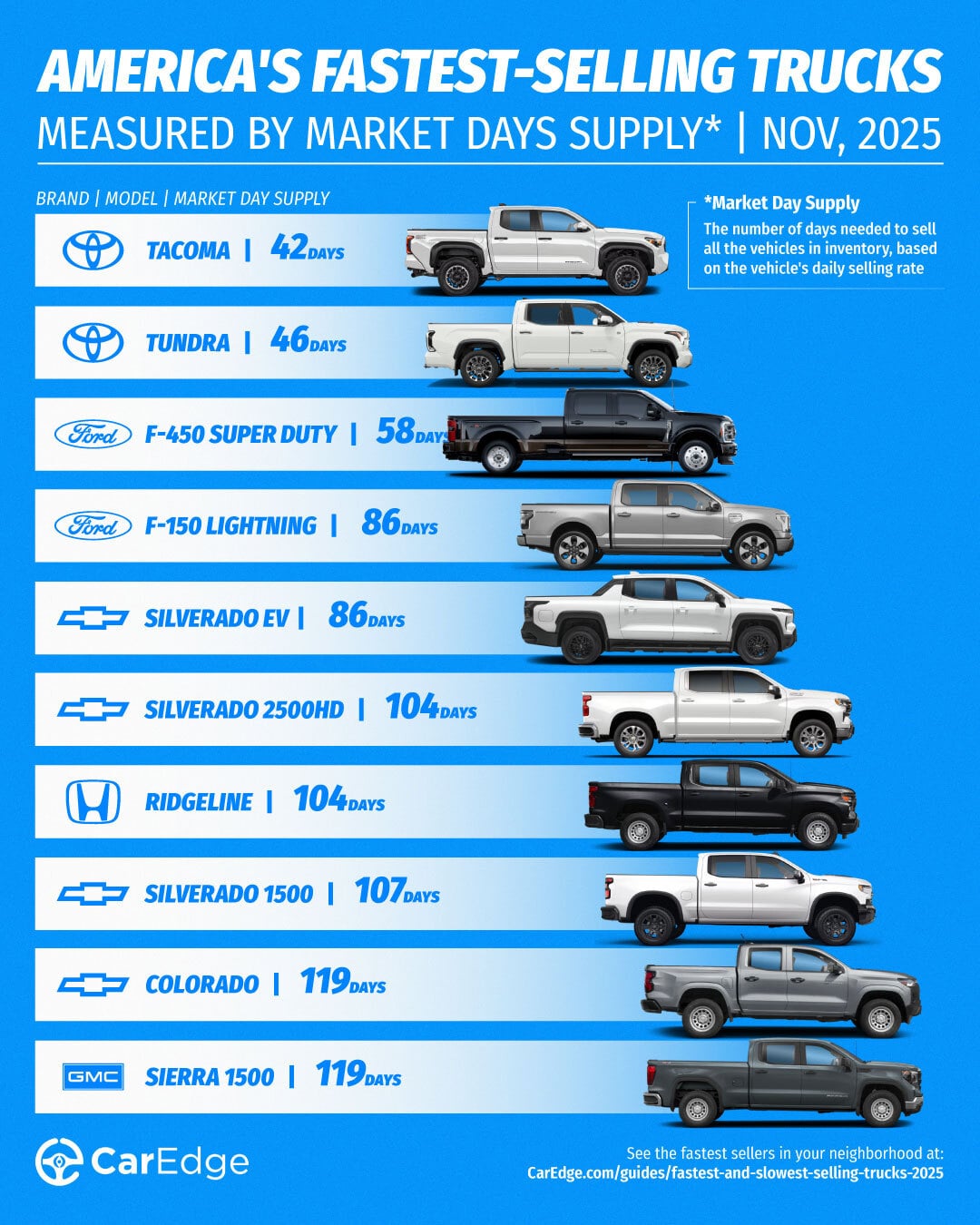
These trucks are in high demand and selling quickly. But if you’re hoping to negotiate a deal on one of these, don’t count on much wiggle room unless you work with a pro.
| Make | Model | Market Day Supply | Total For Sale | 45-Day Sales | Average Selling Price |
|---|---|---|---|---|---|
| Toyota | Tacoma | 42 | 51,245 | 54,331 | $45,723 |
| Toyota | Tundra | 46 | 30,621 | 30,099 | $63,206 |
| Ford | F-450 Super Duty | 58 | 1,578 | 1,233 | $96,354 |
| Ford | F-150 Lightning | 86 | 6,843 | 3,563 | $69,161 |
| Chevrolet | Silverado EV | 86 | 2,946 | 1,541 | $60,307 |
| Chevrolet | Silverado 2500HD | 104 | 30,611 | 13,288 | $40,224 |
| Honda | Ridgeline | 104 | 11,913 | 5,167 | $26,414 |
| Chevrolet | Silverado 1500 | 107 | 77,799 | 32,621 | $29,978 |
| Chevrolet | Colorado | 119 | 27,949 | 10,527 | $25,301 |
| GMC | Sierra 1500 | 119 | 56,676 | 21,350 | $35,094 |
Source: CarEdge Pro
The Toyota Tacoma is the fastest-selling pickup truck in November 2025. On average, this heavy duty pickup truck sits on the lot for a little under two months before finding a buyer. Toyota’s Tundra is in second place at 46 days of supply, with trucks from GM far behind.
We didn’t expect to see two electric trucks on the list of fastest-selling pickups this month. Now that federal EV incentives have expired, the F-150 Lightning and Silverado EV are not likely to return to this list anytime soon.
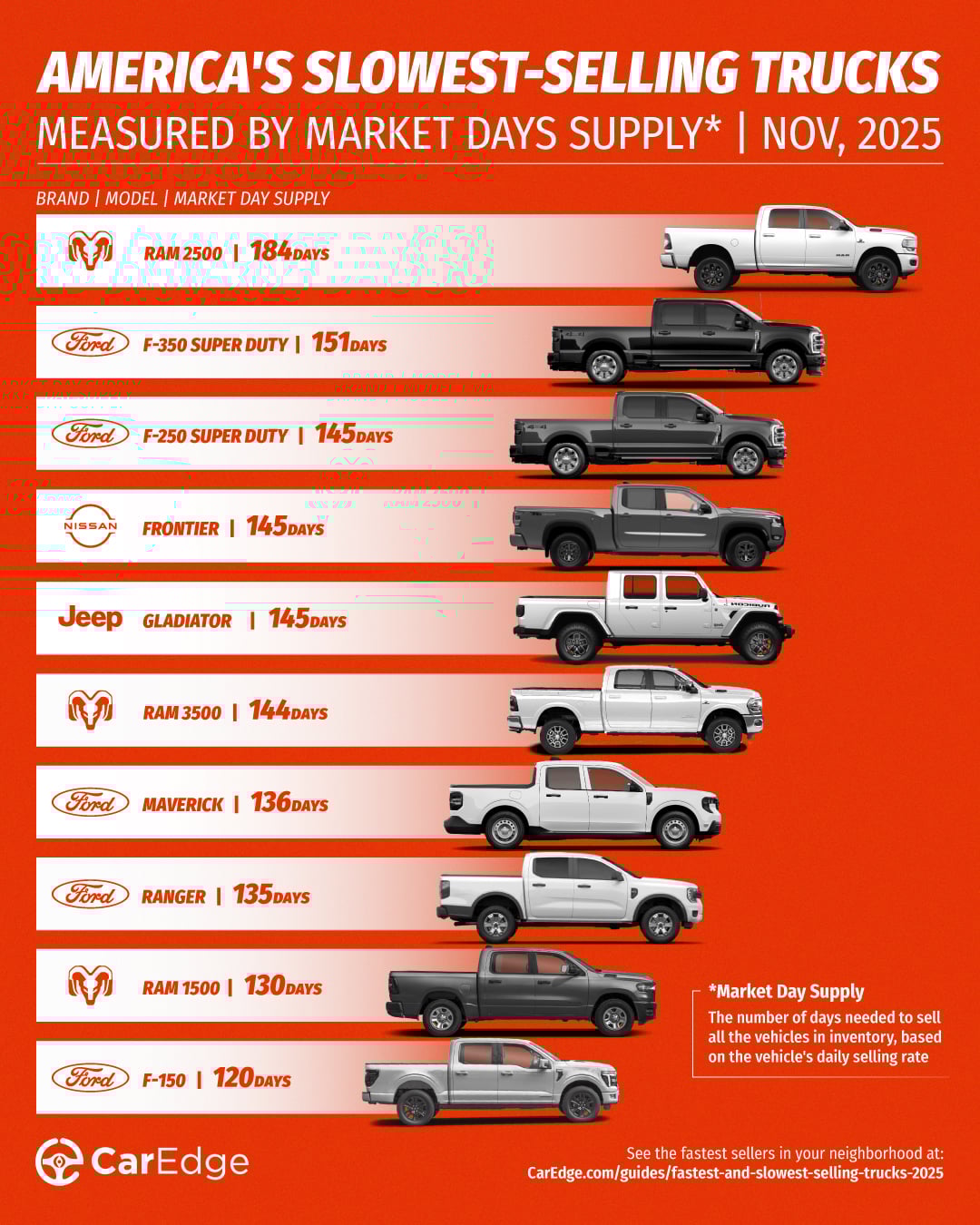
On the flip side, these trucks are struggling to move. Some of these trucks are taking more than six months to sell on average. If you’re in the market, these pickup trucks offer room for negotiation, especially with DIY market insights.
| Make | Model | Market Day Supply | Total For Sale | 45-Day Sales | Average Selling Price |
|---|---|---|---|---|---|
| Ram | Ram 2500 | 184 | 39,136 | 9,577 | $67,626 |
| Ford | F-350 Super Duty | 151 | 31,071 | 9,252 | $76,907 |
| Ford | F-250 Super Duty | 145 | 46,275 | 14,321 | $71,249 |
| Nissan | Frontier | 145 | 21,605 | 6,687 | $22,513 |
| Jeep | Gladiator | 145 | 19,516 | 6,039 | $34,416 |
| Ram | Ram 3500 | 144 | 11,652 | 3,636 | $48,755 |
| Ford | Maverick | 136 | 37,269 | 12,313 | $33,733 |
| Ford | Ranger | 135 | 22,105 | 7,358 | $43,481 |
| Ram | Ram 1500 | 130 | 52,201 | 18,037 | $30,467 |
| Ford | F-150 | 120 | 114,338 | 42,806 | $59,535 |
Source: CarEdge Pro
The Ram 2500 is the slowest-selling truck in America right now. Trucks from Stellantis brands (Ram and Jeep) take up four of the bottom 10 spots in November. Sellers can expect these slow-selling trucks to sit on the lot for at least four months, but this creates great chances to negotiate savings for buyers.
As the truck market ebbs and flows, it’s easy to become overwhelmed. Luckily, there are new tools and services available that take the hassle out of buying a truck entirely. Here’s how CarEdge can help.
👉 Negotiate anonymously with CarEdge AI (NEW!)
👉 Have a pro negotiate your deal with CarEdge’s Car Buying Service
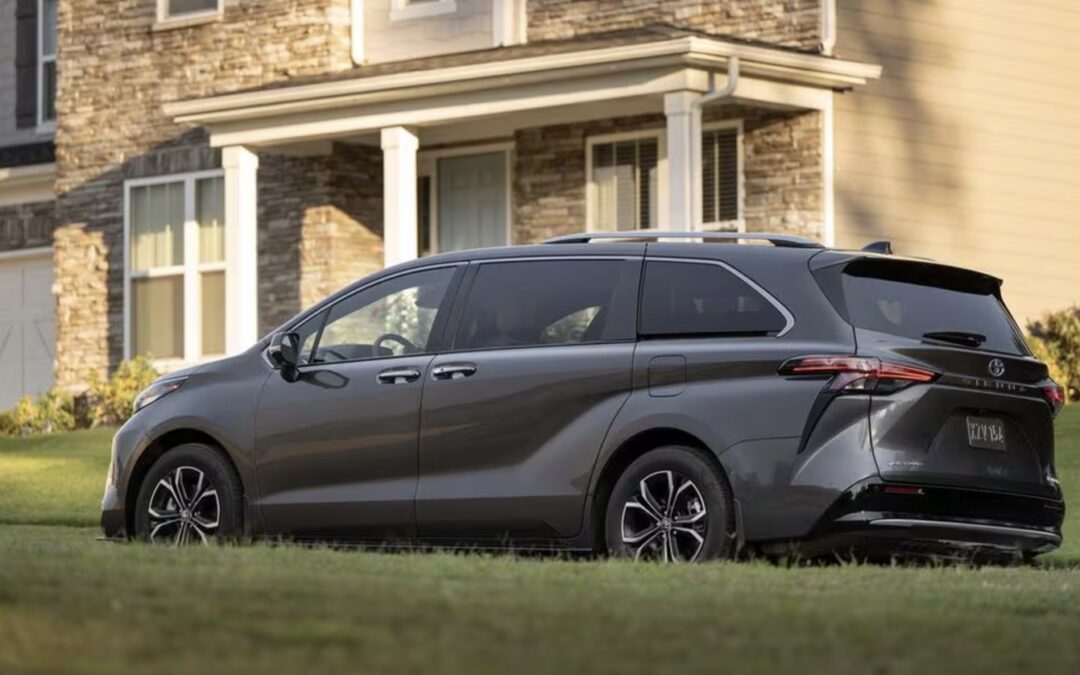
It’s true that SUVs have taken over the car market in recent years, but not all are hot sellers. In fact, the gap between the fastest and slowest-selling models is growing. In 2025, some SUVs and crossovers are being scooped up as soon as they hit the lot, while others are sitting unsold for more than six months. Whether you’re a buyer looking for a great deal or a seller trying to time the market, understanding which SUVs are moving (or not) is essential.
We analyzed November car market data to find the SUVs with the lowest and highest market day supply (MDS). MDS is a measure of how many days it would take to sell through current inventory at the current sales pace. Here are the winners and losers in 2025’s SUV market.
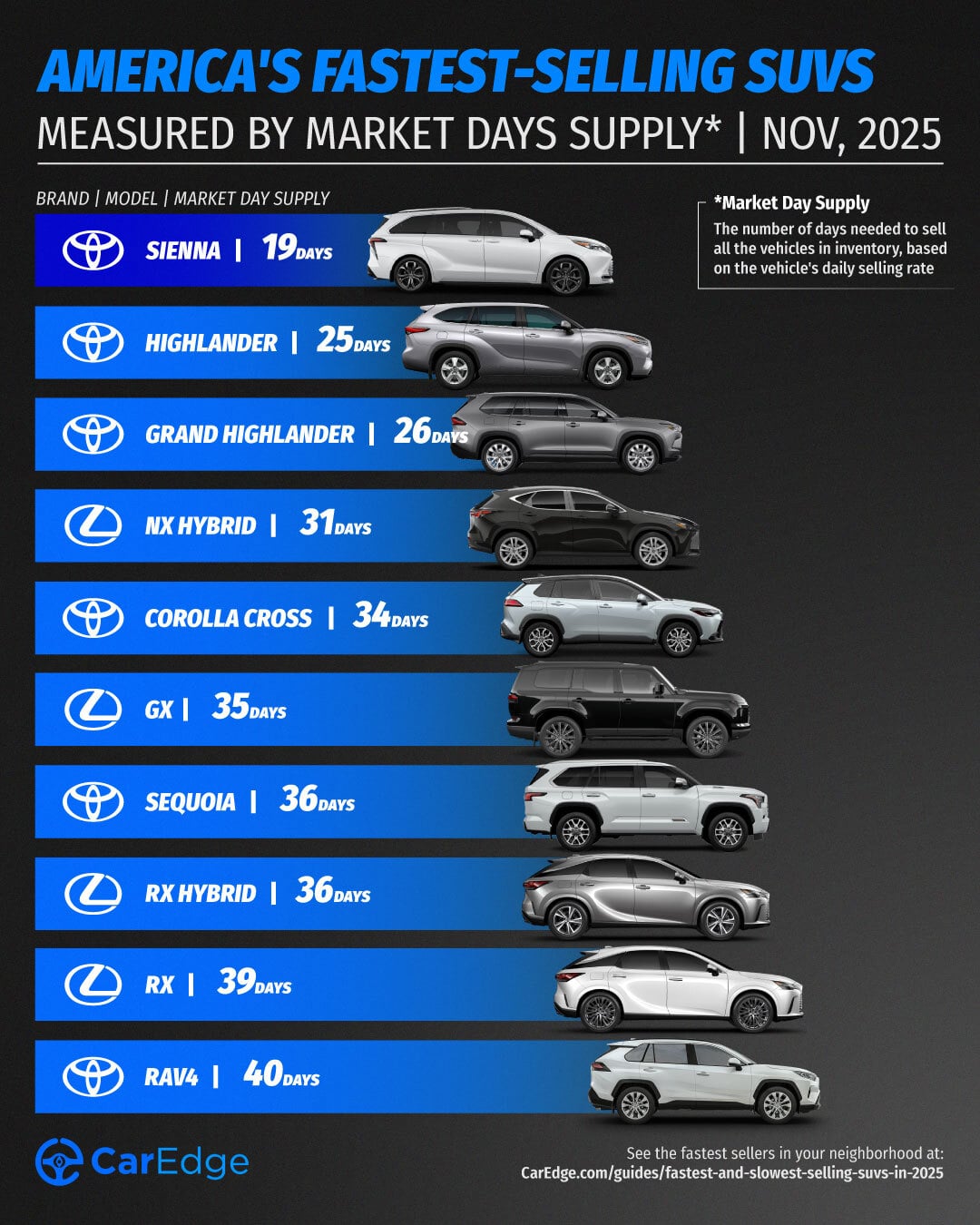
These are the SUVs and crossovers with the lowest market day supply as of November 2025. That means they’re in high demand right now, and are likely harder to negotiate on due to limited availability.
| Make | Model | Market Day Supply | Total For Sale | 45-Day Sales | Average Selling Price |
|---|---|---|---|---|---|
| Toyota | Sienna | 19 | 7,704 | 18,358 | $51,910 |
| Toyota | Highlander | 25 | 5,928 | 10,765 | $52,072 |
| Toyota | Grand Highlander | 26 | 13,733 | 27,573 | $55,573 |
| Lexus | NX Hybrid | 31 | 2,182 | 3,189 | $54,595 |
| Toyota | Corolla Cross | 34 | 14,739 | 19,477 | $31,303 |
| Lexus | GX | 35 | 2,858 | 3,659 | $80,224 |
| Toyota | Sequoia | 36 | 4,408 | 5,483 | $83,585 |
| Lexus | RX Hybrid | 36 | 4,465 | 5,526 | $63,418 |
| Lexus | RX | 39 | 8,315 | 9,702 | $59,010 |
| Toyota | RAV4 | 40 | 70,764 | 80,355 | $37,313 |
Source: CarEdge Pro
All of the top 10 fastest-selling SUVs in 2025 are Toyota or Lexus models. Car buyers are valuing reliability and affordability above all else right now, and the latest data reflects that.
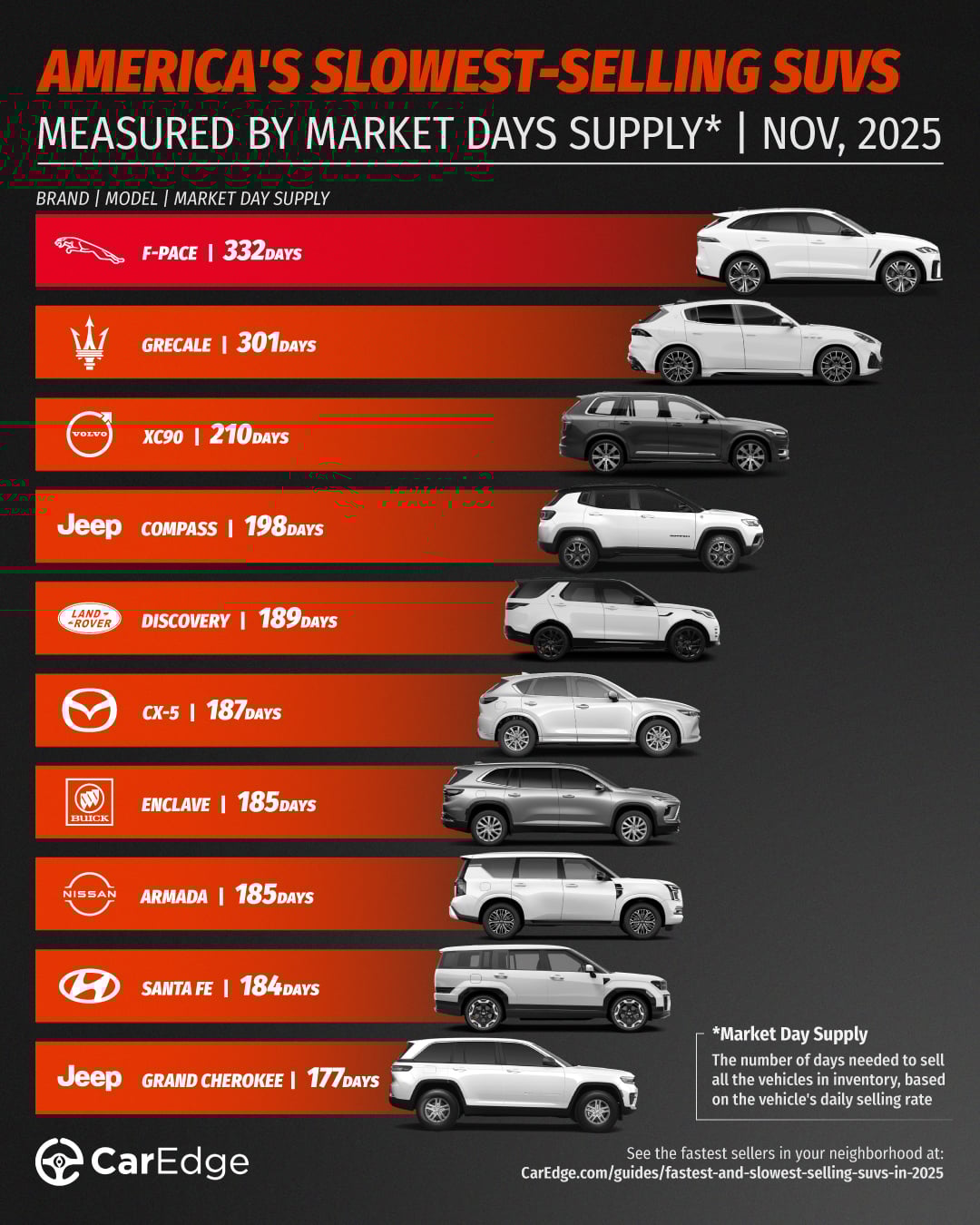
These SUVs have the highest market day supply, which means they’re sitting unsold for longer. Buyers may be able to score better deals on these slowest-selling SUVs in October, especially with this new AI negotiator doing the work for you.
| Make | Model | Market Day Supply | Total For Sale | 45-Day Sales | Average Selling Price |
|---|---|---|---|---|---|
| Jaguar | F-PACE | 332 | 2,299 | 312 | $70,966 |
| Maserati | Grecale | 301 | 675 | 101 | $82,255 |
| Volvo | XC90 | 210 | 15,642 | 3,349 | $71,761 |
| Jeep | Compass | 198 | 21,358 | 4,843 | $31,924 |
| Land Rover | Discovery | 189 | 1,145 | 272 | $73,959 |
| Mazda | CX-5 | 187 | 43,567 | 10,487 | $34,343 |
| Buick | Enclave | 185 | 13,912 | 3,377 | $52,747 |
| Nissan | Armada | 185 | 6,756 | 1,641 | $71,331 |
| Hyundai | Santa Fe | 184 | 42,768 | 10,438 | $42,928 |
| Jeep | Grand Cherokee | 177 | 47,730 | 12,137 | $46,865 |
Source: CarEdge Pro
Many of these models fall into the luxury segment. With recent inflation and persistently high interest rates, buyers are thinking twice about buying luxury vehicles in 2025. Jaguar’s F-PACE is the slowest-selling SUV today. Surprisingly, just one Stellantis model is in the bottom 10. Land Rover has quickly filled the list, with three slow-selling models this month. Many luxury buyers are waiting for interest rates to fall further as year-end sales approach.
For any of these slow-selling SUVs, prices will be more flexible if you come equipped with negotiation know-how.
If you’re looking for a deal, start with the slowest sellers this month. High inventory levels mean dealers are likely motivated to talk pricing if you negotiate with confidence. It’s always best to take a look at the best incentives of the month, too.
“If you’re shopping for a slow-selling SUV, the ball is in your court,” says auto industry veteran Ray Shefska. “Dealers know those vehicles aren’t moving, and that gives you the upper hand in price negotiations.”
Shopping Toyota, Honda, or Lexus? Expect tighter inventory and less room for negotiation. You may need to move quickly if you find the right trim. However, this is no reason to pay for unwanted add-ons or dealer markups!
Thinking about EVs? If it qualifies for the $7,500 federal tax credit, you’ve only got until the end of this month to make a purchase (or get a binding order in writing with a down payment). Although incentives abound, be wary of steep depreciation if you buy any EV. Unless you’ll be keeping your EV for several years, leasing is the smarter choice for your wallet.
With CarEdge Concierge, our experts do the legwork for you, from researching inventory to negotiating with dealers. Already know what you want? Use our AI Negotiation Expert service and have CarEdge AI negotiate with car dealers anonymously!
Explore more free tools and resources with car buying guides, cost of ownership comparisons, and downloadable cheat sheets. There’s no reason to shop unprepared in 2025!
CarEdge is a trusted resource for car buyers, offering data-backed insights, negotiation tools, and expert guidance to help consumers save time and money. Since 2019, CarEdge has helped hundreds of thousands of drivers navigate the car-buying process with confidence. Learn how to buy a car the easy way at CarEdge.com.

How much does brand really matter when it comes to car prices? Quite a lot, as it turns out. Whether you’re eyeing a commuter car or dreaming of a luxury ride, the average price by brand shows just how wide the gap has grown in today’s market.
At CarEdge, we pulled together the latest brand-level data to show you the average transaction price by car brand, from the cheapest to the most expensive. The results might surprise you. Some budget-friendly names are still hanging on, while the ultra-luxury world continues to climb into the stratosphere. Let’s take a look at the cheapest car brands in America, and how they compare to the most expensive brands.
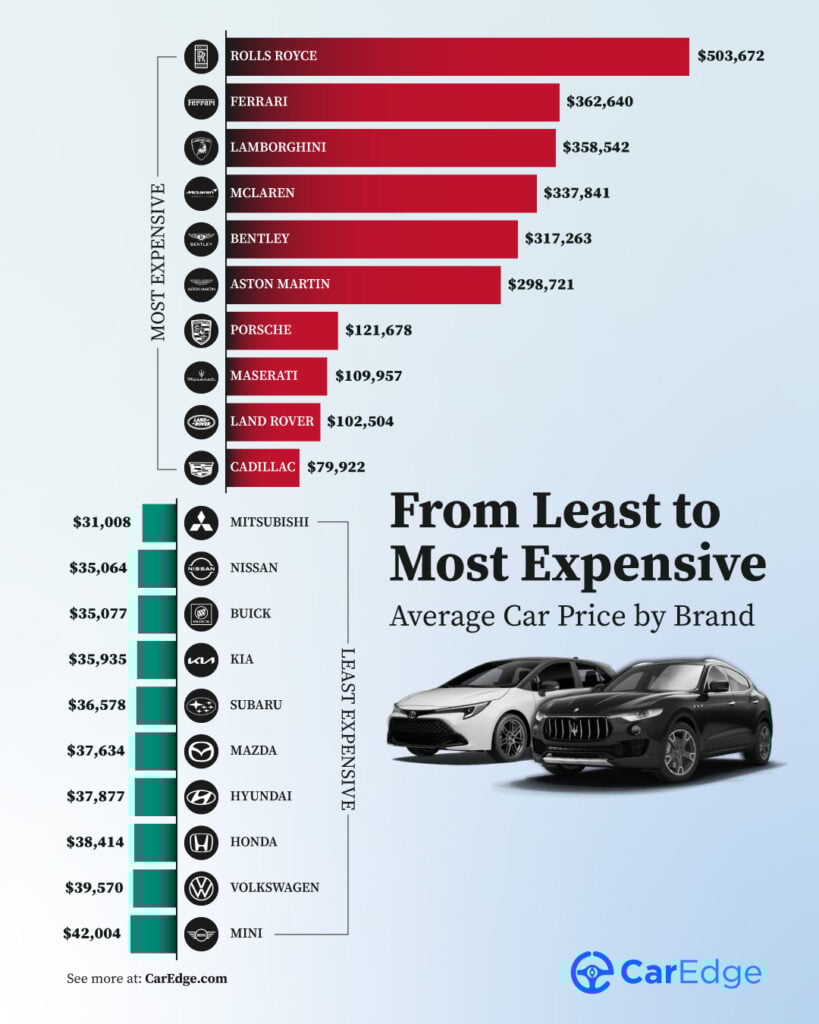
If you’re looking for value, these are the brands to keep on your radar. Most of these car brands average in the $30,000 – $40,000 range. Affordability makes these solid picks for families, commuters, first-time buyers, and just overall frugal drivers.
Mitsubishi’s lineup is small, but models like the Outlander Sport keep prices at the lowest end of the spectrum. If you’re simply looking for the cheapest way into a new car, Mitsubishi tops the list.
With affordable sedans like the Sentra and Versa, plus the popular Rogue SUV, Nissan delivers plenty of options for buyers on a budget. In 2025, Nissan offers a mix of affordability and variety as they aim to win back market share for the struggling automaker.
Buick may be marketed as GM’s entry-level luxury brand, but the brand’s SUVs like the Encore GX and Envision are surprisingly cheap. For many, Buick makes it possible to drive a near-luxury car without the luxury price tag.
Once the underdog, Kia now offers some of the best value cars in the industry. Kia continues to move its lineup upmarket, with the EV9 easily going for north of $60,000. Fortunately, models like the new K4, Soul, and Niro keep prices low for most buyers.
Standard all-wheel drive across nearly every model adds value, especially in snowy states. Budget-friendly pricing plus all-weather capability makes Subaru stand out.
Mazda blends sporty handling with a premium feel, yet average prices remain under $40K.
For budget-conscious drivers, Mazda is known for affordable cars that feel like luxury competitors.
From the Elantra to the Tucson, Hyundai offers popular budget models alongside top-selling EVs like the IONIQ 5. Hyundai is becoming known as a brand that balances affordability with innovation. Now, it’s just a question of whether or not they’ll keep prices affordable as their lineup moves into the future.
The Civic, Accord, and CR-V continue to anchor Honda’s reputation for reliable and efficient cars. Proven long-term reliability and strong resale values continue to lift Honda, even with models like the Passport and Prologue pulling prices higher.
Volkswagen keeps things reasonable with models like the Taos and Jetta, though EVs like the ID.4 edge higher. As the originator of “the people’s car”, VW offers European style at an accessible price.
Stylish, quirky, and fun to drive, MINI rounds out the affordable list, though options and trims can push prices upward quickly.
At the other end of the spectrum, prices soar far beyond what most drivers will ever spend. These are the brands with six-figure averages, where exclusivity, craftsmanship, and performance come at a steep premium. Let’s work our way from GM’s flagship brand up to the most expensive car brand in the U.S.
Cadillac is the only U.S. automaker on this list, and it’s inching closer to European luxury prices. These days, one-third of Cadillac sales are electric, and that is likely to push prices higher with the cancellation of the XT4, CT4, and CT5. Besides EVs, the Escalade is a big reason for the nearly $80,000 average.
Luxury SUVs like the Range Rover and Defender push Land Rover over the $100K mark. The appeal is off-road prestige paired with upscale interiors, but ownership costs are high. Frequent reliability complaints remind buyers that you not only need to afford the price tag, you need to budget for maintenance too.
Maserati’s lineup, from the Grecale SUV to the GranTurismo coupe, oozes Italian styling. But for most buyers, the brand is a niche choice thanks to higher maintenance costs and limited dealer networks. Maserati offers exclusivity, though it comes with compromises.
Porsche has mastered blending sports car heritage with family-friendly SUVs. The 911, Cayenne, and Taycan EV drive the brand’s average price above $120,000. Buyers don’t just pay for performance, they also buy into one of the strongest luxury resale values around.
James Bond’s car of choice doesn’t come cheap. Aston Martin’s lineup of hand-built performance cars averages nearly $300K. Buyers pay for prestige, but also for rarity. With production volumes far lower than mainstream luxury brands, Aston Martin is a symbol of exclusivity.
Every Bentley is handcrafted, with bespoke interiors and massive engines that exude old-world luxury. Models like the Bentayga SUV and Continental GT keep Bentley relevant, but their pricing puts them firmly in ultra-luxury territory.
McLaren builds cars for the racetrack as much as for the road. Every model is a supercar, and nothing in the lineup dips below six figures. With averages pushing $340K, McLaren is about raw performance, carbon fiber, and technology meant for speed.
Known for flamboyant styling and roaring V10 and V12 engines, Lamborghini remains one of the most recognizable exotic brands. Models like the Urus have broadened the lineup, but the average still hovers near $360K. This is wealth on wheels, unapologetically loud in every sense.
Ferrari is synonymous with performance, prestige, and scarcity. Limited production keeps demand high, ensuring average prices remain above $360K. Ferrari ownership is about more than the car, it’s a membership in an elite club.
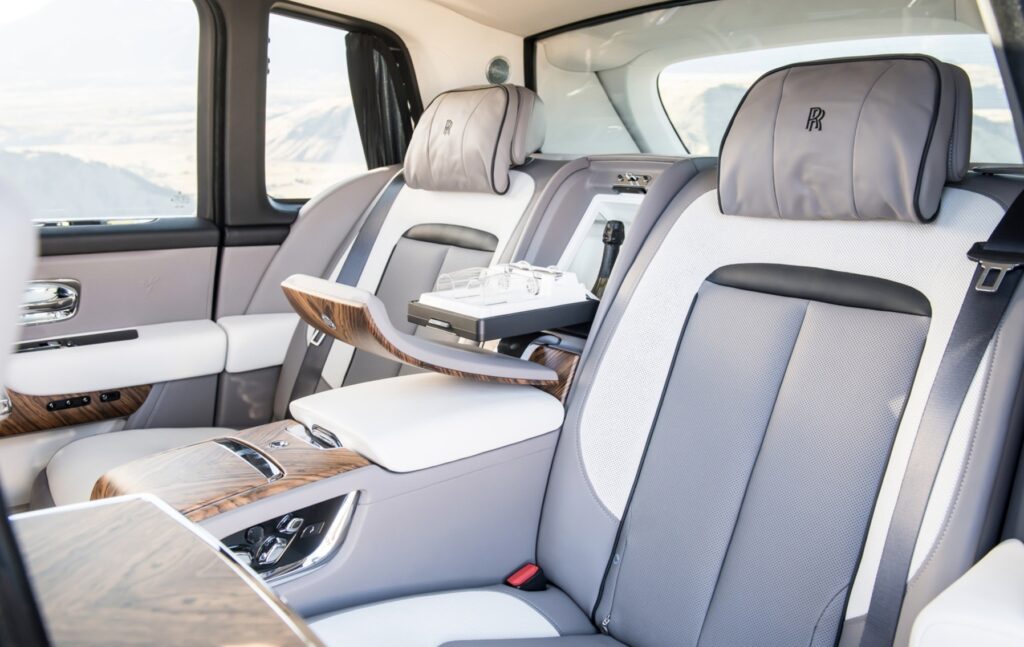
The pinnacle of luxury, Rolls-Royce tops the list with an average transaction price over half a million dollars. Every Rolls is custom-built, with endless personalization options. For most buyers, this is unobtainable, but for the ultra-wealthy, Rolls-Royce represents the ultimate status symbol.
Brand matters a lot when it comes to pricing, but it’s not the whole story. Reliability, depreciation, insurance, and ownership costs all play just as big a role in how much a car really costs over time.
Unfortunately, car price inflation is a serious challenge for consumers today. On average, new car prices have risen 30% over the past five years. Our best advice for car shoppers is to consider the entire cost of ownership before you buy, from expected depreciation and fuel economy to reliability.
Before you buy, make sure you’re looking at the full financial picture, not just the MSRP.
👉 Want to see how your car will hold its value? Check out free car depreciation data from CarEdge.

If you’re asking yourself this question, you’re not alone. It’s probably the single most common question our CarEdge team gets right now. The car market has been unpredictable for years, from rising MSRPs and interest rates to the ups and downs of tariffs. No wonder shoppers are stuck on whether to buy now or sit tight for a few more months.
To make this simple, we turned to CarEdge co-founder Ray Shefska. With 43 years in the auto industry, Ray’s advice is grounded in decades of watching manufacturers, dealers, and markets cycle through ups and downs. Here’s how to use the market to your advantage in the months ahead.
For most shoppers eyeing a new car, the timing of your purchase could make thousands of dollars’ worth of difference. Ray’s take? The smart move for most new car shoppers is to wait until year-end sales from Black Friday through December 2025.
“I think that we will see manufacturers increase their incentive spends in the last two months of this year and they will increase their advertising spends dramatically in December.”
Automakers are sitting on a lot of 2025 inventory, and they’ll need to make space for the 2026 models arriving weekly. Expect 0% APR financing, cash discounts over 10% of MSRP, and the best lease deals of the year come December.
This year, there’s another factor at play, and it’s one that actually helps buyers for a change. The next Federal Reserve meetings in September, late October, and early December are likely to bring about rate cuts for the first time since late 2024.
Ray thinks that falling rates will play a big role in year-end deals in 2025:
“With the anticipated Fed rate cuts, I would expect to see more low-APR incentives as well since the cost of doing that will be less than it has been.”
If you are, you’re in for a real treat when shopping for a car. By treat, we mean serious savings. There are still over 90,000 new 2024 models sitting on dealer lots as of September 2025, including aging vehicles from Ford, Dodge, Jeep, and others. These will be the most negotiable cars in the market until they’re gone. If you’re open to driving last year’s model, dealers are going to be far more flexible on price just to move them off their lots.
On the other hand, waiting until 2026 is unlikely to save you money. Automakers have been steadily announcing higher prices for 2026 models, whether through MSRP hikes or padded fees. Incentives also tend to dry up when a new model year launches, which means buyers holding out could end up paying more for less. The deepest discounts will be on 2025 models during late 2025, not on fresh 2026 arrivals.
Here’s the bottom line: Unless you’re in urgent need of a new car or you’re considering EVs, waiting until year-end sales in November and December is the smart play. If you wait until 2026, higher MSRPs are likely to cost you.
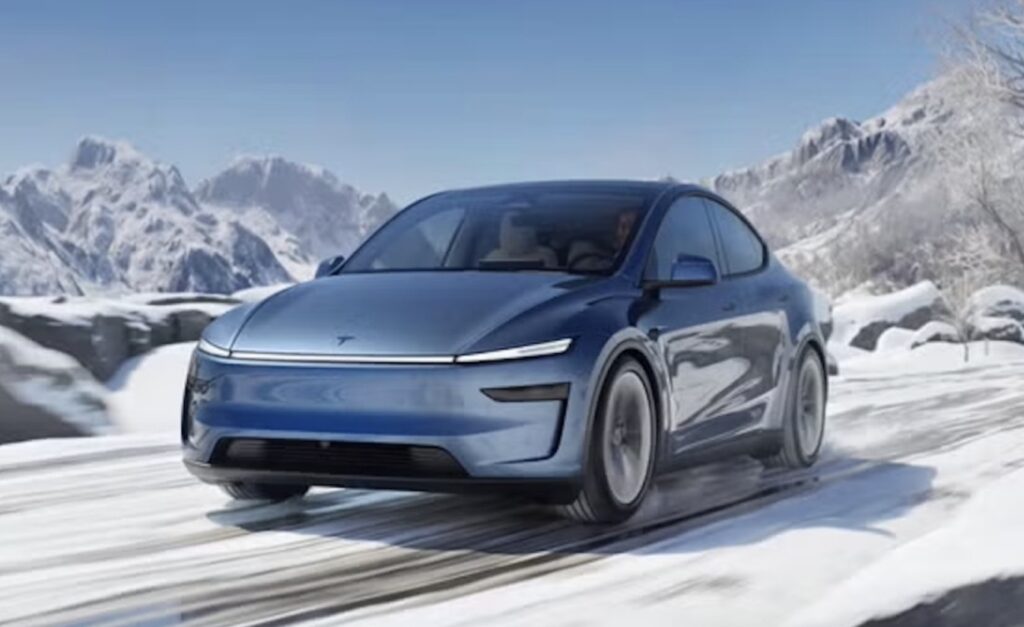
This is where timing matters most. The federal tax credit is set to expire for qualifying vehicles on September 30, 2025, with a catch. New federal guidance from the IRS has clarified that buyers have until that date to get a signed binding contract with a down payment, even if the car isn’t delivered yet. That’s welcome news as electric models are several of the fastest-selling cars right now.
“Obviously EV shoppers should take advantage of the federal tax credits before they expire on September 30th, so if you are looking for an EV do it now not later.”
That’s about as clear as it gets. EV buyers have a ticking clock that runs out at month’s end. Right now, EV leases are especially appealing. Before you rush out to purchase anything with a battery, understand that depreciation hits hard with EVs.
Here’s the bottom line: If a new EV is on your radar, buy or lease before September 30, 2025. The credit for used EVs under $25,000 will also expire on that date.
The used car market doesn’t feature manufacturer incentives, but it does move with interest rates and seasonal demand.
Ray notes that if the economy weakens, it’ll ripple into both new and used prices:
“If the economy struggles, that will add pressure on both the manufacturers and dealers to be even more aggressive at year-end.”
That’s good news for buyers, since cheaper new car financing usually pulls used prices down too.
The exception? You guessed it – used EV buyers should be aware of the expiring $4,000 federal incentive. Most electric models under $25,000 will qualify. The federal used EV incentive will be gone for good when September concludes.
Here’s the bottom line: Don’t feel rushed to buy a used car in 2025, unless you’re shopping for used EVs under $25,000. But if you’re financing, waiting a few months could save you money.
For shoppers on the fence, here’s the big picture: waiting until 2026 could mean paying more. Some automakers are announcing price hikes for the 2026 model year, and others are being sneaky with higher ‘mandatory destination charges’ and other fees. That makes the final months of 2025 one of the best windows to grab a deal on a 2025 model.
Year-end sales will be especially aggressive. Manufacturers will crank up incentives like 0% APR financing and cash offers in November and December. Each year, this manufacturer push lines up perfectly with dealer pressure to clear out remaining inventory. Take note: this level of new car sales won’t be seen again until late 2026. In the auto industry, it’s common knowledge that the end of the year is always the best time to buy a car.
With expiring EV incentives, MSRPs rising, and interest rate cuts looming, car buyers have some decisions to make. However, the good news is that timing can work in your favor. If you’re shopping for a new car (non-EV), November and December are shaping up to be the best months to take advantage of sales and savings. If you’re shopping for an EV, the clock is ticking. Federal incentives vanish after September 30, 2025, making this the time to act.
And if you’re open to considering a leftover 2024 model, you’re in luck: these are the most negotiable cars on the market right now. After all, they’re almost two years old!
Used car shoppers have a bit more flexibility, though late-year sales and falling rates could give you an edge. Retail used car prices have been relatively flat over the past year, and that’s unlikely to change substantially in 2026. What IS likely to shift in buyer’s favor is falling interest rates. For used car shoppers with a bit of flexibility, December is likely to be your best month to purchase with most shoppers focusing on year-end new car deals, and the likelihood of falling interest rates.
Ray summed it up best: wait until December if you can, unless it’s an EV. The manufacturers and dealers will be more aggressive than ever at the end of this year, and that’s when you’ll find the deals worth waiting for.
No matter your timeline, you don’t have to navigate this market alone. CarEdge can handle the negotiations for you, from our white-glove Concierge service to the world’s first AI car price negotiator. Either way, the best way to buy a car in 2025 is with the facts on your side.
If you thought the best car deals wouldn’t show up until Black Friday, think again. September 2025 is stacked with interest-free financing, bonus cash, and cheap EV leases, but only if you know where to find them. We’ve pored over hundreds of sales to find the offers worth your time right now.
Nissan, Chevy, Honda, and even Audi are bringing serious offers to the table. Although there are plenty of ICE models featured in our ‘best of September’ deals, EVs are the stars of the show this month. That’s because the federal $7,500 EV tax credit is expiring on September 30th. This month will be your last chance to take advantage of these savings.
Let’s take a look at the 10 best car deals in September 2025.

0% APR financing for 60 months + $1,750 bonus cash
Why it’s a great deal: Not only can you finance the Rogue with no interest, but Nissan is sweetening the deal with nearly two grand in bonus cash. That’s money back in your pocket. Want a longer term? You can opt for 1.9% APR over 72 months.
👉 See Rogue deals with local market insights
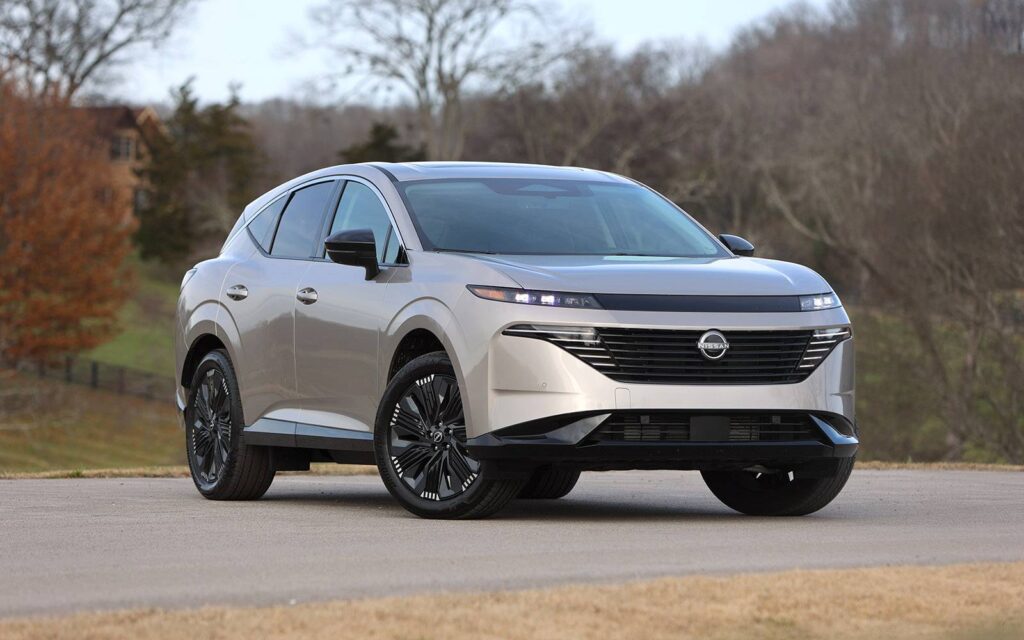
0% APR financing for 60 months
Why it’s a great deal: The redesigned Murano hasn’t exactly flown off dealer lots, which is bad for Nissan but great for you. Zero interest is basically free money. If only student loans worked like this.
👉 Check Murano offers near you
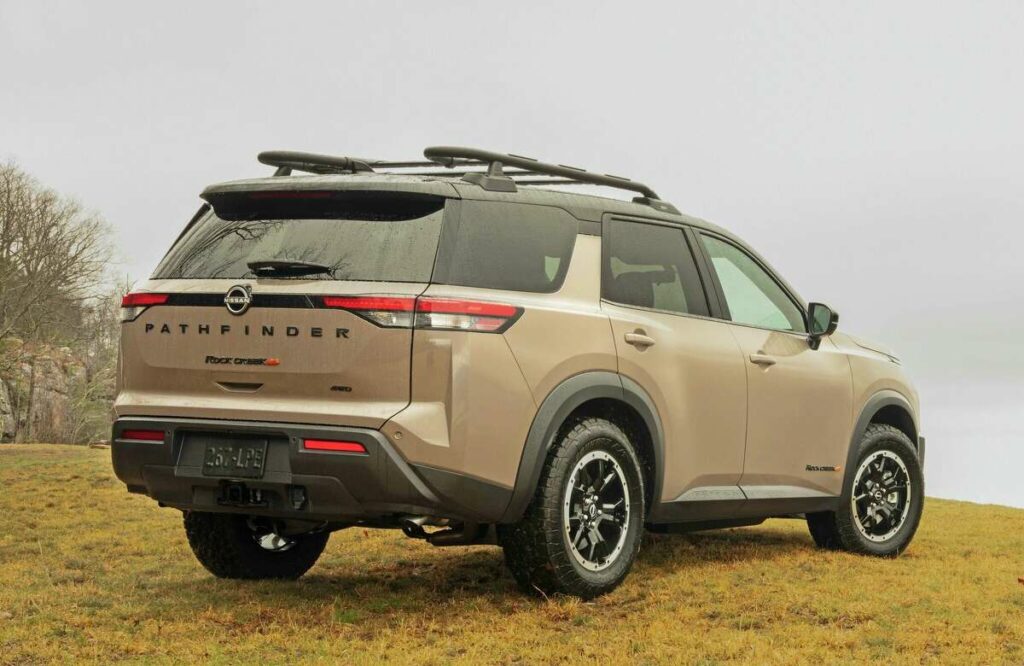
0% APR financing for 60 months + $1,000 bonus cash
Why it’s a great deal: Family haulers with off-road chops aren’t usually cheap to finance, but Nissan is offering the Pathfinder with no interest and a nice chunk of bonus cash on top. Carpool line, here you come.
👉 Find Nissan Pathfinder deals near you

0% APR financing for 60 months
Why it’s a great deal: The Equinox EV is one of the hottest-selling electric crossovers in America right now, with nearly 10,000 sold in August alone. Add in 0% financing and the ability to claim the $7,500 EV tax credit upfront at purchase? That’s a real steal, but it won’t last. The EV credit ends September 30th.
👉 Browse Equinox EV listings near you
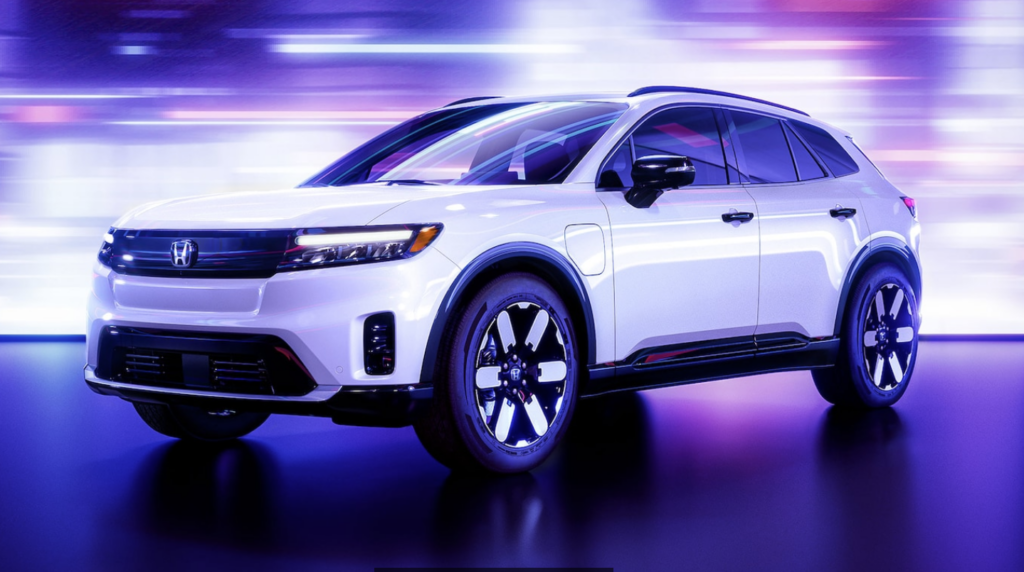
0% APR financing for 60 months, or lease from $179/month
Why it’s a great deal: Honda probably didn’t expect the Prologue to be this popular, but here we are. With the $7,500 federal EV tax credit still in play this month, the Prologue is one of the cheapest ways to go electric. At $179/month, you’ll spend more on streaming subscriptions than on this lease.
👉 See Honda Prologue deals with local market insights
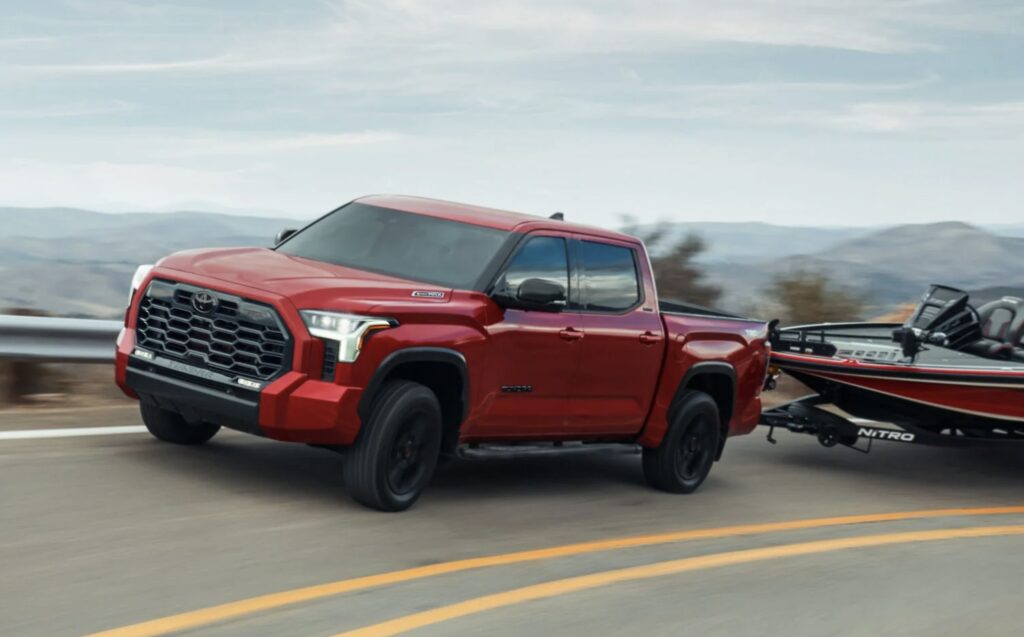
1.75% APR for 72 months (regional offer)
Why it’s a great deal: Toyota is fighting hard for pickup buyers, especially in the South, Midwest, and Texas. Low-APR deals on the Tundra don’t happen often, so check your ZIP code to see if you qualify.
👉 Search Toyota Tundra inventory near you

1.99% APR financing for 72 months
Why it’s a great deal: This is the best luxury EV financing deal in September. The Q6 e-tron qualifies, but so do the Q4 e-tron and upcoming A6 e-tron. Plus, lease shoppers get $7,500 in lease cash.
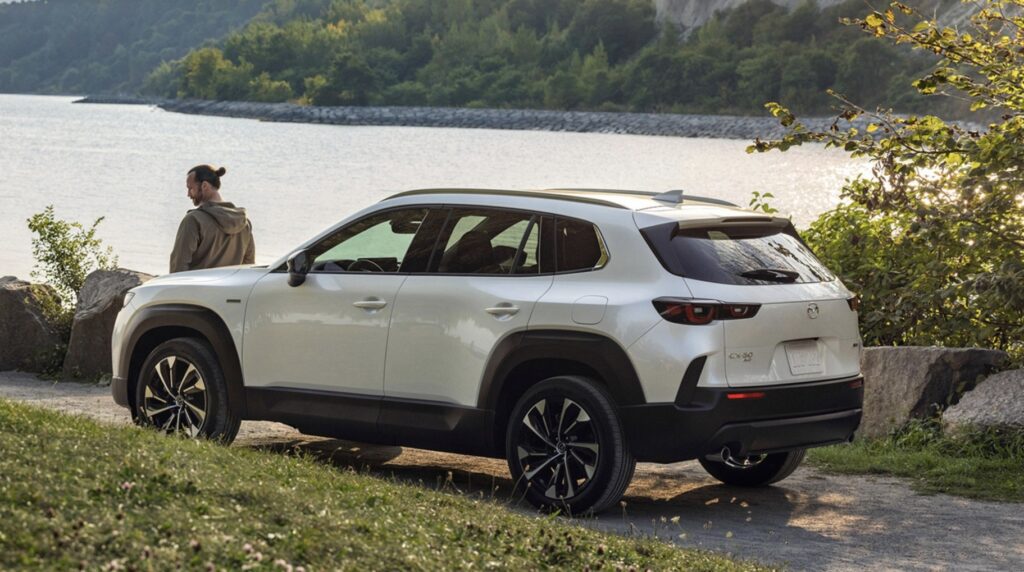
1.9% APR financing for 60 months
Why it’s a great deal: A fan-favorite with all-wheel drive and extra ground clearance, the CX-50 is a smart pick before winter hits. Lock in low financing now, and you’ll thank yourself when the first snowstorm rolls in.
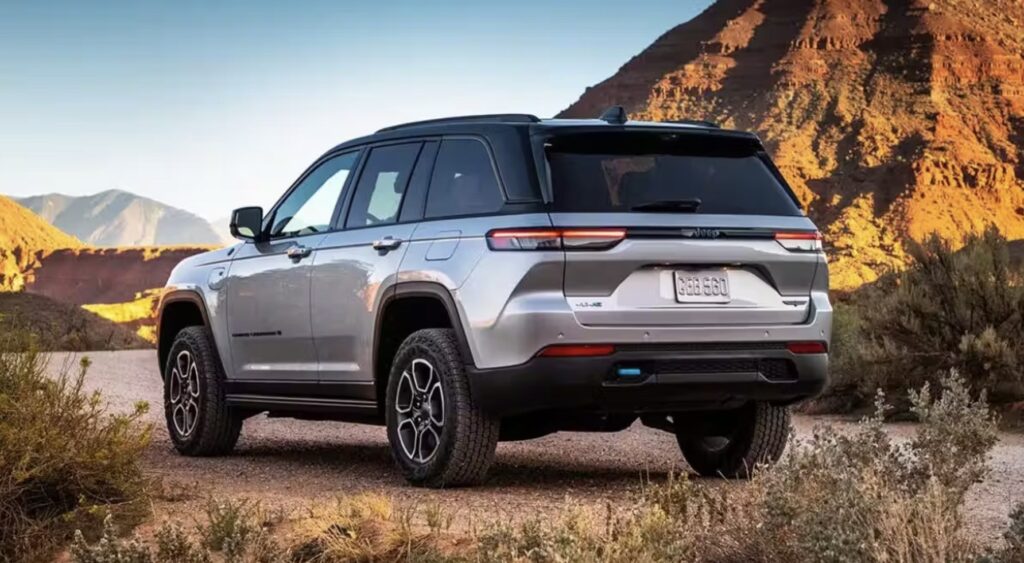
0% APR for 72 months (2024 models) OR 1.9% APR for 72 months (2025 models)
Why it’s a great deal: With 26 miles of all-electric range, the Grand Cherokee 4xe is a great hybrid pick for city commutes. Just don’t expect Prius-like mpg once the gas engine kicks in. Jeep sweetens the pot with $6,250 in cash offers for current owners, though you’ll have to choose between cash or low-APR financing.
👉 Browse the most negotiable Jeep inventory near you
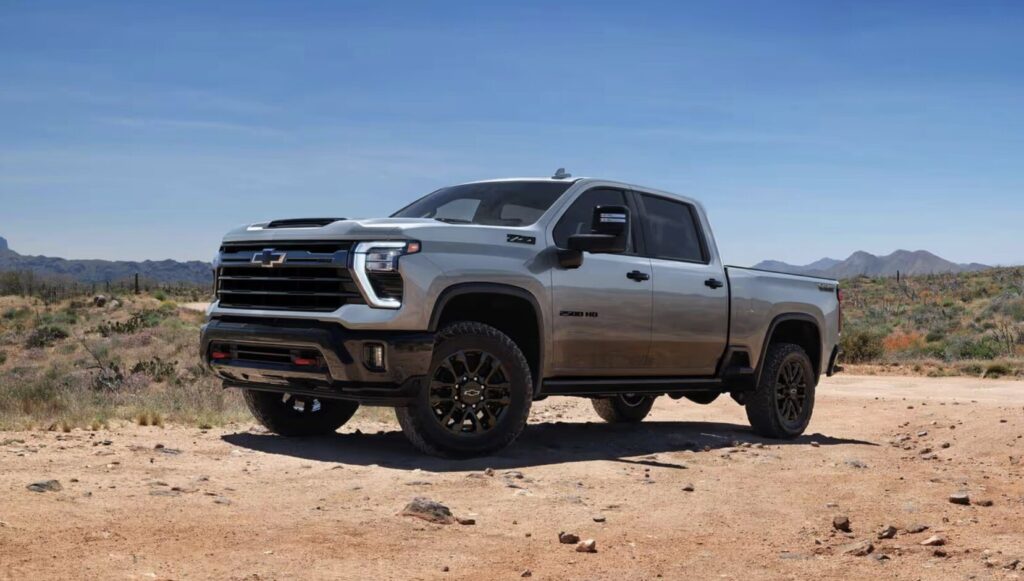
2.9% APR for 72 months, or lease from $379/month
Why it’s a great deal: Chevy’s truck deals beat Ford this month, hands down. Ram comes close, but Silverado shoppers get the win with multiple offers: 0% APR for 36-month terms, or a $379/month loyalty lease for current Chevy lessees. Either way, the Silverado is September’s full-size truck bargain.
By the way, if you’re willing to give electric trucks a try, Silverado EV deals include 0% financing for 60 months. The Silverado EV qualifies for the EV tax credit through the end of the month, as long as you stay under $80,000. Check the deals out here.
👉 See Silverado deals with local market insights
Even with plenty of great offers, the dealership experience can still be a headache. From sneaky add-ons to mysterious “market adjustments,” it’s never as simple as the ad makes it sound. That’s where CarEdge has your back.
Car buying doesn’t have to be a circus. At CarEdge, we’re here to help you avoid the games and get the deal you deserve.
Not all cars are created equal when it comes to insurance costs. While some models are budget-friendly, others will cost drivers thousands more every year in premiums. High repair bills, performance-focused designs, and riskier driver profiles are just some of the factors that push insurance rates higher.
To help you make sense of it, we analyzed insurance data for over 300 models and ranked the most expensive cars to insure in 2025. Our data is based on a 40-year-old driver with good credit, a clean record, and about 13,000 miles driven per year.
At CarEdge, we’ve built our rankings on millions of listings and insurance data points so you can shop smarter, with full transparency on what ownership really costs.
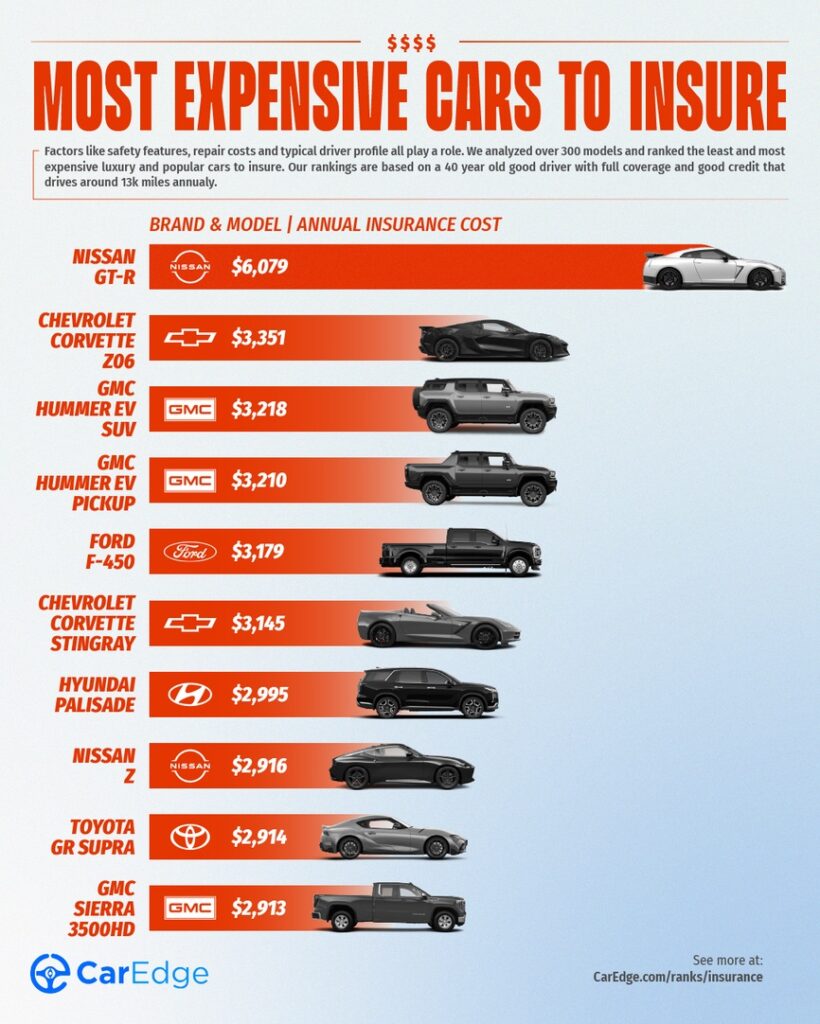
Insurance costs can soar when it comes to sports cars, luxury SUVs, and high-performance trucks. At the very top is the Nissan GT-R, with an average annual premium of $6,079. That’s nearly triple the cost of insuring the cheapest mainstream SUVs.
The Chevrolet Corvette Z06 ($3,351) and both the GMC Hummer EV ($3,218) also ranks among the priciest, thanks to high repair costs and a massive battery. The Ford F-450 ($3,179) shows that heavy-duty trucks can be just as expensive to cover as exotic performance cars.
The Hyundai Palisade is the big surprise on the list. As a popular family hauler, it’s unclear why insurers are charging more for coverage of the Palisade. On average, it costs $2,995 to insure the Palisade for one year.
Other costly models include the Chevrolet Corvette Stingray ($3,145), Nissan Z ($2,916), Toyota GR Supra ($2,914), and GMC Sierra 3500HD ($2,913).
Looking for more insurance rankings? This is just the beginning. See the complete data right here.
A few key factors make these cars and trucks the most expensive models to insure right now.
Looking for the models with the lowest insurance premiums? We’ve got you covered.
👉 Here are the 10 cheapest cars to insure right now.
Even if your car isn’t on this list, there’s a good chance you’re paying more than you should. Studies have shown that 3 out of 4 drivers qualify for a lower rate when shopping around. Insurance companies often don’t reward loyalty, and drivers can save by comparing quotes.
With CarEdge’s insurance quote comparison tool, you can see if you’re getting the best rate in minutes. It’s free, quick, and could save you hundreds per year.

Finding the cheapest cars to insure isn’t just about picking vehicles with the lowest sticker price. Many factors matter, from advanced safety features and affordable repair costs to the typical driver profile. To help car shoppers make smarter decisions, we analyzed insurance data for over 300 models, comparing the least and most expensive vehicles to insure. Our rankings focus on what a 40-year-old driver with a clean record and good credit can expect to pay for full coverage, driving an average of 13,000 miles each year.
At CarEdge, we’ve analyzed millions of listings and insurance data points to give you transparent, reliable insights. Our goal is simple: help you make smarter, more informed car-buying decisions with real data you can trust.
Click on any vehicle to see a full breakdown of insurance costs, as well as other factors in the total cost of ownership.
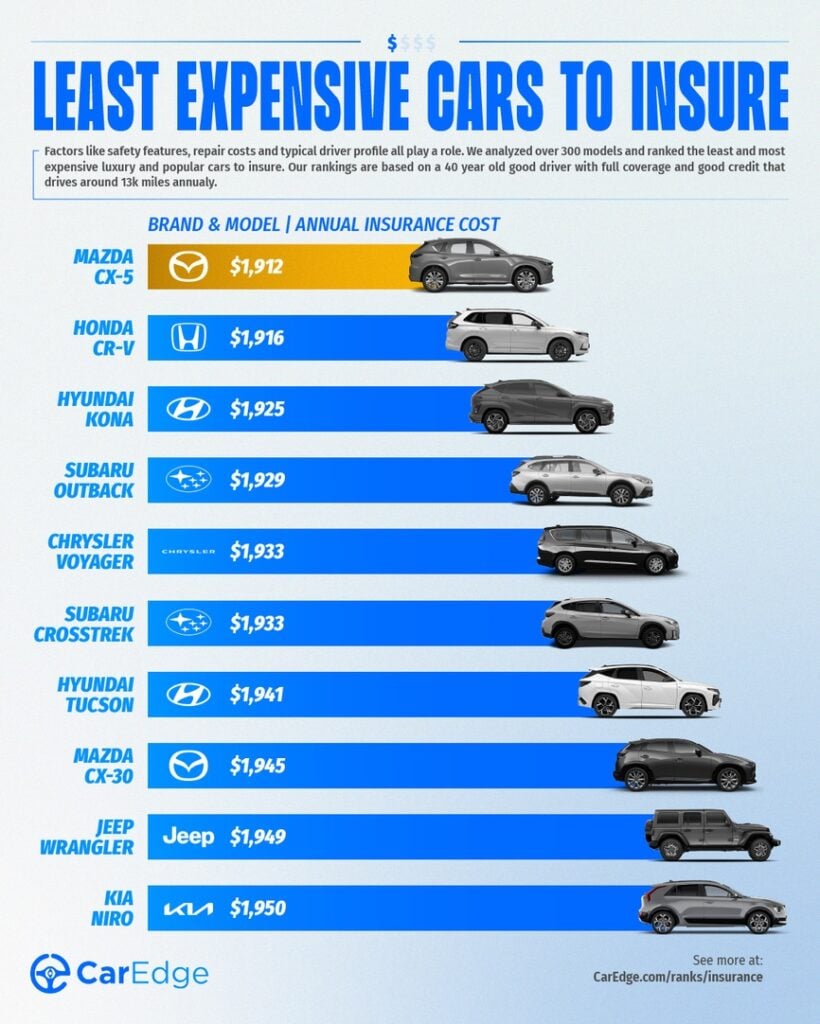
Insurance costs can vary widely depending on the car you drive, but our analysis shows which models consistently land among the cheapest cars to insure. At the top of the list is the Mazda CX-5, with an average annual premium of just $1,912. Closely behind are the Honda CR-V ($1,916) and Hyundai Kona ($1,925).
Subaru models also make a strong showing, with the Outback ($1,929) and Crosstrek ($1,933) offering affordable coverage thanks to their safety features and all-weather versatility. Even a minivan, the Chrysler Voyager ($1,933), ranks among the least expensive vehicles to insure, showing that family-friendly designs often keep premiums low.
Other affordable picks include the Hyundai Tucson ($1,941), Mazda CX-30 ($1,945), and Kia Niro ($1,950). For drivers who want something rugged, the Jeep Wrangler ($1,949) also makes the list.
Overall, the data highlights a clear trend: mainstream, affordable SUVs and crossovers dominate the rankings for low insurance costs.
Looking for more insurance rankings? This is just the beginning. See the complete data right here.
Wondering which cars have the most expensive insurance premiums? We’ve got the data you’re looking for.
👉 These are the 10 most expensive cars to insure right now.
Did you know that auto insurance companies don’t always reward loyalty with lower rates? Most drivers don’t find this out until they finally get around to shopping for lower quotes. It can’t hurt to see if you’re getting your best rate. Find out with CarEdge’s insurance quote comparison tool!
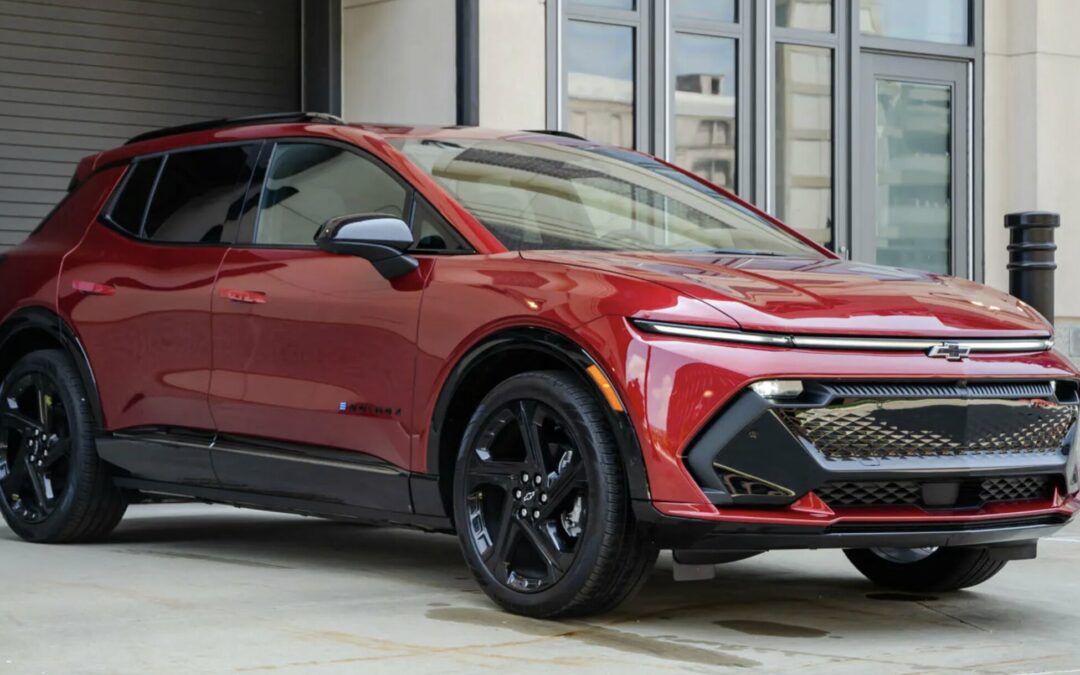
Why wait for incoming 2026 models if 2025 crossovers and SUVs are more affordable? Labor Day sales are here, and it’s clear which automakers are looking to sell some SUVs before year-end sales arrive in a few month’s time. From 0% APR financing to dirt-cheap leases, here are the best SUV deals for Labor Day 2025.

Labor Day Deal: Lease from $299/month
Offer valid through: 9/30/2025
Base MSRP with destination: $51,095
Lease the 2025 Audi Q4 e-tron for $299/month for 24 months, $4,244 due at signing. This lease offer includes the $7,500 EV lease credit, which ends on September 30, 2025.
See offer details, and view Audi listings in your area

Labor Day Deal: Lease with $0 down
Offer valid through: 9/2/2025
Base MSRP with destination: $27,335
Lease the 2025 Buick Encore GX AWD Preferred for $349/month for 39 months with $0 down at signing for current GM lessees (ultra-low mileage lease).
See offer details, and view local Buick listings

Labor Day Deal: 0% APR for 60 months
Offer valid through: 9/2/2025
Base MSRP with destination: $34,995
For Labor Day 2025, lock in 0% APR for 60 months, or lease the Equinox EV LT trim from $319/month for 24 months with $3,649 due before taxes and fees.
The Equinox EV qualifies for the $7,500 federal EV tax credit, which ends on September 30, 2025.

Labor Day Deal: Lease with just $2,509 due
Offer valid through: 9/2/2025
Base MSRP with destination: $21,895
Lease the 2025 Chevrolet Trax for $269/month for 36 months, $2,509 due at signing. The Trax is one of the few crossovers available for well under $25,000.
See offer details, and view local Chevrolet listings
Labor Day Deal: Lease for just $159/month
Offer valid through: 9/2/2025
Base MSRP with destination: $48,850
Lease the 2025 Honda Prologue AWD EX for $159/month for 24 months, $2,599 due at signing.
This lease well under $200/month with little money down is the best EV lease offer for Labor Day. This offer includes the application of the federal EV tax credit, which ends on September 30, 2025. It’s wild seeing a nearly $50,000 car available to lease for $159 a month.
See offer details, and view local Honda listings

Labor Day Deal: 0% APR for 60 months
Offer valid through: 9/2/2025
Base MSRP with destination: $38,695
This is a rare offer for one of Hyundai’s best-sellers, but it’s not quite surprising since revamped 2026 Palisade models are now arriving daily.
Labor Day Deal: 0% APR for 60 months
Offer valid through: 9/2/2025
Base MSRP with destination: $35,795
Santa Fe sales have slowed following a spike with the introduction of the redesign last year. But that doesn’t mean it’s a bad SUV by any means. This is a great offer that won’t last forever.
See offer details, and view local Hyundai listings

Labor Day Deal: $6,000 Bonus Cash Allowance
Offer valid through: 9/2/2025
Base MSRP with destination: $41,030
Jeep is offering $6,000 off the 2025 Grand Cherokee L Limited 4×4 in August. The Grand Cherokee is one of the better-selling Jeep models right now, but with an oversupply on dealership lots, even the Grand Cherokee isn’t safe from clearance sales. See Jeep offer details.
See offer details, and view local Jeep Grand Cherokee L listings
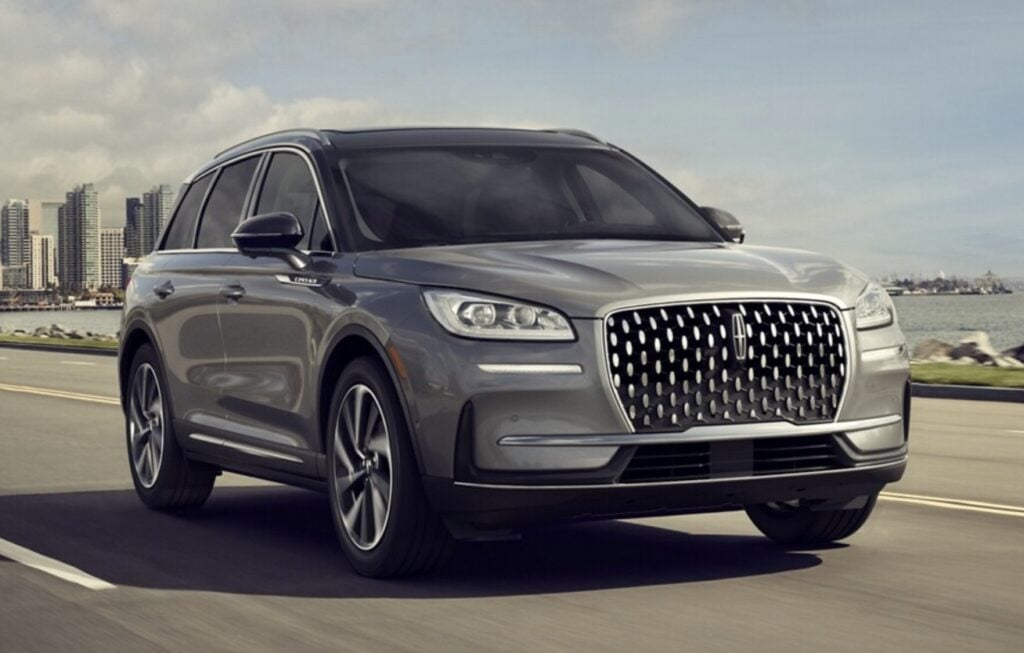
Labor Day Deal: Lease the 2024 Corsair for $276/month
Offer valid through: 9/2/2025
Base MSRP with destination: $41,030
Lease the 2024 Lincoln Corsair for $276/month for 24 months with $4,325 due at signing.
It’s important to note that this offer is for remaining 2024 inventory, but it’s the most affordable Lincoln offer we’ve seen in recent years. Leasing a luxury SUV is virtually unheard of for under $300/month.
See offer details, and view Lincoln listings

Labor Day Deal: $10,000 Lease Cash
Offer valid through: 9/2/2025
Base MSRP with destination: $51,475
The 3-row Mazda CX-90 is a great choice for growing families. This particular offer is for the CX-90 Hybrid, which is a plug-in hybrid with 26 miles of all-electric range before the hybrid engine kicks in.
See offer details, and view Mazda listings in your city
As Nissan looks to claw back market share from Hyundai, Kia, Toyota, and the others, big incentives continue for Labor Day 2025. We’ve never seen such an abundance of zero percent financing for months on end.
All of the following Nissan SUVs have 0% APR for 60 months right now:
See offer details, and view local Nissan listings
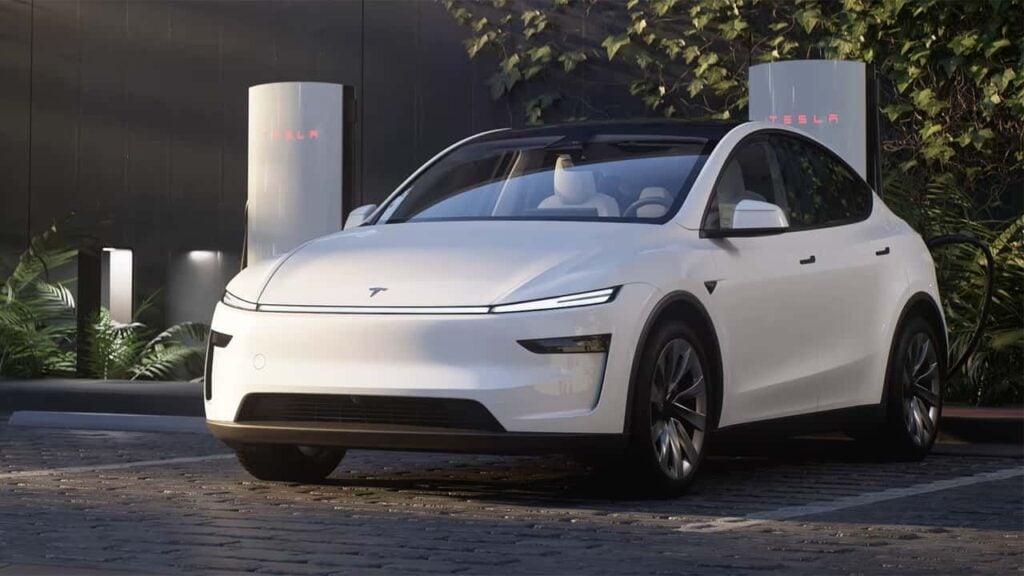
Lease the 2025 Model Y Long Range Rear-Wheel Drive from $399/month for 36 months with $3,000 due at signing. This lease offer includes the $7,500 EV lease credit, which ends on September 30, 2025.
Tesla doesn’t announce when incentives will expire, so this offer could change at any time.

Labor Day Deal: 0% APR for 72 months
Offer valid through: 9/2/2025
Base MSRP with destination: $41,420
The Volkswagen ID.4 may be German-engineered, but it’s manufactured entirely in Chattanooga, Tennessee. That means it qualifies for the $7,500 EV tax credit, which expires on September 30.
See offer details, and view local VW listings
Although it’s not the official best time to buy a car, Labor Day is one of the few times of the year that lease offers truly shine. The top place trophy goes to December’s year-end clearance sales, but September will have plenty to offer SUV shoppers. Dealers want 2025 inventory gone before 2026 models start to crowd dealership lots. That means more sales, and the beginnings of a buyer’s market.
Time is of the essence for Labor Day 2025 lease deals. Most manufacturer incentives end on September 2, but some sales could stretch through the month. EV buyers should know that the $7,500 federal tax credit expires on September 30, so act fast.
Tired of car buying hassles? Let a professional do it for you! Learn how CarEdge makes car buying (or leasing) easier than ever before.
Luxury brands are making big moves this Labor Day. Lease deals dominate as automakers like Audi, BMW, Rivian, and others work to broaden their appeal and lower the barrier to entry for shoppers eyeing a luxury badge. Below, we’ve rounded up the best luxury car deals you can find for Labor Day 2025. Remember, shop prepared with expert insights for the luxury market, or let AI do it all for you.
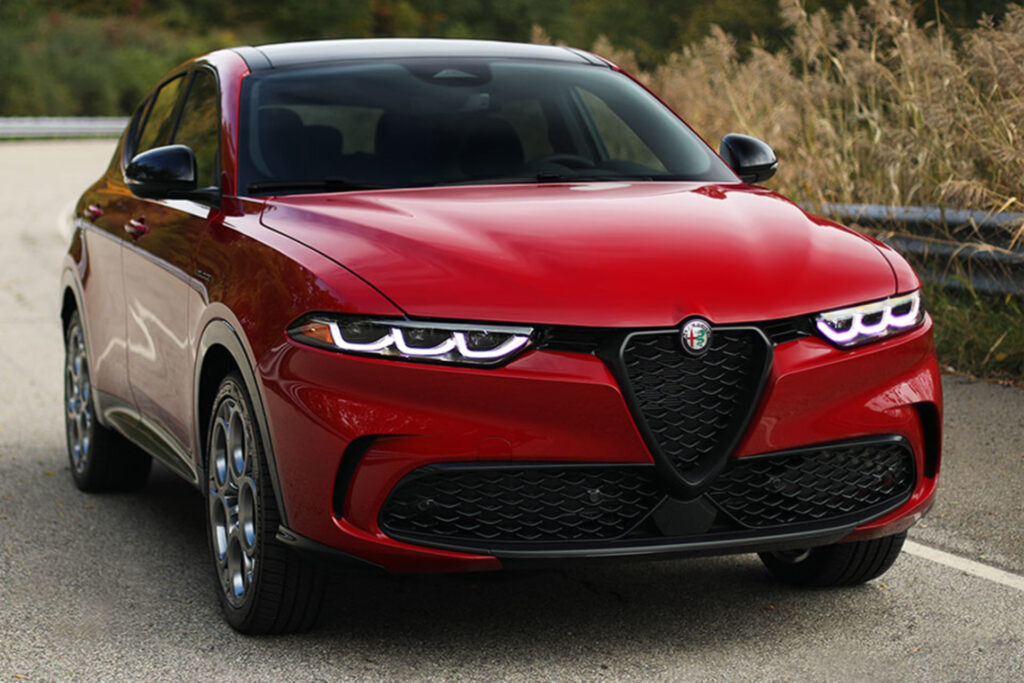
Lease the 2025 Alfa Romeo Tonale for $294/month for 36 months, $4,999 due at signing.
See offer details, and view Alfa Romeo listings
Lease the 2025 Audi Q4 e-tron for $299/month for 24 months, $4,244 due at signing.
See offer details, and view Audi listings in your area

Lease the 2025 BMW X3 for $599/month for 39 months, $5,589 due at signing.
See offer details, and view BMW listings in your area

Lease the 2025 Range Rover Velar for $749/month for 36 months, $6,995 due at signing.
See offer details, and view local Range Rover listings
Lease the 2024 Lincoln Corsair for $276/month for 24 months with $4,325 due at signing.
See offer details, and view Lincoln listings
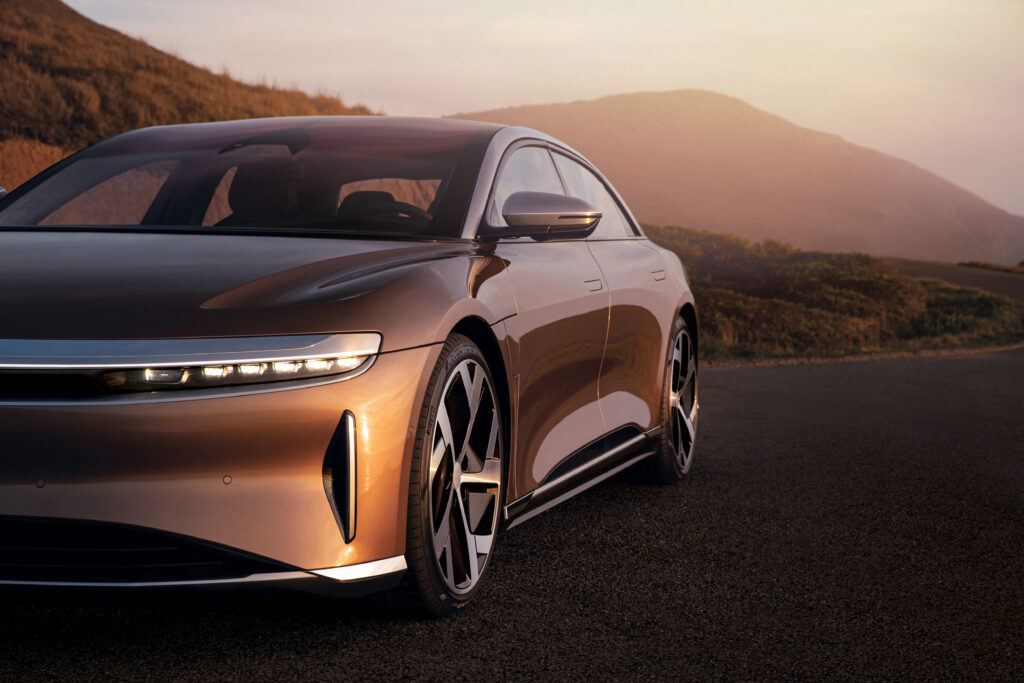
Lease the Lucid Air Pure for $509/month for 36 months with $2,869 due at signing.

Lease the 2025 Mercedes-Benz GLA 250 SUV for $469/month for 36 months, $4,663 due at signing.
See offer details, and view local Mercedes-Benz listings
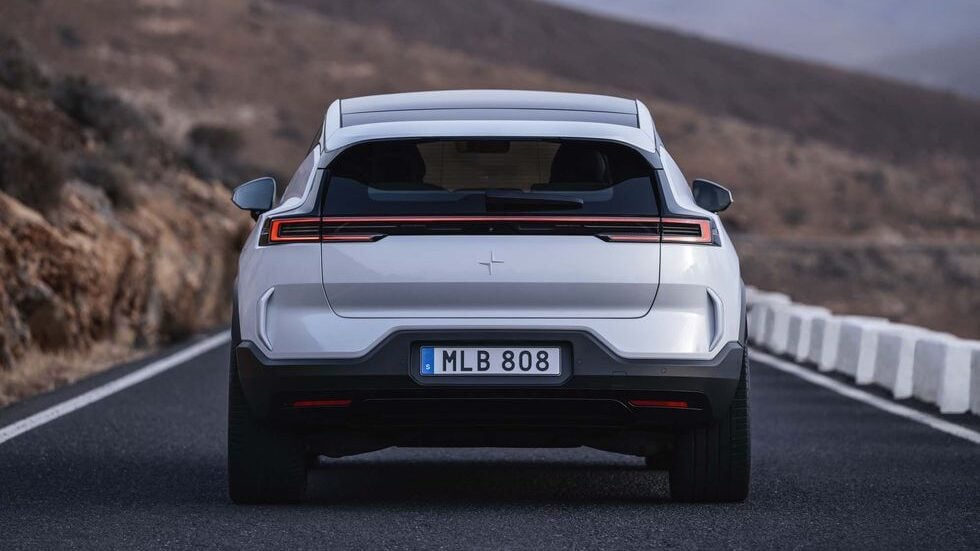
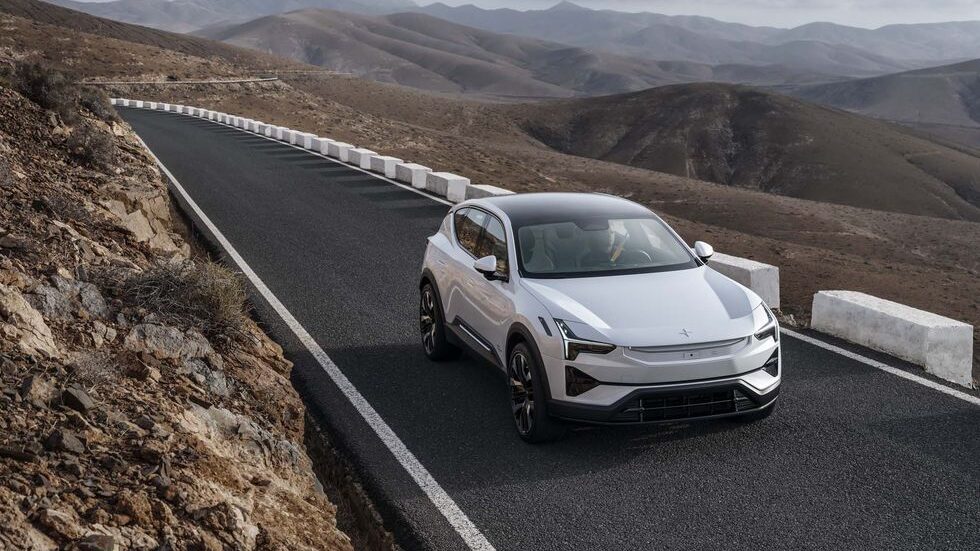
Lease the 2025 Polestar 3 for $399/month for 27 months with $5,399 due at signing.
See offer details, and view Polestar inventory
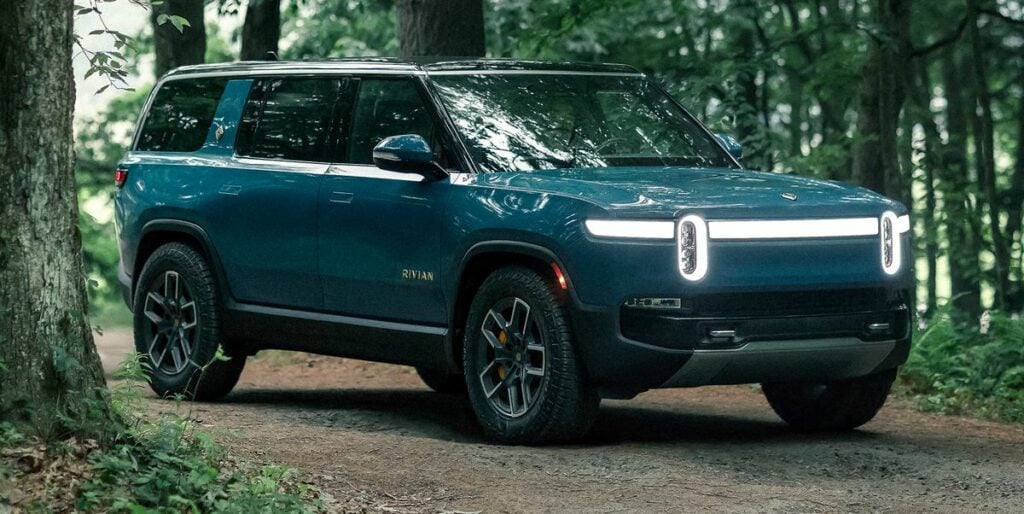
$12,000 – $15,500 in combined lease savings
For Labor Day deal season, Rivian is offering an Endless Adventure Bonus, and an Electric Refresh offer. For eligible vehicles and buyers, these offers can compliment the $7,500 EV lease credit, which ends in September.
See offer details at Rivian.com
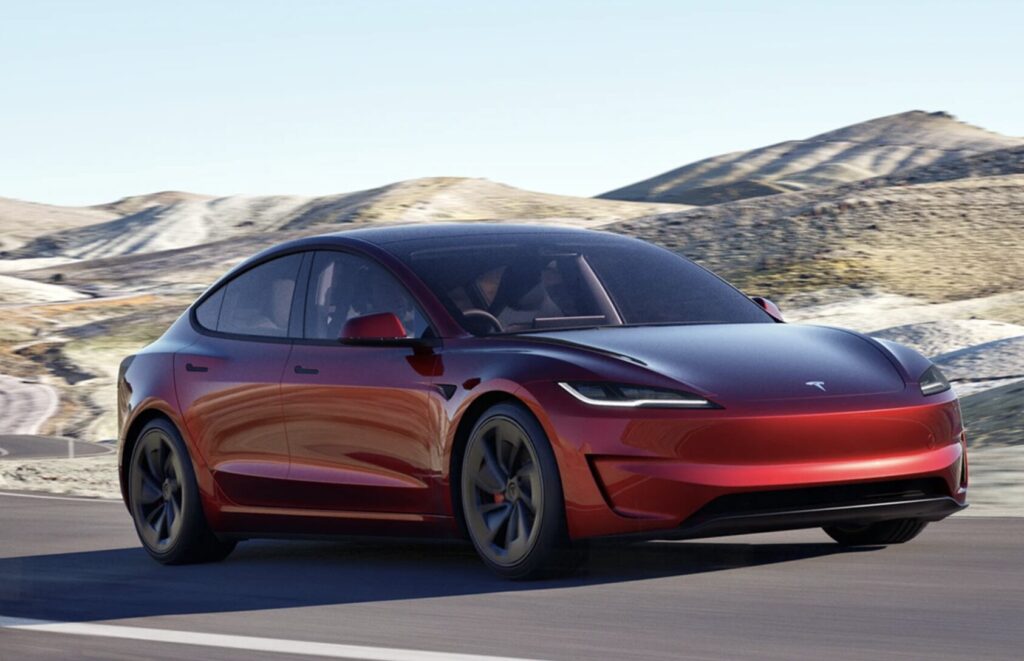
Lease the 2025 Tesla Model 3 rear-wheel drive for $299/month for 36 months with $3,000 due at signing.
See offer details at Tesla.com

Lease the 2025 Volvo XC40 Core Bright for $409/month for 36 months, $2,689 due at signing.
See offer details, and view Volvo listings
A few times each year, luxury cars become a little more attainable for millions of drivers as incentives spike. Labor Day 2025 is one of those times. From lease specials with surprisingly low monthly payments to 0% APR financing, August and September will be your best shot at a deal until December.
Most of these luxury lease deals expire on September 2, 2025. We’ll update this page with the new deals that arrive following Labor Day.
Don’t go it alone. Shop prepared with market data on your side, made possible by CarEdge Pro. Or better yet, let CarEdge Concierge handle the hard part: finding the right car and negotiating the best terms, so you can focus on enjoying the drive.
Let us know how we can help!
CarEdge is a trusted resource for car buyers, offering data-backed insights, negotiation tools, and expert guidance to help consumers save time and money. Since 2019, CarEdge has helped hundreds of thousands of drivers navigate the car-buying process with confidence. Learn more at CarEdge.com.