
CarEdge saved me over 4,500 dollars on a brand new Honda Pilot. I can't say thank you enough.
Price intelligence
Find a wide range of vehicle listings with market insights on new and used listings near you.

What can I do with CarEdge?
 CarEdge Insights
What can I do with CarEdge?
Get access to exclusive information so you can make an informed car buying decision — all in one place.

Find a wide range of vehicle listings with market insights on new and used listings near you.
Track your vehicle’s value and cash in when the time is right to sell.

Access to our proprietary data to help you find the right car, at the right price. Find these unlocked on every listing after subscribing.

With our expert-led, tech-enabled car buying service, we will locate, negotiate, and deliver your vehicle so you can get a new car hassle free.


Help us personalize your CarEdge experience — it only takes a second.
Your answers help us personalize your CarEdge journey — we’ll follow up with tips and next steps that match your buying timeline.
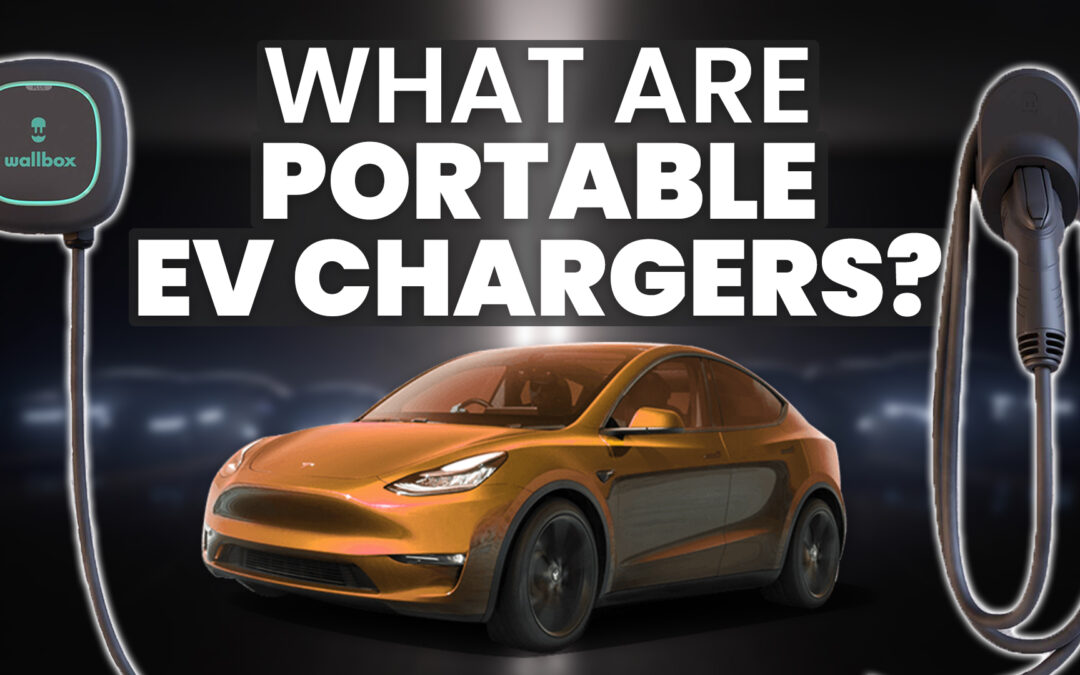
You’ve just bought your first EV, and now you’ve come down with a severe case of range anxiety. What’s the remedy? You could conservatively plan for charging stops (and charge at home), or shell out thousands of dollars for a suitcase-sized portable battery. Portable electric car chargers are coming to market in 2022. How much do portable EV chargers cost, and are they even worth the money? Here’s where things stand today.
When combustion-powered vehicles run out of gas, it’s rarely more than an inconvenience. When an electric vehicle crawls to a stop on the highway, it’s a bigger problem. What if the only charger around is 50 miles down the road? Fortunately, charging an EV is getting easier in America, but range anxiety is a reality for many rural EV drivers and road trippers in 2022.
A portable electric vehicle car charger is an emergency power reserve about the size of a small suitcase that can serve as a portable supply of electricity when there’s no public charger nearby. Basically, a portable EV charger is a big battery with bi-directional capability. It can draw power from the grid, but it can also send power to your car.
Are portable chargers available? Kinda sorta. You could buy your own portable charger (for a few thousand dollars), or you could subscribe to a service that offers on-demand portable charging as a service. However, it isn’t cheap. In fact, far from it. These are the options on the market in 2022, and how much you’ll have to fork over for one.
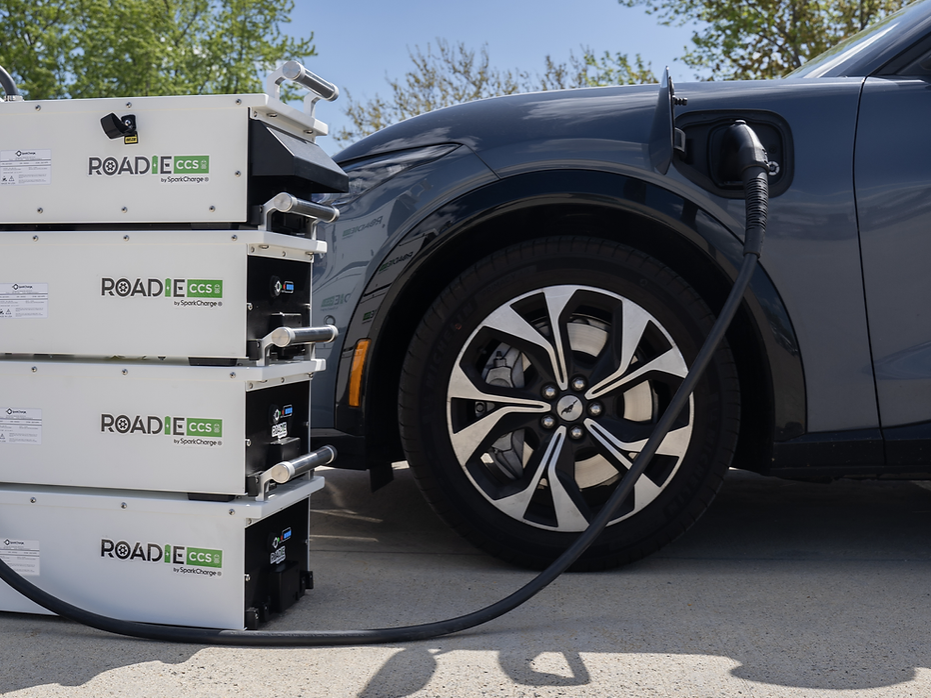
This new company out of Somerville, Mass. is determined to make owning an EV easier. As Forbes noted recently, think of SparkCharge as the “UberEats or DoorDash of electric vehicle charging.” SparkCharge is a service provider that will show up with their portable batteries (affectionately called ‘Roadies’) to deliver a charge when called upon. The service can be accessed through a subscription-based app called Currently. A service vehicle arrives promptly and begins charging. Currently, SparkCharge’s Currently is only available in Dallas, San Francisco, San Jose and Los Angeles. Learn more here.
Size: Doesn’t matter, SparkCharge comes to you! The Roadie is about the size of a standard suitcase.
Weight: Battery = 73 lbs, charger is 51 lbs
Power capacity: 3.5 kilowatt-hours of usable power. However, the batteries are stackable on a rolling cart, so you can multiply that by three or four to get up to 14 kWh of usable power for charging. That’s a lot more than some competitors offer.
Power output: 20 kilowatts
Miles of range added: “One mile of range added per minute,” or a four-stack of Roadie batteries can add 60-70 miles to a single vehicle (in about an hour) or dispense 10 miles of range to seven different EVs.
Price: This is charging as a service (CaaS) at its finest. Here are the subscription options: The Volt subscription costs $25 per month, which covers two charges, each of which comes with a delivery fee of $9.99. The Jolt plan costs $60 for four charges and a $5.99 delivery fee. The Bolt plan is $80 per month for six charges, plus $5.99 delivery. Learn more about SparkCharge here.
The verdict: As EV adoption accelerates, charging as a service will grow as an industry. While today’s charging providers are limited by the energy density of their battery technology, the future’s looking brighter. If you live in a metro area where SparkCharge is offering service, it may be worth considering. If you do, let us know!
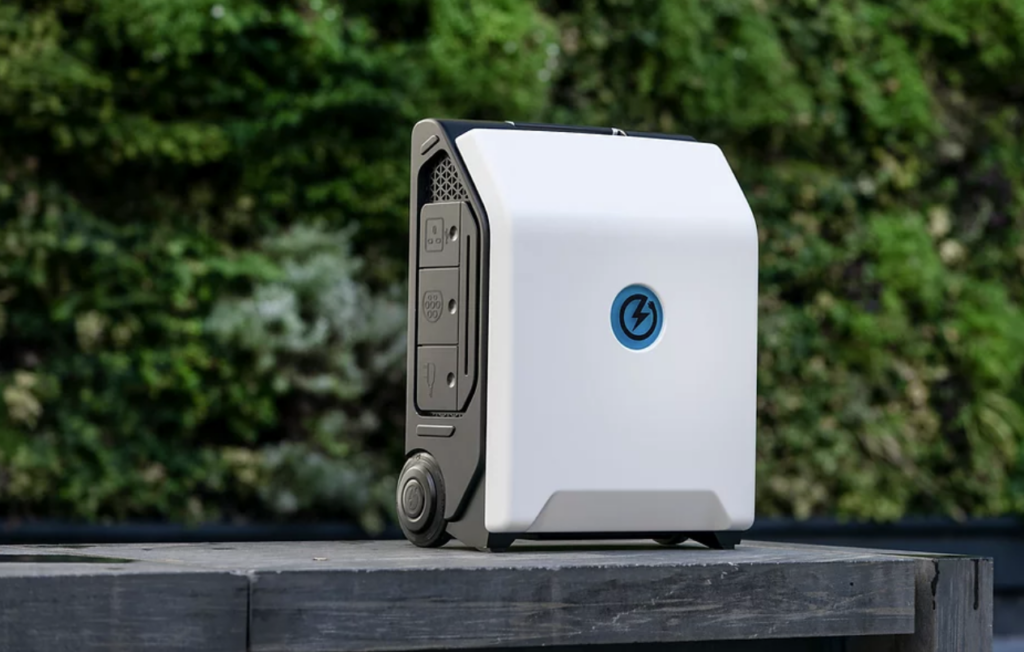
ZipCharge is a new startup out of Britain that promises to bring portable EV chargers to market this year. With wheels on the bottom and a retractable handle (just like a suitcase), the ZipCharge Go is compact, but don’t expect it to get you very far.
Size: About the dimensions of a small suitcase
Weight: ~50 pounds
Power capacity: 4 or 8 kilowatt-hour capacity options
Power output: 7.2 kW of power
Miles of range added: 20 to 40 miles in 30 minutes to one hour
Price: Expected to start around $2,000.
The verdict: Just 20 to 40 miles of emergency range for two grand? I think being smart about planning charging stops is a much smarter route to take for EV drivers.
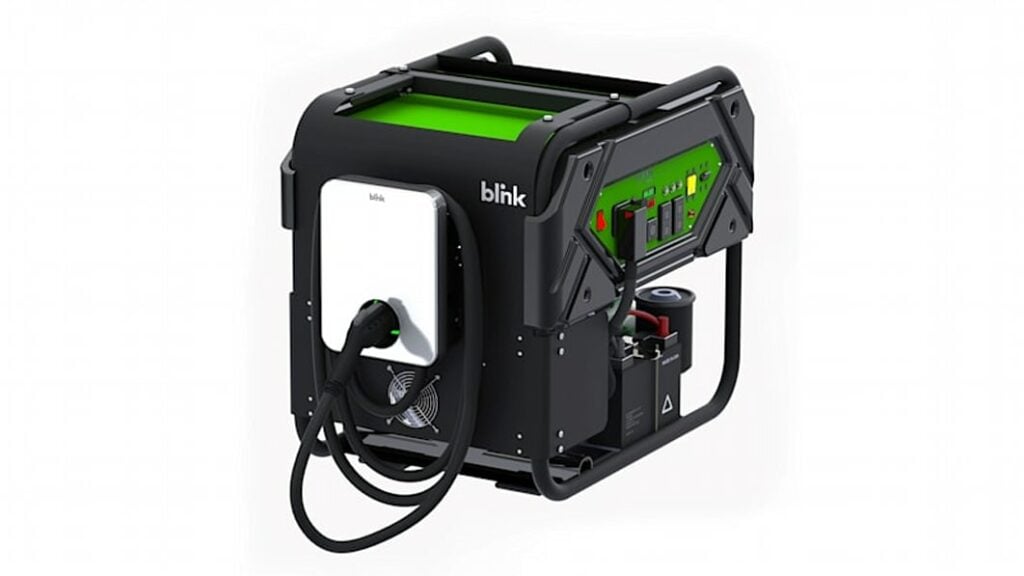
Well-known EV charging company Blink has introduced a portable unit that can be yours for a pretty penny. The Blink portable charger can at up to one mile of range per minute. Blink will sell two versions: one networked for Blink subscribers and one without a network connection so roadside-assistance companies can add the charger to their list of services. Learn more about the Blink portable charger here.
Size: The size of a medium-sized generator
Weight: 350 lbs (this alone would drastically lower driving range)
Power capacity: unknown
Power output: 9.6 kW
Miles of range added: Up to 1 mile of charge per minute
Price: $6,500. Yes, that’s a LOT of money.
The verdict: Unless you’re a fleet manager responsible for a dozen EVs, I don’t see the value of this costly portable charger for the everyday EV driver.
What it all comes down to is an emerging industry divided into subscription-based AAA-like services, and pricey suitcase-sized batteries that can be hauled around to provide an answer to range anxiety. Consider this: adding one mile of range per minute might be worth it when public fast chargers are much more common and widespread. If you know there’s a fast charger 10 miles down the road and you’re stranded at 0%, waiting for enough charge to make it there would be a no-brainer.
But what if the nearest charger is 50 miles away? Or 100 miles away? In most cases, you’ll need a tow truck. Charging as a service will pair nicely with a growing fast-charger network nationwide, but until then, city dwellers are likely to be the only EV drivers to benefit. EV charging networks are making big plans for growth, and billions of dollars are being funneled to states for more charging stations.
The smart thing to do is to simply plan your charging stops before you hit the road, at least until there are more chargers available. A Better Route Planner and PlugShare are the best EV trip planning tools out there. I’ve driven 11,000 miles in my EV without every dropping below 5% state of charge. All it takes is some minor planning and thoughtfulness.
We’ll keep an eye on this new option for electric car drivers. Things are changing at lightning speed.
States just announced their massive EV charging proposals. We’ve gathered every state’s EV charging plans in one spot.
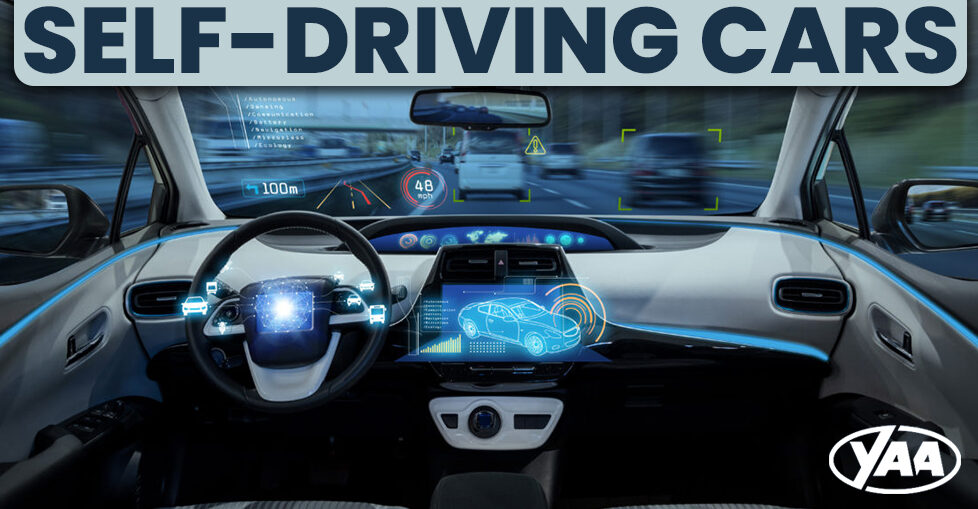
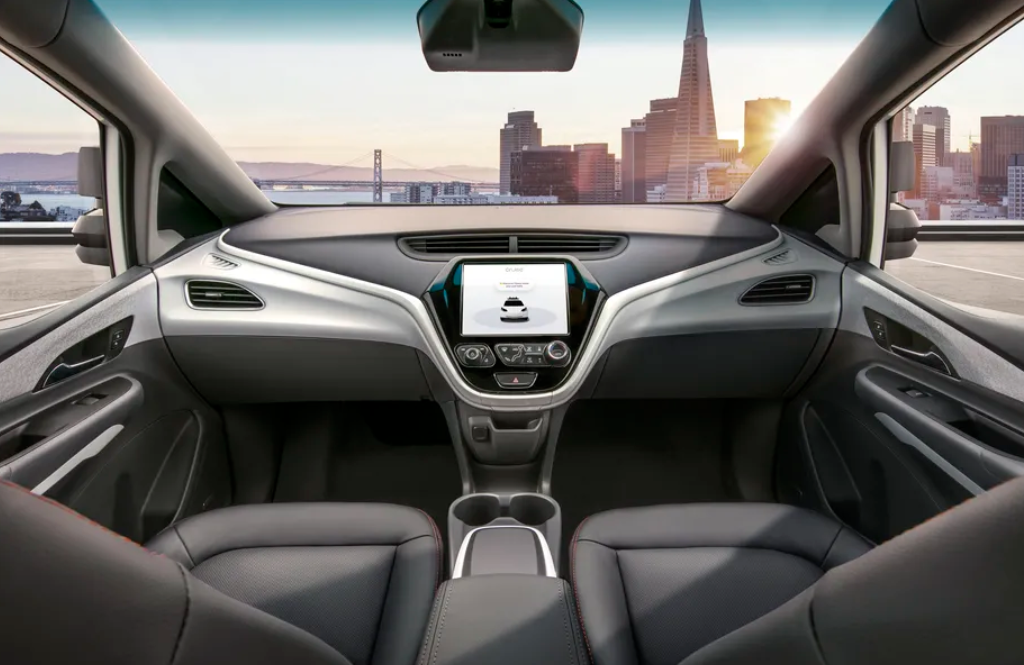
Have you ever seen a driverless vehicle? Not a Tesla, but a moving car, truck or SUV without anyone in the driver’s seat? True self-driving cars are less than a decade away, and key players have established a new industry that’s on the verge of spilling out into the mainstream. Legacy automakers are investing billions of dollars into emerging AI startups focused on driverless tech. These are the big names in autonomous driving, and the automakers they’re teaming up with.
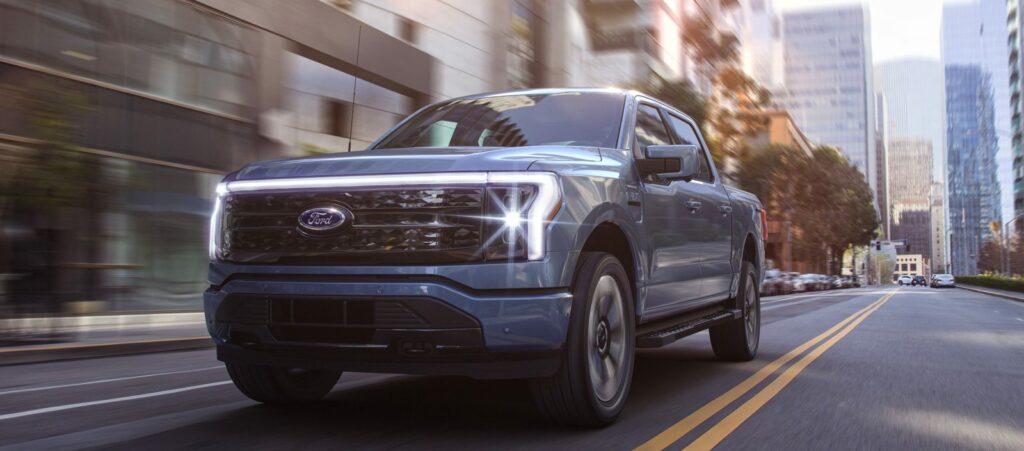
Argo is a Pittsburgh based tech company that is making a name for itself as a leader of autonomous driving technology that is relatively close to mass adoption. Argo has partnerships with Ford, Volkswagen, Walmart and Lyft. The Argo Self-Driving System is already undergoing testing with Ford and Volkswagen vehicles.
Argo’s weakness is more likely a tradeoff that engineers at Argo were willing to accept in exchange for higher probability of success in the near future. And it seems to be working well for them. Argo Self-Driving works on roadways that are intricately mapped beforehand so that the system knows about street-level conditions and safety precautions.
In conjunction with an all-of-the-above sensor approach (LiDAR, radar and cameras), Argo Self-Driving is designed to drive like an experienced driver, but only in certain areas. The benefit of this approach is that it’s much more realistic in the near-term, despite its limited use case.
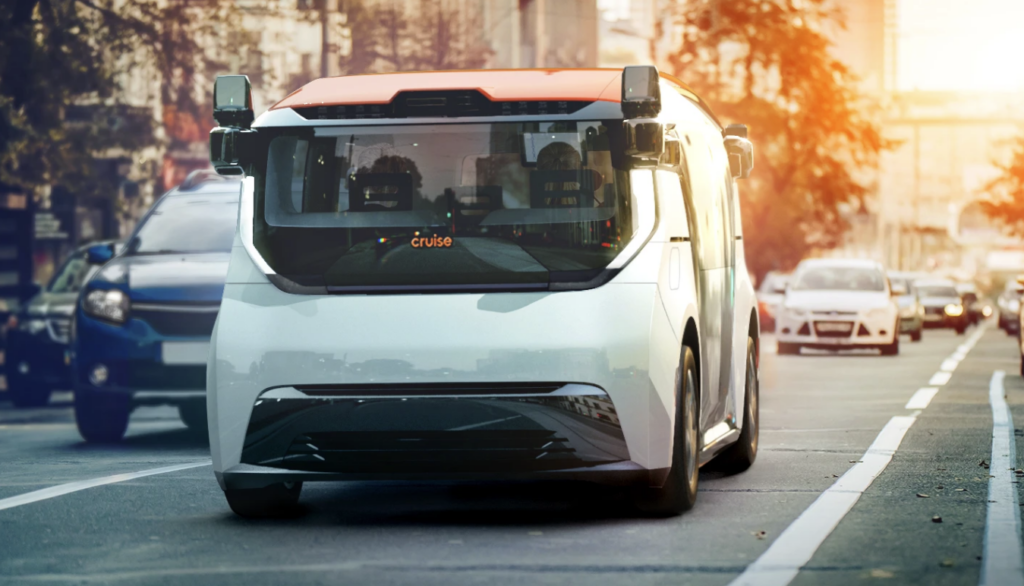
The first generation Cruise Autonomous Vehicle exists on a modified version of the Chevrolet Bolt. That’s because General Motors bought the Cruise startup back in 2016. Rest assured that the next milestone for this promising company is the launch of the Cruise Origin, a driverless pod without a steering wheel. In January of 2021, Honda announced a partnership with Cruise to bring the Origin to Japan. GM announced that the Cruise will begin production in Detroit in 2023. Cruise will certainly be competing head-to-head with Zoox and others with eerily similar product roadmaps.
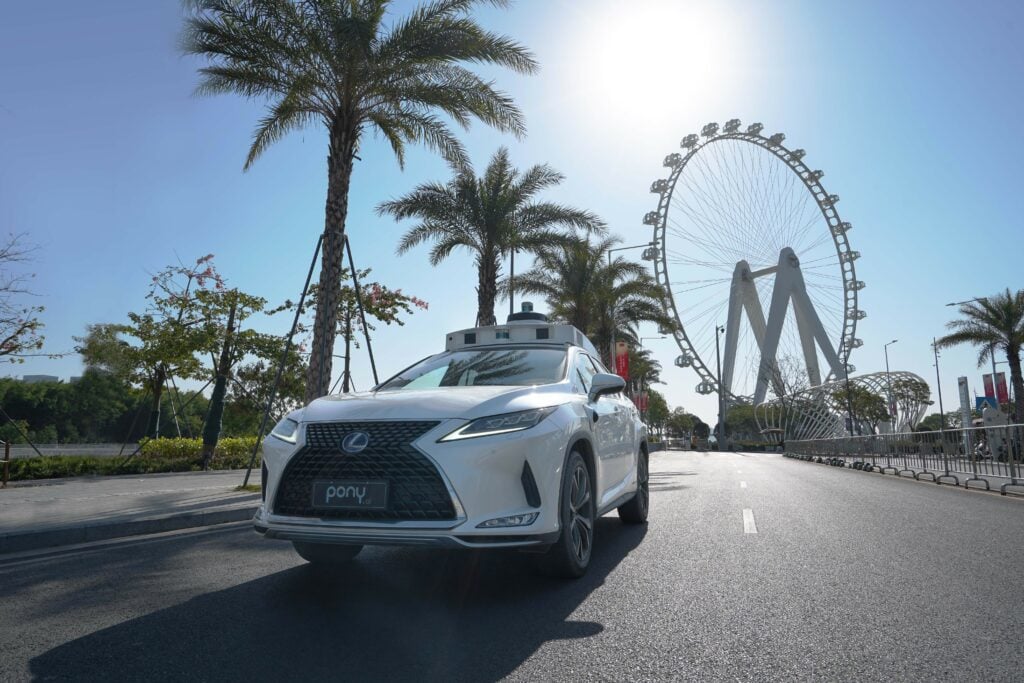
With millions of kilometers of testing completed and a data-driven approach, Pony.AI is playing the long game in autonomous driving. That’s not stopping them from getting off to a strong start. Pony.ai was the first to launch a robo taxi service in 2018, allowing passengers to hail self-driving cars in Guangzhou, Beijing, Irvine, CA, and Fremont, CA. In February 2020, Toyota invested $400 million in the company.
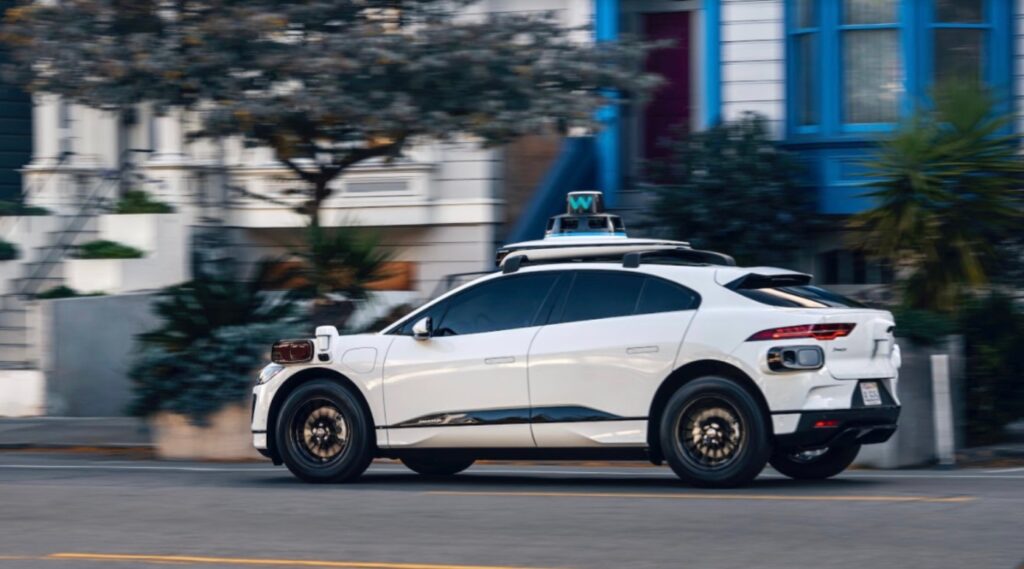
Formerly the Google Self-Driving car project, Waymo is off to a great start with their sensor-loaded approach to autonomous driving. Google started their self-driving research in 2009 back when optimism about near-future autonomy was peaking. Now, Waymo continues as a subsidiary of Alphabet, Google’s parent company.
In 2022, Waymo currently operates ride-hailing driverless vehicles in the Phoenix area, and testing has started in San Francisco and New York. Waymo equips vehicles with a suite of sensors that help the autonomous system paint a picture of the environment around the car at all times. It’s not perfect, but riders say it’s impressive and improving. Interestingly, not all of the vehicles equipped with autonomous driving are fully-electric. Driverless Chrysler vans are a common sight in Phoenix.
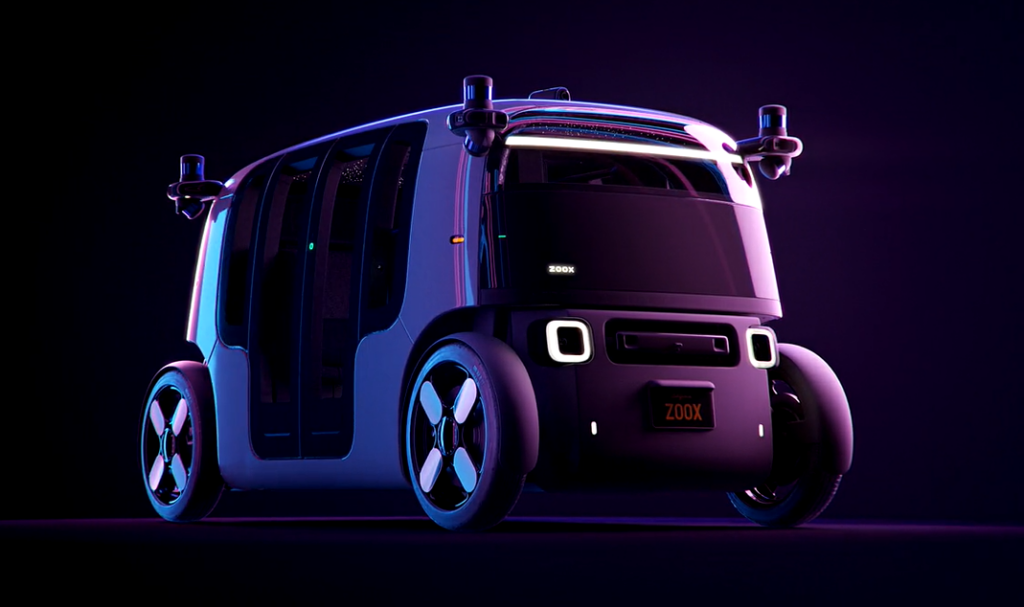
Zoox, a recent subsidiary of Amazon, has the goal of providing enjoyable mobility-as-a-service in dense urban environments. Basically, autonomous ride-hailing. Zoox handles the driving, charging, maintenance, and upgrades for their vehicles. It’s like an autonomous taxi, sort of like Waymo. The rider will simply pay for the service. The Zoox vehicle is a passenger-focused capsule designed in-house. We’ll be hearing more about Zoox autonomous vehicles.
The global autonomous vehicle market was valued at $76.13 billion in 2020, and is projected to reach $2 trillion by 2030. Legacy automakers like GM, Ford, Stellantis and Volkswagen are banking on partnerships with AI startups to leapfrog into a future where driverless vehicles are safe, affordable and accessible. How will the likes of Tesla, Lucid, Rivian, and other newcomers innovate and adapt to the changes to come? Time will tell.
Want to know more? Here’s every automaker’s plan for autonomous driving investments.
Buying a Car? Share Your Experience With Others
Getting ready to buy? See how dealers near you have been treating customers at CarEdge Dealer Reviews. When you make a vehicle purchase, don’t forget to share your experience with the CarEdge family. All submissions are vetted by the CarEdge team. Together, we can transform the car buying experience.
We recently shared five affordable electric cars to buy in 2022. “Affordable” only goes so far in today’s auto market, and not a single top pick lists for under $35,000. With battery and charging advancements around every corner, leasing is a great way to keep up with the pace of technology without having to purchase a new car. All things considered, these are the 5 best electric cars to lease in 2022.
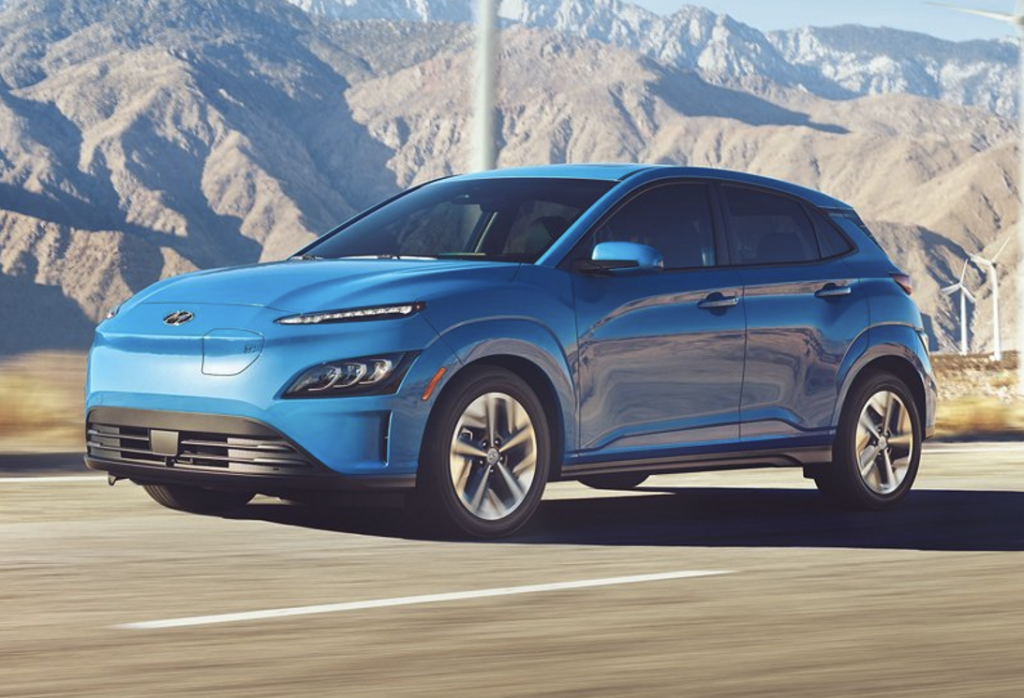
The often overlooked Hyundai Kona EV was the Korean automaker’s electric flagship years before the fancy new IONIQ 5 stole the show. When it comes down to numbers, the Kona EV is a great value. We featured it in our recent CarEdge list of the best affordable electric cars.
This front-wheel drive subcompact crossover gets 258 miles on the charge, exceptional range for a budget EV. Some owners get over 275 miles on a single charge. If you plug in at home, charging to 100% from a 240-volt dryer outlet will only take you about 9 hours from 10% state of charge. That will get you a full battery overnight while you’re sleeping. At a DC fast charger, the Kona is behind the competition. In 47 minutes, the Kona Electric charges from 10% to 80% capacity. For perspective, the new Hyundai IONIQ 5 can do the same in 18 minutes, but it costs nearly twice as much.
You can lease the Hyundai Kona EV for just $259 /mo with $3,699 due at lease signing for 36 months and 10,000 miles of driving allowance per year. If this is your price range, the Chevy Bolt, Nissan Leaf, and the Kona’s cousin the e-Niro are the only other options. You can’t go wrong with the Kona at this price point.
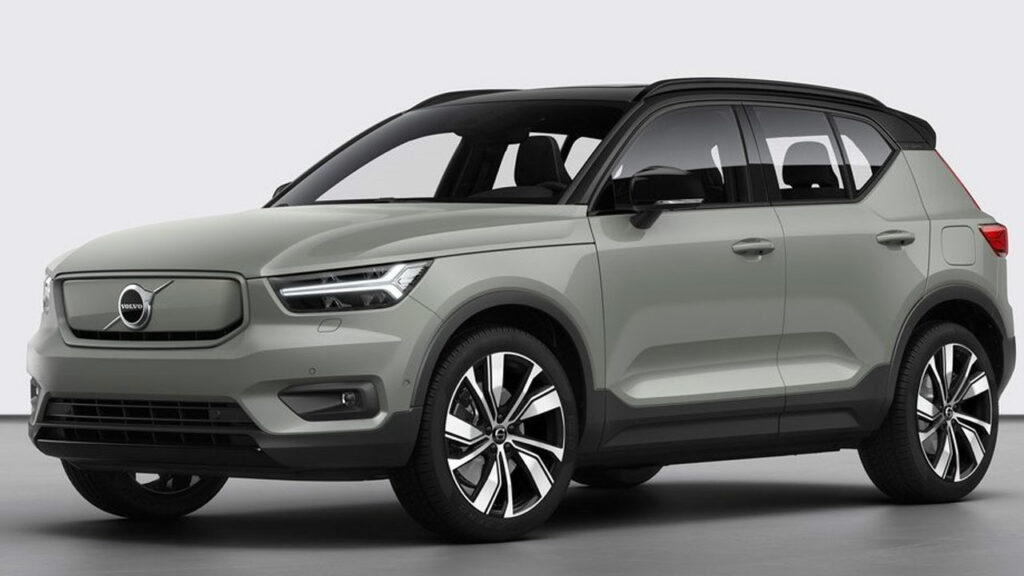
Volvo and sibling Polestar are ramping up their commitment to electrification. The Volvo XC40 Recharge (pure electric) has been the darling of auto reviewers time and time again. Test drivers share a common theme: the XC40 Recharge is a lot more fun to drive than they had expected.
It may look like a family car, but this electric Volvo can launch to 60 mph in just 4.7 seconds as it puts down power via dual electric motors. With 223 miles of range on a charge and up to 150 kW charging speeds at a public fast charger, the XC40 Recharge is just about average for an electric car in 2022. It IS a solid road-tripper, unlike some other options on this list.
Infotainment runs on Google’s Android Auto operating system, much like the popular Polestar 2. An upscale cabin adorned with the elegant and dark-themed interior we’ve come to expect from Volvo features plenty of hidden storage and generous room in the back seat. This electric crossover feels a lot larger than it really is.
Leasing the XC40 Recharge is available for $540 a month with $3,500 down, and 10,000 miles of annual driving allowance. If you’re looking for a peppy electric crossover with a Scandinavian flair, Volvo’s XC40 Recharge just might be the one.
Learn more about the 2022 XC40 Recharge here.
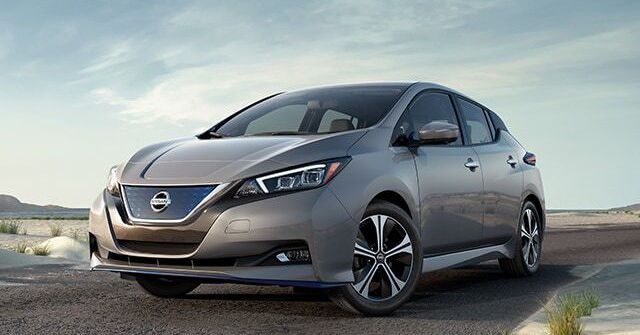
If you’re shopping on a tight budget, don’t overlook the original posterchild of EVs, the Nissan Leaf. A few years before Tesla’s sales ballooned into EV domination, the Leaf was leading electric car sales in America. Why did it fall out of favor? It looks like an appliance, drives like an appliance, can’t make it very far on a charge, and charges slower than most of the competition. But it’s cheap!
With those complaints aside, the Nissan Leaf is still a solid choice for a lease in 2022. We can only recommend the Leaf in the extended range, faster charging versions. That would be the Plus models, which are rated for up to 226 miles on a charge, and can charge at 100 kW charging speeds at a DC fast charger equipped with the CHAdeMO adapter.
The Leaf is not recommended for frequent long-distance travelers. It’s just too much of a pain to stop so frequently and charge for a whole hour once every 180 miles. But for everyone else, the Leaf is a great electric car for around town. Plus, it still qualifies for the EV tax credit.
As of April, the 2022 Nissan Leaf is available for $179 per month for 36 months with $4,179 due at signing. It’s important to note that Nissan keeps the EV tax credit when you lease a Leaf. Regardless, that’s as cheap as it gets to lease a new EV in 2022.
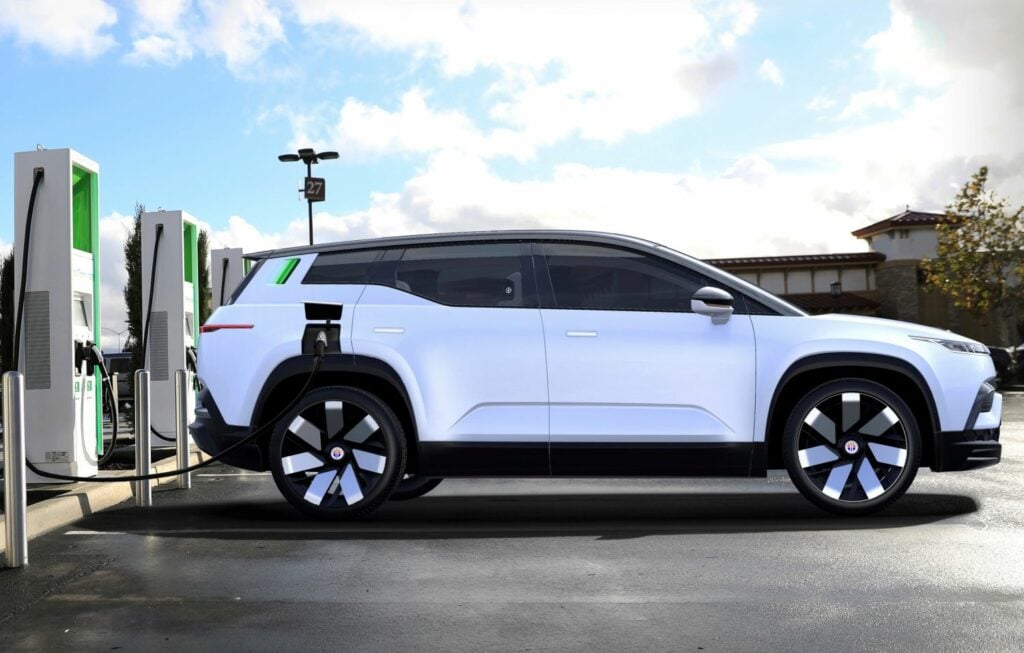
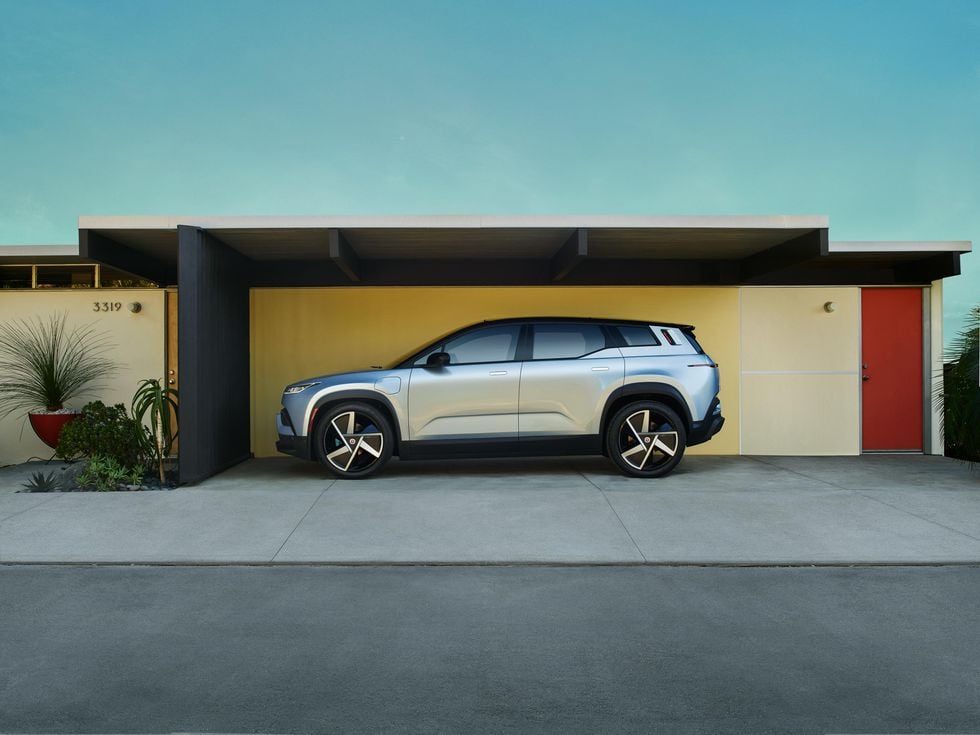
At a time when the average transaction price for a new car is approaching $50,000, a sub-$40,000 electric crossover sounds too good to be true. The Fisker Ocean introduces rare value in the crowded EV segment. We recently shared an in-depth review of the Fisker Ocean.
For just $379 per month, you can lease a Fisker Ocean SUV with the new Fisker Flexee Lease offer. Fisker says that they believe electric vehicles should be affordable to all, and this is how they’re going to try to get there.
With a Fisker Flexee Lease, there are no term limits and you can cancel at any time. It’s basically a long-term rental that appears to be worry-free. After twelve years of leased driving, Fisker will retire and recycle the electric SUV. The Fisker Flexee Lease requires an initial payment of $2,999, and it includes up to 30,000 miles per year. Maintenance is covered.
The Fisker Ocean will be available in very limited quantities late this year. It won’t be until 2023 or even 2024 that a Fisker lease will be easy to come by. Nevertheless, keep it on your radar!

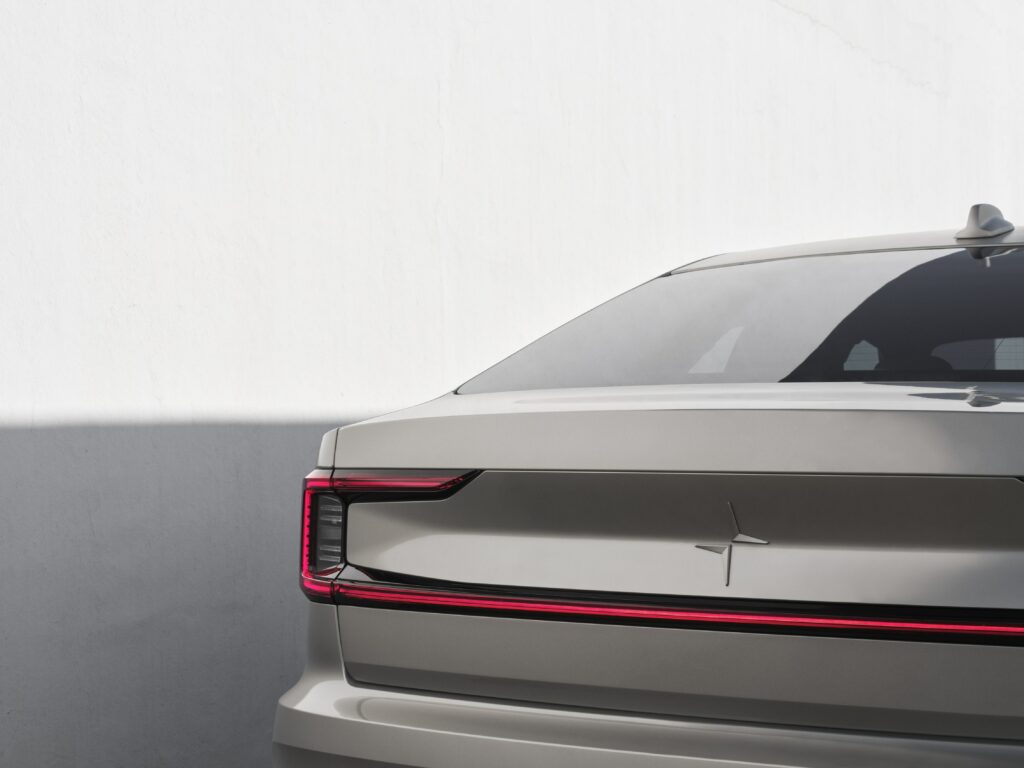
When Volvo acquired Polestar in 2015, the Swedish brand was known for high-performance sports cars. A short time later, Volvo reimagined Polestar as an all-electric brand that mixes performance and luxury in a very Scandinavian fashion. Today, the Polestar 2 is one of the most sought after electric cars in America. Here’s why drivers are falling in love with Polestar’s take on affordable luxury.
The Polestar 2 exudes its kinship with Volvo from every angle, yet the Polestar brand has managed to take on its own identity among EV enthusiasts. With origins in Swedish racing, Polestar is synonymous with style and performance, at least in Europe. In North America, Polestar is unknown to most, however one headline-grabbing Super Bowl commercial improved the brand’s name recognition in the US.
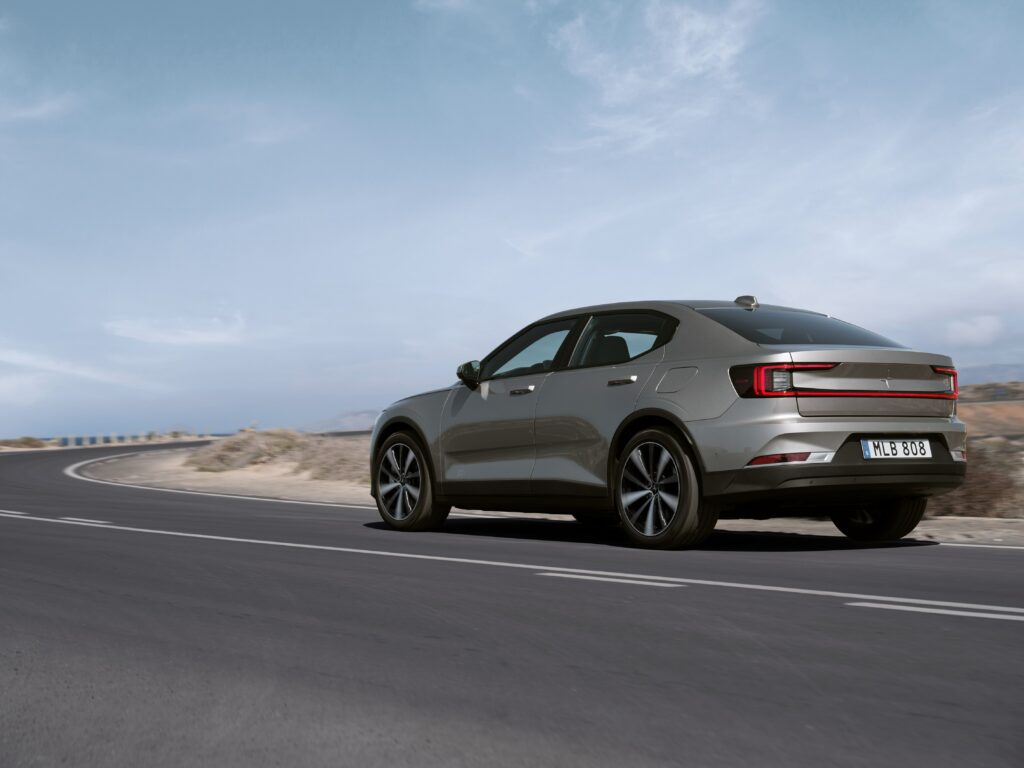
On the exterior, the Polestar 2 is defined by sharp angles and a slightly elevated posture. Volvo-like headlights and taillights leave no guessing as to the design language. With a ground clearance of 5.9 inches and an overall height of 59 inches, the Polestar 2 is a few inches taller than the Model 3. It’s no crossover, but it provides room to grow that many other electric sedans lack.
Behind the back seat, there’s 14.3 cubic feet of cargo space. That may not sound like a lot, but the trunk is accessible via a hatchback-like power liftgate. That’s one serious advantage over the Tesla Model 3. Up front, there’s a little frunk with 1.2 cubic feet of storage space.
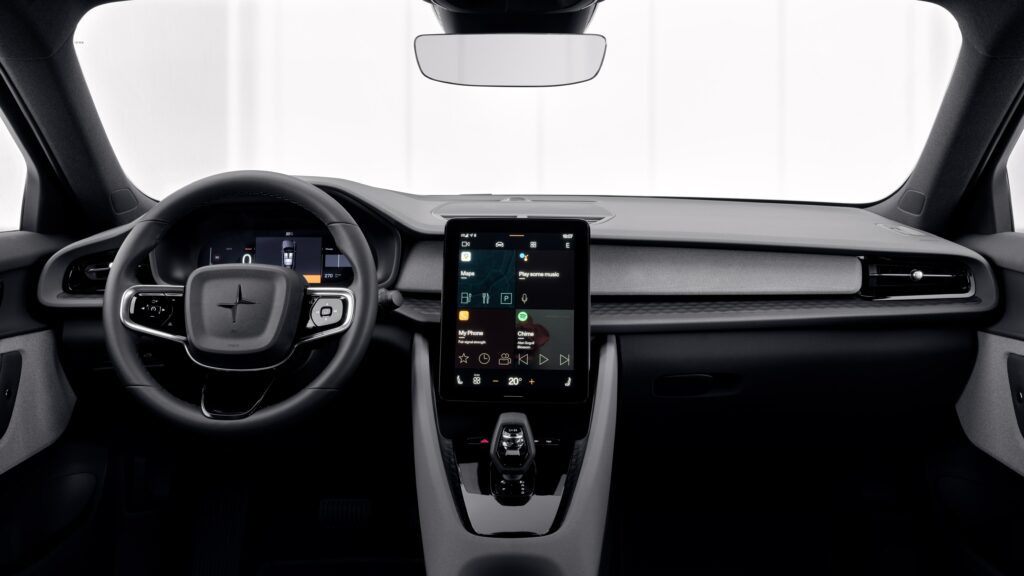
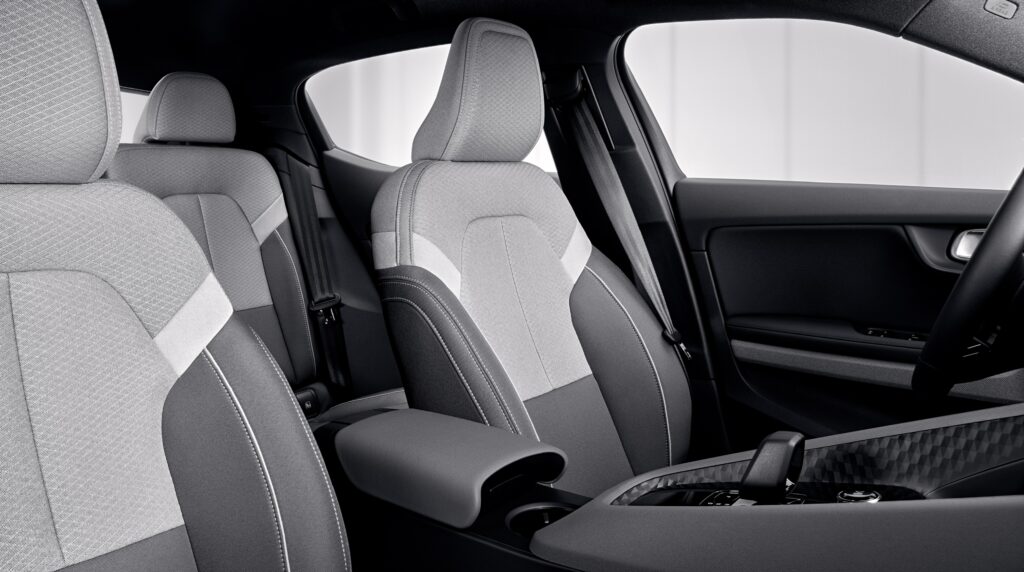
The Polestar 2’s interior is carefully crafted with eco-friendly accents and fabrics. The main touch points and sight areas are a fusion of wood, fabric, and conservative use of plastic. If you’ve seen the interior of any recent Volvo model, you already have an idea of what the Polestar 2 offers. If anything, the Polestar’s interior breathes minimalism into the Volvo family. Seating is offered in sustainably-sourced cloth upholstery or leather. The performance package throws in polarizing gold seatbelts to brighten up an otherwise dark interior.
If you’re a fan of the Android operating system, Polestar has a treat for you. The digital instrument cluster is presented on a 12-inch horizontal display in front of the driver. Infotainment and climate controls are found on a centrally-located 11.3-inch touchscreen that operates on Google’s Android Automotive operating system. Google Maps is seamlessly integrated into the Polestar 2’s navigation system, and apps are displayed much as they are on any Android phone.
Going electric comes with tradeoffs. Range is still king, at least until DC fast chargers become commonplace in America. Rarely does an electric car offer the best range AND performance on the same spec. That remains true for the Polestar 2.
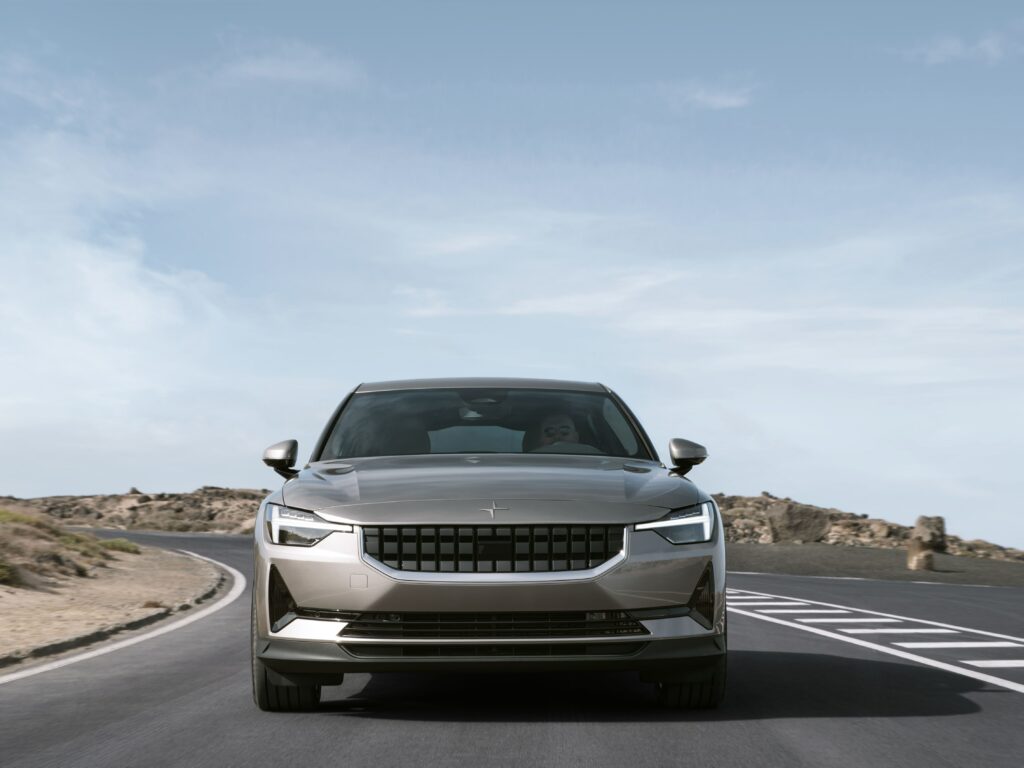
If you foresee the need for maximum range, the single-motor variant is rated for 270 miles. Range comes at the expense of power. The single-motor Polestar 2 cranks out 231 horsepower, which is good for a 0-60 time of around 7 seconds. Speed enthusiasts will be inclined to go for the 408 horsepower all-wheel drive (dual-motor) option. The dual-motor Polestar 2 leaps to 60 mph in just 4.4 seconds, which is just a hair ‘slower’ than the dual-motor Model 3. The performance package drops that to 4.1 seconds.
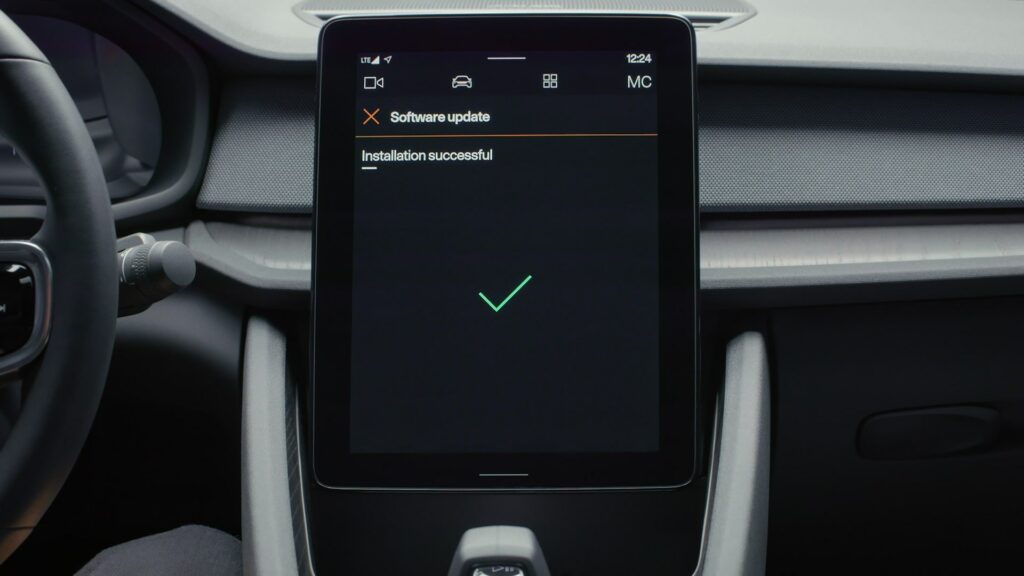
You know what Tesla has that other automakers don’t? A superior charging network, a vertically-integrated platform, and seamless over-the-air (OTA) updates. Other OEMs are catching up slowly but surely. Now, Polestar can tout OTA update capability. An OTA update will increase the dual-motor Polestar 2’s horsepower from 408 to 476 HP and torque from 487 to 502 lb-ft. All that’s needed for an OTA update is a secure wireless internet connection.
The Polestar 2 is powered by Volvo’s electric Compact Modular Architecture (CMA). A 78.0-kWh lithium-ion battery pack (75 kWh usable) lies under the floor. The single-motor model has a range of 270 miles, and the dual-motor variant should make it 249 miles on a single charge. Real-world tests have found that highway driving cuts range considerably. Car and Driver’s 75 mpg highway test yielded just 190 miles of range. For comparison, the dual-motor Tesla Model 3 managed 310 miles at 70 mph.
Charging is not one of the Polestar 2’s strengths, at least compared to the major competitors. The powertrain supports DC fast-charging up to 150 kilowatts. That’s similar to the Ford Mustang Mach-E and Volkswagen ID.4, but slower than what you’ll get in a Model 3, IONIQ 5 or Kia EV6. Polestar claims a charge time from empty to 80 percent in 40 minutes.
Polestar is providing 2 years of free charging sessions (for 30 minutes per session) to new and existing 2021 and 2022 Polestar 2 customers. For those who travel plenty, this could add up to thousands of dollars saved. Tesla no longer offers a free charging incentive, so keep this in mind in addition to the EV tax incentive.
Polestar 2 pricing starts at $47,200 including the $1,300 delivery charge. Upgrading to the dual-motor Polestar 2 will tack on $4,000 for a price of $51,200. The performance pack adds performance brakes, suspension upgrades, performance tires and gold (yes, gold) seat belts for an additional $5,000. The $4,000 plus package adds a heat pump for improved cold weather range, and a long list of luxury upgrades. The $3,200 Pilot package includes upgraded driver assistance tech and better LED headlights.
A fully-loaded Polestar 2 will total up to about $70,000 before taxes. Polestar sells direct to consumers (much like Tesla), so don’t expect any negotiating or surprise dealer fees.
Yes! All automakers who have not yet reached the 200,000-sale milestone continue to qualify for the $7,500 EV tax credit. Tesla and General Motors electric vehicles no longer qualify, but revisions to the tax credit are under discussion in 2022. Until Polestar grows their sales numbers considerably, their electric models will continue to qualify for this incentive in the US. State incentives may provide additional ways of lowering the total cost of ownership for the Polestar 2.
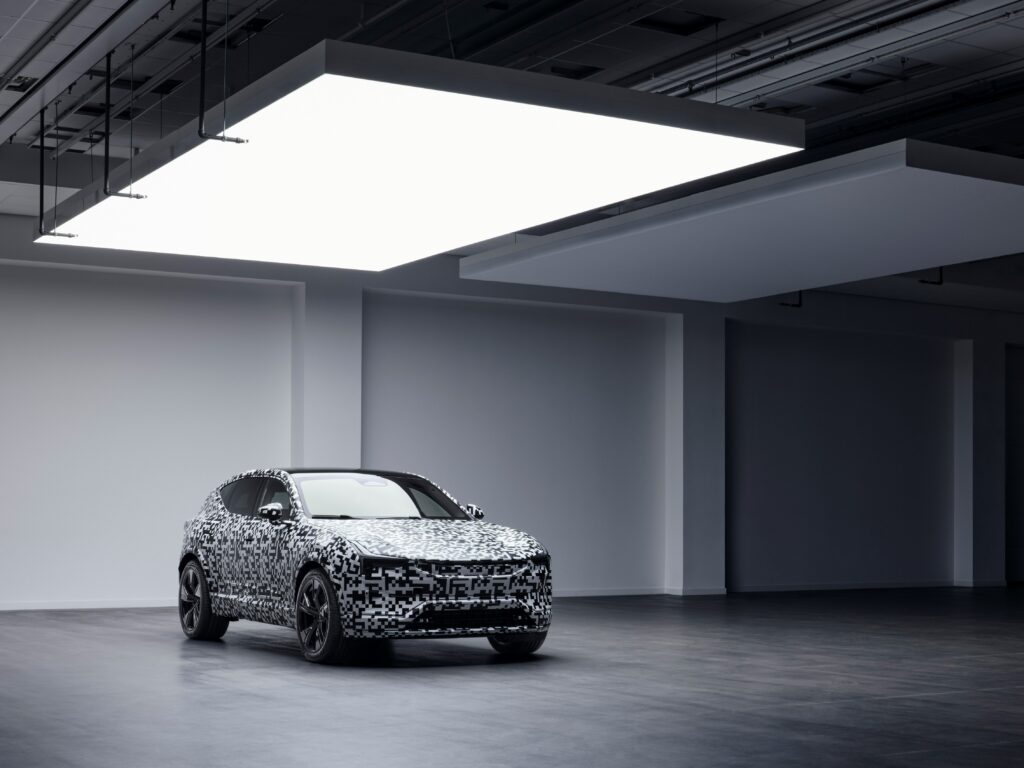
The Polestar 3 electric crossover SUV should arrive in the North American market in the first quarter of 2023. Volvo will make the 3 in America at Volvo’s South Carolina production plant. Polestar has not released many details about the 3, but it is expected to start around $60,000 to $70,000 considering the base MSRPs of the Tesla Model Y, BMX iX, and others.
The electric vehicle space is heating up, and Volvo’s Polestar brand is going full steam ahead. The Polestar 2 represents a compelling alternative to the best-selling Tesla Model 3. Will Swedish sophistication and sharp looks be enough to propel Polestar into the list of top EV contenders? Time will tell.

November 2022 Update
In a huge win for consumers, the FTC announced that it is sending checks to 66,355 customers who were harmed by Napleton’s junk fees and discriminatory practices. The payments total $9.8 million. The FTC says that the payouts will average $147 each. Learn more about the FTC’s Napleton payments in the official announcement.
Original story:
The FTC and the State of Illinois have announced legal action against a large, multi-state dealer group. In a press release issued by the Federal Trade Commission on April 1, both the FTC and the Illinois Attorney General alleged that Napleton dealerships (also known as North American Automotive Services) stuffed junk fees and unwanted add-ons onto vehicle purchases in particularly misleading ways. The legal complaint also cites discriminatory practices against Black customers.
According to the complaint, Napleton’s eight dealerships in Illinois, Florida, Pennsylvania, and Missouri consistently engaged in deceptive practices. The complaint alleges that the eight dealerships would force car buyers to wait through an hours-long negotiation process, only to sneak junk fees for add-on products and services into consumers’ purchase contracts.
“These junk fees were often added despite consumers specifically declining the add-ons or having confirmed prices that did not include the add-ons. In other cases, the consumers were falsely told the add-ons were free or were a requirement to purchase or finance their vehicle,” the complaint states.
A survey found that 83% of buyers from the Napleton dealerships were charged junk fees for add-ons without authorization or as a result of deception. One consumer cited in the complaint reported that the dealership added nearly $4,000 in add-on fees, but only after he’d paid a similar amount in down payment.
The complaint also alleges that the Napleton dealerships discriminated against Black consumers in connection with financing vehicle purchases. Napleton employees had wide latitude to increase the cost of a consumer’s loan by increasing the amount paid in interest or adding add-ons to the final contract.
The FTC complaint also alleges that Black customers at the Napleton dealerships were charged approximately $190 more in interest and paid $99 more for similar add-ons than similarly situated non-Latino White customers. Dealers typically have the ability to increase (or decrease) interest rates in a sale due to captive lending, however the discriminatory practices alleged at Napleton are revealing.
The Federal Trade Commission files a complaint when it has “reason to believe that the named defendants are violating or are about to violate the law and it appears to the Commission that a proceeding is in the public interest. Stipulated final orders have the force of law when approved and signed by the District Court judge.”
The defendants in the case are:
Napleton Auto will pay $10 Million in damages and fines, a record amount for a dealership settlement.
Under the terms of the proposed settlement with the FTC and the State of Illinois, $9.95 million of the $10 million judgment will be used to provide relief to consumers, and $50,000 will be paid to the Illinois Attorney General Court Ordered and Voluntary Compliance Payment projects Fund.
The settlement will also require Napleton to establish a fair lending program that will cap the additional interest markup they can charge consumers. The settlement also requires Napleton to charge consumers only with express, informed consent, and prohibits them from misrepresenting the cost or terms to buy, lease, or finance a car, or whether a fee or charge is optional.
This is why CarEdge exists, to return confident buying to the auto industry. It’s deceptive practices like what’s been alleged at Napleton that associate misery with car buying. It’s great to see one dealer group being held accountable, but how often does this happen without consequence?
Our CarEdge members share countless stories of disappointing customer service experiences, and a few positive ones too. That’s why we recently launched CarEdge Dealer Reviews. With over 750 dealer reviews and more added every day, we’re putting the power back in the hands of the consumer. Getting ready to buy? See how dealers near you have been treating customers at CarEdge Dealer Reviews. When you make a vehicle purchase, don’t forget to share your experience with others. All submissions are vetted by the CarEdge team. Together, we can transform the car buying experience.

Auto industry analysts had predicted that US auto sales would decline by 15-18% in Q1. The supply shortage worsened in March, and the prediction was for a 36% decline in sales year-over-year. Now that March has concluded, automakers have released their performance numbers, and it’s not looking good. Here’s your one-stop resource for all automaker sales numbers for Q1 2022. Several automakers, including Ford, will release Q1 sales numbers next week. Check back for updates.
The first quarter of 2022 saw worsening sales for Ford. While total sales were down 17% year-over-year, March sales dropped 26%. Ford’s brand was down 17% in Q1, however Lincoln sales fell 25%. Among popular models, the Lincoln Navigator took the greatest hit with sales plummeting 56%. Lincoln’s sales have declined for 10 consecutive months.
It wasn’t all bad news for Ford. The average transaction price rose to $47,621, up 5.5% from Q1 of 2021. Inventory rose to 268,000 at the end of March, up from 199,000 one month prior.
Ford’s EV, plug-in hybrid and hybrid sales were up 38% in the first quarter. Sales of the Mustang Mach-E were up 1.8% for the quarter, with supply chain woes and inventory being the limiting factor.
Remember that Ford recently split into two new divisions: Ford Model e and Ford Blue. Ford Blue vice president Andrew Frick said that the automaker sees a lot of positivity in the latest sales report.
“Our newest products continue to turn at a record pace, as Bronco, Bronco Sport, Mustang Mach-E and Maverick had their best combined sales performance yet, with 33,398 vehicles sold,” Frick said.
The chip shortage has not been kind to Toyota. In Q1 of 2022, Toyota sold 514,592 vehicles in the United States. This is the second quarterly decline in a row for Toyota. Toyota’s sales numbers show that the chip shortage got worse as Q1 pressed on, with the worst result coming from March. Toyota’s U.S. sales dropped 24 percent in March to 194,178.
Lexus sales brought down Toyota of North America’s overall performance. The Toyota brand was down 23% in March and down 15% for the first quarter. Lexus fared worse, with sales down 29% for March and off 13% for the quarter.
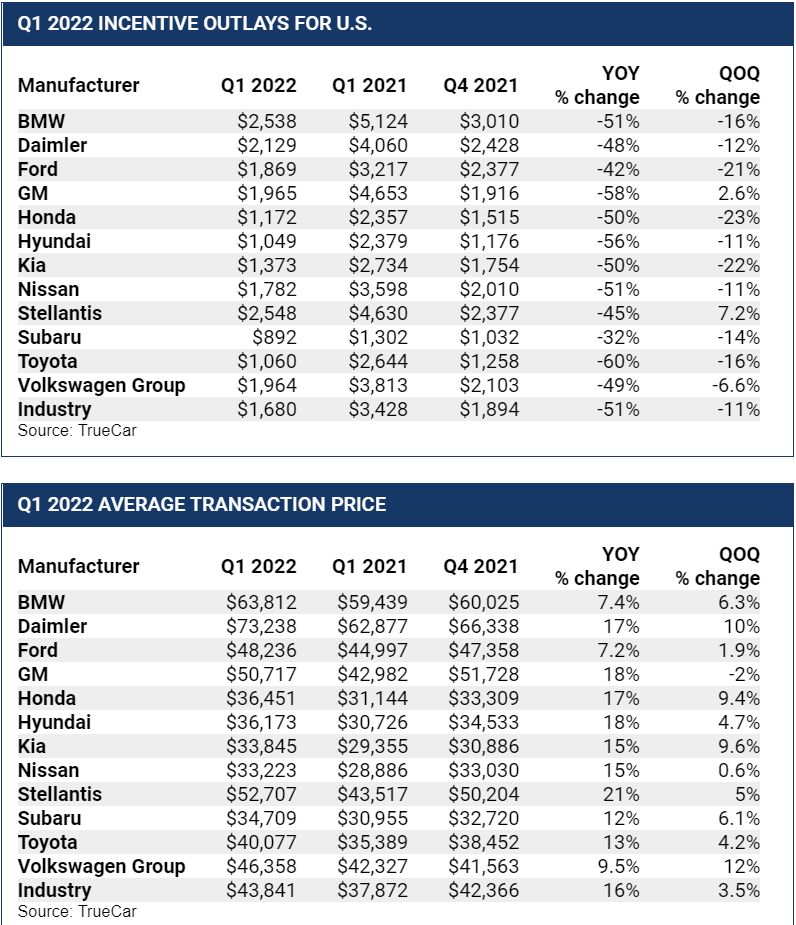
TrueCar says that Toyota’s new car incentives have been on the decline for some time. In Q1, the average incentive was $1,060 per vehicle, down 60% from Q1 of last year.
Toyota’s new car inventory sits at 120,479, which translates to a 17-day supply. March was Toyota’s eighth consecutive month of sales declines.
In 2021, Nissan’s U.S. sales were down 8.7% as the chip shortage worsened. Today’s Q1 2022 sales numbers show that Nissan has given up a lot of momentum. Nissan’s Q1 2022 sales were 201,081 vehicles, down 30% versus a year earlier. Between the two brands, Nissan sales dropped 29%, and Infiniti sales plummeted 41% compared to one year prior.
AutoForecast Solutions says that in North America alone, Nissan lost roughly 228,000 vehicles from production schedules in 2021 because of the chip shortage.
Nissan of North America executive Judy Wheeler told automotive news that they had underestimated the magnitude of the supply shortage in 2022. “Production will continue to get better, but I don’t think it’s going to get back to normal, frankly, until 2023,” Wheeler said. “It’s going to take longer than what we originally expected.”
Hyundai of North America’s U.S. sales look wonderful compared to the competition. In Q1 of 2022, Hyundai’s total U.S. sales were down 4% from a year prior. Hyundai delivered 159,676 vehicles to American consumers between January and the end of March.
Hyundai is proud of their March sales performance, with good numbers all around. According to today’s quarterly sales report, Hyundai sold 59,380 vehicles in March, resulting in the third best March retail month ever for Hyundai. Month-over-month total sales were up 13%. Hyundai electrified vehicle retail sales grew 179% year over year.
Genesis sales climbed 53 percent in March compared to March of 2021.
In March, Kia delivered 59,524 new vehicles in the U.S., which is a 10.5% decrease year-over-year. For Q1, Kia sold 151,194 vehicles, which is a 5.2% decline compared to Q1 of 2021. Electrified car sales grew 55% year-over-year and reached a record level in March.
Overall, GM’s sales were down 20% in the first quarter of 2022. GM reports that 509,108 vehicles were sold in the first three months of the year. GM’s brands all posted declines in Q1. Chevrolet declined 20%, GMC declined 7.5%, Buick was down 58%, and Cadillac sales were down 24% year-over-year. The average transaction price at GM was $50,717 in the first quarter, down 2% since Q4 2021, but up 18% year-over-year.
Toyota surpassed General Motors in total U.S. sales by just 5,484 vehicles.
Stellantis (which includes Jeep, Chrysler, Dodge, Ram, Fiat, Maserati, Alfa Romeo and several European brands) sold 405,221 vehicles in the first quarter of 2022. Overall, total U.S. sales for the first quarter declined 14%.
All of Stellantis’ brands declined year-over-year.
Jeep says that the Jeep Wrangler 4xe is now the best-selling plug-in vehicle in the U.S. Almost one out of every five Wranglers sold last quarter were plug-in hybrids.
In the United States, Honda’s total sales were down 23% in the first quarter YoY. American sales settled at 266,418 vehicles in Q1. Honda and Acura’s car and truck sales were down between 20% and 27% compared to last year. On the bright side, American Honda says that March was their best overall sales month since August of 2021.
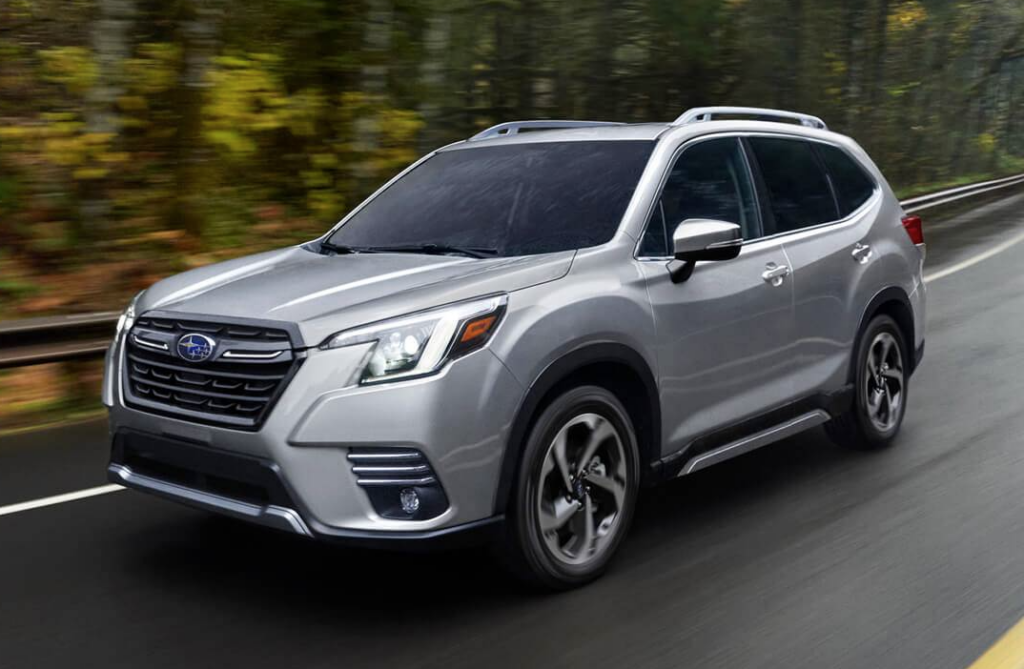
In March, Subaru sales were down 34% YoY, and Q1 sales slid 18% versus a year earlier. Subaru sold 132,346 vehicles in the first quarter. In a press release, Subaru cited the severity of the supply and chip shortage for the dismal sales numbers. Year-to-date sales of the popular Subaru Forester are down -34.3% YoY, and the Outback was down 20.6%. Sales of the Crosstrek, BRZ and Ascent were all up last quarter.
Analysts at J.D. Power and LMC say that auto incentives are set to reach an all-time low of $1,044 in March, a 69% drop year-over-year. Across all brands, the average transaction price in the first quarter is expected to be $44,129, an 18% increase from Q1 of 2021.
It’s not looking good for automakers. The demand is certainly there, but the ongoing supply shortage just keeps dragging on. The war in Ukraine and even an earthquake have added insult to injury for automakers in 2022. It appears that several automakers are beginning to recognize the reality we live in – sales are likely to remain suppressed until 2023. It’s more important than ever to play it smart when buying a car. Be sure to join the CarEdge Community, where auto experts help you make smart decisions to save time, hassle, and money.


Buying from a dealership can be a stressful, painful experience in 2023. If you’re on the hunt for a good deal, chances are you have experienced this frustration firsthand.
What if there was a way to rate and review car dealers so that buyers can cut through the clutter (and rip-offs) and reward honest, fair dealers with their business? The CarEdge team saw the need for a one-stop shop for dealer reviews, so we made it a reality. We’re thrilled to introduce CarEdge Dealer Reviews.
With thousands of dealer and deal reviews and counting, consumers are eager to have their voices heard, and even more determined to help others navigate today’s hectic car buying process.
When submitting your own dealer rating, CarEdge’s Dealer Reviews will ask basic questions about the vehicle you’ve purchased. In addition to sharing the make and model of your new auto, you can tell the world if the dealer is charging above MSRP, requiring dealer add-ons, and simply treating customers with respect and good business practices.
With your contributions, we hope that CarEdge Dealer Reviews will help car buyers feel in control of their next vehicle purchase.

At CarEdge, we value honesty and transparency. There’s no room for ‘sponsored reviews’ or hidden agendas, we all know there’s an abundance of misleading advertising already out there. That’s why CarEdge fully vets every dealer review that is submitted. Thank you for putting your trust in CarEdge’s consumer advocates.

We make it easy for you to have your voice heard, and to make a difference in the car buying experience.
Did you have a great experience buying your car? Or maybe you’ve had a disappointing experience, and you want to warn others. Please, share your experience with the community. Add your own dealer rating today!
CarEdge Dealer Reviews takes the guesswork out of the dealership experience. Check out our growing database of dealer reviews to see the good, the bad, and the ugly! More auto dealers are added to our reviews daily.
If you’re just as excited as we are about this, consider joining the CarEdge Community to access countless car buying tips from veterans of the auto industry, as well as over 100,000 members who’ve joined together to empower the consumer and spread love for autos.

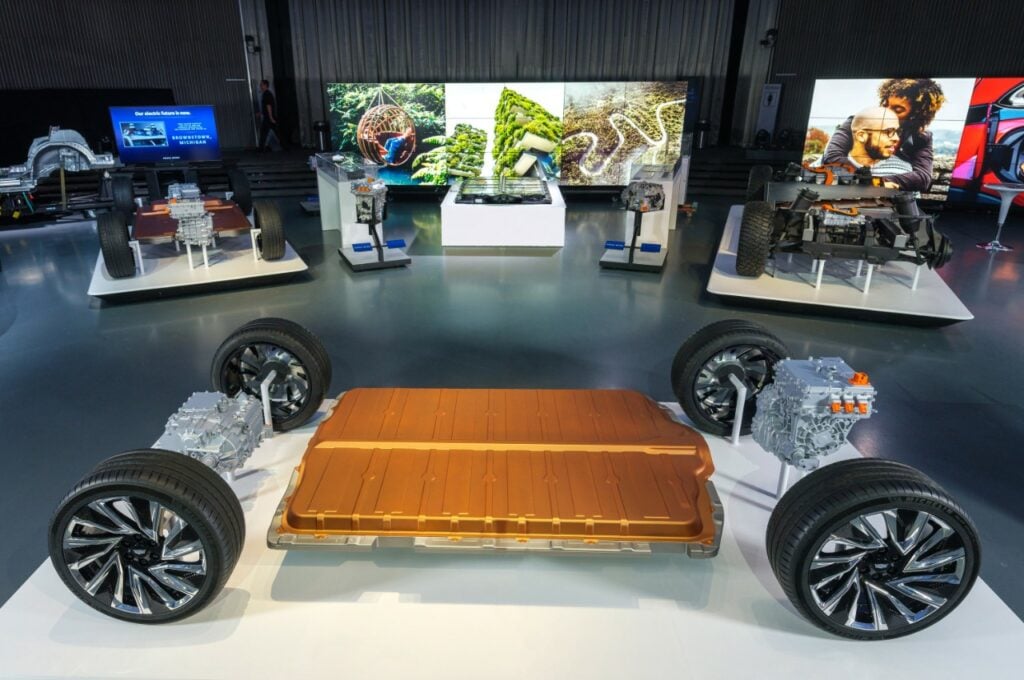
Multiple sources have told major news outlets that President Biden is days away from announcing that he will invoke the Defense Production Act to accelerate domestic production of raw materials essential for manufacturing batteries. The move comes as much of the world’s lithium, nickel, cobalt, iron and aluminum supplies remain offline due to the war in Ukraine. Will the authorization of the DPA finally bring electric cars closer to price parity? Here’s what we know so far.
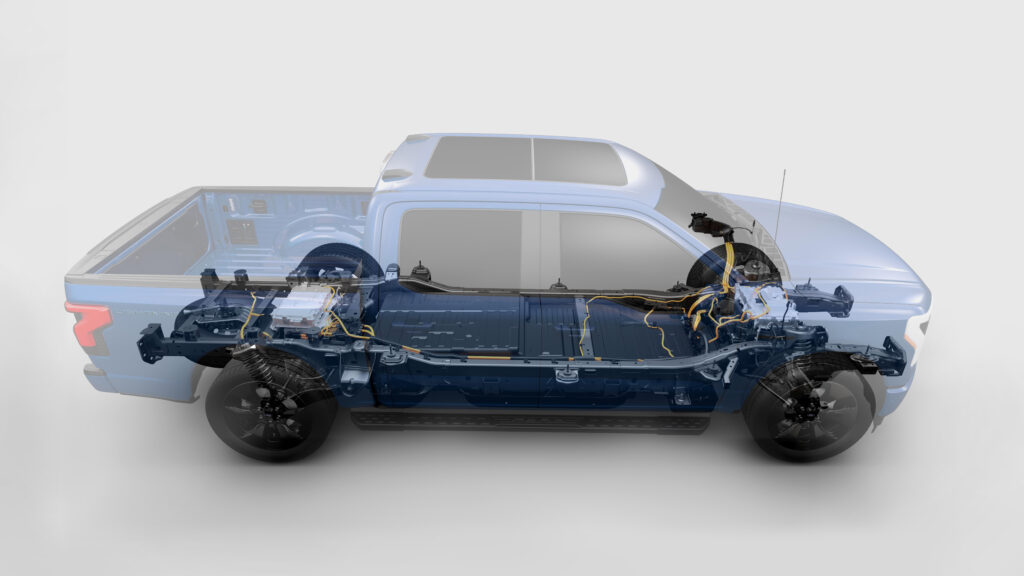
Sources say that the authorization of the Act would apply to raw materials needed to make both electric vehicle batteries and high-capacity batteries used for electric grid stability, usually in conjunction with renewable energy. Domestic energy is seeing renewed interest as reliance on unstable international relations throws a wrench in American energy stability yet again.
High-capacity batteries like the Tesla Megapack are similar in nature to EV batteries, but they require even more lithium, nickel, cobalt and iron than car batteries do simply because of the massive size and capacity. In the near future, energy experts warn that electric vehicle manufacturing and grid-scale battery production could be forced into fierce competition for limited raw material supplies. Accelerated raw material production may be the remedy that both industries need to continue growing in the 2020s.
Cobalt has fallen out of favor for battery manufacturers in recent years, not because of its effectiveness as an ingredient, but because of the dangers of cobalt mining in Africa. The DPA could bring about a resurgence in the use of cobalt, among other market changes.
This three-pronged law authorizes the president to require businesses to accept and prioritize contracts for materials deemed necessary for national defense. The law also gives the authority to establish mechanisms to allocate materials, services and facilities to promote national defense. Furthermore, the Defense Production Act authorizes the president to exert control over the economy so that critical materials are available for national defense.
The Act does specify that it can apply to the production of basic resources, such as raw materials that are important in the nation’s economy. You can read the full text of the DPA here.
The law is invoked more often than one might suspect. Past presidents have used the law’s three major sections to address matters of national security, public safety, and the economy.
Here are the the most recent uses of the Defense Production Act:
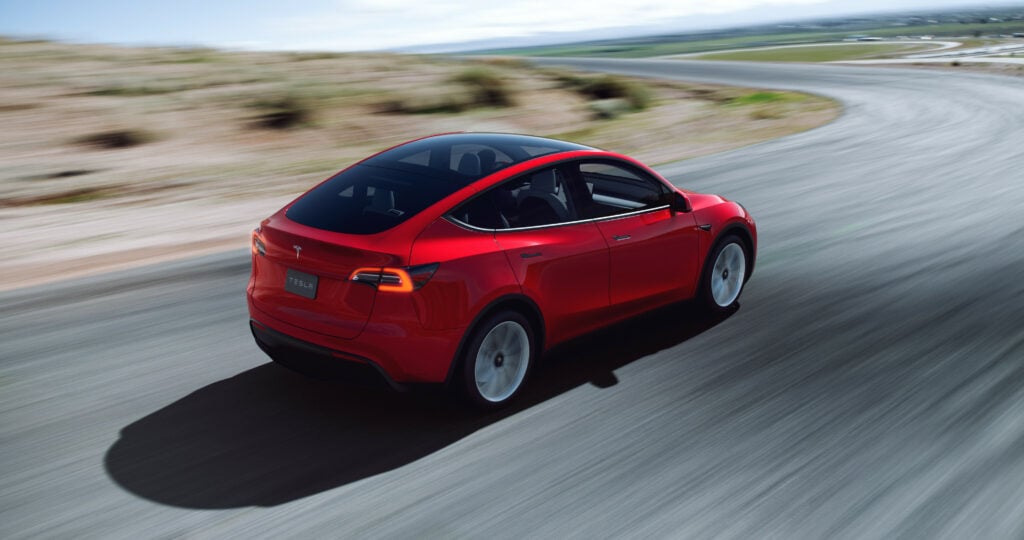
It’s certainly possible that President Biden’s use of the DPA could lower electric car prices, but don’t expect this anytime soon with current inflation and chip shortages. What’s more likely is that the additional raw material supplies will deter additional electric car price increases once nickel, lithium, cobalt and other important materials are substantially produced domestically.
Tesla recently cited nickel’s tenfold price increase when raising prices in early 2022. Raw materials are becoming the limiting factor for affordable electric cars in America and across the world, as we explained in our recent article on soaring EV prices.
For years now, electric vehicle proponents have pointed towards a not-so-distant future when electric cars reach price parity with combustion vehicles. When EVs cost the same as an equivalent gas vehicle, the masses would convert to electric mobility. As time has shown, EV price parity has been a lot harder to accomplish than many, including Elon Musk, had hoped.
The use of the Defense Production Act to spur development of American-based raw material sourcing is big news. American battery manufacturers (and EV makers) have always sourced the vast majority of their raw materials from international suppliers, many of which are based in Russia and China. As the pandemic and recent war have shown, global supply chains have their limits. In due time, EV prices may finally reach price parity if their most expensive component, the battery, becomes a lot less expensive to make.

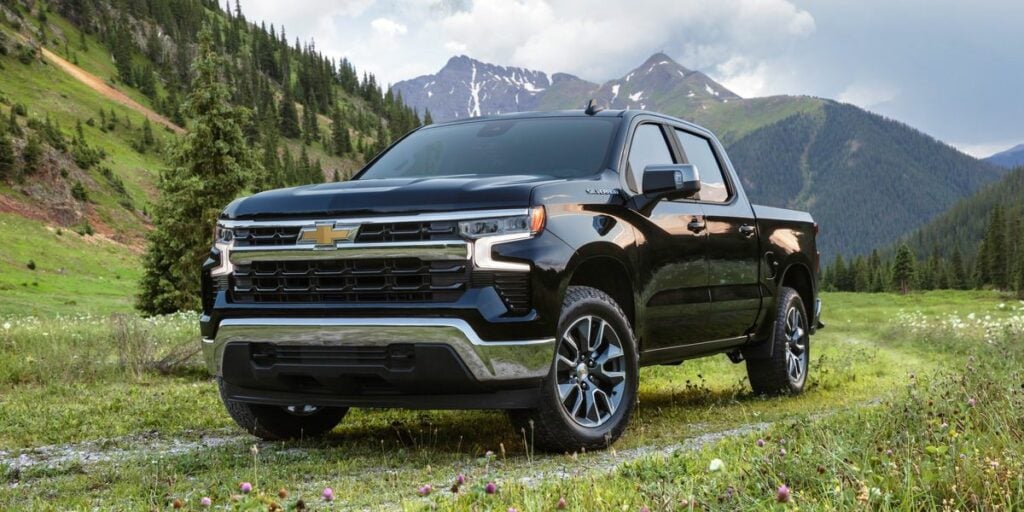
Trucks are somehow an appreciating asset in 2022. Not a single truck is getting more affordable. With inflation, supply shortages, and transportation backlogs, truck inventory remains at record lows in the US. Here’s just how much truck prices have increased in 2022.
Be sure to bookmark this page and check back for updates!
The 2022 model year Chevrolet Silverado HD has seen FOUR price increases since going on sale last year. GM Authority details the latest Silverado price increases:
“The latest price increase for the 2022 Chevy Silverado HD is a flat $1,000 for all trim levels and configurations, including both the 2022 Chevy Silverado 2500HD, and the 2022 Chevy Silverado 3500HD. The Destination Freight Charge also increased from $1,695 to $1,795. As it stands now, the least-expensive 2022 Chevy Silverado HD model is the Silverado 2500HD WT Regular Cab / Long Bed with 2WD and the 6.6L V8 L8T gasoline engine, priced at $41,295, while the most-expensive model is the Silverado 3500HD High Country Crew Cab / Long Bed DRW with 4WD and the 6.6LV8 L5P turbodiesel Duramax engine, priced at $81,345.”
See how much every variant of the Silverado 2500 and 3500 HD costs now here.
Just a few months after the first deliveries crawled out of Rivian’s factory in Normal, Illinois, the electric truck maker fumbled a sudden price increase. All trims of the Rivian R1T saw prices increase, and some specs are up by 20%. The most ‘affordable’ R1T, originally $67,500, now costs $79,500. The catch is that the base spec of the R1T is not even close to being available. Rivian produced 2,500 electric trucks in the first quarter of the year, and delivered 1,200 of them.
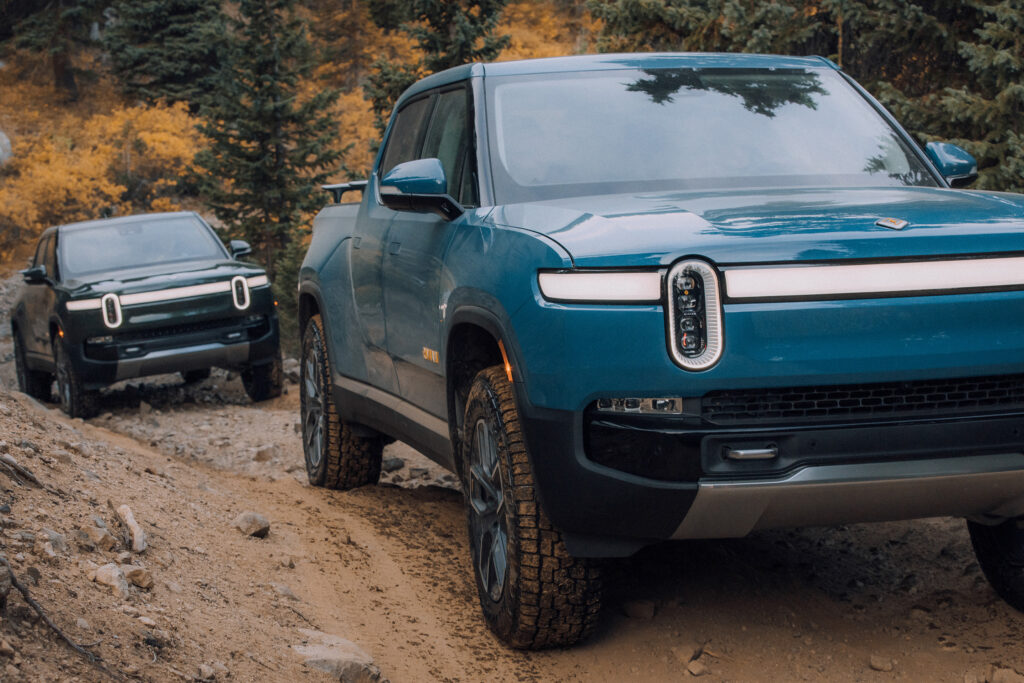
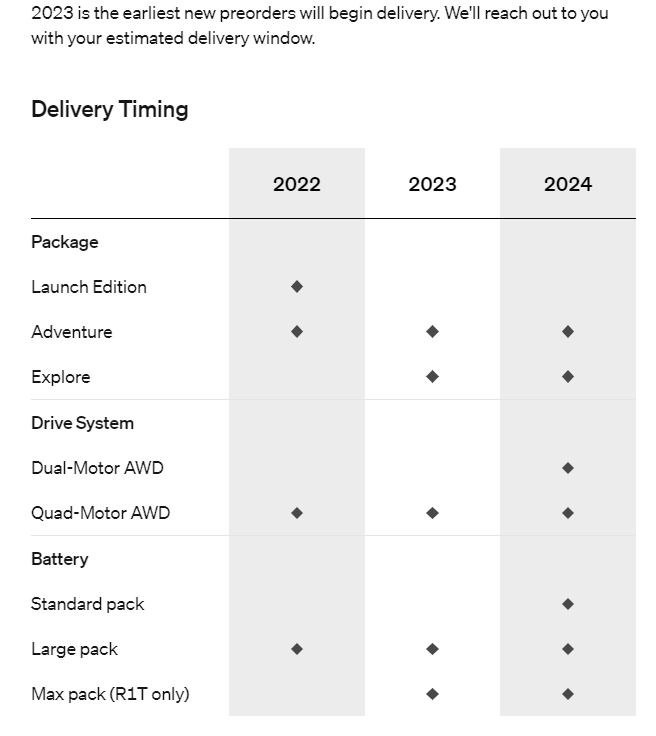
All R1Ts being delivered in 2022 are the quad-motor Adventure package with the large battery pack. If you’re lucky enough to take delivery this year, this R1T configuration costs $85,000.
This is Rivian’s delivery timeline as of Spring 2022:
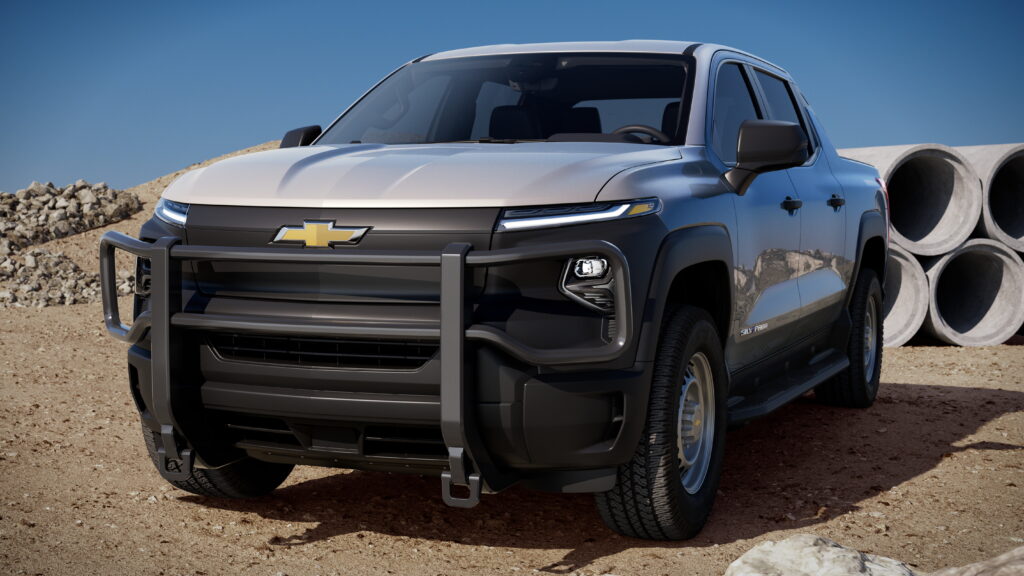
Is there any such thing as an affordable truck any more? Affordability is in the eye of the beholder, however the last few months have raised the bar even further. Here’s the latest data on truck MSRPs for base trims:
The best-selling truck in America, the Ford F-150, has seen a 2.6% increase in base MSRP since December 2021. The F-150 now starts at $29,990. The only truck to fare better (for the consumer) is the Toyota Tacoma, which has gone up 2.1% to a current MSRP of $26,700.
On the other end of the spectrum, General Motors has sent truck prices through the roof. Four months ago, a 2021 Silverado 1500 started at $29,300. A few price hikes later, the base 2022 Silverado now costs $33,800 before destination fees. That’s a staggering 15% price jump in a few short months.
GM’s massive price increases for the 2022 Silverado are especially shocking considering that GM posted record profits in 2021, despite selling 500,000 fewer vehicles than the year before.
The 2022 Nissan Titan now has a base MSRP of $38,310, up 4.8% since late last year. The Ram 1500 has seen a similar price hike, now listing for $33,975 at a minimum. Good luck finding one for MSRP.
In fact, let us know about your dealership experience, good or bad!
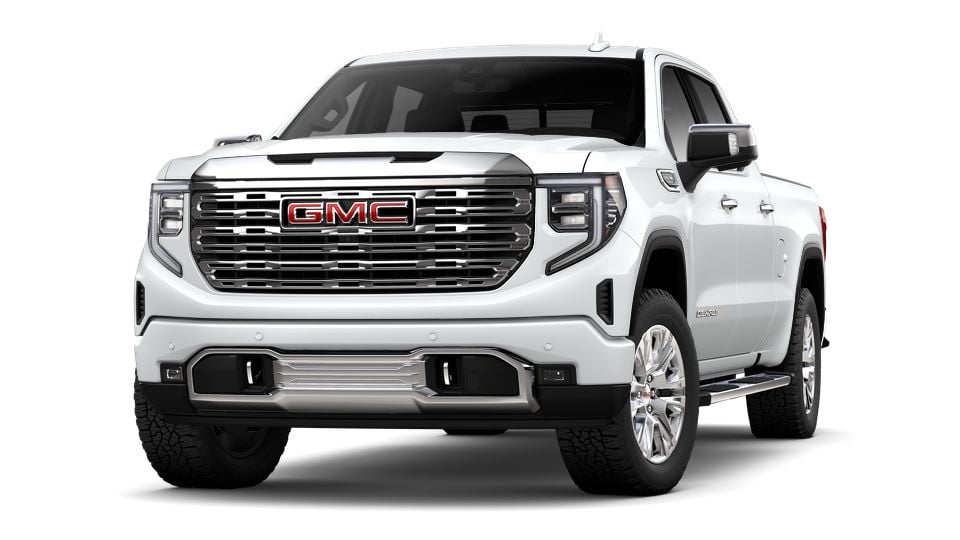
If you thought the base models were bad, wait until you see how expensive fully-loaded trucks have gotten. Check out the data for yourself:
Yes, a 2022 Ford F-150 Raptor now starts at $68,675 (over $70,000 after taxes and fees) after Ford bumped the price by 7% this year. That almost makes the F-150 Lariat look like a steal at $48,140. It’s actually Ram that takes the trophy for biggest MSRP jump in 2022. Following a 9.1% price increase, the Ram 1500 TRX now starts at $76,780. The GMC Sierra AT4X has seen the smallest price increase, but it’s still an expensive truck at an MSRP $77,395.
The short answer is no. If you’re looking to buy new, you’ll have to find a Ford Maverick, Ford Ranger, Hyundai Santa Cruz or maybe even a Tacoma at MSRP (somehow) to stay around $25,000 for a new truck. Most are far beyond $35,000 once all fees are tallied.
Bear in mind that we’re talking about MSRPs here. These are merely suggestions by the manufacturer. You know as well as I do that buying any popular vehicle at sticker price in 2022 is like finding a pot of gold at the end of the rainbow. It’s technically possible, but quite rare. And no one will believe you.
Dealer markups are one of the many novel trends of the past few pandemic years that no one’s excited about. Except for dealers of course. Jalopnik reported on six-figure Ram TRXs and Ford Mavericks going for fifty grand.
Dealers are raking in the profits every time a shopper agrees to pay over MSRP for any truck. Don’t believe me? American dealerships reported all-time record profits in 2021. You know, the year with the worst inventory shortages ever. As one dealer told me, they’re just ‘dying for inventory’. Approach dealerships with caution, truck buyers.
CarEdge Car Search Now Shows In-Transit Status!
In 2022 (and beyond), many car buyers will be shopping for vehicles that are still sailing the high seas or catching a lift from the plant to the dealership. How do you know which vehicles are in transit and which are on the lot? CarEdge’s Car Search is the only car buying search engine that shows you if a particular vehicle is in transit. Try it out for yourself!

The semiconductor chip shortage has forced General Motors to halt production of the Chevrolet Silverado and GMC Sierra during the weeks of April 4 and April 11. GM makes these high-margin models at a plant in Fort Wayne, Indiana. Dealers sold 530,000 Chevy Silverados and 249,000 GMC Sierras in 2021. Silverado sales were down 11% in 2021 compared to the year before, and Sierra sales slipped 1.6%.
GM President Mark Reuss told CNBC that chip supplies were “getting a little better” but the crisis is not over. “We’re not through this, we’re doing the best we can.” The latest CarEdge chip shortage update shows that 308,700 vehicles have been removed from North American production schedules across all manufacturers, and the pace of cancellations remains steady. In 2021, General Motors canceled nearly one million vehicles from production because of the chip shortage.
In February, GM CEO Mary Barra voiced optimism, with perhaps a hint of wishful thinking. “We’ve said the improvements in the first quarter will pull through the year. Definitely, by the second half of this year we’ll be able to get closer to full capability.” The semiconductor chip shortage shows no signs of slowing down. Asian production hubs have been rattled by more COVID shutdowns, and even earthquakes. On top of the chip shortages, the war in Ukraine is affecting European operations.
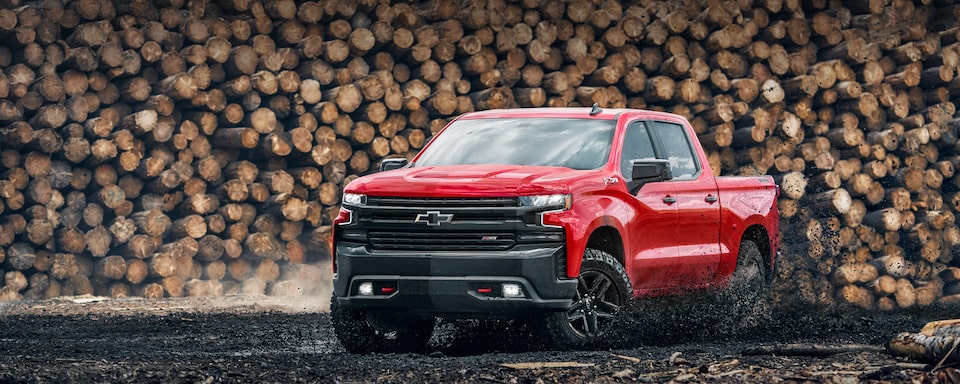
GM’s announcement of a production stop in Fort Wayne is particularly notable considering that the Sierra and Silverado are higher margin vehicles for the automaker. If these two money-making models are temporarily removed from production, the chip shortage may be worse than company executives make it seem.
There may be a chip shortage, but GM’s bank accounts are as healthy as ever. In 2021, GM’s profits surged 55% to $10 billion, an all-time high for the legacy automaker. GM’s record profits coincided with a sharp decline in sales as inventory plummeted and new car prices skyrocketed. The company sold 2.9 million vehicles in 2021, down from 3.4 million in 2020. Sales slumped so much that Toyota took the crown for most U.S. sales for the first time ever.
China has resisted calls to recognize the COVID-19 virus as an endemic illness, and China continues its zero-COVID policy at all costs. China’s ‘closed loop’ economic approach permits businesses to remain in operation, but only if all workers remain onsite. The same ‘closed loop’ policy was in place for the entirety of the 2022 Winter Olympics in Beijing.
GM’s partnership with Chinese state-owned automaker SAIC has been fruitful for bringing the Chevrolet, Buick, and Cadillac brands to China. Over 10,000 people are employed by the SAIC-GM joint venture in China. During the latest COVID lockdown in Shanghai, Automotive News reports that the SAIC-GM production plant has remained open with workers sleeping on floors inside of the facility. GM has declined to comment on the situation.
Continuing operations at the Shanghai facility may give General Motors an upper hand in the struggle to produce higher volumes of vehicles given the current supply shortages. Tesla’s Giga Shanghai factory was forced to close this week. Tesla failed to prepare enough food and other accommodations for the 2,000 employees. Volkswagen has also been impacted by the Shanghai lockdowns, but VW’s factories remain open for now.
Where does General Motors go from here? The now #2 automaker in America managed to score record profits in 2021, despite the severity of the chip shortage. As MSRPs rise and automaker incentives disappear, it’s entirely plausible that GM will see positive outcomes yet again, even with empty dealer lots.