
CarEdge saved me over 4,500 dollars on a brand new Honda Pilot. I can't say thank you enough.
Price intelligence
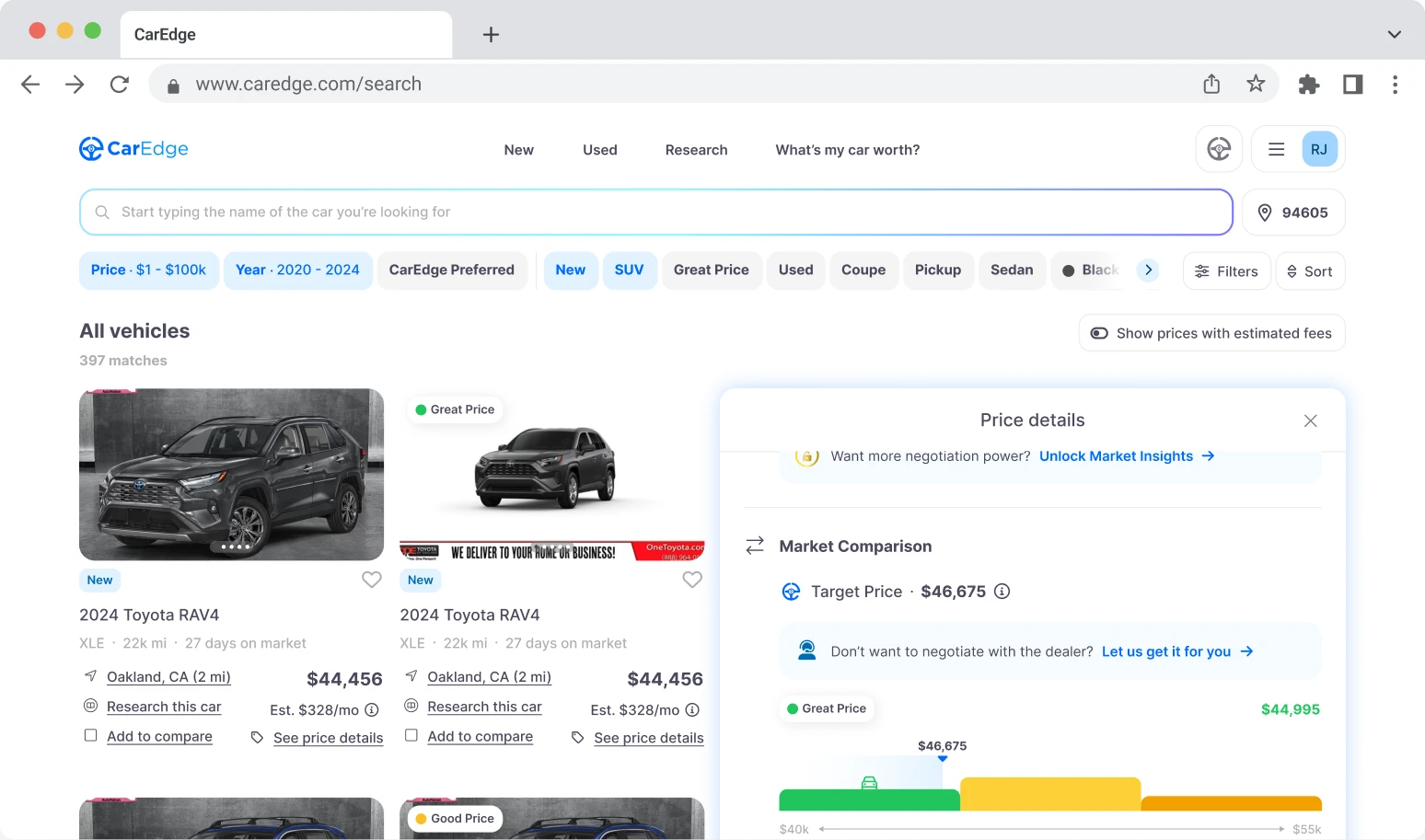
Find a wide range of vehicle listings with market insights on new and used listings near you.

What can I do with CarEdge?
 CarEdge Insights
What can I do with CarEdge?
Get access to exclusive information so you can make an informed car buying decision — all in one place.

Find a wide range of vehicle listings with market insights on new and used listings near you.
Track your vehicle’s value and cash in when the time is right to sell.

Access to our proprietary data to help you find the right car, at the right price. Find these unlocked on every listing after subscribing.

With our expert-led, tech-enabled car buying service, we will locate, negotiate, and deliver your vehicle so you can get a new car hassle free.


Help us personalize your CarEdge experience — it only takes a second.
Your answers help us personalize your CarEdge journey — we’ll follow up with tips and next steps that match your buying timeline.

If you’re thinking about trading in your car, when you do it matters almost as much as what you’re trading in. We’re talking about a difference of several hundred dollars based purely on timing. For high-dollar luxury models, large SUVs, and trucks, the difference can reach into the thousands.
Spring 2026 is almost here, and it happens to be the best time of year to get the most for your trade-in. There are some interesting reasons why dealerships pay more for trade-ins during the spring.
In this guide, we’ll break down exactly why spring is your best window, what makes dealers more generous during this season, and how you can position yourself to get every dollar your car is worth.
Here’s what happens every spring: millions of Americans get their tax refunds, and a significant chunk of that money goes toward buying a car. Usually, tax refunds tend to have a more pronounced impact on the used car market compared to the new car market as budget shoppers head out in droves. This is great news for sellers.
Dealers know this, and they start scrambling for inventory in March to meet the surge in demand.
When dealers need inventory, your trade-in becomes more valuable to them. During tax refund season, the prospect of a buyer walking in to buy your trade-in makes dealers more willing to pay you a fair trade-in value. They’d rather buy your car than have to haul more inventory from dealer auctions to their lot.
Dealers are forward-thinking. By April and May, they’re already preparing for summer, which is traditionally one of the busiest car-buying seasons. Families plan road trips, and people simply feel more optimistic when the weather improves. Most of us are more likely to spend money when we’re in a good mood.
Your trade-in in April isn’t just inventory for today—it’s inventory they’re confident they can move quickly over the next few months. That confidence translates into better offers for you.
👉 Review these trade-in tactics for success, no matter when you’re in the market.
Here’s a reality of the car business: every day your trade-in sits on their lot costs them money. Interest on their floor plan financing, depreciation, and opportunity cost all add up. In the business, we call this ‘floorplanning costs’. In spring, dealers know they can turn your trade-in faster, which means less risk. Less risk means they can afford to pay you more.
Compare that to trading in your car in November when their lot might be full and sales are slowing down. Same car, different value, purely based on how quickly they think they can sell it.
This one’s practical: spring weather makes used cars look better and sell faster. Your car is cleaner, buyers can actually inspect it without freezing or getting soaked, and test drives are more pleasant.
Convertibles and sports cars particularly benefit from spring timing—nobody’s excited about a convertible in January, but in April? That’s a different story. Even for regular sedans and SUVs, warmer weather means more foot traffic at dealerships and more impulse purchases.
The spring selling season doesn’t end on June 1st. Early summer continues to be a strong time for trade-ins, though you start to see the window closing as July progresses.
Come June, many families realize that their current vehicle isn’t going to cut it for that big road trip they’ve been planning. SUVs and minivans move quickly during this period. If your vehicle fits that profile, June can be just as good as April.
High school and college graduations create a wave of first-time car buyers in May and June. Parents who promised their kid a car after graduation are shopping, and young adults entering the workforce need transportation. This is definitely more noticeable on the used car market.
By late July, dealers start shifting their focus beyond the summer rush. They’re less interested in taking on trade-ins because they’re trying to clear space for incoming vehicles for the next model year. After all, those typically arrive around autumn. Your trade-in value starts dropping not because your car got worse, but because dealer priorities changed.
If you’re considering a summer trade-in, get it done before the Fourth of July for best results.
These are the worst months for trade-in value. Dealer lots are quieter, buyers are focused on holiday expenses, and bad weather keeps people home. Dealers also know that anyone trading in during these months probably needs to, which weakens your negotiating position.
Winter weather also works against you. Road salt, dirty conditions, and gray skies make every used car look worse than it actually is. It’s silly, but it’s true (especially if you live in a cold climate).
During this period, dealers are laser-focused on moving current-year new inventory before next year’s models arrive. They’re already drowning in cars and the last thing they want is your trade-in adding to the pile. You’ll get lowball offers simply because they don’t have room or attention for your vehicle.
Post-holiday periods are tough because buyers have tapped out their budgets on gifts, travel, and celebrations. Fewer buyers means dealers need less inventory, which means lower trade-in offers for you.
1. Get your car in good shape
Don’t wait until April to think about this. Take February and early March to get your car in the best possible condition:
2. Get multiple offers online
This should be done when you’re finally ready to trade-in. Before you accept any offer, be sure to compare offers from multiple buyers, such as:
Spring timing works in your favor because all of these buyers are competing for the same limited inventory. Use that competition.
3. Time it right
The sweet spot is mid-March through May. Early enough that you’re ahead of the summer rush, but late enough that tax refunds are flowing and dealers are in a mood to buy.
Memorial Day weekend can still work, but you’re cutting it close. After that, you’re into the gradual decline of summer.
4. Consider your vehicle type
Some vehicles have their own timing:
Getting the most for your trade-in is about understanding basic supply and demand. When dealers need inventory and have confidence they can sell it quickly, they pay more for trade-ins. Spring offers that perfect combination of tax refund money, optimistic buyers, good weather, and dealer demand.
If you’re planning to trade this year, start preparing your vehicle now. Get it cleaned up, gather your paperwork, and plan to gather some official offers soon. The difference between trading in during the best month versus the worst month can easily be $1,000–$2,000 on a typical vehicle.
Your car isn’t getting any younger, but at least you can control when you trade it in. Make spring 2026 work for you.
👉 Use this trade-in checklist to avoid mistakes and get the best deal
The gap between the fastest and slowest-selling pickups is widening in 2026. With some trucks selling in just over a month, and others sitting unsold for over six months, knowing what’s hot (and what’s not) can make or break your next deal.
That’s why understanding Market Day Supply (MDS) is more important than ever for anyone buying or selling a truck in 2026. At CarEdge, we used real-time inventory and sales data to identify the fastest- and slowest-selling trucks each month.
MDS tells us how long it would take to sell all the current inventory of a particular model at the current sales pace, assuming no new units are added. A low MDS means a truck is selling quickly. A high MDS, on the other hand, signals oversupply, and that can mean buyers have more leverage at the dealership.
Whether you’re buying new or considering a trade-in, here’s what the latest market data from CarEdge Pro reveals about the best-selling and worst-selling trucks in America.
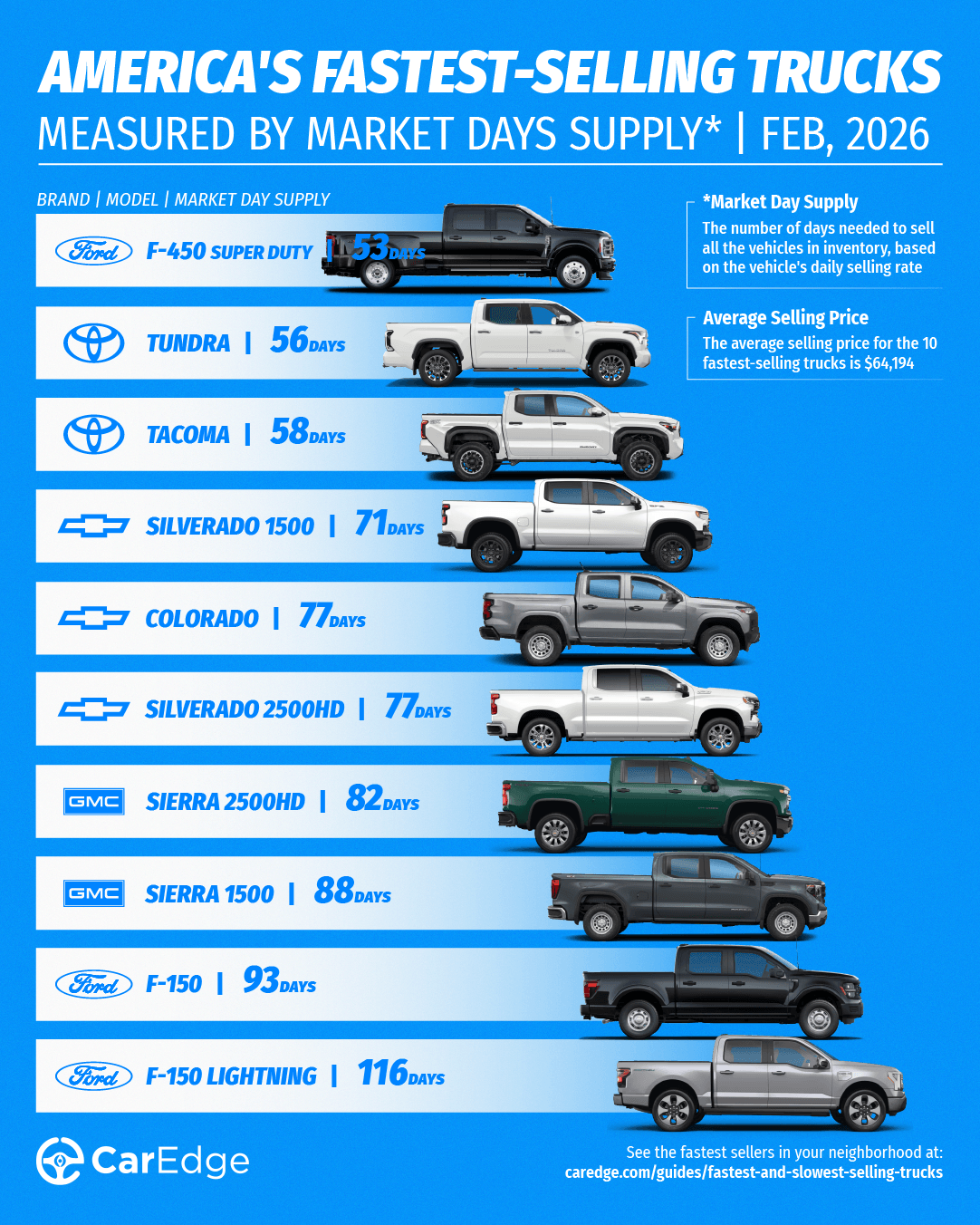
These trucks are in high demand and selling quickly. But if you’re hoping to negotiate a deal on one of these, don’t count on much wiggle room unless you work with a pro.
| Make | Model | Market Day Supply | Total For Sale | 45-Day Sales | Average Selling Price |
|---|---|---|---|---|---|
| Ford | F-450 Super Duty | 53 | 1,555 | 1,318 | $98,065 |
| Toyota | Tundra | 56 | 29,870 | 24,081 | $63,936 |
| Toyota | Tacoma | 58 | 55,275 | 42,861 | $46,088 |
| Chevrolet | Silverado 1500 | 71 | 56,709 | 35,709 | $52,911 |
| Chevrolet | Colorado | 77 | 19,009 | 11,146 | $41,844 |
| Chevrolet | Silverado 2500HD | 77 | 22,335 | 13,120 | $66,488 |
| GMC | Sierra 2500HD | 82 | 17107 | 9420 | $81,410 |
| GMC | Sierra 1500 | 88 | 46,625 | 23,731 | $62,347 |
| Ford | F-150 | 93 | 87,124 | 42,293 | $61,217 |
| Ford | F-150 Lightning | 116 | 4,315 | 1,677 | $67,631 |
Source: CarEdge Pro
The Ford F-450 Super Duty is the fastest-selling pickup truck in February 2026. On average, this heavy duty pickup truck sits on the lot for a little under two months before finding a buyer. Toyota’s Tundra and Tacoma are in second and third place, with trucks from GM far behind.
These trucks will be less negotiable as demand exceeds what’s typical for the truck market. Still, never agree to dealership markups or forced add-ons. Remember, informed shoppers always get the best deals.
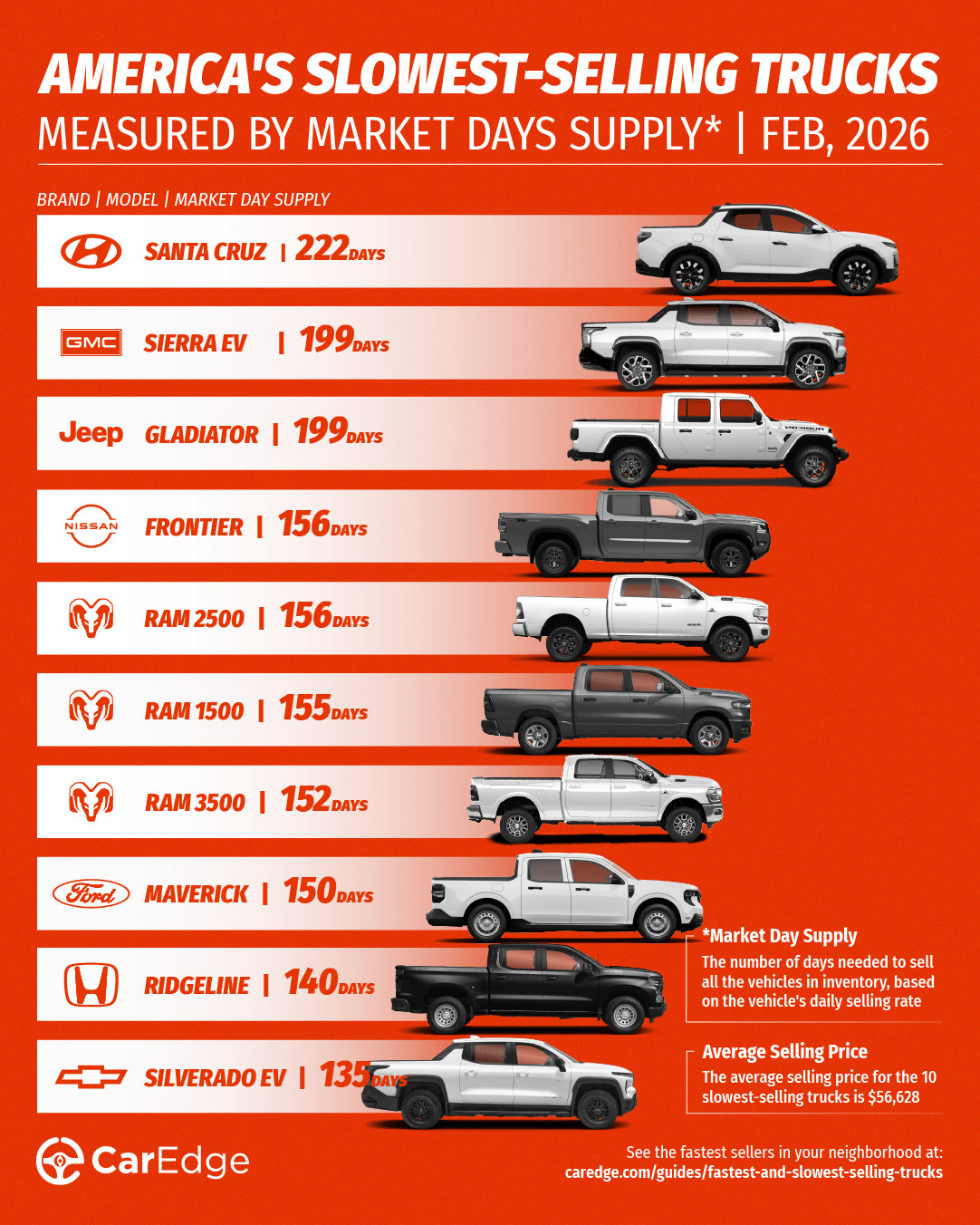
On the flip side, these trucks are struggling to move. Some of these trucks are taking more than six months to sell on average. If you’re in the market, these pickup trucks offer room for negotiation, especially with DIY market insights.
| Make | Model | Market Day Supply | Total For Sale | 45-Day Sales | Average Selling Price |
|---|---|---|---|---|---|
| Hyundai | Santa Cruz | 222 | 10,474 | 2,120 | $36,439 |
| GMC | Sierra EV | 199 | 2,709 | 614 | $81,439 |
| Jeep | Gladiator | 199 | 19,162 | 4,332 | $48,732 |
| Nissan | Frontier | 156 | 21,527 | 6,214 | $39,957 |
| Ram | Ram 2500 | 156 | 31,388 | 9,047 | $68,554 |
| Ram | Ram 1500 | 155 | 66,988 | 19,429 | $60,056 |
| Ram | Ram 3500 | 152 | 10993 | 3263 | $77,020 |
| Ford | Maverick | 150 | 43,224 | 12,933 | $33,930 |
| Honda | Ridgeline | 140 | 11,513 | 3,711 | $45,292 |
| Chevrolet | Silverado EV | 135 | 1,855 | 615 | $74,864 |
Source: CarEdge Pro
The Hyundai Santa Cruz, a truck that was recently sent to the graveyard. Trucks from Stellantis brands (Ram and Jeep) take up four of the bottom 10 spots in February. Sellers can expect these slow-selling trucks to sit on the lot for at least four months, but this creates great chances to negotiate savings for buyers.
As the truck market ebbs and flows, it’s easy to become overwhelmed. Luckily, there are new tools and services available that take the hassle out of buying a truck entirely. Here’s how CarEdge can help.
👉 Negotiate anonymously with CarEdge AI (NEW!)
👉 Have a pro negotiate your deal with CarEdge’s Car Buying Service
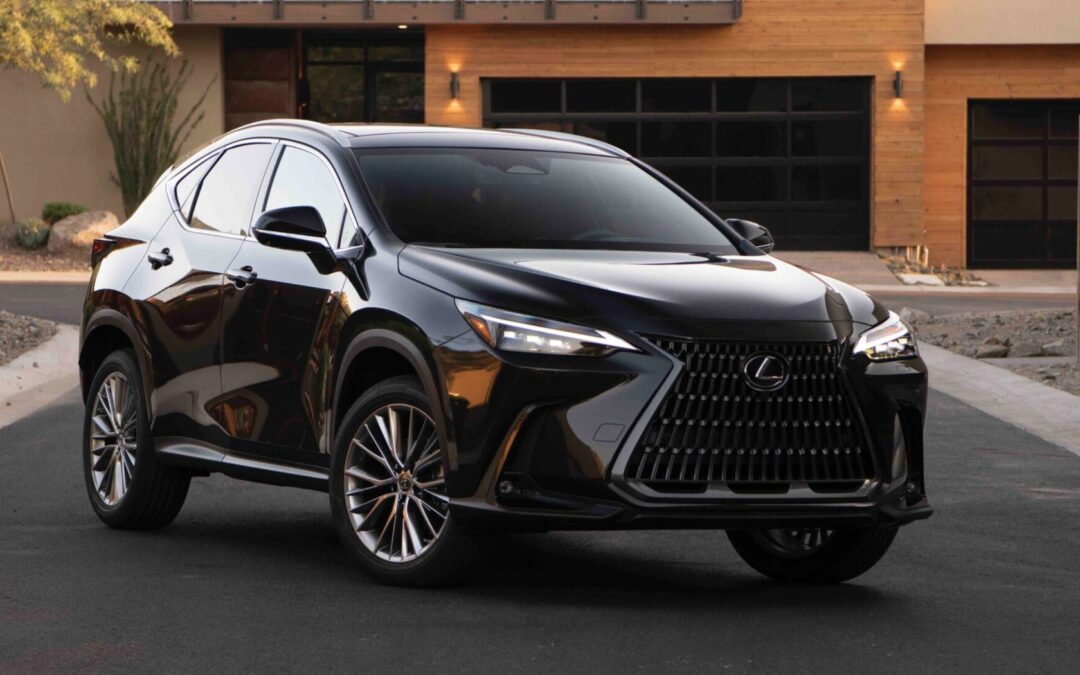
In 2026, some SUVs and crossovers are being scooped up as soon as they hit the lot, while others are sitting unsold for more than a year on average. Whether you’re a buyer looking for a deal or a seller trying to time the market, understanding which SUVs are moving (or not) is essential.
We analyzed February car market data to find the SUVs with the lowest and highest market day supply (MDS). MDS is a measure of how many days it would take to sell through current inventory at the current sales pace. Here are the winners and losers in 2026’s SUV market.
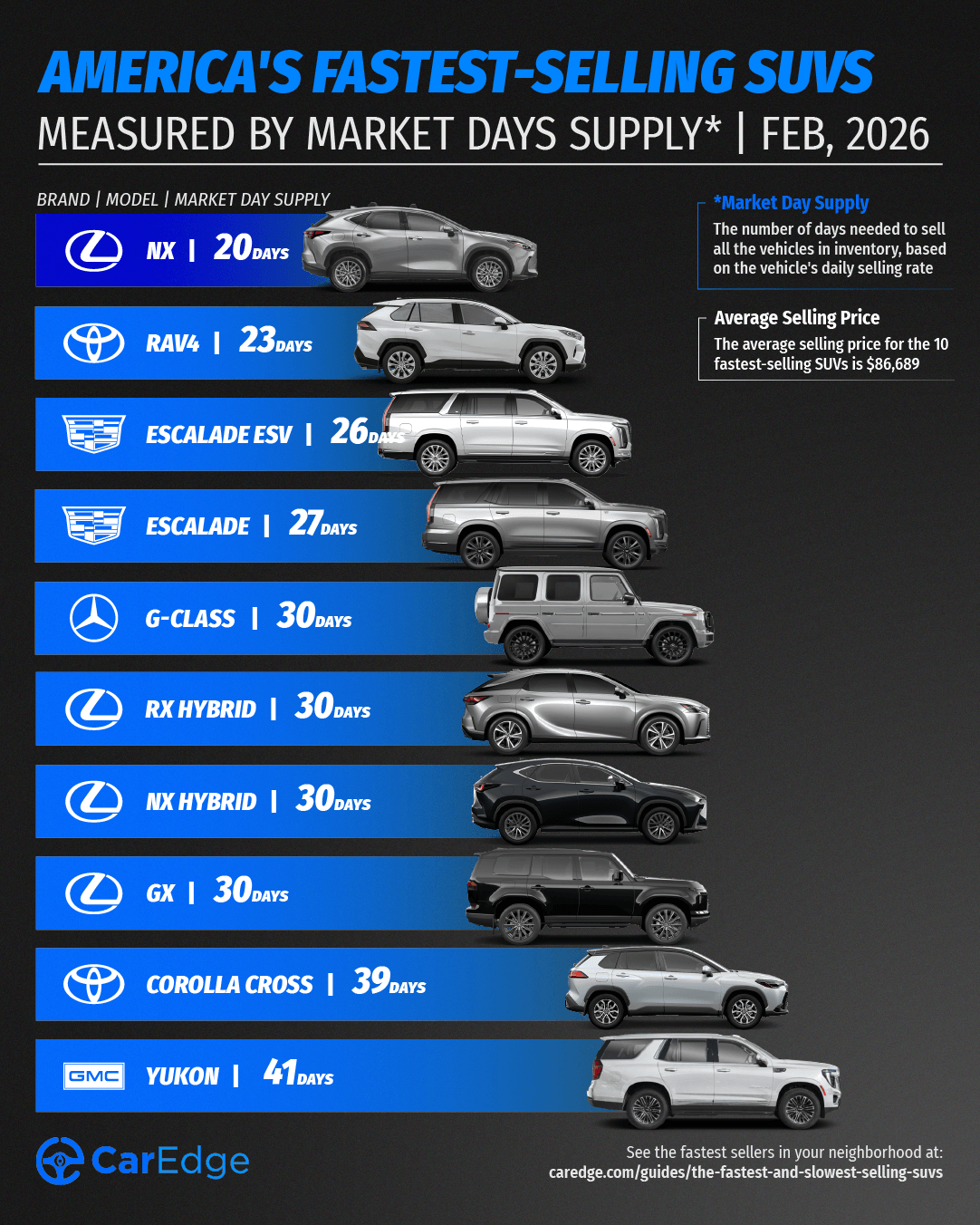
These are the fastest-selling SUVs and crossovers this month. These models have the lowest market day supply, which means they’re in high demand, and are likely harder to negotiate on due to limited availability.
| Make | Model | Market Day Supply | Total For Sale | 45-Day Sales | Average Selling Price |
|---|---|---|---|---|---|
| Lexus | NX | 20 | 1,618 | 3,650 | $51,503 |
| Toyota | RAV4 | 23 | 23,903 | 46,640 | $37,389 |
| Cadillac | Escalade ESV | 26 | 994 | 1,695 | $127,407 |
| Cadillac | Escalade | 27 | 1,795 | 3,026 | $125,746 |
| Mercedes-Benz | G-Class | 30 | 937 | 1,417 | $204,981 |
| Lexus | RX Hybrid | 30 | 4,914 | 7,420 | $64,374 |
| Lexus | NX Hybrid | 30 | 2,511 | 3,796 | $54,465 |
| Lexus | GX | 30 | 2,378 | 3,593 | $80,947 |
| Toyota | Corolla Cross | 39 | 16,797 | 19,195 | $31,709 |
| GMC | Yukon | 41 | 4,643 | 5,139 | $88,369 |
Source: CarEdge Pro
Besides the surprise visit of four GM models on the list, February is yet another month dominated by Toyota and Lexus. The 2026 Lexus NX is the fastest-selling SUV right now, with inventory sitting on the lot for just 20 days on average. The newly-redesigned RAV4 is close behind. Cadillac’s Escalade and larger Escalade ESV are also quick sellers, marking a bright spot for otherwise slow-selling GM models.
What does it all mean? If you plan to buy or lease any of the above SUVs, especially those from Toyota and Lexus, expect to have less negotiating power than if you were to shop one of the slower-selling cars on the market. That doesn’t justify paying for dealer markups or unwanted add-ons. Stay away from those traps. But for these fast-selling SUVs and crossovers, paying MSRP would be a fair deal in 2026’s SUV market.
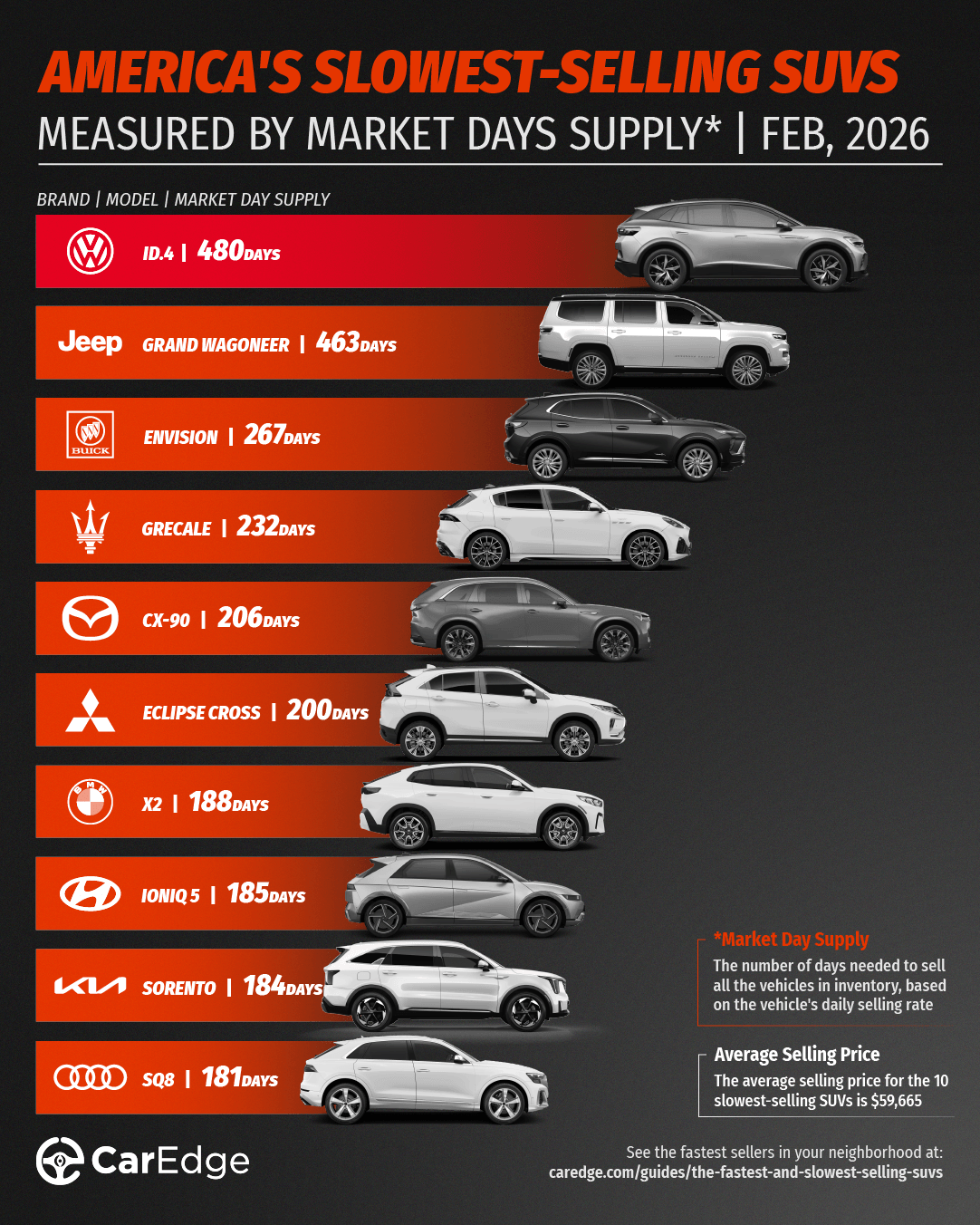
These SUVs have the highest market day supply, which means they’re sitting unsold for longer. Buyers may be able to score better deals on these slowest-selling SUVs in February, especially with this AI negotiator doing the work for you.
| Make | Model | Market Day Supply | Total For Sale | 45-Day Sales | Average Selling Price |
|---|---|---|---|---|---|
| Volkswagen | ID.4 | 480 | 1,482 | 139 | $49,534 |
| Jeep | Grand Wagoneer | 463 | 4,510 | 438 | $85,252 |
| Buick | Envision | 267 | 11,337 | 1,910 | $40,994 |
| Maserati | Grecale | 232 | 583 | 113 | $85,649 |
| Mazda | CX-90 | 206 | 15,991 | 3,486 | $48,214 |
| Mitsubishi | Eclipse Cross | 200 | 2,658 | 597 | $30,111 |
| BMW | X2 | 188 | 1,392 | 333 | $52,698 |
| Hyundai | IONIQ 5 | 185 | 10,276 | 2,506 | $45,901 |
| Kia | Sorento | 184 | 36,137 | 8,845 | $40,047 |
| Audi | SQ8 | 181 | 518 | 129 | $118,251 |
Source: CarEdge Pro
With the federal EV tax credit now over, the Volkswagen ID.4 is at the top of the list for the second month in a row, with well over one year of supply. The IONIQ 5, one of the fastest-charging EVs on the market, is also taking half a year to sell. Several of the others fall into the luxury segment. With recent inflation and persistently high interest rates, buyers are thinking twice about buying luxury vehicles.
Just two Stellantis models are in the bottom 10 this month. That’s a big improvement after dominating the slowest-sellers last year. However, Jeep’s Grand Wagoneer is still in second place. It has been a slow-selling model for most of the past year, despite seeing major price cuts several months ago.
For any of these slow-selling SUVs, prices will be more flexible if you come equipped with negotiation know-how.
If you’re looking for a deal, start with the slowest sellers this month. High inventory levels mean dealers are likely motivated to talk pricing if you negotiate with confidence. It’s always best to take a look at the best incentives of the month, too.
“If you’re shopping for a slow-selling SUV, the ball is in your court,” says auto industry veteran Ray Shefska. “Dealers know those vehicles aren’t moving, and that gives you the upper hand in price negotiations.”
Shopping Toyota, Honda, or Lexus? Expect tighter inventory and less room for negotiation. You may need to move quickly if you find the right trim. However, this is no reason to pay for unwanted add-ons or dealer markups!
With CarEdge Concierge, our experts do the legwork for you, from researching inventory to negotiating with dealers. Already know what you want? Use our AI Negotiation Expert service and have CarEdge AI negotiate with car dealers anonymously!
Explore more free tools and resources with car buying guides, cost of ownership comparisons, and downloadable cheat sheets. There’s no reason to shop unprepared in 2026.
CarEdge is a trusted resource for car buyers, offering data-backed insights, negotiation tools, and expert guidance to help consumers save time and money. Since 2019, CarEdge has helped hundreds of thousands of drivers navigate the car-buying process with confidence. Learn how to buy a car the easy way at CarEdge.com.
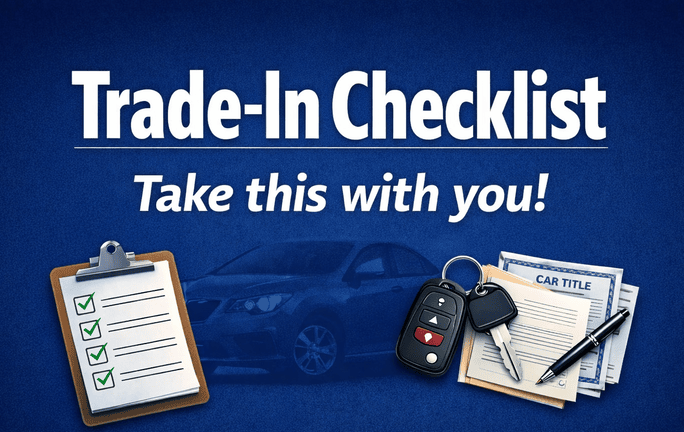
Trading in your car doesn’t have to mean leaving money on the table. With the right preparation and knowledge, you can get the best trade-in value and walk into the dealership with confidence. The key is treating your trade-in as what it really is: a separate transaction that deserves your full attention.
Too many car buyers let dealers bundle their trade-in into the new car purchase, which makes it nearly impossible to know if you’re getting a fair deal on either transaction. This CarEdge guide will show you the smart way to approach your trade-in.
Before you even think about walking into a dealership, do your homework.
Check online valuation tools: Use Kelley Blue Book (KBB), Edmunds, and online buyers like CarMax and Carvana to get an estimated value for your car. This gives you a range of what you might expect.
Check local listings: See what similar cars in your area are selling for. Be sure to compare make/model, mileage, condition, year, and location (local market influences price). See local listings with Car Search.
Get multiple appraisals: Take your car to different dealerships and get online offers. More options = better deal.
Having your paperwork in order makes the process smoother and shows you’re serious about the trade-in.
Title: If you own the car outright, bring the title. If you still owe, bring the payoff statement from your lender.
Registration: Ensure the car is registered and that you have the up-to-date documents.
Insurance: Show proof of insurance to prove the car has been properly maintained.
Maintenance records: If you’ve kept up with regular maintenance (oil changes, brakes, etc.), having these documents can increase the value. For cars routinely serviced at a dealership, these records may already be available online.
Any accessories or extra parts: Include anything you’ve added (new tires, roof racks, custom wheels, etc.).
Loan payoff balance: If there’s still a loan balance, bring the details about what’s left to pay off. You have two options if you still owe money on the car: (1) Pay off the remaining balance directly, or (2) Roll the negative equity into your next car loan (though this will increase your payments, often by a lot).
First impressions count, and a well-maintained vehicle often gets a higher offer.
Exterior: Wash the car. This makes it easy to see the condition of the exterior.
Interior: Clean out trash, vacuum the floors, and wipe down surfaces.
Odor: Neutralize any lingering smells (smoke, pets, etc.) with air fresheners or fabric sprays.
Tires: If they’re worn, don’t worry: it’s not worth it to replace your tires before trading in. You’d be unlikely to receive the value of new tires in added trade-in value. Why? Many trade-ins are sent to dealership auctions, where they are sold to the highest bidder.
Engine bay: Clean it (just don’t use anything too harsh). A clean engine bay makes the car look well-maintained. Here’s a quick guide.
Take care of minor repairs that might be turning off buyers.
Address safety issues: Make sure things like brakes, lights, and other critical systems work properly.
Mechanical problems: If the car has engine, transmission, or suspension issues, it may be worth fixing small things that can raise the car’s value.
Check fluid levels: Top off the oil, coolant, brake fluid, and transmission fluid—this shows the car’s been taken care of. Even the windshield washing fluid should be checked.
Before walking in, know your car’s trade-in value and be prepared to negotiate. Have your offers from online buyers written down on paper, or better yet, printed out for leverage at the dealership.
Have a firm minimum in mind: Know what bottom price you’re willing to accept. This should be based on the online offers you will have received, and the KBB or Edmunds value. Having a minimum in mind will help you avoid emotional or hasty decisions.
Know what similar cars are selling for in the area: The dealer will want some room for profit, but you can still use nearby listings to show that you know what your car is worth.
Bring printed online offers and valuation estimates: Show the dealer that you’ve done your homework.
Be ready to walk away: Don’t let the first offer sway you. If they lowball, you can take it elsewhere.
When the dealer makes an offer, get it in writing so that you have a reference point.
If they try to adjust or lower the price, you’ll have the original offer to fall back on. Getting offers in writing can also serve as a tool for negotiating with other dealers.
Remember, the number one rule of trading in your car is to always treat your trade-in as a separate transaction. Don’t let the dealer tie your trade-in value to your purchase of a new car. That’s a recipe for getting a lowball offer.
Following this checklist will put you in a strong position to get top dollar for your trade-in. But what if you could let the experts handle it? CarEdge’s car buying service doesn’t just help you maximize your trade-in value—we negotiate your entire deal from start to finish.
Your personal CarEdge Concierge negotiates with dealers on your behalf to ensure you’re getting the best possible price on your new vehicle while getting you the most for your trade-in.
We keep these transactions separate (just like you should), and we have the market data and dealer relationships to get you a deal you can feel confident about.
Ready to make your trade-in easy? Let CarEdge do the negotiating for you.
In 2026, getting top dollar for your trade-in requires more preparation and strategy than in previous years.
Here’s why: 7-year-old vehicles traded in during 2025 had an average value of $14,400, a 72% increase from 2019, when they were valued at $8,400, according to a recent report. That’s usually great news for sellers, but there’s a catch.
Despite rising used-car values, many drivers still get less than expected when trading in. The gap between projected and actual resale values is widening as new and used car prices converge. Without knowledge and preparation, you’re likely to leave money on the table.
We consulted CarEdge’s consumer advocates to find out how to get the best trade-in value in 2026. The common theme? Prepared, informed buyers get the best deals. Let’s take a look at how you can top-dollar for your trade-in this year.
Many drivers aren’t aware that some parts of a car trade-in contract are negotiable, primarily because dealers present the agreement as a package.
The number one rule for getting the most for your trade-in is to always treat it as a separate transaction. The car salesperson WILL do their best to tie your trade-in to your purchase. That’s a recipe for a low-ball offer. Negotiating your car purchase and trade-in together gives the dealer more opportunities to profit at your expense. Handle them separately to maximize your trade-in value.
In most cases, the appraisal of your trade-in value isn’t the final offer. Before you arrive at the dealership, get several online offers and values for your car, so you know what it should be worth. Be honest with yourself about the condition of your car when getting these values.
Having several online offers from CarEdge’s free tool, CarFax, Carvana, and others (as well as the KBB Value) not only gives you an up-to-date assessment of your vehicle’s trade-in value, it is your source of leverage against dealer offers.
Go one step further and get trade-in offers in writing from at least two dealerships, ideally three or more. They’ll need to see your vehicle in person to do this, but it’s worth the hassle. You’re likely to get hundreds of dollars more (or thousands, in some cases) by not skipping this step. It’s work on your end, but work that pays.
Having service records on hand can help your trade-in value, too. However, with the widespread use of CarFax and online service records, this is less crucial in 2026. It merely helps to show that the car has been taken care of.
Getting your car detailed can also help you achieve a higher trade-in value, but don’t spend hundreds of dollars on this. A good interior and exterior cleaning at home is usually best for your wallet, and for getting a fair offer for your trade-in.
This is an important one. You’d be shocked to see how effective the following questions are at getting more for your trade-in: “Is that your best offer? Do you mind checking the numbers again? I believe it’s worth more than that.”
In many cases, they’ll ‘check with their manager’ and come back with at least $100 more in value, often more. And that’s all just from showing that you’re not going to just accept the bare minimum for your vehicle.
Knowing what your vehicle offers is crucial when negotiating trade-in offers, as its specific trim level may raise its value. The original window sticker can help you identify these features. It’s likely sitting in your glove compartment.
For example, mid-to-upper level trims of a specific model tend to offer features that include but aren’t limited to:
Anything that’s not standard equipment on your model’s base trim is fair game. Did you get work done recently? Noting new parts and repairs can increase offers for any trim level.
While 2026 is set to offer higher average trade-in offers, some periods are more ideal for maximizing value. Edmunds data shows that Q1 and Q2 are the best times for trade-ins, as used car values tend to trend higher.
Additionally, since a car loses more value the longer you have it in your driveway, it’s more appealing during Q1 and Q2 compared to the end of the year when it’s about to become another model year older.

What kind of vehicle are you trading-in? If you’re trading-in an all-wheel drive SUV, winter can be an opportune time to get top dollar. Softer-selling segments like a convertible may benefit from a trade-in during the warmer months.
Is the air conditioning out on your trade-in? You won’t get top dollar for it during the heat of summer!
Are your tire tread getting low? If so, the icy winter months aren’t the best time to sell. It all matters if you’re aiming to get top dollar for your car!
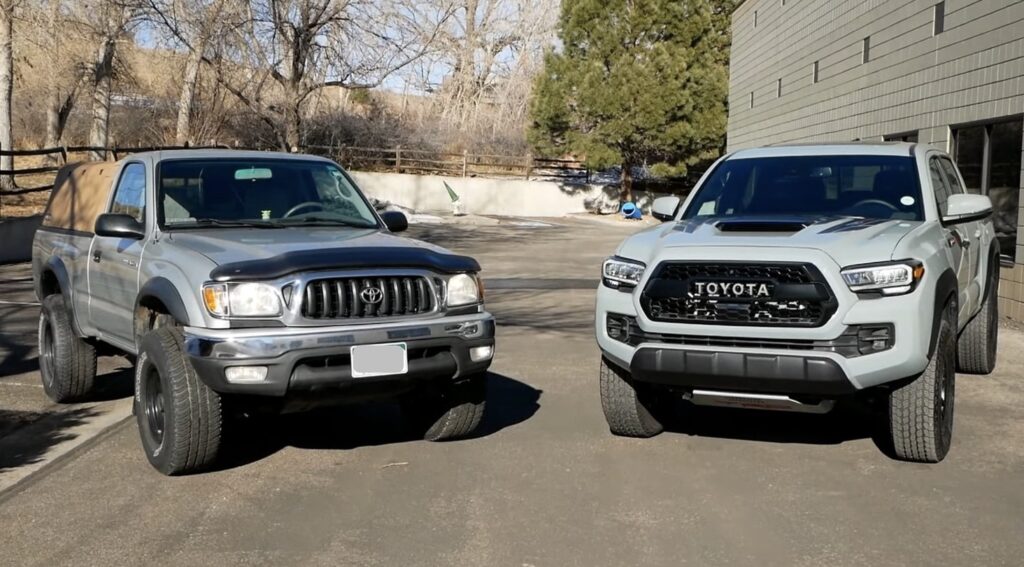
When considering trade-in timing, mileage often comes to mind. Luckily, there’s no major drop-off after certain milestones, as long as your vehicle has been well-kept, which you can help prove with documents like timely service records.
In comparison, model years matter more. It may be obvious to some, but many sellers are surprised to learn that like-for-like, a five year-old car with just 30,000 miles on the odometer is still going to be worth significantly less than a two-year old car with 50,000 miles. Model year matters to buyers, especially if there’s a chance your trade-in will go to auction.
Where a vehicle was built used to be a non-factor; however, a car’s manufacturing location can now play a significant role in resale value due to tariffs.
Depending on the country, automakers exporting vehicles to the U.S. face tariff rates roughly ranging from 10% to 27.5% on a car’s declared value, increasing dealer replacement costs for impacted new models. When these replacement prices increase, dealers have more incentive to lean on already-imported used models, giving you added leverage if you have an imported brand with limited U.S. production.
Examples of these brands can include:
If you follow the news in 2026, you know that the tariff situation seems to change weekly. Even so, sharing this bit of information can still give you more negotiation power, as it shows you’re an informed buyer (and seller).

What if you didn’t have to go back and forth to dealerships, negotiating with pushy salespeople all along the way? Wouldn’t it be nice to have an experiences automotive professional do it all for you? That’s what we offer with CarEdge’s car buying service. From finding the perfect trim and paint color to negotiating every aspect of your deal (including your trade-in), we make car-buying easy.
Learn more about CarEdge Concierge, and take the stress out of your big purchase!
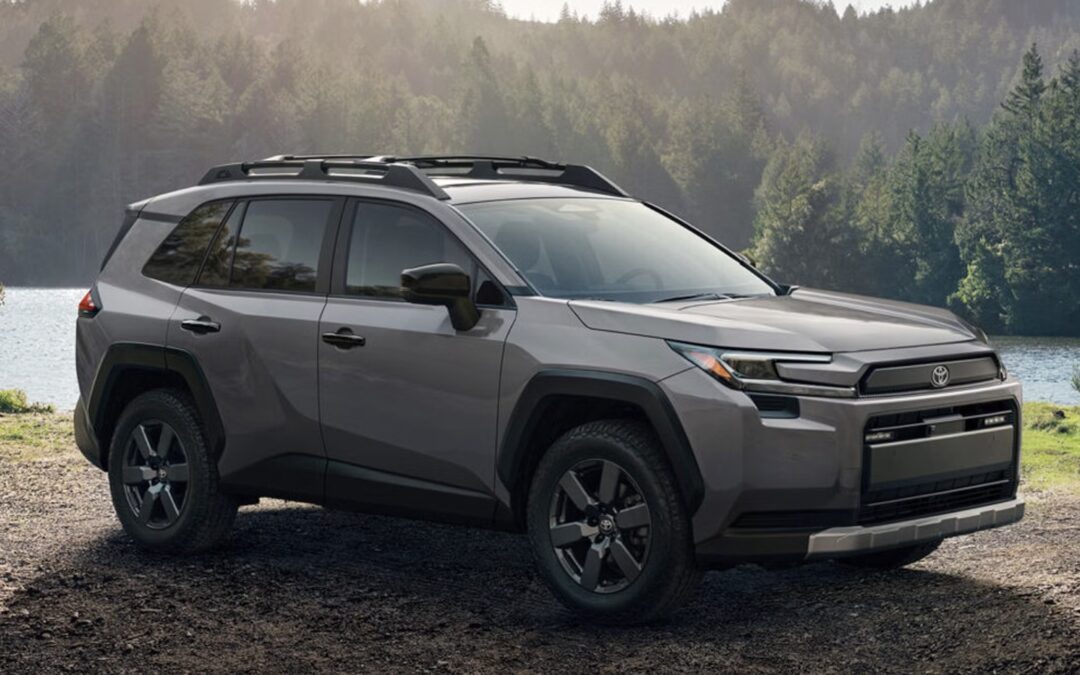
Out with the old, and in with the new seems to be the theme in this month’s rankings of the fastest and slowest-selling SUVs and crossovers. In early 2026, the glory days of EV sales are gone, and reliable namesakes from Toyota are back at the top. Right now, some SUVs are being scooped up as soon as they hit the lot, while others are sitting unsold for nearly a year on average.
We analyzed January 2026 auto market data to find the SUVs with the lowest and highest market day supply (MDS). MDS is a measure of how many days it would take to sell through current inventory at the current sales pace. Here are the winners and losers so far in 2026’s SUV market.
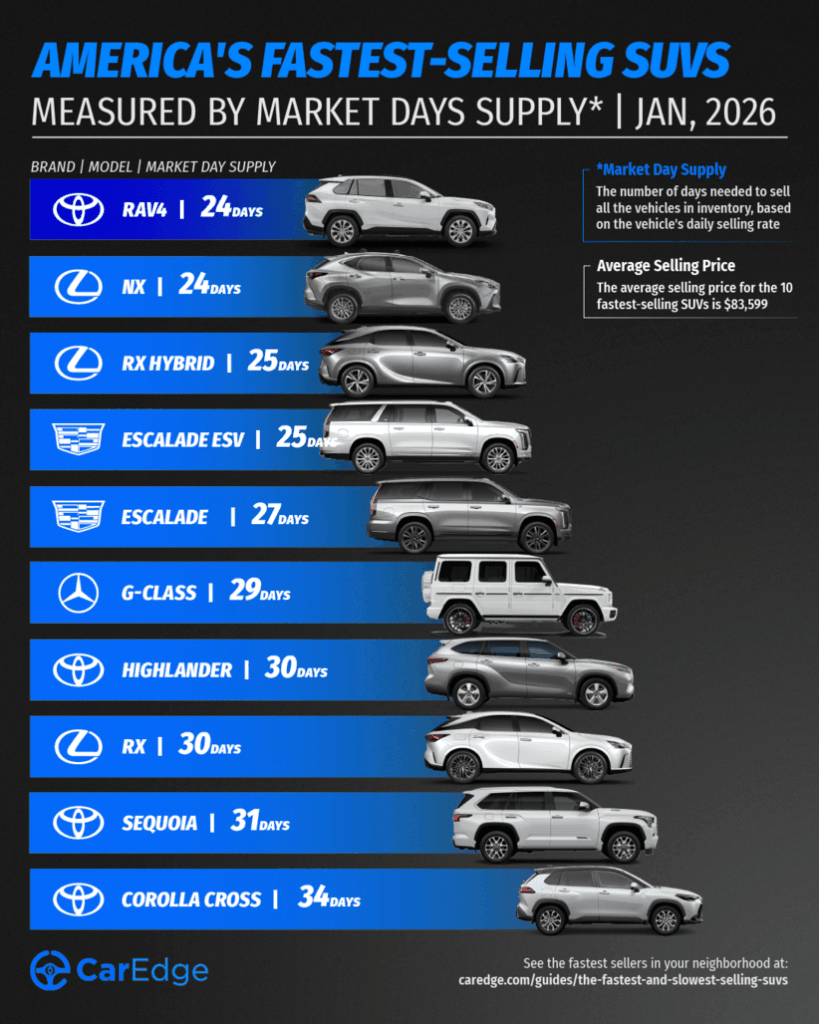
These are the SUVs and crossovers with the lowest market day supply in January 2026. That means they’re in high demand right now, and are likely harder to negotiate on due to limited availability.
| Make | Model | Market Day Supply | Total For Sale | 45-Day Sales | Average Selling Price |
|---|---|---|---|---|---|
| Toyota | RAV4 | 24 | 38,923 | 73,186 | $37,389 |
| Lexus | NX | 24 | 3,008 | 5,713 | $51,475 |
| Lexus | RX Hybrid | 25 | 5,027 | 9,227 | $64,200 |
| Cadillac | Escalade ESV | 25 | 1,149 | 2,057 | $127,519 |
| Cadillac | Escalade | 27 | 2,381 | 3,919 | $125,506 |
| Mercedes-Benz | G-Class | 29 | 1,062 | 1,643 | $201,631 |
| Toyota | Highlander | 30 | 5,480 | 8,100 | $52,703 |
| Lexus | RX | 30 | 5,954 | 8,828 | $59,760 |
| Toyota | Sequoia | 31 | 3,644 | 5,254 | $84,101 |
| Toyota | Corolla Cross | 34 | 15,087 | 20,040 | $31,703 |
Source: CarEdge Pro
Toyota is back on top yet again in January. Seven of the 10 fastest-selling SUVs are Toyota or Lexus models. If you’ve been following along for a while, this isn’t unusual. Toyota’s reputation for reliability, affordability, and overall value continues to be a hit with buyers. Consumer Reports named Toyota as the most-reliable brand yet again last year.
If you haven’t noticed, SUVs are no longer budget-friendly vehicles for the most part. No one wants a $50,000 crossover that lacks in reliability. Buyers are valuing reliability and affordability above all else right now, and the latest data reflects that.
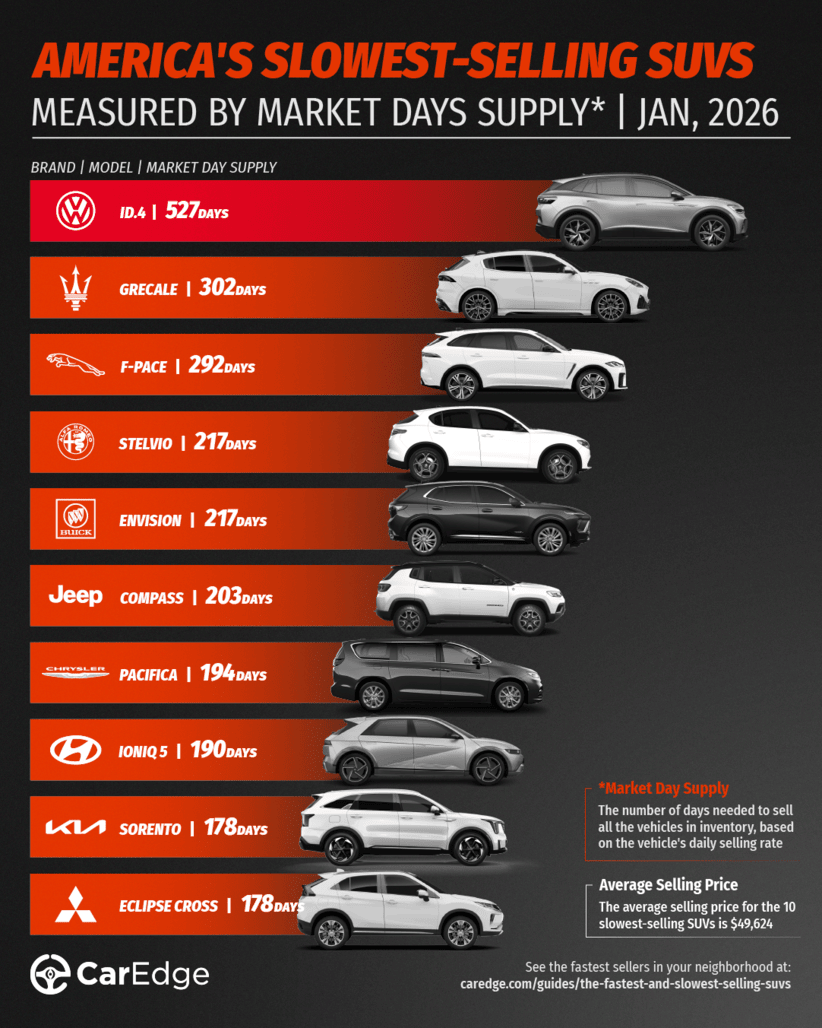
These SUVs have the highest market day supply, which means they’re sitting unsold for longer. Buyers may be able to score better deals on these slowest-selling SUVs in January 2026, especially with this new AI negotiator doing the work for you.
| Make | Model | Market Day Supply | Total For Sale | 45-Day Sales | Average Selling Price |
|---|---|---|---|---|---|
| Volkswagen | ID.4 | 527 | 1,500 | 128 | $49,534 |
| Maserati | Grecale | 302 | 638 | 95 | $84,448 |
| Jaguar | F-PACE | 292 | 2,148 | 331 | $69,503 |
| Alfa Romeo | Stelvio | 217 | 887 | 184 | $55,467 |
| Buick | Envision | 217 | 8,352 | 1,735 | $40,150 |
| Jeep | Compass | 203 | 27,375 | 6,063 | $32,392 |
| Chysler | Pacifica | 194 | 16,442 | 3,815 | $46,694 |
| Hyundai | IONIQ 5 | 190 | 10,693 | 2,536 | $47,865 |
| Kia | Sorento | 178 | 35,349 | 8,955 | $40,126 |
| Mitsubishi | Eclipse Cross | 178 | 2,715 | 685 | $30,058 |
Source: CarEdge Pro
With the federal EV tax credit now over, the Volkswagen ID.4 is the slowest-selling car in America for the second month in a row. There’s a year and a half of market supply right now, meaning that an ID.4 on a dealer’s lot today may see 2027 before finding a buyer.
Several of the others fall into the luxury segment. With recent inflation and persistently high interest rates, buyers are thinking twice about buying luxury vehicles in 2026.
Four Stellantis models are in the bottom 10 this month. Jaguar’s F-PACE has been a slow-selling model for all of the past year, despite being the top model by volume for the British automaker.
For any of these slow-selling SUVs, prices will be more flexible if you come equipped with negotiation know-how.
If you’re looking for a SUV deal in 2026, start with the slowest sellers this month. High inventory levels mean dealers are likely motivated to talk pricing if you negotiate with confidence. It’s always best to take a look at the best incentives of the month, too.
“If you’re shopping for a slow-selling SUV, the ball is in your court,” says auto industry veteran Ray Shefska. “Dealers know those vehicles aren’t moving, and that gives you the upper hand in price negotiations.”
Shopping Toyota, Honda, or Lexus? Expect tighter inventory and less room for negotiation unless market dynamics shift dramatically. You may need to move quickly if you find the right trim. However, this is no reason to pay for unwanted add-ons or dealer markups!
With CarEdge Concierge, our experts do the legwork for you, from researching inventory to negotiating with dealers. Already know what you want? Use our AI Negotiation Expert service and have CarEdge AI negotiate with car dealers anonymously!
Explore more free tools and resources with car buying guides, cost of ownership comparisons, and downloadable cheat sheets. There’s no reason to shop unprepared in 2026.
CarEdge is a trusted resource for car buyers, offering data-backed insights, negotiation tools, and expert guidance to help consumers save time and money. Since 2019, CarEdge has helped hundreds of thousands of drivers navigate the car-buying process with confidence. Learn how to buy a car the easy way at CarEdge.com.