
CarEdge saved me over 4,500 dollars on a brand new Honda Pilot. I can't say thank you enough.
Price intelligence
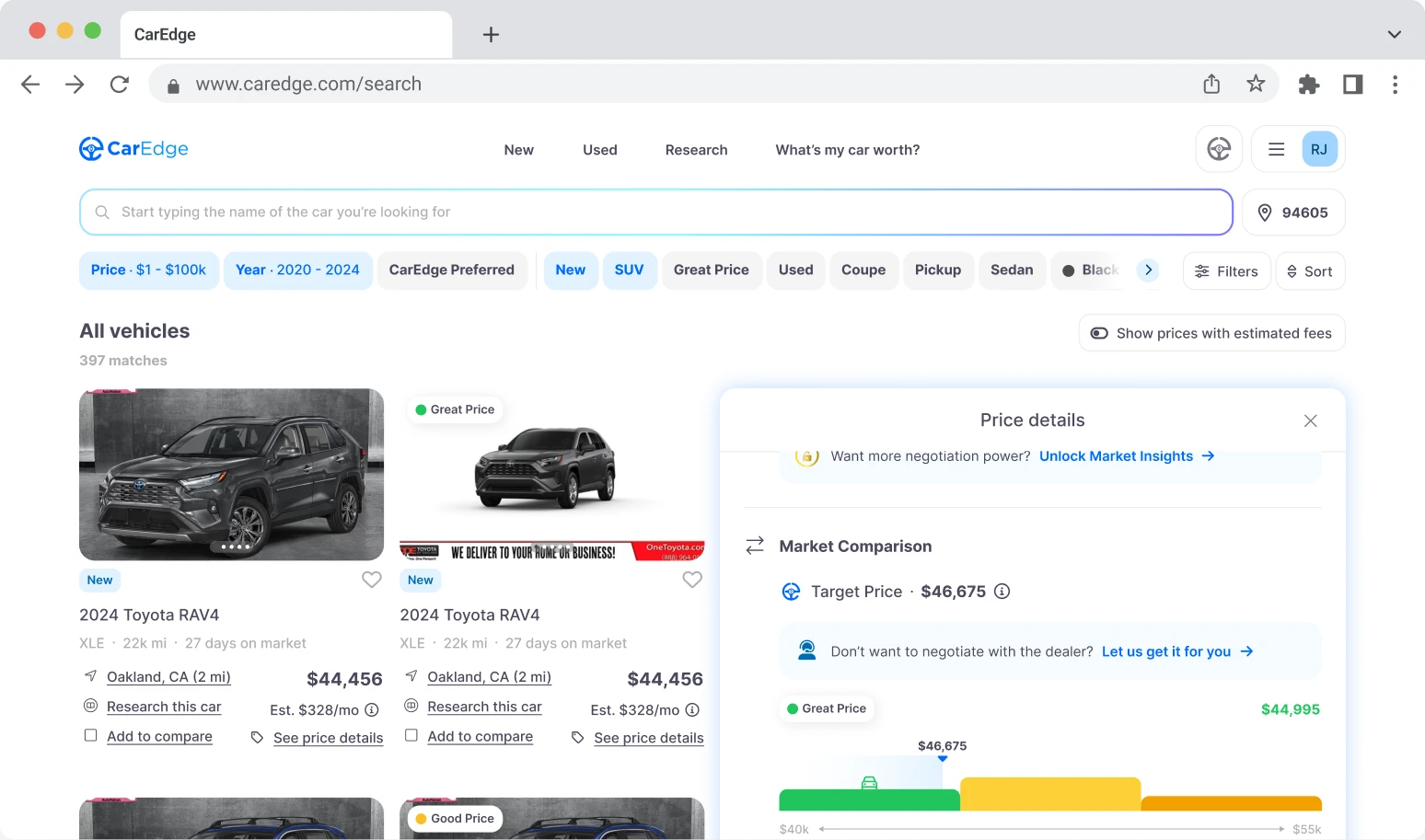
Find a wide range of vehicle listings with market insights on new and used listings near you.

What can I do with CarEdge?
 CarEdge Insights
What can I do with CarEdge?
Get access to exclusive information so you can make an informed car buying decision — all in one place.

Find a wide range of vehicle listings with market insights on new and used listings near you.
Track your vehicle’s value and cash in when the time is right to sell.

Access to our proprietary data to help you find the right car, at the right price. Find these unlocked on every listing after subscribing.

With our expert-led, tech-enabled car buying service, we will locate, negotiate, and deliver your vehicle so you can get a new car hassle free.


Help us personalize your CarEdge experience — it only takes a second.
Your answers help us personalize your CarEdge journey — we’ll follow up with tips and next steps that match your buying timeline.

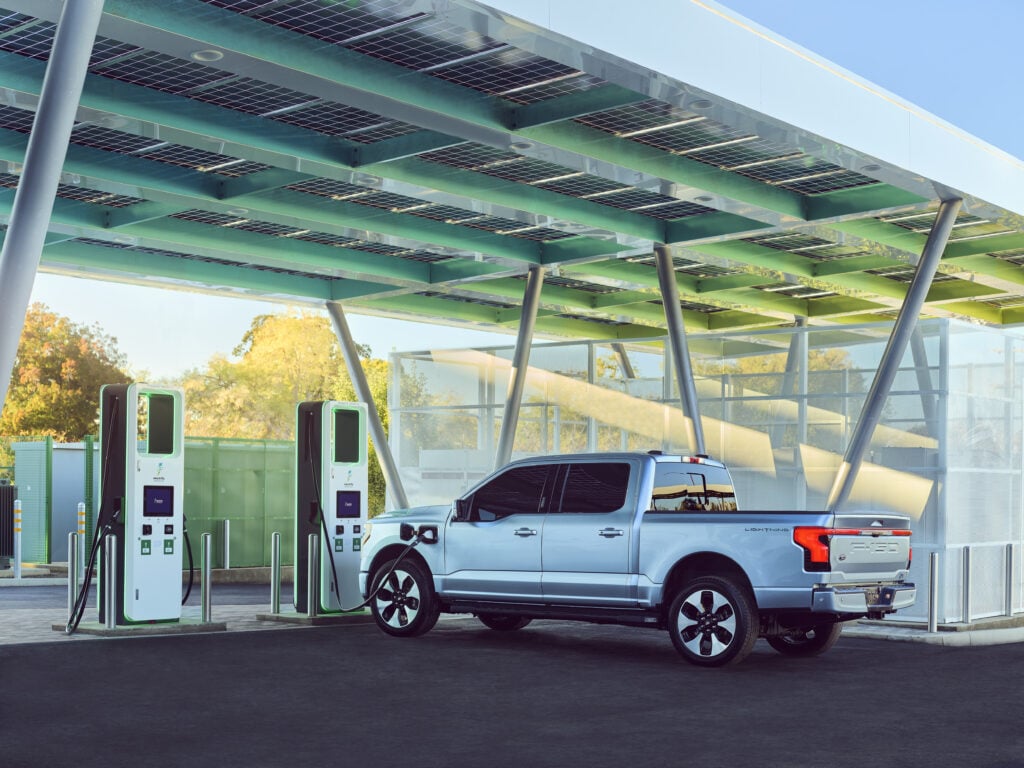
Update: Every day that we wake up to higher gas prices, the case gets stronger for EV adoption. If only EV prices weren’t sky-high. With gas at $4.50, the average American driver commuting 15,000 miles per year can easily save $150 per month or more by going electric. Check out the details below.
Charging an electric vehicle is a whole new experience, one that brings advantages and disadvantages for drivers. If you’ve been stopping at gas stations for decades, the thought of plugging in and waiting for your car to charge may be a bit too much to swallow. But over 80% of EV charging is done at home, where the cost savings are greatest. Two out of three American drivers are considering going electric for their next vehicle, and billions of dollars are being funneled into EV development and infrastructure.
EVs have a higher upfront cost than combustion vehicles, so it’s important to find ways of making up for the expense with fuel savings. Unfortunately, not all charging options are affordable. Here’s how you can save money when charging your EV in 2022.
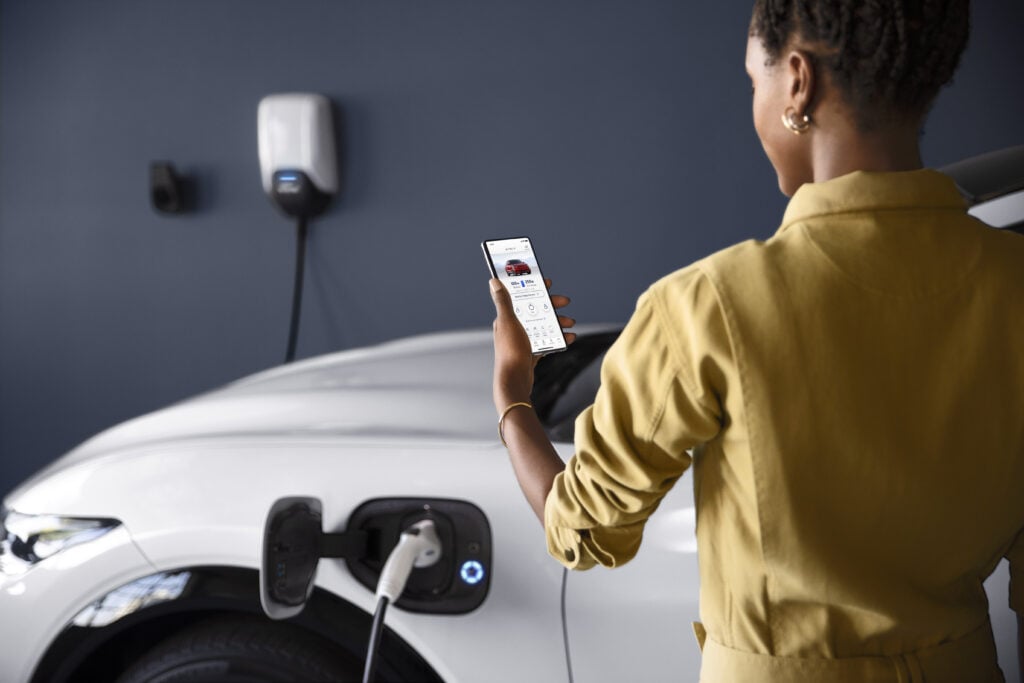
When do you usually charge your phone? While you sleep at home? Oddly enough, for most drivers, that’s exactly how their EVs are charged! Data from the US Department of Energy shows that the vast majority of electric vehicle charging is done at home. Whether you plug in to a simple 120 volt outlet in your driveway or have a more powerful 240 volt outlet in your garage, charging at home is usually the most affordable way to power up.
In the US, the average residential electricity rate is $0.14 per kilowatt-hour, however rates vary widely from one state to another. In Hawaii, the average rate is a whopping $0.34 per kWh, while it’s between $0.10 and $0.14 per kWh in more affordable energy states like Washington and Texas.
What does that all mean? Say you have a level 2 charger capable of filling up your battery from empty in about 7 hours. Plug in every evening, and wake up with a full battery every morning. What did that full ‘tank’ of electrons cost? Let’s consider a real-world example. The 2022 Tesla Model 3 has a 82 kWh battery, so at average American residential rates, at home charging a Tesla Model 3 at home costs just $11.48 for a full charge. That’s enough electrons for 358 miles of driving.
What about if the same Model 3 owner lived in California instead? At typical California residential electricity rates, the same charge would cost $18.04. Considering that a tank of gas costs over $75 today, the savings add up. But clearly, it depends on the rates you pay for power and miles driven per year to maximize savings. If you’d like to know more about average residential electricity rates in each state, you can find that information here.
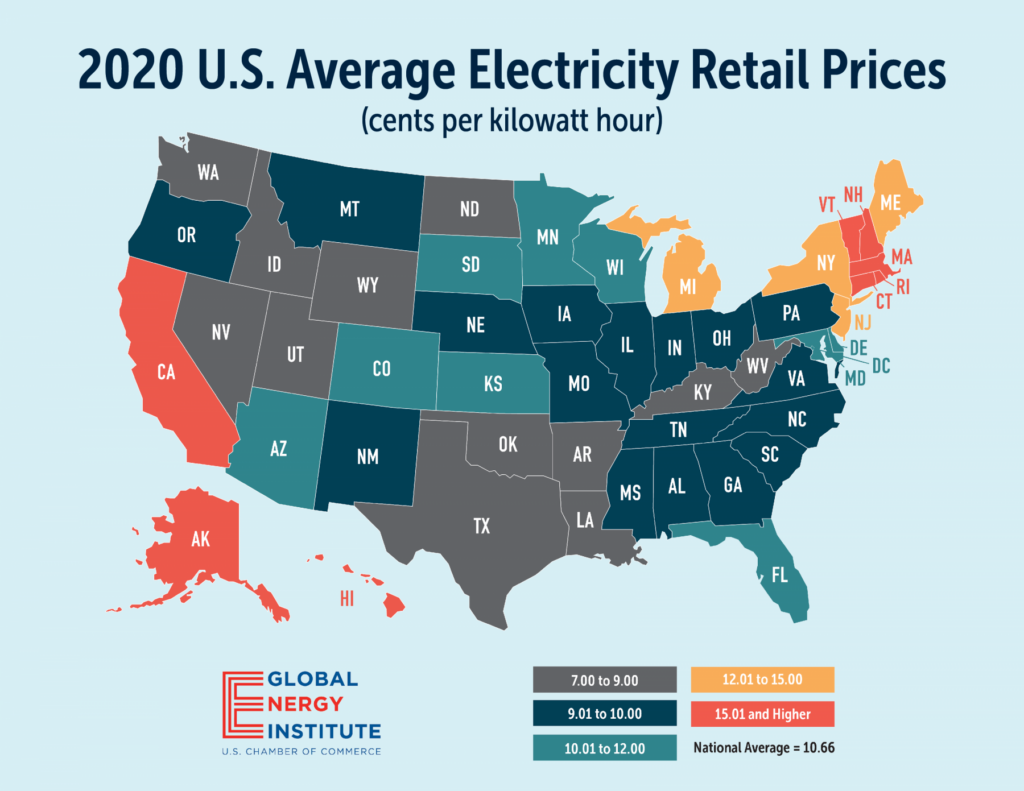
Here’s how much EV drivers from each state can expect to pay for a full charge. The examples below specifically reflect an EV with an 82 kWh battery, such as a Tesla Model 3 or Model Y. My own Hyundai IONIQ 5 has a 72.5 kWh battery.
The stark difference between home charging and public fast charging highlights the fact that going electric likely only brings savings when most charging is done at home.
| State | Residential Electricity Rate ($ per kWh) | Cost of Charging to 100% at Home (82 kWh battery) | EV Fuel Savings Compared to Filling an 18 Gallon Tank at $4.50/Gal | Annual Savings: 15,000 miles/year, 25 MPG versus 300 miles on a charge |
|---|---|---|---|---|
| Alabama | $0.14 | $11.48 | $69.52 | $2,126 |
| Alaska | $0.23 | $18.86 | $62.14 | $1,757 |
| Arizona | $0.13 | $10.66 | $70.34 | $2,167 |
| Arkansas | $0.11 | $9.02 | $71.98 | $2,249 |
| California | $0.22 | $18.04 | $62.96 | $1,798 |
| Colorado | $0.14 | $11.48 | $69.52 | $2,126 |
| Connecticut | $0.23 | $18.86 | $62.14 | $1,757 |
| Delaware | $0.14 | $11.48 | $69.52 | $2,126 |
| DC | $0.14 | $11.48 | $69.52 | $2,126 |
| Florida | $0.12 | $9.84 | $71.16 | $2,208 |
| Georgia | $0.13 | $10.66 | $70.34 | $2,167 |
| Hawaii | $0.34 | $27.88 | $53.12 | $1,306 |
| Idaho | $0.11 | $9.02 | $71.98 | $2,249 |
| Illinois | $0.14 | $11.48 | $69.52 | $2,126 |
| Indiana | $0.14 | $11.48 | $69.52 | $2,126 |
| Iowa | $0.13 | $10.66 | $70.34 | $2,167 |
| Kansas | $0.13 | $10.66 | $70.34 | $2,167 |
| Kentucky | $0.12 | $9.84 | $71.16 | $2,208 |
| Louisiana | $0.12 | $9.84 | $71.16 | $2,208 |
| Maine | $0.18 | $14.76 | $66.24 | $1,962 |
| Maryland | $0.14 | $11.48 | $69.52 | $2,126 |
| Massachusetts | $0.23 | $18.86 | $62.14 | $1,757 |
| Michigan | $0.18 | $14.76 | $66.24 | $1,962 |
| Minnesota | $0.14 | $11.48 | $69.52 | $2,126 |
| Mississippi | $0.12 | $9.84 | $71.16 | $2,208 |
| Missouri | $0.11 | $9.02 | $71.98 | $2,249 |
| Montana | $0.12 | $9.84 | $71.16 | $2,208 |
| Nebraska | $0.11 | $9.02 | $71.98 | $2,249 |
| Nevada | $0.13 | $10.66 | $70.34 | $2,167 |
| New Hampshire | $0.21 | $17.22 | $63.78 | $1,839 |
| New Jersey | $0.16 | $13.12 | $67.88 | $2,044 |
| New Mexico | $0.14 | $11.48 | $69.52 | $2,126 |
| New York | $0.21 | $17.22 | $63.78 | $1,839 |
| North Carolina | $0.12 | $9.84 | $71.16 | $2,208 |
| North Dakota | $0.12 | $9.84 | $71.16 | $2,208 |
| Ohio | $0.13 | $10.66 | $70.34 | $2,167 |
| Oklahoma | $0.13 | $10.66 | $70.34 | $2,167 |
| Oregon | $0.12 | $9.84 | $71.16 | $2,208 |
| Pennsylvania | $0.15 | $12.30 | $68.70 | $2,085 |
| Rhode Island | $0.22 | $18.04 | $62.96 | $1,798 |
| South Carolina | $0.14 | $11.48 | $69.52 | $2,126 |
| South Dakota | $0.13 | $10.66 | $70.34 | $2,167 |
| Tennessee | $0.12 | $9.84 | $71.16 | $2,208 |
| Texas | $0.13 | $10.66 | $70.34 | $2,167 |
| Utah | $0.11 | $9.02 | $71.98 | $2,249 |
| Vermont | $0.21 | $17.22 | $63.78 | $1,839 |
| Virginia | $0.13 | $10.66 | $70.34 | $2,167 |
| Washington | $0.11 | $9.02 | $71.98 | $2,249 |
| West Virginia | $0.14 | $11.48 | $69.52 | $2,126 |
| Wisconsin | $0.15 | $12.30 | $68.70 | $2,085 |
| Wyoming | $0.12 | $9.84 | $71.16 | $2,208 |
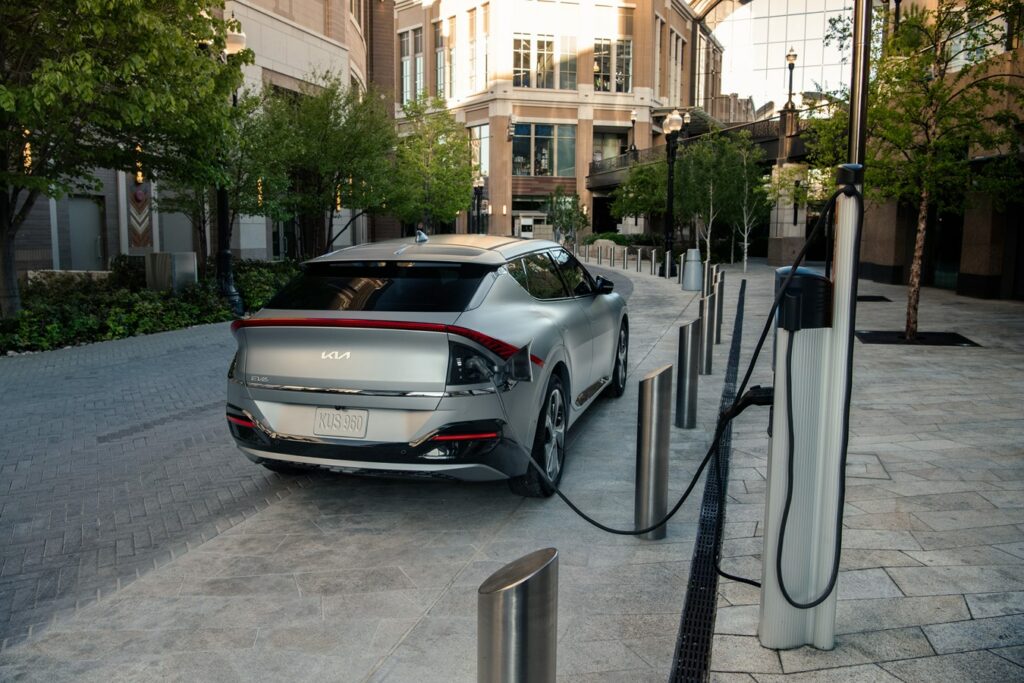
If you already have a 240 volt dryer outlet within reach, you’re all set for just about any scenario. If you don’t, you’re left with two options. If you drive less than 40 miles on most days and live within a reasonable distance of a public charger (in case you need it), you will save the most money by using the so-called ‘trickle charge’ supplied by the charger included with the car. You simply plug into a standard three-prong 120 volt wall outlet. This is called level 1 charging.
Depending on the vehicle, trickle charging typically adds 3-4 miles of charge per hour to the battery, or about 40 miles per night if you leave your car plugged in. So, how much does it cost to charge an electric car? If the above scenario describes your driving habits, you’ll just pay the same residential electricity rates that your pay to power your home.
If that’s not quite enough recharge for your daily needs, you’ll either need to make weekly visits to public fast chargers, or spend anywhere from $800 – $2000 on installation of a level 2 charger. Level 2 chargers supply more power in less time. They plug into a 240 volt outlet, the exact same kind that is used for dryers, ovens and other large appliances at home.
If you already have a conveniently located dryer outlet within reach of where you park the car, you can purchase a power splitter for as little as $300. Splitters send charge to the home appliance (such as a dryer) when needed, and then divert power to charging the car when the appliance is not in use. This saves A LOT of money versus getting electrical work done!
In summary, if you drive less than 40 miles a day, it usually makes the most sense to avoid the costly level 2 charger and stick with a regular wall outlet. If you drive significantly more, consider installing a level 2 charger or simply topping off your battery once or twice a week at a local public fast charger to avoid the expense of electrical work.
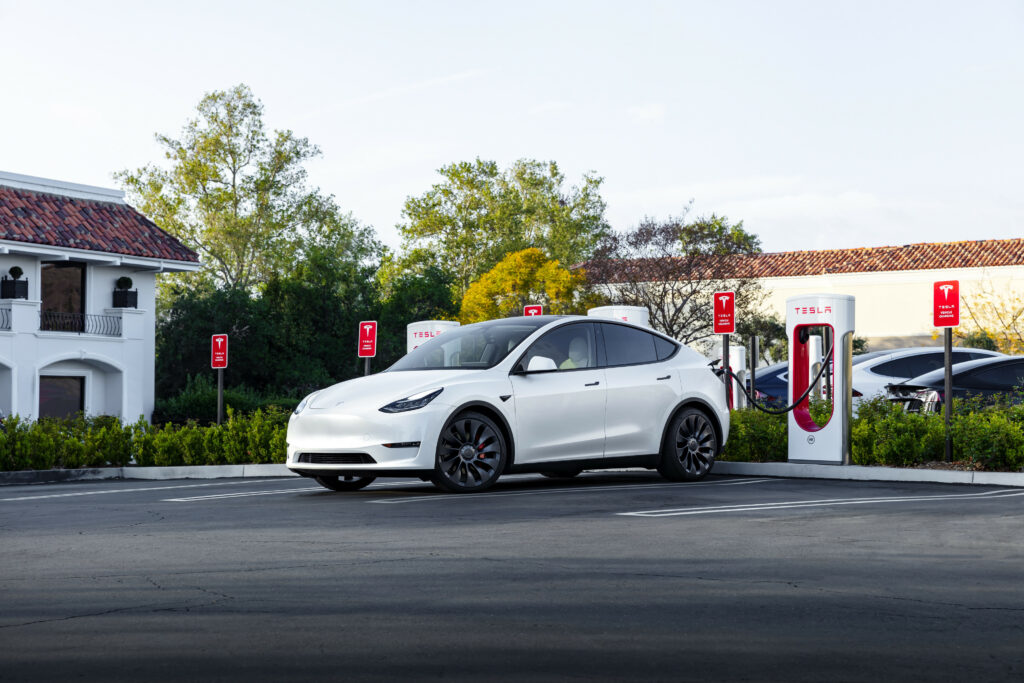
First, there’s one thing we need to make clear. Electric vehicles are not meant to be charged at public DC (direct current) fast chargers every time a charge is needed. It stresses the battery, and it costs a lot more than charging at home. For instance, fast chargers can charge a Model 3 from 10-80% in less than 20 minutes. That much energy transfer puts wear on the vehicle’s battery management system. Fast charging is great for road trips or when you’re in a pinch, but that’s all they’re meant for.
How much can you expect to pay for charging at a public DC fast charging station? Let’s consider the two largest charging networks in the nation: Tesla Superchargers and Electrify America.
As of early 2022, most Tesla Superchargers charge $0.28 per kWh of electricity. For a 2022 Tesla Model Y with a 82 kWh battery pack, that adds up to a cost of $22.96 to go 330 miles on a charge. Some Superchargers have variable pricing dependent on demand charges, as noted on Tesla’s Supercharging support page. “Certain Supercharger stations offer on-peak and off-peak rates. The rates and peak times are both displayed in the navigation application on the touchscreen.”
Depending on state and local regulations, some Tesla Superchargers charge per minute, rather than per kilowatt-hour of electricity. Tesla recently updated the rate structure for their per-minute Superchargers. With Tesla’s plug-and-charge, customers simply plug in the vehicle and the charger communicates with the car, begins charging and bills the customer’s Tesla account.
Here’s how the updated rate structure is tiered in 2022:
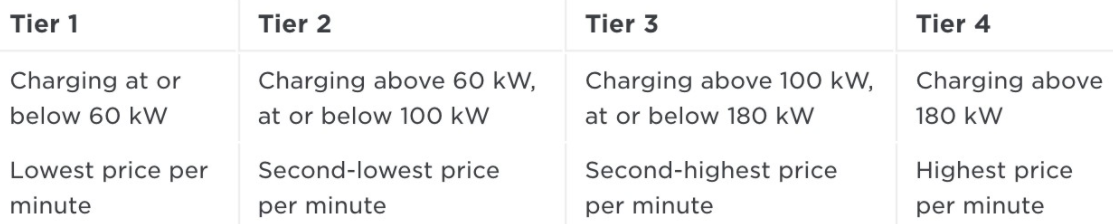
Source: Tesla
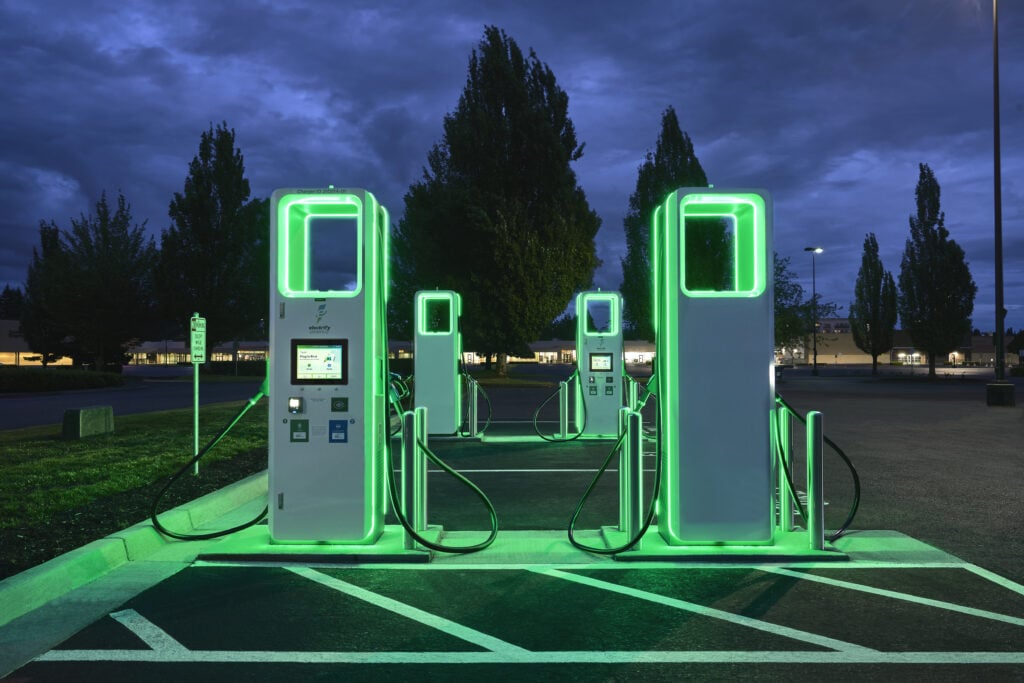
Over at Electrify America, customers can either pay $0.43 per kWh of electricity, or become a Pass+ member for just $4/month and charge at $0.31 per kWh. Having such an affordable membership plan is an interesting approach. That is to say, it almost seems like Electrify America is aiming to become a subscription that everyone with an EV will buy into for a sense of range security, even if they rarely use the network. Down the road, I’m sure prices will go up.
For a Ford Mustang Mach-E, filling up the 98 kWh battery from empty will cost $30.38 with the Pass+ membership. However, the cost jumps to $42.14 without it. Clearly, the fuel savings we often associate with going electric evaporate if charging costs are too high.
| Cost of Charging to 100% at a Tesla Supercharger | Cost of Charging to 100% at Electrify America as a Member | Cost of Charging to 100% at Electrify America as a Guest | Cost of Filling up an 18 Gallon Tank of Gas at $3.25/Gallon |
| $22.96 | $25.42 | $35.26 | $58.50 |
If you know someone who pulls up to Tesla Superchargers in their 2014 Model S and leaves without paying a dime, don’t expect the same perks when shopping for a 2022 Tesla. Early adopters received free supercharging ‘for life’, and there are plenty of Tesla owners out there who keep driving their high-mileage, slow-charging old Model S just for the free charging incentive.
If you’re hoping to score free charging with any of the 2022 EV models, I’ve got good news for you. Many 2022 models come with free charging at Electrify America charging stations. These new EVs all come with a free charging incentive for a limited time:
Some employers, especially large corporations and tech companies, offer free charging for EVs at dedicated parking spots. However, if your employer doesn’t offer charging, maybe you can be the one to spark the idea and help make it happen.
Prices have plummeted in recent years, and having an EV is yet another incentive to go solar. Most utility customers can participate in a net metering program that compensates homeowners for unused solar electricity contributed to the grid. If the sun is shining bright while you’re away at work, you still receive bill credits for the unused power your panels generated. The utility bill credits you’ll receive may cover the entire cost of charging your car. That’s 100% clean, free power for both your home and transportation!
How much does it cost to charge an electric car? As you can see, it depends on utility rates, incentives and if you charge at home or at public fast chargers. Fuel savings is one of the greatest benefits of switching from a combustion vehicle to an electric vehicle. As your consumer advocate, we want to make it clear that EVs don’t always save money. However, for the vast majority of American drivers, affordable electricity rates mean that at least $1,000 could be saved each year by going electric. And that doesn’t include the lower maintenance costs that most EVs have. For those who are fortunate to have a place to plug in at home or work, switching to an electric vehicle is a no-brainer.
Have any questions or comments? How are you feeling about the electrification of the auto industry? Let us know in the comments below, or check out the CarEdge Community forum at caredge.kinsta.cloud. You can also reach out to me at [email protected].

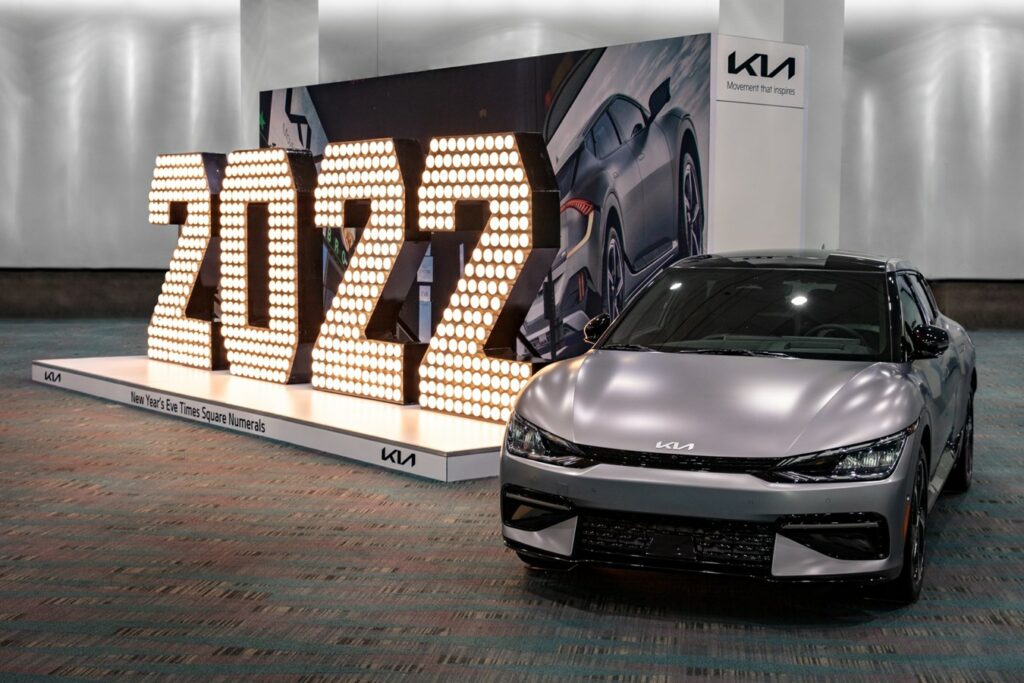
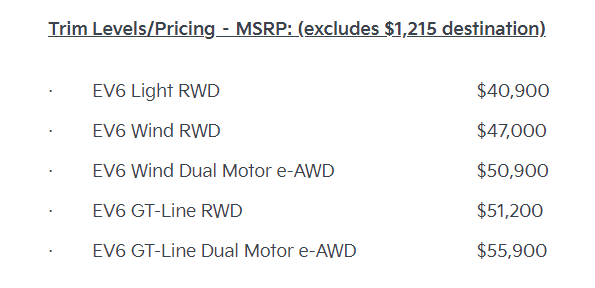
Update 1/25/22: At last, Kia has announced pricing for the 2022 EV6. The base EV6 ‘Light’ starts at $40,900, plus a destination fee of $1,215 for a total entry price of $42,115 for 2022. The EV6 does qualify for up to $7,500 in federal tax credits. Will dealer markups plague the EV6 as much as they have with the Hyundai IONIQ 5? We’ll have to wait and see. Deliveries start in the coming weeks, with the EV6 being available in all 50 states.
Here’s the full price breakdown for the 2022 Kia EV6:
If you’re a fan of the impressive range and charging figures of Hyundai’s new IONIQ 5 but don’t quite get the styling, maybe it’s sibling, the 2022 Kia EV6, is the electric auto for you. After making it’s official American debut at the 2021 LA Auto Show, this sleek electric crossover is slated to hit American roads within months. The new year brings so many more EVs to the market. Here’s what makes the Kia EV6 so distinctive among its peers in the crowded electric crossover segment.
The 2022 Kia EV6 is built on the new e-GMP electric platform engineered by Kia and Hyundai to power their vehicles for the next several years. Previously, Kia EVs like the 2021 Kia eNiro were merely EVs adapted to a chassis engineered for a combustion vehicle. This all-new platform offers decent efficiency and range, and exceptional fast-charging speeds. We’re talking even better than Tesla! In early 2022, only the Porsche Taycan, Lucid Air and Hyundai’s IONIQ 5 are capable of charging at 800 volts. Soon, the EV6 will join them.
Considering that nearly all variants of the Porsche and Lucid cost over $100,000, it’s amazing how far Kia has come to be a leading innovator in the industry. For the 2022 Kia EV6, charging from 10% to 80% (adding about 200 miles of range) takes just 18 minutes. Early tests at InsideEVs show a peak charging rate of 239 kW at public level 3 DC fast chargers. Those are worthy bragging rights for Kia!
Over 80% of EV charging is done at home with level 1 or 2 chargers. Some drivers rarely ever use level 3 fast chargers. With a 240 volt dryer outlet, the EV6 can charge from empty to full in 7 hours. Without giving it much thought, that may sound like a long wait. How many hours each night does your car sit in your garage or driveway? With EVs, most drivers wake up with a full ‘tank’ of electricity every single morning. It’s just like plugging in your phone when you hit the hay. Plus, electricity is much cheaper than gasoline. With myth-busting charging speeds both at home and on the road, the Kia EV6 will help turn the tide in the battle between gasoline and electricity.
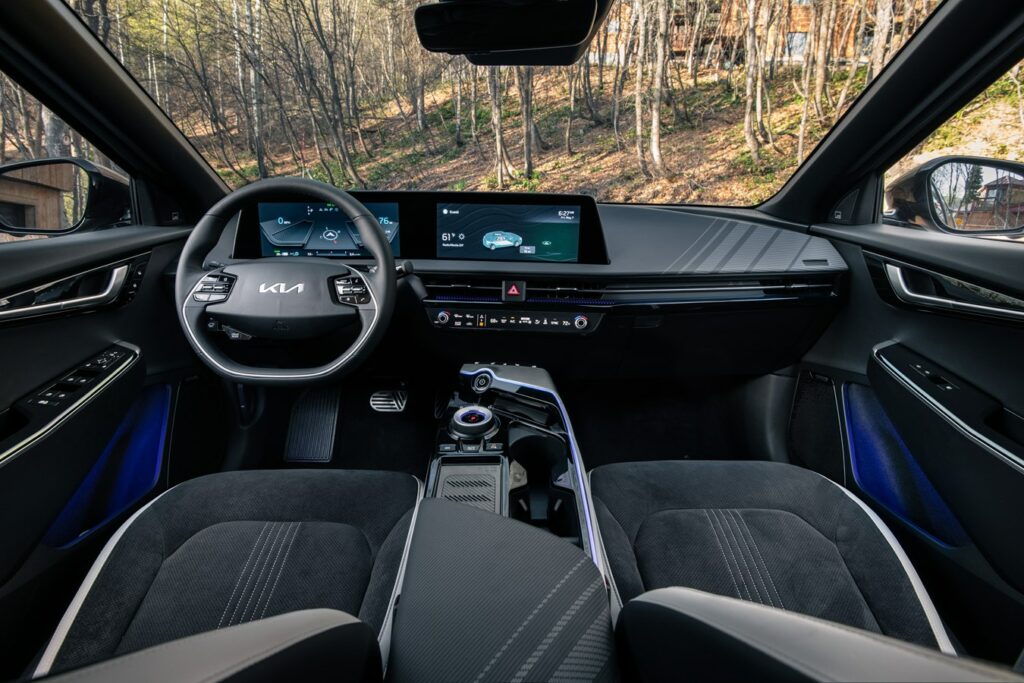
The 2022 Kia EV6 has a premium feel to it, and that’s something we’re still learning to expect from Kia. If someone told me back in 2006 that in 2022, Kia would be making one of the most sought-after electric vehicles on the market, I’d be skeptical. But stepping inside the EV6 welcomes drivers and passengers alike to a sense of spaciousness. The cabin is open and airy, yet the driver’s seat and surrounding controls remain driver-focused.
Cargo room is generous at 27.7 cubic feet, or 53.5 cu. Ft. with the rear seats down. Rear passengers have ample room, and it’s slightly more than you’d expect in a traditional crossover. However, the 61” height of the vehicle is two inches shorter than its Hyundai sibling. The Hyundai IONIQ 5 has a bit more room for rear passengers.

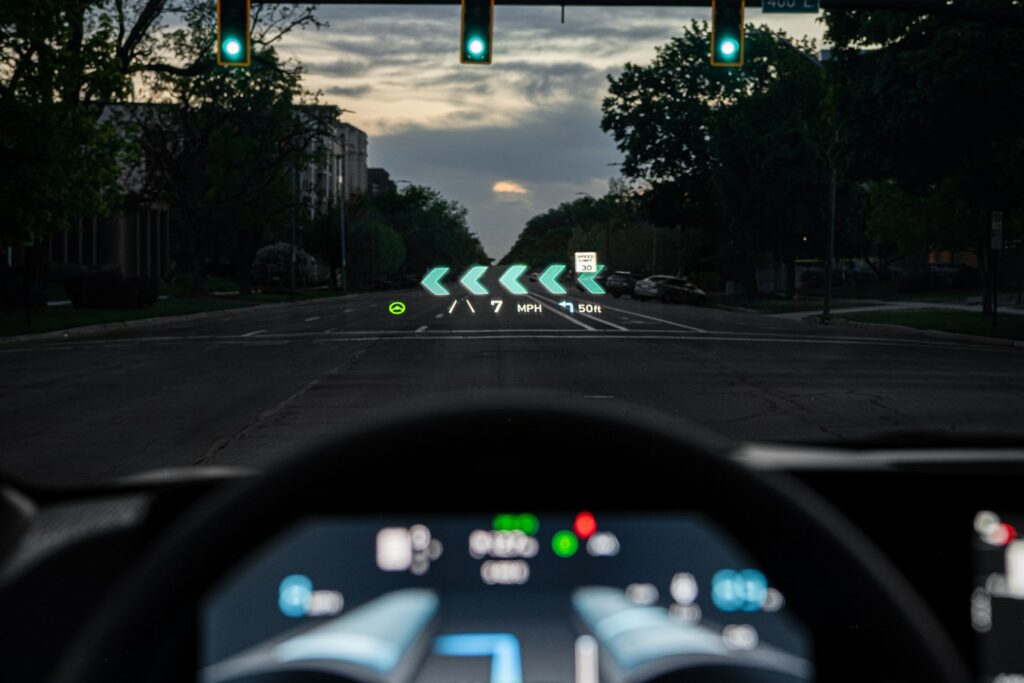
The EV6’s front dash consists of dual high-definition 12.3” screens, one for infotainment and another for the instrument cluster. Higher trims also include an augmented reality heads-up display that projects driving directions and basic info onto the windshield within the driver’s line of sight.
Kia is proud of the ambiance they’ve created in the EV6, and they highlight the intuitive user experience. “Convenience features such as keyless entry with touch-sensitive entry buttons, programmable driver profiles, relaxation seats and ergonomic design create an experience that puts the driver first. From the automatic flush handles that emerge from the car body, through to the intuitive touch-sensitive interfaces and the Augmented Reality head-up display, every journey in EV6 is designed to improve the human-machine interaction and promote a sense of well-being.”
The EV6’s 77.4 kWh lithium-ion battery is produced by SK Innovation, a leading manufacturer of batteries that also supplies Ford. With a curb weight of 4255 pounds, the 310-mile EPA rated range of the 2022 Kia EV6 is very good. That works out to 117 mpg-equivalent on a per unit of energy basis. That’s what you can expect from the rear-wheel drive version, which produces 225 horsepower (168 kW) and 258 lb-ft of torque, or 0-60 mph in 7.3 seconds. Adding an additional motor to the front increases power to 313 hp and a 0-60 time of 5.1 seconds, but range drops to 274 miles on a charge. Unlike combustion-powered vehicles, EVs get better range in city driving. The EV6 will likely get well over 300 miles of range cruising around town.
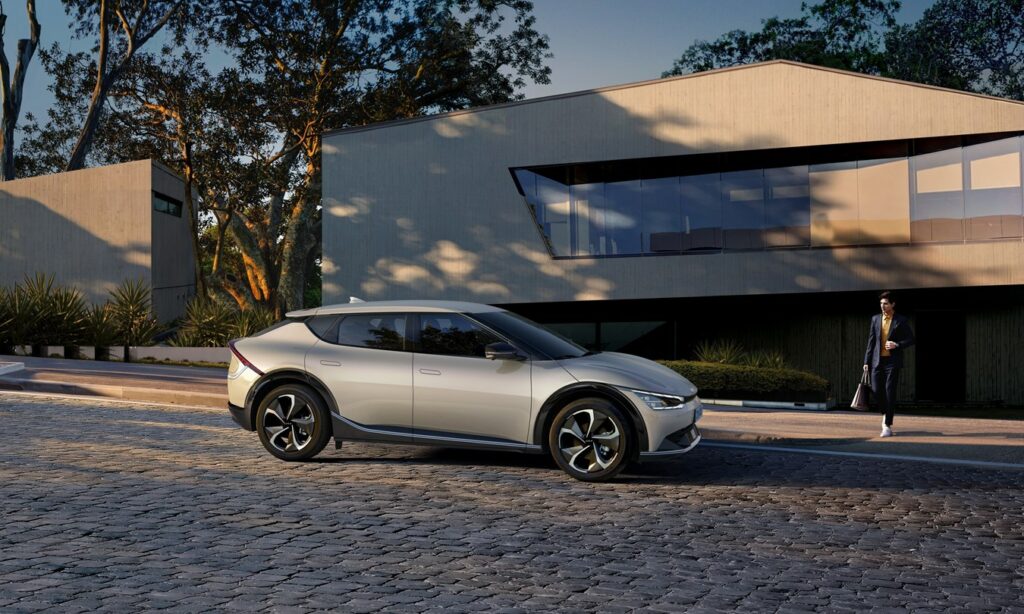
Kia has announced US pricing, and it’s just a hair above the Hyundai IONIQ 5’s MSRPs. Here’s what we know:
The Kia EV6 qualifies for the federal EV tax credit for up to $7,500, depending on tax liability. If you owe at least $7,500 in federal taxes each year, you can subtract that amount from these prices. For many buyers, the EV6 is effectively starting at just under $35,000.
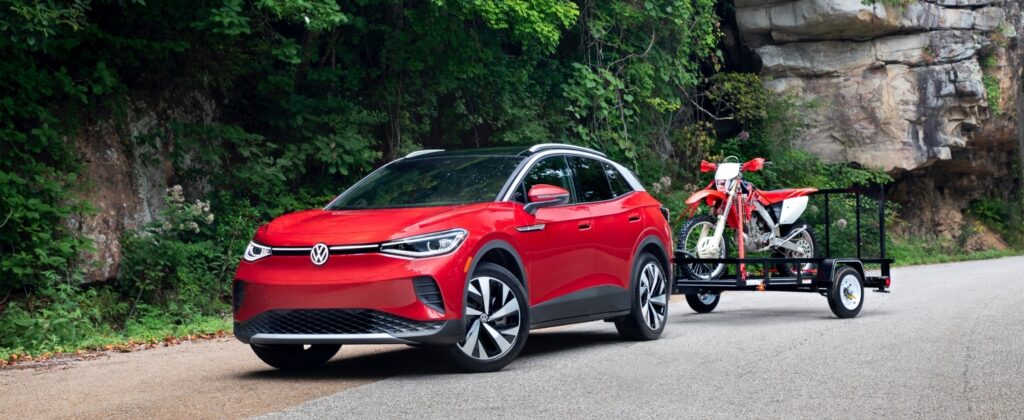
Once again, as we’ve seen with the top-trim Hyundai IONIQ 5, Ford Mustang Mach-E and Volkswagen ID.4, automakers seem to be cornering buyers into a familiar shopping comparison with Tesla. Do buyers want a base-trim Tesla Model Y for about $60,000, or a fully-loaded alternative from a legacy OEM?
As of January 2022, we know that the ‘EX+’ trim options include rear-wheel drive, 310 miles of range, premium sound, heated and ventilated seats, and an onboard power generator that can power laptops, cooking devices, party lights or whatever else you need to plug in. The more premium GT line tacks on a large power sunroof, surround-view and blind-spot monitoring, heads-up display, park assist and highway drive assist, all while riding around on 20-inch wheels.
With a starting MSRP around $42,000 with destination, the 2022 EV6 will be a real contender for crossover market share. Early access owners in the UK love their cars, and many point out the advantages over the elephant in the room (Tesla). While Tesla’s Model 3 and Model Y both have an ultra-minimalist dash and plain interior, the EV6 is full of gadgets and customization. Looking at the top GT-Line trims, buyers could be cross-shopping the Model Y and EV6 for roughly the same price. One big difference: Kia EVs still qualify for the current $7,500 federal EV tax credit. Which would you prefer, the Tesla or the new Kia?
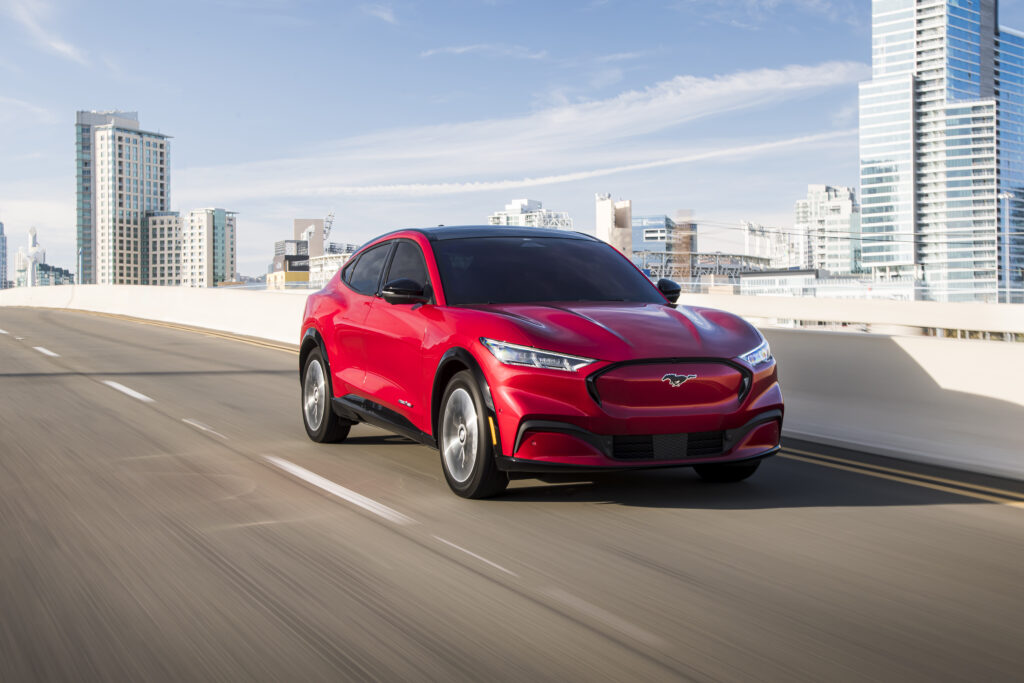
Another likely challenger is the Ford Mustang Mach-E, which sold 24,791 units in America through November 2021. The Mach-E has a few more feet of cargo capacity, but many reviewers note that the ride is quite firm. Shoppers looking for a softer ride and more leisurely handling will probably prefer the EV6. Those looking for a sporty Model Y alternative may find what they desire in the Mach-E. Range figures appear to be similar between the two, but the Kia has a clear advantage when it comes to charging time.
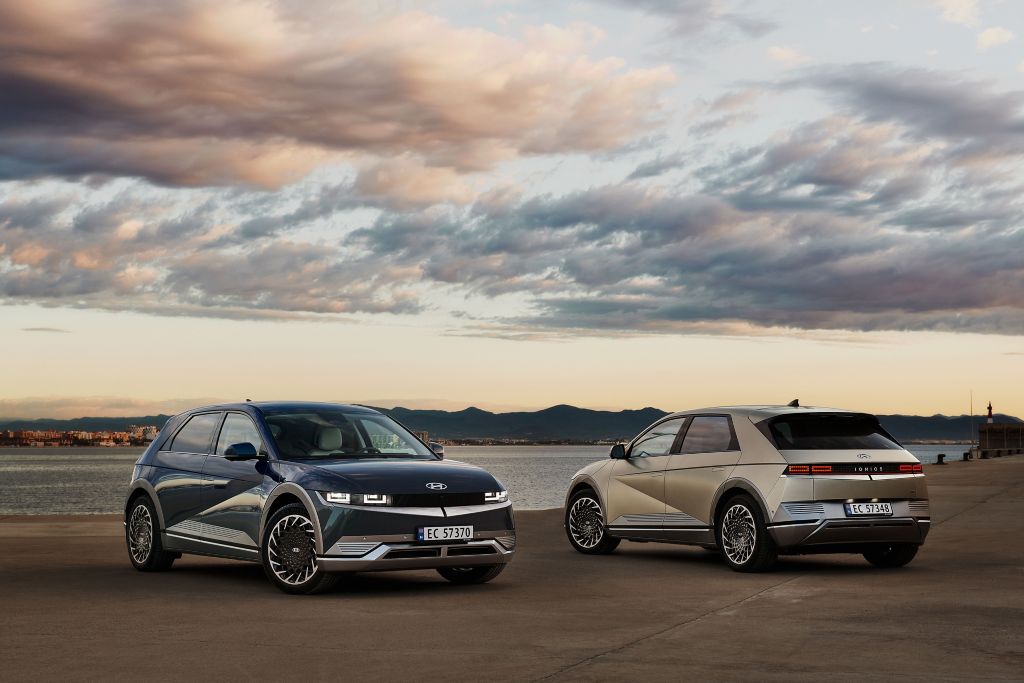
We do know a lot about the EV6’s e-GMP platform sibling, the 2022 Hyundai IONIQ 5. With a starting price of just $40,925 and roughly the same charging and range specs as what the EV6 has to offer, buyers will find that both interior and exterior styling language is the big differentiator. Those who love a retro look with a hatchback flare will instantly fall in love with the IONIQ 5. If you prefer a sleek, aggressive-looking EV that is a family-mover in disguise, the Kia may suit your needs. And then, there’s the supply factor. In the end, whichever OEM can ship more vehicles to America may win out in terms of sales.
Like a few other EVs, ‘early 2022’ is about all we know for now. Select dealerships have a pre-ordering process set up, so it might be worth a stop by your local dealership. If you’re hoping to drive an EV6 home in 2022, bear in mind the threat of additional dealer markups. If you are able to place an order, have in writing the out-the-door price your dealer will commit to. Our team of consumer advocates at CarEdge is ready to help you through this very important process. Don’t let surprise add-ons and ‘market adjustments’ keep you from getting into the driver’s seat.
With some automakers chasing Tesla and others stuck with heartless compliance EVs and struggling to get with the game, it’s refreshing to see EVs blossoming into compelling, fun-to-drive vehicles. The one big problem we see is the prohibitive price. EVs remain out of reach for many, and it doesn’t appear that the EV6 will help on that front. But then again, it doesn’t look like a ‘cheap’ car, so buyers will have to decide if it’s worth the price.
The Kia EV6 brings a new perspective to the crossover EV segment, and it’s one that consumers should definitely check out. The level of detail that the EV6 presents in both the driver-focused interior and eye-catching exterior serves as a reminder that not everything needs to aspire to Tesla. Kia is showing that our electric future is not set in stone. There’s still plenty of room for innovation as we charge ahead.
What do you prefer, the Hyundai IONIQ 5 or the Kia EV6? Let us know in the comments, or hop on over to the CarEdge Community Forum at caredge.kinsta.cloud.
(Updated for Summer 2022)
As anyone who’s fallen head over heels for one of the many 2022 electric vehicles and clicked that ‘Order’ button can attest, just because you can order an EV in 2022 doesn’t mean you can drive it home this year. This was a problem I faced myself, but I finally broke the code and got a Hyundai IONIQ 5 at MSRP (here’s how).
Soon after I began my online car search, it became clear that if I wanted a brand-new vehicle, my options were limited by availability. To make the most of the situation, I thought I’d share what I’ve learned about the availability and estimated delivery times for EVs on the market today. Here’s what we know as we kick off the new year.
Note: These are fully-electric models that can either be ordered now or purchased at a dealership today. Many more have been announced but are not yet officially available.
| Make | Model | Class | Starting MSRP | Estimated Delivery/Lot Availability* |
|---|---|---|---|---|
| Audi | e-tron | crossover SUV | $65,900 | Available Now |
| Audi | Q4 e-tron | crossover SUV | $43,900 | Available Now |
| Audi | RS e-tron GT | sedan | $103,445 | Available Now |
| BMW | iX | SUV | $88,050 | Mid-2022 |
| BMW | i4 | sedan | $55,400 | Mid-2022 |
| Cadillac | Lyriq | SUV | $62,990 | Late-2022 |
| Chevrolet | Bolt | hatchback | $31,000 | Available Now |
| Chevrolet | Bolt EUV | crossover SUV | $33,500 | Available Now |
| Fisker | Ocean | crossover SUV | $37,499 | 2023 |
| Ford | Mustang Mach-E | crossover SUV | $43,895 | Available Now |
| Ford | F-150 Lightning | truck | $39,974 | 2023-2024 |
| GMC | Hummer EV | truck | $99,995 | Mid-to-late 2022 |
| Hyundai | IONIQ | crossover SUV | $33,245 | Available Now (Discontinued) |
| Hyundai | IONIQ 5 | crossover SUV | $43,650 | Available Now |
| Hyundai | Kona | crossover SUV | $34,000 | Available Now |
| Jaguar | I-Pace | crossover SUV | $69,900 | Available Now |
| Kia | Niro | crossover SUV | $39,990 | Available Now |
| Kia | EV6 | crossover SUV | $42,115 | Available Now |
| Lucid | Air | sedan | $77,400 | Mid-2022 |
| Mazda | MX-30 | crossover SUV | $33,470 | 2022 - CA Only |
| Mercedes | EQS | sedan | $102,310 | Available Now |
| Mercedes | EQB | SUV | ~$55,000 | Late 2022 |
| Nissan | Leaf | hatchback | $27,400 | Available Now |
| Nissan | Ariya | crossover SUV | $47,125 | Late 2022 |
| Polestar | Polestar 2 | sedan | $45,900 | Available Now |
| Porsche | Taycan | sedan | $82,700 | Available Now |
| Rivian | R1T | truck | $67,500 | 2023 |
| Rivian | R1S | SUV | $70,000 | 2023 |
| Subaru | Solterra | crossover SUV | $46,220 | Mid-to-late 2022 |
| Tesla | Model S | sedan | $94,990 | Late 2022 - 2023 |
| Tesla | Model 3 | sedan | $46,990 | Mid-to-late 2022 |
| Tesla | Model X | SUV | $104,990 | 2023 |
| Tesla | Model Y | crossover SUV | $62,990 | Late 2022 - 2023 |
| Toyota | bZ4X | crossover SUV | $43,215 | Mid-to-late 2022 |
| Volkswagen | ID.4 | crossover SUV | $40,760 | Mid-2022 |
| Volvo | XC40 Recharge | crossover SUV | $55,300 | Available Now |
| *For a vehicle ordered in May 2022, unless there's existing dealership supply. |
A few things might stand out to you on this list. Not a lot of options are available if you need a new vehicle right now. VW Group’s new EVs are available at many dealerships, although there are reports of major dealer markups. It’s quite easy to find EVs of the previous generation on dealer lots. Think Kia eNiro, Hyundai Kona EV, Nissan Leaf and the like.
The vast majority of 2022 electric vehicles are crossovers. No surprise there given the sales trends over the past decade. Honda doesn’t have a single EV arriving in the North American market until the 2024 Prologue electric SUV. That is surprising considering the popularity and good reputation of the brand. What will it take for automakers to catch up to demand? An end to the chip shortage would be a great step in the right direction. There’s also the supply versus demand factor. Ford, Rivian, Tesla and VW are all swamped with orders well into 2022, and even into 2023. All except Tesla are EV newcomers who are facing the same production ramp-up struggles that Tesla just barely survived a few years ago. We’ll update this page regularly as more information becomes available, so save it to your bookmarks!
Did we miss anything? Let us know in the comments below, or shoot an email to [email protected].

Updated for 2023: https://caredge.com/guides/used-car-price-trends-in-2023
Used car prices trends for 2022 have been interesting. In 2021, unlike any other time in history, used car prices increased. What used to be a depreciating hunk of metal was an appreciating asset, but the car price bubble wasn’t sustainable in the long term. With used car prices remaining volatile, it’s never been more important to track the value of your car.
During the first quarter of 2022 used car prices dropped nearly 5% on the wholesale markets. Springtime brought another increase in used car prices. As we approach autumn, we’ve now seen 24 consecutive weeks of used car prices dropping at the wholesale level. Used car prices are going down, as you’ll see in the latest data below.
While wholesale used car prices have declined significantly over the past ten weeks, retail used car prices have remained fairly steady. That may soon change. The demand for used cars has weakened in recent weeks, and we’re now seeing increases in used vehicle listings as cars sit on the lot longer.
Used car prices in 2023 will continue to decrease. Higher interest rates combined with greater new car inventory will continue downward pressure on used car prices in 2023.
👉 Bookmark this page. Just like we did last year, each week we’ll update this URL with the latest used car price trends. Our hope is that by being informed of the trends in used car prices you can make smart financial decisions about when to trade-in, sell, or buy a car.
Without further ado, let’s dive in.
As of December, used car prices declined (at wholesale auctions) for 24 weeks in a row. We expect this trend to increasingly translate to retail sales.
What types of used cars are dropping, which are increasing? Is now a good time to buy a used car? Should you sell your car now, or wait for prices to go back up? Let’s answer those questions and more.
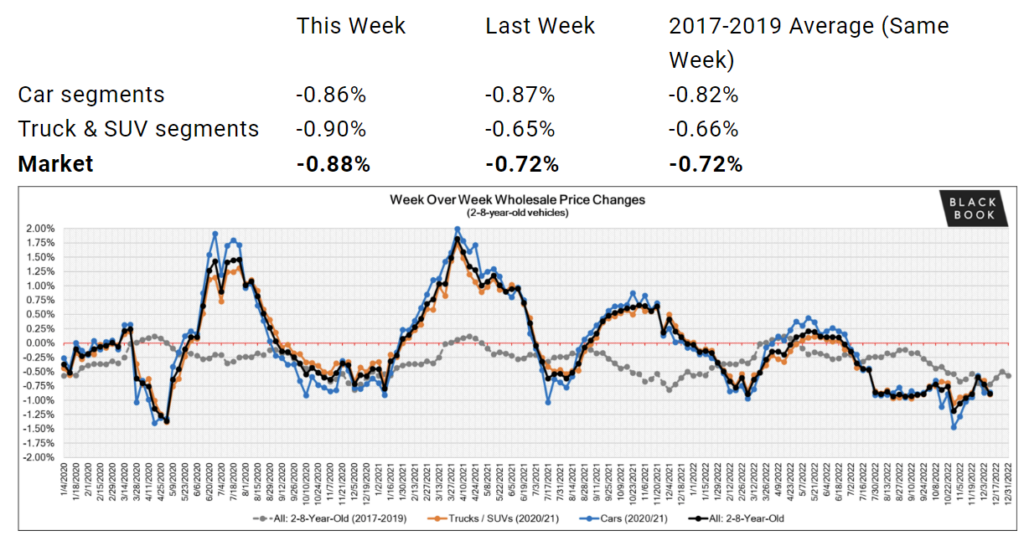
Through April , used car and SUV prices declined by ~5%. This was more depreciation than we’d expect in a “normal” year for the same time period. The rate of depreciation increased in February from January, however the trend reversed in March and April.
In May and June, we saw a reversal, with used car and SUV prices increasing week-over-week on the wholesale market. In December, the overall market is dropping, with no vehicle classes continuing to appreciate.
The overall wholesale used car market saw prices drop -0.88% last week. Cumulatively, used car prices have dropped -19% at the wholesale level over the past 6 months.
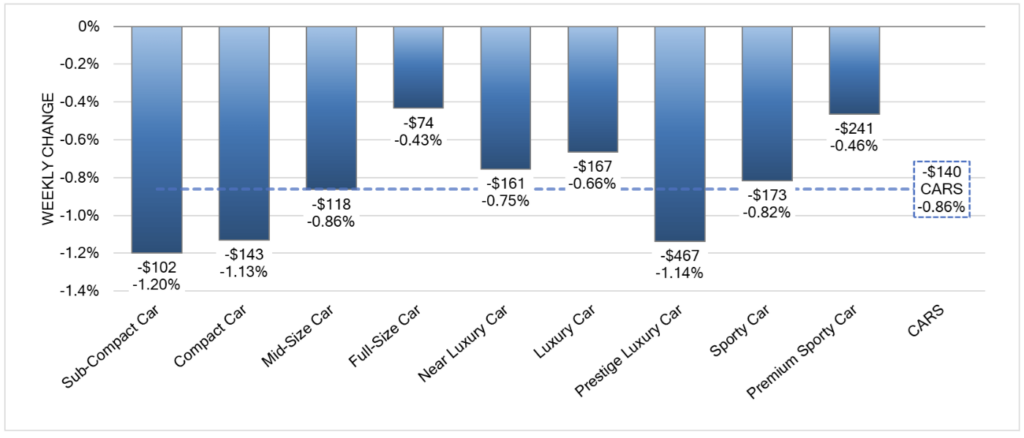
Mass-market car segments dropped the most last week. Compact and sub-compact cars dropped by over -1%, mid-size cars by -0.86%, and full-size cars by -0.43%. Overall luxury car prices fell by about 1% last week.
All used car segments saw declining prices last week, with an average of -0.86%. The week before, car prices were down -0.87%.
We are now seeing a sharp reversal in light-duty truck segments. The overall truck segment decreased -0.90% last week. Compact crossover prices declined the most, by -1.20%.
Mainstream crossover and SUV prices all fell by between -0.79% and -1.20% last week.
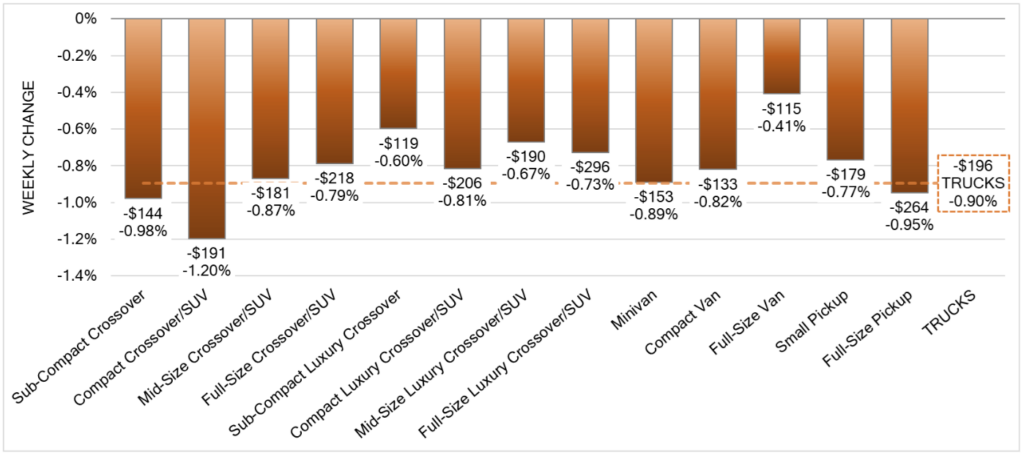
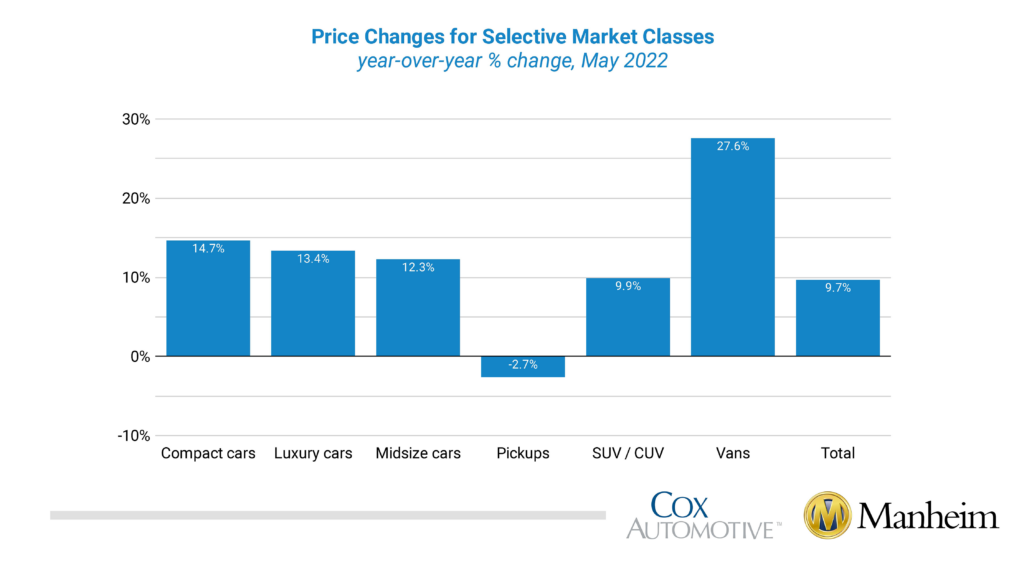
Since the onset of the pandemic, full-size vans have appreciated more than 60%. Now, we’ve seen wholesale full-size van prices drop about -5.0% in the past two months. This week, van prices dropped -0.41% in one week.
Year-Over-Year Prices Remain High
The graph below looks at trends in wholesale prices of 2-6-year-old vehicles, indexed to the first week of the year.
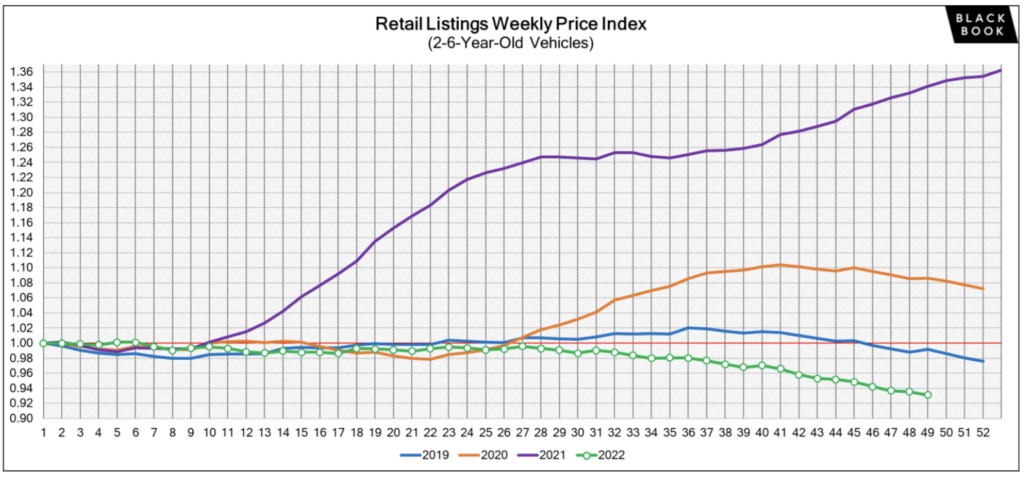
When will retail used car prices go down? Black Book’s weekly price index suggests that used car prices will steadily drop in 2023, after four months of slow but steady price declines in 2022. We expect prices to continue falling into 2023 due to the combined effects of higher interest rates restricting buying and the greater availability of new cars, which often have competitive promotional APRs.
We’re starting to see retail prices come down. Cars are also sitting on the lot for longer. As more vehicles sit on the lot, dealers will be more willing to negotiate.
Use this negotiation cheat sheet to stay in control of your deal
A new phenomenon we have begun tracking is that older used cars are appreciating more rapidly than younger used cars.
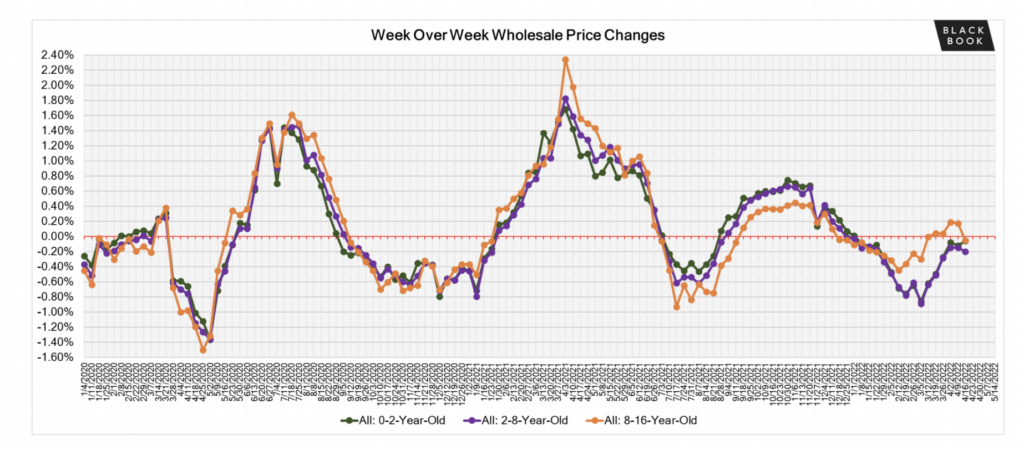
This is primarily a function of consumer demand. Retail customers that want to purchase a car at a sub $20,000 price-point are being forced to look at older used vehicles because the new ones have increased in value beyond their budget. This is scary, crazy, and a whole host of other words.
Wait until at least mid-September to buy a car. We expect to see retail prices decline beginning in early September, following eleven weeks of wholesale declines.
Used cars are sitting on the dealer lots for longer, and that creates better conditions for negotiating a better deal.
Sell as soon as you can. Used car prices are already dropping, and we expect retail prices to decline more in September.
To sell your car for the most money, be sure to read this guide.
Depending on who you ask (Cox Automotive, Edmunds, CarGurus, or Black Book), retail used car prices increased anywhere from 32% to 36% in 2021.
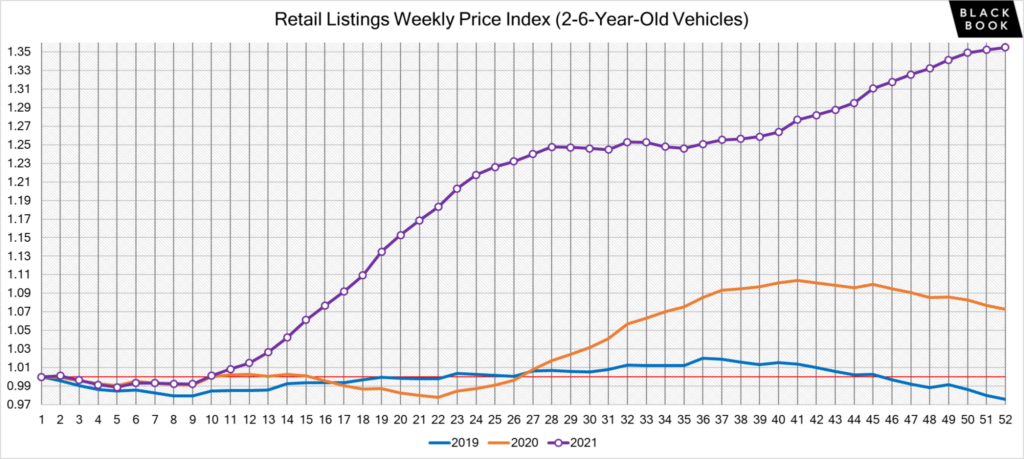
Black Book shows a 35% increase in retail used car prices for 2021 (the purple line). For comparison, the orange line shows a 7% appreciation for used car prices in 2020, and the blue line shows a 3% depreciation of used car values for 2019.
Here’s a month-over-month table showing used car price trends for 2021:
| Month | Average Used Car Price |
| January | $22,112 |
| February | $21,573 |
| March | $21,343 |
| April | $22,568 |
| May | $24,414 |
| June | $25,101 |
| July | $25,500 |
| August | $25,890 |
| September | $26,548 |
| October | $27,067 |
| November | $27,569 |
| December | $29,000 |
This data, supplied by Cox Automotive, shows the incredible ascent used car prices took in 2021.
Different types of vehicles have appreciated more than others. Vans have increased in value the most of all used cars. Take a look at this chart and data from CarGurus.
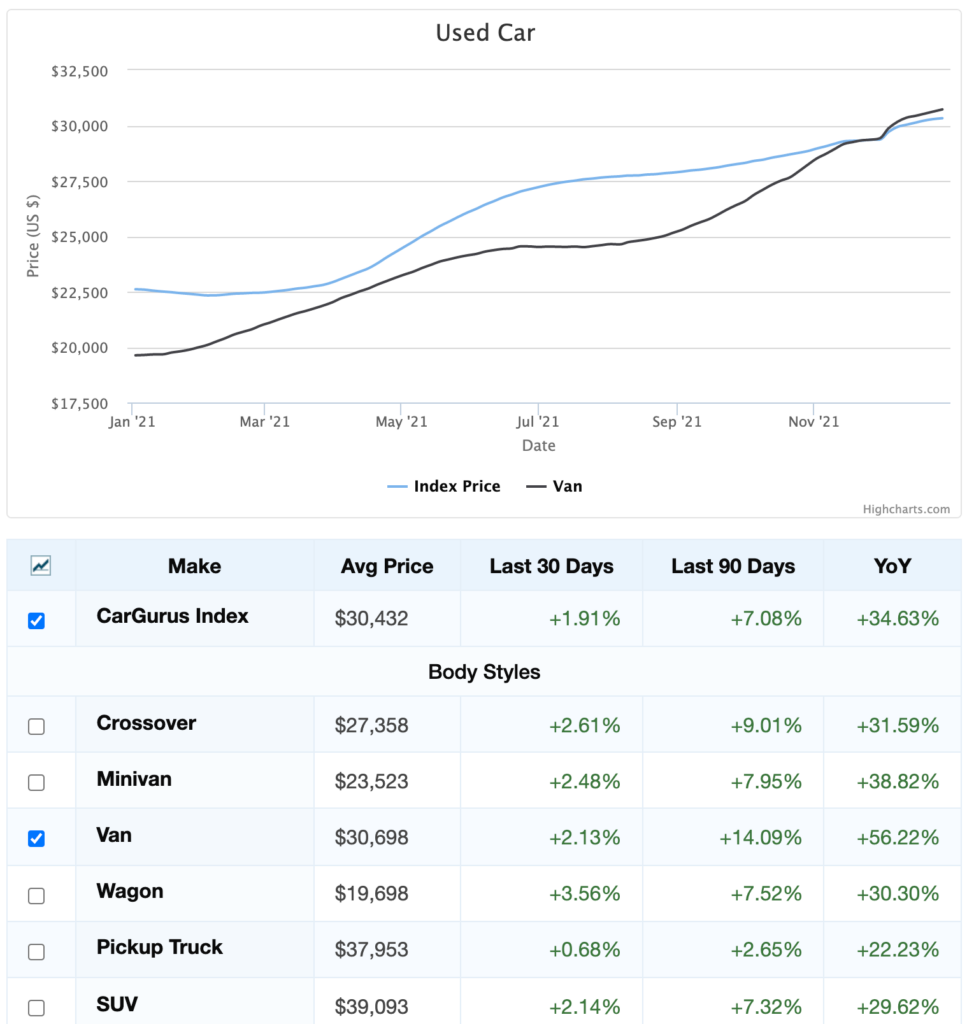
In 2021 used van prices increased over 56%, whereas CarGurus’ data showed a more modest (yet still insane) 34% increase for used car prices in general.
Used van prices have increased the most across vehicle segments for a few reasons:
For these reasons, and many more, used van prices have increased the most of any segment of vehicle.
Every used car has two prices; the wholesale price, and the retail price. As consumers we typically concern ourselves with the retail price, and with good reason, unless you have a dealer’s license you can’t buy a car wholesale at an auction.
That being said, wholesale used car prices are the lifeblood of car dealers, and the used car price trends we saw on the wholesale side in 2021 were truly unfathomable. While retail used car prices increased ~36% in 2021, wholesale used car prices rose 52%.
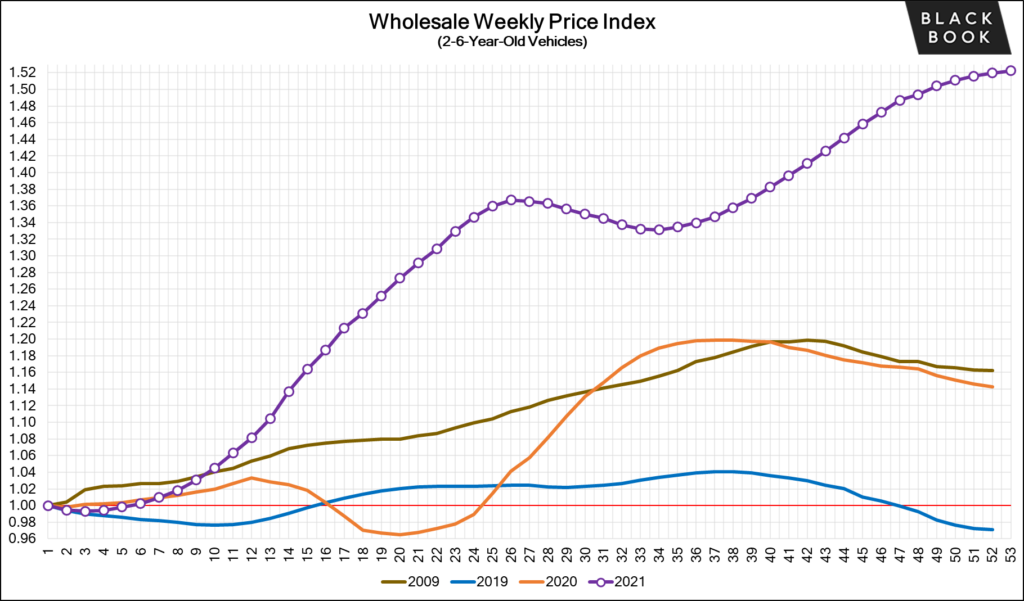
There is an obvious interplay between wholesale and retail prices. As wholesale prices increase, we can expect retail to prices to do the same. Here at CarEdge we are concerned that retail prices will stay highly elevated for a long time (potentially all the way through the fall of 2022) because car dealers will not want to discount their inventory that they grossly overpaid for earlier in the year.
Thanks to our friends at foureyes, we can share with you this real-time updating data set on used and new car prices.
As we enter autumn, retail and wholesale used car prices are falling. In October 2025, the average used car listing price sits at $25,512. The car market is changing as year-end sales approach. This combination of seasonality and economic uncertainty means that used car prices will be difficult to forecast in the weeks ahead. With the continuing market volatility, it’s never been more important to track the value of your car.
👉 We also track new car prices. See the latest monthly update here.
As of October, used car prices have fallen for 25 consecutive weeks. According to the latest used car market data from Black Book, the used car prices are slowly but steadily falling at wholesale markets. These are the markets that most car dealerships buy and sell preowned inventory from. Will retail used car prices continue dropping? We’ll get into that below. First, let’s take a closer look at wholesale prices last week.

This week, wholesale used car prices continue a steady decline as the year-end car buying season appears on the horizon. That’s a great sign for buyers looking for lower prices in the weeks ahead.
In the first week of October, wholesale used car prices fell – 0.26% according to Black Book data. This drop is on par with the historical average for this time of year, following several week of larger declines.
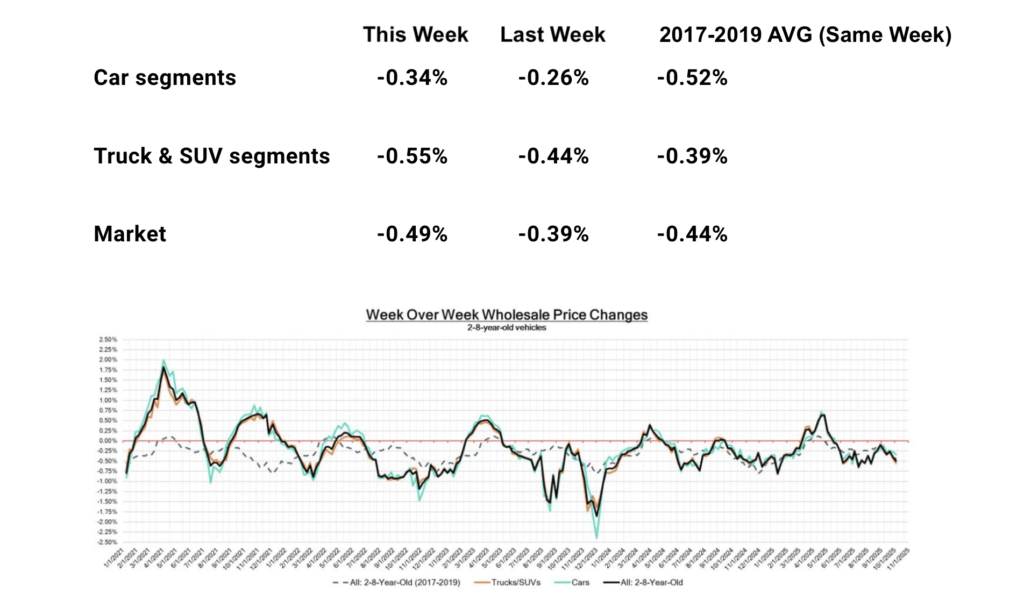
Which used car prices are falling most? Let’s take a look at the latest data from Black Book. We’ll break it down by vehicle segment below.
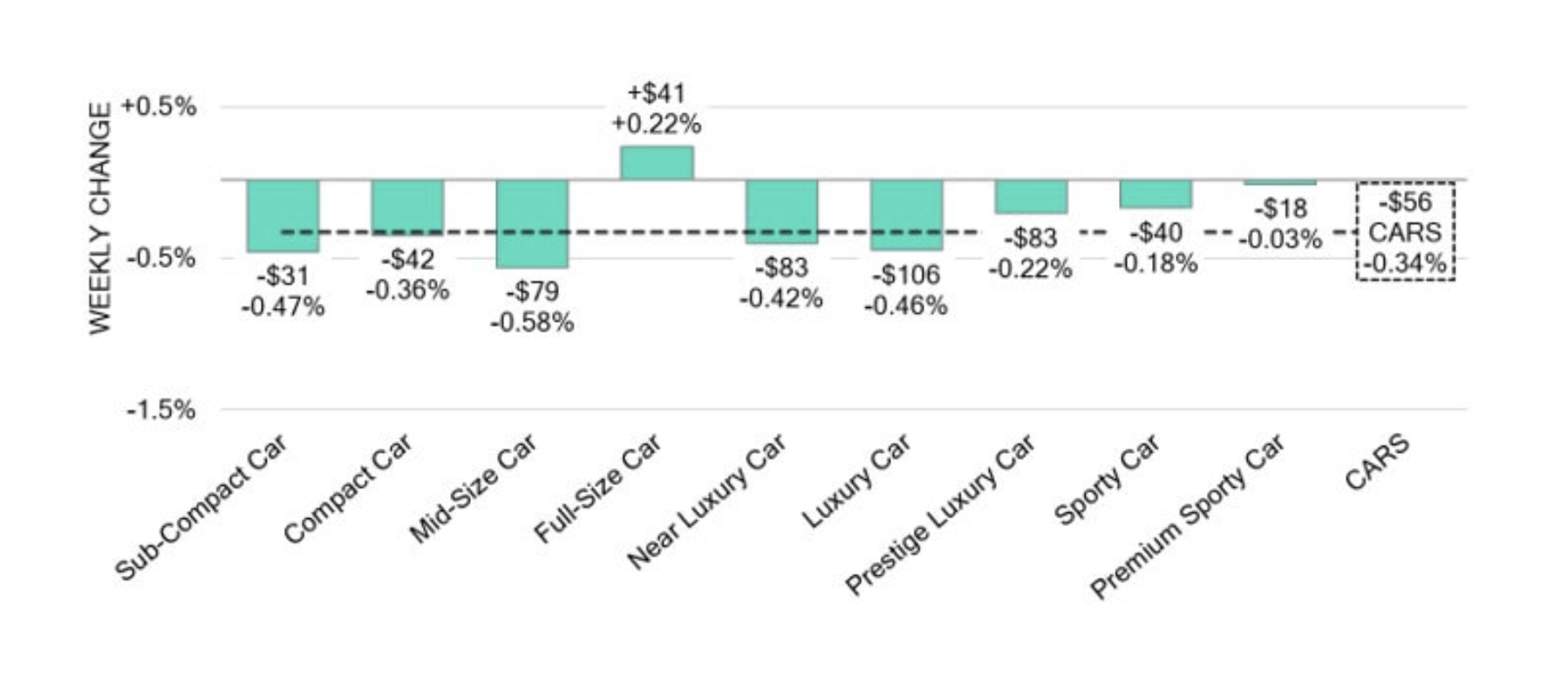
The overall car segment saw prices fall -0.34% this week. Most segments of sedans, from luxury to compact, saw falling prices. Midsize and luxury car prices fell the most, while full-size cars actually increased. Here’s how used car prices changed over the past week:
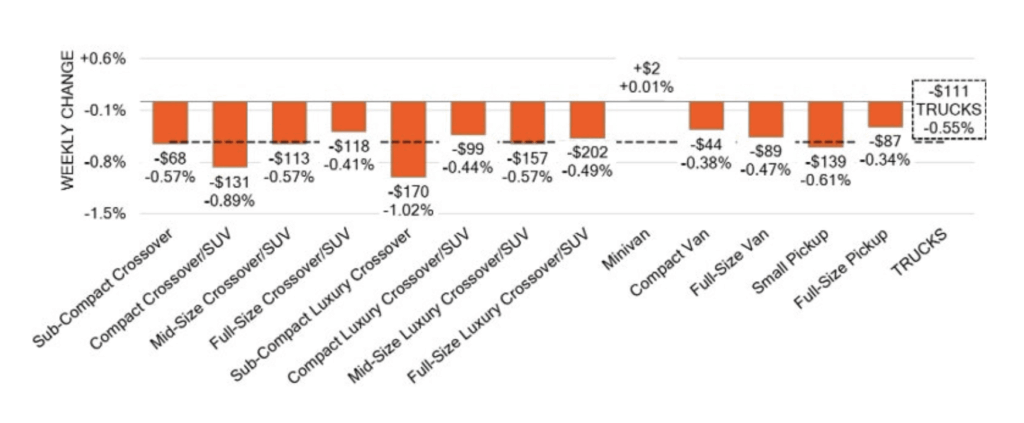
Used truck and SUV prices are falling in October 2025. No segments are falling sharply, but all are seeing moderate declines. Across the segment, wholesale prices fell by -0.55% last week. Buyers should expect better negotiability for used truck and crossover models as the year-end car buying season gets started. How so? Car buyers tend to focus on new car incentives during this time, lowering the demand for used cars. Buyers can use this to their advantage.
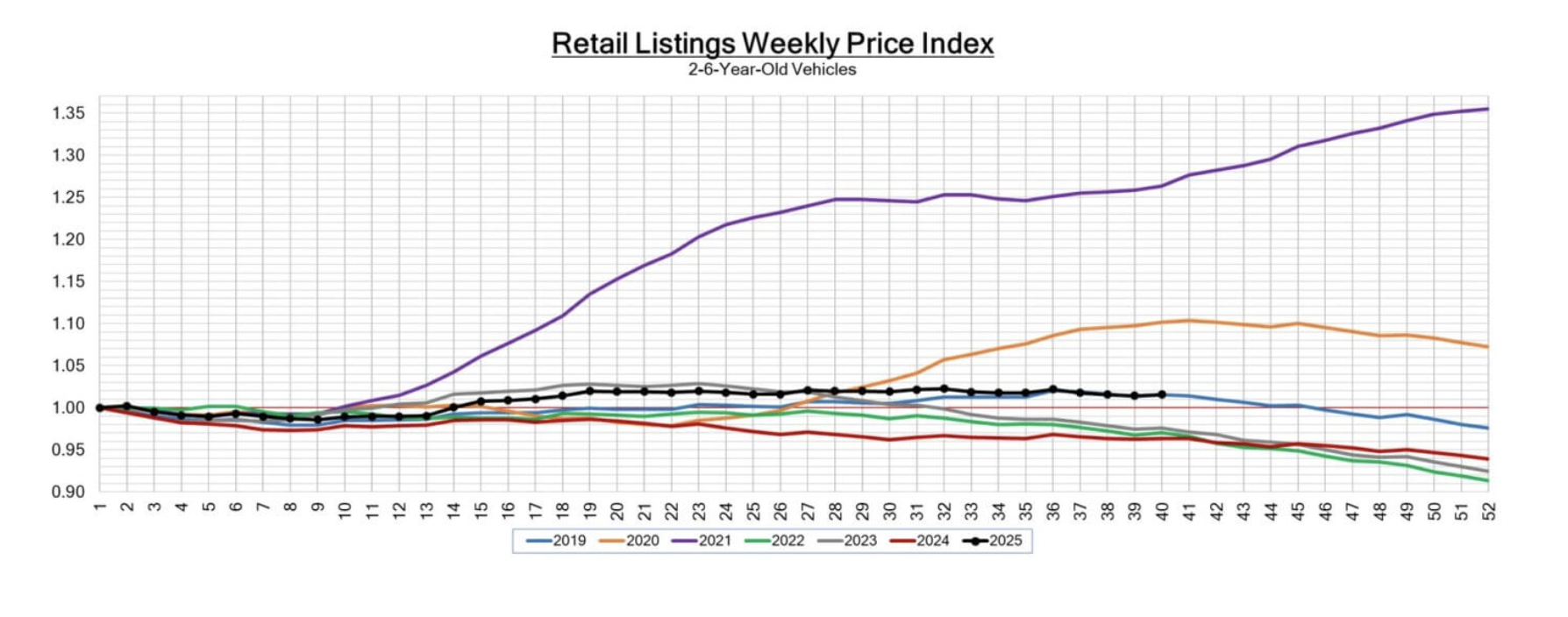
As the data above shows, retail used car prices are basically unchanged in early October. Historically, used car prices fall during the autumn and winter months. We’ll be watching to see if that trend continues in 2025.
Lower interest may drive the demand for used cars higher in the coming months. This is something that both buyers and sellers should be aware of. Sellers are likely to have an easier time selling come December and beyond, while buyers will face increased competition.
Used cars are selling faster than they have in recent years. In the graph below, you can see how the retail days-to-sell metric has been falling over the past few months.
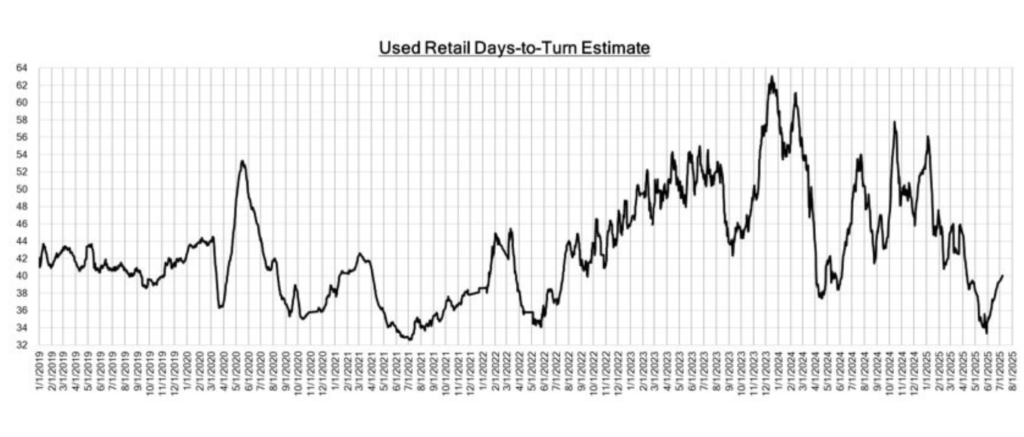
According to Black Book, the estimated Used Retail Days-to-Turn is now at 36 days. In other words, it take 36 days to sell a used car on average in 2025. Late last year, this number was north of 55 days. It’s interesting to note that used car prices are falling as the time to sell has fallen sharply. Usually, we’d expect to see the time to sell increase as prices fall. Of course, cars in higher demand will sell quicker, and those with less demand can take considerably longer.
New Car Price Trends (Monthly Updates)

Ready to outsmart the dealerships? Download your 100% free car buying cheat sheets today. From negotiating a deal to leasing a car the smart way, it’s all available for instant download. Get your cheat sheets today!
A new phenomenon we have begun tracking is that older used cars are appreciating more rapidly than younger used cars.
This is primarily a function of consumer demand. Retail customers that want to purchase a car at a sub $20,000 price-point are being forced to look at older used vehicles because the new ones have increased in value beyond their budget. This is scary, crazy, and a whole host of other words.
How did used car prices get so high? To find the answer, we simply need to remind ourselves of the car shortages of 2021. Depending on who you ask (Cox Automotive, Edmunds, CarGurus, or Black Book), retail used car prices increased anywhere from 32% to 36% in 2021.
Black Book shows a 35% increase in retail used car prices for 2021 (the purple line). For comparison, the orange line shows a 7% appreciation for used car prices in 2020, and the blue line shows a 3% depreciation of used car values for 2019.
Here’s a month-over-month table showing used car price trends for 2021:
| Month | Average Used Car Price |
| January | $22,112 |
| February | $21,573 |
| March | $21,343 |
| April | $22,568 |
| May | $24,414 |
| June | $25,101 |
| July | $25,500 |
| August | $25,890 |
| September | $26,548 |
| October | $27,067 |
| November | $27,569 |
| December | $29,000 |
This data, supplied by Cox Automotive, shows the incredible ascent used car prices took in 2021.
Every used car has two prices; the wholesale price, and the retail price. As consumers we typically concern ourselves with the retail price, and with good reason, unless you have a dealer’s license you can’t buy a car wholesale at an auction.
That being said, wholesale used car prices are the lifeblood of car dealers, and the used car price trends we saw on the wholesale side in 2021 were truly unfathomable. While retail used car prices increased ~36% in 2021, wholesale used car prices rose 52%.

There is an obvious interplay between wholesale and retail prices. As wholesale prices increase, we can expect retail to prices to do the same.
Thanks to our friends at foureyes, we can share with you this real-time updating data set on used and new car prices.

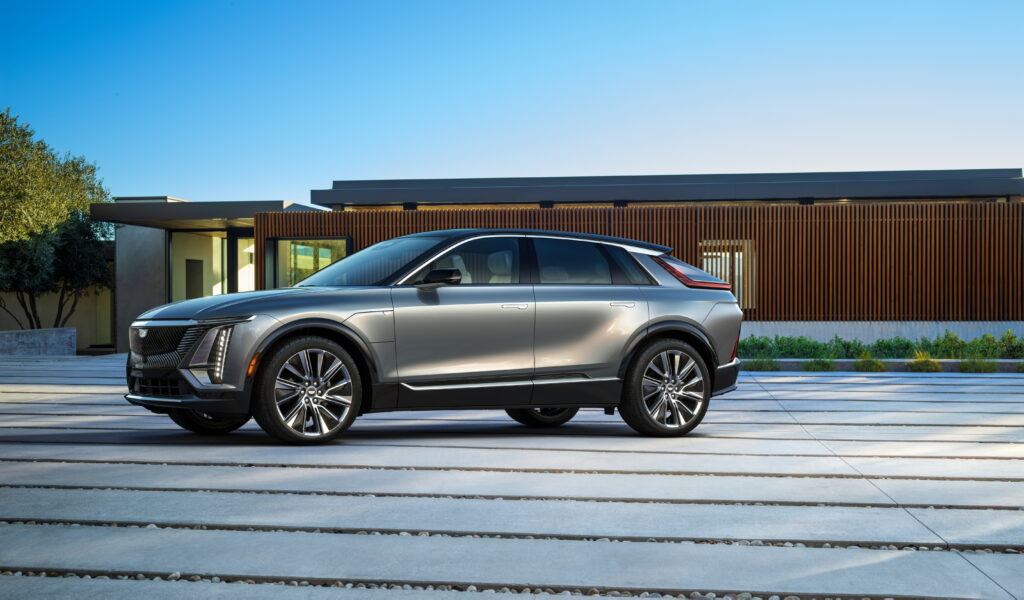
After five years of offering the Chevrolet Bolt as their flagship EV, the General is going all-in with EVs. Now, all eyes are on the next three electric models. The first has just begun deliveries, the $100,000+ GMC Hummer EV. And now, the 2023 Cadillac Lyriq luxury SUV is hitting the market, soon to be followed by the Silverado EV.
By 2030, Cadillac will be an all-EV brand. Other GM brands will follow suit by 2035. GM lost dozens of Cadillac dealerships nationwide after it provided an ultimatum requiring dealers to spend about $200,000 on EV upgrades, or withdraw from the brand altogether and accept a buyout. About one-third of Cadillac dealerships took the buyout, and GM spent a total of $274 million. At the end of 2021, just 560 Cadillac dealerships remained, down from 920 just three years prior.
Now that the dealership shuffle has settled, it’s prime time for Cadillac to unveil the first of its EVs. Deliveries of the Lyriq have just started, and production is ramping up. Here’s what we know about Lyriq pricing, range and more.

For starters, the Lyriq is a true SUV in size and stature. The outside has all the Cadillac design language you’d expect. Walking up to the Lyriq, you’re greeted by a welcome light show put on by the 50 LEDs illuminating the angular front grille. Stepping into the cabin, the first thing you’ll notice is the meticulous detail and labor of love, from the tree canopy inspired door illumination to the well-placed open-pore wood decor throughout.
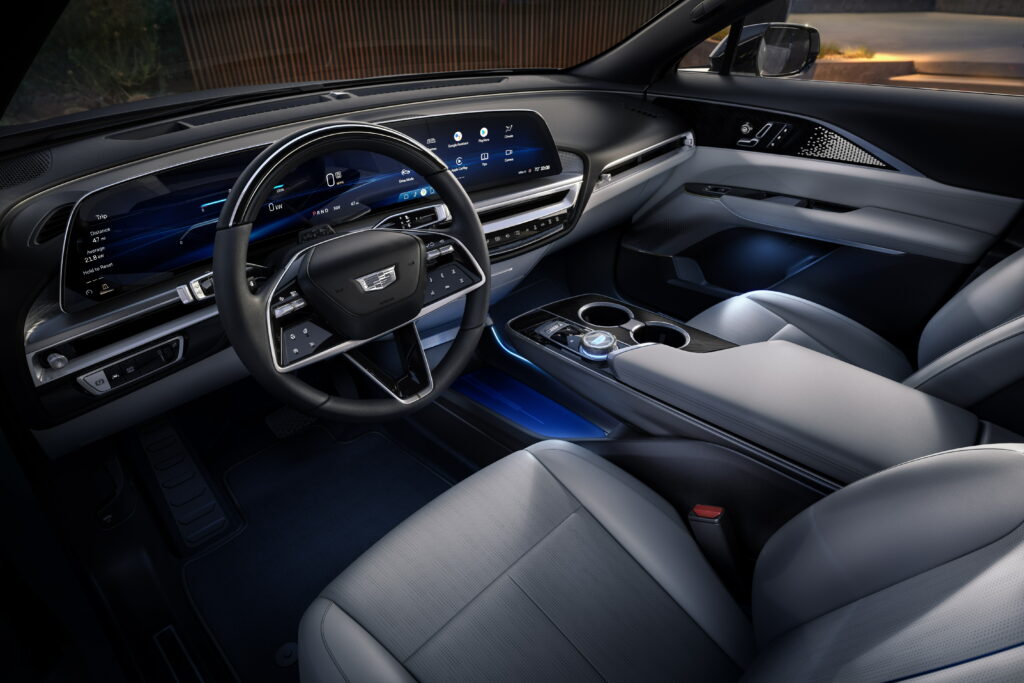
If you lament the auto industry’s shift away from physical controls in favor of haptic feedback and touchscreens, you’ll be a fan of this interior. The Lyriq strikes the ideal balance of physical buttons and knobs and a healthy serving of touch controls. The 33” horizontal screen wrapping across the front dash may sound like the antithesis of physicality, but the screen and surrounding physical controls complement each other, making for an intuitive experience. The Lyriq’s 33” single screen is surprisingly similar to what you’ll find in the much more expensive Lucid Air, and more well-placed than the single 15” screen centrally located in the Tesla Model Y. A Cadillac-exclusive AKG Studio 19-speaker audio system provides excellent sound for audiophiles.
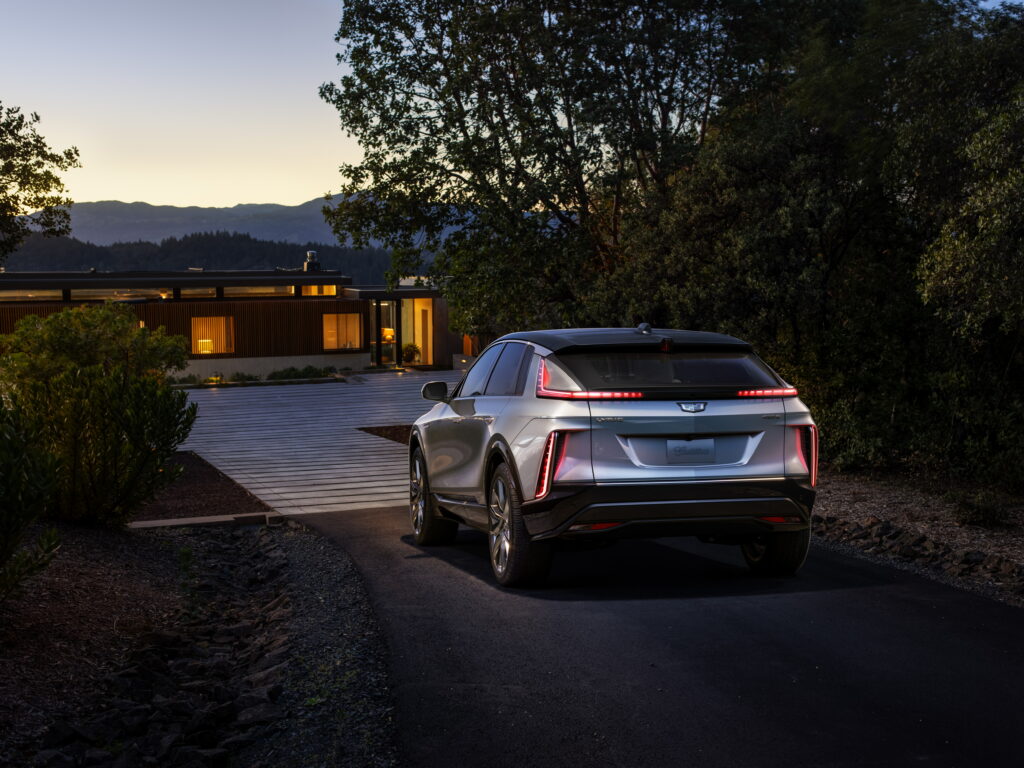
The Lyriq’s tech is all-around impressive. Super Cruise is at the heart of Cadillac’s Smart System suite of safety and driver assist features. Super Cruise supports hands-free driving on over 200,000 miles of North American roads. The ‘hands-free’ part is a big deal, as even Tesla isn’t yet ready to make that claim (and with good reason).
A popular feature of EVs is one-pedal driving. Most EVs allow for energy recuperation as the vehicle slows down. This is called regenerative braking. In essence, some of the electricity that was used to accelerate is recovered as the vehicle slows down, and is returned to the battery. But not all EVs are capable of strong enough ‘regen’ to make the brake pedal almost unnecessary, except of course during instances when hard braking is needed. The Lyriq has what looks like paddle shifters behind the steering wheel. These are the controls for regen strength. At the highway setting, the Lyriq will slow to a stop without needing the brake. Using regen on a daily basis takes some getting used to, but as Tesla owners can attest, it ultimately becomes second nature.

The Lyriq’s serene cabin is well-insulated and quiet with active noise cancellation. 8-way power driver and front-passenger seats with 4-way power lumbar, heat, ventilation and lumbar massage are all included with the 2023 Cadillac Lyriq. Rear passengers have access to dual USB-C charging outlets and a three-prong outlet for charging laptops and other larger devices.
Cadillac claims an expected EPA range of about 312 miles on a charge with rear-wheel drive. Considering the large size of the Lyriq and the rapidly growing charging networks, that’s more than enough for almost everyone. EVs are generally more efficient at lower speeds, so the Lyriq is likely to go well over 300 miles in city driving, and 250 or so on the highway.
When it comes time to charge, the Lyriq supports 190 kW fast charging at level 3 public chargers, like those you’ll find at Electrify America and Tesla Superchargers (if they ever open up to non-Teslas in America). This works out to about 76 miles of range in 10 minutes, or 200 miles in about 30 minutes.
At home, a level 2 charger can be installed into a 240 volt outlet like you’d use to plug in a dryer. This is where the Lyriq stands out above the charging competition. The Lyriq supports segment-leading 19.2 kW home charging, which can add up to 52 miles of range per hour of charge, or a full battery from empty in just six hours. To the uninitiated EV shopper, six hours might sound like a long time, but don’t forget that charging is done at night while you’re asleep. Most Lyriq drivers will wake up with a full battery every morning.
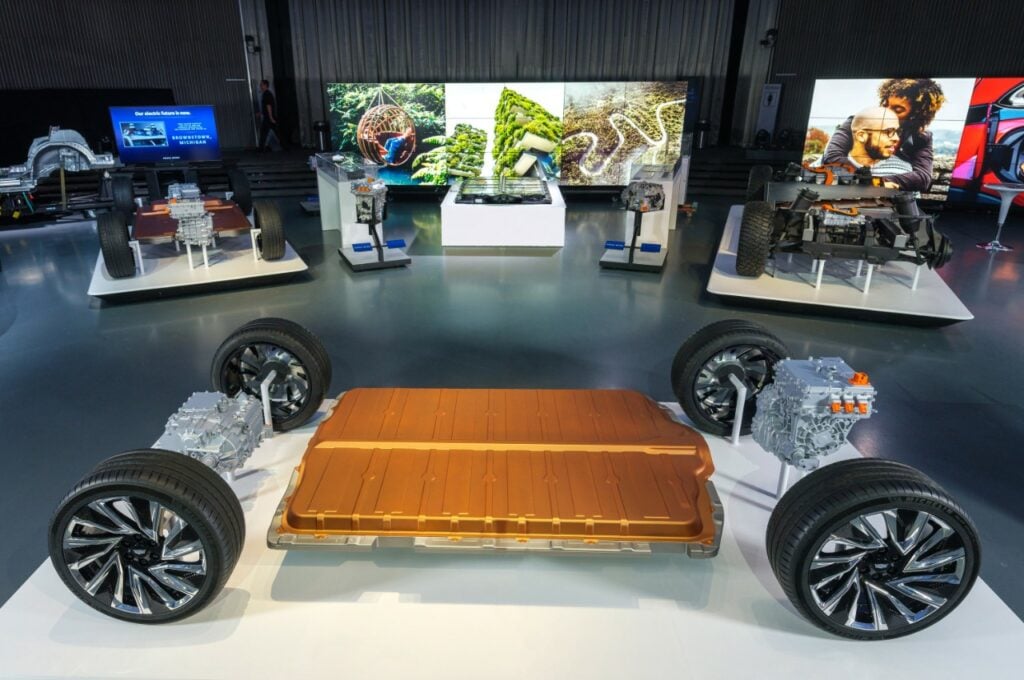
The 2023 Cadillac Lyriq will be the first time most consumers experience GM’s all-new Ultium electric platform. The 2022 Hummer EV is powered by Ultium, but it’s at a much higher price point that’s out of reach for most. Plus, it’s huge, and not everyone wants to drive a crab-walking boat around. GM’s engineers say that Ultium batteries are reliable, durable and more energy dense than anything we’ve seen before in a production EV.
Cadillac claims an EPA range of around 312 miles on a single charge made possible by the Ultium platform’s new chemistry. The public hasn’t forgotten about the ongoing Chevrolet Bolt recall and fire hazard, so it’s comforting to know that all new GM EVs will be built with a completely revamped and improved battery and electric motor architecture.
The 2023 Cadillac Lyriq is powered by a 12-module, 100 kilowatt-hour Ultium battery pack and a rear-wheel-drive Ultium Platform. This powertrain delivers 340 horsepower and 325 lb-ft of torque. It’s no Tesla, but a performance-oriented Lyriq is rumored to be on the way in 2023. For you speedsters out there, official 0-60 times haven’t been released yet, but considering that it weighs 5,610 pounds (over 1,000 pounds more than a Tesla Model Y!), the 5.0 second range is a likely figure.
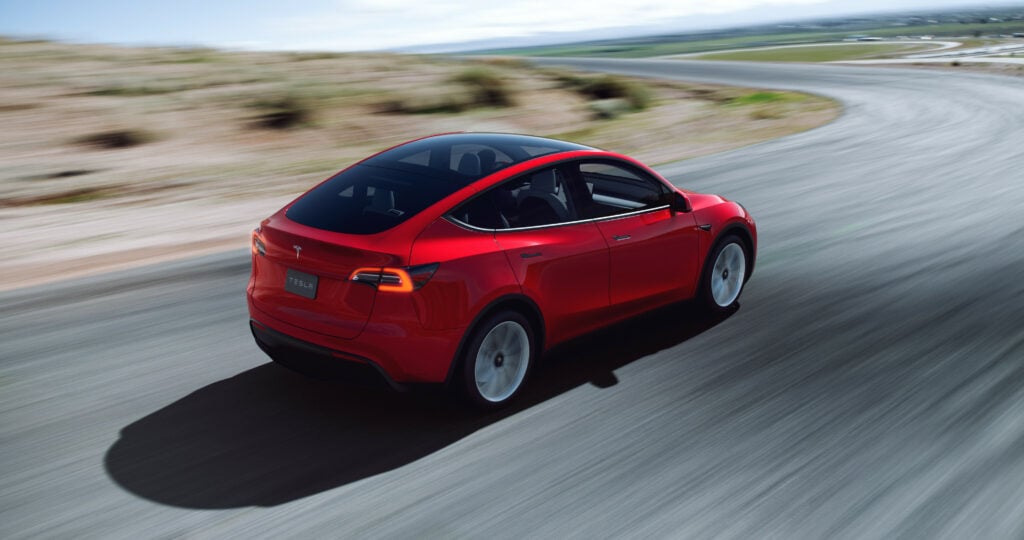
The Lyriq Steps Into a Crowded SUV Segment that was essentially nonexistent just five years ago. One thing that may lure shoppers towards the Lyriq is its size. It’s larger than the Volkswagen ID.4, Tesla Model Y and Ford Mustang Mach-E. Thanks to the compact electric motors, the wheelbase is on par with a Hyundai Palisade, even though the interior volume is a bit less at 105 cubic feet. That’s more than the Model Y and VW ID.4, but just a cubic foot less than the much more affordable Hyundai IONIQ 5. Rear passenger leg room is generous at 40”. Everyone seems to offer a panoramic glass roof these days, and the Lyriq is no different. But the glass roof helps head room stretch to 38” for rear passengers.
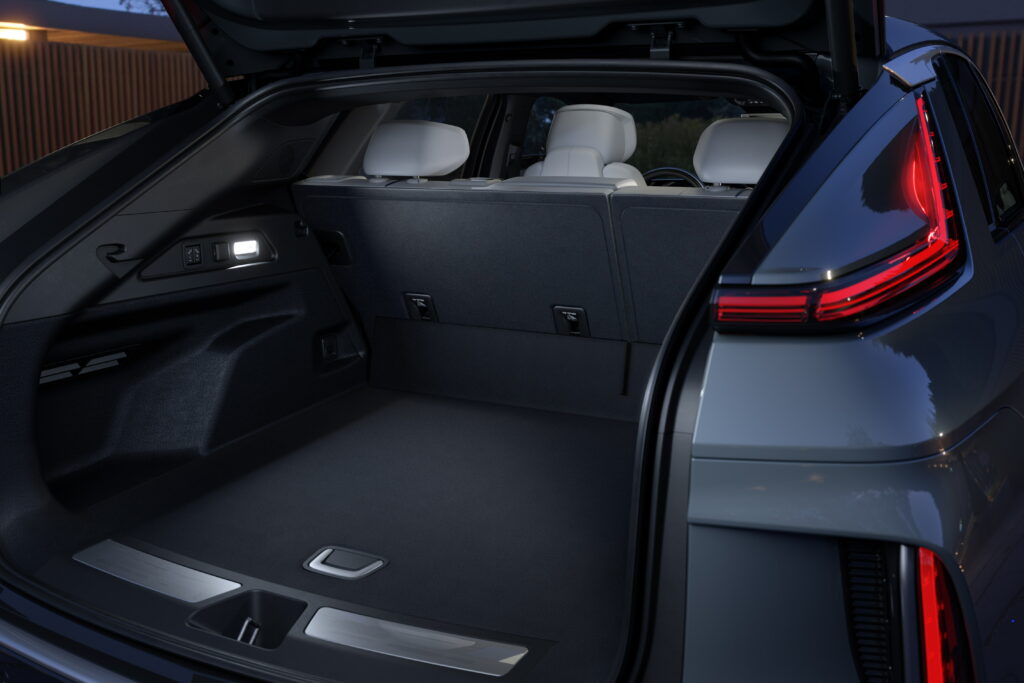
Cargo volume is solid, even though there’s no frunk (front storage). There’s 28 cubic feet with seats up, and 68 cubic feet with seats laying flat. Even though that’s about the same as the ID.4, Model Y and IONIQ 5 (the Kia EV6 and Ford Mustang Mach-E are significantly less), the Cadillac Lyriq has something that none of the others have: the very essence of luxury. Better comparisons could be made with the Audi e-tron, Tesla Model X, the brand-new BMW iX, and the soon-to-arrive Genesis GV60 and Mercedes EQB. Among these competitors, the Lyriq is likely to remain more affordable.
The base Luxury trim of the Lyriq is nearly loaded as-is. The Luxury comes with 19” aero wheels versus 22” rims for higher trims, but Cadillac hasn’t shared many additional details other than that the base trim features all of the biggest perks. Reviewers who’ve had showroom tours of the Lyriq have been told that the base Lyriq has all of the above. The debut edition starts at right under $61,795 with rear-wheel drive. All-wheel drive Lyriq variants start at $64,000. Higher trims are expected to reach well above $70,000.
See Lyriq pricing details at cadillac.com.
Pre-orders are now open! Expect to wait several months for your Lyriq to arrive. It should be worth the wait.
We have great news for those counting on federal EV incentives to bring the Lyriq EV into their price range. The Lyriq is going to be built in Tennessee with American-made Ultium batteries, so it will qualify for the new EV tax credit. Of course, you’ll have to ensure that your household income qualifies.
Learn more about the revised EV tax credit’s requirements.
The base spec of the Lyriq offers a whole lot for an MSRP of 60 grand. Could the Lyriq be the new anti-Tesla? Tesla may be the leader of EV sales for now, but for car buyers yearning for less minimalism, more luxury and competitive pricing, the Lyriq sure works out to a great deal. One thing the two share is that both GM and Tesla no longer qualify for the EV tax credit. Revisions to the EV tax credit are pending, but nobody really knows what the outcome will be.
The Lyriq is looking like a great flagship for GM’s new Ultium battery and powertrain platform. An expected 300+ miles of range and rapid charging make this electric SUV competitive from day one.

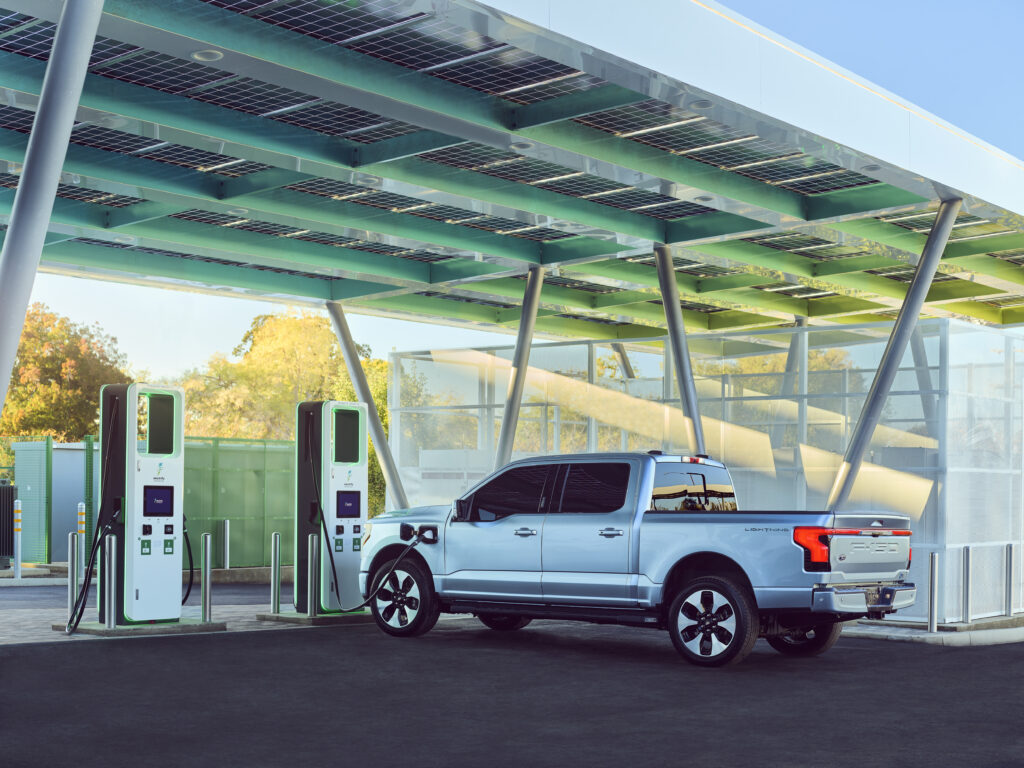
As if anyone needed one more reason to be anxious, some of today’s electric vehicles have inspired a new kind of dread: range anxiety. If you’re new to the world of EVs, you may be wondering why electric vehicle range figures are compared and analyzed meticulously. Maybe you’re even skeptical of EVs because of the sub-300 mile ranges touted as the latest and greatest. The largest automakers are committed to electrification, and American drivers are finding that shopping for an EV is a different experience. There’s no doubt it takes some getting used to. Is the instant acceleration and cheaper fuel worth the learning curve that comes with EV adoption?
Electric vehicle charging stations are still few and far between in most of America. Even charging technologies vary widely from one vehicle to the next. A few new EVs are behind the times when it comes to charging speed, most notably the Chevy Bolt. Others, like the Hyundai IONIQ 5 and Porsche Taycan, are progressing forward with the fastest top-up times in the industry. Thankfully, charging an EV in America is about to get a lot easier in 2022. Billions of dollars in both private and public funding is being funneled into growing the nation’s public charging infrastructure over the next two years. EV range figures will likely become less defining for each new EV that hits the market as charging becomes quicker and easier to find.
As we enter 2022, range is still top of mind for consumers. But estimating EV range is not an exact science. Some vehicles regularly exceed EPA mileage ratings, but many others fall short of the advertised figures. Here’s what consumers need to know about real-world range in today’s growing EV market.
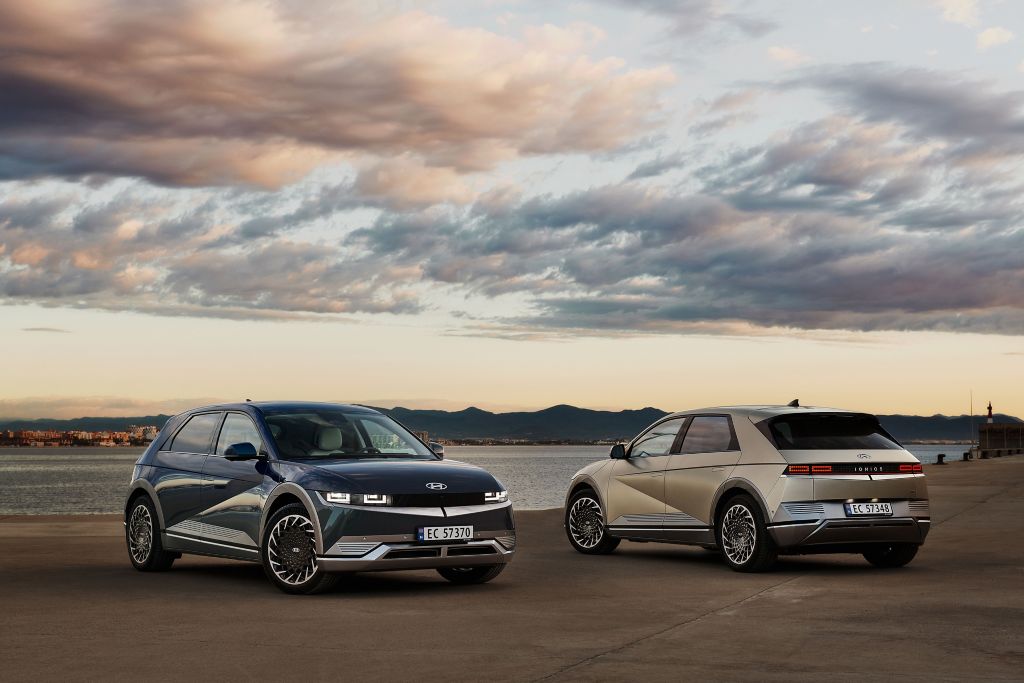
Speed is the number one factor that determines electric vehicle range. The relationship between city/highway driving and range is the opposite with an EV than you’ll find with a combustion-powered vehicle. With a traditional combustion vehicle, better gas mileage is achieved at highway speeds, usually between 50-70 miles per hour. That’s not so with EVs.
EVs are more efficient at lower speeds, even in stop-and-go traffic. Let’s consider the example of the best-selling Tesla Model Y. The 2022 Model Y’s combined range rating is 330 miles, or 125 mpg equivalent. A closer look at the city and highway figures tells an interesting story. On the highway, the US EPA calculates the Model Y’s fuel economy as 131 mpge. Real-world testing at 70 mph finds that the Model Y can make it about 275 miles on a charge. However, in city driving scenarios at lower speeds, the Model Y is good for an astounding 131 mpge, or over 350 miles of range. The story is the same for most other EVs: slower driving around town yields greater efficiency and more range.
Why is speed such an important factor for electric vehicle range? It all comes down to something engineers can’t control, only accommodate: physics. At higher speeds, a vehicle encounters higher friction as it pushes through the air. Friction causes drag, and drag can only be overcome by more force. In this case, the additional force is supplied by higher power output from the electric motors. This is why EV stats often include the ‘drag coefficient’ along with horsepower, torque, curb weight and the rest of the usual metrics for comparison.
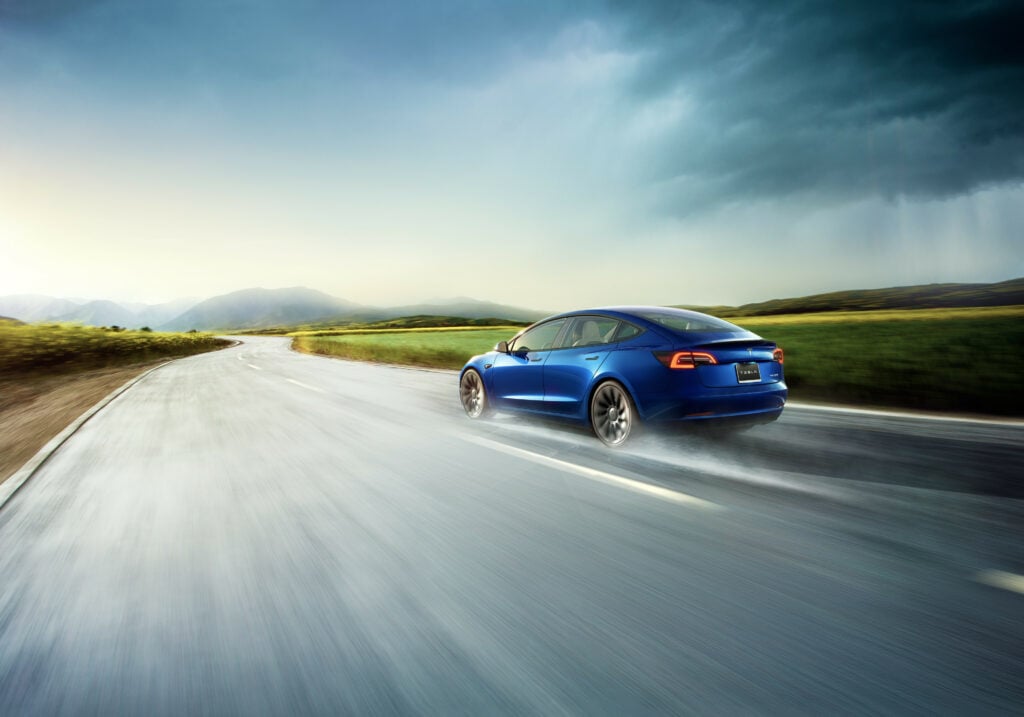
Temperature, wind and even precipitation can all affect electric vehicle range, especially at higher speeds. Every battery-electric motor platform has an ideal operating temperature. Usually, the ideal temperature is somewhere near 70 degrees Fahrenheit. At the ideal temperature, the vehicle can attain up to 115% of its official rated range. That means a Ford Mustang Mach-E rated for 270 miles may actually make it over 300 miles on a single charge in perfect conditions.
Summer heat eats into range somewhat, but winter cold is the real range killer. Effects vary from one model to another, but it’s not uncommon for an EV to lose 30% of its range in freezing temperatures. Why? The cold itself is responsible for about 10% of the range loss, but it’s actually running the heater that demands so much energy, and range takes an even bigger hit. Winter weather is so problematic for EVs that many OEMs are installing heat pumps in their latest models in an effort to reduce range loss in the cold.
As long-haul truck drivers know well, a headwind or severe crosswind kills range for all vehicles, regardless of fuel type. An EV normally rated for 250 highway miles might not even make it 200 with a strong headwind. On the other hand, a tailwind can extend range far beyond the usual performance. Once again, this is similar to what drivers of combustion vehicles will experience.
Rain and snow also reduce range by adding to drag. Think of it this way: any vehicle, electric or otherwise, uses more fuel to literally push through the air as precipitation falls onto it.
All EVs lose rated range as they accumulate miles on the odometer. It’s just a part of battery wear and tear. The range loss is greatest as the vehicle is ‘broken in’ so to speak. Tesla vehicles lose about 5% of their range within the first 30,000 miles of driving, but range loss slows down afterward. There are many examples of Teslas with 200,000 miles on the odometer that continue to carry 90% of the original range, and almost all retain at least 85% by this point. Other EVs show similar range loss over time.
Battery degradation is unavoidable, but there are measures that EV drivers can take to minimize it. Limiting level 3 fast charging to only when necessary (such as road trips) is the biggest effort anyone can make to preserve the health of their battery. Charging at home on a level 1 or 2 charger to 80% or 90% state of charge is recommended for most EVs. Only when the extra mileage is needed should EVs be fully charged to 100%. One notable exception is the 2022 Tesla Model 3. Tesla has decided to put lithium-iron-phosphate (LFP) batteries in the standard range variants of the Model 3, making this the first EV on the market to withstand regular charging to 100% without notable battery degradation. Perhaps this was a factor in Hertz’s recent decision to buy 100,000 Model 3’s.
With so many factors going into EV range, you might be wondering how one can reliably estimate the range of their EV in real time. Luckily, engineers saw the need for real-time range estimators and got ahead of this challenge. Today’s EVs include smart range estimators (that some affectionately call guess-o-meters) that factor in a number of variables to display the remaining range for the driver. Real-world range figures don’t necessarily make road trips challenging, but for the time being, it is something else for drivers to monitor while charging stations remain uncommon.
Curious as to how your favorite electric vehicles match up in real-world range? The EV experts over at InsideEVs have compiled a database of how every model they’ve tested firsthand performs in the real world. Some EV models far exceed their official EPA ratings, while others come up short. Below are a few of their more notable findings.
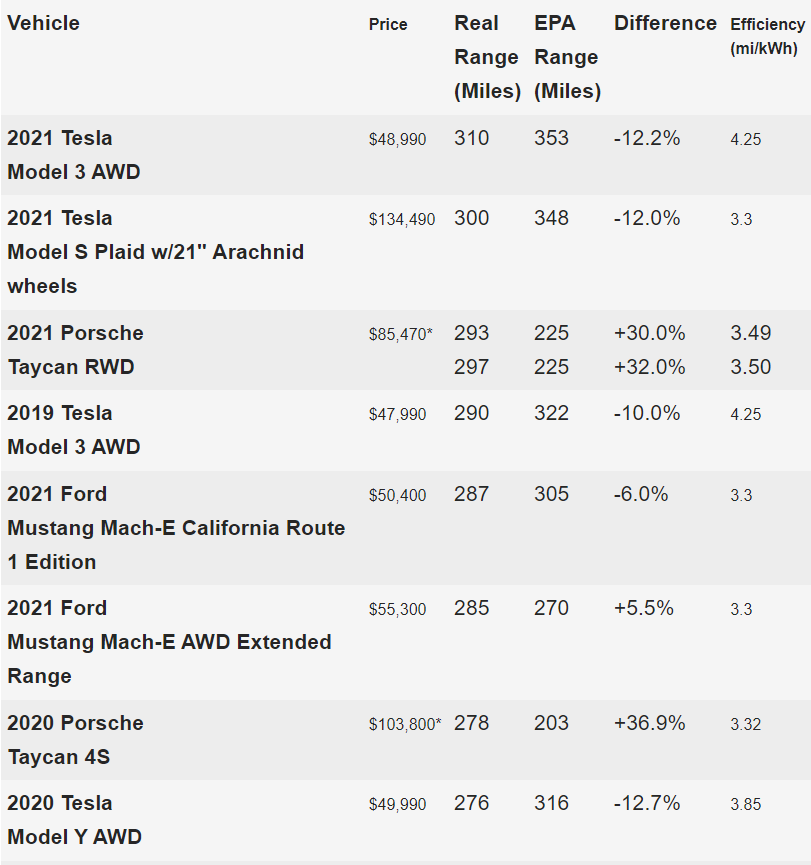
Source: InsideEVs

Today’s EVs are expected to retain 85-90% of their original range after 100,000 miles, and possibly even over 200,000 miles. This normal range loss is due to battery wear after repeated charging and discharging cycles. Real world range is something for EV shoppers to bear in mind when comparing models. Remember: If an EV is EPA rated for 250 miles, it will likely only achieve 225 miles on a full charge after 100,000 miles of driving.
The data from InsideEVs shows that some automakers consistently underperform their ratings, while others exceed expectations. Will range anxiety turn buyers away, or will tech and sporty handling compel more drivers to think about going electric? Let us know your thoughts in the comments below. We’ll continue to keep you informed as electrification overtakes the auto industry.

When GM launched its first plug-in hybrid in 2010, the Chevrolet Volt, turning a profit was an uphill climb. It was a time when EVs were a pipedream to most OEMs. Nissan was nearing the launch of the Leaf, the first fully-electric mainstream vehicle ever. Tesla was a nascent startup raising funds by selling the first-generation Roadster. Automakers old and new alike knew that if EVs were to ever become affordable for the masses and profitable for OEMs, the costs of battery production would have to plummet, and battery efficiency and durability would have to increase.
Here we are 12 years later, and GM is ready to launch its first vehicles powered by their all-new Ultium battery platform and propulsion system. Is the platform a technological leap forward? Could it be the key to dethroning Tesla, or is GM after something different altogether? Here’s the latest on what GM claims is the game-changer for mass electrification.
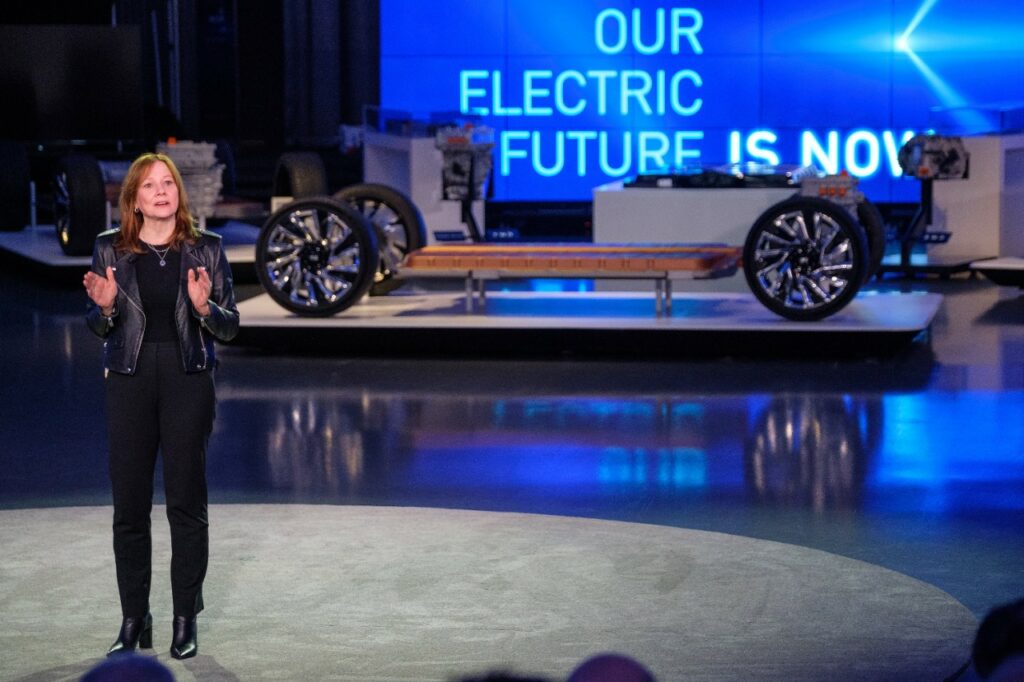
When GM CEO and chairman Mary Barra announced the Ultium platform in March of 2020, there was a lot going on in the world that overshadowed the gravity of her announcement. However, the automotive industry noticed GM’s confidence in its ability to overcome one of the biggest barriers to affordable EVs: battery production costs. Battery capacity is most often measured in kilowatt-hours (kWh). For reference, a plug-in hybrid like the 2011 Chevrolet Volt has a smaller battery, 16 kWh in this case. Today’s popular EVs like the Tesla Model Y, Ford Mustang Mach-E and Volkswagen ID.4 have battery capacities in the 70-80 kWh range.
At the time of the Volt’s launch in 2010, battery costs were about $1,000 per kWh. That meant that the Volt’s 16 kWh battery was the most expensive component of the car. Now, Mary Barra says that the new Ultium platform will be produced at less than $100 per kWh. To date, only Tesla has been known to have reached such battery affordability, and it’s been considered a key ingredient in their secret sauce for success. The press release announcing Ultium didn’t beat around the bush, stating that “the first generation of GM’s future EV program will be profitable.”
Plenty of automakers have ambitious, expensive plans for electric vehicles, but if GM is already there in 2022, are we witnessing a major disruption to the EV segment in real time?
They’re not going it alone. In fact, all major OEMs partner with battery producers to produce their EVs, from Tesla to Ford. In this case, GM is continuing to work with LG Chem for Ultium development and production (which has already begun). LG Chem is a respected battery supplier for Stellantis, Lucid and even some Teslas.
What could go wrong? You’ve heard about the Chevy Bolt battery fires that have resulted in recalls, stop-sales and $2 billion in expenses for GM? LG Chem supplied those batteries too. LG recently agreed to cover the massive costs of the Bolt recall, perhaps in a last-ditch effort to preserve the business partnership between the two.
The automotive industry usually welcomes second chances (remember the Great Recession bankruptcies, VW’s Dieselgate, etc.?), so let’s hope LG and GM’s partnership results in a great electric platform, one that’s far less flammable this time around.
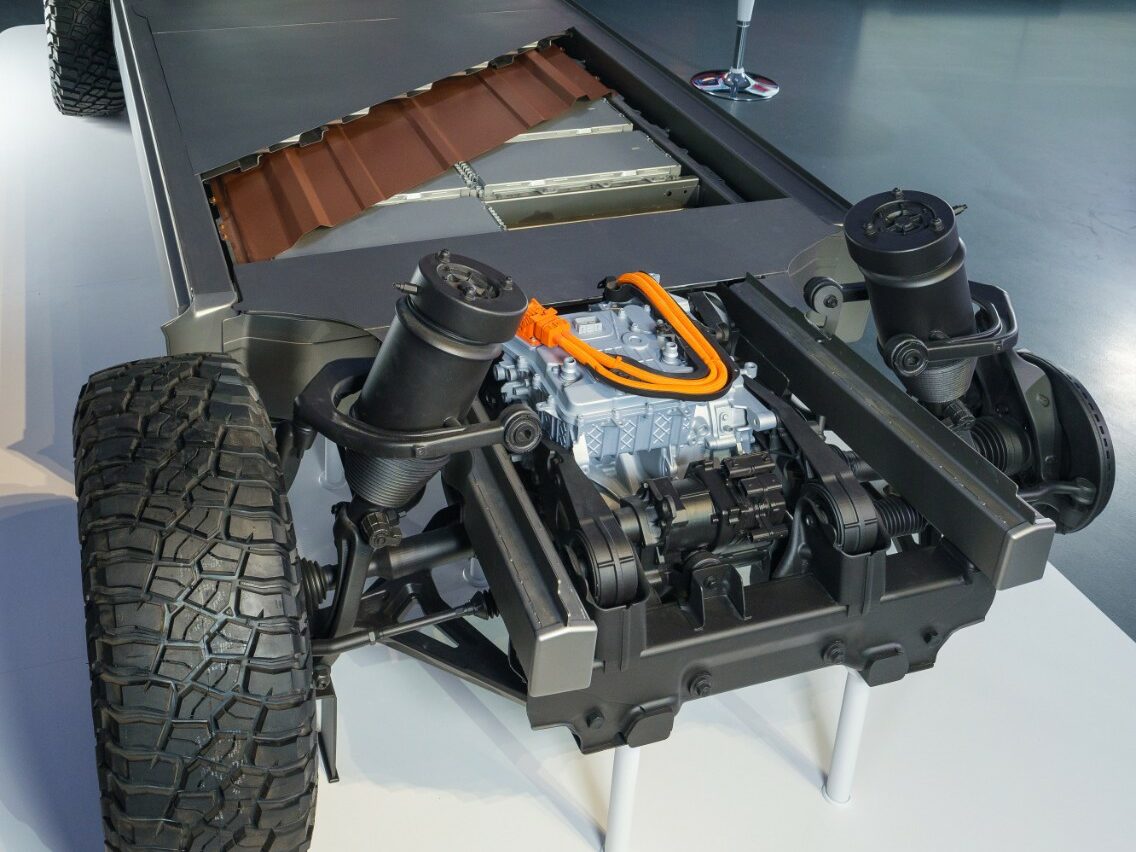
GM says its all-new global platform is flexible enough to build a wide range of trucks, SUVs, crossovers, cars and commercial vehicles all with the same Ultium architecture. They call it a one-size-fits-all approach to electrifying all GM brands by 2035. At the heart of the Ultium platform is a pouch-type of battery module. This is where scalability becomes easy, at least in the eyes of GM’s engineers. Ford and GM are among the legacy automakers who continue to develop pouch-type battery modules, while relative newcomers like Tesla, Lucid and Rivian are using cylindrical batteries in their vehicles. It will be interesting to see which form factor becomes the dominant battery architecture over the coming years.
The new Ultium battery from GM uses a state-of-the-art Nickel Cobalt Manganese Aluminum (NCMA) chemistry, which was designed to reduce the cobalt content in our batteries by more than 70 percent. Cobalt mining in Africa is notorious for human rights abuses, so the battery industry as a whole is looking to reduce reliance on the element.
In the announcement for the new Ultium platform, GM didn’t hide the fact that they see battery production as a new source of revenue. Vertical integration of most vehicle components has been one of Tesla’s most influential strategies in the auto industry. Now GM leadership sees the value of cutting out the middleman (to an extent). “By vertically integrating the manufacture of battery cells, the company can reach beyond its own fleet and license technology to others,” reads the March 2020 announcement. They also tout their ability to leverage existing facilities and equipment for Ultium battery production.
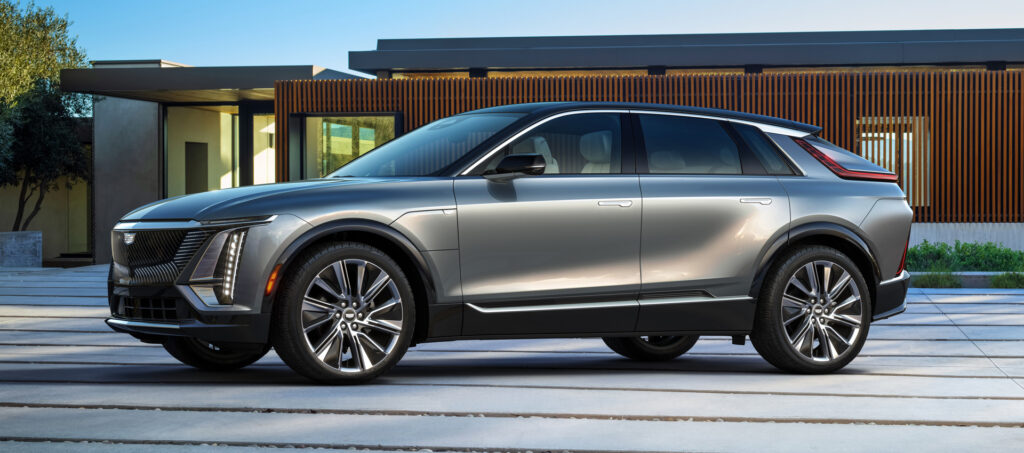
The first generation of Ultium-powered vehicles is already arriving at dealerships. GM just shared the first customer deliveries of the resurrected GMC Hummer EV, a 1,000 hp crab-walking luxury electric truck. In case you’re keeping track, both Rivian and GM have delivered the first electric trucks in America before Tesla has started production of its Cybertruck.

Soon to follow will be the 2023 Cadillac Lyriq electric crossover (starting MSRP of $60,000), which will hit the road in 2022. The real test of the Ultium platform’s market strength will be the Chevy Silverado EV. Electrifying one of GM’s best-sellers is a bold move. We don’t know much about the electric Silverado yet, but GM will unveil the truck on January 6, 2022 at the CES expo in Las Vegas.
GM plans to stop selling combustion vehicles by 2035, so a LOT more Ultium vehicles are surely in the making. Cadillac will be exclusively electric by 2030, a mere eight years ahead. What’s next, an electric Camaro?
Execution is key for GM. We learned in 2008 that no automaker is too big to fail, and a Bolt-like battery blunder can’t happen with the new Ultium platform. Hopefully GM and partner LG Chem have taken the time and due diligence to get it right. It remains to be seen if GM will price its vehicles competitively.
The 2022 Chevy Bolt and Hummer EV are worlds apart in terms of affordability. In fact, the Bolt and Nissan Leaf are the only two popular EVs that typically sell for under $40,000. Will EVs forever be mostly $40k-plus models, or will American soon have Ultium-powered economy options to consider. Only time will tell if consumers are willing to spend Tesla money on a GM EV in 2022. About 641,000 employees work for the big three American automakers (GM, Ford, FCA/Stellantis). With so much money, investment and infrastructure on the line, we sure wish for their success.
We have thousands of EVs (and other vehicles) listed today. Each listing includes industry insights, empowering data and the true TotalPrice that will make buying a car the transparent process it should’ve always been. Check it out here!

As you’re well aware, used cars aren’t supposed to appreciate, however in 2021, used car prices have increased by nearly 50% across the industry. That has led many of us consumers to utter a question we never thought we’d have to say, “When will used car prices drop?”
In “normal” times, used car prices are always dropping (they’re depreciating assets after all), however as the chip shortage and supply chain challenges have reared their ugly heads, we’ve seen some used cars appreciate to levels that were once incomprehensible. Many one to two year old used cars have sold for more than their original MSRP — it’s truly insane!
In this article we present to you our best bet as to when used car prices will drop in 2022. And yes, we do think there will be some sort of price drop in 2022. This article is based on many data sources, such as this report from Boston Consulting Group on the chip shortage, a recent white paper from KPMG, and ongoing data analysis from the team at Black Book.
If you find this content valuable and helpful, please consider sharing it with a friend or family member. Let’s dive in.
Let’s start here; our prediction is that used car prices will begin to drop in 2022. The natural next question is “when?” To answer that, let’s look at what the “experts” are saying:
It’s important to understand that there are two prices for each used car that is sold in the United States; the wholesale price, and the retail price. Wholesale used car prices are the prices dealers have to pay for inventory, and retail used car prices are what us consumers pay at the dealership.
Black Book’s data shows us that wholesale used car prices have increased upwards of 50% in 2021, while retail prices have only increased by 35%. There is an inherent and obvious relationship between wholesale and retail prices, and retail prices typically trail the movement of the wholesale market.
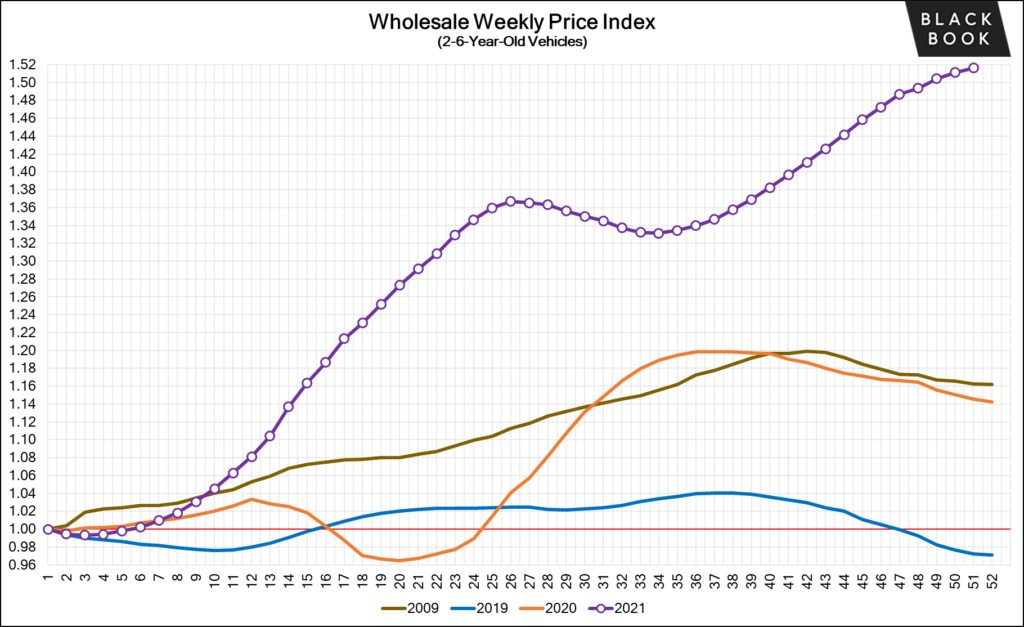
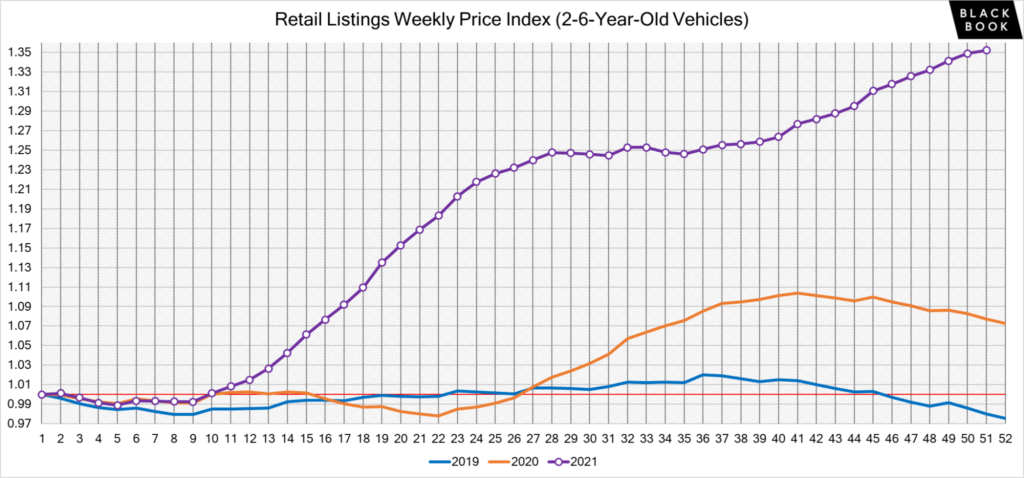
Recently, we have begun to see softening on wholesale used car prices. From Black Book:
The softening trend continued this past week, with the overall market slowing the rate of increase, sales rates declining, and more segments reporting decreases in prices compared to the week prior.
It appears as if the wholesale used car market is plateauing. This is a good sign, however retail prices will likely continue to rise for months to come. This is in part because dealers who bought used cars at inflated wholesale prices will hold on to them until they can find a retail customer to purchase. In prior years, dealers would be more interested in “turning” their inventory so that they could mitigate interest costs on the vehicle, however since interest rates are very low right now that likely won’t be a driving factor.
While wholesale car prices soften, we expect retail used car prices to continue to increase through the first quarter of 2022, especially amidst tax season. We also expect wholesale prices to increase (although less rapidly) in the first quarter.
Consumer availability to credit is high. A recent survey from the Federal Reserve showed that some financial institutions loosened their lending standards. As a result we expect consumers to continue to have relatively easy availability to financing for their vehicles purchases. This will also keep retail used car prices high, since dealers will be able to find financing options for their customers that get them to a comfortable monthly payment.
During the “spring selling season” we will continue to see increases in used car prices. It is by the summer that we anticipate some signs of price declines in wholesale and retail used car prices. The KPMG white paper proposes that used car prices could drop significantly as early as October of 2022, and we agree with them. Prices may continue to stay inflated if new car production continues to be hampered in 2022, however signs are pointing to automakers getting through the worst of their production issues.
As we survey the landscape of the automotive industry, it seems clear that the fall of 2022 represents the most likely time for used car prices to drop in 2022. Traditionally the fall and winter months are when used car depreciate the most. This seasonality, paired with increases in new car production, and likely increases in interest rates, should ultimately drive some downward pressure on used car prices.
One factor that we cannot account for is the potential for government tax incentives on electric vehicles. While Congress has yet to pass a bill that contains EV tax credits for 2022, there is a lot of speculation that they will. proposed credits would significantly increase consumer demand in new and used vehicles, and if this were to happen, it may very well offset the downward pressures on used car prices.
There are also a lot of questions surrounding new car production. While manufacturer’s such as Toyota have published press releases signaling they’re through the worst of their manufacturing woes, only time will tell if that’s actually true. Boston Consulting Group thinks it will be 2025 when new car production meets demand, so questions still remain about how much new car inventory will be available in 2022.
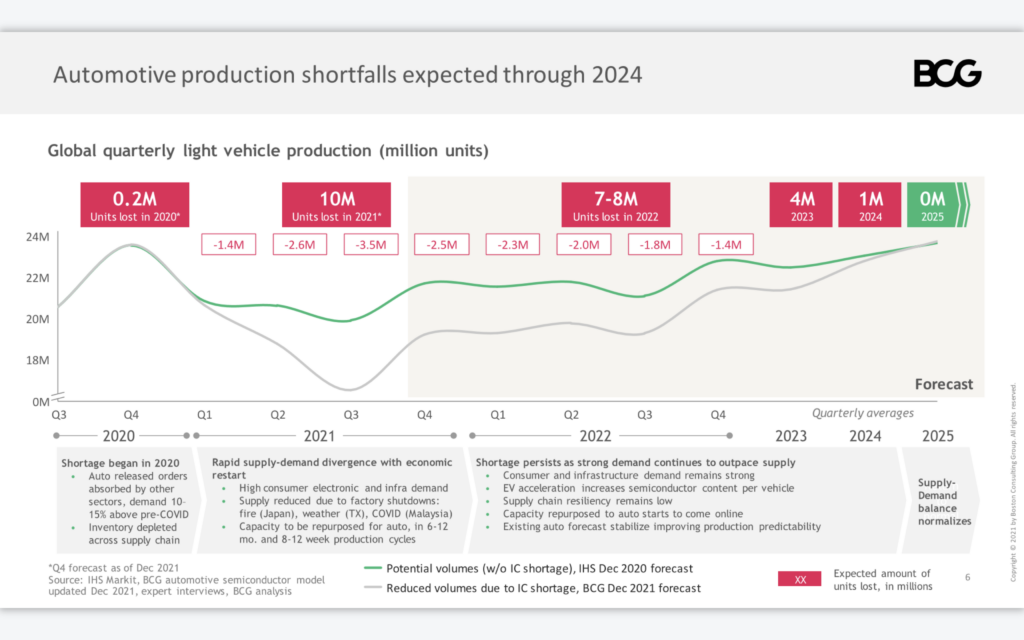
If manufacturers are unable to improve new car supply in 2022 we could see used car prices continue to increase. Our best guess is that automakers will be able to incrementally improve their new car supply throughout the year. We are already seeing signs of this in 2021 as AutoForecast Solutions has begun to revise their worst-case chip shortage estimations downward instead of upwards.
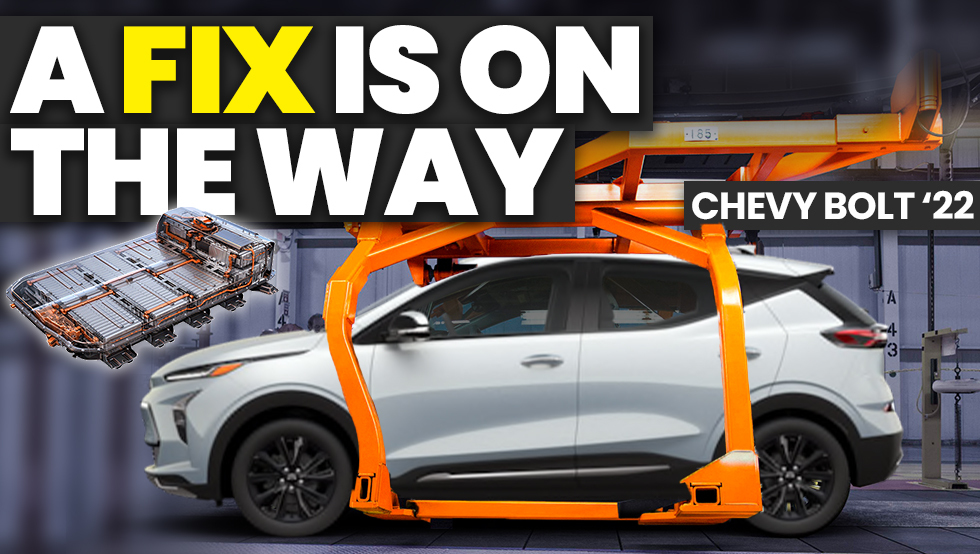
May 2022 Update: About half of 2017-2019 model year Bolts have received their recall fix, which includes a brand new battery pack. The new 2022 Bolt and Bolt EUV are back on sale at dealerships, complete with their new batteries.
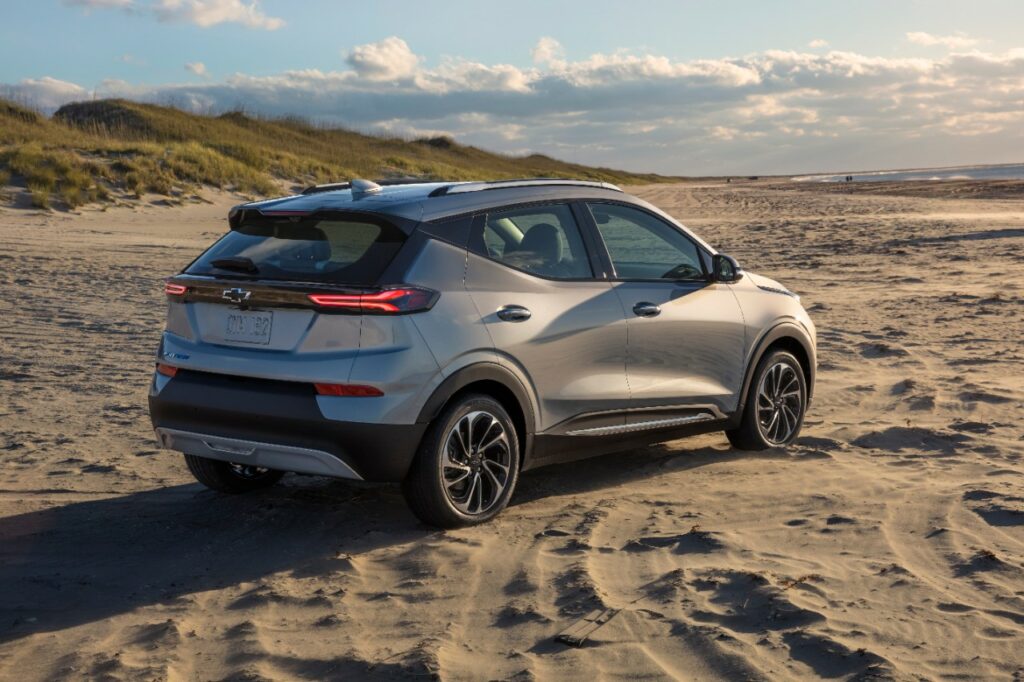
The newly redesigned 2022 Chevrolet Bolt has a lot going for it: sleek new looks, modern tech, a new larger variant, and most of all, a starting MSRP of just $31,000. But as you probably know by now, GM’s golden opportunity went up in smoke when Bolts began to catch fire, sometimes burning down entire homes. Once a great budget EV, the Bolt has been ordered to socially distance by at least 50 feet from any building until GM works its way through the $2 billion dollar fix to get these cars back on the road safely.
There is a fix on the way, and it’s a fix that we’d like to think can’t go wrong. All Bolts from model years 2017 to 2019 are due to receive an all-new battery free of charge, and 2020-2022 models will receive. Could the Bolt fire disaster turn out to be a good thing for consumers in the end?
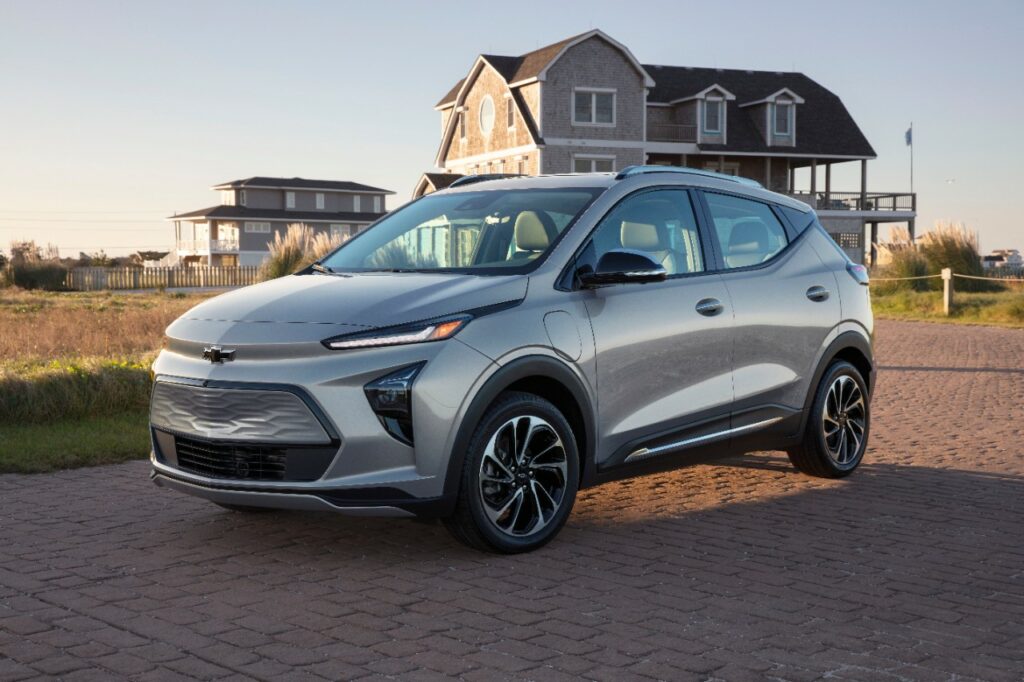
This is the Bolt’s first major refresh since it was unveiled in 2016. Back then, it harkened a new path for GM at a time when the future of electrified transportation was uncertain. Would EVs remain a luxury outlier for Tesla fans? Or would EVs end up appealing to the masses?
The 2017 Bolt arrived at dealerships to great fanfare, even going on to win both the North American Car of the Year and the Motor Trend Car of the Year awards in 2017. Following a few minor efficiency upgrades, by 2021 the Bolt was rated at 259 miles of range in the EPA test cycle. That’s a respectable figure even in today’s field of EVs. With the 2022 model year update came a shock to fans of affordable EVs: the 2022 Bolt had the same rated range, but it was listed for $5,500 less, new technology, curvy looks and all! It’s likely that the price drop was intended to reflect the loss of eligibility for the $7,500 federal tax credit.
Another unexpected announcement was the launch of the Bolt EUV, a larger sibling to the original compact Bolt. The new Bolt EUV is 6 inches longer with an extra 3 inches of backseat legroom. The EUV has a big tech advantage over the Bolt EV: it includes GM’s Super Cruise semi-autonomous driver assistance software. On paper, the 2022 Chevrolet Bolt EV and EUV looked like great deals. Even before the big refresh, efficiency, affordability and the former eligibility for the $7,500 federal tax credit lifted the Bolt to a spot in the top five in American EV sales for four years in a row.
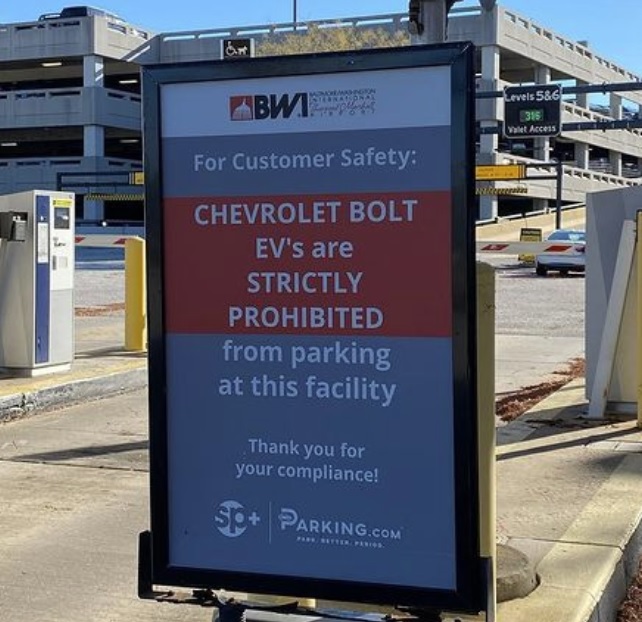
The Chevy Bolt has had its weaknesses since the beginning, but they were always manageable. A peak charging rate of 55kW that continues to this day was always the biggest inconvenience. But you get what you pay for, right? Well, no consumer should ever be cornered into an affordable vehicle that turns out to be a massive fire hazard and safety risk.
Beginning in 2017, news reports emerged of multiple Bolts catching fire in parking lots and driveways. Eventually, so many Bolts caught fire that GM issued a fix in late 2020, but it failed to solve the problem. By early 2021, the pattern was clear, and a combo recall and stop-sale were issued for all Bolts (2017-2022 model years). Production of 2022 Bolts was halted, and remains on pause through January.
We now know the root cause of the battery fires in certain Chevrolet Bolts, and it’s a defect that affects every model year in some capacity. A spokesperson for LG, the battery supplier for the Bolt, shared the cause with Consumer Reports. “GM and LG have identified the presence of two rare simultaneous defects, found in the same battery cell, made during the module manufacturing process.” GM explained that the cause is a torn anode tab and folded separator within the battery modules. What it comes down to is two very rare defects simultaneously occurring in the same battery cells.

GM has to be furious with LG for supplying dangerous batteries to its car that was destined for mass appeal. There’s nothing appealing about buying a $30,000 fire hazard, not to mention the hassle of returning the vehicle for the recall. But it looks like the two behemoths have reached a deal. LG has agreed to compensate GM for the costs associated with the recall. When all is said and done (sometime in 2022), LG will be paying GM about $2 billion.
GM is going to replace all battery packs in 2017-2019 Bolts and will replace defective battery modules (partial replacement) in 2020-2022 Bolt EVs and EUVs. Repaired Bolts will come with a new eight-year, 100,000-mile limited warranty. GM will prioritize customers who have Bolts at the highest risk, but they’re not ready to release a timeline for completion, pending battery availabilty from the supplier. It’s looking like it may take a full year to complete the recall repairs.
As of December 2021, GM has started scheduling dealership visits to install a software upgrade for all eligible Bolts. The upgrade is “designed to detect specific abnormalities that might indicate a damaged battery in Bolt EVs and EUVs by monitoring the battery performance and alerting customers of any anomalies.” GM has not yet implemented over-the-air updates like Tesla, Ford and Volkswagen, so Bolt owners will have to visit a dealership to get the software fix.
Don’t rush out to buy a 2022 Bolt. There’s a stop-sale in effect, so you couldn’t buy one even if you tried. Considering the immense resources GM has thrown at this debacle, once all Bolts are fixed, it’s highly likely that the Bolt will return to its former glory as a true EV bargain worth checking out. The automaker’s engineers MUST have thoroughly investigated and fixed the problems, right? Unfortunately, due to LG’s battery production backlog, the Bolt probably won’t be worth considering until 2023.
Let’s time travel to 2023 together and forget about the battery recall for just a moment. The 2022 Chevrolet Bolt offers 259 miles of range, a modernized interior and refreshing exterior, all for a base MSRP of $31,000. In several states, the effective price of a 2022 Bolt can easily fall under $27,000, even though it no longer qualifies for the federal EV tax credit. If revisions to the EV tax credit ever make their way through congress, the Bolt might even become a $20k car. That’s a steal! proceed with caution and patience, and give GM and LG time to clean up their mess. Plus, there are dozens of other EVs arriving on American roads in 2022. The EV market is far different heading into 2022 than it was when the first generation Bolt arrived in 2016.
Even with the battery fixes, the Bolt still suffers from a poor charging rate of just 55 kW. If you roadtrip often, that will be an issue. Whereas the new 2022 Hyundai IONIQ 5 can recharge from 10-80% (over 200 miles of range) in just 18 minutes, the same charging session would take a full hour in a 2022 Bolt. If you’re on the market for a budget EV, the 2022 Chevrolet Bolt just might be worth a test drive, but not until GM wraps up the ongoing recall fixes. And that might take a whole year. Stay tuned to CarEdge for the latest EV information, car reviews and industry insights.
We have thousands of EVs (and other vehicles) listed today. Each listing includes industry insights, empowering data and the true TotalPrice that will make buying a car the transparent process it should’ve always been. Check it out here!