
CarEdge saved me over 4,500 dollars on a brand new Honda Pilot. I can't say thank you enough.
Price intelligence
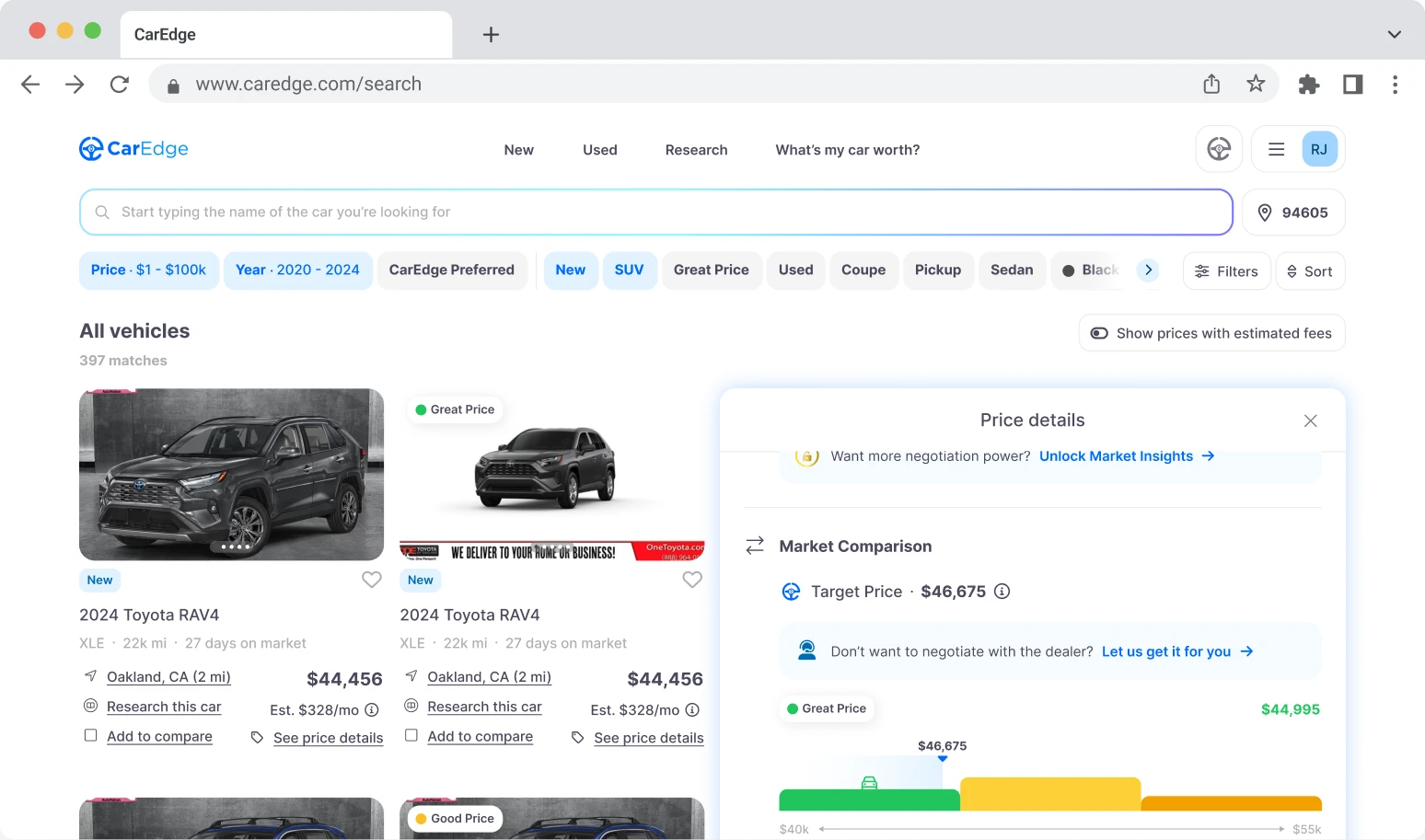
Find a wide range of vehicle listings with market insights on new and used listings near you.

What can I do with CarEdge?
 CarEdge Insights
What can I do with CarEdge?
Get access to exclusive information so you can make an informed car buying decision — all in one place.

Find a wide range of vehicle listings with market insights on new and used listings near you.
Track your vehicle’s value and cash in when the time is right to sell.

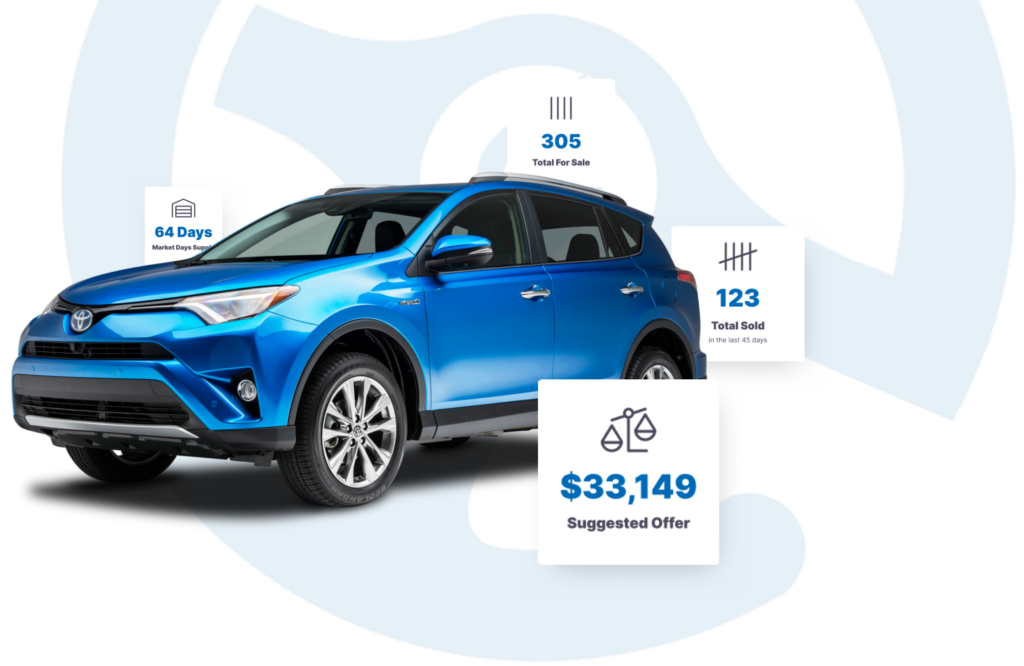
Access to our proprietary data to help you find the right car, at the right price. Find these unlocked on every listing after subscribing.

With our expert-led, tech-enabled car buying service, we will locate, negotiate, and deliver your vehicle so you can get a new car hassle free.


Help us personalize your CarEdge experience — it only takes a second.
Your answers help us personalize your CarEdge journey — we’ll follow up with tips and next steps that match your buying timeline.

If you’re thinking about selling your car, you need to get a quote from EchoPark Automotive. Why would we insist that thousands of CarEdge Community members consider giving one online car buyer special consideration? Frankly, EchoPark is overpaying for used cars, and writing big checks to sellers in the process. Here’s what our team found using this free CarEdge offer comparison tool.
We did some research with CarEdge’s Sell Your Car offer comparison tool, and we found that EchoPark is paying too much for used cars. “Apparently, EchoPark has decided that they want to be the next Carvana,” exclaimed CarEdge Co-Founder Ray Shefska. Ray says that EchoPark may be putting themselves in a position where they’ll be buying high, and selling low.
We got offers from multiple online car buyers, and the difference was shocking.To get a sense of the overall market conditions for online car buyers today, we requested offers for a number of vehicles in different markets in America.
For example, we found a 2016 Ram 1500 for sale by Carvana in Kansas City, and received offers from multiple online buyers, such as Cargurus and CarMax. It turns out that EchoPark is not yet in the Kansas City market (more on that in a moment).
Cargurus made the highest offer, at $23,000. That’s $9,000 less than Carvana’s current asking price of $32,000. That sounds about right, at least in today’s market. But this is where EchoPark’s growing presence in online car buying enters the scene. They’re not in every market, but where they are, they REALLY want to buy your car.
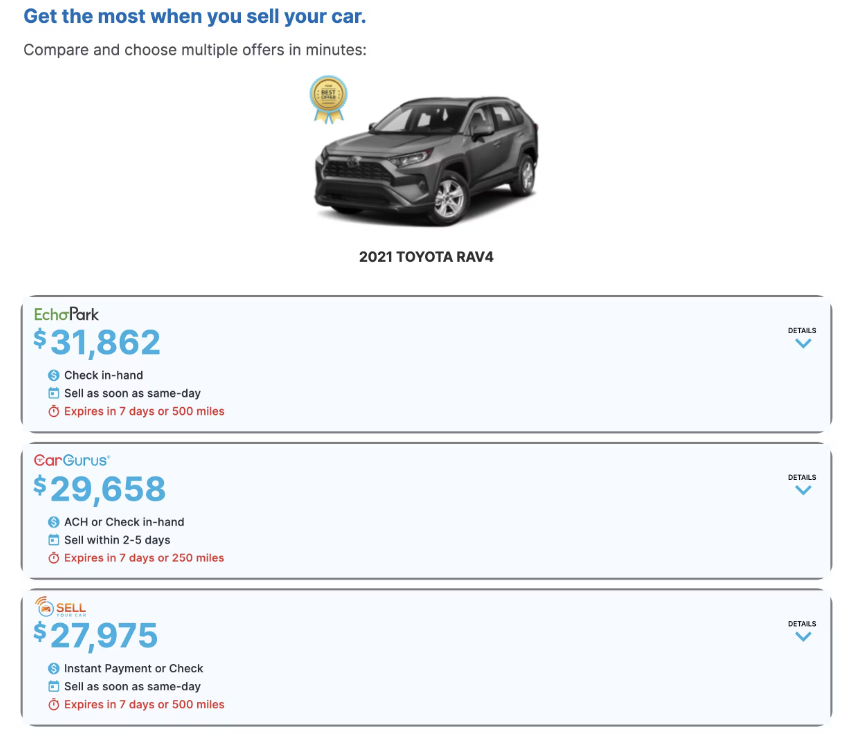
Now, let’s take a look at EchoPark’s determination to gain inventory. Over at CarMax, we found a 2021 Toyota RAV4 XLE on sale in Colorado Springs, Colorado for $33,000. CarMax is known as one of the higher-priced car sellers, since they claim to have no-haggle pricing (although you CAN negotiate your deal). For this RAV4 on sale for $33,000, EchoPark would pay $31,862 to buy it! It’s absolutely insane to see an online car buyer offering just $1,200 less than the car’s listing price. That’s yet another sign of a used car market out of whack.
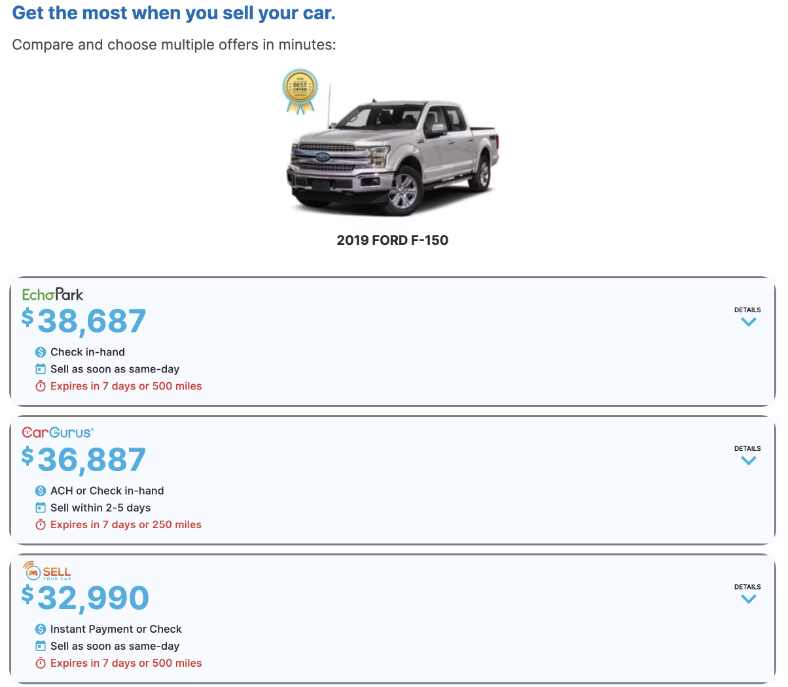
Let’s take a look at one more example. To be sure this wasn’t a Toyota fluke, we picked this 2019 Ford F-150 Lariat. CarMax is asking $43,000, but EchoPark is willing to pay $38,700 to buy it. That’s NOT normal in the used car market. This is like if you went out and bought a $500 TV, and your neighbor offers to buy it off of you days later for $475. Crazy, right?
What does it all mean? This is a recipe for selling at a loss. Ray put it best, “Either EchoPark is desperate for inventory and isn’t worried about losing money on used cars, or this is pure insanity!”
These instant offers from online car buyers are generated by an algorithm that is supposed to offer a compelling price for the seller, but an offer that also makes it easy for the buyer to then sell that vehicle for a profit. Clearly, either there’s something wrong with EchoPark’s algorithm, or they seriously need inventory, and are willing to pay a price for it.
Yes, EchoPark is a legit business that buys and sells used cars online. EchoPark does not sell new cars. It’s also important to point out that EchoPark Automotive does not buy and sell in all markets. To sell your car to EchoPark, you’ll need to be close to one of their Vehicle Buying Centers. Most locations are in the southern half of the country, from coast to coast. See the latest EchoPark dealership locations here.
When you get an offer to sell your car to EchoPark, your offer is good for 7 days or 500 miles, whichever comes first. If you complete the deal within two days, they throw an extra $250 onto the offer.
When it comes to inventory, EchoPark mostly buys and sells 1-5 year old cars with low mileage. All of EchoPark’s cars come with a 7-Day Money Back Guarantee, similar to Carvana’s 7-day money-back guarantee, and CarMax’s 30-day money-back guarantee, as long as you’ve driven under 1,500 miles.
Before you sell to EchoPark Automotive, we highly recommend that you compare offers from multiple online car buyers. You’ll get offers from reputable buyers like CarGurus, CarMax and EchoPark in seconds!
Thinking about buying from EchoPark? It’s possible that you’ll find a great deal, but it’s also possible (almost likely) that they’ll be overpricing their used car inventory to try and recoup money from overpaying for inventory.
We want to help you buy confidently. Do your due diligence and guarantee savings with the latest local car market data on CarEdge Car Search. How about premium market insights like Black Book trade-in values, negotiability score and official CarEdge recommendations for every listing? With CarEdge Data, you’ll get that and more.
Have you sold a car to EchoPark? Perhaps you’ve bought a used car from them? How did it go? Let us know in the comments below!

When it comes to buying a new car, getting the best deal is crucial. That’s why our CarEdge Car Coaches have put together a list of the discount you should expect on the 10 best-selling new cars and trucks. Consider this guide step one of the journey towards finding a great deal on a new car. These insights can help you save thousands of dollars on your next vehicle purchase.
Our CarEdge Car Coaches help hundreds of car buyers every week, and they get a good feel for the negotiability of today’s car market in the process. Based on current market conditions, these are the appropriate discounts CarEdge Car Coaches are seeing for the best-selling new cars and trucks. We’re also sharing average listing prices for brand-new 2023 models, as well as any remaining new 2022 inventory.
| Make | Model | Starting MSRP | Average Listing Price | Negotiability (Off MSRP) |
|---|---|---|---|---|
| Ford | F-150 | $35,590 | $62,353 | 3-6% |
| Chevrolet | Silverado | $37,395 | $58,140 | 5-11% |
| Ram | 1500 | $39,305 | $62,513 | 3-13% |
| Tesla | Model Y* | $48,630 | $66,506 | 0% |
| Toyota | RAV4 | $27,975 | $36,664 | 0% |
| Nissan | Rogue | $28,655 | $34,339 | 0-6% |
| Honda | CR-V | $32,355 | $36,607 | 0-2% |
| GMC | Sierra | $38,995 | $49,998 | 0-11% |
| Toyota | Camry | $27,315 | $31,946 | 0-3% |
| Tesla | Model 3* | $41,630 | $40,607 | 0% |
Looking for negotiability info for other models? With CarEdge Data, you’ll see negotiability scores for every new and used car listing. Want personalized help? Our Car Coaches are ready to help you get the best deal today. Here’s how CarEdge can help.
The Ford F-150 is the best selling truck in the United States. With a starting MSRP of $35,590 the F-150 may seem like a reasonably priced pickup, however the average advertised price is much higher. Our analysis of 100,000 2023 Ford F-150s listed for sale shows an average advertised price of $62,353.
As Ford inventory builds back up, our Car Coaches have helped customers get between 3-6% off of MSRP.
In the screenshot below for a listing in the Dallas market area, you can see there is 184 days supply of inventory. This is well above the industry norm of 60-90 days. This means Ford dealers should be motivated to discount and make deals.
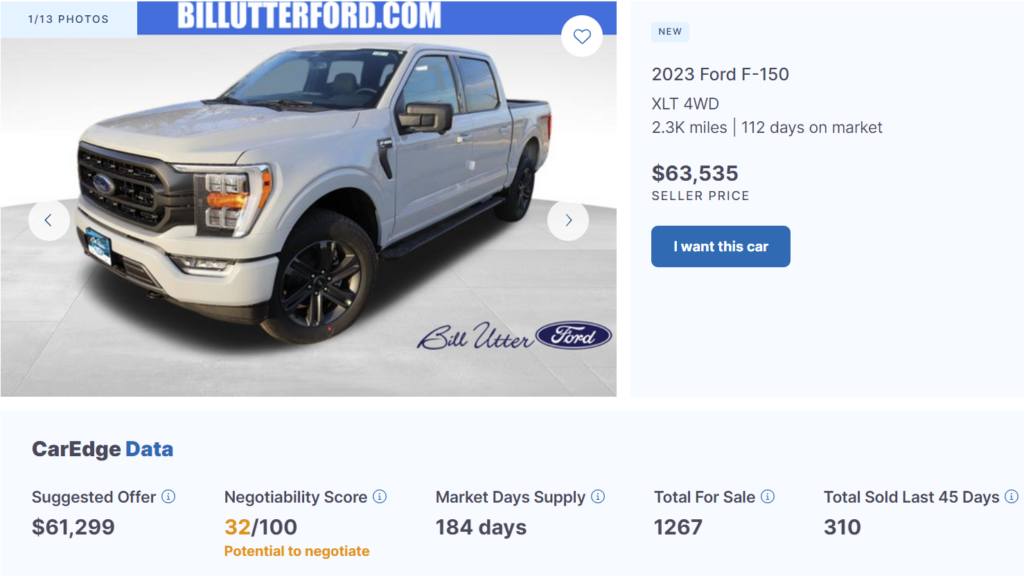
See F-150 listings with no ads and local market data.
If you’re in the market for a new truck, our Car Coaches say that the Silverado 1500 is especially negotiable. In recent deals they’ve negotiated for our members, they’ve found that between 3% and 11% can be negotiated off of MSRP.
GM is having a REALLY hard time selling trucks. It’s gotten so bad that the automaker paused production as dealer lots filled with trucks.
There are plenty of Silverado’s that have been sitting on the lot for over 60 days, but market days’ supply depends on what trim you’re looking at. Remaining new 2022 model years are especially negotiable, such as this truck on sale in Chicago.
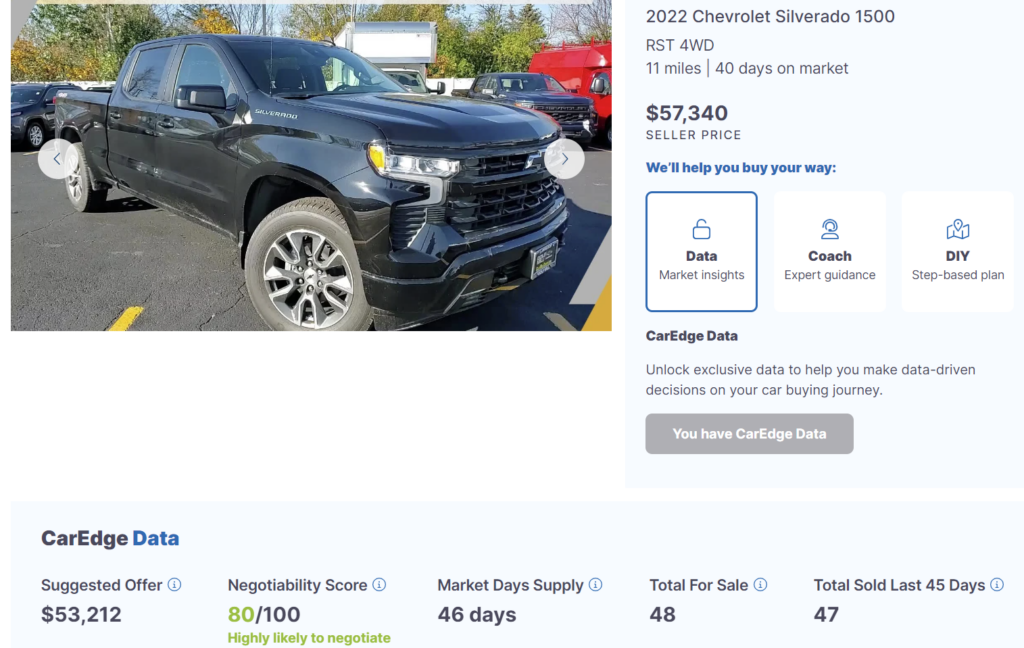
See Silverado negotiability with these local listings.
The Ram 1500 is one of the most negotiable trucks today, with an average discount of around 10% off the MSRP. It’s commonplace for 2022 and 2023 Ram trucks to exceed 120 days supply, which is twice the norm. Here’s our recent report on today’s especially negotiable truck prices.
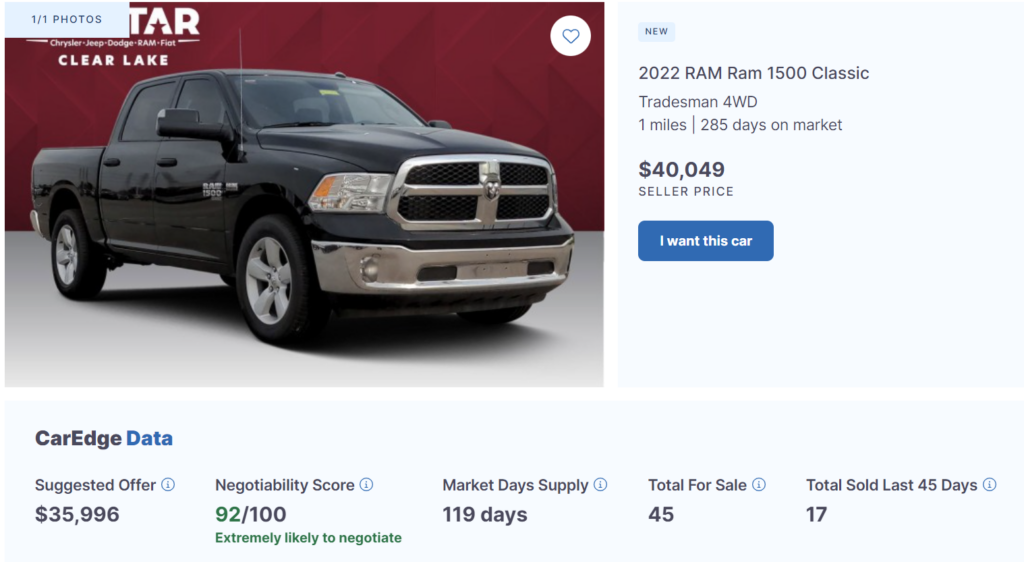
This Ram 1500 on sale in the Houston area has been on sale for nearly 300 days, and is highly negotiable. You’ll always have better chance to pay under MSRP with outgoing model years.
See how negotiable Ram trucks are with these local listings.
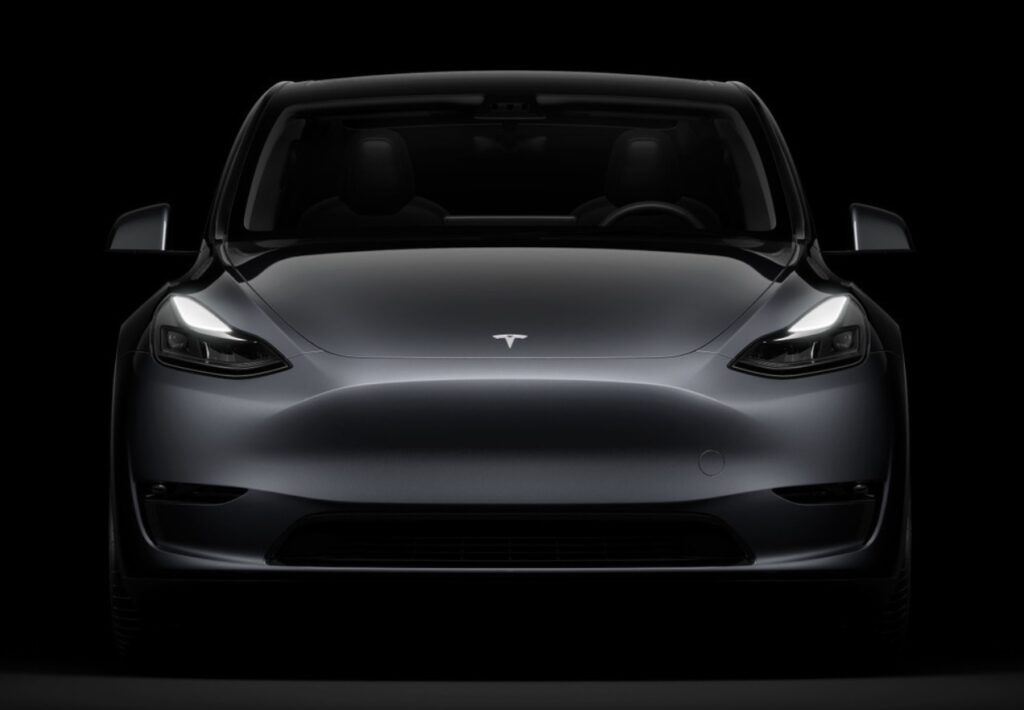
Tesla sells direct-to-consumer, so there’s no negotiating new Tesla prices. However, used Tesla’s are negotiable as the automaker continues to drop prices for new cars. Here’s our used Tesla price forecast for 2023.
Be on the lookout for severely overpriced used Model Ys, as dealers try to cover their losses on plummeting used Tesla values.
See Model Y listings near you.
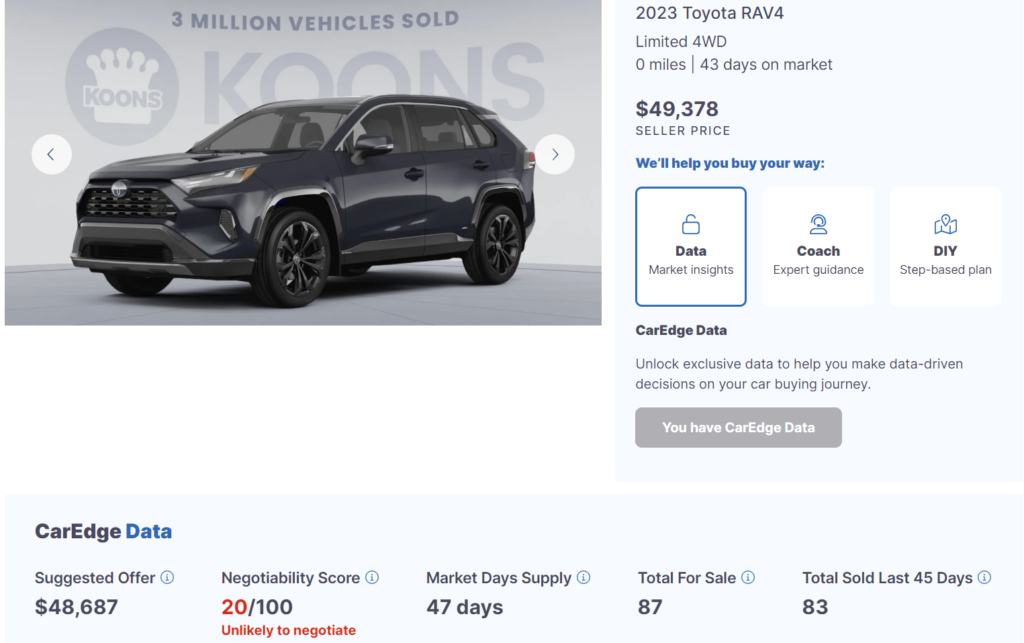
The 2023 Toyota RAV4 is one of the least negotiable new cars on the market today, but it’s also one of the most popular. With a starting price well under $30,000, it’s low negotiability is offset by an affordable price and decent fuel economy. The RAV4 Hybrid and Plug-In Hybrid (PHEV) are by far the least negotiable, according to CarEdge Car Coach Justise.
In most regional markets, days supply ranges between 20 and 50 days for the RAV4. This Limited AWD in DC is sadly one of the more negotiable listings, as it’s been on the market for over one month. That’s rare for the RAV4.
See RAV4 listings near you, with ZERO ads and local market data.
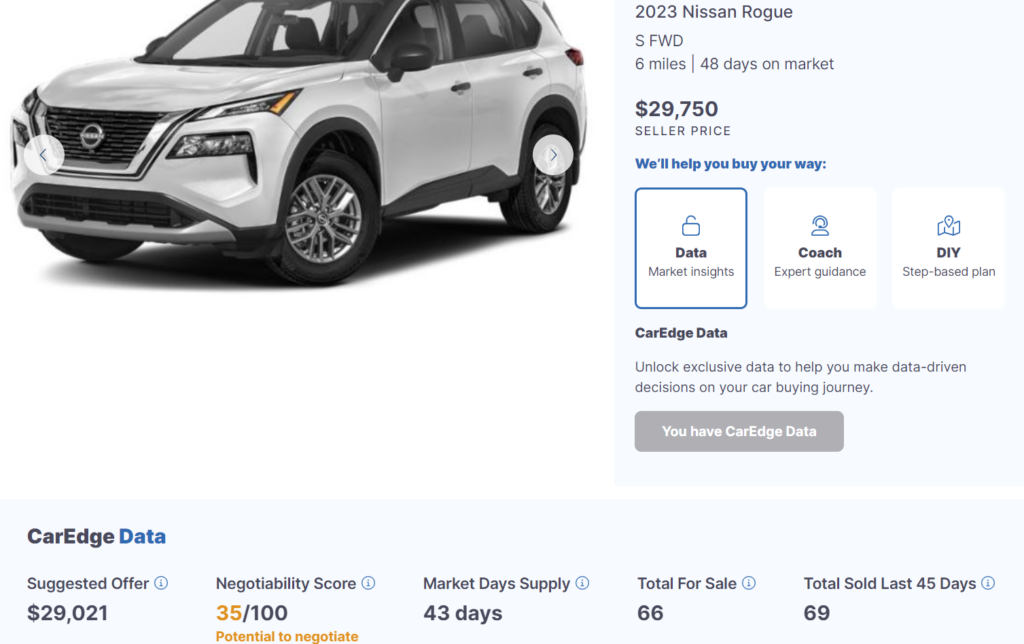
Due to a higher inventory this month, the Nissan Rogue SV is more negotiable. Other Rogue trim options, such as this Rogue S in California, are quite negotiable too, according to our Car Coaches. There will generally be more negotiability towards the end of the month.
See Nissan Rogue listings near you.
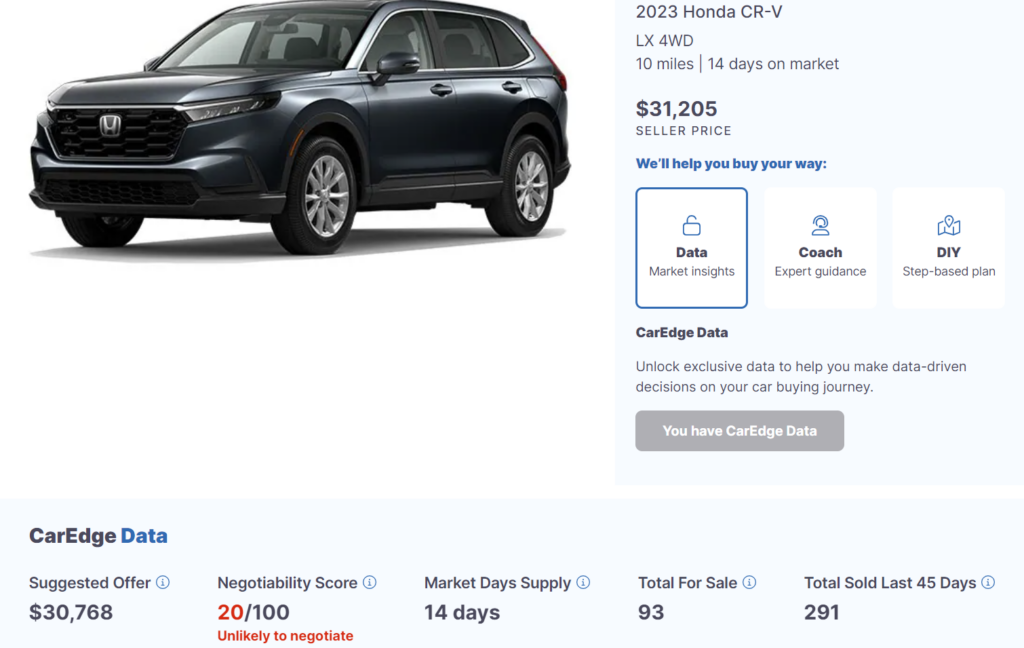
Along with its rival the RAV4, the CR-V is hard to negotiate due to consumer demand exceeding supply. Market Days Supply is FAR below the market norm of 60 days. Some options, such as the all-wheel drive CR-V and CR-V hybrids, have far less supply. We recently took a closer look at inventory in major markets, and the CR-V is hard to find everywhere you look. Be sure to check out new car inventory in major markets across America.
See CR-V listings near you, with ZERO ads.
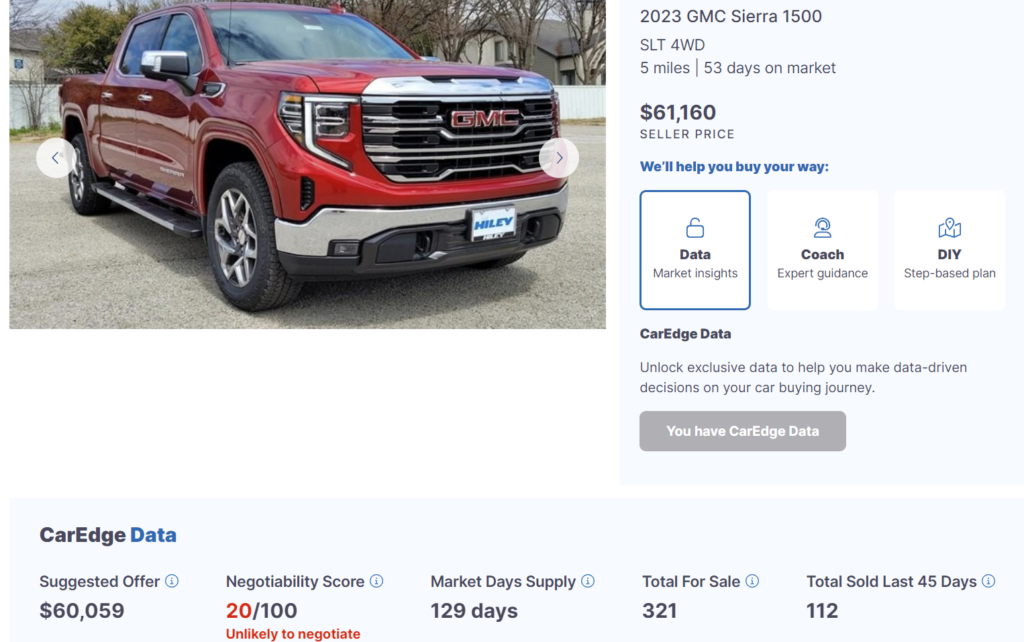
In some markets, there’s over 200 days’ supply for new GMC Sierra trucks. That’s 2.5 times the industry standard for lot inventory. However, as you can see with this new Sierra listing from Texas, market supply depends on the trim you’re wanting. Check local inventory for brand-new 2022 models still on the lot.
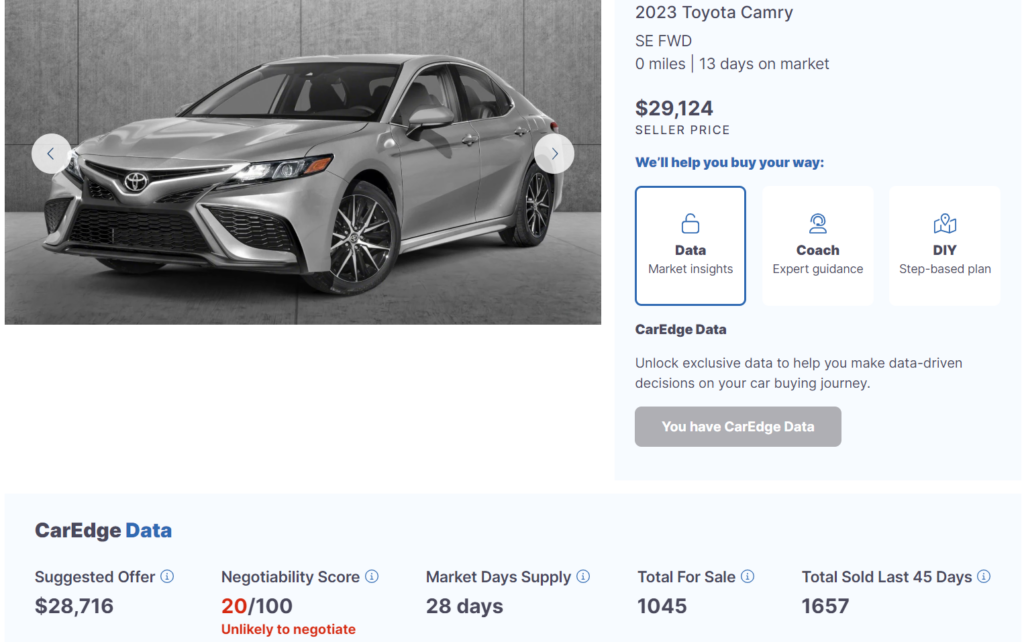
The Toyota Camry is one of the best-selling sedans in America due to its reliability and fuel efficiency. However, its popularity also means that there is high demand and limited supply, which can make negotiating a lower price challenging.
From the East Coast to the Midwest and beyond, Market Days Supply for the 2023 Camry is well under the ‘healthy’ average of about 60 days. This 2023 Camry SE in Florida is a new arrival, and will likely be sold within days.
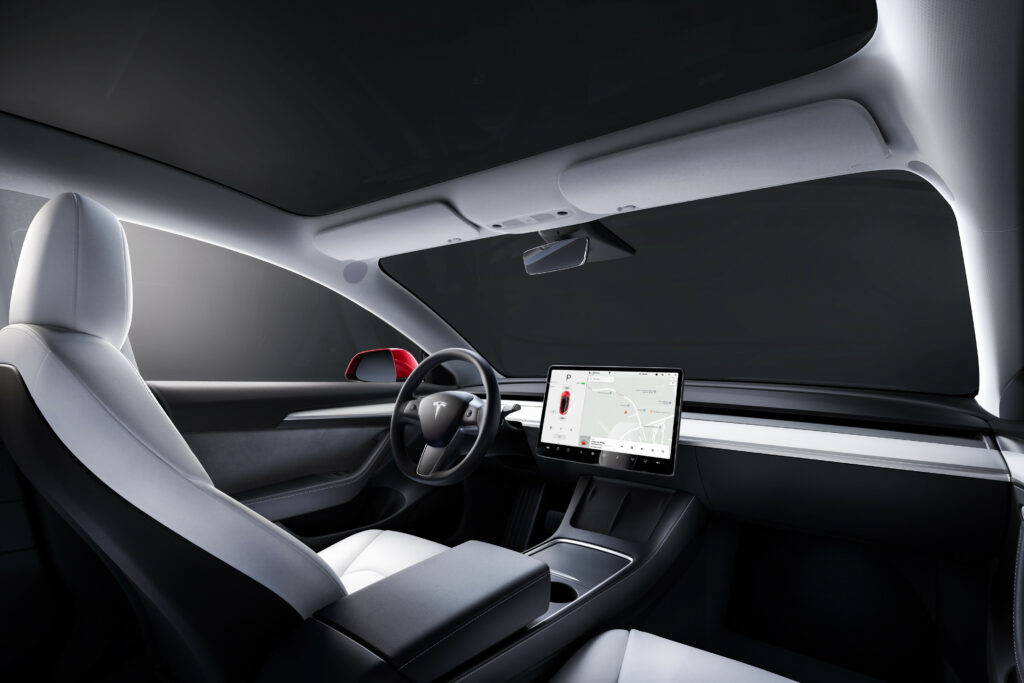
A brand-new Model 3 now starts at just over $40,000 following half a dozen price drops in 2023. But don’t expect to negotiate on a new Model 3 since Tesla sells directly to consumers in states that allow it.
Although you can only buy new Tesla EVs at tesla.com, there are shocking deals on used Tesla models at CarEdge Car Search. See listings near you.
A word of caution: Used Model 3 prices remain VERY inflated as dealers try to recoup losses as new Tesla cars keep getting cheaper.
By utilizing the data and insights provided by CarEdge Data, you can unlock a wealth of valuable information to inform your car buying decisions. With access to market data, Black Book valuations, and local inventory information, you can confidently negotiate a better deal on your next car purchase.
And for even more personalized guidance, consider partnering with a CarEdge Coach – our team of experienced car buying experts who can provide you with 1:1 support throughout the car buying process. Don’t overspend on your next vehicle – here’s how much drivers are saving with CarEdge tools and expert help!
Ford Motor Co. announced strong Q1 2023 results, posting a net income of $1.8 billion, a significant turnaround from a $3.1 billion loss the previous year. The company’s first-quarter revenue grew by 20%, reaching $41.5 billion, fueled by a 9% increase in vehicle shipments, improved sales mix, and higher net pricing. Adjusted earnings before interest and taxes (EBIT) rose by 45% to $3.4 billion, with Ford Blue, the gasoline-powered business, contributing $2.6 billion.
Ford’s commercial business, Ford Pro, generated $1.36 billion, while the electric vehicle (EV) business, Model e, reported a loss of $722 million. Despite the losses from the EV segment, company officials remain optimistic as they expect losses to increase to $3 billion this year, while Ford Blue is projected to make around $7 billion and Ford Pro, $6 billion. Ford reaffirmed its full-year guidance, targeting an adjusted EBIT of $9 to $11 billion and around $6 billion in adjusted free cash flow.
Ford dropped prices for its all-electric Mustang Mach-E for the second time this year. Tesla’s massive price drops have put pressure on Ford, with the Model Y now being more affordable than the base Mach-E. On the other hand, Ford still dominates electric trucks. With no real competition until the Silverado EV arrives, the F-150 Lightning has seen half a dozen price hikes. It now starts $15,000 higher than it did one year ago.
The company’s Q1 results exceeded Wall Street expectations, with revenue reaching $41.5 billion, up 20% from the previous year, and surpassing the anticipated $36.1 billion. Earnings per share were also higher than expected at $0.63, compared to the $0.41 predicted by analysts. In Q1, Ford’s EV sales increased by 41% year over year to 10,866 units, while hybrid sales dipped by 4% to 27,064 units.
Ford Blue’s strong performance yielded $25.1 billion in revenue, $2.623 billion in EBIT, and a 10.4% EBIT margin. Ford Model e reported $700 million in revenue, an EBIT loss of $722 million, and a -102% EBIT margin. Meanwhile, Ford Pro generated $13.2 billion in revenue, $1.366 billion in EBIT, and a 10.3% EBIT margin.
Ford is optimistic about the future of its EV business, targeting a production run rate of 600,000 units by the end of 2023 and 2 million by 2026. Ford sold nearly 16,000 F-150 Lightning electric trucks in 2022, the first year of sales. The company expects Model e to reach break-even status by year-end and aims for an 8% EBIT margin by late 2026. Ford plans to increase production of various models, including the Ford Transit and E-Transit vans, Mustang Mach-E, F-150 Lightning, Bronco Sport, and Maverick pickup, to meet Q1 demand.

If you’re in the market for a new car and considering a factory order, you may want to think twice before committing. A recent survey of nearly 3,000 car buyers shows that more buyers are canceling their factory orders, with over one-third of orders being canceled in recent months. Greedy dealers who force add-ons and last-minute price hikes are among the reasons why buyers are canceling, leaving many factory-ordered vehicles searching for a new buyer. Let’s take a look at this trend, and how it affects car prices for the rest of us.
Also: Factory Ordering a Car? These Are Wait Times We’re Seeing in 2023
We asked the CarEdge YouTube Community what happened to their factory-ordered vehicles in recent months. Here’s what 2,900 respondents had to say about their recent factory orders:
I took delivery = 22%
I canceled my order = 37%
I’m still waiting for my order to arrive = 30%
Other = 11%
That’s right, well over one-third of new car orders are being canceled in recent months. Those factory ordered vehicles are still manufactured, and now they need to find a new buyer.
Among the respondents who selected the “other” option, these were some of the common themes shared:
The car market is still out of whack, and car buyers haven’t forgotten the normalcy of pre-pandemic car buying. “I canceled my factory order because I figured being debt free and driving a clunker bunker that is safe and still runs a much better option in this market.”
Clearly, when automakers take too long to deliver on a promise, the excitement that typically comes along with purchasing a shiny new vehicle often dies. “After waiting almost 2 years for my Bronco, the love affair kind of died. Decided to use the money on a new house.” We don’t blame you!
The high rate of factory order cancellations means there are more cars available on dealership lots, which gives car buyers who are willing to forgo a factory order more room for negotiation. Dealerships will be eager to sell these vehicles. They may be more willing to negotiate on price and add-ons, especially if the cars have been on the lot for an extended period of time. This situation puts car buyers in a better position to secure a good deal, as long as they do their research and are prepare to negotiate.
Negotiate Like a PRO With This Cheat Sheet Made By a Former Dealer
In conclusion, the new car market is facing a new wave of disruption as thousands of canceled factory-ordered vehicles flood dealership lots nationwide. As more and more car buyers opt for factory orders, dealerships and manufacturers must ensure transparency, fair pricing, and timely delivery to avoid losing customers. With the evolving market conditions, it is crucial to keep up with consumer expectations and deliver quality service to maintain a loyal customer base.
If you’re in the market for a new car, make sure to do your research and leverage the current state of the market to negotiate better deals. Be aware of current factory order wait times. For additional insights on car buying like negotiability data, suggested offer, and local market availability, check out CarEdge Data. We’re here to help car buyers stay in the driver’s seat of their deal. Car buying, the way it should have always been.

If you’re planning to buy a new car, it’s important to consider the depreciation rate of the vehicle you’re interested in. Depreciation is the loss of value that occurs over time, and some cars lose their value faster than others. At CarEdge, we’ve analyzed millions of car listings and other automotive data points to provide you with proven data on the cars, SUVs, and trucks with the worst resale value in 2023. Don’t forget to check out the models and brands with the best resale value.
73.74% resale value after 5 years
After 5 years, Buick vehicles lose around 26% of their original value, making them one of the worst brands for resale value. The Buick Encore and Enclave are among the worst models for resale value, with both retaining only around 74% of their original value after 5 years.
Here’s a 2020 Buick Enclave that has lost 44% of its original value in less than three years. On top of that, it’s been sitting on the lot for 112 days. High depreciation can be a huge benefit to used car buyers. This Buick is highly negotiable.

See days on the market, local supply, negotiability score, suggested offer and more for every new and used vehicle listing with CarEdge Data.
74.06% resale value after 5 years
With a resale value of only 74.06% after 5 years, Chrysler is among the worst brands for retaining value. The Chrysler 300 is one of the worst models for resale value, with only around 74% of its original value retained after 5 years.
This 2020 Chrysler Voyager sold for nearly $10,000 more just a few years ago. However, due to ongoing minivan shortages, it’s still tough to negotiate. Days’ supply remains below average for most vans.

75.60% resale value after 5 years
Ram trucks have a resale value of only 75.60% after 5 years, making them a poor choice for those concerned about retaining value. The Ram 1500 is one of the worst models for resale value, with only around 75% of its original value retained after 5 years.
Ram can’t sell trucks right now. In fact, Ford and GM can’t either. We recently took a close look at the oversupply of trucks in America. It’s a startling contrast with the shortage of affordable new car models. Depreciation is definitely something to consider when buying a new Ram truck. This 5-year old Ram 1500 Limited with a clean record and 97,000 miles on the odometer has lost 42% of its value already.

See days’ supply, negotiability scores and recommended offers for every new and used car on the market at CarEdge Car Search.
75.77% resale value after 5 years
After 5 years, Jeep vehicles lose around 24% of their original value, putting them among the worst brands for resale value. The Jeep Grand Cherokee and Cherokee are among the worst models for resale value, with both retaining only around 72% of their original value after 5 years.
This 2020 Jeep Grand Cherokee with a clean record and just 42,000 miles on the odometer has lost 30% of its original value in three years. It’s negotiable!

77.84% resale value after 5 years
Nissan vehicles have a resale value of only 77.84% after 5 years, making them one of the worst brands for retaining value. The Nissan Armada and LEAF are among the worst models for resale value, with both retaining only around 68% of their original value after 5 years.
This 2018 Nissan Altima SR lost 32% of its value in 5 years, and that’s with a clean record and low mileage for a vehicle of that age.

Crunch the numbers with this car depreciation calculator.
Of the more than 400 models on sale in North America, these are the 20 with the highest depreciation, and the quickest to lose resale value.
| Model | 5-Year Depreciation |
|---|---|
| GMC Yukon XL | 68.38% |
| Nissan Armada | 68.80% |
| GMC Sierra 2500HD | 71.30% |
| Chevrolet Suburban | 71.86% |
| Jeep Cherokee | 72.28% |
| Kia Sorento | 72.48% |
| Nissan LEAF | 72.55% |
| Jeep Grand Cherokee | 72.70% |
| Ford Escape | 73.00% |
| Chevrolet Tahoe | 73.12% |
| Buick Enclave | 73.21% |
| Ford Expedition | 73.35% |
| Nissan Altima | 73.90% |
| Nissan Titan | 74.04% |
| Chrysler 300 | 74.06% |
| Buick Encore | 74.26% |
| Chevrolet Spark | 74.62% |
| Nissan Maxima | 75.00% |
| GMC Yukon | 75.31% |
| Ram 1500 | 75.60% |

As you can see, some models lose more than 30% of their value after just five years. Buying a car with a low resale value can cost you thousands of dollars in the long run. This is especially true if you are likely to sell your car within the next decade. So, before you make a purchase, be sure to research the resale value of the vehicle you’re interested in.
Compare depreciation between models, all in one spot.
At CarEdge, we provide you with the data you need to make informed decisions. With CarEdge Data, you can access valuable market data, including Black Book valuations, CarEdge Suggested Offer, Negotiability Score, CarEdge Recommendation, and local Days Supply in your region. With this information, you can negotiate better deals and avoid being taken advantage of by car dealerships.
Don’t get caught off guard with high depreciation. Unlock behind-the-scenes insights that will inform your car buying decisions today. And if you’re looking for 1:1 help with your deal, partner with a car buying pro with years of experience with CarEdge Coach. We’re real people helping drivers everywhere save real money. Check out these uplifting success stories to see how much you could save!

Heading into this summer car buying season, patience will reward shoppers with savings. However, a closer look at market data reveals a shocking reality: deals are very hit-or-miss in 2023. Frankly, your likelihood of buying a new car under MSRP depends on what exactly you’re shopping for. On top of that, notable differences exist between regional markets. To bring much-needed clarity to the car market in 2023, we’re sharing the latest analysis from CarEdge Data. Let’s dive in.
Among the metrics employed to track the new car market, days’ supply is one of the most widely-used. Through the industry’s ups and downs from 2020 through the present, this data point was the bellwether at every turn. But what exactly is days’ supply, and how is it calculated?
Days’ supply is a calculation used in the automotive industry to determine how long it would take for dealerships to sell their current inventory of vehicles based on the average daily sales rate. It is calculated by dividing the number of vehicles in inventory by the average daily sales rate over a certain period of time.
Here’s the car buyer’s guide to auto sales jargon and terms to know.
Historically, a 60 days’ supply is considered normal or average in the auto industry. As we’re about to see, few of the top-selling models in America are anywhere near normal heading into summer.
Are you in the market for a new truck in 2023? We have good news for you. There’s a huge oversupply of trucks in most markets as demand for overpriced inventory dried up earlier this year. Dealers are holding on to their trucks for too long, and with high floorplanning costs, they’re paying the price.
Car dealer floorplanning costs refer to the interest charges that car dealerships incur when they finance their inventory with a line of credit from a bank or a finance company. Essentially, the dealership uses the line of credit to purchase new cars from the manufacturer, and then pays interest on the loan until the cars are sold to customers. The longer the cars sit on the lot unsold, the more interest the dealer has to pay. This is why it’s important for dealers to move their inventory quickly and efficiently.
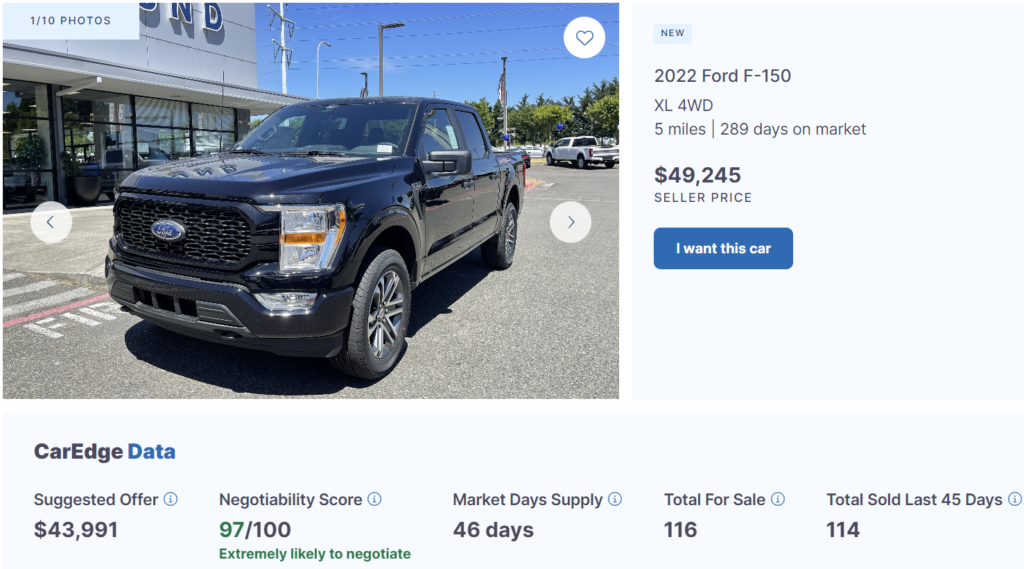
We’re seeing truck prices steadily drop in most markets. Check out these examples from CarEdge Car Search. This brand-new Ford F-150 on sale in the Dallas area has had no fewer than four price adjustments in the past few months, yet it remains on the lot after 290 days. The CarEdge Negotiability Score takes into account days on market, local supply, and other factors to give this F-150 a 97/100. The dealer is EXTREMELY likely to negotiate.
This new Ram 1500 on sale near Houston, Texas has been on sale for over 285 days. The dealer has been dreading dropping the price, but seems to have finally given in recently. This is the perfect example of a new truck that would be quite negotiable.
Affordable SUVs and Sedans In Short Supply

Is it any surprise that automakers are making more of their higher margin, expensive models and far fewer of the budget models that most drivers want? The best-selling affordable vehicles all have days’ supply well under the 60 day norm in major markets.
This includes the following best-sellers:
Let’s take a closer look at current new car inventory for the 20 best-selling cars, trucks and SUVs last year. We analyzed inventory in the five largest car markets in the United States. The following data is as-of Apr 26, 2023.
| Make/Model | Total For Sale | # Sold - 45 Days | Days Supply |
|---|---|---|---|
| Ford F-150 XLT Hybrid | 515 | 138 | 168 |
| Chevrolet Silverado LT 4WD | 1092 | 276 | 178 |
| Ram 1500 Big Horn/Lone Star | 1182 | 250 | 213 |
| Toyota RAV4 XLE Premium | 543 | 876 | 28 |
| Toyota Camry LE FWD | 509 | 625 | 37 |
| GMC Sierra Elevation 4WD | 508 | 133 | 172 |
| Honda CR-V Sport FWD | 361 | 968 | 17 |
| Toyota Tacoma TRD Off Road 4WD | 490 | 505 | 44 |
| Tesla Model Y Long Range (used - 2021) | 110 | 23 | 215 |
| Jeep Grand Cherokee Limited 4WD | 328 | 412 | 36 |
| Toyota Highlander XLE FWD | 1114 | 1692 | 30 |
| Toyota Corolla LE | 767 | 829 | 42 |
| Chevrolet Equinox LS | 390 | 181 | 97 |
| Ford Explorer XLT | 1375 | 364 | 170 |
| Tesla Model 3 RWD (used - 2021) | 118 | 20 | 266 |
| Nissan Rogue SV | 1481 | 1443 | 46 |
| Jeep Wrangler Unlimited | 506 | 107 | 213 |
| Hyundai Tucson SEL | 1365 | 1387 | 44 |
| Subaru Crosstrek Limited | 300 | 754 | 18 |
| Honda Accord EX | 790 | 617 | 58 |
| Make/Model | Total For Sale | # Sold - 45 Days | Days Supply |
|---|---|---|---|
| Ford F-150 XLT Hybrid | 832 | 267 | 140 |
| Chevrolet Silverado LT 4WD | 890 | 253 | 158 |
| Ram 1500 Big Horn/Lone Star | 908 | 118 | 346 |
| Toyota RAV4 XLE Premium | 1003 | 1142 | 40 |
| Toyota Camry LE FWD | 621 | 683 | 41 |
| GMC Sierra Elevation 4WD | 388 | 206 | 85 |
| Honda CR-V Sport FWD | 1052 | 1028 | 46 |
| Toyota Tacoma TRD Off Road 4WD | 585 | 1737 | 15 |
| Tesla Model Y Long Range (used - 2021) | 82 | 51 | 72 |
| Jeep Grand Cherokee Limited 4WD | 182 | 103 | 80 |
| Toyota Highlander XLE FWD | 357 | 766 | 21 |
| Toyota Corolla LE | 642 | 950 | 30 |
| Chevrolet Equinox LS | 301 | 122 | 111 |
| Ford Explorer XLT | 627 | 198 | 143 |
| Tesla Model 3 RWD (used - 2021) | 63 | 74 | 38 |
| Nissan Rogue SV | 754 | 650 | 52 |
| Jeep Wrangler Unlimited | 217 | 103 | 95 |
| Hyundai Tucson SEL | 284 | 419 | 31 |
| Subaru Crosstrek Limited | 8 | 139 | 3 |
| Honda Accord EX | 1020 | 516 | 89 |
| Make/Model | Total For Sale | # Sold - 45 Days | Days Supply |
|---|---|---|---|
| Ford F-150 XLT Hybrid | 479 | 211 | 102 |
| Chevrolet Silverado LT 4WD | 546 | 150 | 164 |
| Ram 1500 Big Horn/Lone Star | 469 | 66 | 320 |
| Toyota RAV4 XLE Premium | 198 | 432 | 21 |
| Toyota Camry LE FWD | 113 | 156 | 33 |
| GMC Sierra Elevation 4WD | 167 | 69 | 109 |
| Honda CR-V Sport FWD | 125 | 380 | 15 |
| Toyota Tacoma TRD Off Road 4WD | 289 | 324 | 40 |
| Tesla Model Y Long Range (used - 2021) | 29 | 20 | 65 |
| Jeep Grand Cherokee Limited 4WD | 173 | 119 | 65 |
| Toyota Highlander XLE FWD | 303 | 637 | 21 |
| Toyota Corolla LE | 214 | 241 | 40 |
| Chevrolet Equinox LS | 131 | 203 | 29 |
| Ford Explorer XLT | 572 | 126 | 204 |
| Tesla Model 3 RWD (used - 2021) | 11 | 17 | 29 |
| Nissan Rogue SV | 482 | 405 | 54 |
| Jeep Wrangler Unlimited | 115 | 31 | 167 |
| Hyundai Tucson SEL | 528 | 598 | 40 |
| Subaru Crosstrek Limited | 33 | 229 | 6 |
| Honda Accord EX | 188 | 185 | 46 |
| Make/Model | Total For Sale | # Sold - 45 Days | Days Supply |
|---|---|---|---|
| Ford F-150 XLT Hybrid | 1269 | 301 | 190 |
| Chevrolet Silverado LT 4WD | 918 | 176 | 235 |
| Ram 1500 Big Horn/Lone Star | 832 | 140 | 267 |
| Toyota RAV4 XLE Premium | 134 | 229 | 26 |
| Toyota Camry LE FWD | 122 | 199 | 28 |
| GMC Sierra Elevation 4WD | 294 | 86 | 154 |
| Honda CR-V Sport FWD | 423 | 260 | 73 |
| Toyota Tacoma TRD Off Road 4WD | 117 | 173 | 30 |
| Tesla Model Y Long Range (used - 2021) | 19 | 15 | 57 |
| Jeep Grand Cherokee Limited 4WD | 225 | 81 | 125 |
| Toyota Highlander XLE FWD | 207 | 235 | 40 |
| Toyota Corolla LE | 103 | 191 | 24 |
| Chevrolet Equinox LS | 53 | 102 | 23 |
| Ford Explorer XLT | 616 | 114 | 243 |
| Tesla Model 3 RWD (used - 2021) | 24 | 20 | 54 |
| Nissan Rogue SV | 678 | 445 | 69 |
| Jeep Wrangler Unlimited | 114 | 54 | 95 |
| Hyundai Tucson SEL | 253 | 320 | 36 |
| Subaru Crosstrek Limited | 15 | 79 | 9 |
| Honda Accord EX | 279 | 188 | 67 |
| Make/Model | Total For Sale | # Sold - 45 Days | Days Supply |
|---|---|---|---|
| Ford F-150 XLT Hybrid | 1378 | 352 | 176 |
| Chevrolet Silverado LT 4WD | 894 | 263 | 153 |
| Ram 1500 Big Horn/Lone Star | 1021 | 139 | 331 |
| Toyota RAV4 XLE Premium | 192 | 223 | 39 |
| Toyota Camry LE FWD | 139 | 151 | 41 |
| GMC Sierra Elevation 4WD | 331 | 63 | 236 |
| Honda CR-V Sport FWD | 352 | 322 | 49 |
| Toyota Tacoma TRD Off Road 4WD | 139 | 216 | 29 |
| Tesla Model Y Long Range (used - 2021) | 27 | 11 | 110 |
| Jeep Grand Cherokee Limited 4WD | 180 | 56 | 145 |
| Toyota Highlander XLE FWD | 250 | 250 | 45 |
| Toyota Corolla LE | 98 | 150 | 29 |
| Chevrolet Equinox LS | 25 | 87 | 13 |
| Ford Explorer XLT | 538 | 147 | 165 |
| Tesla Model 3 RWD (used - 2021) | 23 | 13 | 80 |
| Nissan Rogue SV | 601 | 399 | 68 |
| Jeep Wrangler Unlimited | 48 | 41 | 53 |
| Hyundai Tucson SEL | 194 | 366 | 24 |
| Subaru Crosstrek Limited | 5 | 60 | 4 |
| Honda Accord EX | 201 | 187 | 48 |
The trend couldn’t be more clear: there’s a massive oversupply of trucks, and a shortage of popular, more affordable crossovers, SUVs and sedans. Buyers are holding back on truck purchases, yet automakers keep producing more and more. They make less profit per affordable vehicle sold, and in these greedy times, they’re producing less and less of them. We saw it just the other day with the cancellation of the Chevrolet Bolt to make way for $80,000+ electric trucks.
Let’s talk about what you should do to overcome these obstacles when buying in 2023. With a but of insider know-how, buyers still have the upper hand.
Here’s the latest new car inventory numbers (nationwide).

With the latest market update in mind, CarEdge co-founder and auto industry veteran Ray Shefska wanted to share these timely recommendations with car buyers.
“My advice for buyers can be summed up in one word, patience. With dealer floor plan costs rising and inventory levels growing, a consumer’s patience should be rewarded with lower prices either via direct discounts from the dealership or in combination with manufacturer customer incentives in the form of rebates. Depending on how we see sales play out for the month of May, lower than what they had hoped for, is my expectation. I would not be surprised to see manufacturers offer both customer rebates and subvented interest rates in May to spur slowing sales. Dealers hate aged new vehicle inventory and with trucks sitting for so long, many dealers will react the only way they know how, and that would be discounting trucks to move them.
PATIENCE is the word of the day.”
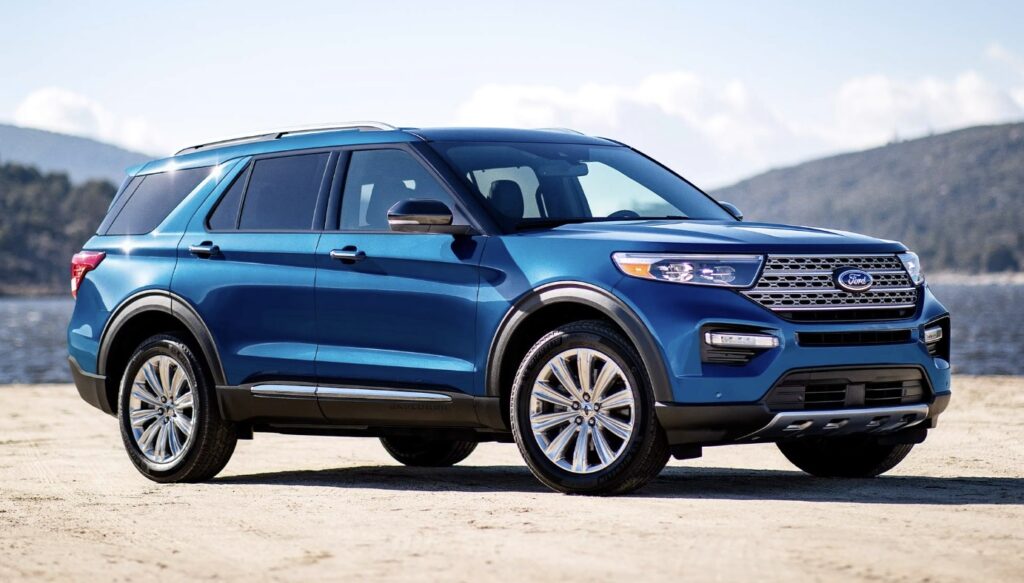
To find the best deals in the current market, car buyers need to be flexible in their choices. Buyers may need to be open to different makes and models to take advantage of the best deals. For example, a buyer in the market for a new Honda CR-V may want to test drive the new Nissan Rogue or even a Ford Explorer, two models with more inventory. If you’re shopping for a model that’s in short supply, now’s probably not the time to be picky about paint color, wheels or other nonessentials.
To make informed buying decisions, car buyers should conduct thorough research on the models they are interested in. With CarEdge Data, buyers can access valuable information on depreciation, resale value, and more. Armed with this knowledge, buyers can negotiate better deals and avoid being taken advantage of by car dealerships. Don’t make a hasty decision – take the time to do your research and make an informed choice.
See behind-the-scenes local market data with CarEdge Car Search.
If you’re in the market for a new car in 2023, it’s more important than ever to make informed buying decisions. With CarEdge Data, you can access proven data on depreciation, resale value, and more to ensure that you get the best deal possible. Don’t let car dealerships take advantage of you – empower yourself with CarEdge Data today.

Are you in the market for a new car? If so, it’s important to consider the depreciation rate of the vehicle you’re interested in. Depreciation in vehicles is inevitable, but some cars hold their value better than others. At CarEdge, we’ve analyzed millions of car listings and other automotive data points to provide you with proven data that you can rely on to make informed decisions. Let’s take a closer look at the cars, SUVs and trucks with the best resale value.
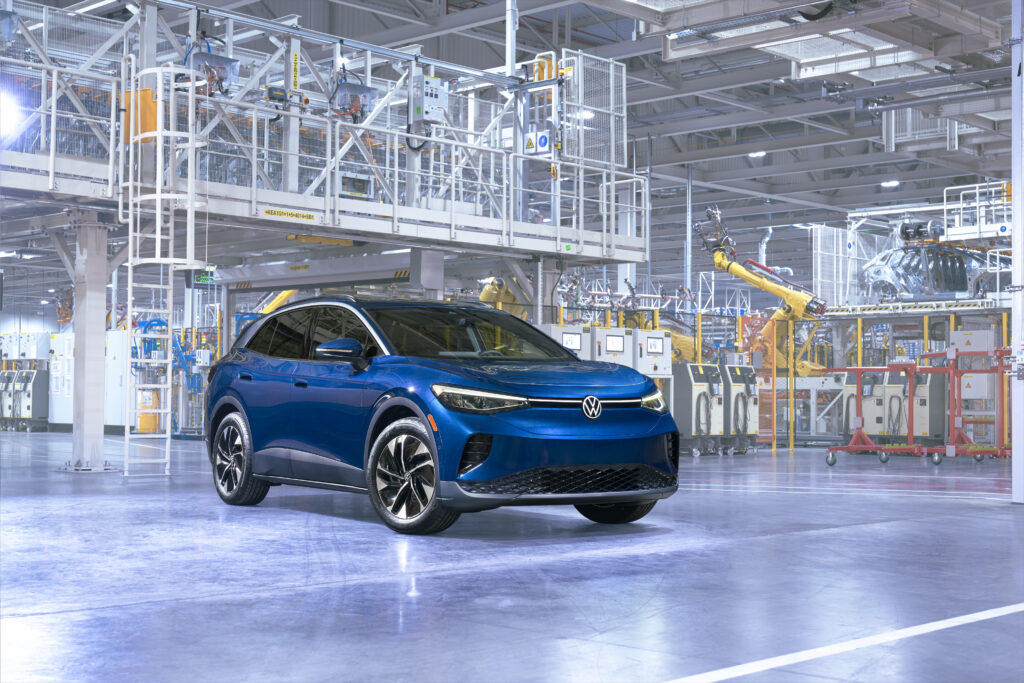
Volkswagen: 85.53% resale value after 5 years
Even though they finally had to re-retire the Beetle, Volkswagen scored in the top half of vehicle manufacturers for value retention after 3, 5, and 7 years. See Volkswagen depreciation by model year.
Subaru: 84.41% resale value after 5 years
The low-inventory king is known for reliable all-weather capability at an affordable price. The Forester (#4), Legacy (#20), Crosstrek (#30) and Outback (#36) are all in the top 50 models for resale value. Despite keeping low inventory on dealership lots, Subaru maintains a great reputation for resale value.
Honda: 83.60% resale value after 5 years
The Civic, Accord and redesigned CR-V were all best-sellers in 2022. It’s no coincidence that these same models are in the top resale value rankings. Honda cars and SUVs are known for their longevity, reliability and strong resale value. As Honda finally enters the EV segment later this year with the all-new Honda Prologue, we wonder if their electric vehicles will earn the same great reputation.
Mazda: 83.29% resale value after 5 years
Mazda’s resale values have improved, relative to their peers, and their rankings have climbed to the Top 5 range at all three time intervals. Mazda’s U.S. market share has been steadily rising for years. The Mazda 3, MX-5 Miata, and CX-5 all rank in the top 50 models for resale value.
Toyota: 83.09% resale value after 5 years
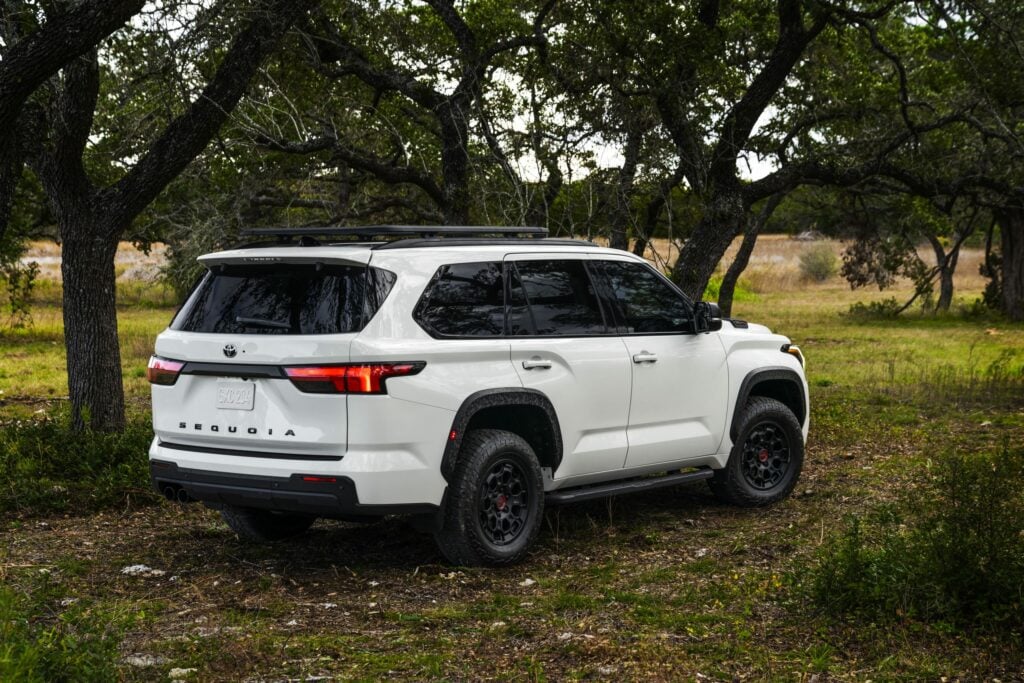
Toyota as a brand, does very well in maintaining its value, consistently ranking at the top of popular brands. The Toyota Tacoma, Highlander, 4Runner, Prius and Sequoia all have better-than-average resale value. Compare Toyota resale values here.
Check out this depreciation calculator
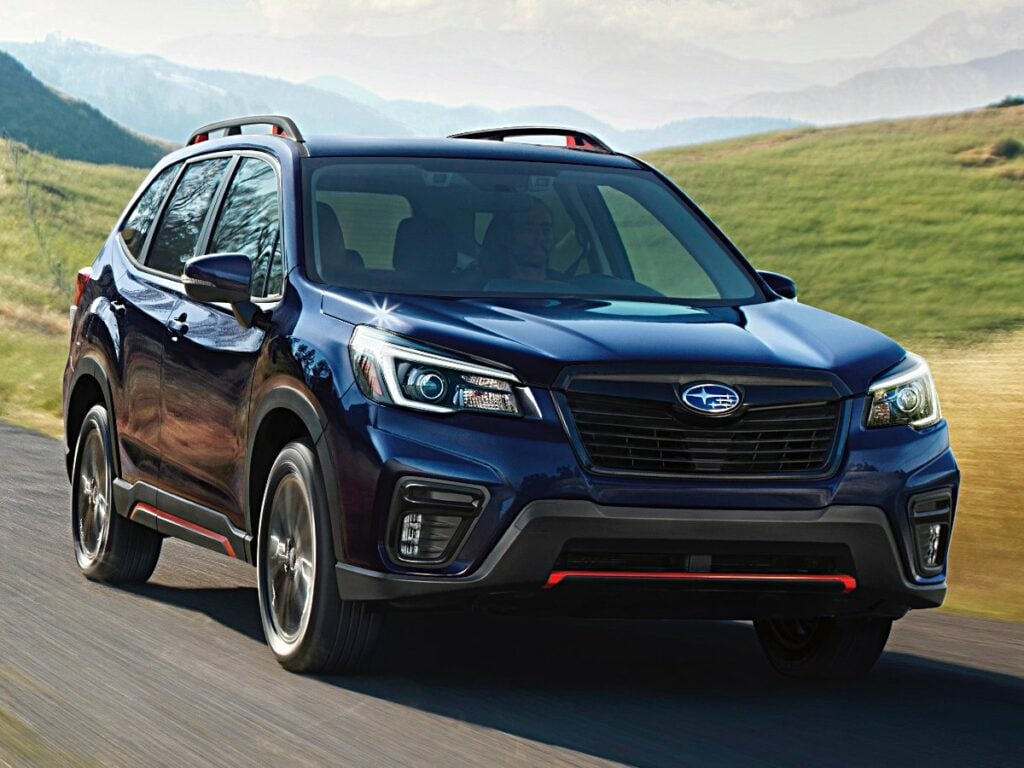
| Rank | Model | 3 Year Residual Value |
|---|---|---|
| 1 | Subaru Forester | 96.40% |
| 2 | Chevrolet Silverado 3500HD | 96.28% |
| 3 | Ford F-450 Super Duty | 95.47% |
| 4 | GMC Sierra 3500HD | 95.44% |
| 5 | Mitsubishi Mirage | 95.26% |
| 6 | Honda Ridgeline | 94.22% |
| 7 | Subaru Crosstrek | 94.00% |
| 8 | Dodge Charger | 93.78% |
| 9 | GMC Sierra 1500 | 93.41% |
| 10 | Jeep Compass | 93.24% |
| 11 | Chevrolet Traverse | 93.23% |
| 12 | Chevrolet Spark | 93.00% |
| 13 | Dodge Durango | 92.51% |
| 14 | Subaru Legacy | 92.49% |
| 15 | Toyota Tacoma | 92.47% |
| 16 | Ford Explorer | 92.00% |
| 17 | Honda Accord | 92.00% |
| 18 | Chevrolet Silverado 2500HD | 91.97% |
| 19 | Ram 2500 | 91.78% |
| 20 | Nissan Altima | 91.62% |
Source: CarEdge Depreciation Data
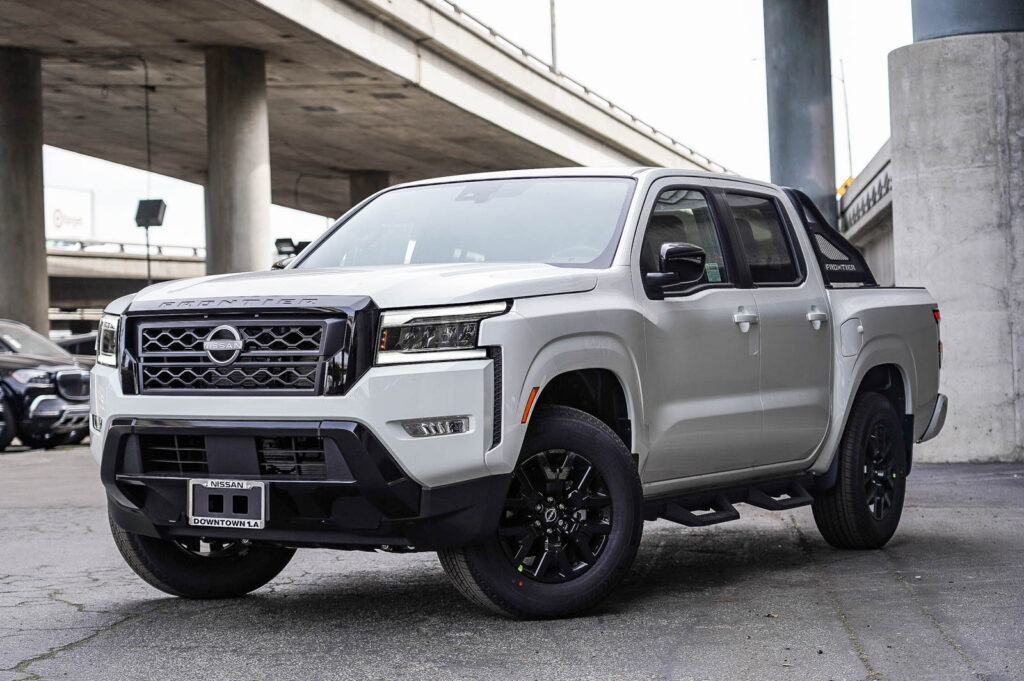
| Rank | Model | 5 Year Residual Value |
|---|---|---|
| 1 | Nissan Frontier | 88.55% |
| 2 | Honda Accord | 88.00% |
| 3 | Toyota Tacoma | 87.58% |
| 4 | Subaru Forester | 87.09% |
| 5 | Ford F-250 Super Duty | 87.00% |
| 6 | Volkswagen Tiguan | 87.00% |
| 7 | Ford F-350 Super Duty | 86.95% |
| 8 | Ford F-150 | 86.75% |
| 9 | Mazda 3 | 86.13% |
| 10 | Honda Civic | 86.00% |
| 11 | Kia Rio | 86.00% |
| 12 | Honda Pilot | 85.95% |
| 13 | Mazda MX-5 Miata | 85.80% |
| 14 | Toyota Highlander | 85.77% |
| 15 | GMC Canyon | 85.33% |
| 16 | Nissan Versa | 85.03% |
| 17 | Toyota 4Runner | 85.00% |
| 18 | Toyota Prius | 85.00% |
| 19 | GMC Sierra 1500 | 84.80% |
| 20 | Subaru Legacy | 84.73% |
Source: CarEdge Depreciation Data
Compare depreciation between models, all in one spot.
Depreciation in the value of cars is an inevitable reality, and it can significantly affect a vehicle’s overall cost. Therefore, it’s crucial to consider resale value when buying a car. CarEdge data shows that brands like Volkswagen, Subaru, Honda, Mazda, and Toyota have the best resale value after five years, and they maintain their great reputation for reliability, longevity, and value retention. This information is helpful to make informed decisions while purchasing a vehicle.
Love the data? We do too. That’s why we’ve created CarEdge Data, where you will find behind-the-scenes insights to inform your car buying decisions. With CarEdge Data, you unlock valuable market data:
✅ Black Book valuations: Get insider trade-in values from dealer auctions
✅ CarEdge Suggested Offer: Know the fair market value of every car on the market
✅ Negotiability Score: Discover the likelihood of negotiating based on market data
✅ CarEdge Recommendation: Get actionable next steps to buy a car
✅ Days Supply in your region
Looking for 1:1 help with your deal? Learn more about how you can partner with a car buying pro with years of experience with CarEdge Coach.
We’re here to help!

When it comes to purchasing a new or used car, the state you’re in can make a significant difference in terms of taxes, fees, and available inventory. We’ll take a look at the best and worst states to buy a car in 2026, focusing on factors like sales tax, insurance costs, documentation fees, and overall car supply. Let’s dive in and see how your state stacks up.
First, let’s explore the states that offer the most advantages when it comes to car buying. States like Alaska, Montana, Oregon, Delaware, and New Hampshire stand out due to their lack of statewide sales tax, as well as generally low fees when buying and registering a car. South Dakota and Iowa are close behind.
Several other states have low state sales tax rates, but many have higher fees that keep them out of our top rankings: Alabama (2%), Colorado (2.9%), Hawaii (4%), Louisiana (4%), Missouri (4.23%), New Mexico (4%), New York (4%), North Carolina (3%), Oklahoma (3.25%), South Dakota (4%), and Virginia (4.15%). However, local taxes can drive costs higher, especially in big cities and affluent suburbs.
Dealerships charge a documentation fee, or “doc fee,” to cover the cost of preparing and filing a sales contract. Many states don’t regulate doc fees, and the amount varies from state to state. In many cases, state taxes and registration fees can outweigh the advantages of low doc fees.
These states have the lowest doc fees in 2025, and as a result, are better states to buy a car in: Minnesota ($75), Arkansas ($110), Oregon ($115), South Dakota ($115), Iowa ($135), Texas ($150), Washington ($150), Indiana ($150). California is also on the list with a very low average doc fee of $85, but the high sales tax and low supply of new cars keeps it far off of the list of best states to buy a car in.
Wondering what the fees are where you live? See Car Dealer Doc Fees by State.

Now, let’s take a look at the states you might want to avoid when purchasing a vehicle. Documentation fees can be particularly high in Florida, Alabama, Virginia, and North Carolina, with fees ranging from $485 to $995. Florida stands out as one of the worst states for new car purchases, with no cap on doc fees (averaging $995). When it comes to vehicle registration, a few states stand out with costly fees:
Alabama, North Carolina, Iowa, and Florida aren’t far behind with registration fees all averaging over $300.
With doc fees, registration fees, sales tax, and new car inventory all taken into consideration, it’s safe to say that the worst states to buy a car are: Mississippi, Florida, California, and North Carolina.
However, Florida’s abundant used car market can make it a better choice for used car buyers, thanks to the state’s older population. On the other hand, flood cars are a much bigger risk in Florida’s used car market.
It’s important to point out that taxes and fees are only part of the picture. The existing supply of new cars in each state is also critically important. Nationwide, there’s an 93-day supply of new cars as of early 2026. However, some states have might tighter supply. Hover over the interactive map below to see the states with the highest and lowest supply of new cars in 2026.
Use the map above to help you find the regions with the greatest oversupply of new cars. If there’s a state near you with a lot more inventory, it may be worth it to take a little trip in order to have more negotiating leverage.
Ready to outsmart the dealerships? With CarEdge Concierge, we’ll negotiate your car price to lock in big savings. Looking for a DIY option? Shop confidently with CarEdge Pro, our most affordable option for empowered car buying. Looking to lease or trade-in? We can help with that too!
Learn more about CarEdge’s car buying help →


Dealer lot inventory is on the rise, but where are the deals at?! As we move further into 2023, many potential car buyers are wondering, “is now a good time to buy a car?” and “will car prices go down in 2023?” The good news is that recent market trends indicate that the tide is starting to turn, with car prices slowly beginning to decrease and negotiability on the rise. However, there are big differences between the new and used car markets today. Let’s take a closer look at the details.
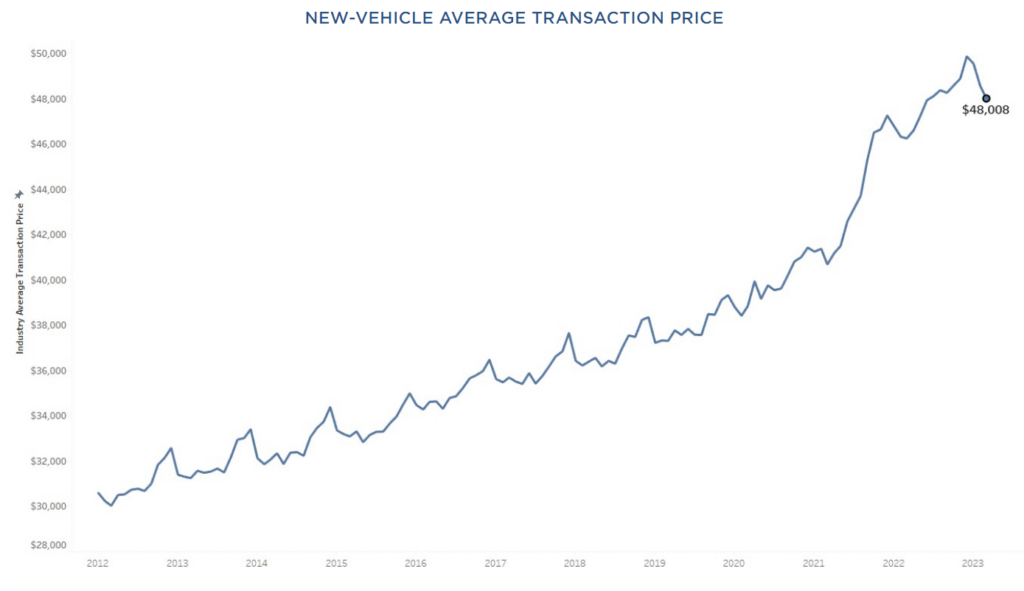
According to CarEdge’s Ray Shefska, recent trends suggest that there’s good news for car buyers, with prices gradually decreasing and more room for negotiation on the horizon.
Ray notes that “March broke a string of 20 straight months where the average new car prices transacted at above MSRP, in March the average price paid was $171 below MSRP.”
“Although this drop might not seem significant, it’s a noteworthy development, indicating that dealerships are becoming more open to selling cars at lower prices,” he explained. Car manufacturers are increasing incentives to attract more buyers to the market, ultimately benefiting car shoppers.
CarEdge’s Car Coaches note that patience will be rewarded as we head into the summer 2023 car buying season. “Consumers who are patient will find themselves in a much better position as negotiability should increase as we get into the summer months.”
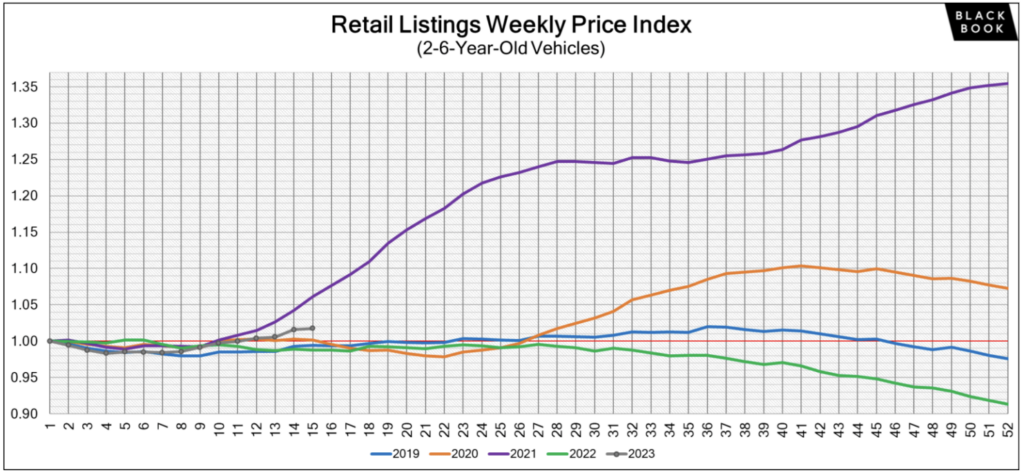
It’s important to note that there are considerable differences between the new and used car markets. New car transaction prices are steadily dropping as dealers try to move more inventory after years of nearly vacant lots. On the other hand, used car prices are increasing as of spring 2023. The latest used car price data from Black Book shows that after 30 weeks of wholesale price declines, used car prices have actually increased for the past several weeks. In April, used car prices increased at the retail level too.
CarEdge’s Car Coaches don’t expect rising used car prices to become a new long-term trend like we saw in 2021 and early 2022. However, there could be a month or two of additional slight price hikes.
We track used car prices weekly here.
How do rising interest rates affect car buying? Of course, buyers who finance are going to pay more in interest, no matter their credit score. But other things change too. Despite higher APRs, there can be benefits for buyers. Car dealers pay interest on lot inventory until it is sold. Think of dealer floor plan financing almost like a credit card made solely for purchasing vehicle inventory. When the federal reserve raises the cost of borrowing money, all kinds of credit will become more expensive, and that includes car lot floor-planning.
With higher floor plan costs, rising lot inventories and incentive spending on the rise, dealers will be motivated to negotiate. Therefore, the longer you can wait to buy a car in 2023, the more likely you’ll be able to negotiate thousands off of your deal.
See the best manufacturer incentives this month (updated)
Furthermore, Ray predicts that it will be a lot easier to secure a deal below MSRP as we get deeper into summer. In fact, the latest data from Kelly Blue Book shows that for the first time in two years, new-vehicle transaction prices fell below MSRP in March. The CarEdge Coaches expect that trend to continue.
Sadly, you and I are well aware that cars are far from cheap these days. The average price paid for a new car is still around $48,000. If you’re looking to go electric, expect to pay 20% more. Even in this market, our Coaches have proven even the toughest new and used cars are negotiable. Check out these success stories from happy drivers around the nation. CarEdge Coaches have even negotiated thousands of dollars off of EV prices in 2023.

We’re real people empowering you to save real money on your next auto. How can we help? Check out hundreds of 100% free resources, great YouTube videos, and the fastest-growing online auto forum today, the CarEdge Community. We just launched Dealer Reviews, where you can see nearly 3,000 crowdsourced car dealer and deal reviews.
Looking for behind-the-scenes auto market data to inform your buying decisions? That’s exactly why we created CarEdge Data. Unlock the Black Book car valuations that dealers use, CarEdge negotiation scores, official recommendations, and local market data for every car on CarEdge Car Search with CarEdge Data.
Ready for expert 1:1 help with your deal? Our Car Coaches are ready to work with you to secure the best deal on out-the-door prices, financing, and more. Learn more about our CarEdge Coach unlimited access plan. We look forward to meeting you.

Are you in the market for a new or used car? If so, you’re probably wondering about the latest auto loan rates and how to qualify for the lowest APR. Whether you’re a first-time buyer or an experienced shopper, understanding auto loan rates is essential to making a smart financial decision. Let’s take a look at current car loan rates this month by credit score. Plus, we’ll go over how to qualify for the lowest APR.
Before we dive into the details, it’s important to know that auto loan rates vary based on several factors, including the loan term, the type of car (new or used), and, most importantly, your credit score. To give you an idea of what to expect, we’ve put together a table template that breaks down the average auto loan rates by credit score for both new and used cars.
First, here’s a reminder of how credit scores are categorized for car loans:
| Credit Score Category | Score Range |
| Super Prime | 781 – 850 |
| Prime | 661 – 780 |
| Nonprime | 601 – 660 |
| Subprime | 501 – 600 |
| Deep Subprime | 300 – 500 |
These are the latest car loan APRs by credit score:
| Credit Score | New Car Average APR | Used Car Average APR |
| Super Prime | 4.75% | 5.99% |
| Prime | 5.82% | 7.83% |
| Nonprime | 8.12% | 12.08% |
| Subprime | 10.79% | 17.46% |
| Deep Subprime | 13.42% | 20.62% |
**Please note that the rates provided in this table represent general market data and will vary based on individual circumstances.

Now that you have a better understanding of auto loan rates by credit score, let’s explore some strategies to help you qualify for the lowest rates:
Shop around: One of the best ways to secure a low auto loan rate is by shopping around and comparing offers from multiple lenders. This will help you find the most competitive rates and terms for your specific needs. See your lowest rate from trusted credit unions, with no hit to your credit score until you choose to finalize your offer.
Opt for a shorter loan term: Although a longer loan term may result in lower monthly payments, it will also lead to higher overall interest payments. By choosing a shorter loan term, you can save money on interest and pay off your loan faster.
Make a larger down payment: By making a larger down payment, you can reduce the amount you need to borrow, which may help you qualify for a lower interest rate.
Improve your credit score: Your credit score plays a significant role in determining the interest rate you’ll receive on an auto loan. By improving your credit score, you can potentially save thousands of dollars in interest payments over the life of your loan. Start by checking your credit report for errors, paying your bills on time, and reducing your overall debt.
Here are some general tips for raising your credit score, and keeping it in excellent shape:
Be sure to check out our in-depth guide on how to save on auto loan interest.
In conclusion, staying informed about the latest auto loan rates and understanding how they can vary based on factors such as credit score and loan term is crucial when shopping for a new or used car. By following these tips, staying on top of the latest market trends, and working to improve your credit score, you’ll be better positioned to secure the best auto loan rates available.
Ready to find the best auto loan rates for your needs? Compare offers from trusted credit unions with CarEdge Finance today. Our platform makes it easy to find competitive rates, ensuring that you get the best deal possible on your auto loan.
Ready for expert car buying help? Our team of auto industry pros is ready to help you negotiate the best deal with the lowest rate. Check out our services below.