
CarEdge saved me over 4,500 dollars on a brand new Honda Pilot. I can't say thank you enough.
Price intelligence
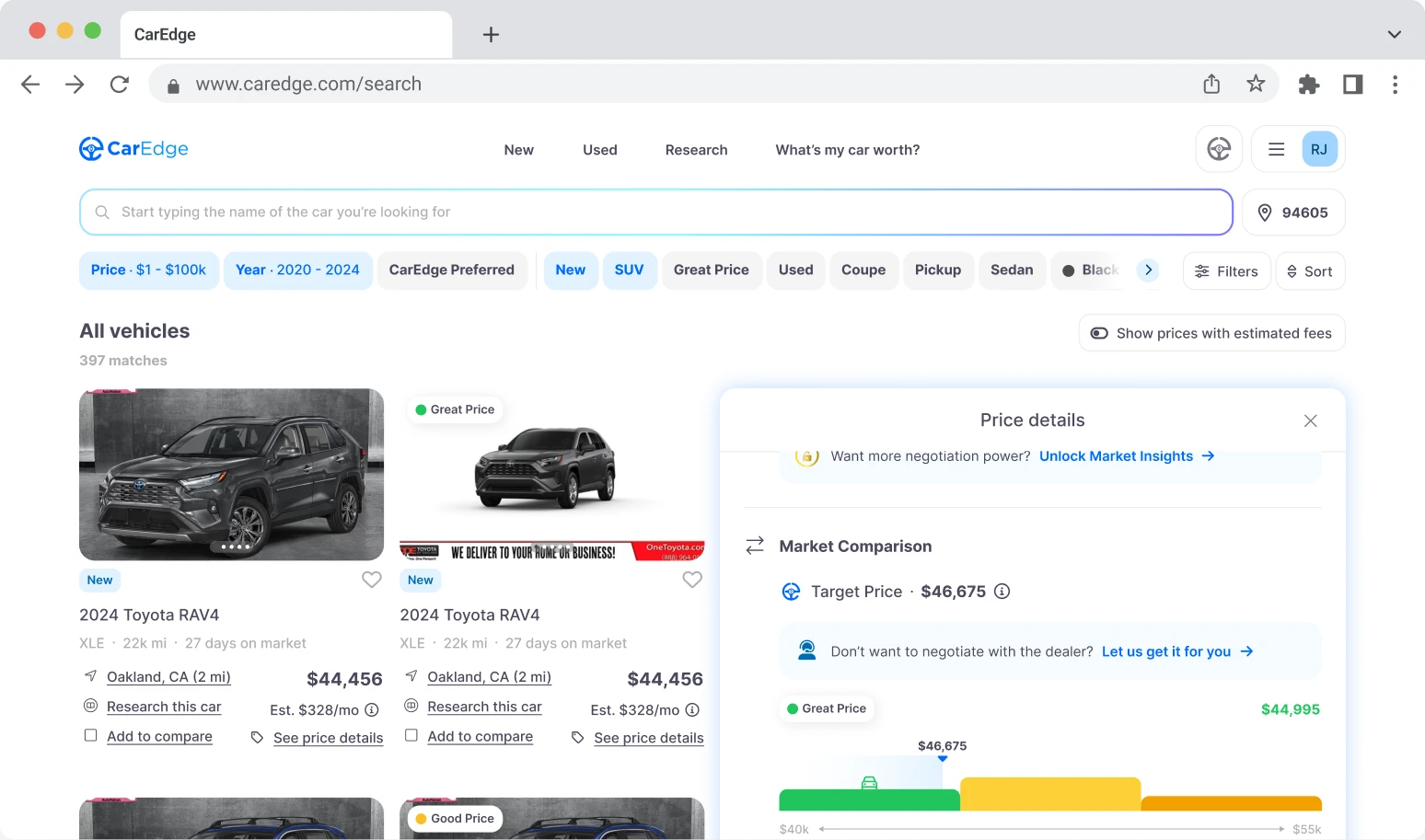
Find a wide range of vehicle listings with market insights on new and used listings near you.

What can I do with CarEdge?
 CarEdge Insights
What can I do with CarEdge?
Get access to exclusive information so you can make an informed car buying decision — all in one place.

Find a wide range of vehicle listings with market insights on new and used listings near you.
Track your vehicle’s value and cash in when the time is right to sell.

Access to our proprietary data to help you find the right car, at the right price. Find these unlocked on every listing after subscribing.

With our expert-led, tech-enabled car buying service, we will locate, negotiate, and deliver your vehicle so you can get a new car hassle free.


Help us personalize your CarEdge experience — it only takes a second.
Your answers help us personalize your CarEdge journey — we’ll follow up with tips and next steps that match your buying timeline.
Right now, there’s a 41-day supply of new Toyota vehicles in the U.S. What this means is, at the current sales pace, all 261,604 new Toyotas would find their new homes in just over a month without new inventory. But how does this scenario compare to other auto manufacturers? And more importantly, which Toyotas give you the most room for negotiation, and which ones are holding their ground? Let’s dive into the details.
| Make | Inventory % Increase (3 Months) | Market Day Supply - December 2023 | Market Day Supply - September 2023 |
|---|---|---|---|
| Honda | +68% | 47 | 28 |
| Kia | +89% | 53 | 28 |
| Toyota | +37% | 41 | 30 |
| Hyundai | +50% | 75 | 50 |
| Chevrolet | +63% | 88 | 54 |
| Nissan | +58% | 112 | 71 |
| Volkswagen | +52% | 96 | 63 |
| Ford | +43% | 127 | 89 |
| Jeep | +31% | 191 | 146 |
Market Day Supply (MDS) is a leading industry metric that is used to assess inventory. Market day supply takes the average daily sellin rate and existing inventory into account to determine how long it would take to sell every vehicle in inventory at recent average selling rates. A healthy ‘normal’ MDS is anywhere between 45 and 65 days of supply.
As you can see, Toyota has the lowest new car inventory among mainstream brands in America with just 41 days of supply. Honda, long perceived as Toyota’s most direct competitor, is #2, but is faring better at 47 days of supply. Kia comes in third with 53 days of inventory.
Contrarily, Nissan, whose market share has been dwindling in the U.S., unsurprisingly has an oversupply of new car inventory at the moment with a MDS of 112 days. Nissan was hit hard by the chip shortage, but the brand doesn’t seem to be winning back many of the customers it lost. Nissan’s US market share is now at just 4.9%.
And then we have the American automakers. Chevrolet is above average with a 88-day supply, but Ford and Jeep are drastically exceeding healthy inventory levels. Jeep is in the lead, with 191 days of supply. Although this isn’t the best news for these automakers, it certainly opens up opportunities for car buyers looking to drive a hard bargain.
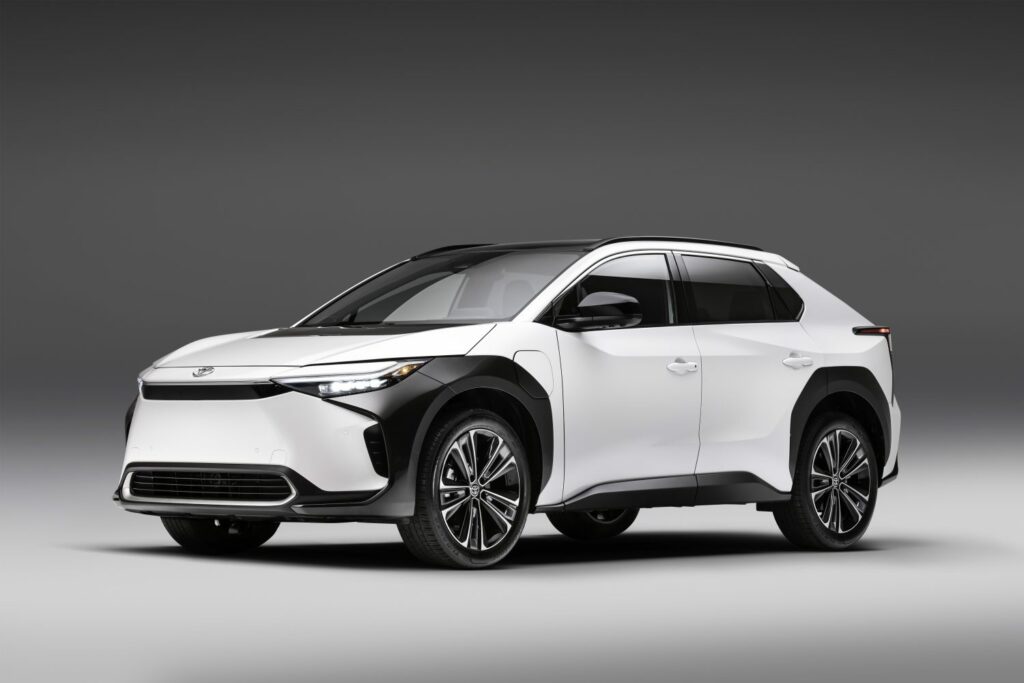
If your goal is to save thousands of dollars on your new Toyota, then it’s time to talk about negotiability at a finer scale. For that, we need to look at today’s inventory numbers across the Toyota model lineup.
Using the tools available through CarEdge Data, we analyzed Toyota inventory for every model on sale in America. These numbers reflect nationwide supply. You can check out local Toyota inventory using CarEdge Data.
| Make | Model | Market Day Supply (October) | Market Day Supply (September) |
|---|---|---|---|
| Toyota | Venza | 46 | 39 |
| Toyota | 4Runner | 61 | 45 |
| Toyota | Tundra | 63 | 34 |
| Toyota | Crown | 88 | 57 |
| Toyota | bZ4X | 110 | 94 |
Remember, a healthy auto market is characterized by about 60 day’s supply of new vehicles. The further inventory gets away from that, the more ‘out-of-whack’ the car market becomes. These models have the most inventory today of all Toyota models.
The redesigned Prius was on this list last month with a 73-day supply, but now the Prius seems to be selling quickly.
The Grand Highlander has been selling a lot quicker, and is going to be a lot tougher to negotiate now. Toyota’s new darling, the resurrected Crown, is selling slowly. Perhaps car buyers don’t have the appetite for $50,000 sedans that Toyota had expected.
The bZ4X electric SUV tops the list, with 110 day’s supply. With no federal tax credit and similarly priced, better equipped competitors, we’re not surprised.
Don’t negotiate without this FREE cheat sheet!
| Make | Model | Market Day Supply (October) | Market Day Supply (September) |
|---|---|---|---|
| Toyota | Camry | 39 | 30 |
| Toyota | Grand Highlander | 20 | 20 |
| Toyota | Highlander | 36 | 32 |
| Toyota | Sienna | 30 | 25 |
| Toyota | Corolla Cross | 28 | 27 |
| Toyota | RAV4 | 32 | 28 |
| Toyota | Sequoia | 44 | 23 |
| Toyota | Tacoma | 42 | 32 |
| Toyota | Corolla | 41 | 18 |
The Camry is the best-selling sedan in America, and Toyota can’t seem to produce enough of them. There’s a 39-day supply of them, and in some local markets, the situation is even worse. Despite slim supply, our Car Coaches say you should NOT pay dealer markups for the Camry, or any model for that matter. The Highlander is not much better, with a three-week supply nationwide.
Our CarEdge Coaches joke that the RAV4 Prime is their nemesis. It’s very tough to negotiate, all because of extremely limited inventory. Across all powertrains, the RAV4 has just a one-month supply right now.
See Toyota listings near you – all with the power of local market data.
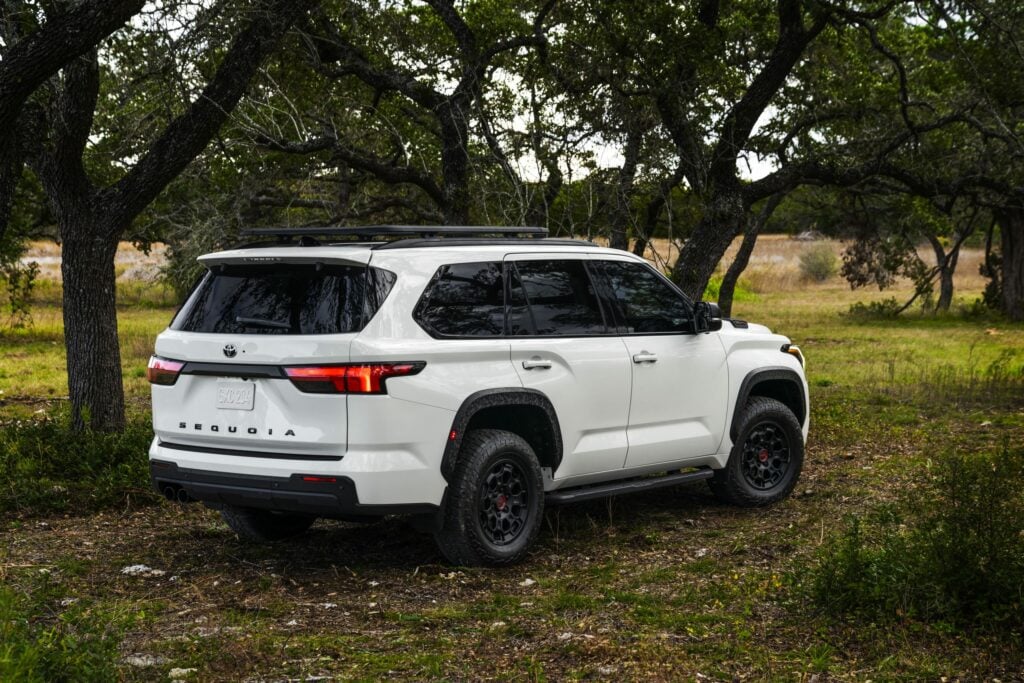
Despite the slim pickings with some Toyota models, it’s still possible to negotiate some great deals. Even for models in highest demand, there’s no reason you should have to pay for dealer markups, forced add-ons, or overpriced warranties.
Ready to negotiate like a pro? Try CarEdge Coach and CarEdge Data today! With these tools at your disposal, you can take control of your car buying experience, understand market dynamics, strategize effectively, and secure the best deal possible. We’re simply here to help!

The average car payment has been on an upward trajectory for some time, and 2023 is no exception. Today, we’re dissecting what the average car payment looks like and why it’s been rising. We’ll explore how average monthly car payments crossed the $1,000 threshold, and how you can navigate this landscape to spend less.
| (New Cars) | 2023 Q3 | 2023 Q2 | 2023 Q1 |
| Average Term | 68.4 | 68.5 | 68.8 |
| Monthly Payment | $736 | $733 | $730 |
| Amount Financed | $40,149 | $40,356 | $40,468 |
| Average APR | 7.4% | 7.1% | 7.0% |
| Down Payment | $6,907 | $6,823 | $6,956 |
According to Edmunds’ latest data, the share of $1,000+ monthly car payments has hit an all-time high. The rise is attributed to various factors: high interest rates, increased automaker prices, and dealer practices.
Reaching a new record, 17.5% of new car loans in Q3 2023 required a monthly payment of $1,000 or more. That’s up from 17.1% in Q2 2023 and a massive increase from the meager 4.3% back in 2019.
The average car payment in Q3 2023 reached a record high of $736 per month for new cars, up 4.5% since Q3 2022, and a 32% increase from 2019. Meanwhile, the average monthly car payment for used cars is $567, marking a 46% rise from 2019, but up less than 1% from Q3 2022.
Take a look a the average new car payment over time:

Data source: Edmunds. Graph by CarEdge.
The average monthly payment for used cars has followed a similar path upward, as we can see here:

Data source: Edmunds. Graph by CarEdge.
In pre-pandemic times, there was a slow but steady rise in car payment amounts. As the auto industry came out of the pandemic recession and the following chip shortage, car prices went through the roof, bringing average monthly payments along with them.
Let’s talk about why car payments are so high right now, and what you can do about it.
So, how much have car prices gone up? The average transaction price for a new car is $48,451 in 2023, a 25% increase since 2019. For used cars, it stands at $28,381, still 37% higher than in 2019, despite a slight decrease from the previous year. To make matters worse, interest rates for used car loans are commonly over 10% these days.
We track used car prices weekly. See the latest data!
Why are average monthly car payments and overall prices rising so fast? The auto industry can’t simply blame it on inflation, as we’ll get into below. But first, let’s talk about financing.
Car buyers are making larger down payments as the cost of borrowing money increases. The average auto loan rate is now 7.4% APR for a new car loan, and 11.2% APR for a used car loan. These are the highest auto loan rates the market has seen since 2007.
When will car loan rates go down? Simply put, it’s up to the Fed. The Federal Reserve sets the ‘Federal Funds Rate’, which largely determines how much it costs for banks to borrow money from each other, ultimately driving consumer loan rates.
Raising interest rates is a tool used to combat inflation. The thinking goes that when borrowing gets too expensive, excessive spending will be discouraged, and in turn demand for goods and services will cool down to the point that inflation slows.
Car loan rates will remain high until The Federal Reserve begins to lower interest rates at their Board meetings. Inflation needs to cool down for that to happen. Things are headed in the right direction, but we’re not there yet.

FREE Resource: How to Finance a Car Like a Pro: The Ultimate Auto Financing Cheat Sheet
Even with auto loan rates at 20-year highs, there ARE ways you can lock in big savings on loan interest. Here are the most effective ways to save on interest, according to our CarEdge team of experts:
Check out our deep dive into the many ways you can spend less on auto loan interest. With today’s interest rates, these tips could save you hundreds of dollars! Don’t forget to print this auto finance cheat sheet and bring it with you!
Our team of Car Coaches is made up of professionals who have decades of experience in the auto industry. Rather than squeeze more money out of every sale at the dealership, these car pros help drivers SAVE money with their auto. We spoke to our team of Coaches to learn how much money today’s car buyers should aim to spend on their monthly car payment.
The consensus was broad: the CarEdge team advises keeping your monthly car payment below 10% of your monthly take-home pay. With gas, insurance, and maintenance, it should ideally be well below 20% of your monthly income. It’s worth noting that negotiation can play a pivotal role in ensuring you spend less on your car.
Here are a few essential FREE resources to help you budget for your car purchase:
Browse cars with expert help just a click away with CarEdge Car search.
Use this Free Out-the-Door Price Calculator to more accurately estimate how much your car will cost once taxes and fees are included.
Here’s a Free Car Payment Calculator that will help you understand what price range you can afford with your down payment. It’s most useful if you have an idea of what loan rates you might qualify for.
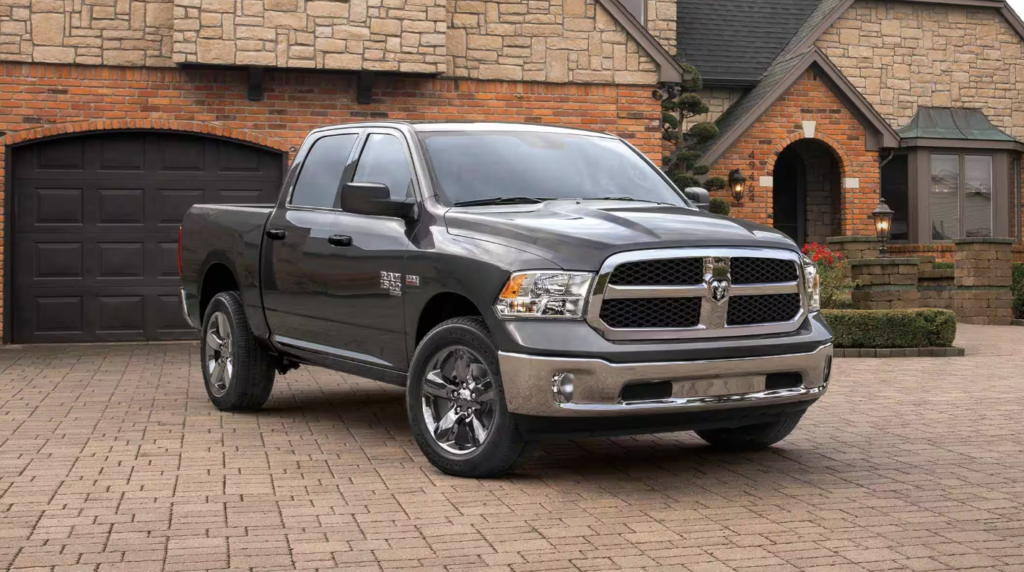
Most automakers have an oversupply of new cars right now. Over the past year, we’ve seen dealer lot inventory climb above and beyond what we typically see in a healthy, stable car market. Automakers and dealers like to have roughly a 60 day supply of new cars on their lots. Today, we see more and more models well above a 100 day supply. For some, like the Ford Mustang Mach-E, Jeep Renegade and Ram 1500 truck, inventory exceeds 200 days.
Something has to give. Floorplanning costs mean that the car dealers themselves pay interest for every day that a car sits on their lot. Plus, no one wants a two-year old ‘new’ car. With each passing day, dealers are incentivized to move their inventory off the lot.
We’re seeing used car prices fall rather quickly, yet new car prices are more complicated. Listing prices remain high (and in some cases outrageous), but our team of CarEdge Coaches is seeing greater negotiability on the new car market.
Dealers are more willing to lower their prices and remove add-ons and markups. However, in most cases, this is only true when the buyer is prepared to put some work into the deal with negotiation know-how. Don’t expect softball deals in today’s new car market. But don’t fret: we’re here to help.
Our team of Car Coaches created this 100% free guide to negotiating a car purchase with one goal: to save you time and money. Print it and bring it with you to the dealership!
Negotiate Car Prices With This Cheat Sheet
Looking for more car buying help? Search our free guides, and join the CarEdge Community today! We’re here to help you negotiate car prices confidently. When it comes to car buying, knowledge certainly is power.
Ready to work 1:1 with your own car buying coach? Learn more about CarEdge Coach, your path to ultimate savings! Looking for more of a DIY route to savings? We created CarEdge Data just for you. For the first time ever, behind-the-scenes market data is at your fingertips, empowering car buyers everywhere to negotiate with confidence.
Remember, the secret to smart car buying isn’t solely about discovering the car that captures your heart. It also involves understanding the market you’re shopping in. Despite escalating prices, opportunities remain for those willing to undertake comprehensive research and exhibit patience.
Stay informed, be patient, and you might find that the perfect deal is just a stone’s throw away. We’re here to help!

Ever wondered why the allure of an affordable new truck seems more like a mirage these days? Despite the lot inventories of best-sellers skyrocketing far beyond the norms of a healthy market, securing an affordably priced new truck has become tougher than ever.
So, what’s behind this paradox? The answer lies in the automakers’ strategic drift from the production of affordable base models. But, is this strategy set to steer the truck industry into troubled waters? Let’s uncover the truth using CarEdge and MarketCheck’s latest data on the state of the truck market in 2023.
There’s an interesting trend that the top-selling trucks in America all share: as the total production figures rebounded from pandemic lows, the production of affordable base models hasn’t kept pace. The strategic move by automakers to limit the production of entry-level models has created scarcity, contributing to their increased prices.
Focusing on one of the best-selling trucks in America, the Ram 1500, CarEdge Data reveals that there are 53,652 new Ram 1500s on sale across the nation. However, the most affordable trim option, the Ram 1500 Tradesman, only makes up a mere 3,445 of this total. Despite having a starting price of just $37,090, the Tradesman, as a result, seems like a near-mythical entity in dealer lots.
The scarcity of base model Ram 1500s isn’t the only issue; the prices of these scarce models have surged as the supply diminished. The Ram 1500 Classic witnessed a 26% price hike from 2019 to 2023, while its inventory dropped by a whopping 88%.
Sadly, the trend isn’t exclusive to Stellantis. Both the F-150 XL and the Chevrolet Silverado Work Truck have also followed the same downward trajectory in their base models’ production:

The Silverado 1500 Work Truck experienced a 41% price increase since 2019, even though its inventory has decreased by 33% over the same period. Today, the base model Work Truck represents a meager 6% of the 67,795 brand-new Silverados available on the market.
Despite the combined U.S. sales of America’s three top-selling trucks rising by 2.5% from the pre-pandemic norms of Q1 2020, the inventory of base models like the F-150 XL sits at just 54% of the pre-pandemic levels.
Here’s a look at how overall truck sales (across all trims) has risen back from pandemic lows, despite leaving affordable base trims behind:

Similarly, the Silverado Work Truck is at a mere 49% of early 2020’s inventory. The worst hit is the Ram 1500 Classic, languishing at 23% of January 2020’s inventory, notwithstanding the overall Ram 1500 sales recovering to 91% of the pre-pandemic levels.
The picture is clear: truck inventories have fully recovered from the inventory woes of 2021, but affordable base models were largely left out of the picture. The result: truck buyers are pushed towards more expensive truck options, feeding into the ultimate goal of the automakers – ever higher profits.

From skyrocketing destination charges to the elimination of popular base models, it’s apparent that automakers are leaving no stone unturned in their bid to maximize profits from each sale. However, this aggressive strategy has not been left unchecked. Consumers are pushing back, sparking significant changes in the industry. A classic example is Honda, which, within a year of canceling the base LX trim for the CR-V and Civic, reversed their decision due to consumer pressure. Kia, too, had to reintroduce its most affordable EV6 after initially discontinuing it.
Car buyers push back, forcing the return of base models
The real question now is, will truck lovers follow suit and make their voices heard? And more importantly, will the major automakers – Ford, GM, and Stellantis – heed the call, or continue their current strategy, potentially alienating millions of middle-class loyal customers?
Don’t let the ever-changing trends in the auto market throw you off guard. Navigate the landscape like a pro with CarEdge Data and get the latest industry insights at your fingertips. Ready for 1:1 help with your deal? With CarEdge Coach, our Car Coaches are at your side via live chat every step of the way, ensuring you find the perfect vehicle at an unbeatable price.
Already found the truck of your dreams? Get comprehensive market price data for every new or used truck listing with CarEdge Reports, included with our Data and Coach plans. Let CarEdge steer you towards your perfect ride. We’re here to help!

As 2023 model year lineups were announced last year, a sizable portion of the automotive industry faced widespread criticism for eliminating their most affordable vehicles from the lineup. At a time when new car prices were running away from the middle class, the most affordable versions of popular cars were sacked.
Now, in 2024, car manufacturers are reversing course. Are we about to see the resurrection of affordable cars? Or are we getting our hopes up too soon? Let’s take a look at where we’ve been, where things stand today, and where we’re headed as new car sales continue through yet another volatile year.
You could say Tesla started it all when they axed the much-hyped $35,000 version of the Model 3 years ago. However, legacy automakers are a different animal entirely, so we’ll fast forward to 2022. Late last year, Honda led the charge with changes to their product lineup, and were soon followed by Kia and Jeep. Within months, multiple base models were discontinued in the United States, sending entry-level prices through the roof overnight for some of the most popular cars in America.
This was no small move. Together, these manufacturers account for 30% of new car sales in the U.S. The effects were swift and significant, leading to an outcry among car buyers, and as one Kia representative put it, ‘unprecedented demand’ for what had previously been seen as unwanted, unpopular base trims.
Automakers cited lower sales numbers and the supply chain woes of 2021-2022 when explaining the abrupt decision. However, in doing so, they overlooked the crucial role these base models play in catering to the needs of lower-income and budget-conscious drivers. Without affordable base models, a large chunk of the market would be priced out, and would simply take their business to used car lots.
Fast forward to 2024, and some of these same automakers are now making a U-turn, resurrecting their affordable vehicles. The most shocking reversal comes from none other than…. Honda.
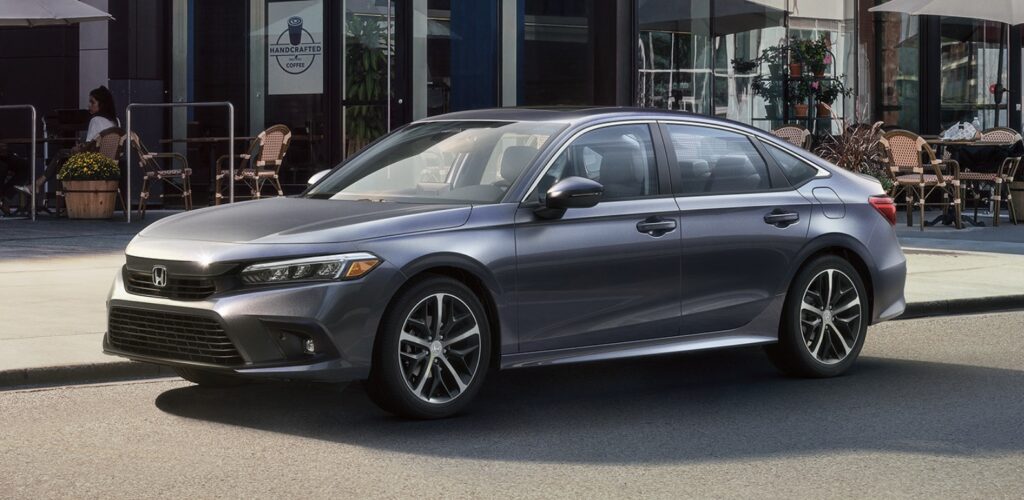
Honda ruffled feathers when it eliminated the most affordable Honda Civic, the LX base model, in late 2022. This decision followed an earlier price hike between $1,000 – $2,000 for the 2023 model year. Consequently, budget-conscious commuters, the heart of Honda’s fanbase, were left reeling just as interest rates climbed higher. Further compounding the issue, the CR-V, America’s #2 best-selling SUV, also lost its base trim.
As the base trims were dropped, the entry-level price for the Civic increased from $22,350 to just north of $25,000 for the EX. For the CR-V, the base price jumped by almost $5,000 overnight to $31,610.
The rationale behind these decisions might have been an attempt to boost profits amidst supply chain issues that had plagued Honda since 2021. However, by mid-2022, the automaker’s US sales had plummeted 50% year-over-year.
Now, Honda seems to be having a change of heart. In response to decreasing new car prices and slowed sales, the company has announced the return of the more affordable CR-V in 2024. The CR-V LX, without a sunroof, power-adjustable driver’s seat, and with just a single climate control zone, now lists for $28,410 plus a $1,295 destination fee.
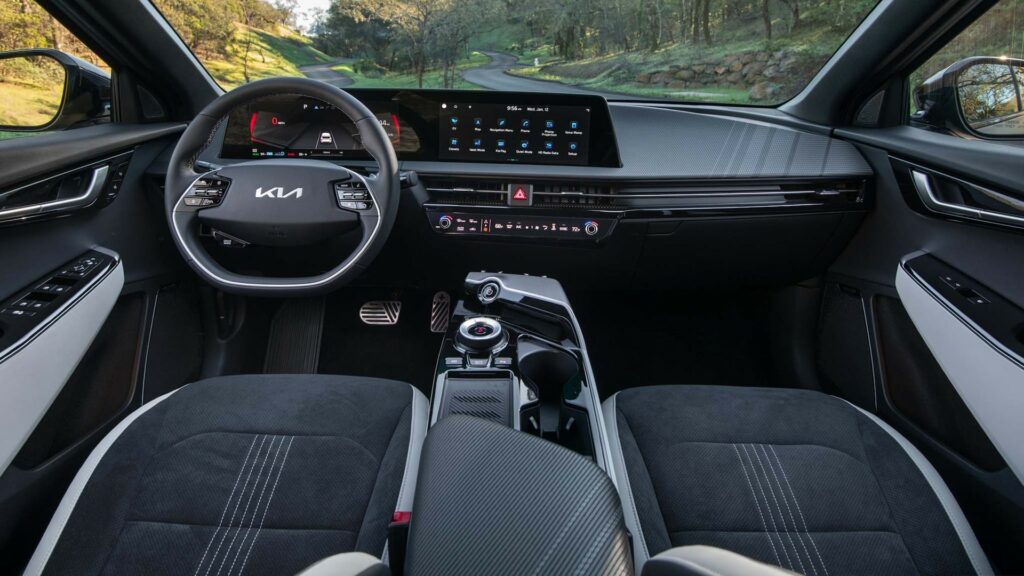
Around the same time as Honda’s controversial move, Kia also announced the cancellation of the most affordable version of its popular electric car, the Kia EV6. This caused the base price of the EV6 to soar by $7,300, or 18%, to nearly $49,000. Furthermore, the beloved gas-powered Kia K5 also lost its LX base trim, pushing the entry price to $26,195.
Kia, once known for affordability, seemed to be pushing further into premium territory.
However, 2023 and 2024 have seen Kia backtrack somewhat, albeit with certain conditions. The automaker is now offering the EV6 Light in select western US states. The EV6 Light has even returned to Kia’s online configurator.
We call this a win for consumers, especially considering that Kia’s EVs lost the federal EV tax credit this year due to the Made in (North) America requirement.
As far as the Kia K5, the entry-level LX trim has yet to return. The K5 now starts at $26,515 with destination fees. For reference, the 2019 Kia Optima started at $23,915, or 11 percent less than today’s K5.
There’s a 399 day supply of Jeep Renegades nationwide, according to the car buying tools available through CarEdge Pro. This didn’t happen overnight. Jeep’s inventory has been building for months. In fact, every Jeep model has over 100 day’s supply, far above the industry’s healthy standard of 60 days.
You would have thought that Jeep’s parent company Stellantis would have seen the writing on the wall, and perhaps even would have considered lowering prices or introducing incentives.
What we got was the complete opposite. The boxy, poor-selling and unreliable Jeep Renegade lost its Sport base trim for the 2023 and 2024 model years. What happened next? Jeep’s inventory just kept on climbing, and now leads the industry for number of cars on the lot.
Here’s a full breakdown of Jeep inventory today, and where the best deals could be negotiated.
In the past five years, new car prices have risen by a staggering 37%. However, there seems to be a light at the end of the tunnel. Our own analysis reveals that automakers who have hiked prices the most are paying the price in the form of WAY too much inventory. See for yourself in the graph below showing how much inventory is on the lot for top-selling models that received price hikes this year.
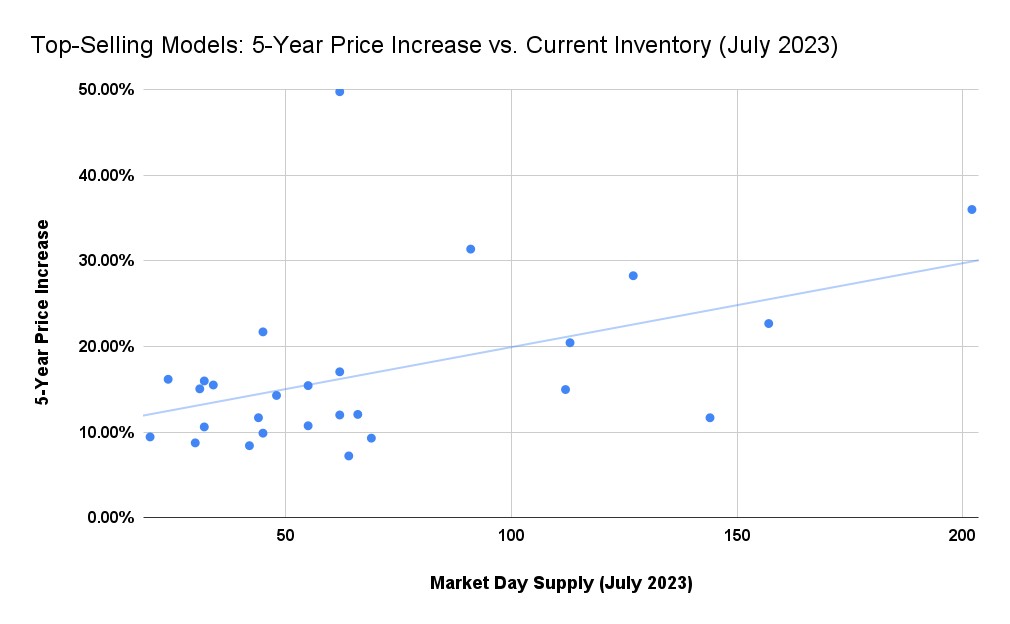
Buyers are pushing back against runaway new car prices. Dealers are loaded with inventory that won’t sell. See which automakers are suffering the consequences right now, and how YOU can use this as negotiation leverage.
When it comes to the car market, we’re no stranger to the ups and downs. Get ready for yet another market adjustment, according to at least one group of experts.
A report by industry analysts at AlixPartners forecasts a steady decline in new car transaction prices over the next few years.
By 2025, the analysts expect the average transaction price to decline to around $42,000, down from where it stands today near $46,000.
What do they expect to drive this downward trend in prices? The dynamics don’t “mean the price of the same vehicle comes down,” Mark Wakefield, global co-leader of the automotive & industrial practice at AlixPartners, said at a press conference. “The predominant driver of that is mix shift and trim shift within a product to reduce the higher, more profitable vehicles and get more volume out.”
In other words, it looks like automakers are coming to their senses (at least somewhat) and are planning to make higher numbers of lower-trim vehicles at more accessible price points.
What if there was a way to guarantee you never overpay for a car again? We’re here to make that a reality for you. Don’t let the journey to your dream car be a bumpy one. Our CarEdge Coaches are ready to guide you every step of the way, ensuring you find the perfect vehicle at an unbeatable price.
Or, if you’re a do-it-yourself enthusiast, use CarEdge Pro to get the industry insights you need to negotiate like a pro.
Let CarEdge steer you towards your perfect ride. We’re here to help!
![Car Price Inflation Is Real – These Brands Are the Worst [2025 Update]](https://caredge.com/wp-content/uploads/2023/07/2024-08-22_Big-Data-Update_-Car-Price-Inflation_Blog-Header-Image_1920x1080_v1-1080x675.jpg)
This decade has brought a whirlwind of challenges for the automotive industry. From pandemic shortages and EV investments to today’s inflation and tariff pressures, lack of stability would be an understatement. So, how have car prices fared over the last five years? Across the new car market, average transaction prices have increased by 30% from Q2 2020 to Q2 2025. The average selling price for a new car now stands at $48,749.
But some automakers seem to have thrown caution to the wind, pushing their prices far higher. Here’s a look at car price inflation over the last five years.
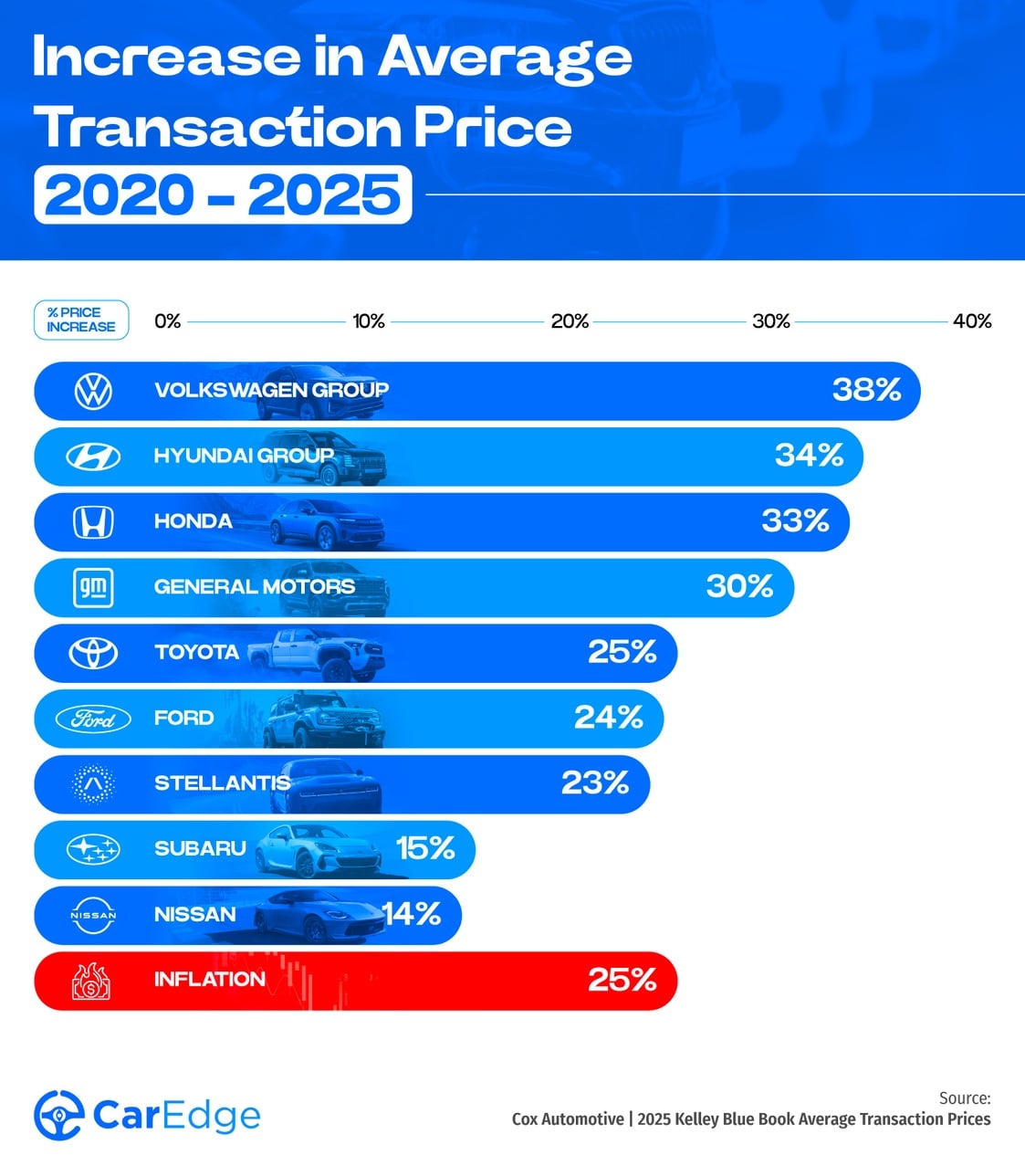
Leading the pack in price hikes is Volkswagen Group, which includes VW, Audi, Porsche, Bentley, and Lamborghini in the United States. The average transaction price for Volkswagen Group has increased by 38% from Q2 2020 to Q2 2025, which is quite a bit higher than the overall economy’s inflation (25%) over the same period.
Hyundai Group (which includes Kia) and Honda are close behind. Hyundai Group prices are up 34% in the first half of this decade. EVs like the new IONIQ 9 are a big reason for the price hike. Honda prices increased by 33% from 2020 to 2025 as MSRPs increased and buyers showed increasing preference for larger SUVs. Honda’s best-seller, the CR-V crossover, saw base MSRPs jump from $26,345 in 2019 to $31,495 in 2025.
General Motors is next in line, with prices up 30% since 2020. Chevrolet and Cadillac prices have risen as EVs have populated the lineup, and trucks like the Silverado 1500 get ever more expensive. In 2020, the Chevy Silverado 1500 RST started at $38,695. For 2025, that same spec of the Silverado starts at $52,345.

However, there’s a bright spot in the data. Ford, Stellantis, Nissan, and Subaru price increases were below the overall rate of inflation over the past five years. Data was unavailable for Mazda.
Subaru seems to have taken a different strategy with a five-year transaction price increase of only 15%, well below the pace of overall inflation. Subaru has managed to maintain an upward trajectory in terms of market share. This gain, paired with standard offerings like all-wheel drive, could be a testament to the importance of price competitiveness in the industry.
Nissan, on the other hand, has likely seen less price increases for a different reason. Nissan has been losing U.S. market share for years as Toyota, Honda, Hyundai, and Kia win over budget shoppers. When demand falls, dealer markups and MSRPs soften. Since 2019, Nissan transaction prices have risen 14%. And now, two of Nissan’s most popular and affordable models, the Altima and Versa, are being discontinued next year.
To the detriment of vehicle affordability, luxury cars are more popular than ever. More drivers are paying over $80,000 for a new car or truck than ever before. Oddly enough, luxury car prices haven’t climbed quite as much over the past half-decade. While mainstream car brands saw prices climb 30%, luxury brands increased by 25% from 2020 to 2025.
Here’s a look price inflation for some of the best-selling luxury brands in America compare. Note that Tesla is not included due to lack of publicly-available data from 2020.
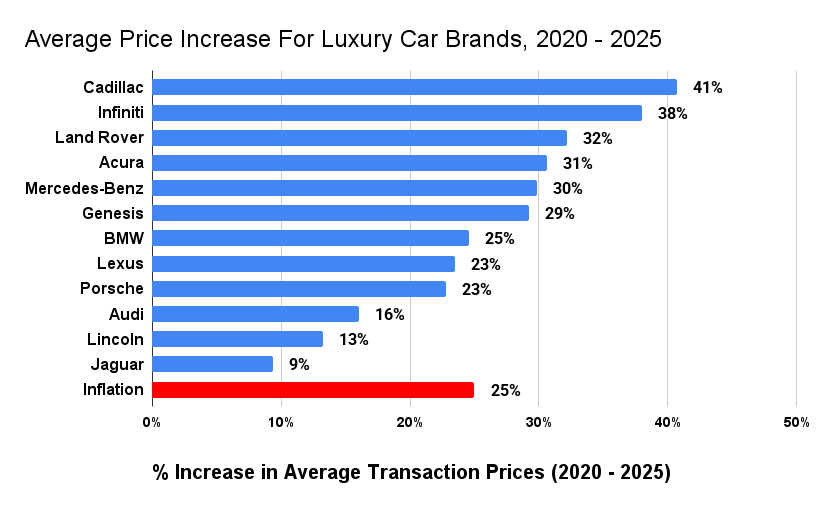
Prices for new Cadillac, Infiniti, Land Rover, Acura, and Mercedes-Benz cars have all had average selling prices rise more drastically than their luxury competitors. All of these luxury cars now sell for at least 30% more than the did just five years prior.
On the other hamd, the luxury car brands with the lowest price increases are Jaguar, Lincoln, and Audi. Audi’s sales have slipped as the brand’s EVs fail to keep up with the competition in the crowded luxury crossover segment.
It’s true that new cars are a lot more expensive these days, but that doesn’t mean you have to surrender and sign whatever the dealer offers. There are still practical ways to save, even in 2025. Here are a few smart car buying tips from CarEdge Co-Founders, father-and-son duo Zach and Ray Shefska:
Use Market Data, Not MSRP
Rely on real-time transaction and listing data (like CarEdge Pro) to understand what others are actually paying in your area.
Target the Slow Sellers
Focus on vehicles with high inventory and long time-on-lot. Dealers are more willing to negotiate on slow movers. We’ve got tools to help you find negotiable inventory.
Look for Dealer-Backed Incentives
Even when automaker incentives are weak, individual dealers may offer their own discounts, especially near end-of-month or quarterly sales targets.
Negotiate More Than Just Price
Push for better financing terms, trade-in value, or extras like extended warranties or free maintenance. Here’s our guide to what’s negotiable at the dealership.
Time Your Purchase Strategically
Shop at the end of the month, end of the quarter, or during seasonal clearance events (like model year transitions). There’s even a better time of the day to buy! Be sure to check out our free tips for timing your purchase right.
Use AI Tools to Level the Playing Field
AI can be terrifying, but it can also be extremely helpful. CarEdge’s AI Negotiator can take the pressure off and ensure you don’t overpay. How does CarEdge AI work? Tell us what car you want, and our AI Negotiator will contact dealers and negotiate pricing for you! It’s really, really cool.
Ready for some expert car buying help to ensure you pay a fair price? That’s why we created CarEdge, the ultimate car buyer’s advocate. Learn more about how our team of consumer advocates is ready to assist you with your deal at CarEdge.com.
In 2025, the car market is changing. For the first time in years, great deals can be won with negotiation know-how. Utilizing tools like CarEdge’s FREE Car Buyer’s Guide can give you a better idea of current inventory levels and help you determine where the best deals might be.

Ready to outsmart the dealerships? Download your 100% free car buying cheat sheets today. From negotiating a deal to leasing a car the smart way, it’s all available for instant download.
We’re constantly told that electric vehicles are the future. But a closer look at recent sales data suggests that, for some models at least, the future isn’t quite here yet. Let’s switch gears and delve into fresh data to understand what all the fuss is about.
The market for electric cars, trucks and SUVs is growing, no doubt about it. Our updated analysis of EV market share has EV sales above 7 percent for the first time. However, as with any burgeoning market, there are growing pains. Some new electric models are spending months on dealer lots, while others seem to be driving off as soon as they arrive.
So, what’s causing these unexpected hold-ups in EV sales? To answer that, we need to take a closer look at a metric of market health that is too often overlooked by car buyers: days supply. “Days supply” is a term used in the automotive industry to represent the number of days it would take to sell all of a particular car model in inventory, given the current sales rate.
In 2023, the days supply of non-Tesla EV models keeps getting weirder and weirder. Why don’t we have Tesla data to share? Well, no one has that except Tesla, since they sell direct-to-consumer, along with Rivian, Polestar, Lucid and a few other low-volume automakers. Analysts have to wait until sales numbers are released for any real insight. We DO, however, have some interesting USED Tesla numbers to dig into. More on that in a bit.

The latest from CarEdge Data reveals some surprising numbers. New EV inventory is above and beyond anything we’ve ever seen before.
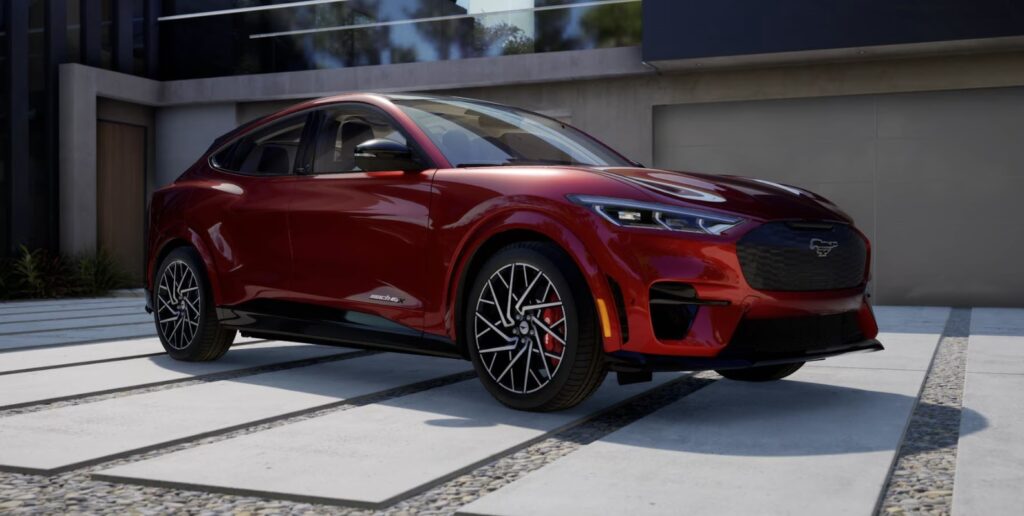
The Mustang Mach-E, despite being highly anticipated and once labeled a ‘Tesla-killer’, now has a supply of 153 days. Meanwhile, other popular EVs like the Hyundai IONIQ 5 and 6, are taking 110 and 159 days, respectively, to sell. The IONIQ 5 was last year’s Car and Driver EV of the Year, only to pass that same title on to the IONIQ 6 in 2023. You’d think they’d be selling like crazy, right?
And that’s not all. Nissan’s Ariya is sitting for a whopping 219 days before finding a new home, and the Subaru Solterra isn’t far behind with 199 days.
Here’s current dealer inventory for every new electric vehicle in America, except Tesla and the other direct-to-consumer automakers.
| Make | Model | New/Used | Days Supply (7/28/23) |
|---|---|---|---|
| Ford | Mustang Mach-E | new | 210 |
| Chevrolet | Bolt EV | new | 44 |
| Chevrolet | Bolt EUV | new | 33 |
| Hyundai | IONIQ 5 | new | 116 |
| Hyundai | IONIQ 6 | new | 159 |
| Genesis | GV60 | new | 200 |
| Kia | EV6 | new | 146 |
| Volkswagen | ID.4 | new | 150 |
| Audi | Q4 e-tron | new | 153 |
| Porsche | Taycan | new | 152 |
| Mercedes | EQS | new | 194 |
| Mercedes | EQB | new | 101 |
| BMW | i4 | new | 61 |
| BMW | i7 | New | 174 |
| Volvo | C40 | new | 132 |
| Subaru | Solterra | new | 199 |
| Nissan | Ariya | new | 176 |
| Nissan | Leaf | new | 140 |
| Toyota | bZ4X | new | 190 |
| Ford | F-150 Lightning | new | 103 |
| GMC | Hummer EV | new | 90 |
Remember when GM executive Bob Lutz couldn’t stop hating on Tesla? For years, he went on and on about how the then-EV startup was doomed to fail. Making cars was just too hard and unprofitable, he said.
Three short years later, and boy was he wrong. Tesla is STILL the king of EV sales, and to rub salt on the wound, Tesla is now convincing one legacy automaker after another to adopt their once proprietary charging standard, GM included. What does all of this have to do with EV inventory numbers in 2023? Let me explain.
Tesla’s bold pricing strategy is driving a shift in the EV market. They initiated massive price cuts this year, predominantly affecting their widely circulated Model 3 and Model Y, and creating a ripple effect in the sector.
These strategic reductions, alongside stabilizing gas prices, rising interest rates, and thrifty consumers, resulted in less demand. When demand dropped, Tesla lowered prices.
Tesla’s price reductions triggered a downward trend in the new EV market. The Model Y began 2023 at $65,990 in the U.S., but price cuts and a cheaper base variant slashed the base price of the Model Y to $47,240 by early May. With access to the Supercharger network, over-the-air updates and longer range, many drivers looking to go electric simply went for the Tesla, leaving the competitors to pile up on dealer lots.
By the way, used Tesla models are still in demand. Days supply remains just slightly above average, and far below new EV inventory. Here’s a look at used Tesla inventory nationwide in July 2023:
| Make | Model | New/Used | Days Supply | Total For Sale | Total Sold (45 Days) |
|---|---|---|---|---|---|
| Tesla | Model Y | used | 65 | 1889 | 1304 |
| Tesla | Model 3 | used | 56 | 4564 | 3664 |
| Tesla | Model S | used | 91 | 2470 | 1218 |
| Tesla | Model X | used | 73 | 1382 | 850 |
Let’s take a closer look at the demand issue. Despite the buzz, not all EVs are finding eager buyers right off the bat. Let’s plug into a few potential reasons: price, charging infrastructure, vehicle range, and brand reputation.
First, despite the falling prices and high inventory, electric cars are expensive. The average EV price remains about 15% higher than that of the average conventional car. Those who really put on the miles can recoup that money through fuel and maintenance savings, but what about urban dwellers who may drive just 5,000 miles a year?
This higher upfront cost might deter many potential buyers, especially those with a limited budget or those who drive less frequently.
Secondly, the charging infrastructure for EVs is still developing and leaves much to be desired. This is especially true in rural America. Those who live in apartments, condos, or similar situations may not have any way to charge at home to begin with. And then there are variables like cold weather, towing, and high-speed driving that all impact an electric vehicle’s range, and undermine consumer confidence in EVs.
Lastly, there’s a cultural shift required to adapt to the EV lifestyle. Transitioning from gas stations to charging points, understanding charging times, and adjusting to the inability to simply work on your car in the garage are just some of the challenges for the everyday driver. In addition, for those who love the roar of an internal combustion engine or frequent long, remote road trips, an EV might not be ideal.
These are the BEST EVs for families today (price, range and more)
So what does this mean for you, the potential EV buyer? If you’re considering one of these slow-sellers, you might be able to secure a great deal. Some (but not all) dealers could be more than ready to sell their electric inventory, which could increase your negotiating power.
In fact, even before the most recent spike in electric vehicle inventory, we shared a few of the many examples of CarEdge community members negotiating thousands off of EV sticker prices. Yup, EVs are indeed negotiable!
Take this negotiation cheat sheet with you to the dealership!
What does it all mean for manufacturers? These trends could be a wake-up call. Legacy automakers and newcomers alike may need to adjust their strategies, rethink pricing, improve vehicle specs, or invest more in marketing and public education to attract buyers who may be on the fence about going electric.
Perhaps it’s too early to claim that these EVs are ‘struggling’. After all, every new technology takes time to become mainstream. And as more people embrace the benefits of electric driving, demand for these slow-selling models might well pick up speed.
But for now, savvy buyers could use this opportunity to drive a hard bargain on a brand-new EV.

Ever heard the phrase ‘patience is a virtue’? In the world of used car buying, it’s more than just a virtue – it’s a strategy. With recent fluctuations in used car prices, knowing when to dive into the market can be the difference between an okay deal and a fantastic bargain. But when will car prices drop? As it turns out, the answer lies in understanding the data behind the trends. We’ll unpack the latest used car market update to reveal why the smartest buyers might want to play the waiting game.
The latest numbers from Cox Automotive are making headlines. In June, wholesale used car prices dropped by -4.2%, with an overall decrease of -10.3% compared to the previous year. June’s decrease was an all-time record for the month, and is second only to the pandemic plunge in car prices during April of 2020.
Here’s where some of the headlines are missing the point: the sharpest declines are being seen at wholesale auctions. These are the auctions that the dealers themselves buy from, not where the average consumer will find their next ride. Surely wholesale price trends will be mirrored in retail prices quickly, right? Not so fast.
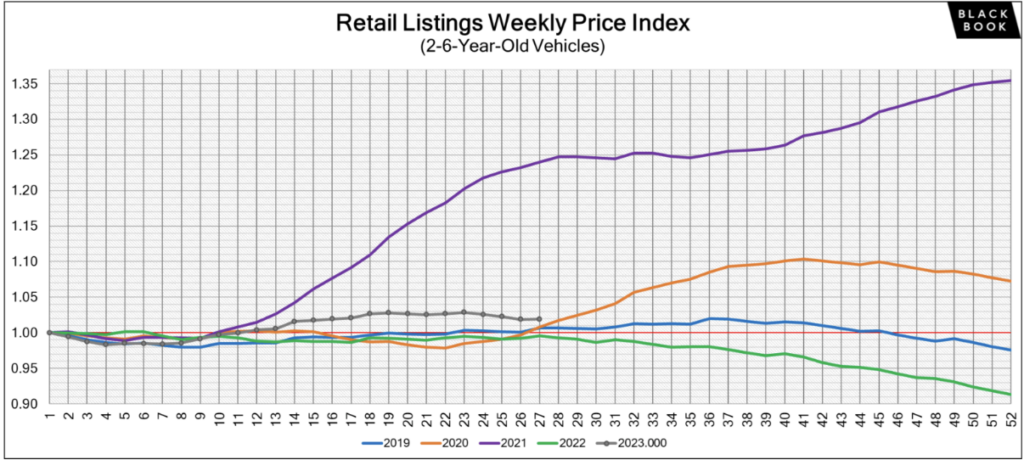
On the retail side, the used car price decreases have been more modest. Retail used car prices fell by just -0.5% over the last month, revealing an unsurprising mismatch between wholesale and retail trends. Let’s dig a bit deeper into that…
But why does this gap between wholesale and retail used car prices exist? Simply put, retail prices typically lag behind wholesale trends. This is due to the time it takes for changes in the wholesale market to trickle down and affect retail prices. Dealers want to squeeze every possible dollar out of their inventory, so it takes a while for market trends to finally be reflected in sticker prices (and negotiability).
Therefore, if you’re planning to buy a used car, it’s likely worth waiting 30, 60, or even 90 days. The drastic declines in wholesale auctions seen today will likely translate to better retail prices in the coming months.
Why not now? Consider the following: We track used car prices weekly here with the help of Black Book. In the graph below, you can clearly see the marginal price movement on the retail side of the market. Retail used car prices in fact remain above where they started 2023.
In this next graph from Black Book, we see the more noteworthy price declines on the wholesale side.
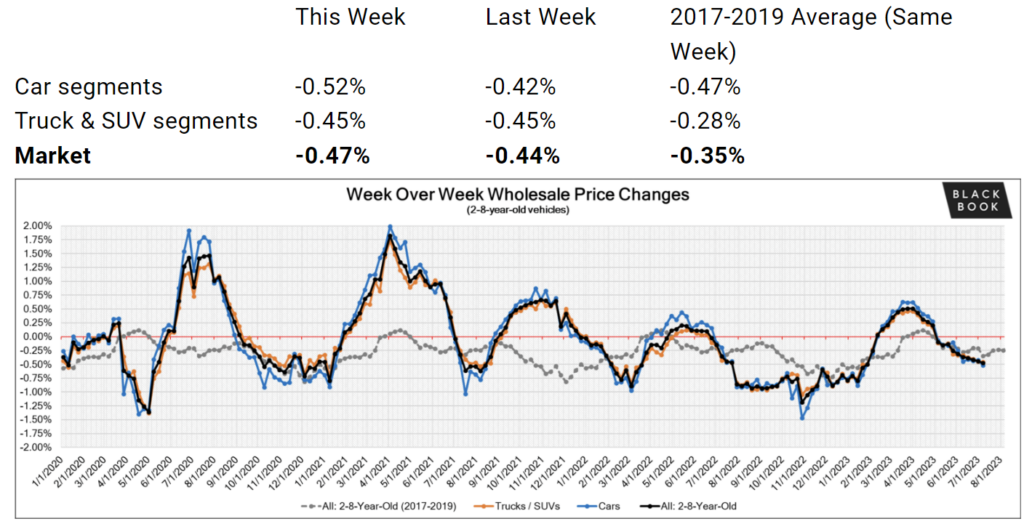
Before you head to the dealership, know this: retail car prices typically lag behind wholesale price trends by one to three months. To save the most on your used car, we recommend waiting 30, 60 or 90 days for retail prices to really come down.
Rushing out to dealer lots today could cost you, as dealers today are very likely to ‘play dumb’ and hold off on lowering prices for as long as they can.
These changes don’t just affect buyers; they also have significant implications for those looking to sell or trade in their vehicle. The most immediate impact of falling used car prices is a decrease in trade-in values. If you’re certain about selling or trading in your car, it’s wise to complete the sale as soon as possible to get the best value.
Compare offers from trusted online buyers with CarEdge today before used car values plummet…
These price trends come alongside a decrease in retail sales for June and a continued rise in used car inventory. ‘Days supply,’ a common industry metric used to compare inventory while also factoring in the daily sales rate, continues to climb for most used vehicle segments. This means that more cars are available, but they are also staying on the lot longer.
Interestingly, the major vehicle market segments saw their seasonally adjusted prices remain lower year over year in June. Compared to June 2022, pickups and vans have fared better than most, losing 6.6% and 8.5% respectively. Sports cars took the hardest hit at 14.8% year-over-year, while compact cars lost 12.6%, and midsize cars dropped by 12.2%. When compared to last month, all segments were down, with compact and midsize cars experiencing the most significant declines.
The rapid fall in used car prices has put car dealerships in a tough spot. Dealers (and their lenders) are under a significant cash crunch. You’re not the only one borrowing money for your next car. Dealers themselves have to pay interest for every day a car sits unsold on their lot, creating a time-is-money dilemma. Car dealerships typically take out loans to purchase inventory at auction, and then pay interest on that loan until the car is sold. This hidden expense is called ‘floorplanning costs’, and they’re rising for dealers in a time of interest rate hikes.
They desperately want to make the most money possible from the sale of each car on their lot. This is their path to profits. However, quickly-changing market dynamics are throwing a wrench in their plans. As used car values fall quickly, dealers are finding themselves in a precarious situation.
Using the market analysis tools available through CarEdge Data, we identified the ten mainstream used cars with the MOST inventory today. These are the used cars that you’re more likely to negotiate a better deal with today.
| Make | Model | Days Supply | Total For Sale | Sold (45 Days) |
|---|---|---|---|---|
| Jeep | Grand Cherokee WK | 155 | 947 | 275 |
| Ford | F-350 | 123 | 1188 | 436 |
| Chevrolet | Impala Limited | 119 | 658 | 248 |
| Chevrolet | Bolt EV | 114 | 1913 | 753 |
| Jeep | Grand Cherokee L | 113 | 3653 | 1451 |
| Jeep | Grand Wagoneer | 110 | 556 | 227 |
| Audi | A8 | 106 | 692 | 294 |
| Ram | 1500 | 106 | 3535 | 1501 |
| Volkswagen | ID.4 | 105 | 675 | 289 |
| Audi | e-tron | 104 | 882 | 382 |
Are there really any surprises here? Trucks can’t sell right now, and just the other day we did a deep-dive into Jeep’s unprecedented glut of inventory.
In the weeks and months ahead, we fully expect to see more models reaching over 100 days supply on the used car market. Electric vehicles and trucks are piling up on dealer lots as we speak!
Negotiating will be tougher with these models in short supply. Note that this list is full of vans and SUVs. These family haulers remain in demand, but the good news is that van and SUV prices have fallen more than the overall market average in recent months. Follow our weekly used car price updates here.
| Make | Model | Days Supply | Total For Sale | Sold (45 Days) |
|---|---|---|---|---|
| Tesla | Model 3 | 55 | 4439 | 3635 |
| Toyota | Sequoia | 55 | 833 | 685 |
| Toyota | Sienna | 55 | 5938 | 4881 |
| Honda | Fit | 54 | 1961 | 1635 |
| Subaru | Ascent | 54 | 3567 | 2946 |
| Ford | Transit | 52 | 961 | 826 |
| Lexus | RX Hybrid | 52 | 804 | 692 |
| Chrysler | Voyager | 50 | 1555 | 1408 |
| Honda | Odyssey | 49 | 6272 | 5791 |
| Porsche | 718 | 49 | 505 | 464 |
There’s more money-saving data where that came from! Try CarEdge Data today to unlock the auto market insights dealers don’t want you to see.
While the current market might seem chaotic, let’s not forget that “patience is a virtue”. As we’ve seen, smart car buyers will benefit significantly from holding off for the next 30 to 90 days. This brief period of waiting will yield better deals and greatly increased negotiability as dealers become eager to offload their inventory. It’s not about being lucky – it’s about being patient and strategic.
To navigate the changing used car market, consider getting expert help from CarEdge. Our CarEdge Data plan provides you with up-to-date, behind-the-scenes market insights that can help you seize the best opportunities. Featuring the latest Black Book vehicle valuations, CarEdge Fair Price and official recommendation for every listing, and three CarEdge Reports per month, you’ll have the tools you need to secure a great deal.
Likewise, a CarEdge Coach can guide you through the process, ensuring you’re equipped with the knowledge and confidence to make the most out of your car buying experience.
Remember, the savviest of car buyers follow the data, not the headlines. Stay patient, stay informed, and get ready to snag that excellent deal on your dream used car soon!

Jeep sales are slipping in 2024. Yes, the brand known for all-terrain traction is having a really hard time keeping up in today’s new car market. Inventory is piling up, 2023 models remain unsold, and yet, prices are soaring higher than ever. It seems that Jeep has plunged headlong into a sales crisis, leaving their brand new vehicles gathering dust on dealer lots.
At CarEdge, we’re all about empowering car buyers to take control of their deal. If you’re in the market for a new or used Jeep, you won’t want to miss this one. For the savvy Jeep fan, major savings could be on the horizon. Let’s dive in.
Inventory is the lifeblood of the car industry, and Jeep is no exception. An abundance of cars on the lot can indicate slow sales, creating an environment where buyers could potentially nab themselves an attractive deal. Simply put, it’s a buyer’s market when there’s too much inventory. That’s generally the case for any product, but it’s especially true for automakers as 2024 models pile on to dealer lots.

This year, however, it appears that Jeep has been having a hard time selling their cars. 2024 model-year inventory is through the roof, and last year’s cars are still in need of an owner. It’s amazing how much 2023 inventory Jeep still needs to sell, with nearly 48,000 new 2023 models on dealer lots nationwide. Shockingly, Jeep still has 2,000 new 2022 models that remain unsold.
But let’s look deeper into the data. The Market Day Supply (MDS), the measure of how long it would take to sell all current inventory at the current sales rate, can provide critical insights into the state of sales. Right now, Jeep’s MDS dominates the list of the new cars with the most inventory. This is an alarming sign that Jeeps are spending far too much time on lots before finding a home.
Here’s a quick breakdown of every Jeep model’s inventory:
| Make | Model (New 2023) | Market Day Supply | Nationwide Inventory |
|---|---|---|---|
| Jeep | Renegade | 211 | 10,765 |
| Jeep | Cherokee | 170 | 3,571 |
| Jeep | Grand Wagoneer | 313 | 3,744 |
| Jeep | Gladiator | 201 | 20,965 |
| Jeep | Wagoneer | 172 | 3,921 |
| Jeep | Grand Cherokee | 187 | 39,874 |
| Jeep | Grand Cherokee L | 175 | 20,526 |
| Jeep | Compass | 217 | 25,768 |
| Jeep | Wrangler | 96 | 1,496 |
| Jeep | Wrangler Unlimited | 170 | 27,837 |
| Jeep | Brand Total | 153 | 143,003 |
It’s clear that the Renegade, Cherokee, Compass, Gladiator and Grand Wagoneer are struggling the most with high MDS and large amounts of inventory still unsold, but they’re not outliers. All Jeep models aside from the Wrangler Unlimited have over 100 day supply right now.
In the auto industry, a market day supply of 60 to 70 days is considered ‘healthy’. Jeep’s inventory has a high fever right now, and the only remedy is to sell cars soon.
For comparison’s sake, here are the ten new car models with the highest inventory right now.
| Make | Model | Market Day Supply | Average Transaction Price | Total For Sale | Total Sold (45 Days) |
|---|---|---|---|---|---|
| Ram | Ram 2500 Pickup | 460 | $88,679 | 33,908 | 3,316 |
| Dodge | Hornet | 432 | $37,588 | 5,790 | 603 |
| Ram | Ram 3500 Pickup | 367 | $81,263 | 12,164 | 1,492 |
| Jeep | Grand Wagoneer | 336 | $104,821 | 3,487 | 467 |
| Chrysler | Pacifica Hybrid | 331 | $56,181 | 7,310 | 995 |
| Jaguar | F-Type | 292 | $100,916 | 603 | 92 |
| BMW | 5-Series | 288 | $70,658 | 1,881 | 294 |
| Dodge | Challenger | 273 | $52,012 | 20,574 | 3,386 |
| Ram | Ram 1500 Pickup | 238 | $60,765 | 60,606 | 11,454 |
| Mercedes-Benz | EQS | 212 | $123,179 | 4,837 | 1,025 |
Still not convinced it’s that bad? Here are the new cars with the lowest inventory. Note that this list is the result of both high sales volumes AND low production numbers for some automakers.
| Make | Model | Market Day Supply | Average Transaction Price | Total For Sale | Total Sold (45 Days) |
|---|---|---|---|---|---|
| Chevrolet | Colorado | 19 | $41,495 | 3,796 | 8,954 |
| Toyota | Corolla Hybrid | 23 | $26,563 | 1,020 | 2,034 |
| Toyota | Prius | 24 | $34,185 | 1,600 | 2,974 |
| Mercedes-Benz | GLC | 27 | $57,272 | 1,873 | 3,103 |
| Honda | Civic | 27 | $27,151 | 10,418 | 17,118 |
| Honda | CR-V | 27 | $35,902 | 25,208 | 42,535 |
| Toyota | Sienna | 28 | $50,963 | 5,939 | 9,556 |
| GMC | Canyon | 28 | $49,415 | 1,375 | 2,184 |
| Toyota | Corolla Cross | 31 | $31,515 | 9,251 | 13,253 |
| Kia | Carnival | 31 | $42,360 | 3,871 | 5,583 |
Despite these alarming figures, Stellantis, the parent company of Jeep, remains undeterred. In fact, it appears that they are doubling down on their strategy of ‘price high, hope for the best’. The average transaction price for a Jeep is now $53,913. For the first time ever, Jeep buyers are more likely to pay luxury prices than anything remotely resembling the sub-$40,000 prices of yesteryear.
And Stellantis is all-in on luxury pricing. The critically-acclaimed Jeep Grand Wagoneer starts with an MSRP north of $60,000, with most on the lot going for well over $75,000. A quick glance at CarEdge Car Search shows that even a humble Wrangler Unlimited is likely to cost you north of $50,000. See for yourself.
When it comes to an automaker’s #1 way to sell cars, Stellantis seems to be neglecting the Jeep brand. That would be incentives. Or in Jeep’s case, the lack thereof.
We track manufacturer incentives monthly, and it couldn’t be more clear that Jeep’s parent company is in no hurry to move inventory. Despite dominating the Top 10 list for the most inventory, Jeep is nowhere to be seen on the list of best incentives this month. You’d think there would be a correlation there. Not so!
To make matters worse, Jeep dealers have become notorious for making customers jump through hoops to get a fair price. We’ve recently seen $100,000+ Jeeps, and an abundance of bait and switch dealer pricing.
Here’s one of many examples that car buyers have shared on the CarEdge Community Forum. This Jeep dealer in Florida adds several thousand dollars in pointless fees to the already sky-high sticker price:

On top of the B.S. ‘Naples Advantage’ fee, there’s a $1,198 doc fee. That’s because Florida is one of the only states that doesn’t put a limit on doc fees, and dealers love taking advantage of that. Yup, over $1,000 to ‘file the paperwork’.
It is abundantly clear that Jeep dealer pricing is reliant on unaware, unsavvy car buyers who will pay the sticker price without hesitation. Fortunately, the car buyer in this example was a CarEdge member, and knew how to push back against B.S. dealer ripoffs.
This reliance on consumers’ lack of awareness doesn’t just reflect poorly on the dealers – it’s a black mark on Jeep itself. Jeep, it’s time to take better care of your customers!
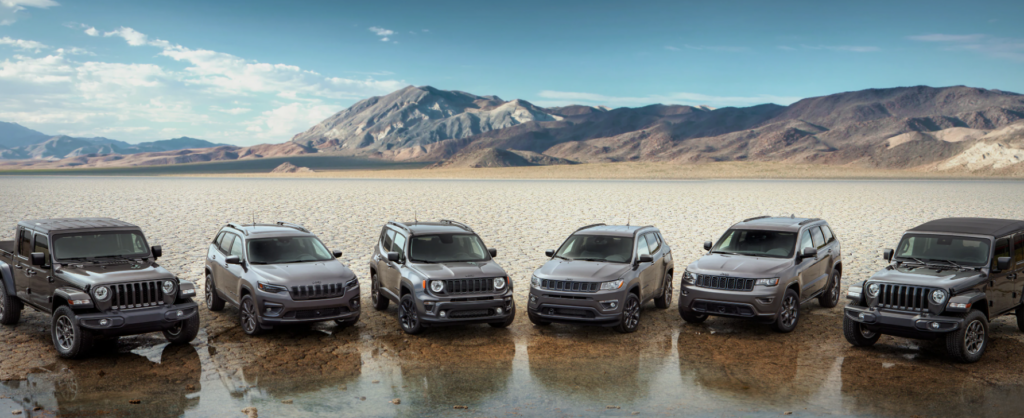
Unlike car buyers in decades past, you now have a powerful tool at your disposal: information. Knowledge is power in negotiation, and these high inventory numbers reveal a potentially golden opportunity. For the prepared and knowledgeable buyer, Jeeps will become increasingly negotiable in 2024. But as we’ve seen, don’t expect dealers to be giving out great deals. You’ll almost certainly have to work for it.
Our CarEdge Car Coaches understand this and are ready to help you save thousands on your next vehicle. They know that the first step in getting a good deal is understanding the market conditions. Our team of experts is ready to help you identify savings opportunities, no matter what new or used car you’re in the market for.
Looking for DIY car buying help? Our CarEdge Data plan is just for you. Using behind-the-scenes market insights and the data goldmine found in every CarEdge Report, you’ll be equipped with insider tools to save you big-time.
In summary, be savvy, do your research, and don’t be afraid to walk away if the deal isn’t right. It’s a great time to be a Jeep buyer—if you know what you’re doing. Dealers might be playing hardball, but you can play the game too. And now, you have the data to back you up.

Looking to save with Fourth of July car sales? Our team at CarEdge has curated a list of standout offers that could save you 10% or more on your next vehicle. These deals are currently unfolding in a changing car market, with some brands eager to sell, and others not so much.
Who has the best car deals right now? Is now the best time to buy? Exactly how much should you negotiate? We’ll answer these questions and more. Let’s dive in!
When it comes to manufacturer incentives, automakers are all over the place with their pricing and deals right now. It pays to know where the best deals are. These five automakers are in a hurry to sell cars, and you, the car buyer, can benefit.
Browse Ford listings in your area
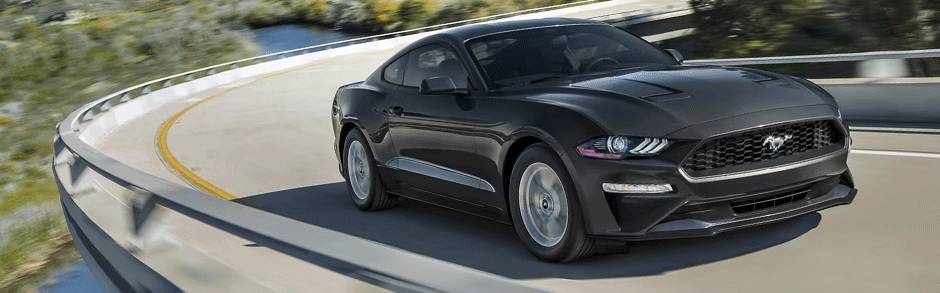
Ford’s dealer lots are filling up, and you know what that means: bring on the incentives! For the Ford Edge, they are offering 0% APR for 72 months, and for the Mustang, buyers can qualify for 0% APR for 60 months. The Bronco Sport, Expedition, Explorer, and F-150 come with a 0.9% APR for 60 months.
Additionally, the F-150 also qualifies for up to $2,000 in cash rebates. Ford is having a really hard time selling electric vehicles like the Mustang Mach-E since Tesla undercut pricing, so don’t hesitate to negotiate EV prices this summer. More on that here.
Browse Hyundai listings in your area
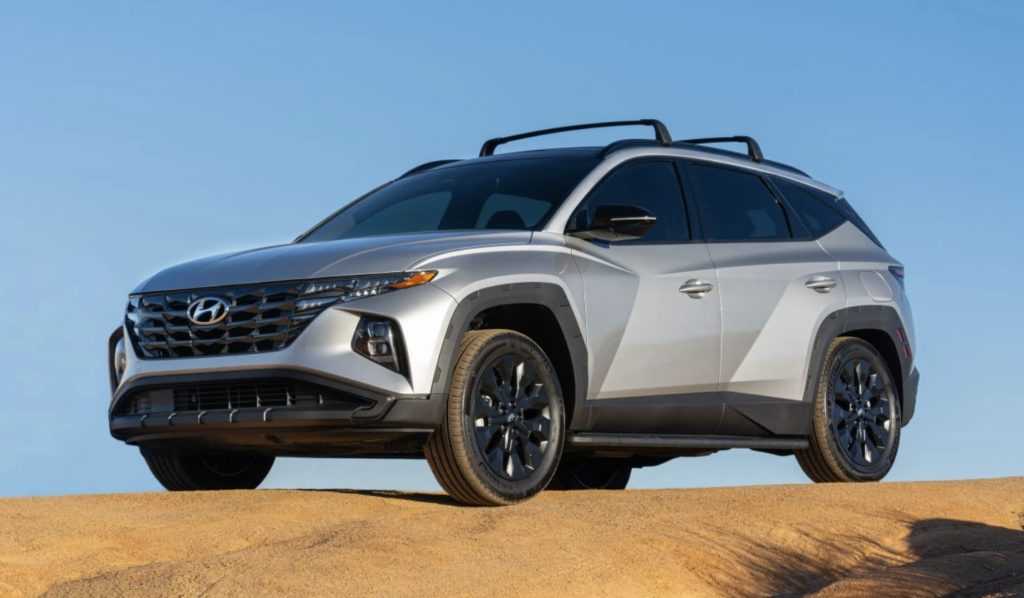
Hyundai is celebrating this Fourth of July with a range of deals across several of their models. The Santa Fe and Tucson models come with a 0.99% APR for 48 months. The all-new Ioniq 5 is available with a 1.49% APR for 60 months. Hyundai’s electric sales have slipped since the brand lost eligibility for the federal tax credit here in the States. Lastly, the Kona, Kona Electric, and Sonata all come with a 1.99% APR for 48 months.
If you’re on the hunt for Car and Driver’s 2023 EV of the Year, the all-new Hyundai IONIQ 6, you can secure 2.75% APR for 60 months (but again, there’s no federal tax credit). Don’t forget to check EV incentives in your state.
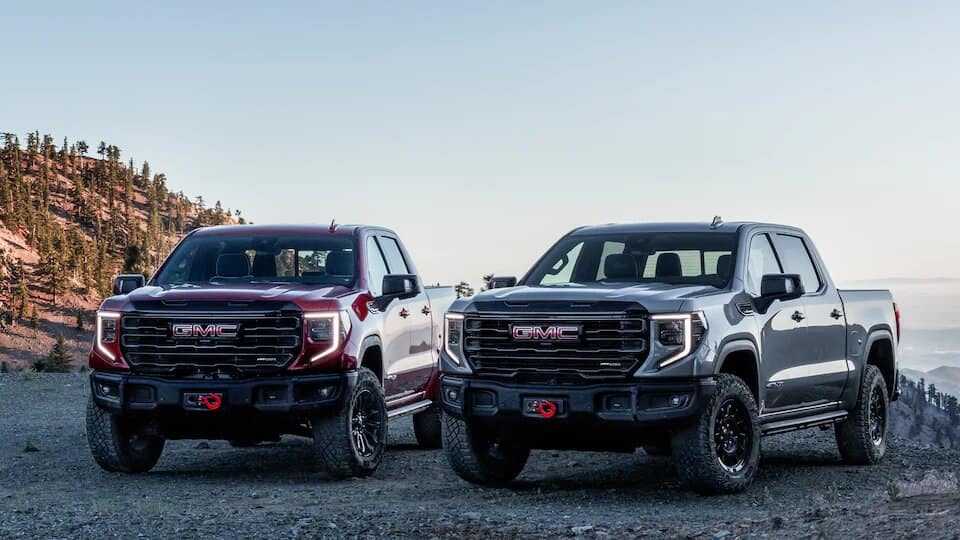
Browse GMC listings in your area
2023 GMC Sierra 1500: Buyers can enjoy a 0.9% APR plus $1,250 cash back. Plus, with high lot inventory (over a 100 day supply in most areas), dealers are often willing to sell the Sierra 1500 well below the sticker price.
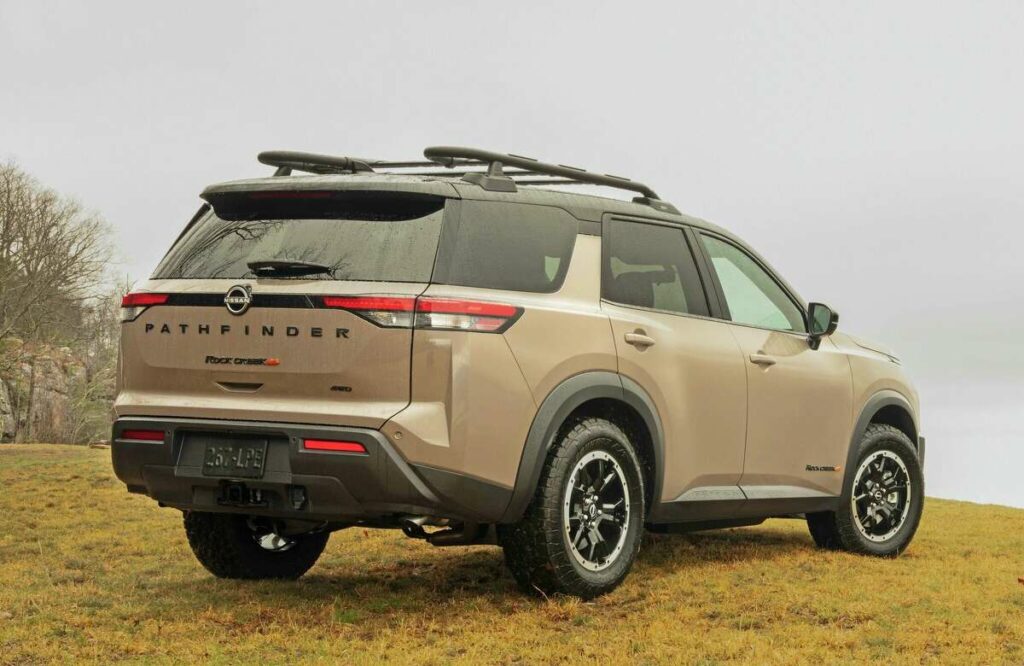
Browse Nissan listings in your area
This brand has several great financing deals across their model lineup. Nissan’s Fourth of July offers include 0% for 60 months for the Titan, 0% for 36 months for the Murano and Rogue, 1.9% for 36 months for the Armada and Rogue Sport, and 2.99% for 36 months for models including the Altima, Ariya, Frontier, Kicks, Leaf, Maxima, Pathfinder, Sentra, and Versa.
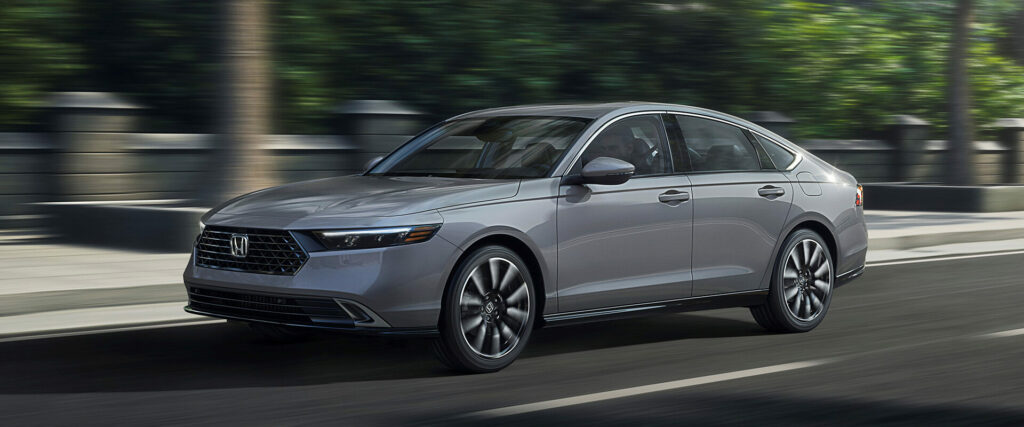
Browse Honda listings in your area
This Fourth of July offers some appealing finance offers for Honda fans. You can snag the powerful Ridgeline at 0.9% APR for 36 months. For those needing a roomy SUV, the Passport is advertised at 2.9% APR for 48 months. Looking to get into an Accord, Accord Hybrid, Civic, CR-V, CR-V Hybrid, HR-V, Odyssey, or a Pilot? These models are all available at a competitive 3.9% APR for 48 months.
Our CarEdge Car Coaches help thousands of buyers find and negotiate the best deals, from trade-ins to purchasing and everything in between. While they’re helping our members, they learn a lot about the state of the auto market.
In recent days, our Coaches have helped our members negotiate incredible deals with brands such as Jeep and Ram. Jeep Grand Cherokees, with great incentives and high inventory, are leading to considerable discounts. Similarly, Ram trucks, especially mid-trim variants of the Ram 1500, are a bargain.
Justise, one of our Car Coaches, says that Ford has some great deals right now. He helps hundreds of car buyers save thousands of dollars every week, so he’s all about the deals. Justise says the Ford Escape and Ford Edge are currently sporting up to 8% discounts in the form of manufacturer rebates, plus extra negotiability with the dealer adding up to over 10% off of MSRP.
The Ford F-150 isn’t lagging behind either, with over 10% being routinely taken off the listing price via rebates and dealer discounts.
Jerry, another one of our fantastic Car Coaches, has identified stellar deals as well. Mazda, with decent availability, is offering discounts of 5% to 8%. Honda Ridgelines are seeing significant cuts of up to $4,000 – $5,000.
Subaru is offering up to 5% discounts and even good leases on the Crosstrek and Forester. If you’re considering VW, you can expect about 7% off on the Volkswagen Atlas.

As the Fourth of July approaches, the CarEdge Team has been working tirelessly to bring you the best car deals in the market. Leveraging our industry insights and car buying tools, we’ve discovered where you could save thousands on a new car purchase this summer.
We’ve combined the best deals curated by our team of professional car buyers with the latest Market Day Supply (MDS) data for every brand in the American auto market to pinpoint the best new car deals this Independence Day.
What exactly is MDS, and why should you care? MDS is a measure of how long the current inventory of a specific car model or brand would last, assuming no additional inventory is added, and sales continue at the current rate. If MDS is high, that generally means there’s an excess of supply over demand, which gives buyers more bargaining power and the potential for bigger discounts.
Don’t expect to see MDS advertised by dealers. Car dealers most certainly would rather you NOT become familiar with how the auto market really works. We’re here to change that. See Market Day Supply and other crucial data points with every new and used car listing in your area at CarEdge Car Search.
Now, on to our findings.
Having choices is always a good thing when you’re shopping for a car. Where there’s a glut of inventory, better deals are sure to follow. Here are the brands with the most inventory right now: Ram (215 MDS), Jeep (170 MDS), Jaguar (149 MDS), Chrysler (146 MDS), and Volvo (143 MDS). Note that Stellantis, who has been struggling with sales, dominates this list. Manufacturer incentives aside, these are the brands that will be most negotiable on dealer lots.
Even better, here’s the latest inventory for every major automaker in America. Note: direct to consumer automakers like Tesla are not included, as they don’t maintain lot inventory.
| Brand | Total Brand MDS | Total New Inventory |
|---|---|---|
| Acura | 66 | 26,201 |
| Alfa Romeo | 127 | 2,814 |
| Audi | 100 | 51,251 |
| BMW | 47 | 32,090 |
| Buick | 112 | 44,964 |
| Cadillac | 46 | 16,203 |
| Chevrolet | 61 | 208,177 |
| Chrysler | 146 | 18,677 |
| Dodge | 85 | 41,620 |
| Ford | 86 | 313,689 |
| GMC | 77 | 89,172 |
| Genesis | 97 | 14,258 |
| Honda | 31 | 97,334 |
| Hyundai | 60 | 108,351 |
| Infiniti | 124 | 18,401 |
| Jaguar | 149 | 2,301 |
| Jeep | 170 | 176,107 |
| Kia | 35 | 62,345 |
| Land Rover | 61 | 7,986 |
| Lexus | 36 | 29,989 |
| Lincoln | 115 | 20152 |
| Mazda | 74 | 64677 |
| Mercedes-Benz | 81 | 59353 |
| Mini | 103 | 8457 |
| Mitsubishi | 76 | 14313 |
| Nissan | 69 | 118133 |
| Porsche | 99 | 13151 |
| Ram | 215 | 111401 |
| Subaru | 43 | 57218 |
| Toyota | 32 | 172851 |
| Volkswagen | 61 | 43565 |
| Volvo | 143 | 36094 |
Honda, Lexus, Kia, Toyota and Subaru are seeing the lowest new car inventory right now, and as a consequence, are less likely to offer attractive deals this July 4th.
On the flip side, Stellantis, GM and Ford have the most inventory. If you’re looking to save thousands off of MSRP, this is your best bet.
Looking for a great deal on something else? Our Car Coaches are always ready to assist you, no matter what car your heart is after. Here’s how we can help.
In the realm of car buying, timing can be everything, and the industry hides a secret that could save you a significant sum. On average, new car incentives are 40% higher during a specific time of the year. Surprisingly, it’s the last week of the year where dealers rush to shift the remaining stock from the previous model year, offering buyers enhanced incentives and negotiation power.
However, the total cost consideration is not as straightforward as it appears. Despite potential year-end savings, rising interest rates, the highest seen in over a decade, can potentially offset your savings, leading to increased monthly payments. Therefore, while end of year sales traditionally offer great deals, current market conditions make this Fourth of July an equally enticing time to consider buying a car.
This is especially true if you’re prepared to negotiate!

Don’t miss these 5 car buying tips for 2023 – they can save you thousands!
In the auto market, the art of negotiation can be the difference between overpaying and a fantastic deal. Particularly in the current market, when inventory is high, and brands are eager to sell, leveraging your negotiation skills could result in thousands of dollars in savings. Keep in mind that high MDS numbers mean more wiggle room for negotiations. So, whether you’re eyeing a Jeep Grand Cherokee or considering a Ford F-150, remember, a well-negotiated deal can lead to considerable savings this Fourth of July.
Ready to master the art of negotiating your next car purchase to save thousands of dollars? You came to the right place! Our team of CarEdge Car Coaches helps hundreds of car buyers just like you become empowered consumers ready to take control of your deal. When you enter the dealership equipped with CarEdge Data and the wisdom and skills shared by your CarEdge Coach, you’ll be ready to conquer car buying once and for all.
Regardless, we hope to see you at the CarEdge Community Forum, where tens of thousands of like-minded drivers share the best deals and car buying tips in the internet’s most inclusive, welcoming automotive community. We’re here to help!
Used car price trends in 2023 have been difficult to keep track of. One week prices are going up, the next week prices are falling down.
Don’t worry, CarEdge has got your back.
Whether you are in the market to buy a used car, or are thinking about selling a car you already own, we’ve crunched the numbers so that you can clearly understand what trends are happening in the used car market right now.
Buckle up, let’s explore these essential insights together.
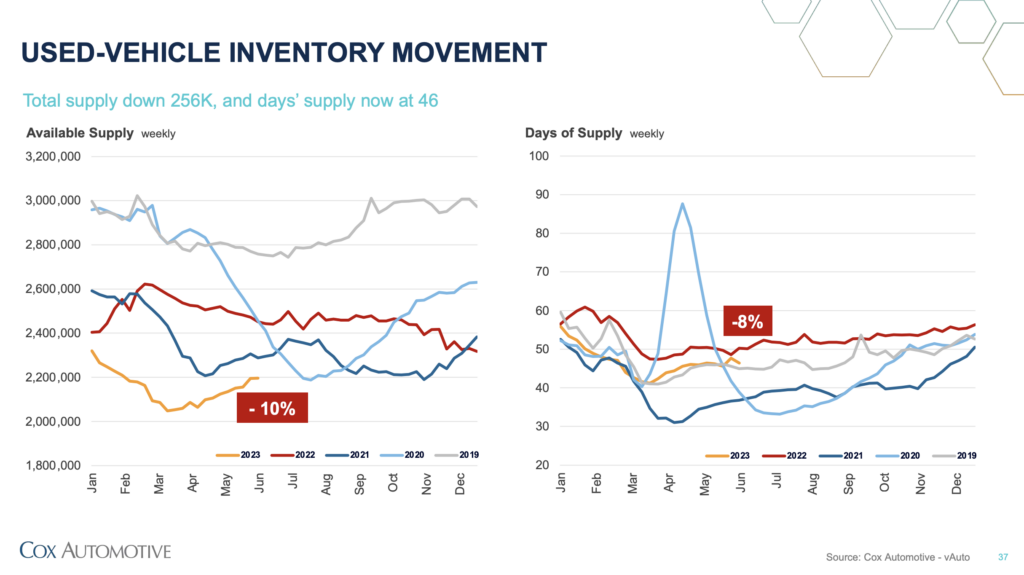
A new analysis from Cox Automotive shows that used car sales are slowing, and at the same time available used vehicle inventory is diminishing.
The multi-year chip shortage that reduced global production of new vehicles in 2021 and 2022 means there are fewer 1 and 2 year old used cars in the market today. This lack of supply is keeping used car prices elevated even as the average interest rate on a used car reaches 13.5%.
Nationwide, used car supply stands at approximately 2.2 million units, a decrease of 256,000 compared to June of the prior year. Quality used cars are still fetching a premium at dealer auctions, however they are fewer and further between.
What goes up, must come down. But when it comes to the used car market of the past 24 months that hasn’t been the case. Where do things stand in mid-2023? “I think the used car market is in flux,” notes Ray, “we are seeing a steady decline in wholesale values at the auctions that is barely reflected on the retail side.” He further explains that quality late-model used cars remain in short supply and still command high prices, stating that “those retail prices won’t be dropping much, if at all, in the near term.”
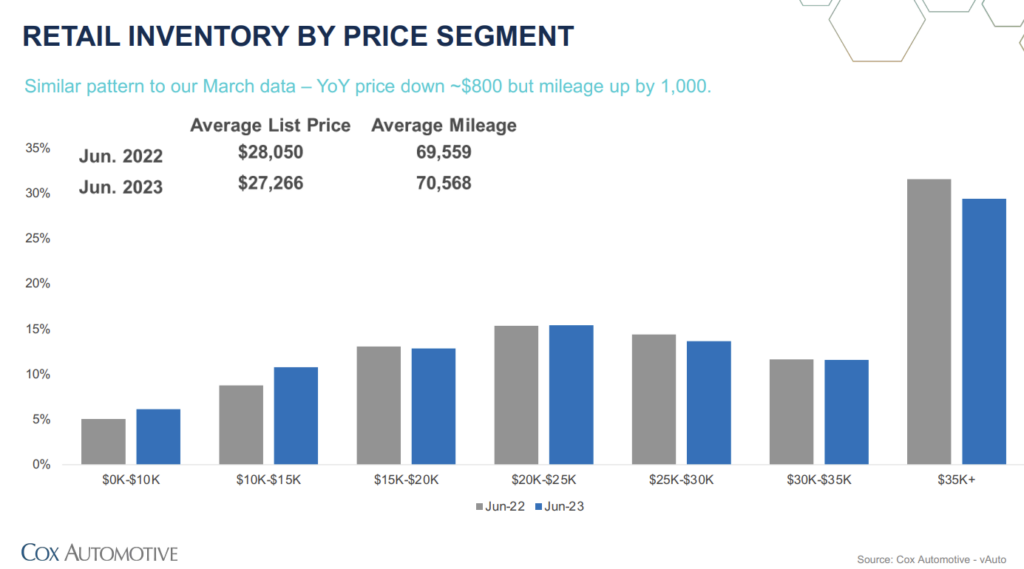
Used car price trends in 2023 look very different across the various segments of vehicles that are sold in the United States. Over the past 24 months we saw major increases in price for “cheaper” used vehicles ($10,000 or less), as consumers looked for any car that could reliably get them from point a to point b without breaking their bank.
Interestingly today, the largest dips in wholesale used car prices are being seen in lower-quality cars and “cheaper” vehicles. This could signal some relief for consumers who are looking for something reasonably priced. “The lower quality cars at the auctions are what are seeing the real declines in values, so whatever retail future price drops that there are will probably be reflected mostly in this group of vehicles,” Ray explained.
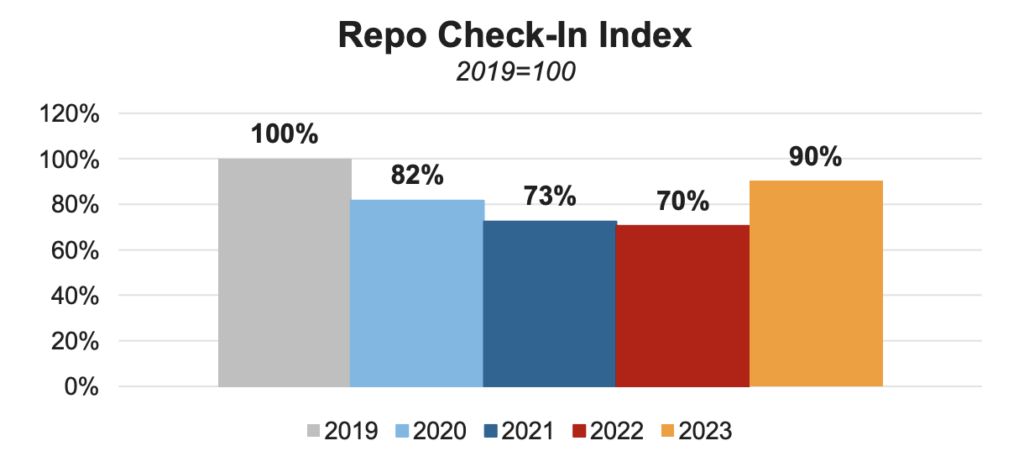
This trend coincides with auto repos increasing significantly. During the pandemic very few vehicles were repossessed. Now, as auto loan delinquency rates increase, we are seeing the number of repo vehicles showing up at dealer auctions increase as well. Typically repossessed vehicles have been treated a bit more “roughly” than other sources of used vehicle inventory (lease returns for example).
Financial institutions are tightening their lending guidelines in response to higher loan delinquency rates. This shift will significantly influence overall sales as it will be more difficult for consumers to find deals within their monthly budget or get approved for financing.However, those with the capacity to purchase the more expensive, higher-quality used cars are likely to continue doing so due to their financial capability to weather these lending challenges. “Those who can and do buy the overpriced newer used cars can and will continue to do so because A) they can put more money down to qualify for a loan and B) they have the ability to be able to afford the higher payment.”
On the flip side, those aspiring to purchase older, cheaper cars may encounter obstacles in qualifying for loans under these stringent guidelines, potentially precipitating a steeper price decline in this vehicle category. Looking forward, high retail prices for low-mileage vehicles a few years old are expected to persist due to ongoing customer demand and limited availability. “I believe that high retail prices will continue well into the future for the 1,2 and 3-year-old lower mileage vehicles because of continued high customer demand and limited availability. I believe that we will still be complaining about high retail prices for quite some time.”
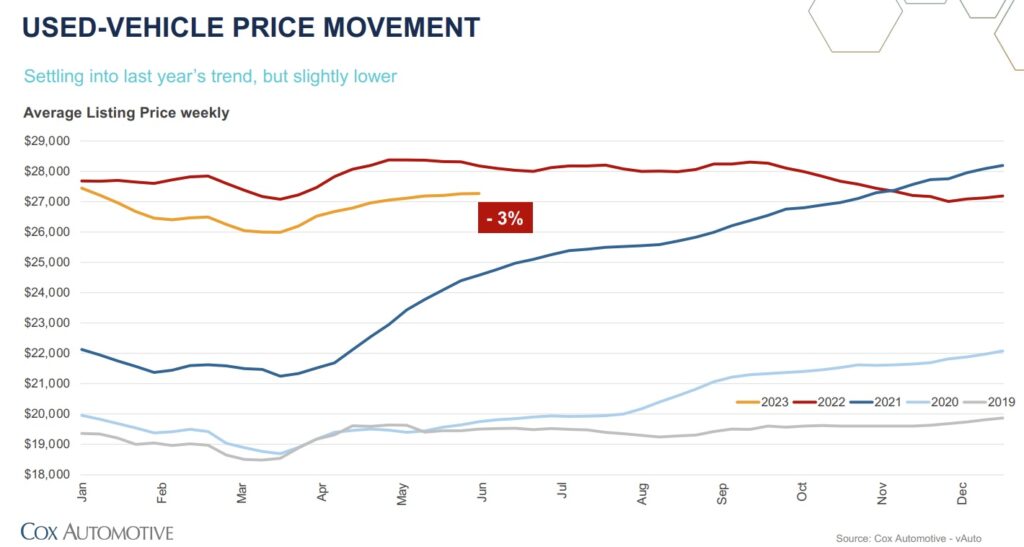
Although the average listing price for used cars in America has dipped 3% since this time last year, they are still near all-time highs. To give some perspective, the average used car price is 39% higher than in 2019 and into pre-pandemic 2020. This dip may represent a relative ‘cooling off,’ but used car prices remain far from pre-pandemic norms.
While retail prices for used cars have dipped slightly since the beginning of 2023, wholesale prices have stabilized, returning to where the year began. This shift might hint towards an equilibrium in the market after a period of intense fluctuations.
An interesting trend is the rising mileage of used car inventory. This change signifies that more drivers are holding onto their cars for longer, a response to continually increasing new car prices that outpace overall inflation. As the cost of buying new becomes less attainable, owners are maximizing the value of their existing vehicles.
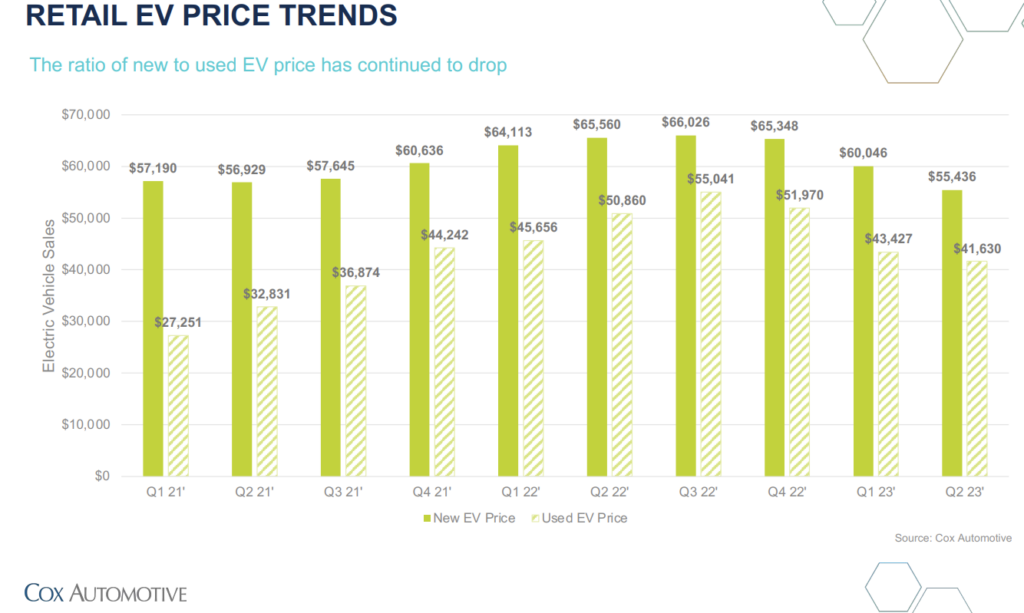
In the world of EVs, things are always changing. Over the past year, the gap between new and used EV prices has narrowed significantly. The rise in new EV inventory, up by a staggering 342% year-over-year, coupled with multiple price adjustments from Tesla, has led to a major correction in the used EV market.
In Q2 of 2023, the average price of a used EV stands at $41,630, quite a bit lower than the $50,000 average a year ago. However, considering the unavailability of federal incentives for used EVs over $25,000 and the abundance of local, state and federal incentives for new EVs, many buyers may still find buying a new EV to be their best bet. For a complete list of eligible cars, check out fueleconomy.gov.
Even though used car prices are experiencing a slight drop, it’s not enough to counteract the significant increases we’ve seen over the last few years. However, with new car inventory increasing rapidly, we’re witnessing the return of buyer incentives, leading to potentially better deals. Moreover, buying new often comes with the added benefit of a full manufacturer warranty.
Stay tuned to CarEdge for the latest insights on car buying trends as we continue to monitor these evolving market conditions. Whether you’re considering a used or new vehicle, we’re here to help you make the most informed decision. Looking for behind-the-scenes market data for new and used vehicles? CarEdge Data is the perfect plan. Ready to dig deep with your top picks? Run a CarEdge Report for the most insights you’ll find anywhere.
Our Coaches are always ready to guide you through your deal with our CarEdge Coach plan.
We’re here to help!