
CarEdge saved me over 4,500 dollars on a brand new Honda Pilot. I can't say thank you enough.
Price intelligence
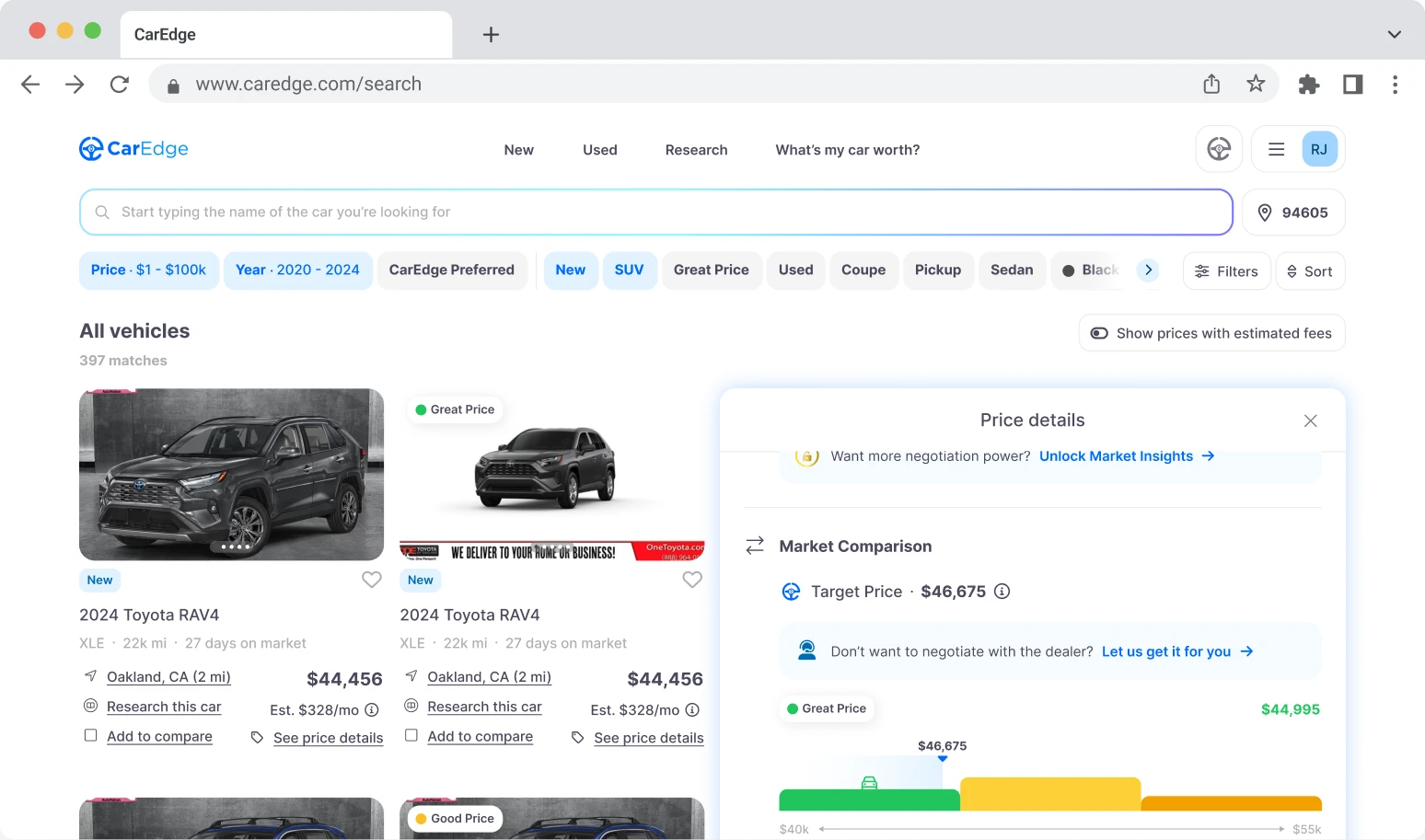
Find a wide range of vehicle listings with market insights on new and used listings near you.

What can I do with CarEdge?
 CarEdge Insights
What can I do with CarEdge?
Get access to exclusive information so you can make an informed car buying decision — all in one place.

Find a wide range of vehicle listings with market insights on new and used listings near you.
Track your vehicle’s value and cash in when the time is right to sell.

Access to our proprietary data to help you find the right car, at the right price. Find these unlocked on every listing after subscribing.

With our expert-led, tech-enabled car buying service, we will locate, negotiate, and deliver your vehicle so you can get a new car hassle free.


Help us personalize your CarEdge experience — it only takes a second.
Your answers help us personalize your CarEdge journey — we’ll follow up with tips and next steps that match your buying timeline.

For those considering taking the plunge into the world of electric vehicles in 2025, there’s exciting news. The U.S. government has now clarified how car dealers can transfer tax credits for new and used EVs directly at the point of sale, ensuring you can benefit instantly from these incentives. But there’s a catch: dealers need to be registered. It’s an encouraging that more than 7,000 dealers have signed up, but thousands of others have yet to do the necessary work. Let’s delve into what this means for you.
Car dealerships across the country now have definitive guidelines on how tax credits for EVs can be handed over to the consumer at the point of sale. Previously, there were doubts about how swiftly dealers would be reimbursed by the federal government after passing the EV tax credit on to the buyer at the point of sale. The latest guidance is good news for EV buyers, but there’s a new item for your car buying checklist.
First, a quick reminder of how we got here.

In late 2022, the Inflation Reduction Act was passed into law here in the United States. The IRA brought back the federal EV tax credit for automakers like Tesla and General Motors, but took it away from Hyundai, Kia, Audi, and many others.
Why did the EV tax credit get taken away? The new rules are complex, but in summary, an electric vehicle must be made in North America, and fall under new price caps, in order to qualify. There are also battery sourcing requirements.
See exactly which EVs qualify, and the IRS income and eligibility guidance.
For all of 2023, the EV tax credit was just that, a non-refundable tax credit. Starting January 1, 2024, the EV tax credit became redeemable at the point of sale. In other words, you can take your federal incentive as a cash discount when you buy your car at the dealership.
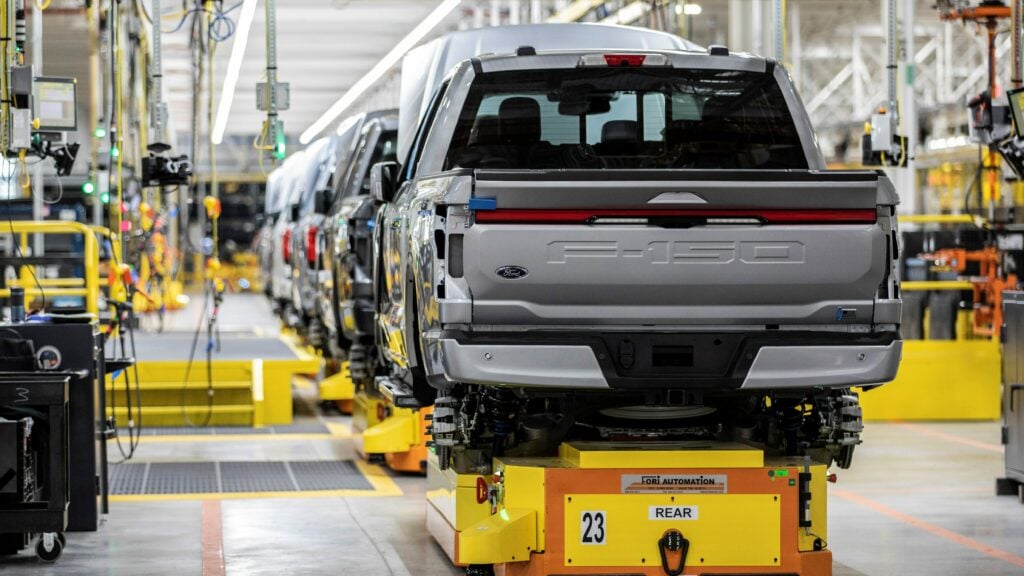
Previously, car dealers were nervous about how this EV incentive could play out. They remember the mess caused by poor planning during the Cash For Clunkers initiative years ago, and feared a repeat. That’s why dealers welcomed the news that the IRS will reimburse them within 72 hours.
For dealers, this is a game-changer. As Juan Alarcon, president of Car Pro Automotive Group, jubilantly told Automotive News, “Three days is great news.” But, he quickly adds a note of caution, “if they can pull it off.”
For these instant credits to materialize for buyers, dealers have a role to play. Your dealer must be registered on a new platform, IRS Energy Credits Online, in order for you to receive a point-of-sale EV tax credit.
This platform is the hub where dealers not only register but also electronically relay EV sales data to the IRS, receive payments for transferred credits, and file time-of-sale reports.
Once a credit is transferred at the point of sale, dealers have the option to slash the purchase price or hand cash over to the buyer. But remember, the amount has to be the full value of the available credit for the qualifying EV. Buyers will have to sign a statement under penalty of perjury that they understand the eligibility requirements for the EV tax credit, and will have to pay it back if they exceed the EV tax credit’s income limits for the year.
Finally, after a decade of asking for a point-of-sale tax credit, it’s finally here. However, if you’re buying from a car dealership, you need to check if they’ve registered with the new ‘IRS Credits Online’ system once it’s available.
If you sense any confusion or uncertainty, you can email them this article for further information. Remember, your car dealer must be registered before you can receive the EV tax credit at the point of sale.
Learn more about our car buying services. We’re simply here to help!

Purchasing a used car can be a smart financial decision, but it also comes with its own set of uncertainties and risks. Unlike new cars that come straight from the factory, a used vehicle has a history. To ensure you’re making an informed decision and getting the best value for your money, it’s essential to ask the seller some important questions. We’ve compiled a list of crucial questions you should ask when buying a used car. These questions will not only provide insights into the car’s history and condition but will also help you negotiate a fair price.
Our team of Car Coaches shared these critical questions for used car buyers. We especially want to thank Jerry from the CarEdge team for his insights!
We’ve listed the questions in order of importance. More important questions are listed first for each section. Of course, it’s best if you can get answers to all of these. No matter what, get a pre-purchase inspection!
It always pays to be an informed shopper. Here are some reader favorites that you can use to save more and stress less.
Used Car Price Trends (Updated Weekly)
Free Guides to Used Car Buying
Join the CarEdge Community to connect with likeminded bargain hunters. You can also see crowdsourced car deal reviews, and contribute your own!
Purchasing a used car requires thorough research and due diligence. By asking these questions, you’re taking the right steps toward ensuring that your next vehicle is a reliable ride, and not a financial and mechanical burden.
Remember, transparency is key. If a seller hesitates or refuses to answer any of these questions, consider it a red flag.
Looking for help with buying a car? The CarEdge Team is ready to assist. From free resources to 1:1 car buying help, we’ve got you covered.
Check out these CarEdge success stories to see how much drivers are saving today.

The Chevrolet inventory landscape is undergoing a shift. Currently, there’s a varied supply of new Chevrolet vehicles across the U.S., but some models, like the Silverado 1500, Blazer, and Equinox, offer opportunities for negotiation and deals. But where does Chevrolet stand compared to its peers, and more critically, which Chevy models are most ripe for negotiation? As we steer through the current state of the market, we’ll take a look at where Chevrolet fits within the broader industry, and spotlight models that present the best opportunities for a deal.
Here’s how Chevrolet’s competition compares this month. It’s clear that new car inventory is rising across the board.
| Make | Inventory % Increase (3 Months) | Market Day Supply - December 2023 | Market Day Supply - September 2023 |
|---|---|---|---|
| Honda | +68% | 47 | 28 |
| Kia | +89% | 53 | 28 |
| Toyota | +37% | 41 | 30 |
| Hyundai | +50% | 75 | 50 |
| Chevrolet | +63% | 88 | 54 |
| Nissan | +58% | 112 | 71 |
| Volkswagen | +52% | 96 | 63 |
| Ford | +43% | 127 | 89 |
| Jeep | +31% | 191 | 146 |
Chevrolet is in the middle of the pack when it comes to inventory. Ford, Volkswagen, Nissan, and Stellantis’ Jeep have an oversupply.
American automakers have high inventory right now. Is that because they’re hot sellers? Not exactly. In recent years, Asian automakers like Toyota, Honda, Hyundai, Kia, and Mazda have all taken larger chunks of market share in the United States. These brands rely less on large SUVs and trucks, and more on crossover SUVs that prove popular.
How did the likes of Hyundai, Kia, and Mazda end up so competitive? In comparison to the imported cars of year’s past, today’s models offer improved reliability, better looks, and in most cases, improved reliability. These improvements from Chevy’s competition have given car buyers more reasons to cross shop.
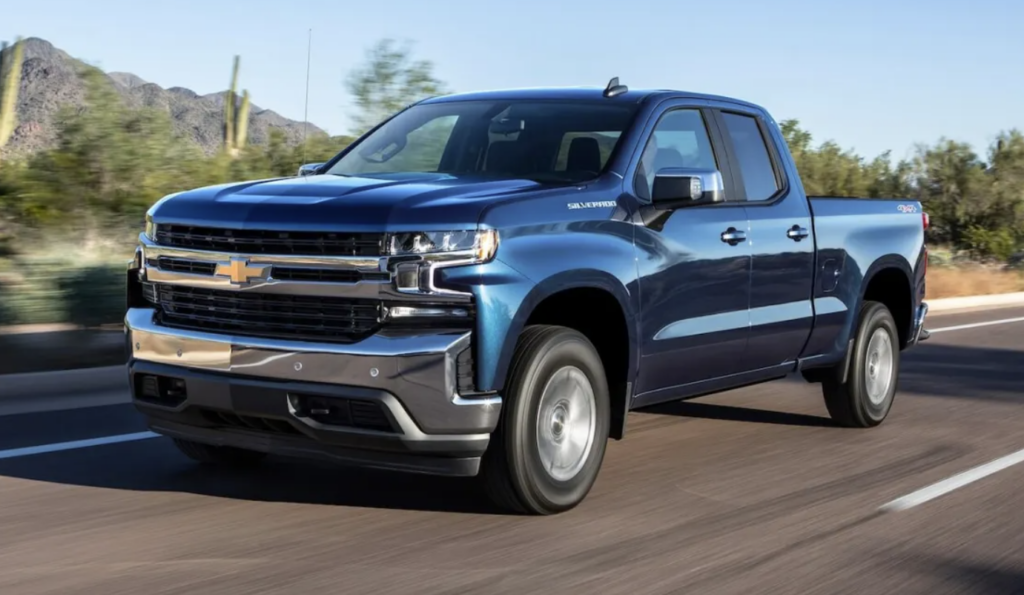
For buyers aiming to save money on a new Chevrolet, it’s smart to harness the power of car market data. Let’s take a look at today’s inventory numbers across the Chevrolet model lineup.
Using the tools available through CarEdge Data, we analyzed Chevrolet inventory for every model on sale in America. These numbers reflect nationwide supply. You can check out local Chevrolet inventory using CarEdge Data.
| Make | Model | Starting MSRP | Market Day Supply | Total For Sale | Negotiability |
|---|---|---|---|---|---|
| Chevrolet | Malibu | $25,000 | 47 | 4,615 | Average |
| Chevrolet | Bolt EV | $26,500 | 53 | 1,204 | Average |
| Chevrolet | Traverse | $34,520 | 54 | 14,893 | Average |
| Chevrolet | Bolt EUV | $27,800 | 55 | 4,218 | Average |
| Chevrolet | Camaro | $30,900 | 76 | 4,744 | Average |
| Chevrolet | Equinox | $26,600 | 85 | 37,708 | High |
| Chevrolet | Blazer | $35,100 | 97 | 12,984 | High |
| Chevrolet | Silverado 1500 | $36,300 | 107 | 77,118 | High |
The higher the inventory, the more negotiable a new car will be. Remember, these figures are for nationwide inventory. For local Chevrolet inventory numbers, try CarEdge Data.
The most negotiable Chevrolet models right now are the Silverado 1500, Blazer, and Equinox. With 107 days of supply, the Silverado 1500 is ripe for negotiating. Trucks across the market are slow-selling as buyers step away from expensive trucks during this extended period of high interest rates. Ram trucks have the highest inventory and most negotiability, with Ford faring slightly better.
For shoppers looking for a deal on an affordable SUV, the Chevrolet Equinox and Blazer are two great options for well under $40,000. In today’s market with average selling prices north of $48,000, that’s not a bad deal. Just be sure to avoid these dealer fees.
The Bolt EV and EUV have average inventory and negotiability. Surprisingly, these two electric models are in higher demand than most electric competitors, such as the Ford Mustang Mach-E and Hyundai IONIQ 5. It looks like the market for $50,000+ EVs has dried up, but there remains demand for more affordable electric vehicles.
Ready to negotiate a great deal on a Chevy? We can help you save thousands. From 1:1 help to free guides, we’ve got resources for every buyer. Our goal is to simplify car buying while saving you money.

New car models with less than 40 days of supply are generally less negotiable. There’s never any reason to justify paying dealer markups, but scoring a deal under MSRP is always tougher for these models.
These are the Chevrolet models with the lowest supply this month:
| Make | Model | Starting MSRP | Market Day Supply | Total For Sale | Negotiability |
|---|---|---|---|---|---|
| Chevrolet | Colorado | $29,200 | 22 | 4,442 | Low |
| Chevrolet | Corvette | $66,300 | 30 | 2,017 | Low |
| Chevrolet | Trax | $20,400 | 32 | 12,939 | Low |
| Chevrolet | Tahoe | $54,200 | 33 | 7,724 | Low |
| Chevrolet | Suburban | $57,200 | 36 | 3,107 | Low |
| Chevrolet | Trailblazer | $23,100 | 39 | 10,775 | Low |
Chevrolet’s most affordable truck, the Colorado, has the least supply right now. The Corvette, always a low-volume model, is typically on this list. The most notable model is the Chevrolet Trax. The Trax just received a major facelift, and is proving to be tremendously popular among budget car shoppers.
Why don’t automakers just make more affordable cars? Sadly, it’s all about profit margins. Manufacturers like General Motors make a lot more money per vehicle selling high-end trucks and SUVs than $30,000 models. To make matters worse, the car market volatility during and after the pandemic showed them that buyers will pay more for cars.
What can we do about it? For starters, never pay junk fees, forced add-ons, or additional dealer markups. Need assistance negotiating your car deal? Let us help!

While Chevrolet’s inventory varies across models, there’s a clear indication that deals are out there, especially for those who know where to look. Regardless of the popularity or scarcity of a particular model, buyers should never settle for unnecessary dealer markups, inflated add-ons, or costly warranties.
Should car buyers wait for 2024 to score a better deal? Don’t expect prices to drop substantially next year. If you’re thinking about waiting to buy, check out our 2024 car buying forecast.
Ready to master the art of negotiation? Equip yourself with the CarEdge advantage! With these invaluable resources, you can transform your car buying journey, gaining insights into market fluctuations, crafting a solid negotiation strategy, and clinching the best Chevrolet deal in town. Our mission is to guide you every step of the way.
Learn more about CarEdge Coach, CarEdge Data, and a member favorite, CarEdge Consults. We’re here to help!
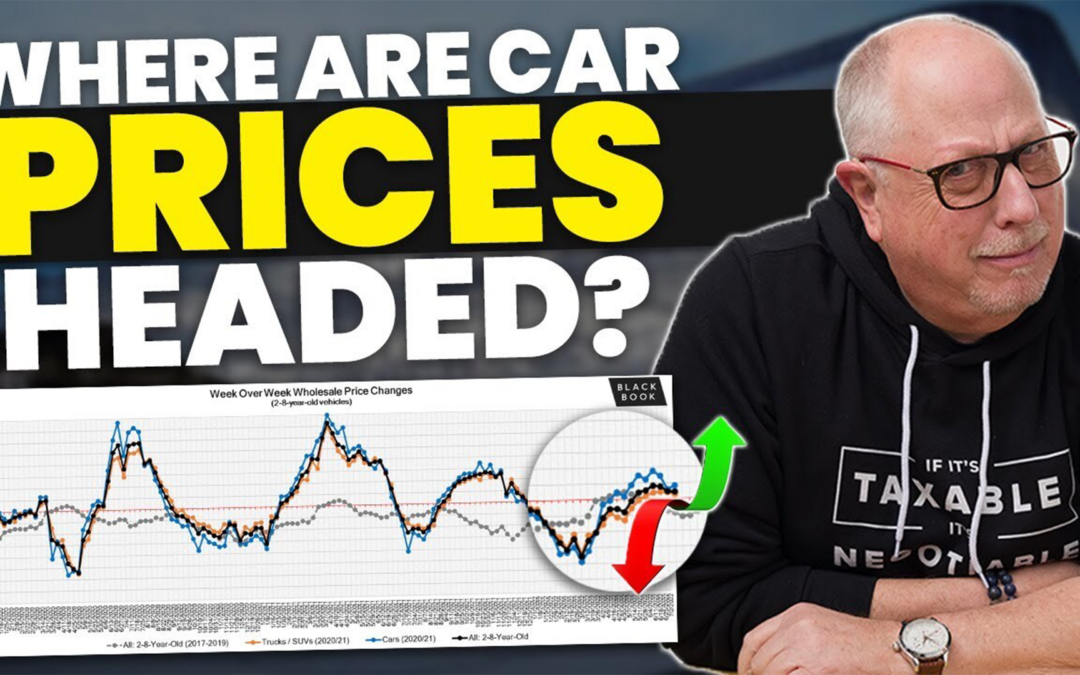
In 2025, the new car prices remain within a few percent of 2022’s all-time record highs. This stability comes after a year of slow but steady price drops, followed by a jump in prices in late 2024. As new car price trends prove tough to forecast, keeping an eye on the market’s subtle movements becomes crucial for potential buyers and sellers alike.
Let’s delve deeper into the current state of the new car market.
Which segments of new cars are experiencing price drops, and which are seeing a rise? Is now a good time to buy a new car, or is it a good time to sell? We will address these pressing questions and more.
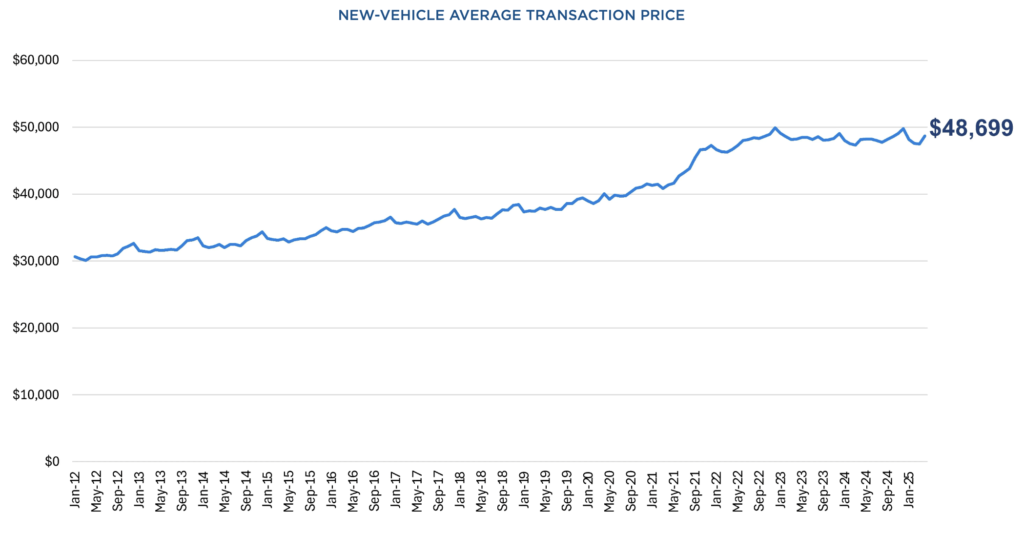
According to the most recent data from Cox Automotive, the average transaction price for new cars is $48,699. That’s down slightly from the peak of $49,929 in December 2022. New car prices increased in April 2025, but were 1.3% higher than one year prior. The month-over-month price increase of 2.5% was sharp was the largest since April of 2020. Prices had previously fallen as low as $47,244 earlier in 2024, before bouncing back. Here’s a look at new car prices over the past year.
| Month-Year | Average New Car Transaction Price |
|---|---|
| 1/1/2024 | $47,401 |
| 2/1/2024 | $47,244 |
| 3/1/2024 | $47,218 |
| 4/1/2024 | $48,368 |
| 5/1/2024 | $48,389 |
| 6/1/2024 | $48,424 |
| 7/1/2024 | $48,166 |
| 8/1/2024 | $47,870 |
| 9/1/2024 | $48,397 |
| 10/1/2024 | $48,623 |
| 11/1/2024 | $48,724 |
| 12/1/2024 | $49,740 |
| 1/1/2025 | $48,641 |
| 2/2025 | $47,577 |
| 3/2025 | $47,462 |
| 4/2025 | $48,699 |
Some new car segments saw notable price declines last month, while others are holding firm. New car incentives have fallen sharply since year-end sales concluded. The luxury vehicle segment has experienced notable price reductions, with Tesla, BMW, Audi, Cadillac, and Lexus seeing lower prices last month. Tesla is now a top-10 luxury brand in America, not just the leader of electric vehicle sales. We’ll see how the first month of 2025 turns out for new car price trends.
If you’re looking for the BEST deal on a new or used car, remember this: knowledge is power when it comes to negotiating car prices. When you have an understanding of local inventory dynamics, car price trends, incentives, and the negotiable aspects of a car deal, you’re better prepared to drive away proud of your deal.
Free Car Buying Help Is Here!

Ready to outsmart the dealerships? Download your 100% free car buying cheat sheets today. From negotiating a deal to leasing a car the smart way, it’s all available for instant download. Get your cheat sheets today!

What do you think 2024 will bring? Hopefully next year will be less exciting than the past few. Already in this decade, we’ve seen a pandemic cause a freefall in car sales, followed by a severe supply shortage that sent prices through the roof, only for car prices to stabilize at a new, much higher normal. Will car prices drop in 2024? Is there relief in sight for buyers facing high interest rates and slim supply? CarEdge co-founder Ray Shefska, with his four decades of auto industry insight, shares his car market predictions for 2024. Let’s explore.
As much as we’d love to be wrong, it’s very likely that both new and used car prices will remain high in 2024. CarEdge co-founder Ray Shefska recently shared his thoughts on the most likely scenarios in the short-term.
All things considered, Ray says that continued high prices are all but guaranteed. When automakers see an opportunity for ‘price adjustments’, they’re not going to pass it up.
“I don’t foresee better pricing soon with various factors at play. For instance, the ongoing UAW strike is pushing labor costs up, despite them comprising only five percent of total vehicle production costs. This increase will inevitably lead manufacturers to adjust their MSRPs, providing a convenient excuse for doing so.”
Multiple factors are converging that lend to this thinking.
For new cars, it’s fair to blame high prices on the manufacturers. Despite consumer demands for more affordable options, OEMs keep producing over-priced SUVs and trucks. Gone are the $30,000 base models.
The continuous production of high-margin vehicles by manufacturers, which are typically priced out of reach for the average consumer, is a losing strategy in our eyes. Nevertheless, with $100,000 trucks and glamorous SUVs coming out of American and foreign automakers alike, this is the road we’re headed down.
“I’m skeptical about the auto industry having a stellar year in 2024, considering that a significant percentage of consumers feel they can’t afford new cars. Manufacturers are increasingly relying on fewer buyers to pay higher prices in order to turn a profit. The average buyer does not benefit in this situation,” said Ray.
This is all in addition to the costly EVs that are filling up dealer lots.
Here’s where it gets interesting. The continued production of high-margin vehicles is primarily motivated by the manufacturers’ need to fund their ventures and investments into the electric vehicle (EV) market. Unlike Tesla, the likes of GM, Ford and Stellantis are still figuring out how to make mainstream EVs that can turn a profit.
This isn’t merely hearsay. In Ford’s earnings report, executives noted the continued profitability of their internal combustion-powered lineup, but also the financial woes of their EV division. Ford expects to lose $4.5 billion on EVs by 2023’s end, despite overall profits rising. The ‘Blue Oval’ has $100,000 trucks to thank for that.
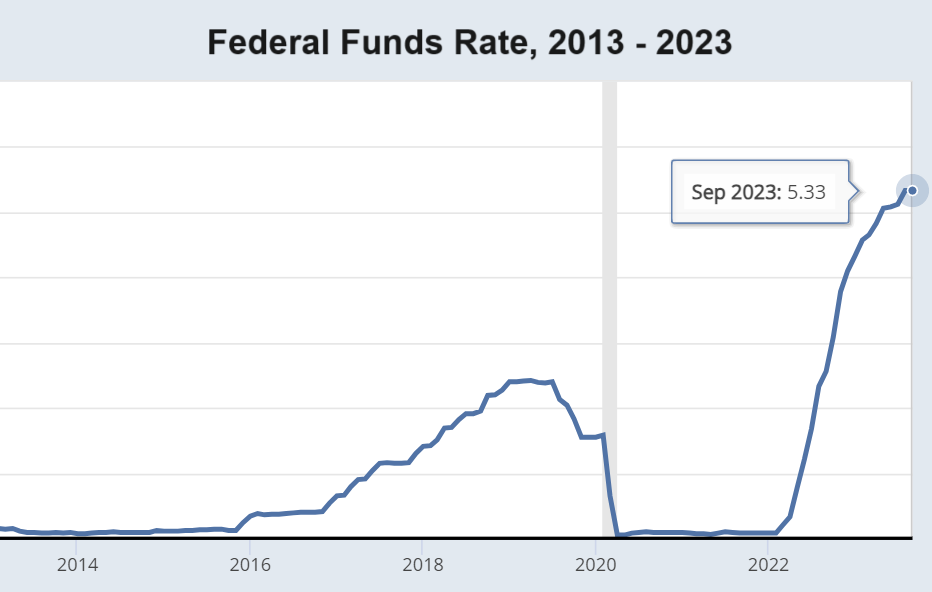
Cash will remain king in 2024. As of October 2023, the average new car loan APR is north of 9%. Used car loans are even more expensive, with the average APR at 14%. See the latest monthly payment statistics here.
The Federal Reserve has stated that rates will remain near current levels through at least the first half of 2024. With that said, auto loan interest rates are forecasted to remain high in 2024.
The tandem of soaring prices and stiff interest rates creates a scenario where affordability takes a significant hit. It’s the sad truth that some buyers will be priced out of the market as a result.
The lowest auto loan rates will continue to be found with manufacturer incentives. New car inventory has been steadily rising, leading to low APR offers from some automakers. Zero percent financing is still possible if you shop for deals, and APRs under 3% are quite common.
See this month’s manufacturer incentives, featuring the lowest APR offers.
As we gaze into the automotive crystal ball for the forthcoming year, a rather annoying trend appears to hold its ground: the significant shortage in the used car market is on track to persist in 2024.
When it comes to used car prices, supply and demand drive the market. In 2023 and 2024, it’s the reduced supply of used cars that ensures prices will remain elevated. Used car prices rose 36% in 2021, only to fall 7% the year after. As 2023 comes to a close, it looks like used car prices will end the year about where they began 12 months ago.
The roots of the used car shortage can be traced back to the supply chain problems of 2021-2022. The production of new cars slowed, and sales dropped like a rock. Fewer cars sold in 2021-2022 resulted in fewer trade-ins and subsequently, a tightened supply of used vehicles. With approximately 15 million new cars that were initially scheduled for production globally never seeing the light of day, the ripple effect has led to a lasting shortage of used cars.
This is not a short-term hiccup. Industry insiders like Ray predict that the scarcity of pre-owned vehicles is likely to extend through this decade.
Ray emphasized the connection between today’s new car market and the shortage of used cars that he expects to see continue in 2024. “Manufacturers aren’t motivated to produce vehicles under $30,000 since they need high profit margins to support their EV initiatives. Production will continue to focus on high-margin vehicles, not affordable models and trims. The problem is that these expensive new cars are accessible only to a small fraction of buyers. Ultimately, more buyers will turn to the used car market for prices they can afford, no matter how inflated used car values may be.”
Consumers in the market for used cars should understand that higher prices and limited options will be around for a while. See the latest used car price date, courtesy of Black Book:
Used Car Price Trends for 2023 (Updated Weekly)
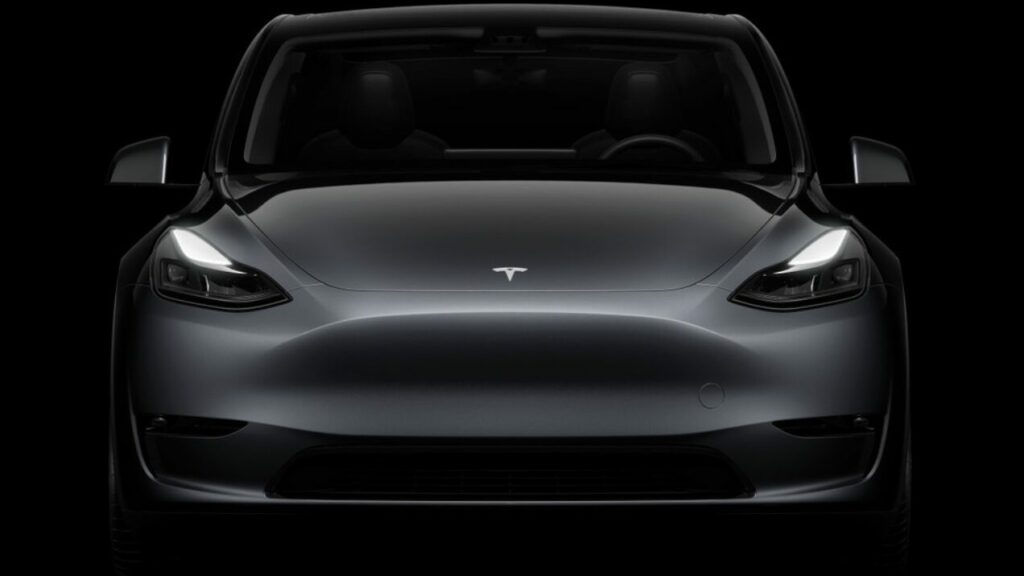
Legacy automakers have invested over half a trillion dollars in electrifying their lineups. The sad reality is that not a single one of them is anywhere close to Tesla in EV market share.
As of last check, 60% of electric vehicles sold in America were Tesla models.
In 2024, we expect Tesla to continue to dominate. Even if Tesla EV market share drops to 40-50%, that’s still domination by anyone’s standards. Tesla invested so heavily in mastering low-cost production that it will continue to have an advantage over Ford, GM, and the rest of the gang.
Tesla’s EV dominance increasingly puts legacy manufacturers such as Ford, General Motors, and Stellantis in a precarious position. This will become much more evident in 2024. How so? Some BIG name, long-awaited EVs will arrive from legacy brands. Here are just a few…
If the above-mentioned electric models fail to attract large numbers of buyers, it will become crystal clear that legacy automakers have a BIG EV problem on their hands.
Traditional automakers are bracing for a turbulent period ahead, grappling with the dual headwinds of rising manufacturing costs and their struggling EV divisions. By the end of 2024, we’ll have learned a lot about the long-term prospects for legacy EVs. It’s possible that Tesla, once the laughing stock of Detroit executives, will indeed have the last laugh.

The automotive industry in 2024 faces a confluence of challenges, some of which are yet unknown. Aside from the variables discussed here, there are other wildcard scenarios that have the potential to disrupt market dynamics.
The UAW strike is over, but the negotiated agreement may force new car prices higher as OEMs spend more on manufacturing costs. As CarEdge’s Ray Shefska has noted, labor costs are a small fraction of total manufacturing expenses. However, that won’t keep automakers from using employee raises as an excuse for MSRP hikes.
The Detroit ‘Big Three’, General Motors, Ford, and Stellantis, are already at a disadvantage in the growing EV market. Rising labor costs and shaky supply chains threaten to wipe away what progress they have made.
An even more important unknown is the health of the global economy in 2024. Most experts agree that there’s only a slight possibility of an economic recession, but it’s a non-zero chance.
Here’s how economic recession impacts car prices.
This economic uncertainty is further exacerbated by conflicts overseas, and a looming election year here at home. Globally, there are dozens of situations that could, in theory, boil over into the automotive market. For starters, there’s the volatile situation in the Middle East, the simmering tensions in Ukraine, and the precarious state of affairs surrounding Taiwan. Each of these geopolitical hotspots has the potential to inject uncertainty into the global markets, creating ripple effects that could inevitably impact the automotive industry.
Moreover, with 2024 being an election year in the United States, the industry is bracing for potential policy shifts and market reactions that often accompany electoral cycles, adding yet another layer of unpredictability to an already uncertain landscape. These combined factors make the outlook for the auto industry in 2024 particularly challenging to forecast.
Ready to outsmart the dealerships? Download your 100% free car buying cheat sheets today. From negotiating a deal to leasing a car the smart way, it’s all available for instant download. Get your cheat sheets today!